Enhancing Learning Beyond Correction: AI-Assisted Japanese Business Writing and Sociocultural Awareness in Online Higher Education


Abstract
1. Introduction
- (1)
- RQ1: How does the use of ChatGPT in classroom instruction influence learners’ overall satisfaction and learning experience?
- (2)
- RQ2: How does ChatGPT-based feedback affect Japanese business document-writing skills?
- (3)
- RQ3: How does feedback using ChatGPT affect learners’ understanding of Japanese business culture?
2. Literature Review
2.1. Automated Feedback in Language Education
2.2. Learner Satisfaction in Online Learning
2.3. Business Japanese Education from a Cultural Education Perspective
3. Methods
3.1. Research Design
3.2. Participants
3.3. Ethical Considerations
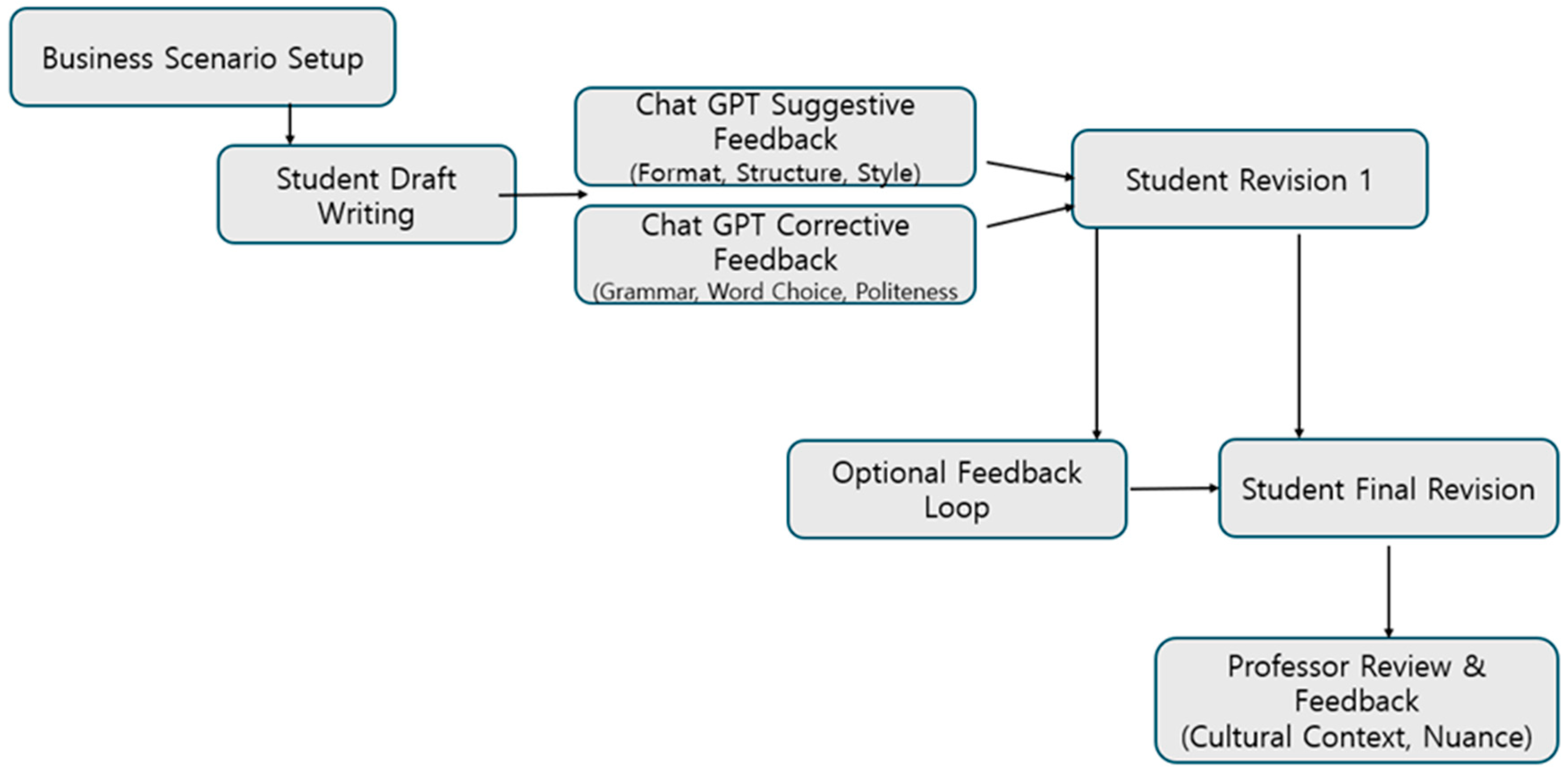
3.4. Classroom Activities Using ChatGPT
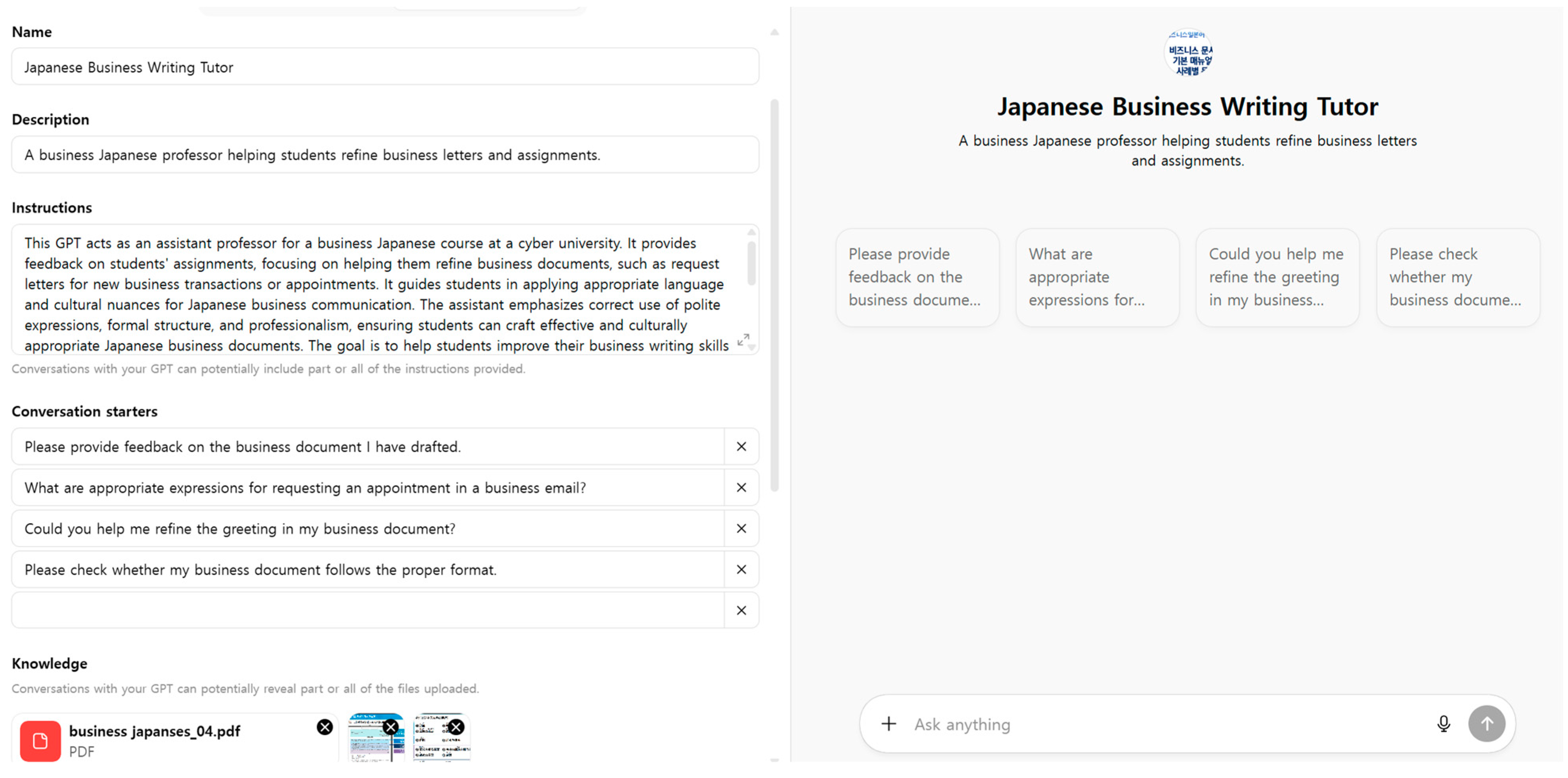
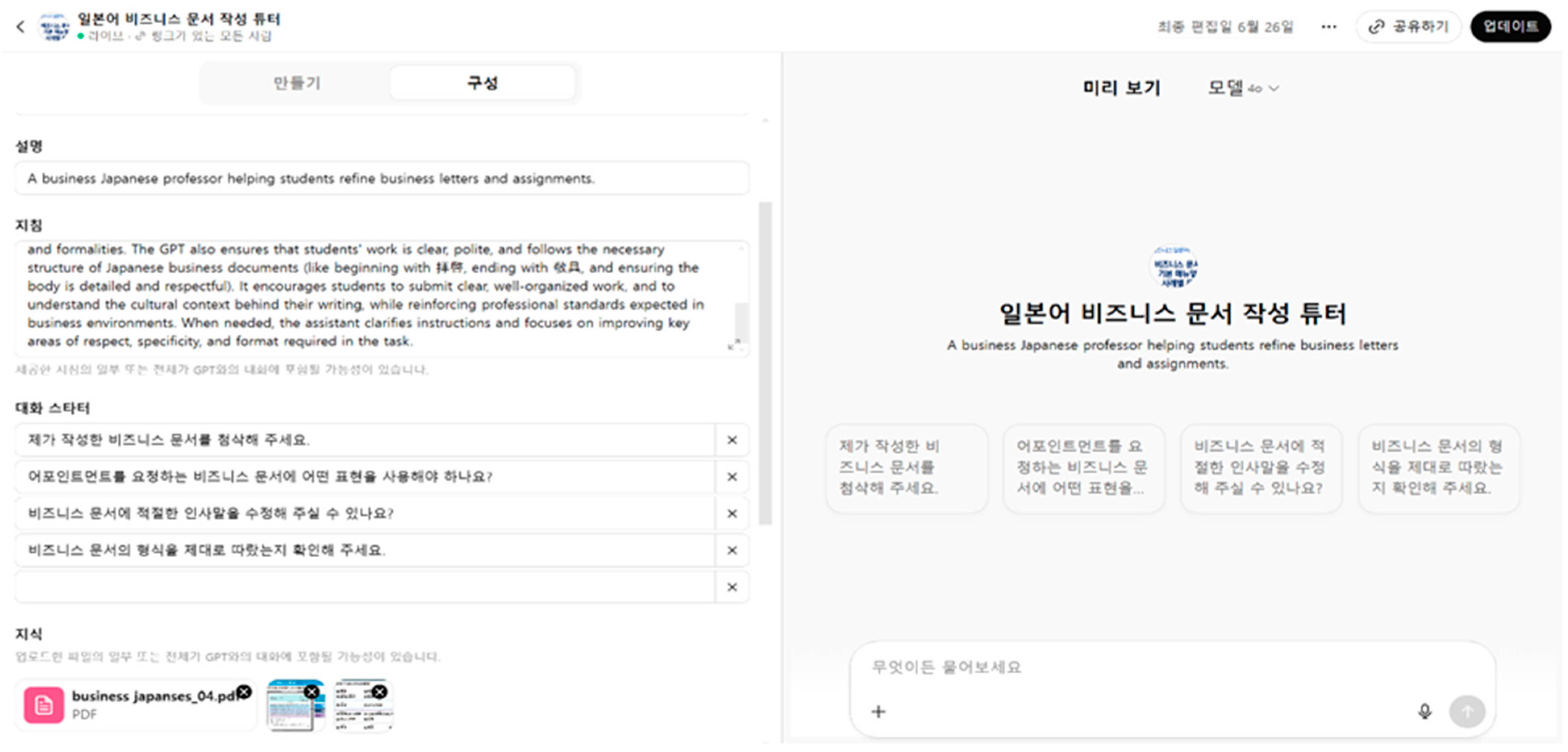
3.5. Custom-Designed Chatbot and Automated Feedback Through ChatGPT
3.6. Instruments
3.6.1. Online Survey
3.6.2. In-Depth Interview
4. Findings
4.1. RQ1: How Does the Use of ChatGPT in Classroom Instruction Influence Learners’ Overall Satisfaction and Learning Experience?
4.1.1. Establishing Learning Plans
“It was really helpful when I wanted to figure out where my Japanese proficiency stood or when I tried to draft a learning plan. Since I’m working and have other obligations, I sometimes have gaps in my schedule, so I asked for advice on how to study during those times. I basically used it for schedule management.”(P2)
4.1.2. Learning Records
“What I liked was that there was a record of what I had previously studied, so I could continue from there.”(P1)
4.1.3. Reducing Learning Time
“It usually takes time to check the contents of multiple websites one by one, but with AI, it was possible to collect materials more smoothly.”(P11)
“Unlike a translator which simply provides an answer, it explains the parts that need to be corrected so that I can understand the reason, and it reduces the time spent searching, which was satisfying.”(P2)
4.1.4. Supplementing Existing Learning Methods with AI
“When I learned in class, I thought it was just my head. But it was easy to understand when I wrote an email myself and asked ChatGPT to fix it. When I actually used the expressions that would have passed if I had just listened to the lecture, I remembered them.”(P4)
“Looking at only the dictionary was confusing. But ChatGPT corrected what I wrote right away, which was helpful. It felt like confirming what I had learned in class.”(P2)
4.1.5. Expressing Concerns About Learning Dependency
“In the past, I used to spend time searching and skimming through materials to get a general understanding. But now, I tend to just check the answers or results provided by AI.”(P2)
“Since I can learn faster now, I feel like I put in less effort, and that might be a drawback. Because I put in less effort, the knowledge doesn’t stay with me for long.”(P3)
4.1.6. Differences in Learner’s Backgrounds and Perceptions of AI Use
“After writing a business email with ChatGPT, I wasn’t sure whether the expressions were actually used, so I often asked people around me who knew Japanese. In the end, I only felt reassured after checking with someone with business experience; otherwise, I had to spend time searching a lot by myself.”(P3)
“I’m more curious about how Japanese people would actually perceive my expressions than about grammatical accuracy. There may be a difference between Japanese and actual usage learned in textbooks, and I feel anxious if I don’t check the emotional reaction of the native speaker.”(P7)
“ChatGPT is meaningful for supplementing formal document expressions. I use it alongside online resources when needed to review drafts, and I judge whether to revise or accept outputs based on my own knowledge and experience.”(P5)
4.2. RQ2: How Does ChatGPT-Based Feedback Affect Japanese Business Document Writing Skills?
4.2.1. Immediate Personalized Feedback
“There are times when you can’t get feedback right away. Sometimes, I study late at night, and I had to get it done right then … In that respect, being able to receive feedback immediately was convenient.”(P2)
4.2.2. Comparison of AI and Instructor Feedback
“Every time I made a request, I received very detailed and quick feedback. As a learner, I couldn’t confirm whether it was correct or not, but once the instructor checked it, I was able to trust the chatbot’s feedback.”(P1)
“AI tends to give standardized answers depending on the prompt settings. But the instructor’s feedback reflected the flow of my own study.”(P8)
4.2.3. Learning Honorific Expressions and Politeness Strategies
“I came to know a lot about what is called humble or honorific expressions, which I didn’t know before, and I thought it would be useful to use them when necessary.”(P6)
“When I want to have a business conversation, if I speak in honorifics to the other person, they also respond in business honorifics, so in those cases I use it.”(P8)
“It was very good that it told me about idiomatic expressions and why they are used.”(P2)
4.2.4. Reinforcement of Learning Content and Self-Reflection
“When I saw GPT correcting what I had written, I thought, ‘Ah, that’s right. This is how it should be!’ and it became clearer to me … If I had just read it in a book, I probably would have overlooked it. But because ChatGPT happened to correct that sentence, I was able to clearly recognize it and felt that I could use it very effectively.”(P9)
4.3. RQ3: How Does Feedback from ChatGPT Affect Learners’ Understanding of Japanese Business Culture?
4.3.1. Learning Business Situation-Specific Communication Techniques
“When I make a phone call, I find it really difficult to know what I should say first.”(P2)
“It [the appropriate way of communicating in business situations] may depend on the language being learned. But depending on whom you are dealing with—such as the person’s gender or age—it is better to receive information and engage in practice tailored to these specific contexts.”(P5)
4.3.2. Learning Expressions by Understanding Regional Culture
“When a Japanese person says that people in Tokyo don’t do it this way but people in Kansai do, I can’t really know that since I’m not a local. Looking it up in a dictionary doesn’t reveal such differences in perception. For that kind of thing, I thought it was better to use AI.”(P9)
“Nuances that only someone who has experienced them directly can feel don’t appear in books, so I often ask about them on YouTube or with GPT.”(P9)
“I searched how people behave at drinking parties when meeting with clients.”(P8)
5. Discussion
6. Conclusions
Author Contributions
Funding
Institutional Review Board Statement
Informed Consent Statement
Data Availability Statement
Acknowledgments
Conflicts of Interest
References
- Ajogbeje, O. J. (2023). Enhancing classroom learning outcomes: The power of immediate feedback strategy. International Journal of Disabilities Sports and Health Sciences, 6(3), 453–465. [Google Scholar] [CrossRef]
- Asadi, M., Ebadi, S., & Mohammadi, L. (2025). The impact of integrating ChatGPT with teachers’ feedback on EFL writing skills. Thinking Skills and Creativity, 56, 101766. [Google Scholar] [CrossRef]
- Awamura, M. (2010). Consideration concerning Japanese corporate culture and business writing. Bulletin of the International Center, 6, 1–6. Available online: https://niigata-u.repo.nii.ac.jp/records/27683 (accessed on 15 April 2025).
- Ayeni, O. O., Al Hamad, N. M., Chisom, O. N., Osawaru, B., & Adewusi, O. E. (2024). AI in education: A review of personalized learning and educational technology. GSC Advanced Research and Reviews, 18(2), 261–271. [Google Scholar] [CrossRef]
- Bhatia, A., Bhatia, P., & Sood, D. (2024). Leveraging AI to transform online higher education: Focusing on personalized learning, assessment, and student engagement. International Journal of Management and Humanities (IJMH), 11(1), 1–6. [Google Scholar] [CrossRef]
- Boillos, M. M., & Idoiaga, N. (2025). Student perspectives on the use of AI-based language tools in academic writing. Journal of Writing Research, 17(1), 155–170. [Google Scholar] [CrossRef]
- Byram, M. (2021). Teaching and assessing intercultural communicative competence: Revisited. Multilingual Matters. [Google Scholar] [CrossRef]
- Cotos, E. (2023). Automated feedback on writing. In E. Lindgren, & M. Papi (Eds.), Digital writing technologies in higher education: Theory, research, and practice (pp. 347–364). Springer International Publishing. [Google Scholar] [CrossRef]
- Dou, C., Yuan, T., Cai, K., Wang, M., & Liu, X. (2022). A study on the influencing factors of online learning satisfaction among college students. In 2022 10th international conference on orange technology (ICOT) (pp. 1–4). IEEE. [Google Scholar] [CrossRef]
- Eragamreddy, N. (2025). The impact of AI on pragmatic competence. Journal of Teaching English for Specific and Academic Purposes, 13, 169–189. [Google Scholar] [CrossRef]
- Fleckenstein, J., Liebenow, L. W., & Meyer, J. (2023). Automated feedback and writing: A multi-level meta-analysis of effects on students’ performance. Frontiers in Artificial Intelligence, 6, 1162454. [Google Scholar] [CrossRef] [PubMed]
- Garcia, G. (2016). International business: Concepts, methodologies, tools, and applications. IGI Global. [Google Scholar] [CrossRef]
- Hatori, M. (2023). Development of teaching materials for business Japanese education. Josai International University Bulletin, 31(2), 107–115. Available online: https://www.jiu.ac.jp/files/user/education/books/pdf/PDF17_HLHK07_%E7%BE%BD%E9%B3%A5%E5%85%88%E7%94%9F.pdf (accessed on 30 May 2025).
- Hiramatsu, Y. (2022). A study on Japanese business mail as an act of communication (コミュニケーション行為としての日本語ビジネスメールに関する研究) [Ph.D. dissertations, Waseda University]. Available online: https://waseda.repo.nii.ac.jp/records/78403 (accessed on 1 October 2025).
- Hou, Y., & Wong, Y. S. (2024). The factors of student dimensions in influencing e-learning student satisfaction. International Journal of Academic Research in Progressive Education and Development, 13(4), 142–148. [Google Scholar] [CrossRef]
- Ilgen, D. R., Fisher, C. D., & Taylor, M. S. (1979). Consequences of individual feedback on behavior in organizations. Journal of Applied Psychology, 64(4), 349–371. [Google Scholar] [CrossRef]
- Ishihara, N., & Cohen, A. D. (2014). Teaching and learning pragmatics: Where language and culture meet. Routledge. [Google Scholar] [CrossRef]
- Jenkins, S., & Hinds, J. (1987). Business letter writing: English, French, and Japanese. TESOL Quarterly, 21(2), 327–349. [Google Scholar] [CrossRef]
- Jiang, Y. (2024). Multidimensional analysis of user experience factors and their impact on satisfaction in online education platforms. In 2024 13th international conference on educational and information technology (ICEIT) (pp. 103–110). IEEE. [Google Scholar] [CrossRef]
- Jin, S. H., Im, K., Yoo, M., Roll, I., & Seo, K. (2023). Supporting students’ self-regulated learning in online learning using artificial intelligence applications. International Journal of Educational Technology in Higher Education, 20(1), 37. [Google Scholar] [CrossRef]
- Kameda, N. (2014). Japanese business discourse of oneness: A personal perspective. International Journal of Business Communication, 51(1), 93–113. [Google Scholar] [CrossRef]
- Kaname, Y., Ebihara, M., & Ōhashi, M. (2021). Proposal for a new business Japanese textbook for a new era. Business Japanese Journal, 4, 2–15. Available online: https://business-japanese.net/journal/BJ004/2_thesis1.pdf (accessed on 23 July 2025).
- Karakas, A. (2023). Breaking down barriers with artificial intelligence (AI): Cross-cultural communication in foreign language education. In Transforming the language teaching experience in the age of AI (pp. 215–233). IGI Global. [Google Scholar] [CrossRef]
- Klimova, B., & Chen, J. H. (2024). The impact of AI on enhancing students’ intercultural communication competence at the university level: A review study. Language Teaching Research Quarterly, 43, 102–120. [Google Scholar] [CrossRef]
- Kuo, Y. C., Walker, A. E., Belland, B. R., & Schroder, K. E. (2013). A predictive study of student satisfaction in online education programs. International Review of Research in Open and Distributed Learning, 14(1), 16–39. [Google Scholar] [CrossRef]
- Lan, M., & Zhou, X. (2025). A qualitative systematic review on AI empowered self-regulated learning in higher education. npj Science of Learning, 10(1), 21. [Google Scholar] [CrossRef]
- Lee, J., Hasebe, Y., Ijuin, I., Aoki, Y., & Murata, Y. (2023, March 13–17). Automatic evaluation of proficiency and logicality using the learner composition evaluation system ‘jWriter’. 29th Annual Meeting of the Association for Natural Language Processing March 2023 (pp. 1569–1573), Tokyo, Japan. Available online: https://www.anlp.jp/proceedings/annual_meeting/2023/pdf_dir/A7-4.pdf (accessed on 20 June 2025).
- Liu, W. (2024). A systematic review of automated writing evaluation feedback: Validity, effects and students’ engagement. Language Teaching Research Quarterly, 45, 86–105. [Google Scholar] [CrossRef]
- Maier, U., & Klotz, C. (2022). Personalized feedback in digital learning environments: Classification framework and literature review. Computers and Education: Artificial Intelligence, 3, 100080. [Google Scholar] [CrossRef]
- Mejía, L. D. G., Yumbo, Y. N. G., Rodríguez, G. E. T., & Toapanta, M. M. L. (2024). Learning log as a didactic tool for independent learning. Ciencia Latina Revista Científica Multidisciplinar, 8(6), 4478–4496. [Google Scholar] [CrossRef]
- Merriam, S. B., & Bierema, L. L. (2013). Adult learning: Linking theory and practice. John Wiley & Sons. [Google Scholar]
- Misgna, H., On, B. W., Lee, I., & Choi, G. S. (2024). A survey on deep learning-based automated essay scoring and feedback generation. Artificial Intelligence Review, 58(2), 36. [Google Scholar] [CrossRef]
- Mohammed, S. J., & Khalid, M. W. (2025). Under the world of AI-generated feedback on writing: Mirroring motivation, foreign language peace of mind, trait emotional intelligence, and writing development. Language Testing in Asia, 15(1), 7. [Google Scholar] [CrossRef]
- Moore, M. G., & Kearsley, G. (1996). Distance education: A systems view. Wadsworth. [Google Scholar]
- Möller, M., Nirmal, G., Fabietti, D., Stierstorfer, Q., Zakhvatkin, M., Sommerfeld, H., & Schütt, S. (2024). Revolutionising distance learning: A comparative study of learning progress with AI-driven tutoring. arXiv, arXiv:2403.14642. [Google Scholar] [CrossRef]
- Nicholas, A., & Blake, J. (2023). Investigating pragmatic failure in L2 English email writing among Japanese university EFL learners: A learner corpus approach. Register Studies, 5(2), 23–51. [Google Scholar] [CrossRef]
- Núñez, J. L., & Castrillo De Larreta-Azelain, M. (2023). The impact of using ChatGPT for feedback in EFL writing: A systematic review. Research in Language Instruction and Evaluation, 17, 95–119. [Google Scholar] [CrossRef]
- Riddell, J. (2015). Performance, feedback, and revision: Metacognitive approaches to undergraduate essay writing. Collected Essays on Learning and Teaching, 8, 79–96. [Google Scholar] [CrossRef]
- Shi, H., & Aryadoust, V. (2024). A systematic review of AI-based automated written feedback research. ReCALL, 36(2), 187–209. [Google Scholar] [CrossRef]
- Silhadi, L. (2025). The effects of digital authoring tools on university students’ writing: A case study of undergraduate students. Journal of Studies in Language, Culture and Society (JSLCS), 8(2), 294–310. Available online: https://asjp.cerist.dz/en/article/273159 (accessed on 30 April 2025).
- Wilson, J., Cordero, T. C., Potter, A., Myers, M., MacArthur, C. A., Beard, G., Fudge, E. A., Raiche, A., & Ahrendt, C. (2025). Recommendations for integrating automated writing evaluation with evidence-based instructional practices. International Journal of Changes in Education, 2(1), 46–54. [Google Scholar] [CrossRef]
- Wilson, J., Zhang, F., Palermo, C., Cordero, T. C., Myers, M. C., Eacker, H., Potter, A., & Coles, J. (2024). Predictors of middle school students’ perceptions of automated writing evaluation. Computers & Education, 211, 104985. [Google Scholar] [CrossRef]
- Yildiz, H., & Kuru Gönen, S. İ. (2024). Automated writing evaluation system for feedback in the digital world: An online learning opportunity for english as a foreign language students. The Turkish Online Journal of Distance Education, 25(3), 183–206. [Google Scholar] [CrossRef]
- Yoon, J. Y., & Kam, S. W. (2021). The characteristics of good teaching based on student’s awareness under COVID-19 learning environments—The comparative case study between liberal arts (human study) major and art major in B college. The Treatise on the Plastic Media, 24, 19–28. [Google Scholar] [CrossRef]
- Yu, E. (2023). Intelligent enough? Artificial intelligence for online learners. Journal of Educators Online, 20(1), n1. Available online: https://eric.ed.gov/?id=EJ1383757 (accessed on 1 October 2025). [CrossRef]
- Yuniarsih, D., & Putra, M. P. I. (2023). Analysis of errors in Japanese business email writing. Japanese Literature Journal, 7(1), 38–47. [Google Scholar] [CrossRef]
- Zang, J. (2024). Design of students’ personalized learning paths under the integration and development of technology and basic education. Applied Mathematics and Nonlinear Sciences, 9(1), 1–16. [Google Scholar] [CrossRef]
- Zhao, Z. (2025). Understanding the role of personalized learning pathways in enhancing academic confidence among ESL students. Journal of Education and Educational Research, 13(2), 19–27. [Google Scholar] [CrossRef]



| Characteristics | N | % | |
|---|---|---|---|
| Gender | Male | 7 | 25.9% |
| Female | 20 | 74.1% | |
| Age | 20–29 | 15 | 55.6% |
| 30–39 | 7 | 26% | |
| 40–49 | 2 | 7.4% | |
| 50–59 | 3 | 11% | |
| Grade Level | 1st | 1 | 3.7% |
| 2nd | 4 | 14.8% | |
| 3rd | 12 | 44.4% | |
| 4th | 10 | 37.1% | |
| ChatGPT Experience | Yes | 24 | 88.9% |
| No | 3 | 11.1% |
| No. | Lesson Topic | Class Activity | ChatGPT-Based Learning Tasks |
|---|---|---|---|
| 1 | Basic Structure of Japanese Business Writing and Case-Specific Documents | Learning about the types of documents essential in business communication in Japan Understanding the role of Japanese business writing | Asking ChatGPT questions on topics such as “definition of business documents,” “the role of documents in Japanese business communication,” and “differences between internal (社内文書) and external documents (社外文書)” Summarizing the answers |
| Learning the basic structure of Japanese business writing, focusing on the essential elements of each section (including opening text [前文], main text [主文], closing text [末文], addressee, and signature [宛て名と署名]) Learning the expressions to be avoided in Japanese business culture | Entering actual email examples from Japanese companies and asking ChatGPT to analyze whether each component (opening text [前文], main text [主文], and closing text [末文], among others) is appropriately included Generating and reviewing a checklist of taboo expressions, overly direct wording, and expressions that disregard hierarchical relationships | ||
| 2 | Introduction to AI-Supported Business Japanese Writing | Understanding the introduction and purpose of ChatGPT Learning about ChatGPT registration and usage, and the feedback chatbot Japanese Business Writing Tutor Practicing the activity in which the chatbot prompts are shared so that learners can create their own chatbot that can provide feedback on their writing that is tailored to their needs | Comparing business writing responses from multiple AIs (e.g., ChatGPT and Google Gemini) Evaluating performance with the same prompt Entering test sentences into the chatbot and analyzing the results Evaluating whether the expressions are overly rigid or unnatural |
| 3 | Assignment Instructions: Submission Method and Feedback Guidelines | Practicing the required formats and honorific expressions in Japanese business writing through actual document creation | Creating an assignment draft (e.g., a proposal for a new business transaction) |
| Writing a request document for new transactions and appointments | Entering their draft documents into ChatGPT and requesting revisions using prompts such as “Please revise these words into more polite wording” and “Please reflect Japanese business manners in this” | ||
| 4 | Practical Assignment Writing and Instructor Feedback | Submitting business writing drafts Receiving joint feedback from a native Japanese instructor and a Korean instructor | Receiving draft feedback via ChatGPT and submitting links Revising and submitting drafts based on ChatGPT’s feedback Reviewing and comparing feedback from the instructor and the native Japanese instructor |
| Seven Multiple-Choice and Eight Essay Questions | Q1. Have you ever used AI (e.g., ChatGPT) before this class? * Q1-1. If yes, for what purpose did you use it? Q2. Are you satisfied with using AI in this class? * Q2-1. Please explain the reason. Q3. Did AI help you manage your learning? * Q3-1. Please explain the reason. Q4. Did AI help you acquire knowledge of Japanese business writing? * Q4-1. Please explain the reason. Q5. Was the chatbot’s feedback helpful for your Japanese business writing? * Q5-1. Please explain the reason. Q6. Did AI help you understand Japanese business manners? * Q6-1. Please explain the reason. Q7. Did AI help you practice using language in diverse contexts? * Q7-1. Please explain the reason. |
| Q8. If you have any suggestions regarding the class using AI, please describe them freely. | |
| Multiple-Choice Question Score | Five points: Very useful Four points: Useful Three points: Moderately useful Two points: Not so useful One point: Not useful at all |
| Learner Code | Gender | Age (Year of Birth) | Major |
|---|---|---|---|
| P1 | Female | 47 years (1978) | Japanese |
| P2 | Female | 35 years (1990) | Japanese |
| P3 | Female | 30 years (1995) | Japanese |
| P4 | Female | 24 years (2001) | Japanese |
| P5 | Male | 55 years (1970) | Finance, Accounting, and Taxation |
| P6 | Female | 27 years (1998) | Japanese |
| P7 | Female | 26 years (1999) | Japanese |
| P8 | Male | 27 years (1998) | Japanese |
| P9 | Female | 40 years (1985) | Japanese |
| P10 | Female | 25 years (2000) | Computer Science |
| P11 | Female | 27 years (1998) | Finance, Accounting, and Taxation |
| Question | Average | Standard Deviation |
|---|---|---|
| Q2. Are you satisfied with using AI in this class? | 4.3 | 0.71 |
| Q3. Did AI help you manage your learning? | 4.0 | 0.90 |
| Question | Average | Standard Deviation |
|---|---|---|
| Q4. Did AI help you acquire knowledge of Japanese business writing? | 4.3 | 0.6 |
| Q5. Was the chatbot’s feedback helpful for your Japanese business writing? | 4.19 | 0.61 |
| Question | Average | Standard Deviation |
|---|---|---|
| Q6. Did AI help you understand Japanese business manners? | 4.37 | 0.67 |
Disclaimer/Publisher’s Note: The statements, opinions and data contained in all publications are solely those of the individual author(s) and contributor(s) and not of MDPI and/or the editor(s). MDPI and/or the editor(s) disclaim responsibility for any injury to people or property resulting from any ideas, methods, instructions or products referred to in the content. |
© 2026 by the authors. Licensee MDPI, Basel, Switzerland. This article is an open access article distributed under the terms and conditions of the Creative Commons Attribution (CC BY) license.
Share and Cite
Park, H.; Kwon, H. Enhancing Learning Beyond Correction: AI-Assisted Japanese Business Writing and Sociocultural Awareness in Online Higher Education. Educ. Sci. 2026, 16, 346. https://doi.org/10.3390/educsci16020346
Park H, Kwon H. Enhancing Learning Beyond Correction: AI-Assisted Japanese Business Writing and Sociocultural Awareness in Online Higher Education. Education Sciences. 2026; 16(2):346. https://doi.org/10.3390/educsci16020346
Chicago/Turabian StylePark, Hyokyung, and Heeju Kwon. 2026. "Enhancing Learning Beyond Correction: AI-Assisted Japanese Business Writing and Sociocultural Awareness in Online Higher Education" Education Sciences 16, no. 2: 346. https://doi.org/10.3390/educsci16020346
APA StylePark, H., & Kwon, H. (2026). Enhancing Learning Beyond Correction: AI-Assisted Japanese Business Writing and Sociocultural Awareness in Online Higher Education. Education Sciences, 16(2), 346. https://doi.org/10.3390/educsci16020346