The primary goal of educational endeavors in higher education is to prepare learners with the experiences necessary to thrive in life and work (
Olszewski & Crompton, 2020). As society constantly undergoes rapid transformation in technological advances, the digital capabilities required to achieve personal and professional goals are ever-changing. Educators play a key role in preparing students for the technology-driven workforce and must quickly adapt to the influx of technologies with new instructional practices that target digital knowledge skills (
OECD, 2024). However, educators are finding many challenges along the adaptation process, including the need to develop a new set of digital competencies to effectively teach across technology-enhanced environments (
Guevara et al., 2021;
Runge et al., 2023).
An educator’s knowledge and skillset in teaching strategies directly impacts instructional quality and students’ learning outcomes (
Blömeke et al., 2022;
Fink, 2008;
Kunter et al., 2013). In educational settings that heavily utilize technology, there is an increasing need for instructors to demonstrate competencies in digital fluency (
Amhag et al., 2019;
Basilotta-Gómez-Pablos et al., 2022). Digital fluency can be defined as “the ability to leverage technology to create new knowledge, new challenges, and new problems, and to complement these with critical thinking, complex problem solving, and social intelligence to solve these new challenges” (
Fleming et al., 2021;
Sparrow, 2018). This ability goes beyond the well-researched concept of “digital literacy” to account for a more agile application of digital knowledge and skills, especially in unintended and unexpected situations (
Bunz et al., 2007;
List, 2019). As more advanced technologies are becoming available, higher education faculty are increasingly demanding professional development opportunities to enhance their agility in learning new digital tools relevant to their course, flexibility in planning for technology integration, and effectiveness in quickly evaluating students’ learning outcomes to make timely improvements in their teaching practices (
Dysart & Weckerle, 2015).
The goal of this study is to identify the competencies of educators who are digitally fluent. Digitally fluent educators are expected to show high levels of confidence and the capability to learn and use new technologies, as well as be fluent in translating their digital skills into effective instructional methods. Given the dearth of research on digital fluency in education, we set out to conduct a Delphi study to examine the defining characteristics of digitally fluent educators. The Delphi method uses a combination of qualitative and quantitative techniques to gather the perspectives of selected experts and systematically extract the convergence of opinions on a subject that is new or under-researched (
Fink-Hafner et al., 2019;
Hsu & Sandford, 2007;
Swank & Houseknecht, 2019). For our study, we recruited a panel of experts across higher education institutions in digital fluency and related fields and administered three rounds of surveys. By leveraging this panel of experts, our research investigated the knowledge, skills, and dispositions that reflect the underlying competencies of digitally fluent teaching practices.
1. Digital Fluency
Fluency as a cognitive capability is not a new concept in educational research. Examples would include decades of research on students’ math fluency (
Cozad & Riccomini, 2016), language fluency (
Housen & Kuiken, 2009), and reading fluency (
Hudson et al., 2005). While little has been studied on fluency in using digital technologies as a cognitive skill, there are several constructs that are related to, but also clearly distinct from, digital fluency. For instance, research on digital literacy (
List, 2019), digital competence (
Redecker, 2017), digital readiness (
Olivares et al., 2021), computer literacy (
Poynton, 2005) and information literacy (
Hollis, 2018) all share similar facets in their definitions such as the ability to use technology to solve complex problems and awareness of the resources to learn new tools. However, they differ in the types of abilities they represent (e.g., performance-oriented versus knowledge-oriented), as well as in the context and scope of the problems to which the digital abilities are applied and examined (e.g., learning environments, information technology tasks). In our study, we build on “digital literacy”, one of the broadest and most researched constructs, and investigated the extent to which it becomes “fluency”, a pivotal cognitive capability in educational practices. Although prior research frequently distinguishes between literacy and fluency in traditional academic domains (e.g., reading), relatively little effort has systematically operationalized and analyzed fluency in applying digital technologies in instruction.
Digital literacy refers to the foundational skills and understanding required to use digital tools effectively, encompassing the ability to find, evaluate, organize, create, and communicate information in various digital formats. Digital fluency goes beyond basic skill proficiency to include the ability to create innovative and meaningful products, transfer skills across platforms and tools, and adapt to new digital environments with ease (
Pelzel, 2019). Digital literacy suggests a narrow, short-term “on-off” state, and does not consider the dynamic nature of emerging technologies. Comparatively, digital fluency recognizes rapid change of functionality and applications and reflects the need for “lifelong” learning to constantly upskill, and overtime develop confidence and capabilities to navigate new digital tasks (
Bunz et al., 2007).
Digital fluency necessarily involves deeper engagement with technology, characterized by an intuitive understanding of digital environments and the creative application of digital tools to solve new problems with agility. Agility is demonstrated through a near transfer of what they have learned, which is conceptualized as the “transfer of knowledge to tasks that are in the same topic or subject as the initial task (
Dinsmore et al., 2014).” A digitally fluent individual can seamlessly navigate between different digital tools and platforms, leveraging their capabilities to enhance learning, productivity, and communication. This distinction between literacy and fluency is akin to the difference between being able to understand and speak a language (literacy) versus being able to express creatively through the language, converse nuanced ideas, and adapt communication to different contexts (fluency) (
Pelzel, 2019).
The increase in variety, complexity, and quantity of today’s convergent technologies that can be used for instructional purposes requires educators to be flexible and adaptive in their teaching practices. For instance, there are a myriad of digital whiteboards approved in higher education institutions (e.g., Padlet, Microsoft Whiteboard, Miro, Lucid Chart, etc.) for instructors to choose from, each with unique functionality and affordances. Another example would be students finding it easier to create and build portfolios online by using web tools such as Sharepoint, Adobe Express, Google Sites, WordPress, etc. Many instructors are increasingly finding value in students crafting their professional identity online by applying the course content to replace project-based assignments. To design an assignment that incorporates digital skills, transfer of learned knowledge, and authenticity of the assignment product, instructors must demonstrate not only digital literacy in related tools, but also digital fluency to effectively carry out the instruction.
While both digital fluency and digital literacy are needed to deliver engaging instruction, higher education institutions are increasingly recognizing the importance of moving from digital literacy to digital fluency to better prepare instructors for learning environments where technology’s role is pervasive. Programs and initiatives are being developed to enhance educators’ and students’ digital fluency, aiming not just for competence in using digital tools but for an adaptable approach to integrating technology into teaching, learning, and problem-solving processes (
Consoli et al., 2023;
Pelzel, 2019).
2. Digital Fluency as Teacher Competency
Instructors in higher education are at the forefront of designing and delivering learning experiences that will help students seamlessly transition into a technology driven workforce (
Zhao et al., 2021;
Spante et al., 2018). Several frameworks highlight the specialized competencies needed for instructors to effectively implement technology-enhanced teaching practices, such as the Technology Pedagogical Content Knowledge Framework (TPACK) (
Mishra & Koehler, 2006) and European Digital Competence Framework for Educators (DigCompEdu) (
Redecker, 2017). Nevertheless, the current frameworks would increase in utility value if they captured the full spectrum of necessary capabilities of a digitally fluent educator.
TPACK is a comprehensive model of the knowledge educators need to effectively integrate technology into their teaching practices. Specifically, the framework identifies three primary forms of knowledge, including Content Knowledge (CK), Pedagogical Knowledge (PK), and Technological Knowledge (TK). Furthermore, each of the primary knowledges intersect to form: Pedagogical Content Knowledge (PCK), Technological Content Knowledge (TCK), Technological Pedagogical Knowledge (TPK), and the convergence of the aforementioned types of knowledge can be identified as Technological Pedagogical Content Knowledge (TPACK). TPACK provides a critical lens for understanding the foundational capabilities of competent educators. However, the framework does not provide a clear distinction between basic abilities in technology know-how compared to flexibility and adaptiveness in digitally enhanced teaching contexts.
DigCompEdu recognizes a range of digital proficiencies necessary for teachers to successfully integrate technologies into instruction, including professional engagement, digital resources, teaching and learning, assessment, empowering learners, and facilitating learners’ digital competence (
Antonietti et al., 2022). While the framework outlines the underlying competencies to design and deliver instruction using digital tools, it heavily focuses on guiding instructors to apply the professional and pedagogical knowledge and skills that they currently possess. More can be done to expand the DigCompEdu framework to include future-oriented skills, indicators of ethical use of technologies, and adaptability dispositions to fluently navigate new tools.
Competency is defined as “an important skill that is needed to do a job” (
Wong, 2020). A more nuanced, but appropriate, definition for educators is provided by
Vitello et al. (
2021): “the ability to integrate and apply contextually appropriate knowledge, skills and psychosocial factors (e.g., beliefs, attitudes, values and motivations) to consistently perform successfully within a specified domain” (p. 4).
Competency-Based Education (CBE) offers a strategic framework for the professional development of instructors in higher education by focusing on the mastery of specific skills and knowledge crucial for effective teaching and learning. This approach aligns professional development efforts with concrete, measurable outcomes, ensuring that faculty development programs are both targeted and relevant to the educators’ needs and the institutional goals. CBE allows for personalized learning paths, accommodating individual faculty members’ current competencies and specific areas for growth, which can lead to more engaging and effective teaching practices (
Sturgis & Patrick, 2010). The emphasis on practical competencies ensures that faculty development is directly applicable to classroom challenges, enhancing instructional quality and student learning outcomes. By adopting a competency-based framework specifically to conceptualize digital fluency, higher education institutions can foster a culture of continuous improvement and adaptability, equipping instructors with the tools to navigate the evolving landscape of modern educational contexts.
To adequately prepare students for a changing and increasingly digital workforce, it stands to reason that part of their experience in higher education should include opportunities to become more digitally fluent. Preparing educators in higher education to effectively facilitate and support that growth requires them to develop their own fluency with digital tools and effective integration of digital technologies into pedagogical planning and decision-making. Given that academic institutions recognize the importance of elevating instructors’ digital fluency, more research is needed to establish a foundational framework and identify the competencies required to teach fluently with digital technologies.
With this study, we take a first step in addressing the question, how do we support the growth and development of digitally fluent educators? Thoughtful design of professional development for educators stems from clear-eyed recognition of what society demands of our learners as well as accurate identification of where educators can grow their capacity. It follows that this should lead to thoughtfully delivered learning experiences created by educators to support learners’ growth.
The process for digital fluency development in educators is a dynamic and cyclical process, with the following guiding questions driving each phase: (1) Recognize: What is our society demanding in our learners? (2) Identify: Where can our educators grow in their capacity? (3) Design: How can we support that educator development? (4) Deliver: When are the developed skills being utilized? For the current study, we focus on “Identify.” That is, we have identified one area for educator growth: digital fluency competencies.
3. Purpose of the Study
The purpose of this study is to examine the underlying competencies of a digitally fluent educator. With an increasing need to teach effectively with and about digital technologies in higher education, educators are seeking resources and opportunities to enhance their digital fluency across contexts (
Guevara et al., 2021;
Konstantinidou & Scherer, 2022). There is, however, a lack of research on the defining characteristics of technology-enhanced instructional practices that demonstrate fluency, and what is required of educators to successfully navigate new tools, new expectations, and ethical considerations in their respective disciplines. While previous research indicates that teachers’ competencies generally include a combination of knowledge, skills, and beliefs related to specific disciplines, pedagogical techniques, and digital technologies, there is no consensus on what constitutes a digitally fluent educator (
Runge et al., 2023). Therefore, this study takes a step in this direction by investigating and identifying the core competencies of a digitally fluent educator in higher education.
We employed the Delphi method to convene a group of experts across higher education institutions to help collect and consolidate the knowledge, skills, and dispositions of digitally fluent educators. First, we identified a panel of experts with experience in the research or implementation of technology-enhanced instruction representing different roles in our institution. Then, we conducted three rounds of data collection over a year to collect their insights and consensus on the knowledge, skills, and dispositions that define digitally fluent educators in higher education.
In post-secondary education, the push towards digital fluency involves a spectrum of stakeholders, each playing a distinct role in shaping the digital competency landscape. For instance, administrators drive institutional strategies that prioritize digital fluency, ensuring that the necessary resources and policies are in place to support these initiatives (
Pomerantz & Brooks, 2017). Instructional designers craft educational experiences that integrate digital tools effectively, thus enhancing learning outcomes and engagement (
Beetham & Sharpe, 2019). Faculty, including some who are already engaged in research related to digitally fluent teaching practices, are directly involved in implementing these digital tools within their teaching practices, serving as both role models and facilitators of digital fluency among students (
Hague & Payton, 2010). Taking these key roles into consideration, our panel of experts comprised representatives across these groups. Such a panel can address the multifaceted aspects of digital fluency, ensuring that technological advancements are pedagogically sound and aligned with institutional educational goals. Individuals who span multiple roles within this spectrum offer a unique perspective, bridging the gap between policy, design, and practice. Their cross-functional insights can facilitate a more integrated approach to digital fluency, promoting innovation and ensuring that digital initiatives are both effective and sustainable.
This research study was guided by the following questions:
- (1)
What competencies reflect the knowledge needed to be a digitally fluent educator?
- (2)
What competencies reflect the skills needed to be a digitally fluent educator?
- (3)
What competencies reflect the dispositions needed to be a digitally fluent educator?
4. Method
The Delphi method is widely used to discover the scope of new constructs by consolidating the perspectives of experts on a particular topic (
Swank & Houseknecht, 2019;
Mengual-Andrés et al., 2016). This research method employs inductive reasoning that aims to develop a framework and its underlying structures by systematically collecting and analyzing targeted observations (
Thomas, 2006). Given the lack of research on digital fluency as a construct and how it applies to instructional practices, the Delphi methodology was appropriate to explore the scope of the knowledge, skills, and dispositions required to teach fluently with technologies.
4.1. Expert Panel Composition
We identified experts in digital fluency by conducting a cross-institutional purposive sampling utilizing personal networks of our research team. Our research team is composed of a university faculty member, an administrator, an information technology manager, and an instructional designer, all with extensive professional experience related to teaching with digital technologies. Participants selected for the expert panel were required to have professional roles as a faculty member, information technology specialist or instructional designer, and/or an administrator in a higher education institution in the United States. They were required to meet at least two of the three inclusion criteria: (1) have experience in teaching with emerging technology as part of their professional role, (2) be currently working on digital fluency projects, and (3) have at least three years of leadership background in academic units that impact digital transformations in higher education.
Eighty digital fluency experts were nominated and recruited via email using the research team members’ individual email addresses. The recruitment letter stated that our team has been working on operationalizing what it means to be a digitally fluent educator, and we are seeking experts in higher education to participate in three rounds of a Delphi study. If the nominee opts to participate in the study, they will click on the survey link provided in the recruitment letter, which then takes them to the consent form to begin Round 1.
Thirty-six individuals across eight institutions opted to participate in the study and completed Round 1. Among the Round 1 participants, 27 of them completed Round 2, and 24 completed Round 3. The optimal number of experts for a Delphi panel varies, but a common recommendation is between 10 and 18 to balance diversity of expertise and manageability of the consensus process (
Hasson et al., 2000;
Okoli & Pawlowski, 2004). The sampling pool for this study is considered sufficient to ensure a broad spectrum of knowledgeable insights while maintaining a focused and efficient deliberation process. Throughout each round of data collection, we sent reminders to participants. However, we did not further reach out and inquire about the reasons behind the attrition if they chose to drop out.
Demographics of the expert panel across three rounds of data collection are presented in
Table 1. The characteristics of participants across three rounds were proportionally comparable with all participants identifying as an educator, two-thirds reported having administrative responsibilities (63–67%), and one-third were information technology specialists (29–38%). The majority of respondents were Caucasian (85–88%) and female (63–67%). The average amount of time that participants reported being involved in teaching and learning with technology was 15–16 years, ranging from 4 to 35 years. Almost all participants would seek out professional development opportunities from colleagues at their institution (93–96%), followed by professional events (86–88%) and independent online explorations (78–84%).
4.2. Data Collection and Analysis
We collected three rounds of data using Qualtrics, an online surveying tool. Round 1 was administered in summer 2022 and data analysis was completed in fall 2022. The first round included open-ended questions to survey experts’ perspectives of the required knowledge, skills, and disposition of digitally fluent educators. Round 2 was conducted in spring 2023. We provided experts’ a list of competencies extracted from Round 1 and they rated their level of agreement on each item. Finally, we conducted Round 3 in the summer of 2023 and presented experts’ competency statements that were further refined from Round 2 and gathered their insights to reach group consensus. Each panelist received email notifications containing a questionnaire link for each study round, with the scheduling of pre-notice, notice, and follow-up emails informed by the Tailored Design Method (
Smyth et al., 2009).
4.2.1. Round 1—Open-Ended Questions
In Round 1, we provided panelists with an operational definition of digital fluency: “the ability to leverage technology to create new knowledge, new challenges, and new problems and to complement these with critical thinking, complex problem solving, and social intelligence to solve the new challenges.” Then panelists were asked three open-ended questions to explore the scope of competencies necessary to achieve digital fluency among educators: (1) What types of knowledge are required to be a digitally fluent educator? In this study, we define knowledge as “the mastery of rigorous content knowledge across multiple disciplines and the facile application or transfer of what has been learned”, (2) What types of skills are required to be a digitally fluent educator? Skills refer to “the strategies that are needed to engage in higher-order thinking, meaningful interaction with the world, and future planning”, and (3) What types of dispositions or attitudes are required to be a digitally fluent educator? We refer to dispositions or attitudes as “mindsets (sometimes referred to as behaviors, capacities, or habits of mind) that are closely associated with success in digital fluency.” We also conducted demographic queries. The demographic questions gathered information on the panelists’ roles (educator, administrator, or information technology specialist), as well as their ethnicity, gender, and preferences for professional learning opportunities.
We conducted a three-part analysis of the responses collected in Round 1 to derive an initial list of competency statements in each domain to be administered in Round 2. Using a Constant-Comparative Method (
Charmaz, 2014) and the General Inductive Approach for analysis of qualitative data (
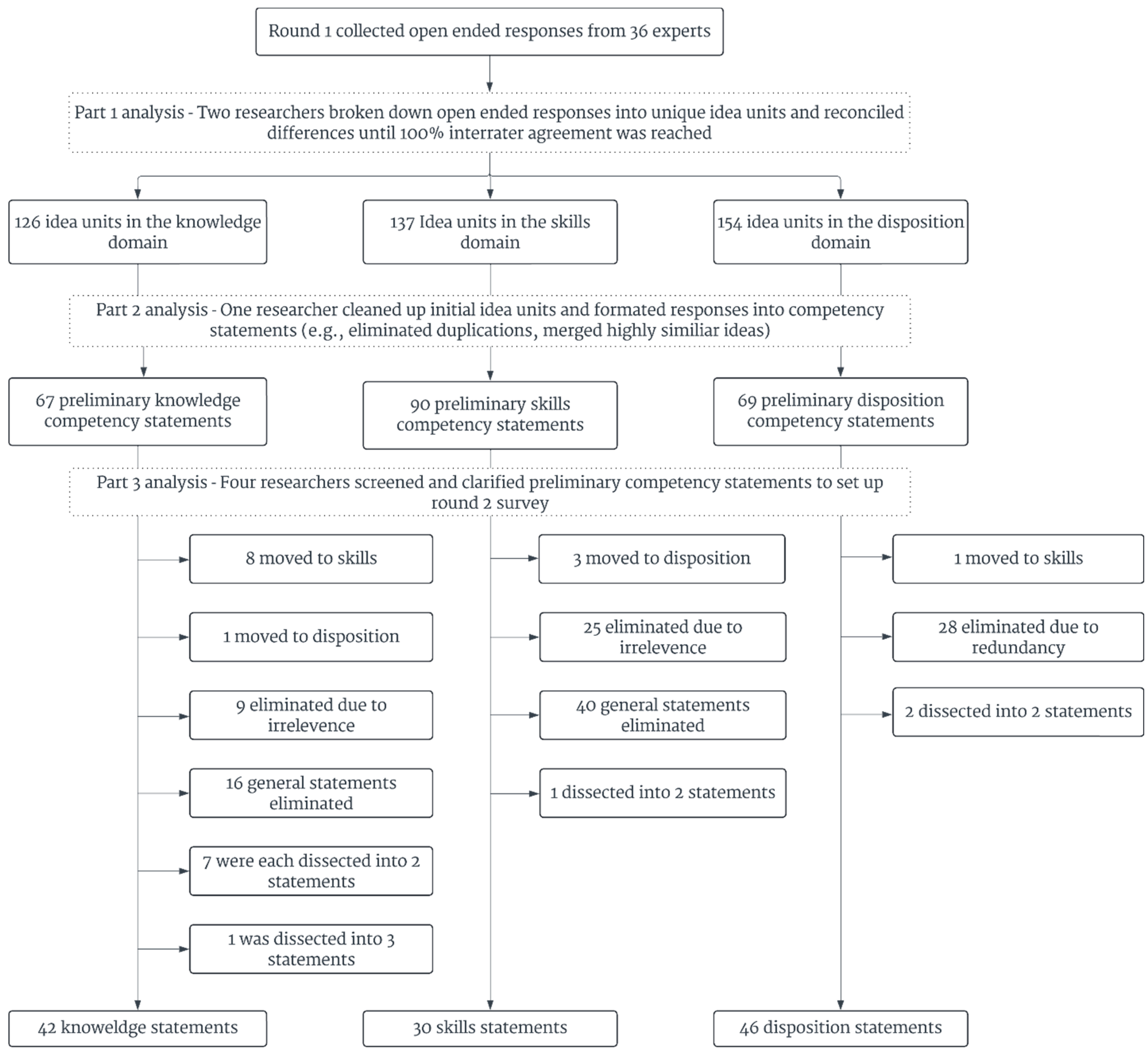
Thomas, 2006), the research team broke down the open-ended responses into unique idea units, consolidated statements that were highly similar in their meanings, eliminated redundant statements, and made systematic revisions to ensure alignment with the intended domains of knowledge, skills, or dispositions. See
Figure 1 for a flowchart of the three-part analysis.
In the first part, two independent coders performed a content analysis to delineate the qualitative data (
Thomas, 2006). Experts responded with either paragraphs or lists to the open-ended questions. The independent coders reviewed each response and identified the distinct ideas that expert participants generated as our unit of analysis. Some responses provided explanations or justifications around the idea units. If the contextual information did not add new idea units, they were discarded. The independent ratings resulted in high reliability for knowledge (ICC = 0.794), skill (ICC = 0.972), and disposition (ICC = 0.963).
In qualitative research, the “unit of analysis” refers to the distinct portion of content that will drive the development of thematic codes (
Roller & Lavrakas, 2015). Given that this study’s goal is to derive a list of specific competencies that define digitally fluent educators, our analysis focused on dissecting the experts’ responses into units of ideas that reflect a specific type of knowledge, skill, or disposition to fluently teach with technology. For example, one of the responses was “First, I believe the subject matter knowledge is vital. In order to determine the types of digital content to use there has to be sound subject matter knowledge. We also have to have the knowledge that technologies exist. Without knowing what is available or where to find that information limits or constrains the teaching possibilities. Finally, a digitally fluent educator must have adequate knowledge of the digital tools being used by the learners in their course (e.g., can explain to students the use of basic tools, like Canvas, that are used in the course),” the two coders agreed that this response can be delineated into three idea units: (1) subject matter knowledge, (2) knowledge that technologies exist, and (3) digital tools being used by the learners in their course.
After independently coding and identifying the idea units, the coders convened to compare and discuss their findings, resolving any discrepancies through discussion to achieve 100% agreement. This analysis yielded 126 idea units for knowledge, 137 for skills, and 154 for dispositions.
In the second part of the analysis, we refined the pool of reconciled idea units by eliminating any duplicates with identical phrasing and merging similar concepts that were phrased differently. For instance, expressions like “knowledge of subject matter in a discipline” and “knowledge of the content/subject area being taught” were combined into a single, representative term, prioritizing the phrasing that most accurately captured the essence of the concept, “subject matter knowledge”. Through this meticulous process of screening and consolidation, we distilled the data into a more manageable set of preliminary competency statements: 69 pertaining to knowledge, 90 to skills, and 69 to dispositions. The statements were formatted with the stems “A digitally fluent educator should have knowledge of…”, “A digitally fluent educator should have the ability to…”, and “The disposition of a digitally fluent educator includes…”, for the knowledge, skills, and disposition domains, respectively.
In the final stage of the three-part analysis, the research team further scrutinized the preliminary competency statements for appropriateness to the study focus of digital fluency as well as to each domain. We adjusted statements within all three categories. From the knowledge domain, we moved eight statements to the skills domain, moved one to dispositions; eliminated nine statements either due to redundancy or ambiguous in meaning (e.g., “understand the full rhetorical context—technical, social, political, pedagogical, institutional of the situation”). We further identified 16 statements as general statements that did not specifically target digital fluency in the context of formal instruction and eliminated them (e.g., “assessment theory”). We further split seven statements into two statements each to maximize clarity (e.g., “procedural knowledge of how digital resources and tools can be approved and accessed” was split into “knowledge of how digital resources and tools are approved”, and “knowledge of how digital resources and tools are accessed”) and split one item into three separate statements. For purposes of clarity, we made minor edits to the remaining statements, generating a total of 42 final knowledge competency statements in Round 1.
For the skills domain, eight statements were added from the knowledge domain, and one from the disposition domain. We eliminated 25 statements due to redundancy or vagueness in meaning (e.g., “demonstrate educational leadership skills”); categorized 40 statements as too general and were not included in the final analysis (e.g., “plan and think strategically”). One statement was dissected into two statements, and we made minor edits to the remaining 28 competencies. Round 1 resulted in a total of 30 final skills competency statements.
One statement was added to the disposition domain from the knowledge domain and three from skills. One disposition statement was moved to skills. We eliminated 28 statements due to repetition or vagueness. For instance, many of the statements were variations of being open to learning and using different technologies and we extracted the specific type of openness that was unique. Two statements were dissected into two separate statements, resulting in a total of 46 disposition statements in Round 1.
4.2.2. Round 2—Item-Level of Agreement
In Round 2, panelists were given the list of 42 knowledge, 30 skills, and 46 disposition competency statements generated from Round 1. On a 4-point Likert scale (1 = strongly disagree, 2 = disagree, 3 = agree, 4 = strongly agree), experts rated their level of agreement on whether each statement reflects a competency required to be a digitally fluent educator. Additionally, after they rated statements in each domain, experts were given the opportunity to identify missing items that should be included as competencies for that domain.
Aligned with previous research, we used a cut-off score of 80% agreement (or a 3.2 average on the 4-point Likert scale) as the threshold for the items advancing to the third and final round of the study (
Diamond et al., 2014). Items that did not make the cut-off were eliminated. Many Delphi studies in education, healthcare, and social sciences have adopted 75–80% agreement as a reasonable level of consensus among experts. Over time, 80% has become a standard benchmark referenced to support credibility and objectivity (e.g.,
Hsu & Sandford, 2007). If the cut-off is too low (e.g., 60–70%), the findings may not reflect a strong enough agreement to define expert consensus. When the cut-off is too high (e.g., 90–100%), this minimizes individual differences in perspectives and may result in discarding valuable items due to minor disagreements, especially when dealing with subjective or complex topics. In the second Round of analysis, we found 21 statements in the knowledge domain, 12 in the skills domain, and 40 disposition statements that met the 80% agreement threshold. See
Table 2,
Table 3 and
Table 4 for descriptive statistics from Round 2.
The majority of panelists did not suggest additional items. Among the few experts who did respond, however, most re-emphasized a certain aspect of the competencies. For instance, one expert mentioned adding the following to the disposition domain: “…independence and a problem-solving orientation, where if there’s an issue knowing that if you read the info doc or google it, you may be able to find an answer.” Other suggestions highlighted that there should be more detailed competency statements in the knowledge domain on ethics, social impact, and equity issues related to the use of technologies in teaching practices. Among the items presented in Round 2, many already have content related to ethical considerations, privacy, and social issues across all three domains (e.g., K1, K24, K13, K6, S5, S6, D7, D24). Therefore, the research team elected not to add additional competency statements around ethics in this study.
A few participants recommended adding competency statements to reflect educators’ knowledge on the benefits and perils of Artificial Intelligence (AI), such as issues related to academic integrity and ethical safeguards when using ChatGPT in higher education. Round 2 of this study was administered in December 2022, whereas ChatGPT was launched in November 2022 and has gone viral in every field ever since, including education. Since the study was launched after the implications of AI became the most popular topic in higher education, we decided to not introduce competency areas around AI midway into this study and aimed to keep the scope of the inquiry consistent across the three rounds of data collection.
4.2.3. Round 3—Achieving Group Consensus
In Round 3, the expert panel was provided with 21 knowledge, 12 skills, and 40 disposition competency statements that had an average rating above 3.2 agreement as indicators of digitally fluent educator generated from Round 2. For this final round of the study, experts were asked to select the competencies that they believe should be included in the final list of statements. They were not required to choose a specific number of items. Consistent with Round 2, we retained competency statements that were selected by more than 80% of the panelists (20 out of 24) to comprise the final list in Round 3.
5. Results
The final list of statements generated from three rounds of analysis on the core competencies that define digitally fluent educators included 8 knowledge, 3 skills, and 3 disposition items. See
Table 2,
Table 3 and
Table 4, for the number of panelists who selected each statement for the final list. The core competencies are elevated in the table by the use of ** and text bolding. One knowledge competency and one skill competency garnered 100% rating from panelists. The three disposition competencies reach over 88% agreement by panelists. Many of the items from Round 3 targets awareness of situations, flexibility, and responsiveness, such as determining if technology is needed depending on the context, how to evaluate the effectiveness of the technology, and the ability to adapt if the use does not go as planned.
Interestingly, across the three domains, very few items were collectively selected as a defining competency that represents digital fluency in teaching practices. Among the 21 knowledge areas that were agreed upon in Round 2 as core indicators, less than half of these items were considered in the final list in Round 3. The expert panel selected three out of 12 skills and three out of the 40 dispositions that were generated from Round 2 when asked to categorically evaluate whether each item represents digitally fluent educators. This indicates that when assessing each item using an ordinal Likert scale, experts are more likely to agree that most items in each domain reflect the competency of digitally fluent educators to a certain extent. However, when experts evaluate each item on a dichotomous scale, the panel reaches consensus on very few items to define digital fluency in educators.
In the knowledge domain, items that were selected targeted declarative knowledge such as understanding the ethical (K1) and social issues (K13) related to digital technology such as plagiarism, fake news, online behavior (K6), procedural knowledge on how to effectively present content (K2) using technology, conditional knowledge such as when to use different tools (K5), where to seek help (K9) and how to address potential obstacles when helping students use digital technologies to learn (K7, K8). In the skills domain, the items that emerged from Round 3 targets educators’ agility to evaluate the effectiveness of digital resources (S1), adaptability when the technology plan fails (S2), and whether technology is truly required to enhance student learning (S3). As for the dispositions of a digitally fluent educator, the panel of experts selected a commitment to quality instruction (D3), adaptability (D4), and an appreciation for digital equity (D7) as core competencies.
6. Discussion
The purpose of this study was to identify the knowledge, skills, and dispositions that define the competencies of a digitally fluent educator in higher education. Moreover, we imagine a dynamic application of the resultant competencies, as we seek mechanisms for digital fluency development. Commonly referenced frameworks such as digital literacy and digital competency describe the minimum that is required of instructors to use digital technologies sufficiently (
Spante et al., 2018). The rapid advancement of convergent technology used in education is challenging these frameworks, threatening to push them towards obsolescence. This study expands upon the existing conceptual models to discover the underlying core competencies that instructors need to be digitally fluent, confident, and successful in their teaching practices.
Through three rounds of inquiry and analyses using the Delphi method, a diverse panel of experts identified 14 competencies, including 8 knowledge, 3 skills, and 3 dispositions as indicators of instructors’ ability to fluently teach with technology in higher education. Given that there has been little research on digital fluency in education to date, the current study provides several key findings to support the theoretical underpinnings of digital fluency when applied to teaching.
Our findings show evidence differentiating the conceptual boundaries of digital fluency from constructs such as digital literacy, digital competency, and the TPACK framework. Across knowledge, skills, and dispositions, the panel of experts in Round 1 independently provided a wide range of descriptors and many reflected aspects of digital literacy and digital competence. However, in Round 2, experts reached consensus on a sub-set of these descriptors and in Round 3, they identified fewer of them as defining characteristics of a digitally fluent educator. For instance, in Round 2, the panel agreed that digitally fluent educators should have knowledge of the digital tools for content presentation to accomplish instructional goals (K2), digital literacy (K17), skills to write a learning objective for a course that describes how digital technology and course activities will align with the learning outcomes (S10), skills to create content presentations, spreadsheets, documents to convey ideas (S7), a commitment to quality student experience (D1) and being open to the idea of using technology in a variety of settings (D19), etc. These statements overlap with the dimensions of digital competency, such as the use of digital technologies to support teaching practices (
Claro et al., 2024), and digital competency-related beliefs regarding actively engaging learnings (
Runge et al., 2023). Interestingly, in Round 3, experts targeted a narrow selection of competency statements when asked to categorically identify whether the list in Round 2 truly defines digital fluency. The dramatic reduction in identified characteristics from Round 2 to Round 3, indicates that experts believe there are conceptual overlaps among digital fluency, digital competency, and digital literacy at a broader level, but there are conceptual distinctions at a finer level.
Viewing the identified competencies through the lens of the TPACK framework extends our understanding of both TPACK and the competencies themselves. While six of the competencies (K1, K6, K13, D3, D4, and D7) do not logically map to the TPACK framework, eight of them do: K5 (“when to use different digital tools to accomplish different purposes”) and K9 (“where to go for technology selection help when needed”) maps onto TK (Technological Knowledge); K7 (“potential obstacles to students’ effective use of technology”), K8 (“the best digital technologies to help students learn”), S2 (“adapt when technology doesn’t go according to plan”) and S3 (“evaluate what can be done without technology versus when technology is needed to benefit students’ learning”) maps onto TPK (Technological Pedagogical Knowledge); K2 (“the digital tools for content presentation to accomplish instructional goals”) and S1 (“evaluate effectiveness of digital resources in achieving instructional goals”) aligns with TCK (Technological Content Knowledge).
The competencies that do not logically map include knowledge, skills, and dispositions that emphasize ethics; intellectual property, copyright, plagiarism, fair use, public domain, creative commons and open-source licensing, fake news, online behavior and netiquette; social issues; commitment to quality; adaptability; and appreciation for digital equity. Thus, while there is some overlap with the TPACK framework, there are limitations, as well. This underscores the need for multiple frameworks, as no singular framework is universally applicable.
Digital Fluency is defined “as the need for an ever-present readiness to identify, adopt, and use new technologies,” (
Fleming et al., 2021) which also supports the evidence of the knowledge, skills and dispositions from the current study. Whereas Digital Literacy is “shaped by emerging technologies, within educational contexts, digital literacy is a broader term that embraces technical, cognitive and social-emotional perspectives of learning with digital technologies, both online and offline” (
Ng, 2012). Digital Literacy embraces cognitive and social emotional aspects in addition to technical skills but does not highlight the comfortability of “readiness” to have these technical skills at the center of learning. The findings support the differentiation between literacy and fluency specifically around the placement of technology.
While there are contextual boundaries to our findings and limits to the panelists who were U.S.-focused, a major motivation of this study is to lay the groundwork for building capacity among all educators. We seek to better understand the requirements for competency. A notable finding is that the final list of competencies that emerged from our study comprises a significant portion of conditional knowledge (e.g., K5. when to use different digital tools to accomplish different purposes), metacognitive monitoring skills (e.g., S3. evaluate what can be done without technology versus when technology is needed to benefit students’ learning), and traits of self-regulation (e.g., D4. Adaptability) applied in the context of teaching with digital technologies. Conditional knowledge reflects the awareness of the contexts or tasks that are appropriate for reaching a goal (
P. Winne & Azevedo, 2022). Metacognitive monitoring is the cognitive process of evaluating the accuracy of one’s knowledge and performance (
Griffin et al., 2013). Self-regulated learning brings together various forms of knowledge and monitoring to evaluate progress and strategically improve one’s capacity to reach goals (
P. H. Winne, 2018). Adaptation to internal and external factors is a core component of self-regulation. In comparison to merely knowing the effectiveness of different digital tools and how to make use of these tools to assist their teaching, findings from our study indicate that an educator fluent in digital technologies is self-regulated and has the capability to leverage metacognitive knowledge and skills to make strategic decisions in their teaching practices.
Ethical consideration is another important aspect for educators to become digitally fluent. As educators incorporate digital tools into their teaching, they might encounter issues around student privacy, data protection, accessibility, equity, and online behavior—all of which have ethical implications. Protecting student data and adhering to privacy laws, for example, safeguards students’ personal information, while considering equity ensures that all students, regardless of socioeconomic background, can access and benefit from digital resources. Ethical fluency also involves using technology to create an inclusive environment where resources are accessible to students with diverse learning needs and abilities. Moreover, as AI-driven tools become more prevalent in education, educators must understand these technologies’ potential biases to avoid unfairly impacting students. By modeling ethical use of digital tools, educators not only foster a safe and fair classroom but also teach students the responsible use of technology, preparing them for mindful digital engagement in the future.
Developing a comprehensive list that describes competencies of digitally fluent educators is a necessary step in providing quality professional development opportunities for instructors and preservice educators in higher education. Instructors in higher education are constantly seeking resources and opportunities to improve and enhance their teaching practices (
Fleming et al., 2021). The knowledge, skill, and disposition competencies that emerged from this study serve as a professional development curriculum on how to teach fluently with digital technologies. In addition, instructors should develop the capability to adapt to ever-evolving digital tools. As new technologies emerge, it is essential for educators to stay informed and flexible, continuously assessing the effectiveness of the tools they use. When instructors find that certain tools are not enhancing teaching and learning as expected, they should be able to recognize this and know how to replace them with more suitable alternatives. This adaptability ensures that the learning experience remains dynamic and effective, with technology serving as an aid rather than a hindrance. By staying updated and open to change, instructors can ensure that they are always utilizing the best tools available to support their teaching goals and student outcomes.
Armed with a list of competencies, we can target faculty development and inform educator training to facilitate growth in these specific areas. This is the most immediate implication of the study’s results. Long term, we would expect that as educators become more competent, learners will also become more competent and contribute to a more digitally fluent workforce. As new technologies such as artificial intelligence evolve, it will be imperative to continue to study and track how requisite competencies change and new ones emerge.
7. Limitations and Recommendations for Future Research
There are limitations to this study. The first round of data collection was conducted in Spring 2022; by the end of the year, generative artificial intelligence tools had proliferated in the tech industry and triggered a rise in the exploratory applications of AI in educational settings. In Round 1, one expert highlighted that advanced technological knowledge was essential to a digitally fluent educator, stating “Foundational knowledge regarding the intersection of Artificial Intelligence, Machine Learning, Natural Language Processing, Extended Reality, Web 3.0, & Quantum Computing.” This competency statement received low agreement in Round 2 of our study, which was conducted in early Spring 2023, and was not included in the final selection in Round 3. In Round 2, another expert suggested that we should consider knowledge of ChatGPT as a point of competency for digitally fluent educators. Although two panel experts recommended including knowledge of artificial intelligence in our conceptualization of digital fluency, we ultimately did not incorporate a competency statement related to ChatGPT or other AI tools. This decision was based on the early stage of AI adoption in education and the uncertainty surrounding its impact on teaching practices in higher education.
It is hard not to imagine how the findings might have differed had we conducted this study one year later, in 2023, when AI tools were the epicenter of research and teaching practices across disciplines. However, it is easy to assume that faculty across higher education are uniformly eager to adopt AI, given the global surge in interest following breakthroughs in its generative capabilities. In reality, this assumption overlooks substantial variation in how AI is perceived and used by educators. In practice, the integration of AI into instruction varies widely, with educators in health sciences (e.g., pharmacy, medicine, dentistry) generally adopting advanced technologies, including AI, more cautiously and sporadically than their counterparts in engineering or technology-related fields (e.g., computer science, information technology). Consequently, the scope of this study remains highly relevant and provides a necessary foundational basis for future research examining competencies faculty need to effectively teach with digital technologies across disciplines.
In addition, the outcomes of inductive research methodologies, such as the Delphi method, are influenced by the time span over which they are conducted. In an era of rapid technological change, examining the knowledge, skills, and dispositions required to fluently use technology to teach is inherently challenging, as these requirements constantly evolve and fluctuate alongside the advancements in the technology sector. Nevertheless, there are many opportunities for future research to capitalize on the ever-changing nature of what defines a digitally fluent educator. For instance, future studies could investigate the role of instructor self-efficacy in learning and using generative AI tools. Given the complexity of AI technologies, it may be hypothesized that a self-efficacy threshold exists for educators to effectively adapt to more advanced technological tools, such as AI. This threshold may, in turn, impede instructors’ ability to leverage AI technologies that would otherwise enrich their instructional strategies. Future research could also examine how discipline-specific pedagogy relates to digital fluencies in educators. The nature in which instruction is delivered within each discipline (e.g., humanities, STEM, social sciences) will determine the type, range, and depth of fluency educators must demonstrate when designing technology-enhanced learning experiences. The current research is an initial study that others can build on and expand the applications of our findings across disciplines.
Nevertheless, a key finding from our study is that digital fluency has metacognitive qualities, suggesting that the resulting competencies generalize to newer technologies such as generative AI tools. Future research should investigate if and how the knowledge, skills, and dispositions required to learn and adopt new technologies are integral to digital fluency. Recent work underscores the importance of educators’ competence in learning and adopting AI for the design and delivery of effective technology-enhanced instruction (
Giannakos et al., 2025). Accordingly, future iterations of a competency framework should be refined and expanded to explicitly account for AI-related technologies.
8. Conclusions
Educators are at the frontline of designing and delivering technology-enhanced learning experiences for their students. It is critical that instructors in higher education are supported with research-based professional development experiences to fluently leverage digital technology in their instructional practices. Using the Delphi Method, we engaged a U.S. centric panel of experts on digital fluency and developed a list of competencies that characterize the knowledge, skills, and dispositions of digitally fluent educators. Our findings provide evidence that digital fluency competencies include dimensions of digital literacy, digital competency, and related constructs (e.g., TPACK), but they also extend beyond these conceptual boundaries. The findings yield plausible competencies that can be used for measuring educator understanding of digital fluency and for direct connection to faculty development efforts.