Article

The Effect of Perceived School Counselor Support on High School Students’ General Mattering, Resilience and Self-Esteem


1
Department of Psychology, Inonu University, Malatya 44000, Turkey
2
Liberal Arts Department, American University of the Middle East, Egaila 54200, Kuwait
3
Counseling Unit, Malatya High School, Malatya 44100, Turkey
4
Counseling Unit, Şehit Fuat Oğuzcan Elementary School, Gaziantep 27010, Turkey
5
Counseling Unit, Ünye Science and Art Center, Ordu 52300, Turkey
*
Author to whom correspondence should be addressed.
Educ. Sci. 2026, 16(2), 339; https://doi.org/10.3390/educsci16020339
Submission received: 8 January 2026 / Revised: 15 February 2026 / Accepted: 17 February 2026 / Published: 20 February 2026
(This article belongs to the Section Education and Psychology)

Abstract

This study examined the predictor role of perceived school counselor support (PSCS) on resilience, general mattering, and self-esteem in high school students who have used counseling services. A total of 573 students (263 boys, 310 girls) participated in the study, providing insight into how counselor support may contribute to students’ psychological well-being. Structural equation modeling was employed to test the proposed second-order factor model in which PSCS was specified as a higher-order construct. Following minor, theoretically justified modifications, the final model demonstrated acceptable fit to the data (χ2(580) = 1965.87, χ2/df = 3.39, CFI = 0.896, TLI = 0.887, RMSEA = 0.065). Results indicated that PSCS significantly and positively predicted resilience (β = 0.15, p < 0.01), general mattering (β = 0.19, p < 0.001), and self-esteem (β = 0.24, p < 0.001). Although the explained variance in the outcome variables was modest, findings highlight the importance of perceived counselor support as a meaningful psychological resource in adolescents’ well-being. These results underscore the role of school counseling services in strengthening students’ resilience, sense of mattering, and self-worth.

1. Introduction

Schools play an important role in delivering mental health services, which yield better outcomes when integrating efforts from schools, families, and communities. High school students (hereafter referred to as students) frequently face developmental challenges that can lead to difficulties within family dynamics and broader social functioning. Therefore, schools are not only responsible for educational support but are also expected to understand students’ social and emotional needs, guiding them to effectively navigate an ever-changing society (Beatty & Campbell-Evans, 2020).
Adolescence is a critical developmental period, requiring students to develop skills to cope with various psychological and physiological changes. Although most students begin adolescence during their middle school, significant challenges affecting their academic, social–emotional, and career development typically arise in high school. During this stage, students make pivotal decisions related to academic track selection, career aspirations, and identity formation, each significantly impacting their future trajectories (Balkin & Schmit, 2016; Orth & Robins, 2014). Simultaneously, students are expected to manage physical, emotional, and social pressures within an increasingly complex and rapidly evolving world (Gati & Levin, 2014; Savickas, 2012). These pressures frequently surpass their developmental readiness, heightening their need for external support (Annapally et al., 2022; Bohnenkamp et al., 2022; Vaillancourt et al., 2013). Although peer relationships play a central role during adolescence, research highlights the importance of supportive adults outside the family, particularly those professionally trained to provide emotional guidance and mental health support (Karaman et al., 2019; Roe, 2013; Yılmaz & Demir, 2016).
School counselors play an active role in both supporting students’ mental health and promoting their learning and social–emotional development (O’Connor, 2018; Ryan & Deci, 2011). They significantly influence early identification of academic and social–emotional risks and can direct students toward suitable tiered interventions (Hickman & Klassen, 2022; Marsh & Mathur, 2020; O’Connor, 2018). Equipped with specialized training, school counselors are adept at recognizing early signs of distress, implementing effective interventions, listening impartially to student concerns, and providing unconditional acceptance and support (Cohen, 2004).
Ideally positioned to assist students during difficult times, school counselors directly or indirectly influence students’ success in reaching their post-secondary goals (Bryan et al., 2009; Oymak, 2018; Poynton & Lapan, 2017). Given the growing mental health needs among adolescents, school counselors’ support has been highlighted as crucial for ensuring students’ voices are heard. For instance, Poynton and Lapan (2017) found that students who consulted school counselors during the university application process showed stronger motivation for higher education. Similarly, Parker and Ray (2017) demonstrated the critical role of school counseling services in guiding Latino high school students through informational and decision-making processes necessary for college and career readiness. In a recent study (Aydoğdu et al., 2021), conducted with high school students, researchers found a negative correlation between perceived school counselor support factor scores and career decision-making difficulty scores. Students who reported higher levels of counselor support experienced lower career decision-making difficulties. This finding suggested that perceived school counselor support may function as a protective and structuring resource, helping students clarify goals, reduce uncertainty, and navigate complex career-related choices by providing emotional reassurance, informational guidance, and a sense of mattering within the school context.
Although the importance of school counseling is well documented, the effectiveness and perceptions of these services can vary by cultural and institutional context. In Türkiye, school counseling services are legally mandated and embedded within schools; however, research students often perceive these services primarily as administrative or academically oriented rather than as sources of emotional or psychological support (Avcı & Yıldırım, 2021; Stockton & Güneri, 2011). Moreover, school counselors frequently face role ambiguity, heavy caseloads, and limited collaboration with teachers and administrators, which can hinder their ability to provide comprehensive mental health support (Doğan & Julian, 2019). Despite these challenges, studies indicate that when counselors are perceived as accessible and trustworthy, they can play a vital role in developing students’ well-being (Karaman et al., 2019). Therefore, examining students’ perceptions of counselor support in the Turkish context is essential for advancing contextualized knowledge in the field.
The concept of mattering, understood as a set of perceptions based on both personal self-evaluation and evaluations from others, holds particular importance during the broad developmental period of adolescence, including its extended form. This stage is characterized by prominent themes of identity formation and social belonging (Shavelson et al., 1976). Mattering also serves as a key factor influencing psychosocial adjustment during adolescence (Lippman et al., 2014). As students transition into this stage, thoughts about their self-identity become increasingly prominent. Providing adolescents with a sense of importance during these formative years lays the foundation for stronger self-concept and character formation in adulthood (Montemayor & Eisen, 1977; Orth & Robins, 2014). School counselors, through individual sessions, group guidance activities, or classroom-based interventions, can foster a healthy coping response and contribute to students’ sense of being valued (Karaman et al., 2021). While such services are mandated in Turkish high schools, their frequency and depth may vary depending on counselor caseloads, institutional priorities, and students’ willingness to seek help.
Self-esteem is defined as an attitude toward oneself that can be either positive or negative (Rosenberg et al., 2018). It results from emotional processes in which individuals evaluate their self-image and personal characteristics, including self-acceptance, approval, and appreciation. Students during adolescence develop self-worth and self-respect, as well as shape overall judgments about themselves (Byrne & O’Brien, 2014). Individuals with higher self-esteem are better equipped to cope with negative life events and mental health challenges (Spitz et al., 2022; Yang et al., 2023). Currently, common psychological issues such as anxiety, depression, loneliness, and low self-esteem have become increasingly prevalent among adolescents (Bains & Diallo, 2015; McGorry et al., 2022; Perou et al., 2013; Stagman & Cooper, 2010). Social support from various sources, including family, peers, and teachers, is positively correlated with higher self-esteem in adolescents (Poudel et al., 2020). Galliker Schrott et al. (2009) examined the role of school social workers and counselors in supporting adolescents and found that individual counseling by school social workers did not have a direct impact on self-esteem or depressiveness unless the counseling was perceived as beneficial by the students. This finding underscores the importance of perceived counselor support rather than mere service availability, highlighting that students’ subjective evaluations of support may be more influential than the structural presence of counseling services alone.
School counseling services, often described as a form of protective support, help students manage stressful life events and reduce associated risks (Marsh & Mathur, 2020). School counselors play a critical role in moderating the association between adolescents’ mental health difficulties and suicidal thoughts and behaviors. The presence of more counselors in schools weakens the relationship between mental health difficulties and suicidal thoughts and behaviors, highlighting the importance of investing in support personnel to promote students’ socioemotional well-being and mental health (Graham & Chiang, 2026). School counselors may help developing protective factors, which likely to positively impact on resilience among children and adolescents (Masten, 2014). Resilience refers to the capacity to adapt to difficulties and recover quickly from crises (Masten, 2014), further strengthening individuals’ abilities to achieve positive developmental outcomes (Li et al., 2023). When faced with adversity, individuals commonly seek external support to help them cope (Doğan & Julian, 2019). Social support, including that provided by school counselors, has been found to positively influence resilience among children and adolescents (J. J. Chen et al., 2021). Counselors provide a safe environment for adolescents to discuss their problems, which supports their emotional well-being. This emotional support is important for building resilience as it helps adolescents manage stress and emotional challenges (Slater et al., 2011). Additionally, counselor support promotes awareness of healthy coping strategies and improve emotional regulation by addressing issues such as anxiety, depression, insecurity, and fear (Karaman et al., 2021). By addressing these negative emotions, counselors help adolescents build a stronger foundation for resilience (Guo et al., 2020). Ultimately, these interventions contribute significantly to the development of resilience, enabling individuals to cope more effectively with adverse life events and improving increased self-confidence (Spitz et al., 2022).
Weist et al. (2014) emphasize comprehensive school-based mental health services, including prevention and awareness programs, to address students’ social, emotional, educational, and career needs. It is critical that students receive support from school counselors that allows them to voice their concerns and needs. Research has demonstrated that such support has positive effects on mental health outcomes (Blake et al., 2020; Harris & Plucker, 2014). While international research underscores the significance of school counselor support in fostering adolescents’ self-esteem, resilience, and sense of mattering, we have considered these constructs within the Turkish context. Recent findings indicate that psychoeducational interventions developed by school counselors can significantly contribute to students’ stress-related growth and well-being in Turkish school settings (Yazıcı-Kabadayı & Öztemel, 2024). Moreover, school-based mental health programs in Türkiye are gaining increasing recognition as a means to improve adolescent adjustment and emotional resilience (Yazgan & Karacam, 2015). These studies complement the international literature and support the relevance of school counselor support for Turkish adolescents, particularly in the face of academic and social stressors. Our study builds on this foundation by offering a multidimensional analysis of school counselor support using a Turkish-developed scale and a large, diverse adolescent sample. Conceptualizing school counselor support as a higher-order construct may provide a more integrative understanding of how different support dimensions collectively contribute to adolescents’ psychological development.

2. Present Study and Theoretical Framework

The present study was grounded in the Risk and Resilience Framework, which conceptualizes adolescent development as a dynamic process shaped by the interaction between contextual risk factors and protective resources (Masten, 2014). Within this perspective, supportive relationships in school settings function as critical protective factors that buffer against psychological vulnerability and promote adaptive developmental outcomes. School counselors, as accessible and professionally trained adults within educational systems, represent an institutionalized source of such protection. Students’ perceptions of counselor support may therefore operate as a contextual asset that strengthens internal psychological resources, particularly during the heightened developmental demands of high school years. Conceptualizing perceived school counselor support as a multidimensional construct may provide a more comprehensive understanding of how academic, emotional, social, and career-related forms of support collectively function as protective assets.
Research (Graham & Chiang, 2026; Karaman et al., 2021; Yazgan & Karacam, 2015; Powers et al., 2016) supported the role of school-based support as a protective mechanism in adolescent mental health. Access to school counselors has been associated with improved mental health outcomes and reduced psychological risk behaviors, particularly in the presence of distress (Graham & Chiang, 2026). Positive counselor–student relationships have been linked to enhanced emotional adjustment and coping capacity (Slater et al., 2011). Broader research on social support similarly demonstrates that perceived support predicts resilience and psychological well-being among adolescents (Guo et al., 2020), and contributes to higher self-esteem across cultural contexts (Gardner & Webb, 2019; Poudel et al., 2020; Spitz et al., 2022; Yang et al., 2023). In school environments, when counseling services are perceived as accessible and meaningful, they are more likely to contribute to students’ sense of being valued and psychologically supported (Karaman et al., 2019; Graham & Chiang, 2026). Furthermore, research conducted in Türkiye indicates that perceived school counselor support is associated with reduced career decision-making difficulties (Aydoğdu et al., 2021), suggesting that such support may serve both an emotional and structuring function in adolescents’ lives. Collectively, these findings align with the protective factor model by suggesting that perceived counselor support may operate not only as emotional reassurance but also as a relational and informational resource that strengthens adolescents’ internal coping systems.
Drawing on this theoretical foundation, the present study conceptualized perceived school counselor support (PSCS) as a contextual protective factor contributing to adolescents’ internal psychological resources—specifically resilience, general mattering, and self-esteem. Although prior research examined these constructs individually, limited research has tested their interrelations within a single structural model, particularly in non-Western contexts, and especially through a higher-order modeling approach that captures the shared variance across multiple dimensions of counselor support. The structural equation model tested in this study reflected the theoretical assumption that higher levels of perceived counselor support were positively associated with greater resilience, stronger feelings of mattering, and higher self-esteem among high school students who had accessed counseling services.
The present study contributes to the literature by clarifying the structural pathways through which perceived school counselor support relates to resilience, mattering, and self-esteem. By exploring these associations through the lens of perceived school counselor support, the present study seeks to contribute to a more integrated understanding of how school-based mental health resources can influence adolescents’ psychological development.
This study adds to the literature by (a) examining perceived school counselor support with a large high-school sample from Türkiye’s Eastern Anatolia Region; (b) employing a Turkish-developed short PSCS aligned with academic, social, emotional, and career domains; and (c) testing a multivariate SEM linking PSCS to mattering, resilience, and self-esteem within a single model.
The findings are expected to inform best practices in counseling services by emphasizing the importance of comprehensive support that addresses students’ academic, social, and emotional needs. Ultimately, this research underscored the role of school counselors in fostering adaptive psychological outcomes, helping students thrive in both educational and personal contexts. We hypothesized that PSCS would significantly and positively predict students’ levels of resilience, general mattering, and self-esteem.

3. Method

Procedures and Participants

The data for this study was collected from 573 students enrolled in three different high schools located in a province classified as a metropolitan area in Türkiye’s Eastern Anatolia Region. Participants were selected using a convenience sampling method. The schools shared similar characteristics in terms of institutional structure, curriculum, and student demographics. For instance, in one school with 1460 enrolled students, three school counselors were employed, resulting in an average student-to-counselor ratio of approximately 486:1 (see Table 1). Before data collection, ethical approval was obtained from the institution where one of the researchers was employed. In line with the ethical approval process, parental consent forms, participant information sheets, and participant consent forms were prepared. Copies of the approved ethics committee form, consent forms, and data collection instruments were provided to school counselors and principals. After receiving the necessary approvals, the parental consent forms were distributed to the parents. Data collection forms were then delivered to the students whose parents granted permission. One of the conditions for participation in the study was that students must have visited the school counseling service at least once. Out of the students who received the forms, 573 completed them in full and submitted them to the school counseling service.
Participants’ ages ranged from 14 to 19 (M = 16.20 years, SD = 1.21). There were 263 boys (46%) and 310 girls (54%). Participants reported their level of classes as follows: 9th grade (n = 161, 28%), 10th grade (n = 57, 27%), 11th grade (n = 114, 20%), and 12th grade (n = 141, 25%).
OpenAI ChatGPT 5.2 and ScopusAI were used solely to support academic English editing, Turkish-to-English translation of author-written text, and literature discovery (keywords/metadata). All AI-assisted passages were reviewed and edited by the authors; all cited sources were verified from the original publications; and no AI tool was used for data analysis or to generate scientific claims. Statistical results derive from AMOS outputs and were independently checked by the authors. Use of AI did not involve identifiable data.

4. Measurements

4.1. General Mattering Scale

The General Mattering Scale (GMS) was developed by Marcus and Rosenberg (1987) to measure the extent to which adolescents believe they are significant and matter to others. The scale consists of 5 items rated on a 4-point Likert scale. Higher scores indicate a stronger sense of mattering. Previous studies (Lippman et al., 2014; Masten, 2014) have linked mattering to various psychological outcomes, including well-being and resilience. The Turkish adaptation was conducted by Haktanır et al. (2016). This version of the scale demonstrated acceptable psychometric properties, with a reported internal consistency of 0.79. This scale is also widely used in research conducted with adolescent populations. In a study by Ding et al. (2025), which included 4225 children and adolescents from 16 P–12 schools, the omega coefficients demonstrated good internal consistency across educational levels: GMS (primary = 0.83, middle = 0.82, senior = 0.88). For the current study, the reliability score was 0.80, which is considered good.

4.2. Perceived School Counselor Support Scale-Short

The Perceived School Counselor Support Scale (PSCS) was originally developed in Türkiye by Karaman et al. (2019). The instrument measures high school students’ perceptions of the support provided by school counselors, based on the American School Counselor Association (ASCA) Mindsets and Behaviors for Student Success Model. It assesses how effectively counselors support students across 16 items and four developmental domains: academic development, social development, emotional development, and career development.
The short version of the PSCS contains 16 items rated on a 5-point Likert scale, ranging from 1 (Strongly Disagree) to 5 (Strongly Agree). Internal consistency estimates for the original study demonstrated high reliability, with Cronbach’s alpha values ranging from 0.94 to 0.95. Recently, Aydoğdu et al. (2021) reported a Cronbach’s alpha coefficient (0.94) comparable to the reliability of the original scale in their study examining the relationship between high school students’ career decision-making difficulties and PSCSS. For the current study, the reliability score for the instrument total score was 0.95, which is considered excellent.

4.3. Rosenberg Self-Esteem Scale

The Rosenberg Self-Esteem Scale (RSES) was developed by Rosenberg (1965) and designed to measure individuals’ overall self-worth and self-acceptance. It assesses self-esteem through 10 items, where higher scores indicate stronger self-esteem. The scale has been widely used and validated across different cultures and populations (Huang et al., 2023; Sugianto et al., 2024).
Turkish adaptation was conducted by Çuhadaroğlu (1986). The Turkish version retains the original factor structure, consisting of a single factor. Reliability analyses in the original study yielded internal consistency coefficients of 0.77 to 0.88, while the Turkish version demonstrated a Cronbach’s alpha of 0.76. Moksnes et al. (2024), in a sample of nearly 3000 Norwegian adolescents, reported satisfactory internal consistency for the total scale score (α = 0.81). For the current study, the reliability score was 0.85, which is considered good.

4.4. Brief Resilience Scale

The Brief Resilience Scale (BRS) was developed to assess individuals’ capacity to recover quickly from adversity. It is based on positive psychology principles and consists of 6 items rated on a 5-point Likert scale. The scale’s original developers, Smith et al. (2008), reported strong psychometric properties, including internal consistency coefficients ranging from 0.80 to 0.91. Haktanır et al. (2016) translated and validated the Turkish version of the scale with a sample of university students. Exploratory and confirmatory factor analyses supported a single-factor structure, with internal reliability estimated at 0.83. Karaman (2023) used the measure with an ethnically diverse sample of high school students and reported a moderate Cronbach’s alpha coefficient of 0.73. For the current study, the reliability score was 0.82, which is considered good.

5. Analyses

The data were analyzed using structural equation modeling (SEM) in AMOS 22.0. The analysis was conducted to test the hypothesized relationships between perceived school counselor support, general mattering, self-esteem, and resilience scores. Several goodness-of-fit indices were evaluated to assess model fit, including chi-square (χ2), the chi-square to degrees of freedom ratio (CMIN/DF), the comparative fit index (CFI), the Tucker–Lewis index (TLI), and the root mean square error of approximation (RMSEA). A non-significant chi-square is desirable, though it is sensitive to sample size and often significant in large samples (Kline, 2016). A CMIN/DF ratio below 3.00 indicates a good fit (Bollen, 1989), though ratios up to 5.00 can be acceptable under complex models (Schumacker & Lomax, 2016). A CFI value above 0.90 indicates an acceptable fit, with values ≥ 0.95 considered excellent (Hu & Bentler, 1999). An RMSEA value under 0.06 indicates a good fit, and values between 0.06 and 0.08 are considered acceptable (Browne & Cudeck, 1993). Given the cross-sectional design, all structural paths were interpreted as correlational associations rather than causal effects.
Last, the model assumptions were tested before running the SEM analysis. These included evaluations of normality, linearity, and homogeneity of variance-covariance matrices. Normality was assessed using the Shapiro–Wilk test, which indicated no significant departures from multivariate normality (W > 0.01). Linearity was inspected through standardized residual plots, confirming that relationships among variables were approximately linear. The analysis proceeded once the assumptions were confirmed to be within acceptable ranges.

6. Results

The hypothesized structural equation model aimed to explore the relationship between perceived school counselor support as the independent variable and general mattering, self-esteem, and resilience as dependent variables. Two analyses were conducted to assess and improve model fit after identifying issues in the initial analysis. Descriptive statistics are reported in Table 2.

7. Initial Analysis Results

The initial structural equation model demonstrated suboptimal fit to the data. The chi-square value was significant, χ2(618) = 2652.11, p < 0.001, with a chi-square to degrees of freedom ratio (CMIN/DF) of 4.29. Comparative fit indices indicated marginal fit (CFI = 0.849; TLI = 0.837). The RMSEA value was 0.076 (90% CI [0.073, 0.079]), suggesting acceptable but not ideal model fit.
Inspection of standardized factor loadings revealed self-esteem measurement item 8 (I wish I could have more respect for myself) a low loading of 0.34, indicating insufficient contribution to the latent construct. Additionally, modification indices suggested several localized areas of strain within factors, particularly among items of the same constructs. These findings indicated the need for theoretically justified model refinements to improve overall model fit.

8. Model Modifications

To improve model fit, theoretically justified refinements were implemented. Examination of standardized factor loadings identified one self-esteem item with a loading below 0.40, which was subsequently removed from the analysis. This decision was made following a review of the literature indicating that item 8 of the scale has demonstrated low factor loadings in several cultural contexts and has, in some cases, been removed from analyses. For example, Tulachan et al. (2022) excluded item 8 from the scale in their Nepali validation study due to its factor loading being below 0.20. Similarly, in the Bangladeshi adaptation conducted by Akhter and Ferdous (2019), although item 8 was retained, it was identified as the item with the lowest factor loading. These findings support the methodological decision to remove item 8 in the present study due to its insufficient contribution to the latent construct.
In addition, residual covariances were specified between Self-Esteem Scale items 9 (All in all, I am inclined to think that I am a failure) and 10 (I take a positive attitude toward myself), as well as items 3 (I feel that I have a number of good qualities) and 5 (I feel I do not have much to be proud of), and between Resilience Scale items 3 (It does not take me long to recover from a stressful event) and 5 (I usually come through difficult times with little trouble), based on conceptual similarity and modification indices. The model refinements were implemented in a stepwise and theory-driven manner rather than simultaneously. Initially, the item with an unsatisfactory standardized factor loading (below 0.40) was removed from the measurement model. Subsequently, modification indices (MIs) were systematically examined, and residual covariances were introduced sequentially, beginning with the highest MI values. At each step, model fit was re-evaluated to ensure that modifications were both statistically meaningful and theoretically justifiable. No cross-construct error covariances were introduced.
Following these modifications, the final model (see Table 3) demonstrated acceptable fit to the data: χ2(580) = 1965.87, p < 0.001, χ2/df = 3.39, CFI = 0.896, TLI = 0.887, and RMSEA = 0.065 (90% CI [0.062, 0.068]). These indices indicate that the revised model provided a substantially improved representation of the observed data.
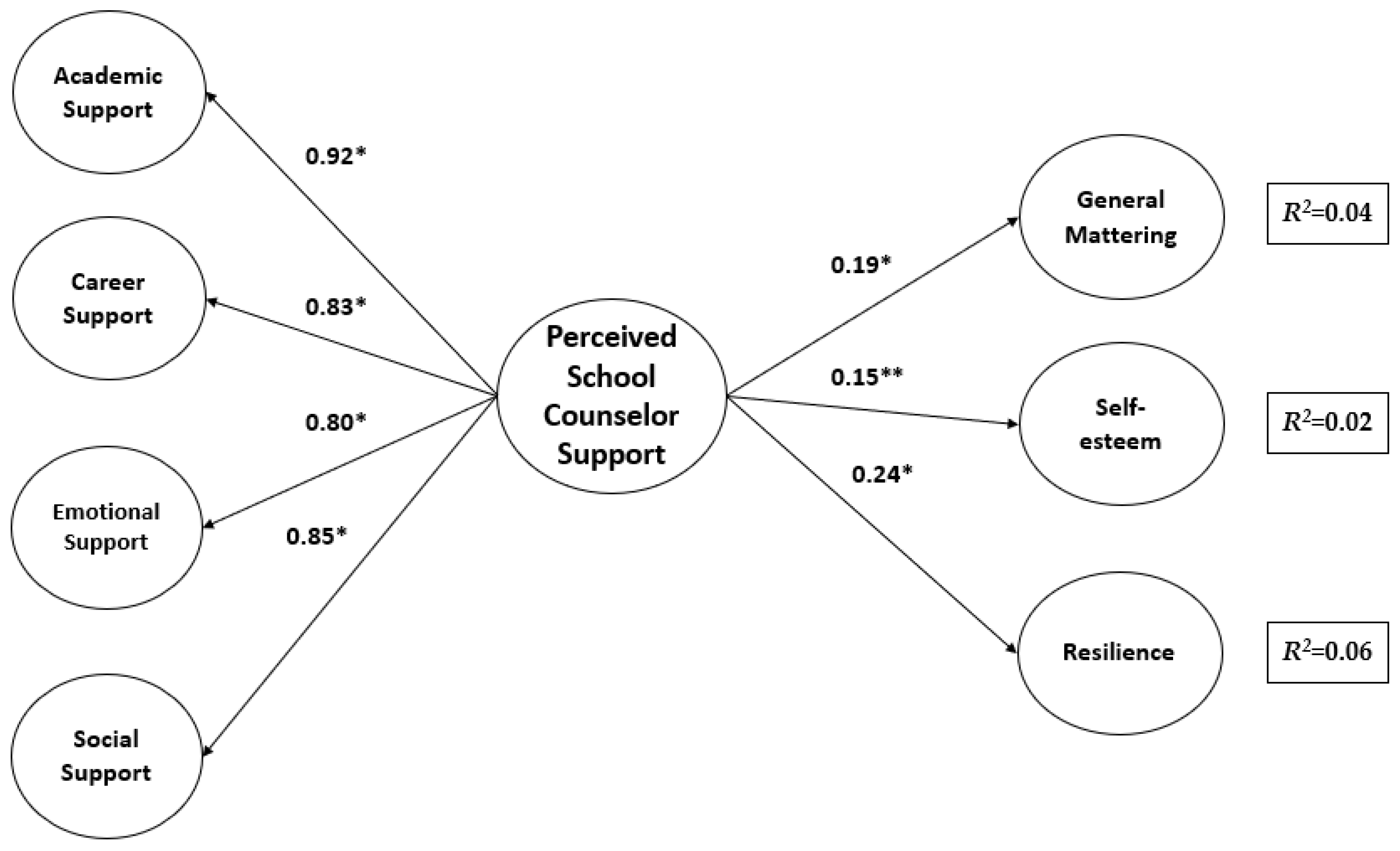
Standardized path coefficients indicated that PSCS significantly predicted all three outcome variables (see Figure 1). Specifically, PSCS positively predicted resilience (β = 0.239, p < 0.001), mattering (β = 0.190, p < 0.001), and self-esteem (β = 0.152, p = 0.002). Although the magnitude of these effects was modest, all associations were statistically significant. PSCS accounted for 5.7% of the variance in resilience, 3.6% of the variance in mattering, and 2.3% of the variance in self-esteem. These findings indicate that higher levels of perceived counselor support are associated with greater resilience, a stronger sense of mattering, and higher self-esteem among students who utilized counseling services. These associations align with the bivariate correlations in Table 2.

9. Discussion

The present study examined the extent to which PSCS predicts resilience, mattering, and self-esteem among high school students who had utilized counseling services. The findings supported the hypothesized model, demonstrating that perceived school counselor support significantly and positively predicted all three psychological outcomes. Although the magnitude of the effects was modest, the results align with the risk and resilience framework by highlighting perceived counselor support as a contextual protective factor contributing to adolescents’ internal psychological resources.
The findings demonstrated that perceived school counselor support, conceptualized as a higher-order construct encompassing academic, career, emotional, and social support, significantly predicted resilience, mattering, and self-esteem. These results are consistent with prior research indicating that school-based support functions as a protective factor promoting adolescents’ psychological adjustment and adaptive functioning (S. Chen & Qiu, 2021; Guo et al., 2020). In line with relational and ecological perspectives, supportive counselor–student interactions may foster coping capacity, emotional regulation, and a strengthened sense of personal significance (Slater et al., 2011). Although the magnitude of the predictive effects was modest, the pattern of results aligns with broader literature emphasizing the role of supportive school environments in reinforcing adolescents’ internal psychological resources (Gardner & Webb, 2019; Poudel et al., 2020). Rather than suggesting a selective or limited influence, the findings indicate that counselor support contributes meaningfully—albeit as one component within a broader ecological system—to students’ resilience, sense of mattering, and global self-worth.
Resilience is shaped by individual, familial, and societal protective factors operating simultaneously (Han & Kim, 2006; Poudel et al., 2020; Stagman & Cooper, 2010). Empirical studies emphasize that resilience develops through cumulative exposure to supportive environments rather than a single contextual influence (S. Chen & Qiu, 2021; Masten, 2014). Within this perspective, perceived school counselor support can be understood as one contextual protective factor that contributes to adolescents’ adaptive capacity. Similarly, self-esteem develops through a dynamic interplay of genetic predispositions, interpersonal experiences, and environmental influences, including social support, school climate, and family relationships (Donat Bacıoğlu et al., 2017; Orth & Robins, 2014; Raevuori et al., 2007). Cross-cultural research further indicates that while perceived support consistently predicts self-esteem, the strength of this association depends on relational depth and contextual quality (Poudel et al., 2020; Gardner & Webb, 2019). In parallel, mattering reflects adolescents’ perception of being valued and significant within interpersonal and institutional contexts (Scarpa et al., 2022). Thus, the observed effects of perceived counselor support should be interpreted within a broader ecological framework in which multiple systems collectively shape resilience, self-esteem, and mattering.
In Türkiye, high school students most often seek support from school counselors for concerns such as test anxiety, study strategies, higher education information, and career planning. While some students also approach counselors for personal issues like friendship problems, family issues, or behavioral challenges (Karataş & Şahin Baltacı, 2013), these tend to be secondary. As a result, the scope of counselor-student interactions may often lean toward academic and career-oriented support, potentially limiting their perceived role in promoting students’ psychological well-being. Additionally, students often turn first to their parents, then friends, and only subsequently to school counselors or trusted teachers when facing personal difficulties (Karataş & Şahin Baltacı, 2013). Thus, while counselors represent a formal and institutional source of support, their salience within students’ interpersonal networks may vary. From a relational and reality therapy perspective, meaningful psychological influence requires the establishment of a trusting and sustained relationship—one that secures a place within the student’s “quality world” (Wubbolding, 2015). International evidence suggests that the impact of school counselors on psychological outcomes tends to be stronger in educational systems where counselor roles are clearly defined and caseloads allow for sustained relational engagement (e.g., Graham & Chiang, 2026; Mullen et al., 2019). Given that counselor-to-student ratios in Turkish schools remain high (Ministry of National Education, 2020), opportunities for intensive relational work may be constrained. Even so, the significant associations observed in the present study indicate that students’ perceptions of counselor support retain psychological relevance despite systemic limitations.
In addition to time constraints, the scope and structure of counseling services may shape their developmental impact. Donat Bacıoğlu et al. (2017) noted that Turkish school counselors frequently engage in informational, assessment-based, and administrative activities, whereas long-term individual or group counseling interventions occur less frequently. International research highlights that comprehensive, developmentally oriented school counseling programs—characterized by collaborative practices, data-informed interventions, and sustained counseling work—are associated with stronger psychosocial outcomes (Mullen et al., 2019; Weist et al., 2014; Powers et al., 2016). Accordingly, expanding the depth and continuity of counseling services may further amplify the protective role of perceived counselor support in fostering resilience, self-esteem, and mattering.
Even when students perceive support from school counselors, the translation of that support into measurable psychological gains may depend on the depth and quality of engagement. Help-seeking research suggests that adolescents may hesitate to disclose personal concerns due to misconceptions about counseling services or fears related to labeling and confidentiality (Karataş & Şahin Baltacı, 2013). In Türkiye, students have sometimes perceived the counseling office as a space associated primarily with academic procedures or with “problem” students rather than as a resource for personal growth. Similar stigma-related barriers have been documented internationally, where concerns about labeling, privacy, or peer perception reduce adolescents’ willingness to engage fully in school-based counseling (Biolcati et al., 2018; Samargia et al., 2006). Such barriers may limit the extent to which counselor support can operate as a fully realized protective factor.
From a developmental and relational perspective, the effectiveness of counseling support depends on establishing trust, ensuring confidentiality, responding to developmental needs, and communicating in ways that resonate with adolescents (Geldard et al., 2019). When students feel psychologically safe and understood, the potential influence of counselor support on self-esteem, resilience, and mattering is likely to be strengthened. Thus, efforts to increase awareness about the scope and purpose of counseling services, reduce stigma, and foster relational continuity may enhance the protective function of perceived counselor support. Although beyond the scope of the present study, future research could examine whether gender, age, or frequency of counseling use moderates the strength of these associations, ideally through longitudinal or multi-group designs including both counseling users and non-users.
An international perspective further contextualizes the findings. School counseling systems differ substantially across countries in terms of counselor-to-student ratios, role definitions, and service structures. In the United States and several European contexts, counseling frameworks often emphasize socio-emotional development alongside academic and career guidance, supported by lower caseloads and more comprehensive service models. In contrast, Turkish school counselors frequently operate within higher caseload environments and broader role expectations. These systemic differences may shape how counselor support is perceived and enacted, potentially influencing its psychological impact. Framing the present findings within this comparative perspective underscores the importance of culturally responsive implementation and cautious cross-national generalization.

10. Limitations

Although the present study contributes to understanding the role of perceived school counselor support in predicting resilience, mattering, and self-esteem among Turkish high school students, several limitations should be considered. First, participants were drawn from three high schools located within a single metropolitan area. While the sample size was adequate for structural equation modeling, the geographic concentration may limit the generalizability of the findings to students in rural areas or regions with different socioeconomic and cultural characteristics.
Second, the sample consisted exclusively of students who had engaged with school counseling services at least once. This criterion introduces potential self-selection bias, as students who seek counseling may differ systematically from those who do not in terms of help-seeking tendencies, perceived support, or psychological functioning. Therefore, the findings should be interpreted within the context of counseling users and may not generalize to the broader student population.
Third, the cross-sectional design precludes causal inference. Although the structural model supports the predictive role of perceived counselor support, reciprocal relationships are plausible. For instance, students with higher resilience or self-esteem may be more inclined to perceive counselor interactions positively or to seek support proactively. Longitudinal and cross-lagged designs would allow for stronger conclusions regarding directionality.
Fourth, all variables were assessed using self-report measures. Although validated instruments were employed, self-report data are inherently susceptible to social desirability bias and shared method variance. Future studies may benefit from incorporating multi-informant data (e.g., counselor reports, teacher evaluations) or mixed-method approaches to triangulate findings.
Finally, the study did not differentiate between students who received counseling support once and those who experienced sustained or repeated engagement. The frequency, duration, and depth of counselor interaction may meaningfully influence the strength of psychological outcomes. Future research should consider examining dosage effects of counseling support and whether sustained engagement produces stronger developmental gains.

11. Implications for School Counselors

The findings of this study underscore the meaningful role of perceived school counselor support in fostering resilience, mattering, and self-esteem among high school students. The significant associations observed in the structural model suggest that even within existing systemic constraints, students’ perceptions of counselor support contribute to important psychological resources. These results offer several practical implications for school counseling practice. First, counselors might consider increasing the time and attention devoted to one-on-one or small-group counseling sessions focused on psychosocial support—an approach that could help students feel more comfortable sharing deeper personal and emotional issues. In practice, this may mean collaborating with administrators to adjust workloads or schedules, ensuring that counselors have enough availability to build stronger rapport with individual students. Second, counselors could raise awareness about the true scope of counseling services (Galliker Schrott et al., 2009; Graham & Chiang, 2026). Sharing information about what counseling entails and addressing misconceptions—such as the belief that counseling is only for “problem” students—can encourage more teenagers to seek help without fear of being labeled. Counseling can be beneficial for all students, not just those with significant problems. It helps in improving academic performance, reducing anxiety, and enhancing overall well-being (Biolcati et al., 2018). School-based interventions and awareness programs can help create a supportive environment where students feel comfortable seeking help (Biolcati et al., 2018; Nair et al., 2012). Educational workshops and interactive classroom presentations may serve as avenues to familiarize students with how the counseling office can support both their academic and personal needs. Finally, the insights from this study could guide counselors to adopt a more collaborative and data-driven stance, such as by collecting regular feedback from students and systematically assessing areas of need. These efforts can help counselors tailor interventions, identify students at risk of low self-esteem or resilience, and ultimately offer more targeted support. By combining these strategies with a genuine, empathetic approach, school counselors may enhance their effectiveness in helping young people navigate the challenging terrain of adolescence.

Author Contributions

Conceptualization, M.A.K. and C.K.; methodology, M.A.K.; software, M.A.K.; formal analysis, M.A.K.; investigation, C.K.; resources, C.K.; data curation, C.K.; writing—introduction, Ş.M.; writing— discussion, A.A. and S.A.K.; writing—review and editing, M.A.K. All authors have read and agreed to the published version of the manuscript.

Funding

This research received no external funding.

Institutional Review Board Statement

The study was conducted in accordance with the Declaration of Helsinki, and approved by the Institutional Review Board of İnönü Üniversitesi Sosyal ve Beşeri Bilimler Bilimsel Araştırma ve Yayın Etik Kurulu (protocol code E566905 and date of approval 6 March 2025).

Informed Consent Statement

Informed consent was obtained from all subjects involved in the study.

Data Availability Statement

The data presented in this study are available on request from the corresponding author due to ethical reasons (ethics committee approval).

Conflicts of Interest

The authors declare no conflicts of interest.

References

  1. Akhter, M. S., & Ferdous, R. (2019). Reliability and validity of the Rosenberg self-esteem scale among university students of Bangladesh. International Journal of Society Systems Science, 11(1), 35–44. [Google Scholar] [CrossRef]
  2. Annapally, S. R., Jagannathan, A., Kishore, T., Muralidhar, D., & Kumar, C. N. (2022). The impact of supportive factors on the academic reintegration of students with mental illness: A qualitative study. Journal of Psychosocial Rehabilitation and Mental Health, 10(2), 247–254. [Google Scholar] [CrossRef]
  3. Avcı, M., & Yıldırım, T. (2021). Experiences of school psychological counsellors working with high school students experiencing traumatic mourning: A focus group study report. Turkish Psychological Counseling and Guidance Journal, 11(60), 13–36. [Google Scholar]
  4. Aydoğdu, F., Dilber, Y., Şahin, T., Sural, G., & Akça, F. (2021). Ortaöğretim öğrencilerinin algilanan okul psikolojik danişman desteği ile kariyer karar verme güçlükleri arasindaki ilişkinin incelenmesi. İstanbul Ticaret Üniversitesi Sosyal Bilimler Dergisi, 20(42), 1520–1543. [Google Scholar] [CrossRef]
  5. Bains, R. M., & Diallo, A. F. (2015). Mental health services in school-based health centers: Systematic review. Journal of School Nursing, 32(1), 8–19. [Google Scholar] [CrossRef]
  6. Balkin, R. S., & Schmit, E. L. (2016). Using the crisis stabilization scale to evaluate progress for adolescents in crisis. Journal of Child and Adolescent Counseling, 2, 33–41. [Google Scholar] [CrossRef]
  7. Beatty, L., & Campbell-Evans, G. (2020). School leaders and a culture of support: Fostering student social emotional development. Issues in Educational Research, 30(2), 435–451. [Google Scholar]
  8. Biolcati, R., Palareti, L., & Mameli, C. (2018). What adolescents seeking help teach us about a school-based counseling service. Child & Adolescent Social Work Journal, 35, 45–56. [Google Scholar] [CrossRef]
  9. Blake, M., Case, A., & Jensen, L. (2020, April 2–5). Broadening counseling psychology’s attention to youth: Engaging with community youth programs to live out our values [Conference presentation]. Counseling Psychology Conference, New Orleans, LA, USA. [Google Scholar]
  10. Bohnenkamp, J. H., Hartley, S. N., Splett, J. W., Halliday, C., Collins, D., Hoover, S., & Weist, M. D. (2022). Promoting school safety through multi-tiered systems of support for student mental health. Preventing School Failure Alternative Education for Children and Youth, 67(1), 9–17. [Google Scholar] [CrossRef]
  11. Bollen, K. A. (1989). Structural equations with latent variables. Wiley. [Google Scholar]
  12. Browne, M. W., & Cudeck, R. (1993). Alternative ways of assessing model fit. In K. A. Bollen, & J. S. Long (Eds.), Testing structural equation models (pp. 136–162). Sage. [Google Scholar]
  13. Bryan, J., Holcomb-McCoy, C., Moore-Thomas, C., & Day-Vines, N. L. (2009). Who sees the school counselor for college information? A national study. Professional School Counseling, 12(4), 252–262. [Google Scholar] [CrossRef]
  14. Byrne, J. S., & O’Brien, E. J. (2014). Interpersonal views of narcissism and authentic high self-esteem: It is not all about you. Psychological Reports: Relationships and Communications, 115(1), 243–260. [Google Scholar] [CrossRef] [PubMed]
  15. Chen, J. J., Wang, Q. L., Li, H. P., Zhang, T., Zhang, S. S., & Zhou, M. K. (2021). Family resilience, perceived social support, and individual resilience in cancer couples: Analysis using the actor-partner interdependence mediation model. European Journal of Oncology Nursing, 52(101932), 1–7. [Google Scholar] [CrossRef] [PubMed]
  16. Chen, S., & Qiu, J. (2021). Advances in resilience research. Journal of Shanghai Jiaotong University (Medical Science), 41(10), 1397–1400. [Google Scholar] [CrossRef]
  17. Cohen, S. (2004). Social relationships and health. American Psychologist, 59(8), 676–684. [Google Scholar] [CrossRef]
  18. Çuhadaroğlu, F. (1986). Adolescent self-esteem in Turkey: Adaptation of the Rosenberg self-esteem scale [Unpublished doctoral dissertation, Hacettepe University]. [Google Scholar]
  19. Ding, J.-L., Zheng, X., Flett, G. L., Cao, C.-H., Gamble, J. H., Jiang, X.-Y., Zhao, L., Zheng, W.-M., Chen, X.-H., & Chen, I.-H. (2025). Psychometric analyses of the general mattering scale, anti-mattering scale, and the fear of not mattering inventory in Chinese youth. Scientific Reports, 15, 33224. [Google Scholar] [CrossRef]
  20. Doğan, S., & Julian, D. (2019). Community psychology practice and school-community partnerships through the lens of school counseling profession in Turkey. Çukurova Üniversitesi Eğitim Fakültesi Dergisi, 48(2), 1041–1053. [Google Scholar] [CrossRef]
  21. Donat Bacıoğlu, S., Onat Kocabıyık, O., & Malkoç, A. (2017). Rehberlik ve psikolojik danışmanlık öğrencilerin okullardaki rehberlik servisini değerlendirmeleri [Guidance and psychological counseling students’ evaluation of guidance services in schools]. Türk Psikolojik Danışmanlık ve Rehberlik Dergisi, 7(48), 98–111. [Google Scholar]
  22. Galliker Schrott, B., Egger, S., Müller, C., Fabian, C., & Drilling, M. (2009). Wirkung von beratung durch die schulsozialarbeit und sozialer unterstützung auf die depressivität und den selbstwert bei schülerinnen und schülern. Zeitschrift für Gesundheitspsychologie, 17(3), 133–140. [Google Scholar] [CrossRef]
  23. Gardner, A. A., & Webb, H. J. (2019). A contextual examination of the associations between social support, self-esteem, and psychological well-being among Jamaican adolescents. Youth & Society, 51(5), 707–730. [Google Scholar] [CrossRef]
  24. Gati, I., & Levin, N. (2014). Counseling for career decision-making difficulties: Measures and methods. The Career Development Quarterly, 62(2), 98–113. [Google Scholar] [CrossRef]
  25. Geldard, K., Geldard, D., & Yin Foo, R. (2019). Counselling adolescents: The proactive approach for young people. SAGE Publications Ltd. [Google Scholar]
  26. Graham, J., & Chiang, Y.-C. (2026). Adolescents’ suicidal thoughts and behaviors, mental health, and access to school counselors: Evidence from Georgia. Educational Policy, 40(2), 151–185. [Google Scholar] [CrossRef]
  27. Guo, J., Liu, L., Zhao, B., & Wang, D. (2020). Teacher support and mental well-being in Chinese adolescents: The mediating role of negative emotions and resilience. Frontiers in Psychology, 10, 3081. [Google Scholar] [CrossRef] [PubMed]
  28. Haktanır, A., Lenz, A. S., Can, N., & Watson, J. C. (2016). Development and evaluation of Turkish language versions of three positive psychology assessments. International Journal for the Advancement of Counselling, 38(3), 233–248. [Google Scholar] [CrossRef]
  29. Han, S. S., & Kim, K. M. (2006). Influencing factors on self-esteem in adolescents. Journal of Korean Academy of Nursing, 36(1), 37–44. [Google Scholar] [CrossRef]
  30. Harris, B., & Plucker, J. (2014). Achieving equity and excellence: The role of school mental health providers in shrinking excellence gaps. Gifted Child Today, 37(2), 110–116. [Google Scholar] [CrossRef]
  31. Hickman, D. L., & Klassen, S. L. (2022). School counselor role advocacy. In A. M. Powell (Ed.), Best practices for trauma-informed school counseling (pp. 13–30). IGI Global Scientific Publishing. [Google Scholar] [CrossRef]
  32. Hu, L. T., & Bentler, P. M. (1999). Cutoff criteria for fit indexes in covariance structure analysis: Conventional criteria versus new alternatives. Structural Equation Modeling: A Multidisciplinary Journal, 6(1), 1–55. [Google Scholar] [CrossRef]
  33. Huang, C.-C., Lin, C.-Y., Pakpour, A. H., & Lin, Y.-C. (2023). A three-wave longitudinal assessment of the Rosenberg Self-Esteem Scale among Chinese healthcare university students: Testing measurement invariance and latent mean differences. BMC Psychology, 11, 171. [Google Scholar] [CrossRef]
  34. Karaman, M. A. (2023). Comparison of levels of bullying, achievement motivation and resilience among Syrian refugee students and Turkish students. Journal of Psychologists and Counsellors in Schools, 33(1), 62–77. [Google Scholar] [CrossRef]
  35. Karaman, M. A., Eşici, H., Tomar, İ. H., & Aliyev, R. (2021). COVID-19: Are school counseling services ready? Students’ psychological symptoms, school counselors’ views, and solutions. Frontiers in Psychology, 12, 1–14. [Google Scholar] [CrossRef]
  36. Karaman, M. A., Karadaş, C., & Vela, J. C. (2019). Development of perceived school counselor support scale: Based on the ASCA mindsets and behaviors. International Journal of Assessment Tools in Education, 6(2), 202–217. [Google Scholar] [CrossRef]
  37. Karataş, Z., & Şahin Baltacı, H. (2013). Ortaöğretim kurumlarında yürütülen psikolojik danışma ve rehberlik hizmetlerine yönelik okul müdürü, sınıf rehber öğretmeni, öğrenci ve okul rehber öğretmeninin (psikolojik danışman) görüşlerinin incelenmesi [An investigation of opinions of school counselor, students, class guidance teacher, school administrator about counseling and guidance services at high school]. Ahi Evran Üniversitesi Kırşehir Eğitim Fakültesi Dergisi, 14(2), 427–460. [Google Scholar]
  38. Kline, R. B. (2016). Principles and practice of structural equation modeling. Guilford Publications. [Google Scholar]
  39. Li, A., Ma, L., Mei, Y., He, H., Zhang, S., Qiu, H., & Lan, Z. (2023). Understanding client reactions in online mental health counseling. arXiv, arXiv:2306.15334. [Google Scholar] [CrossRef]
  40. Lippman, L. H., Ryberg, R., Terzian, M., Moore, K. A., & Humble, J. (2014). Soft skills in the labor market: The value of training in developing soft skills. In Handbook of child well-being (pp. 2823–2866). Springer. [Google Scholar] [CrossRef]
  41. Marcus, F. M., & Rosenberg, M. (1987, March 6–8). Mattering: Its measurement and significance in everyday life. 57th Annual Eastern Sociological Society Meeting, Boston, MA, USA. [Google Scholar]
  42. Marsh, R. J., & Mathur, S. R. (2020). Mental health in schools: An overview of multitiered systems of support. Intervention in School and Clinic, 56(2), 67–73. [Google Scholar] [CrossRef]
  43. Masten, A. S. (2014). Global perspectives on resilience in children and youth. Child Development, 85(1), 6–20. [Google Scholar] [CrossRef]
  44. McGorry, P. D., Mei, C., & Chanen, A. (2022). Designing and scaling up integrated youth mental health care. World Psychiatry, 21(1), 61–76. [Google Scholar] [CrossRef]
  45. Ministry of National Education. (2020). Rehberlik ve psikolojik danışma hizmetleri yönetmeliği. Available online: https://www.mevzuat.gov.tr/mevzuat?MevzuatNo=34760&MevzuatTur=7&MevzuatTertip=5 (accessed on 30 January 2026).
  46. Moksnes, U. K., Espnes, G. A., Eilertsen, M. E. B., Bjørnsen, H. N., Ringdal, R., & von Soest, T. (2024). Validation of the Rosenberg Self-Esteem Scale among Norwegian adolescents: Psychometric properties across samples. BMC Psychology, 12, 200. [Google Scholar] [CrossRef]
  47. Montemayor, R., & Eisen, M. (1977). The Development of self-conceptions from childhood to adolescence. Developmental Psychology, 13(4), 314–319. [Google Scholar] [CrossRef]
  48. Mullen, P. R., Chae, N., & Backer, A. (2019). Comparison of school characteristics among RAMP and non-RAMP schools. The Professional Counselor, 9(2), 156–170. [Google Scholar] [CrossRef]
  49. Nair, M. K. C., Chacko, D. S., Indira, M. S., Siju, K. E., George, B., & Russell, P. S. (2012). A primary care approach for adolescent care and counseling services. Indian Journal of Pediatrics, 79(Suppl. S1), 79–83. [Google Scholar] [CrossRef]
  50. O’Connor, P. (2018). How school counselors make a world of difference. Phi Delta Kappan, 99(7), 35–39. [Google Scholar] [CrossRef]
  51. Orth, U., & Robins, R. W. (2014). The development of self-esteem. Current Directions in Psychological Science, 23(5), 381–387. [Google Scholar] [CrossRef]
  52. Oymak, C. (2018). High school students’ views on who influences their thinking about education and careers. National Center for Education Statistics. [Google Scholar]
  53. Parker, M. M., & Ray, D. C. (2017). School counseling needs of Latino students. Journal of School Counseling, 15(16), 1–30. [Google Scholar]
  54. Perou, R., Bitsko, R. H., & Blumberg, S. J. (2013). Mental health surveillance among children—United States, 2005–2011. MMWR Surveillance Summaries, 62(2), 1–35. [Google Scholar]
  55. Poudel, A., Gurung, B., & Khanal, G. P. (2020). Perceived social support and psychological wellbeing among Nepalese adolescents: The mediating role of self-esteem. BMC Psychology, 8, 43. [Google Scholar] [CrossRef]
  56. Powers, J. D., Swick, D. C., Wegmann, K. M., & Watkins, C. S. (2016). Supporting prosocial development through school-based mental health services: A multisite evaluation of social and behavioral outcomes across one academic year. Social Work in Mental Health, 14(1), 22–41. [Google Scholar] [CrossRef]
  57. Poynton, T. A., & Lapan, R. T. (2017). Aspirations, achievement, and school counselors’ impact on the college transition. Journal of Counseling & Development, 95(4), 369–377. [Google Scholar] [CrossRef]
  58. Raevuori, A., Dick, D. M., Keski-Rahkonen, A., Pulkkinen, L., Rose, R. J., Rissanen, A., Kaprio, J., Viken, R. J., & Silventoinen, K. (2007). Genetic and environmental factors affecting self-esteem from age 14 to 17: A longitudinal study of Finnish twins. Psychological Medicine, 37(11), 1625–1633. [Google Scholar] [CrossRef]
  59. Roe, A. (2013). The psychology of occupations. Routledge. [Google Scholar]
  60. Rosenberg, M. (1965). Society and the adolescent self-image. Princeton University Press. [Google Scholar]
  61. Rosenberg, M., Schooler, C., Schoenbach, C., & Rosenberg, F. (2018). Global self-esteem and specific self-esteem: Different concepts, different outcomes. American Sociological Review, 83(1), 56–80. [Google Scholar] [CrossRef]
  62. Ryan, R. M., & Deci, E. L. (2011). A self-determination theory perspective on social, institutional, cultural, and economic supports for autonomy and their importance for well-being. In V. I. Chirkov, R. M. Ryan, & K. M. Sheldon (Eds.), Human autonomy in cross-cultural context: Perspectives on the psychology of agency, freedom, and well-being (pp. 45–64). Springer Science + Business Media. [Google Scholar] [CrossRef]
  63. Samargia, L. A., Saewyc, E. M., & Elliott, B. A. (2006). Foregone mental health care and self-reported access barriers among adolescents. The Journal of School Nursing, 22(1), 17–24. [Google Scholar] [CrossRef]
  64. Savickas, M. L. (2012). Life design: A paradigm for career intervention in the 21st century. Journal of Counseling & Development, 90(1), 13–19. [Google Scholar] [CrossRef]
  65. Scarpa, M. P., Zopluoglu, C., & Prilleltensky, I. (2022). Mattering in the community: Domain and demographic differences in a US sample. Journal of Community Psychology, 50(3), 1481–1502. [Google Scholar] [CrossRef] [PubMed]
  66. Schumacker, R. E., & Lomax, R. G. (2016). A beginner’s guide to structural equation modeling. Routledge. [Google Scholar]
  67. Shavelson, R. J., Hubner, J. J., & Stanton, G. C. (1976). Self-concept: Validation of construct interpretations. Review of Educational Research, 46(3), 407–441. [Google Scholar] [CrossRef]
  68. Slater, H. M., Mitschke, D. B., & Douthit, P. (2011). Understanding qualities of positive relationship dynamics between adolescent parents and their school-based counselors. Journal of Family Social Work, 14(4), 354–368. [Google Scholar] [CrossRef]
  69. Smith, B. W., Dalen, J., Wiggins, K., Tooley, E., Christopher, P., & Bernard, J. (2008). The brief resilience scale: Assessing the ability to bounce back. International Journal of Behavioral Medicine, 15, 194–200. [Google Scholar] [CrossRef]
  70. Spitz, A., Aebi, M., Metzke, C. W., Walitza, S., & Steinhausen, H. (2022). Stability and change in a predictive model of emotional and behavioural problems from early adolescence to middle adulthood. Journal of Psychiatric Research, 151, 8–16. [Google Scholar] [CrossRef]
  71. Stagman, S., & Cooper, J. L. (2010). Children’s mental health: What every policymaker should know. National Center for Children in Poverty. [Google Scholar]
  72. Stockton, R., & Güneri, O. (2011). Counseling in Turkey: An evolving field. Journal of Counseling & Development, 89(1), 98–104. [Google Scholar] [CrossRef]
  73. Sugianto, J., Li, W., Rahardjo, W., Pramesona, B. A., & Ginting, H. (2024). Structural validity of the Rosenberg Self-Esteem Scale in patients with schizophrenia in Indonesia. PLoS ONE, 19(3), e0300184. [Google Scholar] [CrossRef]
  74. Tulachan, P., Lama, P. Y., Upadhyaya, S., Pant, S. B., Chapagai, M., & Dhungana, S. (2022). Translation, adaptation and validation of Nepali version of Rosenberg Self-Esteem Scale in adult Nepali population. SSM–Mental Health, 2, 100150. [Google Scholar] [CrossRef]
  75. Vaillancourt, T., Hymel, S., & McDougall, P. (2013). Long-term adult outcomes of peer victimization in childhood and adolescence: Pathways to adjustment and maladjustment. American Psychologist, 68(6), 394–401. [Google Scholar] [CrossRef]
  76. Weist, M. D., Youngstrom, E. A., Stephan, S., Lever, N., Fowler, J., Taylor, L., McDaniel, H., Chappelle, L., Paggeot, S., & Hoagwood, K. (2014). Challenges and ideas from a research program on high-quality, evidence-based practice in school mental health. Journal of Clinical Child & Adolescent Psychology, 43(2), 244–255. [Google Scholar]
  77. Wubbolding, R. E. (2015). Reality therapy (E. E. Öksüz, Trans.). Okuyan Us Publishing. [Google Scholar]
  78. Yang, S., Huang, P., Li, B., Gan, T., Lin, W., & Liu, Y. (2023). The relationship of negative life events, trait-anxiety and depression among Chinese university students: A moderated effect of self-esteem. Journal of Affective Disorders, 339, 384–391. [Google Scholar] [CrossRef]
  79. Yazgan, Y., & Karacam, S. (2015). Improving mental health via schools. In S. Kutcher, Y. Wei, & M. D. Weist (Eds.), School mental health global challenges and opportunities (pp. 218–238). Cambridge University Press. [Google Scholar]
  80. Yazıcı-Kabadayı, S., & Öztemel, K. (2024). Can stress-related growth be enhanced by psychoeducational group intervention? A randomized controlled trial. Current Psychology, 43(25), 21502–21517. [Google Scholar] [CrossRef]
  81. Yılmaz, F., & Demir, S. (2016). Revize edilmiş okul iklimi öğretmen ölçeğinin Türkçe formunun geçerlik ve güvenirlik çalışması. International Journal of Assessment Tools in Education, 3(1), 84–99. [Google Scholar]
Figure 1. Final structural model with standardized path coefficients. * p < 0.001, ** p = 0.002.
Education 16 00339 g001
Table 1. Type of high school attended and data collected.
SchoolN of Enrolled StudentsN of School CounselorsN of Students Who Attended Study
A vocational school 14603323
An Anatolian school4801152
A science school360198
Table 2. Means, Standard Deviations, Reliability Coefficients, and Intercorrelations Among Study Variables.
Variables 1234567
1. Self-esteem-0.47 *0.77 *0.060.14 **0.050.02
2. General mattering -0.51 *0.17 *0.16 *0.09 **0.15 *
3. Resilience -0.17 *0.25 *0.09 **0.14 **
4. Academic Support -0.71 *0.72 *0.65 *
5. Career Support -0.64 *0.61 *
6. Social Support -0.67 *
7. Emotional Support -
n573573573573573573573
M29.4514.7522.3113.3314.5012.9314.96
SD5.973.465.314.824.574.924.65
α0.850.800.820.900.900.900.91
* p < 0.001. ** p < 0.05.
Table 3. Fit indices for SEM analysis.
Fit IndexSEM (Initial)SEM (Final)Recommended Thresholds
Chi-square2652.11 (df = 618)1965.87 (df = 580)Non-significant value
CMIN/DF4.293.39<3.00
CFI0.8490.896≥0.90
TLI0.8370.887≥0.90
RMSEA0.0760.065≤0.06 (good), ≤0.08 (acceptable)
90% CI for RMSEA[0.073, 0.079][0.062, 0.068]
Disclaimer/Publisher’s Note: The statements, opinions and data contained in all publications are solely those of the individual author(s) and contributor(s) and not of MDPI and/or the editor(s). MDPI and/or the editor(s) disclaim responsibility for any injury to people or property resulting from any ideas, methods, instructions or products referred to in the content.