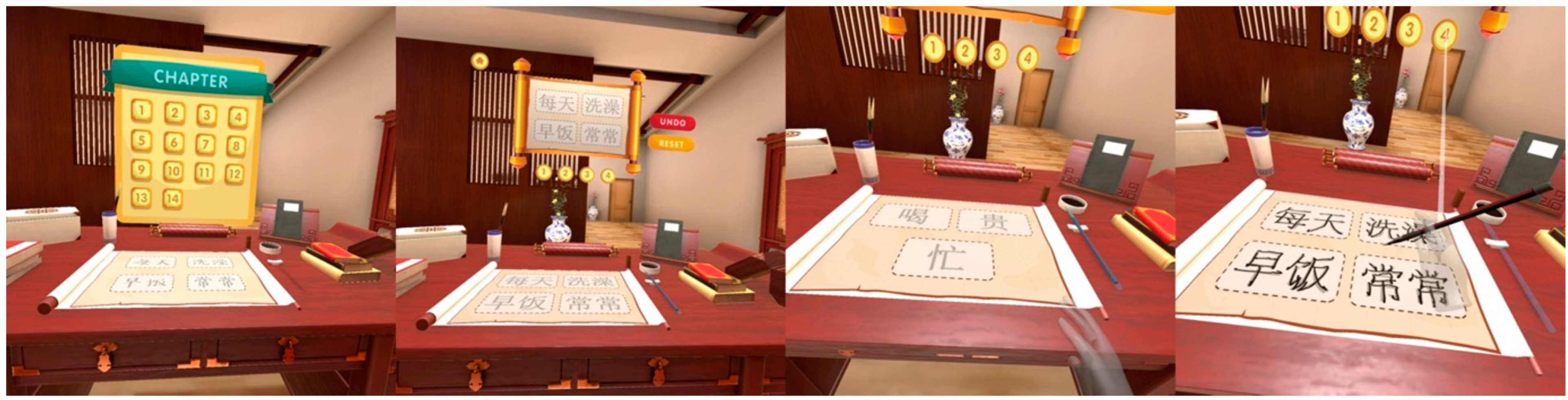
As previously mentioned, the pre-test and post-test included using a VR model and not using a VR model (non-VR group). The following section presents the statistical analyses examining the effectiveness of VR technology on students’ performance and their satisfaction.
4.1. RQ1
Table 6 presents the descriptive statistics for pre-test and post-test scores across both experimental conditions. In the VR group, the mean score increased substantially from 8.67 (SD = 2.16) in the pre-test to 12.10 (SD = 2.04) in the post-test. In contrast, the control group showed only a slight increase, with scores rising from 8.93 (SD = 1.68) to 9.23 (SD = 1.31). These results suggest that students in the experimental group achieved greater improvement than those in the control group.
Paired-samples
t-tests were conducted to examine changes in performance within each group from the pre-test to the post-test (
Table 7). The experimental group demonstrated a statistically significant improvement from the pre-test to the post-test: t(29) = −11.67,
p < 0.001. Conversely, the control group did not exhibit significant improvement, t(29) = −1.04,
p = 0.307, suggesting that traditional instructional methods alone were insufficient to produce measurable learning gains during the study period.
Independent-samples
t-tests were performed to compare post-test performance between the experimental conditions (
Table 8). Levene’s test for equality of variances was non-significant (F (1,58) = 3.74,
p = 0.058), confirming that the assumption of homogeneity of variance was met. The analysis revealed a significant difference between groups, with the experimental group scoring higher than the control group, t(58) = 6.48,
p < 0.001. The mean difference between groups was 2.87 points, with a 95% confidence interval of [1.98, 3.75], indicating that the experimental group outperformed the control group by approximately 2.9 points on average.
As shown in
Table 9, Cohen’s d = −2.13, with a 95% CI of [−2.776, −1.472]. The negative sign reflects that post-test scores were higher than pre-test scores. This represents a very large effect size, indicating that VR-based instruction produced substantial and meaningful improvements in student performance. Hedges’ correction = −2.07 confirms the robustness of this effect after correcting for sample size.
In contrast, the control group yielded a negligible effect size with Cohen’s d = −0.19 (95% CI [−0.550, 0.173]). This very small effect suggests only minimal gains from the pre-test to the post-test, and the confidence interval includes zero, implying that the change is not statistically reliable. Hedges’ correction is −0.185, further supporting the negligible effect.
The statistical analyses provide compelling evidence for the effectiveness of VR-based instruction. The experimental group’s effect size (d = −2.13) is dramatically larger than that of the control group (d = −0.19). While students in the experimental group experienced clear and substantial learning gains, the control group showed little to no measurable improvement.
4.2. RQ2: Quantitative
In the follow-up survey, which collected quantitative and qualitative data on learners’ experiences, students in the experimental group provided feedback on their perceptions of the intervention. Regarding the participants, 4 were male, 22 were female, and 1 was undisclosed. Most students (27 people) reported Chinese Proficiency Test (HSK) levels 1–2, with 3 at Chinese Proficiency Test (HSK) levels 3–4. Academically, 12 were from Social Sciences and 18 from Health/Natural Sciences. This demographic overview provides context for analyzing their experiences and responses.
Table 10 shows that learners generally held positive perceptions of VR-based tasks for Chinese language learning. Among all items, students reported the highest level of agreement with the statement regarding task interest, suggesting that the VR-based activities were highly engaging (mean = 4.90, SD = 0.31). This finding highlights the strong potential of VR to capture learners’ attention and sustain engagement during task-based learning activities.
Students also perceived clear learning benefits from the VR-supported tasks. In particular, they agreed that VR helped improve their vocabulary comprehension (mean = 4.43, SD = 0.63). Similarly, learners perceived the tasks as relevant to real-life language use (mean = 4.37, SD = 0.72), indicating that the VR environment successfully simulated authentic communicative contexts and supported practical language application.
Regarding affective outcomes, the impact of VR-based tasks on learning motivation was rated as moderate (mean = 3.80, SD = 0.41). While students generally felt more motivated when learning through VR, the motivational effect was less pronounced than their perceived interest and learning gains. When asked to compare VR-based learning with traditional instructional approaches, students expressed some uncertainty about its overall effectiveness. The mean score for this item fell below the midpoint of the scale (mean = 2.63, SD = 0.67), suggesting that learners did not yet view VR as a clear replacement for conventional classroom instruction.
Despite these reservations, students showed a relatively strong preference for VR-based learning over traditional classroom methods (mean = 3.93, SD = 0.87). This finding suggests that, although learners may still perceive limitations in VR’s effectiveness, they remain open to and supportive of its integration into Chinese language instruction.
In addition to the Likert-scale items, the survey includes multiple-choice and select-all questions.
Table 11 summarizes students’ responses to a question that allows them to select all that they think applies. The majority (28) identified Chinese character learning (Hanzi) as the most improved skill, followed by word meaning (8), pronunciation (7), and sentence construction (4).
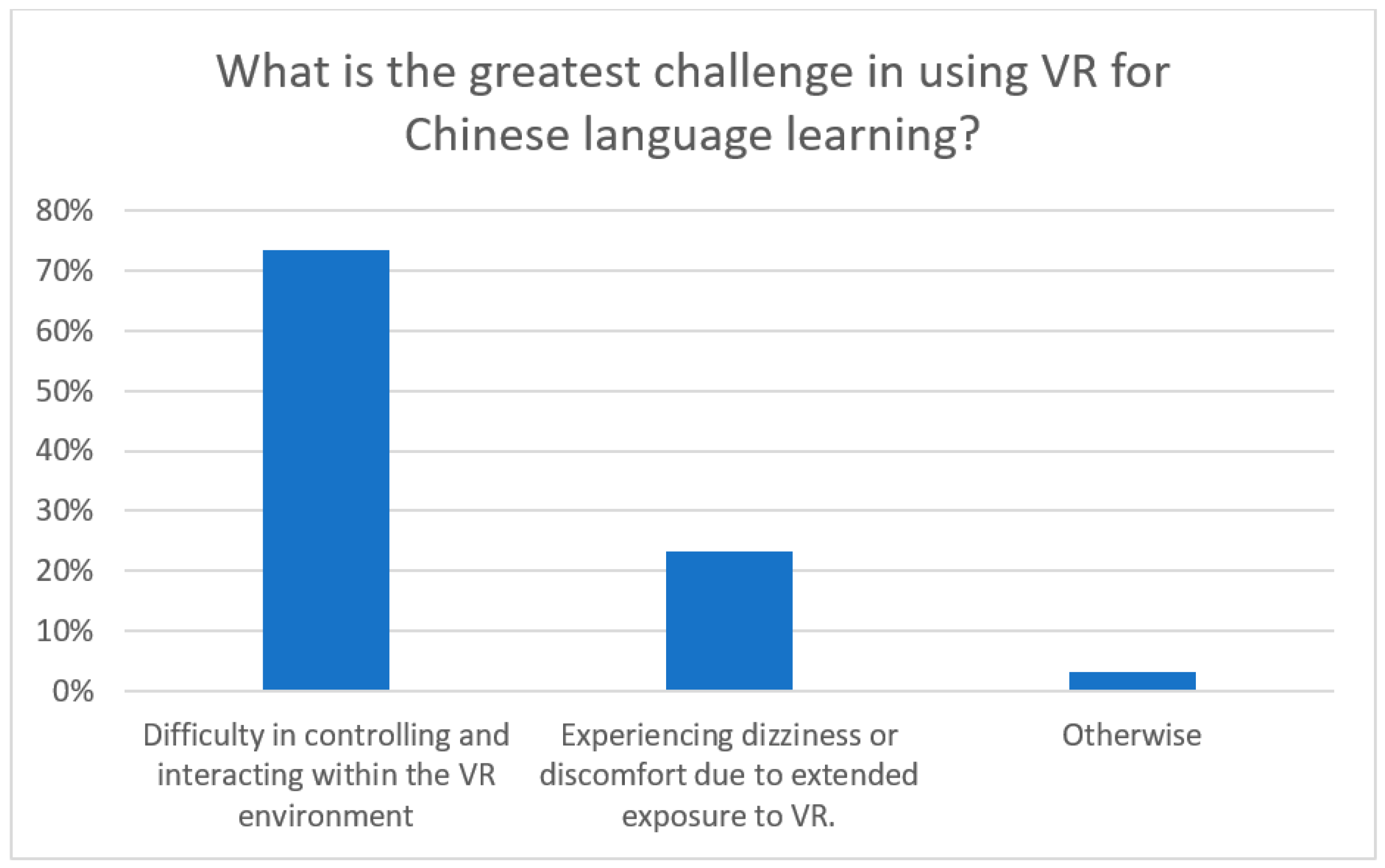
Figure 2 and
Table 12 shows that the greatest challenge was difficulty in controlling and interacting in VR (73.33%). Another 23.33% reported dizziness or discomfort, and 3.33% listed other challenges.
Qualitative Data
Open-ended survey questions enriched the results of this study. The eight themes identified are discussed below.
Differences in Interest Levels across VR Tasks
As noted earlier, the quantitative findings show that students’ interest levels were remarkably high. They were further supported by students’ open-ended responses. Many described the VR activities as enjoyable and stimulating, as shown in Comments 1–4:
“VR lessons are engaging and make learning Chinese more enjoyable.”
“It feels fun and very immersive.”
“The activities encourage me to take part and learn more.”
“VR tasks are more appealing than regular classroom activities.”
Improvement in Students’ Vocabulary Comprehension
Several qualitative comments show improvement in students’ vocabulary comprehension. Students mentioned that the immersive VR environment helped them understand and remember vocabulary more effectively:
“VR makes it easier for me to recall new vocabulary.”
“I can grasp the meanings of words more clearly when I view them in VR.”
“The visuals help me link the vocabulary to real-life contexts.”
“Learning vocabulary through VR feels much clearer and more understandable.”
Real-Life Language Application
The qualitative evidence offers additional insights into real-life language application when VR is used. Students noted that VR enabled them to connect classroom learning with practical communication:
“VR presents scenarios that feel very close to real life.”
“I can see how Chinese is actually used beyond the classroom.”
“It allows me to practice in realistic situations.”
“I can picture myself using Chinese in real-world environments.”
These responses indicate that VR effectively links instructional content with authentic language use.
Students’ Motivation
A substantial majority of students (80%) reported that VR significantly increased their motivation to learn Chinese, while the remaining 20% indicated a moderate increase. Students’ written comments reflect a similar pattern, showing that VR made lessons more engaging and encouraged active participation:
“VR makes the lessons more engaging and motivates me to learn.”
“I feel more alert and focused.”
“The immersive experience keeps me fully engaged.”
“VR inspires me to study Chinese more actively.”
Skills Improvement
In the quantitative results, students identified the language skills that were most improved through VR activities. Students’ qualitative comments provide insight into why Hanzi writing showed the largest gains.
“VR helps me clearly visualize the stroke order.”
“Seeing characters in 3D makes them easier to remember.”
“It makes understanding how to write the characters much simpler.”
Perceived Effectiveness Compared with Traditional Learning
Students were also asked to compare the effectiveness of VR tasks with traditional learning methods. The results showed that 73.33% believed VR was more effective, 16.67% viewed it as equally effective, and 10% considered it less effective.
“VR helps me grasp concepts more quickly.”
“It is more interactive than traditional lessons.”
“Conventional lessons feel less engaging.”
Challenges Encountered
Students reported various challenges in using VR. The majority (73.33%) found it difficult to control or interact in the VR environment, 23.33% experienced dizziness or discomfort, and 3.33% noted other minor issues.
“Sometimes the controls are hard to use.”
“I feel dizzy after using the headset.”
“It’s fun but a bit challenging to navigate.”
Students’ Preference for VR
When asked whether they preferred VR to traditional classroom instruction, 66.7% agreed (30% strongly agreed, 36.7% agreed). Another 30% selected a neutral response, while 3.3% disagreed.
“I prefer VR because it keeps me more engaged.”
“VR makes learning clearer and more enjoyable.”
“I still appreciate traditional lessons at times, but VR is more fun.”