1. Introduction
The relationship between humans and music has been studied from various perspectives, focusing on its effects on intellectual, social, and personal development (
Hallam, 2015). Studying how people behave in environments related to musical learning is useful for identifying and analyzing the relationships between the factors surrounding the educational experience, thereby understanding, enriching, valuing, innovating, or transforming it.
Self-reflection serves as a valuable analytical tool in education. It involves constructing and recognizing meaning related to identity and understanding their connection to learning. This process enhances guidance and comprehension of learning contexts (
Coll & Falsafi, 2010). This approach is particularly relevant for analyzing the learning experiences of children and young people in an orchestra, particularly in the context of social action through music.
On the other hand, studying the interactions between people, contexts, and life experiences allows us to understand learning, musical development, and the meanings that participants attribute to music-related activities (
O’Neil, 2017). To make inferences and discuss the potential benefits of arts learning, a more profound understanding of the processes involved and the contextual elements that can contribute to the outcomes of this interaction is necessary (
Martin et al., 2013). Regarding children and youth orchestras, analyzing and understanding these elements can guide and support decision-making about music education practices and the implementation of cultural and educational policies that respond to the needs of each context.
It is assumed that in a training process, such as that represented by the orchestra, the way in which the teacher structures the class, the teaching strategies used, and the articulation of the elements of their practice influence students’ self-perceptions (
Martinez-Carpio, 2009) and the perceived benefits related to musical practice (
Giráldez, 2007). Self-perceptions construct identity and self-concept (
Shavelson et al., 1976;
Spychiger, 2017). Analyzing and understanding the bidirectional relationship between music education practices and identity construction can provide resources that promote the improvement and innovation of musical practices.
1.1. Identity and Teacher Identity
From the social cognitive perspective, identity is defined as a cognitive structure or self-theory that offers a personal interpretative framework for evaluating self-relevant information, resolving conflicts, and making decisions (
Berzonsky, 2011). This personal interpretative framework is a set of cognitions and mental representations that the subject forms based on their self-perceptions.
Additionally, identity encompasses both our self-perception and the perception that others have of us. Identity can also be understood as a discursive and mental construct that individuals use to express a particular way of seeing and feeling themselves in relation to their environment (
Bolívar et al., 2014). Here, the role of language stands out, making it possible to articulate what we conceive about ourselves. Language is essentially a mediating tool that enables the organization of thoughts within a complex structure (
Luria, 1976).
Subjective representations of identity are organized narratively, which allows us to make sense of experiences, the world, others, and ourselves. From this perspective, we are considered narrators of our stories, and the way we live our lives is inseparable from the way we tell stories (
Bruner, 1991). Based on this idea of construction through narrative, we can draw on Paul Ricoeur’s conception of narrative identity, in which the sense of “self” is defined through storytelling (
Ricoeur, 1996).
Teacher identity, viewed as a process, considers the configuration of subjective representations related to the teaching profession. This process involves self-definitions and self-representations that teachers perceive in their personal trajectory, and it is also developed considering collective constructions associated with their work. In other words, professional teacher identity is constructed and reconstructed through the interaction and interrelation between personal and social identity (
Jorquera-Jaramillo & Gutiérrez, 2013). In the long process of constructing teacher identity, there is an involvement in the experiences teachers have had as students, their inclination or vocation toward teaching, and the beginnings of their professional development, among other aspects (
Bolívar et al., 2014).
The most recurrent postmodern characterizations of teacher identity are related to its multiplicity, discontinuity, and social nature. Teacher identity is an entity that changes over time and context. For its part, dialogical self-theory conceives of identity as multiple and unitary, continuous and simultaneously discontinuous, and both social and individual (
Akkerman & Meijer, 2011).
The dialogical self-theory explores identity as a narrative construction, highlighting the dialogue that connects social and individual identities. While we construct our identities through our narratives, we hold a distinctive position within the network of narratives in which we engage in society (
MacIntyre, 1981). Teachers’ narratives intertwine personal and professional factors, which are negotiated between their internal experiences and external circumstances (
Abramson & Schachter, 2024).
This research considers teacher identity as a complex process in which people develop subjective representations of what it means to be a teacher in interaction with each educational context. The notion of narrative identity enables us to comprehend the individual’s negotiation and organization of mental representations, as well as their acquisition of meaning. Based on the above, it is considered useful to analyze the narratives of teacher identities of the participants from children and youth orchestra programs included in this study to understand how their contexts shape subjective representations about their jobs in an interactive and reciprocal way and how they acquire meaning.
Kelchtermans (
2007,
2009) has made significant contributions to the study of teachers’ personal interpretive framework, noting that the mental representations and the set of cognitions that make up this framework operate as lenses through which teachers view their work, assign meaning to it, and act accordingly. He uses the term “self-understanding” to name this personal interpretive framework, avoiding the notion of identity, as will be discussed later. For the above reasons, this study adopted this author’s approach, as it offers an empirically grounded conceptual framework on teacher development and teacher professionalism.
1.2. The Relationship Between a Musician’s Professional Identity and Their Teaching Identity
According to
Guadarrama (
2019), professional identity is an ongoing process that reshapes various elements of the artistic field, career paths, and the social and historical conditions in which artists pursue their careers. This author examines questions surrounding the definition of a professional musician and how this status is attained to explain how social recognition influences musicians’ professions and their social-labor conditions in the Mexican context.
Kelchtermans (
2009) discusses the difficulty of determining the precise type of expertise required for teaching in a specific discipline. This includes the skills, knowledge, and attitudes required, as well as an understanding of how teachers acquire and develop this expertise.
When analyzing the identities of music teachers, it is crucial to analyze the significance of being a teacher in terms of opportunities and obligations (
Roberts, 2004). This suggests a need to explore the representations that teachers create regarding the opportunities their work presents and the obligations they acknowledge. Their motivation, attitude, and commitment to their professional teaching performance reflect these elements.
The factors involved in identity and its modification, as well as teachers’ perceived self-efficacy, depend on the social context, life experiences, professional stage, relationships with colleagues and students, the organization of the academic environment, and their life circumstances (
Bolívar, 2007). Additionally, teachers shape their professional identity through their perceptions of their knowledge and capabilities, including what they should know and what they can do (
Beijaard et al., 2000).
Teacher identity, professional identity, and professional development in the arts are influenced by social change.
Bowe et al. (
1992) argue that social change in education occurs through a complex and interactive cycle, explaining that education policy evolves through three main levels or contexts. The first is the “context of influence,” a macro-level that relies on the political sector and social and economic forces, driving the educational system to adapt to new production systems. The second is the “context of policy text production,” a meso-level that includes the legal and administrative framework guiding teachers’ actions in the classroom and shaping their professionalism. Lastly, the “context of practice” represents a micro-level, illustrating the actual environment where teachers engage in their daily work.
For this research, the macro level depends on the cultural institutions that fund orchestral programs and manage resources at the state or federal level. The second level comprises the management or coordination of orchestral programs, whose decisions influence the professional development of educators. The final level consists of the teachers’ usual environment for teaching music in the classroom.
Social change results in a restructuring of educational leadership, which continuously reconstructs each teacher’s identity (
Bolívar et al., 2014). Additionally, the social status of a job influences the hiring of future teachers, the retention of experienced teachers, and ultimately, the way in which public policies concerning this field are developed (
Kelchtermans, 2007).
The ongoing reconstruction of teachers’ identities brings with it their vulnerability. Social change brings with it greater emphasis on effectiveness and efficiency and the achievement of learning objectives under certain working conditions over which teachers have no control (
Kelchtermans, 2009). It is necessary to understand the real conditions and the everyday realities that shape teachers’ identity development. That is why the investigation into the vulnerability of teachers’ identities in music projects with social purposes can contribute to supporting decisions in the music-educational field at all levels: macro, meso, and micro.
1.3. A Conceptual Framework for Understanding Teacher Development and Professionalism
According to
Kelchtermans (
2009), the term “self-understanding” refers to the conception of the self as a product at a certain moment and a process of making sense of experiences that construct the self. He avoided using the notion of identity, which is often understood as stable and fixed in the social sciences. Self-understanding is an analytical term that emphasizes situated subjectivity. It refers to how specific social location and context shape an individual’s experiences and perspectives (
Brubaker & Cooper, 2000).
As mentioned previously, this study conceived identity as meanings that are organized narratively. Given that identity configuration is a dynamic process, the self-understanding conceptual framework can effectively analyze the meanings of experiences. This research identified the significance that participating teachers attributed to their actions and the roles these actions play in shaping their self-understanding. However, the concept of teacher identity was derived from the narrative approach to explore how personal and professional factors interact and are negotiated within the context of internal and external experiences and circumstances.
In his work, Kelchtermans identified five components of a teacher’s self-understanding: self-image, self-esteem, task perception, job motivation, and future perspective.
Self-image is a descriptive component based on self-perception; it is the way teachers perceive themselves, which is largely affected by the way they are perceived by others. Self-esteem, an evaluative component, signifies the teacher’s assessment of their actual job performance. Task perception is a normative component that encompasses the beliefs and ideas about what tasks and duties are considered necessary in their performance as teachers. The job motivation component “refers to the motives or drives that make people choose to become teachers, stay in teaching, or give it up for another career” (p. 262). Finally, the future perspective is a time element that refers to the teacher’s expectations about the future, considering the meaningful experiences from the past.
This study analyzed the narrative identities of teachers in children and youth orchestras using this conceptual framework.
1.4. Children and Youth Orchestras in Mexico
In the past 20 years, community orchestras have gained popularity and increased in number throughout Latin America. Many of these orchestras have adopted the model of the National System of Children and Youth Orchestras from Venezuela (
Wald, 2017). “Social Action through Music” is a field that aims to achieve social transformation and inclusion. The focus is on orchestral learning, mainly through symphonic orchestras, whose repertoire is based on classical music (
Baker, 2022).
In countries such as England, Portugal, the United States of America, Colombia, Venezuela, Argentina, and Chile, research on children and youth orchestra programs has focused on the benefits obtained by the participants, such as personal development (
Creech et al., 2016;
Rincón, 2012) and the development of social skills (
Lewis et al., 2011), among others. However, few studies analyze the learning that takes place in children and youth orchestras and their relationship to their identity formation (
Wald, 2017;
Valenzuela et al., 2018). Little attention has been paid to the process surrounding the association between the individual and these types of musical programs. It is stated that something “miraculous” happens in community music. However, other perspectives need to encourage participation in a more rigorous analysis that also examines the problems or difficulties that arise in these practices and reflects more deeply on the processes that lie beneath the surface in community music initiatives for social change (
Bartleet & Higgins, 2018;
Baker, 2022).
In the Mexican context, some research has focused on children and youth orchestras (
Prieto-Astudillo, 2014;
Morales-Petersen, 2015;
Capistrán Gracia & Reyes Sosa, 2020). While these studies have laid the groundwork for reflecting on and discussing the teaching and learning processes that take place in orchestras of this nature, the understanding, guidance, and evaluation of the learning practices and situations within community-based children and youth orchestra programs in Mexico remain insufficient, due to the limited information available regarding the meanings that participants attribute to this orchestral activity.
1.5. Research Questions
The study addressed the following questions: What is the self-perception of teachers regarding their roles in the orchestral program? What training do orchestra teachers require for their work? How do orchestra teachers perceive themselves as professionals? What are their working conditions? Answering these questions can contribute to a more profound understanding of the factors related to teachers’ identity and development in the context of children and youth orchestras. Studies like this can lead to changes in the vocational training process for music teachers. Furthermore, it can help identify teachers’ training needs and work requirements. This work stems from doctoral research whose purpose was to understand the identities of students and teachers in children and youth orchestras in Mexico (
Ortiz-Cortés, 2023). A previous study reflects on the actions carried out by six conductor–teachers of children and youth orchestras for virtual learning during the COVID-19 pandemic in Mexico (
Ortiz-Cortés & Carbajal-Vaca, 2022).
The involvement of the first author in this research derives from the teaching experience acquired in children and youth orchestras. Additionally, her involvement stemmed from her prior experience in research activities focused on understanding and innovating musical learning situations. The review of the literature on the effects of music and on music for social change raised questions about the complexity of the learning contexts that these orchestras represent. This work identified the need for an approach that would study and understand these relationships and interconnections.
3. Results
The section below presents the findings following
Kelchtermans’ (
2009) teachers’ self-understanding model.
3.1. Self-Image
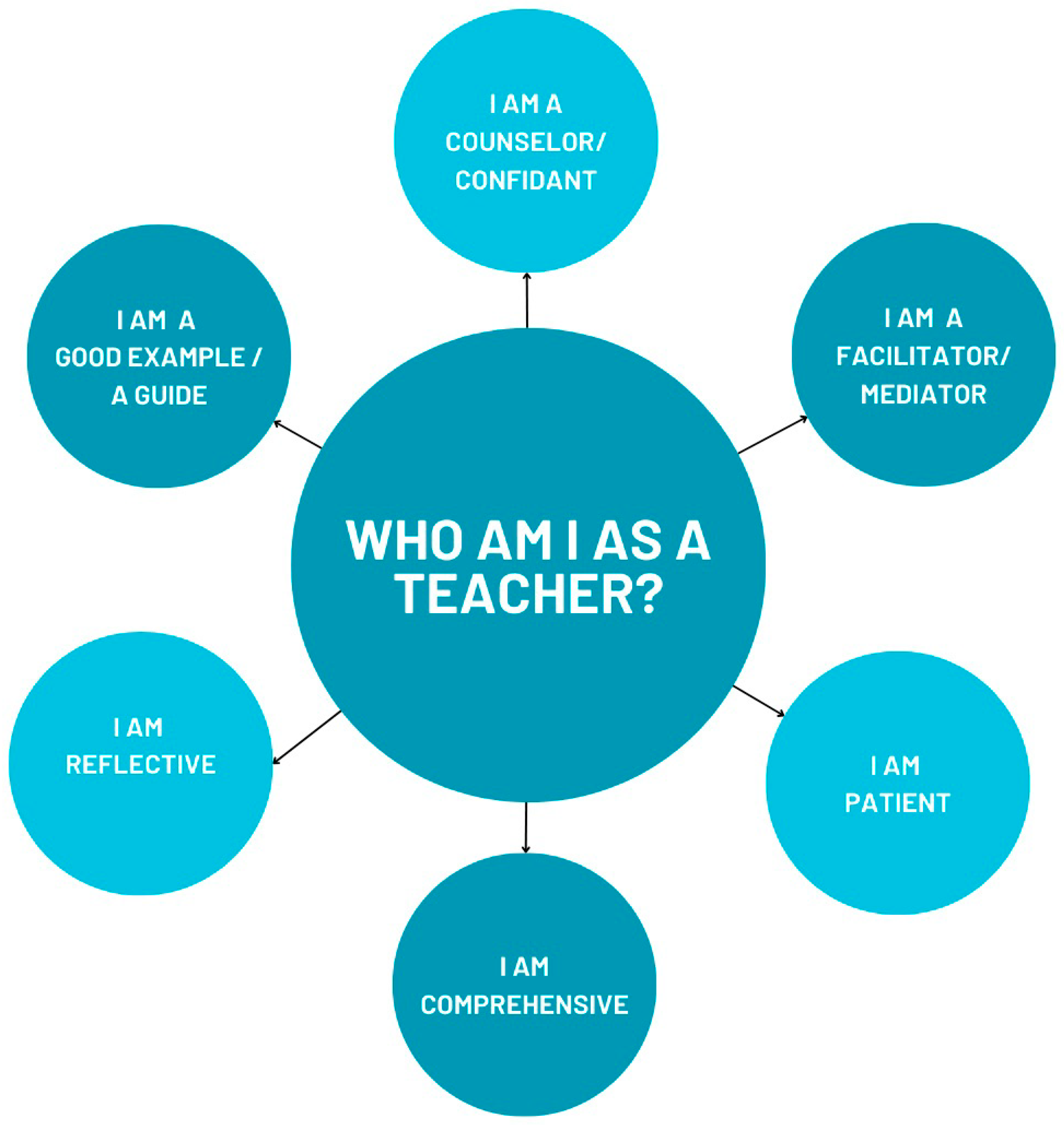
Self-image is a descriptive component based on self-perceptions. In this study, the way to access the teachers’ self-perceptions in a narrative way was through the “Who am I as a teacher?” research technique. In this task, teachers were asked to create a list of phrases, adjectives, or words in response to this question. Furthermore, the information derived from this instrument was discussed in a second interview. Subsequently, information from all participants was analyzed to identify differences and commonalities. This section’s data derives from the interview transcripts in which teachers described themselves as members of their orchestral program. The responses were more aligned with the definition of their self-concept and self-image, which allowed for the analysis of subjective representations and what it means for them to perform certain roles and possess certain characteristics by which they perceive themselves in relation to their work in interaction whit each context. The analysis of the participants’ self-image was developed based on narrative data about the meanings that the teachers assigned to their self-concepts. Additionally, the information discussed in this section is connected to other sections, as will be explained later, because self-image was found to be closely related to task perception and future perspective.
According to information gathered from the narratives of teachers in the studied programs, they perceive themselves according to their tasks: as role models, guides, leaders, mediators, and advisors, among other descriptions. This characterization reveals a correlation between the development of their skills and their social commitment, in terms of responsibility toward the community that the orchestra represents.
The data collected from both programs highlight teachers’ self-perception and the way they believe students perceive them, resulting in a self-image of educators who serve as guides, assessing learning needs, and adapting methods to achieve specific learning outcomes.
Figure 1 shows a summary of the adjectives or words that appeared most frequently in the teachers’ lists. Words that are associated with or considered synonyms were grouped into the same category, for example, counselor/confidant. They were grouped into the same category based on the explanations the teachers gave regarding the meaning they assigned to that term.
Self-descriptions from program B participants were oriented toward their pedagogical model. The use of phrases like “teacher and facilitator” or “learning facilitator” and the descriptions of themselves as learning mediators show a shift away from the traditional teaching model and towards more constructivist or dialogic-oriented teaching models. For example, participant B1 explained why he wrote the word “democratic” to describe himself: “I started teaching at a very young age and never liked imposing my will, not even when I taught children […]; in fact, I have never liked imposing my ideas in any of the groups I have played in. I always ask if they agree or what they propose. I never believed that my ideas were superior simply because I held the position of teacher” (5 August 2022).
The interviewed teachers from both programs are instrumental performance specialists within higher music education programs at conservatories and music schools, but they did not receive specialized training in pedagogy during their studies in college. Participants from Program A reported having acquired knowledge of pedagogy through their experience in the program. Additionally, two teachers reported currently pursuing a master’s degree in education. For their part, participants from Program B have received ongoing teacher training as part of the program.
It is important to strengthen the pedagogical area in both programs, since in their descriptions, the teachers also identified difficulties in their interaction with students regarding the learning process. Participant B1 pointed out, “There are times when patience runs out […] when I lose my patience, my energy drops […] I start speaking in a tired way” (5 August 2022).
As an example from program B, these are the phrases that participant B2 used to describe himself as a teacher: “teacher and facilitator,” “example and image,” “guide and counselor,” “confidant,” and “support (for students and parents).”
On the other hand, participants’ descriptions from program A emphasize being flexible and comprehensive teachers. For example, participant A1 pointed out, “I think that a large part of teaching requires being understanding with the students, with the situations we face with parents, with the orchestra’s administration, and with the rehearsal spaces.” She reaffirmed, “It is a job that requires a lot of reflection and flexibility from teachers, and being always open to changes” (20 May 2022).
As an example from program A, these are the words participant A5 used to describe herself as a teacher and director in the orchestral program: efficient, comprehensive, strong, calm, patient, decisive, accurate, objective, analytical, observant, and reflective.
The view of themselves as guides and role models was present in the descriptions provided by teachers in both programs; some teachers identified as “guides” in the sense of being counselors. This topic will be discussed later in the Task Perception section. In the following example, participant A1 detailed what it means for her to see herself as a guide: “We are instrumental teachers, but I think many times we end up being a bit like guides when it comes to other things that happen, for example, at home or at school. Many students, for example, come in with anxieties and worries, and we are not psychologists, right? But we often must help them resolve those issues; working together, I think, is what gradually helps them over time” (14 October 2021).
The self-description of participant B2 as a guide, according to what he explained, means to be someone who can teach technical aspects in music because he possesses those technical skills. This implies, to him, continuing to develop professionally in music and to keep learning. “For me, being a guide means having the opportunity to set an example for them […] by saying, ‘I want a cantabile like this,’ or ‘I want a staccato like this,’ and showing them how to do it” (4 August 2022).
Similarly, in both programs, the teachers’ self-image emphasized being “examples” in the sense of serving as role models for music learners and as active musicians. This topic will be discussed in more detail in the Future Perspective section.
Participant A2 expressed what it means to her to perceive herself as an example for students: “I give an example of how you can end up playing in orchestras and making a living from music, but obviously you have to study and be disciplined […] students are always very attentive to what we teachers do” (6 August 2022).
Additionally, in line with perceptual–humanistic thinking, the relationship between teachers’ abilities and their self-perceptions is highlighted: seeing themselves as capable or incapable, and adequate or inadequate, is a determining factor in their performance and sense of accomplishment. This value judgment is related to the next dimension, self-esteem.
3.2. Self-Esteem
Self-esteem is the teacher’s evaluation of their actual job performance. The results indicate that an important element in their self-esteem as teachers is initial and ongoing teacher training. In the case of Program A, orchestra teachers sought resources outside the program for performing their work effectively. These resources included taking courses and seminars and pursuing second bachelor’s degrees or even master’s degrees. Program A takes place in Mexico City, where there are ample options for specialized training, whether in pedagogy or orchestral conducting, but it is important to note that this training is not part of the program, and the teachers cover the costs of these courses. Additionally, these experiences can lead to heterogeneous approaches. Program B’s training has been ongoing. Since it takes place in the Bajío region, the options for pedagogical–musical training are limited; however, according to their narratives, the program has provided them with everything necessary to develop as teachers and ensemble directors. The training they receive involves knowledge in multi-instrumental teaching, ensemble direction, and pedagogy.
Self-esteem is an evaluative component closely related to self-efficacy. The analyzed results indicate that an important aspect that allows teachers to receive information about their job performance is the progress of their students in their musical learning and their personal and academic development. Appreciating the progress of their students lets them know how they are performing as teachers and understand their successes and mistakes. The participants of both programs provided photographs that were taken with their students before or during the concerts, either individually, accompanied by one or two students, or in groups, with the orchestral section or with the entire orchestra. The places where the photographs were taken were at music festivals or recitals in different concert halls and stages that they described as significant to them due to their cultural relevance. When discussing these photographs, the teachers’ narratives revolved around significant events in musical advancement and the attitudes or skills of their students, with respect to their personal and socio-emotional development. The example below is a description of a photograph shared by a teacher, where we can notice the relationship between the perception of her students’ development and her self-efficacy as a teacher. In the photograph, the teacher is seen with her students after a recital, with their violins and bows in hand, posing while standing next to the piano in a concert hall.
“I love seeing my students learn what I teach and prepare them for their audition, which helps me see what works and what doesn’t. I love seeing my students, and I’m glad they get along with their classmates and can work in teams”.
(A2, 8 April 2022)
Similarly, participant A4 perceived that the orchestra’s achievement reflected his self-efficacy as a teacher and conductor: “In the orchestra we have had the opportunity to go to the Washington Music Festival […], and they have seen the work; they see the quality. […] I think it went quite well for me” (31 August 2021).
Following the same idea, participant B2 from Program B noted in one of his narratives what the progress of one of the percussion students evoked in him: “At first he did not talk much, and every time he did something right he would smile […] his smile was our smile […] A lot happened to him, but he became one of the best percussionists in the program, and I think that makes me happier than it does him” (8 April 2022). Additionally, this teacher indicated as a source of “satisfaction” that many of his students had gained admission to conservatories and universities to study music professionally.
3.3. Task Perception
In their narratives, teachers from program A expressed that their roles extend beyond just teaching, as one teacher noted in her description of a photograph. In the photograph, the teacher is seen placing plastic on the windows of the cultural center where the viola section rehearsals take place, which is the section she teaches. The mother of one of her students accompanies her in the photograph, collaborating with her on this task: “This photo is from a week ago; we are together with the mothers of the orchestra putting plastic sheeting on some windows of the cultural center. I look at it and think that we do everything! But that makes me happy” (A1, 20 May 2022). When discussing her perception of this type of task, the participant pointed out that: “It is for the benefit of the orchestra community.”
Through their narratives, the teachers noted that they perform all kinds of tasks, from cleaning spaces to carrying music stands or chairs, as participant A4 pointed out, “I have had to schedule classes […] I have even had to paint the orchestra headquarters” (31 August 2021).
Four of the teachers in Program A explained that they also serve as directors. Additionally, the directors oversee the management of the loaned instruments. They also perform school administration tasks, including keeping attendance lists, monitoring students, and handling registration processes, among other activities.
On the other hand, Program B has an organized structure with coordinating roles such as general coordination, training coordination, choir coordination, band coordination, and string coordination. Teachers from program B constantly receive pedagogical training and develop necessary skills to direct ensembles, sectional and orchestral rehearsals, as well as teach various instruments.
The involvement in situations related to the students’ socio-emotional development is an important aspect that emerged from the teachers’ self-perceptions from both programs. The participants expressed that socio-emotional development is essential to them and constitutes the strategy for achieving the professional objectives of the orchestral programs and gaining social impact through musical training. As an example of this situation, we can recall what participant B3 expressed:
Sensitize human beings and the community […] to the idea that community work bears fruit […]. An orchestra cannot function effectively without community involvement; if we do not engage with the community, it will fail to thrive.
(18 October 2021)
This statement aligns with participant A3’s perspective:
[…] the fundamental task is to create community profiles for individuals who can integrate into a community, as the orchestra ultimately serves as an example of an ecosystem and community.
(2 September 2021)
According to teachers, developing programs requires empathy, and addressing the teacher–student relationship requires proper training:
[…] The pandemic has made it even more important for teachers to be empathetic when interacting with students. I had children in crisis every day. Knowing how to contain a child, guide a child, and navigate a crisis are all types of training that we should have.
(A6, 28 October 2021)
I value community development; it is vital to connect with the guys […] so a student can come and say, “You know what? I am facing this situation; I am uncertain about whom to approach; I am experiencing feelings of depression or sadness, or I observe that there is a particular issue occurring within my household […]. I think that is the purpose, does not it? I believe that the guys can adopt a more human approach, beyond just music” (B3, 17 September 2021).
Through the dialogue that emerged around the photographs shared by teachers from program B, the participants reflected on their task perception and took the time to explain their interaction with the students and the way their tasks focused on aspects related to listening, empathy, and understanding what the students experience in their everyday environments. For example, participant B1 shared a photo with a student and explained their interaction: “Sometimes he talks about how he feels, and if something is going on, he always asks for advice […]. I believe that the musical aspect is often overlooked; it is not a lack of attention but rather a shift towards a more social approach” (5 August 2022).
The need for relevant training in psychology issues, including socio-emotional skills, problem-solving, psychological first aid, and tutoring, among others, is emphasized to assess the progress of teachers’ work and determine when it would be more appropriate to refer a student to another professional. Likewise, they must know how to establish clear boundaries in the teacher–student relationship.
Teachers from program B expressed in their narratives that one conflict they consistently face is the demonstration of results through concerts, which implies commitment to the institutions that fund the programs. For instance, participant B4 pointed out that these samples of “results” do not allow us to see the depth of educational processes.
[…] However, in many programs, the orchestra’s appearance or its presenter still overshadows the learning process, prioritizing the governor’s or the president’s benefit. Sometimes it happens like this because it is a commitment, and our dependence on the state government is sometimes obvious. […].
(8 October 2021)
Teachers stated that they are primarily focused on preparing the repertoire for upcoming concerts, prioritizing it over other repertoires and knowledge that may be more relevant to the students’ current stage of musical development. In this context, a conflict arises between the teachers’ envisioned educational goals and the educational requirements they must meet.
3.4. Job Motivation
In their narratives, orchestra teachers from both programs acknowledge their commitment to students in establishing a “friendly environment” or “an atmosphere of warmth.” The programs foster interpersonal relationships that provide socio-emotional support for their members.
In program A, the friendly environment was more noticeable, since eight of the total orchestra teachers interviewed participated in the program during their student stage. A participant expressed that she had found refuge in the orchestra when she faced family issues in her time as a student. She pointed out that now, as teachers, they provide the same support they received during their time as students:
“We are the psychologists, we are the nurses, we are the refuge of many of my students”.
(A5, 19 May 2022)
Several teachers highlighted the desire to benefit from this program because they received the same benefit when they were students:
“It [the program] changed my life, especially due to my circumstances and social environment. I understand what can change your life and open new possibilities. I know this community can help, and if students are comfortable, they will join the program.”
(A6, 28 October 2021)
“I feel very grateful to the program for everything I have received here, and I want to benefit from it as well.”.
(A4, 31 August 2021)
Through their participation in orchestral programs, both students and orchestra teachers could experience traveling and attending music festivals in other cities, states, or countries, opening possibilities and perspectives that are different from their reality. Participant A4 pointed out, “We have had the opportunity to go to another country; imagine the cultural richness on display at those international festivals. […] They and I have had the chance to enjoy the wonders this program offers” (31 August 2021). Similarly, participant A5, who is also the orchestra’s director, pointed out that these kinds of experiences fill her with pride, given the extensive preparation behind each musical performance. She shared these thoughts, posting a photograph showing her with her students in a concert hall during a music festival that took place in Argentina. In the photo, the entire group of students can be seen. Two of them are clutching a Mexican flag. She shared the photograph accompanied by a description detailing that the photo shows her with her students in Buenos Aires, Argentina, during a music festival where they performed. She mentioned that the students remembered these experiences as some of the most significant in their lives. Their memories motivated her to continue leading the orchestra.
The employment situation of the teaching musicians is another important aspect that motivates their participation in the programs, especially in program B, which, due to its geographical location, has fewer job opportunities for professional musicians. For example, a smaller number of professional orchestras are in this region compared to Mexico City, where the country’s main orchestras are located. Similarly, Mexico City has a higher concentration of music initiation schools, cultural centers, music faculties, academies, and conservatories.
As they noted in their narratives, teachers consider participating in the program as a stable source of work, even though it is considered informal due to the lack of labor rights such as social security, non-salary benefits, and severance pay. The findings showed that the participants engage in professional musical activities in various contexts, including recordings, events, quartets, chamber orchestras, and others.
However, belonging to the orchestral program provides teachers with a degree of economic stability, since the other artistic projects they are involved in tend to be temporary. This information was expressed in the ecomap research technique, where the participants created a diagram of the different spheres in which they work as artists and musicians.
Through one of the research techniques, the timeline, participant B1 highlighted a decisive moment before joining the program. He moved to Mexico City in search of job opportunities as a professional musician; after several months of searching, he took a job as a cashier at a bookstore. In his timeline, he wrote, “Cashier at a bookstore.” And he explained the following: “It left an impression on me because it was a seasonal/temporal job […] when I auditioned for the program and got in, it helped me appreciate it. I told myself, “I must take care of this; I cannot let it go so easily […] I am going to put all my effort into it” (5 August 2022).
3.5. Future Perspective
The interviewees from Program B expressed that this program affords them the opportunity to develop as musicians and performers. It features a faculty orchestra that performs in concerts, allowing them to fulfill a professional development opportunity. Participant B1 shared a photo in which he is seen performing along with the teachers’ orchestra in one of the most emblematic theaters of a city where the orchestral program takes place and included the following description: “In this photo, we are playing—the teachers’ orchestra in the theater. I had never played there before […], but I value playing and spending time with my colleagues.” (5 August 2022).
Through one of the research techniques, the “Who am I as a teacher?” task, the participant B1, wrote the word “interpreter” and then explained, “The program allows me to do that, in addition to everything else—the pedagogical, the community-based, and everything else. The program has allowed me to stay active, to keep playing […], which I often compared to when I was working in high school, where it was basically teaching and then doing attendance lists and lesson planning […]. When I was working there, I refrained from playing for approximately one year due to a demanding schedule. I like that part of the program […] continuing to learn musically […] continuing to perform music” (5 August 2022).
In his narrative, participant B2 explained that first he needs to perform the technical aspects by himself and then explain these technical aspects to students. His position requires continued studying and developing his instrumental skills, as he pointed out: “A musician never rests […] fingering, embouchure, sight-reading, solfège, harmony, everything. We must continue to prepare ourselves in this area […].” (B2, 5 September 2021). Following the same idea, through the “Who am I as a teacher?” task, this teacher wrote the word “guide” and expressed that it is important for him to be a professionally active musician, since that allows him to explain to students what he is teaching them in an empirical way: “For me, being a guide means having the opportunity to set an example for them […] by saying, ‘I want a cantabile like this,’ or ‘I want a staccato like this,’ and showing them how to do it.” (4 August 2022).
Echoing the idea of musical growth, one of the teachers pointed out that being in the orchestral program implies constant growth in a personal, human, and professional sense: “Musically, it also means having this idea that what we teach is what we are. Therefore, if I want to teach something worthwhile, something true, I must test it on myself first. This attitude has given me an entirely unique perspective and has helped me in my personal, human, and professional development” (B4, 8 October 2021).
Receiving training in the program allows them to teach others basic and intermediate levels of instruments different from the ones they studied in their undergraduate degree. This approach, combined with the knowledge acquired in orchestral conducting, enables the teachers to broaden their musical horizons. As they mentioned in the interviews, this approach presents them with a wider vision of other musical aspects that transcend teaching a single instrument, such as working in ensembles, and implies growth as musicians, which contributes to the development of their musical identity.
The program’s training and experience help teachers gain confidence in music teaching by acquiring specialized knowledge, as participant B5 said: “We began training with the vision that we were no longer just going to be instrumentalists, but that we were going to become conductors and instructors. Therefore, in this initial course, I, as a French horn player, had to learn somewhat about the violin, viola, cello, double bass, oboe, and flute. It was very intriguing because these were entirely new instruments for us” (6 October 2021).
In a similar way, interviewees from program A pointed out, “It is important that the teachers and directors of the orchestra have experience developing as instrumentalists in a professional orchestra and, especially, that they are active musicians” (A4, 31 August 2021).
Furthermore, the ongoing development of teachers as instrumentalists and educators, while utilizing all available resources, highlights a significant challenge: serving as role models for learning. In other words, the teacher will inspire students to seek knowledge and not settle for the basics. As participant A4 indicated, it is important to continue developing as musicians: “When teachers are active musicians, they push their students to improve because they themselves are also active and know what it is all about” (31 August 2021).
Additionally, two teachers from Program A are pursuing a master’s degree. Participant A2, who is pursuing a master’s degree in education, emphasized the importance of continuing her studies, since her musical performance training did not provide the pedagogical foundation, which she believes is necessary for her professional practice. For her part, participant A5 is pursuing a master’s degree in educational innovation; she explained, “I think this master’s program will be very beneficial in bringing a new educational approach to my community.” (19 May 2022).
4. Discussion
The two children and youth orchestra programs analyzed differ in aspects related to their administration and organization. Some of the most prominent aspects of teacher identity converge and are evident in the narratives of the teachers in both programs. Based on the information gathered and subsequently analyzed, we can draw some inferences that may guide the development of children and youth orchestra programs in Mexico.
First, regarding self-image, it is important to highlight that the view of teachers as facilitators is contrary to the approach taken in conservatories and music schools, where the instrumental teacher dictates the class and is the one from whom students are expected to learn, sometimes without questioning anything. In this context, the relationship between a teacher and a student is characterized by a power imbalance between the two roles, leading to a lack of motivation and interest in learning and the resulting academic failure associated with the development of self-esteem (
Millán, 2011). This approach has been challenged in studies that expose the psychological violence perpetrated in music conservatories (
Fernández-Morante, 2018), which discuss the authoritarian and unidirectional social interaction that occurs in these settings. Nevertheless, this study demonstrates that teachers are intentionally moving away from the traditional model and toward a dialogical model, where the needs, interests, and concerns of the students are considered. This perspective aligns with the student-centered learning approach (
Pozo et al., 2020).
The social nature of the programs necessitates a well-established philosophical and pedagogical approach to education. Both programs focus their objectives on social aspects rather than musical training. Therefore, music is the means, not the end goal. The reflection on how teachers employ their pedagogical tools in these programs reaffirms the idea that, in the field of music education, pedagogy is above music when it comes to achieving desirable social effects. Cobo (in
Baker, 2022) and
Henley (
2018) reiterate that there are inquiries regarding the assumptions surrounding music’s transformative capacity; the socio-musical interactions cultivated through pedagogy engender both musical and emotional development, which are not distinct entities but rather interdependent phenomena. What teachers call “living well together” and “working as a team” is not due to an intrinsic quality of music but to the pedagogical resources used in this educational context. As noted earlier, it is important that teachers have solid training in the development of socio-emotional skills, enabling them to meet the objectives of the programs.
Secondly, the analyzed data show that one of the most important indicators of teachers’ self-esteem is noticing their students’ progress and “success” in terms of having contributed to their development not only musically but also socially and academically. In other words, their students’ ability to coexist and get along is considered an indicator of their value and performance as teachers. Self-perception of teaching abilities has been shown to be an important indicator of performance and sense of accomplishment (
Combs et al., 1999). In this way, their professional development is also a cornerstone of their self-efficacy. As evidenced in program A, teachers have sought to enhance their skills through studies complementary to their musical training, pursuing a second degree, taking courses in pedagogy or musical direction, and, in some cases, a master’s degree. On the other hand, in program B, teacher training is provided as part of the program and is ongoing. Self-perception of teacher self-efficacy is linked to the development of skills and the strengthening of both pedagogical and artistic deficiencies (
Lee et al., 2013). It is important to provide teachers with tools that enable them to successfully address the pedagogical difficulties that arise in the programs.
Regarding task perception, teachers reported performing duties that extend beyond pedagogical and musical instruction, including operational tasks such as carrying music stands and administrative tasks such as taking attendance. They also emphasized what they consider one of the most important aspects of the program: tasks focused on socio-emotional education. It is important that teachers receive training as part of the programs that address this need or, alternatively, that they have access to psychosocial support provided by professional psychologists who also facilitate social coexistence workshops involving students, teachers, and parents, which have been implemented successfully in other programs of this nature (
Baker, 2022).
Delivering results through concerts is another important aspect that defines teachers’ actions, highlighting a conflict between their expressed motivations, beliefs, and attitudes regarding participation in the orchestra. The teachers assert that both programs prioritize social orientation over musical training. Through their narratives, they conveyed that music serves as a tool to achieve their goals. Prioritization of musical results over social processes brings vulnerability to the identities of the teachers who participated in this research. At the macro-level, the cultural institutions responsible for funding orchestral programs and managing their resources do not appear to consider the same objectives as those set at other levels. From what it seems, there is a discrepancy that undermines the continuity of the programs. At the meso-level, comprising the directors or coordinators of orchestral programs, there is pressure to deliver musical results that compromise the educational decisions teachers must make at their micro-level. This process creates certain working conditions over which teachers have no control. Therefore, it will be important to conduct analyses that allow us to examine the extent to which social interaction is being achieved, that is, to understand how the desired social impact can be improved. This prioritization of musical outcomes over social processes has been noted in reports on orchestral teaching practices in other contexts (
Baker & Frega, 2016;
Baker, 2022), which aligns with what could have been inferred from this research.
Within the dimension of job motivation, two central themes emerged from the findings. The first is that teachers’ motivation to participate in orchestral teaching programs translates into a sense of social commitment, which aligns with other research reflecting on the teacher’s role as an agent of social change (
Espinel-Granada, 2018). Therefore, teachers perceive the recognition and appreciation they receive from students as a reward for their work.
Based on the information gathered, the second topic of job motivation pertains to the need for employment and the scarcity of available job opportunities. Job insecurity, lack of social recognition, and the multiple jobs that characterize musician teachers in orchestral programs have been reported in other studies analyzing the current situation of professional musicians in Mexico (
Guadarrama, 2019). Data from the 2025 National Survey of Occupation and Employment (ENOE) in Mexico highlights the high rate of informal employment in the music sector, which reaches 93.9% (
Secretariat of Economy, 2025). It is necessary to call on cultural bodies, educational institutions, and the governments that administer the resources allocated to these programs to review how the working conditions of teachers can be improved.
Finally, regarding their future perspective, the teachers reported that they continue to develop as musical performers, either outside the program, in the case of program A, or as part of the program’s activities, performing in concerts as a teacher’s orchestra in the case of program B.
Such actions allow them to attain a balance between their identity as teachers and their identity as performing musicians, which in turn influences their professional expectations and pedagogical skills (
Pellegrino, 2009). Additionally, teachers demonstrated their involvement in ongoing training processes, showing their commitment to continued professional development and expanding their musical and pedagogical knowledge. In this sense, their actions are geared towards developing a learner identity, which is the result of the process of self-identification as a learner (
Coll & Falsafi, 2008). From the above, it can be inferred that musician–teachers serve as role models for learners, and in turn, they positively influence the development of their students’ learning activities.