Skip to Content
Education SciencesEducation Sciences
  • Article
  • Open Access

11 February 2026

The Enhancement of Number Sense Through the Interactive Reading of Mathematical Stories in Kindergarten

and
1
Early Childhood Education Department, College of Education, King Faisal University, Al-Ahsa 31982, Saudi Arabia
2
Graduate School of Education, University of Exeter, Exeter EX4 4PY, UK
*
Author to whom correspondence should be addressed.

Abstract

Developing children’s number sense is an important aspect of early mathematical education and has been the focus of multiple studies targeting the kindergarten stage. We investigated the impact of reading mathematical stories on the number sense of kindergarten children. A small-scale intervention study was conducted with 46 kindergarten children aged 5–7 years. The study employed a non-equivalent quasi-experimental design involving comparison and intervention groups. The intervention involved eight mathematical stories presented in interactive reading environments during their class storytime. Therefore, both the books and the interactive reading style were considered core components of the intervention in this study. A pretest, posttest, and delayed test measured the children’s number sense, and the resulting data was analysed with ANCOVA. The results showed the intervention to have a promising effect on their number sense: the experimental group significantly outperformed the control group on both the posttest and delayed test. We consider it important that teachers be encouraged to make the maximum use of kindergarten storytelling sessions to further children’s early mathematical understanding. With acknowledgement of the limited sample size and its implications for the statistical generalisability of the findings, this study should be regarded as an exploratory investigation that can inform and encourage future large-scale research. In addition, the findings offer meaningful pedagogical implications that may support teachers and curriculum designers in early childhood education and provide valuable insights into the potential effects of reading mathematical stories interactively with children in kindergarten in authentic classroom contexts.

1. Introduction

Early childhood mathematics education is of critical importance for children’s intellectual development and future success. A large-scale longitudinal study by Claessens and Engel (2013) demonstrated that early mathematics skills are not only strong predictors of later mathematics achievement in eighth grade, but also predict achievement in reading and science, with numerical knowledge identified as one of the most powerful early mathematics predictors of later academic success. Moreover, while the mathematics ability of young children before school enrolment can predict their mathematical achievement in high school, the growth in that ability during kindergarten and first grade, is an even stronger predictor, which highlights the importance of mathematics learning at this stage (Watts et al., 2014). Further support for the importance of early mathematics skills is derived from the perspectives of parents and teachers, suggesting that mathematical prerequisites have a more substantial impact on children’s cognitive development during the transition from kindergarten to formal schooling than reading and writing prerequisites (Catalano et al., 2025).
Due to the multidimensional nature of early mathematics skills, particular emphasis has been placed on early numeracy mastery. Its importance extends beyond mathematics achievement, with Davis-Kean et al. (2022) finding that early numeracy mastery can predict not only future mathematics success in high school, but also the likelihood of a student enrolling in college, even after controlling the key demographics. The critical role of early numeracy is further corroborated by a recent meta-analysis synthesising evidence from 54 longitudinal studies, which confirmed that early numeracy during the kindergarten years is a strong predictor of later mathematics achievement (Liu et al., 2025).
Number sense, which is a crucial component of early mathematical education (Ministry of Education [MoE] et al., 2015), involves the comprehension of numbers and operations and is evidenced in associated competencies such as comparative magnitude, counting, and addition (Howell & Kemp, 2010; Jordan et al., 2012; Lago & DiPerna, 2010). A working definition of number sense in this study is the capacity to make comparisons between quantities using concepts such as “more” and “less”, to employ counting principles, identify number position within a sequence, and evaluate the comparative magnitude of numbers, as well as to solve addition and subtraction problems without the need for concrete objects.
Number sense is a crucial core concept targeted at the kindergarten stage and believed to act as a foundation for the acquisition of mathematics proficiency in later years (Jordan et al., 2009; Lago & DiPerna, 2010). However, many children enter formal schooling without demonstrating good number sense, and this is reflected in their poor performance on related competences (Howell & Kemp, 2010). One reason children might have insufficiently developed number sense, is that despite mathematical concepts being embedded in many of children’s everyday activities and routines, opportunities to engage with mathematics explicitly as an intentional learning object are relatively limited and infrequently planned by teachers (Björklund & Barendregt, 2016). Thus, there is a genuine need to target number sense through intentional pedagogical approaches, many of which have been proposed and shown to be effective. Examples include S. Griffin’s (2004) mathematics programme “Number Worlds”, the number sense-enhancing activities proposed by Jordan et al. (2012) and Hassinger-Das et al. (2015), and a pedagogical board game devised by Wang and Hung (2010).
Storytelling activities are commonly scheduled activities in kindergarten, and mathematical stories targeting number sense competencies could play an important role in early mathematics learning. Mathematical stories have many characteristics that make them valuable for early number sense development, including a richness in mathematical language and the use of varied mathematical representations (e.g., visual, contextual, and symbolic) (Hassinger-Das et al., 2015; Maričić et al., 2017; Trakulphadetkrai et al., 2019). Following Trakulphadetkrai et al. (2019), for the purposes of this study mathematical stories are defined as picture books that tell a story about fictional characters who encounter and grapple with a problem in the everyday world or in an imaginary world and use their understanding of mathematical concepts to try to solve it.
Previous studies aiming to enhance aspects of number sense (although without those aims being explicitly stated as about ‘number sense’) (Hong, 1996; Jennings et al., 1992; McGuire et al., 2020; Young-Loveridge, 2004) examined the effects of reading mathematical stories followed by other related activities. However, the evidence to suggest that any of the observed outcomes were influenced by the reading sessions or by the associated support activities was inconclusive. Given that follow-up activities in kindergarten storytelling sessions are not consistently implemented after story reading, it becomes essential to understand the effects of the story-reading experience itself. One study addressed this gap by conducting mathematical story reading sessions with small groups of two to three children during storytime; however, the size of the groups may have limited the efficacy of the intervention at the classroom level (Purpura et al., 2017). To date, there has been no research on the effect of reading mathematical stories on the number sense of kindergarten children in real-world storytime settings, which is often with the whole class. Thus, the present study endeavoured to address this gap in the literature by asking the following research question: To what extent does the interactive reading of mathematical stories enhance number sense in kindergarteners aged 5 to 7 years?
In the next section, the concept of number sense is explained in detail, and attention drawn to the importance of targeting it in the early stages of children’s development. This is followed by a discussion of the potential that reading mathematical stories interactively has for enhancing number sense.

1.1. Number Sense: The Struggle for Meaning

While number sense is often considered to be a precondition for mathematical success, it is very difficult to define precisely (S. Griffin, 2004), and there is as yet no full agreement about the definition of the term number sense itself (Gersten et al., 2011; Gersten et al., 2005; Lago & DiPerna, 2010). After a comprehensive examination of the related literature, Berch (2005), attempting to capture the complexity of number sense, listed 30 components on the basis that possessing them allowed:
… one to achieve everything from understanding the meaning of numbers to developing strategies for solving complex maths problems; from making simple magnitude comparisons to inventing procedures for conducting numerical operations; and from recognizing gross numerical errors to using quantitative methods for communicating, processing, and interpreting information.
(pp. 333–334)
In all attempts at developing an operational meaning of number sense, one common component is the ability to make magnitude comparisons (Gersten et al., 2011). This corresponds to the lower order concept of number sense, the “perceptual sense of quantity”, in Berch’s (2005, p. 334) construction, which differentiates this from the higher order “conceptual sense-making of mathematics”. In light of this, multiple scholars offer definitions of number sense that demonstrate the importance of magnitude comparisons. For instance, according to Malofeeva et al. (2004, p. 648), “number sense can be defined broadly as an understanding of what numbers mean and of numerical relationships”, while Baroody and Wilkins (1999, p. 55) believe that number sense is “a “feel” for how big a number is”, which results in better grasping of numerical relationships. Making magnitude comparisons based on deep understanding means, to give two examples, that children can recognise the smallest number in a set and compare two numbers to determine which is the largest with ease (Gersten et al., 2011). In the first example, children simply need to discriminate between two sets of quantities, while in the second, which is more advanced, children must not only discriminate between quantities but also demonstrate an awareness that counting numbers symbolically represent such quantities (S. Griffin, 2004, 2005). In developing such awareness, they behave as if they have a mental counting line that can help them to figure out the answer using counting strategies, such as counting all or counting on, without requiring access to physical objects to count (S. Griffin, 2005). These strategies lie at the heart of basic calculation, explaining why understanding magnitude comparisons is the fundamental underpinning for more complex calculation (Gersten & Chard, 1999; Gersten et al., 2011). In addition, when a child answers a question such as “3 + 8”, they will realise it is more practical to start with the largest number presented rather than the first number, and to use a counting on strategy (Gersten & Chard, 1999; S. Griffin, 2005). In this way, the ability to understand the relative sizes of numbers results in the utilisation of more professional problem solving strategies (Gersten & Chard, 1999). The correlation between the ability to compare numerical magnitudes and the ability to perform basic operations is thus evident in definitions of number sense. For example, the National Mathematics Advisory Panel (NMAP, 2008) states that number sense includes the “ability to immediately identify the numerical value associated with small quantities [and] a facility with basic computing skills” (p. 27).
These aspects of number sense are further confirmed in central conceptual structure theory (Case & Griffin, 1990; S. Griffin, 2005; S. A. Griffin et al., 1994). S. Griffin (2005) identifies three stages that children showcase between the ages of four and eight. This study investigated the developmental stages of kindergarten children, which correspond to the first two stages: the predimensional stage and the unidimensional stage.

1.2. The Theory of Central Conceptual Structure for Number

1.2.1. The Predimensional Stage of Central Conceptual Structure

It is hypothesised that typical four-year olds are in the predimensional stage (Case, 1996; Okamoto & Case, 1996), where they demonstrate extensive numerical value awareness in relation to presented quantities (Case, 1996; S. Griffin, 2005). Accordingly, they grasp counting principles of that are of a one-to-one correspondence; stable order, cardinality, abstraction, and order irrelevance (Gelman & Gallistel, 1978). The counting schema underpins these skills (Case, 1996; S. Griffin, 2005). Moreover, children in this age group possess the global quantity schema, which allows them to grasp the relative differences between quantities (S. Griffin, 2005). However, when children are asked to determine whether four or five is the highest number, they do not use counting techniques to perform quantity judgments between numbers (S. Griffin, 2005). It is therefore believed that most children at this age do not use a counting schema and global quantity schema in an integrated or coordinated manner (Siegler & Robinson, 1982).

1.2.2. The Unidimensional Stage of Central Conceptual Structure

The transition between the ages of four and six is accompanied by marked growth, with children developing the capacity to tackle more sophisticated questions (Case, 1996; S. Griffin, 2005). For this reason, it is rational to assume that the previous two schemata become integrated, producing a single knowledge network known as the central conceptual structure for whole numbers, or a mental counting line structure (Case, 1996; S. Griffin, 2005). The mental counting line structure enables children to appreciate that numbers have fixed positions in the counting sequence, and that these refer to quantities. Thus, they can be employed to make comparisons or perform operations without using physically countable items (S. Griffin, 2005).
Table 1 illustrates a brief overview of the overall development of the two stages of central conceptual structure theory.
Table 1. Overall Development Summary of the Two Different Stages of the Theory of Central Conceptual Structure.

1.3. The Need to Build Number Sense

Aunio et al. (2005) illustrate three assumptions that support early intervention in the development of number sense in early childhood education. The first is that individual children differ in the sufficiency of their acquisition of early number sense prior to entering formal schooling (Aunio et al., 2005). The second is that it is useful to determine which children have less number sense than their peers to allow a more effective focusing of resources. The third is that number sense is considered to be one of the foundations required for future mathematical skill acquisition, suggesting that allowing a lack of number sense to continue will result in mathematical difficulties later on (Aunio et al., 2005). Enhancing number sense is thus perceived to be an important component in improving mathematical achievement in national and international competitions (Howell & Kemp, 2010). The importance of number sense is emphasised in both the Saudi MoE standards (2015) and the National Council of Teachers of Mathematics (NCTM, 1989) framework, highlighting it as a core goal in teaching number and operations.

1.4. Building Number Sense Through Interactive Reading of Mathematical Stories

Children who are taught number facts based on repetitive drills may never acquire much number sense (Gersten & Chard, 1999; Wang & Hung, 2010). Those children who lack number sense seem “to rely on procedures rather than reason” (Burns, 2007, p. 24), and consequently, they often cannot spot unreasonable answers (Burns, 2007) or make connections between varying mathematical representations (Wang & Hung, 2010). For example, a child might “do 5 + 1 + 1 = 7 without understanding one needed a 5-dollar coin and two 1-dollar coins to buy a 7-dollar item” (Wang & Hung, 2010, p. 22). That illustrates that some children might be able to perform mathematical operations using symbolic representations without understanding the meaningful contexts in which such knowledge can be applied (Burns, 2007).
Therefore, instruction should encourage children to make connections between mathematical representations (S. Griffin, 2005). Children aged between five and six years old typically know the number words and use them for counting objects. However, they need to appreciate that these numbers refer to quantities to make comparisons or perform additions and subtractions without relying on physical items. Therefore, connecting verbal representations, for example, number words, to visual representations such as the cardinal values of each number, enhances their number sense. This makes mathematical stories potentially valuable learning tools for developing number sense. Such stories provide a rich medium for conveying intended learning objectives through engaging narratives and accompanying visual, symbolic, contextual, and verbal representations (Maričić et al., 2017; Trakulphadetkrai et al., 2019). Referring to these types of story, Burns (2007), for example, suggests that teachers should encourage children to “connect the suitable arithmetic processes to the contexts presented in the stories” to enhance number sense (p. 13). The value of using multiple mathematical representations within story-based contexts has been increasingly recognised in the literature, particularly in relation to early number concepts. Björklund and Palmér (2022), for example, examined mathematical storybooks centred on numbers and found that the use of multiple representations can lead to rich and challenging interactions during mathematical story readings, supporting children’s understanding of numerical ideas. Similarly, intervention studies have highlighted the importance of integrating visual, verbal, and symbolic representations within mathematical storybooks addressing number-related concepts, which contribute to the development of children’s quantitative language related to numbers (Hassinger-Das et al., 2015) and their understanding of number comparison (Almulhim, 2025).
S. Griffin (2005) notes that instruction designed to develop children’s number sense should also engage their emotions. This view is consistent with the widely acknowledged relationship between cognitive processes and emotions (Trakulphadetkrai et al., 2019). Similarly, Baroody and Wilkins (1999) point out that in developing children’s number sense it is important for the context to be meaningful—that numbers be related to “personally meaningful experiences” (p. 56). Stories with everyday contexts that are familiar to children helps them to see that mathematics is “an integral part of their everyday experiences” (Moyer, 2000, p. 248). Mathematical stories can thus offer meaningful contexts for learning mathematics (Van Den Heuvel-Panhuizen et al., 2009; Trakulphadetkrai et al., 2019). This is illustrated by Björklund and Palmér (2020), who designed a mathematical storybook based on a meaningful activity familiar to children, namely sharing berries, through which key number ideas were explored. They found that stories grounded in such everyday numerical contexts encouraged children’s engagement in mathematical thinking.
In addition, facilitating mental computation should be considered in all forms of instruction (Burns, 2007). As mentioned above, when children begin to understand that numbers refer to quantities, they seem to rely on a “mental counting line inside their heads and/or their fingers” (S. Griffin, 2005, p. 273). That mathematical stories can represent concepts in any form except the physical, may help encourage young children not to rely on examining and manipulating real objects when engaging with the problems the stories contain.
As evidence of their developing number sense children are expected to demonstrate key skills such as comparing quantities, counting, comparing numbers, and performing basic operations like addition and subtraction (S. Griffin, 2005). Mathematical storybooks offer a valuable medium for supporting this development, as they can provide a narrative around which to frame the problems and their possible solutions (Hong, 1996; Jennings et al., 1992). Children can thus engage with and relate to such stories’ mathematical content, which promotes the use of mathematical skills in problem-solving scenarios (Trakulphadetkrai et al., 2019). Indeed, the National Council of Teachers of Mathematics (NCTM, 1989) states:
Many children’s books present interesting problems and illustrate how other children solve them. Through these books, students see mathematics in a different context while they use reading as a form of communication.
(p. 27)
During this communication, mathematical language is used to explain ideas (Moyer, 2000). Number sense is largely influenced by the capacity to understand mathematical language. According to S. Griffin (2005), when young children engage in learning to count sequences and other skills involving number-related concepts, they create mental number lines that enable them to perform simple operations or make comparisons between numbers. Mathematical language is critical at this stage. For example, Purpura et al. (2017) argue that the concepts of before, last, and after can promote effective understanding of spatial elements in number lines, a theoretical claim supported by the results of their study, which identified a causal relationship between mathematical language and early number knowledge.
It is recommended that intervention programmes designed to enhance number sense provide opportunities for discussion and reasoning (Burns, 2007; S. Griffin, 2005; Witzel et al., 2012). In this way, young children can clarify and refine their understanding of numbers (S. Griffin, 2005), thereby reinforcing the notion that “thinking numerically is about reasoning, not just memorising” (Burns, 2007, p. 26). To achieve this, teachers can support children by posing questions or addressing child queries and comments (S. Griffin, 2005). The resulting interactions provides opportunities for teachers to encourage children to think about a problem and increases teachers’ own mathematics talk (Hojnoski et al., 2016) as well as children’s maths talk (Björklund & Palmér, 2020). This approach is inherently interactive, and interactive reading approaches such as dialogic reading or interactive read-aloud are recommended for mathematical learning through the use of mathematical stories (Hassinger-Das et al., 2015; McGuire et al., 2020; Purpura et al., 2017).
Given these combined features of mathematical storybooks—namely the integration of multiple representations, the use of mathematical language, the inclusion of meaningful contexts, and the potential to stimulate constructive mathematical communication—numerous empirical studies have demonstrated the effectiveness of mathematical stories in supporting children’s number learning. Studies have reported positive effects on overall mathematical achievement, including numerical knowledge (Green et al., 2017; McGuire et al., 2020; Purpura et al., 2017; van den Heuvel-Panhuizen et al., 2016), in addition to specific number-related improvements, which encompass reading and writing numerals (Ompok et al., 2018), understanding place value (Durmaz & Miçooğullari, 2021), and the development of quantitative mathematical language (Hassinger-Das et al., 2015; Purpura et al., 2017). This body of evidence supports the assumption that mathematical storybooks serve as an effective pedagogical approach for enhancing number sense in early mathematics education. In addition, recent systematic literature reviews have further confirmed these benefits, highlighting the effectiveness of picture books in supporting mathematical learning, particularly in early childhood and primary education (Edelman et al., 2019; Zhang et al., 2023; Op ‘t Eynde et al., 2023).

2. Materials and Methods

This study aims to investigate the effect of reading mathematical stories interactively on the development of kindergarten children’s number sense. As in much previous research (e.g., Aunio et al., 2005; Howell & Kemp, 2010; Lago & DiPerna, 2010; Malofeeva et al., 2004; Wang & Hung, 2010), we evaluated number sense through quantitative measures of performance, adopting a pretest-posttest nonequivalent groups quasi-experimental design, a design widely used in this type of educational research (L. Cohen et al., 2018). In detail, the experimental group received the intervention, which consisted of two core components: mathematical storybooks and interactive reading. The final period in the children’s daily timetable is a session allocated for storytime or an instructional television period. This phase was the session used to deliver the interactive reading intervention to the experimental group, so it did not replace or conflict with regular mathematics lessons. In contrast, the control group continued to engage in their usual classroom activities typically scheduled for this final period. Therefore, this study’s control group operated as usual, not as an active group receiving an alternative mathematical intervention (Op ‘t Eynde et al., 2023). This design choice was purposive: our aim was not to replace a specific mathematical intervention but to investigate the usefulness of reading mathematical stories interactively during storytelling activities that are already commonly scheduled in kindergarten classrooms.

2.1. Participants

The participants were children aged between five years and one month to six years and nine months, from two kindergarten stage 3 (KG3) classes at a Saudi Arabian hospitality centre located in Hofuf City. All the participants were Arabic speakers. The researchers contacted the centre to request child participation after obtaining ethical approval. A consent form explaining the purpose of the study and how the data would be used was approved by the main teacher of each class. As they were minors, signed consent forms were obtained from both the participants and their guardians. The two classes were randomly assigned to the experimental or control group by the administrator of the facility. Table 2 shows the sample demographics by study group.
Table 2. Demographics of the Study Participants by Group.

2.2. Context of the Study

The centre’s school schedule has a designated period for mathematics instruction, with the KG3 curriculum concentrating on teaching the numbers from 1 to 100 alongside the addition and subtraction operations.

2.3. Intervention

The programme consisted of eight stories, each targeting one or more of the number sense competencies shown in Table 1. These stories align with the KG3 curriculum scope, as the mathematical content of the stories was intentionally limited to numbers up to 10 and focused on simple addition and subtraction operations, reflecting the core numerical expectations of classroom instruction at this level. A summary of the eight stories and the rationale for their inclusion is provided in Appendix A and Appendix B.
Six of the stories were originally written in English and subsequently translated into Arabic for use in the study, while the remaining two stories were specifically designed for the intervention. The selection of the six stories and the design of the remaining two were guided by a set of theoretically grounded features derived from the study’s conceptual framework. These features included the presence of a clear mathematical problem, the use of varied examples, the inclusion of multiple mathematical representations, the use of rich mathematical language, and the provision of meaningful contexts appropriate to the children’s age, curriculum, and targeted numerical content.
To ensure content validity, the original stories were only slightly modified by enriching them with illustrations, additional mathematical representations, and mathematical vocabulary, without altering their core structure. Furthermore, all eight stories were reviewed by experts in early childhood education and mathematics education. A detailed mapping of how two stories fulfil the identified features is provided in Appendix B.
As the stories were to be read interactively, between twenty and thirty mathematical questions were provided as suggestions for the teacher, to enable her to generate appropriate interactions during the readings. To provide greater methodological clarity, a list of the questions suggested in two stories is included in Appendix C. The study aimed to be naturalistic and to keep the class sessions similar to what the children were used to during normal story reading times. For this reason, the teacher was informed that the questions were only guiding suggestions and that she should not feel obliged to adhere to them rigidly, but pose other questions whenever appropriate occasions arose.

2.4. Measure

To test children’s number sense, we used the Number Knowledge Test (S. Griffin, 2005), which has previously been successfully adapted for studies related to central conceptual structure theory (S. Griffin, 2005; Okamoto & Case, 1996; S. A. Griffin et al., 1994). The test has three levels, each measuring one stage in the theory. As the study was targeting number sense related to the first two stages of central conceptual structure, we used items from levels zero and one. There were a total of 14 items, 5 from level zero, and 9 from level one.
As the test was translated from English to Arabic, the translation was subject to expert review prior to the testing process to verify the integrity of the translated version. Following the translation, researchers in mathematics education evaluated the number knowledge test to determine its relevance to number sense as defined in this study. Based on expert feedback, the test was slightly modified through the addition of one item, resulting in a total of 15 items. The test featured a formal subtraction problem, but not a subtraction word problem. The additional question was: If you had 5 cars and someone took 3 of them, how many cars would you have left? This mimics how the addition operation was assessed in the original test.
The number sense in this study comprises six competencies based on the theory of central conceptual structure for number, as shown in Table 1. The corresponding test items for each competence are provided in Appendix D This inclusion not only details the items used, including the additional item developed for this study, but also illustrates their alignment with the number sense competencies reported in the literature reviewed in the previous section. The test in Appendix D was administered at the pretest, posttest and delayed testing stages to evaluate children’s number sense at each stage to determine whether reading mathematical stories interactively enhanced their number sense. To address potential testing effects, the interval between the pretest and posttest was approximately one and a half months, and a delayed test was conducted six weeks after the posttest (see Table 3).
Table 3. Timetable of Assessment and Instruction.
Each correct answer was awarded one point. For items consisting of two parts, both (a) and (b) had to be answered correctly in order for a point to be awarded. Cronbach’s alpha scores at the pretest, posttest, and delayed test phases were 0.68, 0.78, and 0.72, respectively, indicating acceptable levels of internal consistency. The pretest value dipped below the 0.70 cut-off criterion recommended by Nunnally (1978, p. 245). Efforts were made to increase the alpha value at the pretest phase by removing items. The score did not reach 0.70 with any item removed. However, according to L. Cohen et al. (2018), an alpha value that exceeds 0.60 is regarded as an acceptable level in education. This supports Malhotra and Birks (2007), who reported that cut-off values and scores of over 0.60 are satisfactory in social science research. These findings would appear to indicate that the number sense test is a reliable instrument. Moreover, both Malhotra and Birks (2007) and Streiner (2003) highlight that the number of items included in a scale can affect the alpha value obtained. Both studies reported that a rise in values corresponded with an increase in the number of scale items included. In addition, Streiner (2003) found that the coefficient alpha produced acceptable values in tests comprising over 20 items. Pretest values may thus fall to below 0.70 due to the number of test items included, which amounted to 15. Moreover, it should be noted that the inclusion of a subtraction word-problem item did not negatively affect the reliability of the test. In fact, Cronbach’s alpha for the pretest was 0.68 with the item included and decreased to 0.66 when the item was removed.

2.5. Procedures

The interactive story readings were conducted by the teacher of the experimental group. Individual tests were administered by the first author in front of their teacher. Table 3 below shows the teaching course.

2.6. Data Analysis

Although both groups showed similar abilities at the pretest stage, using the non-equivalent group design in the study required verification of baseline group equivalence. An independent-samples t-test was conducted on the pretest scores, yielding t(44) = 0.79, p = 0.433. This data indicates that there was no statistically significant difference between the experimental and control groups at baseline. Moreover, since Malofeeva et al. (2004) found that the pretest and posttest results of children who took a number sense test were significantly related, previous studies targeting children’s number sense (e.g., Jordan et al., 2012; Malofeeva et al., 2004) controlled for the effect of the pretest, considering it as a covariate and conducting an analysis of covariance (ANCOVA). According to Field (2018), integrating covariate variables in the analysis provides for a more sensitive assessment of the differences between group means; in other words, boosting the analytical power (Pallant, 2020). Accordingly, to evaluate the effect of the intervention on the children’s number sense, the data from the three tests was analysed through ANCOVA using SPSS (Version 28); therefore, it included children’s pretest scores as a covariate to enable a more accurate assessment of posttest and delayed test results.

3. Results: The Extent to Which Number Sense Is Enhanced

An overview of the findings for each item within the test of number sense is provided in Table 4, subdivided by testing stage and group.
Table 4. Children’s Performance on Each Item of the Test of Number Sense at Pretest, Posttest, and Delayed Test.
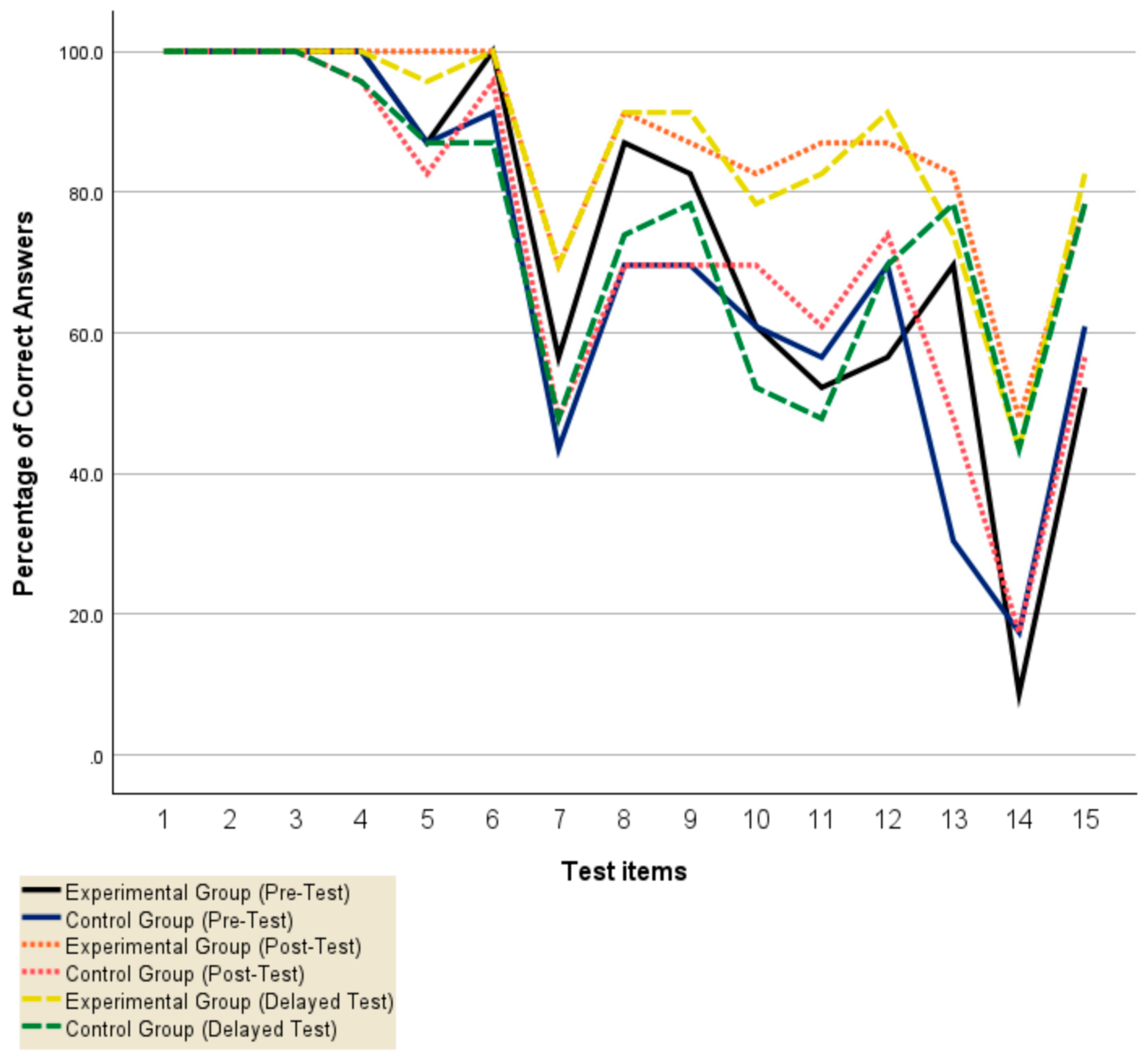
Figure 1 shows a line graph of the data from Table 4, and indicates that both groups were at a similar level in the pretest. Findings from the pretest results revealed that most (80%) children in both groups succeeded in passing all competencies at level zero. This indicates that most children possessed the cognitive structure of the first stage of the theory of central conceptual structure, which it is hypothesised that typical four-year-olds are capable of demonstrating (e.g., Case, 1996; S. Griffin, 2005). Essentially, they can complete with ease counting tasks using counting principles and quantity comparison tasks using words such as “more” and “fewer”. However, the cognitive structure of the second stage of the theory of central conceptual structure did not appear to have manifested yet. This is due to the fact that just three out of ten questions in level one were correctly answered by most children. This indicates that children greatly benefit from teaching programmes that address stage one competencies. Moreover, they might need to read stories that aim to teach these competencies on more than one occasion. Most difficulty was encountered in item 14 of level one. More than 80% of children in both groups were unable to solve the subtraction problem when it was stated in a formal manner.
Figure 1. Test Item Results by Group and Test Stage.
Table 5 confirms that both groups achieved similar results in the pretest. While both groups demonstrated the same ability and skill level across all tasks at level zero in terms of the percentage success rate among the children, greater variation was found to occur across all level one tasks. In particular, the experimental group outperformed the control group in five out of the 10 level one questions. Furthermore, the control group outperformed the experimental group in four out of the 10 questions. These very slight differences generated a small overall mean difference between the groups at pretest, as shown in Table 5.
Table 5. Means and Standard Deviations by Group and Time.
Unlike the control group, after the intervention, the experimental group improved remarkably in the posttest and delayed test. Of particular importance, the group receiving the intervention maintained their improvement relative to the control group, at least up until the time of the delayed test.
Although both groups showed similar abilities at the pretest stage, ANCOVA was used to control the effect of the pretest to give more precise results. As shown in Table 6, the ANCOVA results indicate a significant difference between the control and experimental groups at the posttest phase controlling for pretest scores. To understand the size of this effect, calculating eta squared was deemed appropriate. J. Cohen (1988) states that an Eta squared value of above 0.138 is indicative of a large effect size. In this instance, Eta squared was 0.217, which suggests the effect was large. Moreover, it is noteworthy that the intervention group’s gain remained statistically significant on the delayed test, albeit at a lower level than for the posttest. The eta squared value was also reduced to 0.105, which indicates a medium effect size.
Table 6. ANCOVA Results Between Groups.
While Table 6 reports the intervention effect using standardised effect-size measures (η2), Table 7 provides a complementary descriptive perspective by illustrating how score improvements were distributed across individual test items using data in Table 4. The categories of improvement (‘slight 1–3,’ ‘medium 4–6,’ and ‘large 7–9’) were based on the possible score range within each item and are intended solely as descriptive indicators of raw score change, rather than as substitutes for standardised effect-size measures. Therefore, Table 7 clarifies the way in which the scores improved and provides further understanding of the statistical data outlined in Table 4, Table 5 and Table 6.
Table 7. Comparison of the Pretest, Posttest and Delayed Test Results of the Children in the Experimental Group.
Overall, the experimental group’s posttest and delayed test results showed large improvements in competencies for both the addition and subtraction items. However, an exception occurred for item 13 on both tests. The high pretest scores for this item may have affected subsequent intervention results. Conversely, no large improvement was seen in the other number sense competencies in the posttest and delayed test items. The singular exception was number position, where just one item out of four showed large improvement in the delayed test.

4. Discussion

An increasing number of studies now suggest that early number sense acts as a foundation for the acquisition of mathematical proficiency in later years (Gersten & Chard, 1999; Jordan et al., 2009; Lago & DiPerna, 2010). This has motivated research in mathematics education to examine the efficacy of enhancing number sense in young children through purposeful instruction (S. Griffin, 2004; Hassinger-Das et al., 2015; Jordan et al., 2012; Wang & Hung, 2010). Although not always explicitly focused on promoting number sense specifically, a body of research have examined mathematical stories as a promising instruction method for promoting children’s mathematical understanding (Hong, 1996; Jennings et al., 1992; McGuire et al., 2020; Young-Loveridge, 2004). These types of stories contain many features that are effective for learning mathematical concepts; for example, they can include rich mathematical representations and vocabulary, as well as provide a meaningful context for solving mathematical problems. However, this research has not explored the potential impact of these stories in the real-world storytime settings found in kindergarten, which tend to involve interactive reading to an entire class without any additional activities. This study therefore contributes to current knowledge by addressing this gap—it answers the following research question: To what extent does the interactive reading of mathematical stories enhance number sense in kindergarteners aged 5 to 7 years?
The pretest results in Table 4 show that most children in both the control and intervention groups had a good understanding of all number sense competencies comprising the first, predimensional stage of central conceptual structure. However, around 50% of children had only a limited understanding of most number sense competencies of the second, unidimensional stage. These latter competencies are related to number position within a sequence, and addition and subtraction. Around 25% were unable to carry out the comparative judgements associated with the competence to compare the magnitude of numbers. The cognitive structure of the second stage of the theory of central conceptual structure hypothesises that typical five to seven-year-olds are capable of demonstrating these competencies (e.g., Case, 1996; S. Griffin, 2005). At the start of the study, participants ranged in age from five years and one month to six years and nine months. This suggested that the children needed an intervention targeting the second stage’s competencies, and that without such intervention, they might enter school with an insufficiently developed number sense. Our results concord with the findings of previous studies, such as Howell and Kemp (2010) and S. A. Griffin et al. (1994). For example, Howell and Kemp (2010) assessed children’s number sense prior to school entry and found that around 80% could not answer questions related to addition and subtraction problems; around 50% could not answer questions related to number position; and 35% could not answer questions involving magnitude comparisons between two numbers. However, around 90% of children in their study could answer questions related to the competencies of the first stage of the theory, such as comparing two groups, counting principles, and cardinality.
While both the intervention and control groups in our study demonstrated an improvement in their number sense in the posttest and delayed test, the improvements were of different magnitude and due to different causes. As regular maths lessons were delivered to both groups, a slight improvement in the control group’s means was both expected and found at posttest and delayed test. Unlike the control group, however, the children in the intervention group demonstrated a significant improvement in their number sense following the administration of an intervention consisting of interactive readings of eight carefully designed mathematical stories. After controlling for initial skill level, a significant difference was found between the intervention and control groups on the posttest. This gain was maintained over the six weeks following completion of the intervention to the administration of the delayed test, where again the intervention-control group comparison was significant. Furthermore, we also computed the effect sizes for both tests, which demonstrated that the size of the intervention effect was very large at posttest and decreased to medium at the delayed test. It should be noted that, while the persistence of a statistically significant medium effect after six weeks indicates some degree of sustainability of the intervention, it also has practical implications for its implementation in kindergarten settings.
The posttest and delayed test results of the intervention group showed that children exhibited improvements in all four competencies of the second stage of the theory. Generally, the small to moderate improvements observed were linked to the comparative magnitude of numbers and the position of numbers, respectively. The more substantial enhancements were found in relation to addition and subtraction problems, suggesting that their ability to utilise and manipulate mental representations of numbers was enhanced, leading to progress in all associated competencies of the second stage of the theory. Differences in the magnitude of improvement may be explained by two possible causes. First, the pattern of gains appears to be related to children’s initial performance levels. The largest improvements in addition and subtraction, and the medium improvements in number position, were observed precisely in those competencies for which children showed relatively low scores at pretest, whereas competencies with higher pretest scores had less room for noticeable gains at posttest and delayed test. Second, children were exposed to a greater number of stories targeting addition and subtraction than those focusing on the other competencies, in line with the need to provide additional reinforcement in these areas. This increased exposure may therefore have contributed to the larger gains observed in addition and subtraction. This second explanation, in turn, has practical implications for the design of classroom interventions.
Research by S. Griffin (2004), Hassinger-Das et al. (2015), Jordan et al. (2012), and Wang and Hung (2010) confirm that early number sense can be promoted via purposeful instruction. In addition to confirming those findings, our results indicate that mathematical storytelling is an extremely effective means to achieve such targeted instruction. The above researchers each used their empirical findings to propose interventions, and our own study proposed (and, based on our empirical findings, now proposes) the interactive reading of mathematical stories. It should be noted that the targeted setting for this study was the storytime session typically found in kindergarten. The study was therefore purposefully designed so that our intervention did not replace existing mathematics instruction or other mathematical interventions. Instead, children were exposed to the interactive reading of mathematical stories during a period in kindergarten day that was already allocated to story reading or educational television. Consequently, any enhancement in children’s number sense can be attributed to our intervention, which was intended to complement rather than replace other forms of mathematics instruction. These findings also encourage teachers to make purposeful use of storytime for mathematics learning, by illustrating the degree of improvement that can be achieved through this approach.
Previous studies examining the impact of mathematical storybooks on number-sense-related concepts typically combined story reading with additional activities (Hong, 1996; Jennings et al., 1992; McGuire et al., 2020). In contrast, Purpura et al. (2017) isolated the effect of mathematical stories by excluding supporting activities and found that children in the intervention group significantly outperformed those in the control group on both mathematical language and numeracy knowledge measures. However, the researchers conceded that the reading groups in the study were too small, which “may limit the feasibility for scaling the intervention to the classroom level” (Purpura et al., 2017, p. 132). Therefore, our study addressed this limitation and found that an intervention consisting of mathematical stories without support from any additional activities, was a promising approach that could be used at the classroom level to help develop children’s number sense. One explanation of our findings is that in Purpura et al.’s study, number words in mathematical stories were replaced with mathematical words as their focus was on mathematical vocabulary. For example, “two apples on the tree” was read as “few apples on the tree”. Nevertheless, and as the authors acknowledge, how effective Purpura et al.’s intervention would be in large classroom settings remains unknown, as their study did not compare the effects of the intervention in different sized groups or contexts. Hence, our findings validate the outcome of Purpura et al.’s study and align with it regarding the beneficial impact of employing mathematical stories without accompanying supportive tasks on early numerical comprehension. Furthermore, our study extends the prior work, in its being carried out in a realistic and applicable context, which is more appropriate for implementing this instructional method. The promising findings of the intervention might best be explained as being the result of combining mathematical stories specifically designed to enhance number sense, with an interactive environment that optimised their effectiveness. Improving number sense thus requires carefully planned instruction (S. Griffin, 2004; Hassinger-Das et al., 2015; Jordan et al., 2012; Wang & Hung, 2010).
As shown in Appendix A, the stories we selected situated the mathematical content in personal, meaningful experiences that the children could relate to. This is in line with the views of Van Den Heuvel-Panhuizen et al. (2009), and Trakulphadetkrai et al. (2019), who argue that mathematical stories’ advantage is that they provide a meaningful context for learning mathematics. Similarly, S. Griffin (2005) proposes that instruction should engage children’s emotions and feelings in order for them to develop a sense of what numbers represent.
In addition to this meaningful content, our stories were designed such that they included multiple forms of representation for the targeted learning content. This was to help children see the connections between the different and equivalent ways of representing the same mathematical problem or concept. For example, the addition problem in the story A Fair Bear Share by Stuart J. Murphy (1998) is represented not only through symbolic representation but also through contextualisation, as addition is used to work out the amounts of ingredients needed to cook a pie. The quantities involved are also supported by visual and verbal representations, as the ingredient amounts were drawn both before and after the addition to show the current total, with the processes themselves being explained using words such as equal, plus, and add. As the story examples employed all mathematical representations except for manipulative aids, children were exposed to more nonphysical than physical representations. This meant they needed to use these nonphysical forms of representation to find the answer (and not rely on physical aids), and this is thought to be important for enhancing their number sense. As observed by S. Griffin (2005), children who have well-developed number sense can use a mental counting line to perform operations and make comparisons between numbers—a reason why Burns (2007) argues that encouraging mental computation is critical to the enhancement of number sense. Hence, it can be asserted that the experience of reading a mathematical story without supplementary activities differs significantly from that of reading a story with such activities. It is important to qualify this statement to avoid misinterpretation—we do not advocate strictly prohibiting young children’s use of manipulative aids, as these play a crucial role in their education; rather, we advocate their being provided with some opportunities to develop their understanding that does not depend on such tools.
Moreover, given the critical nature of problem-solving in mathematics and the corresponding importance of mathematical education, we considered it crucial to incorporate mathematical problems into this study’s stories—a point confirmed in National Council of Teachers of Mathematics’s (NCTM, 1989, p. 27) statement that “Many children’s books present interesting problems and illustrate how other children solve them. Jennings et al. (1992) and Hong (1996), who published the first two empirical studies about using children’ literature to teach mathematics, also shared this view. Therefore, in this study we adopted Trakulphadetkrai et al.’s (2019, p. 201) definition of a mathematical story, which they state as comprising “written accounts of imagined experiences of fictional characters who struggle with a problem and try to solve it using their mathematical knowledge and skills in settings that can be close to or far removed from everyday experiences of readers”. Incorporating mathematical problems into the story’s content served a learning function that went beyond merely allowing the children to subsequently see the solution put forward by the story’s characters. It also involved the use and refinement of the children’s mathematical skills as they tried to solve the stories’ problems.
A characteristic of mathematical stories is their rich mathematical language (Trakulphadetkrai et al., 2019), and the stories in this study were intentionally designed to have such language surrounding a targeted concept. Furthermore, most of the mathematical words teachers use when reading and discussing a story with children are likely to be the same or closely related to those in the story. Without an abundance of mathematical language in the written text, the child’s exposure to and use of that language cannot be guaranteed. The significance of mathematical language is widely emphasised in the literature on children’s mathematical learning. For example, Purpura and Logan (2015), found that the mathematical language of pre-schoolers is one of the strongest predictors of having early number knowledge. Purpura et al.’s (2017) study went further, in that it showed the relationship between mathematical language and early number knowledge is not merely a correlation but that the latter, to some extent, depends on the former. Therefore, children’s exposure to and use of appropriate mathematical language during the interactive readings in our study would be expected to play a role in enhancing number sense.
We consider the interactive nature of the reading environment to have been an important contributory factor to the number sense improvements we observed, as it provided a socially interactive environment in which the teacher could ask and clarify many of the mathematical ideas in the stories. The children in our study therefore had many opportunities to clarify and refine their understanding of numbers, which is fundamental key to enhance their number sense (S. Griffin, 2005).
One limitation of this study was the relatively small sample size. It was a small-scale study with the outcomes based on only two classes (46 children in total). Although the statistically significant findings and the medium-to-large effect sizes suggest that the intervention had a meaningful impact, the modest sample size limits the extent to which the results can be generalised to the wider population of kindergarten children. Larger scale investigations employing similar interventions for enhancing number sense and evaluated over a longer time-span would provide more generalisable results for guiding future research and practice. A second limitation concerns the specific context in which the study was conducted. The intervention took place in a single Saudi Arabian hospitality centre in Hofuf City, serving KG3 children with specific characteristics. Characteristics of this context including the number of children per class, the type of mathematical content emphasised, teachers’ instructional practices, and parents’ expectations may differ from those found in other kindergarten contexts, which limits the transferability of the findings. Consequently, caution is needed when transferring these findings to different educational contexts. Future research should therefore replicate and extend this work in a broader range of kindergarten settings, to examine the extent to which the observed effects of interactive reading of mathematical stories are context-dependent or more widely applicable.

5. Conclusions

This study aimed to investigate how kindergarten children’s number sense could be improved through interactive readings of mathematical stories in authentic storytime settings. The results showed a promising effect: the experimental group significantly outperformed the control group, on both the posttest and delayed test targeting the first two levels of the central conceptual structure for number. The stories were chosen for their relevance to the domain of early number sense, and some were slightly modified to enhance the richness of the mathematical language and the diversity of mathematical representations. The stories were well designed and had mathematical problems that were embedded in contexts meaningful to the children. We consider that these features, when combined with the highly interactive learning environment, were the principal factors responsible for the observed improvements in the children’s number sense. Furthermore, this positive effect occurred despite there being no supplementary learning activities. These findings are consistent with prior research (e.g., Hong, 1996; Jennings et al., 1992; McGuire et al., 2020; Purpura et al., 2017; Young-Loveridge, 2004) demonstrating that mathematical stories can effectively facilitate number knowledge in kindergarten children. They also contribute to existing knowledge by showing that such improvements can be achieved without supporting activities and in real, whole-class kindergarten settings. Importantly, such improvements should not be viewed as the result of the stories alone, but rather as the outcome of the two core components of the intervention—interactive reading and mathematical stories—as reflected in the title of the paper.
Mathematical stories are not often read in kindergartens (BinAli, 2013; Pentimonti et al., 2011; Van Den Heuvel-Panhuizen et al., 2009) nor indeed very likely to be found in most kindergarten libraries (Stites et al., 2021). An important implication of this study, therefore, is that such readings should be encouraged, and furthermore that kindergarten teachers need to pay more attention to developing children’s number sense. Nearly half of the children in this study did not demonstrate a good level of number sense on the pretest. This is particularly alarming because number sense serves as a foundation for the development of mathematical proficiency in later life (Gersten & Chard, 1999; Lago & DiPerna, 2010; Wang & Hung, 2010; Witzel et al., 2012). The decrease in effect size from posttest to delayed test has important implications as well for educational practice. Although interactive reading of mathematical stories demonstrated significant improvements at posttest in children’s number sense, the partial decline of the effect over time suggests that continued instructional reinforcement is necessary to sustain the full impact of the intervention. This indicates that while the interactive reading of mathematical stories can serve as a powerful instructional approach to learning mathematics, it may be most effective when integrated regularly during storytime in kindergartens rather than implemented as a one-time intervention. At the same time, the persistence of a statistically significant medium effect after six weeks highlights the practical and partially sustainable value of interactive reading of mathematical stories in authentic kindergarten storytime settings. A final implication concerns kindergarten principles. Given the promising results on using mathematical stories for teaching and learning mathematics, these books should be readily available in kindergarten libraries. Using mathematical stories by reading them interactively to learn mathematics in the early years can be an effective means to enhance foundational mathematical skills such as number sense.

Author Contributions

Conceptualization, M.G.A. and T.F.; methodology, M.G.A. and T.F.; software, M.G.A. and T.F.; validation, M.G.A. and T.F.; formal analysis, M.G.A. and T.F.; investigation, M.G.A. and T.F.; resources, M.G.A. and T.F.; data curation, M.G.A. and T.F.; writing—original draft preparation, M.G.A. and T.F.; writing—review and editing, M.G.A. and T.F.; visualization, M.G.A. and T.F.; supervision, M.G.A. and T.F.; project administration, M.G.A. and T.F.; funding acquisition, M.G.A. All authors have read and agreed to the published version of the manuscript.

Funding

This research is funded by the Deanship of Scientific Research, Vice Presidency for Graduate Studies and Scientific Research, King Faisal University, Saudi Arabia [Grant No. KFU254819].

Institutional Review Board Statement

The procedural aspect of the study was supervised by University of Exeter (based in the UK) and has been approved by the Research Ethics Committee (Ref No. 491611), approval date of 13 January 2022.

Data Availability Statement

The data presented in this study are available on request from the author.

Conflicts of Interest

The author declares no conflicts of interest.

Appendix A

Table A1. Descriptive Summaries of the Eight Mathematical Stories.
Story NumberTargeted CompetencyTitle of the BookAuthorSeriesYouTube LinkBrief Justification for the Selection
OneComparisons between quantitiesTally O’MalleyStuart J. MurphyMathStarthttps://www.youtube.com/watch?v=ZcGb5u2qigY&t=196s (accessed on 15 November 2021)Tallying is used in the story to compare between three sets of tallies in a game, and the participant with the highest tally wins. Comparing quantities is thus required to decide the winner. Children are encouraged to use their knowledge about magnitude comparison to fairly decide who won.
TwoEmploying counting principlesTen Play Hide- and- SeekPenny DaleThe Ten in the Bedhttps://www.youtube.com/watch?v=qzC0mhvt6G0 (accessed on 15 November 2021)This story is about a boy who has nine dolls that he plays hide and seek with. While he is searching for them, he keeps count of how many he has found so far. He thus needs to count to know how many dolls have already been found and how many have not yet been found.
ThreeIdentifying number position within a sequenceCount off, squeak scoutsLaura DriscollMouse Mathhttps://www.youtube.com/watch?v=ucipL0Qq-ok&t=270s (accessed on 15 November 2021)This story focuses on a number sequence by telling a tale of young mice going on an adventure. In order to keep them safe, an older mouse gives them numbered T-shirts and tells them many times during the adventure to line up, as a way to check no one is missing. Thus, identifying the correct place for each number is presented as a means of ensuring the safety of the mice.
FourEvaluating the comparative magnitude of numbers without the need for concrete objectsHenry Keeps ScoreDaphne SkinnerMath Mattershttps://www.youtube.com/watch?v=J1ibvFa6pzg (accessed on 15 November 2021)The story is about comparing numbers. Henry always wants to have at least as many items as his older sister, and thinks that having more things is always better. He therefore sometimes asks to have even more things than his sister. However, at the end of the story, he discovers that having more may not always be as good as he thought. Comparisons between numbers are therefore used as a means of ensuring a good outcome—fairness between siblings.
FiveSolving addition problems without the need for concrete objectsA Fair Bear ShareStuart J. MurphyMathStarthttps://www.youtube.com/watch?v=Poenu3g2Xkw (accessed on 15 November 2021)The story focuses on regrouping numbers and can be easily modified to be about addition simply by decreasing the numbers. A Mama Bear wants to cook a Blue-Ribbon Blueberry Pie for her cubs. She asks her cubs to gather the necessary ingredients from the garden. All of the cubs do their best to help, except for the youngest, and her not contributing much means the quantities of each ingredient are insufficient. Later, the youngest one makes up for her mistake by going and gathering more ingredients to enable the Mom to cook for them. The cubs thus have to use addition to solve the problem of gathering enough ingredients to make a delicious pie.
SixSolving subtraction problems without the need for concrete objectsElevator MagicStuart J. MurphyMathStarthttps://www.youtube.com/watch?v=5WBWQV43evU&t=602s (accessed on 15 November 2021)A boy is visiting his mother at her office, on floor number 10. On the way down in the lift to go back home, his mom wants to stop off at different floors. The boy helps his mom by pressing the number buttons for the correct floors, but his mom only tells him how many floors down it is from the one they are currently on, forcing the boy to figure out which number he needs to press by subtracting the number of floors from the current floor number.
SevenSolving addition problems without the need for concrete objectsWhen ten was sickThe researcher- The story focuses on “making 10” by combining two different numbers, with this process repeated many times with varying pairs. “Making 10” is presented in the story as a way to keep an absent and ill friend in mind during a popular Saudi Arabian celebration, allowing children to experience the commutative law while using addition to solve a mathematical problem in a related context.
EightSolving addition and subtraction problems without the need for concrete objectsNo more than five toysThe researcher- The “five” in the story refers to the number of toys that the children in the story can borrow from their school. They start by collecting five toys. If they want to change their toys for new ones, they have to return the same number of old ones as they want new ones. Through exchanging old toys for new toys but never exceeding five, the story covers the inverse relationship between addition and subtraction.

Appendix B

Table A2. How the story’s content fulfils the identified features of mathematical stories.
The FeaturesStory Number ThreeStory Number Five
The content should reflect a mathematical problem Identifying the correct place for each number is presented as a means of ensuring the safety of the mice.Addition in used the story as a means to ensure that the characters have sufficient ingredients to cook a delicious pie. In this story, the cubs are shown performing adding to solve the problem of gathering of enough ingredients for the pie.
The content should be meaningfulThe content is meaningful, discussing an interesting trip and presenting number sequence as a way to keep the young mice safe, offering children a connection with their own lives.While gathering ingredients from garden may not be a familiar activity for many children, helping mom to cook a pie or cake be bringing ingredients from their places in the grocery store or kitchen is likely to be familiar. Also, the idea that the youngest family member does not do as much as older ones might be connected to the real live. In general, talking about helping in the kitchen, eating a delicious dish, and fairness between siblings are all meaningful activities for children. Children should thus experience a connection with their lives.
The content should contain multiple representationsThe story offers multiple mathematical representations, including symbolic, and contextual representations. The potential power of the story could be further maximized by adding visual representations of numbers, however, and the numbers should be written in words in the text to offer verbal representations of number rather than them being given only symbolically.The story presents multiple representations of numbers, including symbolic, contextual, and visual. However, verbal representations of numbers should be added. The addition operation is presented in multiple ways, particularly symbolic, contextual, and verbal; however, visual representation of addition should be included.
The content should have many examples of mathematical languageThe story is rich in mathematical language, using “first”, “second”, “between”, “order”, “all”, “everyone”, “last one”, and “backward order”. A few further mathematical words could potentially be added such as “smallest”, “greatest”, “smaller than”, “before” and “after”.With regard to the use of mathematical language, there are many examples: “adding them up”, “enough” “altogether”, “any at all”, “even one”, “three”, “one”, “lots”, and “left over”. However, there are still opportunities to add further mathematical words to maximise the potential power of the story, such as “bigger”, “as much as” “equal”, and “plus”.

Appendix C

Table A3. A list of the questions suggested in two stories.
The Suggested Questions for Story Number ThreeThe Suggested Questions for Story Number Four
Which numbers you can see here? Do you want to ask a question? Or say something? Can you say numbers in order? I will say the numbers, but I will miss one out. Can you tell me which number I have missed: 1, 2, 4, 5… Was it easy to spot the missing number? Who remember Wanda’s number? Where should number seven be? Or which number should number seven come after? Before? Which number follows two numbers after number seven? Do you remember where Albert should go? Why should Albert be between one and three? What is the correct order? What should the first number be and what should the last number be? Who can help them in saying the numbers? Let’s help them together: 1, 2, 3, 4, 5, 6, 7, 8, 9, 10! Who knows where number two should be? What about five? Which number follows number five? Which number follows two numbers after number five? Do you think that Albert knows the correct place of each number now? Do you know the correct place for number four? What about eight? Do you think that all of them are there now? How do you know? If you had a safety t-shirt, which number would you like to have? Which two numbers would it go between? Which number would come after your number? Which would come two numbers after your number?How many nuts, berries, and seeds do think they should collect?
Do you want to ask a question? Or add comments?
How many nuts did Mark collect? How many nuts should Mary collect to have ten altogether?
So, how many did they collect in total? How do you know? (may be via visual or symbolical representations, or through remembering the narrated events) Is that enough to cook the pie? Why?
Do you think they collected ten blueberries? How many do you think Mary collected? What about Mark?
How much is four plus four? Did they collect enough blueberries to cook the pie? Why?
Do you remember how many nuts they collected? What about blueberries? Which is more? Which is closer to ten?
How many seeds do you think they collected?
Are nine seeds enough to cook the pie? Why?
Remind me … how many nuts did they have? How many more do they need? What about blueberries? How many did they have? How many more do they need? What about seeds? How many did they have? How many more do they need?
How much is five plus five? Is that enough to cook the pie? Why?
They had eight blueberries, then Sara added two. How many did they have then?
Do you think Mom can cook the pie now? Why?

Appendix D

Table A4. Test Items and their Corresponding Competencies.
Test LevelItemTheory StageCompetence
Zero1. Can you count these chips and tell me how many there are? (Place 3 counting chips in front of the child in a row.)Predimensional Stage1st Competence: Count using counting principlesFirst three principles
2a. (Show stacks of chips, 5 vs. 2, same colour.) Which pile has more?
2b. (Show stacks of chips, 3 vs. 7, same colour.) Which pile has more?
2nd Competence: Use words such as more or less to compare between two quantitiesUsing more
3a. This time I’m going to ask you which pile has less. (Show stacks of chips, 2 vs. 6, same colour.) Which pile has less?
3b. (Show stacks of chips, 8 vs. 3, same colour.) Which pile has less?
2nd Competence: Use words such as more or less to compare between two quantitiesUsing less
4. I’m going to show you some counting chips. (Show a line of 3 red and 4 yellow chips in a row, as follows: R Y R Y R Y Y.) Count just the yellow chips and tell me how many there are.1st Competence: Count using counting principlesFourth principle
5. (Pick up all the chips from the previous question.) Here are some more counting chips. (Show a mixed array [not in a row] of 7 yellow and 8 red chips.) Count just the red chips and tell me how many there are.1st Competence: Count using counting principlesFifth principle
One6. What number comes right after 7?Unidimensional Stage3rd Competence: Identify number position within a sequenceOne number after
7. What number comes two numbers after 7?3rd Competence: Identify number position within a sequenceTwo numbers after
8a. Which is bigger: 5 or 4?
8b. Which is bigger: 7 or 9?
4th Competence: Compare between single numbers without relying on physical objectsUsing bigger
9a. This time, I’m going to ask you about smaller numbers. Which is smaller: 8 or 6?
9b. Which is smaller: 5 or 7?
4th Competence: Compare between single numbers without relying on physical objectsUsing smaller
10a. Which number is closer to 5: 6 or 2? (Show visual array after asking the question.)
10b. Which number is closer to 7: 4 or 9? (Show visual array after asking the question.)
3rd Competence: Identify number position within a sequenceCloser number
11. If you had 4 chocolates and someone gave you 3 more, how many chocolates would you have altogether?5th Competence: Use numbers to solve addition problem without relying on physical objectsAddition word problem
12. How much is 2 + 4? (OK to use fingers for counting.)5th Competence: Use numbers to solve addition problem without relying on physical objectsFormal addition problem
13. If you had 5 cars and someone took 3 of them, how many cars would you have left?6th Competence: Use numbers to solve subtraction problem without relying on physical objectsSubtraction word problem
14. How much is 4 − 1? (OK to use fingers for counting.)6th Competence: Use numbers to solve subtraction problem without relying on physical objectsFormal subtraction problem
15a. (Show visual array 9 5 3 6. Ask the child to point to and name each numeral.) When you are counting, which of these numbers do you say first?
15b. When you are counting, which of these numbers do you say last
3rd Competence: Identify number position within a sequenceFirst number, last number
Note: All items were taken from the Number Knowledge Test (S. Griffin, 2005), with the exception of item 13 which was created by researchers. The justification for this additional item is provided in Section 2.4.

References

  1. Almulhim, M. G. (2025). Supporting kindergarteners’ learning of mathematics through the interactive reading of mathematical stories. Cogent Education, 12(1), 2597056. [Google Scholar] [CrossRef]
  2. Aunio, P., Hautamäki, J., & Van Luit, J. E. (2005). Mathematical thinking intervention programmes for preschool children with normal and low number sense. European Journal of Special Needs Education, 20(2), 131–146. [Google Scholar] [CrossRef]
  3. Baroody, A. J., & Wilkins, J. L. (1999). The development of informal counting, number, and arithmetic skills and concepts. In J. V. Copley (Ed.), Mathematics in the early years (pp. 48–65). National Association for the Education of Young Children. [Google Scholar]
  4. Berch, D. B. (2005). Making sense of number sense: Implications for children with mathematical disabilities. Journal of Learning Disabilities, 38(4), 333–339. [Google Scholar] [CrossRef] [PubMed]
  5. BinAli, A. A. (2013). The impact of using stories in pre-school mathematics teaching in the Saudi Arabian context [Doctoral thesis, Brunel University School of Sport and Education]. Brunel University Research Archive. Available online: https://bura.brunel.ac.uk/bitstream/2438/8389/1/FulltextThesis.pdf (accessed on 7 July 2021).
  6. Björklund, C., & Barendregt, W. (2016). Teachers’ pedagogical mathematical awareness in Swedish early childhood education. Scandinavian Journal of Educational Research, 60(3), 359–377. [Google Scholar] [CrossRef]
  7. Björklund, C., & Palmér, H. (2020). Pre-schoolers’ reasoning about numbers in picture books. Mathematical Thinking and Learning, 22(3), 195–213. [Google Scholar] [CrossRef]
  8. Björklund, C., & Palmér, H. (2022). Teaching toddlers the meaning of numbers—Connecting modes of mathematical representations in book reading. Educational Studies in Mathematics, 110(3), 525–544. [Google Scholar] [CrossRef]
  9. Burns, M. (2007). About teaching mathematics: A K-8 resource (3rd ed.). Math Solutions Publications. [Google Scholar]
  10. Case, R. (1996). Reconceptualizing the nature of children’s conceptual structures and their development in middle childhood. Monographs of the Society for Research in Child Development, 61(1–2), 1–26. [Google Scholar] [CrossRef]
  11. Case, R., & Griffin, S. (1990). Child cognitive development: The role of central conceptual structures in the development of scientific and social thought. In C.-A. Hauert (Ed.), Developmental psychology: Cognitive, perceptuo-motor and neuropsychological perspectives (Vol. 64, pp. 193–230). Developmental Psychology. Elsevier. [Google Scholar] [CrossRef]
  12. Catalano, H., Albulescu, I., Ani-Rus, A., Albulescu, M., Mestic, G., & Rus, A. (2025). Reading–writing and math prerequisites as predictors of children’s transition from kindergarten to school. Education Sciences, 15(5), 586. [Google Scholar] [CrossRef]
  13. Claessens, A., & Engel, M. (2013). How important is where you start? Early mathematics knowledge and later school success. Teachers College Record, 115(6), 1–29. [Google Scholar] [CrossRef]
  14. Cohen, J. (1988). Statistical power analysis for the behavioral sciences (2nd ed.). Lawrence Erlbaum Associates. [Google Scholar]
  15. Cohen, L., Manion, L., & Morrison, K. (2018). Research methods in education (8th ed.). Routledge. [Google Scholar]
  16. Davis-Kean, P. E., Domina, T., Kuhfeld, M., Ellis, A., & Gershoff, E. T. (2022). It matters how you start: Early numeracy mastery predicts high school math course-taking and college attendance. Infant and Child Development, 31(2), e2281. [Google Scholar] [CrossRef]
  17. Durmaz, B., & Miçooğullari, S. (2021). The effect of the integrated mathematics lessons with children’s literature on the fifth-grade students’ place value understanding. Acta Didactica Napocensia, 14(2), 244–256. [Google Scholar] [CrossRef]
  18. Edelman, J., Green, K. B., & Jett, C. C. (2019). Children’s literature to inform mathematics teaching and learning: A systematic review of the research literature from 1991–2016. The International Journal of Science, Mathematics and Technology Learning, 26(1), 49. [Google Scholar] [CrossRef]
  19. Field, A. (2018). Discovering statistics using IBM SPSS statistics (5th ed.). Sage. [Google Scholar]
  20. Gelman, R., & Gallistel, C. R. (1978). The child’s understanding of number. Harvard University Press. [Google Scholar]
  21. Gersten, R., & Chard, D. (1999). Number sense: Rethinking arithmetic instruction for students with mathematical disabilities. The Journal of Special Education, 33(1), 18–28. [Google Scholar] [CrossRef]
  22. Gersten, R., Clarke, B. S., Haymond, K., & Jordan, N. C. (2011). Screening for mathematics difficulties in K-3 students. Center on Instruction. [Google Scholar]
  23. Gersten, R., Jordan, N. C., & Flojo, J. R. (2005). Early identification and interventions for students with mathematics difficulties. Journal of Learning Disabilities, 38(4), 293–304. [Google Scholar] [CrossRef] [PubMed]
  24. Green, K. B., Gallagher, P. A., & Hart, L. (2017). Integrating mathematics and children’s literature for young children with disabilities. Journal of Early Intervention, 40(1), 3–19. [Google Scholar] [CrossRef]
  25. Griffin, S. (2004). Building number sense with number worlds: A mathematics program for young children. Early Childhood Research Quarterly, 19(1), 173–180. [Google Scholar] [CrossRef]
  26. Griffin, S. (2005). Fostering the development of whole-number sense: Teaching mathematics in the primary grades. In M. S. Donovan, & J. D. Bransford (Eds.), How students learn: Mathematics in the classroom (pp. 257–308). The National Academies Press. [Google Scholar]
  27. Griffin, S. A., Case, R., & Siegler, R. S. (1994). Rightstart: Providing the central conceptual prerequisites for first formal learning of arithmetic to students at risk for school failure. In K. McGilly (Ed.), Classroom lessons: Integrating cognitive theory and classroom practice (pp. 24–49). MIT Press. [Google Scholar]
  28. Hassinger-Das, B., Jordan, N. C., & Dyson, N. (2015). Reading stories to learn math: Mathematics vocabulary instruction for children with early numeracy difficulties. The Elementary School Journal, 116(2), 242–264. [Google Scholar] [CrossRef]
  29. Hojnoski, R., Polignano, J., & Columba, H. L. (2016). Increasing teacher mathematical talk during shared book reading in the preschool classroom: A pilot study. Early Education and Development, 27(5), 676–691. [Google Scholar] [CrossRef]
  30. Hong, H. (1996). Effects of mathematics learning through children’s literature on math achievement and dispositional outcomes. Early Childhood Research Quarterly, 11(4), 477–494. [Google Scholar] [CrossRef]
  31. Howell, S. C., & Kemp, C. R. (2010). Assessing preschool number sense: Skills demonstrated by children prior to school entry. Educational Psychology, 30(4), 411–429. [Google Scholar] [CrossRef]
  32. Jennings, C. M., Jennings, J. E., Richey, J., & Dixon-Krauss, L. (1992). Increasing interest and achievement in mathematics through children’s literature. Early Childhood Research Quarterly, 7(2), 263–276. [Google Scholar] [CrossRef]
  33. Jordan, N. C., Glutting, J., Dyson, N., Hassinger-Das, B., & Irwin, C. (2012). Building kindergartners’ number sense: A randomized controlled study. Journal of Educational Psychology, 104(3), 647–660. [Google Scholar] [CrossRef] [PubMed]
  34. Jordan, N. C., Kaplan, D., Ramineni, C., & Locuniak, M. N. (2009). Early math matters: Kindergarten number competence and later mathematics outcomes. Developmental Psychology, 45(3), 850–867. [Google Scholar] [CrossRef]
  35. Lago, R. M., & DiPerna, J. C. (2010). Number sense in kindergarten: A factor-analytic study of the construct. School Psychology Review, 39(2), 164–180. [Google Scholar] [CrossRef]
  36. Liu, Y., Peng, P., & Yan, X. (2025). Early numeracy and mathematics development: A longitudinal meta-analysis on the predictive nature of early numeracy. Journal of Educational Psychology, 117(6), 863–883. [Google Scholar] [CrossRef]
  37. Malhotra, N., & Birks, D. (2007). Marketing research: An applied approach (3rd ed.). Pearson. [Google Scholar]
  38. Malofeeva, E., Day, J., Saco, X., Young, L., & Ciancio, D. (2004). Construction and evaluation of a number sense test with head start children. Journal of Educational Psychology, 96(4), 648–657. [Google Scholar] [CrossRef]
  39. Maričić, S. M., Stakić, M. M., & Malinović-Jovanović, N. T. (2017). The role of literary content for children in preschool mathematics education. Eurasia Journal of Mathematics, Science and Technology Education, 14(2), 631–642. [Google Scholar] [CrossRef]
  40. McGuire, P., Himot, B., Clayton, G., Yoo, M., & Logue, M. E. (2020). Booked on math: Developing math concepts in pre-K classrooms using interactive read-alouds. Early Childhood Education Journal, 49(2), 313–323. [Google Scholar] [CrossRef]
  41. Ministry of Education (MoE), Tatweer Co. for Educational Services & National Association for the Education of Young Children. (2015). Early developmental learning standards in Saudi Arabia: Children aged 3–6 years. Ministry of Education.
  42. Moyer, P. S. (2000). Communicating mathematically: Children’s literature as a natural connection. The Reading Teacher, 54(3), 246–255. [Google Scholar]
  43. Murphy, S. (1998). A fair bear share. HarperCollins. [Google Scholar]
  44. National Council of Teachers of Mathematics (NCTM). (1989). Curriculum and evaluation standards for school mathematics. National Council of Teachers of Mathematics. [Google Scholar]
  45. National Mathematics Advisory Panel (NMAP). (2008). Foundations for success: The final report of the National Mathematics Advisory Panel. U.S. Department of Education.
  46. Nunnally, J. C. (1978). Psychometric theory (2nd ed.). McGraw-Hill. [Google Scholar]
  47. Okamoto, Y., & Case, R. (1996). Exploring the microstructure of children’s central conceptual structures in the domain of number. Monographs of the Society for Research in Child Development, 61(1–2), 27–58. [Google Scholar] [CrossRef]
  48. Ompok, C. C., Teng, L. M., Pang, V., Mun, H. C., Abdullah, A. C., & Sapirai, J. (2018). Early mathematics learning in reading and writing numerals: Learning through “What Are the Numbers?”—A picture book made up of Flora and Fauna in Borneo. International Journal of Early Childhood Education and Care, 7, 52–59. [Google Scholar]
  49. Op ‘t Eynde, E., Depaepe, F., Verschaffel, L., & Torbeyns, J. (2023). Shared picture book reading in early mathematics: A systematic literature review. Journal für Mathematik-Didaktik, 44, 505–531. [Google Scholar] [CrossRef]
  50. Pallant, J. (2020). SPSS survival manual: A step by step guide to data analysis using IBM SPSS (7th ed.). Routledge. [Google Scholar]
  51. Pentimonti, J. M., Zucker, T. A., & Justice, L. M. (2011). What are preschool teachers reading in their classrooms? Reading Psychology, 32(3), 197–236. [Google Scholar] [CrossRef]
  52. Purpura, D. J., & Logan, J. A. (2015). The nonlinear relations of the approximate number system and mathematical language to early mathematics development. Developmental Psychology, 51(12), 1717–1730. [Google Scholar] [CrossRef] [PubMed]
  53. Purpura, D. J., Napoli, A. R., Wehrspann, E. A., & Gold, Z. S. (2017). Causal connections between mathematical language and mathematical knowledge: A dialogic reading intervention. Journal of Research on Educational Effectiveness, 10(1), 116–137. [Google Scholar] [CrossRef]
  54. Siegler, R. S., & Robinson, M. (1982). The development of numerical understandings. In H. W. Reese (Ed.), Advances in child development and behavior (Vol. 16, pp. 241–312). Academic Press. [Google Scholar] [CrossRef]
  55. Stites, M. L., Sonnenschein, S., Dowling, R., & Gay, B. (2021). Mathematics learning opportunities in preschool: Where does the classroom library fit in? Early Education and Development, 32(1), 66–81. [Google Scholar] [CrossRef]
  56. Streiner, D. L. (2003). Starting at the beginning: An introduction to coefficient alpha and internal consistency. Journal of Personality Assessment, 80(1), 99–103. [Google Scholar] [CrossRef]
  57. Trakulphadetkrai, N. V., Aerila, J.-A., & Yrjänäinen, S. (2019). Bringing mathematics alive through stories. In K. J. Kerry-Moran, & J.-A. Aerila (Eds.), Story in children’s lives: Contributions of the narrative mode to early childhood development, literacy, and learning (pp. 199–225). Springer. [Google Scholar]
  58. van den Heuvel-Panhuizen, M., Elia, I., & Robitzsch, A. (2016). Effects of reading picture books on kindergartners’ mathematics performance. Educational Psychology, 36(2), 323–346. [Google Scholar] [CrossRef]
  59. Van Den Heuvel-Panhuizen, M., van den Boogaard, S., & Doig, B. (2009). Picture books stimulate the learning of mathematics. Australasian Journal of Early Childhood, 34(3), 30–39. [Google Scholar] [CrossRef]
  60. Wang, Z., & Hung, L. (2010). Kindergarten children’s number sense development through board games. International Journal of Learning, 17(8), 19–31. [Google Scholar] [CrossRef]
  61. Watts, T. W., Duncan, G. J., Siegler, R. S., & Davis-Kean, P. E. (2014). What’s past is prologue: Relations between early mathematics knowledge and high school achievement. Educational Researcher, 43(7), 352–360. [Google Scholar] [CrossRef] [PubMed]
  62. Witzel, B. S., Ferguson, C. J., & Mink, D. V. (2012). Number sense: Strategies for helping preschool through grade 3 children develop math skills. YC Young Children, 67(3), 89–94. [Google Scholar]
  63. Young-Loveridge, J. M. (2004). Effects on early numeracy of a program using number books and games. Early Childhood Research Quarterly, 19(1), 82–98. [Google Scholar] [CrossRef]
  64. Zhang, Q., Sun, J., & Yeung, W. Y. (2023). Effects of using picture books in mathematics teaching and learning: A systematic literature review from 2000–2022. Review of Education, 11(1), e3383. [Google Scholar] [CrossRef]
Disclaimer/Publisher’s Note: The statements, opinions and data contained in all publications are solely those of the individual author(s) and contributor(s) and not of MDPI and/or the editor(s). MDPI and/or the editor(s) disclaim responsibility for any injury to people or property resulting from any ideas, methods, instructions or products referred to in the content.

Article Metrics

Citations

Article Access Statistics

Multiple requests from the same IP address are counted as one view.