
Science Beyond School: Exploring Students’ Understanding of Science Through a Citizen Science Project on Micrometeorites
 , , , and
Abstract
1. Introduction
1.1. Research Questions
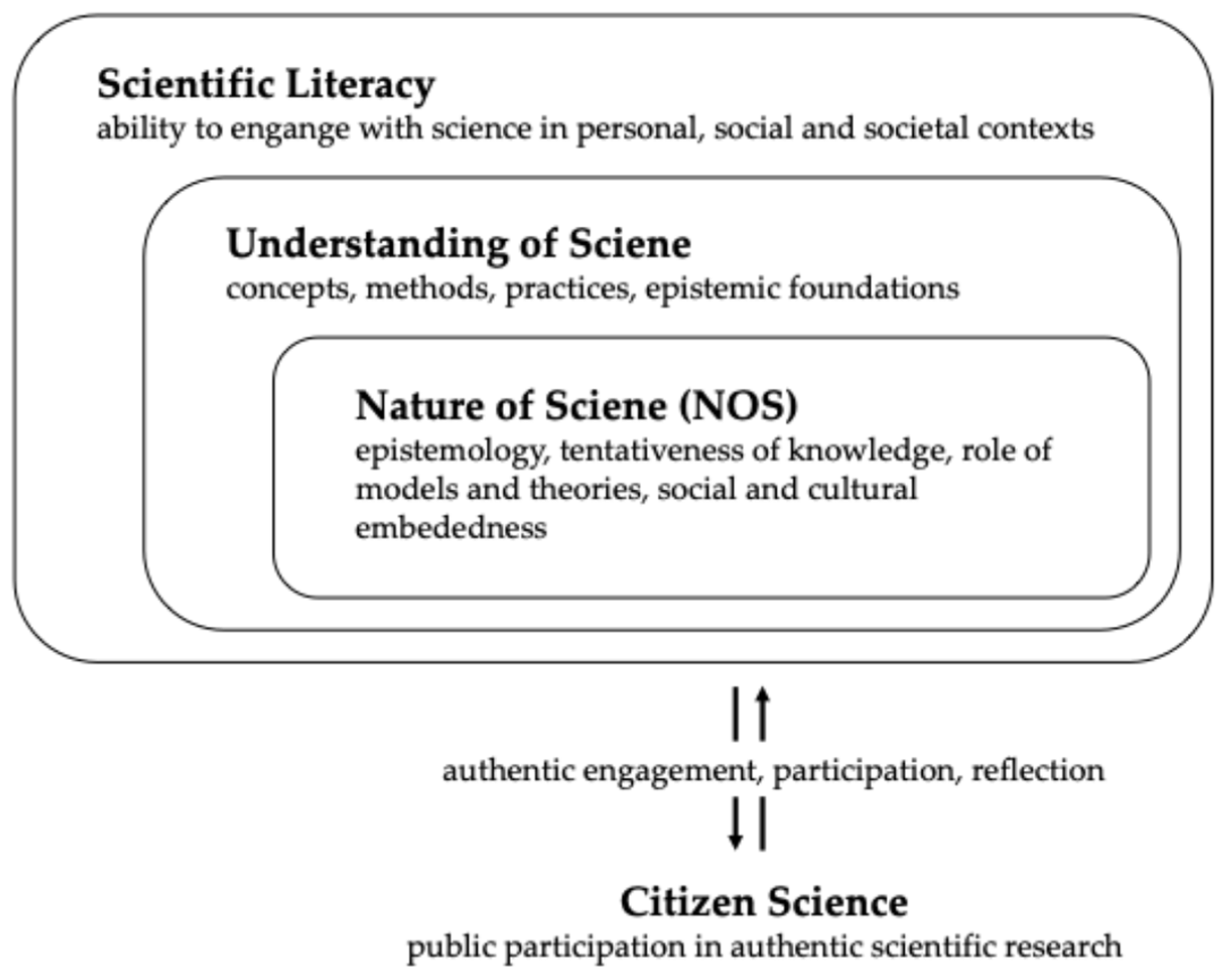
- How does participation in a short-term citizen science project about micrometeorites contribute to students’ understanding of science?
- What opportunities and challenges does a citizen approach about micrometeorites present for collaborations between schools and science museums?
1.2. Citizen Science Project “Micrometeorites”
- Selection of a suitable roof top and sampling of dust, often using a magnetic device since most micrometeorites are magnetic;
- Washing, removal of floating organics and separation by grain size via sieving to facilitate optical identification of micrometeorites;
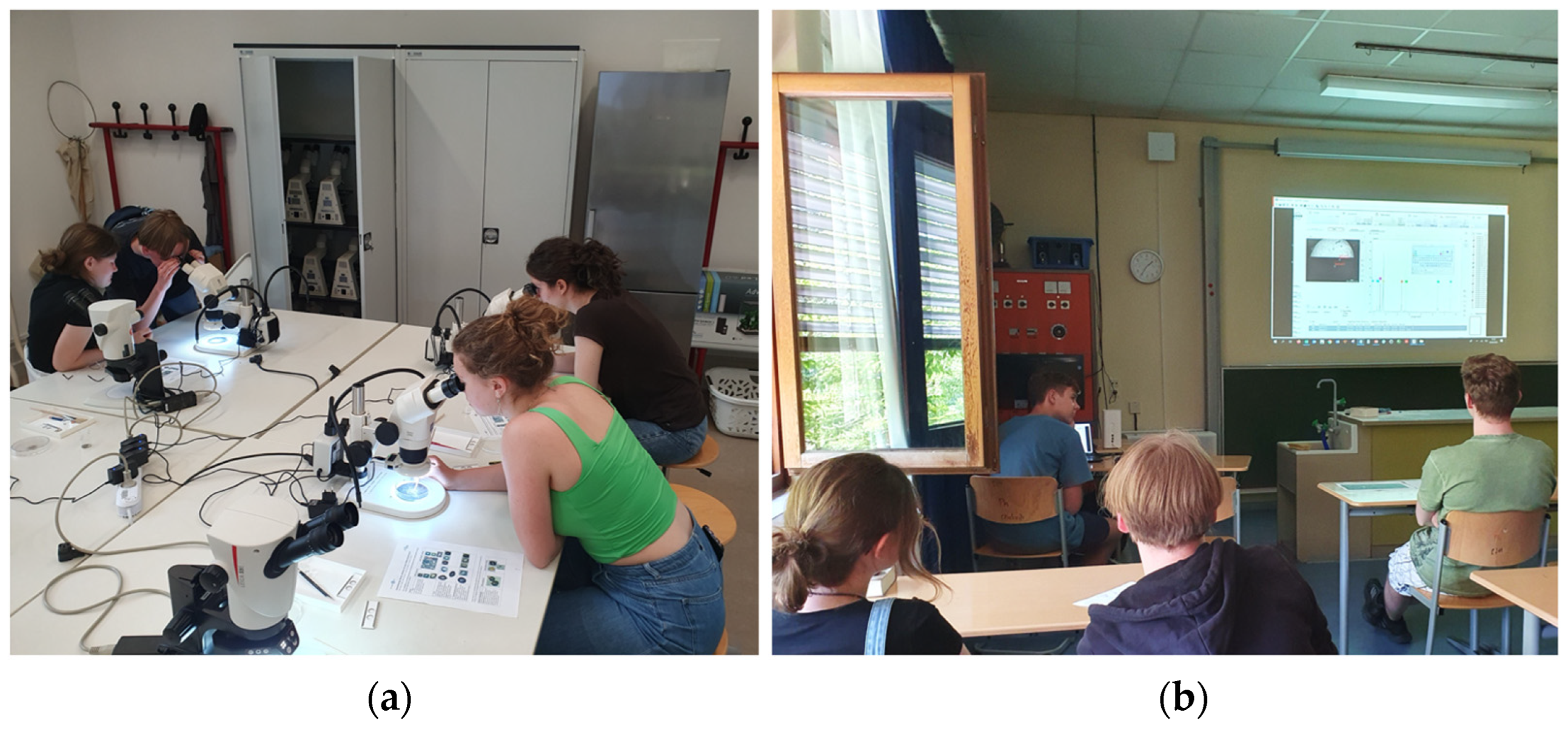
- Manual separation (picking) of micrometeorites based on their optical properties under the stereo microscope;
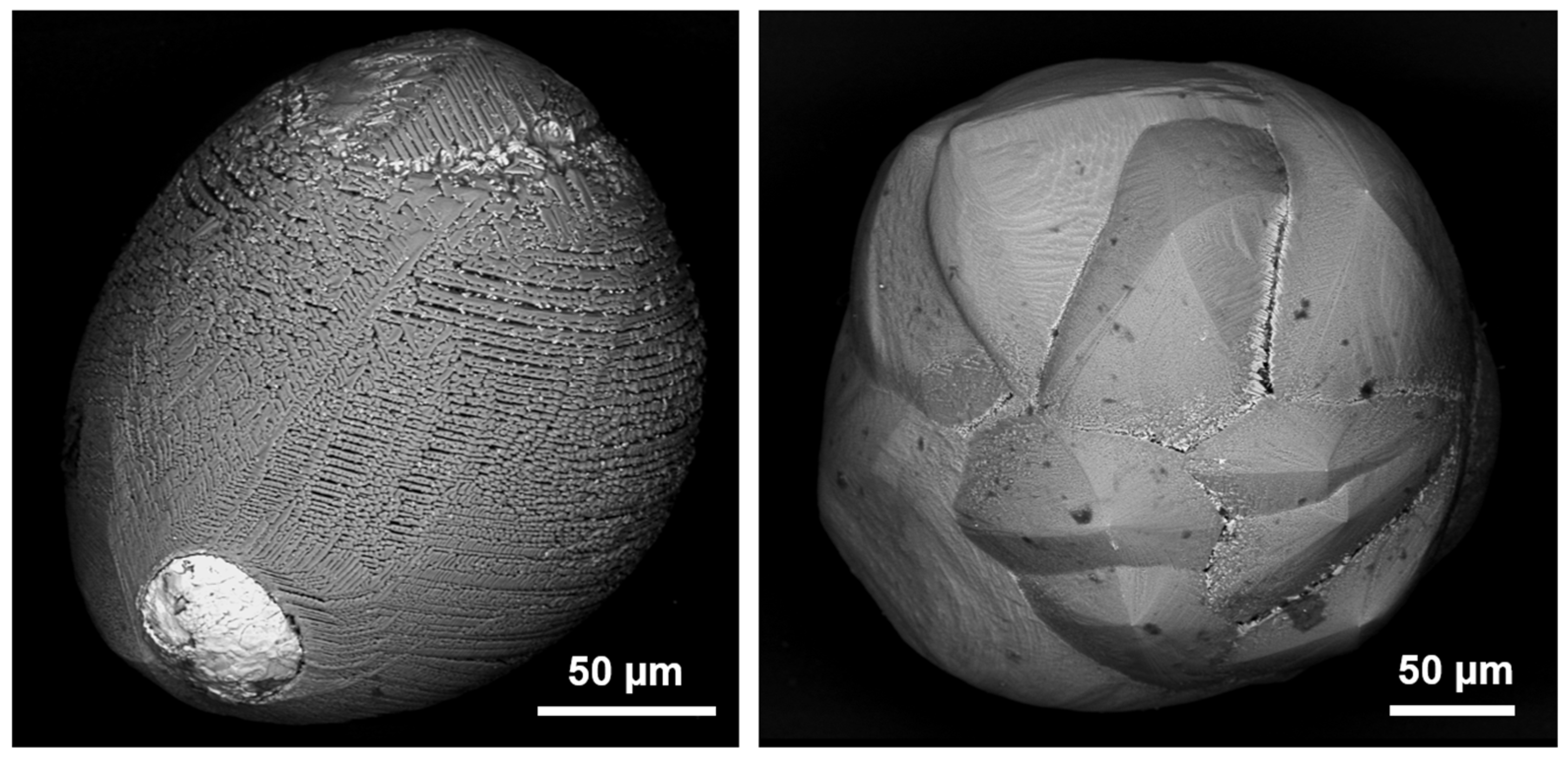
- Further classification and verification of the micrometeorites by means of a scanning electron microscope (SEM) equipped with an energy-dispersive X-ray spectroscopy (EDS) detector to allow for chemical analysis;
- Several other very specialized micro-analytical investigations may follow depending on research questions, often not suitable for citizen science;
- Scientific publication in a broad sense (e.g., open access database, reports, publications in scientific journals) of the findings and new insights into urban micrometeorite research.
2. Materials and Methods
2.1. Study Design
2.2. Project Team
2.3. School Collaboration
2.4. Interview Administration
2.5. Research Instruments
2.6. Sample Characteristics
2.7. Data Analysis
3. Results
3.1. Interviews with the Students
3.1.1. Insight into Real Scientific Work
For me, I would say that the way of working on scientific projects has changed as a result…I didn’t know before the whole project how to work scientifically, how to approach different things. I had absolutely no idea how to conduct research in general. And this has given me a good insight into that now.
So for me, well for many, science always seems really far away and always totally complicated and you don’t understand it. But the project showed me that even certain small aspects can play a really big role and a great deal of science is also surprisingly mundane.
I think I didn’t know before how much effort goes into a project like this, because I didn’t know that at the end you have to write an analysis or like a result—like a report about them. In school we started experiments and then made some kind of protocol and then like a brief evaluation and that’s it. But now you can see that there is actually a lot more work involved, which I didn’t know before.
3.1.2. Science as a Participatory Process
At first, I would’ve thought that you mostly just apply existing knowledge. But through the project, I realized that a lot of knowledge is gained through trying things out so to speak. So I used to think that you derived things from the old, but a lot is also in a way newly created or developed through trial and error.
3.1.3. Hands-On and Self-Directed Learning
Where I really learned a lot was simply in the practical implementation. Like when we went to the natural history museum and started working with the microscopes and also the electron microscope. I’d never seen that before and I also had fun because it was just like a practical application and not always only theoretical, which was a great experience.
The practical stuff is really important, that you actually see something and don’t just get theoretical facts. So that you don’t just get told, ‘A micrometeorite is structured like this or that,’ but instead you actually pick out a micrometeorite yourself and examine it and then see if it really is one based on what it’s chemically made of. That was really interesting. And I think if you approach it like that, it is actually easier to grasp than if you just learn it theoretically. (Student 0111)
I understood much better how things work, like, for example with the microscopes. I found that exciting. I felt like a scientist when I used the microscopes. And I thought it was actually really nice that you also had the chance to explore things yourself. And yeah, I really enjoyed it.
At school we don’t really do anything with science. I mean, in school you could just explain more how it works, what you do. Because in science classes, we don’t really do anything with science, we just do calculations or something like that… so you could incorporate science more.
I could really immerse myself in the topic and not just do a speed run. And that made it way easier for me, like, really to work longer on one topic instead of working through 50 topics in ten minutes.
3.2. Interview with the Teacher
3.2.1. Potential of Citizen Science Projects for Scientific Understanding
I actually think, um, probably the main growth is at a meta level, in that they realize in a way that science isn’t something that takes place in some lonely little room, but that there are working groups made up of several people who work on projects, have laboratories, are somehow networked–that there are also museums that conduct research. I think that’s something that very few students know about, and very few people in general.
What I found particularly nice for the students was that they simply had the opportunity to work with equipment that they would otherwise not come into contact with, like, the high-quality stereo microscopes and electron microscopes, which of course is a highlight. These really are devices that students normally have no access to and I think that was almost the most important point.
I think it’s also an experience, um, how much hard work goes into science. And that science, if you look at it a bit critically in quotation marks, is not always a big eureka moment, but rather also a lot of painstaking work that is not always fruitful, although we were lucky that we did have success. That is very motivating, but of course we could have been left empty handed, and then they would have had to live with that. So that’s another thing. That’s also something I allow in my teaching, at least with the older students, that experiments simply don’t work sometimes and then they have to live with that.
3.2.2. Challenges and Requirements in Collaboration Between Citizen Science Projects and Schools
- Format-Specific Considerations
The students come out of it mentally, they have so many other things that somehow come crashing down on them and then it’s quite far away again, especially when you do evaluations like this, then many things are already very distant, in terms of time and mentally.
The more intensive, the better. So if you can somehow manage to do it as a block internship or block project, that would be ideal. So if you can really manage to do it for a week, 5 days, each 6 or 7 h a day, that would be perfect. It’s just the organizational constraints that make it difficult in some circumstances. Most of the time, it’s difficult to anchor something like this in the school system.
I think there is virtually no way around a structured science education. But it can be added, especially in the context of such courses like elective courses, where you simply have a bit more freedom in terms of content and where you have particularly interested students, um, that certainly has potential.
I don’t see the potential in regular lessons, I have to say. I think there might be potential for other projects, other citizen science projects that are perhaps even more vibrant and more accessible, where there is less hard work involved. Because I would say the average student, who is not so interested in the subject, needs more entertainment.
- Compensation for Additional Work
If schools want something like this to happen regularly and a lot and continuously, then they have to compensate for that. Just realistically speaking, in terms of the amount of work I had to do, I should have actually had an hour’s reduction in teaching hours for the whole year.
The resources must be available, in particular time resources for the teachers involved. Because it is simply more work than regular lesson preparation. That is clear. And ideally, time could be made available, but that is really a question of school organization.
- Organizational and Legal Factors
Of course, it would be great to go through the whole work cycle, but then again there are the organizational difficulties. So, starting with the sampling on a roof would of course be optimal. And then to also do the specimen preparation and so on. You’d have to–I don’t know, you’d have to think about it thoroughly again, whether you could somehow manage to, uh, I’ll say, tie that together organizationally and legally in such a way that it’s feasible.
4. Discussion and Limitations
4.1. Discussion
4.2. Practical Implications and Recommendations
4.3. Limitations
Author Contributions
Funding
Institutional Review Board Statement
Informed Consent Statement
Data Availability Statement
Acknowledgments
Conflicts of Interest
Abbreviations
| APA | American Psychological Association |
| ECSA | European Citizen Science Association |
| EDS | Energy Dispersive Spectroscopy |
| MfN | Museum für Naturkunde Berlin |
| NHM | Natural History Museum |
| NOS | Nature of Science |
| SEM | Scanning Electron Microscope |
| STEM | Science, Technology, Engineering, Mathematics |
Appendix A
Appendix A.1. Interview Guideline for Student Interviews
- How has your understanding of what science is changed as a result of the project? (your idea of how science works or what science means—including the goal of science and who carries it out)?
- To what extent do you think creativity plays a role in science classes (physics, biology, chemistry, math, geography)? (How important do you think creativity/creative thinking is in science lessons?)
- How do you use creativity when learning in science classes (physics, biology, chemistry, math, geography)? (When must or can you be creative?)
- When you think of the micrometeorite project, does creativity play a (different) role there than in your science lessons? Explain/justify your answer.
- What do you think of the following statement: “Scientific theories are often more complicated than they need to be.” Is that true in your opinion? Explain why or why not.
- Why do you think it is that learning about science (scientific work, processes or procedures, research cycle) is/seems complicated for most people?
- a.
- What would help you to make learning about science less complicated? (In reference to the project: What experiences did you have in the micrometeorite project in terms of learning about science? Did the project help you to understand scientific theories and processes more easily? Explain!)
- What do you think is the purpose of science? (The aim of science, why we actually conduct research)
- a.
- And when you think about the project again: What is the purpose of our research in the project, in which you discovered and analyzed new micrometeorites?
Appendix A.2. Interview Guideline for Teacher Interview
- What motivated you to participate twice in the micrometeorite project with your students—as, so to speak, citizen scientists?
- What did you particularly like about the project?
- What do you think the students learned from the project— in terms of the subject matter, but also about what science is and how it works?
- a.
- To what extent is such a project suitable for promoting students’ understanding of science?
- What challenges have you faced in order to successfully integrate the micrometeorite project into your class?
- In your opinion, what conditions must be met for such citizen science projects to succeed in schools? What recommendations would you give us?
- In your opinion, what opportunities does the use of such citizen science projects in schools offer?
- Is there anything else you would like to say about the project and collaboration?
Appendix B
Appendix B.1. Verbal Consent Script for Participating Students
Appendix B.2. Verbal Consent Script for Participating Teacher
References
- Abd-El-Khalick, F., Bell, R. L., & Lederman, N. G. (1998). The nature of science and instructional practice: Making the unnatural natural. Science Education, 82(4), 417–436. [Google Scholar] [CrossRef]
- Abd-El-Khalick, F., & Lederman, N. G. (2000). Improving science teachers’ conceptions of nature of science: A critical review of the literature. International Journal of Science Education, 22(7), 665–701. [Google Scholar] [CrossRef]
- Anderson, D., Lucas, K. B., Ginns, I. S., & Dierking, L. D. (2000). Development of knowledge about electricity and magnetism during a visit to a science museum and related post-visit activities. Science Education, 84(5), 658–679. [Google Scholar] [CrossRef]
- Anderson, T., & Shattuck, J. (2012). Design-based research: A decade of progress in education research? Educational Researcher, 41(1), 16–25. [Google Scholar] [CrossRef]
- Aristeidou, M., & Herodotou, C. (2020). Online citizen science: A systematic review of effects on learning and scientific literacy. Citizen Science: Theory and Practice, 5(1), 1–12. [Google Scholar] [CrossRef]
- Ballard, H. L., Dixon, C. G., & Harris, E. M. (2017). Youth-focused citizen science: Examining the role of environmental science learning and agency for conservation. Biological Conservation, 208, 65–75. [Google Scholar] [CrossRef]
- Bergqvist, A., & Chang Rundgren, S. N. (2017). The influence of textbooks on teachers’ knowledge of chemical bonding representations relative to students’ difficulties understanding. Research in Science & Technological Education, 35(2), 215–237. [Google Scholar] [CrossRef]
- Berndt, J., & Nitz, S. (2023). Learning in citizen science: The effects of different participation opportunities on students’ knowledge and attitudes. Sustainability, 15(16), 12264. [Google Scholar] [CrossRef]
- Bonney, R., Ballard, H., Jordan, R., McCallie, E., Phillips, T., Shirk, J., & Wilderman, C. C. (2009a). Public participation in scientific research: Defining the field and assessing its potential for informal science education. A CAISE inquiry group report. Available online: https://files.eric.ed.gov/fulltext/ED519688.pdf (accessed on 1 February 2026).
- Bonney, R., Cooper, C. B., Dickinson, J., Kelling, S., Phillips, T., Rosenberg, K. V., & Shirk, J. (2009b). Citizen science: A developing tool for expanding science knowledge and scientific literacy. BioScience, 59, 977–984. [Google Scholar] [CrossRef]
- Bonney, R., Phillips, T. B., Ballard, H. L., & Enck, J. W. (2016). Can citizen science enhance public understanding of science? Public Understanding of Science, 25(1), 2–16. [Google Scholar] [CrossRef] [PubMed]
- Braun, V., & Clarke, V. (2006). Using thematic analysis in psychology. Qualitative Research in Psychology, 3(2), 77–101. [Google Scholar] [CrossRef]
- Bruckermann, T., Greving, H., Stillfried, M., Schumann, A., Brandt, M., & Harms, U. (2022). I’m fine with collecting data: Engagement profiles differ depending on scientific activities in an online community of a citizen science project. PLoS ONE, 17(10), e0275785. [Google Scholar] [CrossRef]
- Bybee, R. W. (1997). Achieving scientific literacy: From purposes to practices. Heinemann. [Google Scholar]
- Dawson, C., Julku, H., Pihlajamäki, M., Kaakinen, J. K., Schooler, J. W., & Simola, J. (2024). Evidence-based scientific thinking and decision-making in everyday life. Cognitive Research: Principles and Implications, 9(1), 50. [Google Scholar] [CrossRef] [PubMed]
- ECSA (European Citizen Science Association). (2015). Ten principles of citizen science. Available online: https://osf.io/xpr2n/overview (accessed on 1 February 2026).
- Feinstein, N. W., & Waddington, D. I. (2020). Individual truth judgments or purposeful, collective sensemaking? Rethinking science education’s response to the post-truth era. Educational Psychologist, 55(3), 155–166. [Google Scholar] [CrossRef]
- Gandolfi, H. E. (2024). (Re)considering nature of science education in the face of socio-scientific challenges and injustices. Science & Education, 34, 3799–3825. [Google Scholar] [CrossRef]
- Genge, M. J., Larsen, J., Van Ginneken, M., & Suttle, M. D. (2017). An urban collection of modern-day large micrometeorites: Evidence for variations in the extraterrestrial dust flux through the quaternary. Geology, 45, 119–122. [Google Scholar] [CrossRef]
- Greving, H., Bruckermann, T., Schumann, A., Straka, T. M., Lewanzik, D., Voigt-Heucke, S. L., Marggraf, L., Lorenz, J., Brandt, M., Voigt, C. C., Harms, U., & Kimmerle, J. (2022). Improving attitudes and knowledge in a citizen science project about urban bat ecology. Ecology and Society, 27, art24. [Google Scholar] [CrossRef]
- Harlin, J., Kloetzer, L., Patton, D., & Leonhard, C. (2018). Turning students into scientists. In S. Hecker, M. Haklay A. Bowser, Z. Makuch, J. Vogel, & A. Bonn (Eds.), Citizen science: Innovation in open science, society and policy (pp. 410–428). UCL Press. [Google Scholar] [CrossRef]
- Hasse, T. (2020). Urbane Mikrometeorite: Kosmische Staubpartikel in der Stadt. Available online: https://www.micrometeorites.org/ (accessed on 1 February 2026).
- Hecht, L., Milke, R., & Greshake, A. (2021). Urbane mikrometeorite: Citizen science in den geowissenschaften. Geowissenschaftliche Mitteilungen, 84, 8–21. [Google Scholar] [CrossRef]
- Hodson, D., & Wong, S. L. (2014). From the horse’s mouth: Why scientists’ views are crucial to nature of science understanding. International Journal of Science Education, 36(16), 2639–2665. [Google Scholar] [CrossRef]
- Howell, E. L., & Brossard, D. (2021). (Mis) informed about what? What it means to be a science-literate citizen in a digital world. Proceedings of the National Academy of Sciences, 118(15), e1912436117. [Google Scholar] [CrossRef]
- Kelemen-Finan, J., Scheuch, M., & Winter, S. (2018). Contributions from citizen science to science education: An examination of a biodiversity citizen science project with schools in Central Europe. International Journal of Science Education, 40(17), 2078–2098. [Google Scholar] [CrossRef]
- Khishfe, R. (2017). Consistency of nature of science views across scientific and socio-scientific contexts. International Journal of Science Education, 39(4), 403–432. [Google Scholar] [CrossRef]
- Khishfe, R. (2023). Improving students’ conceptions of nature of science: A review of the literature. Science & Education, 32(6), 1887–1931. [Google Scholar] [CrossRef]
- Khishfe, R., & Abd-El-Khalick, F. (2002). Influence of explicit and reflective versus implicit inquiry-oriented instruction on sixth graders’ views of nature of science. Journal of Research in Science Teaching: The Official Journal of the National Association for Research in Science Teaching, 39(7), 551–578. [Google Scholar] [CrossRef]
- Kisiel, J. F. (2014). Clarifying the complexities of school–museum interactions: Perspectives from two communities. Journal of Research in Science Teaching, 51(3), 342–367. [Google Scholar] [CrossRef]
- Kloetzer, L., Lorke, J., Roche, J., Golumbic, Y., Winter, S., & Jõgeva, A. (2021). Learning in citizen science. In The Science of Citizen Science (pp. 283–308). Springer. [Google Scholar] [CrossRef]
- Larsen, J. (2017). In search of stardust: Amazing micrometeorites and their terrestrial imposters. Voyageur Press. [Google Scholar]
- Larsen, J. (2019). On the trail of stardust: The guide to finding micrometeorites: Tools, techniques, and identification. Voyageur Press. [Google Scholar]
- Lederman, N. G. (2007). Nature of science: Past, present, and future. In S. Abell, & N. G. Lederman (Eds.), Handbook of research on science education (pp. 831–879). Routledge. [Google Scholar]
- Lederman, N. G., & Lederman, J. S. (2014). Research on teaching and learning of nature of science. In N. G. Lederman, & J. S. Lederman (Eds.), Handbook of research on science education, volume II (pp. 600–620). Routledge. [Google Scholar]
- Love, S. G., & Brownlee, D. E. (1993). A direct measurement of the terrestrial mass accretion rate of cosmic dust. Science, 262, 550–553. [Google Scholar] [CrossRef] [PubMed]
- Mady, R. P., Phillips, T. B., Bonter, D. N., Quimby, C., Borland, J., Eldermire, C., Walters, B. T., Parry, S. A., & Chu, M. (2023). Engagement in the data collection phase of the scientific process is key for enhancing learning gains. Citizen Science: Theory and Practice, 8(1), 1–16. [Google Scholar] [CrossRef]
- Masters, K., Oh, E. Y., Cox, J., Simmons, B., Lintott, C., Graham, G., Greenhill, A., & Holmes, K. (2016). Science learning via participation in online citizen science. arXiv, arXiv:1601.05973. [Google Scholar] [CrossRef]
- Mayring, P. (2014). Qualitative content analysis: Theoretical background and procedures. In A. Bikner-Ahsbahs, C. Knipping, & N. Presmeg (Eds.), Approaches to qualitative research in mathematics education: Examples of methodology and methods (pp. 365–380). Springer. [Google Scholar] [CrossRef]
- McComas, W. F., Clough, M. P., & Nouri, N. (2020). Nature of science and classroom practice: A review of the literature with implications for effective NOS instruction. In Nature of science in science instruction: Rationales and strategies (pp. 67–111). Springer. [Google Scholar] [CrossRef]
- McCreedy, D., & Dierking, L. D. (2013). Cascading influences. Long-term impacts of informal STEM experiences for girls. Franklin Institute Science Museum Press. [Google Scholar]
- Moormann, A., & Sturm, U. (2025). Nature experience through citizen science projects. In U. Gebhard, A. Lude, A. Möller, & A. Moormann (Eds.), Nature experience and education. Contributions from biology education research (pp. 351–364). Springer. [Google Scholar] [CrossRef]
- Mujtaba, T., Lawrence, M., Oliver, M., & Reiss, M. J. (2018). Learning and engagement through natural history museums. Studies in Science Education, 54(1), 41–67. [Google Scholar] [CrossRef]
- OECD. (2019). PISA 2018 results (volume I): What students know and can do. PISA. OECD Publishing. [Google Scholar] [CrossRef]
- Osborne, J. (2017). Going beyond the consensus view: A response. Canadian Journal of Science, Mathematics and Technology Education, 17(1), 53–57. [Google Scholar] [CrossRef]
- Osterman, M. D., & Sheppard, B. (2010). Museums and schools working together. In K. Fortney, & B. K. Sheppard (Eds.), An alliance of spirit: Museum and school partnerships (pp. 1–8). American Association of Museums. [Google Scholar]
- Öberg, G., Campbell, A., Fox, J., Graves, M., Ivanochko, T., Matsuchi, L., Mouat, I., & Welsh, A. (2022). Teaching science as a process, not a set of facts. Science & Education, 31, 787–817. [Google Scholar] [CrossRef]
- Pedretti, E., & Iannini, A. M. N. (2020). Towards fourth-generation science museums: Changing goals, changing roles. Canadian Journal of Science, Mathematics and Technology Education, 20(4), 700–714. [Google Scholar] [CrossRef] [PubMed]
- Reiss, M. J., & McComas, W. F. (2020). Informal learning sites and their role in communicating the nature of science. In W. F. McComas (Ed.), Nature of science in science instruction: Rationales and strategies (pp. 711–729). Springer International Publishing. [Google Scholar] [CrossRef]
- Roche, J., Bell, L., Galvão, C., Golumbic, Y. N., Kloetzer, L., Knoben, N., Laakso, M., Lorke, J., Mannion, G., Massetti, L., Mauchline, A., Pata, K., Ruck, A., Taraba, P., & Winter, S. (2020). Citizen science, education, and learning: Challenges and opportunities. Frontiers in Sociology, 5, 613814. [Google Scholar] [CrossRef] [PubMed]
- Sandoval, W. A. (2005). Understanding students’ practical epistemologies and their influence on learning through inquiry. Science Education, 89(4), 634–656. [Google Scholar] [CrossRef]
- Saunders, M. E., Roger, E., Geary, W. L., Meredith, F., Welbourne, D. J., Bako, A., Canavan, E., Herro, F., Herron, C., Hung., O., Kunstler, M., Lin, J., Ludlow, N., Paton, M., Salt, S., Simpson, T., Wang, A., Zimmerman, N., Drews, K. B., … Moles, A. T. (2018). Citizen science in schools: Engaging students in research on urban habitat for pollinators. Austral Ecology, 43(6), 635–642. [Google Scholar] [CrossRef]
- Schwartz, R. S., Lederman, N. G., & Crawford, B. A. (2004). Developing views of nature of science in an authentic context: An explicit approach to bridging the gap between nature of science and scientific inquiry. Science Education, 88(4), 610–645. [Google Scholar] [CrossRef]
- Solé, C., Couso, D., & Hernández, M. I. (2024). Citizen science in schools: A systematic literature review. International Journal of Science Education, Part B, 14(3), 383–399. [Google Scholar] [CrossRef]
- Storksdieck, M., Shirk, J. L., Cappadonna, J. L., Domroese, M., Göbel, C., Haklay, M., Miller-Rushing, A. J., Roetman, P., Sbrocchi, D., & Vohland, K. (2016). Associations for citizen science: Regional knowledge, global collaboration. Citizen Science: Theory and Practice, 1(2), 10. [Google Scholar] [CrossRef]
- Strasser, B. J., Baudry, J., Mahr, D., Sanchez, G., & Tancoigne, E. (2019). “Citizen science”? Rethinking science and public participation. Science & Technology Studies, 32(2), 52–76. [Google Scholar] [CrossRef]
- Suttle, M. D., Hasse, T., & Hecht, L. (2021). Evaluating urban micrometeorites as a research resource—A large population collected from a single rooftop. Meteoritics & Planetary Science, 56(8), 1531–1555. [Google Scholar] [CrossRef]
- Urhahne, D., Kremer, K., & Mayer, J. (2008). Welches Verständnis haben Jugendliche von der Natur der Naturwissenschaften? Entwicklung und erste Schritte zur Validierung eines Fragebogens. Zeitschrift für Didaktik der Naturwissenschaften, 14(1), 71–93. [Google Scholar]
- Williams, K. A., Hall, T. E., & O’Connell, K. (2021). Classroom-based citizen science: Impacts on students’ science identity, nature connectedness, and curricular knowledge. Environmental Education Research, 27(7), 1037–1053. [Google Scholar] [CrossRef]
- Wishart, J., & Triggs, P. (2010). MuseumScouts: Exploring how schools, museums and interactive technologies can work together to support learning. Computers & Education, 54(3), 669–678. [Google Scholar] [CrossRef]
- Zoellick, B., Nelson, S. J., & Schauffler, M. (2012). Participatory science and education: Ringing both views into focus. Frontiers in Ecology and the Environment, 10(6), 310–313. [Google Scholar] [CrossRef]



| Session | Setting | Content |
|---|---|---|
| 1 | School |
|
| 2 | School |
|
| 3 | School |
|
| 4 | MfN Berlin |
|
| 5 | School |
|
| 6 | School |
|
| Themes | Subthemes | Students (n) |
|---|---|---|
| Insight into Real Scientific Work | First exposure to authentic research | 3 |
| Understanding research cycle and scientific practices | 9 | |
| Science as a Participatory Process | Science is an iterative process | 6 |
| Accessibility of science participation | 5 | |
| Hands-On and Self-Directed Learning | Learning by doing | 14 |
| Self-directed learning | 11 | |
| Contrast between citizen science project and classroom science | 12 |
Disclaimer/Publisher’s Note: The statements, opinions and data contained in all publications are solely those of the individual author(s) and contributor(s) and not of MDPI and/or the editor(s). MDPI and/or the editor(s) disclaim responsibility for any injury to people or property resulting from any ideas, methods, instructions or products referred to in the content. |
© 2026 by the authors. Licensee MDPI, Basel, Switzerland. This article is an open access article distributed under the terms and conditions of the Creative Commons Attribution (CC BY) license.
Share and Cite
Moormann, A.; Tilove, A.; Dieter, D.; Miedtank, A.; Hecht, L. Science Beyond School: Exploring Students’ Understanding of Science Through a Citizen Science Project on Micrometeorites. Educ. Sci. 2026, 16, 291. https://doi.org/10.3390/educsci16020291
Moormann A, Tilove A, Dieter D, Miedtank A, Hecht L. Science Beyond School: Exploring Students’ Understanding of Science Through a Citizen Science Project on Micrometeorites. Education Sciences. 2026; 16(2):291. https://doi.org/10.3390/educsci16020291
Chicago/Turabian StyleMoormann, Alexandra, Aria Tilove, Dominik Dieter, Andrea Miedtank, and Lutz Hecht. 2026. "Science Beyond School: Exploring Students’ Understanding of Science Through a Citizen Science Project on Micrometeorites" Education Sciences 16, no. 2: 291. https://doi.org/10.3390/educsci16020291
APA StyleMoormann, A., Tilove, A., Dieter, D., Miedtank, A., & Hecht, L. (2026). Science Beyond School: Exploring Students’ Understanding of Science Through a Citizen Science Project on Micrometeorites. Education Sciences, 16(2), 291. https://doi.org/10.3390/educsci16020291