Designing a Technology Integration Competency Framework for Mathematics Teachers Through Reflective Practice: A Design-Based Research Approach


Abstract
1. Introduction
2. Backgrounds
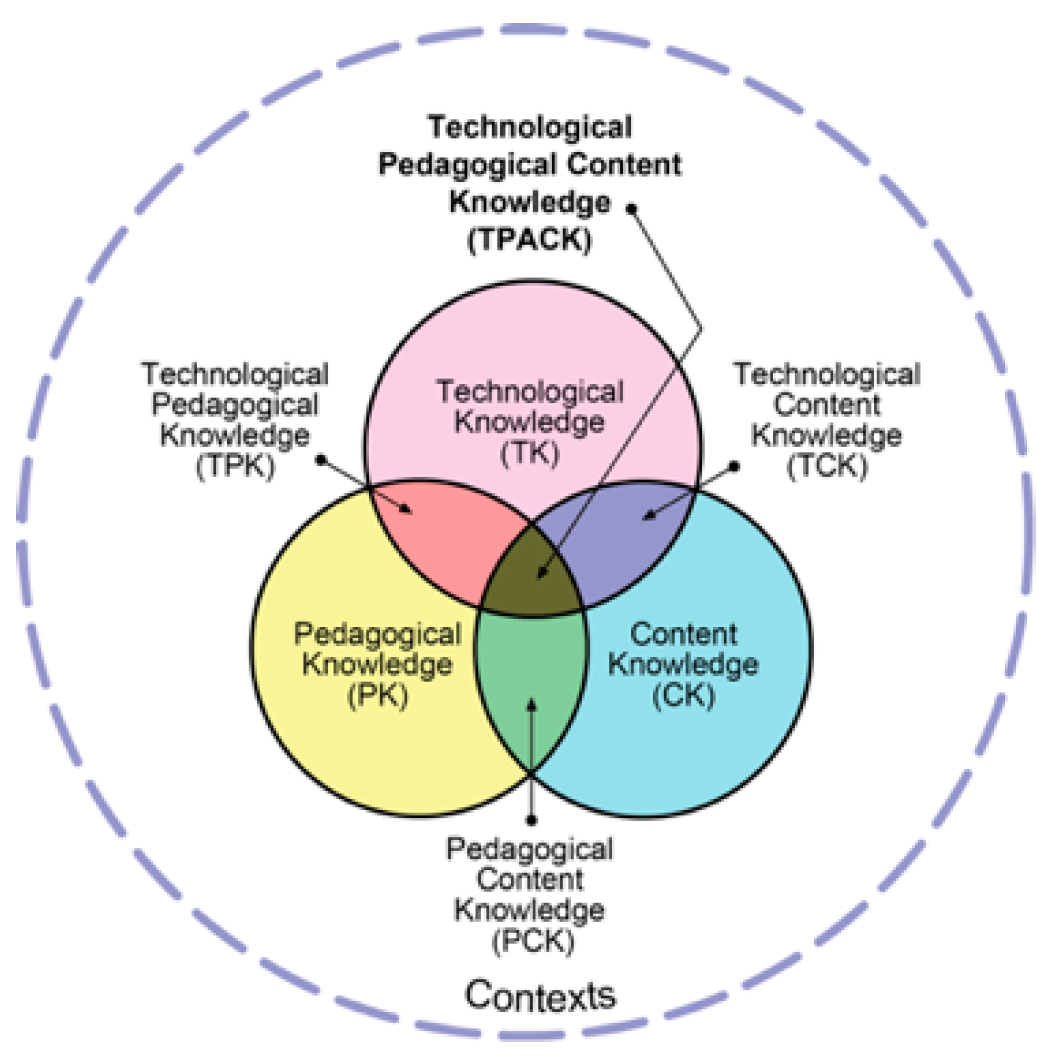
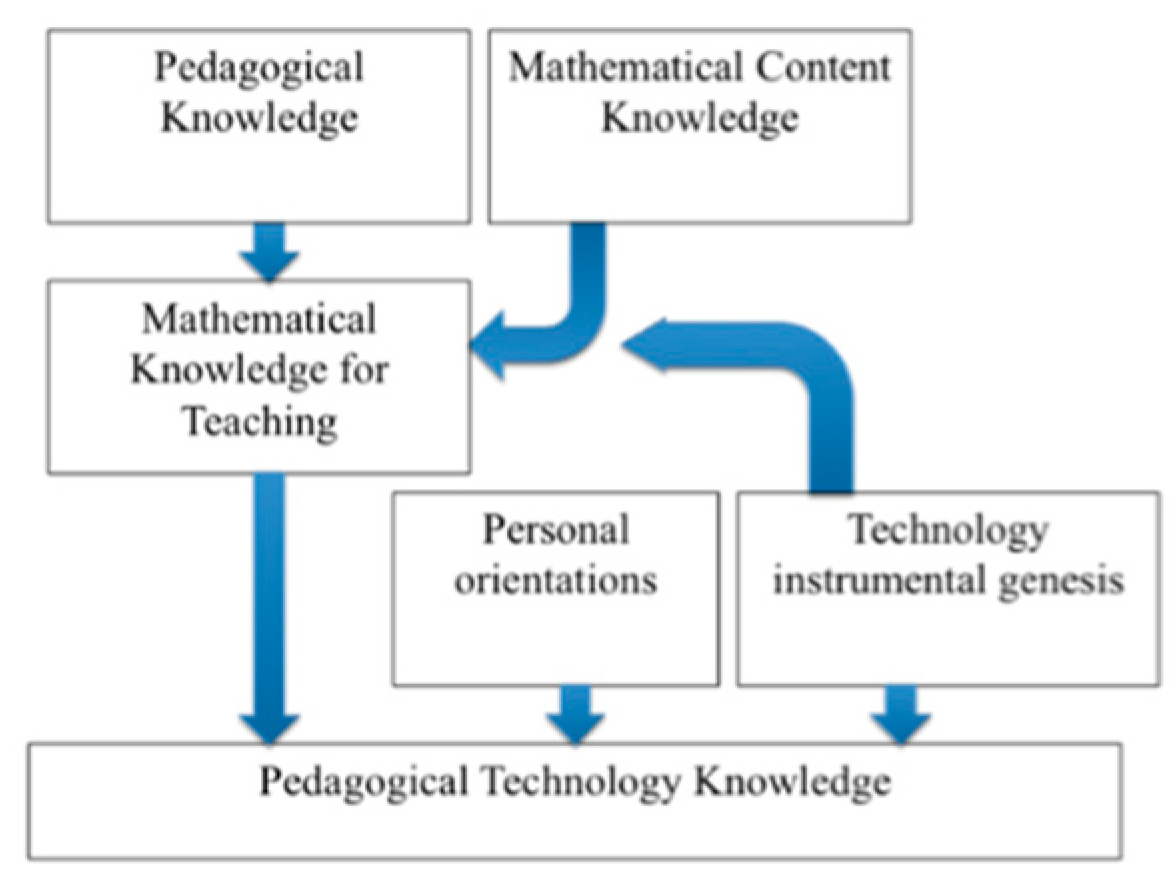
2.1. Existing Frameworks Relating to Technology Integration
2.2. Professional Development for Technology Integration
2.3. Reflective Practice as a Causal Mechanism for Professional Growth
3. Materials and Methods
3.1. Design-Based Research and Intervention Design
3.1.1. Structure of the Professional Development
3.1.2. Research Paradigm: DBR
- Phase 1: Initial Design and Framework Development
- Phase 2: Implementation and Iterative Refinement
- Phase 3: Final Evaluation and Validation
3.2. Participants
3.3. Data Collection
3.4. Data Analysis and Validation
3.5. Iterative Evolution of the Framework
4. Results
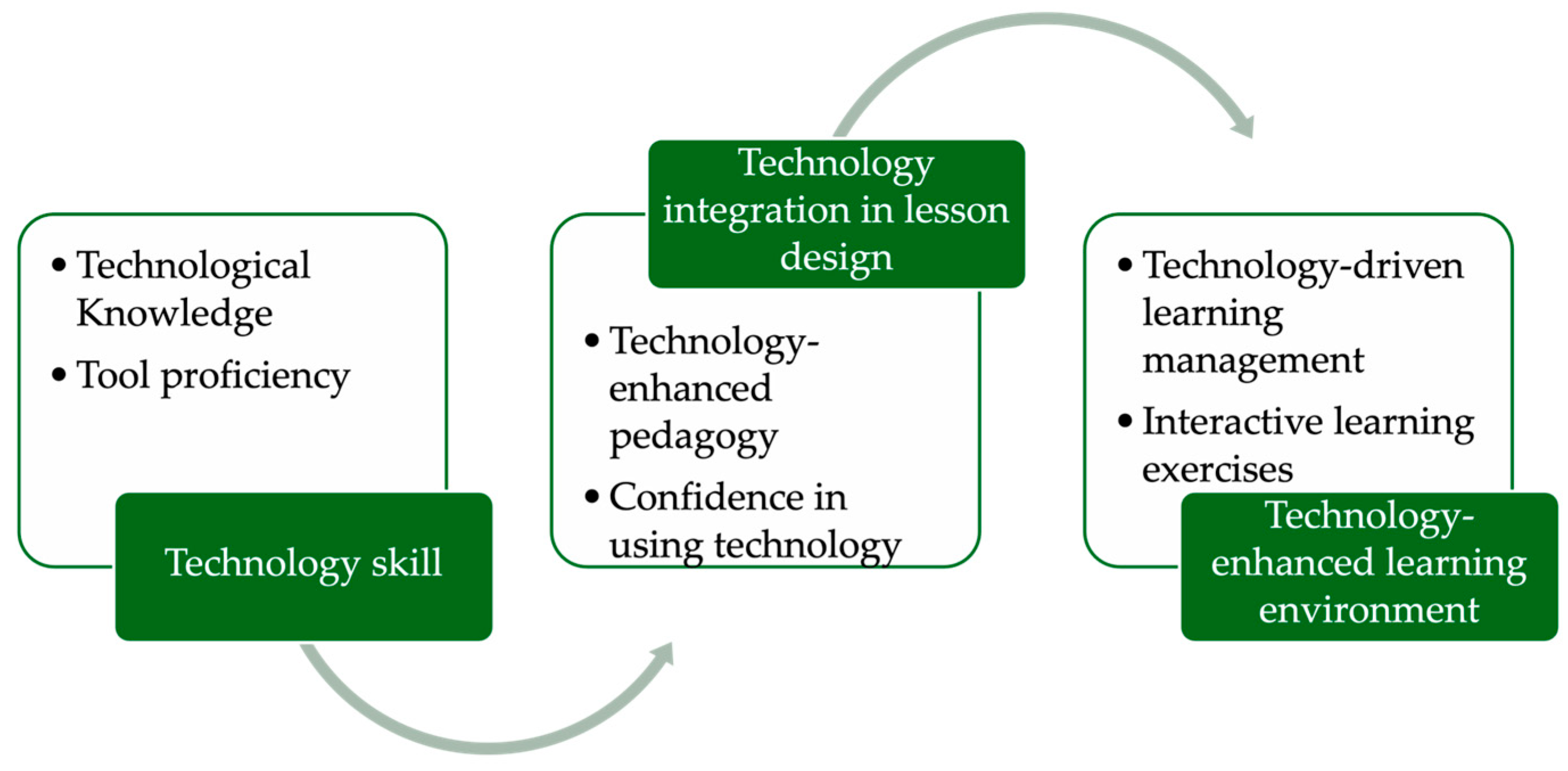
4.1. Initial Draft Framework and Preliminary Themes
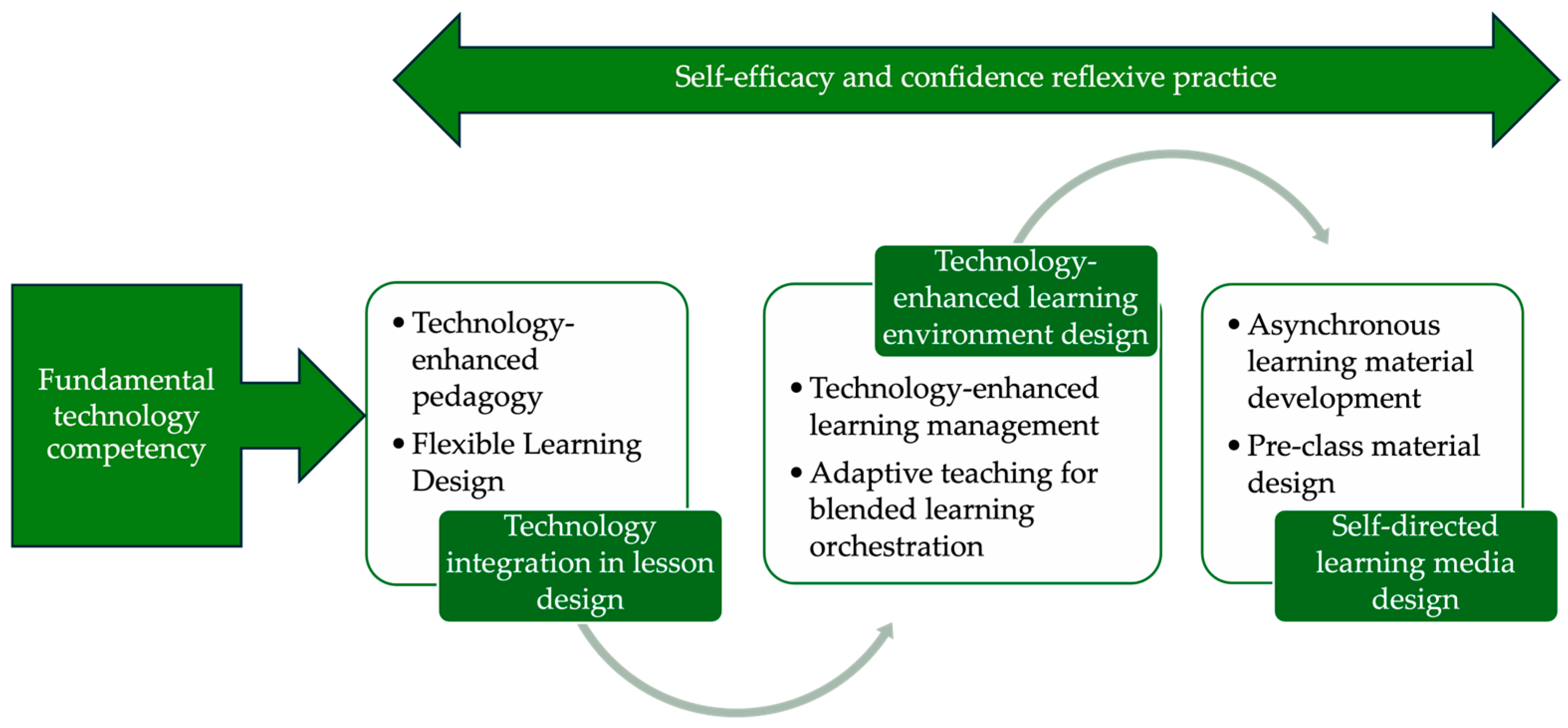
4.2. Empirical Refinement and Framework Reconfiguration
5. Discussion
5.1. Contributions and Significance of Reflective Practice Research to Theoretical Novelty
5.2. Reflection as a Mechanism for Changing
5.3. Emergent Themes as Reflection on Evidence
5.4. Implications for Professional Development
5.5. Limitation and Future Research
6. Conclusions
Author Contributions
Funding
Institutional Review Board Statement
Informed Consent Statement
Data Availability Statement
Acknowledgments
Conflicts of Interest
References
- Abebe, F., & Trainin, G. (2024). Predicting technological, pedagogical, and content knowledge (TPACK) formation in elementary math education. Contemporary Issues in Technology and Teacher Education, 24(2), 125–150. [Google Scholar] [CrossRef]
- Agnihotri, S., Mamoria, P., Moorthygari, S. L., Chandel, P., & Raju, S. G. (2024). The role of reflective practice in enhancing teacher efficacy. Educational Administration: Theory and Practice, 30(6), 1689–1696. [Google Scholar] [CrossRef]
- Aguirre-Muñoz, Z., Yeter, I. H., Garro, E. S. L., & Koca, F. (2020). Building teachers’ capacity to integrate science and math content: Implications for professional development and learning. Journal of Science Teacher Education, 32(1), 62–84. [Google Scholar] [CrossRef]
- Ahmad, A. N., Hamid, H., & Zahrin, S. N. A. (2025). Reflective practice in teaching and learning: An analysis from experts’ perspectives. International Journal of Academic Research in Business and Social Sciences, 15(10), 87–106. [Google Scholar] [CrossRef]
- Akram, H., Abdelrady, A. H., Al-Adwan, A. S., & Ramzan, M. (2022). Teachers’ perceptions of technology integration in teaching-learning practices: A systematic review. Frontiers in Psychology, 13, 920317. [Google Scholar] [CrossRef]
- Anand, J., & Gangmei, E. (2023). Reflective practices: A connecting bridge between theory and practice in teacher education. International Journal for Multidisciplinary Research, 5(6), 23069459. [Google Scholar] [CrossRef]
- Aqib, M. A. I., Ekawati, R., & Khabibah, S. (2025). A modified technological pedagogical and content knowledge (TPACK) framework: A systematic literature review. Multidisciplinary Reviews, 8(6), 2025167. [Google Scholar] [CrossRef]
- Arendt, K., Stark, L., Friedrich, A., Brünken, R., & Stark, R. (2025). Quality of reflections on teaching: Approaches to its measurement and low-threshold promotion. Education Sciences, 15(7), 884. [Google Scholar] [CrossRef]
- Ball, D. L. (2000). Bridging practices: Intertwining content and pedagogy in teaching and learning to teach. Journal of Teacher Education, 51(3), 241–247. [Google Scholar] [CrossRef]
- Braun, V., & Clarke, V. (2006). Using thematic analysis in psychology. Qualitative Research in Psychology, 3(2), 77–101. [Google Scholar] [CrossRef]
- Braun, V., & Clarke, V. (2019). Reflecting on reflexive thematic analysis. Qualitative Research in Sport, Exercise and Health, 11(4), 589–597. [Google Scholar] [CrossRef]
- Bueno, R. W. D. S., Lieban, D., & Ballejo, C. C. (2021). Mathematics teachers’ TPACK development based on an online course with GeoGebra. Open Education Studies, 3(1), 110–119. [Google Scholar] [CrossRef]
- Cullen, C. J., Hertel, J. T., & Nickels, M. (2020). The roles of technology in mathematics education. The Educational Forum, 84(2), 166–178. [Google Scholar] [CrossRef]
- Do Anh, T. (2016). Reflective practice and teacher professional learning. VNU Journal of Science: Education Research, 32(4), 29–35. Available online: https://js.vnu.edu.vn/ER/article/view/3847?utm (accessed on 6 February 2026).
- Ertmer, P. A., & Ottenbreit-Leftwich, A. (2012). Removing obstacles to the pedagogical changes required by Jonassen’s vision of authentic technology-enabled learning. Computers & Education, 64(1), 175–182. [Google Scholar] [CrossRef]
- Eyal, L. (2025). Developing and validating an AI-TPACK assessment framework: Enhancing teacher educators’ professional practice through authentic artifacts. Education Sciences, 15(11), 1452. [Google Scholar] [CrossRef]
- Hegedus, S., & Moreno-Armella, L. (2009). Introduction: The transformative nature of “dynamic” educational technology. ZDM Mathematics Education, 41(4), 397–398. [Google Scholar] [CrossRef]
- Ince-Muslu, B., & Erduran, A. (2021). A suggestion of a framework: Conceptualization of the factors that affect technology integration in mathematics education. International Electronic Journal of Mathematics Education, 16(1), em0617. [Google Scholar] [CrossRef] [PubMed]
- Kholid, M. N., Hendriyanto, A., Sahara, S., Muhaimin, L. H., Juandi, D., Sujadi, I., Kuncoro, K. S., & Adnan, M. (2023). A systematic literature review of technological, pedagogical and content knowledge (TPACK) in mathematics education: Future challenges for educational practice and research. Cogent Education, 10(2), 2269047. [Google Scholar] [CrossRef]
- Koehler, M., & Mishra, P. (2009). What is technological pedagogical content knowledge (TPACK)? Contemporary Issues in Technology and Teacher Education, 9(1), 60–70. [Google Scholar] [CrossRef]
- Korobkova, O. K., Galchenko, N. A., Orekhovskaya, N. A., Drozdova, E. A., Zakharova, O. V., & Lobuteva, A. V. (2025). A scoping review of contemporary frameworks, challenges, and future directions on educational technology for digital generations. Contemporary Educational Technology, 17(4), ep611. [Google Scholar] [CrossRef] [PubMed]
- Kurniawan, W., Sutrisno, Maison, Marzal, J., & Anwar, K. (2025). Construction of an intelligent teacher assistant system using the TPACK framework and machine learning to diagnose work and energy misconceptions. International Journal of Information and Education Technology, 15(5), 1084–1102. [Google Scholar] [CrossRef]
- Lee, H. Y., Chung, C. Y., & Wei, G. (2022). Research on technological pedagogical and content knowledge: A bibliometric analysis from 2011 to 2020. Frontiers in Education, 7, 765233. [Google Scholar] [CrossRef]
- Liesa, E., Mayoral, P., Giralt-Romeu, M., & Angulo, S. (2023). Video-based feedback for collaborative reflection among mentors, university tutors and students. Education Sciences, 13(9), 879. [Google Scholar] [CrossRef]
- Lu, L. (2014). Cultivating reflective practitioners in technology preparation: Constructing TPACK through reflection. Education Sciences, 4(1), 13–35. [Google Scholar] [CrossRef]
- Mariotti, M. A. (2009). Artifacts and signs after a Vygotskian perspective: The role of the teacher. ZDM, 41(4), 427–440. [Google Scholar] [CrossRef]
- McKenney, S., & Reeves, T. C. (2021). Educational design research: Portraying, conducting, and enhancing productive scholarship. Medical Education, 55(1), 82–92. [Google Scholar] [CrossRef]
- Mohamed, M., Rashid, R. A., & Alqaryouti, M. H. (2022). Conceptualizing the complexity of reflective practice in education. Frontiers in Psychology, 13, 1008234. [Google Scholar] [CrossRef]
- Mshayisa, V. V., & Ivala, E. N. (2022). No student left behind: Students’ experiences of a self-paced online learning orientation in undergraduate studies during COVID-19 pandemic. Education Sciences, 12(6), 386. [Google Scholar] [CrossRef]
- Muir, T., Deed, C., Thomas, D., & Emery, S. (2021). Achieving teacher professional growth through professional experimentation and changes in pedagogical practices. Australian Journal of Teacher Education, 46(9), 22–38. [Google Scholar] [CrossRef]
- Mukuka, A., & Alex, J. K. (2025). Profiling mathematics teacher educators’ readiness for digital technology integration: Evidence from Zambia. Journal of Mathematics Teacher Education, 28(2), 315–339. [Google Scholar] [CrossRef]
- Ogwu, E. N., Emelogu, N. U., Azor, R. O., & Okwo, F. A. (2023). Educational technology adoption in instructional delivery in the new global reality. Education and Information Technologies, 28(1), 1065–1080. [Google Scholar] [CrossRef]
- Priyanda, R., Herman, T., Amalia, R., & Ihsan, I. R. (2025). Exploring teachers’ pedagogical reasoning in mathematics education using the TPACK framework. Frontiers in Education, 10, 1552760. [Google Scholar] [CrossRef]
- Qvortrup, L. (2019). Provision of school data and research based teacher professional development: Does it work? Data- and research-informed development of schools in the Danish “Program for Learning Leadership”. Education Sciences, 9(2), 92. [Google Scholar] [CrossRef]
- Rogge, T., & Herzig, B. (2025). Enhancing pre-service teachers’ reflective competence through structured video annotation. Education Sciences, 15(9), 1146. [Google Scholar] [CrossRef]
- Rothe, L., & Göbel, K. (2024). Preservice teachers’ reflection processes when collaboratively reflecting on videotaped classroom teaching. Education Sciences, 14(12), 1357. [Google Scholar] [CrossRef]
- Ruiz-López, N. (2018). The instrumental genesis process in future primary teachers using dynamic geometry software. International Journal of Mathematical Education in Science and Technology, 49(4), 481–500. [Google Scholar] [CrossRef]
- Scott, E. E., Wenderoth, M. P., & Doherty, J. H. (2020). Design-based research: A methodology to extend and enrich biology education research. CBE—Life Sciences Education, 19(2), es11. [Google Scholar] [CrossRef]
- Seufert, S., Guggemos, J., & Sailer, M. (2020). Technology-related knowledge, skills, and attitudes of pre- and in-service teachers: The current situation and emerging trends. Computers in Human Behavior, 115(1), 106552. [Google Scholar] [CrossRef]
- Simpson, A., Anderson, A., Maltese, A. V., Penney, L., & Paul, K. (2025). Co-adapting a reflective video-based professional development in informal STEM education. Education Sciences, 15(3), 353. [Google Scholar] [CrossRef]
- Thomas, M. O. J., & Hong, Y. Y. (2013). Teacher integration of technology into mathematics learning. International Journal of Technology in Mathematics Education, 20(2), 69–84. [Google Scholar]
- Tinoca, L., Piedade, J., Santos, S., Pedro, A., & Gomes, S. (2022). Design-based research in the educational field: A systematic literature review. Education Sciences, 12(6), 410. [Google Scholar] [CrossRef]
- Toledo, C. (2005). A five-stage model of computer technology infusion into teacher education curriculum. Contemporary Issues in Technology and Teacher Education, 5(2), 177–191. [Google Scholar]
- Vogelsang, C., Scholl, D., Meier, J., & Küth, S. (2025). Thoughts are free—Differences between unstructured and structured reflections of teachers with different levels of expertise. Education Sciences, 15(7), 820. [Google Scholar] [CrossRef]
- Zhang, C., Schießl, J., Plößl, L., Hofmann, F., & Gläser-Zikuda, M. (2023). Evaluating reflective writing in pre-service teachers: The potential of a mixed-methods approach. Education Sciences, 13(12), 1213. [Google Scholar] [CrossRef]




| Stage | Timeline | Activities for Participants |
|---|---|---|
| Foundational workshops | Month 1–2 |
|
| Collaborative lesson design | Month 3–4 |
|
| Reflective cycles 1 | Month 5–10 |
|
| Reflective cycles 2 | Month 11–16 |
|
| Validation stage | Month 17–18 |
|
| PD Session | DBR Phase | Timeline | Core Activities of Researcher | Research Outputs |
|---|---|---|---|---|
| 1. Foundational workshops | DBR Phase 1. Initial Design and Framework Development Phase | |||
| Analysis and Exploration | Month 1–2 | Literature review on TPACK/PTK; expert consultations; baseline surveys of teacher needs; planning of the PD curriculum. | Identification of primary generators for the design; PD workshop materials. | |
| 2. Collaborative lesson design | Initial Design | Month 3–4 | Foundational workshops: development of the draft framework. | First version of draft framework: co-design technology-enhanced tasks. |
| 3. Reflective cycles | DBR Phase 2. Implementation and Iterative Refinement Phase | |||
| Reflective Cycle 1 | Month 5–10 | Implementation of the first draft; monthly workshops; first round of classroom video reflection. | Preliminary thematic map: identification of functional overlaps. | |
| Reflective Cycle 2 | Month 11–16 | Refinement of the framework based on Cycle 1 data; focus on adaptive teaching and blended orchestration. | Final framework: design principles for reflective PD. | |
| 4. Validation | DBR Phase 3. Final Evaluation and Validation Phase | |||
| Validation | Month 17–18 | Validation of the framework | Final validated framework: design principles for reflective PD. | |
| Criterion | Weighting | Operational Definition and Verification |
|---|---|---|
| Professional Dedication | 40% | Commitment to attend 100% of the 18-month workshop; prior history of engaging in school-based peer learning communities. |
| Implementation Fidelity | 30% | Willingness to implement at least four technology-integrated lessons and record them for review. |
| Reflective Capacity | 20% | Capability to articulate pedagogical rationales in a pre-screening interview; readiness to share problems of practice openly. |
| Technical Readiness | 10% | Basic proficiency in core educational software for measuring pre-intervention skills. |
| Participant | Teaching Experience (Years) | Grade Level | Primary Technology Utilised |
|---|---|---|---|
| T01–T04 | 6–15 | Primary | GeoGebra, Google Classroom, Microsoft Teams |
| T05–T07 | 6–15 | Lower Secondary | GeoGebra, Google Classroom, Microsoft Teams |
| T08–T09 | 6–15 | Upper Secondary | GeoGebra, Google Classroom, Microsoft Teams, mixed-level Excel, interactive whiteboards |
| T10–T13 | Over 15 | Primary | GeoGebra, Geometer’s Sketchpad, Google Classroom, Microsoft Teams, Mixed Levels Excel |
| T14–T17 | Over 15 | Lower Secondary | GeoGebra, Geometer’s Sketchpad, Google Classroom, Microsoft Teams, Mixed Levels Excel |
| T18–T21 | Over 15 | Upper Secondary | GeoGebra, Geometer’s Sketchpad, Google Classroom, Microsoft Teams, Mixed Levels Excel, Interactive Whiteboards |
| Data Source | Purpose in DBR | Key Data Captured |
|---|---|---|
| Reflective Journals (n = 252) | Capturing self-reflection and longitudinal shifts in affective factors | Shifts in attitudes and confidence/perceptions towards technology, reflections on what worked/what did not, intended revisions |
| Classroom Video Reflection (n = 42) | Capturing instructional practice (action) and evidence of technology integration fidelity | Enacted technology integration, teaching methods, and evidence of adaptive teaching |
| Individual and Group Interviews (Reflective dialogue) (n = 42 and n = 12) | Qualitative insight into pedagogical rationale and empirical justification for changes | Teacher goals, perception changes, justification for using technology vs. traditional methods |
| Framework Dimension | Primary Data Sources | Secondary Data Sources | Triangulation Logic |
|---|---|---|---|
| Fundamental Tech Competency | Video Recording | Individual Interview | Corroborating technical proficiency with actual classroom operation. |
| Transversal Confidence | Reflective Journal | Individual Interview | Mapping longitudinal shifts in self-efficacy to qualitative justifications. |
| Adaptive Orchestration | Video Recording | Group Interview | Observing real-time adjustments and the teacher’s subsequent rationale for them. |
| Framework Level | Draft Component (Cycle 1) | Final Component (Cycle 2) | Empirical Criterion for Revision |
|---|---|---|---|
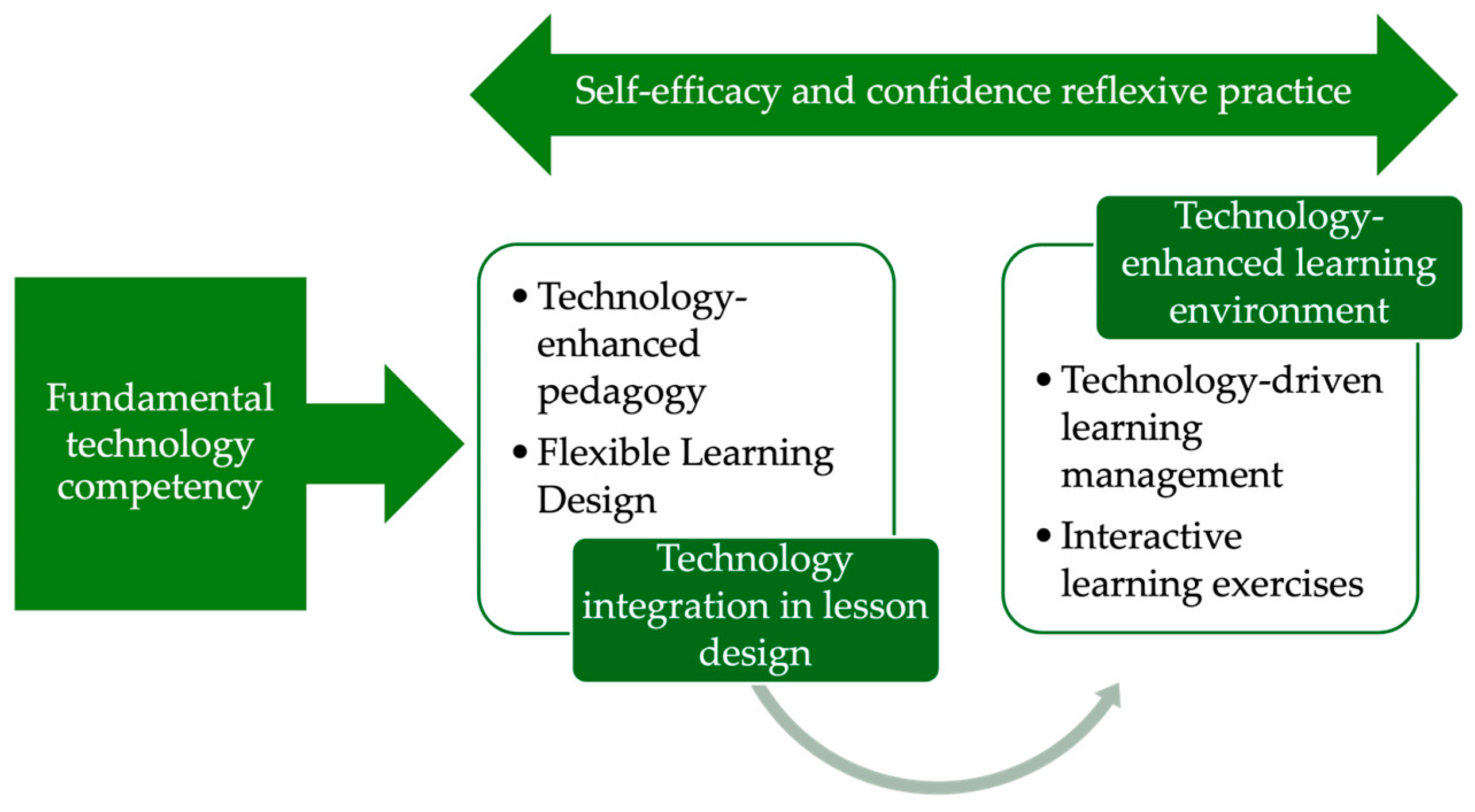
| Foundation | TK + Tool Proficiency | Fundamental Tech Competency | Functional Overlap
|
| Affective | Confidence | Transversal Dimension | Cyclical Relationship
|
| Instruction | (Static) Lesson Design | Flexible Learning Design | Situational Adaptability
|
| Environment | Interactive Exercises | Blended Orchestration | Redundancy/Output
|
| Theme | Sub-Theme | Key Codes |
|---|---|---|
| 1. Technology Skills | Technological Knowledge (TK) | Tool selection (TS); successful application (SA); knowledge of tool operation (TO) |
| Technological Tool Proficiency | Device familiarity (DF); software functional mastery (SM); specific software feature utilisation (sSU); variable manipulation skill (VM) | |
| 2. Technology Integration in Lesson Design | Technology-Enhanced Pedagogy | Intentional planning (IP); technology blending (TB); shift to integration (IC) |
| Confidence in utilising technology | Self-efficacy (S-E); reduction in fear/hesitation (HR); personal orientation (PO); reinforcement of belief (B) | |
| 3. Technology-Enhanced Learning Environment | Technology-Driven Learning Management | Using technology to organise group work (GW); Tracking student progress through technology (Track); Adjusting instruction based on real-time feedback (R-F); Classroom culture of exploration/collaboration (Coll) |
| Interactive Learning Exercise Development | (Student learning) instrument design (IDe); dynamic concept manipulation (Dym); self-paced student exploration (S-P Ex); knowledge construction (KnowCon) |
| Theme | Code | Cycle 1 Frequency | Cycle 2 Frequency | Trajectory Description |
|---|---|---|---|---|
| Technology Skills | Tool selection (TS) | 148 | 22 | Shift from “finding tools” to “justifying tool affordances” for specific math concepts. |
| Software functional mastery (SM) | 92 | 34 | Rapid decline as technical operation became subconscious and automated. | |
| Technology Integration in Lesson Design | Intentional planning (IP) | 58 | 112 | Increased focus on linking technology to specific mathematical learning goals. |
| Flexible Learning Design (FD) | 14 | 86 | Emergence of planning for asynchronous, self-paced, and hybrid environments. | |
| Affective Factors | Self-Efficacy (S-E) | 42 | 98 | Growth in belief that tech-enhanced pedagogy improves student outcomes. |
| Reduced Hesitation (RH) | 12 | 74 | Observable shift from cautious, scripted use to fluid, impromptu tech adjustments. | |
| Risk-Taking (RT) | 8 | 62 | Willingness to relinquish teacher control and allow student-led exploration. | |
| Technology-Enhanced Learning Environment | Adaptive Teaching (AT) | 11 | 145 | Core shift in Cycle 2: using digital data traces to adjust instruction in real time. |
| Blended Orchestration (BO) | 26 | 94 | Sophisticated management of simultaneous online and face-to-face activities. | |
| Exercise Output (EO) | 88 | 42 | Reclassified as an output; codes shifted to the management of these materials. |
| Framework Shift | Participant | Data Source | Representative Excerpt | Analytical Significance |
|---|---|---|---|---|
| Merging TK and Tool Proficiency | T05 | Reflective Journal (C2) | “I don’t think about ‘how’ to use GeoGebra sliders anymore. The slider is the ratio y/x.” | Technical skills became invisible as they fused with mathematical content knowledge. |
| Confidence as Transversal | T12 | Interview (C2) | “In the first lesson, I was terrified if the internet failed. Now, if a student breaks the model, I use it as a ‘teaching moment.’ Confidence isn’t a stage. It’s what lets me try new things every day.” | Confidence functions as a continuous amplifier of all other competencies, not a siloed stage. |
| Adding Adaptive Teaching | T18 | Video Reflection (C2) | “I saw on the Google Classroom dashboard that half the class was struggling with the domain restriction x > 0. I stopped the individual work to do a quick mini-lesson on why the graph disappeared.” | Using technology-mediated evidence to inform formative assessment and instructional axes. |
| Reclassifying Exercise Development | T09 | Reflective Dialogue (C1) | “Designing the Quizizz was easy, but managing 40 students as they explored it was the real challenge. The Quizizz is just a tool. The organisation is the skill.” | Material creation is an output of successful orchestration, not a standalone core competency. |
| Flexible Learning Design | T21 | Reflective Journal (C2) | “The flipped model required me to design tasks where students could struggle productively at home. I had to anticipate their errors in the digital task design.” | Response to the contextual demands of blended and contactless mathematics instruction. |
| Draft Components (Figure 3) | Final Components (Figure 5) | Structural Revision Type | Evidence Source(s) | Quote Label | Empirical Justification |
|---|---|---|---|---|---|
| TK + Tool proficiency (2 elements) | Fundamental technology competency (merged) | Consolidation | Video, Interview | Software skill is math skill (Ref: T05-I-C2) | High functional overlap; teachers did not separate knowing from using in practice. |
| Confidence (Siloed stage) | Transversal confidence and risk-taking | Reclassification | Journal, Interview | Fuel for the engine (Ref: T12-I-C2) | Recursive relationship: success in practice drives confidence, which enables more complex design. |
| Static learning exercise | Flexible learning design | Expansion | Journal | Planning for the struggle (Ref: T21-J-C2) | Need for crisis-resilient teaching in blended/asynchronous settings. |
| Learning management | Adaptive teaching based on digital evidence | Redefinition | Video, Interview | Digital eyes to see (Ref: T18-V-C2) | Shift from monitoring behaviour to using data traces to adjust mathematical pacing. |
| Exercise development | Self-directed media (outcome) | Reclassification | Journal, Interview | Orchestration byproducts (Ref: T09-I-C1) | Determined to be a specific output of effective management, not an independent core competency. |
| PD Phase | Core Activity | Timeline | Recommended Facilitation Move | Prompt for Teacher Reflection |
|---|---|---|---|---|
| Phase I: Technical Genesis | Exploring software affordances | Months 1–4 | Modelling digital collaboration in PD sessions. | Which specific mathematical representation does this tool make more accessible? |
| Phase II: Collaborative Design | Co-planning tasks in Community of Inquiry groups | Months 5–8 | Challenging the view of students as “reproducers” of knowledge. | What is your plan for assessing student thinking in this lesson? |
| Phase III: Enactment and Feedback | Implementing plans; classroom video capture | Months 9–14 | Providing “formative, non-evaluative feedback” on teacher uptake. | What did you notice about the relationship between your question and the student’s digital drag? |
| Phase IV: Validation and Scaling | Sharing products (TMLS); revising the local theory | Months 15–18 | Facilitating post-lesson dialogue that balances support with challenge. | How has your understanding of this concept changed through watching the students’ errors? |
Disclaimer/Publisher’s Note: The statements, opinions and data contained in all publications are solely those of the individual author(s) and contributor(s) and not of MDPI and/or the editor(s). MDPI and/or the editor(s) disclaim responsibility for any injury to people or property resulting from any ideas, methods, instructions or products referred to in the content. |
© 2026 by the authors. Licensee MDPI, Basel, Switzerland. This article is an open access article distributed under the terms and conditions of the Creative Commons Attribution (CC BY) license.
Share and Cite
Jun-on, N.; Suwanreang, C. Designing a Technology Integration Competency Framework for Mathematics Teachers Through Reflective Practice: A Design-Based Research Approach. Educ. Sci. 2026, 16, 284. https://doi.org/10.3390/educsci16020284
Jun-on N, Suwanreang C. Designing a Technology Integration Competency Framework for Mathematics Teachers Through Reflective Practice: A Design-Based Research Approach. Education Sciences. 2026; 16(2):284. https://doi.org/10.3390/educsci16020284
Chicago/Turabian StyleJun-on, Nipa, and Chanankarn Suwanreang. 2026. "Designing a Technology Integration Competency Framework for Mathematics Teachers Through Reflective Practice: A Design-Based Research Approach" Education Sciences 16, no. 2: 284. https://doi.org/10.3390/educsci16020284
APA StyleJun-on, N., & Suwanreang, C. (2026). Designing a Technology Integration Competency Framework for Mathematics Teachers Through Reflective Practice: A Design-Based Research Approach. Education Sciences, 16(2), 284. https://doi.org/10.3390/educsci16020284