1. Introduction
Assessing bilingual children’s language abilities presents challenges, as traditional standardized tests often underestimate their abilities by assuming monolingual patterns of exposure. Sentence Repetition (SRep) tasks have emerged as a reliable alternative because they draw on both vocabulary and grammatical knowledge, providing a holistic and ecologically valid measure of linguistic competence (
Torregrossa et al., 2024;
Kałowski et al., 2025).
SRep tasks are language assessment activities in which children listen to a sentence spoken by an examiner and are asked to repeat it aloud as accurately as possible. The sentences are presented one at a time, without visual support, and vary in grammatical structure and complexity. For example, a simple item may require repeating a short sentence such as “The boy is running”, whereas a more complex item may involve repeating a syntactically more complex sentence, such as “The boy that the teacher praised is running to school”. Children are not asked to judge, explain, or manipulate the sentences; their task is simply to repeat what they hear.
Evidence from clinical contexts, further underscores that language assessment must capture multiple dimensions of competence rather than rely on narrow, standardized measures (
Dosi & Boni, 2023;
Dosi & Koutsipetsidou, 2019;
Marinis & Armon-Lotem, 2015;
Theodorou et al., 2017). Crucially, recent studies show that bilingual children’s performance on SRep is not uniform across structures: while simple constructions are often repeated accurately, complex morphosyntactic domains such as clitic dependencies and subordination tend to be more challenging (
Chondrogianni et al., 2015;
Kaltsa et al., 2020;
Makrodimitris & Schulz, 2021;
Prentza et al., 2022;
Torregrossa et al., 2024). Recent review work further consolidates the role of SRep Tasks as a sensitive measure of bilingual language ability, highlighting how task design, scoring procedures, and structural complexity account for cross-study variation in bilingual children’s performance (
Kałowski et al., 2025).
The present study investigates a less researched language pair—Greek–Turkish bilingual children—using SRep tasks administered in Greek. It examines the role of key predictors, morphological awareness, expressive vocabulary and age, in shaping children’s performance. By comparing bilinguals with age-matched Greek monolingual peers, the study not only clarifies how these variables support morphosyntactic development but also aims to identify the factors that best predict language outcomes in bilingual contexts. In doing so, it also tests whether bilinguals perform uniformly across SRep conditions or show selective difficulties in line with earlier evidence on clitics and subordination. This extends previous validation work on SRep to an understudied bilingual population and contributes evidence on the predictive value of morphological awareness and vocabulary for grammatical competence in Greek.
1.1. Sentence Repetition Task as an Index of Language Ability in Educational Assessment
Beyond their surface simplicity, SRep tasks provide a window into children’s underlying linguistic representations. Successful repetition requires children to temporarily retain the auditory input, access lexical items, and reconstruct the sentence using their grammatical knowledge. For this reason, performance on SRep tasks reflects the interaction of multiple components of language ability rather than short-term memory alone.
Importantly, SRep performance can be evaluated along two complementary dimensions. First, the grammatical well-formedness of a child’s response provides evidence about their implicit morphosyntactic knowledge and ability to generate complex sentence structures. Second, the extent to which the child reproduces the target sentence verbatim—using the same words—reflects the precision of recall, which is more closely associated with working memory demands. Crucially, these dimensions are interdependent: limitations in grammatical representations tend to surface most clearly under increased processing load.
SRep tasks have increasingly been recognized as sensitive and integrative measures of children’s language ability because successful performance requires the coordination of multiple linguistic processes. To repeat a sentence accurately, children must perceive and temporarily store the input, access relevant vocabulary, and reconstruct the sentence using their grammatical knowledge. As a result, SRep tasks engage lexical knowledge (word meanings), morphosyntactic knowledge (how words are inflected and combined into sentences), and memory resources simultaneously (
Riches, 2012). Unlike simple recall tasks, which primarily tap memory span, SRep tasks rely on linguistic representations and real-time processing capacity, making them a valid indicator of language competence in both monolingual and bilingual learners (
Ellis, 2005;
Erlam, 2006;
Klem et al., 2015;
Meir et al., 2015;
Dosi et al., 2016;
Andreou et al., 2020;
Correia et al., 2025).
Recent systematic reviews confirm that SRep tasks are among the most effective measures of language proficiency across diverse populations and educational contexts. These reviews show that performance on SRep tasks is systematically influenced by factors such as sentence complexity, scoring procedures, and item design (
Correia et al., 2025;
Ward et al., 2024). Importantly, these findings support the interpretation that SRep performance reflects children’s underlying language knowledge rather than rote memory alone.
One of the main advantages of SRep tasks is their suitability for assessing bilingual children. Traditional standardized vocabulary or grammar tests often underestimate bilingual learners’ abilities because they are designed around monolingual norms and assume uniform exposure to a single language. In contrast, SRep tasks allow children to draw on whatever linguistic resources they have available in real time. When SRep tasks’ items are carefully designed to avoid culture-specific content or rare vocabulary, they can function as fair assessment tools across different language backgrounds (
Theodorou et al., 2017;
Fitton et al., 2019;
Pratt et al., 2021;
Prentza et al., 2022;
Kaltsa et al., 2024). From an educational perspective, this means that SRep tasks can provide a more balanced picture of bilingual children’s linguistic competence without penalizing them for uneven exposure across languages.
At the same time, research consistently shows that SRep performance varies depending on the grammatical structures involved. Bilingual children typically perform well on simple sentence structures but experience greater difficulty with complex morphosyntax, such as sentences involving object clitics (short grammatical markers referring to objects, common in languages like Greek) or subordinate clauses (
Chondrogianni et al., 2015;
Kaltsa et al., 2020;
Makrodimitris & Schulz, 2021;
Prentza et al., 2022). This pattern demonstrates that SRep tasks are sensitive to specific areas of grammatical development that are known to be challenging in bilingual acquisition.
Empirical evidence further supports the interpretation of SRep tasks as measures of grammatical competence.
Dosi et al. (
2016), in their study of Greek–Albanian bilingual children, showed that SRep accuracy was strongly influenced by sentence complexity and morphosyntactic knowledge. Similarly,
Andreou et al. (
2020), studying Albanian–Greek bilingual children, found that biliteracy support and educational setting were stronger predictors of SRep performance than working memory. Their results indicate that children who receive structured literacy input in both languages are better able to repeat sentences accurately, highlighting the role of vocabulary knowledge and grammatical experience rather than memory capacity alone.
Further validation comes from
Prentza et al. (
2022), who developed a Greek SRep task for typically developing monolingual and bilingual children. Their findings showed that SRep accuracy was sensitive to sentence complexity and scoring criteria, and crucially, that the task functioned consistently across monolingual and bilingual groups. This consistency supports the use of SRep tasks as fair and reliable tools in educational settings where children’s language exposure is distributed across more than one language.
SRep tasks are particularly valuable in heritage and minority-language contexts, where standardized assessments often disadvantage children with reduced input in their home language.
Kaltsa et al. (
2024), for example, found links between lexical and grammatical development in both the heritage and majority languages of Greek–Albanian bilingual children. Their findings suggest that supporting the heritage language can enhance overall linguistic competence, rather than hinder development in the majority language, a pattern also reported in other bilingual studies (
Monsrud et al., 2022;
Valentini & Serratrice, 2021). Because SRep tasks rely on implicit linguistic knowledge, they are well suited to capturing these cross-linguistic relationships.
Given the limitations of standardized testing, SRep tasks have therefore emerged as a robust alternative for assessing bilingual populations.
Komeili and Marshall (
2013) demonstrated the cross-linguistic applicability of SRep tasks, showing that they operate at the interface of language and memory while reliably indexing grammatical competence and minimizing cultural bias.
In the present study, ecological validity is understood in a constrained and task-relevant sense. Rather than approximating spontaneous conversational interaction, ecological validity refers to the extent to which SRep tasks engage core processing demands of real-world language use, namely the real-time integration of lexical access, activation of morphosyntactic knowledge, and short-term retention under listening conditions. In addition, when items are designed with familiar vocabulary and minimal cultural specificity, SRep tasks reduce bias associated with culturally loaded content and monolingual norms. At the same time, we acknowledge that decontextualized SRep tasks do not capture pragmatic, discourse-level, or interactive aspects of language use. Thus, ecological validity in this study is not claimed in an absolute sense, but with respect to the task’s ability to index underlying grammatical competence under processing conditions that resemble everyday educational language demands.
Torregrossa et al. (
2024) compared traditional decontextualized SRep tasks with versions embedded in a short narrative. They showed that providing a discourse context helps children track referents and anticipate upcoming information, thereby reducing unnecessary processing costs and allowing the task to more directly assess linguistic competence. While these discourse-enriched SRep tasks do not capture pragmatic or interactive aspects of communication, they represent a principled compromise between experimental control and contextual relevance. Together, this body of research suggests that SRep tasks —particularly when carefully designed and clearly explained—offer educators and researchers an accessible, reliable, and informative tool for assessing language development in linguistically diverse classrooms.
From an educational perspective, SRep tasks resemble everyday classroom demands in which children are required to listen to teacher input, retain linguistic information, and reproduce or reformulate it orally. Unlike metalinguistic tasks that require explicit grammatical judgments, SRep tasks place minimal demands on formal linguistic knowledge or test-taking strategies. This makes them particularly accessible to children from diverse linguistic backgrounds and allows educators to interpret performance as reflecting children’s ability to process and produce grammatical language under naturalistic conditions.
1.2. Morphological Awareness and Vocabulary as Predictors of Sentence Repetition
Two important predictors of SRep performance are morphological awareness and expressive vocabulary. Morphological awareness refers to the ability to reflect upon and manipulate the smallest meaningful units in language. It is a core metalinguistic ability that supports vocabulary growth, syntactic development, and reading development (
Carlisle, 2000;
Dosi, 2025;
Kuo & Anderson, 2006).
In bilingual contexts, morphological awareness plays an especially crucial role because it allows learners to exploit morphological cues in both their languages, supporting comprehension and production under processing demands.
Dosi (
2025) further demonstrated that morphological awareness is a strong predictor of both lexical and morphosyntactic abilities in Greek–Turkish bilingual children, confirming that morphological awareness not only facilitates vocabulary development but also scaffolds sentence-level processing, and, thus, reading comprehension.
Cheng et al. (
2025) argue that morphological awareness supports vocabulary development, while vocabulary enrichment strengthens lexical retrieval during sentence processing. They conducted a meta-analysis and found that morphological awareness was strongly correlated with vocabulary in both monolingual and bilingual children, with evidence of cross-linguistic transfer. Specifically, morphological awareness in the first language predicted vocabulary knowledge in the second language, suggesting that morphological sensitivity is a transferable resource that supports bilingual development.
Expressive vocabulary is the second key predictor of SRep. Vocabulary breadth and depth allow learners to retrieve words quickly and integrate them into sentence frames during recall (
Dosi et al., 2023).
Hoff (
2013) emphasized that vocabulary knowledge supports not only communicative ability but also broader language development, as lexical representations enrich semantic networks that support sentence processing. Recent studies confirm that vocabulary is tightly linked to SRep performance in bilingual children.
Fitton et al. (
2019) found that Spanish–English bilingual kindergarteners’ SRep accuracy correlated significantly with vocabulary knowledge in both languages. Analyses at the item level revealed that children’s ability to repeat particular phrase types predicted their vocabulary scores, showing that SR reflects underlying lexical as well as grammatical knowledge.
The relationship between vocabulary and SRep is particularly salient in bilingual contexts where exposure to each language is often unequal. Children with limited input in their heritage language may have smaller expressive vocabularies, which in turn reduces their ability to recall sentences in that language. As
Kaltsa et al. (
2024) noted, heritage language input strengthens both vocabulary and grammar in the minority language, with positive consequences for the majority language as well. This suggests that vocabulary growth in either language can boost performance on SRep tasks, given the close interplay of lexical and grammatical development across languages.
Crucially, SRep performance reflects the interaction of representational and processing resources. Representationally, morphological awareness and expressive vocabulary provide the building blocks for recall, while processing resources, such as working memory, determine how effectively these can be used under time constraints.
Riches (
2012) observed that children often omit or simplify morphemes in SRep when memory demands are high, indicating that weak representations are magnified by processing load.
Ward et al. (
2024) similarly concluded that sentence complexity interacts with linguistic knowledge to determine repetition accuracy. From this perspective, SRep tasks do not measure memory in isolation but capture how lexical and morphosyntactic representations are deployed in real time.
Crucially, experimental evidence suggests that SRep performance is primarily constrained by children’s morphosyntactic and lexical–phonological knowledge rather than semantic plausibility or prosodic cues. Using a cross-linguistic design with English- and Czech-speaking children,
Polišenská et al. (
2015) demonstrated that syntactic violations and non-words had the strongest negative impact on repetition span, while semantic implausibility and prosody played a comparatively minor role.
In conclusion, SRep offers a powerful, ecologically valid means of assessing bilingual children’s linguistic competence. Its sensitivity arises from the integration of representational skills—morphological awareness and expressive vocabulary—with processing demands.
1.3. Similarities and Differences Between Greek and Turkish
Modern Greek and Turkish show significant typological contrasts despite geographic proximity. Greek, an Indo-European inflectional language, is predominantly head-initial with basic SVO order, though constituent placement is flexible (
Holton et al., 2016). Turkish, by contrast, is a Turkic agglutinative language with rigidly head-final syntax: verbs appear clause-finally and modifiers precede heads (
Göksel & Kerslake, 2005). Both are pro-drop, but they diverge significantly in negation, clitics, subordination, and wh-clauses.
The following sections compare the conditions of the SRep administered to the participants, noting that the task was given only in Greek, the language of schooling and community, and the one in which bilingual children face the greatest reported difficulties in vocabulary and grammar. Turkish examples are included to illustrate typological contrasts, while acknowledging that children often maintain Turkish as their dominant home language. This framing ensures the discussion reflects the assessment context without implying that Turkish is of lesser linguistic or educational importance.
1.3.1. Negation
Modern Greek expresses sentential negation with preverbal particles—
ðen for indicative and
min for subjunctive or imperative (
Holton et al., 2016). Turkish, by contrast, marks negation morphologically with the suffix
-ma/-me on verbs (gel
medi “did not come”) and uses
değil for nominal predicates (
Göksel & Kerslake, 2005). Both languages display negative concord, but Greek uses free particles, whereas Turkish integrates negation into the verbal complex.
1.3.2. Clitics
Greek employs a rich system of pronominal clitics that attach to the verb, often allowing clitic doubling of full noun phrases (
Joseph & Philippaki-Warburton, 1987). For example, o ʝorγos
tin aγapa tin Maria (“George loves Maria”) illustrates the fixed clitic order, which precedes the verb. Additionally, Greek has only object clitics, and these form part of a well-structured cluster that interacts with verbal morphology. By contrast, Turkish lacks pronominal clitics altogether (
Göksel & Kerslake, 2005). Pronominal arguments are either overt full noun phrases or dropped under pro-drop, with no clitic doubling parallel to Greek. Instead, Turkish makes use of enclitic particles such as the polar question marker
mi, which obligatorily follows the constituent it modifies (
Öztürk, 2005). In line with its head-final typology, Turkish clitics are exclusively post-posed and do not form multi-item clitic clusters (
Öztürk, 2005), highlighting a sharp contrast with the pre-verbal pronominal clitics of Greek.
1.3.3. Coordination
In Greek, coordination is analytic, relying on conjunctions such as
ce (“and”),
i (“or”) and
ala (“but”) linking finite clauses or constituents (
Holton et al., 2016). Turkish, in contrast, often uses converbial suffixes like-
(y)Ip to connect verbs within a clause, with only the final verb inflected (gid
ip geldi “went and came”;
Göksel & Kerslake, 2005). Borrowed coordinators like
ve “and” exist, but the preferred strategy reflects Turkish’s head-final, agglutinative typology.
1.3.4. Complement Clauses
In Modern Greek, the infinitive has been lost, and all complement clauses are finite, introduced either by the indicative complementizers
oti/pos (“that”) or the subjunctive particle
na (
Philippaki-Warburton, 1994). Thus, verbs of saying take indicative complements (ksero
oti θa erθi “I know that he will come”), whereas verbs of desire or command select subjunctive complements (θelo
na fiγο “I want to leave”). In Turkish, by contrast, complement clauses are typically nominalized with suffixes such as -
DIK or -
mA, and the embedded subject, when overt, appears in the genitive case (
Göksel & Kerslake, 2005). For example, Ali’nin geldiğini biliyorum (“I know that Ali came”) literally means “I know Ali’s coming”. Only the final verb in the sentence is finite, consistent with Turkish’s head-final typology.
1.3.5. Relative Clauses
Greek relative clauses are post-nominal and finite, introduced either by the invariant relativizer
pu or by inflected relative pronouns such as
o opios (
Joseph & Philippaki-Warburton, 1987;
Holton et al., 2016). For instance, i ʝineka
pu iða (“the woman that I saw”) contains a full finite clause following the head noun. Turkish relative clauses, by contrast, are prenominal participial constructions: the verb is marked with a participial suffix such as
-(y)An for subject relatives or
-DIK for object relatives, and the head noun follows the clause (
Göksel & Kerslake, 2005).
1.3.6. Adverbial Clauses
Modern Greek employs subordinating conjunctions introducing finite adverbial clauses, such as
otan “when”,
an “if”, and
epiði “because” (
Holton et al., 2016). For example, efiγe
otan kurastice (“he left when he was tired”) contains a fully inflected subordinate clause introduced by a temporal conjunction. Turkish instead uses a rich system of converbial suffixes, which attach directly to the verb to encode temporal, conditional, or causal relations (
Göksel & Kerslake, 2005). Examples include
-IncE (“when”),
-ken (“while”), and
-sA (“if”), as in o gel
ince gittik (“when he came, we left”). These clauses are non-finite and usually precede the main clause.
1.3.7. Wh-Clauses
In Modern Greek, embedded wh-questions are finite CPs with wh-movement: the wh-element obligatorily fronts to the left periphery, as in ðen ksero
pu piγe “I don’t know where he went” (
Joseph & Philippaki-Warburton, 1987;
Holton et al., 2016). These clauses serve as complements of predicates like xéro “know” and rotáo “ask”, mirroring matrix wh-constructions. Turkish, by contrast, realizes embedded wh-questions as nominalized clauses with wh- in situ, e.g., Ayşe [Ali’nin kimi gördüğünü] bilmiyor “Ayşe doesn’t know whom Ali saw” (
İşsever, 2009). Thus, Greek encodes embedded interrogatives via finite complementation and movement, whereas Turkish employs non-finite nominalizations with in situ wh-elements.
3. Materials and Methods
3.1. Participants
The study included two groups of children (n = 70): 35 Greek monolinguals (MLs) and 35 Greek–Turkish bilinguals (BLs). The BL children were late sequential bilinguals living in Greece, with Turkish as their dominant language according to teachers’ reports and children’s self-ratings of language use and proficiency. Although they attended an intercultural school where Greek was the sole language of instruction and had been exposed Greek after the age of 4, Turkish remained the primary language of home interaction and daily use. As a result, Greek input was largely restricted to the school context, while Turkish continued to be the language in which the children reported greater ease and confidence. Importantly, this pattern reflects differences in language exposure and use rather than differences in language value or status. MLs and BLs were matched for socioeconomic status, as indexed by maternal education level, ensuring comparability across groups.
All participants were typically developing, had no reported history of language or hearing impairments, and were recruited from the region of East Macedonia and Thrace.
Participants were divided into two age groups: younger (8–9 years) and older (10–12 years).
Table 1 presents descriptive statistics for chronological age across groups. As shown, the younger monolinguals had a mean age of 9.01 years (SD = 0.5, range = 8.3–9.7), while younger bilinguals had a mean age of 9.3 years (SD = 0.5, range = 8.1–9.9). The older monolingual group had a mean age of 11.0 years (SD = 0.7, range = 10.0–12.0), and the older bilingual group had a mean age of 10.9 years (SD = 0.6, range = 10.0–11.7). Independent samples
t-tests confirmed that age differences between monolinguals and bilinguals were not statistically significant in either the younger group (
t(31) = −1.66,
p = 0.108) or the older group (
t(35) = 0.24,
p = 0.812), indicating that the two groups were age-matched within each band.
All participants completed a nonverbal intelligence task (
Raven et al., 2008) to ensure that they exhibited typical levels of nonverbal ability. Analyses indicated no significant differences between language groups among younger participants [M difference = −0.46, SE = 1.27,
p = 0.633, 95% CI [−2.95, 2.03]]. Likewise, no significant difference was observed between ML and BL in the older group [M difference = −0.40, SE = 1.20,
p = 0.738, 95% CI [−2.80, 1.99]], meaning that BL and ML groups are comparable.
3.2. Material
All participants completed a set of tasks designed to assess their language abilities in Greek.
3.2.1. Expressive Vocabulary
Expressive vocabulary was evaluated using the Greek adaptation of the
Expressive Vocabulary Test (
Vogindroukas et al., 2009). This test consists of 50 familiar pictures depicting everyday objects, which participants were asked to name. Administration stopped after five consecutive incorrect responses, with a maximum possible score of 50.
3.2.2. Morphological Awareness
Morphological awareness was tested with two subtasks, each containing 12 sentences (24 in total). In the first subtask, participants were given a simple word and asked to generate its derived form to appropriately complete a sentence (e.g., “Kostas was the … of the competition … (win)” → winner). In the second subtask, they were presented with a derived word and asked to produce the simple word in context (e.g., “Yesterday we visited a place with fragrant grapes. It was a beautiful … (vine)” → vineyard). Only one answer was grammatical; if the participant gave a compound word instead of the derived one, their answer was considered as wrong (e.g., vineyard field (ambeloxorafo) instead of vineyard (ambelonas). The highest possible score across both subtasks was 24.
3.2.3. Sentence Repetition
In this task, children were seated individually with the examiner and listened to a series of short sentences spoken aloud in Greek. Each sentence was presented once, and children were asked to repeat it immediately and as accurately as possible. No visual support was provided, and children were encouraged to respond naturally, without being corrected or prompted during the task; however, a warm-up session was conducted beforehand. Each item consisted of a single sentence designed to test a specific grammatical structure (e.g., clitic dependencies, subordination), using vocabulary familiar to school-age children.
The SRep task employed in this study was based on the rationale of COST Action IS0804 (
Chondrogianni et al., 2013), which provides a well-established framework for the development of cross-linguistically comparable SRep tasks. Consistent with this approach, all items were grammatical, with no fillers included. The Greek version consisted of 32 sentences encompassing a range of syntactic structures, including negation, clitics, coordination, complement clauses, relative clauses, adverbial clauses, and wh-clauses.
The sentences were carefully constructed to be structurally varied yet comparable in length. Specifically, they ranged from 9 to 12 words (M = 10.56, SD = 0.79) and from 20 to 32 syllables (M = 25.47, SD = 3.03). This design ensured high consistency in word count while allowing for greater variability in syllabic load, thereby providing a controlled but sufficiently challenging set of items. The vocabulary was carefully adapted to be accessible to children with lower proficiency in Greek. While the syntactic complexity of the sentences was preserved, the lexical demands were kept appropriate by using everyday words. This included incorporating some words that were loanwords, such as “dolap” instead of the standard “dulápa” to better match with the vocabulary some children were familiar.
Examples (1a–c) illustrate the scoring procedure under the Clitic Left Dislocation (CLLD) condition (1a), a structure in which an object is realized twice: once as a full noun phrase and once as a preverbal object clitic. A response received one point if it successfully reproduced this morphosyntactic dependency, regardless of minor lexical substitutions. By contrast, responses that were fully grammatical in Greek but failed to preserve the target CLLD structure—for example, by omitting the preverbal clitic and producing a simple canonical object–verb configuration—were scored as unsuccessful (1b). Importantly, such responses are not ungrammatical in the language per se; rather, they do not meet the structural requirements of the target sentence. For comparison, (1c) illustrates a genuinely ungrammatical response (marked with an *) in Greek, involving a violation of core grammatical constraints. Both structurally unsuccessful and genuinely ungrammatical responses received a score of zero.
| (1) a. Target sentence (CLLD condition: 1 point) |
| to | vazo | to= |
| the.ACC.NEUT.SG | vase.ACC.NEUT.SG | it.CL.ACC.NEUT.SG |
| akubise | prosektika | i |
| place.PST.PFV.ACT.IND.3SG | carefully | the.NOM.FEM.SG |
| mitera | sto | strogilo |
| mother.NOM.FEM.SG | in.the.ACC.NEUT.SG | round.ACC.NEUT.SG |
| trapezi | | |
| table.ACC.NEUT.SG | | |
| “The mother carefully placed the vase on the round table.” |
| b. Unsuccessful but grammatical response to the target sentence (CLLD condition: 0 points) |
| i | kiria | evale |
| the.NOM.FEM.SG | lady.NOM.FEM.SG | put.PST.PFV.ACT.IND.3SG |
| to | potiri | sto |
| the.ACC.NEUT.SG | glass.ACC.NEUT.SG | in.the.ACC.NEUT.SG |
| trapezi | | |
| table.ACC.NEUT.SG | | |
| “The lady put the glass on the table.” |
| c. Ungrammatical response to the target sentence (CLLD condition: 0 points) |
| *i | mitera | evale |
| the.NOM.FEM.SG | mother.NOM.FEM.SG | put.PST.PFV.ACT.IND.3SG |
| sto | trapezi | |
| in.the.ACC.NEUT.SG | table.ACC.NEUT.SG | |
| “*The mother put on the table.” |
3.3. Data Collection and Analysis
Participants completed all tests in a single session. Each test included a warm-up phase to ensure that participants fully understood the task and procedure. Feedback was provided during the warm-up but not during the main testing phase.
All participant responses were audio-recorded and transcribed. Data were analyzed using SPSS 29.
Prior to conducting parametric analyses, assumptions of normality and homogeneity of variance were examined. Normality was assessed using Shapiro–Wilk tests, while homogeneity of variance was evaluated using Levene’s tests. All variables met the assumptions required for parametric testing. Detailed assumption checks are reported in the
Supplementary Materials.
To answer RQ1, a multivariate two-way ANOVA (2 × 2) was conducted, with vocabulary, morphological awareness, and SRep scores as dependent variables, and language group (BL vs. ML) and age group (young vs. old) as independent variables. This approach allowed us to examine the independent and combined effects of language group and age within a single model, while controlling for Type I error and testing for potential interaction effects.
To address RQ2, we conducted a repeated-measures ANOVA with SRep condition (eight levels: SVO, negation, CLLD, coordination, complement clauses, adverbial clauses, wh-clauses, relative clauses) as a within-subjects factor and language group (monolinguals vs. bilinguals) as a between-subjects factor, as this design accounts for the non-independence of observations across structures and allows for direct testing of language-by-structure interaction effects. Post hoc comparisons were adjusted using the Bonferroni correction.
To examine RQ3, bivariate correlations were first calculated separately for each language group among age, vocabulary, morphological awareness, and SRep. Variables that showed significant correlations with SRep were subsequently entered into linear regression models, following a theory-driven approach based on prior evidence linking lexical and morphological knowledge to SRep performance.
4. Results
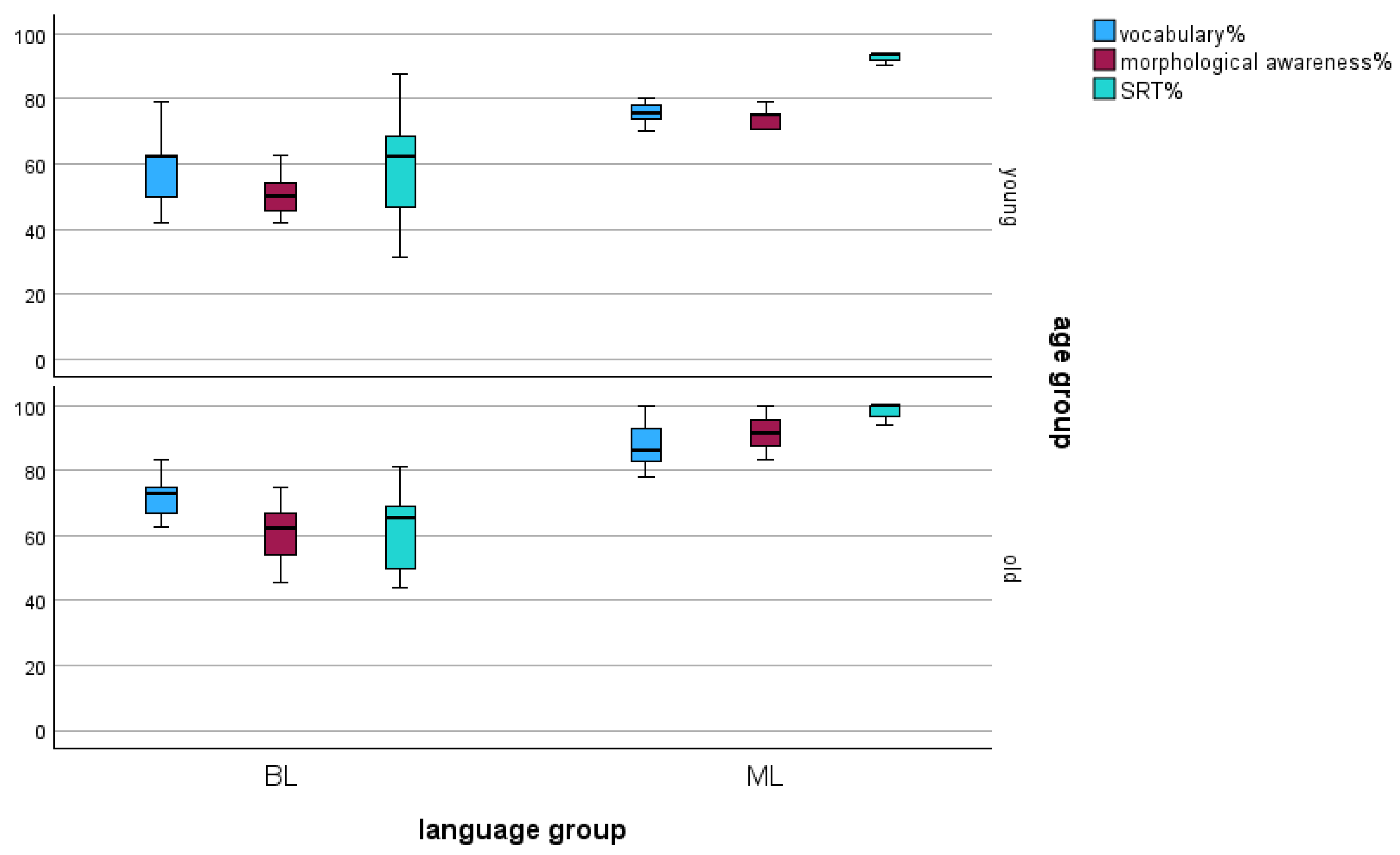
A two (language group: ML vs. BL) × two (age group: younger vs. older) multivariate analysis of variance was conducted on three dependent variables: vocabulary, morphological awareness and SRep (
Figure 1). The overall model was significant (
F(2, 66) = 8.53,
p < 0.001, partial η
2 = 0.28).
Follow-up univariate ANOVAs showed significant effects of language group on vocabulary (F(1, 66) = 1895.55, p < 0.001, partial η2 = 0.97), morphological awareness (F(1, 66) = 346.63, p < 0.001, partial η2 = 0.84) and SRep (F(1, 66) = 225.93, p < 0.001, partial η2 = 0.77). Bonferroni-adjusted pairwise comparisons revealed that MLs scored significantly higher than BLs on vocabulary (mean difference = 25.16, p < 0.001, 95% CI [24.01, 26.31]), morphological awareness (mean difference = 6.37, p < 0.001, 95% CI [5.69, 7.05]), and SRep (mean difference = 10.89, p < 0.001, 95% CI [9.44, 12.33]). It should be noted that some extremely large effect sizes (partial η2 > 0.90) primarily reflect ceiling effects in the monolingual group, who scored near 100% on SRep, rather than indicating unusually strong differences per se.
For age group, significant effects emerged for vocabulary (F(1, 66) = 56.77, p < 0.001, partial η2 = 0.46) and morphological awareness (F(1, 66) = 92.61, p < 0.001, partial η2 = 0.58). The effect on SRep did not reach significance (F(1, 66) = 3.23, p = 0.077, partial η2 = 0.05). Bonferroni-adjusted pairwise comparisons have shown that older participants outperformed younger participants on vocabulary (mean difference = −4.35, p < 0.001, 95% CI [−5.51, −3.20]), and morphological awareness (mean difference = −3.29, p < 0.001, 95% CI [−3.97, −2.61]). No significant age group differences were observed for SRep (mean difference = −1.30, p = 0.077).
A significant interaction between language group and age group was found for vocabulary (
F(1, 66) = 6.99,
p = 0.010, partial η
2 = 0.10) and for morphological awareness (
F(1, 66) = 7.17,
p = 0.009, partial η
2 = 0.10). No significant interaction was observed for SRep (
F(1, 66) = 0.26,
p = 0.611, partial η
2 = 0.004). Regarding the language × age group interaction, Bonferroni tests showed significant effects for vocabulary and morphological awareness. Younger ML speakers scored significantly higher on vocabulary than younger BL speakers (mean difference = 23.63,
p < 0.001, 95% CI [21.96, 25.31]) and on morphological awareness (mean difference = 6.87,
p < 0.001, 95% CI [6.25, 7.52]). Similarly, older ML speakers outperformed older BL speakers on vocabulary (mean difference = 26.69,
p < 0.001, 95% CI [25.30, 28.27]) and morphological awareness (mean difference = 5.92,
p < 0.001, 95% CI [5.30, 6.55]). Complete ANOVA statistics and Bonferroni-adjusted post hoc comparisons are presented in
Table 2.
A repeated-measures ANOVA was conducted with structure (8 levels: SVO, negation, CLLD, coordination, complement clauses, adverbial clauses, wh-clauses and relative clauses) as a within-subjects factor and language group (MLs vs. BLs) as a between-subjects factor (
Table 3).
There was a significant main effect of language (F(1, 68) = 305.99, p < 0.001, η2 = 0.82), with ML children performing overall more accurately than BL children.
The analysis also revealed a significant main effect of structure (F(5.30, 360.27) = 10.78, p < 0.001, η2 = 0.14), indicating that performance varied across syntactic structures. Most importantly, there was a significant language × structure interaction (F(5.30, 360.27) = 11.85, p < 0.001, η2 = 0.15), showing that the pattern of performance across structures differed between groups.
Bonferroni-adjusted pairwise comparisons confirmed that monolinguals did not differ significantly across structures (all
ps > 0.05), reflecting ceiling performance. In contrast, bilinguals showed significant variation: performance on CLLD (M = 33.57, SD = 33.73) was significantly lower than all other structures (
ps < 0.001). Complement clauses (M = 50.71, SD = 26.07) and adverbial clauses (M = 52.14, SD = 22.99) were also significantly weaker than SVO and wh-clauses. The highest bilingual scores were observed for SVO (M = 67.14, SD = 23.30) and wh-clauses (M = 65.71, SD = 18.28). Detailed repeated-measures ANOVA results and post hoc comparisons across syntactic structures are provided in
Table 4.
Correlation analyses (
Table 5) have shown that for the ML group, age was strongly correlated with vocabulary (
r = 0.94,
p < 0.001), morphological awareness (
r = 0.92,
p < 0.001), and SRep (
r = 0.82,
p < 0.001). Vocabulary was positively associated with morphological awareness (
r = 0.89,
p < 0.001) and SRep (
r = 0.79,
p < 0.001), and morphological awareness was likewise correlated with SRep (
r = 0.82,
p < 0.001).
For the BL group, age correlated positively with vocabulary (r = 0.45, p = 0.006) and morphological awareness (r = 0.66, p < 0.001), but not with SRep (r = 0.16, p = 0.354). Vocabulary was correlated with morphological awareness (r = 0.65, p < 0.001) and SRep (r = 0.68, p < 0.001). Morphological awareness was also correlated with SRep (r = 0.52, p = 0.001).
Vocabulary and morphological awareness were moderately to strongly correlated in both groups, raising concerns about multicollinearity and unstable parameter estimates given the sample size. For this reason, predictors were entered selectively based on theoretical relevance and significant bivariate associations with SRep. Although multiple predictors were initially considered, only one predictor met these criteria in each group, resulting in simple linear regression models for monolinguals and bilinguals (
Table 6).
For MLs, the model including morphological awareness significantly predicted SRep (F(1, 33) = 68.54, p < 0.001, R2 = 0.68; β = 0.82, t(33) = 8.28, p < 0.001). For BLs, the model including vocabulary significantly predicted SRep (F(1, 33) = 27.75, p < 0.001, R2 = 0.46; β = 0.68, t(33) = 5.27, p < 0.001).
5. Discussion
The present study investigated the morphosyntactic abilities of Greek–Turkish BL children compared to Greek ML peers, using a SRep task alongside measures of expressive vocabulary and morphological awareness. Three research questions guided the analysis: whether BLs differ from MLs across SRep, morphological awareness, and vocabulary (RQ1), whether their performance is similar across structures of the SRep (RQ2), and which predictors best explain SRep performance in each group (RQ3).
Overall, the present study provides clear evidence that Greek–Turkish bilingual children significantly differ from their monolingual peers in vocabulary, morphological awareness, and morphosyntactic performance as measured by SRep, yet the task remains a fair and ecologically valid indicator of their underlying competence. The findings show three converging patterns. Regarding the first pattern, BLs scored significantly lower across all tasks, reflecting distributed input and later acquisition of Greek.
However, the absence of a significant age effect on SRep performance should be interpreted with some caution. First, the relatively narrow age range of the participants (8–12 years) may have constrained observable developmental variability, particularly for grammatical structures that are typically acquired earlier in monolingual development. Second, the near-ceiling performance on grammaticality observed in the monolingual group across SRep conditions likely reduced sensitivity to age-related growth, potentially masking subtle developmental changes. Importantly, however, the lack of age effects in the bilingual group—despite clear age-related gains in vocabulary and morphological awareness—suggests that SRep performance on grammaticality is more strongly shaped by language experience and input than by chronological age. From this perspective, SRep appears to be particularly sensitive to experience-based development, indexing the consolidation of morphosyntactic representations as a function of exposure rather than maturational change, especially in bilingual populations.
In terms of specific structures, bilinguals’ difficulties were not uniform: they matched monolinguals on simpler structures such as SVO and wh-clauses, but their pronounced weaknesses in clitic left dislocation, complement clauses and adverbial clauses can be attributed to the considerable typological mismatches between Greek and Turkish in these domains. Furthermore, the predictors of performance diverged between groups: monolinguals’ SRep was best explained by morphological awareness, whereas bilinguals’ performance was driven primarily by expressive vocabulary.
Crucially, these findings gain particular significance in the context of Greek–Turkish bilingualism, a language pairing characterized by substantial typological divergence and relatively limited empirical coverage in the assessment literature. By demonstrating that SRep tasks reliably capture selective morphosyntactic vulnerabilities in this population—without being confounded by age or general cognitive maturation—the present study strengthens the case for SRep tasks as valid assessment tools for Greek–Turkish bilingual learners in educational settings. At the same time, the results provide a principled account of why certain structures pose persistent challenges, linking performance directly to cross-linguistic structural contrasts rather than to generalized bilingual delay.
5.1. Bilingual–Monolingual Differences in Sentence Repetition, Morphological Awareness, and Vocabulary (RQ1)
The first research question addressed whether Greek–Turkish bilingual children differed from their monolingual peers in expressive vocabulary, morphological awareness, and SRep. Results revealed robust group differences across all three domains, with monolingual children significantly outperforming bilinguals. These differences are best interpreted not as deficits but as a reflection of distributed input across two languages and a later onset of Greek exposure. Importantly, although bilingual children’s mean scores were lower, the SRep tasks nonetheless functioned as an ecologically valid tool: it captured their grammatical competence without over-penalizing them, in line with validation studies showing that SRep tasks are sensitive to linguistic representations rather than simply mirroring memory span or chronological age (
Dosi et al., 2016;
Prentza et al., 2022;
Riches, 2012;
Ward et al., 2024). The absence of a significant main effect of age on SRep, despite strong age effects for vocabulary and morphological awareness, further supports this interpretation, suggesting that SRep indexes specific morphosyntactic knowledge rather than general maturational development. At the same time, this pattern should be interpreted in light of the relatively narrow age range examined (8–12 years) and the near-ceiling performance of monolingual children, which may have limited sensitivity to age-related growth. Importantly, the lack of age effects among bilingual children—despite clear age-related gains in vocabulary and morphology—indicates that SRep performance is more strongly shaped by language experience and input than by chronological age, particularly in bilingual populations (
Ellis, 2005;
Erlam, 2006;
Klem et al., 2015;
Riches, 2012;
Prentza et al., 2022;
Ward et al., 2024). Taken together, these findings extend prior work by showing that even in a bilingual population with limited exposure to the societal language, SRep remains a fair and informative assessment measure (
Andreou et al., 2020;
Dosi et al., 2016;
Fitton et al., 2019;
Pratt et al., 2021;
Prentza et al., 2022;
Theodorou et al., 2017).
5.2. Effects of Syntactic Complexity on SRep Task (RQ2)
The second research question examined whether bilinguals’ performance on the SRep was uniform across syntactic conditions or whether specific structures proved more vulnerable. The results revealed a robust language-by-structure interaction: monolingual children significantly outperformed bilinguals in all conditions, scoring close to ceiling across the board (M = 91–99%), a pattern expected given that our participants were 8–12 years old and these core structures are typically acquired much earlier in Greek monolingual development (
Holton et al., 2016). The extremely high partial η
2 values observed in the ANOVAs for language group and vocabulary/morphological measures largely reflect these ceiling effects rather than unusually strong effects. In contrast, bilingual children’s scores were markedly lower across all structures, and their performance varied considerably by condition. Within the bilingual group, relatively higher accuracy was observed for simple SVO (M = 67.1%) and coordination (M = 72.9%), whereas more difficulties emerged in complement clauses (M = 50.7%), and adverbial clauses (M = 52.1%) and, in particular, in clitic left dislocation (M = 33.6%). Wh-clauses (M = 65.7%) and relative clauses (M = 60.0%) were less problematic than clitic dependencies and other complex subordinate structures yet still fell significantly below monolingual performance levels.
Complement and adverbial clauses showed intermediate performance, likely reflecting their dependence on clause-level subordination without strong surface cues, whereas the markedly poorer performance on clitic left dislocation highlights the added burden of clitic dependencies and discourse linking under conditions of limited exposure.
This asymmetrical pattern aligns with prior evidence that bilingual children show selective discrepancies in complex morphosyntax (
Chondrogianni et al., 2015;
Meir et al., 2015;
Kaltsa et al., 2020;
Makrodimitris & Schulz, 2021). It can be plausibly explained by the combined effects of typological contrasts between Greek and Turkish and reduced input in the societal language. Specifically, Greek makes extensive use of preverbal object clitics and complementizers introducing finite clauses, whereas Turkish lacks clitics altogether and encodes subordination primarily through nominalizations and converbs (
Göksel & Kerslake, 2005;
Philippaki-Warburton, 1994). These divergences mean that bilinguals cannot rely on direct transfer from their dominant home language and must acquire these structures largely from more limited Greek input. Wh-clauses, while still challenging, were relatively less challenging, likely because overt wh-fronting in Greek provides surface-salient processing cues (
Joseph & Philippaki-Warburton, 1987). Nevertheless, bilinguals’ persistent difficulties compared to their monolingual peers underscore that both structural non-equivalence and limited exposure interact to shape condition-specific vulnerabilities in SRep (
Kaltsa et al., 2020).
Importantly, while these findings are grounded in the Greek–Turkish pairing, their implications extend beyond this specific language combination. Many bilingual contexts involve typological asymmetries similar to those observed here, such as differences in cliticization, finiteness, or the morphosyntactic encoding of subordination.
The present results suggest that SRep tasks are particularly well suited to revealing such asymmetries, as they allow educators and researchers to identify structure-specific vulnerabilities that arise from limited input and non-overlapping grammatical systems, rather than from bilingualism per se.
5.3. Predictors of SRep Performance in Bilingual and Monolingual Children (RQ3)
The third research question explored which factors best predicted SRep performance within each group. For monolingual children, morphological awareness emerged as the strongest predictor, explaining nearly 70% of the variance in SRep scores. This underscores the centrality of morphological knowledge in scaffolding syntactic processing and recall, consistent with theoretical accounts that emphasize morphology as an anchor for sentence-level representation (
Carlisle, 2000). In contrast, for bilingual children, expressive vocabulary was the primary predictor, accounting for almost half of the variance. This divergence indicates that when morphological representations in the societal language are less entrenched due to reduced input, bilingual children rely more heavily on lexical retrieval to support SRep. This interpretation converges with evidence from other bilingual populations where vocabulary size, rather than morphology, was the critical resource for successful repetition (
Fitton et al., 2019). Moreover, the absence of a correlation between age and SRep among bilinguals, in contrast to the strong age effects observed for monolinguals, reinforces the conclusion that input quantity and language exposure, rather than chronological age, drive bilinguals’ morphosyntactic abilities within the examined age range. These findings refine our understanding of the representational and processing resources that underlie SRep performance and demonstrate that while monolinguals depend more on morphology, bilinguals compensate through vocabulary, reflecting different underlying mechanisms shaped by language exposure (
Dosi, 2025).
5.4. Educational Implications
For educators working with Greek–Turkish bilingual learners, the present findings highlight the importance of distinguishing between surface-level performance differences and underlying grammatical competence when interpreting assessment outcomes.
Pedagogically, the differential predictors of SRep suggest differentiated intervention priorities. For monolingual children, interventions that enhance morphological awareness may yield the strongest benefits. For bilingual children, however, strengthening expressive vocabulary may provide a more effective initial pathway, serving as a lexical foundation upon which morphological awareness can subsequently develop. Educational contexts that integrate and validate both languages are likely to foster richer lexical and morphosyntactic growth, in line with evidence that heritage language support enhances outcomes across both languages (
Andreou et al., 2020;
Kaltsa et al., 2024). Additionally, the findings confirm that SRep tasks can serve as efficient, culturally fair screening tools, particularly in regions where bilingualism is the norm and standardized monolingual tests risk underestimating abilities.
5.5. Limitations and Future Directions
Despite its contributions, the study is subject to certain limitations. The sample was restricted to one regional population and age span (8–12 years), limiting generalizability. Working memory, a relevant processing factor, was not assessed directly, leaving open questions about the relative contributions of cognitive versus representational resources. Longitudinal data would also be valuable to trace how reliance on vocabulary versus morphology shifts with increased exposure to Greek. In addition, assessing bilingual children in both of their languages would provide a more comprehensive picture of their linguistic abilities and cross-linguistic interactions. Finally, future cross-linguistic studies comparing Greek–Turkish bilinguals to bilinguals of other typologies could further disentangle the role of structural mismatch in shaping condition-specific vulnerabilities.
Moreover, caution is warranted when generalizing these findings beyond the studied population. Our participants were sequential bilinguals with later exposure to Greek, and results may not extend to early bilinguals, balanced bilinguals, or bilingual children with different literacy experiences. Future research could explore how SRep performance varies across these different bilingual profiles, as well as across bilinguals acquiring typologically diverse languages, to determine whether observed vulnerabilities are specific to the Greek–Turkish pairing or reflect broader patterns associated with distributed input and structural divergence.