Article

Teaching Sensitive Topics Through Critical Reflective Practice and Discourse: A Curricular Guide

Department of Curriculum & Instruction, Baylor’s School of Education, Baylor University, Waco, TX 76798, USA
Educ. Sci. 2026, 16(1), 77; https://doi.org/10.3390/educsci16010077
Submission received: 29 August 2025 / Revised: 23 November 2025 / Accepted: 20 December 2025 / Published: 6 January 2026
(This article belongs to the Special Issue The Role of Reflection in Teaching and Learning)

Abstract

Reflective practice is essential to teaching and professional growth in the classroom. However, reflection is often seen as an evaluative tool for teachers’ practice, with limited emphasis on how it can be used to gain student insights or explore their beliefs, sociocultural assumptions, and contextual biases in learning. This oversight can miss its potential to foster deep knowledge development, civic discourse, and transformative engagement. This paper used a document analysis method to describe how critical reflective practice was incorporated through a structured multilevel process to promote preservice teachers’ active participation and meaningful engagement with sensitive topics. The pedagogical approach enabled them to connect both cognitively and relationally, as evidenced by (a) increased self-awareness and understanding of their positionality; (b) greater engagement with the content; and (c) enhanced responsiveness with peers. This approach can help educators design curricula that positively improve students’ engagement when teaching sensitive topics. The implications of applying this curricular design are discussed.

Highlights:
  • Perspectives significantly impact teaching and learning outcomes.
  • Self-identity and positionality are critical elements for meaningful reflection within any learning context.
  • Purposeful, reflective class discussions are essential for fostering adaptive shifts, promoting inclusion, and enhancing responsiveness within a learning community.
  • Educators’ modeling of a reflective approach promotes meaningful learning outcomes.
Transformative learning develops autonomous [critical] thinking when learners make their interpretation instead of acting than acting on purposes, beliefs, judgments, and feelings of others.

1. Introduction

Teaching sensitive topics can present distinct challenges for educators across all levels, particularly within today’s increasingly diverse educational environments and polarized national climate in the United States. Certain topics are often perceived as controversial or socially charged due to their cultural, racial, regional, or national significance. Such topics may cause discomfort, resistance, or disengagement among students. As a result, instructors may encounter diminished participation and reduced opportunities for interactive learning. In such contexts, critical reflective practice becomes a powerful teaching tool for reducing potential tensions and promoting constructive dialogue (Mercer & Dawes, 2014; Saimon & Mtenzi, 2021), cognitive development (Cleary et al., 2013), and a democratic classroom (Harvey et al., 2016, 2025; Haneda, 2017). Due to the lack of standard definitions, inconsistent usage, and overlapping interpretations of reflection, critical reflection, and reflective practice in educational contexts, this paper adopts specific definitions to guide the analysis of the presented curriculum.
Reflection is a reactive process based on past events or experiences, used to analyze current or future events (Morris, 2024; Sullivan et al., 2016; Philp-Clark & Grieshaber, 2024). In education, it is an evaluative method for examining teachers’ practice and professional competence (Agnihotri et al., 2024; Belvis et al., 2012; Farrell, 2014; Mathew et al., 2017). According to Dos Santos (2018), reflection is contextual, allowing individuals to construct meaning through systems of beliefs and cultural influences within a learning environment.
Critical reflection is a proactive, deliberate, contextual, and iterative process of self-inquiry that engages cognitive and emotional capacities to create meaning and promote transformation (Cleary et al., 2013; Dewey, 1933; Mezirow, 1991). While it provides opportunities for deeper learning and civic discourse, its use in teacher preparation programs remains limited, especially for examining preservice teachers’ beliefs and sociocultural assumptions (Liu, 2013; Philp-Clark & Grieshaber, 2024; Russell, 2017).
Reflective practice encompasses reflection and critical reflection as defined earlier. The origins of reflective practice date back to Dewey (1933), who described it as an active, persistent, and intentional process of evaluating one’s beliefs about a concept or phenomenon. According to Dewey, learning is rooted in thoughtful reflection influenced by cultural, experiential, and philosophical frameworks. Scholars have built on this foundation to emphasize the importance of purposeful and meaningful participation in transformative learning through reflective practices, whether among teachers or students (Crichton et al., 2021; Lefebvre et al., 2022; Machost & Stains, 2023; Shandomo, 2010). This paper describes a curricular approach that uses a multilayered instructional method to foster preservice teachers’ (PSTs) critical reflection and dialogic engagement with sensitive topics in a teacher preparation course. For clarity, the term ‘dialogic’ in this paper refers to in-class and out-of-class reflections and peer-to-peer interactions as they work on assigned tasks, both individually and collectively, rather than as a theoretical perspective. The pedagogical approach is a practical model that supports both cognitive and experiential learning outcomes, fostering the personal and professional growth of preservice teachers.

2. Guiding Frameworks

This paper integrates Dewey’s educational philosophy, expanded through Vygotsky’s social constructivist learning theory, and Schön’s reflective practice framework. These perspectives complement each other because they emphasize prior knowledge, agency, and social interaction in implementing student-centered learning aimed at cultivating critical thinking, authentic, and transformative learning outcomes.

2.1. Social Constructivist Theory

Reflective practice aligns closely with constructivist principles. Dewey (1933) posited that learners actively construct meaning and solve problems through experience and engagement, positioning active learning as central to critical thinking [reflective] development. Extending this view, Vygotsky’s (1978) social constructivist theory emphasizes the co-construction of knowledge through prior experiences, social interaction, and reflective processes within supportive learning environments. Vygotsky’s framework illustrates how learners’ backgrounds shape responses to new information while Chaseley and Abercrombie (2025) demonstrate how scaffolding fosters critical reflection. Research further demonstrates that using constructivist principles with dialogic exchanges promote collaborative conceptual development, leading to deeper learning (Haneda, 2017; Harvey et al., 2025; Mezirow, 2000; Liu, 2013). These interactions serve as catalysts for reflection and inquiry, making learning more inclusive and transformative. Building on this, Woodward et al. (2021) argue that integrating constructivist principles with reflective practice acknowledges learners’ diverse cultural and contextual influences, epistemological orientations, and cognitive processes, thereby challenging dominant paradigms. Collectively, these theoretical perspectives provide a robust foundation for designing student-centered learning experiences that advance critical thinking and transformative learning.

2.2. Schön’s Reflective Practice Theory

Schön’s (1983, 1987) theory of reflective practice provides a critical lens for understanding reflection as a dynamic process in professional learning. His framework identifies three interconnected forms of reflection: reflection-in-action, reflection-on-action, and reflection-for-action. Reflection-in-action involves real-time decision-making and instructional adjustments; reflection-on-action entails retrospective analysis of prior decisions; and reflection-for-action informs proactive planning for future practice. These modalities have been widely applied in research and teacher education to evaluate instructional effectiveness and professional growth. For example, Morris (2024) demonstrated how mediated reflection supported a novice chemistry teacher’s transition to inquiry-based instruction by documenting changes across her development. Similarly, Ogodo (2022) illustrated how preservice teachers engaged in structured reflection before, during, and after an intercultural immersion experience, revealing implicit biases and assumptions about diverse learners in a specific context. Reflection-for-action plays a vital role in shaping learners’ engagement and conceptual understanding. Collectively, Schön’s model offers a theoretical foundation for examining how reflective processes intersect with active learning and social constructivist principles to foster critical inquiry and transformative practice.
The theoretical perspectives of Dewey, Vygotsky, and Schön converge in their shared emphasis on experiential, social, and process-oriented dimensions of learning, especially when reflective practices are intentionally embedded in pedagogy. These scholars argue that reflection must be purposeful, proactive, and meaningful to avoid becoming superficial or procedural (Spiteri, 2025). Within this integrated framework, learners engage with their beliefs, assumptions, and practices while socially mediating experiences through dialogue and collaboration. Such interactions foster the development of new understandings and catalyze transformative shifts in thinking. Collectively, these principles provide a robust foundation for designing learning environments that promote critical inquiry, agency, and continuous professional growth.

3. Literature Review

3.1. Foundations of Critical Reflection

Critical reflection is a deliberate self-examination in which learners draw on prior knowledge to generate new insights or alternative perspectives on a subject or phenomenon. It involves thoughtful consideration and internalization of personal and interpersonal experiences to inform future decisions and actions. Research indicates that critical reflection catalyzes for lifelong learning (S. Collins et al., 2012; Goh, 2019), equips and empowers learners to navigate complex educational landscapes (Maggioli, 2025; Saimon & Mtenzi, 2021), and bridges theory and practice (Ogodo, 2022; Morris, 2024; Woodward et al., 2021). Other studies indicate that critical reflection involves actively analyzing one’s beliefs, actions, and consequences to guide decision-making (Dewey, 1933; Machost & Stains, 2023; Shandomo, 2010; Tiainen et al., 2018). However, Morris (2024) noted that while critical reflection involves self-analysis, it can be challenging due to unconscious assumptions and personal biases. Therefore, there is a need for ongoing, socially mediated reflection, such as classroom discussions and collaborative reasoning, to encourage deeper self-learning and awareness.

3.2. Critical Reflection and Prior Knowledge

Critical reflection helps individuals assess their current knowledge and enhance their thinking, thereby increasing self-awareness—a state of understanding oneself in relation to a particular phenomenon or subject. Dewey (1933) described self-awareness as the active, ongoing examination of one’s beliefs and their effects on real-life situations. For instance, when learners engage in critical reflective processes, they become more aware by combining prior knowledge with new perspectives (Pang, 2022; Ryan, 2014) and reflecting on their previous understanding with a willingness to challenge assumptions out of curiosity to learn more, which, in turn, influences their cognitive, emotional, and behavioral responses. According to Parsons et al. (2018), critical reflection boosts self-awareness and promotes metacognitive development. As a self-assessment practice, individuals can recognize their limitations, strengths, and implicit biases, as well as understand how their prior knowledge affects new learning. Furthermore, Dewey (1933) emphasized the importance of this mental process for effectively integrating new information into existing schemas for better retention.

3.3. Critical Reflection, Agency, and Conceptual Understanding

Agency is essential for creating reflective moments in teaching and learning. When PSTs have the autonomy to select materials and resources that support their learning, they are positioned as active learners rather than passive recipients of knowledge (Dewey, 1933; Tiboris & Danforth, 2016). Also, having the autonomy to research necessary materials and justify the choice with well-reasoned arguments enhances learners’ conceptual understanding of a subject matter. Therefore, these skills are necessary for handling complex, emotionally charged classroom discussions (Anselmann, 2023; Smith et al., 2023). Autonomy in resource selection not only builds confidence and responsibility but prepares PSTs to design learning experiences that promote growth and adaptability in future educational contexts and to make informed instructional decisions rooted in evidence and ethical considerations (Dewey, 1933; Hurrell, 2021).

3.4. Critical Reflection as an Evaluative Tool

Critical reflection can be leveraged as an evaluative tool for real-time adjustments to new knowledge as what is known is connected to what is being learned. Doing so can lead to transformative change. This internal evaluative metaphysical introspection dictates and influences future steps (Kolb, 1984). Shandomo (2010) noted that evaluating the assumptions behind one’s actions and placing them within historical and contemporary contexts allows learners to explore and find meaning. Scholars support critical reflection as an evaluative tool to promote behavioral change and knowledge development (Brookfield, 2017; Tiainen et al., 2018; Sullivan et al., 2016; Sunar et al., 2024). As an evaluative process, critical reflection reveals overlooked experiences and encourages deeper understanding that considers diverse perspectives to guide judgments and decisions (Freire, 1970; Schön, 1983, 1987). According to Brookfield (2017), such ongoing evaluation is crucial for remaining engaged with one’s learning progress and adapting to changes.

3.5. Modeling Critical Reflective Practice in Education

Modeling critical reflective practices involves an interactive process of connecting what students understand with what remains unknown (Maguire, 2023; Pang, 2022). It acts as a tool that enhances understanding and expands learners’ perspectives. Goldhaber (2019) argued that PSTs need a repertoire of instructional strategies that promote awareness and introspection, thereby bridging gaps for educational change. According to Mathew et al. (2017), teacher educators can coach PSTs in reflective practice by using their s personal histories, dialogue journals, and small and large-group discussions about their experiences to help them reflect and improve their knowlede and practices. Consistently modeling the iterative process of reflection helps PSTs refine their practice and develop adaptive strategies for navigating complex teaching environments or challenges (Athanases et al., 2020; Parsons et al., 2018).
Educators who model critical reflective practices in their classrooms strengthen their teaching identity and foster inclusive environments that encourage all students’ engagement and learning (Mathew et al., 2017; Suphasri & Chinokul, 2021). Lefebvre et al. (2022) noted that modeling these practices helps teachers gain a deeper understanding of their students’ needs, while Lalor et al. (2014) maintained that using critical reflective practices is more likely to yield responsive, adaptable formative assessments that address student misconceptions in real time. Lastly, teaching and implementing reflective behaviors can inspire students to adopt similar habits.
Students perceive, process, and receive information based on their lived experiences and other sociocultural influences. Therefore, they need critical reflection to evaluate existing knowledge through peer interactions within the community of learners (Ogodo, 2022; Crichton et al., 2021; Körkkö, 2021; Lefebvre et al., 2022). By engaging in critical reflection, learners avoid dismissing new information and instead connect it to their existing knowledge through collaborative discourse. Maguire’s (2023) study showed that learning strategies like this promote knowledge growth as participants engage in dialogue, socially co-constructing knowledge, and perspective-taking as a community of learners.
In summary, the extant literature has demonstrated that critical reflective learning approaches are practical, effective, and useful for identifying and evaluating learners’ positions on specific topics, concepts, or phenomena, and for uncovering their academic strengths and weaknesses in knowledge development.

4. Research Method

4.1. Research Questions

To fully capture the role of critical reflection in enhancing the PSTs’ engagement with the learning process, this inquiry was guided by the following question: How does using reflective practice as an instructional tool influence students’ critical reflection, discursive participation, and perspective change when dealing with sensitive topics?

4.2. Research Methodology

This study used qualitative content analysis (QCA) to examine PSTs’ critical reflective processes and knowledge development as they engaged with sensitive topics. According to Schreier (2012), QCA is a qualitative research methodology that utilizes a systematic meaning-making process to extract information from written data. QCA is used to organize and interpret textual and visual data, such as reflective writing, interview transcripts, policy statements or briefs, commentaries, etc., to provide narratives and contextual meanings that capture the emotions and significance of the written words. Krippendorff (2019) noted that the QCA process goes beyond merely counting words to uncovering hidden meanings, patterns, and themes. Researchers have demonstrated how the iterative process of immersing in the data, coding, grouping, and interpreting themes enhances transparency and trustworthiness in research (Brookfield, 2017; Schreier, 2012; Suphasri & Chinokul, 2021).
The approach uses pre-class reflections on assigned readings, followed by in-class discussions with peers using artifacts, scenarios, and vignettes, and, finally, post-class reflections that synthesized their understanding and were articulated through shifts in perspective. Through this multistep critical reflection, the course fostered meaningful discourses and encouraged a transformative understanding of complex issues.

4.3. Context, Material, and Analysis

The undergraduate course is offered to PSTs at a private, faith-based, four-year institution located in a southeastern state in the United States. The university is predominantly White, with about 60% of the students self-identifying as White. The other students identify as Latino, Asian, Black or African American, or as belonging to two or more racial or ethnic groups. For this course, the class size is usually fewer than 25 students, mostly females.
Textual data for this study included written pre- and post-reflections based on course readings, as well as artifacts such as images, scenarios, and vignettes collected over two consecutive semesters. The written documents served as the primary source of data for interpreting and constructing meaning from PSTs’ engagement with and deconstruction of course material. Prior research suggests that written reflections provide interpretive insights into how PSTs negotiate reasoning and understanding of sensitive topics (Gläser-Zikuda et al., 2024). The various written documents offered rich data for triangulation (Creswell & Poth, 2018; Merriam & Tisdell, 2016). Direct quotations were extracted from the texts and anonymized to preserve authenticity (Krippendorff, 2019).
The iterative analytical approach of immersing oneself in the data, identifying and segmenting each type of reflection to find hidden, meaningful units for interpretation, was crucial for capturing underlying patterns and meanings aligned with the research questions. Combining various reflective data sources from before, during, and after reflection aligns with the QCA method, which enhances validity and interpretation.

4.4. Instructor Positionality

My identity within this learning space has been shaped by my sociocultural and pedagogical intersectionality, which positions me uniquely as an African American woman, a faith-informed educator, and a veteran educator with over 25 years of teaching experience. This positionality is especially important given the sensitive topics discussed. Nevertheless, as a committed critical reflective practitioner, I continuously reflect on and refine my practice by modeling the behaviors I expect from my students. In practicing critical reflection, I stay objective by providing my students with diverse resources and the autonomy to take ownership of their knowledge development. My dual role as facilitator and co-learner underscores the importance of cultivating trust, openness, and critical inquiry in preparing future educators.
Additionally, using critical reflection as an evaluative tool shaped the lens through which I provide meaningful learning opportunities to the PSTs. The approach has fostered engagement and authentic experience-based contributions in classroom discussions, as evidenced in students’ feedback, such as, “I did not miss a class because I enjoyed our reflections and discussions and the freedom to be authentic with our views.”

4.5. Students’ Self-Identity and Positioning

The first part of the course is the “Who I Am” assignment, which asks students to create a collage representing their identities and sociocultural experiences. Understanding how students view and position themselves within the learning environment is essential to cultivating meaningful, critical classroom discussions. This assignment captures their initial perspective and personal stories, teaching philosophies, and reasons for choosing teaching. It also reveals their thoughts on the purpose and value of education. In a faith-based setting, this activity is especially meaningful, as many students articulate their beliefs through religious or spiritual frameworks. Reflecting on self-identity not only gives students an authentic voice but also establishes a foundation for ongoing dialogic engagement and reflective thinking throughout the course.

4.6. The Three-Tier Course Modality

The three-tiered reflective process is used to activate the PSTs’ prior knowledge through the discursive engagement, preventing reflection from becoming a perfunctory exercise but transforming it into a meaningful pursuit of self-understanding (Spiteri, 2025). While the course covered twelve topics each semester, three were selected because of their sensitive nature: race, racism, and colorblindness, whiteness and white privilege, and gender and sexuality The goal of using the three-tier holistic approach is to create a respectful, civil, and intellectually stimulating learning environment where students critically examine and deconstruct preconceived notions through assigned and self-selected materials that facilitate effective discussions. This approach is especially significant due to the sociocultural complexity of the contexts where such topics are taught and interpreted through historical, religious, and cultural narratives.
Pre-Class Reflections. Students reflect on assigned readings and self-selected artifacts, videos vignettes, and scenarios before class. Research shows that personal reflection significantly impacts learning (Harvey et al., 2025; Tiainen et al., 2018). Each reflection includes question(s) that serves as an entry point for class discussion. Brownhill (2022) recommended using questioning to support reflective practice. Questions arising from reflections signal their curiosity or uncertainty.
In-Class Reflective Discussion. Students participate in small-group discussions (typically four students per group) to explore key insights from the week’s resources. Students actively participate drawing from their pre-class reflection, adding to the authentic peer interaction. Each group presents their collective insights, highlighting areas of contention during the whole class share outs. The discussions are moderated with the questions raised from their reflections, a strategy that reduces individual anxiety and ensures broader participation. Other material such as the vignettes, scenarios, and video provides additional sources for moderating the class discussions.
Post-Class Reflection. Students complete a final reflection articulating their new understanding of the topic based on new insights. They also show how their new understanding might implicate their practice as future educators (see Table 1 for the structured transition of the reflective practice). Using these three modalities to examine each topic, the PSTs dig in to have deeper insights into each topic.
The lessons are structured to transition progressively, enabling students to build upon their existing knowledge through peer interactions and whole group discussions. This scaffolded approach ensures learning is both cumulative and collaborative, ensuring deeper engagement and critical thinking. Table 1 provides an overview of the reflective process during specific lessons.

4.7. Topic 1: Race, Racism, and Colorblindness in Education

Lesson Introduction. Racism in education is phenomenon that is deeply embedded systemically in every facet of the U.S. which has led to instances of inequities that marginalize and disproportionately disadvantage some citizens. In education, certain institutionalized policies adversely impact students’ academic performance, sense of belonging, and future socioeconomic opportunities. Ladson-Billings (2018) observed that the disparities, policies, and historical exclusion of students of color, for example, continue to shape contemporary schooling through inequitable access to qualified teachers, advanced coursework, and resource-rich learning environments. Other scholars also note how biased curricula reinforce structural disparities (Ceglie & Olivares, 2012), disproportionate disciplinary measures (Castagno & Brayboy, 2014), and the underrepresentation of racially diverse perspectives in the content (Gay, 2018; Ladson-Billings, 2018). Racism also manifests in more insidious forms, such as diminished teacher expectations for non-white students and deficit-based assumptions about their capabilities (Apfelbaum et al., 2012; Gillborn, 2019). These systemic factors contribute to persistent achievement and opportunity gaps and perpetuate broader patterns of social inequity and injustice (Ladson-Billings, 2014, 2022; Mensah & Jackson, 2018). Confronting racism in education requires an ongoing and intentional commitment to equity-centered pedagogical practices and culturally sustaining approaches (Jeffery et al., 2022; Paris & Alim, 2017), as well as institutional reforms that dismantle discriminatory norms and structures (see Table 2 for the structural process of teaching the topic).
Sample Excerpts from students’ reflections–Color Blindness:
  • Pre-class assignments
  • Student 1
The article argues that the concept of racial colorblindness perpetuates racism because, according to research, avoidance of mentioning race or glossing over it “can shape individuals’ attitudes toward racial out-groups” and can actually result in racial resentment and the establishment of explicit and implicit racial biases.
  • Student 2
I agree with the article’s definition of colorblindness in that it involves the claim that someone does not notice racial differences among people, or that this is something that should not be considered or acknowledged because they are trying to avoid being accused of being racist or racial biased and feel that not recognizing the topic all together is the best course of action- even though as the research presented in the article states, it is not.
  • In-class Reflective Discussion:
  • Student 3
To me, the comment “I don’t see color” means that a person rejects the social categories of placing people in boxes based on the color of their skin. However, Bonilla-Silva (2014) disagrees with my definition because he states that colorblindness is only a cover for racism.
  • Student 4
I understand where you are coming from. Still, I disagree with your [Student 3] argument because I feel like it is essential to see color and to embrace the differences between people. If we see color, we see people for who they truly are, which further supports equity within all races, and it is here that we begin to see that we are more united than divided.
  • Post-class Reflections:
  • Student 5
I now understand that choosing not to acknowledge the systems that harm minorities is choosing to be ignorant of the term, rather than educating yourself. Being color blind to racial colors is simply not seeing them for what they are. It is to look through one’s physical appearance and be, to some extent, oblivious to one’s skin, and neither make nor base any decisions on one’s color. If enough people stood up for others in these kinds of situations, it would empower the right voices to be heard and silence those who are wrong.
  • Student 6
I believe teachers must first identify any racial biases and then work to overcome those biases. They must then strive to provide equity by offering everyone an equal opportunity to succeed. Understanding one another’s strengths is not limited to their color, but it does start there if we allow it. The social construction of race impacts equity by enabling others to see what each person needs. These factors implicate classroom teaching because they provide insight into how teachers should approach race and racism, as well as how to model equity and teach students how to approach it in their own lives.
  • Student 7
To be the best teacher, it is up to us to truly respect and value our students as individuals rather than judging or looking down upon them because of their race or ethnic group. We must always treat others the way we would wish to be treated. Anything less would be an extreme injustice to our students and would equate to failure as a teacher.

4.8. Topic 2: Whiteness, White Privilege, and Education

Lesson Introduction. Whiteness is an ideology that is deeply embedded in the historical, social, and cultural systems of the United States. Whiteness is a social construct designed to confer power, dominance, and privilege, legitimizing racial hierarchies and sustaining the oppression of non-white people. White privilege is the systemic benefits and unearned advantages students with European descent enjoy without conscious recognition. These privileges are embedded within school structures, curriculum, policies, and cultural norms, positioning whiteness as the normative standard. For instance, research indicates that White students are more likely to attend well-resourced schools, be taught by qualified educators who share their racial identity, and see their experiences positively represented in the curriculum (C. Collins, 2018; McIntosh, 1998; Worsley, 2018). They are also less likely to face discriminatory disciplinary practices, disproportionately tracked to lower academic rigor classes or misidentified for special education or remedial tracks—barriers that non-white students routinely encounter (Darling-Hammond, 2013; Ladson-Billings, 2018; Ushomirsky & Williams, 2015). Acknowledging white privilege is essential for educators and policymakers seeking to create equitable learning environments. Doing so helps in challenging the neutrality of existing systems and highlights the need for transformative change in curriculum, teaching practices, and institutional accountability (see Table 3 for the structure and process of teaching whiteness and white privilege).
Students research and artifacts related to the week’s topic.
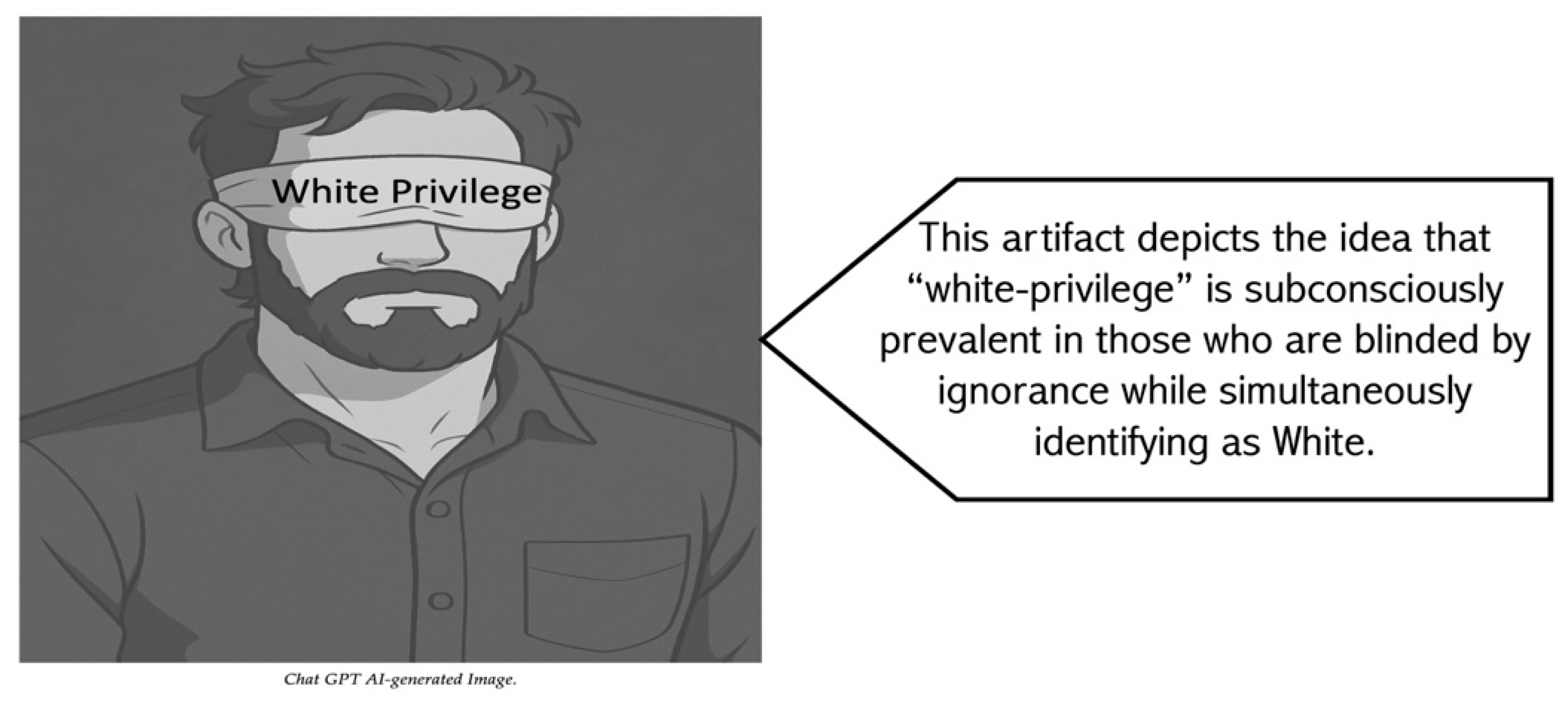
These artifacts can be video diaries, articles, images, or multimedia content. These various deliverables are used to initiate small group discussions. Students analyze and interpret their artifacts, draw connections to the course topics, and formulate shared perspectives. Each group selects key artifacts for whole group presentation articulating their collective interpretations based on their group discussions (See sample artifacts, accompanied by student explanation). Figure 1 shows an artifact on student representation of white priviledge.
  • Student 1
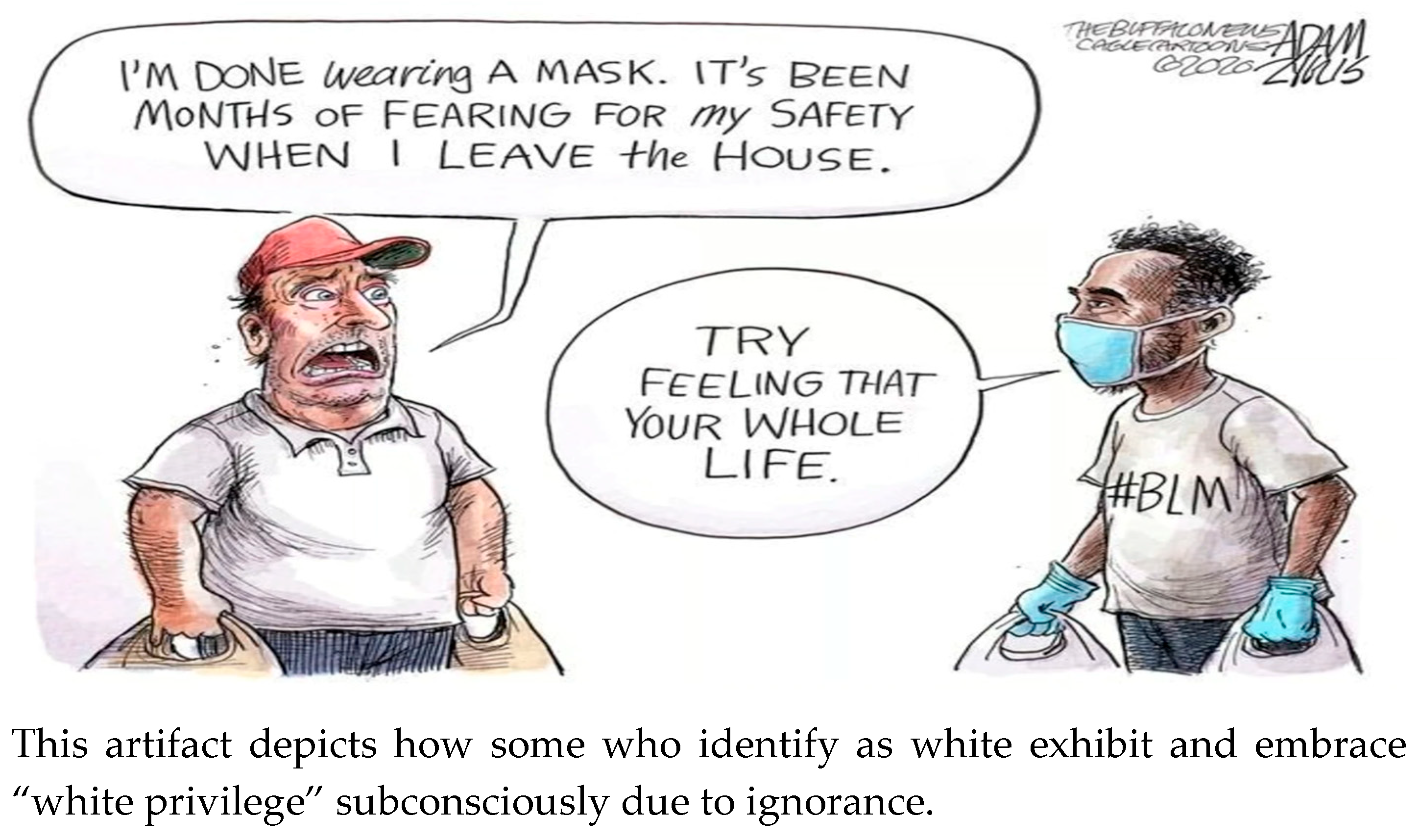
This artifact represents the idea that white privilege is like a blindfold. One may never recognize their privilege or even deny that they have it because the privilege itself blinds them to its existence. Often, white people were never taught that they inherently have privilege because of the color of their skin, which causes this blindfold to continue to block them from recognizing this for generations. (see Figure 2 for a detailed outline of the artifact reflective process).
  • Student 2
In the article What is White Privilege, C. Collins (2018) defined white privilege as unseen and unconscious advantages that white people have due to the systemic and social construction of racism. This does not mean that white people have never struggled or that they have not earned everything they have, but there is a “built-in advantage, separate from one’s level of income or effort” (C. Collins, 2018, p. 3). As a self-identified white person, I identify with a lot of McKintosh’s definition. An example of the artifact is shown in Figure 3.
  • Student 3
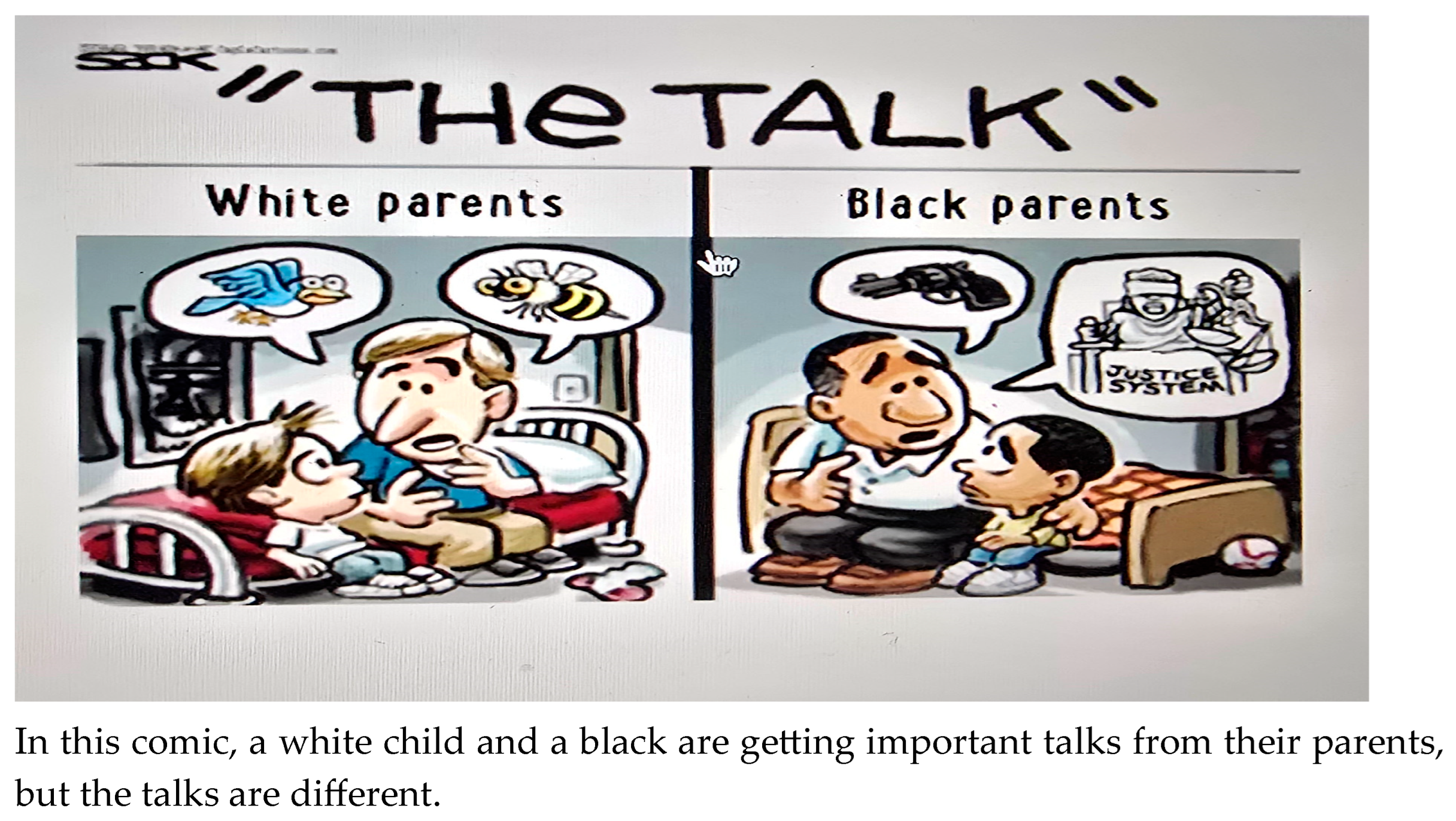
This artifact ties into a vital lesson we discussed during the previous week in class, ‘The talk’ is a tough topic that people of color [POC] have to discuss with their children to keep them safe. I feel that this cartoon effectively represents the differences between the conversations of white families and black families. Most white children will never have the same talk as black children due to the “power of the benefit of the doubt,” mentioned in C. Collins’ (2018) article. People of color get the talk about racial profiling and stereotypes. The white child seems to have their innocence of the world still, while the other child has to learn how the world really works so early on in their lives. This is because society will treat them differently, as expressed in the speech bubbles. This is why most white children have no idea about these harsh topics, and that is a privilege, while black children must walk around with their invisible backpack of concerns and careful living.
  • Post-class Reflection:
  • Student 1
As a person who identifies as white, my big takeaway this week is that white privilege is like a blindfold. One may never recognize their privilege, and they may even deny having it because the privilege itself blinds them. Often, white people were never taught that they inherently have privilege because of the color of their skin, which causes this blindfold to continue to block them from recognizing this for generations. White privilege can be like wearing a blindfold; those who have it often don’t see it. People might even deny having privilege because they aren’t aware of it. This usually happens because society doesn’t always teach white people about the advantages they have due to their skin color. This lack of education means that generations grow up without realizing the importance of education. So, the “blindfold” stays on, and the advantage isn’t recognized.
  • Student 2
White Privilege is something I have always debated within myself. To some degree, there is absolutely a privilege for whites, but then again, some things make me wonder. The image of a nude bandage on black skin is one of the things that definitely makes me believe there is white privilege. Everyone has the right to an education, to vote, and to be a legal citizen of this country. However, simple things, such as makeup brands offering enough shades for darker-skinned individuals and band-aids that blend in with one’s skin, are a simple privilege that lighter-skinned people don’t have to think about or worry about. That is what I took away from our discussions and the McKintosh article.

4.9. Topic 3: Gender, Sexuality, and Education

Lesson Introduction: Gender and sexualism are critical dimensions of educational equity, influencing learners’ academic pathways and access. With regards to gender, despite progress in enrollment and access to meaningful participation, structural inequities persist as normative gender roles continue to be reinforced within educational settings (Andrus et al., 2018; Cimpian, 2018). Gender and sexuality are often conceptualized through binary and heteronormative lenses that constrain identity expression and learning opportunities. For instance, girls remain underrepresented in STEM fields, while boys are often discouraged from caregiving or human-centered professions. Students who identify outside the gender binary frequently encounter exclusionary practices that undermine their engagement and sense of belonging (Schmidt, 2015).
Heteronormative assumptions embedded in curricula often marginalize, overlook, or misrepresent the diverse identities present in classrooms (Dove, 2021; Schmidt, 2015). Moreover, many educators lack the training necessary to implement inclusive pedagogies, compounding the psycho-emotional stress experienced by marginalized students. Creating inclusive and equitable learning spaces requires intentional pedagogical commitments and institutional affirmations of all identities, including those related to gender and sexual orientation. These commitments should involve reflective and dialogic practices, raising questions such as the following: How is gender inequality reinforced, either intentionally or unintentionally, in the classroom? (see Table 4 for the structure and process of teaching gender and sexuality).
Scenarios are presented as personal or witnessed stories of the impacted the topic on their lives or eye-witness accounts of others’ experiences. These scenarios or vignettes are resources used in class.
  • In-class Discussion Scenarios—Sample 1
Education 16 00077 i001
  • Student 1
I think about Schmidt’s (2015) article on microaggressions faced by LGBTQ+ youth. I look at it as someone who waited to come out because I was scared about the discrimination and microaggressions I would face. Over time, I became comfortable with myself and became more open about it. Of course, this didn’t come without microaggressions, such as hearing people fetishize lesbian relationships or hearing my dad tell me people like me shouldn’t be allowed to teach, despite him not knowing this about me. Recently, I was called the f-slur by someone who didn’t even know this about me. They went on to tell me how I’m not real. This hurt a lot, but I knew I could not let it bother me because, as a queer teacher, I knew that I would face and probably hear much worse from my parents.
  • Scenarios—Sample 2
Education 16 00077 i002
  • Student 2
Our initial consensus was that a male student bullied another male, while the female students jeered at them. Another male intervened and confronted the bully. But Francis [Pseudonym] took a different stance. He believes that a female student bullied a male, and another female stopped the bullying while the four boys were the supporting onlookers. While this seems remote, Francis’s critical thinking was actually correct.
  • Sample Post-class Reflection
I believe that understanding gender biases is essential because teachers are responsible for students’ learning and school experiences. Some teachers favor male students while undervaluing female students because they believe male students possess more talent and work harder than their female counterparts. Teachers must create a safe environment, address their stereotypes, and reflect on their biases, as these can hinder students’ learning.

5. Discussion of Findings

In examining the learning outcomes of implementing this curriculum and instructional approach, I focused on the following question: How does using reflective practice as an instructional tool influence students’ critical reflection, discursive participation, and perspective change when dealing with sensitive topics? Teaching sensitive issues for over ten semesters has provided insights into the effectiveness of this method, especially amid the current sociopolitical complexities of the U.S. educational landscape. More than ever, teacher preparation programs must intentionally adopt practical, theoretical, and research-based strategies to cultivate students’ engagement in critical reflective practice. The analyzed data from the sequential multilevel process of pre-class reflections, in-class discussions, and post-class indicated that the PSTs’ developed knowledge facilitated dialogic exchanges in the following areas: (1) re-examination of frames of reference, (2) increased autonomy and use of authentic voice, and (3) personal growth and perspective shift.

5.1. Re-Examination of Frames of Reference

The PSTs’ reactions to the course readings, as shown in their initial reflections, were influenced by their sociocultural identities, such as race, subject-matter knowledge, and religious affiliations, primarily Christianity. These factors served as their interpretive lenses, aligning with Piaget’s (1936) and Vygotsky’s (1978) theories on cognitive development and the value of prior knowledge. For example, in a student’s reflection on issues of sexual orientation, she wrote, “Because of my Christian beliefs, I am not likely to change my views on people’s choice of sexual orientations; however, as a future teacher, I will treat students fairly.” Similarly, individual and group dialogue-based reflection in this course promoted shifts in perception, encouraging students to question previously unexamined assumptions. This aligned with Tiainen et al.’s (2018) study of students during their practicum, emphasizing how personal and peer-based reflections helped shape and reshape their professional understanding. As students engaged with these topics in a structured yet progressive manner, they refined their initial understandings, leading to meaningful growth.
The findings also revealed that students became more open to considering alternative perspectives, thereby deepening their appreciation of other perspectives. For example, in a final reflection, one student wrote, “The most valuable aspect of this course has been the emphasis on reflective teaching practices, which have enabled me to examine my own experiences and make better decisions about my stance.” Similar findings were reported by Sunar et al. (2024), who observed that participants’ engagement in reflective practice facilitated professional growth by “bringing change in their frame of reference” (p. 117). Whether students’ beliefs shifted or remained firm, the instructional process improved their self-awareness and their ability to approach sensitive issues with pedagogical responsiveness as they moved beyond singular narratives toward a more critically informed approach to discussing the topics.

5.2. Increased Confidence and Authentic Voice

The iterative reflective process enhanced the PSTs’ sense of autonomy and agency. Students reflected on prior experiences, chose relevant resources, and included real-world examples to analyze issues. The peer and interpersonal connections fostered a respectful, supportive learning environment. For example, a student’s final reflection stated, “I learned a lot from my peers this semester. As an introvert, I was unsure how this class would turn out. But we had a safe space to be ourselves, state our opinion, and have a voice on the topic.” Giving them the freedom and confidence to speak openly increased their sense of value and independence within the learning community. This instructional approach promoted understanding and perspective-taking. As noted by one student,
This ongoing reflection has helped me adapt and gain a deeper understanding of my students’ needs. I also appreciated the focus on teaching strategies, where I learned new techniques to engage students and enhance learning outcomes. Overall, these components have made me a more effective and thoughtful teacher, encouraging continuous growth for myself and my students.
Drawing on personal experiences deepened peer insights and appreciation for different viewpoints. They felt empowered to express and defend their beliefs while recognizing the importance of inclusive dialogue. As one student noted, “The structured nature of the lesson design and the varied reflective formats enabled us to articulate our personal views, even when initially we were reluctant to do so.” This comment echo Crichton et al.’s (2021) findings that collaboration and peer evaluation increased students’ confidence by creating supportive spaces for sharing interpretation in both small- and whole-group settings.

5.3. Personal Growth and Perspective Shifts

The multilevel critical reflective process normalized productive discomfort, helping the PSTs navigate ideological tensions while maintaining mutual respect and improving their social awareness, ethical reasoning, and empathy. The data also revealed that the students developed listening skills, empathy, and the ability to consider new perspectives constructively, leading to personal growth. Throughout the course, the PSTs reflected both independently and collaboratively, even when the conversations were uncomfortable. As one student noted,
This course helped us to work independently of our classmates while learning and growing together. I received helpful insights from my peers, which aided my understanding of these difficult topics. I also received instructional feedback based on my reflections, which assisted me greatly in this class.
This finding aligns with Slade et al.’s (2019) analysis of PSTs’ reflections, showing that engaging in reflective practice positively influenced participants’ perceptions of the target subject matter—a culture of poverty (p. 6). The results from this study also agree with Dewey’s (1933) assertion that reflective thinking promotes “freedom from prejudice, partisanship, and such other habits as close the mind” (p. 30). Modeling this approach supported their holistic learning and critical analysis as they shared personal stories using scenarios and vignettes. These stories enable them to engage thoughtfully with the issues. Lastly, they also experienced holistic development and transformative change, as stated by one student,
This course was practical and focused on issues impacting education, utilizing a concrete strategy to enhance student engagement. I learned from the optimized lesson structure because of the different ways we could approach the topics. Some of us were initially unsure how to address these topics or did not want to discuss our genuine feelings personally. But using different reflections enabled me to share my thoughts sincerely.

6. Implications for Teacher Education

Critical reflective practice should be foundational to educational practice because it fosters change and meaningful learning outcomes (Mezirow, 2000; Liu, 2013). It is an instructional method of equipping PSTs with tools for navigating complex classroom dynamics and engaging in socio-contextual learning. The five focal areas arising from this study that implicate PSTs’ preparation include
  • Activating Prior Knowledge to Situate Students’ Beliefs. The constructivist instructor uses students’ prior and background knowledge as a lesson starter to elicit and engage their learning. This practice is extremely beneficial in addressing single narratives and misconceptions about a phenomenon or concept.
  • Model and Promote Class Discourse. Instructors should encourage dialogic interactions by modeling and creating space for change to happen. Modeling effective instructional practices is essential for learners’ growth and designing activities that prompt discussions help students discover key aspects of their learning independently.
  • Design activities that challenge existing assumptions. Structure discussions and activities that encourage critical reflection and question current beliefs. Students should be guided to develop skills, such as questioning, to identify concerns and deepen their understanding of the material.
  • Promote Learner Autonomy and Agency. Student voice matters, especially regarding issues that affect their learning and growth. Allowing students to choose resources that connect their personal and real-life experiences to the classroom’s theoretical concepts can be empowering. Participatory opportunities for co-constructing knowledge, a constructivist approach, are vital for building agency and self-advocacy.
  • Cultivate Critical Mindset. Learners bring various assets and skills to the classroom and should cultivate them to promote critical thinking, listening, collaboration, and empathetic knowledge building.
  • Normalize Productive Discomfort. Creating a Safe Space for exploring sensitive and diverse viewpoints is important for individual and collective learning. Such environments help learners sense-making as they develop the dispositions for transformative, inclusive, and responsive teaching.

7. Limitations/Generalizability

This document analysis was conducted in a teacher education course at one institution, which may limit the generalizability of the findings. The findings provide some contextual insights reflecting the critical reflective instructional method specific to this school setting. Although the instructional process might not be unique to this course or institution, the learning outcomes, especially for these PSTs, are likely to differ in other institutional settings. Therefore, interpretations of these outcomes may not fully represent broader trends across different educational settings and teaching methods implemented. Educators planning to adopt or adapt this curricular design should carefully consider their students’ characteristics and their institutional context to achieve similar results.

8. Conclusions

The instructional approach described in this paper was purposefully designed to include multilayered critical reflective strategies based on Dewey’s (1933) and Vygotsky’s (1978) socio-constructivist theory, as well as Schön’s (1983) frameworks for reflective practice. These frameworks are supported by research emphasizing the importance of prior knowledge, social interactions, collaborative learning, and reflective practice. This paper shows how these elements promote and sustain critical reflective practice.
It was essential to scaffold the topics through three phases—pre-class reflection, in-class discussion, and post-class reflection—so the PSTs could fully engage with the issues. For example, the pre-class reflection enabled them to examine their core beliefs and perspectives from the reading summaries before engaging with peers. The in-class discussions were engaging because the PSTs had already processed the information and could speak from a position of knowing. Also, creating a safe, non-judgmental environment promoted authentic civil discourse and fostered appreciation for diverse viewpoints among the PSTs. Finally, as they synthesized their understanding during post-reflection, some transformative shifts occurred. The findings indicated that they developed greater confidence and insight when handling sensitive topics and gained the ability to conceptualize, contextualize, and articulate their knowledge, which enhanced their understanding of the issues and their broader sociocultural implications.
Modeling this instructional approach enabled the PSTs to engage in deeper critical reflection, self-awareness, and socio-contextual understanding of their peers’ perspectives. They increased their intellectual rigor and their ability to recognize how personal beliefs and assumptions can influence knowledge construction.

Funding

This research received no external funding. The APC was funded by the author’s start up funds.

Data Availability Statement

The datasets used/presented in this article are not readily available because third party used of students’ documents is restricted by the institution.

Acknowledgments

During the preparation of this manuscript the author used Microsoft 365 Copilot and Grammarly for the purposes of editing and correcting grammar used. The author has reviewed and edited the output and take fully responsible for the content of this publication.

Conflicts of Interest

The authors declare no conflict of interest.

References

  1. Agnihotri, S., Mamoria, P., Moorthygari, S. L., Chandel, P., & Gopala Raju, S. V. (2024). The role of reflective practice in enhancing teacher efficacy. Educational Administration: Theory and Practice, 30(6), 1689–1696. [Google Scholar] [CrossRef]
  2. Andrus, S., Jacobs, C., & Kuriloff, P. (2018). Miles to go: The continuing quest for gender equity in the classroom. Phi Delta Kappan, 100(2), 46–50. Available online: https://kappanonline.org/andrus-jacobs-kuriloff-gender-equity-classroom/ (accessed on 10 June 2024). [CrossRef]
  3. Anselmann, V. (2023). How to promote preservice teachers’ reflections through critical incident training. Frontiers in Education, 8, 1212158. [Google Scholar] [CrossRef]
  4. Apfelbaum, E. P., Norton, M. I., & Sommers, S. R. (2012). Racial colorblindness: Emergence, practice, and implications. Current Directions in Psychological Science, 21(3), 205–209. [Google Scholar] [CrossRef]
  5. Athanases, S. Z., Sanchez, S. L., & Martin, L. M. (2020). Saturate, situate, synthesize: Fostering preservice teachers’ conceptual and practical knowledge for learning to lead class discussions. Teaching and Teacher Education, 88, 102970. [Google Scholar] [CrossRef]
  6. Belvis, E., Pineda, P., Armengol, C., & Moreno, V. (2012). Evaluation of reflective practice in teacher education. European Journal of Teacher Education, 36(3), 279–292. [Google Scholar] [CrossRef]
  7. Bonilla-Silva, E. (2014). Racism without racists: Color-blind racism and the persistence of racial inequality in America. Rowman & Littlefield Publishers. [Google Scholar]
  8. Brookfield, S. (2017). Becoming a critically reflective teacher (2nd ed.). Jossey-Bass. [Google Scholar]
  9. Brownhill, S. (2022). Asking more key questions of self-reflection. Reflective Practice, 23(2), 279–290. [Google Scholar] [CrossRef]
  10. Castagno, A. E., & Brayboy, B. M. J. (2014). Culturally responsive schooling for Indigenous youth: A review of the literature. Review of Educational Research, 78(4), 941–993. [Google Scholar] [CrossRef]
  11. Ceglie, R., & Olivares, V. (2012). Representation of diversity in science textbooks. In The new politics of the textbook: Problematizing the portrayal of marginalized groups in textbooks (pp. 49–68). Sense Publishers. [Google Scholar]
  12. Chaseley, T. L., & Abercrombie, S. (2025). Using scaffolds to support preservice teachers’ reflective practice. Frontiers in Education, 10, 1621269. [Google Scholar] [CrossRef]
  13. Cimpian, J. R. (2018). How our education system undermines gender equity. Brookings Education. Available online: https://www.brookings.edu/articles/how-our-education-system-undermines-gender-equity/ (accessed on 10 June 2024).
  14. Cleary, M., Horsfall, J., Happell, B., & Hunt, G. E. (2013). Reflective components in undergraduate mental health nursing curricula: Some issues for consideration. Issues in Mental Health Nursing, 34(2), 69–74. [Google Scholar] [CrossRef]
  15. Collins, C. (2018). What is white privilege, really? Recognizing white privilege begins with truly understanding the term itself. Teaching Tolerance, 60. Available online: https://www.tolerance.org/magazine/fall-2018/what-is-white-privilege-really (accessed on 5 August 2024).
  16. Collins, S., Karsenti, T., & Komis, V. (2012). Reflective practice in initial teacher training: Critiques and perspectives. Reflective Practice, 14(1), 104–117. [Google Scholar] [CrossRef]
  17. Creswell, J. W., & Poth, C. N. (2018). Qualitative inquiry & research design: Choosing among five approaches (4th ed.). SAGE Publications. [Google Scholar]
  18. Crichton, H., Valdera Gil, F., & Hadfield, C. (2021). Reflections on peer micro-teaching: Raising questions about theory-informed practice. Reflective Practice, 22(3), 345–362. [Google Scholar] [CrossRef]
  19. Darling-Hammond, L. (2013). The right to learn: A blueprint for creating schools that work. Jossey-Bass. [Google Scholar]
  20. Dewey, J. (1933). How we think: A restatement of the relation of reflective thinking to the educative process. D.C. Heath & Co. Publishers. [Google Scholar]
  21. Dos Santos, L. M. (2018). The cultural cognitive development of personal beliefs and classroom behaviours of adult language instructors: A Qualitative Inquiry. Brain Sciences, 8(12), 220. [Google Scholar] [CrossRef]
  22. Dove, K. G. (2021). Classroom equity and the role of a teacher leader: Making classrooms equitable to all students. In B. S. Zugelder (Ed.), Empowering formal and informal leadership while maintaining teacher identity (pp. 109–134). IGI Global. [Google Scholar] [CrossRef]
  23. Farrell, T. S. C. (2014). Promoting teacher reflection in second language education: A framework for TESOL professionals. Routledge. [Google Scholar] [CrossRef]
  24. Freire, P. (1970). Pedagogy of the oppressed. Seabury Press. [Google Scholar]
  25. Gay, G. (2018). Culturally responsive teaching: Theory, research, and practice (3rd ed.). Teachers College Press. [Google Scholar]
  26. Gillborn, D. (2019). Hiding in plain sight: Understanding and addressing whiteness and colorblind ideology in education. Kappa Delta Pi Record, 55(3), 112–117. [Google Scholar] [CrossRef]
  27. Gläser-Zikuda, M., Zhang, C., Hofmann, F., Plößl, L., Pösse, L., & Artmann, M. (2024). Mixed methods research on reflective writing in teacher education. Frontiers in Psychology, 15, 1394641. [Google Scholar] [CrossRef]
  28. Goh, A. Y. S. (2019). Rethinking reflective practice in professional lifelong learning using learning metaphors. Studies in Continuing Education, 41(1), 1–16. [Google Scholar] [CrossRef]
  29. Goldhaber, D. (2019). Evidence-based teacher preparation: Policy context and what we know. Journal of Teacher Education, 70(2), 90–101. [Google Scholar] [CrossRef]
  30. Haneda, M. (2017). Dialogic learning and teaching across diverse contexts: Promises and challenges. Language and Education, 31(1), 1–5. [Google Scholar] [CrossRef]
  31. Harvey, M., Coulson, D., & McMaugh, A. (2016). Towards a theory of the ecology of reflection: Reflective practice for experiential learning in higher education. Journal of University Teaching and Learning Practice, 13(2), 1–22. [Google Scholar] [CrossRef]
  32. Harvey, M., Walkerden, G., Semple, A., McLachlan, K., Lloyd, K., & Bosanquet, A. (2025). Reflecting on reflective practice: Issues, possibilities and guidance principles. Higher Education Research & Development, 44, 1849–1857. [Google Scholar] [CrossRef]
  33. Hurrell, D. P. (2021). Conceptual knowledge and procedural knowledge: Why the conjunction matters. Australian Journal of Teacher Education, 46(2), 57–71. [Google Scholar] [CrossRef]
  34. Jeffery, T. D., Jackson-Osagie, E. A., & Ogodo, J. A. (2022). Integrating social justice pedagogy in an online elementary science classroom. In F. S. Allaire, J. E. Killham, & J. D. O’Leary (Eds.), Teaching and learning online: Science for elementary grade levels. Teaching and grade levels. Information Age Publishing (IAP). [Google Scholar]
  35. Kolb, D. A. (1984). Experiential learning: Experience as the source of learning and development. Prentice Hall. [Google Scholar]
  36. Körkkö, M. (2021). Towards meaningful reflection and a holistic approach: Creating a reflection framework in teacher education. Scandinavian Journal of Educational Research, 65(2), 258–275. [Google Scholar] [CrossRef]
  37. Krippendorff, K. (2019). Content analysis: An introduction to its methodology (4th ed.). SAGE Publications. [Google Scholar]
  38. Ladson-Billings, G. (2014). Culturally relevant pedagogy 2.0: A.k.a. the remix. Harvard Educational Review, 84(1), 74–84. [Google Scholar] [CrossRef]
  39. Ladson-Billings, G. (2018). The dreamkeepers: Successful teachers of African American children (2nd ed.). John Wiley & Sons. [Google Scholar]
  40. Ladson-Billings, G. (2022). Culturally relevant pedagogy: Asking a different question. Teachers College Press. [Google Scholar]
  41. Lalor, J., Lorenzi, F., & Rami, J. (2014). Developing professional competence through assessment: Constructivist and reflective practice in teacher-training. Eurasian Journal of Educational Research, 58, 45–66. [Google Scholar] [CrossRef]
  42. Lefebvre, J., Lefebvre, H., & Lefebvre, B. (2022). Reflection of novice teachers on their teaching practice. Reflective Practice, 23(4), 452–466. [Google Scholar] [CrossRef]
  43. Liu, K. (2013). Critical reflection as a framework for transformative learning in teacher education. Educational Review, 67(2), 135–157. [Google Scholar] [CrossRef]
  44. Machost, H., & Stains, M. (2023). Reflective practices in education: A primer for practitioners. CBE—Life Sciences Education, 22(2), es2. [Google Scholar] [CrossRef]
  45. Maggioli, G. (2025). New trends in reflective practice in ELT. In N. A. Nazari (Ed.), Empowering the English language teacher in a Multipolar environment. English language teaching: Theory, research and pedagogy. Springer. [Google Scholar] [CrossRef]
  46. Maguire, K. R. (2023). Preservice teachers’ reflections on content knowledge through microteaching. Reflective Practice, 24(2), 153–167. [Google Scholar] [CrossRef]
  47. Mathew, P., Mathew, P., & Peechattu, P. J. (2017). Reflective practice: A means to teacher development. Asian Pacific Journal of Contemporary Education and Communication Technology, 3(1), 126–131. Available online: https://apiarpublications.com/wp-content/uploads/2017/02/13_APJCECT_Feb_BRR798_EDU-126-131.pdf (accessed on 12 February 2025).
  48. McIntosh, P. (1998). White privilege: Unpacking the invisible knapsack. In M. McGoldrick (Ed.), Re-visioning family therapy: Race, culture, and gender in clinical practice (pp. 147–152). The Guilford Press. [Google Scholar]
  49. Mensah, F. M., & Jackson, I. (2018). Whiteness as property in science teacher education. Teachers College Record, 120(1), 1–38. [Google Scholar] [CrossRef]
  50. Mercer, N., & Dawes, L. (2014). The study of talk between teachers and students, from the 1970s until the 2010s. Oxford Review of Education, 40, 430–445. [Google Scholar] [CrossRef]
  51. Merriam, S. B., & Tisdell, E. J. (2016). Qualitative research: A guide to design and implementation (4th ed.). Jossey-Bass. [Google Scholar]
  52. Mezirow, J. (1991). Transformative dimensions of adult learning. Jossey-Bass Publishers. [Google Scholar]
  53. Mezirow, J. (2000). Learning as transformation: Critical perspectives on a theory in progress. Jossey-Bass. [Google Scholar]
  54. Morris, D. L. (2024). Reflections of a first-year chemistry teacher: Intersecting PCK, responsiveness, and inquiry instruction. Education Sciences, 14(1), 93. [Google Scholar] [CrossRef]
  55. Ogodo, J. A. (2022). Developing STEM teachers’ cultural competence through an urban teaching curriculum: A cultural border crossing experience. Journal of Science Teacher Education, 34, 267–286. [Google Scholar] [CrossRef]
  56. Pang, N. S.-K. (2022). Teachers’ reflective practices in implementing assessment for learning skills in classroom teaching. ECNU Review of Education, 5(3), 470–490. [Google Scholar] [CrossRef]
  57. Paris, D., & Alim, S. A. (2017). Culturally sustaining pedagogies teaching and learning for justice in a changing world. Teachers College Press. [Google Scholar]
  58. Parsons, S. A., Vaughn, M., Scales, R. Q., Gallagher, M. A., Parsons, A. W., Davis, S. G., Pierczynski, M., & Allen, M. (2018). Teachers’ instructional adaptations: A research synthesis. Review of Educational Research, 88(2), 205–242. [Google Scholar] [CrossRef]
  59. Philp-Clark, C., & Grieshaber, S. (2024). Teacher critical reflection: What can be learned from quality research? The Australian Educational Researcher, 51, 697–717. [Google Scholar] [CrossRef]
  60. Piaget, J. (1936). The Origins of Intelligence in the Child. Routledge. [Google Scholar]
  61. Russell, T. (2017). A teacher educator’s lessons learned from reflective practice. European Journal of Teacher Education, 41(1), 4–14. [Google Scholar] [CrossRef]
  62. Ryan, M. (2014). Introduction: Reflective and reflexive approaches in higher education: A warrant for lifelong learning? In Teaching reflective learning in higher education: A systematic approach using pedagogic patterns (pp. 3–14). Springer. [Google Scholar]
  63. Saimon, M., & Mtenzi, F. (2021). Reflective practices as the cornerstone for teacher development in the 21st century: Lessons from educators’ action research projects. Journal of Research, Policy & Practice of Teachers & Teacher Education, 11(2), 88. [Google Scholar] [CrossRef]
  64. Schmidt, J. S. (2015). A queer arrangement of school: Using spatiality to understand inequity. Journal of Curriculum Studies, 47(2), 253–273. [Google Scholar] [CrossRef]
  65. Schön, D. A. (1983). The reflective practitioner: How professionals think in action. Basic Books. [Google Scholar]
  66. Schön, D. A. (1987). Educating the reflective practitioner. Jossey-Bass. [Google Scholar]
  67. Schreier, M. (2012). Qualitative content analysis in practice. Sage. [Google Scholar]
  68. Shandomo, H. M. (2010). The role of critical reflection in teacher education. School University Partnerships, 4(1), 101–113. [Google Scholar]
  69. Slade, M. L., Burnham, T. J., Dr. Catalana, S. M., & Waters, T. (2019). The impact of reflective practice on teacher candidates’ learning. International Journal for the Scholarship of Teaching and Learning, 13(2), 15. [Google Scholar] [CrossRef]
  70. Smith, J., Shelton, R., Scholten, N., & McCall, M. (2023). Secondary preservice teachers’ critical reflecting practices. School-University Partnerships, 16(1), 56–70. [Google Scholar] [CrossRef]
  71. Spiteri, D. (2025). The hall of mirrors: Reflecting on preservice teachers’ reflections. Teachers and Teaching, 31(1), 52–69. [Google Scholar] [CrossRef]
  72. Sullivan, B., Glenn, M., Roche, M., & McDonagh, C. (2016). Introduction to critical reflection and action for teacher researchers: A step-by-step guide. Routledge. [Google Scholar]
  73. Sunar, P. K., Pant, B. P., & Dahal, N. (2024). Knowing, doing, and becoming reflective practitioners: A narrative inquiry of STEAM educators. Alberta Journal of Educational Research, 70(1), 114–129. [Google Scholar] [CrossRef]
  74. Suphasri, P., & Chinokul, S. (2021). Reflective practice in teacher education: Issues, challenges, and considerations. Pasaa, 62(1), 236–264. [Google Scholar] [CrossRef]
  75. Tiainen, O., Korkeamäki, R. L., & Dreher, M. J. (2018). Becoming reflective practitioners: A case study of three beginning preservice teachers. Scandinavian Journal of Educational Research, 62(4), 586–600. [Google Scholar] [CrossRef]
  76. Tiboris, M., & Danforth, S. (2016). Learning to occupy yourself: The substantive content of educating for autonomy. Social Theory and Practice, 42(3), 636–654. Available online: http://www.jstor.org/stable/24871360 (accessed on 4 November 2024). [CrossRef]
  77. Ushomirsky, N., & Williams, D. (2015). Funding gaps 2015: Too many states still spend less on educating students who need the most. Education Trust. Available online: https://eric.ed.gov/?id=ED566665 (accessed on 17 September 2024).
  78. Vygotsky, L. S. (1978). Mind in Society: The development of higher psychological processes. Harvard University Press. [Google Scholar]
  79. Woodward, D., Booth, S., Allen, E., Forbes, C. D., & Taylor, J. (2021). Constructivism and reflective practice: An evidence-based approach to tertiary teaching. Scope: Contemporary Research Topics (Learning and Teaching), 10, 145–153. [Google Scholar] [CrossRef]
  80. Worsley, C. (2018). Understanding and confronting white privilege in schools: A journey of cultural humility. CSEE Connections, 27–31. Available online: https://cdn.ymaws.com/www.csee.org/resource/resmgr/docs/_topic_documents/diversity/understanding_and_confrontin.pdf (accessed on 17 September 2024).
Figure 1. Sample Artifact 1.
Education 16 00077 g001
Figure 2. Sample Artifact 2.
Education 16 00077 g002
Figure 3. Sample Artifact 3.
Education 16 00077 g003
Table 1. The Reflective Process Procedure.
Reflective Practice Expectations
Pre-Class Refection
(1–2 Pages)
In-Class Discussion
(75 min)
Post-Class Reflection
(One-Paragraph)
  • Read assigned text(s) and submit a three-paragraph reflective response that include the following:
    • 1st paragraph—restate authors’ main arguments in your own words.
    • 2nd paragraph—your personal views/interpretation of the text. Identify any area of conflicts or agreements.
    • 3rd paragraph—two takeaways and an outstanding question(s).
  • Analyze the included video to support your response and your stance on the topic.
  • Groups (three or four students), share their thoughts from the assignment.
    • Each group team lead summarizes their key points for whole class share-outs.
    • Questions arising from the readings are discussed by the whole class. Feedback and clarifying thoughts are provided by peers and the instructor.
  • Based on the material covered and class discussions, re-examine your position.
    • What changed, what stayed the same?
    • Implications of the topic for classroom practice?
Table 2. Structure and Process of Teaching Race, Racism, and Colorblindness.
Topic:
Race, Racism,
and
Colorblindness
Lesson Goal: Students will
  • Distinguish between race, racism, and colorblindness.
  • Identify the typology of colorblindness
  • Generate key arguments for class discussion
  • Utilize peer knowledge co-construction to synthesize comprehension of the phenomenon.
Instructional Strategies:
  • Article readings/video analysis, artifact presentation
Pre-class
Reflection
Read and reflect:
  • Read the assigned texts on race, racism, color blindness.
  • Submit your reflection based on the course reflection guidelines.
In-class
Discussion
Discussion Prompts:
Based on key points from the reading, scenarios, or vignettes typical discussion prompts may include
  • I don’t see color. What does it mean?
  • Can racism be perpetuated? Give an example.
  • Discuss the concepts of “colorblind” or “color brave” and the implications to the classroom environment and teacher practice.
Post-reflection Task
  • Reexamine your initial stance on the subject and reflect on the Insights
  • Where was new knowledge gained or reinforced?
  • How does this knowledge implicate classroom teaching?
Table 3. Structure and Process for Teaching Whiteness and White Privilege.
Topic:
Whiteness and
White Privilege
Lesson Goal: Students will
  • Synthesize what whiteness and white privilege look like in educational settings.
  • Evaluate and present examples/scenarios/artifacts on the visibility of whiteness/white privilege in education.
  • Examine the implications of whiteness and white privilege in the educational system.
Instructional strategies:
  • Article Readings
  • Generate key arguments for class discussion
  • Artifact & Video analysis
Pre-Reflection
Task
Read and reflect on assigned reading
  • Submit reflection based on course guidelines
In-class DiscussionDiscussion based on the week’s reading questions, artifacts, and video analysis
  • The instructor provided two scenarios for discussion.
Post-Reflection
  • Based on these interactive discussions, reexamine your initial position and understanding of this topic and provide new or reinforced insights.
  • What are the implications for classroom teaching?
Table 4. Lesson Structure for Teaching Gender and Sexuality and Student Reflective Process.
Topic:
Gender, Sexuality,
and Education
Lesson Goal: Students will
  • Distinguish between gender and sexuality.
  • Examine the issues of gender and sexuality in the classroom.
  • Delineate how these issues mitigate learning.
Instructional Strategies:
  • Article reading, scenario & video analysis
Pre-reflection TaskRead and reflect on assigned texts on
  • Gender, gender stereotypes, and sexual orientation.
  • Watch the accompanying videos.
In-class Reflective
Discussion
Sample discussion prompts:
Discussion prompts can be student and instructor-directed based on submitted artifacts, video analysis, scenarios, etc. Video: Gender stereotypes:
  • What are (non-) traditional genders, and how are they positioned or privileged in schools?
  • How is heteronormativity maintained in schools?
  • How do teachers or school curricula privilege particular genders?
  • How is gender inequality reinforced intentionally or unintentionally in the classroom?
Post Reflection TaskBased on these interactive discussions, reexamine your initial stance and
  • Provide a contextual understanding of the topics.
  • How does this knowledge implicate classroom teaching?
  • In what ways do teachers, the curriculum, or schools privilege a particular gender?
  • How does the intersection of gender, sexual orientation, and other identities impact school experiences?
Disclaimer/Publisher’s Note: The statements, opinions and data contained in all publications are solely those of the individual author(s) and contributor(s) and not of MDPI and/or the editor(s). MDPI and/or the editor(s) disclaim responsibility for any injury to people or property resulting from any ideas, methods, instructions or products referred to in the content.