Review

Controversies in Learning English as an Additional Language in Early Schooling

College of Humanities and Social Sciences, Hamad Bin Khalifa University, Minaretein Building, Ground Floor, Qatar Foundation, Education City, P.O. Box 5825, Doha 5825, Qatar
*
Author to whom correspondence should be addressed.
Educ. Sci. 2026, 16(1), 33; https://doi.org/10.3390/educsci16010033
Submission received: 21 October 2025 / Revised: 10 December 2025 / Accepted: 18 December 2025 / Published: 26 December 2025

Abstract

As the English language spreads worldwide, debate has intensified over introducing it early in multilingual school systems. In the Arab world, this question is especially sensitive because Arabic is closely linked to cultural and religious identity, and early English policies may shift the language balance in primary education. This review synthesizes 31 peer-reviewed studies on childhood English learning and early English teaching practices, addressing key aspects of age of acquisition, bilingual outcomes, and language maintenance or identity. Using transparent search and selection reporting, we examined studies published between 2000 and 2025. Findings cluster around four themes: age of acquisition, mother-tongue maintenance and identity, teacher preparation and pedagogy, and social outcomes. The evidence from the review shows that earlier exposure can support pronunciation, fluency, and metalinguistic awareness, but the strength and direction of these gains depend primarily on program quality and bilingual model design. Additive approaches that maintain and value Arabic literacy while providing rich, high-quality English input are often associated with better learning outcomes than subtractive arrangements that reduce Arabic use. However, effects vary by context and implementation quality. Where Arabic is reduced without adequate support, learners may face risks such as weaker first-language development and heightened identity-related strain. However, these outcomes are not inevitable and are moderated by factors such as teacher preparation, instructional design, and school–home language support. We propose a balanced early-English design that builds progressive English proficiency while maintaining continuous Arabic-medium literacy, supported by targeted teacher professional development, family and community engagement, and continuous Arabic-medium literacy. The review concludes with policy and practice implications for curriculum designers, school leaders, and decision-makers, and calls for longitudinal, classroom-based research on identity trajectories and English-medium instruction in Arab primary education.

1. Introduction and Background

Learning a second or additional language is essential for individuals living in multilingual and multicultural societies. There is also credible evidence that proficiency in English is associated with better labor-market integration and greater access to services. Studies demonstrate that higher-intensity language training increases immigrants’ formal-sector employment and the likelihood of permanent contracts (Lang, 2022; Pont-Grau et al., 2023). In health systems, limited English proficiency is associated with poorer access to and outcomes from care, as shown in a recent scoping review (Twersky et al., 2024). Complementing these public-service effects, evaluations link language proficiency and training to stronger labor-market outcomes, higher employment probabilities, and permanent-contract rates (Lang, 2022; Pont-Grau et al., 2023) and wage gains for migrants (Azad & Fahmida, 2024). More broadly, multilingualism is linked to broad social and educational benefits, including enhanced participation and future economic opportunities (Liwiński, 2019; Veerman et al., 2025). Therefore, a key policy question is how early English should be introduced in primary schooling, especially in settings where local languages carry strong identity functions. This review addresses that question in the context of Arab primary education.
The first research concern is the age of acquisition and what the “earlier is better” claim can realistically mean in English as an additional language (EAL) instruction in schools. For EAL, the “earlier is better” claim is domain-specific, in the sense that younger starters tend to have advantages in accent (Flege et al., 1995; Snow & Hoefnagel-Höhle, 1977), whereas morphosyntax and literacy are highly responsive to explicit instruction and input quality (Norris & Ortega, 2000; Spada & Tomita, 2010). Large-scale analyses of grammar detect a critical-period signal while years of exposure remain a strong predictor of ultimate outcomes (Hartshorne et al., 2018). This shifts the policy question from “how early?” to “under what instructional conditions does early start help?” as supporting background from a methodological synthesis (DeKeyser, 2013). Similarly, cautions that age effects in instructed settings are moderated by instructional conditions and the specific language features targeted.
A second strand emphasizes that affective factors and learning outside school shape early EAL trajectories. Motivation and out-of-school engagement matter. For example, a meta-analysis by Botes et al. (2020) showed that Foreign Language Enjoyment (FLE) correlates positively with achievement (r~0.30) and willingness to communicate (r~0.48). Recent work (Wu, 2024) further indicates that components of the second language (L2) motivational self-system (L2MSS) and FLE jointly predict motivated behavior. Beyond the classroom, a recent review (Gowenlock et al., 2024) finds that high-quality children’s videos can support short-term learning of specific targets, but links to broader, longer-term standardized outcomes are small and/or mixed and depend on design and viewing context. Studies of adolescents’ extramural English likewise find vocabulary gains, though prior vocabulary knowledge outweighs the amount of digital activity (Laufer & Vaisman, 2023). These findings indicate that early English learning outcomes are shaped not only by starting age but also by learners’ engagement and the wider learning ecology.
To understand why age effects are conditional, it is useful to consider the mechanisms underlying early language learning. Children learn language through socially contingent interaction with caregivers and ambient input. Behavioral and neurocognitive evidence (Akan, 2018; Kuhl, 2004) shows advantages for live, responsive interaction and early sensitivity to speech structure. According to (Kuhl, 2004; Romberg & Saffran, 2010), language functions as a core human communicative system and shows that learning exploits statistical regularities in the input. While imitation plays a role early on, statistical learning (segmentation, order memory, grammatical generalization, abstract categories) alongside social interaction drive acquisition (Gómez & Gerken, 2000; Kuhl, 2007). In school-based EAL instruction, these mechanisms translate into a strong dependence on the quantity and quality of English input and interactional opportunities. As Pfenninger and Singleton (2017) reported, with intensive exposure and strong pedagogy, later starters can match or exceed earlier starters (Pfenninger & Singleton, 2017). Thus, start-age effects must be interpreted within an input-and-instruction framework.
Empirical findings on sensitive periods, therefore, need to be read alongside instructional evidence. Sensitive-period research shows a clear early advantage for accent (Flege et al., 1995), and age of onset is negatively associated with ultimate attainment on morphosyntactic and phonetic measures (Abrahamsson, 2012; Abrahamsson & Hyltenstam, 2009). At the same time, meta-analytic results, such as (Norris & Ortega, 2000), show reliable gains from explicit grammar instruction. Also, well-designed reading interventions can improve literacy outcomes for English learners (Cho et al., 2021; Solari et al., 2022). Together, this literature indicates that age of onset is only one contributor within a broader system shaped by exposure, pedagogy, and sustained literacy support. Policy decisions must therefore adopt a more holistic approach that considers model design, not age alone.
However, the age-of-start debate takes on distinctive stakes in Arab Gulf contexts, where English expansion intersects with Arabic identity and schooling norms. In Saudi Arabia and the UAE, a comparative empirical analysis of English-medium instruction reports that longer exposure to EMI is associated with heightened concerns about Arabic “domain loss” (Aljehani & Modiano, 2025). In Qatar, Mustafawi et al. (2022) report a large survey study of Qatar University students (N = 861), finding that Arabic was rated higher for identity/cultural symbolism and medium-of-instruction preferences, while English was perceived as more useful for scientific and professional communication (Mustafawi et al., 2022).
In KSA, Al-Jarf (2023) surveyed 300 mothers and found that about 70% preferred kindergartens that teach English. The participants, expecting academic benefits, believed that early English instruction does not harm children’s Arabic. The discussed sources report attitudes and perceived consequences from higher education student and parent populations and are not child-outcome trials (Al-Jarf, 2023). As such, implications for primary schooling depend on program design, specifically, protecting Arabic-literacy time and aligning language support when English exposure increases.
The language program model is, therefore, a key leverage in shaping outcomes. School-level Content and Language Integrated Learning (CLIL) and English-Medium Instruction (EMI) studies highlight several factors, including capacity constraints, uneven teacher L2 proficiency, underspecified language objectives, and misaligned assessment as supported by an empirical CLIL evidence (Pérez Cañado, 2018b). These outcomes indicate a need for CLIL-specific professional learning in language-aware content pedagogy, scaffolding, and assessment literacy. In Arab contexts, program-model debates intersect with Arabic diglossia and the demands of biliteracy. Psycholinguistic research (Abu Ahmad & Share, 2021; Asli-Badarneh & Asadi, 2023; Saiegh-Haddad & Haj, 2018; Shahbari-Kassem et al., 2025) shows that greater phonological and lexical distance between children’s spoken varieties and Modern Standard Arabic (MSA) systematically constrains early phonological representations, word learning, and later reading. Accordingly, increases in English instructional time should not reduce Arabic literacy; rather, Arabic should be sustained and explicitly supported.
Beyond formal schooling, the broader learning ecology shapes outcomes. Guided extramural English can support vocabulary growth, moderated by initial vocabulary and activity type (Laufer & Vaisman, 2023). Reviews of children’s learning (Gowenlock et al., 2024) from video identify facilitative features (e.g., contingent cues, high linguistic quality) but mixed long-term effects due to heterogeneity of design and exposure. Motivation and identity remain central: investment theory frames English as symbolic and material capital (Darvin & Norton, 2015, 2023). Evidence for broad cognitive advantages of bilingualism is limited; meta-analyses often find small or non-significant executive-function effects after controlling for bias and task differences (Lehtonen et al., 2018). These findings reinforce that primary-school policy should prioritize language-and-literacy design over presumed general cognitive benefits.
Despite rapid policy shifts toward earlier English, the Arab primary-school evidence base remains fragmented and uneven. Across Arab schooling systems, gaps remain. Few studies track learners beyond two–three years; rigorous earlier-vs-later comparisons with implementation checks are rare; Arabic outcomes (writing, morphology, academic vocabulary) are inconsistently measured alongside English; teacher training is described more than evaluated; technology is barely assessed for effectiveness or cost; exposure measures blur classroom time with poorly captured interactional opportunities; samples skew small or urban or private-school, with limited attention to equity or socioeconomic status (SES); and identity and agency measures are weak. These gaps matter because several systems have moved to earlier English without firm evidence of durable gains or clear protection of children’s Arabic language.
Accordingly, the objective of this review was to synthesize and critically appraise peer-reviewed evidence on early English instruction in Arab primary schooling, with particular attention to age-of-start effects, Arabic language maintenance and identity outcomes, and the program, pedagogical, and exposure conditions that shape trajectories. Guided by this objective, we asked three practical questions:
(1)
When does starting earlier help, and for whom?
(2)
What trade-offs arise for Arabic language proficiency, literacy, and cultural identity?
(3)
How do teacher preparation, methods, technology, and input shape trajectories?
The contribution of this review is threefold. We offer a context-specific synthesis that organizes mixed findings and can be utilized for a policy framework. We link age-of-start debates to identity and mother-tongue development, showing how pedagogy and teacher development can amplify benefits or mitigate risks. Moreover, we translate the evidence into possible policy actions on curriculum timing, safeguards for Arabic language (e.g., coordinated literacy targets), and professional learning, while mapping priorities for future longitudinal and intervention research.

2. Methodology

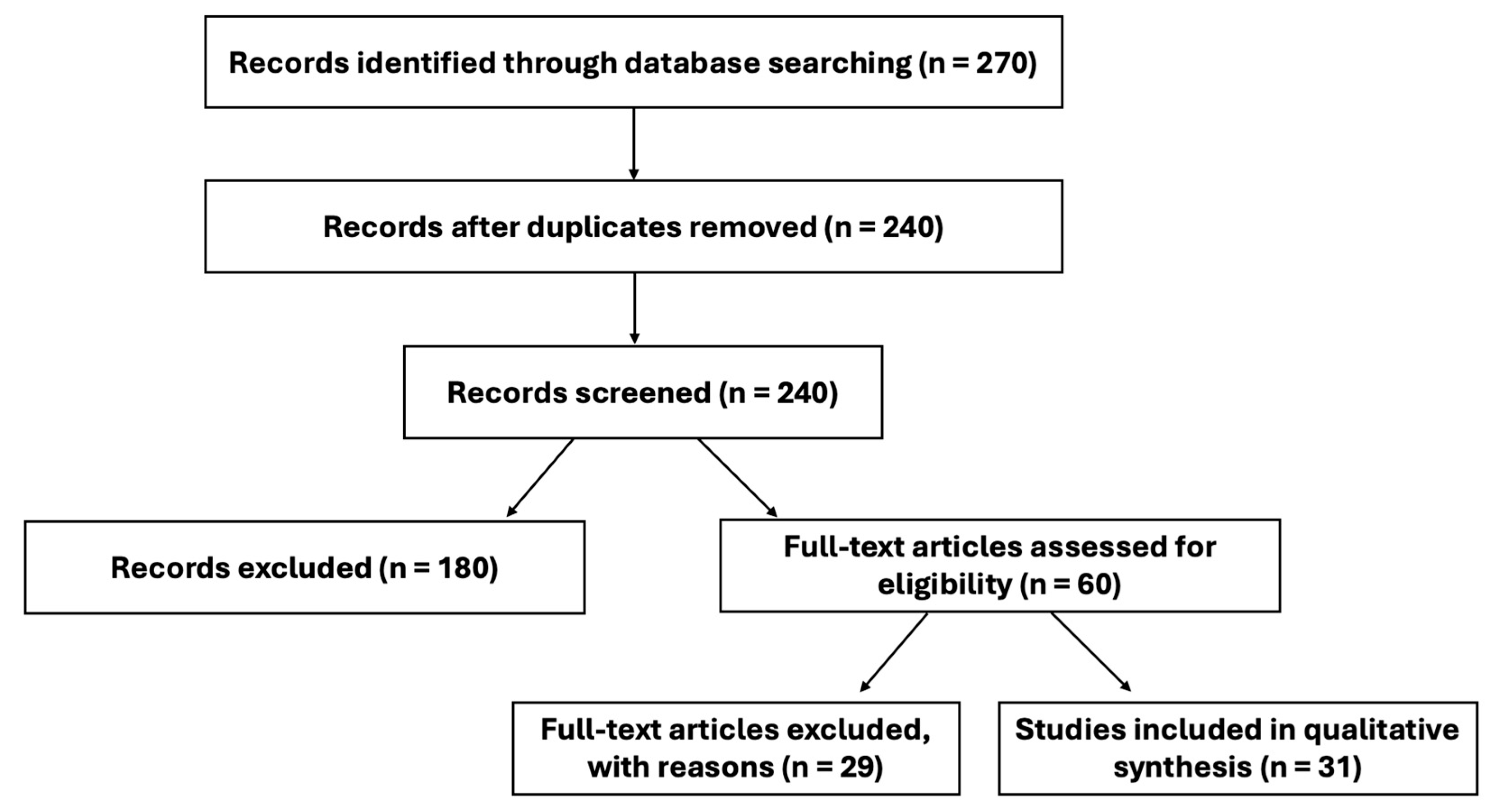
This review adopted transparent reporting principles inspired by Preferred Reporting Items for Systematic Reviews and Meta-Analyses (PRISMA) 2020 guidelines (Page et al., 2021) to ensure clarity and replicability. Searches were conducted in Google Scholar, Scopus, Web of Science, ERIC, and JSTOR for studies published between 2000 and 2025, as shown in Figure 1.
After applying inclusion and exclusion criteria, 31 peer-reviewed sources were retained for review and analysis. The 31 sources included a mix of empirical and conceptual or review sources. Empirical papers included interventional, observational, and longitudinal designs, while the remainder were conceptual, theoretical, policy-oriented, or synthesis contributions.
In the synthesis, we explicitly distinguish conceptual framing from empirical evidence; claims about learning outcomes are drawn from empirical and meta-analytic findings, while conceptual sources are used to frame mechanisms and policies.
Because this is a narrative review integrating evidence from various sources, we did not apply a formal risk-of-bias scoring tool. Instead, empirical studies were read with attention to basic design robustness (e.g., use of comparison groups, sample adequacy, clarity of measures and whether follow-up measures were reported), and whether findings were interpreted with proportional caution in the synthesis.

2.1. Search Strategy

The search was conducted across major academic databases, including Google Scholar, Scopus, Web of Science, ERIC, and JSTOR. A combination of keywords was used to maximize coverage. These included “early English instruction learning,” “second language acquisition in childhood,” “bilingualism,” “age of acquisition,” “English medium instruction,” “mother-tongue interference,” “teacher training in language education,” and “Qatar or Arab world English learning.” The timeline was set for publications after 2000, as the intention was to review studies published over the past quarter.
The initial search yielded 270 sources published between 2000 and 2025, covering both theoretical and empirical studies.

2.2. Inclusion Criteria

To ensure relevance and quality, studies were included if they met all of the following criteria:
-
Were peer-reviewed journal articles, book chapters, or scholarly reports.
-
Focused on English as a second or additional language learning in childhood.
-
Addressed at least one key issue, debate, or established finding related to age of acquisition, Arabic language maintenance or identity, bilingualism outcomes, or early-EAL teaching practices.
-
Published in English or Arabic.

2.3. Exclusion Criteria:

Articles were excluded if they met any of the following exclusion criteria:
-
Focused exclusively on adult learners;
-
Were non-scholarly sources (opinion essays, blogs, non-peer-reviewed reports).
-
Were unrelated to second language acquisition (e.g., general education without a focus on language).
After applying these criteria, 31 studies met eligibility and were included in the review and synthesis.

2.4. Categorization and Analysis

Based on the review and analysis of the 31 sources, they were grouped into four broad clusters, including (1) age of acquisition, (2) mother-tongue interference and cultural identity, (3) teacher training and pedagogical methods, and (4) problems and benefits of bilingualism. These clusters served as broad organizing frames, and the sources within each cluster were examined for points of agreement as well as disagreement. Detailed analytical items for reviewing and analyzing sources are provided in Table S1. The clustering and the source placements were iteratively reviewed. Because this was a typical review integrating both empirical and conceptual sources and did not involve parallel independent coding at the time of analysis, formal inter-coder reliability statistics (e.g., Cohen’s kappa) were not calculated. The four clusters are introduced below.
1-Age of acquisition: Studies in this category examined whether earlier exposure to the English language provides cognitive and linguistic advantages or whether exposure to and learning of the language at later ages may be more beneficial. The screened evidence base (Table S1) comprised eight conceptual/commentary sources (Nikolov & Djigunović, 2006; Hernandez et al., 2021; Meisel, 2009; Wallin & Cheevakumjorn, 2020; Gulzar et al., 2014; Hu, 2016; Hardi & Marleni, 2020; Winskel et al., 2015) and seventeen empirical studies (Hartshorne et al., 2018; Chondrogianni & Marinis, 2012; Paradis, 2005, 2010; Place & Hoff, 2011; Bedore et al., 2016; Sorenson Duncan & Paradis, 2020; Copland et al., 2014; De Wilde et al., 2020; Jensen, 2017; Lindgren & Muñoz, 2013; Puimège & Peters, 2019; Jaekel et al., 2017; Baumert et al., 2020; Pérez Cañado, 2018a; Almukahhili, 2022; Aljohani, 2016). All other citations used in Section 3.1 (e.g., classic SLA theory, broader policy documents, or general background reviews not listed in Table S1) were treated as supporting background rather than part of the screened evidence base.
2-Arabic language maintenance and identity: This category of studies examined the extent to which early English-language instruction might adversely affect the development of Arabic, with implications for communication, literature, and cultural heritage. The screened evidence base (Table S1) comprised two conceptual syntheses (Ortiz & Fránquiz, 2019; Genesee & Fortune, 2014) and one empirical study (Aljohani, 2016). All other citations were treated as supporting background.
3-Teacher training and pedagogical methods: Studies in this category highlighted the role of teacher preparedness, instructional approaches, and the use of technology in shaping early English language instruction and outcomes. The screened evidence base (Table S1) included implementation/teacher-capacity sources (Copland et al., 2014; Ortiz & Fránquiz, 2019; Sorenson Duncan & Paradis, 2020), classroom/intervention studies on early-years instructional design (Shintani, 2012, 2013; Almukahhili, 2022), child L2 morphology evidence showing that outcomes depend on exposure quality and elicitation conditions (Paradis, 2005, 2010), longitudinal evidence on sustained CLIL programs (Pérez Cañado, 2018a), synthesis/meta-analytic evidence on structured reading interventions for K–5 English learners (Ludwig et al., 2019; Solari et al., 2022), and studies linking extramural exposure to language outcomes (De Wilde et al., 2020; Lindgren & Muñoz, 2013). All other citations were used as supporting background.
4-Bilingualism outcomes: Research in this category examined both the cognitive and social benefits of bilingualism, as well as potential risks such as linguistic interference and delayed linguistic and cognitive development. Included screened studies for this section: De Wilde et al. (2020); Sorenson Duncan and Paradis (2020).
The clustering of the sources helped us highlight key areas of convergence and divergence in the literature. These studies addressed issues such as whether English should be taught in childhood, the risks that early English language instruction might pose to the mother tongue and identity, and which conditions (e.g., teacher preparation, appropriate methods) might mitigate those risks. We were also able to compare global scholarly debates with the specific cultural, linguistic, and educational contexts of Qatar and the Arab world.
Ancillary sources: To contextualize the reviewed evidence, we also consulted formal guidance and policy documents from international organizations such as UNESCO, UNICEF, and the World Bank, as well as a small set of pre-2000 “classic” works and general reference texts. These sources were used to define core constructs, such as acquisition vs. learning. These materials were not part of the screened evidence base and were excluded from eligibility screening, quality appraisal, and synthesis. We cite them selectively to frame concepts and describe policy rationales.

3. Results and Discussion

This section synthesizes findings from the 31 included sources (empirical and conceptual) and organizes them into four clusters relevant to childhood English learning and instruction. Findings are presented across the four clusters discussed earlier, that is, (1) age of acquisition, (2) Arabic language maintenance and identity, (3) teacher preparation and pedagogy, and (4) bilingualism outcomes. This structure helps to highlight points of convergence, divergence, and policy implications. Where additional citations are used, they are included only as supporting background.

3.1. Age of Acquisition

The review of articles in this category highlighted starting-age effects in childhood EAL and showed that benefits are domain-specific and strongly conditioned by cumulative exposure and instructional design. To create a context for the discussion of the age of acquisition, it is helpful to discuss language ‘acquisition vs. learning’ in early education.
Because most reviewed studies examined classroom or school-program EAL, starting-age effects should be interpreted as instructed L2 teaching and learning, not a naturalistic language acquisition. Following Krashen’s (1981) classic formulation, as supporting background, acquisition refers to largely subconscious, experience-driven development in naturalistic settings, whereas learning involves conscious study of rules, typically in instructional contexts (Krashen, 1981). First-language acquisition is primarily subconscious from birth, whereas school-based L2 instruction combines explicit instruction of language rules with communicative practice in a practice-oriented conceptual discussion (Wallin & Cheevakumjorn, 2020). Gulzar et al. (2014) argued, in a conceptual/theoretical discussion, that in an English as a Foreign Language (EFL) context, classroom practices and policy debates could be interpreted through the distinction between “acquisition” and “learning” and how these two concepts play out locally (Gulzar et al., 2014). Also, Almukahhili (2022) empirical intervention evidence that the “learning” side in young language classrooms can be boosted through game-based applications, which is an instance of a technology-mediated form of explicit instruction that can complement naturalistic exposure and acquisition (Almukahhili, 2022).
Engaging with a new language can broaden children’s repertoires of concepts and expressions. However, the extent of such enrichment depends on opportunities for interaction and the quality of input in and out of school. Empirically, Hartshorne et al. (2018) report an age-related decline pattern consistent with a sensitive-period signature with offset in late adolescence, while Hernandez et al. (2021) (commentary) re-interprets these findings and clarifies what such “critical period” claims can and cannot mean (Hartshorne et al., 2018; Hernandez et al., 2021)
Moreover, the study of second-language learning in childhood is complex and multidimensional, with outcomes shaped by an interaction among environmental, cognitive, and motivational factors (Al-Khatib, 2006; Nikolov & Djigunović, 2006). Building on conceptual research, Krashen’s (1981), Gulzar et al. (2014) also outline conditions for successful early L2 learning, such as a genuine need to communicate, access to proficient speakers, assisted interaction, and sustained contact, which align with effective EFL classroom practice (Gulzar et al., 2014; Krashen, 1981). Input characteristics also contribute; in Spanish–English bilingual toddlers, an empirical study shows that early English proficiency is predicted not only by the amount of exposure but also by who provides it (Place & Hoff, 2011).
The hypothesis that age relates to ultimate L2 attainment has generated diverse findings. Meisel’s (2009) conceptual argument is that successive acquisition with onset after roughly age 3–4 is best treated as a child’s second language (L2) rather than a second “first” language. According to Meisel, L2 shares properties with the first language (L1) but also shows important differences that bring it closer to adult L2 in some domains (Meisel, 2009). Classic studies (Johnson & Newport, 1989; Snow & Hoefnagel-Höhle, 1977) report robust age effects in pronunciation, younger starters are less accented, and a negative association between age of arrival and morphosyntactic performance in naturalistic learners. However, careful reviews such as those by Hu (2016) and Nikolov & Djigunović (2006) emphasize that “younger is better” is not uniform across settings: outcomes depend on the amount and quality of input, the linguistic features targeted (Hu, 2016; Nikolov & Djigunović, 2006).
Conceptual early-childhood reviews flag implementation constraints that can blunt early-start advantages in school contexts, particularly limited teacher expertise, restricted time-on-task, and curricular crowding (Winskel et al., 2015). Accordingly, a system-level conceptual analysis questions universal elementary-level implementation in under-resourced contexts where capacity constraints are likely to be binding (Hardi & Marleni, 2020).
Crucially, experience moderates age. Included empirical studies show that both the age of onset and the quantity and quality of input contribute to outcomes, with input often being the stronger predictor for vocabulary, verb morphology, and even word-order phenomena (Bedore et al., 2016; Place & Hoff, 2011; Sorenson Duncan & Paradis, 2020). An empirical study of sequential child learners likewise reveals temporary asymmetries; online comprehension is sensitive to grammatical violations even when overt production is variable, indicating that with sustained exposure, production catches up, and that input, practice, and interaction are the engines of progress (Chondrogianni & Marinis, 2012).
Although bilingualism is widespread, supporting research shows that balanced proficiency is uncommon; children’s abilities in each language are dynamic and depend on use and input across contexts (Grosjean, 2013; Kroll et al., 2015). Teaching an additional language can shape learners’ identities and opportunities. However, as background support, its meaning for the child is best understood through investment and identity frameworks rather than as simple evidence of “desire” to interact (Darvin & Norton, 2015). People typically become bilingual either simultaneously (from birth) or sequentially (after early childhood), with different developmental profiles. In an empirical regression study, Sorenson Duncan & Paradis (2020) nuance “home English helps”: among young immigrant children, older siblings’ L2 input predicts vocabulary, morphology, and discourse outcomes, whereas increased parental L2 use alone is less predictive (Sorenson Duncan & Paradis, 2020).
Stakeholder views also diverge. Practitioner-oriented conceptual accounts often advocate an earlier start to English (Wallin & Cheevakumjorn, 2020), while policy and classroom evidence warn that early English instruction succeeds only when teacher expertise, instructional time, and material support are in place. International examples also highlight quality and equity risks in very-early programs, including preschool English provision constraints under policy restrictions (Li, 2022). Indonesia’s policy context leaves time and exposure uneven and sets qualified teachers and facilities as prerequisites (Hardi & Marleni, 2020), and global classroom studies document training gaps, resource shortages, and time pressures when early programs are rolled out without adequate resourcing (Copland et al., 2014). Meanwhile, empirical studies of extramural (out-of-school) English show that children who game, watch videos, or otherwise engage with English outside class can enter school with sizeable vocabulary and broader multi-skill advantages, implying that schooling should harness and equalize such exposure (De Wilde et al., 2020; Jensen, 2017; Puimège & Peters, 2019).
Supporting commentary suggests there is a scarcity of empirical work on language-in-education in the Arab region, a gap that remains salient for research on primary schooling (Gallagher, 2011). Future studies in the Gulf context should explicitly separate age-of-start effects from the amount and quality of input and instruction, highlighted in empirical evidence on age-related learning patterns (Hartshorne et al., 2018). In addition, empirical Gulf-context evidence suggests that Arabic-language outcomes can be reported and monitored when English instruction is designed additively (Aljohani, 2016). Practically, studies should quantify the input ecology (number of speakers, share of proficient input, sibling effects), classroom variables, and out-of-school English so that “how early” debates are anchored in the conditions that actually drive trajectories (De Wilde et al., 2020; Place & Hoff, 2011; Sorenson Duncan & Paradis, 2020).
It is often argued that earlier L2 learning yields better outcomes; however, the empirical record is mixed and depends on context. In school-based EFL programs, empirical evidence indicates that earlier start does not uniformly predict better results: in Germany, later starters caught up substantially, and differences were small by secondary school, a pattern attributed to instructional intensity and program design rather than starting age per se (Baumert et al., 2020; Jaekel et al., 2017). Supporting background reviews also argue that age effects are real but not deterministic and depend on the learning setting and linguistic domain (DeKeyser, 2013).
Two recurrent perspectives help organize the evidence. One holds that earlier exposure confers advantages, especially in accent and phonology; the other notes that older beginners can show faster initial progress in the classroom. The Critical Period Hypothesis often frames the debate in this way: in naturalistic learning situations, performance on English morphosyntax declines with increasing age of arrival, suggesting a maturational constraint through adolescence (Johnson & Newport, 1989). Similarly, classic speech research (supporting background) reports that earlier starters typically display less foreign accent (Flege et al., 1995). Even so, age is not determinative: empirical studies of child bilinguals find that the amount and quality of input strongly moderate outcomes, and later starters can approximate earlier starters on many morphosyntactic measures when exposure is rich and sustained (Bedore et al., 2016; Place & Hoff, 2011; Sorenson Duncan & Paradis, 2020)
It is important, therefore, to clarify what is meant by “adult” learners. In most studies, “child learners” are defined as those who begin before or around puberty (approximately 12–13 years old), whereas “adult learners” are individuals who begin after puberty (DeKeyser, 2013). Classic longitudinal work found that older beginners progress faster initially on many measures, except pronunciation, whereas younger learners tend to overtake with more exposure; accent shows a robust early-age advantage.
Subsequent empirical evidence suggests that, in classroom settings, starting-age differences often shrink once cumulative exposure or current input are accounted for. Later starters can catch up and sometimes surpass early starters as instruction becomes more intensive. This points to input and time-on-task as key drivers of longer-term outcomes (Baumert et al., 2020; Bedore et al., 2016; Jaekel et al., 2017). Age-related advantages are most consistently observed in phonology and pronunciation. Many other outcomes, however, remain strongly dependent on sustained, high-quality exposure and instruction. That is, age effects are domain-specific rather than universal (Hartshorne et al., 2018).
Empirical research helps explain this pattern: in classroom settings, in classroom settings, later starters can catch up and sometimes surpass earlier starters as cumulative exposure and learning conditions change; this again points to exposure and learning conditions as key drivers rather than age alone (Bedore et al., 2016). Conceptual syntheses further note that limited time-on-task and implementation constraints can blunt early-start benefits in school programs (Hardi & Marleni, 2020; Winskel et al., 2015).
Across child ESL or EFL contexts, exposure profiles, both in and out of school, are decisive. Empirical evidence demonstrates that out-of-school English (e.g., films, TV programs, and peer activities) is a strong predictor of listening and reading outcomes, with film viewing emerging as a particularly influential exposure type (Lindgren & Muñoz, 2013). At home, the source of L2 input matters: input from older siblings, rather than increased parental L2 use, is associated with faster growth in vocabulary, morphology, and discourse skills (Sorenson Duncan & Paradis, 2020). Therefore, when evaluating age-of-start effects, studies should model the amount and quality of input and the learning setting; early starts conferring their clearest benefits under rich, interactive exposure, while older starters may perform comparatively well in classroom-dominant contexts.
Complementing these findings, early childhood offers favorable conditions for second-language development, but the nature of that advantage varies across domains. Large-scale modeling shows a sensitive or critical period for grammatical learning whose capacity declines after the late teens (Hartshorne et al., 2018). In terms of pronunciation, classic speech research shows that the age of learning is a strong predictor of foreign accent, making early starters more likely to attain near-native pronunciation (Flege et al., 1995). At the same time, age is not destiny: as DeKeyser (2013) emphasized, even children who start learning an L2 before ~15 do not automatically reach native-like proficiency without rich, sustained exposure, especially for abstract, academic language (DeKeyser, 2013).
In classroom settings, what learners hear, how often they hear it, and what they are asked to do with it are decisive. Detailed empirical studies (Paradis, 2005, 2010) of English verb and tense morphology in child L2 learners show that input quantity and quality, and the elicitation task complexity account for much of the variance in accuracy; simple “earlier is better” explanations are insufficient. Input sources are also important for young immigrant learners. L2 input from older siblings predicts vocabulary, morphology, and narrative skills more than increased L2 use by mothers, underscoring the importance of who provides exposure (Sorenson Duncan & Paradis, 2020).
These moderating factors help explain mixed age-of-start findings in schools. Empirical longitudinal research shows that late starters can catch up and sometimes surpass early starters as instruction intensifies in lower secondary school. A large Year-9 sample reveals only minor residual differences among early, middle, and late starters, suggesting that cumulative exposure and program continuity are key levers (Baumert et al., 2020; Jaekel et al., 2017). When programs guarantee sustained, high-quality input, including well-designed CLIL and EMI with coordinated language-and-content aims and trained teachers, learners make meaningful language gains while maintaining content learning on par with mainstream instruction, as reported in an empirical program-evaluation study (Pérez Cañado, 2018a).
Another prominent controversy concerns the age at which to introduce English in childhood. Classic age-of-onset research shows that learners who begin earlier, especially in immersion contexts, tend to reach higher ultimate attainment in grammar, consistent with critical-period claims. However, these studies do not directly measure neural plasticity or classroom EFL. At the same time, International guidance (Johnson & Newport, 1989; UNESCO, 2003, 2016; UNICEF, 2016; World Bank, 2005) warns that introducing English too early without strong, sustained mother-tongue instruction risks subtractive bilingualism, eroding L1 literacy and pressuring cultural identity, and therefore recommends early schooling in the language children understand, with gradual, additive English expansion. Supporting multilingual education and identity research, Bialystok (2018) and Darvin and Norton (2015) show that program model, quality of input, and learners’ opportunities to invest in valued practices shape outcomes and identities more than starting age alone (Bialystok, 2018; Darvin & Norton, 2015).
Overall, the empirical evidence in this section indicates that starting-age effects in school-based child EAL/EFL are domain-specific and strongly moderated by cumulative exposure (time-on-task), input quality, and instructional design. Earlier starts show the clearest advantages for phonology/pronunciation, but do not guarantee stronger grammar or literacy outcomes under typical classroom conditions, and later starters can catch up when instruction becomes sustained and intensive. Accordingly, policy should prioritize teacher capacity, instructional time, and program quality at least as much as “earliness,” with attention to out-of-school exposure as a major source of unequal input.
Table 1 summarizes the main themes in the child L2 English literature, showing that age effects are domain-specific and strongly moderated by input quality and quantity. It maps the main findings to concrete classroom actions (focus-on-form, structured extramural exposure, and adequate teacher and time resources), with notes for Arabic-medium contexts.

3.2. Mother-Tongue Interference and Cultural Identity

Children learn a language naturally from the environment in which they live. With sufficient input and interaction, children develop implicit knowledge of what “sounds right,” enabling them to accept grammatical patterns and reject ungrammatical ones. A persistent misconception is that early exposure to two languages confuses children and harms L1 development. In a conceptual synthesis, Ortiz and Fránquiz (2019) argue that this belief is inconsistent with research on bilingual development. They note that claims that bilingual exposure causes delays are unfounded and are often used to justify English-only instruction for Dual Language Learners (DLLs) (Ortiz & Fránquiz, 2019). A conceptual research synthesis emphasizing that maintaining learners’ first language is compatible with academic development and can be especially important for learners who need additional support (Genesee & Fortune, 2014).
Empirically, a quantitative analysis of primary-school achievement results across multiple schools found no clear overall positive or negative impact on Arabic-subject achievement under English expansion, although patterns may vary by school type and learning conditions (Aljohani, 2016).
Supporting intervention evidence further counters the “confusion” claim. In an Arabic-medium program that systematically taught Arabic phonology, morphology, orthography, and syntax (Haddad-Najjar & Abu-Rabia, 2024), students showed within-Arabic gains and cross-linguistic transfer to English for phonological and morphological awareness. No transfer was detected for orthographic or syntactic awareness, indicating that some skills transfer while others are language-specific, supporting an additive, L1-strengthening approach. Because Arabic and English are structurally distant, cross-linguistic influence (CLI) is a key concern in early EAL instruction. Alkhannani (2021) argues that:
Differences in the sounds of the Arabic alphabet and the English alphabet, verb system, syntax, sentence structure, vowel and consonant sounds, word stress, and sound elision are likely to cause Saudi Arabian students difficulties at an early stage of learning the English language.
These cross-linguistic differences can contribute to early L2 difficulties, so instruction often benefits from explicit support.
To clarify the English side of this distance, present-day English is relatively analytic, with limited inflection and predominantly fixed subject–verb–object (SVO) order (van Gelderen, 2014). According to the supporting source (Culicover, 2008), in present-day English, many core contrasts are expressed via auxiliaries and word-order (e.g., negation and interrogatives through do-support, and aspect or modality with be, have, will), while the simple past remains inflectional.
Recent developmental work within Arabic diglossia sharpens the policy implications. Children’s inflectional and derivational morphological awareness increases with grade and is systematically constrained by the morphological distance between their Spoken Arabic variety and Modern Standard Arabic; performance also varies by SES. These findings imply that when schooling expands English time, Arabic literacy requires sustained, explicit support rather than compression, because diglossic distance loads additional demands on the L1 side that highlight reading (supporting background) (Shahbari-Kassem et al., 2025). Thus, if schooling expands English time, Arabic literacy needs sustained, variety-sensitive instruction rather than compression.
As supporting discussion, Zhang (2022) argues that strong first-language development supports subsequent second-language learning (Zhang, 2022). The diglossia study (Shahbari-Kassem et al., 2025) further sharpens this point: building Standard-Arabic morphological awareness is developmentally nontrivial; ignoring it in early grades, while expanding English, risks subtractive trajectories for Arabic and, paradoxically, weaker transfer to English.
In a conceptual study, Ortiz and Fránquiz (2019) described several methods that are employed to teach English to children who speak languages other than English. Teachers may use the first language to preview the material before presenting it in English, to explain procedures, or to highlight key terms; activities can include bilingual naming, target-language texts alongside L1 scaffolds, and opportunities to respond in either language. Peer mediation (e.g., classmates translating or clarifying) can also leverage students’ linguistic resources. Teachers should dispel the myth that family support in the home language causes DLLs to struggle academically and can raise community awareness of the value of local-language literacy for long-term academic and employment prospects (Ortiz & Fránquiz, 2019).
More broadly, the question of when to introduce English is less a matter of chronological age and more a function of dosage, distribution, and quality of exposure within an ecologically valid learning environment. Early introduction can facilitate perception and production advantages. Nevertheless, durable attainment trajectories are mediated by the amount and type of input, opportunities for interaction, and the alignment of classroom tasks with clear language-and-content objectives. In Arabic-dominant contexts, outcomes are further shaped by the linguistic ecology, most notably the demands of Arabic diglossia and orthographic depth, which require explicit bridging rather than deficit framings of learner performance.
For policy and practice, an additive bilingualism stance is the most defensible: protect scheduled Arabic literacy, structure sustained and purposeful English input and build teacher capacity to mobilize first-language resources (e.g., planned preview–review routines, bilingual scaffolds, and peer support) in service of academic language. This recommendation is consistent with the empirical pattern in this cluster: cross-language transfer is selective rather than global, and Arabic literacy development is shaped by diglossic distance and socioeconomic variation, so Arabic support should be planned rather than compressed. Program evaluation should therefore track whether Arabic is maintained or strengthened alongside gains in English, not English metrics alone. Within this frame, later starters can make substantial progress under intensive, well-designed instruction, while early starters sustain advantages only when exposure remains rich and cumulative. In short, effectiveness depends on how well and how much learners engage with both languages over time, not merely on how early instruction begins.

3.3. Teacher Training and Pedagogical Methods

This theme addresses the conditions under which early English instruction succeeds in practice. It first examines whether systems have adequate teacher preparation to deliver early EAL, then reviews instructional approaches that improve young learners’ outcomes within additive bilingual models.

3.3.1. Teacher Training in the Debate on Early English Instruction

One of the central controversies about introducing English in early childhood is whether systems have the teacher capacity to do it well. Included empirical implementation evidence indicates that early-start initiatives can outpace teacher preparation and classroom resourcing, with recurrent training gaps and time/material constraints when programs are rolled out without adequate support (Copland et al., 2014). Included empirical child bilingualism studies further indicate that children’s L2 outcomes are strongly associated with the amount, quality, and sources of input/exposure (and that age effects are conditional on these factors), which implies teacher preparation should prioritize interaction-rich instruction, adequate time-on-task, and well-designed tasks (Bedore et al., 2016; Place & Hoff, 2011; Sorenson Duncan & Paradis, 2020). Home-input patterns are also important; interaction with older siblings predicts young learners’ English vocabulary and morphology, underscoring the value of teacher training that supports practical school–home coordination (Sorenson Duncan & Paradis, 2020). On the improvement side, an included conceptual synthesis argues that targeted professional learning can mitigate these risks by strengthening teacher knowledge of bilingual development, culturally responsive practice, and assessment, capacities needed to align English instruction with children’s first-language development (Ortiz & Fránquiz, 2019).

3.3.2. Methods of Teaching in the Debate on Early English Instruction

Another line of debate concerns how to teach English in the early years. Traditional grammar-translation remains common in some settings, yet classroom experiments with young beginners show that input-based, meaning-focused tasks can build vocabulary and support grammar learning more effectively than rule-heavy lessons. With Japanese primary-age EFL learners, empirical classroom experiments found that input-based tasks produced vocabulary gains and more accurate use of targeted forms, and focus-on-form lessons matched or outperformed focus-on-forms on several measures (Shintani, 2012, 2013).
Digital, game-like activities can also help when tightly integrated with teaching: in Saudi primary classrooms, a game-based vocabulary program reported significant pre–post vocabulary gains (Almukahhili, 2022). Nevertheless, children’s accuracy with tense and agreement is influenced by input quality and task design. Studies of child L2 morphology (Paradis, 2005, 2010) show that the amount and quality of exposure and elicitation conditions, not age alone, explain much of the variance. Reading and language-arts methods matter as well: meta-analytic and synthesis evidence indicates that structured reading interventions for English learners yield reliable gains and should not be delayed until oral English is “good enough,” with K–5 word-reading interventions showing positive effects when instruction is explicit and well designed (Ludwig et al., 2019; Solari et al., 2022). Where schools adopt CLIL in the primary years, large longitudinal comparisons report consistent English advantages for sustained CLIL, while highlighting that these outcomes depend on factors such as time-on-task/resourcing and related inputs (Pérez Cañado, 2018a).
Primary-school empirical studies (De Wilde et al., 2020; Lindgren & Muñoz, 2013) also show that extramural English predicts vocabulary, reading, and listening outcomes, highlighting the importance of input beyond classroom hours. A balanced position is that early English instruction can succeed when it delivers sustained, interaction-rich input in class, gives targeted support to known “hard” areas such as tense and verb morphology (an inference from evidence on persistent vulnerabilities in child L2 (Paradis, 2005, 2010), and builds structured pathways for high-quality exposure beyond school (via EE) (De Wilde et al., 2020; Paradis, 2005, 2010).
In multilingual Arabic contexts, teacher preparation is critical so L2 instruction supports rather than displaces L1 development. Evidence that phonological and morphological awareness in Standard vs. Spoken Arabic highlights early literacy supports the broader implication that Arabic literacy needs explicit protection alongside English expansion (Schiff & Saiegh-Haddad, 2018).

3.4. Problems and Benefits of Bilingualism

While second language learning offers benefits, there are legitimate concerns regarding its impact on the first language and cultural identity, especially in Arab contexts. In the Kingdom of Saudi Arabia (KSA) and the United Arab Emirates (UAE), the rise in English-medium instruction has been linked to a gradual preference toward English in specific domains, sometimes at the expense of lowering Arabic use and heritage (Aljehani & Modiano, 2025). In households where children attend international schools, some parents report an emerging generational gap if they insist on speaking Arabic, while their children prefer speaking English. Research on Arabic diglossia (Schiff & Saiegh-Haddad, 2018) clarifies why first-language (L1) support cannot be an afterthought. These studies show that the phonological and lexical distance between children’s spoken varieties and MSA systematically shapes early phonological and morphological awareness, as well as their links to word reading. Therefore, as English hours expand, Arabic literacy should be sustained and explicitly taught rather than reduced.
Supporting research notes possible risks to L1 use when maintenance is not supported, concerns that resonate strongly in Arab settings (Zhang, 2022). At the same time, extramural English meaningfully boosts vocabulary and oral skills, and home input sources can predict English outcomes, highlighting the value of coordinating input across home and school (De Wilde et al., 2020; Sorenson Duncan & Paradis, 2020).
This illustrates a central controversy: while early English instruction may provide cognitive and academic advantages, it also raises questions about preserving children’s first language, heritage, and identity in Arab contexts. Furthermore, there is debate over whether childhood bilingualism confers cognitive advantages or imposes a strain. Supporting research on infant artificial-language learning shows that very young learners can rapidly detect patterns in linguistic input, underscoring the importance of exposure characteristics in early language outcomes (Gómez & Gerken, 2000). However, because bilingual learners divide exposure across two languages, they may receive less input in the school language than monolingual peers. In some contexts, this can be associated with slower early growth in vocabulary and oral language in that language (Moreno & Prieto, 2020). Given mixed cognitive findings, the more robust justification for early English instruction in Arab primary schools is communicative and educational, provided that Arabic development is explicitly safeguarded.

3.5. Pedagogical and Policy Implications

For Arab primary education, the policy question is not simply when English should begin but under what conditions early English instruction produces benefits without eroding Arabic biliteracy and identity. Across child bilingual research, the most consistent signal is that the amount and quality of input and interaction drive attainment; age of start helps mainly insofar as it yields more sustained, higher-quality exposure. This places teacher capacity at the center: preparation should equip teachers to engineer sustained, interaction-rich lessons and to make form–meaning connections transparent for features children typically find difficult, as indicated by empirical classroom experiments (Shintani, 2012, 2013). Evidence from child ESL shows that accuracy in these domains varies with exposure, feature complexity, and elicitation task type, not age alone; this motivates explicit, form-focused work embedded in meaningful tasks rather than “grammar or communication” dichotomies (Paradis, 2010).
Policy should also treat the home as part of the input ecology. Empirical evidence indicates that specific home sources, particularly interaction with older siblings, predict children’s L2 English vocabulary, morphology, and narrative skills. This suggests that schools can amplify their impact by guiding families toward simple, age-appropriate routines for shared reading, discussions around daily activities, and bilingual support for homework (Sorenson Duncan & Paradis, 2020). This aligns with findings that extramural English (digital media, games, peer interaction) predicts vocabulary, listening, speaking, and writing among upper-primary pupils, where such exposure is uneven, attainment gaps emerge before formal instruction can compensate. A credible early-start policy, therefore, includes measures that curate and equalize out-of-school input (e.g., school-provided reading, media packs, parent guides, device-lending schemes) rather than relying on classroom hours alone (De Wilde et al., 2020; Sorenson Duncan & Paradis, 2020).
Model choice matters as well. When jurisdictions adopt CLIL or partial EMI in the primary years, advantages are observed when programs are sustained over time and adequately resourced. Empirical evidence syntheses show CLIL cohorts outperforming non-CLIL peers on multiple English outcomes, with time-on-task emerging as a key driver, conditions often missing in rapid roll-outs; this argues for staged implementation tied to coaching, collaborative planning time, and model lessons, with expansion contingent on demonstrated capacity rather than decree (Pérez Cañado, 2018a).
Early English instruction must be explicitly additive, as Arabic literacy lies at the core of cultural and religious identity. Psycholinguistic work. Psycholinguistic work (Saiegh-Haddad & Haj, 2018; Schiff & Saiegh-Haddad, 2018; Shahbari-Kassem et al., 2025) shows that differences between Spoken Arabic varieties and Modern Standard Arabic, alongside the orthographic demands of voweled vs. unvoweled script, shape phonological and morphological awareness and children’s word reading. If English hours expand incommensurate to Arabic instruction that targets these properties, subtractive patterns are more likely. Policy should therefore protect scheduled Arabic literacy blocks in every grade and require programs to build planned bridges between Arabic and English (e.g., leveraging Arabic morphological awareness to support English vocabulary) while monitoring progress in both languages.
Moreover, accountability should mirror the mechanisms that produce growth. School reviews and evaluations ought to record dosage (weekly minutes of meaningful English interaction), input sources (classroom, home, extramural), and feature coverage, alongside Arabic and English outcomes (Baumert et al., 2020; Unsworth, 2016). Using measures and analyses that are sensitive to input quantity or quality and to age of onset, yields fairer comparisons and more actionable feedback. Framed this way, early English instruction becomes a conditional commitment: systems introduce it when they can guarantee sustained classroom input, scaffold equitable exposure beyond school, and co-develop Arabic biliteracy; where those conditions are not yet in place, the priority is investment in teacher development, family partnership, and Arabic-aware literacy design, with expansion as capacity is demonstrated.
In practical terms, these implications point to a set of operational commitments for balanced early English policy in Arab primary education. Systems can protect Arabic literacy blocks in every grade and monitor Arabic outcomes alongside English. Programs can be designed additively, with planned bridges between Arabic and English rather than reducing Arabic use. Early-years teacher preparation can focus on sustaining interaction-rich input and integrating form–meaning work within meaningful tasks. Policy can also treat the home and extramural environment as part of the input ecology by supporting families with simple routines and resources that help reduce disparities in out-of-school English exposure while maintaining Arabic. Where CLIL or partial EMI is introduced, a gradual, well-coached rollout with capacity-based scaling is more likely to yield benefits without weakening Arabic literacy. Finally, accountability frameworks can track input dosage and quality (weekly minutes of meaningful English interaction, key input sources, and feature coverage) so evaluation and adjustment reflect the mechanisms that drive bilingual development.

4. Conclusions

This review examined the controversies surrounding the introduction of English as a second language in childhood, with a particular focus on Arab societies. The debate is far from settled, as researchers continue to weigh the cognitive, linguistic, cultural, and educational implications of early second-language learning and its policy trade-offs. Across the screened literature, the most consistent empirical signal is that child outcomes are strongly shaped by the amount and quality of input, instructional design, and implementation capacity, with starting age mattering mainly insofar as it changes exposure conditions.
By comparing global and Arab perspectives, this review shows how debates about early English instruction are not only pedagogical but also deeply connected to multilingual identity, cultural continuity, and social cohesion. Evidence was obtained through searches of peer-reviewed studies published between 2000 and 2025, applying explicit inclusion and exclusion criteria and clustering the final body of eligible sources into four clusters: age of acquisition, Arabic maintenance and identity, teacher preparation and pedagogy, and bilingual outcomes. The conclusions below, therefore, consolidate converging and diverging patterns from this screened and clustered literature. Where conceptual work is cited, it is used for framing; conclusions about outcomes are anchored primarily in the empirical studies in the screened set.
Empirically, advantages associated with earlier exposure are most consistently domain-specific (clearest for phonology/pronunciation) and are not uniform across grammar, literacy, or academic language. In school-based settings, empirical patterns indicate that later starters can catch up when instruction becomes sustained and intensive, and that program continuity and time-on-task are often decisive. Policy rationale (not screened outcome evidence): In policy debates, early English is often framed as supporting later educational mobility and participation in labor markets. On the other hand, critics caution that these advantages may come at a cost. Introducing English in early childhood, especially in Arab societies, raises concerns about subtractive bilingualism, mother-tongue attrition, identity formation, and cultural continuity. In Arabic-medium contexts, the reviewed evidence and policy discussions converge on the need to prevent subtractive trajectories by protecting Arabic literacy development as English expands. Without safeguards, there is a risk that the central role of Arabic in shaping cultural and religious identity can be diluted.
The evidence further suggests that outcomes depend on age, program design, and classroom conditions. Teacher preparation, coherent instructional models, and sustained L1 literacy blocks determine whether early exposure is beneficial or harmful. Empirical findings reviewed across clusters also point to selective (not global) cross-language transfer, and to systematic constraints on Arabic literacy development in diglossic contexts, reinforcing the need for explicit Arabic support rather than compression. In many Arab contexts, families value early English instruction but simultaneously demand explicit protections for Arabic, reflecting broader concerns about English-medium expansion and the long-term vitality of Arabic. Thus, the controversy is not only educational but deeply sociocultural.
Although this review centers on Arab societies, the main mechanisms it identifies are relevant to other multilingual regions where a global language is introduced alongside a heritage or national language. Across contexts, balanced outcomes depend on additive bilingual design, sustained L1 literacy, high-quality L2 input, and teacher preparation. At the same time, the Arab-context empirical evidence is unevenly distributed, with many studies drawn from Gulf countries and urban or private-school settings, so representativeness across the wider region remains partial. Local language ecologies and identity stakes also vary across regions, so the implications should be adapted to each context.
Taken together, the literature points toward a nuanced conclusion: early English instruction can be advantageous under the right conditions, but risky if introduced without safeguards. When mother-tongue development is intentionally nurtured alongside English, and when teachers are equipped to deliver additive (not subtractive) bilingual models, early bilingualism can enrich rather than endanger children’s identities. However, when instruction prioritizes English over Arabic, it can undermine both linguistic development and a sense of belonging. Therefore, the central controversy is not whether English should be taught in childhood, but how, when, and under what conditions it should be introduced. The findings of this review highlight the need for balanced, context-specific policies in Arab countries, policies that build English proficiency for global participation while safeguarding Arabic as the foundation of identity, heritage, and community life. Ultimately, the debate around early English instruction in Arab societies shows that language education cannot be separated from culture, identity, and equity. The future of bilingual education in the region is likely to depend on pedagogical quality and policy commitment to preserving Arabic while responsibly embracing English.

Supplementary Materials

The following supporting information can be downloaded at: https://www.mdpi.com/article/10.3390/educsci16010033/s1, Table S1: Characteristics of Included Studies (n = 31): design, participants, context and key findings.

Author Contributions

Conceptualization, N.A.A.-S. and A.M.R.; methodology, N.A.A.-S. and A.M.R.; validation, N.A.A.-S. and A.M.R.; formal analysis, N.A.A.-S.; investigation, N.A.A.-S.; resources, N.A.A.-S.; data curation, N.A.A.-S. and A.M.R.; writing—original draft preparation, N.A.A.-S.; writing—review and editing, N.A.A.-S. and A.M.R.; visualization, N.A.A.-S.; supervision, A.M.R. All authors have read and agreed to the published version of the manuscript.

Funding

This research received no external funding. The APC was funded by the College of Humanities and Social Sciences, HBKU.

Institutional Review Board Statement

Not applicable for studies not involving humans or animals.

Informed Consent Statement

Not applicable.

Data Availability Statement

Not applicable, given this is a review paper.

Conflicts of Interest

The authors declare no conflict of interest.

References

  1. Abrahamsson, N. (2012). Age of onset and nativelike L2 ultimate attainment of morphosyntactic and phonetic intuition. Studies in Second Language Acquisition, 34(2), 187–214. [Google Scholar] [CrossRef] [Scilit]
  2. Abrahamsson, N., & Hyltenstam, K. (2009). Age of onset and nativelikeness in a second language: Listener perception versus linguistic scrutiny. Language Learning, 59(2), 249–306. [Google Scholar] [CrossRef] [Scilit]
  3. Abu Ahmad, H., & Share, D. L. (2021). Foundations of early literacy among Arabic-speaking pre-school children. Applied Psycholinguistics, 42(5), 1195–1220. [Google Scholar] [CrossRef] [Scilit]
  4. Akan, M. F. (2018). The influencing factors of language development: Learners developing second and foreign languages. Bulletin of Advanced English Studies, 1(1), 119–129. [Google Scholar] [CrossRef] [Scilit]
  5. Al-Jarf, R. (2023). Learning English by kindergarten children in Saudi Arabia: A mothers’ perspective. Journal of Learning and Development Studies, 3(2), 15–32. [Google Scholar] [CrossRef] [Scilit]
  6. Aljehani, K., & Modiano, M. (2025). The impact of English medium instruction in the Gulf: A comparative study of KSA and UAE. Cogent Education, 12(1), 2479402. [Google Scholar] [CrossRef] [Scilit]
  7. Aljohani, O. (2016). Does teaching English in Saudi primary schools affect students’ academic achievement in Arabic subjects? Advances in Language and Literary Studies, 7(1), 214–225. [Google Scholar]
  8. Alkhannani, B. M. (2021). Before and after: English language acquisition in Saudi Arabia and the new possibilities in teaching and learning that the COVID-19 pandemic may have brought. Journal of Language Teaching and Research, 12(5), 756–761. [Google Scholar] [CrossRef] [Scilit]
  9. Al-Khatib, M. A. (2006). Aspects of bilingualism in the Arab world: An introduction. International Journal of Bilingual Education and Bilingualism, 9(1), 1–6. [Google Scholar] [CrossRef] [Scilit]
  10. Almukahhili, M. M. N. (2022). Effects of gaming applications on english language vocabulary learning among young learners in saudi arabian elementary schools. Journal of Arts, Literature, Humanities and Social Sciences, (82), 251–271. [Google Scholar] [CrossRef] [Scilit]
  11. Asli-Badarneh, A., & Asadi, I. (2023). The impact of lexical and phonological distance on reading acquisition: The diglossic context of Arabic. Journal of Research in Reading, 46(4), 376–392. [Google Scholar] [CrossRef] [Scilit]
  12. Azad, P., & Fahmida, M. V. (2024). Impact of English language proficiency on the wage returns of Kerala migrant workers in Gulf countries. The Indian Journal of Labour Economics, 67(3), 849–863. [Google Scholar] [CrossRef] [Scilit]
  13. Baumert, J., Fleckenstein, J., Leucht, M., Köller, O., & Möller, J. (2020). The long-term proficiency of early, middle, and late starters learning English as a foreign language at school: A narrative review and empirical study. Language Learning, 70(4), 1091–1135. [Google Scholar] [CrossRef] [Scilit]
  14. Bedore, L. M., Peña, E. D., Griffin, Z. M., & Hixon, J. G. (2016). Effects of age of english exposure, current input/output, and grade on bilingual language performance. Journal of Child Language, 43(3), 687–706. [Google Scholar] [CrossRef] [Scilit] [PubMed] [PubMed Central]
  15. Bialystok, E. (2018). Bilingual education for young children: Review of the effects and consequences. International Journal of Bilingual Education and Bilingualism, 21(6), 666–679. [Google Scholar] [CrossRef] [Scilit] [PubMed Central]
  16. Botes, E., Dewaele, J.-M., & Greiff, S. (2020). The foreign language classroom anxiety scale and academic achievement: An overview of the prevailing literature and a meta-analysis. The Journal for the Psychology of Language Learning, 2(1), 26–56. Available online: https://www.jpll.org/index.php/journal/article/view/botesetal. [CrossRef] [Scilit]
  17. Cho, Y., Kim, D., & Jeong, S. (2021). Evidence-based reading interventions for English language learners: A multilevel meta-analysis. Heliyon, 7(10), e07985. [Google Scholar] [CrossRef] [Scilit]
  18. Chondrogianni, V., & Marinis, T. (2012). Production and processing asymmetries in the acquisition of tense morphology by sequential bilingual children. Bilingualism: Language and Cognition, 15(1), 5–21. [Google Scholar] [CrossRef] [Scilit]
  19. Copland, F., Garton, S., & Burns, A. (2014). Challenges in teaching English to young learners: Global perspectives and local realities. TESOL Quarterly, 48(4), 738–762. [Google Scholar] [CrossRef] [Scilit]
  20. Culicover, P. W. (2008). The rise and fall of constructions and the history of English do-support. Journal of Germanic Linguistics, 20(1), 1–52. [Google Scholar] [CrossRef] [Scilit]
  21. Darvin, R., & Norton, B. (2015). Identity and a model of investment in applied linguistics. Annual Review of Applied Linguistics, 35, 36–56. [Google Scholar] [CrossRef] [Scilit]
  22. Darvin, R., & Norton, B. (2023). Investment and motivation in language learning: What’s the difference? Language Teaching, 56(1), 29–40. [Google Scholar] [CrossRef] [Scilit]
  23. DeKeyser, R. M. (2013). Age effects in second language learning: Stepping stones toward better understanding. Language Learning, 63(s1), 52–67. [Google Scholar] [CrossRef] [Scilit]
  24. De Wilde, V., Brysbaert, M., & Eyckmans, J. (2020). Learning English through out-of-school exposure. Which levels of language proficiency are attained and which types of input are important? Bilingualism: Language and Cognition, 23(1), 171–185. [Google Scholar] [CrossRef] [Scilit]
  25. Flege, J. E., Munro, M. J., & MacKay, I. R. A. (1995). Factors affecting strength of perceived foreign accent in a second language. The Journal of the Acoustical Society of America, 97(5), 3125–3134. [Google Scholar] [CrossRef] [Scilit]
  26. Gallagher, K. (2011). Bilingual education in the UAE: Factors, variables and critical questions. Education, Business and Society: Contemporary Middle Eastern Issues, 4(1), 62–79. [Google Scholar] [CrossRef] [Scilit]
  27. Genesee, F., & Fortune, T. W. (2014). Bilingual education and at-risk students. Journal of Immersion and Content-Based Language Education, 2(2), 196–209. [Google Scholar] [CrossRef] [Scilit]
  28. Gowenlock, A. E., Norbury, C., & Rodd, J. M. (2024). Exposure to language in video and its impact on linguistic development in children aged 3–11: A scoping review. Journal of Cognition, 7(1), 57. [Google Scholar] [CrossRef] [Scilit]
  29. Gómez, R. L., & Gerken, L. (2000). Infant artificial language learning and language acquisition. Trends in Cognitive Sciences, 4(5), 178–186. [Google Scholar] [CrossRef] [Scilit]
  30. Grosjean, F. (2013). Bilingualism: A short introduction. The Psycholinguistics of Bilingualism, 2(5), 5–25. [Google Scholar]
  31. Gulzar, M. A., Gulnaz, F., & Ijaz, A. (2014). Utility of krashen’s five hypotheses in the saudi context of foreign language acquisition/learning. English Language Teaching, 7(8), 134–138. [Google Scholar] [CrossRef] [Scilit]
  32. Haddad-Najjar, L., & Abu-Rabia, S. (2024). Exploring cross-linguistic transfer of phonology, morphology, syntax, and orthography from Arabic (L1) to English (FL): An intervention study. International Journal of Bilingualism, 29(6), 1657–1680. [Google Scholar] [CrossRef] [Scilit]
  33. Hardi, V. A., & Marleni, L. (2020). Do the children need to learn English at elementary level? Jurnal Basicedu, 4(3), 551–557. [Google Scholar] [CrossRef] [Scilit]
  34. Hartshorne, J. K., Tenenbaum, J. B., & Pinker, S. (2018). A critical period for second language acquisition: Evidence from 2/3 million English speakers. Cognition, 177, 263–277. [Google Scholar] [CrossRef] [Scilit]
  35. Hernandez, A. E., Bodet, J. P., 3rd, Gehm, K., & Shen, S. (2021). What does a critical period for second language acquisition mean?: Reflections on Hartshorne et al. (2018). Cognition, 206, 104478. [Google Scholar] [CrossRef] [Scilit] [PubMed Central]
  36. Hu, R. (2016). The age factor in second language learning. Theory and Practice in Language Studies, 6(11), 2164–2168. [Google Scholar] [CrossRef] [Scilit]
  37. Jaekel, N., Schurig, M., Florian, M., & Ritter, M. (2017). From early starters to late finishers? A longitudinal study of early foreign language learning in school. Language Learning, 67(3), 631–664. [Google Scholar] [CrossRef] [Scilit]
  38. Jensen, S. H. (2017). Gaming as an English language learning resource among young children in Denmark. CALICO Journal, 34(1), 1–19. [Google Scholar]
  39. Johnson, J. S., & Newport, E. L. (1989). Critical period effects in second language learning: The influence of maturational state on the acquisition of English as a second language. Cognitive Psychology, 21(1), 60–99. [Google Scholar] [CrossRef] [Scilit]
  40. Krashen, S. (1981). Second language acquisition. Available online: https://www.sdkrashen.com/content/books/sl_acquisition_and_learning.pdf (accessed on 10 November 2015).
  41. Kroll, J. F., Dussias, P. E., Bice, K., & Perrotti, L. (2015). Bilingualism, mind, and brain. Annual Review of Linguistics, 1, 377–394. [Google Scholar] [CrossRef] [Scilit] [PubMed Central]
  42. Kuhl, P. K. (2004). Early language acquisition: Cracking the speech code. Nature Reviews Neuroscience, 5(11), 831–843. [Google Scholar] [CrossRef] [Scilit] [PubMed]
  43. Kuhl, P. K. (2007). Is speech learning ‘gated’ by the social brain? Developmental Science, 10(1), 110–120. [Google Scholar] [CrossRef] [Scilit] [PubMed]
  44. Lang, J. (2022). Employment effects of language training for unemployed immigrants. Journal of Population Economics, 35(2), 719–754. [Google Scholar] [CrossRef] [Scilit]
  45. Laufer, B., & Vaisman, E. E. (2023). Out-of-classroom L2 vocabulary acquisition: The effects of digital activities and school vocabulary. Modern Language Journal, 107(4), 854–872. [Google Scholar] [CrossRef] [Scilit]
  46. Lehtonen, M., Soveri, A., Laine, A., Järvenpää, J., de Bruin, A., & Antfolk, J. (2018). Is bilingualism associated with enhanced executive functioning in adults? A meta-analytic review. Psychological Bulletin, 144(4), 394–425. [Google Scholar] [CrossRef] [Scilit]
  47. Li, X. (2022). Preschool English language provision in China under the government ban. Cogent Education, 9(1), 2152257. [Google Scholar] [CrossRef] [Scilit]
  48. Lindgren, E., & Muñoz, C. (2013). The influence of exposure, parents, and linguistic distance on young European learners’ foreign language comprehension. International Journal of Multilingualism, 10(1), 105–129. [Google Scholar] [CrossRef] [Scilit]
  49. Liwiński, J. (2019). The wage premium from foreign language skills. Empirica, 46(4), 691–711. [Google Scholar] [CrossRef] [Scilit]
  50. Ludwig, C., Guo, K., & Georgiou, G. K. (2019). Are reading interventions for english language learners effective? A meta-analysis. Journal of Learning Disabilities, 52(3), 220–231. [Google Scholar] [CrossRef] [Scilit]
  51. Meisel, J. M. (2009). Second language acquisition in early childhood. Zeitschrift für Sprachwissenschaft, 28(1), 5–34. [Google Scholar] [CrossRef] [Scilit]
  52. Moreno, M. C., & Prieto, J. P.-A. (2020). Bilingual cognitive and language development in the early years. Ensayos: Revista de la Facultad de Educación de Albacete, 35(1), 151–161. [Google Scholar] [CrossRef] [Scilit]
  53. Mustafawi, E., Shaaban, K., Khwaileh, T., & Ata, K. (2022). Perceptions and attitudes of Qatar University students regarding the utility of Arabic and English in communication and education in Qatar. Language Policy, 21(1), 75–119. [Google Scholar] [CrossRef] [Scilit]
  54. Nikolov, M., & Djigunović, J. M. (2006). Recent research on age, second language acquisition, and early foreign language learning. Annual Review of Applied Linguistics, 26, 234–260. [Google Scholar] [CrossRef] [Scilit]
  55. Norris, J. M., & Ortega, L. (2000). Effectiveness of L2 instruction: A research synthesis and quantitative meta-analysis. Language Learning, 50(3), 417–528. [Google Scholar] [CrossRef] [Scilit]
  56. Ortiz, A. A., & Fránquiz, M. E. (2019). Co-editors’ introduction: Early childhood education programs for dual language learners: Opportunities and challenges. Bilingual Research Journal, 42(3), 269–274. [Google Scholar] [CrossRef] [Scilit]
  57. Page, M. J., McKenzie, J. E., Bossuyt, P. M., Boutron, I., Hoffmann, T. C., & Mulrow, C. D. (2021). The PRISMA 2020 statement: An updated guideline for reporting systematic reviews. BMJ, 372, n71. [Google Scholar] [CrossRef] [Scilit]
  58. Paradis, J. (2005). Grammatical morphology in children learning English as a second language: Implications of similarities with specific language impairment. Language, Speech, and Hearing Services in Schools, 36(3), 172–187. [Google Scholar] [CrossRef] [Scilit]
  59. Paradis, J. (2010). Bilingual children’s acquisition of English verb morphology: Effects of language exposure, structure complexity, and task type. Language Learning, 60(3), 651–680. [Google Scholar] [CrossRef] [Scilit]
  60. Pérez Cañado, M. L. (2018a). CLIL and educational level: A longitudinal study on the impact of CLIL on language outcomes. Porta Linguarum, (29), 51–70. Available online: http://hdl.handle.net/10481/54022. [CrossRef] [Scilit]
  61. Pérez Cañado, M. L. (2018b). The effects of CLIL on L1 and content learning: Updated empirical evidence from monolingual contexts. Learning and Instruction, 57, 18–33. [Google Scholar] [CrossRef] [Scilit]
  62. Pfenninger, S. E., & Singleton, D. (2017). Beyond age effects in instructional L2 learning: Revisiting the age factor. Multilingual Matters. [Google Scholar]
  63. Place, S., & Hoff, E. (2011). Properties of dual language exposure that influence two-year-olds’ bilingual proficiency. Child Development, 82(6), 1832–1849. [Google Scholar] [CrossRef] [Scilit] [PubMed]
  64. Pont-Grau, A., Lei, Y.-H., Lim, J. Z. E., & Xia, X. (2023). The effect of language training on immigrants’ integration: Does the duration of training matter? Journal of Economic Behavior & Organization, 212, 160–198. [Google Scholar] [CrossRef] [Scilit]
  65. Puimège, E., & Peters, E. (2019). Learners’ English vocabulary knowledge prior to formal instruction: The role of learner-related and word-related variables. Language Learning, 69(4), 943–977. [Google Scholar] [CrossRef] [Scilit]
  66. Romberg, A. R., & Saffran, J. R. (2010). Statistical learning and language acquisition. Wiley Interdisciplinary Reviews: Cognitive Science, 1(6), 906–914. [Google Scholar]
  67. Saiegh-Haddad, E., & Haj, L. (2018). Does phonological distance impact quality of phonological representations? Evidence from Arabic diglossia. Journal of Child Language, 45(6), 1377–1399. [Google Scholar] [CrossRef] [Scilit] [PubMed]
  68. Schiff, R., & Saiegh-Haddad, E. (2018). Development and relationships between phonological awareness, morphological awareness and word reading in spoken and standard Arabic. Frontiers in Psychology, 9, 356. [Google Scholar] [CrossRef] [Scilit] [PubMed Central]
  69. Shahbari-Kassem, A., Schiff, R., & Saiegh-Haddad, E. (2025). Development of morphological awareness in Arabic: The role of morphological system and morphological distance. Reading and Writing, 38(8), 2235–2267. [Google Scholar] [CrossRef] [Scilit]
  70. Shintani, N. (2012). Input-based tasks and the acquisition of vocabulary and grammar: A process-product study. Language Teaching Research, 16(2), 253–279. [Google Scholar] [CrossRef] [Scilit]
  71. Shintani, N. (2013). The effect of focus on form and focus on forms instruction on the acquisition of productive knowledge of L2 vocabulary by young beginning-level learners. TESOL Quarterly, 47(1), 36–62. [Google Scholar] [CrossRef] [Scilit]
  72. Snow, C. E., & Hoefnagel-Höhle, M. (1977). Age differences in the pronunciation of foreign sounds. Language and Speech, 20(4), 357–365. [Google Scholar] [CrossRef] [Scilit]
  73. Solari, E. J., Kehoe, K. F., Cho, E., Hall, C., Vargas, I., Dahl-Leonard, K., Richmond, C. L., Henry, A. R., Cook, L., Hayes, L., & Conner, C. (2022). Effectiveness of interventions for English learners with word reading difficulties: A research synthesis. Learning Disabilities Research & Practice, 37(3), 158–174. [Google Scholar] [CrossRef] [Scilit]
  74. Sorenson Duncan, T., & Paradis, J. (2020). Home language environment and children’s second language acquisition: The special status of input from older siblings. Journal of Child Language, 47(5), 982–1005. [Google Scholar] [CrossRef] [Scilit]
  75. Spada, N., & Tomita, Y. (2010). Interactions between type of instruction and type of language feature: A meta-analysis. Language Learning, 60(2), 263–308. [Google Scholar] [CrossRef] [Scilit]
  76. Twersky, S. E., Jefferson, R., Garcia-Ortiz, L., Williams, E., & Pina, C. (2024). The impact of limited English proficiency on healthcare access and outcomes in the U.S.: A scoping review. Healthcare, 12(3), 364. [Google Scholar] [CrossRef] [Scilit]
  77. UNESCO. (2003). Education in a multilingual world. In UNESCO education position paper. UNESCO. Available online: https://www.unesco.org/en/articles/education-multilingual-world-unesco-education-position-paper (accessed on 10 November 2025).
  78. UNESCO. (2016). If you don’t understand, how can you learn? In Global education monitoring report policy paper 24. UNESCO. Available online: https://www.unesco.org/gem-report/en/publication/if-you-dont-understand-how-can-you-learn (accessed on 15 November 2025).
  79. UNICEF. (2016). The impact of language policy and practice on children’s learning: Evidence from Eastern and Southern Africa. Available online: https://www.unicef.org/esa/sites/unicef.org.esa/files/2018-09/UNICEF-2016-Language-and-Learning-FullReport.pdf (accessed on 15 May 2025).
  80. Unsworth, S. (2016). Early child L2 acquisition: Age or input effects? Neither, or both? Journal of Child Language, 43(3), 608–634. [Google Scholar] [CrossRef] [Scilit] [PubMed]
  81. van Gelderen, E. (2014). A history of the English language. John Benjamins Publishing Company. [Google Scholar]
  82. Veerman, E., Danbury, E., Duarte, J. d. S., Volman, M., & Gaikhorst, L. (2025). A systematic review of empirical studies into multilingual pedagogies and their outcomes in primary education. Journal of Multilingual and Multicultural Development, 1–26. [Google Scholar] [CrossRef] [Scilit]
  83. Wallin, J., & Cheevakumjorn, B. (2020). Learning English as a second language: Earlier is better. JEES (Journal of English Educators Society), 5, 1–8. [Google Scholar] [CrossRef] [Scilit]
  84. Winskel, H., Zhou, J., Li, Z., Mei, G., Peart, E., & Booth, K. (2015). Challenges of foreign language learning in early childhood. In S. O’Neill, & H. van Rensburg (Eds.), Global Language Policies and Local Educational Practices and Cultures (11th ed., pp. 142–156). Deep University Press. [Google Scholar]
  85. World Bank. (2005). In their own language: Education for all. Education Notes. Available online: https://openknowledge.worldbank.org/server/api/core/bitstreams/80cb74ea-afe8-5993-8bb7-208b37f89ead/content (accessed on 15 May 2025).
  86. Wu, L. (2024). L2 motivational self system, foreign language enjoyment as predictors of motivated behavior. Acta Psychologica, 251, 104585. [Google Scholar] [CrossRef] [Scilit]
  87. Zhang, C. (2022, November 26–28). The advantages and disadvantages of learning a second language early. 2021 International Conference on Social Development and Media Communication (SDMC 2021), Sanya, China. [Google Scholar]
Figure 1. PRISMA-informed flow diagram of information through the phases of the review.
Education 16 00033 g001
Table 1. Child L2 English in School: Key Findings and Implications.
ClusterEvidence ImplicationKey References
Age effects are domain-specificAge-related learning patterns exist, but school outcomes remain strongly exposure-dependent.Don’t treat “earlier” as sufficient; specify the conditions that make early start effective.Hartshorne et al. (2018)
Input quantity/quality often rivals starting ageInput amount/quality and who provides it are strong predictors across domains.Measure/model input ecology (quantity, quality, source) when interpreting AoA.Bedore et al. (2016); Place and Hoff (2011); Sorenson Duncan and Paradis (2020)
Program intensity/design shapesLater starters can catch up when instruction intensifies; CLIL evidence is associated with gains in English outcomes under well-prepared implementation.Phase implementation; prioritize continuity, intensity, and teacher preparation over lowering starting age.Baumert et al. (2020); Jaekel et al. (2017); Pérez Cañado (2018a)
Out-of-school exposure and implementation capacityExtramural exposure predicts outcomes; early rollouts depend on staffing/time/resources. Harness extramural exposure; ensure staffing/time/resources; monitor Arabic outcomes alongside English in Arabic-medium settings.Lindgren and Muñoz (2013); Copland et al. (2014); De Wilde et al. (2020); Aljohani (2016)
Abbreviations: AoA = age of acquisition; CLIL = Content and Language Integrated Learning.
Disclaimer/Publisher’s Note: The statements, opinions and data contained in all publications are solely those of the individual author(s) and contributor(s) and not of MDPI and/or the editor(s). MDPI and/or the editor(s) disclaim responsibility for any injury to people or property resulting from any ideas, methods, instructions or products referred to in the content.