The Benefits and Challenges of Using the Demonstration Method in STEM Education: A Systematic Literature Review


Abstract
1. Introduction and Literature Review
1.1. The Growth of STEM Education and the Pedagogical Challenges It Presents
1.2. The Demonstration Method as a Pedagogical Substitute for Practical Work in STEM Education
2. Research Questions (RQs)
- What are the advantages and disadvantages of using the DM in STEM education?
- What are the components that are usually associated with the effective use of the DM?
- In these studies, what are the common components that make the DM superior to other techniques?
- How can these common components lead to effective DMs?
3. Methodology
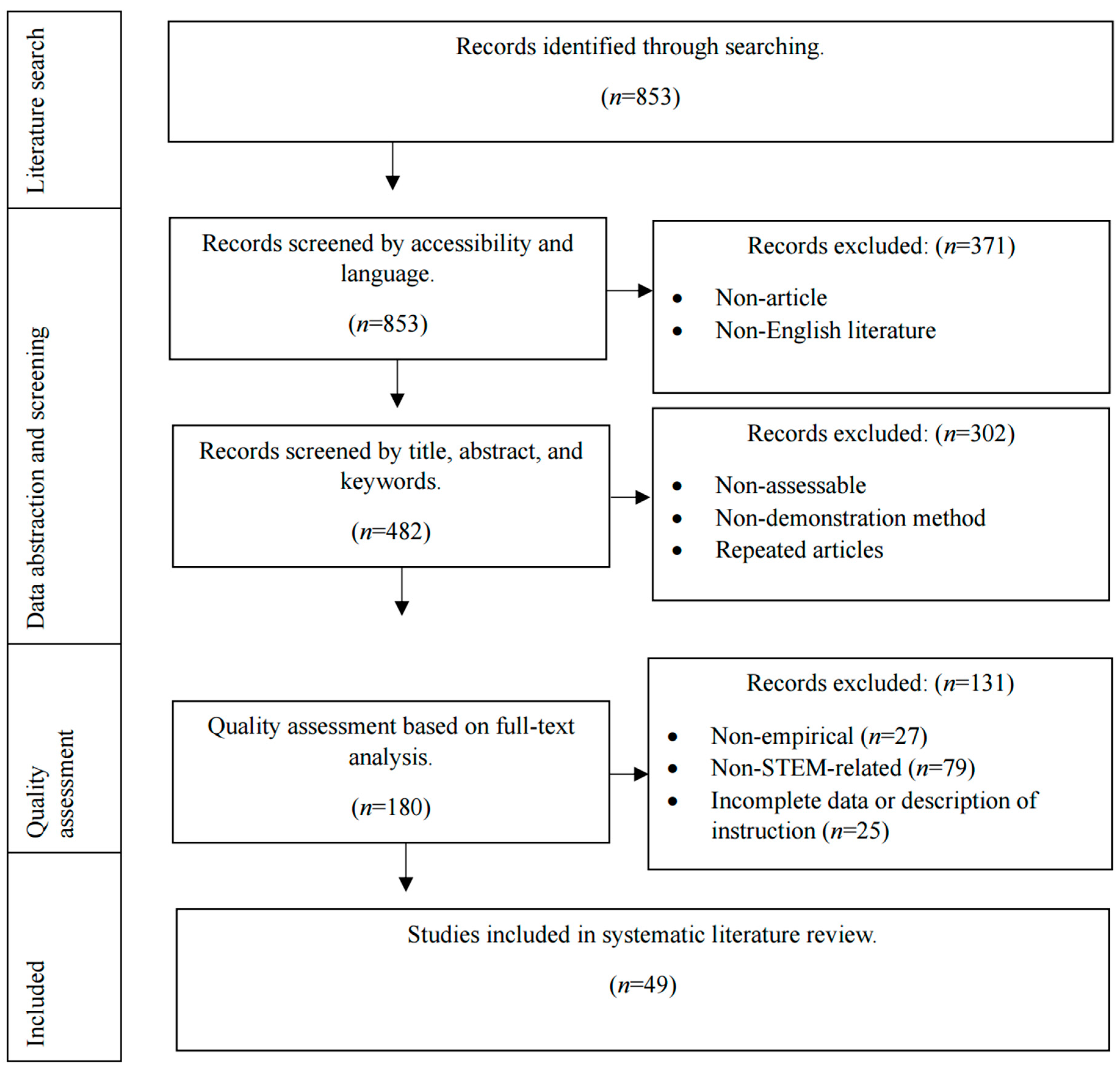
3.1. Searching and Screening Procedure
- Demonstration Method (DM): The study must explicitly examine the DM as an instructional approach, where a teacher or instructor demonstrates a procedure, experiment, or phenomenon to facilitate student learning. Studies that merely used the word “demonstration” in a different context (e.g., to demonstrate a piece of equipment without a pedagogical focus) were excluded. For instance, an article titled “Two Teaching Demonstrations Using Flexible Mirrors” was excluded as it pertained to an apparatus description rather than a pedagogical procedure.
- STEM-Related: The study’s primary focus must be on teaching and learning within at least one of the core STEM disciplines: Science, Technology, Engineering, or Mathematics. This was determined by the subject context described by the authors (e.g., physics, chemistry, biology, computer science, engineering design, or mathematics).
- Empirical Research: The study must report on primary data collection and analysis. This includes, but is not limited to, experimental designs, quasi-experiments, surveys, case studies, and mixed-methods research that present original findings. Theoretical papers, pure literature reviews, and opinion pieces were excluded.
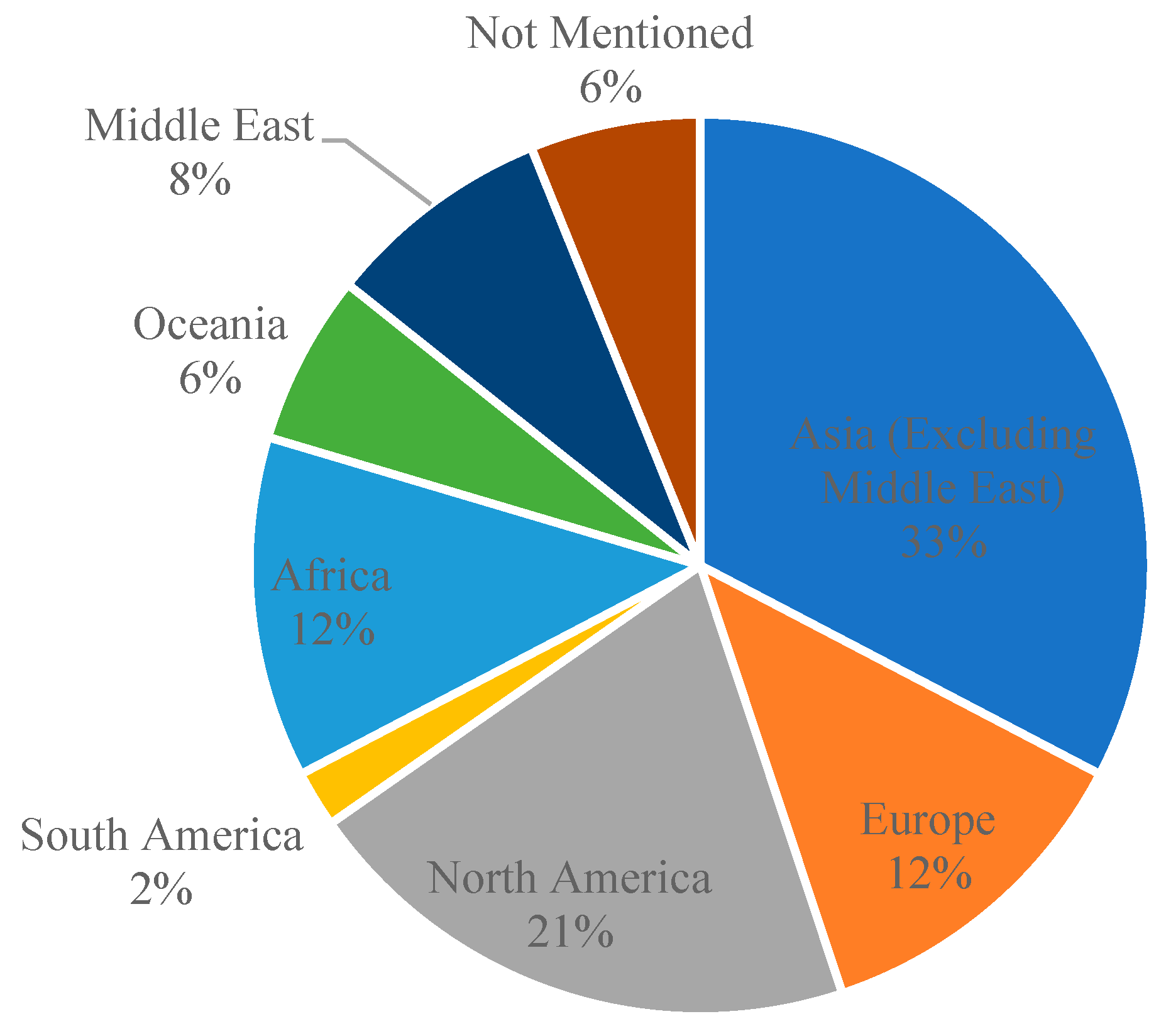
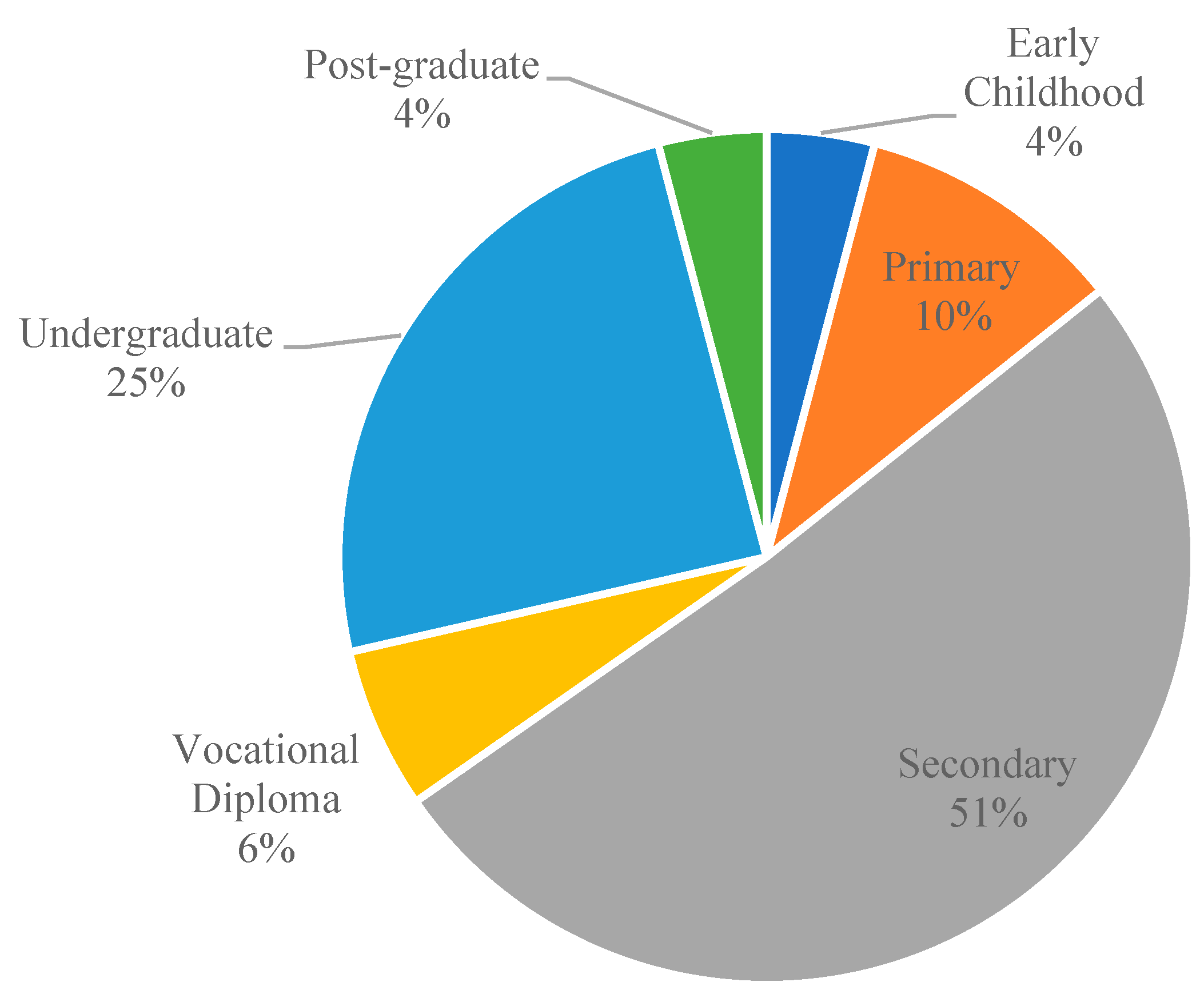
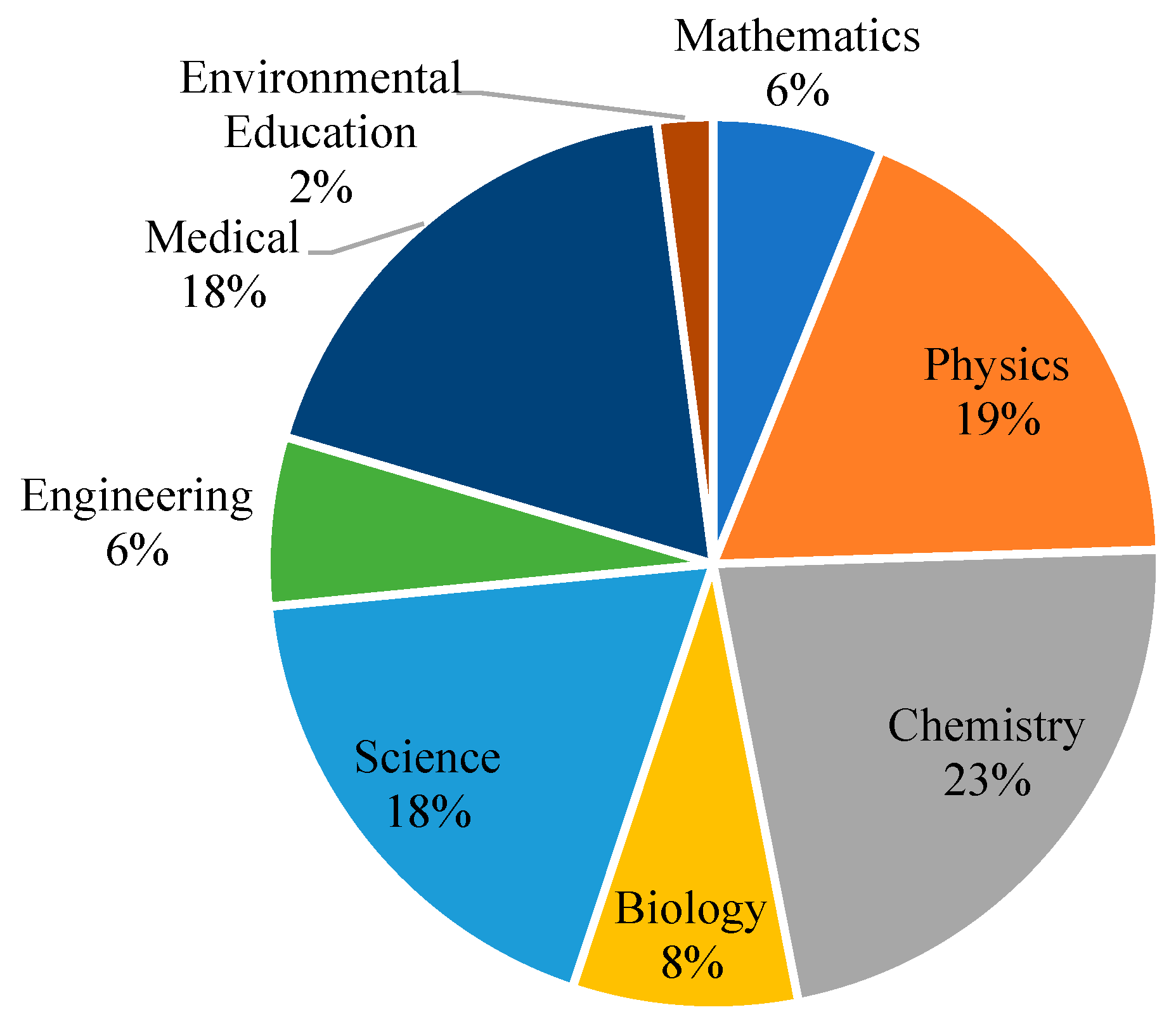
3.2. Demographic Information
4. Result
4.1. Advantages of Demonstration Method
4.2. Disadvantages of Demonstration Method
4.3. The Essential Components That Contribute to the Benefits of DMs
5. Discussion
5.1. When and How to Use the Demonstration Method?
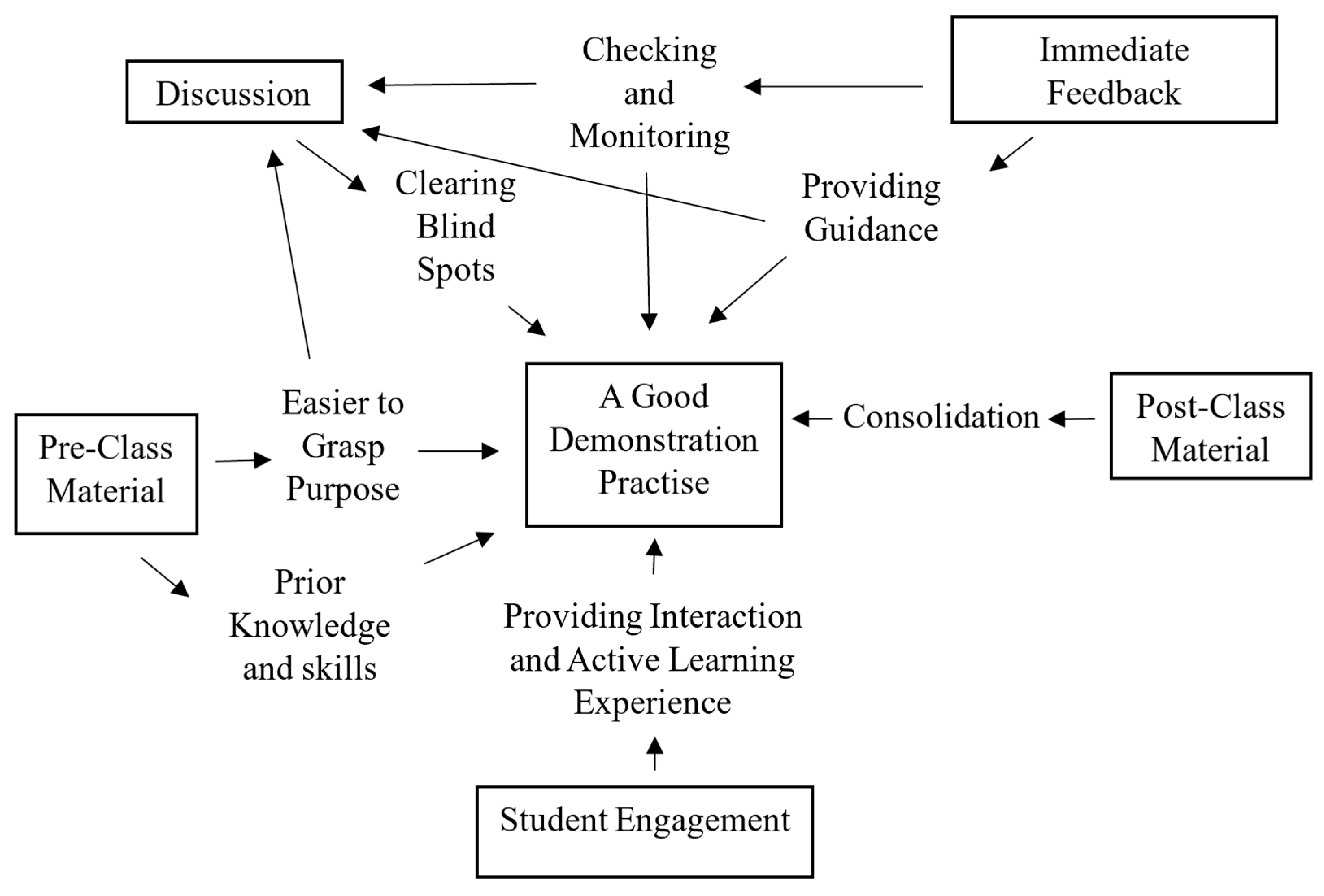
5.2. Advancing STEM Teaching Practices via the Demonstration Method: The PEDDI Approach
- Pre-class material: Through the use of pre-class materials, students are equipped with the prior knowledge, experimental skills, materials, and detailed procedures required for the DM, making it easier for students to grasp the knowledge and purpose of the experiment. According to Table 3, which presents studies indicating that DM is more effective, pre-class material is more commonly found in the DM group.
- Engagement: The DM content should be as interactive as possible, involving students through student helpers or step-by-step calculations to enhance learning. In the study conducted by Ragadhita et al. (2023), engagement is present in effective DM conditions.
- DM: As the main teaching session, teachers need to make appropriate adjustments to the presentation and venue, considering the following questions: What type of demonstration should be used? Is it better to use traditional experimental tools or videos? Is the number of students too large, or will the venue result in obstructions to students’ vision?
- Discussion: Teachers should provide sufficient time for students to discuss and thus construct what they have learnt so far and to remove any blind spots in their learning. According to Table 4, which presents studies indicating that DM is less effective, discussion is less frequently observed in the DM group.
- Immediate teacher feedback: While students are discussing, teachers provide immediate feedback to address students’ learning difficulties. According to Table 4, teachers’ feedback is less frequently observed in the DM group.


| PEDDI Components | Challenges Addressed |
|---|---|
| Pre-class Material |
|
| Engagement |
|
| Demonstration |
|
| Discussion |
|
| Immediate Teacher Feedback |
|
5.3. Theoretical Underpinnings of the PEDDI Approach
- Cognitive Load Theory (CLT): CLT posits that the working memory is limited, and instructional design should optimize the load associated with learning (Sweller, 1988). In PEDDI, the pre-class materials (P) and structured demonstration (DM) serve to reduce extraneous cognitive loads. By providing essential background and visualizing complex processes, they help students channel their cognitive resources towards integrating new information with prior knowledge, rather than struggling with unfamiliar procedures or abstract representations.
- Social Learning Theory (SLT): SLT emphasizes learning through observation, imitation, and modeling (Bandura, 1977). The core demonstration (DM) component embodies this principle, as the teacher acts as a model who exhibits specific skills and thought processes. Students observe these modeled behaviors, which can lead to the acquisition of new strategies and understandings without the need for an initial direct performance.
- Constructivism: Constructivist theories assert that learners actively build their own knowledge through experience, reflection (Piaget, 1971), and social interaction (Vygotsky, 1978). PEDDI incorporates this through student engagement (E) and discussion (D). Engagement transforms passive observation into active participation, while peer and class discussions provide a forum for articulating, challenging, and refining mental models, thereby co-constructing knowledge.
- Zone of Proximal Development (ZPD): Vygotsky’s ZPD defines the distance between what a learner can do independently and what they can achieve with guidance (Vygotsky, 1978). PEDDI is designed to operate within this zone. Pre-class materials (P) are designed to raise the learner’s independent level (actual development). Subsequently, the demonstration (DM), guided engagement (E), and discussion (D) provide structured support (scaffolding). Crucially, the immediate teacher feedback (I) component offers real-time, adaptive scaffolding to address misconceptions and guide understanding, directly facilitating progress from the actual to the potential level of development.
5.4. Limitations
5.5. Further Studies
6. Conclusions
Implications
Supplementary Materials
Author Contributions
Funding
Institutional Review Board Statement
Informed Consent Statement
Data Availability Statement
Conflicts of Interest
| 1 | Article titles, abstracts, and keywords were searched on Scopus (“systematic literature review” AND “demonstration”) on 7 October 2025, resulting in 127 articles, but none of them were relevant to the demonstration method. |
References
- Abrahams, I., & Reiss, M. (2010). Effective practical work in primary science: The role of empathy. Primary Science, 113, 26–27. Available online: https://discovery.ucl.ac.uk/id/eprint/10024060/1/Reiss_Abrahams%20Reiss%202010%20Primary%20Science.pdf (accessed on 2 April 2025).
- Adejimi, S. A., Nzabalirwa, W., & Shivoga, W. A. (2022). Enhancing students’ attitudes towards biology using consensus and cooperative reflective journal writing educational strategies. Problems of Education in the 21st Century, 80(2), 242–255. [Google Scholar] [CrossRef]
- Akcan, A. T., Yıldırım, B., Karataş, A. R., & Yılmaz, M. (2023). Teachers’ views on the effect of STEM education on the labor market. Frontiers in Psychology, 14, 1184730. [Google Scholar] [CrossRef]
- Aleman, M. P. (1992). Redefining “teacher”. Educational Leadership, 50(3), 97. [Google Scholar]
- Amin, D. I., & Ikhsan, J. (2021). Improving higher order thinking skills via semi second life. European Journal of Educational Research, 10(1), 261–274. [Google Scholar] [CrossRef]
- Aslam, S., Alghamdi, A. A., Abid, N., & Kumar, T. (2023). Challenges in implementing STEM education: Insights from novice STEM teachers in developing countries. Sustainability, 15(19), 14455. [Google Scholar] [CrossRef]
- Babaita, A. O., Kako, M., Teramoto, C., Okamoto, M., Hayashi, Y., Ohshimo, S., Sadamori, T., Hattori, M., & Moriyama, M. (2024). Face-to-face versus 360 VR video: A comparative study of two teaching methods in nursing education. BMC Nursing, 23(1), 199. [Google Scholar] [CrossRef]
- Bandura, A. (1977). Social learning theory. Prentice-Hall. [Google Scholar]
- Barak, M., & Hussein-Farraj, R. (2013). Integrating model-based learning and animations for enhancing students’ understanding of proteins structure and function. Research in Science Education, 43, 619–636. [Google Scholar] [CrossRef]
- Basheer, A., Hugerat, M., Kortam, N., & Hofstein, A. (2017). The effectiveness of teachers’ use of demonstrations for enhancing students’ understanding of and attitudes to learning the oxidation-reduction concept. Eurasia Journal of Mathematics, Science and Technology Education, 13(3), 555–570. [Google Scholar] [CrossRef]
- Başaran, M., & Erol, M. (2021). Recognizing aesthetics in nature with STEM and STEAM education. Research in Science & Technological Education, 41(1), 326–342. [Google Scholar] [CrossRef]
- Boeck, C. H. (1956). The relative efficiency of reading and demonstration methods of instruction in developing scientific understandings. Science Education, 40(2), 92–97. [Google Scholar] [CrossRef]
- Boughaydi, M., Hassouni, T., & Erramli, H. (2025). Challenges and solutions in conducting experimental activities in science education. International Journal on Technical and Physical Problems of Engineering, 17(2), 314–323. Available online: https://www.iotpe.com/IJTPE/IJTPE-2025/IJTPE-Issue63-Vol17-No2-Jun2025/37-IJTPE-Issue63-Vol17-No2-Jun2025-pp314-323.pdf (accessed on 15 February 2025).
- Burton, R. (2022). Nursing students perceptions of using YouTube to teach psychomotor skills: A comparative pilot study. SAGE Open Nursing, 8, 23779608221117385. [Google Scholar] [CrossRef] [PubMed]
- Byrne, C. (2020). Aristotle and scientific experiments. Dialogue, 59(4), 527–537. [Google Scholar] [CrossRef]
- Cheng, P. H., Molina, J., Lin, M. C., Liu, H. H., & Chang, C. Y. (2022). A new TPACK training model for tackling the ongoing challenges of COVID-19. Applied System Innovation, 5(2), 32. [Google Scholar] [CrossRef]
- Coetzee, C., Rollnick, M., & Gaigher, E. (2022). Teaching electromagnetism for the first time: A case study of pre-service science teachers’ enacted pedagogical content knowledge. Research in Science Education, 52(1), 357–378. [Google Scholar] [CrossRef]
- Copridge, K. W., Uttamchandani, S., & Birdwell, T. (2021). Faculty reflections of pedagogical transformation in active learning classrooms. Innovative Higher Education, 46(2), 205–221. [Google Scholar] [CrossRef]
- Craig, E., Thomas, R., Hou, C., & Mathur, S. (2012). No shortage of talent: How the global market is producing the STEM skills needed for growth. Accenture Institute for High Performance. Available online: https://www.slideshare.net/slideshow/no-shortageof-talent-how-the-global-market-is-producing-the-stem-skills-needed-for-growth/9875626 (accessed on 5 March 2025).
- Curriculum Development Council. (2017). Science education key learning area curriculum guide (Primary 1–Secondary 6). Education Bureau. Available online: https://www.edb.gov.hk/attachment/en/curriculum-development/kla/science-edu/SEKLACG_ENG_2017.pdf (accessed on 26 April 2025).
- Dare, E. A., Keratithamkul, K., Hiwatig, B. M., & Li, F. (2021). Beyond content: The role of STEM disciplines, real-world problems, 21st century skills, and STEM careers within science teachers’ conceptions of integrated STEM education. Education Sciences, 11(11), 737. [Google Scholar] [CrossRef]
- Darling-Hammond, L. (1994). Will 21st-century schools really be different? The Education Digest, 60, 4. Available online: https://www.proquest.com/magazines/will-21st-century-schools-really-be-different/docview/218194566/se-2 (accessed on 4 March 2025).
- Devetak, I., Hajzeri, M., Glažar, S. A., & Vogrinc, J. (2010). The influence of different models on 15-years-old students’ understanding of the solid state of matter. Acta Chimica Slovenica, 57(4), 904–911. [Google Scholar]
- Dharmadasa, I., & Silvern, S. B. (2000). Children’s conceptualization of force: Experimenting and problem solving. Journal of Research in Childhood Education, 15(1), 88–103. [Google Scholar] [CrossRef]
- Drake, S. (1978). Galileo at work: His scientific biography. University of Chicago Press. [Google Scholar]
- Education Bureau. (2016). Report on promotion of STEM education: Unleashing potential in innovation. Available online: https://www.info.gov.hk/gia/general/201612/05/P2016120500376.htm (accessed on 5 May 2025).
- El Batri, B., Maskour, L., Ksiksou, J., Jeronen, E., Ismaili, J., Alami, A., & Lachkar, M. (2022). Teaching environmental themes within the “scientific awakening” course in Moroccan primary school: Approaches, methods and difficulties. Education Sciences, 12(11), 837. [Google Scholar] [CrossRef]
- Eniaiyeju, P. A. (1983). The comparative effects of teacher-demonstration and self-paced instruction on concept acquisition and problem-solving skills of college level chemistry students. Journal of Research in Science Teaching, 20(8), 795–801. [Google Scholar] [CrossRef]
- Fung, C. H. (2020). How does flipping classroom foster the STEM education: A case study of the FPD model. Technology, Knowledge and Learning, 25(3), 479–507. [Google Scholar] [CrossRef]
- Fung, C. H., & Poon, K. K. (2020). Can dynamic activities boost mathematics understanding and metacognition? A case study on the limit of rational functions. International Journal of Mathematical Education in Science and Technology, 52(8), 1225–1239. [Google Scholar] [CrossRef]
- Fung, C. H., Poon, K. K., & Ng, S. P. (2022). Fostering student teachers’ 21 century skills by using flipped learning by teaching in STEM education. Eurasia Journal of Mathematics, Science and Technology Education, 18(2), em2204. [Google Scholar] [CrossRef] [PubMed]
- Ginns, P., Hu, F. T., Byrne, E., & Bobis, J. (2016). Learning by tracing worked examples. Applied Cognitive Psychology, 30(2), 160–169. [Google Scholar] [CrossRef]
- Glasson, G. E. (1989). The effects of hands-on and teacher demonstration laboratory methods on science achievement in relation to reasoning ability and prior knowledge. Journal of Research in Science Teaching, 26(2), 121–131. [Google Scholar] [CrossRef]
- Goldstein, P. (1937). Student laboratory work versus teacher demonstration as a means of developing laboratory resourcefulness. Science Education, 21(4), 185–193. [Google Scholar] [CrossRef]
- Gorucu-Coskuner, H., Atik, E., & Taner, T. (2020). Comparison of live-video and video demonstration methods in clinical orthodontics education. Journal of Dental Education, 84(1), 44–50. [Google Scholar] [CrossRef]
- Hamad, S., Tairab, H., Wardat, Y., Rabbani, L., AlArabi, K., Yousif, M., Abu-Al-Aish, A., & Stoica, G. (2022). Understanding science teachers’ implementations of integrated STEM: Teacher perceptions and practice. Sustainability, 14(6), 3594. [Google Scholar] [CrossRef]
- Hmelo-Silver, C. E., Duncan, R. G., & Chinn, C. A. (2007). Scaffolding and achievement in problem-based and inquiry learning: A response to Kirschner, Sweller, and Clark (2006). Educational Psychologist, 42(2), 99–107. [Google Scholar] [CrossRef]
- Hong Kong Federation of Education Workers. (2017). Research report of support policy to the frontline STEM teacher. Available online: https://hkfew.org.hk/en/%E6%95%99%E8%82%B2%E6%94%BF%E7%AD%96/item/download/1868_decc5f308549ea804db32ab7dbccbfa8 (accessed on 10 October 2025).
- Hošnjak, A. M., Čukljek, S., Fičko, S. L., & Smrekar, M. (2019). The influence of different ways of training on development of practical skills in performing parenteral therapy in full-time first year nursing students. Central European Journal of Nursing and Midwifery, 10(3), 1111–1116. [Google Scholar] [CrossRef]
- Hsu, Y. S., Tang, K. Y., & Lin, T. C. (2024). Trends and hot topics of STEM and STEM education: A co-word analysis of literature published in 2011–2020. Science & Education, 33(4), 1069–1092. [Google Scholar] [CrossRef]
- Inderanata, R. N., & Sukardi, T. (2023). Investigation study of integrated vocational guidance on work readiness of mechanical engineering vocational school students. Heliyon, 9(2), e13333. [Google Scholar] [CrossRef] [PubMed]
- Ismayil, B. G. (2022). Opinions and views on the reflection of the interaction in the teacher-cadet position. Modern Applied Science, 16(1), 49–57. [Google Scholar] [CrossRef]
- Jang, S., & Anderson, C. W. (2004, April 1–3). Different ways of coping with scientific knowledge in elementary science classrooms. Annual Meeting of the National Association for Research in Science Teaching, Vancouver, BC, Canada. [Google Scholar]
- Kaneza, P., Nkurunziza, J. B., Twagilimana, I., Mapulanga, T., & Bwalya, A. (2024). Comparison of teaching-learning behaviours in hands-on experiments and teacher-based demonstration chemistry laboratory sessions in Rwandan secondary schools. Cogent Education, 11(1), 2424152. [Google Scholar] [CrossRef]
- Karpin, T., Juuti, K., & Lavonen, J. (2014). Learning to apply models of materials while explaining their properties. Research in Science & Technological Education, 32(3), 340–351. [Google Scholar] [CrossRef]
- Kiebler, E. W., & Woody, C. (1923). The individual laboratory versus the demonstration method of teaching physics. The Journal of Educational Research, 7(1), 50–58. [Google Scholar] [CrossRef]
- Kruglak, H. (1952). A comparison of the conventional and demonstration methods in the elementary college physics laboratory. The Journal of Experimental Education, 20(3), 293–300. [Google Scholar] [CrossRef]
- Lazarowitz, R., & Naim, R. (2013). Learning the cell structures with three-dimensional models: Students’ achievement by methods, type of school and questions’ cognitive level. Journal of Science Education and Technology, 22(4), 500–508. [Google Scholar] [CrossRef]
- Lestari, D. P., Supahar, P., Suwarjo, & Herianto. (2023). Effect of science virtual laboratory combination with demonstration methods on lower-secondary school students’ scientific literacy ability in a science course. Education and Information Technologies, 28(12), 16153–16175. [Google Scholar] [CrossRef]
- Liou, W. K., & Chang, C. Y. (2018, February 19–24). Virtual reality classroom applied to science education. 2018 23rd International Scientific-Professional Conference on Information Technology (IT) (pp. 1–4), Zabljak, Montenegro. [Google Scholar] [CrossRef]
- Liu, C. C., Wen, C. T., Chang, H. Y., Chang, M. H., Lai, P. H., Fan Chiang, S. H., Yang, C. W., & Hwang, F. K. (2022). Augmenting the effect of virtual labs with “teacher demonstration” and “student critique” instructional designs to scaffold the development of scientific literacy. Instructional Science, 50, 303–333. [Google Scholar] [CrossRef]
- Liu, X., Wang, X., Xu, K., & Hu, X. (2023). Effect of reverse engineering pedagogy on primary school students’ computational thinking skills in STEM learning activities. Journal of Intelligence, 11(2), 36. [Google Scholar] [CrossRef]
- Lo, C. K. (2021). Design principles for effective teacher professional development in integrated STEM education. Educational Technology & Society, 24(4), 136–152. [Google Scholar]
- Lo, C. K., & Hew, K. F. (2017). A critical review of flipped classroom challenges in K-12 education possible solutions and recommendations for future research. Research and Practice in Technology Enhanced Learning, 12(4), 1–22. [Google Scholar] [CrossRef] [PubMed]
- Logar, A., & Savec, V. F. (2011). Students’ hands-on experimental work vs. lecture demonstration in teaching elementary school chemistry. Acta Chimica Slovenica, 58(4), 866–875. [Google Scholar]
- Manishimwe, H., Shivoga, W. A., & Nsengimana, V. (2022). Exploring the impact of enquiry-based instructional strategies on students’ attitudes towards biology. International Journal of Learning, Teaching and Educational Research, 21(12), 21–43. [Google Scholar] [CrossRef]
- Marshall, W. (2015, November 6). Guest commentary: A “STEM” in collier county to reach their future. Naples Daily New. [Google Scholar]
- Moore, A. M., Fairhurst, P., Bennett, J. M., Harrison, C., Correia, C. F., & Durk, J. (2024). Assessment and practical science: Identifying generalizable characteristics of written assessments that reward and incentivise effective practices in practical science lessons. International Journal of Science Education, 46(7), 643–669. [Google Scholar] [CrossRef]
- Moore, A. M., Fairhurst, P., Correia, C., Harrison, C., & Bennett, J. (2020). Science practical work in a COVID-19 world: Are teacher demonstrations, videos and textbooks effective replacements for hands-on practical activities? School Science Review, 102(378), 7–12. [Google Scholar]
- Muka, T., Glisic, M., Milic, J., Verhoog, S., Bohlius, J., Bramer, W., Chowdhury, R., & Franco, O. H. (2020). A 24-step guide on how to design, conduct, and successfully publish a systematic review and meta-analysis in medical research. European Journal of Epidemiology, 35(1), 49–60. [Google Scholar] [CrossRef]
- Munna, A. S., & Kalam, M. A. (2021). Teaching and learning process to enhance teaching effectiveness: A literature review. International Journal of Humanities and Innovation, 4(1), 1–4. [Google Scholar] [CrossRef]
- NAE & NRC. (2014). STEM integration in K-12 education: Status, prospects, and an agenda for research. National Academies Press. [Google Scholar]
- Nandiyanto, A. B. D., Fiandini, M., Hofifah, S. N., Ragadhita, R., Al Husaeni, D. F., Al Husaeni, D. N., Maryanti, R., & Masek, A. (2022). Collaborative practicum with experimental demonstration for teaching the concept of production of bioplastic to vocational students to support the sustainability development goals. Journal of Technical Education and Training, 14(2), 1–13. [Google Scholar] [CrossRef]
- Nicol, C. B., Gakuba, E., & Habinshuti, G. (2022). Effects of inquiry-based chemistry experimentation on students’ attitudes towards the teaching and learning of chemistry. Journal of Baltic Science Education, 21(4), 663–679. [Google Scholar] [CrossRef]
- Office of Innovation and Improvement. (2016). STEM 2026: A vision for innovation in STEM education. U.S. Department of Education. Available online: https://www.ed.gov/sites/ed/files/2016/09/AIR-STEM2026_Report_2016.pdf (accessed on 6 February 2025).
- Office of the Chief Executive. (2015, January 14). 2015 Policy address. Government of the Hong Kong special administrative region. Online archival document. Available online: http://www.policyaddress.gov.hk/2015/eng/index.html (accessed on 26 March 2019).
- Office of the Chief Executive. (2016, January 13). 2016 Policy address. Government of the Hong Kong special administrative region. Online archival document. Available online: http://www.policyaddress.gov.hk/2016/eng/index.html (accessed on 26 March 2019).
- Ogunlowo, S. O., & Ajibade, B. L. (2024). Investigating the differential efficacy of lecture and demonstration teaching methods in teaching medical-surgical nursing among nursing students. BMC Nursing, 23(1), 884. [Google Scholar] [CrossRef] [PubMed]
- Oliveira, A. P. D., Carvalho, E. D. S., Lage-Marques, J. L., Cavalli, V., Habitante, S. M., & Raldi, D. P. (2012). Evaluation of a strategic practice demonstration method applied to endodontic laboratory classes. Revista Odonto Ciência, 27, 127–131. [Google Scholar] [CrossRef]
- Oliveira, H., & Bonito, J. (2025). Challenges and opportunities for science practical work: A view on secondary education. Revista Colombiana de Educación, 97, 1–34. [Google Scholar] [CrossRef]
- Page, M. J., McKenzie, J. E., Bossuyt, P. M., Boutron, I., Hoffmann, T. C., Mulrow, C. D., Shamseer, L., Tetzlaff, J. M., Akl, E. A., Brennan, S. E., Chou, R., Glanville, J., Grimshaw, J. M., Hróbjartsson, A., Lalu, M. M., Li, T., Loder, E. W., Mayo-Wilson, E., McDonald, S., … Moher, D. (2021). The PRISMA 2020 statement: An updated guideline for reporting systematic reviews. BMJ, 372, n71. [Google Scholar] [CrossRef]
- Paxinou, E., Georgiou, M., Kakkos, V., Kalles, D., & Galani, L. (2020). Achieving educational goals in microscopy education by adopting virtual reality labs on top of face-to-face tutorials. Research in Science & Technological Education, 40(3), 320–339. [Google Scholar] [CrossRef]
- Pell, A. W., Iqbal, H. M., & Sohail, S. (2010). Introducing science experiments to rote-learning classes in Pakistani middle schools. Evaluation & Research in Education, 23(3), 191–212. [Google Scholar] [CrossRef]
- Perignat, E., & Katz-Buonincontro, J. (2019). STEAM in practice and research: An integrative literature review. Thinking Skills and Creativity, 31, 31–43. [Google Scholar] [CrossRef]
- Piaget, J. (1971). Biology and knowledge. Edinburgh University Press. [Google Scholar]
- Popoola, A. A. (2014). Effect of play way method on the numeracy skills of early basic education school pupils in Ekiti State Nigeria. Mediterranean Journal of Social Sciences, 5(10), 318–324. [Google Scholar] [CrossRef][Green Version]
- Ragadhita, R., Nandiyanto, A. B. D., Maryanti, R., Al Husaeni, D. F., Al Husaeni, D. N., Fiandini, M., Mudzakir, A., Hufad, A., & Masek, A. (2023). Best practice in distance learning with experimental demonstration on the concept of the automotive brake pad fabrication from domestic waste to vocational students for supporting education for sustainable development. Journal of Technical Education and Training, 15(1), 40–54. [Google Scholar] [CrossRef]
- Rose, T. M. (2018). Lessons learned using a demonstration in a large classroom of pharmacy students. USA Journal of Pharmaceutical Education, 82(9), 1081–1085. [Google Scholar] [CrossRef]
- Rowell, J., & Mansfield, H. (1980). The teaching of transformation geometry in grade eight: A search for aptitude-treatment interactions. The Journal of Educational Research, 74(1), 55–59. [Google Scholar] [CrossRef]
- Sanders, M. (2009). STEM, STEM education, STEM mania. The Technology Teacher, 68(4), 20–26. [Google Scholar] [CrossRef]
- Sari, M. A., Setiadi, G., & Rondhi, W. S. (2024). Effectiveness of using demonstration and experiment methods on learning outcomes. Uniglobal Journal of Social Sciences and Humanities, 3(1), 96–101. [Google Scholar] [CrossRef]
- Schweizer, M. L., & Nair, R. (2017). A practical guide to systematic literature reviews and meta-analyses in infection prevention: Planning, challenges, and execution. American Journal of Infection Control, 45(11), 1292–1294. [Google Scholar] [CrossRef] [PubMed]
- Sever, S., Yurumezoglu, K., & Oguz-Unver, A. (2010). Comparison teaching strategies of videotaped and demonstration experiments in inquiry-based science education. Procedia-Social and Behavioral Sciences, 2(2), 5619–5624. [Google Scholar] [CrossRef]
- Sharma, S., Singh, J. P., & Devi, P. (2024). Beyond traditional boundaries: Exploring the jigsaw method to strengthen academic achievement in biology. Multidisciplinary Science Journal, 7(3), 2025133. [Google Scholar] [CrossRef]
- Siu, M. K. (2022). The role of M (mathematical worlds) in HPM (history and pedagogy of mathematics) and in STEM (science, technology, engineering, mathematics). ZDM–Mathematics Education, 54(7), 1643–1655. [Google Scholar] [CrossRef]
- Smith, H. A. (1949). A determination of the relative effectiveness of sound motion pictures and equivalent teacher demonstrations in ninth grade general science. Science Education, 33(3), 214–221. [Google Scholar] [CrossRef]
- Sujarwanto, E., Madlazim, & Sanjaya, I. G. M. (2021). A conceptual framework of STEM education based on the Indonesian curriculum. Journal of Physics: Conference Series, 1760, 012022. [Google Scholar] [CrossRef]
- Sweller, J. (1988). Cognitive load during problem solving: Effects on learning. Cognitive Science, 12(2), 257–285. [Google Scholar] [CrossRef]
- Sweller, J., van Merriënboer, J. J. G., & Paas, F. (2019). Cognitive architecture and instructional design: 20 years later. Educational Psychology Review, 31(2), 261–292. [Google Scholar] [CrossRef]
- Thahir, A., Mawarni, A., & Palupi, R. (2019). The effectiveness of demonstration methods assisting multiplication board tools for understanding mathematical concept in Bandar Lampung. Journal for the Education of Gifted Young Scientists, 7(2), 353–362. [Google Scholar] [CrossRef]
- Thair, M., & Treagust, D. F. (1997). A review of teacher development reforms in Indonesian secondary science: The effectiveness of practical work in biology. Research in Science Education, 27(4), 581–597. [Google Scholar] [CrossRef]
- Thijs, G. D., & Bosch, G. M. (1995). Cognitive effects of science experiments focusing on students’ preconceptions of force: A comparison of demonstrations and small-group practicals. International Journal of Science Education, 17(3), 311–323. [Google Scholar] [CrossRef]
- Thomas, B., & Watters, J. (2015). Perspectives on Australian, Indian, and Malaysian approaches to STEM education. International Journal of Educational Development, 45, 42–53. [Google Scholar] [CrossRef]
- Vilaythong, T. (2011). The role of practical work in physics education in Lao PDR [Doctoral dissertation, Umeå Universitet]. Available online: https://www.diva-portal.org/smash/get/diva2:408814/FULLTEXT01.pdf (accessed on 8 June 2025).
- Viswasom, A. A., & Jobby, A. (2017). Effectiveness of video demonstration over conventional methods in teaching osteology in anatomy. Journal of Clinical and Diagnostic Research: JCDR, 11(2), 9–11. [Google Scholar] [CrossRef] [PubMed]
- Vygotsky, L. S. (1978). Mind in society: The development of higher psychological processes. Harvard University Press. [Google Scholar]
- Wang, T. H., Kao, C. H., & Dai, Y. L. (2019). Developing a web-based multimedia assessment system for facilitating science laboratory instruction. Journal of Computer Assisted Learning, 35(4), 529–539. [Google Scholar] [CrossRef]
- Ward, J. N. (1956). Group-study versus lecture-demonstration method in physical science instruction for general education college students. The Journal of Experimental Education, 24(3), 197–210. [Google Scholar] [CrossRef]
- Wei, B., Chen, S., & Chen, B. (2019). An investigation of sources of science teachers’ practical knowledge of teaching with practical work. International Journal of Science and Mathematics Education, 17(4), 723–738. [Google Scholar] [CrossRef]
- White, P., & Smith, E. (2021). From subject choice to career path: Female STEM graduates in the UK labour market. Oxford Review of Education, 48(6), 693–709. [Google Scholar] [CrossRef]
- Wu, T., Xia, H., Sun, W., Ge, Y., Liu, C., He, F., Cheng, T., Zhao, Y., & Chen, S. (2024). Effectiveness of a flipped classroom for undergraduate in implant dentistry hands-on course. BMC Medical Education, 24(1), 545. [Google Scholar] [CrossRef] [PubMed]
- Xu, L., & Clarke, D. (2012). Student difficulties in learning density: A distributed cognition perspective. Research in Science Education, 42, 769–789. [Google Scholar] [CrossRef]
- Yager, R. E., Engen, H. B., & Snider, B. C. (1969). Effects of the laboratory and demonstration methods upon the outcomes of instruction in secondary biology. Journal of Research in Science Teaching, 6(1), 76–86. [Google Scholar] [CrossRef]
- Zhou, H., Liu, M., Zeng, J., & Zhu, J. (2016). Selection of nursing teaching strategies in Mainland China: A questionnaire survey. Nurse Education Today, 39, 147–151. [Google Scholar] [CrossRef]



| Benefits of Demonstration | |||
|---|---|---|---|
| Benefits | Descriptions | n | |
| Student-Related Benefits | Promoting knowledge and understanding | Demonstrations help students acquire and retain knowledge, improve their memory, and enhance their understanding of the subject matter. | 15 |
| Enhancing academic performance | Demonstrations have been shown to foster students’ academic performance by providing visual and practical examples. | 11 | |
| Increased interest, motivation, and positive learning attitude | Demonstrations increase students’ interest, motivation, positive learning attitude, and engagement in the learning process. | 9 | |
| Student preference | Students generally prefer demonstrations as a teaching method. | 7 | |
| Cross-disciplinary linkage and real-life application | Demonstrations help students connect knowledge between different subjects and connect theoretical knowledge to real-life applications. | 4 | |
| Development of technical lab skills | Demonstrations contribute to the development of students’ technical lab skills. | 3 | |
| Reduced cognitive load | Demonstrations help reduce cognitive load for students, making learning more manageable. | 1 | |
| Increased curiosity | Demonstrations arouse students’ curiosity, stimulating their interest in the subject matter. | 1 | |
| Avoids negative impact of students’ inadequate lab skills | Conducting a demonstration does not necessitate a high level of laboratory proficiency among students. | 1 | |
| Faculty-Related Benefits | Comparable effect to other strategies | Demonstrations have a comparable effect to other teaching methods in fostering students’ performance and attitudes. | 5 |
| Favorable to teachers | Demonstrations are popular and favorable among teachers, as they facilitate the planning and implementation of lab activities. | 3 | |
| Increases students’ attention | Demonstrations can draw students’ attention to the experiment or content. | 2 | |
| Addresses teachers’ blind spots | Demonstrations help teachers identify and address their blind spots. | 1 | |
| Operational Benefits | Time-saving and efficiency | Demonstrations save time and promote efficiency in the teaching and learning process. | 1 |
| Improved preparation efficiency | Demonstrations require less preparation time after the creation of video resources. | 1 | |
| Challenges of Demonstration | |||
|---|---|---|---|
| Challenges | Descriptions | n | |
| Student-Related Challenges | Limited impact on academic performance | Demonstrations may be less effective at fostering academic performance. | 6 |
| Limited impact on procedural knowledge and lab skills | Demonstrations may be less effective at fostering students’ procedural knowledge and lab skills. | 3 | |
| Lack of direct experience | Demonstrations may lack direct experience for students, as they are more teacher-centered. | 3 | |
| Limited impact on soft skills | Demonstrations may be less effective at fostering students’ soft skills, such as creativity, cooperation, algorithmic thinking, critical thinking, and problem-solving. | 2 | |
| Less opportunity for mistakes | Demonstrations may limit opportunities for students to make mistakes, which can be an important learning experience. | 1 | |
| Weaker at enhancing science literacy | Demonstrations may be weaker in enhancing students’ science literacy. | 1 | |
| Lack of understanding of purpose and connection | Students may not fully understand the purpose or connection between observations and the knowledge or procedures. | 1 | |
| Faculty-Related Challenges | Teaching difficulties | Demonstrations can increase teaching difficulties, especially when students lack prior knowledge or when there are insufficient teaching materials or tools. | 4 |
| Difficulty in checking learning progress | It can be challenging to monitor students’ learning progress, as important information may be missed, or it may be difficult to determine if students have watched the demonstration video. | 4 | |
| Lack of professional training | Teachers may lack professional training for conducting effective demonstrations. | 2 | |
| Lack of immediate feedback | Demonstrations may lack immediate feedback for students. | 2 | |
| Operational Challenges | Limited teaching hours | The allocation of teaching hours for demonstrations may be insufficient. | 2 |
| Lack of teaching materials or equipment | There may be insufficient teaching materials or tools. | 2 | |
| Challenges in large class sizes | Demonstrations may be difficult to conduct with large class sizes. | 1 | |
| Components in DM Group | Components in Non-DM Group | ||||||||||||||
|---|---|---|---|---|---|---|---|---|---|---|---|---|---|---|---|
| Articles | Intervention in Sample Group | Intervention in Control Group | P | Q | E | D | T | O | P | Q | C | E | D | T | O |
| Ragadhita et al. (2023) | Video demonstration | Conventional direct teaching with video | Y | Y | Y | Y | Y | Y | Y | Y | Y | ||||
| Inderanata and Sukardi (2023) | Demonstration + practical work | Direct teaching | Y | Y | |||||||||||
| Nandiyanto et al. (2022) | Experimental demonstration using video | Conventional direct teaching | |||||||||||||
| Thahir et al. (2019) | Demonstration | Direct teaching | |||||||||||||
| Basheer et al. (2017) | Demonstration | Conventional direct teaching | Y | Y | |||||||||||
| Lazarowitz and Naim (2013) | Practical | Demonstration/direct teaching | Y | Y | |||||||||||
| Barak and Hussein-Farraj (2013) | Inquiry web-based models and animations | Demonstration/direct teaching (other) | |||||||||||||
| Xu and Clarke (2012) | Demonstration + practical work | Direct teaching | Y | Y | Y | Y | Y | Y | |||||||
| A. P. D. Oliveira et al. (2012) | Lecture + visual demonstration + laboratory practice | Lecture + laboratory practice | |||||||||||||
| Pell et al. (2010) | Demonstration | Direct teaching | Y | Y | Y | Y | |||||||||
| Rowell and Mansfield (1980) | Demonstration | Student activities | Y | Y | |||||||||||
| Yager et al. (1969) | Demonstration | Laboratory–discussion/discussion only | Y | Y | Y | Y | Y | Y | |||||||
| Boeck (1956) | Demonstration/demonstration + reading | Reading approach (reading + discussion) | Y | Y | Y | Y | |||||||||
| Ward (1956) | Demonstration | Group method | Y | Y | Op | Y | Y | Op | |||||||
| Goldstein (1937) | Demonstration | Laboratory practical work/no practices | Y | Y | Y | ||||||||||
| Total Count | 7 | 4 | 5 | 3 | 1 | 4 | 6 | 4 | 3 | 1 | 5 | 1 | 2 | ||
| Components in DM Group | Components in Non-DM Group | ||||||||||||||
|---|---|---|---|---|---|---|---|---|---|---|---|---|---|---|---|
| Articles | Intervention in Sample Group | Intervention in Control Group | P | Q | E | D | T | O | P | Q | C | E | D | T | O |
| Sharma et al. (2024) | Jigsaw | Lecture + demonstration | Y | Y | Y | ||||||||||
| Lestari et al. (2023) | Virtual laboratory combination with demonstration methods | Only virtual laboratory | Y | Y | Y | Y | Y | ||||||||
| X. Liu et al. (2023) | Practical work | Demonstration method | Y | Y | Y | Y | Y | ||||||||
| Nicol et al. (2022). | Inquiry-based teaching | Traditional demonstration | Y | Y | Y | Y | Y | Y | |||||||
| Manishimwe et al. (2022) | Group work + watching video + practical work | Direct teaching + demonstration + practical work | Y | Y | Y | ||||||||||
| Amin and Ikhsan (2021) | Virtual lab or virtual lab with practical work | Demonstration method | Y | Y | Y | Y | Y | Y | Y | Y | |||||
| Paxinou et al. (2020) | Lecture + simulation with VR | Lecture + demonstration | Y | ||||||||||||
| Wang et al. (2019) | Web-based multimedia assessment + lab | Demonstration + lab | Y | Y | Y | Y | Y | ||||||||
| Viswasom and Jobby (2017) | Conventional direct teaching | Video demonstration | |||||||||||||
| Popoola (2014) | Guided play | Demonstration | Y | Y | |||||||||||
| Lazarowitz and Naim (2013) | Practical work | Demonstration/direct teaching | Y | Y | Y | ||||||||||
| Barak and Hussein-Farraj (2013) | Inquiry web-based models and animations | Demonstration/direct teaching (other) | Y | Y | Y | Y | |||||||||
| Devetak et al. (2010) | Student modeling | Demonstration/virtual model using computer | Y | Y | Y | ||||||||||
| Dharmadasa and Silvern (2000) | Interacting with activities | Lecture with demonstration | Y | Y | Y | Y | Y | Y | Y | ||||||
| Thijs and Bosch (1995) | Demonstration | Practical work (small group) | Y | Y | Y | Y | Y | Y | Y | Y | |||||
| Glasson (1989) | Demonstration | Hands-on activities | Y | Y | Y | Y | Y | Y | Y | ||||||
| Eniaiyeju (1983) | Self-paced mode of instruction | Demonstration | Y | Y | Y | Y | |||||||||
| Kruglak (1952) | Demonstration | Laboratory practical work | Y | Y | Y | Y | Y | Y | Y | Y | |||||
| Goldstein (1937) | Demonstration | Laboratory practical work/no practices | Y | Y | Y | Y | Y | ||||||||
| Kiebler and Woody (1923) | Demonstration | Laboratory practical work | Y | Y | Y | Y | Y | Y | Y | ||||||
| Total Count | 8 | 4 | 5 | 5 | 3 | 5 | 13 | 4 | 8 | 16 | 9 | 9 | 5 | ||
| Components in Sample Group (That Yield a Superior Effect) | Components in Control Group | ||||||||||||||
|---|---|---|---|---|---|---|---|---|---|---|---|---|---|---|---|
| Articles | Intervention in Sample Group | Intervention in Control Group | P | Q | E | D | T | O | P | Q | C | E | D | T | O |
| With Distinguishable results | |||||||||||||||
| Moore et al. (2024) | Teacher demonstration | Video demonstration and reading | Y | Y | Y | ||||||||||
| Hošnjak et al. (2019) | Video demonstration + simulation | Teacher demonstration + simulation | Y | Y | Y | Y | |||||||||
| Karpin et al. (2014) | Demonstration + practical | Demonstration + discussion | Y | Y | Y | Y | Y | ||||||||
| With Indistinguishable result | |||||||||||||||
| Burton (2022) | Video demonstration (experimental) | Demonstration + practical work | Y | Y | |||||||||||
| Smith (1949) | Demonstration | Demonstration by film/mixed | Y | Y | |||||||||||
Disclaimer/Publisher’s Note: The statements, opinions and data contained in all publications are solely those of the individual author(s) and contributor(s) and not of MDPI and/or the editor(s). MDPI and/or the editor(s) disclaim responsibility for any injury to people or property resulting from any ideas, methods, instructions or products referred to in the content. |
© 2026 by the authors. Licensee MDPI, Basel, Switzerland. This article is an open access article distributed under the terms and conditions of the Creative Commons Attribution (CC BY) license.
Share and Cite
Fung, C.-H.; Ng, S.-P. The Benefits and Challenges of Using the Demonstration Method in STEM Education: A Systematic Literature Review. Educ. Sci. 2026, 16, 161. https://doi.org/10.3390/educsci16010161
Fung C-H, Ng S-P. The Benefits and Challenges of Using the Demonstration Method in STEM Education: A Systematic Literature Review. Education Sciences. 2026; 16(1):161. https://doi.org/10.3390/educsci16010161
Chicago/Turabian StyleFung, Chak-Him, and Siu-Ping Ng. 2026. "The Benefits and Challenges of Using the Demonstration Method in STEM Education: A Systematic Literature Review" Education Sciences 16, no. 1: 161. https://doi.org/10.3390/educsci16010161
APA StyleFung, C.-H., & Ng, S.-P. (2026). The Benefits and Challenges of Using the Demonstration Method in STEM Education: A Systematic Literature Review. Education Sciences, 16(1), 161. https://doi.org/10.3390/educsci16010161