

K-12 Teachers’ Adoption of Generative AI for Teaching: An Extended TAM Perspective



Abstract
1. Introduction
2. Research Hypotheses
2.1. Technology Acceptance Model
2.2. Pedagogical Beliefs
2.3. Perceived Intelligence
2.4. Perceived Ethical Risks
2.5. GenAI Anxiety
2.6. Gender, Educational Background, and Teaching Grade
3. Methodology
3.1. Research Design
3.2. Participants and Procedure
3.3. Data Collection and Analysis
4. Results
4.1. Descriptive Results
4.2. Measurement Model Analysis
4.3. Structural Model Analysis
4.3.1. Predictors of Teachers’ Intention to Adopt GenAI
4.3.2. Predictors of Perceived Usefulness and Ease of Use
4.3.3. Relationship Between Perceived Ethical Risks and GenAI Anxiety
4.4. Mediation Effects
4.5. Moderating Effects
5. Discussion
5.1. Summary of Key Findings
5.2. Theoretical Implications
5.2.1. Extending TAM to GenAI in K-12 Settings
5.2.2. The Central Role of Pedagogical Beliefs
5.2.3. Ethical Risks, Anxiety, and the Complexity of Affective Responses
5.2.4. Heterogeneity Across Teacher Subgroups
5.3. Practical Implications
5.4. Limitations and Future Research Directions
6. Conclusions
Author Contributions
Funding
Institutional Review Board Statement
Informed Consent Statement
Data Availability Statement
Conflicts of Interest
References
- Abdelkader, O. A. (2023). ChatGPT’ s influence on customer experience in digital marketing: Investigating the moderating roles. Heliyon, 9(8), e18770. [Google Scholar] [CrossRef]
- Al-Abdullatif, A. M. (2024). Modeling teachers’ acceptance of generative artificial intelligence use in higher education: The role of AI literacy, intelligent TPACK, and perceived trust. Education Sciences, 14(11), 1209. [Google Scholar] [CrossRef]
- Al-Emran, M., AlQudah, A. A., Abbasi, G. A., Al-Sharafi, M. A., & Iranmanesh, M. (2023). Determinants of using AI-based chatbots for knowledge sharing: Evidence from PLS-SEM and fuzzy sets (fsQCA). IEEE Transactions on Engineering Management, 71, 4985–4999. [Google Scholar] [CrossRef]
- Al-kfairy, M. (2024). Factors impacting the adoption and acceptance of ChatGPT in educational settings: A narrative review of empirical studies. Applied System Innovation, 7(6), 110. [Google Scholar] [CrossRef]
- Anthony, B., Jr., Kamaludin, A., & Romli, A. (2023). Predicting academic staffs behaviour intention and actual use of blended learning in higher education: Model development and validation. Technology, Knowledge and Learning, 28(3), 1223–1269. [Google Scholar] [CrossRef]
- Armitage, C. J., & Conner, M. (2001). Efficacy of the theory of planned behaviour: A meta-analytic review. The British Journal of Social Psychology, 40, 471–499. [Google Scholar] [CrossRef]
- Barbieri, W., & Nguyen, N. (2025). Generative AI as a “placement buddy”: Supporting pre-service teachers in work-integrated learning, self-management and crisis resolution. Australasian Journal of Educational Technology, 41, 34–49. [Google Scholar] [CrossRef]
- Bawack, R. E. (2021, July 12). How perceived intelligence affects consumer adoption of AI-based voice assistants: An affordance perspective. PACIS Pacific Asia Conference on Information Systems (p. 178), Online. [Google Scholar]
- Bayaga, A. (2024). Leveraging AI-enhanced and emerging technologies for pedagogical innovations in higher education. Education and Information Technologies, 30(1), 1045–1072. [Google Scholar] [CrossRef]
- Bazelais, P., Lemay, D. J., & Doleck, T. (2024). User acceptance and adoption dynamics of ChatGPT in educational settings. Eurasia Journal of Mathematics, Science and Technology Education, 20(2), em2393. [Google Scholar] [CrossRef]
- Beimel, D., Amzalag, M., Zviel-Girshin, R., & Voloch, N. (2025). Blending generative AI and instructor-led learning: Empirical insights on student motivation, learning experience, and academic performance in higher education. Education Sciences, 15(11), 1480. [Google Scholar] [CrossRef]
- Bernabei, M., Colabianchi, S., Falegnami, A., & Costantino, F. (2023). Students’ use of large language models in engineering education: A case study on technology acceptance, perceptions, efficacy, and detection chances. Computers and Education: Artificial Intelligence, 5, 100172. [Google Scholar] [CrossRef]
- Blundell, C. N., Mukherjee, M., & Nykvist, S. (2025). Adopting generative AI in K-12 teaching and learning: Australian teachers’ actions through the lens of innovation theory. Education and Information Technologies, 30, 24009–24028. [Google Scholar] [CrossRef]
- Cabero-Almenara, J., Palacios-Rodríguez, A., Loaiza-Aguirre, M. I., & Rivas-Manzano, M. D. R. D. (2024). Acceptance of educational artificial intelligence by teachers and its relationship with some variables and pedagogical beliefs. Education Sciences, 14(7), 740. [Google Scholar] [CrossRef]
- Cambra-Fierro, J. J., Blasco, M. F., López-Pérez, M. E. E., & Trifu, A. (2025). ChatGPT adoption and its influence on faculty well-being: An empirical research in higher education. Education and Information Technologies, 30(2), 1517–1538. [Google Scholar] [CrossRef]
- Can, V.-D., & Nguyen, V.-H. (2025). The relationship between perceived usability and perceived credibility of middle school teachers in using AI chatbots. Cogent Education, 12(1), 2473851. [Google Scholar] [CrossRef]
- Chan, K.-W., & Elliott, R. G. (2004). Relational analysis of personal epistemology and conceptions about teaching and learning. Teaching and Teacher Education, 20(8), 817–831. [Google Scholar] [CrossRef]
- Chand, S. P. (2025). Challenges in implementing constructivist approaches: Exploring teachers’ experiences in Fijian primary school classrooms. The Australian Educational Researcher, 52, 3631–3655. [Google Scholar] [CrossRef]
- Chatterjee, S. (2020). Impact of AI regulation on intention to use robots: From citizens and government perspective. International Journal of Intelligent Unmanned Systems, 8(2), 97–114. [Google Scholar] [CrossRef]
- Cheng, S. L., Chang, J. C., & Romero, K. (2022). Are pedagogical beliefs an internal barrier for technology integration? The interdependent nature of teacher beliefs. Education and Information Technologies, 27(4), 5215–5232. [Google Scholar] [CrossRef]
- Choi, S., Jang, Y., & Kim, H. (2023). Influence of pedagogical beliefs and perceived trust on teachers’ acceptance of educational artificial intelligence tools. International Journal of Human–Computer Interaction, 39(4), 910–922. [Google Scholar] [CrossRef]
- Cohen, A., & Ehrlich, S. (2019). Exchange variables, organizational culture and their relationship with constructive deviance. Management Research Review, 42(12), 1423–1446. [Google Scholar] [CrossRef]
- Collie, R. J., & Martin, A. J. (2024). Teachers’ motivation and engagement to harness generative AI for teaching and learning: The role of contextual, occupational, and background factors. Computers and Education: Artificial Intelligence, 6, 100224. [Google Scholar] [CrossRef]
- Cox, J. (2012). Information systems user security: A structured model of the knowing–doing gap. Computers in Human Behavior, 28(5), 1849–1858. [Google Scholar] [CrossRef]
- Cui, C., & Li, Z. (2024). Prompt-enhanced generation for Multimodal open question answering. Electronics, 13(8), 1434. [Google Scholar] [CrossRef]
- Cui, Y., & Li, M. (2025). Factors affecting vocational education teachers’ adoption of Gen AI: A multi-group analysis by discipline and region. Interactive Learning Environments, 1–17. [Google Scholar] [CrossRef]
- Davis, F. D., Bagozzi, R. P., & Warshaw, P. R. (1989). User acceptance of computer technology: A comparison of two theoretical models. Management Science, 35(8), 982–1003. [Google Scholar] [CrossRef]
- Deng, F., Chai, C. S., Tsai, C. C., & Lee, M. H. (2014). The relationships among Chinese practicing teachers’ epistemic beliefs, pedagogical beliefs and their beliefs about the use of ICT. Journal of Educational Technology & Society, 17(2), 245–256. Available online: http://www.jstor.org/stable/jeductechsoci.17.2.245.
- Ertmer, P. A. (2005). Teacher pedagogical beliefs: The final frontier in our quest for technology integration? Educational Technology Research and Development, 53(4), 25–39. [Google Scholar] [CrossRef]
- Farrukh Shahzad, M., Xu, S., An, X., Asif, M., & Javed, I. (2025). From policy to practice: A thematic analysis of generative AI technologies in China’s education sector. Interactive Learning Environments, 1–20. [Google Scholar] [CrossRef]
- Feng, L., Liu, M., & Hou, W. (2025). EFL teachers’ acceptance of generative artificial intelligence in teaching and academic research: Use experience as moderator. European Journal of Education, 60(3), e70205. [Google Scholar] [CrossRef]
- Fuller, C. M., Simmering, M. J., Atinc, G., Atinc, Y., & Babin, B. J. (2016). Common methods variance detection in business research. Journal of Business Research, 69(8), 3192–3198. [Google Scholar] [CrossRef]
- Gao, M., Zhang, H., Dong, Y., & Li, J. (2025). Embracing generative AI in education: An experiential study on preservice teachers’ acceptance and attitudes. Educational Studies, 1–20. [Google Scholar] [CrossRef]
- García de Blanes Sebastián, M., Sarmiento Guede, J. R., Azuara Grande, A., & Filipe, A. F. (2025). UTAUT-2 predictors and satisfaction: Implications for mobile-learning adoption among university students. Education and Information Technologies, 30(3), 3201–3237. [Google Scholar] [CrossRef]
- Gerlich, M. (2023). Perceptions and acceptance of artificial intelligence: A multi-dimensional study. Social Sciences, 12(9), 502. [Google Scholar] [CrossRef]
- Granić, A. (2022). Educational technology adoption: A systematic review. Education and Information Technologies, 27(7), 9725–9744. [Google Scholar] [CrossRef]
- Granić, A., & Marangunić, N. (2019). Technology acceptance model in educational context: A systematic literature review. British Journal of Educational Technology, 50(5), 2572–2593. [Google Scholar] [CrossRef]
- Haroud, S., & Saqri, N. (2025). Generative AI in higher education: Teachers’ and students’ perspectives on support, replacement, and digital literacy. Education Sciences, 15(4), 396. [Google Scholar] [CrossRef]
- Hazzan-Bishara, A., Kol, O., & Levy, S. (2025). The factors affecting teachers’ adoption of AI technologies: A unified model of external and internal determinants. Education and Information Technologies, 30(11), 15043–15069. [Google Scholar] [CrossRef]
- Hu, L., & Bentler, P. M. (1999). Cutoff criteria for fit indexes in covariance structure analysis: Conventional criteria versus new alternatives. Structural Equation Modeling: A Multidisciplinary Journal, 6(1), 1–55. [Google Scholar] [CrossRef]
- Ivanov, S., Soliman, M., Tuomi, A., Alkathiri, N. A., & Al-Alawi, A. N. (2024). Drivers of generative AI adoption in higher education through the lens of the Theory of Planned Behaviour. Technology in Society, 77, 102521. [Google Scholar] [CrossRef]
- Jatileni, C. N., Sanusi, I. T., Olaleye, S. A., Ayanwale, M. A., Agbo, F. J., & Oyelere, P. B. (2024). Artificial intelligence in compulsory level of education: Perspectives from Namibian in-service teachers. Education and Information Technologies, 29(10), 12569–12596. [Google Scholar] [CrossRef]
- Jayasinghe, S., Arm, K., & Gamage, K. A. A. (2025). Designing culturally inclusive case studies with generative AI: Strategies and considerations. Education Sciences, 15(6), 645. [Google Scholar] [CrossRef]
- Jukiewicz, M. (2024). The future of grading programming assignments in education: The role of ChatGPT in automating the assessment and feedback process. Thinking Skills and Creativity, 52, 101522. [Google Scholar] [CrossRef]
- Kim, C., Kim, M. K., Lee, C., Spector, J. M., & DeMeester, K. (2013). Teacher beliefs and technology integration. Teaching and Teacher Education, 29, 76–85. [Google Scholar] [CrossRef]
- Koutromanos, G., Styliaras, G., & Christodoulou, S. (2015). Student and in-service teachers’ acceptance of spatial hypermedia in their teaching: The case of HyperSea. Education and Information Technologies, 20(3), 559–578. [Google Scholar] [CrossRef]
- Lewis, J. R., Utesch, B. S., & Maher, D. E. (2015). Measuring perceived usability: The SUS, UMUX-LITE, and AltUsability. International Journal of Human-Computer Interaction, 31(8), 496–505. [Google Scholar] [CrossRef]
- Li, J., & Huang, J. S. (2020). Dimensions of artificial intelligence anxiety based on the integrated fear acquisition theory. Technology in Society, 63, 101410. [Google Scholar] [CrossRef]
- Li, S., Liu, Y., & Su, Y. S. (2022). Differential analysis of teachers’ technological pedagogical content knowledge (TPACK) abilities according to teaching stages and educational levels. Sustainability, 14(12), 7176. [Google Scholar] [CrossRef]
- Liao, J., Sun, F., Liu, Y., & Hu, Y. (2025). DeepSeek in education: Exploring the transformative potential of AI-driven educational intelligence. Future in Educational Research. early view. [Google Scholar] [CrossRef]
- Liao, J., Zhong, L., Zhe, L., Xu, H., Liu, M., & Xie, T. (2024). Scaffolding computational thinking with ChatGPT. IEEE Transactions on Learning Technologies, 17, 1628–1642. [Google Scholar] [CrossRef]
- Lin, X., & Tan, H. (2025). A systematic review of generative AI in K–12: Mapping goals, activities, roles, and outcomes via the 3P model. Systems, 13(10), 840. [Google Scholar] [CrossRef]
- Liu, M., Zwart, R., Bronkhorst, L., & Wubbels, T. (2022). Chinese student teachers’ beliefs and the role of teaching experiences in the development of their beliefs. Teaching and Teacher Education, 109, 103525. [Google Scholar] [CrossRef]
- Liu, R., Wu, T., Chu, J., & Qu, P. (2025). Enhancing human computer collaboration in design process: How AI-generated content elevates students’ creativity. Thinking Skills and Creativity, 59, 101967. [Google Scholar] [CrossRef]
- Liu, S. H. (2011). Factors related to pedagogical beliefs of teachers and technology integration. Computers & Education, 56(4), 1012–1022. [Google Scholar] [CrossRef]
- Luan, H., Geczy, P., Lai, H., Gobert, J., Yang, S. J. H., Ogata, H., Baltes, J., Guerra, R., Li, P., & Tsai, C.-C. (2020). Challenges and future directions of big data and artificial intelligence in education. Frontiers in Psychology, 11, 580820. [Google Scholar] [CrossRef] [PubMed]
- Luik, P., Taimalu, M., Naruskov, K., & Kalk, K. (2024). Does knowledge according to the TPACK framework have an impact on student teachers’ beliefs? A path analysis. Education and Information Technologies, 29(17), 23027–23048. [Google Scholar] [CrossRef]
- Mac Callum, K., & Jeffrey, L. (2014). Factors impacting teachers’ adoption of mobile learning. Journal of Information Technology Education: Research, 13, 141–162. [Google Scholar] [CrossRef]
- Maheshwari, G. (2024). Factors influencing students’ intention to adopt and use ChatGPT in higher education: A study in the Vietnamese context. Education and Information Technologies, 29(10), 12167–12195. [Google Scholar] [CrossRef]
- Marangunić, N., & Granić, A. (2015). Technology acceptance model: A literature review from 1986 to 2013. Universal Access in the Information Society, 14(1), 81–95. [Google Scholar] [CrossRef]
- Mello, R. F., Freitas, E., Pereira, F. D., Cabral, L., Tedesco, P., & Ramalho, G. (2023). Education in the age of Generative AI: Context and Recent Developments. arXiv. [Google Scholar] [CrossRef]
- Moussawi, S., Koufaris, M., & Benbunan-Fich, R. (2021). How perceptions of intelligence and anthropomorphism affect adoption of personal intelligent agents. Electronic Markets, 31(2), 343–364. [Google Scholar] [CrossRef]
- Nasr, N. R., Tu, C.-H., Werner, J., Bauer, T., Yen, C.-J., & Sujo-Montes, L. (2025). Exploring the impact of generative AI ChatGPT on critical thinking in higher education: Passive AI-directed use or human–AI supported collaboration? Education Sciences, 15(9), 1198. [Google Scholar] [CrossRef]
- Nayak, R. D. (2014). Anxiety and mental health of software professionals and mechanical professionals. International Journal of Humanities and Social Science Invention, 3(2), 52–56. [Google Scholar]
- Pahi, K., Hawlader, S., Hicks, E., Zaman, A., & Phan, V. (2024). Enhancing active learning through collaboration between human teachers and generative AI. Computers and Education Open, 6, 100183. [Google Scholar] [CrossRef]
- Qazi, A., Hasan, N., Abayomi-Alli, O., Hardaker, G., Scherer, R., Sarker, Y., Paul, S. K., & Maitama, J. Z. (2022). Gender differences in information and communication technology use & skills: A systematic review and meta-analysis. Education and Information Technologies, 27(3), 4225–4258. [Google Scholar] [PubMed]
- Reiss, M. J. (2021). The use of Al in education: Practicalities and ethical considerations. London Review of Education, 19(1), n1. [Google Scholar] [CrossRef]
- Sahari, Y., Al-Kadi, A. M. T., & Ali, J. K. M. (2023). A cross sectional study of ChatGPT in translation: Magnitude of use, attitudes, and uncertainties. Journal of Psycholinguistic Research, 52(6), 2937–2954. [Google Scholar] [CrossRef]
- Samala, A. D., Rawas, S., Wang, T., Reed, J. M., Kim, J., Howard, N.-J., & Ertz, M. (2024). Unveiling the landscape of generative artificial intelligence in education: A comprehensive taxonomy of applications, challenges, and future prospects. Education and Information Technologies, 30(3), 3239–3278. [Google Scholar] [CrossRef]
- Scherer, R., & Teo, T. (2019). Unpacking teachers’ intentions to integrate technology: A meta-analysis. Educational Research Review, 27, 90–109. [Google Scholar] [CrossRef]
- Shankar, S. K., Pothancheri, G., Sasi, D., & Mishra, S. (2024). Bringing teachers in the loop: Exploring perspectives on integrating generative AI in technology-enhanced learning. International Journal of Artificial Intelligence in Education, 35(1), 155–180. [Google Scholar] [CrossRef]
- Sing, C. C., Teo, T., Huang, F., Chiu, T. K. F., & Xing Wei, W. (2022). Secondary school students’ intentions to learn AI: Testing moderation effects of readiness, social good and optimism. Educational Technology Research and Development, 70(3), 765–782. [Google Scholar] [CrossRef]
- Strzelecki, A., & ElArabawy, S. (2024). Investigation of the moderation effect of gender and study level on the acceptance and use of generative AI by higher education students: Comparative evidence from Poland and Egypt. British Journal of Educational Technology, 55(3), 1209–1230. [Google Scholar] [CrossRef]
- Sun, J., Wu, Q., Ma, Z., Zheng, W., & Hu, Y. (2025). Understanding pre-service teachers’ acceptance of generative artificial intelligence: An extended technology acceptance model approach. Educational Technology Research and Development, 73, 1975–1997. [Google Scholar] [CrossRef]
- Şimşek, A. S., Cengiz, G. Ş. T., & Bal, M. (2025). Extending the TAM framework: Exploring learning motivation and agility in educational adoption of generative AI. Education and Information Technologies, 30(15), 20913–20942. [Google Scholar] [CrossRef]
- Tan, B. (2002). Understanding consumer ethical decision making with respect to purchase of pirated software. Journal of Consumer Marketing, 19(2), 96–111. [Google Scholar] [CrossRef]
- Teo, T., Fan, X., & Du, J. (2015). Technology acceptance among pre-service teachers: Does gender matter? Australasian Journal of Educational Technology, 31(3), 235–251. [Google Scholar] [CrossRef]
- Thanigan, J., Reddy, S. N., Sethuraman, P., & Rajesh, J. I. (2021). Understanding consumer acceptance of m-wallet apps: The role of perceived value, perceived credibility, and technology anxiety. Journal of Electronic Commerce in Organizations (JECO), 19(1), 65–91. [Google Scholar] [CrossRef]
- Venkatesh, V., & Davis, F. D. (2000). A theoretical extension of the technology acceptance model: Four longitudinal field studies. Management Science 46, 186–204. [Google Scholar] [CrossRef]
- Wang, J., & Kim, E. (2023). Exploring changes in epistemological beliefs and beliefs about teaching and learning: A mix-method study among Chinese teachers in transnational higher education institutions. Sustainability, 15(16), 12501. [Google Scholar] [CrossRef]
- Wang, Y., Liu, C., & Tu, Y. F. (2021). Factors affecting the adoption of AI-based applications in higher education. Educational Technology & Society, 24(3), 116–129. [Google Scholar] [CrossRef]
- Wang, Y., Pi, T., & Xie, B. (2025). Exploring factors influencing pre-service teachers’ intention to use ChatGPT. Education and Information Technologies, 30, 23761–23790. [Google Scholar] [CrossRef]
- Wang, Y., Qin, K., Luo, C., Yang, T., & Xin, T. (2022). Profiles of Chinese mathematics teachers’ teaching beliefs and their effects on students’ achievement. ZDM--Mathematics Education, 54(3), 709–720. [Google Scholar] [CrossRef]
- Wijaya, T. T., Cao, Y., Bernard, M., Rahmadi, I. F., Lavicza, Z., & Surjono, H. D. (2022). Factors influencing microgame adoption among secondary school mathematics teachers supported by structural equation modelling-based research. Frontiers in Psychology, 13, 952549. [Google Scholar] [CrossRef]
- Wu, W., Zhang, B., Li, S., & Liu, H. (2022). Exploring factors of the willingness to accept AI-assisted learning environments: An empirical investigation based on the UTAUT model and perceived risk theory. Frontiers in Psychology, 13, 870777. [Google Scholar] [CrossRef]
- Ximénez, C., Maydeu-Olivares, A., Shi, D., & Revuelta, J. (2022). Assessing cutoff values of SEM Fit indices: Advantages of the unbiased SRMR index and its cutoff criterion based on communality. Structural Equation Modeling: A Multidisciplinary Journal, 29(3), 368–380. [Google Scholar] [CrossRef]
- Xu, J., Shen, R., Tian, M., & Hu, D. (2025). A multi-method study on influencing factors of teachers’ willingness to use generative artificial intelligence. Interactive Learning Environments, 1–19. [Google Scholar] [CrossRef]
- Yang, S., & Appleget, C. (2024). An exploration of preservice teachers’ perceptions of generative AI: Applying the technological acceptance model. Journal of Digital Learning in Teacher Education, 40(3), 159–172. [Google Scholar] [CrossRef]
- Yim, I. H. Y., & Wegerif, R. (2024). Teachers’ perceptions, attitudes, and acceptance of artificial intelligence (AI) educational learning tools: An exploratory study on AI literacy for young students. Future in Educational Research, 2(4), 318–345. [Google Scholar] [CrossRef]
- Yue, M., Jong, M. S. Y., & Ng, D. T. K. (2024). Understanding K–12 teachers’ technological pedagogical content knowledge readiness and attitudes toward artificial intelligence education. Education and Information Technologies, 29(15), 19505–19536. [Google Scholar] [CrossRef]
- Zhang, C., Hu, M., Wu, W., Kamran, F., & Wang, X. (2024). Unpacking perceived risks and AI trust influences pre-service teachers’ AI acceptance: A structural equation modeling-based multi-group analysis. Education and Information Technologies, 30(2), 2645–2672. [Google Scholar] [CrossRef]
- Zhang, C., Schießl, J., Plößl, L., Hofmann, F., & Gläser-Zikuda, M. (2023). Acceptance of artificial intelligence among pre-service teachers: A multigroup analysis. International Journal of Educational Technology in Higher Education, 20(1), 49. [Google Scholar] [CrossRef]
- Zhao, J., Li, S., & Zhang, J. (2025). Understanding teachers’ adoption of AI technologies: An empirical study from Chinese middle schools. Systems, 13(4), 302. [Google Scholar] [CrossRef]
- Zheng, Y., Wang, Y., Liu, K. S. X., & Jiang, M. Y. C. (2024). Examining the moderating effect of motivation on technology acceptance of generative AI for English as a foreign language learning. Education and Information Technologies, 29(17), 23547–23575. [Google Scholar] [CrossRef]
- Zhong, L., & Tang, Y. (2025, March 14–16). Factors influencing the adoption of intelligent resource recommendation services by K-12 teachers in China [Presentation]. 2025 International Conference on Educational Innovation and Technology (ICEIT), Guangzhou, China. [Google Scholar]
- Zhou, K., Deng, H., Chan, H. C., & Lin, C.-H. (2025). Integrating generative AI into language teachers’ professional development: A longitudinal study using the synthesis of qualitative data (SQD) model. Professional Development in Education, 1–29. [Google Scholar] [CrossRef]
- Zhu, W., Huang, L., Zhou, X., Li, X., Shi, G., Ying, J., & Wang, C. (2025). Could AI ethical anxiety, perceived ethical risks and ethical awareness about AI influence university students’ use of generative AI products? An ethical perspective. International Journal of Human–Computer Interaction, 41(1), 742–764. [Google Scholar] [CrossRef]


| Item | Option | Frequency | Percentage (%) |
|---|---|---|---|
| Gender | Male | 61 | 28.0 |
| Female | 157 | 72.0 | |
| Teaching Stage | Primary School | 62 | 28.4 |
| Middle School | 156 | 71.6 | |
| Educational background | Bachelor’s Degree or Below | 178 | 81.7 |
| Master’s Degree or Above | 40 | 18.3 | |
| School location | Urban | 167 | 76.6 |
| County/Town/Rural | 51 | 23.4 | |
| Prior GenAI experience | Yes | 182 | 83.5 |
| No | 36 | 16.5 | |
| GenAI teaching application | Yes | 162 | 74.3 |
| No | 56 | 25.7 | |
| Total | 218 | 100.0 | |
| Variable | Mean | SD | Skewness | Kurtosis |
|---|---|---|---|---|
| BI | 3.72 | 0.80 | −0.995 | 1.756 |
| PU | 3.96 | 0.71 | −0.768 | 0.610 |
| PEU | 3.79 | 0.76 | −0.694 | 0.473 |
| CPB | 4.15 | 0.52 | −0.206 | −0.060 |
| TPB | 3.74 | 0.69 | −0.509 | 0.278 |
| PI | 3.72 | 0.59 | −0.292 | −0.372 |
| PER | 3.26 | 0.89 | −0.302 | −0.561 |
| GAIA | 2.46 | 1.01 | 0.560 | −0.550 |
| Latent Construct | Item | Estimate | AVE | CR | Cronbach’s α |
|---|---|---|---|---|---|
| BI | BI1 | 0.733 | 0.579 | 0.804 | 0.807 |
| BI2 | 0.826 | ||||
| BI3 | 0.720 | ||||
| CPB | CPB1 | 0.744 | 0.561 | 0.793 | 0.723 |
| CPB2 | 0.740 | ||||
| CPB3 | 0.763 | ||||
| TPB | TPB1 | 0.614 | 0.592 | 0.810 | 0.807 |
| TPB2 | 0.814 | ||||
| TPB3 | 0.859 | ||||
| PU | PU1 | 0.865 | 0.715 | 0.881 | 0.870 |
| PU2 | 0.714 | ||||
| PU3 | 0.943 | ||||
| PEU | PEU1 | 0.860 | 0.712 | 0.880 | 0.880 |
| PEU2 | 0.729 | ||||
| PEU3 | 0.930 | ||||
| PI | PI1 | 0.820 | 0.582 | 0.805 | 0.788 |
| PI2 | 0.670 | ||||
| PI3 | 0.791 | ||||
| GAIA | GAIA1 | 0.835 | 0.760 | 0.904 | 0.904 |
| GAIA2 | 0.873 | ||||
| GAIA3 | 0.906 | ||||
| PER | PER1 | 0.692 | 0.595 | 0.814 | 0.811 |
| PER2 | 0.841 | ||||
| PER3 | 0.775 |
| Variable | BI | CPB | TPB | PU | PEU | PI | GAIA | PER |
|---|---|---|---|---|---|---|---|---|
| BI | 0.761 | |||||||
| CPB | 0.244 | 0.749 | ||||||
| TPB | 0.237 | 0.454 | 0.769 | |||||
| PU | 0.708 | 0.723 | 0.443 | 0.846 | ||||
| PEU | 0.686 | 0.269 | 0.494 | 0.776 | 0.843 | |||
| PI | 0.58 | 0.222 | 0.716 | 0.752 | 0.773 | 0.763 | ||
| GAIA | −0.248 | −0.011 | 0.04 | −0.307 | −0.265 | −0.163 | 0.871 | |
| PER | 0.017 | −0.005 | 0.121 | 0.005 | −0.058 | 0.102 | 0.496 | 0.771 |
| Indicators | Results | Reference Standards |
|---|---|---|
| CMIN/df | 2.270 | 1–3 (excellent), 3–5 (good) |
| RMSEA | 0.077 | <0.05 (excellent), <0.08 (good) |
| IFI | 0.905 | >0.9 (excellent), >0.8 (good) |
| TLI | 0.881 | >0.9 (excellent), >0.8 (good) |
| CFI | 0.904 | >0.9 (excellent), >0.8 (good) |
| Path | Estimate (β) | S.E. | C.R. (t) | p | ||
|---|---|---|---|---|---|---|
| BI | <--- | PU | 0.357 | 0.101 | 3.551 | <0.001 |
| BI | <--- | PEU | 0.357 | 0.105 | 3.397 | <0.001 |
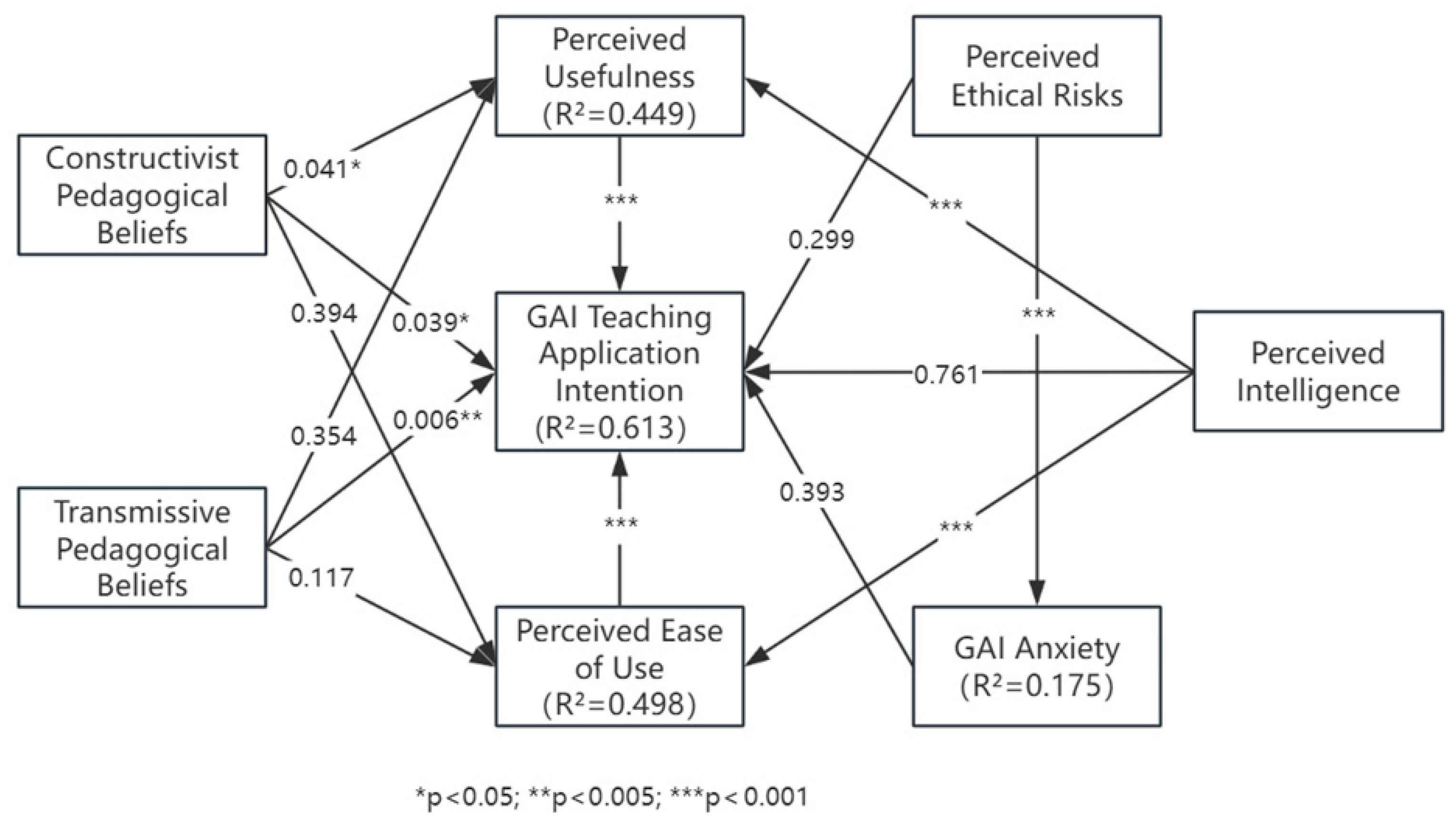
| BI | <--- | CPB | 0.256 | 0.125 | 2.059 | 0.039 |
| BI | <--- | TPB | −0.139 | 0.05 | −2.76 | 0.006 |
| BI | <--- | PER | 0.069 | 0.067 | 1.038 | 0.299 |
| BI | <--- | GAIA | −0.048 | 0.056 | −0.854 | 0.393 |
| BI | <--- | PI | 0.035 | 0.116 | 0.304 | 0.761 |
| PU | <--- | CPB | 0.275 | 0.135 | 2.043 | 0.041 |
| PU | <--- | TPB | 0.05 | 0.054 | 0.926 | 0.354 |
| PU | <--- | PI | 0.793 | 0.092 | 8.588 | <0.001 |
| PEU | <--- | CPB | 0.112 | 0.131 | 0.852 | 0.394 |
| PEU | <--- | TPB | 0.087 | 0.055 | 1.566 | 0.117 |
| PEU | <--- | PI | 0.875 | 0.097 | 8.985 | <0.001 |
| GAIA | <--- | PER | 0.486 | 0.094 | 5.169 | <0.001 |
| Effect Type | Path | Estimate | 95%CI (Lower, Upper) | p | Interpretation |
|---|---|---|---|---|---|
| Indirect effect 1 | PI --->PU---> BI | 0.289 | [0.000, 0.770] | 0.050 | Not supported |
| Indirect effect 2 | PI ---> PEU ---> BI | 0.229 | [−0.173, 0.699] | 0.205 | Not supported |
| Direct effect | PI ---> BI | 0.058 | [−0.626, 0.800] | 0.899 | Not supported |
| Total effect | PI ---> BI | 0.576 | [0.392, 0.829] | 0.001 | Supported |
| Variable | Model Comparison | ΔX2 | Δdf | p | Invariant |
|---|---|---|---|---|---|
| Gender | Measurement model VS. Unconstrained model | 25.409 | 16 | 0.063 | No |
| Structural model VS. Unconstrained model | 27.752 | 11 | 0.004 | Yes | |
| Teaching stage | Measurement model VS. Unconstrained model | 24.554 | 16 | 0.078 | No |
| Structural model VS. Unconstrained model | 22.958 | 11 | 0.018 | Yes | |
| Educational background | Measurement model VS. Unconstrained model | 16.821 | 16 | 0.397 | No |
| Structural model VS. Unconstrained model | 20.651 | 11 | 0.037 | Yes |
| Moderating Variables | Moderating Paths | Group 1 | Group 2 | t | p |
|---|---|---|---|---|---|
| Gender | PEU--->BI | Male (β = 0.017) | Female (β = 0.422) | −3.051 | 0.003 |
| Teaching Level | CPB--->PU | Primary School (β = 0.413) | Middle School (β = −0.035) | 2.753 | 0.006 |
| Educational Background | CPB--->PU | Bachelor or Blow (β = 0.018) | Postgraduate or Above (β = 0.320) | −4.195 | 0.000 |
Disclaimer/Publisher’s Note: The statements, opinions and data contained in all publications are solely those of the individual author(s) and contributor(s) and not of MDPI and/or the editor(s). MDPI and/or the editor(s) disclaim responsibility for any injury to people or property resulting from any ideas, methods, instructions or products referred to in the content. |
© 2026 by the authors. Licensee MDPI, Basel, Switzerland. This article is an open access article distributed under the terms and conditions of the Creative Commons Attribution (CC BY) license.
Share and Cite
Tang, Y.; Zhong, L. K-12 Teachers’ Adoption of Generative AI for Teaching: An Extended TAM Perspective. Educ. Sci. 2026, 16, 136. https://doi.org/10.3390/educsci16010136
Tang Y, Zhong L. K-12 Teachers’ Adoption of Generative AI for Teaching: An Extended TAM Perspective. Education Sciences. 2026; 16(1):136. https://doi.org/10.3390/educsci16010136
Chicago/Turabian StyleTang, Ying, and Linrong Zhong. 2026. "K-12 Teachers’ Adoption of Generative AI for Teaching: An Extended TAM Perspective" Education Sciences 16, no. 1: 136. https://doi.org/10.3390/educsci16010136
APA StyleTang, Y., & Zhong, L. (2026). K-12 Teachers’ Adoption of Generative AI for Teaching: An Extended TAM Perspective. Education Sciences, 16(1), 136. https://doi.org/10.3390/educsci16010136