Article

Factors Influencing Students’ Performance in University Mathematics Courses: A Structural Equation Modelling Approach


1
Department of Mathematics, Natural Sciences and Technology Education, Faculty of Education, University of the Free State, Bloemfontein 9301, South Africa
2
Academic Support for Engineering in Cape Town (ASPECT), Centre for Higher Education Development, Upper Campus, University of Cape Town, Rondebosch 7701, South Africa
*
Author to whom correspondence should be addressed.
Educ. Sci. 2025, 15(2), 188; https://doi.org/10.3390/educsci15020188

Submission received: 12 October 2024 / Revised: 4 January 2025 / Accepted: 30 January 2025 / Published: 5 February 2025

Abstract

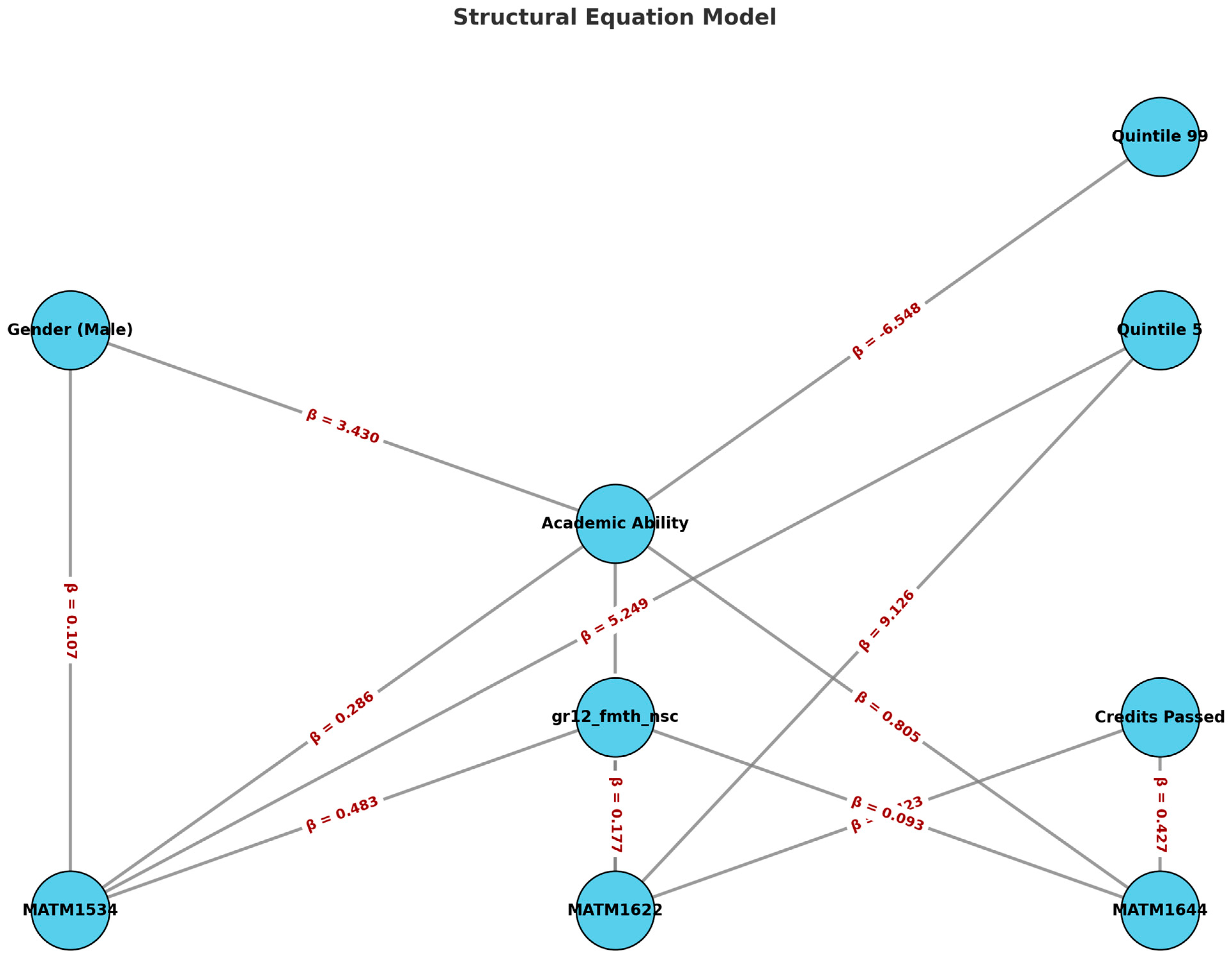
This study examined the predictive relationships between Grade 12 National Senior Certificate (NSC) Mathematics results (representing students’ academic preparation at the secondary school level), university mathematics credits (indicating students’ progress in mathematics-related university courses), gender, and socioeconomic status (SES, measured by school quintile and family income) on student performance in specific university mathematics courses. The endogenous construct, student performance in university mathematics courses, was assessed using final grades from three courses representing progressive levels of mathematical complexity. Previous research had often evaluated these factors in isolation, leaving gaps in understanding how they collectively influenced academic success in South African higher education. Participants were selected using stratified random sampling to ensure representation across diverse socioeconomic backgrounds and genders. Data collection relied on institutional records for NSC Mathematics results, university mathematics credits, and course grades. SES information was gathered using surveys capturing school quintile and family income data. Structural equation modelling (SEM), specifically the covariance-Based SEM approach, was employed to analyse these variables’ direct and indirect effects on student performance. The analysis was conducted using the lavaan package in R, enabling the simultaneous assessment of multiple variables and offering a comprehensive understanding of their interrelationships. Results indicated that NSC Mathematics results and university mathematics credits were significant predictors of student success. Additionally, gender and SES were found to moderate these relationships, with performance disparities observed. The findings emphasised the need for a multi-dimensional approach to predicting and supporting student success in university mathematics. Recommendations included the implementation of targeted interventions, such as academic assistance programmes and policy initiatives, to ensure that all students have equitable access to resources and opportunities.
Keywords: academic success; higher education; mathematics education; national senior certificate (NSC); STEM fields; structural equation modelling (SEM) academic success; higher education; mathematics education; national senior certificate (NSC); STEM fields; structural equation modelling (SEM)