Strategic Leadership and Systems Connection as Key Predictors of Learning Organization Outcomes: Evidence from Saudi Arabian Nursing Education



Abstract
1. Introduction
2. Methods
2.1. Study Design
2.2. Participants/Sampling
2.3. Instrument
2.4. Data Collection
2.5. Ethical Considerations
2.6. Statistical Analysis
3. Results
4. Discussion
4.1. On the Dimensions of the Learning Organization Quality (DLOQ) Instrument
4.2. On the Correlation Between the Dimensions of LO
4.3. Differences Between the Demographic Profile of the Participants and the Learning Outcomes Dimensions
4.4. On Hierarchical Multiple Regression
4.5. On Hierarchical Multiple Regression Coefficients (Extended with Model 3)
4.6. On the Robustness Check: Ridge Regression Analysis
4.7. Study Implications
4.8. Limitations
5. Conclusions
Author Contributions
Funding
Institutional Review Board Statement
Informed Consent Statement
Data Availability Statement
Acknowledgments
Conflicts of Interest
References
- Aboshaiqah, A., Alammar, K., Alenezi, A., Majrashi, B., Alshamlani, Y., Alshehari, A., & Alanazi, N. H. (2023). Development of nursing research in Saudi Arabia: Implications for policies and practice. Nursing Reports, 13, 1216–1224. [Google Scholar] [CrossRef] [PubMed]
- Abualrub, R. F., & Alghamdi, M. G. (2012). The impact of leadership styles on nurses’ satisfaction and intention to stay among Saudi Nurses. Journal of Nursing Management, 20, 668–678. [Google Scholar] [CrossRef] [PubMed]
- Alboliteeh, M., Magarey, J., & Wiechula, R. (2017). The profile of Saudi nursing workforce: A cross-sectional study. Nursing Research and Practice, 2017, 1710686. [Google Scholar] [CrossRef] [PubMed]
- Alghamdi, R., Albloushi, M., Alzahrani, E., Aldawsari, A., & Alyousef, S. (2019). Nursing education challenges from Saudi nurse educators’ and leaders’ perspectives: A qualitative descriptive study. International Journal of Nursing Education Scholarship, 16, 1–9. [Google Scholar] [CrossRef]
- Alharbi, H., Alshahrani, F., Hasan, Z., Al Baalharith, I., Al-Tawfiq, J., & Temsah, M.-H. (2024). Conducting nursing research in Saudi Arabia during the COVID-19 pandemic: Insights and lessons learned. The Egyptian Journal of Hospital Medicine, 95, 1778–1783. [Google Scholar] [CrossRef]
- Aljohani, K. A. (2020). Nursing education in Saudi Arabia: History and development. Cureus, 12, e7874. [Google Scholar] [CrossRef]
- Alluhidan, M., Tashkandi, N., Alblowi, F., Omer, T., Alghaith, T., Alghodaier, H., Alazemi, N., Tulenko, K., Herbst, C. H., Hamza, M. M., & Alghamdi, M. G. (2020). Challenges and policy opportunities in nursing in Saudi Arabia. Human Resources for Health, 18, 98. [Google Scholar] [CrossRef]
- Almutairi, H. A., Alharbi, K. N., Alotheimin, H. K., Gassas, R., Alghamdi, M. S., Alamri, A. A., Alsufyani, A. M., & Bashatah, A. S. (2020). Nurse practitioner: Is it time to have a role in Saudi Arabia? Nursing Reports, 10, 41–47. [Google Scholar] [CrossRef]
- Alonazi, W. B. (2021). Building learning organizational culture during COVID-19 outbreak: A national study. BMC Health Services Research, 21, 422. [Google Scholar] [CrossRef]
- Alotaibi, J., Paliadelis, P., & Valenzuela, F.-R. (2015). Factors that affect the job satisfaction of Saudi Arabian nurses. Journal of Nursing Management, 24, 275–282. [Google Scholar] [CrossRef]
- Alrashidi, N. A., Lagura, G. L., & Celdran, M. B. (2023). Utilization of the dimensions of learning organization for enhanced hospital performance. Frontiers in Communication, 8, 1189234. [Google Scholar] [CrossRef]
- Alsadaan, N., Jones, L. K., Kimpton, A., & DaCosta, C. (2021). Challenges facing the nursing profession in Saudi Arabia: An integrative review. Nursing Reports, 11, 395–403. [Google Scholar] [CrossRef]
- Alsufyani, A. M., Alforihidi, M. A., Almalki, K. E., Aljuaud, S. M., Alamri, A. A., & Alghamdi, M. S. (2020). Linking the Saudi Arabian 2030 vision with nursing transformation in Saudi Arabia: Roadmap for nursing policies and strategies. International Journal of Africa Nursing Sciences, 13, 100256. [Google Scholar] [CrossRef]
- Atallah, M. A., Hamdan-Mansour, A. M., Al-Sayed, M. M., & Aboshaiqah, A. E. (2013). Patients’ satisfaction with the quality of nursing care provided: The Saudi experience. International Journal of Nursing Practice, 19, 584–590. [Google Scholar] [CrossRef] [PubMed]
- Awasthy, R., & Gupta, R. K. (2012). Dimensions of the learning organization in an Indian context. International Journal of Emerging Markets, 7, 222–244. [Google Scholar] [CrossRef]
- Bhaskar, A. U., & Mishra, B. (2017). Exploring relationship between learning organization and organizational performance. International Journal of Emerging Markets, 12, 593–609. [Google Scholar] [CrossRef]
- Borge, M., Ong, Y. S., & Rose, C. P. (2018). Learning to monitor and regulate collective thinking processes. International Journal of Computer-Supported Collaborative Learning, 13, 61–92. [Google Scholar] [CrossRef]
- Carroll, J. S., Rudolph, J. W., & Hatakenaka, S. (2003). Learning from organizational experience. In M. E. Smith, & M. A. Lyles (Eds.), Handbook of organizational learning and knowledge (pp. 1–25). Blackwell. [Google Scholar]
- Chaudhuri, K., Drakpa, D., & Zangmo, S. (2022). Organizational culture and learning organization: An empirical study of the colleges in Bhutan. Asian Journal of Education and Social Sciences, 30, 1–15. [Google Scholar] [CrossRef]
- Dirani, K. M. (2013). Does theory travel? Dimensions of the learning organization culture relevant to the lebanese culture. Advances in Developing Human Resources, 15, 177–192. [Google Scholar] [CrossRef]
- Do, N., Nguyen, M., Nguyen, T., Huynh, B., & Ho, T. (2023, September 12–14). The impact of employees’ perceptions of a learning organization on innovativeness in a healthcare organization. 4th Asia Pacific Conference on Industrial Engineering and Operations Management (pp. 854–865), Ho Chi Minh City, Vietnam. [Google Scholar] [CrossRef]
- Gheorghe, C.-M., Purcărea, V., Gheorghe, I.-R., & Popa-Velea, O. (2018). Investigating the dimensions of learning organizations questionnaire (DLOQ) in a romanian private ophthalmology organization. Romanian Journal of Ophthalmology, 62, 288–295. [Google Scholar] [CrossRef]
- Goula, A., Stamouli, M.-A., Latsou, D., Gkioka, V., & Kyriakidou, N. (2021). Learning organizational culture in Greek public hospitals. International Journal of Environmental Research and Public Health, 18(4), 1867. [Google Scholar] [CrossRef] [PubMed]
- Goula, A., Stamouli, M.-A., Latsou, D., Gkioka, V., & Sarris, M. (2020). Validation of dimensions of learning organization questionnaire (DLOQ) in health care setting in Greece. Journal of Public Health Research, 9, 517–522. [Google Scholar] [CrossRef] [PubMed]
- Holyoke, L. B., Sturko, P. A., Wood, N. B., & Wu, L. J. (2012). Are academic departments perceived as learning organizations? Educational Management Administration and Leadership, 40(4), 436–448. [Google Scholar] [CrossRef]
- Ju, B., Lee, Y., Park, S., & Yoon, S. W. (2021). A meta-analytic review of the relationship between learning organization and organizational performance and employee attitudes: Using the dimensions of learning organization questionnaire. Human Resource Development Review, 20, 207–251. [Google Scholar] [CrossRef]
- Kareem, J., Patrick, H., & Prabakaran, N. (2024). Exploring the factors of learning organization in school education: The role of leadership styles, personal commitment, and organizational culture. Central European Management Journal, 33, 232–251. [Google Scholar] [CrossRef]
- Kim, J., Egan, T., & Tolson, H. (2015). Examining the dimensions of the learning organization questionnaire: A review and critique of research utilizing the DLOQ. Human Resource Development Review, 14(1), 91–112. [Google Scholar] [CrossRef]
- Kim, K., Watkins, K. E., & Lu, Z. L. (2017). The impact of a learning organization on performance: Focusing on knowledge performance and financial performance. European Journal of Training and Development, 41, 177–193. [Google Scholar] [CrossRef]
- Kipasika, H. (2024). Expression of leadership mission, vision, values, and strategic objectives in academic institution development practices. Journal of Research Innovation and Implications in Education, 8, 393–402. [Google Scholar] [CrossRef]
- Klasmeier, K. N., & Rowold, J. (2020). A multilevel investigation of predictors and outcomes of shared leadership. Journal of organizational Behavior, 41, 915–930. [Google Scholar] [CrossRef]
- Kroll, C. N., & Song, P. (2013). Impact of multicollinearity on small sample hydrologic regression models. Water Resource Research, 49, 3756–3769. [Google Scholar] [CrossRef]
- Leufvén, M., Vitrakoti, R., Bergström, A., KC, A., & Målqvist, M. (2015). Dimensions of learning organizations questionnaire (DLOQ) in a low-resource health care setting in Nepal. Health Research Policy Systemst, 13, 6. [Google Scholar] [CrossRef]
- Malik, P., & Garg, P. (2017). Learning organization and work engagement: The mediating role of employee resilience. The International Journal of Human Resource Management, 31, 1071–1094. [Google Scholar] [CrossRef]
- Marsick, V. J., & Watkins, K. E. (2003). Demonstrating the value of an organization’s learning culture: The dimensions of the learning organization questionnaire. Advances in Developing Human Resource, 5, 132–151. [Google Scholar] [CrossRef]
- Mbassana, M. E. (2014). Validating the dimensions of the learning organization questionnaire (DLOQ) in the Rwandan context. European Journal of Business, Economics and Accountancy, 2, 15–26. [Google Scholar]
- Moschovopoulou, A., & Papavassiliou-Alexiou, I. (2025). The effect of perceived organizational support, empowering leadership and learning organization on Greek psychiatric nurses’ employee resilience: A cross-sectional study. International Journal of Workplace Health Management, 18, 371–390. [Google Scholar] [CrossRef]
- Mujallad, A. (2023). The nursing profession in the new era of Saudi Arabia. Middle East Journal of Nursing, 17, 18–23. [Google Scholar] [CrossRef]
- Nguyen-Duc, T., Phuong, T. T., & Le, T. T. (2022). Validation of dimensions of the learning organization questionnaire (DLOQ) in a Vietnamese context. The Learning Organization, 30, 511–531. [Google Scholar] [CrossRef]
- Osagie, E., Wesselink, R., Blok, V., & Mulder, M. (2022). Learning organization for corporate social responsibility implementation: Unravelling the intricate relationship between organizational and operational learning organization characteristics. Organization & Environment, 35, 130–153. [Google Scholar] [CrossRef]
- Pokharel, M., & Choi, S. O. (2015). Exploring the relationship between the learning organization and organizational performance. Management Research Review, 38, 126–148. [Google Scholar] [CrossRef]
- Razali, M. M., & Jamil, R. (2023). Sustainability learning in organizations: Integrated model of learning approaches and contextual factors. Sage Open, 13, 1–16. [Google Scholar] [CrossRef]
- Song, J. H., Chermack, T. J., & Kim, W. (2013). An analysis and synthesis of DLOQ-based learning organization research. Advances in Developing Human Resources, 15(2), 222–239. [Google Scholar] [CrossRef]
- Song, J. H., Joo, B.-K., & Chermack, T. J. (2009). The dimensions of learning organization questionnaire (DLOQ): A validation study in a Korean context. Human Resource Development Quarterly, 20, 43–64. [Google Scholar] [CrossRef]
- Ugurluoglu, O., Aldogan, E. U., & Dilmac, E. (2012). The impact of managers’ perceptions of learning organizations on innovation in healthcare: Sample of Turkey. The International Journal of Health Planning and Management, 28, 158–168. [Google Scholar] [CrossRef]
- Wali, R., Aljohani, H., Murug, S., Jaha, A., & Alhindi, H. (2023). Job satisfaction among nurses working in king abdul aziz medical city primary health care centers: A cross-sectional study. Cureus, 15, e33672. [Google Scholar] [CrossRef] [PubMed]
- Wallo, A., Lundqvist, D., & Coetzer, A. (2024). Learning-oriented leadership in organizations: An integrative review of qualitative studies. Human Resource Development Review, 23, 230–275. [Google Scholar] [CrossRef]
- Watkins, V. J. (2013). The dimensions of a learning organization questionnaire (DLOQ): Introduction to the special issue examining DLOQ use over a decade. Advances in Developing Human Resource, 15, 127–132. [Google Scholar] [CrossRef]
- Weldy, T. G., & Gillis, W. E. (2010). The learning organization: Variations at different organizational levels. The Learning Organization: An International Journal, 17, 455–470. [Google Scholar] [CrossRef]
- Yang, B., Watkins, K. E., & Marsick, V. J. (2004). The construct of the learning organization: Dimensions, measurement, and validation. Human Resource Development Quarterly, 15, 31–55. [Google Scholar] [CrossRef]


| Demographics | Frequency | Percentage % |
|---|---|---|
| Age | ||
| 25–35 years old | 73 | 35.10 |
| 36–45 years old | 81 | 38.94 |
| 46–60 years old | 54 | 25.96 |
| Gender | ||
| Male | 76 | 36.54 |
| Female | 132 | 63.46 |
| Nationality | ||
| Saudi | 39 | 18.75 |
| Egyptian | 43 | 20.67 |
| Filipino | 47 | 22.60 |
| Jordanian | 45 | 21.63 |
| Other | 34 | 16.35 |
| Educational Attainment | ||
| BSN | 27 | 12.98 |
| Master’s Degree | 97 | 46.63 |
| Doctorate Degree | 84 | 40.38 |
| Years in Service | ||
| Less than 5 years | 47 | 22.60 |
| 5–10 years | 37 | 17.79 |
| 11–15 years | 73 | 35.10 |
| 16–20 years | 34 | 16.35 |
| More than 20 years | 17 | 8.173 |
| Attended Seminars | ||
| Yes | 204 | 98.08 |
| No | 4 | 1.923 |
| Dimensions of Learning Organization | N | M (Mean) | SD (Standard Deviation) | Skewness | Kurtosis |
|---|---|---|---|---|---|
| Continuous Learning Opportunities (CLO) | 208 | 3.46 | 0.957 | −0.206 | −0.968 |
| Promoting Dialogue and Inquiry (PDI) | 208 | 3.15 | 1.205 | 0.078 | −1.041 |
| Team Learning and Collaboration (TLC) | 208 | 3.43 | 1.028 | 0.196 | −1.093 |
| Embedded systems (ES) | 208 | 3.45 | 1.053 | −0.311 | −0.291 |
| Empowerment (E) | 208 | 3.35 | 1.242 | −0.392 | −1.083 |
| System Connection (SC) | 208 | 3.4 | 1.192 | −0.208 | −1.09 |
| Strategic Leadership (SL) | 208 | 3.42 | 1.16 | −0.128 | −1.059 |
| Correlations | |||||||
|---|---|---|---|---|---|---|---|
| VARIABLE | CLO | PDI | TLC | ES | E | SC | SL |
| CLO | 1 | 0.715 ** | 0.633 ** | 0.707 ** | 0.735 ** | 0.748 ** | 0.616 ** |
| PDI | 1 | 0.822 ** | 0.777 ** | 0.783 ** | 0.759 ** | 0.800 ** | |
| TLC | 1 | 0.628 ** | 0.769 ** | 0.676 ** | 0.806 ** | ||
| ES | 1 | 0.737 ** | 0.745 ** | 0.765 ** | |||
| E | 1 | 0.847 ** | 0.792 ** | ||||
| SC | 1 | 0.795 ** | |||||
| SL | 1 | ||||||
| Variable Tested | Demographic Group | Test Used | Degrees of Freedom (df) | Test Statistic (H or U) | p-Value |
|---|---|---|---|---|---|
| Overall LO Performance | Gender (Male vs. Female) | Mann–Whitney U | N/A | U = 1912.00 | 0.812 |
| Overall LO Performance | Age Group | Kruskal–Wallis H | 3 | H = 2.15 | 0.541 |
| Overall LO Performance | Years in Service | Kruskal–Wallis H | 4 | H = 1.88 | 0.757 |
| Overall LO Performance | Educational Attainment | Kruskal–Wallis H | 2 | H = 0.53 | 0.768 |
| Overall LO Performance | Nationality | Mann–Whitney U | N/A | U = 1950.00 | 0.655 |
| 1. Strategic Leadership (SL) | Gender | Mann–Whitney U | N/A | U = 1920.50 | 0.78 |
| 1. Strategic Leadership (SL) | Nationality | Mann–Whitney U | N/A | U = 1888.50 | 0.902 |
| 1. Strategic Leadership (SL) | Age Group | Kruskal–Wallis H | 3 | H = 3.50 | 0.32 |
| 2. Systems Connection (SC) | Gender | Mann–Whitney U | N/A | U = 1850.00 | 0.99 |
| 2. Systems Connection (SC) | Age Group | Kruskal–Wallis H | 3 | H = 1.95 | 0.58 |
| 3. Team Learning/Collaboration (TLC) | Years in Service | Kruskal–Wallis H | 4 | H = 2.80 | 0.6 |
| 4. Empowerment € | Educational Attainment | Kruskal–Wallis H | 2 | H = 1.50 | 0.47 |
| 5. Continuous Learning Opportunities (CLO) | Gender | Mann–Whitney U | N/A | U = 2000.00 | 0.55 |
| 6. Promoting Dialogue and Inquiry (PDI) | Age Group | Kruskal–Wallis H | 3 | H = 4.20 | 0.24 |
| 7. Final LO Dimension | Years in Service | Kruskal–Wallis H | 4 | H = 3.10 | 0.54 |
| Predictor | Model | Unstandardized B | β | t | p | Tolerance | VIF | R2 | ΔR2 | Sig. F Change |
|---|---|---|---|---|---|---|---|---|---|---|
| Model 1 Summary | 0.429 | 0.429 | <0.001 | |||||||
| (Constant) | 1 | 0.051 | 0.98 | 0.328 | ||||||
| SL | 1 | 0.603 | 0.694 | 10.768 | <0.001 | 0.18 | 5.549 | |||
| SC | 1 | 0.11 | 0.128 | 2 | 0.046 * | 0.187 | 5.34 | |||
| Model 2 Summary | 0.451 | 0.022 | 0.129 | |||||||
| (Constant) | 2 | 0.046 | 0.812 | 0.418 | ||||||
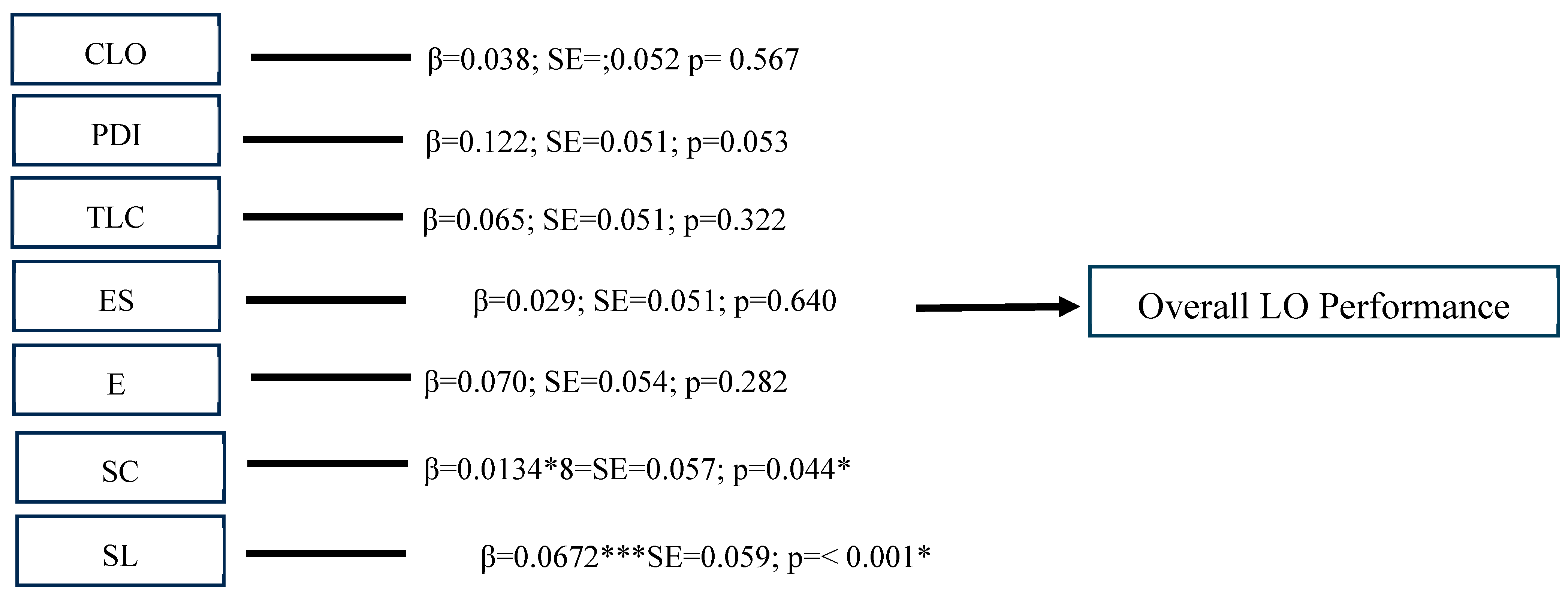
| SL | 2 | 0.584 | 0.672 | 9.932 | <0.001 * | 0.18 | 5.549 | |||
| SC | 2 | 0.115 | 0.134 | 2.023 | 0.044 * | 0.187 | 5.34 | |||
| CLO | 2 | 0.03 | 0.038 | 0.573 | 0.567 | 0.285 | 3.511 | |||
| PDI | 2 | 0.1 | 0.122 | 1.95 | 0.053 | 0.226 | 4.417 | |||
| TLC | 2 | 0.051 | 0.065 | 0.992 | 0.322 | 0.228 | 4.382 | |||
| ES | 2 | 0.024 | 0.029 | 0.468 | 0.64 | 0.292 | 3.424 | |||
| E | 2 | 0.058 | 0.07 | 1.079 | 0.282 | 0.244 | 4.095 |
| Predictor | Model | B | Std. Error | Tolerance | VIF | β | t | p |
|---|---|---|---|---|---|---|---|---|
| Model Collinearity Diagnostic | Model 2 | Condition Index | ≈42.0 | |||||
| (Constant) | 2 | 0.046 | 0.057 | 0.812 | 0.418 | |||
| SL | 2 | 0.584 | 0.059 | 0.18 | 5.549 | 0.672 | 9.932 | <0.001 * |
| SC | 2 | 0.115 | 0.057 | 0.187 | 5.34 | 0.134 | 2.023 | 0.044 * |
| … (Remaining 5 Predictors) | 2 | … | … | … | … | … | … | … |
| --- | --- | --- | --- | --- | --- | --- | --- | --- |
| Model Collinearity Diagnostic | Model 3 | Condition Index | ≈45.0 | |||||
| (Constant) | 3 | 0.042 | 0.057 | 0.737 | 0.462 | |||
| SL | 3 | 0.581 | 0.06 | 0.178 | 5.617 | 0.669 | 9.683 | <0.001 * |
| SC | 3 | 0.113 | 0.058 | 0.185 | 5.405 | 0.131 | 1.948 | 0.053 |
| CLO | 3 | 0.035 | 0.053 | 0.282 | 3.546 | 0.044 | 0.66 | 0.51 |
| PDI | 3 | 0.098 | 0.052 | 0.224 | 4.464 | 0.12 | 1.885 | 0.061 |
| TLC | 3 | 0.048 | 0.052 | 0.226 | 4.425 | 0.061 | 0.923 | 0.357 |
| ES | 3 | 0.021 | 0.052 | 0.289 | 3.46 | 0.025 | 0.404 | 0.686 |
| E | 3 | 0.055 | 0.055 | 0.241 | 4.149 | 0.066 | 1 | 0.318 |
| SL × SC | 3 | 0.015 | 0.035 | 0.75 | 1.333 | 0.025 | 0.429 | 0.668 |
| Model | Predictor | OLS β (at λ = 0) | Ridge β (at Optimal λ ≈ 0.10) | Interpretation |
|---|---|---|---|---|
| Core Drivers | SL | 0.672 | 0.655 | Stable: Coefficient maintains impressive value, suggesting SL continues to have a dominant and robust impact. |
| SC | 0.134 | 0.145 | Stable: Magnitude of the coefficient is maintained or is increased/decreased slightly, suggesting a unique, although more modest, impact | |
| Non-Significant | PDI | 0.122 | 0.075 | Shrunken: The coefficient is driven particularly nearer to zero. corroborating the OLS result that its distinct influence is insignificant and superfluous. |
| E | 0.07 | 0.04 | Shrunken: Also diminished, affirming high communal variance and low distinctive predictive power. |
Disclaimer/Publisher’s Note: The statements, opinions and data contained in all publications are solely those of the individual author(s) and contributor(s) and not of MDPI and/or the editor(s). MDPI and/or the editor(s) disclaim responsibility for any injury to people or property resulting from any ideas, methods, instructions or products referred to in the content. |
© 2025 by the authors. Licensee MDPI, Basel, Switzerland. This article is an open access article distributed under the terms and conditions of the Creative Commons Attribution (CC BY) license (https://creativecommons.org/licenses/by/4.0/).
Share and Cite
Alrashidi, N.A.; Lagura, G.A.L.; Celdran, M.C.B. Strategic Leadership and Systems Connection as Key Predictors of Learning Organization Outcomes: Evidence from Saudi Arabian Nursing Education. Educ. Sci. 2025, 15, 1705. https://doi.org/10.3390/educsci15121705
Alrashidi NA, Lagura GAL, Celdran MCB. Strategic Leadership and Systems Connection as Key Predictors of Learning Organization Outcomes: Evidence from Saudi Arabian Nursing Education. Education Sciences. 2025; 15(12):1705. https://doi.org/10.3390/educsci15121705
Chicago/Turabian StyleAlrashidi, Nojoud Abdullah, Grace Ann Lim Lagura, and Ma Christina Bello Celdran. 2025. "Strategic Leadership and Systems Connection as Key Predictors of Learning Organization Outcomes: Evidence from Saudi Arabian Nursing Education" Education Sciences 15, no. 12: 1705. https://doi.org/10.3390/educsci15121705
APA StyleAlrashidi, N. A., Lagura, G. A. L., & Celdran, M. C. B. (2025). Strategic Leadership and Systems Connection as Key Predictors of Learning Organization Outcomes: Evidence from Saudi Arabian Nursing Education. Education Sciences, 15(12), 1705. https://doi.org/10.3390/educsci15121705