Article

Cultural Diversity in Spanish Educational Policy (1970–2025): From Assimilation to Intercultural Inclusion


by
Isabel Torrijos-Martí
Faculty of Education and Educational Sciences, Catholic University of Valencia, C/Sagrado Corazón, 5, 46110 Godella, Valencia, Spain
Educ. Sci. 2025, 15(12), 1699; https://doi.org/10.3390/educsci15121699
Submission received: 24 November 2025 / Revised: 10 December 2025 / Accepted: 12 December 2025 / Published: 16 December 2025

Abstract

Spanish educational legislation on cultural diversity has shifted in five decades from homogenizing frameworks to an explicit commitment to inclusion and interculturality. This article reports a qualitative documentary analysis of state laws and Royal Decrees from the Ley 14/1970 General de Educación to the Ley Orgánica 3/2020, de 29 de diciembre, por la que se modifica la Ley Orgánica 2/2006, de Educación to examine how cultural and linguistic diversity is conceptualized, how it is embedded in a competence-based curriculum, and which tools are provided for its implementation. The analysis addresses three dimensions: (a) policy conceptions of diversity, (b) curricular instruments (competences, learning situations, assessment), and (c) implementation mechanisms (resources, teacher development, equity monitoring). Results indicate a move from compensatory and assimilationist logics to rights-based, competence-based formulations, with clearer references to dialogue, mediation, and non-discrimination, but also a persistent gap between legal texts and school realities. The study concludes that the current framework enables more observable and assessable intercultural aims, while its impact depends on concrete support for school and teachers. This diachronic perspective on a medium-sized European system offers transferable insights for other countries seeking to embed intercultural competences and equity in curriculum assessment and teacher development.

1. Introduction

Cultural diversity is increasingly recognized as both a challenge and an opportunity for contemporary education systems. In the 21st century, societies are no longer homogeneous units, but complex and plural environments shaped by globalization, migration, digitalization, and supranational frameworks. This heterogeneity places education at the center of social cohesion, demanding not only academic instruction but also the cultivation of inclusive identities, intercultural dialogue, and democratic citizenship. Schools thus represent more than places for knowledge transmission; they are crucial spaces for learning to live together.
Within this context, legislation acquires a strategic role. Educational laws are not neutral; they reflect prevailing political ideologies, social priorities, and cultural attitudes. They establish the principles that determine whether diversity is treated as a deficit, as a mere reality to be tolerated, or as a resource that enriches the community. As such, the study of legislation becomes essential to understand how cultural diversity is conceptualized, promoted, and operationalized in the classroom.
One of the most persistent ways in which diversity has been framed as a deficit is what many authors describe as assimilationism. In this approach, minoritized or migrant groups are progressively incorporated into the dominant culture and are expected to adopt its language, values and traditions, which leads to the erosion of cultural plurality and to the implicit assumption that one culture is superior or more appropriate for the context (Fundación Entreculturas, 2009). As several authors have pointed out, assimilationism is therefore a form of relationship between groups from different backgrounds in which one group is required to make the norms of the other its own; individuals may retain some elements of their original culture in private or associative spaces, but are expected to conform to majority rules in public life (Dassetto, 2006; Shuali, 2008).
Throughout this article, different concepts are used. Sociolinguistic and cultural diversity is understood, following Neubauer et al. (2022) as the set of social, cultural, economic, ethnic, religious and linguistic characteristics that shape individuals and groups, making contemporary societies inherently heterogeneous. From a linguistic perspective, sociolinguistic and cultural diversity also encompasses the coexistence of multiple languages and language varieties within the same society. It implies acknowledging that all languages and linguistic repertoires have equal dignity and educational value, and that schools should make them visible as a way to build more inclusive, democratic and intercultural communities (Neubauer et al., 2022).
Multiculturalism designates policy and curricular approaches that recognize and represent cultural plurality, usually stressing coexistence and respect for difference. In line with Tuts (2007), it can also be described as an ideological and socio-economic arrangement in which different cultural groups share the same space while largely maintaining their own traditions, ways of life and languages, with limited interaction beyond acceptance of common legal frameworks.
Following Leiva (2008), interculturality is conceived not merely as the coexistence or recognition of different cultures, but as an ongoing, deep and critical reflection on the possibilities that cultural diversity opens up for the mutual exchange of values, perspectives and ways of life. From this perspective, diversity becomes a resource for questioning and dismantling prejudices, for creating shared spaces of encounter and interaction, and for weaving bonds and relations of interdependence among the different cultural groups that coexist. Interculturality thus goes beyond recognition by emphasizing interaction, critical reflection, and the transformation of unequal relations, foregrounding dialogue, mediation, and actions against discrimination. This distinction is increasingly reflected in recent international reports that frame inclusion and diversity as conditions for educational quality and equity, and that conceptualize intercultural and democratic competences as observable attitudes, skills, and knowledge (Council of Europe, 2021; UNESCO, 2022; OECD, 2023).
This conceptual distinction underpins the analysis of how Spanish legislation reframes diversity. In line with established intercultural theories, intercultural competence is understood not only as knowledge about other cultures, but as the ability to engage in critical, dialogic interaction and to act against discrimination (Byram, 1997; Banks, 2008). From this perspective, legislation can be assessed according to whether it merely recognizes diversity or whether it creates the conditions for interaction, mediation and civic action.
The Spanish case is particularly illustrative. Over the last five decades, the country has experienced profound social transformations, from the transition to democracy to its integration into the European Union and the arrival of significant migratory flows. These dynamics have tested the capacity of the education system to address cultural plurality. The Ley 14/1970 General de Educación (LGE) reflected a centralized and assimilationist model, whereas later reforms such as the Ley Orgánica 1/1990, de Ordenación General del Sistema Educativo (LOGSE) and Ley Orgánica 2/2006, de Educación (LOE) introduced more inclusive language and competences. The Ley Orgánica 8/2013, para la Mejora de la Calidad Educativa (LOMCE,), however, represented a step back by prioritizing efficiency and competitiveness over equity, generating intense debate among scholars and practitioners. For instance, López Melero (2006) argues that LOMCE dismantles a comprehensive and inclusive model of schooling and replaces it with an elitist and segregationist framework that fails to respond to diversity. The recent Ley Orgánica 3/2020, de 29 de diciembre, por la que se modifica la Ley Orgánica 2/2006, de Educación (LOMLOE) has once again shifted the discourse towards equity, inclusion, and intercultural perspectives, aligning more closely with international frameworks.
Beyond the national dimension, the relevance of this issue is reinforced by global agendas. The Sustainable Development Goals, particularly SDG 4 (quality education) and SDG 10 (reduced inequalities), emphasize inclusive and equitable education as a foundation for sustainable societies. Similarly, the Council of Europe and the Common European Framework of Reference for Languages (CEFR) underline the role of intercultural competence as essential for 21st century citizenship. Positioning Spain within this international landscape allows for a deeper understanding of both the progress achieved and the limitations that persist. Recent analyses of citizenship and values education across successive reforms from LOGSE to LOMLOE also show how these legislative changes reflect wider social and political tensions around democracy and diversity in Spain (Vázquez & Porto, 2020). In addition, recent documentary analyses of the LOMLOE curriculum from the perspective of global competence underline its alignment with international agendas while revealing imbalances in how different dimensions of global citizenship are represented across stages and curricular elements (Neubauer & Fernández-Aragón, 2025).
The purpose of this article is to critically examine how Spanish educational legislation from 1970 to 2025 has addressed cultural diversity. The main objective is to provide a comprehensive diachronic analysis that highlights the role of educational policy in shaping inclusive or exclusionary practices. More specifically, the article pursues three interrelated goals: (1) to analyze the evolution of Spanish educational laws—from LGE (1970) to the most recent law, LOMLOE (2020)—with a focus on how they conceptualize and regulate cultural diversity; (2) to identify the main advances, setbacks, and gaps in the incorporation of intercultural education into the curriculum; and (3) to reflect on the future challenges that Spanish educational policy must address in order to move beyond rhetorical commitments and promote genuine inclusion and intercultural dialogue in schools.
Beyond documenting legislative change, this article makes three specific contributions to international debates on intercultural education and equity. First, it offers a diachronic, competence-based reading of five decades of Spanish education laws, showing how cultural diversity has been reframed from compensatory to a rights-based, assessable outcome. Second, it clarifies how interculturality is operationalized in curriculum architecture under the LOMLOE and its implementing objectives, key competences and learning situations. Third, it distils a set of lessons for other educational systems that are seeking to align national legislation with international frameworks on inclusion, intercultural competence and social cohesion.
This article offers a diachronic, competence-based reading of Spanish educational laws, showing how cultural diversity is reframed as a rights-based, assessable outcome under LOMLOE and its Royal Decrees. To substantiate this claim, state legislation, peer-reviewed scholarship, and a transparent ATLAS.ti audit trail are integrated to trace conceptual, curricular, and implementation shifts across five decades. Throughout the analysis, a reflexive stance was maintained: the researcher’s positionality and potential biases were explicitly documented in analytic memos, and fortnightly peer-debriefing sessions were conducted to challenge interpretations and enhance dependability.
Taken together, these contributions position the Spanish case as a useful lens for understanding how legislation can support or constrain the realization of intercultural education as a core dimension of democratic citizenship.

2. Materials and Methods

2.1. Research Design

This research follows a qualitative documentary design within an interpretive paradigm. The objective is not to quantify references to cultural diversity, but to interpret how Spanish educational laws build discourses of inclusion, exclusion and interculturality. Following principles of qualitative inquiry (Suárez Relinque et al., 2013), the design was conceived as flexible and emergent, allowing categories to evolve as analysis progressed.
Although quantitative content analysis could be employed to count occurrences of specific terms or categories in the legislation, this option was not considered the most appropriate for the aims of the study. The research questions focus on how educational laws frame cultural diversity, how they articulate curriculum architecture, and how they envisage implementation mechanisms, with particular attention to nuance, context, and shifts in underlying policy logics. These aspects are better captured through an interpretive qualitative strategy that treats preambles, general principles, and objectives as “high-density” sites of meaning rather than as sources of frequency counts alone. Quantitative content analysis may therefore complement future research, but it would not, by itself, illuminate the evolving theories of action embedded in the legal texts.
A diachronic perspective was chosen given the historical nature of legislation: each law is both a product of its socio-political context and a response to previous frameworks. Thus, rather than considering legal text as isolated documents, this research examines them as a discursive continuum that reflects evolving conceptions of cultural diversity, inclusion and citizenship in Spain.

2.2. Data Sources and Sampling

The main analyzed resources are official legal texts and related policy documents that regulate the Spanish education system. A purposive sampling strategy was applied, focusing on five key laws that mark a turning point in Spanish educational policy:
  • Ley General de Educación (LGE, 1970);
  • Ley Orgánica de Ordenación General del Sistema Educativo (LOGSE, 1990);
  • Ley Orgánica de Educación (LOE, 2006);
  • Ley Orgánica para la Mejora de la Calidad Educativa (LOMCE, 2013);
  • Ley Orgánica de Modificación de la LOE (LOMLOE, 2020).
These laws were selected for their systemic scope and historical significance, as each represents a milestone in shaping the Spanish education system and influencing curricular structures, teacher training and equity policies. Laws and policy documents were included if they: (1) had system-wide scope, (2) had explicit provisions on equity, diversity, inclusion or interculturality, and (3) were a significant reform in the Spanish education system. Regional regulations and more minor legislative changes were not the focus, unless they were explicitly referenced in the selected laws or emerged as crucial for understanding the broader policy trajectory. Complementary materials were also considered to capture the ideological and rhetorical framings underpinning the legal texts.
In addition to the primary legal corpus, peer-reviewed academic literature was also consulted through searches in Scopus, Dialnet, Web of Science and Google Scholar. Combinations of terms such as “Spanish educational legislation”, “cultural diversity”, “intercultural education”, and “educational policy” were used. Studies were included if they were published within the last 10–15 years and they:
-
Focused on Spain or contrasted Spanish and European policies;
-
Offered explicit analysis of how legislation/curriculum addresses cultural/linguistic diversity;
-
Engaged explicitly with interculturality or intercultural education in this context.
The emphasis on the last 10–15 years responds to the consolidation of competence-based reforms and contemporary debates on intercultural inclusion under the LOE, LOMCE and LOMLOE. However, earlier references were retained when their theoretical or historical contribution was deemed essential to understand the evolution of cultural diversity in Spanish education. This triangulation positioned the legal texts within broader scholarly and international debates. This strategy guaranteed that the interpretation of laws was not limited to the textual level but was also critically informed by academic analyses, thereby increasing the robustness and depth of the findings.

2.3. Analytical Framework

The analysis was guided by three interrelated dimensions, developed deductively from intercultural education literature and inductively refined through engagement with the texts:
(a)
Conceptualization of cultural and linguistic diversity: how diversity is defined or implied (as a problem, as a right, as a resource).
(b)
Curricular integration: the extent to which intercultural principles are embedded in curricular goals, competences and subject content.
(c)
Implementation mechanisms: measures proposed for operationalization, such as teacher training, provision of resources, or evaluation frameworks.
These dimensions are based on intercultural education theory (Aguado, 2011; Banks, 2008; Byram, 1997; Dietz, 2008) and international frameworks such as UNESCO’s (2006) Guidelines on Intercultural Education, the White Paper on Intercultural Dialogue (Council of Europe, 2008), and the CEFR (Council of Europe, 2001, 2020).

2.4. Procedure and Data Collection

The qualitative analysis was carried out using ATLAS.ti 25, which enabled systematic coding and retrieval of data. The five main education laws and complementary documents were imported into the software and segmented into smaller analytical units such as titles, articles, and preambles. A process of qualitative content analysis guided by inductive category development was applied through iterative reading of the texts. This procedure followed classic principles of qualitative content analysis, emphasizing systematic coding, explicit rules for category development and careful interpretation rather than frequency counts (Stemler, 2001). Initially, meaning units related to diversity, inclusion, and interculturality were identified and coded. These codes were then refined and grouped into broader analytical categories corresponding to the three dimensions of the study (conceptualization, curriculum, and implementation), allowing patterns and shifts to be identified across periods. Throughout the process, analytic memos and annotations were used to document interpretive decisions and ensure reflexivity. The visualization tools in ATLAS.ti helped explore relationships between categories and highlight key emphases and silences within the laws. An ATLAS.ti audit trail (codebook with definitions, code–document tables, and network views) was exported to ensure traceability and replicability of the analytic pathway. By combining interpretive reading with computer-assisted analysis, the study maintained methodological rigor while remaining sensitive to the contextual nuances of educational policy discourse.
Within each law, key objectives and principles related to diversity and inclusion were identified by systematically coding preambles, general principles, and stage objectives. These sections were treated as “high-density” sites for the articulation of policy intentions and used them to trace how conceptions of diversity, curriculum organization, and implementation mechanisms changed over time. Coding combined deductive categories with inductive codes that captured emergent themes and formulations.

2.5. Criteria for Rigor and Trustworthiness

The rigor of this research was ensured by adhering to qualitative standards of credibility, transferability, dependability and confirmability. Credibility was strengthened through a combination of strategies: the triangulation of data sources, the contrast with peer-reviewed academic literature, and the systematic use of ATLAS.ti to document and retrieve analytic decisions. The software provided a transparent record of codes, categories, and networks, making it possible to trace how interpretations emerged from the data and to cross-check them against secondary sources.
Transferability was promoted by offering a detailed description of the legislative corpus, the socio-historical context in which each law was enacted, and the inclusion criteria applied to the secondary literature. By clarifying the boundaries and conditions of the study, readers can assess whether and how the findings might be relevant to other educational systems facing similar challenges in addressing cultural diversity. Dependability was secured through the creation of an explicit audit trail. Coding reports, network diagrams, and analytic memos generated in the program document the iterative process of analysis and provide evidence of methodological consistency. Finally, confirmability was pursued by maintaining a reflexive stance throughout the research. Analytic memos were used not only to capture emergent insights but also to acknowledge the researcher’s assumptions and potential biases. This reflexive practice, complemented by peer debriefing and external feedback, reinforced the grounding of interpretations in the data rather than in subjective predispositions. Together, these strategies contribute to the trustworthiness of the study and validate its contribution to understanding how Spanish educational legislation has addressed cultural diversity over the last five decades.
Finally, this qualitative documentary design has inherent limitations. The analysis focuses on official state laws and related policy documents; it does not include systematic empirical data from schools, teachers or students. As a result, the findings show how cultural diversity and interculturality are framed and operationalized discursively at the policy level, but they cannot directly capture variation in school-level implementation or classroom practice. This boundary is acknowledged in the discussion when outlining directions for future empirical research.

3. Results

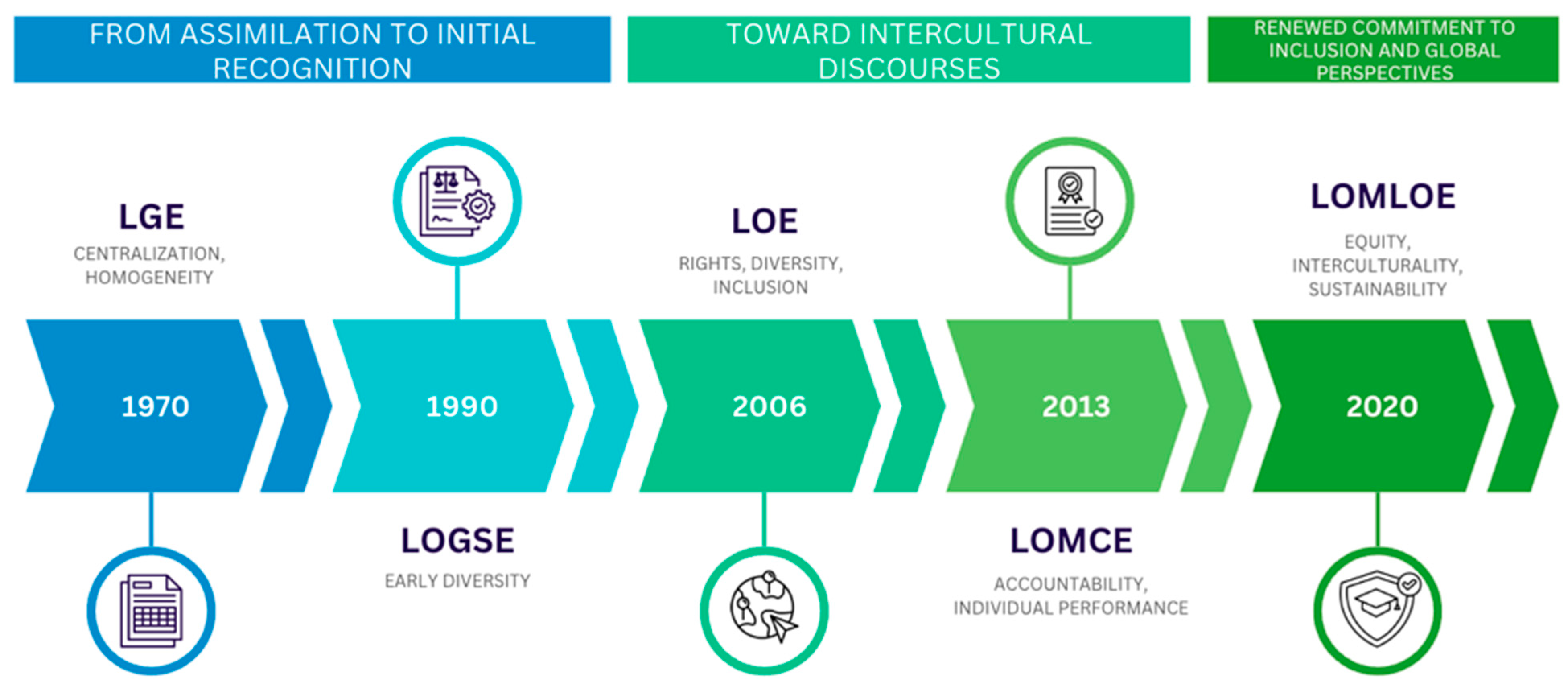
Findings are organized across three historical periods—1970–1990, 2000–2013 and 2020–2025—each analyzed through the lenses of conceptualization, curriculum and implementation. Every subsection closes with a brief verdict summarizing its trajectory across these dimensions. To support readers’ understanding of the diachronic design, Figure 1 summarizes the main legislative milestones and periods analyzed in this study. The timeline shows the approval and implementation of the LGE (1970), LOGSE (1990), LOE (2006), LOMCE (2013), and LOMLOE (2020), together with the key Royal Decrees that establish the current competence-based curriculum. It also highlights the three broader period used in the Results section (1970–1990; 2000–2013; 2020–2025), indicating overlaps and transitions between laws. This visual synthesis is intended to complement the documentary analysis by providing a quick overview of the Spanish education policy trajectory on cultural diversity and intercultural inclusion.

3.1. From Assimilation to Initial Recognition of Diversity (1970–1990s)

The right to education was not established in Spain until the second half of the 20th century. It is therefore unsurprising that if education itself was not yet guaranteed, much less could educational legislation contemplate the development of measures or policies related to the acceptance, inclusion, and equitable treatment of diversity. The emergence of “diversity” as a legislative concern within the educational sphere can be located between the 1970s and the 1990s. Before this, education had not been regarded as a basic responsibility of the State but was delegated to other entities, as the Preamble to the Ley Orgánica 8/1985, de 3 de julio, Reguladora del Derecho a la Educación (LODE, 1985) mentions:
Due to the shortcomings of its economic development and the vicissitudes of its political evolution, the State at various times abandoned its responsibilities in this area, leaving them in the hands of private individuals or institutions, in the name of the so-called principle of subsidiarity. Thus, until recent times, education was more a privilege of a few than a right of all.
(p. 4)
During the 20th century, the need for the State to assume responsibility for schooling became increasingly evident, given its recognition as a fundamental pillar for both individual and collective development (LODE, 1985). For the purposes of this study, the first period of analysis spanned from the LGE (1970) to the LOGSE (1990).
The LGE of 1970 sought to lay the foundations of a more equitable system of education (Grañeras et al., 1997). This was not unexpected, as internal migrations from rural areas to urban centers highlighted the need to serve the entire population. As Verdeja (2017) observes, “the aim of the LGE had been to provide Spain with a more equitable and higher-quality educational system” (p. 369). Although the text made no explicit mention of managing diversity, some scholars have noted that it adopted a relatively respectful stance toward it (Etxeberría & Elosegui, 2010). The most notable example was the case of gypsies, largely ignored by public institutions up to that point, whose schooling had been left to religious and private entities (Salinas, 2015). As a result, the State failed to actively integrate this community into the school system, perpetuating their illiteracy and social exclusion.
In the case of foreign pupils, inclusion in education was carried out through “complementary courses to compensate for possible deficits” (Moreno Vargas-Machuca, 2010, p. 122). Bernabé Villodre (2013) explains, they received assistance during their academic process but there was no explicit reference made to heterogeneity, “since Franco did not allow manifestations of diversity that could threaten the supposed cultural uniformity of Spain” (p. 68).
The first legislative reference to cultural diversity appeared in the LODE (1985), passed under the Socialist government. Article 1.3 explicitly recognized the right of all people residing in Spain to free compulsory education (LGE, 1970; Leiva, 2012; Verdeja, 2017), as established in Article 27.1 of the Spanish Constitution (Constitución Española, 1978). Article 6 enumerated the fundamental rights and duties of students, among which the following stand out: the right to respect for their “personal identity, integrity and dignity” (LODE, 1985, art. 6.3(b) p. 8); the right to “an inclusive and quality education” (LODE, 1985, art. 6.3(e), p. 8); the right to “protection against any intimidation, discrimination, and situation of violence or bullying” (LODE, 1985, art. 6.3(g), p. 8); the right to freedom of opinion respecting others’ voices (LODE, 1985, art. 6.3(h), p. 8); and the right to “receive the necessary aid and support to compensate for personal, familiar, economic, social, and cultural disadvantages, especially in the case of special educational needs that impede or hinder access to and continuation in the educational system” (LODE, 1985, art. 6.3(j), p. 9). These provisions reinforced the principle stated in both the Preamble and Article 1.3, establishing that all students, without distinction, should be guaranteed freedom of expression and recognition of plural identities, whether national or foreign, thereby facilitating the inclusion of all pupils within the education system.
Regarding students’ duties, Articles 6.4(e), 6.4(f), and 6.4(g) emphasized the obligation to respect peers and teachers, to participate in school activities that promote a climate of coexistence, and to respect “freedom of conscience, religious and moral convictions, and the diversity, dignity, integrity, and privacy of all members of the educational community” (LODE, 1985, p. 9). Although migratory movements in Spain had not yet reached the intensity of the 1990s, the legislative orientation was evident, entitled to quality education, the respect of identities, and protection against segregation or exclusion on socio-economic grounds.
By the late 20th century, Spanish society was undergoing a paradigmatic shift, which translated into the need to reframe education. This is evident in the Preamble to LOGSE (1990), which declared: “Ours is a society in an accelerated process of modernization, moving ever more clearly towards a common European horizon” (p. 1). Article 2 further emphasized the need for personalized training to promote integral education in equality and to eliminate discrimination.
The LOGSE introduced an individualized perspective on both students and teachers, granting teachers greater autonomy in decision-making. As Verdeja (2017) mentions, this facilitated closer attention to pupils as individuals rather than as a general group. However, as Peñalva (2009) points out, this autonomy could also be a double-edged sword: while it promoted equal opportunities and empowered teachers, it also made them responsible for managing diversity without adequate preparation. Even so, the law is considered a milestone in opening Spanish education to the future, framing it as “a common experience for all, regardless of race, gender, social class, beliefs, or socio-economic background” (Peñalva, 2009, p. 105).
As Moreno Vargas-Machuca (2010) highlights, the law did not use terms such as immigrant or foreigner, but rather referred to differences of an “ethnic, cultural, or geographic nature” (p. 123). While the LOGSE is valued for its positive view of diversity, cultural minorities were largely integrated into the system without genuine recognition or participation, maintaining a multicultural perspective rather than an intercultural approach. Moreover, as the author states, it perpetuated compensatory measures already present in earlier legislation.
Even considering the similarities between these laws regarding educational compensation, and largely due to Spain’s migratory growth during those years, the LOGSE represented a great improvement for minorities and is therefore considered as a positive reform in addressing emerging democratic needs.
Taken together, the period 1970–1990 is marked by a gradual shift from assimilationist understandings of education toward an incipient recognition of cultural pluralism. Diversity was largely conceptualized through compensatory and deficit-oriented frameworks that positioned immigrants and minorities as objects of integration rather than agents of inclusion. In the curriculum, diversity remained only faintly visible, more a contextual condition than an organizing principle, so intercultural aims were mostly implicit. Implementation was governed by remedial logics and targeted, often segregated, support mechanisms that acknowledged disadvantage without yet reimagining schooling as intrinsically plural.

3.2. Toward Intercultural Discourses (2000s–2013)

The turn of the century in Spain was marked by an exponential increase in the number of immigrants in society. As Bernabé Villodre (2013) points out, successive governments merely reflected this reality in their legislation, aiming to ensure and safeguard the integration of these individuals into society. Everyone residing in Spain was to be treated with the same dignity, obligations and rights as European citizens, without any form of distinction—a principle that, according to the author, sparked considerable debate.
Up to that point, Spanish legislation had generally supported the peaceful coexistence of all individuals. However, in 2002, the government led by José María Aznar promoted the Ley Orgánica 10/2002, de 23 de diciembre, de Calidad de la Educación, which sought the social integration of the immigrant population. Bernabé Villodre (2013) provides a detailed analysis of this law, noting that it defined among the main objects of Primary Education the acquisition of values and norms of coexistence that promote respect for the pluralism of Spain at that time. According to the author, the law introduced the notion of cultural plurality and acknowledged the specific educational needs of immigrant children.
Bernabé Villodre (2013) also highlights the relevance of this legislative reference for emphasizing the role of parental education and training as a first step toward ensuring their children’s education. The law established that family involvement becomes a key factor of educational success, as the absence of active participation weakens one of the main important participants supporting teachers. Ortiz Díaz (2009) mentions that families should not be excluded from school life, since their engagement represents an essential component of inclusive and intercultural education. Moreno Vargas-Machuca (2010) notes that although the LOCE emphasizes the need to address inequalities to improve the education of immigrant children and to place their right to education on an equal footing, it reverted to using outdated language similar to that used in the LGE.
In this regard, the Colectivo Ioé (2006) noted that the LOCE depicted students of foreign origin as a “burden for the system and spread the suspicion that […] they would not always respect its basic values” (p. 28). Similarly, they emphasized that marginalization would occur through the establishment of specific classrooms or by denying these students adequate attention from the teaching staff. Ultimately, the LOCE was never implemented, as the PSOE suspended it after winning the 2004 elections (Verdeja, 2017). This law would have entailed not only a lack of progress in managing diversity but even a regression in this regard. Seeking to advance further in the protection of rights, the PSOE aimed to promote a new educational reform that would consolidate democratic values and respond to the increasingly plural composition of Spanish society.
The first decade of the 21st century thus marked a significant step in the evolution of Spanish educational policy, coinciding with growing social and linguistic diversity due to international migration and European integration. During this period, the Ley Orgánica de Educación (LOE, 2006) represented the first genuine attempt to incorporate intercultural education into national legislation. Yet, the subsequent Ley Orgánica para la Mejora de la Calidad Educativa (LOMCE, 2013) reframed inclusion within a performance and accountability paradigm centered on quality, performance, and competitiveness, diluting many of the inclusive and intercultural advances previously achieved.
The LOE emerged within a European context that increasingly associated educational quality with inclusion and equity, in line with the principles established by UNESCO (2006) and the Council of Europe (2008). This new change in the vision of education was part of a broader period of social reform policies aimed at renewing Spain, which included “the legalization of same-sex marriage, the implementation of comprehensive measures against gender-based violence, the Law on Dependency, and the recognition of the plurinational character of the State” (Verdeja, 2017, p. 274). Azagra Ros and Chorén Rodríguez (2007) concluded that by the end of the first decade of the 21st century, nearly 14% of Spain’s population had been born abroad, which helps explain why legislation began to reflect this increasingly multicultural reality.
In the preamble of the aforementioned law, the need to guarantee equal opportunities and to value diversity as a fundamental component of education was explicitly emphasized. Furthermore, Article 2 of the same law set out several objectives that reflect this inclusive orientation:
(b) Education in respect for fundamental rights and freedoms, equality of rights and opportunities […], and equal treatment and non-discrimination for persons with disabilities.
(c) Education in the exercise of tolerance and freedom within the democratic principles of coexistence, as well as in the prevention and peaceful resolution of conflicts.
(e) Education for peace, respect for human rights, communal life, social cohesion, and cooperation and solidarity among peoples.
(g) Education in respect for and recognition of Spain’s linguistic and cultural plurality, and of interculturality as an enriching element of society.
According to Moreno Vargas-Machuca (2010) the guiding principle of this law was that all students should be able to reach their full potential, which required ensuring access to quality education and equal opportunities. The objectives were ambitious and aimed to move the system closer to an intercultural model. The multicultural paradigm appeared to be largely accepted, signaling a shift toward promoting attitudes that foster interaction and coexistence among diverse identities. As Verdeja (2017) argues, “the goal is to achieve an evolutionary and sustainable mode of coexistence in multicultural societies, fostering mutual understanding, respect, and dialogue among different cultural groups” (p. 375), thus encouraging not only the recognition of the other but also interaction and the exchange of experiences.
Continuing this emphasis on diversity, the law integrated the concept into the curricular framework through the introduction of basic competences, reflecting the European recommendation to align national education systems with the development of key competences for lifelong learning (European Parliament and Council of the European Union, 2006). This change meant that education was no longer limited to the transmission of knowledge but extended to the development of skills, attitudes, and values oriented toward coexistence, participation and intercultural understanding.
In line with this, Byram (1997) and Aguado (2003) argue that curricular evolution represents a shift toward intercultural pedagogy, since learning a foreign language necessarily involved learning to interact across cultural boundaries. In this sense, the LOE (2006) institutionalized a discourse consistent with the European educational agenda, where intercultural competence was recognized as a key dimension of democratic citizenship. However, as Dietz (2008), Moreno Vargas-Machuca (2010), Essomba (2012) and Bernabé Villodre (2013) point out, the inclusion of terminology related to diversity and interculturality in normative documents does not guarantee its effective implementation in schools. This was the case with the LOE, which lacked solid mechanisms for teacher training, curricular adaptations, and evaluation in intercultural terms.
This fragile balance was later altered by the LOMCE whose discursive orientation shifted toward academic performance and competitiveness. The LOMCE did not completely replace the LOE but reformulated its structure to introduce what it defined as improvements in school organization, content, and objectives. Although it did not change the previous law completely, it is considered as the major educational change since the LGE. At that time, the government was ruled by the Partido Popular which, holding an absolute majority, drafted and passed the law without the support of other political parties or the educational community. Some authors have identified some irregularities in the approval process, but it is important to note that both positive and negative aspects can be observed regarding the management of students’ diversity and identity.
The preamble emphasized that students were at the center of their own educational process:
Students are the center and the raison d’être of education. Learning in school must aim to form autonomous, critical individuals with independent thinking. […] Every student shall receive the attention that makes education the main instrument of social mobility, helping to overcome economic and social barriers and fostering realistic aspirations and ambitions for all.
In line with these principles, education was expected to be adapted to each student individually, recognizing diversity as inherent to personal development: “This reform is based on the evolution to a system capable of guiding students along pathways best suited to their abilities, enabling them to realize their aspirations” (LOMCE, 2013, p. 1). The preamble further acknowledged the educational challenge of this century: creating the necessary conditions to form citizens who will build future societies, framing education as the foundation of nations’ growth.
While the LOMCE formally retained references to diversity, these became subordinate to a broader framework centered on efficiency and educational outcomes. The introduction of external evaluations and ranking systems, combined with reduced curricular flexibility, implicitly reinstated selective dynamics contrary to the principle of inclusion. Consequently, the law reframed diversity from a right to be guaranteed into a challenge to be managed, thus reverting to a functional and instrumental conception of inclusion, as is evident when its objectives are analyzed.
The Royal Decree 126/2014, of 28 February, establishes the objectives of Primary Education in Article 7, among which the first four are of relevance to the present study. The first objective emphasizes the need for students to acquire the values and norms of coexistence underscoring the importance of community life and respect for others as the foundation of a democratic and plural society. The second objective is noteworthy as it highlights the responsibility to foster in students “self-confidence, critical thinking, personal initiative, curiosity and interest” (Royal Decree 126/2014, 2014, p. 7). Although it does not directly refer to cultural diversity or the promotion of individual identities, it seeks to cultivate in students an awareness of their future role in society. The third explicitly refers to the acquisition of skills that enable students to act autonomously within their social and family environments, as well as to develop abilities to resolve conflicts peacefully. Finally, the fourth objective addresses cultural diversity, although it does not refer to intercultural interaction or the promotion of interculturality. It establishes that students should “know, understand and respect the different cultures and the differences among people, the equality of rights and opportunities between men and women and the non-discrimination of disabled people” (Royal Decree 126/2014, 2014, p. 7). By the end of this educational period, students are expected to have acquired these objectives and to be able to engage successfully with individuals from diverse sociocultural backgrounds.
Regarding Secondary Education, it should be noted that Royal Decree 1105/2014, of 26 December, implementing decree for ESO and Baccalaureate has been repealed and no longer appears as such in the consolidated text. Nevertheless, in its original BOE publication, it included Article 11, which set out the stage objectives for Secondary Education. In that version, the first, third, fourth, and tenth objectives were particularly significant. The key difference with respect to Primary Education is that, at this level, students are expected not only to know and respect but also to act: to use dialogue to ensure equal treatment and opportunities, to promote non-discrimination, to reject violence and prejudice, and to value both their own culture and history and those of others (Royal Decree 1105/2014, 2014, original BOE text, art. 11). As for Baccalaureate, since this stage is not compulsory in Spanish education system, its main goals are expected to have been achieved in earlier stages. At this point, students should have acquired the requisite knowledge, and the key is to put it at the service of society so as to act as agents of change.
The analysis of this period highlights the urgency of responding to the increasing social, cultural and economic disparities evident in today’s schools. Although both the LOE and the LOMCE incorporated the language of equality and diversity, their practical implementation remained limited, revealing what Banks (2004) calls the utopian gap between democratic ideals and social realities.
A genuine educational reform had to go beyond rhetorical inclusion to promote interaction, coexistence and social awareness among students. As Echeita and Ainscow (2011) argue, intercultural education should enable learners to coexist with and learn from people of different backgrounds, seeing diversity as an asset rather than a challenge. This approach encourages empathy, shared learning and the development of democratic citizenship (Pascual, 2011; López Melero, 2006).
Such transformation requires systemic change that reaches beyond individual schools. Intercultural education must serve all students, not just minorities, fostering identities built on equality and cooperation without mentioning religion, culture or ethnicity (Besalú & López, 2011). As Giménez (2012) concludes, only by emphasizing what unites rather than what separates can education contribute to real social cohesion and the construction of an inclusive, democratic society.
Across 2000–2013, a persistent tension emerged between the intercultural discourse advanced under the LOE and the performance-driven paradigm introduced by the LOMCE. While the LOE positioned diversity within democratic and European frameworks and opened curricular space for intercultural learning, the LOMCE narrowed this space by prioritizing external evaluations and accountability. As a result, diversity was formally recognized but often treated as a challenge to be managed rather than as a resource to be cultivated. This tension between expansive, intercultural rhetoric and limited implementation mirrors patterns identified in international research on multicultural and intercultural reforms, where democratic ideals often coexist with accountability regimes that narrow curricular space for critical, dialogic work on diversity (Banks, 2004; Dietz, 2008).

3.3. Renewed Commitment to Inclusion and Global Perspectives (2020–2025)

The LOMLOE repositions equity and inclusion as structuring principles of the Spanish educational system. It updates the LOE and reverses the drift introduced by the LOMCE. The preamble explicitly recognizes that the LOMCE represented a turning point that departed from the principles previously established by the LOE, emphasizing the need to return to those foundations (LOMLOE, 2020). It also notes the importance of reformulating some of the objectives originally defined by the LOE “in accordance with European goals […] requiring updating, while also incorporating approaches drawn from the recent 2030 Agenda for Sustainable Development in matters related to education” (LOMLOE, 2020, p. 4). Consequently, education is defined as a public good oriented to human rights, gender equality, democratic coexistence, peace, sustainability, and intercultural education.
The LOMLOE reconnects with the previous discourse articulated by the LOE, deepening it by linking educational quality with equity and social cohesion. It conceives education as:
The most appropriate means for individuals to fully develop their capacities, build their personality, shape their own identity, and configure their understanding of reality […] for society, it constitutes the most suitable means to transmit and, at the same time, renew the culture and the body of knowledge and values that sustain it, to draw upon all its sources of wealth, to foster democratic coexistence and respect for individual differences, to promote solidarity and prevent discrimination, with the ultimate aim of achieving the necessary social cohesion.
However, although these aims represent the law’s fundamental pillars, individuals and collectives, regarding the educational process, Fernández Tilve and Malvar Méndez (2021) argue that such provisions are not fully effective due to the absence of a concrete and sustained plan for addressing diversity.
Regarding the Royal Decree 157/2022, of 1 March, which establishes the organization and minimum teaching requirements for Primary Education, several aspects stand out both in its pedagogical principles and in its stated objectives. Article 6 specifies that the stage of Primary Education shall “emphasize ensuring educational inclusion, personalized attention to students and their learning needs, participation and coexistence” (Royal Decree 157/2022, 2022, p. 7). Nevertheless, it does not explicitly indicate how these goals are to be operationalized. The decree also highlights that each student should acquire the key competences defined for this stage, considering individual developmental processes and performance levels.
Article 7 outlines the stage objectives, three of which are particularly relevant for their relation to diversity and the promotion of democratic values. The first represents a normative shift as the students must now “appreciate the values and norms of coexistence” (Royal Decree 157/2022, 2022, p. 7) and “prepare for active citizenship and respect for human rights, as well as for the pluralism inherent in a democratic society” (Royal Decree 157/2022, 2022, p. 7). This implies not only recognizing difference but legitimizing it through dialogic interaction. The third objective reinforces this view by emphasizing the peaceful resolution of conflicts, where students are expected to acquire mediation skills and engage in intercultural dialogue as a core principle: understanding others, adopting their perspective and established shared points for agreement. The fourth objective directly addresses cultural diversity and non-discrimination and is explicitly linked to the competences of cultural awareness and expression, as well as plurilingual competence.
With regard to Compulsory Secondary Education, the Royal Decree 217/2022, of 29 March, which sets out the organization and minimum teaching requirements for this stage, also defines objectives closely related to diversity within an intercultural pedagogical framework. Among these, the first and tenth objectives are particularly significant. The first states that students should “assume their responsibilities, know and exercise their rights with respect for others” and “engage in dialogue grounded in human rights as shared values of a plural society” (Royal Decree 217/2022, 2022, p. 8). The tenth refers directly to the need to “know, value and respect the essential aspects of one’s own culture and history as well as those of others, including artistic and cultural heritage” (Royal Decree 217/2022, 2022, p. 9). Beyond knowledge, this objective calls for appreciation and respect not only for one’s own culture but also for others’ cultures.
Similarly, the Royal Decree 243/2022, of 5 April, which establishes the organization and minimum teaching requirements for Baccalaureate, specifies its objectives in Article 7. Among these, the first, third, and eighth stand out. The first objective employs the verb “to exercise”, implying that students completing this non-compulsory stage are expected not only to possess knowledge but also to act. It situates democratic citizenship within the framework of the Spanish Constitution and human rights, combining both local and global dimensions. The third objective promotes intervention against any form of discrimination based on gender, religion, identity, or racial/ethnic origin. Finally, the eighth objective goes beyond the mere acquisition of knowledge about global realities as it encourages critical reflection and active participation in improving society.
Taken together, the LOMLOE and its Royal Decrees on minimum curricula for Primary Education (Royal Decree 157/2022, 2022), Secondary Education (Royal Decree 217/2022, 2022), and Baccalaureate (Royal Decree 243/2022, 2022) move cultural diversity from a declarative principle to a central purpose of the educational system. They link it with human rights and democratic citizenship, making it both an object of learning and an evaluable competence: living together in pluralism, engaging in dialogue, mediating conflicts, identifying and correcting discrimination, and critically evaluating local and global realities. Due to this, this study concludes that LOMLOE aligns with the intercultural turn described in the literature (Byram, 1997; Aguado, 2003; Dietz, 2008).
Nevertheless, the effectiveness of this framework depends on its operational translation within schools: teaching programs that include intercultural learning situations, criteria and indicators that make non-discrimination and participation observable and formative assessment sided with exit profiles. As recent studies warn, implementation challenges persist because of the absence of concrete and sustained diversity plans, the need for adequate teacher resources and coordination, and curricular adaptation in highly heterogeneous contexts (Fernández Tilve & Malvar Méndez, 2021).
Bridging the gap between policy and practice requires strengthening teacher training in mediation, critical analysis of stereotypes and universal design for learning so as to promote meaningful intercultural interactions rather than folkloric treatments of culture (López Melero, 2006; Echeita & Ainscow, 2011; Pascual, 2011). This implies rethinking institutional projects, curricular planning and assessment with the cited stage objectives and establishing equity metrics that enable the monitoring of progress and correction of bias, particularly regarding minority and migrant students (Besalú & López, 2011; Giménez, 2012; Serrano & Fundación Secretariado Gitano, 2012; Tárraga & Aparisi, 2012). Only under these conditions can the LOMLOE fulfill the promise anticipated by earlier reforms and by Spain’s plural social context: schools that promote, protect and value cultural diversity as a condition of educational quality, social cohesion, and a genuine foundation for democratic citizenship (Banks, 2004; Azagra Ros & Chorén Rodríguez, 2007; Verdeja, 2017).
In the most recent period (2020–present), the LOMLOE and its Royal Decrees reposition diversity within a rights-based, competence-based architecture that links educational quality to equity and social cohesion. In this sense, the LOMLOE corresponds to what Byram (1997), and Banks (2008) describe as a shift from multicultural recognition toward intercultural, competence-based citizenship education, even if its realization in schools remains contingent on implementation conditions. Conceptually, intercultural inclusion is placed at the center of education as a public good; at the curricular level, it is embedded across key competences and learning situations, rendering dialogue, mediation, and non-discrimination assessable. Implementation, however, remains contingent on school-level curriculum making, sustained teacher professional development and robust equity-monitoring mechanisms capable of translating policy language into classroom practice. Where these conditions align, earlier aspirations are consolidated and interculturality is more likely to become a lived educational experience.
A synoptic view of the results is presented in Table 1, which organizes the evidence by conceptualization, curriculum, and implementation, and shows a cumulative shift from initial recognition to sustained interaction and, ultimately, to deliberation and civic action, whose impact depends on school-level curriculum design, sustained teacher development, and equity monitoring.
As shown in Table 1, the three periods reveal a cumulative shift in how diversity is understood and operationalized. The first period (LGE-LOGSE) moves from assimilation to initial recognition, with diversity treated as a contextual condition and addressed mainly through compensatory measures. The second period (LOE-LOMCE) introduces explicit intercultural discourse and competence-based curricula, but these advances are partially diluted by performance-driven arrangements and weak implementation tools. The most recent period (LOMLOE and Royal Decrees) anchors diversity in rights-based inclusion and competence-based objectives, yet its impact ultimately hinges on school-level curriculum making, sustained teacher development, and equity monitoring. This synoptic view underscores the central argument of the article: legal recognition of diversity has progressively increased, but its effective implementation depends on robust operational mechanisms. This diachronic pattern converges with recent empirical and comparative studies that analyze how legislation address sociocultural and linguistic diversity, highlighting both advances in curricular recognition and persistent tensions in implementation, particularly regarding the need for sustained teacher professional development and school-level support structures to work with diverse student populations (Neubauer et al., 2022; Shuali et al., 2023).

4. Discussion

Although this article is not a full comparative study, the Spanish trajectory resonates with findings from other European contexts, where reforms have progressively linked curriculum quality to inclusion and intercultural competence while still struggling with persistent segregation, teacher preparation and resource gaps (UNESCO, 2006; Council of Europe, 2008). Positioning Spain within this broader landscape helps highlight both the distinctive features of its competence-based structure and the common implementation challenges shared by many systems. In the Spanish case, recent analyses of curricular development and of citizenship and values education underline that the way in which sociocultural and linguistic diversity is articulated has become a key indicator of educational quality and equity (Neubauer et al., 2022; Vázquez & Porto, 2020). These findings are consistent with previous work on intercultural education policies in Spain, which argues that recognitive and rights-based policy discourses need to be accompanied by structural and organizational conditions (such as adequate teacher training, school culture and resources) if they are to transform everyday practice in schools (Bel Blanca, 2017; Shuali, 2008).
This study traces a policy trajectory from homogenizing frameworks (LGE) to multicultural recognition (LOGSE), an initial intercultural turn (LOE), and, finally, a renewed inclusive architecture under the LOMLOE. The distinctive contribution of the most recent reform lies not only in its discourse but in its curricular grammar: the objectives of stage and competence-based design in the implementing Royal Decrees for Primary, Secondary, and Baccalaureate education make cultural diversity a demonstrable learning outcome: to live with pluralism, deliberate with others, mediate conflicts and act against discrimination. In this sense, the LOMLOE operationalizes what intercultural education theorists have long demanded: moving beyond recognition toward interaction, mediation, and critical cultural awareness (Aguado, 2003; Banks, 2008; Byram, 1997; Dietz, 2008). This reading converges with recent overviews of the legislative response to diversity in Spain, which also interpret the succession of education laws as a gradual shift from special education towards an inclusive education paradigm (Álvarez-Rementería et al., 2022).
At the level of Primary Education (Royal Decree 157/2022, 2022), the shift from “complying with rules” to “appreciating values and norms of coexistence” and explicitly respecting different cultures and non-discrimination positions diversity as a rights-based and pedagogical imperative. In Secondary Education (Royal Decree 217/2022, 2022), the objectives require students to exercise rights in a plural society, dismantle stereotypes, and resolve conflicts peacefully, thereby transforming interculturality into a set of performative competences (dialogue, perspective-taking, and participation). In Baccalaureate (Royal Decree 243/2022, 2022), the emphasis moves to global democratic citizenship, explicit non-discrimination by racial/ethnic origin, religion, or other status, and critical appraisal of contemporary realities with an expectation of solidary participation. Across stages, the progression is coherent: from recognition (Primary) to interaction and intervention (Secondary Education), and finally to public deliberation and civic action (Baccalaureate). This curricular pattern is consistent with recent analyses of the LOMLOE curriculum that examined intercultural competence in Primary Education (González Plasencia, 2022) and global competence across compulsory education, highlighting both the potential and limitations of the new competence-based architecture for addressing diversity and social justice (Neubauer & Fernández-Aragón, 2025).
Despite this coherence, the findings reveal a policy–practice gap. Scholars have repeatedly warned that normative invocations of diversity do not guarantee effective implementation in schools (Bernabé Villodre, 2013; Dietz, 2008; Essomba, 2012; Moreno Vargas-Machuca, 2010). The analysis converges with that concern: the LOMLOE provides an enabling framework, but its realization depends on school-level curriculum making, teacher expertise, and sustained support. Without teacher professional development in intercultural mediation, formative assessment, and task-based, competency-oriented design, intercultural competence risks remaining rhetorical. Likewise, center-level planning must connect stage objectives to assessable situations of learning, avoiding folklorization and ensuring that non-discrimination becomes visible in criteria, indicators, and evidence.
At the school and classroom level, the findings point to several practical strategies for operationalizing LOMLOE objectives. First, whole-school plans can be developed that explicitly connect stage objectives and key competences to specific intercultural learning situations, such as dialogic projects on local and global inequalities, peer-mediation activities, and collaborative inquiries involving families and community actors. Second, both initial and in-service teacher education can be redesigned so that intercultural competence is treated as a core professional requirement rather than an optional add-on. This redesign includes compulsory modules on intercultural education and inclusive pedagogy, practicum placements in highly diverse schools, and the use of simulation-based activities that help teachers rehearse responses to discrimination, bias, and conflict (Angelini et al., 2024). Third, measurement and evaluation systems can move beyond narrow performance indicators to include equity-oriented monitoring and qualitative evaluation of intercultural practices. Disaggregated data on presence, participation, and achievement can be used to identify patterns of exclusion and to guide targeted support, while rubrics and self-assessment tools aligned with intercultural competence descriptors allow dialogue, non-discrimination, and participation to be observed and assessed systematically.
The discussion also underscores the need to reframe diversity, shifting from a compensatory logic to one centered on educational quality. In the LOMLOE, personalization is articulated through a universal-design approach that incorporates supports and assessment criteria for all students, and this reorientation aligns with international agendas that treat interculturality as a core dimension of quality education. Recent UNESCO reports on inclusion and equity in education and the OECD’s work on equity and inclusion conceptualize intercultural competence as a set of observable attitudes, skills, and behaviors and link it directly to curriculum design, resource allocation, and evaluation (OECD, 2023; UNESCO, 2022), in continuity with the Council of Europe (2020) frameworks on intercultural dialogue and language education. These documents situate the Spanish competence-based architecture within a broader movement to render inclusion and interculturality visible and measurable in learning outcomes. Nevertheless, tensions persist, as pressures for efficiency and external accountability often collide with the time, resources, and collaborative work that inclusive, intercultural pedagogy requires, particularly in schools with high levels of diversity.
Methodologically, the use of ATLAS.ti strengthened the audit trail by making visible how codes and categories were developed, linked and refined across the different legal texts, and by allowing analytic memos to be systematically attached to segments of data. This kind of use of computer-assisted qualitative data analysis software is recommended to enhance transparency and trustworthiness in qualitative and documentary studies, as it facilitates systematic coding, clear documentation and the visualization of relationships within the dataset (Silver & Lewins, 2014; Nowell et al., 2017). In this sense, the software did not replace interpretive reading but supported it, providing a structured environment for maintaining an audit trail and for revisiting and challenging preliminary interpretations. These strategies, combined with the criteria of credibility, transferability, dependability and confirmability outlined in the methodological section, contribute to the trustworthiness of the study’s claims about how Spanish education laws have addressed cultural diversity over the last five decades. Future research should combine documentary analysis with multi-sited school studies, mixed indicators of equity (presence, participation, achievement), and longitudinal designs to capture how competence-based, intercultural objectives become practice.
Finally, the findings speak to a broader theoretical point raised by Banks (2004) and others: the “utopian gap” between democratic ideals and social realities. The LOMLOE narrows this gap at the level of policy architecture, embedding interculturality in objectives and competences and aligning quality with equity and cohesion. Closing the gap in practice will require multilevel alignment (administration, school leadership, and classrooms) backed by time, professional learning communities, and monitoring regimes that value equity and inclusion alongside achievement. In short, the Spanish framework now contains the language and structure to promote, care for, and value cultural diversity; the decisive frontier is implementation that turns those commitments into consistent classroom experiences of dialogue, participation, and non-discrimination.

5. Conclusions

Spain’s educational policy has moved from homogenization (LGE) to recognition (LOGSE), an incipient intercultural turn (LOE), and, under the LOMLOE, to an inclusive, competence-based architecture that renders cultural diversity a rights-based, assessable learning outcome (living with pluralism, deliberating, mediating, acting against discrimination), consistent with intercultural theory (Byram, 1997; Aguado, 2003; Dietz, 2008; Banks, 2008).
The decisive frontier is implementation. Three priorities emerge: the first, aligning stage objectives with intercultural, assessable learning situations (dialogue, mediation, anti-discrimination); the second, investing in sustained teacher development in mediation, task design, and formative assessment; and third, ensuring multilevel alignment and equity monitoring (presence, participation, achievement). If pursued coherently, the LOMLOE’s language and architecture can translate into lived, measurable intercultural experiences for all learners.
The analysis carried out also points to several avenues for future research. Empirical studies are needed to examine how schools and teachers in different regions interpret and enact the LOMLOE’s provisions on diversity and intercultural inclusion, and how these enactments shape the experiences and trajectories of minoritized students. Comparative research could explore how Spain’s competence-based, rights-oriented framework relates to policy developments in other European contexts. Mixed-methods designs linking legislative analysis with classroom observation, student and family voices, and outcome data would help clarify under which conditions intercultural objectives translate into substantive changes in participation and achievement. Research on the effectiveness of specific models of initial teacher education and school-based professional development for fostering intercultural competence would also be particularly valuable in guiding future policy decisions.

Funding

This research was funded by the UCV.

Data Availability Statement

The original contributions presented in this study are included in the article. Further inquiries can be directed to the corresponding author.

Conflicts of Interest

The author declare no conflicts of interest.

Abbreviations

The following abbreviations are used in this manuscript:
LGELey General de Educación
LOGSELey Orgánica de Ordenación General del Sistema Educativo
LOELey Orgánica de Educación
LOMCELey Orgánica para la Mejora de la Calidad Educativa
LOMLOELey Orgánica de Modificación de la LOE

References

  1. Aguado, T. (2003). Pedagogía intercultural [Intercultural pedagogy]. McGraw-Hill. [Google Scholar]
  2. Aguado, T. (2011). El enfoque intercultural en la búsqueda de buenas prácticas escolares [The intercultural approach in the search for good school practices]. Revista Latinoamericana de Inclusión Educativa, 5(2), 23–42. [Google Scholar]
  3. Angelini, M. L., Diamanti, R., & Aguilar-Moya, R. (2024). Predictive factors for difficulty in simulation methodology in teacher education. Simulation & Gaming, 55(3), 502–526. [Google Scholar] [CrossRef]
  4. Azagra Ros, J., & Chorén Rodríguez, P. (2007). Actividad y territorio: Un siglo de cambios [Activity and territory: A century of changes] (F. J. Goerlich Gisbert, & M. Mas Ivars, Eds.). Fundación BBVA. Available online: https://www.fbbva.es/wp-content/uploads/2017/05/dat/DE_2007_IVIE_actividad_y_territorio.pdf (accessed on 11 December 2025).
  5. Álvarez-Rementería, M., Darretxe, L., & Gaintza, Z. (2022). Historia legislativa de la respuesta educativa a la diversidad en el Estado español: Desde la Ley Moyano hasta la LOMLOE [Legislative history of the educational response to diversity in the Spanish state: From the Moyano Law to the LOMLOE]. Foro Educacional, 38, 155–183. [Google Scholar] [CrossRef]
  6. Banks, J. A. (2004). Introduction: Democratic citizenship education in multicultural societies. In J. A. Banks (Ed.), Diversity and citizenship education: Global perspectives (pp. 3–15). Jossey-Bass. [Google Scholar]
  7. Banks, J. A. (2008). Diversity, group identity, and citizenship education in a global age. Educational Researcher, 37(3), 129–139. [Google Scholar] [CrossRef]
  8. Bel Blanca, Y. (2017). Retos formativos del profesorado en un contexto intercultural. Estudio empírico en la Ciudad Autónoma de Ceuta [Teachers’ training challenges in an intercultural context: An empirical study in the Autonomous City of Ceuta] [Doctoral thesis, Universidad de Granada]. [Google Scholar]
  9. Bernabé Villodre, M. M. (2013). Legislación educativa española e interculturalidad: Cambios necesarios [Spanish educational legislation and interculturality: Necessary changes]. Hekademos, 13, 65–75. [Google Scholar]
  10. Besalú, X., & López, B. (Eds.). (2011). Interculturalidad y ciudadanía: Red de Escuelas Interculturales [Interculturality and citizenship: Network of intercultural schools]. Wolters Kluwer España. [Google Scholar]
  11. Byram, M. (1997). Teaching and assessing the intercultural communicative competence. Multilingual Matters. [Google Scholar]
  12. Colectivo Ioé. (2006). Inmigración, género y escuela. Exploración de los discursos del profesorado y del alumnado [Immigration, gender and school: Exploring teachers’ and students’ discourses]. Colectivo Ioé. [Google Scholar]
  13. Constitución Española. (1978). Constitución Española [Spanish constitution]. Boletín Oficial del Estado, 311, 29313–29424. Available online: https://www.boe.es/buscar/pdf/1978/BOE-A-1978-31229-consolidado.pdf (accessed on 11 December 2025).
  14. Council of Europe. (2001). Common European framework of reference for languages: Learning, teaching, assessment. Council of Europe Publishing. Available online: https://rm.coe.int/common-european-framework-of-reference-for-languages-learning-teaching/16802fc1bf (accessed on 11 December 2025).
  15. Council of Europe. (2008). White paper on intercultural dialogue: “Living together as equals in dignity”. Council of Europe Publishing. Available online: https://www.coe.int/t/dg4/intercultural/source/white%20paper_final_revised_en.pdf (accessed on 11 December 2025).
  16. Council of Europe. (2020). Common European framework of reference for languages: Learning, teaching, assessment—Companion volume. Council of Europe Publishing. Available online: https://rm.coe.int/common-european-framework-of-reference-for-languages-learning-teaching/16809ea0d4 (accessed on 11 December 2025).
  17. Council of Europe. (2021). Reference framework of competences for democratic culture: Teacher reflection tool. Council of Europe Publishing. Available online: https://rm.coe.int/reference-framework-of-competences-for-democratic-culture-teacher-refl/1680a526ac (accessed on 11 December 2025).
  18. Dassetto, F. (2006). Identidades e interacciones en los nuevos marcos sociales [Identities and interactions in the new social frameworks]. Revista CIDOB d’Afers Internacionals, 73–74, 21–37. [Google Scholar]
  19. Dietz, G. (2008). El paradigma de la diversidad cultural: Tesis para el debate educativo [The cultural diversity paradigm: Theses for the educational debate]. In Conferencias magistrales del IX congreso nacional de investigación educativa. Consejo Mexicano de Investigación Educativa, A.C. Available online: https://seminarioinclusioneducativa.wordpress.com/wp-content/uploads/2017/09/paradigma-de-la-diversidad-cultural-1.pdf (accessed on 11 December 2025).
  20. Echeita, G., & Ainscow, M. (2011). La educación inclusiva como derecho: Marco de referencia y pautas de acción para el desarrollo de una revolución pendiente [Inclusive education as a right: A framework of reference and guidelines for action to develop a long-overdue revolution]. Tejuelo, 12, 26–46. [Google Scholar]
  21. Essomba, M. À. (2012). Inmigración, sociedad y educación en la UE. Hacia una política educativa de plena inclusion [Immigration, society and education in the EU: Towards an educational policy of full inclusion]. Cultura y Educación, 24(2), 137–148. [Google Scholar] [CrossRef]
  22. Etxeberría, F., & Elosegui, K. (2010). Integración del alumnado inmigrante: Obstáculos y propuestas [Integration of immigrant students: Obstacles and proposals]. Revista Española de Educación Comparada, 16, 235–263. [Google Scholar]
  23. European Parliament and Council of the European Union. (2006). Recommendation on key competences for lifelong learning (2006/962/EC). Official Journal of the European Union, L 394, 10–18. [Google Scholar]
  24. Fernández Tilve, M. D., & Malvar Méndez, M. L. (2021). LOMLOE: ¿Un avance hacia la educación inclusiva? [LOMLOE: A step forward towards inclusive education?]. Dirección y Liderazgo Educativo, 10, 22–25. [Google Scholar]
  25. Fundación Entreculturas. (2009). Aulas que cambian el mundo. Educamos en red para la solidaridad y la justicia [Classrooms that change the world: Educating in networks for solidarity and justice]. Interculturalidad: Claves para Entendernos, 2, 1–16. [Google Scholar]
  26. Giménez, C. (2012). Pluralismo, multiculturalismo e interculturalidad: ¿Qué significa “intercultural” cuando hablamos de “educación intercultural”? [Pluralism, multiculturalism and interculturality: What does “intercultural” mean when we talk about “intercultural education”?]. In L. Díe (Ed.), Aprendiendo a ser iguales. Manual de educación intercultural (pp. 48–65). CeiMigra. [Google Scholar]
  27. González Plasencia, Y. (2022). El futuro de la interculturalidad en educación primaria según la LOMLOE: Análisis desde la enseñanza de ELE [The future of interculturality in primary education under the LOMLOE: An analysis from the teaching of Spanish as a foreign language (ELE)]. Cultura, Lenguaje y Representación, 28, 103–120. [Google Scholar] [CrossRef]
  28. Grañeras, M., Llamelas, R., Segalerva, A., Vázquez, E., Gordo, J. L., & Molinuevo, J. (1997). Catorce años de investigación sobre desigualdades en la educación [Fourteen years of research on inequalities in education]. Centro de Investigación y Documentación Educativa. [Google Scholar]
  29. Leiva, J. J. (2008). Interculturalidad, gestión de la convivencia y diversidad cultural en la escuela: Un estudio de las actitudes del profesorado [Interculturality, coexistence management and cultural diversity in school: A study of teachers’ attitudes]. Revista Iberoamericana de Educación, 46(2), 1–14. [Google Scholar] [CrossRef]
  30. Leiva, J. J. (2012). La formación en educación intercultural del profesorado y la comunidad educative [Intercultural education training for teachers and the educational community]. Revista Electrónica de Investigación y Docencia (REID), 8–31. Available online: https://dialnet.unirioja.es/servlet/articulo?codigo=5472621 (accessed on 11 December 2025).
  31. LGE. (1970). Ley 14/1970, de 4 de agosto, General de Educación y Financiamiento de la Reforma Educativa (LGE). Boletín Oficial del Estado, 187. Available online: https://www.boe.es/boe/dias/1970/08/06/pdfs/A12525-12546.pdf (accessed on 11 December 2025).
  32. LODE. (1985). Ley Orgánica 8/1985, de 3 de julio, reguladora del Derecho a la Educación (LODE). Boletín Oficial del Estado, 159. Available online: https://www.boe.es/buscar/pdf/1985/BOE-A-1985-12978-consolidado.pdf (accessed on 11 December 2025).
  33. LOE. (2006). Ley Orgánica 2/2006, de 3 de mayo, de Educación (LOE). Boletín Oficial del Estado, 106. Available online: https://www.boe.es/buscar/pdf/2006/BOE-A-2006-7899-consolidado.pdf (accessed on 11 December 2025).
  34. LOGSE. (1990). Ley Orgánica 1/1990, de 3 de octubre, de Ordenación General del Sistema Educativo (LOGSE). Boletín Oficial del Estado, 238. Available online: https://www.boe.es/boe/dias/1990/10/04/pdfs/A28927-28942.pdf (accessed on 11 December 2025).
  35. LOMCE. (2013). Ley Orgánica 8/2013, de 9 de diciembre, para la Mejora de la Calidad Educativa (LOMCE). Boletín Oficial del Estado, 295. Available online: https://www.boe.es/boe/dias/2013/12/10/pdfs/BOE-A-2013-12886.pdf (accessed on 11 December 2025).
  36. LOMLOE. (2020). Ley Orgánica 3/2020, de 29 de diciembre, por la que se modifica la Ley Orgánica 2/2006, de 3 de mayo, de Educación (LOMLOE). Boletín Oficial del Estado, 340. Available online: https://www.boe.es/boe/dias/2020/12/30/pdfs/BOE-A-2020-17264.pdf (accessed on 11 December 2025).
  37. López Melero, M. (2006). Cultura de la diversidad, cultura de la inclusión: Educar para construir una escuela sin exclusions [Culture of diversity, culture of inclusion: Educating to build a school without exclusions]. In Actas de las XVI jornadas municipales de psicopedagogía “L’escola que inclou” (Collecció Hort de Trenor, Vol. 18, pp. 11–52). Ajuntament de Torrent. [Google Scholar]
  38. Moreno Vargas-Machuca, M. J. (2010). La interculturalidad en Educación Primaria [Interculturality in primary education]. Hekademos: Revista Educativa Digital, 7, 115–132. [Google Scholar]
  39. Neubauer, A., Álvarez Pavón, S., & Nicolás Ruiz, M. Á. (2022). La diversidad sociocultural y lingüística en el desarrollo curricular: Un estudio comparado en España, Finlandia e Irlanda [Sociocultural and linguistic diversity in curriculum development: A comparative study in Spain, Finland and Ireland]. Revista Española de Educación Comparada, 41, 65–83. [Google Scholar] [CrossRef]
  40. Neubauer, A., & Fernández-Aragón, C. (2025). La competencia global en el currículo de la educación obligatoria española: Un análisis documental de la LOMLOE [Global competence in the Spanish compulsory education curriculum: A documentary analysis of the LOMLOE]. Educación XX1, 28(2), 355–376. [Google Scholar] [CrossRef]
  41. Nowell, L. S., Norris, J. M., White, D. E., & Moules, N. J. (2017). Thematic analysis: Striving to meet the trustworthiness criteria. International Journal of Qualitative Methods, 16, 1–13. [Google Scholar] [CrossRef]
  42. OECD. (2023). Equity and inclusion in education: Finding strength through diversity. OECD Publishing. [Google Scholar] [CrossRef]
  43. Ortiz Díaz, N. (2009). La riqueza de la diversidad [The richness of diversity]. Hekademos: Revista Educativa Digital, 2(2), 71–84. [Google Scholar]
  44. Pascual, M. R. (2011). La interculturalidad desde la óptica docente en las aulas de los centros educativos: ¡Aprendemos a convivir con respeto y alegría! [Interculturality from a teaching perspective in educational settings: We learn to live together with respect and joy!]. In F. Sabio Ramos (Ed.), Tendiendo Puentes hacia la Interculturalidad—Ponencias (pp. 117–124). DEDiCA. [Google Scholar]
  45. Peñalva, A. (2009). Análisis de la diversidad cultural en la legislación educativa Española [Analysis of cultural diversity in Spanish educational legislation]. Migraciones, 26, 85–114. [Google Scholar]
  46. Royal Decree 126/2014. (2014). Real Decreto 126/2014, de 28 de febrero, por el que se establece el currículo básico de la Educación Primaria [Royal Decree 126/2014, of 28 February, establishing the basic curriculum for Primary Education]. Boletín Oficial del Estado (BOE), 52. Available online: https://www.boe.es/buscar/pdf/2014/BOE-A-2014-2222-consolidado.pdf (accessed on 11 December 2025).
  47. Royal Decree 1105/2014. (2014). Real Decreto 1105/2014, de 26 de diciembre, por el que se establece el currículo básico de la Educación Secundaria Obligatoria y del Bachillerato [Royal Decree 1105/2014, of 26 December, establishing the basic curriculum for Compulsory Secondary Education and the Baccalaureate]. Boletín Oficial del Estado (BOE), 3. Available online: https://www.boe.es/buscar/pdf/2015/BOE-A-2015-37-consolidado.pdf (accessed on 11 December 2025).
  48. Royal Decree 157/2022. (2022). Real Decreto 157/2022, de 1 de marzo, por el que se establecen la ordenación y las enseñanzas mínimas de la Educación Primaria [Royal Decree 157/2022, of 1 March, establishing the organization and minimum teaching requirements for Primary Education]. Boletín Oficial del Estado (BOE), 52. Available online: https://www.boe.es/buscar/pdf/2022/BOE-A-2022-3296-consolidado.pdf (accessed on 11 December 2025).
  49. Royal Decree 217/2022. (2022). Real Decreto 217/2022, de 29 de marzo, por el que se establece la ordenación y las enseñanzas mínimas de la Educación Secundaria Obligatoria [Royal Decree 217/2022, of 29 March, establishing the organization and minimum teaching requirements for Compulsory Secondary Education]. Boletín Oficial del Estado (BOE), 76. Available online: https://www.boe.es/buscar/pdf/2022/BOE-A-2022-4975-consolidado.pdf (accessed on 11 December 2025).
  50. Royal Decree 243/2022. (2022). Real Decreto 243/2022, de 5 de abril, por el que se establecen la ordenación y las enseñanzas mínimas del Bachillerato [Royal Decree 243/2022, of 5 April, establishing the organization and minimum teaching requirements for the Baccalaureate]. Boletín Oficial del Estado (BOE), 82. Available online: https://www.boe.es/buscar/pdf/2022/BOE-A-2022-5521-consolidado.pdf (accessed on 11 December 2025).
  51. Salinas, J. (2015). Una aproximación a la historia de la escolarización de las gitanas y gitanos españoles (2ª parte: Siglos XX y XXI) [An approach to the history of the schooling of Spanish Roma (Part 2: 20th and 21st centuries)]. Revista Cabás, 14, 96–126. [Google Scholar]
  52. Serrano, N., & Fundación Secretariado Gitano. (2012). Historia de la educación intercultural en España: La experiencia del pueblo gitano [History of intercultural education in Spain: The experience of the Roma people]. In L. Díe (Ed.), Aprendiendo a ser iguales—Manual de educación intercultural (pp. 182–197). CeiMigra. [Google Scholar]
  53. Shuali, T. (2008). Inmigración e integración: Políticas educativas para la diversidad cultural en Europa [Immigration and integration: Educational policies for cultural diversity in Europe] [Doctoral thesis, Universitat de València]. [Google Scholar]
  54. Shuali, T., Tenreiro, V., Carmona, C., Simó, M., Aneas, A., Bekerman, Z., Bar, A., Neubauer, A., & Casino, A. M. (2023). Addressing educational needs of teachers in the EU for inclusive education in a context of diversity. Volume 4: Towards intercultural and democratic competent teachers in the EU: Key findings from literature and practice and recommendations for policymakers (INNO4DIV project). Publications Office of the European Union. [Google Scholar] [CrossRef]
  55. Silver, C., & Lewins, A. (2014). Using software in qualitative research: A step-by-step guide (2nd ed.). SAGE. [Google Scholar]
  56. Stemler, S. (2001). An overview of content analysis. Practical Assessment, Research & Evaluation, 7(17), 1–9. [Google Scholar]
  57. Suárez Relinque, C., del Moral Arroyo, G., & González Fernández, M. T. (2013). Consejos prácticos para escribir un artículo cualitativo publicable en Psicología [Practical advice for writing a publishable qualitative article in Psychology]. Psychosocial Intervention, 22(1), 71–79. [Google Scholar] [CrossRef][Green Version]
  58. Tárraga, R., & Aparisi, J. A. (2012). El profesorado ante la educación intercultural [Teachers in the face of intercultural education]. In L. Díe (Ed.), Aprendiendo a ser iguales. Manual de educación intercultural (pp. 128–145). CeiMigra. [Google Scholar][Green Version]
  59. Tuts, M. (2007). Las lenguas como elementos de cohesión social. Del multilingüismo al desarrollo de habilidades para la comunicación intercultural [Languages as elements of social cohesion: From multilingualism to the development of skills for intercultural communication]. Revista de Educación, 343, 35–54. [Google Scholar][Green Version]
  60. UNESCO. (2006). Guidelines on intercultural education. UNESCO. Available online: https://unesdoc.unesco.org/ark:/48223/pf0000147878 (accessed on 11 December 2025).[Green Version]
  61. UNESCO. (2022). Reimagining our futures together: A new social contract for education. UNESCO. Available online: https://unesdoc.unesco.org/ark:/48223/pf0000379381 (accessed on 11 December 2025).[Green Version]
  62. Vázquez, R., & Porto, Á. S. (2020). Cross-curricular teaching, citizenship and values education: From LOGSE (1990) to LOMLOE (2020). Innovación Educativa, 30, 113–125. [Google Scholar] [CrossRef]
  63. Verdeja, M. (2017). Atención a la diversidad cultural del alumnado: Un recorrido por leyes de educación de Ámbito Español. Revista Internacional de Educación para la Justicia Social, 6(1), 367–382. [Google Scholar] [CrossRef][Green Version]
Figure 1. Chronological evolution of Spanish education policies on cultural diversity and intercultural inclusion (1970–2025).
Education 15 01699 g001
Table 1. Analytical matrix by period and dimension.
PeriodConceptualization
of Diversity
CurriculumImplementationPolicy Implementation Gap
1970–1990
(LGE → LOGSE)
Gradual move from an assimilationist view of difference to initial public recognition.Diversity remains implicit: a contextual condition rather than an organizing principle.Compensatory logics and targeted supports prevail; schools are not yet reimagined as intrinsically plural.Schooling remains largely homogenizing, with diversity addressed mainly through remedial measures. Little explicit guidance or structural support provided for working with emerging plurality.
2000–2013
(LOE → LOMCE)
Explicit intercultural discourse (LOE) later contested by performance-centered arrangements (LOMCE).Competency turn opens space for intercultural learning, but assessment of intercultural outcomes remains blurred.Underdeveloped teacher professional development and evaluation tools; inclusive aims are only partially realized.Intercultural and inclusive aims coexist with limited teacher-training, and under LOMCE accountability risks undermining equity and reinforcing segregation.
2020–2025
(LOMLOE + RDs 157/2022, 217/2022, 243/2022)
Rights-based inclusion; diversity anchored in citizenship and non-discrimination.Competence-based curriculum makes dialogue, mediation, and non-discrimination assessable across stages.Impact hinges on school-level curriculum making, sustained professional development, and equity monitoring (presence, participation, achievement).LOMLOE provides a strong rights-based and competence-oriented framework, yet effective implementation depends on schools’ capacity, resources and equity-focused monitoring. Without support, objectives remain largely rhetorical.
Disclaimer/Publisher’s Note: The statements, opinions and data contained in all publications are solely those of the individual author(s) and contributor(s) and not of MDPI and/or the editor(s). MDPI and/or the editor(s) disclaim responsibility for any injury to people or property resulting from any ideas, methods, instructions or products referred to in the content.