


Abstract
This systematic literature review addresses the urgent need for early language intervention research focused on dual language learners (DLLs) who are at risk of developmental delays, particularly among preschoolers. The findings highlight a significant gap in research focusing on DLLs who experience developmental delays highlighting the need for more research on effective interventions. This review offers a fresh look at evidence-based strategies for informing future research. It emphasizes the importance of including diverse populations and developing culturally responsive intervention frameworks tailored for young DLLs.
1. Dual Language Learners in Early Childhood
In the United States, children aged from birth to eight years who are learning English while developing their first language are known as Dual Language Learners (DLLs) (National Conference of State Legislatures, 2022). DLLs are typically under the age of five and come from homes where at least one parent speaks a language other than English (Weyer, 2018). Research indicates that by 2030, 40% of children in formal education in the U.S. will be DLLs, making them a significant and growing demographic (Park et al., 2018; National Center for Education Statistics, 2021). Research shows that 27% of children under the age of six and 29% of children in Head Start are DLLs (Hammer et al., 2014). By 2027, Latino children will represent 29% of school-age children, with 39% of children under five projected to come from non-English-speaking homes by 2050 (Keffala et al., 2020). Even though projections indicate that, by 2050, 62% of the children in the United States will be children of color, there remains a significant gap in the literature regarding effective interventions for DLLs, especially those at risk for developmental delays. This provides essential insights for teachers, families, and caregivers who can implement these strategies in school and at home (Lin et al., 2023).
The U.S. Census Bureau indicates that over 380 languages are spoken in American homes. Despite this fact, there is often a lack of specific dual-language programs, as English-only curricula still dominate the current education system (Gándara & Escamilla, 2016; Guiberson & Ferris, 2019). Various factors influence DLLs, such as country of origin, socio-economic status, and language proficiency (Hammer et al., 2014). There is a pressing need for further reviews focusing on early literacy practices for DLLs at risk of developmental delays, emphasizing the role educators, researchers, policymakers, and students can play in addressing these gaps.
1.1. Theoretical Framework
This literature review draws on the Simple View of Reading (Gough & Tunmer, 1986) and the Theory of Second Language Acquisition (Schutz, 2019).
1.1.1. Simple View of the Reading
The Simple View of Reading states that reading comprehension depends on two distinct skills: decoding and language comprehension (Gough & Tunmer, 1986).
Decoding (D) means “the ability to translate a word from print to speech, usually by employing knowledge of sound-symbol correspondences; also, the act of deciphering a new word by sounding it out” (Foorman et al., 2016). A deficit in D affects the child’s ability to read quickly and accurately (Gough & Tunmer, 1986). Language Comprehension (LC) means “the ability to derive meaning from spoken words when they are part of sentences or other discourse (Foorman et al., 2016). Deficits in LC impact the knowledge domain or higher-order thinking skills (Gough & Tunmer, 1986).
Kamhi (2007) notes that, while D develops in the early years of literacy and is not typically taught, LC is not a skill and requires explicit instruction. Lonigan et al. (2022) observe that both skills are crucial for early reading comprehension, according to the Simple View of Reading.
The Simple View formula is D × LC = Reading Comprehension (RC) (Gough & Tunmer, 1986). Therefore, higher RC scores align with stronger D and LC skills (Gough & Tunmer, 1986). As a result, targeted children who need early intervention services and other additional support in various settings, like school and community experience, can be tested on these components for effective reading instructions (Braun et al., 2020). While language develops naturally among children, reading does not, and support should be provided to prevent future reading difficulties. The Simple View model helps teachers identify whether a child struggles with decoding or language comprehension, as these require separate interventions to improve reading comprehension. This approach benefits DLLs aiming for proficiency in their first (L1) and second (L2) languages.
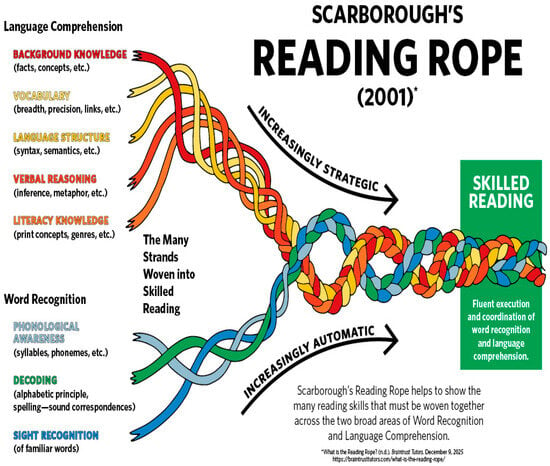
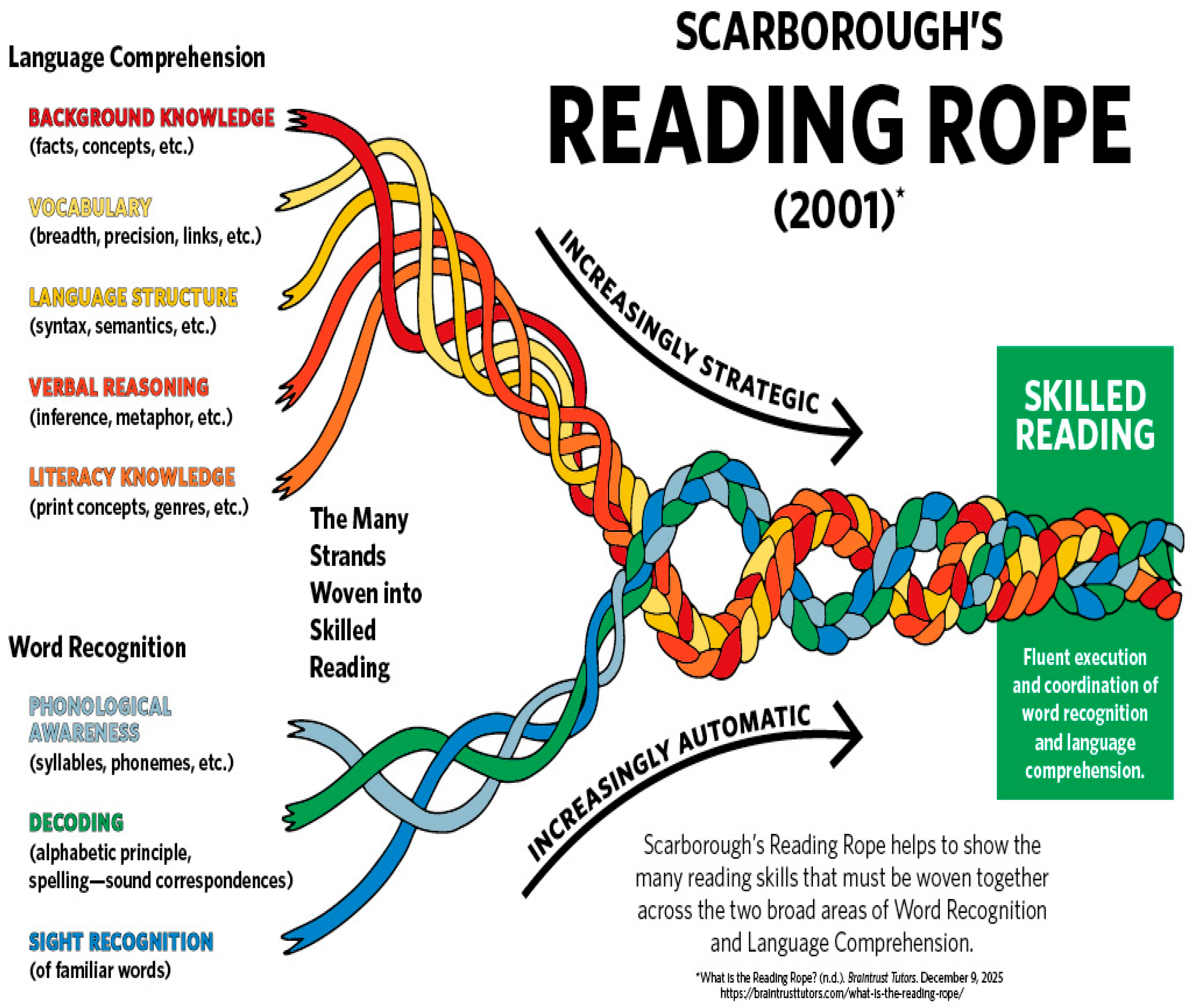
Scarborough’s Reading Rope (Scarborough, 2001) complements this theory, illustrating that proficient reading requires both language comprehension and word recognition skills. The upper strand represents language comprehension, and the lower strand symbolizes word recognition, with both elements intertwining to represent the complexity of learning to read. In summary, both the Simple View of Reading and Scarborough’s Reading Rope emphasize the importance of understanding and supporting the components of reading to enhance educational outcomes for children (see Figure 1).
Figure 1.
Scarborough’s reading rope (Braintrust Tutors, n.d.). Note. Adapted from (Scarborough, 2001).
1.1.2. Theory of Second Language Acquisition
The second language acquisition theory emphasizes that language acquisition occurs through meaningful interaction in the target language (Schutz, 2019). It prioritizes the message conveyed by words over their form. Therefore, comprehensible input is key to natural acquisition. Krashen (1998) identifies five hypotheses for second language acquisition: the acquisition-learning hypothesis, the monitor hypothesis, the input hypothesis, the affective filter hypothesis, and the natural order hypothesis.
According to Krashen (Schutz, 2019), foreign languages have two independent systems of performance: the ‘acquired system/acquisition system’ and the ‘learned system.’ The acquisition-learning hypothesis develops similarly to how children learn their first language through natural communication, while the learned system involves a teacher-centered, deductive approach (Schutz, 2019). Krashen contends that acquisition is more vital than formal learning.
The monitor hypothesis highlights the relationship between acquisition and learning, explaining that learners can use a “monitor” for planning and correcting when they know the rules (Schutz, 2019). Learners may fall into ‘under-user’ or ‘over-user’ categories based on their monitor use.
The input hypothesis emphasizes that learners progress at different rates depending on the input they receive (Schutz, 2019). Since not all learners progress at the same rate, Krashen (Schutz, 2019) suggests following a natural communicative input when designing a syllabus for appropriate linguistic competence.
The affective filter hypothesis identifies factors like motivation and confidence as critical to success in language acquisition. According to Krashen (Schutz, 2019), learners with high motivation, self-confidence, good image, and low stress are better equipped to succeed in second language acquisition.
Lastly, the natural order hypothesis suggests that grammatical acquisition follows a predictable sequence that is not affected by external factors. The predictable order is independent of the learner’s age, L1 acquisition, exposure, etc.
While critics have pointed out that Krashen’s (1998) hypotheses are broad and difficult to test empirically, their impact on foreign language education remains significant. Despite these critiques, Krashen’s (1998) theories have had a lasting effect on language teaching methodologies. His focus on comprehensible input and the importance of a low-anxiety learning environment has influenced many modern, communicative, and immersive teaching approaches. Although empirical validation is challenging, many educators report positive outcomes when applying these principles in real-world classrooms. For this reason, we have used Krashen’s (1998) work as an example, due to its practical applicability in creating effective learning environments that promote motivation and language acquisition. The strengths of his theories, especially in guiding input-driven and student-centered practices, justify their relevance, even amid ongoing debate about their empirical testability. Overall, Krashen’s (1998) theory advocates for educational practices that enhance enthusiasm, improve input quality, reduce anxiety, and develop communicative competence in second language learners. The Theory emphasizes a natural sequence in how second language learners acquire their target language, English (L2), for DLLs.
2. Literature Review Search Procedures
The present literature review builds on the findings of Duran et al. (2016). Duran et al. (2016) is a systematic review to determine the effectiveness of bilingual or home language intervention on DLLs who are Spanish speakers with language impairment or at risk of a language impairment aged two to six years. The current literature review covers the period from 1 January 2000 to 31 May 2024, compared to Duran et al. (2016), who searched till 2015. In contrast to the review by Duran et al. (2016), this literature review has more defined and inclusive criteria to include a larger sample of studies; it consists of a diverse population, not just young DLLs who speak Spanish. The review will focus on the early school years as they are considered the foundation for academic outcomes (Gándara & Escamilla, 2016). The synthesis will also list various evidence-based early intervention practices highlighting the child’s natural environment. The literature explored the caregiver-based intervention strategy that significantly influences the child. Therefore, the review emphasizes the importance of early language intervention strategies considered effective for DLL’s literacy development.
2.1. Literature Review Purpose
The purpose of this review is to (a) review the extant literature on early language intervention for DLLs who are at risk for language delays and other developmental delays, (b) examine what language interventions are effective for birth–five-year-old DLLs who are at risk for a disability between 2000 and 2024, and (c) identify gaps in the research and determine future needs.
The review focused on the early childhood years, because they are considered the foundation for academic outcomes, as mentioned earlier (Bialystok, 2018). In addition, this review focuses on studies conducted till May 2024, emphasizing family and team collaboration in the intervention process for DLLs at risk of a developmental delay. Therefore, the setting for the literature review would be the child’s natural environment, such as home, early childhood centers, clinics, etc. Finally, the review is restricted to reliable empirical studies to form conclusions on primary education in the United States. Reviews like this will help educators, policymakers, and researchers understand the linguistic developmental needs of DLLs (Hammer et al., 2014).
The following research questions guided the literature review:
- What is the trend in published, peer-reviewed intervention research in the last 20+ years for young DLLs aged birth–five years who have or are at risk for language impairment?
- What evidence-based intervention research has been conducted with young DLLs from birth through five years of age with disabilities involving families and caregivers?
- What culturally relevant strategies from these studies can be recommended for future research and practices concerning young DLLs?
2.2. Inclusion Criteria
For a research study to be included in the literature review, first, it must describe children from homes where a language other than English is spoken or who are exposed to English when enrolled in an intervention or educational program. Second, it must be published in a peer-reviewed journal in English between 2000 and 2024. Third, the articles must focus on DLLs with or at risk for a disability. Fourth, they include young DLLs aged between birth to five years of age. Fifth, they measure some aspects of language as the outcome variable (receptive/expressive, vocabulary, syntax, morphology, phonology, or a combination of the factors listed). Sixth, they describe language intervention from birth to five years. Seventh, they employ an experimental group design, a quasi-experimental design, or a single-case design (SCD) to test the efficacy of the intervention.
Furthermore, articles were excluded if:
- They were not empirically based research focusing on children’s language and linguistic development from birth to five years in the past 20 years.
- If the studies included children going to kindergarten.
- If the study participants were solely parents and caregivers and the children were not involved in the intervention.
A comprehensive search was conducted to identify peer-reviewed journal articles that identify bilingual interventions or strategies for children aged between birth and five years who have been identified as being at risk for language delays.
2.2.1. Database Search
A two-step research procedure was implemented: (a) an electronic search and (b) a manual search with an ancestral review. A computer search was done on online databases, including ERIC, EBSCOhost, PubMed, PsycINFO, and Google Scholar. The key terms used to search for the relevant studies are as follows: “Dual language learner OR bilingual OR English language learner OR limited English proficiency” AND “Infant OR toddler OR preschool OR early childhood OR young children OR early development” AND “Strategy OR Intervention AND disability* OR impair* OR delay.” The key terms were limited to the title and abstract search only.
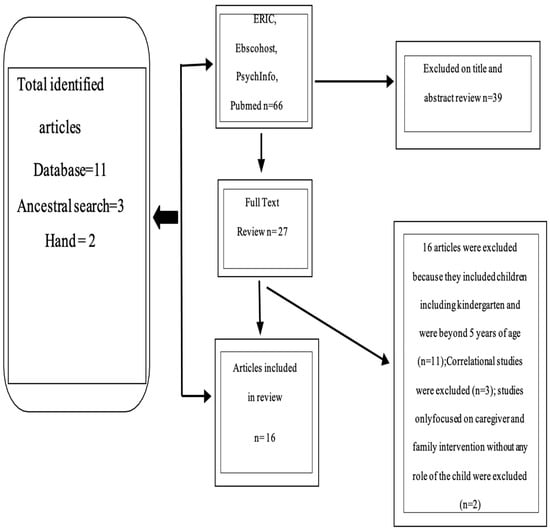
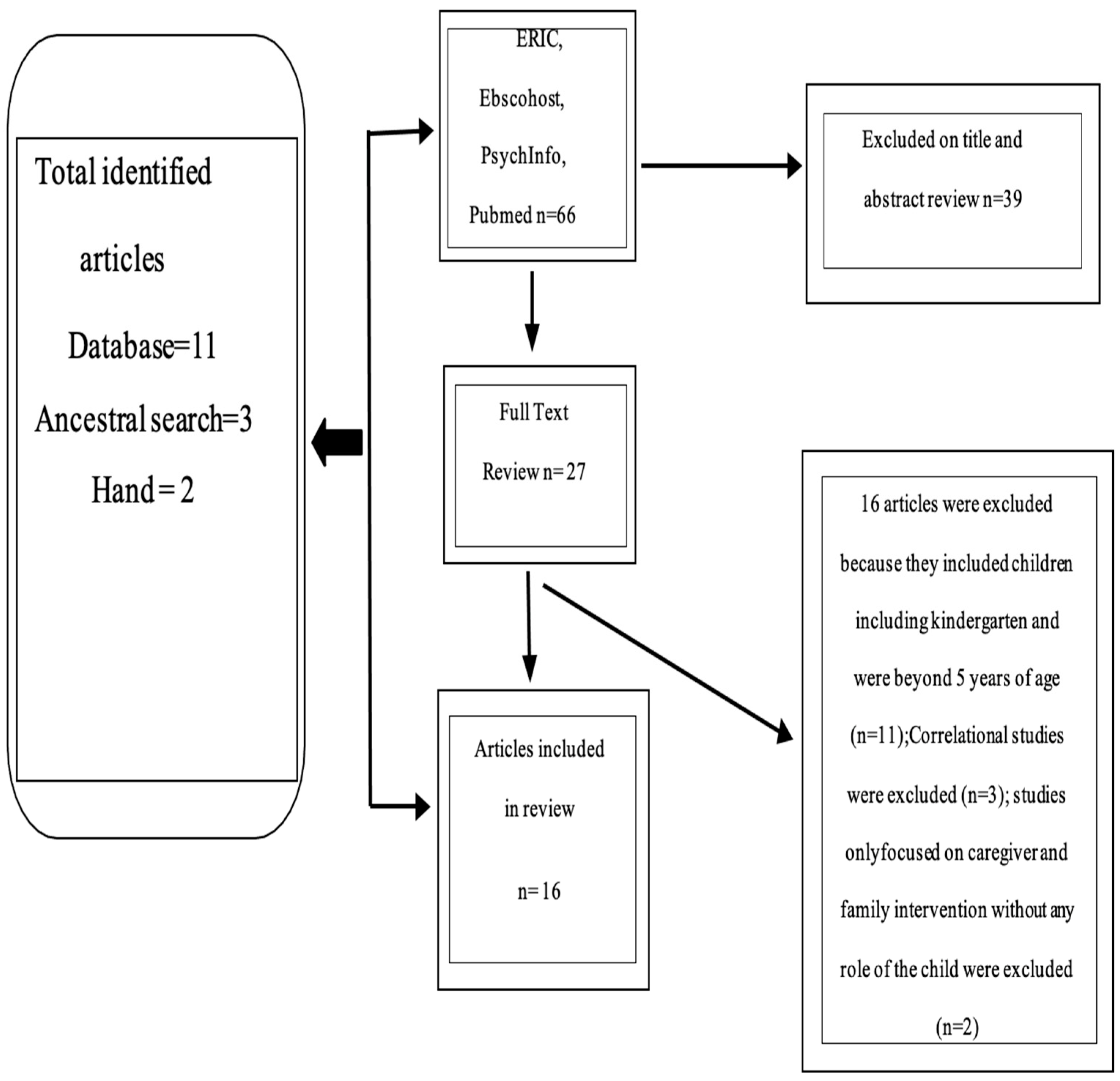
The search yielded 66 studies. Of these, 39 articles (59%) were excluded based on disqualifying information reported in article abstracts or because they were duplicates. The full texts of the remaining 27 articles (41%) were reviewed. Of these, the following articles were excluded: nine articles (33%) because they included children above five years of age; some used correlational research designs (11%); studies solely focused on caregiver or family intervention without any role of the child were excluded if there was no involvement of the child in the intervention process (7%). Eleven articles (41%) met the full inclusion criteria and were analyzed.
2.2.2. Ancestral Search
After the initial search, an ancestral investigation was conducted on the reference section of “(Duran et al., 2016)”. As a result, the ancestral search produced three additional articles.
2.2.3. Manual Search
Finally, a manual search was completed of all published articles in the following journals: Bilingual Research Journal, Exceptional Children and Young Exceptional Children, American Speech and Language Hearing, and Journal of Communication Disorders. These journals were selected as the final articles appeared in these journals. Moreover, the aims and focuses of the journals were on publishing peer-reviewed evidence-based research on DLLs who are birth through 5 years and are at risk for delay or disability. This manual search began with articles published in 2018 and concluded with articles published by 31 May 2024. The manual search identified new articles (n-2) meeting the inclusion criteria (Figure 2 presents a graphical representation of the search process).
Figure 2.
Search Process.
A total of 16 articles met inclusion criteria and were coded (Hargrave & Sénéchal, 2000; Bernhard et al., 2006; Roberts, 2008; Farver et al., 2009; V. F. Gutiérrez-Clellen & Simon-Cereijido, 2009; Tsybina & Eriks-Brophy, 2010; Pham et al., 2011; V. Gutiérrez-Clellen et al., 2012; Simon-Cereijido et al., 2013; Restrepo et al., 2013; Simon-Cereijido & Gutiérrez-Clellen, 2014; Huennekens & Xu, 2016; Méndez & Simon-Cereijido, 2019; Zhou et al., 2019; Pérez et al., 2021; Rollins et al., 2022). Table A1 represents duration of intervention of the selected articles, Table A2 represents intervention studies shortlisted based on the inclusion criteria, and Table A3 represents journal article type and scope in Appendix A.
3. Literature Review Results
The search found 16 intervention studies that met the inclusion criteria and were published between 2000 and 2024. The studies included 1313 child participants whose age ranged from 18 months to five years of age. Twelve (75%) studies mentioned the participants’ gender, mentioning the number of boys and girls participating. Five hundred and forty boys (49%) and five hundred and fifty-three (51%) girls participated in the studies. Four studies (25%) did not report the participants’ gender, and eight (8%) had parents as participants in the intervention process.
3.1. Intervention Description and Characteristics
Subsequent studies measured aspects of language development: Out of the 16 studies, 8 studies (50%) measured receptive (the ability to understand language and spoken words), vocabulary development (learning new words), and expressive vocabulary (the ability to make choices, ask questions, and describe events).
Three studies (19%) measured vocabulary acquisition; two studies (13%) measured standard receptive and vocabulary; two studies (n = 2, 13%) measure sensory, speech, and lexical-grammatical skills; one study (7%) estimates expressive, communication, and language.
The studies’ contexts are mainly educational settings, some including home and school. Of 16 studies, 11 (69%) occurred in school, daycare, and special education classrooms. Two studies (13%) were conducted at home. Two studies (13%) were performed at home and school combined, and one (7%) was born at home and daycare combined.
3.1.1. Country/Ethnicity
Across the 16 studies, 14 (88%) were conducted in the USA, while two (12%) were conducted in Canada. Among these studies, five (31%) included participants who identified as Latino. One of these studies had a diverse group of participants, including Latino, Hispanic, African American, and Caucasian participants, among other ethnicities.
Two studies (12%) had participants of Hispanic ethnicity, out of which one study (6%) had Hispanic participants with Latino, African American, and Caucasian participants, among others. Two studies (12%) had Hmong, Ukrainian, Portuguese, Japanese, Vietnamese, Chinese, Tigrinya, Romanian, Hindi, and German participants; one study (6%) had Mexican American participants, one study (6%) had Vietnamese participants, and one study (6%) had Asian and Black/African American participants.
3.1.2. Type of Disabilities
Among the 16 studies, a diverse range of disabilities were evident among the participating children. Eight (50%) focused on specific language impairments, one (6%) focused on expressive vocabulary delays, one (6%) focused on moderate–severe language delays, one (6%) focused on hearing difficulties, one (6%) focused on developmental language delays, two (12%) focused on language impairment, and two (12%) focused on autism spectrum disorder.
3.1.3. Research Design
Across the 16 identified studies, two distinct research designs (n = 2) were employed to assess the effectiveness of the intervention: a group design (82%) and a single case design (18%). This methodological diversity underscores the rigorous approach taken in these studies.
3.2. Intervention Strategies
Based on the systematic review search, 16 studies described the following strategies. Although the terms used for the different intervention strategies in each source varied, they have been collated into the following themes.
3.2.1. Theme 1: Caregiver-Based Strategies
Caregiver-based strategies are a collection of educational resources developed by family and friend caregivers who provide care and support for young children at home or in a healthcare setting (Kaelin et al., 2024). The caregiver-based approach suits the caregiver’s cultural background and interaction style. The family’s education level on bilingualism, language development, and early literacy development was considered. These strategies had recommendation, including child–parent interaction, cooperative play activities such as picture naming guidance, and interactive book reading.
The caregiver-based strategies mainly included storytelling, teachers’ narratives, vocabulary instruction, and Dialogic Reading intervention strategies such as engaging children in the shared book reading experience. Previous research has shown a need for bilingual activities like Shared Reading practices and culturally relevant reading. Promising recommendations included asking comprehension and recall questions suggested by eight of the studies (Bernhard et al., 2006; Farver et al., 2009; V. F. Gutiérrez-Clellen & Simon-Cereijido, 2009; Hargrave & Sénéchal, 2000; Huennekens & Xu, 2016; Tsybina & Eriks-Brophy, 2010; Restrepo et al., 2013). Recommendations based on the outcomes included teaching new words or phrases in verbs and learning small sentences. Numerous recommendations needed to be stronger, including using bilingual books/reading activities in both languages and repeated reading of the same book. Bernhard et al. (2006) conducted a language intervention strategy that involves creating bilingual student self-authored identity texts called the Early Author Program (EAP). The intervention focuses on the optimum use of space and opportunities for DLL’s language development (Bernhard et al., 2006). EAP combines effective teaching, valuing home language, and cognitive engagement in the learning process based on a child’s family history, life, and interests (Bernhard et al., 2006). The program positively affected children’s language scores and strengthens their identity and self-esteem (Bernhard et al., 2006).
Farver et al. (2009) designed phonological awareness activities, including word games like picture puzzles and other manipulatives, which led to the development of phonological awareness after children’s preliteracy skills were assessed. Initial activities focused on sounds and small group activities that used pictures, letters, and writing to teach children alphabets, recognizing letters, matching letters, and selecting their names from a group of characters using an English-only curriculum (Farver et al., 2009).
Hargrave and Sénéchal (2000) tested the benefits of storybook reading when children were active participants compared to children who participated in regularly shared reading situations. Children in the Dialogic Reading group made more progress in vocabulary and expressive vocabulary than in regular book reading through an English-only curriculum (Hargrave & Sénéchal, 2000).
Huennekens and Xu (2016) conducted an early reading intervention focusing on phonological awareness, alphabetic knowledge, and interactive reading strategies through an English-only curriculum. They used the Get Ready to Read (GRTR) screening tool. They also implemented 20 min books with colorful pictures, rhymes, and pattern storylines (Huennekens & Xu, 2016). They also implemented 20 min shared reading sessions for six weeks (Huennekens & Xu, 2016).
Tsybina and Eriks-Brophy (2010) conducted a Dialogic Reading intervention using target words for six weeks under two conditions: English-only and bilingual. A post-test follow-up occurred after six weeks of intervention (Tsybina & Eriks-Brophy, 2010). Restrepo et al. (2013) also focused on early language and literacy interventions like Tsybina and Eriks-Brophy (2010). Restrepo et al. (2013) simultaneously conducted a Dialogic Reading intervention in English and children’s home language for 12 weeks. The intervention was focused on vocabulary acquisition through target words in English and the home language, followed by post-intervention (Restrepo et al., 2013).
3.2.2. Theme 2: Language Intervention Strategies
Language intervention strategies are instructional techniques that help improve language skills such as vocabulary, articulation of ideas, and spoken expression. They are the foundation for literacy and learning (Fricke et al., 2013). Six (n = 6, 38%) articles supported five compelling recommendations, which included expanding the child’s comments, teaching narratives/storytelling, focused stimulation, cross-linguistic referencing, and enhanced vocabulary instruction, teaching new words/short phrases with verbs and learning numbers (V. Gutiérrez-Clellen et al., 2012; Méndez & Simon-Cereijido, 2019; Pham et al., 2011; Roberts, 2008; Simon-Cereijido et al., 2013; Simon-Cereijido & Gutiérrez-Clellen, 2014; Zhou et al., 2019).
V. Gutiérrez-Clellen et al. (2012) conducted a randomized control trial to determine the effect of the above-and-beyond language used by other service providers on the child. After a pretest, the intervention began, where children participated in academic enrichment activities in small groups (V. Gutiérrez-Clellen et al., 2012). The lessons included curriculum-based activities like picture sorting, manipulatives, and storytelling to facilitate vocabulary development and numeracy skills (V. Gutiérrez-Clellen et al., 2012). The intervention teacher is intended to measure aspects of preparedness in the child as the teacher alternates the language of instructions each day (V. Gutiérrez-Clellen et al., 2012). Each lesson is taught in Spanish, followed by the same address in English on a consecutive day using the same book (V. Gutiérrez-Clellen et al., 2012).
Méndez and Simon-Cereijido (2019) conducted language intervention through picture naming, English picture vocabulary, and other illustration forms. Pham et al. (2011) conducted an eight-month language intervention to identify target words, speech, and phonological awareness for preschoolers. Both English-only and bilingual curriculum was used. Roberts (2008) conducted two six-week experimental storybook reading sessions, illustrating vocabulary words, 3D word picturing pictures, and shared storybook intervention in English.
Simon-Cereijido et al. (2013) randomly assigned children to English-only and bilingual groups. The language intervention measured the child’s level of language development, socio-emotional skills, and English use (Simon-Cereijido et al., 2013). In the bilingual enrichment group, children were encouraged to match their language usage to the day’s language of instruction by using the same books for each language (Simon-Cereijido et al., 2013). Simon-Cereijido and Gutiérrez-Clellen (2014) initiated the Vocab, Oral Language, and Academic Readiness Language, and Academic Readiness Program (VOLAR), designed for DLLs who are preschoolers with language impairment. The curriculum emphasized vocabulary and conceptual development to facilitate language comprehension and academic readiness in Spanish and English to improve oral language skills, as children with language impairment require intensive and focused language stimulation (Simon-Cereijido & Gutiérrez-Clellen, 2014).
Lastly, Zhou et al. (2019) focused on ESDM in a bilingual and English-only setting, a parent-delivered intervention followed by two years of intensive developmentally appropriate community-based intervention. It focused on social interaction, applied behavior, and independent play activities (Zhou et al., 2019).
3.2.3. Theme 3: Interactive Strategies
Interaction strategies are techniques or approaches in communication, collaboration, support, and feedback that support teaching and learning (Senthamarai, 2018). Two studies (n = 2, 13%) recommended interactive-based strategies, including technology (Pérez et al., 2021; Rollins et al., 2022). Pérez et al. (2021) had an app-based approach to creating a language training program called Teach-Model-Coach-Review, where mothers were trained to interact with their children using language facilitation strategies (Completion, Distancing, and Questioning) while reading to their child using the app. The computer-based tool helped mothers implement evidence-based language strategies at home (Pérez et al., 2021). These included an evidence-based strategy for children with autism and language delay based on parent–child interaction, using several words and expressive vocabulary (Pérez et al., 2021). Hence, allocating attention to parents’ speech helps in social orienting. The results support approaches to intervention that encourage joint attention within developmentally appropriate activities like following routines.
Rollins et al. (2022) focused on developing a behavior intervention program and experienced vocabulary using technology. In this study, participants participated in a randomized control trial focused on parent–child interaction, expressive language, the number of different communication intents, and responses to parents’ preceding utterances and social communication (Rollins et al., 2022). Results of the study show that children with autism and language delays use expressive vocabulary to respond to parents’ speech (Rollins et al., 2022). Therefore, designing a rudimentary form of social orientation by encouraging more mature social attention is advisable for language development.
4. Discussion
The review provided crucial insight into research describing the language and literacy development of DLLs with developmental delays or at risk of experiencing a language delay or any developmental delay. Such a review helps make provisions needed for DLLs entering the school system in the U.S. It also highlights the importance of children’s early language and literacy development for later academic success.
The review’s findings indicate that intervention studies focusing on children with disabilities or at risk vary based on their country of origin and exposure to two languages. The synthesis emphasizes young DLL’s language and literacy development within a culturally relevant context. It explicitly highlights the importance of interactive opportunities for young children with their family members and instructors who honor the cultural background of these children through effective evidence-based intervention practices in a conducive environment in the classroom for language and literacy acquisition. Interventions that have demonstrated positive effects include reading strategies, systematic vocabulary intervention, Dialogic Reading, and shared reading strategies. Several factors influence early language intervention; steps are needed to make cultural modifications by considering the background, interaction style, and priorities of the young DLL’s and their families/caregivers for the intervention strategies to be effective. This aspect must be investigated as it is currently lacking in existing literature.
A significant limitation of this review is the lack of diversity in the research. Although the review included DLLs, the majority of the identified studies focused on Spanish–English bilingual children. Additionally, the included studies varied considerably in their research designs, intervention durations, and outcome measures. Such heterogeneity in methodology makes it difficult to compare results across studies.
Future reviews can (a) conduct follow-up studies to examine outcomes with a larger sample over a more extended period and to compare intervention effectiveness with similar programs; (b) incorporate different designs better to evaluate the intervention features, including randomization of participants, using a comparison group, or conducting in-depth qualitative research to understand better which specific feature(s) of the intervention was the most influential or beneficial to the participants; (c) include more diverse populations; (d) assess the progress of the DLLs with more standardized tools normed according to the standards of the diverse population; (e) attempt to fill in the gap in the literature on the lack of early intervention practices for DLLs who have some language and other developmental delays.
5. Conclusions
The literature review highlights the adaptability of the strategies for a bilingual approach. Teachers can alternate the language of daily instruction between English and their home language on consecutive days using the same book, a method that can be adjusted to different contexts. This approach, along with the use of engaging, illustrative materials, has shown to be beneficial for children with language impairment. It allows them to transfer syntactical skills from L1 to L2 using words and phrases with similar sentence structures. As children with language delays require intensive and focused language stimulation, the selection of books with many illustrations, picture sorting, manipulatives, word definitions, and semantic association will improve their lexical and conceptual learning, as the review explains.
Author Contributions
Conceptualization/Introduction, E.G. and R.B.; Theoretical Framework, E.G. and R.B.; Literature Review Search Procedures, E.G.; Literature Review Results, E.G.; Discussion, E.G. and R.B.; Conclusion, E.G. and R.B. All authors have read and agreed to the published version of the manuscript.
Funding
This research received no external funding.
Institutional Review Board Statement
Not applicable as it is a review.
Informed Consent Statement
Not applicable as this is a literature review.
Data Availability Statement
No new data were created or analyzed in this study. Data sharing is not applicable to this article.
Conflicts of Interest
The authors declare no conflict of interest.
Appendix A
Table A1.
Duration of intervention of the selected articles.
Table A2.
Intervention studies shortlisted based on the inclusion criteria.
Table A3.
Journal article type and scope.
References
- Bernhard, J. K., Winsler, A., Bleiker, C., Ginieniewicz, J., & Madigan, A. L. (2006). Read my story! Using the early authors program to promote early literacy among diverse, urban preschool children in poverty. Journal of Educational Psychology, 98(1), 50–64. [Google Scholar] [CrossRef] [Scilit]
- Bialystok, E. (2018). Bilingual education for young children: Review of the effects and consequences. International Journal of Bilingual Education and Bilingualism, 21(6), 666–679. [Google Scholar] [CrossRef] [Scilit] [PubMed]
- Braintrust Tutors. (n.d.). Waht is the reading rope? Available online: https://braintrusttutors.com/what-is-the-reading-rope (accessed on 9 December 2025).
- Braun, G., Kumm, S., Brown, C., Walter, S., Hughes, M. T., & Maggin, D. M. (2020). Living in tier 2: Educators’ perceptions of MTSS in urban schools. International Journal of Inclusive Education, 24(10), 1114–1128. [Google Scholar] [CrossRef] [Scilit]
- Durán, L. K., Hartzheim, D., Lund, E. M., Simonsmeier, V., & Kohlmeier, T. L. (2016). Bilingual and home language interventions with young dual language learners: A research synthesis. Language, Speech, and Hearing Services in Schools, 47(4), 347–371. [Google Scholar] [CrossRef] [Scilit] [PubMed]
- Farver, J. A. M., Lonigan, C. J., & Eppe, S. (2009). Effective early literacy skill development for young Spanish—Speaking English language learners: An experimental study of two methods. Child Development, 80(3), 703–719. [Google Scholar] [CrossRef] [Scilit]
- Foorman, B., Dombek, J., & Smith, K. (2016). Seven elements important to successful implementation of early literacy intervention. New Directions for Child and Adolescent Development, 154, 49–65. [Google Scholar] [CrossRef] [Scilit]
- Fricke, S., Bowyer-Crane, C., Haley, A. J., Hulme, C., & Snowling, M. J. (2013). Efficacy of language intervention in the early years. Journal of Child Psychology and Psychiatry, 54(3), 280–290. [Google Scholar] [CrossRef] [Scilit]
- Gándara, P., & Escamilla, K. (2016). Bilingual education in the United States. In O. García, A. M. Y. Tse, & J. K. Gutiérrez (Eds.), Bilingual and multilingual education (pp. 1–14). Springer. [Google Scholar] [CrossRef] [Scilit]
- Gough, P. B., & Tunmer, W. E. (1986). Decoding, reading, and reading disability. Remedial and Special Education, 7(1), 6–10. [Google Scholar] [CrossRef] [Scilit]
- Guiberson, M. M., & Ferris, K. P. (2019). Early language interventions for young dual language learners: A scoping review. American Journal of Speech-Language Pathology, 28(3), 945–963. [Google Scholar] [CrossRef] [Scilit]
- Gutiérrez-Clellen, V., Simon-Cereijido, G., & Sweet, M. (2012). Predictors of second language acquisition in Latino children with specific language impairment. American Journal of Speech-Language Pathology, 21(1), 64–77. [Google Scholar] [CrossRef] [Scilit]
- Gutiérrez-Clellen, V. F., & Simon-Cereijido, G. (2009). Using language sampling in clinical assessments with bilingual children: Challenges and future directions. Seminars in Speech and Language, 30(4), 234–245. [Google Scholar] [CrossRef] [Scilit]
- Hammer, C. S., Hoff, E., Uchikoshi, Y., Gillanders, C., Castro, D. C., & Sandilos, L. E. (2014). The language and literacy development of young dual language learners: A Critical Review. Early Childhood Research Quarterly, 29(4), 715–733. [Google Scholar] [CrossRef] [Scilit] [PubMed]
- Hargrave, A. C., & Sénéchal, M. (2000). A book reading intervention with preschool children who have limited vocabularies: The benefits of regular reading and dialogic reading. Early Childhood Research Quarterly, 15(1), 75–90. [Google Scholar] [CrossRef] [Scilit]
- Huennekens, M. E., & Xu, Y. (2016). I am using dialogic reading to enhance the emergent literacy skills of young dual-language learners. Early Child Development and Care, 186(2), 324–340. [Google Scholar] [CrossRef] [Scilit]
- Kaelin, V. C., Saluja, S., Bosak, D. L., Anaby, D., Werler, M., & Khetani, M. A. (2024). Caregiver strategies supporting community participation among children and youth with or at risk for disabilities: A mixed-methods study. Frontiers in Pediatrics, 12, 1345755. [Google Scholar] [CrossRef] [Scilit]
- Kamhi, A. G. (2007). The role of the speech-language pathologist in providing intervention for reading problems. Language, Speech, and Hearing Services in Schools, 38(1), 61–72. [Google Scholar] [CrossRef] [Scilit]
- Keffala, B., Scarpino, S., Scheffner Hammer, C., Rodriguez, B. L., Lopez, L., & Goldstein, B. (2020). Vocabulary and phonological abilities affect dual language learners’ consonant production accuracy within and across languages: A large-scale study of 3- to 6-year-old Spanish-English dual language learners. American Journal of Speech-Language Pathology, 29(3), 1196–1211. [Google Scholar] [CrossRef] [Scilit]
- Krashen, S. D. (1998). Comprehensible output? System, 26(2), 175–182. [Google Scholar] [CrossRef] [Scilit]
- Lin, Z., McClelland, M. M., & Gunderson, L. (2023). Dual language learners: Influence of parent education & mobility on school readiness. Applied Developmental Science, 27(3), 101605. [Google Scholar] [CrossRef] [Scilit]
- Lonigan, C. J., Burgess, S. R., & Schatschneider, C. (2022). Word reading and language comprehension: Separating and integrating components of reading. Scientific Studies of Reading, 26(1), 1–17. [Google Scholar]
- Méndez, L. I., & Simon-Cereijido, G. (2019). A view of the lexical–grammatical link in young latinos with specific language impairment using language-specific and conceptual measures. Journal of Speech, Language, and Hearing Research, 62(6), 1775–1786. [Google Scholar] [CrossRef] [Scilit]
- National Center for Education Statistics. (2021). 2021 NAEP school and teacher questionnaire special study. U.S. Department of Education. Available online: https://nces.ed.gov/ (accessed on 9 December 2025).
- National Conference of State Legislatures. (2022). Dual language learners and early childhood education. NCSL. Available online: https://www.ncsl.org (accessed on 9 December 2025).
- Park, M., Zong, J., & Batalova, J. (2018). Growing superdiversity among young U.S. dual language learners and its implications. Migration Policy Institute. [Google Scholar]
- Pérez, M. V., Mancilla-Martínez, J., & Goldenberg, C. (2021). Interactive reading strategies and language development in young dual language learners. Early Childhood Research Quarterly, 56, 191–204. [Google Scholar] [CrossRef] [Scilit]
- Pham, G., Kohnert, K., & Mann, D. (2011). Addressing clinician-client mismatch: A preliminary intervention study with a bilingual Vietnamese-English preschooler. Language, Speech & Hearing Services in Schools, 42(4), 408–422. [Google Scholar] [CrossRef] [Scilit]
- Restrepo, M. A., Morgan, G. P., & Thompson, M. S. (2013). The efficacy of a vocabulary intervention for dual-language learners with language impairment. Journal of Speech, Language, and Hearing Research, 56(2), 748–765. [Google Scholar] [CrossRef] [PubMed]
- Roberts, T. A. (2008). Home storybook reading in primary or second language with preschool children: Evidence of equal effectiveness for second—Language vocabulary acquisition. Reading Research Quarterly, 43(2), 103–130. [Google Scholar] [CrossRef] [Scilit]
- Rollins, P. R., De Froy, A. M., Gajardo, S. A., & Brantley, S. (2022). Pragmatic contributions to early vocabulary and social communication in young autistic children with language and cognitive delays. Journal of Communication Disorders, 99, 106243. [Google Scholar] [CrossRef] [Scilit]
- Scarborough, H. S. (2001). Connecting early language and literacy to later reading (dis)abilities: Evidence, theory, and practice. In S. B. Neuman, & D. Dickinson (Eds.), Handbook for research in early literacy (pp. 97–110). Guilford Press. [Google Scholar]
- Schütz, R. E. (2019). Stephen Krashen’s theory of second language acquisition. English Made in Brazil. Available online: https://www.sk.com.br/sk-krash-english.html (accessed on 9 December 2025).
- Senthamarai, S. (2018). Interactive teaching strategies. Journal of Applied and Advanced Research, 3(1), S36–S38. [Google Scholar] [CrossRef] [Scilit]
- Simon-Cereijido, G., & Gutiérrez-Clellen, V. F. (2014). Bilingual education for all: Latino dual language learners with language disabilities. International Journal of Bilingual Education and Bilingualism, 17(2), 235–254. [Google Scholar] [CrossRef] [Scilit]
- Simon-Cereijido, G., Gutiérrez-Clellen, V. F., & Sweet, M. (2013). Predictors of growth or attrition of the first language in Latino children with specific language impairment. Applied Psycholinguistics, 34(6), 1219–1243. [Google Scholar] [CrossRef] [Scilit]
- Tsybina, I., & Eriks-Brophy, A. (2010). Bilingual dialogic book-reading intervention for preschoolers with slow expressive vocabulary development. Journal of Communication Disorders, 43(6), 538–556. [Google Scholar] [CrossRef] [Scilit]
- Weyer, M. (2018). Dual- and English-language learners. National Conference of Staff Legislatures. Available online: https://www.ncsl.org/research/education/english-dual-language-learners (accessed on 9 December 2025).
- Zhou, V., Munson, J. A., Greenson, J., Hou, Y., Rogers, S., & Estes, A. M. (2019). An exploratory longitudinal study of social and language outcomes in children with Autism in bilingual home environments. Autism, 23(2), 394–404. [Google Scholar] [CrossRef] [Scilit]
Disclaimer/Publisher’s Note: The statements, opinions and data contained in all publications are solely those of the individual author(s) and contributor(s) and not of MDPI and/or the editor(s). MDPI and/or the editor(s) disclaim responsibility for any injury to people or property resulting from any ideas, methods, instructions or products referred to in the content. |
© 2025 by the authors. Licensee MDPI, Basel, Switzerland. This article is an open access article distributed under the terms and conditions of the Creative Commons Attribution (CC BY) license (https://creativecommons.org/licenses/by/4.0/).