1. Introduction
The use of artificial intelligence (AI)-based tools and applications has increased dramatically since the beginning of the current decade. AI is a field in computer science that deals with the development of software and hardware that enables computer systems to perform operations similar to human intelligence (
Chassignol et al., 2018). This includes the development of algorithms that allow systems to learn from data, identify patterns, make predictions, and make decisions with minimal human intervention (
Bengio et al., 2021;
Chen et al., 2020). The term AI is not new and has appeared in the literature since the 1950s; however, there is no agreed-upon definition of AI in the academic and professional literature (
Abbass, 2021). One reason for this is that AI, in addition to computer science, is related to other sciences, such as life sciences, health sciences, and social sciences, with each scientific field defining it differently. Another reason for diverse definitions is that the term has evolved in line with technological developments over the years. A third reason is that a variety of AI-based applications and technologies are being rapidly integrated into every digital device, offering a wide range of forms and options that affect all areas of life, from industry and commerce to the diversity of services.
Despite these, several definitions need to be stated.
Bedizel (
2023) defined AI as computer systems with the ability to perform tasks that typically require human intelligence, such as learning, problem solving, decision making, perception, and natural language processing. Another definition of AI refers to the imitation of human cognitive processes, such as visual perception, speech recognition, and language translation by machines (
Braiki et al., 2020). These definitions focus on the capacity of computerized machines to mimic or simulate complex human cognitive functions. According to
Bostrom (
2020), AI technologies refer to the ability of artificial agents to perceive their environment, reason, and act to achieve their goals.
Abbass (
2021) offered two complementary definitions for AI: the first is automation of cognition and the second is a social and cognitive phenomenon that allows a machine to integrate socially, perform tasks that require cognition, and communicate socially by exchanging high-level messages and information. These descriptions emphasize the autonomy and ability of AI systems to make decisions and perform actions independently.
One of the breakthrough points of AI into the consciousness of the general public around the world was at the end of November 2022, when OpenAI Company launched ChatGPT 3.5, which quickly generated huge interest among Internet users around the world (
Nam & Bai, 2023). The launch of ChatGPT marked the beginning of increased exposure, leading to the rapid release of numerous applications and tools based on artificial intelligence by major technology corporations, including Google and Microsoft. The chatbots ChatGPT of OpenAI, Gemini of Google, and others are classified as a subfield of AI called generative artificial intelligence (GenAI). Nowadays, many GenAI tools are capable of producing new content, such as texts, images, and videos, based on user instructions, while relying on large databases and big data. GenAI can answer complex questions, summarize vast amounts of information, translate texts very fast, rearrange information, create complex images and videos, and automate many tasks performed previously by humans (
Dowling & Lucey, 2023;
Espinoza Vidaurre et al., 2024). The rapid technological advancements of GenAI, along with its frequently updated and improved versions, have contributed to its high popularity and swift adoption among private users, businesses, government organizations, and institutions, including higher education institutions (
Crompton & Burke, 2023;
Nam & Bai, 2023). The disruptive innovation of GenAI technologies affects all sectors of the economy, especially the higher education sector, which, among its roles, is to teach and train students for the future employment market optimally (
Almaraz-Menéndez et al., 2022;
T. Wang et al., 2023).
GenAI-based technological innovations are growing at an accelerated pace, both in terms of the wealth of advanced options and the intelligent capabilities of the applications. The media exposure and the availability of GenAI tools on the Internet and mobile, with the basic ones also being free, are leading to rapid adoption and increasing use among students in their academic studies. Approximately two years after the launch of the first version of ChatGPT there is a better familiarity with GenAI tools among students, and they have accumulated experience in using these tools. Additionally, more advanced versions and new GenAI-based applications offer advanced capabilities, new options, and uses that did not exist before. Therefore, in line with the empirical studies reviewed in this study, it is crucial to continue examining students’ attitudes toward GenAI tools, their contribution to academic learning effectiveness, and the need to understand their advantages and disadvantages, as well as the importance of risk awareness and ethical use within academic institutions.
The following sections of the study are structured as follows. First, a comprehensive review of the current literature will be presented, synthesizing insights and perspectives on the integration of GenAI into academic studies. This will be followed by a discussion of the results and conclusions from quantitative and qualitative studies on GenAI integration conducted over the past two years at academic institutions worldwide. These articles form the conceptual basis for conducting our study. Then, the methodology and hypotheses used to examine the variables will be presented. The discussion section will discuss the findings obtained, comparing the results to studies in the literature review. Finally, the conclusions and theoretical and practical insights regarding the pedagogical and administrative implications of this study will be presented, along with recommendations, limitations and contribution.
2. Literature Review
2.1. GenAI in Higher Education Challenges
Integrating AI technologies, especially GenAI Chabot in higher education institutions, poses many challenges: technical, managerial, pedagogical, and ethical in particular (
Almaraz-López et al., 2023;
Dabis & Csáki, 2024;
Soodan et al., 2024;
Zhang & Qian, 2024). From a technical perspective, integrating GenAI-based applications into existing technology systems necessitates adjustments and connections between various technologies, including enhanced information and cybersecurity technologies. From a managerial perspective, institutional managers need a good understanding of technological advantages and disadvantages, setting a clear policy for integrating and using AI technologies, strategic thinking, budgeting for advanced GenAI tools, and managing changes following disruptive innovation (
Almaraz-Menéndez et al., 2022). Assessing the pedagogical effectiveness and learning implications of GenAI Chabot is essential for formal integration into academic programs (
Soodan et al., 2024). The use of GenAI in academic frameworks has a very significant impact on both research methods and teaching practices of lecturers and on the learning processes of students. It enables daily use for innovative teaching and learning, creating new opportunities for improving pedagogical processes and empowering students’ learning (
Hwang & Chien, 2022;
Kiryakova & Angelova, 2023).
However, the expanding use of GenAI, especially chatbots, in higher education also raises concerns about how these powerful tools can be used ethically. GenAI’s ability to create texts and essays, even if pseudo-academic, tests the integrity of students on the one hand, and makes it difficult for lecturers in the process of examining students’ papers and exercises on the other (
Nam & Bai, 2023). Additionally, the increased use of GenAI Chabot’s technology to perform even simple academic tasks puts at risk the intellectual growth, professional skills that students acquire in their academic studies, as well as excessive reliance on Chabot’s conclusions weakens critical thinking and independent judgment which are academic cornerstones (
Ausat et al., 2023;
Chan & Hu, 2023;
Zhang & Qian, 2024). Additional concerns include misidentification of GenAI-generated texts, privacy issues, and even malicious use of GenAI. Academia must transparently address concerns such as plagiarism risks, bias in GenAI training, impacts on the workplace, and emphasize the importance of addressing ethical risks and developing frameworks for assessing GenAI in research and future implementation of GenAI in academia (
Soodan et al., 2024;
Yavich & Davidovitch, 2024).
Several scholars have examined the ethical implications and initial policy responses in higher education institutions regarding GenAI integration in academic settings.
Dabis and Csáki (
2024) conducted a content analysis of publicly available policy and guidelines documents from 30 leading universities regarding GenAI integration. Their research relies on five significant international frameworks issued by the United Nations, the European Union, and the OECD, from which several ethical principles have been derived that are relevant to higher education practices: accountability and responsibility, human oversight, transparency and explainability, and inclusiveness and diversity. Their research findings showed that initial responses of higher education institutions to the emergence of GenAI, especially after the launch of ChatGPT, initially ranged from blanket bans on using technologies to enthusiastic adoption. However, over time, leading institutions began to develop clear guidelines and policies, inspired by international ethical documents. The findings suggest that universities are actively exploring and leveraging the potential benefits of GenAI, but with a critical and cautious approach. They seek to harness opportunities while addressing emerging challenges. The core ethical principle is that students must complete assignments using the knowledge and skills they have acquired, with moral and legal responsibility ultimately resting on the individual. This “top-down” approach is often complemented by a “bottom-up” approach that gives lecturers room to maneuver in determining how to allow the use of GenAI in their courses. Good practices for human oversight include preventative measures (such as changing assessment methods) and soft processes based on dialog, while providing precise and transparent communication in the syllabus. Promoting GenAI inclusion is best achieved through proactive central support and focused resources, ensuring equal accessibility for all students.
Nam and Bai (
2023) showed that the arrival of ChatGPT has sparked widespread discussion and deep concerns about the ethical implications for the academic core: how knowledge is created (research and publishing), how it is transferred and acquired (teaching and learning), and the future of those involved in these fields (human resources). The researchers conducted a comparative analysis of 72 papers in the STEM fields (science, technology, engineering, and mathematics) published in four major media outlets. The discourse analysis shows a complex picture of ChatGPT integration in academia. On the one hand, potential benefits include assisting in data organization, improving writing, and saving time and resources; alternately, the primary focus is on identifying risks and ethical dilemmas. Their main ethical conclusion is the urgent and significant need to formulate clear rules, policies, and educational frameworks to deal with these challenges, while recognizing that AI cannot replace human responsibility and integrity in the academic system.
Additionally, according to
Soodan et al. (
2024), a judicious implementation of innovative GenAI Chabots within academic learning systems necessitates a series of coordinated strategies. First, a scrupulous alignment of the technology with specific academic tasks is required. Second, transparency regarding the potential risks inherent in the use of these tools is crucial. Third, academic institutions are required to formulate incentive policies to encourage the adoption of these technologies. Fourth, targeted messaging tailored to different disciplines should be developed to ensure relevance. Finally, collaboration with influential figures in the academic community can promote the integration of these tools. Moreover, enhancing user experience through personalization, collaborative features, and plagiarism detection mechanisms may further encourage broader adoption.
Furthermore,
Zhang and Qian (
2024) claimed that the integration of AI ethics issues in higher education institutions in China within professional curricula frequently receives less attention than developing knowledge and skills in professional courses. Furthermore, achieving a synergistic integration of these three educational imperatives presents a complex challenge. They propose to strengthen ethics regarding AI with three suggestions. First, the goals of ethics should correspond to the progression of knowledge and skills in the course system, while developing students’ awareness, sense of responsibility, understanding, and compliance with norms. Hierarchical, collaborative, and supportive relationships should be created between courses at different stages of training, and consistency, accuracy, and efficiency should be ensured through appropriate syllabus and assessment systems. Second, the ethics subject is taught as implicit education, whereas a higher level of integration is required, and it is taught as explicit education. Trait modifications are necessary to achieve an ideal balance in which ethical values are actively integrated into the acquisition of knowledge and skills throughout the teaching process. Third, implementing ethics in courses requires close integration and coordination throughout the training process, a kind of practical path that is built on coherence between successive courses along a timeline and parallel synergy between different courses at the same stage of content, methodology, and tools within the courses, according to the changing characteristics as the learning process progresses. According to the authors, developing an ethics education system for AI, structured around three stages, and integrating it into the academic learning process will enhance students’ ethical understanding of AI.
2.2. Students’ Learning Effectiveness and Attitudes Toward GenAI
A study examining the factors influencing university students’ intentions to use AI found that perceived ease of use and perceived usefulness were the most significant factors directly influencing students’ intentions to use AI in their learning. Factors such as self-efficacy, perceived enjoyment, and perceived playfulness were found to affect perceived ease of use positively. Others, such as job relevance, output quality, and result demonstrability, positively affect perceived usefulness. Moreover, it was found that perceived ease of use had a significant positive effect on perceived usefulness (
Duy et al., 2025). The results of
Alzahrani’s (
2023) study found that performance expectancy, facilitating conditions, and technology awareness significantly and positively affected the attitudes and behavioral intentions of higher education students to use AI technologies. In contrast, effort expectancy did not significantly affect attitudes toward using AI, while perceived risk negatively affected students’ attitudes. The researcher concluded that addressing security and privacy issues can reduce perceived risk, focusing on the usability of AI systems to strengthen performance and effort, and thus encourage wider adoption of AI in higher education. Another study examined the impact of different learn agents (AI/ChatGPT, human expert, checklist tools, and a control group) on motivation, self-regulated learning processes, and learning performance among university students. The main conclusion of the researchers was that AI, such as ChatGPT, can enhance short-term task performance, particularly for tasks with clear criteria. However, it may not boost intrinsic motivation or contribute to long-term knowledge acquisition and transfer, and may create overdependence on AI, causing metacognitive laziness among students (
Fan et al., 2025).
An additional study conducted among 500 nursing students examined the relationship between attitudes toward AI and creative personality traits. The results of the study showed high positive attitudes toward AI, as well as high creative personality traits. A significant positive relationship was also found; the higher the students’ creative personality traits, the more positive their attitudes toward AI tend to be. The researchers also identify socio-demographic factors, such as gender, prior participation in creative activities, and level of technological inclination, as significantly influencing students’ attitudes toward AI. As part of their conclusions, they note the need to develop regulations and ethical policies for the use of AI, and the importance of developing creativity as a significant component for the effective integration of AI technologies into nursing practice in accordance with international standards (
Gülırmak Güler & Şen Atasayar, 2025). In another study involving approximately 700 medical students, most participants expressed positive attitudes toward AI in medical education, viewing it as an effective and reliable learning tool that optimizes study time, provides up-to-date medical information, and is considered more effective than traditional tools for understanding complex medical concepts. The researchers report a significant difference in attitudes between “technologists” and “non-technologists,” with the former having a more positive attitude and tending to use AI more for learning and trusting its reliability. The researchers conclude that the integration of AI tools is critical to preparing medical professionals for a technology-driven healthcare future, and note that regulation and policy are needed to regulate the use of AI and ensure ethical standards (
Sami et al., 2025).
Research results from
Yilmaz and Yilmaz (
2023) showed that using ChatGPT for teaching programming statistically significantly increased the computational thinking skills, sense of self-efficacy in programming, and motivation for the lesson of students in the experimental group compared to the control group. In terms of computational thinking skills, an improvement was found in all dimensions tested: creativity, algorithmic thinking, collaboration, critical thinking, and problem solving. A significant improvement was observed in programming self-efficacy, both for simple and complex tasks. In terms of motivation, the experimental group also showed a significant increase across most dimensions compared to the control group. The main conclusion from the study is that integrating AI technologies such as ChatGPT into programming teaching may be beneficial for learning processes and their outcomes. However, the researchers note that in order to get the most out of these tools, it is important to develop students’ thinking and imagination skills, and, in particular, to learn the skills of writing effective prompts for AI systems. In a study by
Chan and Hu (
2023) among approximately 400 students in Hong Kong, it was found that students have a generally positive attitude toward GenAI in teaching and learning, are familiar with these technologies, and know how to use them. The students expressed a willingness to integrate GenAI into their studies and professional future. They pointed to many potential benefits, including personalized support for learning, assistance with writing and brainstorming, help with research and analysis, and completion of administrative tasks. However, the students also mentioned significant concerns, such as inaccuracy and lack of transparency, privacy and ethical issues, such as plagiarism, over-reliance, and harm to the development of critical and creative thinking skills, including implications for professional career prospects.
Other studies have shown less encouraging results. In a study by
Gasaymeh et al. (
2024), students reported moderate familiarity with AI-based writing tools, low technical knowledge, concerns about security and privacy, as well as misinformation and manipulation. However, students expressed interest in AI tools and recognized their potential benefits for fostering creativity and innovation. The study found no significant differences based on gender or degree level. The study concluded that to maximize the benefits of academic studies, significant improvements in technical familiarity with AI tools are required and that students’ concern need to be addressed.
Săseanu et al. (
2024) showed that students in higher years of study in Romania see AI as having a positive impact and the ability to improve learning experiences, more so than students in the first years, and that male students are more confident in using AI tools than female students. It was also found that as students approach graduation, they fear losing their jobs to advances in AI technologies, believing that AI will initially cause job losses before fostering a more intelligent and skilled workforce.
Okulich-Kazarin et al. (
2024) examined the perceptions of 1104 students from Eastern European universities regarding the AI threat in higher education in the next five years. The findings showed that a significant number of students do indeed see AI as a threat to higher education. The study concluded that a “safe learning environment” is not ensured for a significant number of students due to the perceived threat of AI, and that the use of AI in higher education could give rise to serious systemic problems. Therefore, there is an urgent need to design and implement a set of organizational, pedagogical, and methodological measures to address student concerns and ensure a safe learning environment. Another study examined the knowledge, attitudes, and perceptions of 384 dental students toward AI. The findings revealed that only half of the subjects possessed basic knowledge of AI and were aware of its applications in their field of specialization, with social media being the most common source of learning about AI applications. Students found the use of diagnostic AI “exciting” and agreed that its most prominent role lies in predicting oral disease. One of the key conclusions was that there is a need to include and increase training in AI in dental schools (
Elchaghaby & Wahby, 2025).
The scope of the studies described above, conducted in a relatively short period, indicates the popularity that GenAI tools have gained among students in academic institutions, and the need to conduct additional studies that examine the impact of integrating these tools as an integral part of academic studying. A significant portion of the studies in the review examined students’ attitudes or perceptions, with some focusing on the standard GenAI tool ChatGPT and others involving students from a single discipline. Further to this, in the current study, we aim to expand the research knowledge base by examining students from different fields of knowledge who utilize a variety of GenAI tools in their studies. This includes not only examining their attitudes but also their learning effectiveness in using these tools. We also aim to expand our study by examining additional variables and factors that influence students’ attitudes, satisfaction, and learning effectiveness when using GenAI tools in academic study. This study will enhance the research literature in this dynamic field, and its results will contribute to the academic discourse on integrating GenAI tools and their impact on students’ learning.
In light of this, our study aims to investigate students’ attitudes and satisfaction with the use of GenAI tools, as well as their effectiveness of learning through these innovative tools. Additionally, to examine the influences of accumulated experience, frequency of use, and the variety of GenAI tools that students use for their educational needs on the three variables above. The study will also examine intriguing effects of variables related to learning using GenAI, such as practical training on GenAI tools, ethical knowledge for proper use, realization of learning goals, and academic assignments among students. The research will also examine the demographic variables of the students and their impact on attitudes, satisfaction, and learning effectiveness. We believe that continuously examining students’ use of GenAI tools over time is crucial, given the tools’ constant evolution and rapid change, as well as the personal experience students accumulate while using them, often daily. Previous studies have shown that students’ prior experience using a particular technology directly influences their attitudes toward the learning process, their satisfaction with the use of technology, their perceptions of learning effectiveness, and learning outcomes (
Bahasoan et al., 2020;
Carmi, 2023;
Haand & Tareen, 2020;
Daher & Hussein, 2024;
Q. Y. Wang et al., 2018). Thus, prior experience using a technological tool may influence the way students learn, their patterns of use, the educational benefits they derive from the tool, and the strategies and techniques they employ to navigate digital environments based on high technologies. Moreover, a personal experience gives students better coping skills and more advanced use of technological tools to achieve educational purposes.
In accordance with the topic of this study, learning effectiveness consists of four important and common learning components, which, in our opinion, are very much needed for learning in academia: skills, motivation, benefits, and understanding. Effectiveness in learning is created and developed when students acquire new technological skills and refine existing skills due to the active use of GenAI tools in their studies. Motivation to learn and use GenAI tools is crucial for effectiveness, as it fosters a desire to experiment with new tools, encourages learning, and directly impacts the time utilization and investment of students in the learning process and their learning through these tools. Benefits are created when learners feel that they gain more from learning through these innovative tools, they see clear advantages, and that it contributes to their personal development. Moreover, a better and faster understanding of study content in various fields, along with support in performing study tasks, occurs with the assistance of autonomous intelligent GenAI tools that work independently. The four components above appear in the research literature in education as significant factors for effective learning (
Means et al., 2013). The components are interrelated and influence each other in every educational activity, and constitute substantial foundations for developing existing knowledge and building new ones as part of acquiring an academic education. Additionally, the attitudes in the study were divided into two categories: one, attitudes toward the GenAI learning process, and the other, satisfaction with the use of the GenAI tools. Here, we adopted the definition of
Marengo et al. (
2025), which stated that attitude toward GenAI is an “evaluative disposition of students toward the various applications and uses of GenAI tools within educational settings”. Their definition is based on psycho-educational theories that view attitudes as an evaluative complex of cognitive, emotional, and behavioral components. This definition also integrates well conceptually and complements the four components that construct the learning effectiveness measure. As is common in such studies, these variables were measured empirically through students’ statements in a quantitative response questionnaire.
We believe that expanding the research topic and examining additional aspects not examined in the previous studies reviewed above will be a significant contribution to the research literature on the integration of GenAI technologies into teaching and learning processes in academia. Additionally, the results of this study are expected to provide several practical implications for integrating GenAI into academic courses and for defining the role of academic institutions in offering both technical and ethical training to ensure students use these tools responsibly. First, the study will provide a good understanding of the strength of the relationship between students’ attitudes and satisfaction and the effectiveness of learning using GenAI tools. Second, the study findings will help us rank the degree of influence of each variable on students’ attitudes and learning effectiveness, and distinguish which of the four components of the effectiveness index is most affected. Third, the extent of prior experience, frequency of use, and use of a variety of GenAI tools are significant factors that affect attitudes, satisfaction, and learning effectiveness. Fourth, we will gain a better understanding of how previous factors, such as training and ethical knowledge regarding the correct use of tools, as well as students’ ways of using GenAI tools in their academic activities, influence their attitudes, satisfaction, and learning effectiveness.
3. Research Goals
The purpose of this study is to examine the learning effectiveness, attitudes, and learning satisfaction of students who have used GenAI tools during their academic studies. We aim to assess the effectiveness of learning using GenAI, and to examine attitudes and satisfaction toward GenAI as a learning tool. Based on the literature review and our objectives of the study, nine research hypotheses were formulated:
- (1)
A positive correlation will be found between the students’ learning effectiveness, attitudes, and learning satisfaction in using GenAI tools.
- (2)
A student who has more experience in using GenAI tools will have more effective learning, positive attitudes, and learning satisfaction from using these tools.
- (3)
A student who uses GenAI tools frequently will have more effective learning, positive attitudes, and learning satisfaction from using these tools.
- (4)
A student who uses a variety of GenAI tools will have more effective learning, positive attitudes, and learning satisfaction from using these tools.
- (5)
A student who uses GenAI tools to diverse learning goals will have more effective learning, positive attitudes, and learning satisfaction from using these tools.
- (6)
A student who uses GenAI tools for a variety of academic assignments will have more effective learning, positive attitudes, and learning satisfaction from using these tools.
- (7)
A student who recognizes the advantages and disadvantages of using GenAI tools will experience more effective learning, positive attitudes, and learning satisfaction from using these tools.
- (8)
A student who has ethical knowledge on using GenAI tools will have more effective learning, positive attitudes, and learning satisfaction from using these tools.
- (9)
A student who has undergone academic institution training on GenAI tools will have more effective learning, positive attitudes, and learning satisfaction from using these tools.
4. Methods
4.1. Sample Population
A self-report questionnaire created with Google Forms was distributed among college students during two semesters to collect the data. A total of 548 questionnaires were collected, but 485 were fully completed as required. The participants were informed that the questionnaire would be anonymous and that all information collected would be used for research purposes only; therefore, we assumed that they would be honest with their responses. Of the 485 students in this study, 64% were females and 36% were males, with an average age of 25 years. The vast majority (93%) of students studied for a bachelor’s degree, while a minority (7%) pursued a master’s degree at an academic college. Participants came from a variety of fields of study, the most from computer science and software engineering (36%), medical sciences and nursing (25%), accounting (13%), engineering studies (11.3%), business administration (8.4%), and others. Most of the students were in their first year of study (29.1%), second (25.3%), or third (25.3%) year, and the rest were in their fourth or fifth year of study.
4.2. Data Collection Method
In line with the research hypotheses, the data for this study were collected from participants who completed an online questionnaire comprising four parts. The first examined students’ usage patterns of GenAI tools. The second examined students’ attitudes toward the learning process using GenAI tools and their satisfaction with the use of these tools. The third examined students’ perceptions of the effectiveness of learning using GenAI technologies. The fourth examined demographic data of the sample participants. In this study, we chose to use a quantitative methodology because it allowed us to answer the research hypotheses and reveal students’ attitudes and perceptions objectively, and to extensively discover their ways of using GenAI tools. Additionally, many studies that examined students’ attitudes and perceptions used a quantitative approach using a multiple-choice questionnaire (
Chan & Hu, 2023;
Duy et al., 2025;
Fan et al., 2025;
Sami et al., 2025;
Săseanu et al., 2024). Therefore, it appears that the testing method is accepted and widespread in the field of research and is most suitable for this study.
The current questionnaire is based on an updated version refined and tested by
Carmi (
2024), with additional changes and adjustments tailored to our study’s specific needs. We note that the preliminary questionnaire underwent factor analysis as part of structural validity, as well as content validity. Despite the validity and reliability of the questionnaire initially, it was reviewed again by a research associate who tested the statements and confirmed that all variables in the study were fairly represented in the questionnaire. Based on the associate’s comments, several statements were revised and tested in a preliminary study on a random group of students (N = 42). After receiving feedback from the participants, several statements were further improved. The questionnaire was validated using content validity and face validity procedures.
5. Data Analysis Results
Some of the questions in the questionnaire were given multiple choices; hence, some of the data presented below exceeded 100%. The vast majority of students (92%) reported using GenAI tools in academic studies, of which 92.4% use ChatGPT, Gemini 36%, and Claude 21.2%. Only 7% of students reported using one of the tools daily, 43% once a week, 16% once every two weeks, and 11% once a month. A significant portion of the students (222, 43.2%) indicated that they have experience using GenAI tools to a large extent, 162 (31.5%) to a moderate extent, and 130 (25.3%) to a little to a minimal extent. Students use the GenAI tools in a variety of academic courses: lectures (61.5%), projects (58.3%), labs (39%), and seminars (20.5%). They use GenAI for writing papers and seminars (64%), practicing study material (63%), writing code (40%), and translating texts (43%). They use GenAI technologies primarily for information retrieval and summarization of study materials (73.6%), and explanation of new or unclear study content (70.8%). Additionally, to achieve educational goals they use GenAI technologies to formulate ideas for papers (46.5%), improve writing style and proofreading (46%), create initial drafts of papers (31%), plan the structure and chapters of academic papers (30.3%), analyze data and create visual content (16.4%), and automatically create citations and design lists in bibliographies (11.5%).
Moreover, the vast majority of students (73%) reported receiving no institutional training at all on using GenAI tools, and others (24.3%) reported that they had undergone academic training to a minimal extent. Among all students, 38.8% believe that the academic institution should establish a code of ethics and clear guidelines for students on the use of GenAI tools. In comparison, 31.4% disagree, and the remainders are unsure. The students’ answers to the advantages of using GenAI tools in academic studies were distributed in descending order as follows: saving time and effort (82.6%), expanding learning and research options (65.6%), improving performance and quality of work (64.9%), increasing efficiency and productivity (62.3%), preparing for the job market in a technology-rich era (48%), access to innovative and technological tools (47.3%). Their answers regarding disadvantages were distributed in descending order as follows: over-reliance on technological tools (68.6%), negative impact on thinking processes and creativity (66.3%), negative impact on academic skills (42.1%), violation of privacy and information security breach (14.5%), violation of copyright and intellectual property (9%), provides misleading information, incorrect answers and encourages laziness (8.2%), and discrimination, misuse or abuse (7.5%).
The study’s index credibility was analyzed for internal consistency using Cronbach’s α. The analysis results indicate high credibility of all the questionnaire indices among the items, reflecting high to very high internal validity among the study indices (see
Appendix A Table A1). To assess students’ learning effectiveness when using GenAI tools, we employed a 20-item questionnaire. Each question was rated from one “not at all” to six “very much” on a Likert scale. Questions were divided into four subscales of effectiveness of learning: skills (5 items, Cronbach α = 0.89), motivation (5 items, Cronbach α = 0.85), benefits (5 items, Cronbach α = 0.89), and understanding (5 items, Cronbach α = 0.86). Additionally, to address students’ attitudes and satisfaction toward GenAI tools, we used a 15-item questionnaire. Each question was rated from one “not at all” to six “very much” on a Likert scale. The questions were divided into attitudes toward the learning process with GenAI (9 items) and satisfaction with the use of the GenAI tools (6 items). We found a very high inner reliability, with an alpha Cronbach of 0.92 for attitudes toward the learning process with GenAI, and 0.89 for satisfaction with the use of the GenAI tools. Moreover, to examine students’ ethical knowledge in using GenAI tools within their academic studies; we used a six-item questionnaire. Each question was rated from one “not at all” to six “very much” on a Likert scale. Here, we found adequate inner reliability, with an alpha Cronbach of 0.67.
Spearman’s rho correlation analysis was conducted to determine the linear correlation between attitudes toward the learning process using GenAI tools, satisfaction with using GenAI tools, and learning effectiveness, which was measured through four components: Skills, Motivation, Benefit, and Understanding (see
Table 1).
Table 1 shows significant positive correlations between students’ attitudes and satisfaction, r(510) = 0.82,
p < 0.001. We found significant positive correlations between students’ attitudes, satisfaction, and learning effectiveness in the current sample, as shown in
Table 1. The table shows that more positive attitudes and satisfaction were associated with learning effectiveness. Specifically, we found strong positive correlations between attitudes and skills, r(510) = 0.70,
p < 0.001; motivation, r(510) = 0.69,
p < 0.001; benefits, r(510) = 0.77,
p < 0.001; and understanding, r(510) = 0.71,
p < 0.001. Likewise, there were strong positive correlations between students’ satisfaction and skills, r(510) = 0.65,
p < 0.001; motivation, r(510) = 0.60,
p < 0.001; benefits, r(510) = 0.77,
p < 0.001; and understanding, r(510) = 0.67,
p < 0.001.
Additionally, we used Spearman’s rho correlation analysis to determine the linear correlation between students’ experience with GenAI, frequency of use, and variety of GenAI tools used to the four components of learning effectiveness, attitudes toward the learning process using GenAI tools, and satisfaction with using GenAI tools (see
Table 2).
According to
Table 2, students’ experience using GenAI tools was positively correlated with all key outcomes from medium to high, especially satisfaction, r(510) = 0.65,
p < 0.001; benefit, r(510) = 0.57,
p < 0.001; attitudes, r(510) = 0.52,
p < 0.001 and understanding, r(510) = 0.48,
p < 0.001. Frequency of GenAI use and variety of GenAI tools used also showed consistent positive, medium to weak correlations with learning effectiveness measures, attitudes, and satisfaction. For instance, the frequency of GenAI use correlated with benefit, r(510) = 0.44,
p < 0.001, and satisfaction, r(510) = 0.40,
p < 0.001. Positive but weak correlations were obtained for all other variables.
Moreover, to examine the linear correlation between students’ use of GenAI tools for achieving learning goals, completing academic assignments, recognizing the advantages and disadvantages of GenAI tools, have ethical knowledge, and receiving practical training on GenAI tools with the four components of learning effectiveness, attitudes toward the learning process using GenAI tools and satisfaction with using them, we employed Spearman’s rho correlation analysis (see
Table 3).
As described in
Table 3, the use of GenAI for learning goals and academic assignments showed a significant positive correlation. Specifically, using GenAI tools to achieve learning goals were correlated with satisfaction (r
s = 0.37,
p < 0.01), attitudes (r
s = 0.36,
p < 0.01) perceived benefit (r
s = 0.36,
p < 0.01). Using GenAI tools to perform academic assignments use was also positively correlated with attitudes (r
s = 0.43,
p < 0.01), satisfaction (r
s = 0.39,
p < 0.01), and perceived benefit (r
s = 0.38,
p < 0.01). Additionally, perceived advantages of using GenAI tools were significantly and positively correlated with all examined variables, especially with attitudes (r
s = 0.50,
p < 0.01), satisfaction (r
s = 0.44,
p < 0.01), perceived benefit (r
s = 0.45,
p < 0.01), and skills (r
s = 0.42,
p < 0.01). In contrast, perceived disadvantages of using GenAI tools showed significant negative correlations with most of the examined variables, particularly with skill (r
s = −0.22,
p < 0.01), understanding (r
s = −0.19,
p < 0.01), and attitudes (r
s = −0.17,
p < 0.01). Regarding the students’ ethical use of GenAI tools, accepted weak but significant positive correlations with all variables (r
s ranging from 0.12 to 0.18, all
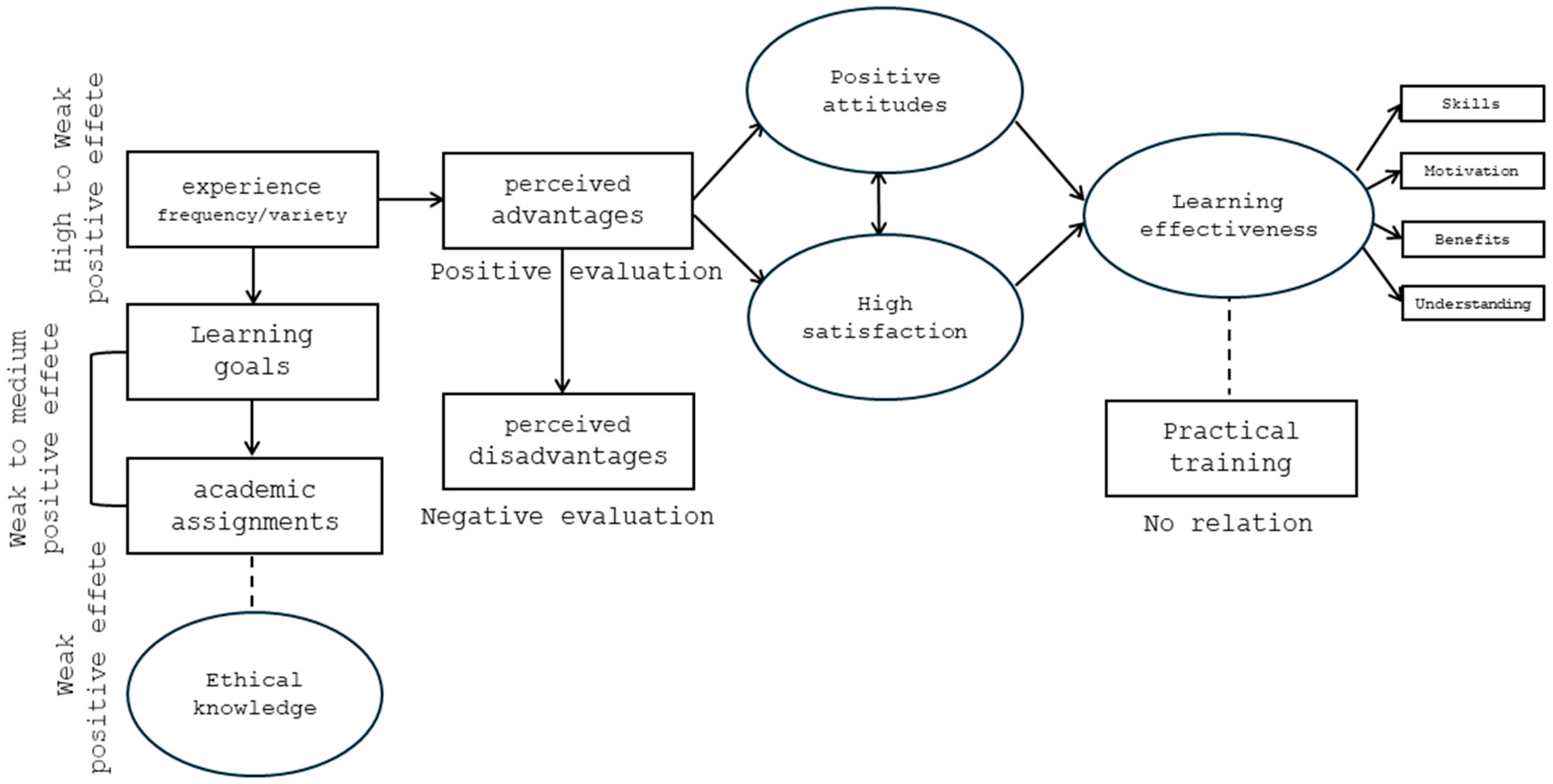
p < 0.01). Additionally, practical training in GenAI tools use was not significantly correlated with any of the measured variables. All the relations that found between the variables can also be seen in
Figure 1.
6. Discussion
The aim of the study was to examine the role of GenAI tools in academic learning, while gaining a profound understanding of the relationships between learning experiences, perceptions of these technologies, actual academic uses, attitudes, satisfaction, and effectiveness of learning. The study’s findings clearly demonstrate a positive, and in some cases, a strongly positive, correlation between students’ attitudes, satisfaction, and the four dimensions of learning effectiveness examined in the study: skills, motivation, benefits, and understanding. More positive attitudes and higher satisfaction of GenAI tools were found to be significantly associated with skill development, motivation, perceived benefits, and understanding of the learning materials. This indicates that the student’s emotional-cognitive experience is a key factor influencing actual learning outcomes. Previous studies have shown that when students perceive technology as useful and enjoyable, their learning experience improves significantly (
Chan & Hu, 2023;
Duy et al., 2025;
Gülırmak Güler & Şen Atasayar, 2025;
Yilmaz & Yilmaz, 2023). The results of the current study reinforce the assumption that GenAI technologies are no different from other technologies in this respect, despite their significant power and disruptive innovations. The strong relationship between these factors also indicates that the factors are not only related to each other but also complement each other in the learning activities of the students. Hence, examining them together in an integrated manner is a correct and essential process to see a clear picture regarding students’ use of GenAI tools for learning purposes in academic courses.
The results of the study show that although GenAI tools are new and have been known and available for about two years, students are rapidly adopting the tools for learning purposes and gaining experience while using and doing academic work. Students’ understanding of the perceived usefulness as a significant factor resulting from the use of AI tools was also obtained in a study by
Duy et al. (
2025). The short experience they have gained shows that students are satisfied with using GenAI tools in their studies, their attitudes toward the tools are positive, they understand well the educational benefits resulting from their use, and they report that using the tools increases their academic and technological skills, their motivation and their motivation, and academic understanding both content and tasks. These findings indicate that exposure and actual experience with GenAI tools contribute to students’ sense of value and learning experience. Similar findings were also reported in a study by
Daher and Hussein (
2024).
The frequency of use of the tools is of great importance for students’ accumulation of experience and the ability to better utilize the tools for their educational benefit. The research results of the study show a linear relationship and positive correlation between students’ frequency of use of GanAI, and their satisfaction and understanding of the educational benefits of using it in the learning process. This finding is consistent with the fact that only very few students reported using the GenAI tool daily. The use of a variety of GenAI tools within the framework of students’ studies is found to have a low correlation with all the subtest indicators examined, probably because the vast majority of students do not use many GenAI-based tools but mainly use the famous and well-known ChatGPT for their educational needs. These results seem to reflect an important insight: the value of GenAI tools in the eyes of students does not lie in the amount of use, but in the quality of the experience and perception that the student builds around these technologies. This way, even limited use may yield good learning results if students believe in the effectiveness of using GenAI, understand its strengths and experience using the tools positively. On the other hand, students can use GenAI to a large extent, but if they are frustrated, insecure or concerns, the impact on their learning effectiveness will be limited.
Additionally, the results of the study clearly show that students use GenAI tools to achieve learning goals and perform academic assignments. They express positive attitudes and satisfaction, clearly understanding the benefits of using these tools for learning purposes and performing tasks. Similarly to the
Fan et al. (
2025) main conclusion, these findings also show that targeted and clear academic use of GenAI tools positively correlated with positive perceptions among students. Studies by
Gülırmak Güler and Şen Atasayar (
2025) and
Sami et al. (
2025) also found positive attitudes among students toward AI technologies.
Furthermore, the results of the study show that students are well aware of the inherent advantages of using GenAI tools to improve their academic learning. The strong positive correlation between the advantages of using GenAI technologies and students’ attitudes, satisfaction, and measures of learning effectiveness especially benefits and skills, suggests that recognizing these advantages positively influences attitudes, enhances satisfaction, and improves learning outcomes. Moreover, these surprising findings show that students’ perception of the contribution of the tools is more influential than the actual use of the tools for academic purposes.
Chan and Hu (
2023) reported in their study that students also mentioned many benefits of incorporating AI. Conversely, in all variables examined in the context of the disadvantages of using GenAI tools, the results showed significant negative correlations. However, there seems to be logic in these results, especially as a direct continuation of the above results on the advantages, and the practical training that was not found to be related at all to the results. According to the results obtained the more disadvantages a student perceives in using the GenAI tool, the more negative correlation was found with his learning effectiveness, attitudes, and satisfaction.
The result of students’ ethical knowledge in using GenAI tools shows positive but relatively weak correlations with all the variables examined. In light of this, although the result is statistically significant, its practical impact appears limited. This finding indicates that ethical knowledge about the proper and informed use of GenAI tools is not a strong predictor of learning effectiveness, positive attitudes, or satisfaction in using GenAI tools for learning academic purposes. This may be due to the fact that the ethical challenge is perceived as an institutional requirement rather than part of the learning experience itself. Further to this, practical training on GenAI tools was not found to be significantly correlated with any of the variables measured in the study. This finding is not surprising, since most students reported that they had not received any training on using GenAI tools during their studies from the academic institution. This finding is consistent with the results of
Gasaymeh et al. (
2024) and
Elchaghaby and Wahby (
2025).
In view of this, it appears that students are learning independently how to work with GenAI technologies and applying the technical aspects of using them at a practical level, but without directed guidance and sufficient knowledge of important ethical issues within the framework of use, such as reliability, transparency, responsibility, biases, and copyright. Similarly to the results of
Zhang and Qian (
2024) and
Nam and Bai (
2023), it appears that students do not consider ethical issues when using these tools for their academic studies. It would be correct to say that given the positive statistical results of ethical knowledge in this study, the more organized and structured institutional training that is delivered as an integral part of the academic curriculum, the more likely it is to result in more theoretical knowledge and practical ethical behavior among students, which may lead to more positive attitudes, satisfaction, and better learning effectiveness in using the GenAI tools.
The demographic data sampled in the study, including gender, age, degree level, and the year of study, were not found to be in correlation with the students’ attitudes, satisfaction, or effectiveness in learning using GenAI tools. It is possible that these results were due to the large majority of students in the sample being women who study for a bachelor’s degree in an academic college and belong to Generation Z in terms of age. These demographic results differ somewhat from the study of
Săseanu et al. (
2024).
7. Conclusions and Recommendations
From the results of the study, several conclusions can be drawn. First, Attitudes and satisfaction are the key factors predicting effective student learning using GenAI tools. Therefore, the positive attitude of students toward the use of GenAI technologies in academic learning processes is critical, as these technologies are rapidly penetrating all areas of life and are already an integral part of various roles in organizations and employer requirements in a very short time. Second, there is a rapid informal learning of GenAI tools by students belonging to Generation Z, in particular, the familiar tools among them, led by ChatGPT. Students are well aware of the strengths of GenAI technologies for improving their academic learning, understand the benefits of the tools well, make informed use of them in performing academic assignments, and utilize them well for their learning and realizing learning goals in various ways in various courses. Consequently, students express positive attitudes and satisfaction with these technologies, which support their learning and contribute to their academic success.
The third conclusion is that, despite the short time that has passed since the appearance of the most well-known GenAI tools, it is evident that students have gained practical experience using the tools. Using GenAI tools significantly contributes to the learning experience, and the accumulation of experience is a significant component that contributes to more effective academic learning, more positive attitudes, and satisfaction with the use of advanced technologies. Consistent daily exposure to a variety of tools, similar to the use of basic Microsoft office tools and mobile device applications, will foster a deeper understanding of intelligent tools, enable more advanced uses for different learning purposes, enhance technical skills and interactions with technological interfaces, and promote greater utilization of GenAI technologies for the continuous improvement of academic learning. Moreover, fourth, although the GenAI technological storm has not spared academia, and there is a growing understanding of the importance of familiarity with and use of these tools, it seems that higher education institutions are struggling to keep up with the pace of development and innovations based on GenAI tools, and are not providing applied training on various tools in accordance with the different learning needs. As a result, there is a lack of ethical guidance at the institutional level for the correct and appropriate use of GenAI-based technologies that have long been available to everyone on the Internet and in mobile applications, leaving students to navigate these technologies primarily on their own. Despite the above, this does not mean that students are not learning about one GenAI tool or another within the framework of a particular course, but rather that there is a lack of academic guidance and comprehensive systemic training regarding the use of these technologies, when it is quite clear that they will shape the future of us all.
Based on the conclusions, several operational recommendations can lead to better integration of GenAI technologies into academic studies in higher education institutions. We recommend that universities and colleges not be satisfied with just rules of what students are allowed and prohibited from doing with GenAI technologies, but rather formulate a transparent and regulated policy that defines the manner of integrating GenAI into the courses taught, allocates the necessary resources, and determines ways to implement GenAI technologies in their institutions effectively. Additionally, the most important and urgent issue from an institutional perspective is the faster integration of basic courses for better familiarizing students with a variety of GenAI-based tools used for diverse learning needs, from writing, editing, and summarizing texts and presentations, to advanced uses of audio, images, and video, according to the needs and interests of each academic institution. In this framework, emphasis will be placed on learning the capabilities and strengths of each tool, understanding how to utilize each tool for learning purposes, and working correctly and intelligently with the various intelligent tools, as well as engaging in practical practice on the tools being studied to develop higher-order thinking skills. For instance, the implementation of “Cognitive Accelerant Assignments” requires students to utilize GenAI for generating initial drafts in academic tasks, while emphasizing the critical evaluation, editing, and justification of the output as the primary component of the task. In this process, students must undertake in-depth analysis, conceptual correction, the addition of theoretical nuances, and the justified rejection or acceptance of system-generated content. Employing GenAI technologies in this manner directly cultivates high-order cognitive skills essential for advanced academic study, specifically critical evaluation, editing, synthesis, and justification.
Moreover, academic institutions should focus not only on making GenAI accessible and providing technical guidance, but also on fostering positive perceptions, enhancing the benefits of the tools, and reducing barriers and negative perceptions. Ethical guidelines and personal responsibility for the appropriate and correct use of the tools will also be conveyed, and the problems and risks that exist in widespread and ongoing use will be explained comprehensively. Relevant regulatory laws (if they have already been enacted) and institutional procedures for the proper and ethical use of GenAI technologies in the framework of academic studies will be taught. In other words, institutions should improve the experience and meaning of using GenAI, and not just focus on the technological aspects of training students.
Another clear recommendation is that academic institutions should also conduct comprehensive institutional training for lecturers to become familiar with GenAI tools that are compatible with the types of courses they teach and for the research they conduct. Herein, higher education institutions should not rely on lecturers to independently become familiar with, learn from, and update themselves on the innovations and possibilities of GenAI tools, especially lecturers who lack technological literacy. As a result, lecturers will teach students in a more effective pedagogical manner, utilizing advanced intelligent tools in their courses and leveraging these tools to streamline and advance their research. Furthermore, lecturers should reduce students’ concerns by having an open dialog about weaknesses and challenges, showing them how GenAI tools contribute to better understanding, develop advanced skills, and contribute to motivation. We believe that implementing the recommendations will lead to a more advanced understanding, application, and use of GenAI technologies among students in academia. Structured, organized, and enhanced learning initiatives within academic institutions will lead to the accumulation of high-quality, practical, and professional experience in the use of GenAI tools, benefiting both academic staff and students. This experience will lead to more effective learning, strengthen positive attitudes toward the use of the tools, and increase students’ satisfaction with their use of these advanced technologies in their studies.
8. Contribution and Limitations
The current study contributes to the research literature in three ways: The first is a central understanding that students are adopting GenAI technologies very quickly as part of the multitude of technologies used by Generation Z. They understand well the benefits of using these technologies for their educational needs, which are expressed in more effective learning, the presentation of positive attitudes and high satisfaction with advanced technologies. The second, which stems directly from the first, is the great importance of institutionalized training and theoretical and practical study of diverse GenAI tools for lecturers and students alike. This is an academic necessity so that the innovative tools can be utilized with maximum efficiency for teaching, learning, and research purposes, as well as to train students with ethical knowledge and awareness of the risks and threats that exist in the use of intelligent technologies. The third, related to the second, is an emphasis on the students’ accumulated experience in using GenAI tools. This personal experience is built not only on a collection of self-study efforts but also on professional, high-quality, and practical training that involves advanced learning across diverse tools. It emphasizes practical applications that bridge academic knowledge with job market demands, serving as preparation for the future. In addition to these three aspects, the study supports a well-known theoretical model of technology acceptance such as TAM, but expands on it by emphasizing the significant role of perceived advantages and disadvantages as mediating variables, and not only perceived ease of use or usefulness. The study also suggests that learning outcomes in GenAI depend more on the effective experience than on the technologies themselves.
Examining additional variables and relationships, such as creativity, trust, and improvement in achievements in future studies, along with longitudinal or task-based studies based on GenAI tools will shed light on additional aspects of this dynamic research area. The results of the study reinforce the recognition of the research need to examine student attitudes and satisfaction, along with learning effectiveness and additional variables that have not yet been examined, related to the integration of GenAI tools in academic teaching and learning. Additionally, the conclusions and recommendations of the study contribute to the developing academic discourse, both theoretically and practically, regarding the challenges arising from the integration of GenAI tools in academia and how they contribute to students’ learning processes and outcomes.
This study has several limitations. A survey questionnaire was used to examine the variables. The sample of students was relatively homogeneous and included mainly women belonging to Generation Z. The vast majority of students are in undergraduate studies, and a minority is in advanced degrees. Despite the diversity in the fields of study of the students in the sample, a significant portion of them studied in knowledge areas with a high technological orientation. Additionally, the techno-system in the country where the study was conducted is very advanced, and the level of awareness and usability of new technologies is relatively high among the overall population. In light of this, we suggest that future studies focus on more advanced degree students and that the sample be more gender balanced and include students of older ages. Finally, further variables such as self-efficacy and overreliance affecting learning effectiveness and other factors influencing students’ attitudes and perceptions toward the use of GenAI tools in their academic studies should be investigated.
9. Summary
GenAI technologies are rapidly penetrating all areas of life, including studies in higher education institutions. Accordingly, the research literature in the field of teaching and learning technologies is attempting to establish the broad implications and initial insights into the integration of these tools as an integral part of academic learning. In this study, we examined students’ attitudes toward the use of GenAI technologies in their academic studies, their satisfaction with these tools, and the effectiveness of their learning.
The results of the study clearly show positive attitudes and satisfaction using GenAI tools, which are the most powerful factors in relation to effective learning. This reinforces the fact that affective–cognitive factors, and not just technological factors, are the ones that drive students’ learning. Students are rapidly adopting GenAI tools for their academic learning. They understand the strengths and contributions of these tools to their learning processes. They are satisfied with the integration of the tools in the learning processes. They fully understand the benefits inherent in using them for learning purposes. They see the tools as helpful and positive. While using the tools for personal assignments and academic work, students gain experience, and it is clear that it contributes to more effective learning, positive attitudes, and higher satisfaction. An important issue that requires more institutional attention is organized academic training on the use of GenAI tools, including a comprehensive consideration of guiding students in the ethical use of these groundbreaking technologies. Future studies on the integration of GenAI into academic teaching and learning should examine additional cognitive, emotional and ethical aspects as this technology continues to advance at a dizzying pace.