Unlocking the Magic: Professional Development on Reading for Teachers in Prevocational Education—Insights from Four Case Studies


Abstract
1. Introduction
1.1. Theoretical Framework
1.1.1. Teacher Competence
1.1.2. Reading Comprehension and Its Instruction
- Engaging students in textual discourse (Guthrie, 2004; Murphy et al., 2009).
- Teaching about reading comprehension, for instance by strategy-instruction (Okkinga et al., 2018; Wu et al., 2021) or teaching text structures (Bogaerds-Hazenberg et al., 2024; Nestlog et al., 2024).
- Promoting reading motivation (Schiefele et al., 2012; Van der Sande et al., 2023; Wigfield et al., 2016).
- Offering a diverse range of functional texts and contexts (Wigfield et al., 2016).
- Fostering knowledge acquisition, encompassing vocabulary development and world knowledge (Cabell & Hwang, 2020; Cervetti et al., 2016).
- Integrating reading and writing activities (Graham, 2020; Shanahan et al., 2025).
1.1.3. Reading Motivation and Its Promotion
1.1.4. Teacher Professional Development
1.2. Research Objectives
2. Method
2.1. Participants
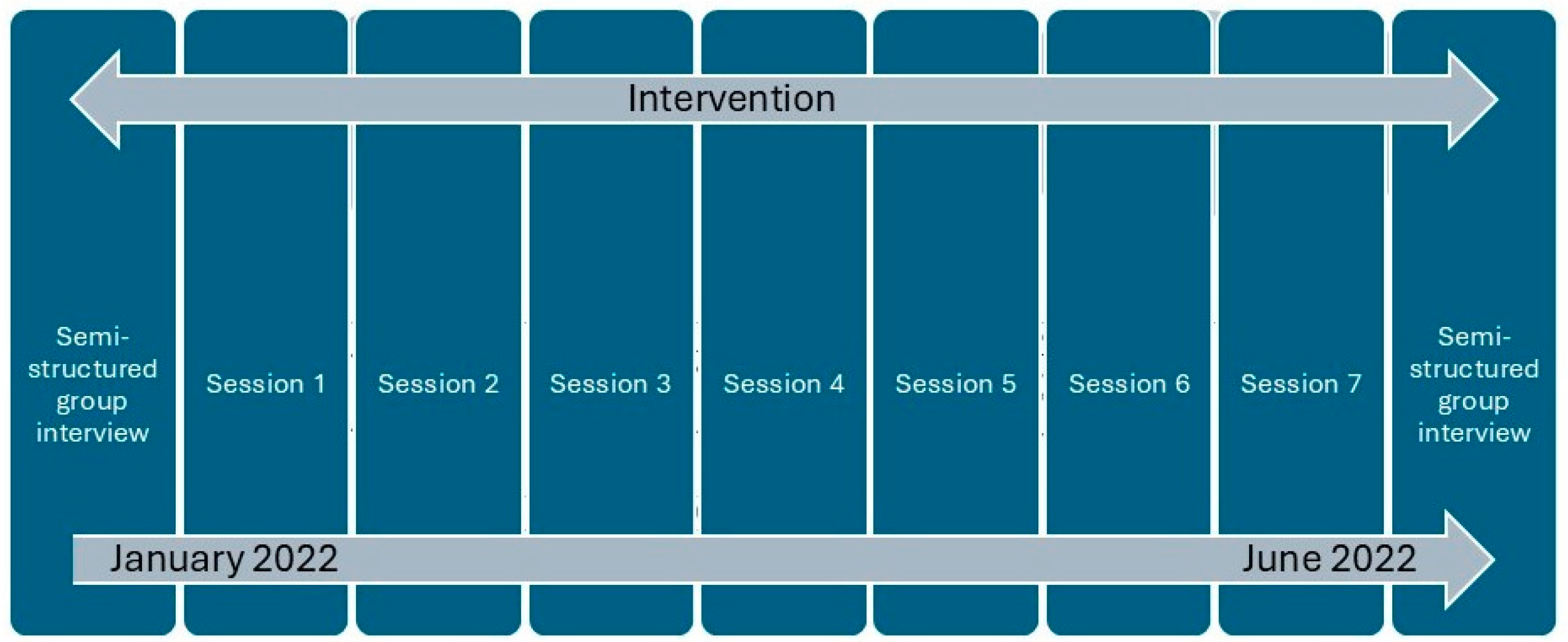
2.2. Research Design
2.2.1. Description of the Professional Development
2.2.2. Semi-Structured Interviews
2.2.3. Qualitative Analysis of Interviews
3. Results
3.1. Flanders Technical Academy
| 1 | Before PD | After PD |
| “Reading comprehension involves comprehending a text accurately.” | “Reading comprehension involves leveraging the context to derive meaning.” |
| 2 | Before PD | After PD |
| “Students are unable to demonstrate reading comprehension.” | “Students’ low reading comprehension level is due to limited vocabulary and a lack of foundational knowledge.” |
| 3 | Before PD | After PD |
| “It is important to teach reading comprehension.” | “If you choose the right text, I think you’ve already achieved about 60% more with your lesson than if you just take a text from the manual, where it’s merely about searching for information in texts. That doesn’t work in prevocational education. You have to be able to do some magic there.” |
| 4 | Before PD | After PD |
| “It is difficult to offer a text at their level matching their interests.” | “It is an exciting lesson that I plan to teach next year.” |
| 5 | Before PD | After PD |
| “Reading motivation involves students enjoying reading.” | “Students struggled significantly with reading fluency in elementary school.” |
| 6 | Before PD | After PD |
| “Defining reading motivation promotion is difficult.” | “Students’ reading motivation is growing because I focus more on the context of the text.” |
| 7 | Before PD | After PD |
| “The teacher’s role is to ensure students to put their phones away and sit with a book.” | “Reading motivation promotion involves allocating time and paying attention to it.” |
| 8 | Before PD | After PD |
| “I am unsure about my confidence in reading motivation promotion.” | “More cooperation with other teachers would help me feel more confident.” |
3.2. Nexus School
| 9 | Before PD | After PD |
| “Reading comprehension involves reading the text and understanding its content.” | “Reading comprehension is grasping both the essence and the depth of a text.” |
| 10 | Before PD | After PD |
| “Students will not be able to read proficiently.” | “I underestimated the students.” |
| 11 | Before PD | After PD |
| “[Reading comprehension instruction is] offering short texts with questions.” | “[Reading comprehension instruction is] providing a clear structure for how to read the text.” |
| 12 | Before PD | After PD |
| “I follow the manual.” | “You have to take time to read a text.” |
| 13 | Before PD | After PD |
| “How supporting students who are not proficient in Dutch.” | “I really enjoyed [teaching] this lesson and want to do it again.” |
| 14 | Before PD | After PD |
| “Reading motivation involves providing a diverse range of books.” | “Our goal is to cultivate reading pleasure for our students.” |
| 15 | Before PD | After PD |
| “The teacher’s role is to ensure students to put their phones away and sit with a book.” | “Reading motivation promotion involves allocating time and paying attention to it.” |
| 16 | Before PD | After PD |
| “It is quite challenging to encourage students to engage in reading” | “It is more challenging in prevocational education.” |
3.3. Professional Academy
| 17 | Before PD | After PD |
| “Reading comprehension involves reading a text and answering questions.” | “Reading comprehension is complex, we must teach it to students.” |
| 18 | Before PD | After PD |
| “Students struggle with deep comprehension of texts and stay on the surface.” | “Students lack confidence in their reading abilities.” |
| 19 | Before PD | After PD |
| “We consistently assign students to continue reading.” | “Step by step, we need to build and enhance students’ reading comprehension abilities.” |
| 20 | Before PD | After PD |
| “We consistently assign students to continue reading.” | “Step by step, we need to build and enhance students’ reading comprehension abilities.” |
| 21 | Before PD | After PD |
| “Reading motivation occurs when a student enjoys reading without feelings of pressure.” | “For our students, reading motivation is less about enthusiastic reading in all contexts and more about accepting to read a given text.” |
| 22 | Before PD | After PD |
| “Allow them to choose their reading material.” | “ Reading motivation promotion involves offering brief texts that students feel confident to tackle.” |
| 23 | Before PD | After PD |
| “Bring a book to class and place it on your desk.” | “The lesson should be conducive to reading motivation promotion.” |
| 24 | Before PD | After PD |
| “It is challenging to find rich texts aligning with our themes in PGS.” | “Seeing students’ enthusiasm fills me with joy.” |
3.4. Pathways Institute
| 25 | Before PD | After PD |
| “Reading comprehension is always purposeful and not for fun.” | “We need to differentiate between reading for comprehension, where training on reading fluency is essential, as well as reading for pleasure.” |
| 26 | Before PD | After PD |
| “Reading comprehension instruction is promoting reading comprehension.” | “Reading comprehension instruction involves taking a reading test.” |
| 27 | Before PD | After PD |
| “Reading comprehension instruction is promoting reading comprehension.” | “Reading comprehension instruction involves taking a reading test.” |
| 28 | Before PD | After PD |
| “Students read reluctantly.” | “My students will never experience reading motivation.” |
| 29 | Before PD | After PD |
| “Allow students to work individually.” | “Describing my role is difficult. I tried to read out loud, did some free reading, but students disrupted the lessons.” |
| 30 | Before PD | After PD |
| “I struggle to inspire reading motivation.” | “I struggle with addressing reading motivation.” |
3.5. Cross-Case Analysis
4. Discussion
4.1. Reading Comprehension
4.2. Reading Comprehension Instruction
4.3. Reading Motivation
4.4. Reading Motivation Promotion
4.5. Varying Effects Across Domains and Contexts
4.6. Implications for Practice
4.7. Limitations of the Research
5. Conclusions
Author Contributions
Funding
Institutional Review Board Statement
Informed Consent Statement
Data Availability Statement
Acknowledgments
Conflicts of Interest
Abbreviations
| PD | Professional Development |
| PGS | Project General Subjects |
Appendix A. Semi-Structured Group-Interview
References
- Bandura, A. (1978). Self-efficacy: Toward a unifying theory of behavorial change. Psychological Review, 84(2), 191–215. [Google Scholar] [CrossRef]
- Bandura, A. (1989). Regulations of cognitive processes through perceived self-efficacy. Developmental Psychology, 25(5), 729–735. [Google Scholar] [CrossRef]
- Basma, B., & Savage, R. (2023). Teacher professional development and student reading in middle and high school: A systematic review and meta-analysis. Journal of Teacher Education, 74(3), 214–228. [Google Scholar] [CrossRef]
- Bilge, H., & Kalenderoğlu, İ. (2022). The relationship between reading fluency, writing fluency, speaking fluency, reading comprehension, and vocabulary. Eğitim ve Bilim, 47, 25–53. [Google Scholar] [CrossRef]
- Blömeke, S., Busse, A., Kaiser, G., König, J., & Suhl, U. (2016). The relation between content-specific and general teacher knowledge and skills. Teaching and Teacher Education, 56, 35–46. [Google Scholar] [CrossRef]
- Blömeke, S., Dunekacke, S., & Jenßen, L. (2017). Educational and psychological determinants of prospective preschool teachers’ beliefs. European Early Childhood Education Research Journal Cognitive, 25, 885–903. [Google Scholar] [CrossRef]
- Blömeke, S., Gustafsson, J. E., & Shavelson, R. J. (2015). Beyond dichotomies: Competence viewed as a continuum. Zeitschrift für Psychologie, 223, 3–13. [Google Scholar] [CrossRef]
- Blömeke, S., Jentsch, A., Ross, N., Kaiser, G., & König, J. (2022). Opening up the black box: Teacher competence, instructional quality, and students’ learning progress. Learning and Instruction, 79, 101600. [Google Scholar] [CrossRef]
- Blömeke, S., & Kaiser, G. (2017). Understanding the development of teachers’ professional competencies as personally, situationally and socially determined. In J. Clandinin, & J. Husu (Eds.), International handbook of research on teacher education (pp. 783–802). Sage Publishers. [Google Scholar]
- Bogaerds-Hazenberg, S. T. M., Evers-Vermeul, J., & van den Bergh, H. H. (2024). Text structure instruction in primary education: Effects on reading, summarization, and writing. Pedagogische Studiën, 101(1), 30–59. [Google Scholar] [CrossRef]
- Braun, V., & Clarke, V. (2006). Using thematic analysis in psychology. Qualitative Research in Psychology, 3(2), 77–101. [Google Scholar] [CrossRef]
- Braun, V., & Clarke, V. (2022). Toward good practice in thematic analysis: Avoiding common problems and be(com)ing a knowing researcher. International Journal of Transgender Health, 24(1), 1–6. [Google Scholar] [CrossRef]
- Cabell, S. Q., & Hwang, H. J. (2020). Building content knowledge to boost comprehension in the primary grades. Reading Research Quarterly, 55, S99–S107. [Google Scholar] [CrossRef]
- Cervetti, G. N., Wright, T. S., & Hwang, H. J. (2016). Conceptual coherence, comprehension, and vocabulary acquisition: A knowledge effect? Reading and Writing, 29(4), 761–779. [Google Scholar] [CrossRef]
- Chin, M., Beckwith, V., Levy, B., Gulati, S., Macam, A. A. F., Saxena, T., & Suwarningsih, D. P. S. (2022). Navigating researcher positionality in comparative and international education research: Perspectives from emerging researchers. International Education Journal-Comparative Perspectives, 21(2), 21–36. [Google Scholar]
- Clarke, D., & Hollingsworth, H. (2002). Elaborating a model of teacher professional growth. Teaching and Teacher Education, 18(8), 947–967. [Google Scholar] [CrossRef]
- Cochran-Smith, M., & Lytle, S. (2009). Inquiry as stance: Practitioner research for the next generation. Teachers College Press. [Google Scholar]
- Conradi, K., Jang, B. G., & McKenna, M. C. (2014). Motivation terminology in reading research: A conceptual review. In Educational psychology review (Vol. 26, pp. 127–164). Springer Science and Business Media, LLC. [Google Scholar]
- Darling-Hammond, L., Hyler, M. E., & Gardner, M. (2017). Effective teacher professional development. Leaning Policy Institute. [Google Scholar]
- Davoudi, M., & Hashemi Moghadam, H. (2015). Critical review of the models of reading comprehension with a focus on situation Models. International Journal of Linguistics, 7, 172. [Google Scholar] [CrossRef]
- Deci, E., Vallerand, R., Pelletier, L., & Ryan, R. (1991). Motivation and education: The self-determination perspective. Educational Psychologist, 26(3–4), 325–346. [Google Scholar] [CrossRef]
- De Meyer, I., Berlamont, L., Hoedt, L., Janssens, R., Lermytte, A., Warlop, N., & van Braak, J. (2023). Vlaams rapport PISA2022. Universiteit Gent. [Google Scholar]
- De Meyer, I., Janssens, R., Warlop, N., Van Keer, H., De Wever, B., & Valcke, M. (2019). PISA in focus: 7 plezier in Lezen. Vlaamse resultaten van PISA2018. Universiteit Gent. [Google Scholar]
- De Naeghel, J., & Van Keer, H. (2013). The relation of student and class-level characteristics to primary school students’ autonomous reading motivation: A multi-level approach. Journal of Research in Reading, 36(4), 351–370. [Google Scholar] [CrossRef]
- De Naeghel, J., Van Keer, H., & Vanderlinde, R. (2014). Strategies for promoting autonomous reading motivation: A multiple case study research in primary education. Frontline Learning Research, 2(1), 83–101. [Google Scholar] [CrossRef]
- De Naeghel, J., Van Keer, H., Vansteenkiste, M., Haerens, L., & Aelterman, N. (2016). Promoting elementary school students’ autonomous reading motivation: Effects of a teacher professional development workshop. The Journal of Educational Research, 109(3), 232–252. [Google Scholar] [CrossRef]
- De Naeghel, J., Van Keer, H., Vansteenkiste, M., & Rosseel, Y. (2012). The relation between elementary students’ recreational and academic reading motivation, reading frequency, engagement, and comprehension: A self-determination theory perspective. Journal of Educational Psychology, 104(4), 1006–1021. [Google Scholar] [CrossRef]
- Desimone, L. M. (2009). Improving impact studies of teachers’ professional development: Toward better conceptualizations and measures. Educational Researcher, 38(3), 181–199. [Google Scholar] [CrossRef]
- Desimone, L. M. (2011). A primer on effective professional development. Phi Delta Kappan, 92(6), 68–71. [Google Scholar] [CrossRef]
- Desimone, L. M., & Garet, M. S. (2015). Best practices in teachers’ professional development in the United States. Psychology, Society & Education, 7(3), 252–263. [Google Scholar]
- Didion, L., Toste, J. R., & Filderman, M. J. (2020). Teacher professional development and student reading achievement: A meta-analytic review of the effects. Journal of Research on Educational Effectiveness, 13(1), 29–66. [Google Scholar] [CrossRef]
- Duke, N. K., Pearson, P. D., Strachan, S. L., & Billman, A. K. (2011). Essential elements of fostering and teaching reading comprehension. In S. J. Samuels, & A. E. Farstrup (Eds.), What research has to say about reading instruction (4th ed.). The International Reading Association. [Google Scholar]
- Dweck, C. S., & Leggett, E. L. (1988). A social-cognitive approach to motivation and personality. Psychological Review, 95(2), 256–273. [Google Scholar] [CrossRef]
- Engler, L., & Westphal, A. (2024). Teacher autonomy support counters declining trend in intrinsic reading motivation across secondary school. European Journal of Psychology of Education, 39, 4047–4065. [Google Scholar] [CrossRef]
- Filderman, M. J., Didion, L., Austin, C. R., Payne, B., Silvert, C., & Wexler, J. (2025). Teacher professional development for reading: A review of the state of the research. Reading Research Quarterly, 60(4), e70054. [Google Scholar] [CrossRef]
- Garces-Bacsal, R. M., Tupas, R., Kaur, S., Paculdar, A. M., & Baja, E. S. (2018). Reading for pleasure: Whose job is it to build lifelong readers in the classroom? Literacy, 52(2), 95–102. [Google Scholar] [CrossRef]
- Geudens, A., Schraeyen, K., Bellens, K., Taelman, H., & Trioen, M. (2023). Effectief lessonderwijs voor het basis- en secundair onderwijs in Vlaanderen. Universiteit Antwerpen. [Google Scholar]
- Graham, S. (2020). The sciences of reading and writing must become more fully integrated. Reading Research Quarterly, 55, S35–S44. [Google Scholar] [CrossRef]
- Guskey, T. (2002). Professional development and teacher change. Teachers and Teaching, 8, 381–391. [Google Scholar] [CrossRef]
- Guthrie, J. T. (2004). Teaching for literacy engagement. Journal of Literacy Research, 36(1), 1–30. [Google Scholar] [CrossRef]
- Hollenbeck, A. F., & Kalchman, M. (2013). Professional development for conceptual change: Extending the paradigm to teaching reading comprehension in US schools. Professional Development in Education, 39(5), 638–655. [Google Scholar] [CrossRef]
- Hoover, W. A. (2024). The simple view of reading and its broad types of reading difficulties. Reading and Writing, 37(9), 2277–2298. [Google Scholar] [CrossRef]
- Hoover, W. A., & Gough, P. B. (1990). The simple view of reading. Reading and Writing, 2(2), 127–160. [Google Scholar] [CrossRef]
- Houtveen, A. A. M., van Steensel, R., & de la Rie, S. (2019). De vele kanten van leesbegrip. Erasmus Universiteit Rotterdam. [Google Scholar]
- King, F., Philip, P., & Pierre, T. (2023). A pragmatic meta-model to navigate complexity in teachers’ professional Learning. Professional Development in Education, 49(6), 958–977. [Google Scholar] [CrossRef]
- Kintsch, W. (1988). The role of knowledge in discourse comprehension—A construction integration model. Psychological Review, 95(2), 163–182. [Google Scholar] [CrossRef]
- Kintsch, W. (2005). An overview of top-down and bottom-up effects in comprehension: The CI perspective. Discourse Processes, 39(2–3), 125–128. [Google Scholar] [PubMed]
- Klassen, R. M., & Tze, V. M. C. (2014). Teachers’ self-efficacy, personality, and teaching effectiveness: A meta-analysis. Educational Research Review, 12, 59–76. [Google Scholar] [CrossRef]
- Kunter, M., Klusmann, U., Baumert, J., Richter, D., Voss, T., & Hachfeld, A. (2013). Professional competence of teachers: Effects on instructional quality and student development. Journal of Educational Psychology, 105(3), 805–820. [Google Scholar] [CrossRef]
- Lentz, A., Desimone, L., Stornaiuolo, A., Pak, K., Flores, N., Nichols, P., Polikoff, M., & Porter, A. (2024). Changes that stick. Phi Delta Kappan, 105(6), 8–11. [Google Scholar] [CrossRef]
- Lin, Y. H. (2025). A reflection of learners’ motivation to read, self-assessment, critical thinking, and academic well-being in extensive and intensive reading offline instruction: A focus on self-determination theory. Learning and Motivation, 89, 102093. [Google Scholar] [CrossRef]
- Linde, I., & Daniela, L. (2025). Teachers’ insights into the efficacy of the ‘reading circle’ project using English language teaching graded readers. Education Sciences, 15(1), 91. [Google Scholar] [CrossRef]
- Lumivero. (2020). NVivo (version 13 [2020, R1]). Available online: https://www.lumivero.com (accessed on 21 October 2025).
- Magnusson, C. G., Luoto, J. M., & Blikstad-Balas, M. (2023). Developing teachers’ literacy scaffolding practices—Successes and challenges in a video-based longitudinal professional development intervention. Teaching and Teacher Education, 133, 104274. [Google Scholar] [CrossRef]
- McRae, A., & Guthrie, J. T. (2009). Promoting reasons for reading: Teacher practices that impact motivation (E. H. Hiebert, Ed.). Guilford Press. [Google Scholar]
- Medina, A. L., Hancock, S. D., Hathaway, J. I., Pilonieta, P., & Holshouser, K. O. (2021). The influence of sustained, school-based professional development on explicit reading comprehension strategy instruction. Reading Psychology, 42(8), 807–835. [Google Scholar] [CrossRef]
- Merchie, E., Gobyn, S., De Bruyne, E., De Smedt, F., Schiepers, M., Vanbuel, M., Ghesquière, P., Van den Branden, K., & Van Keer, H. (2019). Effectieve, eigentijdse begrijpend leesdidactiek in het basisonderwijs. Wetenschappelijk eindrapport van een praktijkgerichte literatuurstudie. Vlaamse Onderwijsraad (VLOR). [Google Scholar]
- Murphy, P. K., Wilkinson, I. A. G., Soter, A. O., Hennessey, M. N., & Alexander, J. F. (2009). Examining the effects of classroom discussion on students’ comprehension of text: A meta-analysis. Journal of Educational Psychology, 101(3), 740–764. [Google Scholar] [CrossRef]
- Nestlog, E. B., Danielsson, K., & Jeppsson, F. (2024). Disciplinary content and text structures communicated in the classroom–pathways in science lessons. Linguistics and Education, 84, 101343. [Google Scholar] [CrossRef]
- OECD. (2019). PISA 2018 results (Volume I). Available online: https://www.oecd.org/en/publications/pisa-2018-results-volume-i_5f07c754-en/full-report.html (accessed on 21 October 2025).
- OECD. (2023). PISA 2022 results (Volume I). Available online: https://www.oecd.org/en/publications/pisa-2022-results-volume-i_53f23881-en/full-report.html (accessed on 21 October 2025).
- Okkinga, M., van Steensel, R., van Gelderen, A. J. S., van Schooten, E., Sleegers, P. J. C., & Arends, L. R. (2018). Effectiveness of reading-strategy interventions in whole classrooms: A meta-analysis. Educational Psychology Review, 30(4), 1215–1239. [Google Scholar] [CrossRef]
- Onderwijsinspectie. (2020). Begrijpend leesonderwijs in de basisscholen kwaliteitsvol? Onderwijsinspectie.
- Organisation for Economic Co-operation and Development (OECD). (2019). Education at a glance 2019. Available online: https://www.oecd.org/en/publications/education-at-a-glance-2019_f8d7880d-en.html (accessed on 21 October 2025).
- Pajares, M. F. (1992). Teachers’ beliefs and educational research: Cleaning up a messy construct. Review of Educational Research, 62(3), 307–332. [Google Scholar] [CrossRef]
- Rice, M., Lambright, K., & Wijekumar, K. (2024). Professional development in reading comprehension: A meta-analysis of the effects on teachers and students. Reading Research Quarterly, 59(3), 424–447. [Google Scholar] [CrossRef]
- Ruwette, M., van Schooten, E., & de Glopper, K. (2020). Teachers’ reading promotion activities: Variation, structure and correlates. L1-Educational Studies in Language and Literature, 20(1), 1–27. [Google Scholar] [CrossRef]
- Ryan, M., & Hendry, G. D. (2022). Sources of teacher efficacy in teaching reading: Success, sharing, and support. Australian Journal of Language and Literacy, 46(1), 1–14. [Google Scholar] [CrossRef]
- Ryan, R. M., & Deci, E. L. (2000). Self-determination theory and the facilitation of intrinsic motivation, social development, and well-being. American Psychologist, 55(1), 68–78. [Google Scholar] [CrossRef] [PubMed]
- Ryan, R. M., & Deci, E. L. (2020). Intrinsic and extrinsic motivation from a self-determination theory perspective: Definitions, theory, practices, and future directions. Contemporary Educational Psychology, 61, 101860. [Google Scholar] [CrossRef]
- Scarborough, H. S. (2001). Connecting early language and literacy to later reading (dis)abilities: Evidence, Theory, and Practice. In S. Neuman, & D. Dickinson (Eds.), Handbook for research in early literacy (pp. 97–110). Guidlford Press. [Google Scholar]
- Schiefele, U., Schaffner, E., Möller, J., & Wigfield, A. (2012). Dimensions of reading motivation and their Relation to reading behavior and competence. Reading Research Quarterly, 47(4), 427–463. [Google Scholar] [CrossRef]
- Shanahan, E., Reno, E., Chandler, B. W., Novelli, C., An, J. C., Choi, S., & McMaster, K. L. (2025). Effects of writing instruction on the reading outcomes of students with literacy difficulties in pre-kindergarten to fifth grade: A meta-analysis. Reading and Writing, 38(3), 627–650. [Google Scholar] [CrossRef]
- Shulman, L. S. (1986). Those who understand: Knowledge growth in teaching. Educational Researcher, 15(2), 4–14. [Google Scholar] [CrossRef]
- Snow, C. (2002). Reading for understanding: Toward an R&D program in reading comprehension. RAND Corporation. Available online: https://www.rand.org/pubs/monograph_reports/MR1465.html (accessed on 6 June 2025).
- Steunpunt Toetsontwikkeling en Peilingen (STEP). (2021). Peiling project algemene vakken (PAV). Steunpunt Toetsontwikkeling en Peilingen. [Google Scholar]
- Svrcek, N. S., & Abugasea Heidt, M. (2022). Beyond levels and labels: Applying self-determination theory to support readers. Literacy, 56(4), 311–326. [Google Scholar] [CrossRef]
- Tiba, C. (2023). Motivation to explicitly teach reading comprehension strategies after a workshop. Reading & Writing-Journal of the Reading Association of South Africa, 14(1), a405. [Google Scholar] [CrossRef]
- Troyer, M., Kim, J. S., Hale, E., Wantchekon, K. A., & Armstrong, C. (2019). Relations among intrinsic and extrinsic reading motivation, reading amount, and comprehension: A conceptual replication. Reading and Writing, 32(5), 1197–1218. [Google Scholar] [CrossRef]
- Van Ammel, K., Aesaert, K., De Smedt, F., & Van Keer, H. (2021a). An analytic description of projectExpert: An instructional reading program for ninth grade vocational students. L1 Educational Studies in Language and Literature, 21, 1–35. [Google Scholar] [CrossRef]
- Van Ammel, K., Aesaert, K., De Smedt, F., & Van Keer, H. (2021b). Skill or will? The respective contribution of motivational and behavioural characteristics to secondary school students’ reading comprehension. Journal of Research in Reading, 44, 574–596. [Google Scholar] [CrossRef]
- van den Broek, P., & Helder, A. (2017). Cognitive processes in discourse comprehension: Passive processes, reader-Initiated processes, and evolving mental representations. Discourse Processes, 54(5–6), 360–372. [Google Scholar] [CrossRef]
- Van der Sande, L., van Steensel, R., Fikrat-Wevers, S., & Arends, L. (2023). Effectiveness of interventions that foster reading motivation: A meta-analysis. Educational Psychology Review, 35(1), 1–38. [Google Scholar] [CrossRef]
- Vansteelandt, I., Mol, S. E., Vanderlinde, R., Lerkkanen, M. K., & Van Keer, H. (2020). In pursuit of beginning teachers’ competence in promoting reading motivation: A mixed-methods study into the impact of a continuing professional development program. Teaching and Teacher Education, 96, 103154. [Google Scholar] [CrossRef]
- Vansteelandt, I., Mol, S. E., & Van Keer, H. (2022). Pre-service teachers’ reader profiles: Stability and change throughout teacher education. Journal of Research in Reading, 45(1), 1–19. [Google Scholar] [CrossRef]
- Washburn, E. K., & Pierce, A. (2025). Teaching older struggling readers: Novice 4–12th general and special education teachers’ knowledge of foundational reading skills. Education Sciences, 15(6), 745. [Google Scholar] [CrossRef]
- Wigfield, A., Gladstone, J. R., & Turci, L. (2016). Beyond cognition: Reading motivation and reading comprehension. Child Development Perspectives, 10(3), 190–195. [Google Scholar] [CrossRef] [PubMed]
- Wu, L., Valcke, M., & Van Keer, H. (2021). Supporting struggling readers at secondary school: An intervention of reading strategy instruction. Reading and Writing, 34(8), 2175–2201. [Google Scholar] [CrossRef]
- Yin, R. (2018). Case Study research and applications. Design and methods (6th ed.). Sage Publications. [Google Scholar]


| Flanders Technical Academy | Nexus School | Professional Academy | Pathways Institute | |
|---|---|---|---|---|
| Schools’ description | ||||
| Study areas | Art & Creation; Agriculture & Horticulture; Mechanics-electricity | Science, Technology, Engineering & Mathematics | Bakery, Butchery, Restaurant Kitchen | Science, Technology, Engineering & Mathematics; Agriculture & Horticulture; Mechanics-electricity |
| Number of students in prevocational track | 83 | 32 | 92 | 53 |
| Subjects and hours taught per week in 2 prevocational years | Dutch: 5 PGS: 13 | Dutch: 4 PGS: 4 | Dutch: 7 Reading with computer-based program: 2 | Dutch: 7 Reading with computer-based program: 2 |
| PD Participants’ description | ||||
| Number of participants | 9 | 3 | 13 | 3 |
| Attendance >5 of 7 | 6 | 3 | 7 | 2 |
| Attendance <5 of 7 | 3 | 6 | 1 | |
| Female | 8 | 3 | 11 | 3 |
| Male | 1 | 2 | ||
| Experienced * | 6 | 11 | 1 | |
| New in this assignment | 1 | 2 | 1 | 1 |
| New in teaching | 2 | 1 | 1 | 1 |
| Goals | Approach | |
|---|---|---|
| Session 1 | Introduction to the goals, process, and participant roles. Reflection on current practices in teaching reading comprehension and promoting reading motivation. Broadening understanding of reading comprehension and motivation. | Transmission of information by the researcher. Group discussion led by the researcher Researchers’ inputs during group discussion. |
| Session 2 | Introduction of the theoretical framework regarding reading motivation and reading motivation promotion. Exploration of the application of theoretical insights in practice (e.g., how to evaluate students’ reading motivation; how to refine reading motivational strategies). | Transmission of information by the researcher. Group discussion led by the researcher |
| Session 3 | Introduction of the theoretical framework of reading comprehension and its effective instruction. | Transmission of information by the researcher. |
| Session 4 | Observation of a modeled reading lesson combining effective comprehension instruction and motivational strategies. Engagement in a reflective discussion about the modeled lesson. | The researcher modeled a reading lesson. Group discussion led by the researcher. |
| Session 5 | Putting theory into practice: collaborative design of an effective reading lesson. | Hands-on workshop with step-by-step guidance, guided by a presentation (step 1: determine the objectives of the lesson, 2: choose a text, 3: decide how you will promote reading motivation, 4: choose a pre-reading activity, 5: set reading goals and design exercises to meet them, 6: organize an activity involving other skills, 7: return to the lesson objectives, does the lesson address the objectives). Researcher supported in design. |
| Session 6 | Putting theory into practice: teaching the reading lesson. Learning from each other’s lessons. | Delivery of the developed lesson. Observation of the reading lesson of a colleague. |
| Session 7 | Final reflections and group evaluation. | Individual reflections. Group discussion led by the researcher. |
| Knowledge | Beliefs | |
|---|---|---|
| Reading comprehension | Students | |
| Reading comprehension instruction | Teachers | |
| Role | Self-efficacy | |
| Reading motivation | Students | |
| Reading motivation promotion | Teachers | |
| Role | Self-efficacy | |
Disclaimer/Publisher’s Note: The statements, opinions and data contained in all publications are solely those of the individual author(s) and contributor(s) and not of MDPI and/or the editor(s). MDPI and/or the editor(s) disclaim responsibility for any injury to people or property resulting from any ideas, methods, instructions or products referred to in the content. |
© 2025 by the authors. Licensee MDPI, Basel, Switzerland. This article is an open access article distributed under the terms and conditions of the Creative Commons Attribution (CC BY) license (https://creativecommons.org/licenses/by/4.0/).
Share and Cite
Werbrouck, S.; Van Keer, H. Unlocking the Magic: Professional Development on Reading for Teachers in Prevocational Education—Insights from Four Case Studies. Educ. Sci. 2025, 15, 1448. https://doi.org/10.3390/educsci15111448
Werbrouck S, Van Keer H. Unlocking the Magic: Professional Development on Reading for Teachers in Prevocational Education—Insights from Four Case Studies. Education Sciences. 2025; 15(11):1448. https://doi.org/10.3390/educsci15111448
Chicago/Turabian StyleWerbrouck, Soetkin, and Hilde Van Keer. 2025. "Unlocking the Magic: Professional Development on Reading for Teachers in Prevocational Education—Insights from Four Case Studies" Education Sciences 15, no. 11: 1448. https://doi.org/10.3390/educsci15111448
APA StyleWerbrouck, S., & Van Keer, H. (2025). Unlocking the Magic: Professional Development on Reading for Teachers in Prevocational Education—Insights from Four Case Studies. Education Sciences, 15(11), 1448. https://doi.org/10.3390/educsci15111448