


Abstract
Although prosody plays a critical role in early language acquisition, the effects of prosodic training on language outcomes during infancy remain unexplored. This study evaluated the feasibility and preliminary efficacy of a prosodic training program. Thirty-three children aged 6 to 36 months attended 23 weekly group sessions in their educational setting. Language development was assessed pre- and post-training using the Griffiths III Language and Communication subscale. Results showed a significant shift in the discrepancy between developmental and chronological age, with mean scores increasing from below-age to above-age expected levels. Educators and caregivers reported high satisfaction, language gains, and strong engagement.
Keywords:
early intervention; education; feasibility studies; infant; language; nursery; prosody; rhythm 1. Introduction
Prosody refers to the variation in the sound properties of speech that occurs independently of lexical content, encompassing phenomena such as intonation (i.e., the melody of speech), phrasing (i.e., the division of speech into prosodic units), prominence, and rhythm (Frota & Prieto, 2015; Ladd, 2008; Wagner & Watson, 2010). These prosodic features play a central role in early language acquisition, supporting, for instance, speech segmentation, word recognition, syntactic parsing, and pragmatic interpretation (Gervain et al., 2020; Gleitman & Wanner, 1982; Jusczyk, 1997).
Empirical research has provided robust evidence for the role of prosody in early developmental stages, particularly in infancy. Several studies demonstrated that prosody provides essential cues for speech segmentation and the extraction of linguistic units from continuous speech (e.g., Jusczyk, 1999; Nazzi & Ramus, 2003). de Carvalho et al. (2018) reviewed findings showing that very young infants rely on phrasal prosody to segment continuous speech into smaller units, such as words and phrases, supporting the acquisition of lexical and syntactic knowledge. Moreover, prosodic cues have been shown to facilitate word segmentation in both typical and atypical populations, particularly when words occur in prosodically prominent positions such as the beginning and end of utterances (Butler & Frota, 2018; Frota et al., 2020; Johnson et al., 2014). Experimental studies have further shown that infants rely on prosodic information, for example, to discriminate between languages, identify word patterns and learn words, interpret syntactic structures, and resolve ambiguities (Y. Choi & Mazuka, 2003; Mehler et al., 1988; Nazzi et al., 1998; Thorson, 2018). Prosodic abilities have been found to emerge early in development and, in some cases, to precede other linguistic skills (Frota & Butler, 2018; Frota et al., 2016; Prieto et al., 2012). Indeed, prosodic abilities have been linked to broader linguistic development (De la Cruz-Pavía et al., 2021; Goswami et al., 2010; Gutman et al., 2015; Holliman et al., 2008; Shukla et al., 2011).
Although research has focused on the role of prosody in typical language development, there is increasing recognition of its relevance in atypical development as well (Paul et al., 2020). For example, difficulties in processing prosodic cues have been associated with atypical developmental profiles, including dyslexia (Goswami et al., 2002). These findings underscore the theoretical significance of prosodic training as a mechanism for supporting language acquisition. Nevertheless, prosody remains largely absent from early language training programs, regardless of developmental profile (Pak et al., 2023; Verbeek et al., 2023).
Recent approaches have identified auditory–motor integration as a core mechanism in perception and production, with sensorimotor grounding proposed to support early language development (D. Choi et al., 2023; Goswami, 2022; Kuhl, 2021). Within this framework, prosodic abilities might be strengthened by embodied interactions that couple rhythm, intonation, stress, phrasing, and other prosodic features with motor activities. This framework provides a theoretical basis for prosodic training approaches that employ structured sensorimotor activities to support early language development.
The present study aimed to implement a novel prosodic training program (PRyME—Prominence, Rhythm, Melody and Embodiment; Filipe et al., in press) designed for children aged 6 to 36 months and developed to enhance language skills in young children by targeting rhythm, intensity, tempo, and melody, exploring auditory–motor integration as a foundation for verbal and nonverbal communication. The primary objective was to evaluate the program’s feasibility, acceptability, and preliminary efficacy within an educational context, generating initial data to inform future large-scale investigations. We hypothesized that the findings would demonstrate the potential of prosodic training as a developmentally appropriate, engaging, and feasible approach to support early language development in typically developing populations. By introducing a structured, prosody-focused training in early childhood education, this study seeks to address a critical research gap and lay the groundwork for future studies and practical implementation.
2. Method
2.1. Participants
Thirty-three typically developing children aged 6 to 36 months (Mage = 24.77 months, SD = 9.46) were recruited from an early childhood education center in Lisbon, Portugal, and participated in the training program. For statistical analyses, six children were excluded due to missing data. An additional eight children were excluded for scoring below the 15th percentile on the Language and Communication subscale of the Griffiths Mental Development Scales–3rd edition (Green et al., 2016) at pre-test, as the study targeted typically developing children. The 15th percentile was selected as a conservative cutoff to identify children at risk for language delay, corresponding to approximately one standard deviation below the mean in a normal distribution. This criterion ensured a more homogeneous sample and allowed a more straightforward interpretation of training effects among children performing within the expected developmental range. The final sample included 19 children (Mage = 23.79 months, SD = 7.86; 12 boys).
An analysis of the employment and educational status of the participants’ parents or guardians revealed that the majority of families were classified as low qualified (55%) or moderately qualified (30%), with a smaller proportion classified as highly qualified (15%). These categories were derived from the Portuguese Classification of Occupations (Classificação Portuguesa das Profissões, PP/2010; Instituto Nacional de Estatística, 2011), which distinguishes four group levels of professional competence: (i) Low qualified corresponds to CPP levels 1 and 2, i.e., unskilled and semi-skilled occupations usually requiring only basic or secondary education; (ii) Moderately qualified corresponds to CPP level 3, i.e., technical and intermediate occupations typically associated with short-cycle, vocationally oriented higher education; and (iii) Highly qualified corresponds to CPP level 4, i.e., professional, scientific, and managerial occupations requiring advanced higher education.
Four early childhood educators (three teachers who implemented the training and one pedagogical coordinator) and 28 caregivers completed feasibility and acceptability measures.
The study was conducted in accordance with the Declaration of Helsinki and was approved by the Ethics Committee of the authors’ University (Process No. 12_CEI2023). Informed consent was obtained from all participants’ legal guardians. For the educator and caregiver questionnaires, participants completed anonymous paper-and-pencil forms immediately after the training period. Questionnaires were collected by the pedagogical coordinator to ensure confidentiality.
2.2. Measures
Expressive and receptive language abilities were assessed using the Language and Communication subscale of the Griffiths Mental Development Scales–3rd edition (Green et al., 2016), a standardized measure of overall language development that captures both comprehension and production skills. During the first years of life, the assessment of expressive language includes early vocalizations, babbling, the emergence and consistent use of meaningful words, and the progressive development of phrase and sentence production. During the second and early third years of life, evaluation also includes aspects of syntactic and semantic development, such as combining words, using simple grammatical forms, and expanding vocabulary. Receptive language assessment focuses on the child’s ability to attend to speech, respond to their own name, comprehend familiar words, and follow increasingly complex instructions. The subscale has demonstrated very good to excellent internal consistency, with a mean Cronbach’s alpha of 0.82 reported across samples of children aged 1 to 6 years (Green et al., 2016).
To evaluate the acceptability and feasibility of the PRyME program from the perspective of educators, a 10-item questionnaire was developed combining 5-point Likert-scale items (ranging from strongly disagree to strongly agree) with open-ended questions, enabling the collection of both quantitative and qualitative data. The questionnaire assessed: (i) Perceived usefulness of the program; (ii) Overall satisfaction with the program; (iii) Perceived improvements in children’s language and communication skills within the classroom, with an open-ended prompt to describe specific changes; (iv) Ongoing concerns related to children’s language and communication development, followed by an open-ended item to specify such concerns; (v) Children’s motivation to participate in the sessions; (vi) Perceived appropriateness of the duration and frequency of the sessions; (vii) Perceived benefits of children’s participation, with an open-ended question to elaborate on observed advantages; (viii) Ease of integrating the sessions into existing classroom routines; (ix) Perceived interference with other classroom activities, with space to describe any observed disruptions; and (x) Willingness to recommend the program to other educators or contexts.
A similar questionnaire was developed for caregivers, following the same general structure as the educator version, addressing: (i) Perceived usefulness of the program for their child; (ii) Overall satisfaction with the program; (iii) Perceived changes in their child’s language and communication at home, with space to describe specific observations; (iv) Persistent concerns regarding language development, with an optional prompt for elaboration; (v) Perceived benefits of participation, followed by an open-ended question to detail those benefits; and (vi) Willingness to recommend the program to other families. The full version of both questionnaires is available in the Appendix A.
2.3. Training
The PRyME program addressed key prosodic and embodied communication skills, including the perception and production of rhythmic patterns, loudness and speech rate control, melodic contouring, and movement coordination with sound perception and vocal expression. By anchoring prosodic training in sensorimotor experience, the program aimed to strengthen auditory–motor pathways essential for language development. Also, grounded in research on rhythm-based learning and auditory–motor integration (Goswami, 2022; Rocha et al., 2024), the PRyME program fosters meaningful, embodied engagement with speech prosody through playful, socially embedded experiences.
The program was organized around ten core activity types (see Table 1), which served as guiding templates for implementation. These activities were selected based on their relevance to prosodic development and adaptability to the classroom environment. While the structure of each activity was consistent, educators were encouraged to tailor materials, themes, and delivery to match children’s interests and classroom dynamics. This flexibility aimed to enhance engagement while maintaining fidelity to the program’s objectives.
Table 1.
Activities, Age Groups, Descriptions, and Objectives of the PRyME Prosodic Training Program (Filipe et al., in press).
To ensure consistent exposure, activities were flexibly cycled throughout the training period so that each prosodic component was revisited with regularity. This balanced design allowed children to experience repeated, varied opportunities to engage with the targeted prosodic features.
2.4. Procedure
All children were individually assessed before and after the training period in a quiet room with appropriate lighting and acoustics within their regular educational setting. Each assessment session lasted approximately one hour, during which a trained researcher recorded children’s responses on scoring sheets and subsequently entered the data into a secure electronic database. To ensure data accuracy, all entries were double-checked by a second member of the research team.
Children participated in 23 weekly PRyME sessions, integrated into their routine classroom activities throughout the 2023/2024 academic year. Although designed as a weekly training, the schedule included breaks due to school holidays; the program began in December 2023 and ended in June 2024. The training was implemented in three age-based classrooms (infants, one-year-olds, and two-year-olds), with sessions delivered by the children’s regular educators (three in total), supported by a pedagogical coordinator. All educators received training on the PRyME protocol prior to implementation and ongoing support from the research team through in-person meetings, classroom observations, feedback sessions, and digital communication. Each session included three structured activities targeting prosodic features and lasted up to 45 min for older children and 30 min for infants.
Treatment fidelity was monitored through structured observation procedures developed for the PRyME protocol. After each session, educators provided a brief structured record of adherence to the planned activities, timing, and use of required materials. Additionally, 50% of the sessions were video-recorded and independently reviewed by trained researchers, who applied the same structured criteria. Analyses of these records indicated full adherence to the planned activities, with interrater agreement exceeding 90%.
Following the training, educators and primary caregivers completed anonymous satisfaction and feasibility questionnaires to reduce response bias and allow for independent feedback. The study followed CONSORT 2010 guidelines for pilot and feasibility trials (Eldridge et al., 2016).
3. Results
Developmental progress was evaluated by examining the discrepancy between developmental age and chronological age before and after the training. Discrepancy scores were calculated as Developmental Age minus Chronological Age (both values measured in months). Developmental age was derived using age-equivalent scores from the Griffiths Mental Development Scales–3rd edition. Positive values indicated performance above chronological age expectations, whereas negative values reflected developmental functioning below age level.
A paired-samples t-test was conducted to examine whether there was a statistically significant change in developmental discrepancy following the training. Prior to the analysis, the assumptions of the test were assessed. Visual inspection of histograms and Q–Q plots, along with results from the Shapiro–Wilk test, indicated that discrepancy scores were approximately normally distributed at both time points: pre-training (W = 0.946, p = 0.335) and post-training (W = 0.975, p = 0.875).
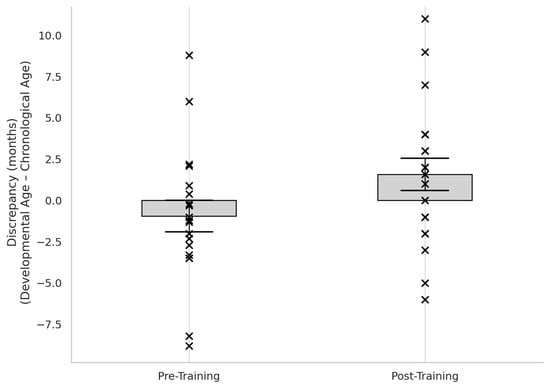
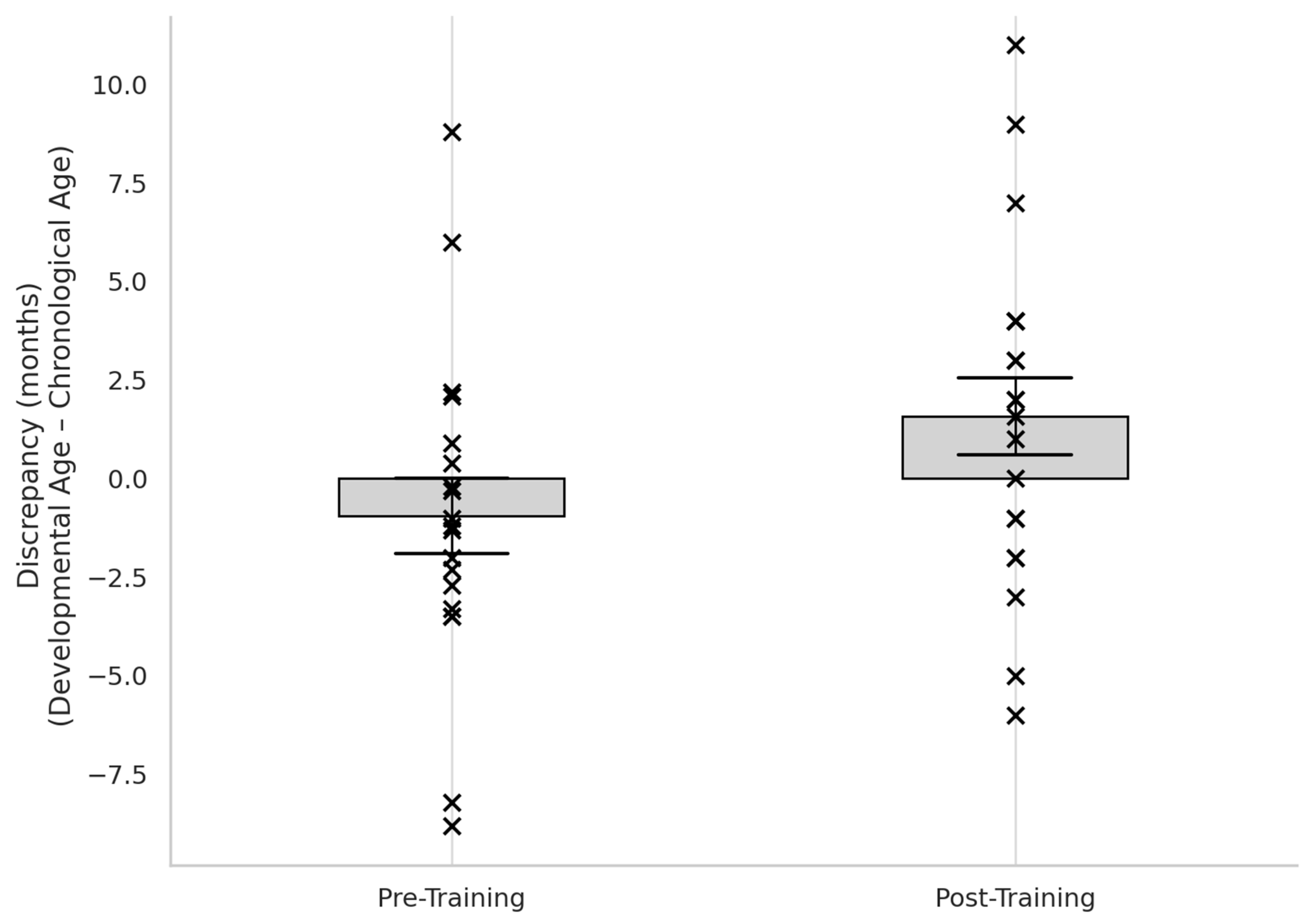
A paired-samples t-test revealed a significant shift in discrepancy from pre-test (M = –0.95 months, SD = 4.14) to post-test (M = 1.58 months, SD = 4.46), t(18) = 3.76, p < 0.001, d = 0.86, suggesting that the children’s developmental performance improved to levels exceeding age-based expectations following the training (see Figure 1).
Figure 1.
Mean Discrepancy between Developmental and Chronological Age at Pre-training and Post-training. Error bars represent standard errors of the mean. Individual data points (×) are displayed.
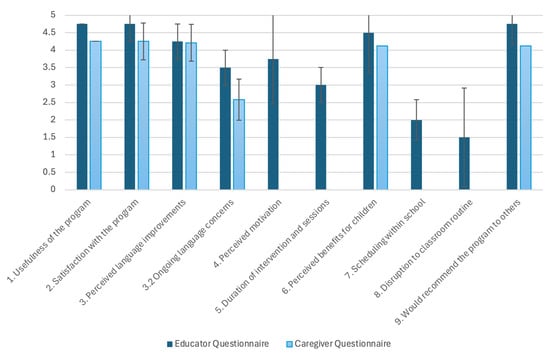
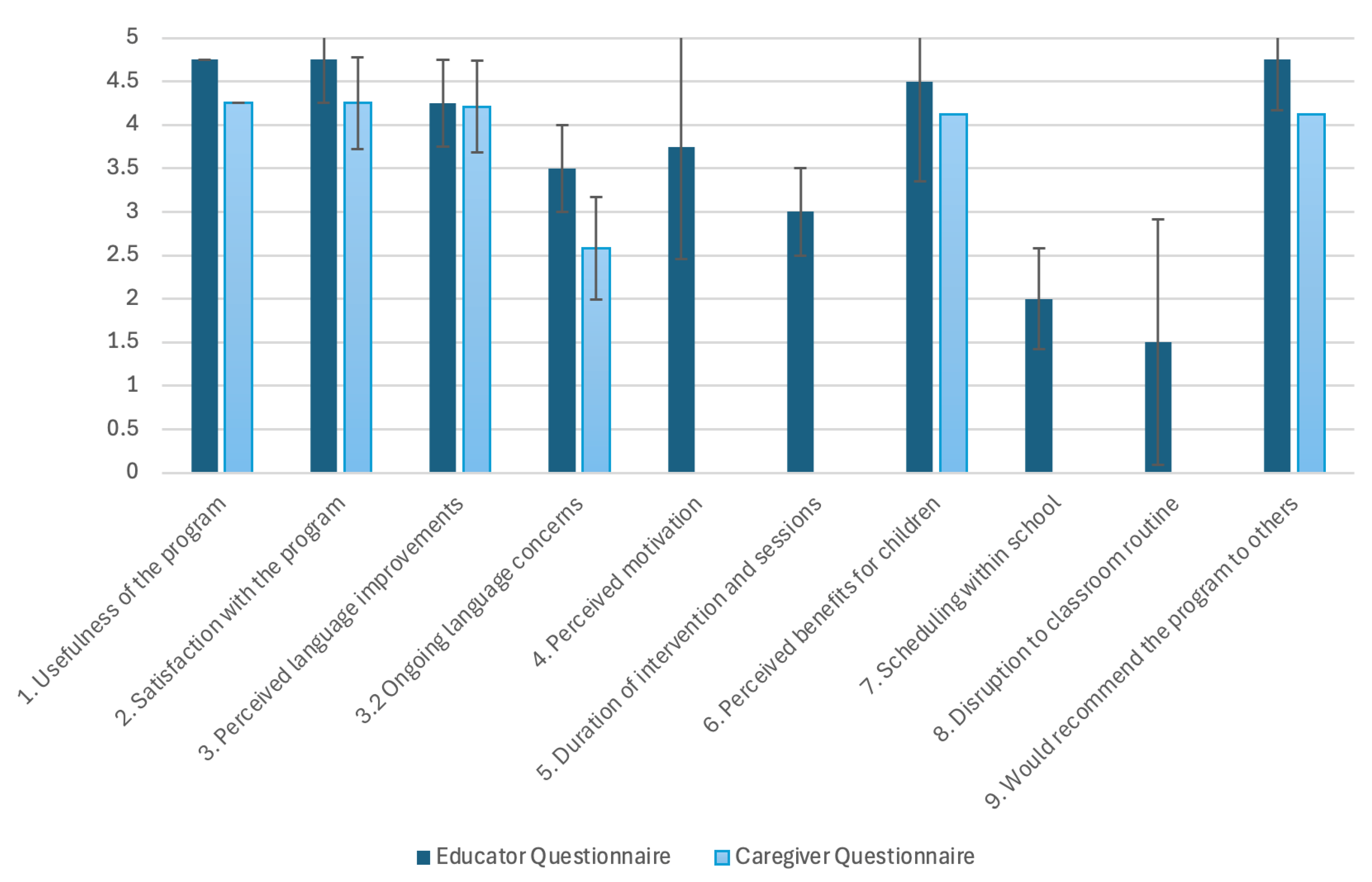
The results for feasibility are shown in Table 2 and Figure 2. Educators reported high satisfaction with the training. The usefulness of the program (M = 4.75, SD = 0.50), satisfaction with its structure (M = 4.75, SD = 0.50), and willingness to recommend it to others (M = 4.75, SD = 0.50) were among the highest-rated items. Educators also perceived clear improvements in children’s language and communication (M = 4.25, SD = 0.50). By contrast, the item assessing ongoing concerns about language and communication development showed greater variability and suggested that some concerns persisted despite the generally positive outcomes (M = 3.50, SD = 1.29).
Table 2.
Educator and Caregiver Satisfaction Questionnaire: Descriptive Statistics.
Figure 2.
Educator and Caregiver Satisfaction Questionnaires: Descriptive Statistics (Mean and Standard Deviations).
With respect to implementation feasibility, educators indicated that the training was beneficial (M = 4.50, SD = 0.58), although they reported logistical difficulties to integrate the sessions into the school schedule (M = 2.00, SD = 1.41). Importantly, they did not perceive the sessions as disruptive to classroom functioning (M = 1.50, SD = 0.58). Taken together, these findings support the feasibility of the training from the educators’ perspective, particularly in terms of acceptability, perceived effectiveness, and practical integration into the school setting.
Caregivers also reported high levels of agreement across all items related to the acceptability and satisfaction with the training, perceived improvements in their children’s language abilities, and the likelihood of recommending the program to others. Mean scores for these items ranged from 4.12 to 4.25, reflecting a consistently positive evaluation. By contrast, the item assessing ongoing concerns about language and communication yielded a lower mean score (M = 2.58, SD = 1.10), indicating that despite high satisfaction, some caregivers continued to experience moderate concerns. Two open-ended questions explored caregivers’ views on the benefits of the training and invited additional comments. Responses were overwhelmingly positive. Although the training was implemented exclusively in the school setting, no concerns were raised by caregivers regarding its execution or communication with families. This absence of negative feedback further supports the program’s feasibility from the caregivers’ perspective, particularly in terms of acceptability, perceived benefit, and perceived effectiveness. No significant differences emerged between responses from caregivers of children included in the efficacy analysis and those excluded, supporting consistency in perceived outcomes.
4. Discussion
This study evaluated the feasibility and preliminary effects of PRyME, a prosodic training program for typically developing children aged 6 to 36 months. A significant shift in discrepancy between children’s developmental age and chronological age, from performance below age level to performance above chronological age expectations, was observed following the training. This finding suggests improvements in language development potentially associated with participation in the PRyME program. The activities were implemented by regular educators within routine classroom contexts, with high adherence and overall positive acceptability. Educators reported observable improvements in children’s language and communication, and despite some scheduling challenges, all indicated willingness to recommend the program. Caregivers similarly expressed high satisfaction and perceived benefits in their children’s development. Notably, no negative feedback was reported, reinforcing the program’s acceptability across stakeholder groups. Taken together, these results support the feasibility and perceived value of PRyME within early educational settings.
These findings are consistent with existing research emphasizing the foundational role of prosody in early language acquisition (Gervain et al., 2020; Gleitman & Wanner, 1982; Jusczyk, 1997). Indeed, the importance of prosody has been highlighted in studies that link prosodic sensitivity to broader linguistic development (De la Cruz-Pavía et al., 2021; Goswami et al., 2010; Gutman et al., 2015; Holliman et al., 2008; Shukla et al., 2011). Prosodic features such as rhythm, intonation, and phrasing support essential processes in language learning including speech segmentation, i.e., the extraction of linguistic units from continuous speech, lexical access, i.e., word recognition, and syntactic parsing, i.e., the chunking of sentences into syntactic units (e.g., Butler & Frota, 2018; de Carvalho et al., 2018; Jusczyk, 1999; Nazzi & Ramus, 2003). Taken together, this body of work suggests that prosodic training might be a theoretically grounded mechanism with potential to support language acquisition. The PRyME program targeted specific prosodic features through structured activities grounded in sensorimotor experience, aligning with recent theoretical accounts of auditory–motor integration in language development (D. Choi et al., 2023; Goswami, 2022; Kuhl, 2021). By engaging children in structured activities that combine rhythm, prominence, intonation, and body movement, PRyME promotes auditory–motor integration and sensorimotor processes, which are mechanisms thought to underlie language perception and production. Its delivery by familiar educators in naturalistic classroom environments further enhances ecological validity and supports its potential for broader educational implementation.
Despite robust empirical evidence linking prosody to early language acquisition (Christophe et al., 2008; Gleitman & Wanner, 1982; Jusczyk, 1997; Gervain et al., 2020 for a review), most intervention programs for young children continue to only emphasize aspects such as vocabulary and syntax (e.g., Pak et al., 2023 for a systematic review and meta-analysis), with a small focus on prosodic skills. This translational gap between basic research and practice in language intervention further highlights the novelty and relevance of the present study. By demonstrating the feasibility of a prosody-based program implemented by educators within naturalistic classroom contexts, our findings provide preliminary evidence that prosody may be an effective and scalable target for early educational interventions.
Although the program was implemented in a European Portuguese context, its potential for cross-linguistic applicability should be highlighted. Languages may differ in how prosody is structured and realized, with language specific rhythm type, prominence and intonation patterns, and prosodic phrasing (Frota & Prieto, 2015; Jun, 2014; Ladd, 2008). However, infants’ and toddlers’ sensitivity to the prosodic features of language seems to be universal (Nallet & Gervain, 2021), and thus the ability to process prosodic features in early infancy suggests that similar training approaches could be adapted to other languages, emphasizing their specificities.
Moreover, the improvements observed in this short-term pilot study may reflect developmental cascade effects, whereby early sensitivity to prosody sets the foundation for growth in broader linguistic and communicative domains (Goswami et al., 2010). Thus, the feasibility and acceptability of PRyME might extend beyond immediate outcomes, underscoring its theoretical relevance for understanding how early prosodic experiences contribute to language development trajectories.
Several limitations of the current study should be acknowledged. First, the small sample size and absence of a control group limit the ability to draw causal conclusions regarding the observed effects. Additionally, the study was conducted at a single educational center with a relatively homogeneous participant population, which may restrict the generalizability of the findings. The more challenging socioeconomic profile of the population from the current study is suggestive that the PRyME program is suitable to large sectors of the population, but recruiting a more socioeconomically diverse population would certainly enhance the external validity of the training program. Although fidelity of implementation was high, future research should also incorporate objective outcome measures and long-term follow-up assessments to evaluate the stability of the intervention effects.
Given these limitations, future studies should replicate and extend the findings with larger samples, employ randomized controlled trial designs, and examine the program’s applicability across diverse cultural and educational contexts. Investigating the program’s scalability in different educational settings, together with mixed-methods approaches (that include qualitative evaluations of participants’ experiences), may yield additional evidence to support large-scale implementation and long-term sustainability. These directions will strengthen the evidence base and enable a more comprehensive understanding of the program’s effectiveness.
This study provided preliminary evidence that PRyME is a feasible, effective, and well-accepted classroom-based prosodic training program, endorsed by educators and caregivers, with potential benefits for early language development. These findings offer promising avenues for further research and constitute an essential step towards future large-scale investigation to establish PRyME’s efficacy and scalability. By highlighting prosody as a key mechanism for fostering language development in early childhood, this study underscores the potential of the PRyME program to make a meaningful contribution to developmental research and educational practice.
Author Contributions
Conceptualization, M.G.F., M.V. and S.F.; methodology, M.G.F., T.C., A.M., M.V. and S.F.; validation, M.G.F., T.C., A.M. and S.F.; formal analysis, M.G.F.; investigation, M.G.F., T.C. and C.S.; resources, A.M.; data curation, M.G.F. and T.C.; writing—original draft preparation, M.G.F.; writing—review and editing, M.G.F., T.C., C.S., M.V. and S.F.; visualization, M.G.F. and T.C.; supervision, M.V., S.F. and A.M.; project administration, S.F. and A.M.; funding acquisition, A.M., M.V. and S.F. All authors have read and agreed to the published version of the manuscript.
Funding
This research was supported by the Portuguese Foundation for Science and Technology (2020.01866.CEECIND, https://doi.org/10.54499/2020.01866.CEECIND/CP1592/CT0011; PTDC/LLT-LIN/1115/2021, https://doi.org/10.54499/PTDC/LLT-LIN/1115/2021; UID/214/2025: Center of Linguistics of the University of Lisbon), and received additional support from the Municipality of Cascais through the “Plataforma Crescer Melhor em Cascais” initiative (2024), which funded specialized and pedagogical intervention projects in the context of early childhood education.
Institutional Review Board Statement
The study was conducted in accordance with the Declaration of Helsinki and approved by the Ethics Committee of the authors’ university. Informed consent was obtained from the legal guardians of all participants.
Informed Consent Statement
Informed consent was obtained from all subjects involved in the study.
Data Availability Statement
Given the restrictions imposed by the Ethics Committee, the detailed data from this study are available from the corresponding author.
Conflicts of Interest
The authors declare no conflicts of interest.
Appendix A
| Questionnaire on Satisfaction—Caregivers |
| “Language starts now: From 6 to 36 months of age” |
- 1
- In general, the intervention was useful for my child.

- 2
- What is your level of satisfaction with the intervention program?

- 3
- In general, the intervention program improved my child’s language within the family context.

- 3.1
- If yes: What improvements did you notice?

- 3.2
- There are difficulties related to language and communication development that concern me.

- 3.2.1
- If yes: Which ones?

- 4
- In my opinion, my child’s participation in the intervention project was advantageous.

- 4.1
- Following the previous question, in what way do you consider your child’s participation to have been advantageous?

- 5
- I would recommend this intervention program to other children.

- 6
- Please list any other comments or observations you may have.
 |
| Thank you very much! |
| Questionnaire on Satisfaction—Educators |
| “Language starts now: From 6 to 36 months of age” |
- 1
- In general, the intervention was useful for my students.

- 2
- What is your level of satisfaction with the intervention program?

- 3
- In general, the intervention program improved the students’ language within the classroom context.

- 3.1
- If yes: What improvements did you notice?

- 3.2
- There are difficulties related to language and communication development that still concern me.

- 3.2.1
- If yes: Which ones?

- 4
- In your perception, what was the level of motivation of the students to participate in the intervention sessions?
- ☐
- Not motivated at all
- ☐
- Slightly motivated
- ☐
- Moderately motivated
- ☐
- Very motivated
- ☐
- Extremely motivated
- 5
- In my opinion, the duration of the intervention and its sessions was appropriate.

- 6
- In my opinion, the students’ participation in this intervention project was advantageous.

- 6.1
- Following the previous question, in what way do you consider your students’ participation to have been advantageous?

- 7
- It was difficult to integrate the intervention sessions with the school schedule.

- 8
- The intervention sessions negatively interfered with other classroom dynamics.

- 8.1
- If yes: In what way do you consider that the intervention sessions interfered with classroom dynamics?

- 9
- I would recommend this intervention program to other children.

- 10
- Please list any other comments or observations you may have.
 |
| Thank you very much! |
References
- Butler, J., & Frota, S. (2018). Emerging word segmentation abilities in European Portuguese-learning infants: New evidence for the rhythmic unit and the edge factor. Journal of Child Language, 45(6), 1294–1308. [Google Scholar] [CrossRef] [Scilit]
- Choi, D., Yeung, H. H., & Werker, J. F. (2023). Sensorimotor foundations of speech perception in infancy. Trends in Cognitive Sciences, 27(8), 773–784. [Google Scholar] [CrossRef] [Scilit]
- Choi, Y., & Mazuka, R. (2003). Young children’s use of prosody in sentence parsing. Journal of Psycholinguistic Research, 32(2), 197–217. [Google Scholar] [CrossRef] [Scilit]
- Christophe, A., Millotte, S., Bernal, S., & Lidz, J. (2008). Bootstrapping lexical and syntactic acquisition. Language and Speech, 51(1–2), 61–75. [Google Scholar] [CrossRef] [Scilit]
- de Carvalho, A., Dautriche, I., Millotte, S., & Christophe, A. (2018). Early perception of phrasal prosody and its role in syntactic and lexical acquisition. In P. Prieto, & N. Esteve-Gibert (Eds.), The development of prosody in first language acquisition (pp. 17–35). John Benjamins Publishing Company. [Google Scholar] [CrossRef] [Scilit]
- De la Cruz-Pavía, I., Marino, C., & Gervain, J. (2021). Learning word order: Early beginnings. Trends in Cognitive Sciences, 25(9), 802–812. [Google Scholar] [CrossRef] [Scilit] [PubMed]
- Eldridge, S. M., Chan, C. L., Campbell, M. J., Bond, C. M., Hopewell, S., Thabane, L., & Lancaster, G. A. (2016). CONSORT 2010 statement: Extension to randomised pilot and feasibility trials. BMJ, 355, i5239. [Google Scholar] [CrossRef] [Scilit] [PubMed]
- Filipe, M. G., Carneiro, T., Vigário, M., & Frota, S. (in press). PRyME: Manual for a classroom-based prosodic training program in early infancy (6–36 months). Laboratório de Fonética—CLUL/FLUL.
- Frota, S., & Butler, J. (2018). Early development of intonation. Perception and production. In P. Prieto, & N. Esteve-Gibert (Eds.), The development of prosody in first language acquisition (pp. 145–164). John Benjamins Publishing Company. [Google Scholar] [CrossRef] [Scilit]
- Frota, S., Cruz, M., Matos, N., & Vigário, M. (2016). Early prosodic development. In M. Armstrong, N. C. Henriksen, & M. M. Vanrell (Eds.), Intonational grammar in Ibero-Romance: Approaches across linguistic subfields (pp. 295–324). John Benjamins Publishing Company. [Google Scholar] [CrossRef] [Scilit]
- Frota, S., Pejovic, J., Severino, C., & Vigário, M. (2020, May 25–28). Looking for the edge: Emerging segmentation abilities in atypical development. 10th International Conference on Speech Prosody 2020 (pp. 814–818), Tokyo, Japan. [Google Scholar] [CrossRef] [Scilit]
- Frota, S., & Prieto, P. (2015). Intonation in romance: Systemic similarities and differences. In S. Frota, & P. Prieto (Eds.), Intonation in romance (pp. 392–418). Oxford University Press. [Google Scholar]
- Gervain, J., Christophe, A., & Mazuka, R. (2020). Prosodic bootstrapping. In C. Gussenhhoven, & A. Chen (Eds.), The oxford handbook of language prosody (pp. 562–573). Oxford Academic. [Google Scholar] [CrossRef] [Scilit]
- Gleitman, L. R., & Wanner, E. (1982). Language acquisition: The state of the state of the art. Cambridge University Press. [Google Scholar]
- Goswami, U. (2022). Language acquisition and speech rhythm patterns: An auditory neuroscience perspective. Royal Society Open Science, 9(7), 211855. [Google Scholar] [CrossRef] [Scilit]
- Goswami, U., Gerson, D., & Astruc, L. (2010). Amplitude envelope perception, phonology and prosodic sensitivity in children with developmental dyslexia. Reading and Writing, 23(8), 995–1019. [Google Scholar] [CrossRef] [Scilit]
- Goswami, U., Thomson, J., Richardson, U., Stainthorp, R., Hughes, D., Rosen, S., & Scott, S. K. (2002). Amplitude envelope onsets and developmental dyslexia: A new hypothesis. Proceedings of the National Academy of Sciences of the United States of America, 99(16), 10911–10916. [Google Scholar] [CrossRef] [Scilit]
- Green, E., Stroud, L., Bloomfield, S., Cronje, J., Foxcroft, C., Hurter, K., Lane, H., Marais, R., Marx, C., McAlinden, P., O’Connell, R., Paradice, R., & Venter, D. (2016). Escalas de Desenvolvimento Mental de Griffiths–3ª Edição (C. T. Ferreira, I. T. Carvalhão, I. C. Gil, & S. F. Fernandes, Trans.). Hogrefe. [Google Scholar]
- Gutman, A., Dautriche, I., Crabbé, B., & Christophe, A. (2015). Bootstrapping the syntactic bootstrapper: Probabilistic labeling of prosodic phrases. Language Acquisition, 22(3), 285–309. [Google Scholar] [CrossRef] [Scilit]
- Holliman, A. J., Wood, C., & Sheehy, K. (2008). Sensitivity to speech rhythm explains individual differences in reading ability independently of phonological awareness. British Journal of Developmental Psychology, 26(3), 357–367. [Google Scholar] [CrossRef] [Scilit]
- Instituto Nacional de Estatística. (2011). Classificação Portuguesa das profissões 2010 [Portuguese classification of professions 2010]. Instituto Nacional de Estatística. Available online: https://www.ine.pt/xurl/pub/107961853 (accessed on 30 September 2025).
- Johnson, E. K., Seidl, A., & Tyler, M. D. (2014). The edge factor in early word segmentation: Utterance-level prosody enables word form extraction by 6-month-olds. PLoS ONE, 9(1), e83546. [Google Scholar] [CrossRef] [Scilit] [PubMed]
- Jun, S. A. (2014). Prosodic typology: By prominence type, word prosody, and macro-rhythm. In S. A. Jun (Ed.), Prosodic typology II: The phonology of intonation and phrasing (pp. 520–540). Oxford University Press. [Google Scholar] [CrossRef] [Scilit]
- Jusczyk, P. W. (1997). The discovery of spoken language. MIT Press. [Google Scholar]
- Jusczyk, P. W. (1999). How infants begin to extract words from speech. Trends in Cognitive Sciences, 3(9), 323–328. [Google Scholar] [CrossRef] [Scilit]
- Kuhl, P. K. (2021). Infant speech perception: Integration of multimodal data leads to a new hypothesis—Sensorimotor mechanisms underlie learning. In M. D. Sera, & M. Koenig (Eds.), Minnesota symposia on child psychology (pp. 113–158). John Wiley & Sons. [Google Scholar] [CrossRef] [Scilit]
- Ladd, D. R. (2008). Intonational phonology (2nd ed., Vol. 119). Cambridge University Press. [Google Scholar] [CrossRef] [Scilit]
- Mehler, J., Jusczyk, P., Lambertz, G., Halsted, N., Bertoncini, J., & Amiel-Tison, C. (1988). A precursor of language acquisition in young infants. Cognition, 29(2), 143–178. [Google Scholar] [CrossRef] [Scilit]
- Nallet, C., & Gervain, J. (2021). Neurodevelopmental preparedness for language in the neonatal brain. Annual Review of Developmental Psychology, 3(1), 41–58. [Google Scholar] [CrossRef] [Scilit]
- Nazzi, T., Bertoncini, J., & Mehler, J. (1998). Language discrimination by newborns: Toward an understanding of the role of rhythm. Journal of Experimental Psychology: Human Perception and Performance, 24(3), 756–766. [Google Scholar] [CrossRef]
- Nazzi, T., & Ramus, F. (2003). Perception and acquisition of linguistic rhythm by infants. Speech Communication, 41(1), 233–243. [Google Scholar] [CrossRef] [Scilit]
- Pak, N. S., Chow, J. C., Dillehay, K. M., & Kaiser, A. P. (2023). Long-term effects of early communication interventions: A systematic review and meta-analysis. Journal of Speech, Language, and Hearing Research, 66(8), 2884–2899. [Google Scholar] [CrossRef] [Scilit]
- Paul, R., Simmons, E. S., & Mahshie, J. (2020). Prosody in children with atypical development. In C. Gussenhover, & A. Chen (Eds.), Oxford handbook of language prosody (pp. 582–594). Oxford University Press. [Google Scholar]
- Prieto, P., Estrella, A., Thorson, J., & Vanrell, M. D. M. (2012). Is prosodic development correlated with grammatical and lexical development? Evidence from emerging intonation in Catalan and Spanish. Journal of Child Language, 39(2), 221–257. [Google Scholar] [CrossRef] [Scilit]
- Rocha, S., Attaheri, A., Ní Choisdealbha, Á., Brusini, P., Mead, N., Olawole-Scott, H., Boutris, P., Gibbon, S., Williams, I., Grey, C., Oliveira, M. A., Brough, C., Flanagan, S., Ahmed, H., Macrae, E., & Goswami, U. (2024). Precursors to infant sensorimotor synchronization to speech and non-speech rhythms: A longitudinal study. Developmental Science, 27(4), e13483. [Google Scholar] [CrossRef] [Scilit]
- Shukla, M., White, K. S., & Aslin, R. N. (2011). Prosody guides the rapid mapping of auditory word forms onto visual objects in 6-mo-old infants. Proceedings of the National Academy of Sciences of the United States of America, 108(15), 6038–6043. [Google Scholar] [CrossRef] [Scilit]
- Thorson, J. C. (2018). The role of prosody in early word learning. In P. Prieto, & N. Esteve-Gibert (Eds.), The development of prosody in first language acquisition (pp. 59–77). John Benjamins Publishing Company. [Google Scholar]
- Verbeek, L., Vissers, C., Kleemans, T., Scheper, A., & Verhoeven, L. (2023). Early intervention of language and behavior in monolingual and bilingual preschoolers with Developmental Language Disorders. Early Childhood Research Quarterly, 64, 106–118. [Google Scholar] [CrossRef] [Scilit]
- Wagner, M., & Watson, D. G. (2010). Experimental and theoretical advances in prosody: A review. Language and Cognitive Processes, 25(7–9), 905–945. [Google Scholar] [CrossRef] [Scilit] [PubMed]

Disclaimer/Publisher’s Note: The statements, opinions and data contained in all publications are solely those of the individual author(s) and contributor(s) and not of MDPI and/or the editor(s). MDPI and/or the editor(s) disclaim responsibility for any injury to people or property resulting from any ideas, methods, instructions or products referred to in the content. |
© 2025 by the authors. Licensee MDPI, Basel, Switzerland. This article is an open access article distributed under the terms and conditions of the Creative Commons Attribution (CC BY) license (https://creativecommons.org/licenses/by/4.0/).