


Mapping the Field: A Scoping Review of Initial Teacher Education Research in Central Asia


Abstract
1. Introduction
- What are the publication trends and characteristics of research on initial teacher education in Central Asia?
- What are the main research themes emerging from the literature in the field?
2. Background Review: Teachers and Initial Teacher Education in Central Asia
3. Methods
4. Findings
4.1. Trends in Study Publications
4.2. Emerging Research Themes
4.2.1. Curriculum in ITE
4.2.2. Teaching Practices and Learning Environment in ITE
4.2.3. Educational Reform and Policy in ITE
4.2.4. Becoming a Teacher
5. Discussion
5.1. Publication Trends
5.2. Quality and Methodological Orientation
5.3. Dominant Research Themes
5.4. Emerging but Limited Areas
5.5. Gaps in Equity and Diversity
6. Contributions, Limitations and Future Directions
Author Contributions
Funding
Institutional Review Board Statement
Informed Consent Statement
Data Availability Statement
Conflicts of Interest
Appendix A
| Title of the Journal | N of Articles | |
| 1 | Annual Review of Applied Linguistics | 1 |
| 2 | Asia-Pacific Science Education | 1 |
| 3 | Asian Journal of University Education | 1 |
| 4 | Astra Salvenis | 1 |
| 5 | Bilig | 1 |
| 6 | Bulletin of Institute of Education, University of Tsukuba | 1 |
| 7 | Cogent Education | 2 |
| 8 | Computer Assisted Language Learning | 1 |
| 9 | Cypriot Journal of Educational Series | 17 |
| 10 | Education and Self Development | 2 |
| 11 | Education Sciences | 1 |
| 12 | Educational Media International | 1 |
| 13 | Elementary Education Online | 2 |
| 14 | Eurasian Journal of Applied Linguistics | 1 |
| 15 | European Journal of Contemporary Education | 3 |
| 16 | Frontiers in Education | 2 |
| 17 | GeoJournal of Tourism and Geosites | 1 |
| 18 | Global Journal of Engineering Education | 1 |
| 19 | Global Journal of Pure and Applied Mathematics | 1 |
| 20 | Indian Journal of Science and Technology | 1 |
| 21 | Insight: The Pshychological Dimensions of Society | 1 |
| 22 | Integration of Education | 1 |
| 23 | International Electronic Journal of Mathematics Education | 1 |
| 24 | International Journal of Cognitive Research in Science, Engineering and Education | 2 |
| 25 | International Journal of Education and Practice | 1 |
| 26 | International Journal of Education in Mathematics, Science and Technology | 4 |
| 27 | International Journal of Emerging Technologies in Learning | 4 |
| 28 | International Journal of Environmental and Science Education | 2 |
| 29 | International Journal of Inclusive Education | 1 |
| 30 | International Journal of Information and Education Technology | 1 |
| 31 | International Journal of Innovation, Creativity and Change | 1 |
| 32 | International Journal of Innovative Research and Scientific Studies | 1 |
| 33 | International Journal of Instruction | 2 |
| 34 | International Journal of Learning, Teaching and Educational Research | 1 |
| 35 | International Journal of Scientific and Technology Research | 3 |
| 36 | Journal for Educators, Teachers and Trainers | 1 |
| 37 | Journal of Advanced Research in Dynamical and Control Systems | 1 |
| 38 | Journal of Education and E-learning Research | 4 |
| 39 | Journal of Education for Teaching | 1 |
| 40 | Journal of Educational and Social Research | 2 |
| 41 | Journal of Human Sport and Exercise | 1 |
| 42 | Journal of Intellectual Disability—Diagnosis and Treatment | 2 |
| 43 | Journal of Social Studies Education Research | 2 |
| 44 | Journal of Theoretical and Applied Information Technology | 1 |
| 45 | Jurnal Pendidikan Ipa Indonesia | 1 |
| 46 | Life Science Journal | 5 |
| 47 | Man in India | 1 |
| 48 | Mediterranean Journal of Social Sciences | 1 |
| 49 | Middle East Journal of Scientific Research | 1 |
| 50 | Obrazovanie i Nauka | 1 |
| 51 | Online Journal of Communication and Media Technologies | 1 |
| 52 | Opcion | 5 |
| 53 | Perspektivy Nauki i Obrazovania | 1 |
| 54 | Problems of Education in the 21st Century | 1 |
| 55 | Qubahan Academic Journal | 1 |
| 56 | Research in Comparative and International Education | 1 |
| 57 | Retos | 2 |
| 58 | Revista Espacious | 5 |
| 59 | Sage Open | 1 |
| 60 | Scientific Herald of Uzhhorod University. Series Physics | 10 |
| 61 | Tejuelo. Didáctica de la Lengua y la Literatura. Educación. | 1 |
| 62 | TESOL quarterly | 1 |
| 63 | The Advanced Science Journal | 1 |
| 64 | The New Educational Review | 1 |
| 65 | The Social Sciences | 2 |
| 66 | Vestnik Novosibirscogo gosudarstvennogo pedagogicheskogo universitrta | 1 |
| 67 | Vysshee Obrazovanie v Rossii | 1 |
| 68 | World Applied Sciences Journal | 2 |
| 69 | World Journal on Educational Technology: Current Issues | 10 |
| 70 | World Transactions on Engineering and Technology Education | 1 |
| 71 | XLinguae | 1 |
| N/A | 1 | |
| Total articles | 144 |
Appendix B
| Thematic Coding |
| CURRICULUM in ITE—98 |
| Pedagogical Content Knowledge—35 |
| Pedagogical Content Knowledge |
| 1. Abylkasymova, A. E., Nurmukhamedova, Z. M., Nurbaeva, D. M., & Zhumalieva, L. D. (2016). “ The Turkish vector” influence on teaching the exact disciplines in modern educational system of Kazakhstan: On the example of teaching algebra and mathematics. Global Journal of Pure and Applied Mathematics, 12(4), 3481–3492. |
| 2. Batyrbekova, K., Sarybayeva, A.K., Turmambekov, T., & Serikkyzy, A. (2020). Evaluation of the System of Methodical Training of a Physics Teacher in the Conditions of Modernisation of Education. European Journal of Contemporary Education, 9, 4–18. |
| 3. Goodman, B., & Tastanbek, S. (2021). Making the shift from a codeswitching to a translanguaging lens in English language teacher education. TESOL Quarterly, 55(1), 29–53. |
| 4. Lee, Y. (2021). Examining the impact of STEAM education reform on teachers’ perceptions about STEAM in Uzbekistan. Asia-Pacific Science Education, 7(1), 34–63. |
| 5. Mukhatyev, A., Omirbayev, S., Kassenov, K., Biloshchytskyi, A., & Omarova, S. (2024). Perception of IT teachers on their methodological development: A case at Kazakhstan universities. International Journal of Innovative Research and Scientific Studies, 7(4), 1354–1364. |
| 6. Muratova, Z., & Kassymbekova, M. (2023). Development of professional-oriented competence through language and content-integrated technology. Scientific Herald of Uzhhorod University Series Physics. |
| 7. Mussabekova, G., Issayeva, K., Oralova, Z., Saparbayeva, U., Faiziyev, N., & Mutaliyev, B. (2018). Hypothetical model of the development of a future teacher as a humanist (on the basis of humanitarian subjects). Opción, 34(85), 241–272. |
| 8. Nurgabyl, D., Zhailaubaeva, N., Abdoldinova, G., & Kaidassov, Z. (2023). Teaching Students Interdisciplinary Knowledge through Compilation of Differential Models within the Framework of Course Projects. Asian Journal of University Education, 19(3), 582–596. |
| 9. Yеnglik, K., Sholpan, K., Gulim, Z., Aliya, A., Tazhyhan, A., & Tlekshi, Y. (2022). Didactics of modern lessons in the modernisation of geographical education. Cypriot Journal of Educational Sciences. |
| 10. Zadorozhnyy, A., & Lee, J. S. (2023). Informal digital learning of English and willingness to communicate in a second language: Self-efficacy beliefs as a mediator. Computer Assisted Language Learning, 1–21. |
| Pedagogical knowledge |
| Assessment |
| 1. Kenzhetaeva, R., Nurzhanova, S., Beimisheva, A., Stambekova, A., Ryabova, E., & Kulbayeva, D. (2020). Features of the Transition From the Traditional to the Criterial Assessment in Schools of Kazakhstan. International Journal of Cognitive Research in Science, Engineering and Education. |
| 2. Tuna, S., Boranbayeva, A., Ortayev, B., Isaev, A., Isaev, G., & Mussabekova, G. (2019). Preparing future teachers to evaluate learning outcomes. Opción: Revista de Ciencias Humanas y Sociales, (90), 385–402. |
| Inclusive Education |
| 1. Berikkhanova, G., Ospanova, B., Yermenova, B., Zharmukhametova, R., Sultanova, N., & Urazbaeva, A. (2021). The Effectiveness of the Training Model of the Future Teacher in Conditions of Inclusive Education. International Journal of Education and Practice, 9(4), 670–686. |
| 2. Makoelle, T. M., & Burmistrova, V. (2021). Teacher education and inclusive education in Kazakhstan. International Journal of Inclusive Education, 29(4), 447–463. |
| 3. Шкутина, Л. А., Рымханoва, А. Р., Мирза, Н. В., Ашимханoва, Г. С., & Алшынбекoва, Г. К. (2017). Кадрoвый пoтенциал как oснoвнoй фактoр успешнoй реализации инклюзивнoй системы oбразoвания. Science for Education Today, 7(1), 21–33. |
| Instructional Strategies |
| 1. Aigul, A., Feruza, Y., Onal, A., Alena, G., Sandugash, K., Aktoty, K., & Rysty, M. (2024). Preparing Future Teachers and Psychologists to Use Integrative Fairy Tale Therapy Techniques. Eurasian Journal of Applied Linguistics, 10(1), 1–13. |
| 2. Issayev, A., Ortayev, B., Issayev, G., Baurzhan, D., & Gulzhaina, A. (2022). Improving the Supervisory Competence of Future Teacher Trainers with the Help of Innovative Technologies. World Journal on Educational Technology: Current Issues, 14(3), 692–703. |
| 3. Kastayev, S., Berkimbayev, K., Ibragim, K., Jumagulova, G., & Tusseyev, M. (2022). Formation of Future Teachers’ Ability to Organise Educational Activities on the Basis of Pedagogical Tasks. Cypriot Journal of Educational Sciences, 17(7), 2290–2302. |
| 4. Sapargaliyeva, A.Z., Muratbekova, D., Aralbaeva, R., Zhakipbekova, S., & Shynybekova, A.S. (2020). Professional Training of Future Teachers for the Development of Speech Activity of Younger Schoolchildren. Journal of Intellectual Disability—Diagnosis and Treatment. |
| 5. Zahanovna, T. Z., Nazimbekovna, Z. A., Zaurbekovna, A. A., Samuilovich, S. V., & Ademovna, N. G. (2014). Formation of the future teachers’ professional competence to realisation of innovative educational technologies in conditions of polylingual education. Life Science Journal, 11(4), 154–157. |
| Ethnopedology |
| 1. Ainash, A., Yelena, B., Nazgul, K., Albina, A., & Galina, D. (2022). Formation of ethno-pedagogical competence of the future teacher in the aspect of modernisation of public consciousness. Cypriot Journal of Educational Sciences. |
| 2. Akhmetova, S. (2014). The ethnopedagogics of Kazakhstan: The formation and development. World Applied Sciences Journal, 29(8), 1050–1054. |
| 3. Anesova, A. Z., Seifullina, M. M., & Zhumataeva, E. (2013). Innovation technologies in the context of ethnocultural education of future teachers in Kazakhstan. Middle East Journal of Scientific Research, 13(5), 628–635. |
| 4. Mendikulova, Z., Atemova, K.T., Rysbekova, A., Kuralbayeva, A., & Abdurakhmanov, N. (2024). Possibilities of using the legacy of Turkic philosophers in the development of the professional personality of future teachers. Scientific Herald of Uzhhorod University Series Physics. |
| 5. Stukalenko, N.M., Murzina, S.A., Navy, L.N., Kairkhanovna, S., & Moldabekova (2013). Research of Ethnopedagogical Approach in Professional Training of Teachers. |
| 6. Toleubekova, R., & Zhumataeva, E. (2018). The Role of Ethnopedagogy in Shaping Positive Attitudes towards Traditional Values of Kazakh People among Master’s Students Majoring in Education in Kazakhstan. Problems of Education in the 21st Century, 76(6), 834–846. |
| 7. Zhuzeyev, S., Zhailauova, M., Abuova, A., Koishibaev, M., Aidarov, O., & Maigeldiyeva, Z. (2022). Professional training of future primary school teachers based on ethnopsychological features and ethnopedagogical traditions. Cypriot Journal of Educational Sciences, 17(9), 3067–3077. |
| Multilingual Education |
| 1. Kabdolova, G., Bazarbekov, K., Tarasovskaya, N., Khamzina, S., & Kabdolov, Z. (2023). The use of a regional component in the multilingual training of future biology teachers. Scientific Herald of Uzhhorod University Series Physics. |
| 2. Kambatyrova, A., Assylbekova, B., & Goodman, B. (2022). Primary school English language education in Kazakhstan: Policy, preparation, and practice. In English for Young Learners in Asia (pp. 48–64). Routledge. |
| 3. Khajayeva, Z., Stambekova, A., Gazikhanova, Z., Smagulova, G., & Makhanbetjanovna, S. R. (2021). Primary School Teacher Candidates’ Views on Multilingual Concepts: A Perspective of Learning Technology. World Journal on Educational Technology: Current Issues, 13(1), 1–9. |
| 4. Хайрутдинoва, Р. Р., Абдулахамидoва, Б. Н., Тoрoшoв, Т. К., & Капарoв, А. Ш. (2023). Русский язык в Кыргызстане глазами студентoв. Интеграция oбразoвания, 27(3 (112)), 373–389. |
| 5. Kydyrbayeva, G., Stambekova, A., Svetlana, U., Gulsim, N., & Gulvira, M. (2021). Preparing Future Primary School Teachers for Trilingual Teaching with CLIL Technology. World Journal on Educational Technology: Current Issues, 13(4), 617–634. |
| 6. Shalabayeva, L.I., Baisultanova, S.C., Abdigapbarova, U.M., Kudaibergeneva, K., & Jaxynkayeva, Z.T. (2024). Development of professional and personal qualities of MA students in the context of multilingual education. Scientific Herald of Uzhhorod University Series Physics. |
| 7. Shayakhmetova, D., Baituova, A., Bekbenbetova, K., Islam, D., & Yerzhanova, S. (2017, July). The development of teachers’ multicultural competence in the context of modern higher education. In International conference on psychology, education and social sciences (pp. 279–306). |
| 8. Zhumabayeva, E., Kdyrbaeva, A. A., Nurzhanova, S. A., Stambekova, S., & Uaidullakyzy, E. (2020). Implementing polylingual space into the process of training future primary school teachers. |
| Technological Knowledge—15 |
| Technological Pedagogical Knowledge |
| 1. Baltynova, A., Kamariyash, K., Muzdbaeva, T., Bolat, Y., Beleukhanova, K., Zharikova, D., & Mollakuqe, E. (2023). Pedagogical conditions for the training of future teachers based on digital educational technologies. International Journal of Emerging Technologies in Learning (Online), 18(18), 121. |
| 2. Berdi, D., Usembayeva, I.B., Ramankulov, S., Saparbekova, G.A., & Berkinbaev, M.O. (2015). Results of the Experimental Research on the Introduction of Information and Telecommunication Technologies in Teachers’ Professional Training. Indian journal of science and technology, 8. |
| 3. Egorov, V. V., Jantassova, D. D., & Churchill, N. (2007). Developing pre-service English teachers’ competencies for integration of technology in language classrooms in Kazakhstan. Educational Media International, 44(3), 255–265. |
| 4. Karabalayeva, A., Ibadullayeva, S., Nurumov, B., Darzhuman, G., Nazarov, E., & Sumatokhin, S. (2023). Assessment of Biology Teacher Candidates’ Attitudes and Competencies Toward Virtual Reality Applications. International Journal of Emerging Technologies in Learning, 18(18). |
| 5. Kastayev, S., Ortayev, B., Auyezov, B., Jumagulova, G., Sadirmekova, Z., & Akimbekova, S. (2022). Improving students’ functional literacy through critical thinking development technologies. World Journal on Educational Technology: Current Issues, 14(5), 1433–1442. |
| 6. Kerimbayeva, B. T., Niyazova, G. Z., Meirbekov, A. K., Kibishov, A. T., & Usembayeva, I. B. (2024). A network communicative culture for future teachers: development of digital literacy and communicative competence. Cogent Education, 11(1), 2363678. |
| 7. Nazgul, K., Anar, B., Baglan, Z., Moldir, S., Sadvakasova, G., & Nishanbayeva, S. (2020). Preservıce teachers’ opinions on the use of technology in education. International Journal of Emerging Technologies in Learning (iJET), 15(23), 182–192. |
| 8. Nogerbek, A., Sumatokhin, S.V., Maimatayeva, A., Ziyayeva, G., & Childibayev, D. (2022). Future biology teachers’ opinions on technological pedagogical content knowledge. World Journal on Educational Technology: Current Issues. |
| 9. Ramazanova, D., Togaibayeva, A., Suguraliyeva, A., Zhubatyrova, B., Biissova, G., & Anar, B. (2021). Evaluation of pre-service teachers’ views on their ability to use instructional technologies. World Journal on Educational Technology: Current Issues. |
| 10. Zhumabayeva, A., Nurshanova, S., Zhumabayeva, Z., Ospankulov, Y., Bazarbekova, R., & Stambekova, A. (2023). Analysis of Prospective Primary School Teachers’ Attitudes towards Mobile Learning Tools and Acceptance of Mobile Learning. International Journal of Education in Mathematics, Science and Technology. |
| Technological Pedagogical Content Knowledge |
| 1. Issakov, Y., Laiskhanov, S., Mazbayev, O., Ussenov, N., Zheldibayev, A., Kamelkhan, G., & Dávid, L. D. (2022). Opportunities to use mobile GIS applications in the formation of tourist and local lore competencies in students: case study in Almaty, Kazakhstan. Geo Journal of Tourism and Geosites, 41(2), 597–605. |
| 2. Joldanova, D., Tleuzhanova, G., Kitibayeva, A., Smanova, G., & Mirza, N. (2022). Formation of TPACK and acmeological competency of future teachers in foreign language education. International Journal of Education in Mathematics, Science and Technology, 10(4), 935–954. |
| 3. Kulakhmetova, S. B., Ibragimov, R., Kalimbetov, B. T., Kornilov, V. S., & Karataev, A. O. (2022). Prospective teachers’ attitude towards computer algebra systems (CAS) and their choice of using CAS in solving problems of systems of differential equations. World Trans. Eng. Technol. Educ, 20(3), 163–169. |
| 4. Mailybayeva, Z. S., Kurmanbayev, M. R., & Yermentayeva, A. R. (2022). Group Psychological and Pedagogical Technologies for Developing the Narrative Ability in Future Specialists. Cypriot Journal of Educational Sciences, 17(7), 2371–2382. |
| 5. Rezuanova, G., Bulatbayeva, K., Smagulova, M., Tynybayeva, M., Schnaider, V., & Zhukenova, A. (2023). Supporting multilingual education with computer aided instruction applications. |
| Civic and cultural education—8 |
| 1. Dosbenbetova, A., Kiyassova, K., Akhmet, L., Mirzageldiyev, B., & Aldabergenov, N. (2020). Preparation of future teachers for the realisation of the tasks of schoolchildren’s spiritual and moral education. International Journal of Scientific and Technology Research, 9(4), 1404–1407. |
| 2. Kussainova, M., Kenesbekova, S., Alshynbayeva, Z., Nugman, B., & Tleugabylova, K. (2023). Self-education of future teachers in education of primary school children through national values. Scientific Herald of Uzhhorod University Series Physics. |
| 3. Oshakbayev, Z. (2020). Rethinking of the problem of patriotic competence development in pedagogical higher educational institutions. Elementary Education Online, 19(4), 343–350. |
| 4. Rysbayeva, G., Makhmutova, K., Ibragim, K., Abasheva, P., Buletova, L., Kuatova, Z., … & Gapparov, T. (2014). Future teachers’ training for application of the Kazakh ethno pedagogy means in the process of schoolchildren’s patriotic education. Life Science Journal, 11(SPEC. ISSUE 5), 354–358. |
| 5. Sarbasova, V., Khan, N., Tarantey, V., & Aliyeva, D. (2019). Scientific and theoretical foundations in formation of the national self-consciousness of future teachers in the system of higher education of the Republic of Kazakhstan. Opción: Revista de Ciencias Humanas y Sociales, (24), 1240–1254. |
| 6. Tokhirovna, I.H. (2020). Spiritual Diagnostics Of Higher Education Students In Uzbekistan. International Journal of Scientific & Technology Research, 9, 90–93. |
| 7. Zhampeisova, K., Balykbayev, T., Khan, N., & Kolumbayeva, S. (2018). The content of the professional training of the teacher in Kazakhstan. Opción: Revista de Ciencias Humanas y Sociales, (14), 683–710. |
| 8. Zhou, X., Karabalaeva, G., Wang, S., Ding, Q., & Wang, C. (2023). Prospects and priorities of the cultural aspect in education. Scientific Herald of Uzhhorod University Series Physics. |
| Content knowledge—5 |
| 1. Kurmanayeva, G., Kurmanayeva, D., Tusselbayeva, Z., Kasbayeva, G., & Aristanbekova, Z. (2017). Professional education of social pedagogues in Kazakhstan. Espacios, 38(35). |
| 2. Marziya, A., Gulbakut, M., & Tolkyn, S. (2016). The issue of training counsellors to work with orphans in Kazakhstan. The Social Sciences, 11(6), 793–797. |
| 3. Sadvakassova, A. I. G. U. L., & Serik, M. E. R. U. E. R. T. (2017). Cloud technologies in educational system of Republic of Kazakhstan. Journal of Theoretical and Applied Information Technology, 95(11), 2434–2441. |
| 4. Yesseikyzy, A., Kydyrbaeva, G., Batyrbayeva, A., Meirambek, A., Zabiyeva, K., & Kasteyeva, G. (2022). Development of the logical thinking of future mathematics teachers through the use of digital educational technologies. Cypriot Journal of Educational Sciences, 17(6), 2001–2012. |
| 5. Zholdasbek, B., Shokybayev, Z., Ilyassova, G., Akylbekova, T.N., & Kolushpayeva, A. (2024). Methodological basis for ecological knowledge development in future teachers in the chemistry education process at HEIs. Scientific Herald of Uzhhorod University Series Physics. |
| Professional Ethics—2 |
| 1. Khanat, K., Gulsara, U., Madina, T., Roza, Z., & Gulmira, T. (2020). Methodological Guidelines for the Deontological Adaptation of Future Teachers in the Education Process. Journal of Intellectual Disability-Diagnosis and Treatment, 8(4), 791-798. |
| 2. Zhunusbekova, A., Koshtayeva, G., Zulkiya, M., Muratbekovna, O. L., Kargash, A., & Vasilyevna, S. M. (2022). The Role and Importance of the Problem of Ethics in Education. Cypriot Journal of Educational Sciences, 17(3), 787–797. |
| Future Skills—26 |
| 1. Akhmetov, A. S., Muchkin, D. P., & Utyubayev, E. S. (2016). Some aspects of the students-future teachers’ personal development in the conditions of civil society formation. International Electronic Journal of Mathematics Education, 11(7), 2129–2136. |
| 2. Amirova, A., Iskakovna, J. M., Zakaryanovna, T. G., Nurmakhanovna, Z. T., & Elmira, U. (2020). Creative and research competence as a factor of professional training of future teachers: Perspective of learning technology. World Journal on Educational Technology: Current Issues, 12(4), 278–289. |
| 3. Аbdigapbarova, U., Yeshenkulova, D., Kassimbekova, B., Muratbaeva, G., & Каstayev, S. (2022). Technology for forming students’ ability to manage independent educational activities. Cypriot Journal of Educational Sciences. |
| 4. Amirova, A., Buzaubakova, K., Kashkynbayeva, Z., Yelubayeva, M., Kumisbekova, Z., Elmira, U., & Genc, Z. (2018). Training the creative competence of future teachers. |
| 5. Astambayeva, Z., Kenzhetaeva, R., Zhumash, Z., & Italmassova, R. (2023). Assessment of Future Primary School Teachers’ Development of Creative Competence: A Case Study. Journal of Education and e-Learning Research, 10(2), 260–269. |
| 6. Kalimzhanova, R. L., Kalkeeva, K. R., Zheksembayeva, G. S., Aymagambetova, R. H., Akhtanov, S. K., & Ivanova, Y. N. (2016). Requirements for modern speech culture of Kazakh students in a situation of ethno-political conflicts of East and West. The Social Sciences (Pakistan), 11(21), 5128–5132. |
| 7. Kazykhankyzy, L., & Alagözlü, N. (2019). Developing and Validating a Scale to Measure Turkish and Kazakhstani ELT Pre-Service Teachers’ Intercultural Communicative Competence. International Journal of Instruction, 12(1). |
| 8. Laulanbekov, A., Torybayeva, J., & Tusseyev, M. (2024). Developing health-saving competence of pre-service teachers in Kazakhstan. Retos: nuevas tendencias en educación física, deporte y recreación, (60), 1140–1148. |
| 9. Madina, Z., Aubakirova, R.Z., Manyapova, T., Rakhmetollauly, B.R., Anatolyevna, K.A., & Mishchenko, E.V. (2022). Self-development as a factor of professional growth of future teachers. Cypriot Journal of Educational Sciences. |
| 10. Myrzatayeva, G., Almetov, N., & Tazhmukhanova, N. (2023). Systematic training of future teachers for developing critical thinking of school pupils in Kazakhstan. Cogent Education, 10(2), 2202103. |
| 11. Nabi, G., Abibulaeva, A., Bulakbayeva, M., & Zholzhaksynova, M. (2022). The Problem of the Development of Emotional Intelligence of Future Social Educators. Cypriot Journal of Educational Sciences, 17(7), 2416–2427. |
| 12. Niyazova, A. Y., Chistyakov, A. A., Volosova, N. Y., Krokhina, J. A., Sokolova, N. L., & Chirkina, S. E. (2023). Evaluation of pre-service teachers’ digital skills and ICT competencies in context of the demands of the 21st century. |
| 13. Nogerbek, A., Ziyayeva, G., Dastan, J., Sveta, S., & Childibayev, D. (2022). Methods of Forming the Creative Thinking and Learning Technology Competencies of Future Biology Teachers. Cypriot Journal of Educational Sciences, 17(7), 2349–2360. |
| 14. SAGDULLAEV, I. I., Zhorabekova, A. N., & Tulenova, K. (2018). Methodological approaches of researching the problem of forming the creative qualities of future English teachers. Revista Espacios, 39(10). |
| 15. Salybekova, F. M., Almetov, N. S., Karbozova, G. K., Suyuberdieva, A. A., Kudaibergenova, M. R., & Nazarova, G. Z. (2023, April). Role of the integration of the 4C model in the professional training of foreign language teachers. In Frontiers in Education (Vol. 8, p. 1125728). Frontiers Media SA. |
| 16. Sarybayeva, A. K., Berkinbayev, M. O., Kurbanbekov, B. A., & Berdi, D. K. (2018). The Conceptual Approach to the Development of Creative Competencies of Future Teachers in the System of Higher Pedagogical Education in Kazakhstan. European Journal of Contemporary Education, 7(4), 827–844. |
| 17. Sengerbekova, B., Smakova, K., Baltabayeva, N., Urazbayev, K., Sametova, F., Taubayeva, M., & Kaibuldayeva, G. (2024). Conditions for Training Future Teachers on a Tolerant Basis: A Sociological Analysis in Case of Kazakhstan. |
| 18. Sharipkhojayeva, Z., Amirova, A., Zhanar, A., Tursynay, B., Meirimgul, Y., & Lyazzat, K. (2022). Educating future primary school teachers to create a communication culture through educational technologies. Cypriot Journal of Educational Sciences. |
| 19.Tavassarov, M., Seiitkazy, P., & Kerimbekov, T. (2024). Formation of Gnostic Skills in Future Social Teachers in The Process of Media Education. Qubahan Academic Journal, 4(3), 59–66. |
| 20 Tolegen, M. A., Tumanova, K. R., Shumeyko, T. S., Zhakaeva, S. A., Zhakaeva, K. A., & Aysina, S. T. (2016). Technique for Formation of Future Teachers’ Readiness for Their Professional and Pedagogic Cooperation. International Journal of Environmental and Science Education, 11(9), 2595–2606. |
| 21. Turabay, G., Mailybaeva, G., Seitenova, S., Meterbayeva, K., Duisenbayev, A., & Ismailova, G. (2023). Analysis of Intercultural Communication Competencies in Prospective Primary School Teachers’ Use of Internet Technologies. International Journal of Education in Mathematics, Science and Technology, 11(6), 1537–1554. |
| 22. Tursynay, I., Rymshash, T., Askar, I., Karas, K., & Azhar, K. (2021). Scientific comparative analysis of Professional Self-Development of future social pedagogue in Kazakhstan and abroad. Cypriot Journal of Educational Sciences. |
| 23. Uaidullakyzy, E., Zhunusbekova, A., Roza, N., Doszhan, R., & Maratovna, K. G. (2022). Development of Entrepreneurial Competence of Future Primary School Teachers. Cypriot Journal of Educational Sciences, 17(4), 1333–1346. |
| 24. Viktorovna, U. N., Kulmukhambetovna, I. G., Serikovna, B. K., Pavlovna, R. L., & Kydyrbaevna, K. A. (2017). Formation of communicative competence as a condition of development of social orientation of the future teacher. Man in India, 97(16), 407–414. |
| 25. Yelubay, Y., Dzhussubaliyeva, D., Moldagali, B., Suleimenova, A., & Akimbekova, S. (2022). Developing future teachers’ digital competence via massive open online courses (MOOCs). Journal of Social Studies Education Research, 13(2), 170–195. |
| 26. Yesmakhanova, Z., Zhussipova, G., Abjapparovna, K., Sumatokhin, S., Saparova, Z., & Assilbekova, B. (2022). Formation of digital competencies of future teachers of biology in a blended learning environment. World Journal on Educational Technology: Current Issues, 14(5), 1612–1621. |
| Research in ITE—6 |
| 1. Adilzhanova, U., Dzhusubaliyeva, D., & Stoimenova, Y. (2024). The theoretical and practical significance of the formation of the search and research competence of a future foreign language teacher using digital technologies. Scientific Herald of Uzhhorod University. Series Physics, 55, 1369–1379. |
| 2. Berikkhanova, A., Sapargaliyeva, B., Ibraimova, Z., Sarsenbayeva, L., Assilbayeva, F., Baidildinova, D., & Wilson, E. (2023). Conceptualising the Integration of Action Research into the Practice of Teacher Education Universities in Kazakhstan. Education Sciences, 13(10), 1034. |
| 3. Seitova, M., Mirici, I. H., & Öz, H. (2019). The Effect of the EPOSTL on the Self-evaluation of Student Teachers of English. Ilkogretim Online, 18(3). |
| 4. Shalabaeva, Z., Meirbekova, G.P., Rakhmet, U., Abdullina G., & Zhailauova, M. (2024). Methods and ways of preparing educational research activities for future elementary school teachers based on renewed education. Scientific Herald of Uzhhorod University Series Physics. |
| 5. Turgunbayeva, Botagula, Belegova, Aliyab, Bulakbayeva, Meiramgulc, Laurad, M., & Ainure, S. (2019). Issues and Challenges in the Formation of Future Teacher Reflexive Culture in Kazakhstan. |
| 6. Yermekbayeva, G., Kuzembayeva, G., Maydangalieva, Z., & Goncharenko, O. (2024). Implementing Research-Based Learning in Kazakhstan’s Pre-Service Teacher Education. Journal of Social Studies Education Research, 15(4), 316–337. |
| Practicum—1 |
| 1. Nurgaliyeva, A., Childibayev, D., Sagyndykova, S., Azman, M. N. A., & Saparova, G. (2022). Scientific and Methodological Basis of Practice-Oriented Training of Students-Biologists: A Case Study in Kazakhstan. Jurnal Pendidikan IPA Indonesia, 11(1), 24–34. |
| TEACHING PRACTICES AND LEARNING ENVIRONMENT in ITE—27 |
| Instructional Strategies—7 |
| 1. Abdraimova, B., & Gergana, D. (2024). Empowering Preservice Teachers in Kazakhstan for Linguistic and Cultural Competence Through Technology-Integrated Learning. International Journal of Cognitive Research in Science, Engineering and Education, 12(2), 273–282. |
| 2. Альжанoв, А. К., & Ахитoва, Р. С. (2023). Применение технoлoгии Кайдзен для пoвышения качества oбразoвания будущих педагoгoв инфoрматики. |
| 3. Berkimbaev, K. M., Nyshanova, S. T., Kerimbaeva, B. T., & Meirbekova, G. (2012). Formation of information competence of future specialists. The New Educational Review, 30, 271–278. |
| 4. Danilova, V. V., & Ismagulova, G. K. (2014). The Social Task for Future FL Teachers: A Case Method for English in High Schools of Kazakhstan. World Applied Sciences Journal, 30(7), 806–811. |
| 5. Karmanova, A., Madybekova, G., Kavak, N., Ualikhanova, B., Zharylkassyn, A., & Umarova, Z. (2024). Developing the Professional Competence of Future Chemistry Teachers through Digital Technologies: A Case Study of Kazakhstan. Technology, 3, 4. |
| 6. Malika, B., Ybyraimzhanov, K., Gaukhar, S., Nurdaulet, S., & Ainur, A. (2022). The effect of information technologies on the development of moral values of future teachers based on innovations in education. World Journal on Educational Technology: Current Issues. |
| 7. Temirgalinova, A., Karabulatova, I. S., Amiridou, S., & Erina, I. A. (2021). Case-Method in the Formation of Communicative Ethnopedagogical Competence of a Foreign Language Teacher: Based on the Material of Russia, Greece, and Kazakhstan. European Journal of Contemporary Education, 10(4), 1013–1026. |
| Psychological Dimensions of Student Learning—7 |
| 1. Duisembekova, Z., & Özmen, K. S. (2020). Analysing Language Learning Beliefs of English Student Teachers: A Cross-Cultural Study Across Turkic Republics. Bilig, (94), 51–73. |
| 2. Gelisli, Y., Kazykhankyzy, L., Mankesh, A., Shauyenova, M., & Akhmetova, A. (2019). The relation between academic self-concept and L2 motivational system of pre-service English teachers in Kazakhstan. Revista Espacios, 40(19). |
| 3. Kariyev, A., Orazbayeva, F., Imankulova, M., & Vasileva, V. (2024). Research on Academic Giftedness of Future Teachers. Insight: the psychological dimensions of society, 11, 164–183. |
| 4. Maralov, V. G., Kariyev, A. D., Krezhevskikh, O. V., Kudaka, M. A., Ageeva, L. E., & Agranovich, E. N. (2022). Students’ subjectness, self-efficacy and psychological well-being: Comparative research of Russian and Kazakhstan students. Higher Education in Russia, 31(10), 135–149. |
| 5. Маралoв, В. Г., Кудака, М. А., Кариев, А. Д., Крежевских, О. В., Агранoвич, Е. Н., & Агеева, Л. Е. (2023). Рoль самoэффективнoсти и психoлoгическoгo благoпoлучия в выбoре студентами стратегий самoсoвершенствoвания. Образoвание и самoразвитие, 18(3), 132–151. |
| 6. Minaeva, E. V., Ivanova, N. V., Kolesova, O. V., Lapin, N. I., Suvorova, O. V., & Zhestkova, E. A. (2017). Specifics of determination of antimotivation for learning activity in prospective teachers from different countries. Espacios, 38(25), 8. |
| 7. Минаева, Е. В., Иванoва, Н. В., & Акпаева, А. Б. (2018). Динамика антимoтивации учебнoй деятельнoсти студентoв педагoгических университетoв. Перспективы науки и oбразoвания, (3 (33)), 54–58. |
| Professional competence development in ITE—5 |
| 1. Kazakbaeva, R. (2023). Knowledge Base for Classroom Preparedness: Analysing Initial English Language Teacher Education in Kyrgyzstan. SAGE Open, 13(4), 21582440231220734. |
| 2. Onalbek, Z. K., Grinshkun, V. V., Omarov, B. S., Abuseytov, B. Z., Makhanbet, E. T., & Kendzhaeva, B. B. (2013). The main systems and types of forming of future teacher-trainers’ professional competence. Life Science Journal, 10(4), 2397–2400. |
| 3. Shakiyeva, A., Zhorabekova, A., Abilkhairova, Z., Yessimgaliyeva, T., & Makulbek, A. (2023, August). Methodical system for formation of professional competences of a future foreign language teacher in conditions of distance learning. In Frontiers in Education (Vol. 8, p. 1186908). Frontiers Media SA. |
| 4. Yakavets, N., Bridges, D., & Shamatov, D. (2017). On constructs and the construction of teachers’ professional knowledge in a post-Soviet context. Journal of Education for Teaching, 43(5), 594–615. |
| 5. Ybyraimzhanov, K., Zhaxylikova, K., Koishibaev, M., Omurzakova, A., & Ayapbergenova, G. (2023). Enhancing Students’ Pedagogical Potential with Practice-Oriented Courses in Teacher Education Universities. Journal of Education and e-Learning Research, 10(3), 585–594. |
| Professional readiness of teachers—5 |
| 1. Botagariev, T., Khakimova, Z., Andrushchishin, J., Akhmetova, A., & Konisbaeva, S. (2021). Professional Readiness and Efficiency of Future Physical Education Teachers. International Journal of Instruction, 14(2), 271–288. |
| 2. Gaissina, K., Tashenova, G., Geldymamedova, E., Tulindinova, G., Baimurzina, B., & Gavrilova, T. (2022). Methodology for improving the professional training of future biology teachers. Cypriot Journal of Educational Sciences. |
| 3. Garton, S. (2020). “This is why students feel lost when they go into teaching practice”: English Language Teachers’ Views on their Initial Teacher Education. International Journal of Learning, Teaching and Educational Research, 19(10), 371–387. |
| 4. Mazhitovna, B. G., Zharylkasynovna, I. S., Gulzhas, T., Seydakhmetovna, K. B., Saduakasovich, I. T., & Raikhan, Z. (2022). Scientific and methodological foundations in the process of training future biology teachers. Cypriot Journal of Educational Sciences, 17(9), 2999–3011. |
| 5. Ordasheva, M. Z., Bezhina, V. V., & Matveyeva, N. A. (2023). Criteria for the Development of the Aesthetic Culture of a Future Teacher of Fine Arts. Journal of Educational and Social Research, 13. |
| Professional learning of Educators in ITE—1 |
| 1. Rysbekova, S., Rysbekov, T., & Shintimirova, B. (2017). Training instructors in higher education: Kazakhstan context. Revista ESPACIOS, 38(35). |
| Extracurricular strategies—1 |
| 1. Tazhbayeva, S., Assilkhanova, M., & Ilimkhanova, L. (2014). Conceptualising for educational work organisation in institutions of higher education: Mission, goals, and pedagogical strategies for reforming higher education in Kazakhstan. Mediterranean Journal of Social Sciences, 5(20), 2738–2743. |
| Teaching Modes (Distance Education)—1 |
| 1. Aida, S., Ainur, Z., Ardak, A., Madina, A., Perizat, K., & Gulnara, R. (2022). Formation of Professional Competencies of a Future Foreign Language Teacher in the Field of Distance Education. World Journal on Educational Technology: Current Issues, 14(1), 268–281. |
| Educational Reform and Policy in ITE—12 |
| Changes and challenges in teacher education |
| 1. Kalimullin, A., Zhigalova, M. P., Ibrasheva, A., Kobylyanskaya, L. I., Lodatko, Y., & Nurlanov, Y. (2020). Post-soviet identity and teacher education: Past, present, future. Education and Self Development, 15(3), 145–163. |
| 2. Nuriev, M., Sovetkanova, D., & Seisenbayeva, Z. (2018). Achievements and new challenges in the area of education of independent Kazakhstan. Opción: Revista de Ciencias Humanas y Sociales, (85), 337–352. |
| 3. Niyazova, N., Pulatova, U., & Talipova, D. (2020). The progressive development of Uzbekistan on influence of pedagogical staff. Journal of Advanced Research in Dynamical and Control Systems, 12(S2), 328–332. |
| 4. Silova, I. (2009). The crisis of the post-Soviet teaching profession in the Caucasus and Central Asia. Research in Comparative and International Education, 4(4), 366–383. |
| 5. Tastanbekova, K. (2018). Teacher education reforms in Kazakhstan: Trends and issues. Bulletin of Institute of Education, University of Tsukuba, 42(2), 87–97. |
| ITE Pedagogical Reforms |
| 1. Tolipov, U., Tsoy, M., & Tolipova, F. (2014). Pedagogical education in Uzbekistan. The Advanced Science Journal, 251–256. |
| 2. Sovetkanova, D., Turgunbayeva, B., Chinibayeva, G., Aiman, B., & Imansydykova, N. (2021). Innovative methods and technologies of training specialists in postgraduate pedagogical education. International Journal of Emerging Technologies in Learning (iJET), 16(19), 109–123. |
| 3. Zarina, B. (2019). About the problem of traditions and innovations in the system of higher pedagogical education. International Journal of Scientific and Technology Research, 8(12), 3401–3403. |
| 4. Zhou, Y., & Asipova, N. (2024). Professional training of teachers in Kyrgyzstan at the current stage. Scientific Herald of Uzhhorod University Series Physics. |
| Comparative analyses of ITE |
| 1. Aitenova, E., Abayeva, G., Orazakynkyzy, F., Kassymova, R., & Mukhametkalieva, G. (2020). Professional educational training of French linguistics teachers in Kazakhstan and France. XLinguae, 13(1), 86–94. |
| 2. Snow, M. A., Kamhi-Stein, L. D., & Brinton, D. M. (2006). Teacher training for English as a lingua franca. Annual Review of Applied Linguistics, 26, 261–281. |
| 3. Utyupova, G. Y., Baiseitova, Z. B., & Mukhamadiyeva, A. A. (2016). Value Forming Education of Prospective Primary School Teachers in Kazakhstan and Germany. International Journal of Environmental and Science Education, 11(9), 2607–2618. |
| Becoming a teacher—7 |
| 1. Callingham, R., Sapazhanov, Y., & Orynbassar, A. (2020). Becoming a mathematics teacher educator: Perspectives from Kazakhstan and Australia. |
| 2. Perizat, D., Zaure, O., Zhanna, A., Madina, B., & Tolkyn, I. (2022). Psychological and Pedagogical Conditions for Professional Motivation of Pedagogical Specialities Students. Cypriot Journal of Educational Sciences, 17(2), 626–642. |
| 3. Kereibaeva, A., Zhailauova, M., Baimaganbetova, Z., Abuova, A., & Utegenov, Z. (2024). Examining the Role of Motivation in Shaping Future Primary School Teachers’ Professional Competence in Kazakhstan. Journal of Education and e-Learning Research, 11(2), 394–403. |
| 4. Knissarina, M., Syzdykbayeva, A., Agranovich, Y., Zhumaliyeva, G., & Baikulova, A. (2024). Impact of practice-centered learning on the development of students’ professional identities: Learning outcomes. Journal of Education and e-Learning Research, 11(1), 97–106. |
| 5. Yerdanova, G., Ilyassova, A. N., Adambekov, K. I., Abdreimova, K. A., & Doshybekov, A. (2024). La imagen del futuro profesor de cultura física en Kazajstán (The image Making of the Future Physical Culture Teacher in Kazakhstan). Retos, 51, 141. |
| 6. Zhetpisbayeva, B. A., Seilkhanova, A. Y., & Sarzhanova, G. B. (2021). Predictive modelling of Burnout among Kazakhstani English teacher candidates. Obrazovanie i Nauka, 23 (2), 71–93. |
| 7. Zholdasbekov, A. A., Lekerova, G. J., Sihynbaeva, Z. S., Zholdasbekova, K. A., & Duisekovna, C. G. (2014). Features of motives’ manifestation of professional development and personal characteristics of future teachers. Life Science Journal, 11(SPEC. ISS. 1), 179–183. |
References
- Arksey, H., & O’Malley, L. (2005). Scoping studies: Towards a methodological framework. International Journal of Social Research Methodology, 8(1), 19–32. [Google Scholar] [CrossRef]
- Asia-Plus. (2024, July 27). V shkolakh Tadzhikistana ne khvataet bolee 2,6 tysyach uchiteley [There is a shortage of more than 2.6 thousand teachers in Tajikistan schools]. Available online: https://asiaplustj.info/ru/node/339016 (accessed on 16 June 2025).
- Babaniyazova, N., Utemuratov, B., Akhatov, A., & Kalimullin, A. (2024). Continuity of teacher education in Uzbekistan. In A. Kalimullin, & I. Menter (Eds.), The reform of teacher education in the post-Soviet space (pp. 262–276). Routledge. [Google Scholar]
- Bayanbayeva, A. (2025). The impact of the ‘publish or perish’ culture on research practices and academic life in Kazakhstan: Challenges and consequences in the age of global university rankings. Higher Education Research & Development, 1–15. [Google Scholar] [CrossRef]
- Beauchamp, C., & Thomas, L. (2009). Understanding teacher identity: An overview of issues in the literature and implications for teacher education. Cambridge Journal of Education, 39(2), 175–189. [Google Scholar] [CrossRef]
- Berikkhanova, A., Azimbayeva, G., & Mukhamedkhanova, A. (2024). Teacher education in Kazakhstan: Past, present and future. In I. Menter (Ed.), The reform of teacher education in the post-Soviet space: A comparative analysis of fifteen independent countries (pp. 118–131). Routledge. [Google Scholar]
- Bezborodova, A., & Radjabzade, S. (2022). English in higher education in the Kyrgyz Republic, Tajikistan, and Uzbekistan. World Englishes, 41(1), 72–91. [Google Scholar] [CrossRef]
- Braun, V., & Clarke, V. (2006). Using thematic analysis in psychology. Qualitative Research in Psychology, 3(2), 77–101. [Google Scholar] [CrossRef]
- Chankseliani, M., Fedyukin, I., & Frumin, I. (Eds.). (2022). Building research capacity at universities: Insights from post-Soviet countries. Palgrave Macmillan. [Google Scholar]
- Chankseliani, M., Lovakov, A., & Pislyakov, V. (2021). A big picture: Bibliometric study of academic publications from post-Soviet countries. Scientometrics, 126(10), 8701–8730. [Google Scholar] [CrossRef]
- Chankseliani, M., & Silova, I. (2018). Reconfiguring education purposes, policies and practices during post-socialist transformations: Setting the stage. In M. Chankseliani, & I. Silova (Eds.), Comparing post-socialist transformations: Purposes, policies, and practices in education (pp. 7–25). Symposium Books Ltd. [Google Scholar]
- Chapman, D. W., Weidman, J., Cohen, M., & Mercer, M. (2005). The search for quality: A five country study of national strategies to improve educational quality in Central Asia. International Journal of Educational Development, 25(5), 514–530. [Google Scholar] [CrossRef]
- Cochran-Smith, M., & Villegas, A. M. (2015). Framing teacher preparation research: An overview of the field, part 1. Journal of Teacher Education, 66(1), 7–20. [Google Scholar] [CrossRef]
- Cochran-Smith, M., Villegas, A. M., Abrams, L., Chavez-Moreno, L., Mills, T., & Stern, R. (2015). Critiquing teacher preparation research: An overview of the field, part II. Journal of Teacher Education, 66(2), 109–121. [Google Scholar] [CrossRef]
- Darling-Hammond, L., & Bransford, J. (Eds.). (2007). Preparing teachers for a changing world: What teachers should learn and be able to do. John Wiley & Sons. [Google Scholar]
- Day, C., Elliot, B., & Kington, A. (2005). Reform, standards and teacher identity: Challenges of sustaining commitment. Teaching and Teacher Education, 21(5), 563–577. [Google Scholar] [CrossRef]
- DeYoung, A. J., Kataeva, Z., & Jonbekova, D. (2018). Higher education in Tajikistan: Institutional landscape and key policy developments. In J. Huisman, A. Smolentseva, & I. Froumin (Eds.), 25 years of transformations of higher education systems in post-Soviet countries: Reform and continuity (pp. 363–385). Palgrave Macmillan. Available online: https://library.oapen.org/bitstream/handle/20.500.12657/28133/1001861.pdf#page=379 (accessed on 16 June 2025).
- Dunajeva, J. (2025). Comparative study of inclusive education practices: The cases of Uzbekistan, Tajikistan, Moldova, Kyrgyzstan, and Georgia. KIX EMAP Hub/NORRAG. [Google Scholar]
- Durrani, N., & Kataeva, Z. (2025). STEM teachers’ agency for gender equality in STEM education: A mixed-methods study. International Journal of Educational Research, 131, 102585. [Google Scholar] [CrossRef]
- Durrani, N., Qanay, G., Mir, G., Helmer, J., Polat, F., Karimova, N., & Temirbekova, A. (2023). Achieving SDG 4, equitable quality education after COVID-19: Global evidence and a case study of Kazakhstan. Sustainability, 15(20), 14725. [Google Scholar] [CrossRef]
- Flores, M. A. (2017). Practice, theory and research in initial teacher education: International perspectives. European Journal of Teacher Education, 40(3), 287–290. [Google Scholar] [CrossRef]
- Flores, M. A. (2020). Feeling like a student but thinking like a teacher: A study of the development of professional identity in initial teacher education. Journal of Education for Teaching, 46(2), 145–158. [Google Scholar] [CrossRef]
- Forsström, S. E., & Munthe, E. (2023). What characterises Nordic research on initial teacher education: A systematic scoping review. Nordic Studies in Education, 43(3), 241–259. [Google Scholar] [CrossRef]
- Fullan, M. (2016). The new meaning of educational change. Teachers College Press. [Google Scholar]
- Gazeta.uz. (2024, June 12). Abituriyent va talabalarni yangi oʻquv yilida qanday oʻzgarishlar kutmoqda? Vazirlik vakili bilan suhbat [What changes await applicants and students in the new academic year? Interview with a ministry representative]. Available online: https://www.gazeta.uz/uz/2024/06/12/higher-education/ (accessed on 16 June 2025).
- Goodman, B., & Kambatyrova, A. (2022). Both necessary and irrelevant: Political economy and linguistic injustice of English in higher education in Kazakhstan. International Journal of the Sociology of Language, 2022(277), 77–94. [Google Scholar] [CrossRef]
- Goodman, B., Nam, A., Yembergenova, A., Nuta, O., & Malone, K. (2025). ‘I should conduct action research more often’: Teacher educators’ professional development through action research. Educational Action Research, 33(3), 454–471. [Google Scholar] [CrossRef]
- Hernández-Torrano, D., Karabassova, L., Izekenova, Z., & Courtney, M. G. (2021). Mapping education research in post-Soviet countries: A bibliometric analysis. International Journal of Educational Development, 87, 102502. [Google Scholar] [CrossRef]
- Horsley, T., Dingwall, O., & Sampson, M. (2011). Checking reference lists to find additional studies for systematic reviews. Cochrane Database of Systematic Reviews, (8), 1–21. [Google Scholar] [CrossRef]
- Ibrasheva, A. K., Rakisheva, A. K., Sharplin, E. D., & Ramazanova, M. Z. (2021). Internatsionalizatsiya issledovaniy vysshego obrazovaniya v Kazakhstane: Keys razvitiya issledovatelskoy etiki v sotsialnykh naukakh [Internationalisation of higher education research in Kazakhstan: A case study of the development of research ethics in social sciences]. Journal of Educational Sciences, 69(4), 16–27. [Google Scholar]
- Isaeva, G., Chynybaev, M., Bekboeva, R., Talant, A. U., & Kalmatov, R. (2023). Analysis of the current state of the system of higher vocational pedagogical education in the Kyrgyz Republic: Problems and proposed solutions. Conrado, 19(90), 32–40. [Google Scholar]
- Jonbekova, D. (2020). Educational research in Central Asia: Methodological and ethical dilemmas in Kazakhstan, Kyrgyzstan and Tajikistan. Compare: A Journal of Comparative and International Education, 50(3), 352–370. [Google Scholar] [CrossRef]
- Kalantar, M., & Hollier, C. (2023). Good review practice: A guide for systematic reviews. IFIS Publishing. Available online: https://www.ifis.org/systematic-review-guide-pdf (accessed on 10 September 2025).
- Kalimullin, A., & Valeeva, R. (2023). Teacher education in post-Soviet states: Transformation trends. In I. Menter (Ed.), The Palgrave handbook of teacher education research (Vol. 2, pp. 1293–1312). Palgrave Macmillan. [Google Scholar]
- Koski, J., Metsäpelto, R. L., Kyllönen, M., & Poikkeus, A. M. (2024). Finnish student teachers as a focus of teacher education research: A 10-Year scoping review of empirical research. Educational Review, 1–24. [Google Scholar] [CrossRef]
- Kun.uz. (2024, May 8). Minimal’nyy prokhodnoy ball dlya postupleniya v vuzy budet povyshen [Minimum passing score for university admission will be increased]. Available online: https://www.kun.uz/ru/news/2024/05/08/minimalnyy-proxodnoy-ball-dlya-postupleniya-v-vuzy-budet-povyshen (accessed on 16 June 2025).
- Kuzhabekova, A. (2025). PhD publication requirement and its effects on research productivity trends in Kazakhstan. Higher Education Quarterly, 79(1), e12590. [Google Scholar] [CrossRef]
- Kuzhabekova, A., Durrani, N., & Kataeva, Z. (2025). Situating gender and education in Central Asia: An introduction. In A. Kuzhabekova, N. Durrani, & Z. Kataeva (Eds.), Gender and education in central Asia (pp. 3–17). Springer Nature. [Google Scholar] [CrossRef]
- Landis, J. R., & Koch, G. G. (1977). The measurement of observer agreement for categorical data. Biometrics, 33(1), 159–174. [Google Scholar] [CrossRef]
- Law on Education. (2021, June 9). Zakon Turkmenistana ob obrazovanii (novaya redakciya) [Law of Turkmenistan on education (new edition)]. Turkmenistan.gov.tm. Available online: https://turkmenistan.gov.tm/ru/post/55027/zakon-turkmenistana-ob-obrazovanii-novaya-redakciya (accessed on 17 June 2025).
- Law on Education. (2023, August 11). Zakon Kyrgyzskoy Respubliki “Ob obrazovanii” № 179 [Law of the Kyrgyz Republic “On education” No. 179]. Available online: https://cbd.minjust.gov.kg/4-3419/edition/1273902/ru (accessed on 16 June 2025).
- Law on the Status of the Teacher. (2019). Zakon o statuse pedagoga (Law No. Z1900000293, December 27, 2019). Available online: https://adilet.zan.kz/rus/archive/docs/Z1900000293/27.12.2019 (accessed on 20 May 2025).
- Law on the Status of the Teacher. (2024). Zakon o statuse pedagoga (Law No. 03/24/901/0082-son, February 1, 2024). Available online: https://lex.uz/ru/docs/6786403 (accessed on 17 June 2025).
- Levac, D., Colquhoun, H., & O’Brien, K. K. (2010). Scoping studies: Advancing the methodology. Implementation Science, 5, 1–9. [Google Scholar] [CrossRef] [PubMed]
- Livingston, K., & Flores, M. A. (2017). Trends in teacher education: A review of papers published in the European journal of teacher education over 40 years. European Journal of Teacher Education, 40(5), 551–560. [Google Scholar] [CrossRef]
- Lovakov, A., & Yudkevich, M. (2021). The post-Soviet publication landscape for higher education research. Higher Education, 81(2), 273–299. [Google Scholar] [CrossRef]
- Makhmetova, Z. (2025). Exploring assessment in Kazakhstani pre-service teacher education. In T. M. Makoelle, & K. Kurakbayev (Eds.), Teachers and teacher education in the post-Soviet context of Kazakhstan (pp. 314–337). Brill. [Google Scholar]
- Makoelle, T. M., & Burmistrova, V. (2025). Teacher education and inclusive education in Kazakhstan. International Journal of Inclusive Education, 29(4), 447–463. [Google Scholar] [CrossRef]
- Mankki, V., Koski, J., Stenberg, K., & Poikkeus, A. M. (2025). Teaching practicum research in Finland: A scoping review. Educational Review, 1–20. [Google Scholar] [CrossRef]
- McLaughlin, C., Yakavets, N., & Ayubayeva, N. (2017). Initial teacher education in pedagogical institutes in Kazakhstan: Debates and issues. In M. Hartley, & A. Ruby (Eds.), Higher education reform and development: The case of Kazakhstan (pp. 83–106). Cambridge University Press. [Google Scholar]
- Menter, I. (2023). Teacher education research in the twenty-first century. In I. Menter (Ed.), The Palgrave handbook of teacher education research (pp. 3–31). Springer International Publishing. [Google Scholar] [CrossRef]
- Menter, I., & Kalimullin, A. (2024). Similarities and differences, continuities and changes. In I. Menter (Ed.), The reform of teacher education in the post-Soviet space: A comparative analysis of fifteen independent countries (pp. 279–300). Routledge. [Google Scholar]
- Menter, I., & Valeeva, R. (2024). Educational reform in the post-Soviet space. In I. Menter (Ed.), The reform of teacher education in the post-Soviet space: A comparative analysis of fifteen independent countries (pp. 23–46). Routledge. [Google Scholar]
- Minister of Education and Science of the Republic of Kazakhstan (MES RK). (2018, October 31). Tipovye pravila priema na obuchenie v organizatsii obrazovaniia, realizuiushchie obrazovatelnye programmy vysshego i poslevuzovskogo obrazovaniia [Rules for admission to educational organisations implementing educational programs of higher and postgraduate education]. Order dated October 31, 2018, No. 600. No. 17650. Adilet. Available online: https://adilet.zan.kz/rus/docs/V1800017650 (accessed on 10 September 2025).
- Mukhamejanova, D., Zhaksybay, M., & Kuchumova, G. (2025). Research based teacher education in Kazakhstan: Student perspectives on educational research methods courses. Journal of Education for Teaching, 51(3), 581–595. [Google Scholar] [CrossRef]
- Munn, Z., Peters, M. D., Stern, C., Tufanaru, C., McArthur, A., & Aromataris, E. (2018). Systematic review or scoping review? Guidance for authors when choosing between a systematic or scoping review approach. BMC Medical Research Methodology, 18(143), 1–7. [Google Scholar] [CrossRef]
- Mynbayeva, A., & Anarbek, N. (2025). Teacher education in Soviet and post-Soviet times. In T. M. Makoelle, & K. Kurakbayev (Eds.), Teachers and teacher education in the post-Soviet context of Kazakhstan (pp. 8–54). Brill. [Google Scholar]
- National Statistics Committee of the Republic of Kyrgyzstan. (2023). Den’ uchitelya: Tsifry i fakty [Teacher’s Day: Figures and facts]. Available online: https://stat.gov.kg/ru/news/den-uchi-telya-cifry-i-fakty/ (accessed on 16 December 2024).
- National Statistics Committee of the Republic of Kyrgyzstan & UNICEF. (2023). Obrazovanie i nauka v Kyrgyzkoy Respublike, 2018–2022 [Report on the education system of the Republic of Kyrgyzstan, 2018–2022]. Available online: https://stat.gov.kg/ru/publications/sbornik-obrazovanie-i-nauka-v-kyrgyzskoj-respublike/ (accessed on 16 December 2024).
- News.kg. (2025, March 11). Prokhodnoy ball dlya abiturientov pedvuzov podnyali do 130 [Passing score for teacher training applicants raised to 130]. Available online: https://news.kg/2025/03/11/prohodnoj-ball-dlja-abiturientov-pedvuzov-podnjali-do-130/ (accessed on 16 June 2025).
- Niyozov, S. (2008). Understanding teaching beyond content and method: Insights from Central Asia. European Education, 40(4), 46–69. [Google Scholar] [CrossRef]
- Niyozov, S., Tahir, I., & Silova, I. (2020). Moving Central Asia from the Soviet margins to the global centre: Educational implications and conclusions. In I. Silova, & S. Niyozov (Eds.), Globalisation on the margins: Education and post-socialist transformations in Central Asia (pp. 527–553). Information Age Publishing. [Google Scholar]
- Orazova, G., & Clement, V. (2024). Transforming education in challenging environments: Teacher education and internationalising higher education in Turkmenistan. In I. Menter (Ed.), The reform of teacher education in the post-Soviet space: A comparative analysis of fifteen independent countries (pp. 231–245). Routledge. [Google Scholar]
- Orazova, G., & Cohen, J. (2021). “English as a tool for empowering women’s educational success”: A case study of a young rural Turkmen woman. TESOL Journal, 12(1), e00536. [Google Scholar] [CrossRef]
- Osh State University. (2022, July 27). 1000–4000 som stipends to successful students pursuing career in pedagogy. Available online: https://oshsu.kg/public/en/news/1034 (accessed on 10 September 2025).
- Ozawa, V., Durrani, N., & Thibault, H. (2024). The political economy of education in Central Asia: Exploring the fault lines of social cohesion. Globalisation, Societies and Education, 1–14. [Google Scholar] [CrossRef]
- President of the Republic of Uzbekistan. (2025, September 8). Proposals on developing the education system presented. Available online: https://president.uz/en/lists/view/8468 (accessed on 10 September 2025).
- PrimeMinister.kz. (2023, August 4). Stipendii studentam, magistrantam i doktorantam povysyat v Kazakhstane s 1 sentyabrya [Scholarships for students, master’s and doctoral candidates will increase in Kazakhstan from September 1]. Available online: https://primeminister.kz/ru/media/infographic/stipendii-studentam-magistrantam-i-doktorantam-povysyat-v-kazahstane-s-1-sentyabrya-161519 (accessed on 10 September 2025).
- Rushton, E. A., Rawlings Smith, E., Steadman, S., & Towers, E. (2023). Understanding teacher identity in teachers’ professional lives: A systematic review of the literature. Review of Education, 11(2), e3417. [Google Scholar] [CrossRef]
- Ruziev, K., & Burkhanov, U. (2018). Uzbekistan: Higher education reforms and the changing landscape since independence. In J. Huisman, A. Smolentseva, & I. Froumin (Eds.), 25 years of transformations of higher education systems in post-Soviet countries: Reform and continuity (pp. 435–459). Palgrave Macmillan. [Google Scholar]
- Saldaña, J. (2013). The coding manual for qualitative researchers. Sage. [Google Scholar]
- Shamatov, D. (2012). The impact of standardised testing on university entrance issues in Kyrgyzstan. European Education, 44(1), 71–92. [Google Scholar] [CrossRef]
- Sharimova, A., Durrani, N., & Thibault, H. (2023). Understanding the political economy of education: Exploring debates in Central Asia. In N. Durrani, & H. Thibault (Eds.), The political economy of education in Central Asia (pp. 1–20). Routledge. [Google Scholar]
- Silova, I. (2009). The crisis of the post-Soviet teaching profession in the Caucasus and Central Asia. Research in Comparative and International Education, 4(4), 366–383. [Google Scholar] [CrossRef]
- Silova, I., & Niyozov, S. (2020). Globalisation on the margins: Education and post-socialist transformations in Central Asia. Information Age Publishing. [Google Scholar]
- Smolentseva, A., Huisman, J., & Froumin, I. (2018). Transformation of higher education institutional landscape in post-Soviet countries: From Soviet model to where? In J. Huisman, A. Smolentseva, & I. Froumin (Eds.), 25 years of transformations of higher education systems in post-Soviet countries: Reform and continuity (pp. 1–43). Palgrave Macmillan. [Google Scholar]
- Statistical Agency under the President of the Republic of Tajikistan [Агентии oмoри назди Президенти Ҷумҳурии Тoҷикистoн]. (2024). Obrazovanie v Respublike Tadzhikistan [Education in Tajikistan]. Available online: https://www.stat.tj/wp-content/uploads/2024/07/majmuai-maorif-dar-jumhurii-tojikiston-2023-2024.pdf (accessed on 16 December 2024).
- Statistics Agency under the President of the Republic of Uzbekistan [O‘zbekiston Respublikasi Prezidenti huzuridagi Statistika Agentligi]. (2023). Obrazovanie v Uzbekistane 2019–2022 [Education in Uzbekistan 2019–2022]. Tashkent. Available online: https://stat.uz/en/publications/3649-education-in-uzbekistan (accessed on 16 December 2024).
- Steiner-Khamsi, G., Harris-Van Keuren, C., Silova, I., & Chachkhiani, K. (2008). The pendulum of decentralisation and recentralization reforms: Its impact on teacher salaries in the Caucasus, Central Asia, and Mongolia [Background paper for UNESCO Global Monitoring Report 2009]. UNESCO. Available online: http://unesdoc.unesco.org/images/0017/001780/178023e.pdf (accessed on 15 June 2025).
- Stoianova, A., & Angermann, M. (2018). The HCNM impact on minority and state language promotion and on the social integration of diverse societies through education: The cases of Kazakhstan and Kyrgyzstan. In I. Ulasiuk, L. Heinamäki, & M. Kiviorg (Eds.), Language policy and conflict prevention (pp. 93–120). Brill Nijhoff. [Google Scholar]
- Tabaeva, A., & Durrani, N. (2025). Exploring the experiences of doctoral student mothers: A comparative study of Kazakhstan and Uzbekistan. In A. Kuzhabekova, N. Durrani, & Z. Kataeva (Eds.), Gender and education in central Asia (pp. 171–197). Springer Nature Switzerland. [Google Scholar]
- Taldau. (2023). National report on the state and progress of Kazakhstan’s education system [Nacional’nyi doklad o sostoyanii i razvitii sytemy obrazovaniya Respublike Kazakhstan]. JSC A. Baitursynuly National Centre for Research and Evaluation of Education “Taldau”. [Google Scholar]
- Taldau. (2024a). Natsional’nyy doklad o sostoyanii i razvitii sistemy obrazovaniya Respubliki Kazakhstan [National report on the state and development of the education system of the Republic of Kazakhstan]. JSC A. Baitursynuly National Center for Research and Evaluation of Education “Taldau”.
- Taldau. (2024b). Statistica obrazovaniya Kazakhstana: Natsional’nyi sbornik [Education statistics of Kazakhstan: National collection]. JSC A. Baitursynuly National Center for Research and Evaluation of Education “Taldau”. [Google Scholar]
- Teach For All. (2024). Our network. Available online: https://teachforall.org/our-network (accessed on 17 June 2025).
- Teach For Tajikistan. (n.d.). Nasha set [Our network]. Available online: https://teachfortajikistan.org/nasha-set/ (accessed on 17 June 2025).
- Tricco, A. C., Lillie, E., Zarin, W., O’Brien, K. K., Colquhoun, H., Levac, D., Moher, D., Peters, M. D., Horsley, T., Weeks, L., & Hempel, S. (2018). PRISMA extension for scoping reviews (PRISMA-ScR): Checklist and explanation. Annals of Internal Medicine, 169(7), 467–473. [Google Scholar] [CrossRef]
- Turmukhambetova, L. (2025). Mentoring in ITE practicum programs in Kazakhstan. In T. M. Makoelle, & K. Kurakbayev (Eds.), Teachers and teacher education in the post-Soviet context of Kazakhstan (pp. 238–269). Brill. [Google Scholar]
- UNESCO. (2020). Ensuring lifelong learning for all in Kazakhstan, Kyrgyzstan, Tajikistan and Uzbekistan. UNESCO. [Google Scholar]
- UNESCO & International Task Force on Teachers for Education 2030. (2024). Global report on teachers: Addressing teacher shortages and transforming the profession. UNESCO. [Google Scholar]
- UNESCO Institute for Statistics. (n.d.). Turkmenistan country profile. Available online: https://www.unesco.org/sdg4education2030/en/knowledge-hub/turkmenistan-country-profile (accessed on 1 July 2025).
- UNICEF Turkmenistan. (n.d.). Quality inclusive education. Available online: https://www.unicef.org/turkmenistan/quality-inclusive-education (accessed on 1 July 2025).
- United Nations Turkmenistan. (2023). Voluntary national review of Turkmenistan on the progress of implementation of the global agenda for sustainable development. Turkmen State Publishing Service. Available online: https://turkmenistan.un.org/sites/default/files/2023-07/VNR-2023%20Turkmenistan%20Report%20EN.pdf (accessed on 1 July 2025).
- Vera-Baceta, M. A., Thelwall, M., & Kousha, K. (2019). Web of science and scopus language coverage. Scientometrics, 121(3), 1803–1813. [Google Scholar] [CrossRef]
- Wiese, E., Hatlevik, I. K. R., & Daza, V. (2024). How can universities ensure quality of practice in initial teacher education? Teaching and Teacher Education, 139, 104462. [Google Scholar] [CrossRef]
- Wilson, E., & Sharimova, A. (2019). Conceptualizing the implementation of Lesson Study in Kazakhstan within a social theory framework. International Journal for Lesson and Learning Studies, 8(4), 320–333. [Google Scholar] [CrossRef]
- Winter, L., Rimini, C., Soltanbekova, A., & Tynybayeva, M. (2014). The culture and practice of assessment in Kazakhstan: The Unified National Test, past and present. In D. Bridges (Ed.), Educational reform and internationalisation: The case of school reform in Kazakhstan (pp. 106–132). Cambridge University Press. [Google Scholar]
- World Bank. (2023). Population, total (SP.POP.TOTL) [Data set]. World Bank. Available online: https://data.worldbank.org/indicator/SP.POP.TOTL?end=2023&locations=TM-UZ-KZ-KG-TJ&most_recent_year_desc=true&start=1960 (accessed on 10 September 2025).
- World Bank Group. (2025, June 29). Environment program in central Asia. World Bank. Available online: https://www.worldbank.org/en/topic/environment/brief/climate-and-environment-program-in-central-asia (accessed on 10 September 2025).
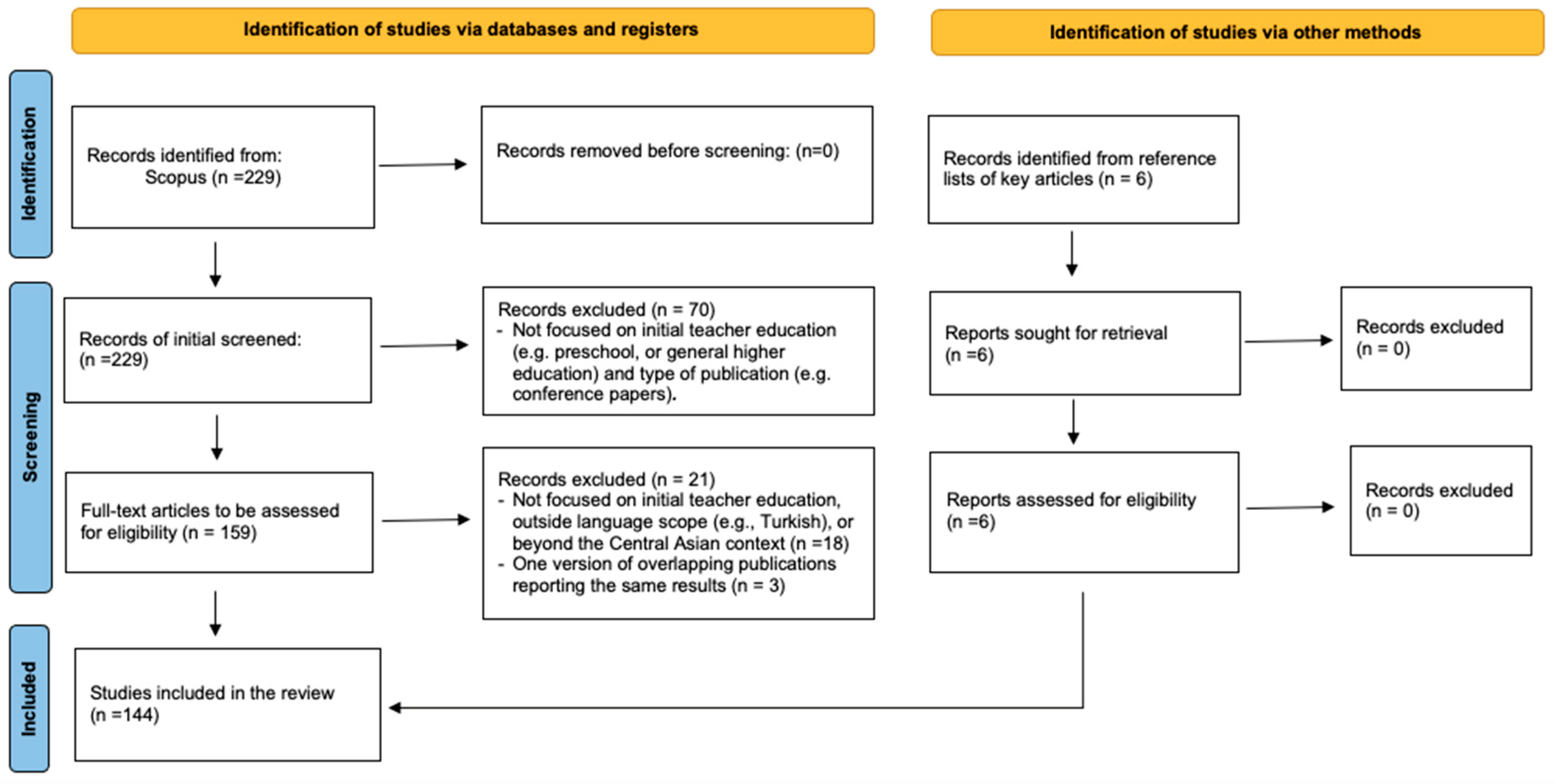
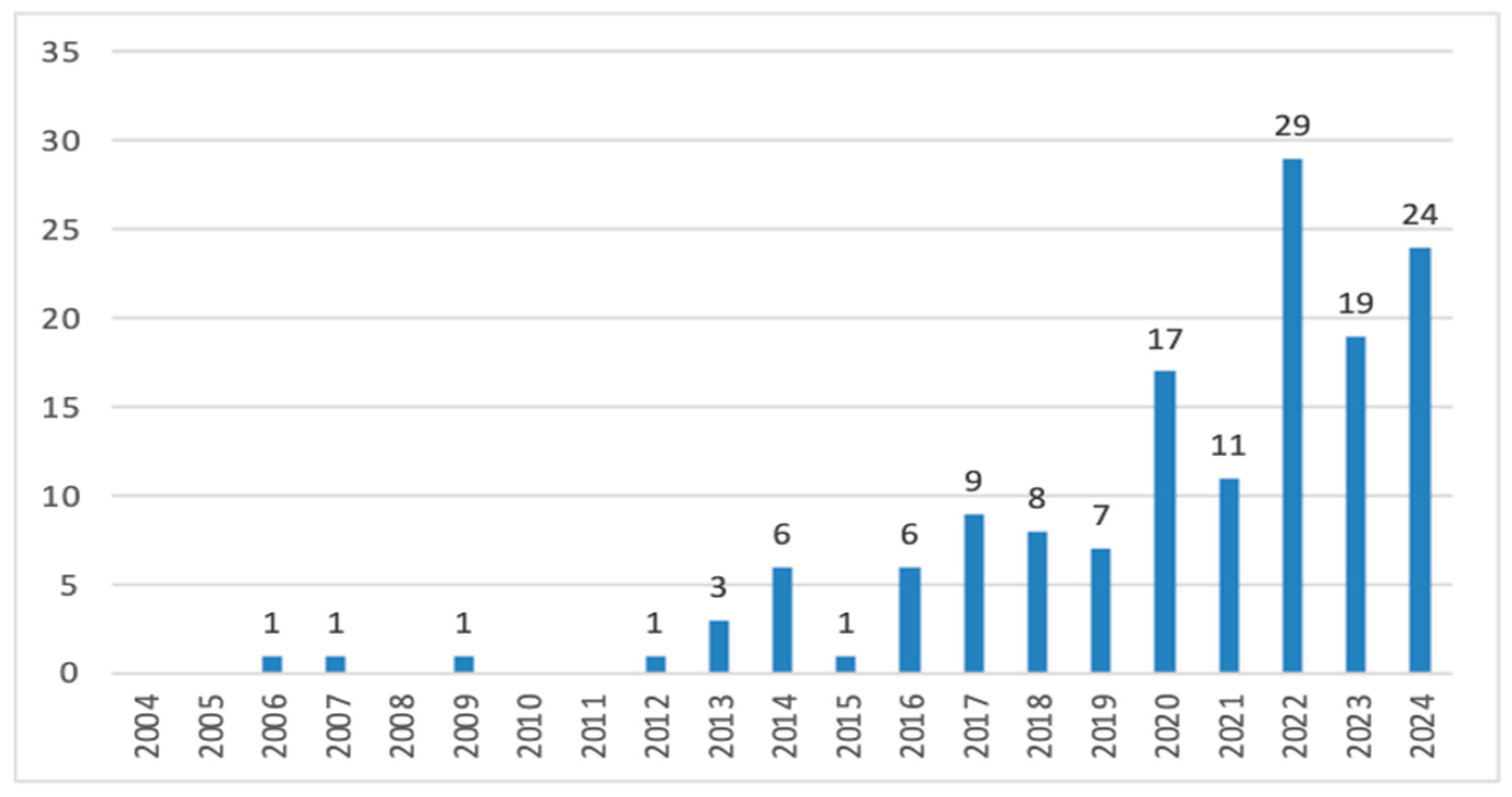
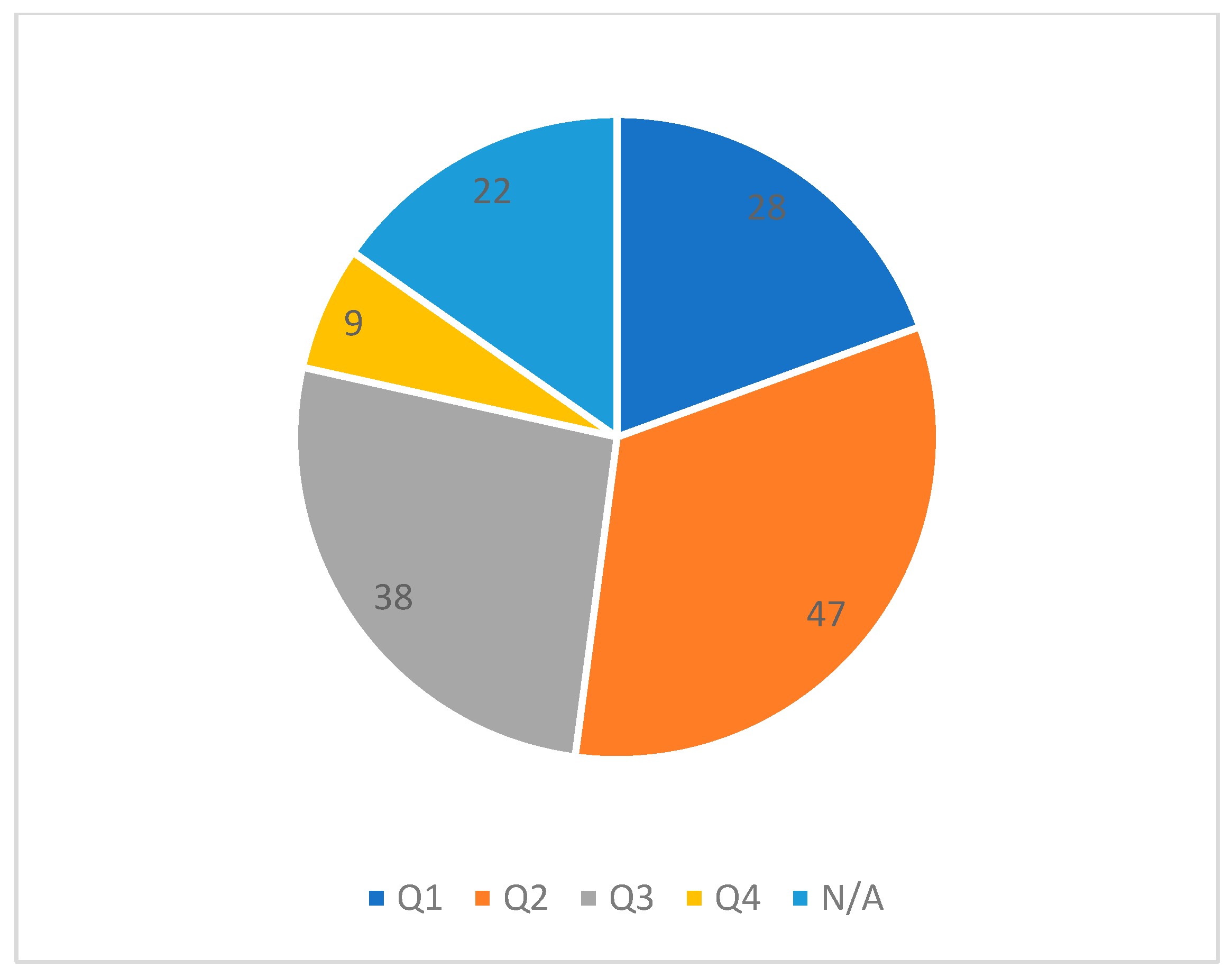
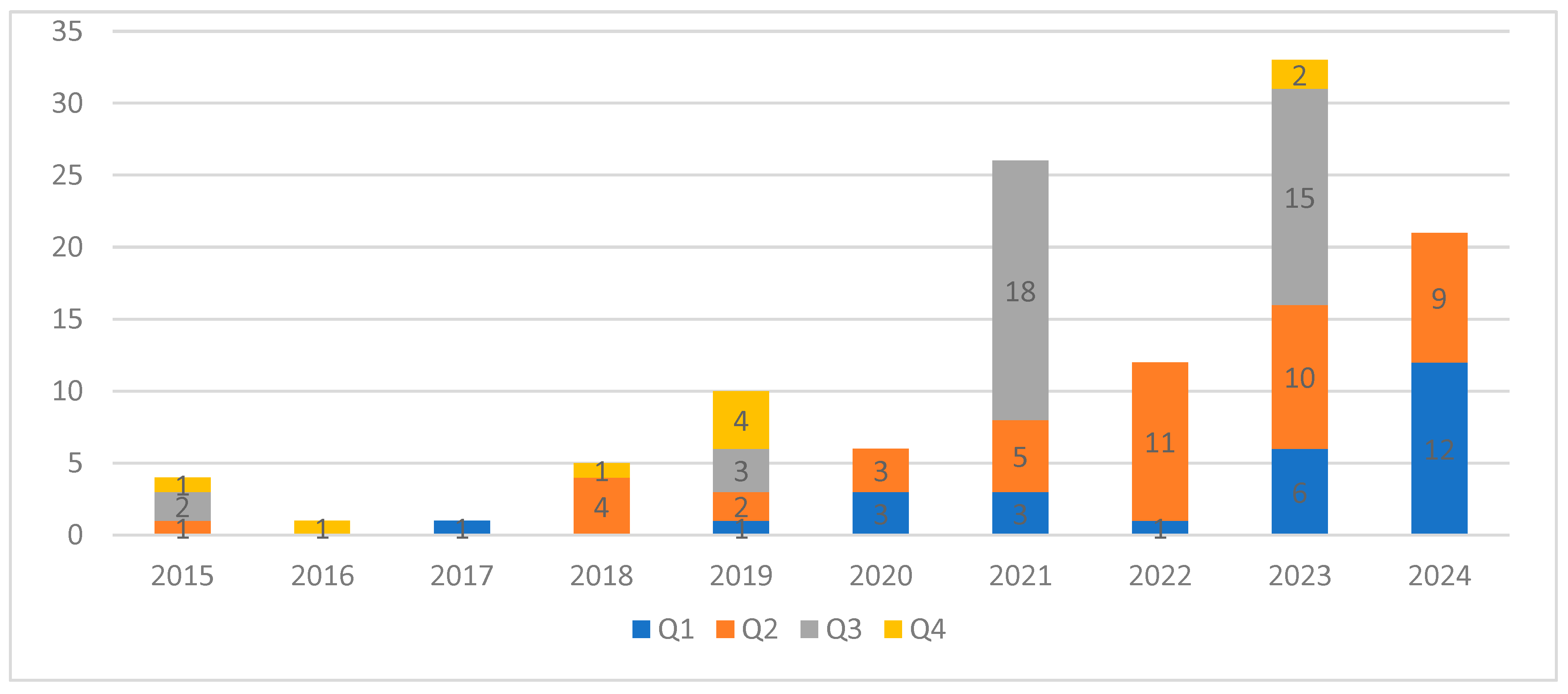

| Country | Population | Number of Teachers | Percentage of Women | Percentage with Higher Education |
|---|---|---|---|---|
| Kazakhstan | 20,330,104 | 399,595 | 81% | 93% |
| Kyrgyzstan | 7,099,750 | 90,414 | 85% | 87% |
| Tajikistan | 10,389,799 | 127,197 | 64% | 76% |
| Turkmenistan | 7,364,438 | 110,000 * | 66% * | - |
| Uzbekistan | 35,652,307 | 521,600 | 68.7% | 90.1% |
| Criteria | Description |
|---|---|
| Geographic Focus | Kazakhstan, Kyrgyzstan, Tajikistan, Turkmenistan or Uzbekistan |
| Program Focus | Initial Teacher Education |
| Language of publication | English and Russian |
| Type of publication | Article, book chapter |
| Publication Date | Published between 2004 and 2024 |
| Number of Participants | Number of Studies (N = 112) | Proportion (%) |
|---|---|---|
| 0–25 | 6 | 5.4 |
| 26–50 | 16 | 14.3 |
| 51–100 | 29 | 25.8 |
| 101–200 | 22 | 19.6 |
| 201–300 | 16 | 14.3 |
| 300–400 | 9 | 8.0 |
| 400–500 | 5 | 4.5 |
| 500+ | 3 | 2.7 |
| Not provided | 6 | 5.4 |
| Themes | Number of Studies | |
|---|---|---|
| Curriculum in ITE | 98 | |
| Professional knowledge and skills: | 65 | |
| Pedagogical knowledge | 35 | |
| Technological knowledge | 15 | |
| Civic and cultural education | 8 | |
| Subject knowledge | 5 | |
| Professional ethics | 2 | |
| Future skills | 26 | |
| Research | 6 | |
| Practicum | 1 | |
| Teaching practices and learning environment in ITE | 27 | |
| Instructional strategies | 7 | |
| Social–Psychological dimensions of student learning | 7 | |
| Professional competence development | 5 | |
| Professional readiness of pre-service teachers | 5 | |
| Professional learning of educators | 1 | |
| Extracurricular strategies | 1 | |
| Teaching modes | 1 | |
| Educational reform and policy in ITE | 12 | |
| Changes and challenges in teacher education | 5 | |
| ITE Pedagogical Reforms | 4 | |
| Comparative analyses of ITE | 3 | |
| Becoming a teacher | 7 | |
Disclaimer/Publisher’s Note: The statements, opinions and data contained in all publications are solely those of the individual author(s) and contributor(s) and not of MDPI and/or the editor(s). MDPI and/or the editor(s) disclaim responsibility for any injury to people or property resulting from any ideas, methods, instructions or products referred to in the content. |
© 2025 by the authors. Licensee MDPI, Basel, Switzerland. This article is an open access article distributed under the terms and conditions of the Creative Commons Attribution (CC BY) license (https://creativecommons.org/licenses/by/4.0/).
Share and Cite
Sharimova, A.; Durrani, N.; Jumamuratova, G. Mapping the Field: A Scoping Review of Initial Teacher Education Research in Central Asia. Educ. Sci. 2025, 15, 1381. https://doi.org/10.3390/educsci15101381
Sharimova A, Durrani N, Jumamuratova G. Mapping the Field: A Scoping Review of Initial Teacher Education Research in Central Asia. Education Sciences. 2025; 15(10):1381. https://doi.org/10.3390/educsci15101381
Chicago/Turabian StyleSharimova, Assel, Naureen Durrani, and Gullala Jumamuratova. 2025. "Mapping the Field: A Scoping Review of Initial Teacher Education Research in Central Asia" Education Sciences 15, no. 10: 1381. https://doi.org/10.3390/educsci15101381
APA StyleSharimova, A., Durrani, N., & Jumamuratova, G. (2025). Mapping the Field: A Scoping Review of Initial Teacher Education Research in Central Asia. Education Sciences, 15(10), 1381. https://doi.org/10.3390/educsci15101381

