1. Introduction
Rural education in Australia presents distinctly different challenges and opportunities compared to urban teaching contexts. These rural-specific factors significantly impact teacher effectiveness and retention in ways not typically experienced in metropolitan schools [
1,
2]. For instance, rural teachers often manage multi-age classrooms, operate with limited specialist support, and navigate close-knit community expectations, circumstances rarely encountered in urban settings [
3].
Broadly in Australian contexts, Initial Teacher Education (ITE) policy and regulatory frameworks privilege classroom-ready discourses [
4]. This discourse encompasses a multifaceted approach that goes beyond the acquisition of content knowledge that has been predominantly shaped by urban-centric standards. The Teacher Education Ministerial Advisory Group (TEMAG) [
5] emphasises “classroom-ready” graduates as those who demonstrate core pedagogical skills, content knowledge, and assessment capabilities. This framework, which is embedded in the Australian Institute for Teaching and School Leadership (AITSL) national standards, reflects conventional expectations of teacher competence primarily drawn from metropolitan contexts.
However, the concept of “thriving” in rural contexts differs significantly from this standardised view of teaching success. Beyond the classroom competencies emphasised in national frameworks, rural teachers must navigate complex community relationships and demonstrate adaptability in ways not typically demanded in metropolitan schools [
6].
Recent policy initiatives acknowledge these unique rural needs. Halsey’s [
7] Independent Review into Regional, Rural and Remote Education specifically highlighted how rural teaching differs from urban contexts and called for targeted preparation, stating in Recommendation Two that “rural contexts, challenges and opportunities are explicitly included in the selection and pre-service education of teachers” [
7] (p. 45). Similarly, Queensland’s Advancing Rural and Remote Education action plan [
8] recognises the distinct challenges of rural education and the need for specific support structures not required in urban settings. This government commitment encompassed a comprehensive approach, which involved preparing prospective teachers in collaboration with higher education institutions and offering continuous mentoring to novice teachers, with the aim of preparing them to teach in rural and remote areas [
8].
However, Trinidad et al. [
9] argue that the capacity of university ITE programs to prepare pre-service teachers for employment in rural locations continues to require significant attention, research, and funding. This perspective is supported by the findings of both historical and current reports, as well as recent research [
2,
7]. Further, research supports the necessity for a re-conceptualisation of the pre-service teacher education curriculum to include further integration between coursework and rural professional experience [
10,
11,
12]. Although the literature discusses how university ITE programs have included rural and remote professional experiences [
11], specific courses of study which address the cultural and learning needs of those communities necessitate further research and implementation [
12].
Considering discussions from rural leaders and the aforementioned policy evaluations that underscore persistent difficulties in adequately preparing, attracting, and retaining teachers in rural locations, the upcoming research seeks to examine:
What are the key dispositions and attributes that rural leaders identify as enabling teachers to thrive in rural contexts?
Based on these identified attributes, what are the implications for policy and practice in preparing and supporting teachers for rural contexts?
3. Materials and Methods
3.1. Research Design
The research design employed an interpretivist qualitative methodology to examine the attributes of thriving rural teachers through the perspective of educational leaders. An interpretivist paradigm was selected as it enables researchers to construct meaning between multiple perspectives while acknowledging the complex social contexts in which these meanings are formed [
31]. This approach enabled a deep exploration of how educational leaders understand and interpret teacher success within their particular rural settings.
The decision to focus on rural educational leaders’ perspectives was methodologically purposeful. Leaders occupy a unique position to observe patterns of teacher success and challenge across multiple cases and contexts. Their extended experience with both successful and unsuccessful cases provides valuable insights into the attributes that enable teachers to thrive in rural settings. While teacher perspectives offer important personal dimensions of rural teacher experience, leaders’ broader observational stance contributes to a distinctive understanding of success patterns over time.
3.2. Participant Selection
Following human ethics approval, participant recruitment occurred at a rural and remote education summit hosted by a regional Queensland university. The focus group discussions were integrated as a scheduled session within the summit program, enabling access to a diverse range of educational leaders actively engaged in rural education. One hundred and three rural leaders participated, representing various Queensland geographical regions, school sizes, and leadership experiences across rural contexts.
Participants met the following criteria:
Current leadership position in a rural community or school;
Minimum of five years of rural education experience;
Direct involvement in teacher supervision and support;
Experience with teacher recruitment and retention.
As the participants were all members of leadership from rural educational contexts, they are referred to as ‘rural leaders’ throughout this paper.
3.3. Data Collection Methods
Twelve focus groups were formed, each comprising 8-9 participants. Group compositions were purposefully arranged to ensure representation across different jurisdictions and school contexts, enriching the potential for diverse perspectives and experiences. This approach aligned with the interpretivist framework, allowing for multiple viewpoints to contribute to understanding how teachers thrive in rural contexts. To maintain consistency across all groups, a structured protocol guided the discussions through four distinct phases: introduction and context setting, initial exploration of the primary research prompt, detailed discussion of emerging themes and synthesis of key ideas.
The primary discussion prompt asked participants to describe a thriving teacher in a rural context. Facilitators used standardised probing questions to explore:
Specific attributes and dispositions of successful rural teachers;
Contextual factors influencing teacher effectiveness;
Observable patterns on teacher success;
Challenges and support mechanisms;
Examples of thriving in practice.
Focus groups were conducted by experienced university facilitators who received specific training in the research protocol to ensure consistency across all sessions. Focus group discussions were audio recorded with participant consent for accuracy and transcribed. To enhance data quality, facilitators maintained field notes and compiled thematic summaries immediately following the focus group session. These field notes captured important contextual details, non-verbal interactions, and emerging themes that informed subsequent analysis, supporting the interpretivist approach to understanding multiple perspectives within their specific contexts.
3.4. Theoretical Framework
The study employs attribution theory as a lens to examine how educational leaders understand and explain teacher’s success in rural contexts. While alternative value or personality models and frameworks might offer insights into stable teacher characteristics, attribution theory was selected for its particular utility in understanding how educational leaders make sense of teacher success and failure within specific rural contexts. This choice aligns with the study’s focus on leaders’ interpretations of teacher thriving rather than measuring fixed personality traits or values. Within the context of this study, attribution theory provides a way of understanding how individuals interpret events and make causal attributions for their and other’s behaviours.
Attribution theory, as conceptualised by Weiner [
32], incorporates three key dimensions: locus of causality (internal/external), stability (stable/unstable) and controllability (controllable/uncontrollable), which provide an analytical framework for examining rural leaders’ perspectives on teacher thriving. This framework is particularly relevant when examining educational leaders’ perspectives and observations when the following occurs:
Acknowledges the complex interplay between personal attributes and contextual factors;
Supports the analysis of how leaders distinguish between fixed traits and developable capabilities;
Provides tools for understanding how leaders perceive teacher agency in rural success;
Enables the examination of how context-specific factors influence attribute interpretation.
The application of attribution theory within this study extends beyond simple internal-external categorisations. Leaders’ attributions are analysed through multiple dimensions to understand:
Which teacher attributes are perceived as internal (personality-based) versus external (context-dependent);
Whether attributes are viewed as stable (fixed traits) or unstable (developmental capabilities).
This theoretical framework guided both data collection and analysis. During focus groups, facilitators used prompts designed to elicit attributional thinking (e.g., exploring why leaders believed certain teachers thrived while others struggled). In analysis, the framework provided structured approaches for examining the following:
Patterns in leaders’ causal explanations;
Contextual influences on attribute interpretation;
Perceived relationships between personal and environmental factors.
By applying attribution theory to rural leaders’ perspectives of thriving rural teacher characteristics and behaviours, insights were gained into the individual attributes and dispositions influencing teaching practices and interactions within rural contexts. Of particular importance to this study is the locus of causality, that is, the location of the attribute. Is it internal, that is, is it related to an individual’s personality, or outside, related to the context or situation [
33,
34]? Utilising this lens helps us deepen our understanding of the attributes that could be developed within teacher preparation programs.
3.5. Data Analysis
The process for analysing the data was conducted in two distinct phases and was inductive in nature with a focus on capturing the rural contextual characteristics and individual characteristics associated with thriving rural teachers. Within phase 1, the research team employed Clarke and Braun’s [
35] framework approach to inductive thematic analysis for the following two key reasons:
Firstly, the transcripts were read and reread to gain a thorough understanding of the content. Secondly, Author 1 led the thematic analysis process with 664 initial codes identified. These codes were then reviewed to identify segments of the data that were relevant to the research problem. These coded transcript sections were compared to a separate set of coded transcripts conducted by Author 2 and correlated to find synergies between the two sets of codes as well as reach agreement. The third step was to search for themes within the coded data by reviewing the codes, comparing them and identifying patterns of meaning that emerged. This step is followed by further analysis and comparison of codes to themes to ensure each theme boundary and meaning is unique.
Within phase 2, an attribution theory lens was then applied to the thematically analysed data to uncover the underlying internal and external attributes and factors that were perceived to positively influence teachers’ success in rural communities. Identified attributes were categorised as internal or external, stable or unstable and controlled or uncontrolled. Once the research team was satisfied, attributes were grouped under the identified themes. The resulting 441 codes (see
Table 1) that emerged from these processes were grouped into 12 code groups and organised under the following themes: community attributes, personal attributes, professional attributes and classroom attributes.
4. Results
The findings outlined in this section provide a description of the emerging themes (see
Table 1) derived from participants’ perceptions. The presentation of the findings also considers the application of attribution theory that was utilised to unpack the described casual patterns within each theme and to build a collective description of the key intra- and interpersonal attributes and characteristics of thriving teachers working within rural locations.
4.1. Community Characteristics and Attributes
The theme of community emerges as a crucial factor underscoring the importance of robust, supportive, and well-integrated communities in enhancing the well-being and efficacy of teachers, especially in remote and rural regions. A detailed analysis of the key attributes contributing to the success of teachers in rural areas revealed several key findings.
The rural leaders (n = 53) consistently emphasised the role of teachers in creating connections within the community. It was noted (n = 36) that teachers who actively contributed to the community and embraced community expectations prior to accepting a teaching position reported positive experiences while living and teaching within rural communities. Teachers flourished when embedded within communities that provided essential support and resources. This was corroborated by the experiences of participants (n = 24), who highlighted the importance of offering practical support and information, which significantly contributed to the well-being and retention of teachers in rural areas. Rural leaders (n = 13) also stressed the need for community-based solutions and collaborative efforts tailored to address specific challenges faced by teachers in remote contexts, underscoring the need for continuous evaluation to ensure their effectiveness, as suggested by Rural Leader 65.
It was evident that the presence of community support networks had an indirect yet profound impact on the classroom environment. A selection of rural leaders (n = 15) observed that teachers who felt supported by their communities were more likely to bring a positive attitude and a sense of belonging into the classroom, ultimately contributing to a better learning environment, as emphasised by Rural Leader 42. Community expectations (n = 24), particularly in the context of teachers understanding and meeting the expectations of the rural or remote communities they serve, were a recurring topic of discussion. The rural leaders within this study stressed the importance of teachers engaging with the community, understanding the town’s characteristics (n = 13), and adapting to local events, news, and community expectations. The experiences shared by Rural Leader 6 highlighted how the community’s awareness, respect and acceptance of teachers prior to their arrival can influence their integration and acceptance in the community.
The presence and engagement of teachers within the community played a significant role in their acceptance and well-being. The rural leaders (n = 21) noted that creating connections between teachers, families, and the community fostered positive community perceptions and relationships that extended into the school and classroom context. Active engagement in local events, such as Australian and New Zealand Army Corps (ANZAC) day marches, was seen as an essential step in integrating into the community and gaining trust, as articulated by Rural Leader 43. A smaller number of rural leaders (n = 9) underscored the importance of acknowledging and celebrating the positive contributions of teachers to their communities and schools. Highlighting these contributions not only boosted the well-being and morale of teachers but also strengthened the teacher-community bond. A poignant personal anecdote shared by Rural Leader 7 illustrated the profound impact of recognising and appreciating teachers’ contributions to the community, both in terms of their interactions and their engagement with local businesses and organisations.
In summary, the results from this study clearly demonstrate the pivotal role of the community in shaping the experiences and effectiveness of teachers in rural areas. Building strong connections, understanding and meeting community expectations, and active engagement within the community all emerge as critical factors contributing to teacher well-being and success in these unique educational settings. When considering the teacher attributes associated with these behaviours, participants described those teachers who listened, were empathetic and respectful, were able to adapt and be accountable for their behaviours and were collaborative and effective communicators who thrived in rural communities.
The categorisation of these attributes (
Table 2) highlighted that they are predominantly internal, which suggests that participants viewed thriving in rural communities as largely dependent on the teacher’s personal characteristics and skills. Most are also controllable, implying that teachers can develop or improve these attributes. The stability of these attributes varies, with some being more trait-like and others more skill-based, which can change over time.
4.2. Personal Attributes
The central theme of personal attributes revolves around teacher well-being, work-life balance, stress management, and emotional resilience, all of which significantly influence teacher effectiveness and satisfaction in their roles. Rural leaders (n = 32) stressed the importance of teacher well-being, emphasising the need to strike a balance between priorities to sustain connection, purpose, and overall satisfaction in their roles, as noted by Rural Leader 62. Teachers often grapple with stress and burnout, and it is essential to equip them with strategies to cope effectively. Participants highlighted the repercussions of a lack of resilience, as described by Rural Leader 52, and underscored the need to avoid feeling helpless in the face of these challenges, as expressed by Rural Leader 64. It was evident that the well-being of teachers has a ripple effect, impacting not only the individual but also their students, families and colleagues, as pointed out by Rural Leader 52.
Maintaining a balance between professional commitments and personal life through establishing boundaries and self-care routines emerged as a crucial aspect of teachers’ overall well-being. Rural Leader 22 emphasised the profound impact of a positive mindset when approaching work, and Rural Leader 36 underlined the significance of achieving this balance for teachers’ well-being within rural contexts. These insights collectively affirm that meaningful, balanced work contributes to teacher productivity, reduces burnout, and fosters a positive living experience in rural settings. Emotional resilience was identified as pivotal for teachers to manage their emotions and effectively handle stressful situations. A high number of rural leaders (n = 33) stressed the need to develop strategies to withstand the challenges encountered, both in the classroom and in personal life. Rural Leader 28 aptly pointed out that while everyone has challenging days, they should not dominate one’s experience, emphasising the importance of maintaining emotional strength. This is particularly crucial in situations where family support may be limited.
In summary, the personal attribute’s theme underscores the significance of personal behaviours such as well-being, stress management, work-life balance, and emotional resilience in shaping teacher effectiveness and satisfaction within rural contexts. Underpinning these characteristics, participants highlighted that teachers who were self-aware and flexible and who demonstrated self-regulation, effective time management skills and established boundaries thrived in rural contexts. These characteristics and attributes not only affect teachers’ individual experiences but also have far-reaching implications for students, families, and colleagues in these unique educational settings.
The categorisation of these attributes (
Table 3) highlights that while the rural context presents unique challenges, the ability to thrive is largely attributed to personal factors that teachers can potentially develop or enhance as they are predominantly internal and controllable. The stability of these attributes varies, with some being more trait-like and others more skill-based, which can change over time.
4.3. Professional Characteristics and Attributes
The theme of professional attributes focuses on the critical skills, knowledge, and support that educators require to excel in their roles, encompassing curriculum expertise, mentorship, leadership, and continuous professional development. This multifaceted aspect of teacher preparation and empowerment is indispensable for the effective delivery of education. A significant number of rural leaders (n = 43) emphasised the importance of teachers possessing a deep understanding of the curriculum. Rural Leader 65 discussed that teachers well-versed in the curriculum can adeptly tailor their teaching to the individual needs of students. As Rural Leader 35 pointed out, having a solid grasp of the curriculum alleviates the stress associated with planning and preparation, creating a fail-safe approach to teaching. Mentorship and coaching emerged as critical elements for teachers, particularly in remote areas, with experienced mentors playing a pivotal role in helping teachers adapt and thrive. The cultivation of a sustainable culture of support was emphasised by Rural Leader 27. However, the rural leaders (n = 11) also recognised the need for personalised support, acknowledging that new graduates and experienced teachers may require different forms of support and development, as articulated by Rural Leader 42.
A well-equipped teacher, both in terms of knowledge and support, is better prepared to deliver quality education and excel in their roles. Professional development was a central focus (n = 31) within this theme. The rural leaders stressed the necessity of teachers receiving ongoing training, participating in workshops, and seizing opportunities for skill enhancement to remain updated with the latest educational practices and enhance their teaching methods. While leadership was acknowledged as a driving force behind a culture of professional growth and well-being, participants also recognised that teachers need to be self-motivated in sourcing professional development, creating a collaborative environment that starts with leadership and extends horizontally, as expressed by Rural Leader 42.
The theme discussed from the participant data of professional inter and intrapersonal attributes highlights the integral role of professional skills, knowledge, and support in empowering teachers to excel in their roles. A strong foundation in curriculum expertise, reflective practice, mentorship, networking, resilience, adaptability, and continuous professional development equips teachers to deliver quality education and adapt to the evolving demands of their profession. This, in turn, fosters a culture of growth and development for rural teachers.
The categorisation of these attributes (
Table 4) highlights the complex interplay between personal skills, professional knowledge and external support systems in supporting thriving teachers in rural contexts. The mix of internal and external locus, stability and controllability suggests that while personal effort and development are crucial, creating supportive professional environments and opportunities are also essential.
4.4. Classroom Characteristics and Attributes
The theme of Classroom Attributes centres around the critical resources, tools, and strategies essential for effective teaching and learning in the classroom. This multifaceted aspect includes access to educational materials, technology, classroom management skills, and the ability to differentiate instruction to meet the diverse needs of students.
A high number of rural leaders (n = 52) emphasised that, in addition to mastering the curriculum and pedagogical strategies, teachers in rural areas must possess robust classroom management skills. This entails creating a positive learning environment, effectively managing student behaviour, and engaging learners. Rural leaders (n = 16) recognised that early career teachers often faced challenges in this area and would benefit from additional support. Teachers should be equipped with strategies to differentiate instruction to accommodate the diverse needs of their students, as noted by the rural leaders (n = 37). This involves adapting teaching methods and materials to address various learning styles and abilities. Furthermore, in smaller rural communities, rural leaders (n = 26) acknowledged that parents and community members were often more aware of the different strategies employed and would discuss and compare these. Consequently, teachers needed to communicate with authority and transparency regarding why specific strategies were employed with certain students while not others.
The theme of Classroom Attributes underscores the significance of teachers’ confidence in teaching the curriculum, their ability to be approachable and consistently manage classrooms effectively and their skill in differentiating instruction with clarity, creativity and confidence. It emphasises the importance of having the necessary resources and skills to establish an optimal learning environment for students. Where resources and support may be limited, these attributes are fundamental to ensuring the quality of education and the success of both teachers and students.
The categorisation of these attributes (
Table 5) highlights the complexity of classroom teaching, particularly in rural contexts. It suggests that while much of a teacher’s effectiveness is attributed to personal skills and characteristics that can be developed, external support in terms of resources is also crucial.
5. Discussion
The research findings not only integrate existing literature on challenges and solutions in rural education but also provide new insights into how the rural context distinctly shapes teacher success. Effective rural teachers demonstrate unique adaptations of professional practice: their community engagement extends beyond typical school-community relationships, their personal wellbeing strategies must account for high visibility in small communities, their professional development occurs despite geographical isolation, and their classroom management and curriculum encompass multi-age teaching and resource adaptation. These characteristics, behaviours and attributes collectively present a holistic view of the key factors contributing distinctly to teachers’ success in rural locations.
While previous studies have explored the notions of preparedness and readiness, this research reveals that rural contexts demand more than traditional preparation. The classroom readiness that is discussed in current Australian policy documents has been repositioned in this paper as ‘equipped’. The authors argue that the findings position the need for a more fluid and interpretive approach to readiness and, as such, suggest the term “equipped” is more suitable for being ready for rural contexts as it encapsulates a broader preparedness that goes beyond the traditional classroom setting. It implies that an individual possesses not only academic knowledge but also the specific skills needed to navigate the unique dimensions of rural teaching: community integration, resource adaption, and multi-role professional practice.
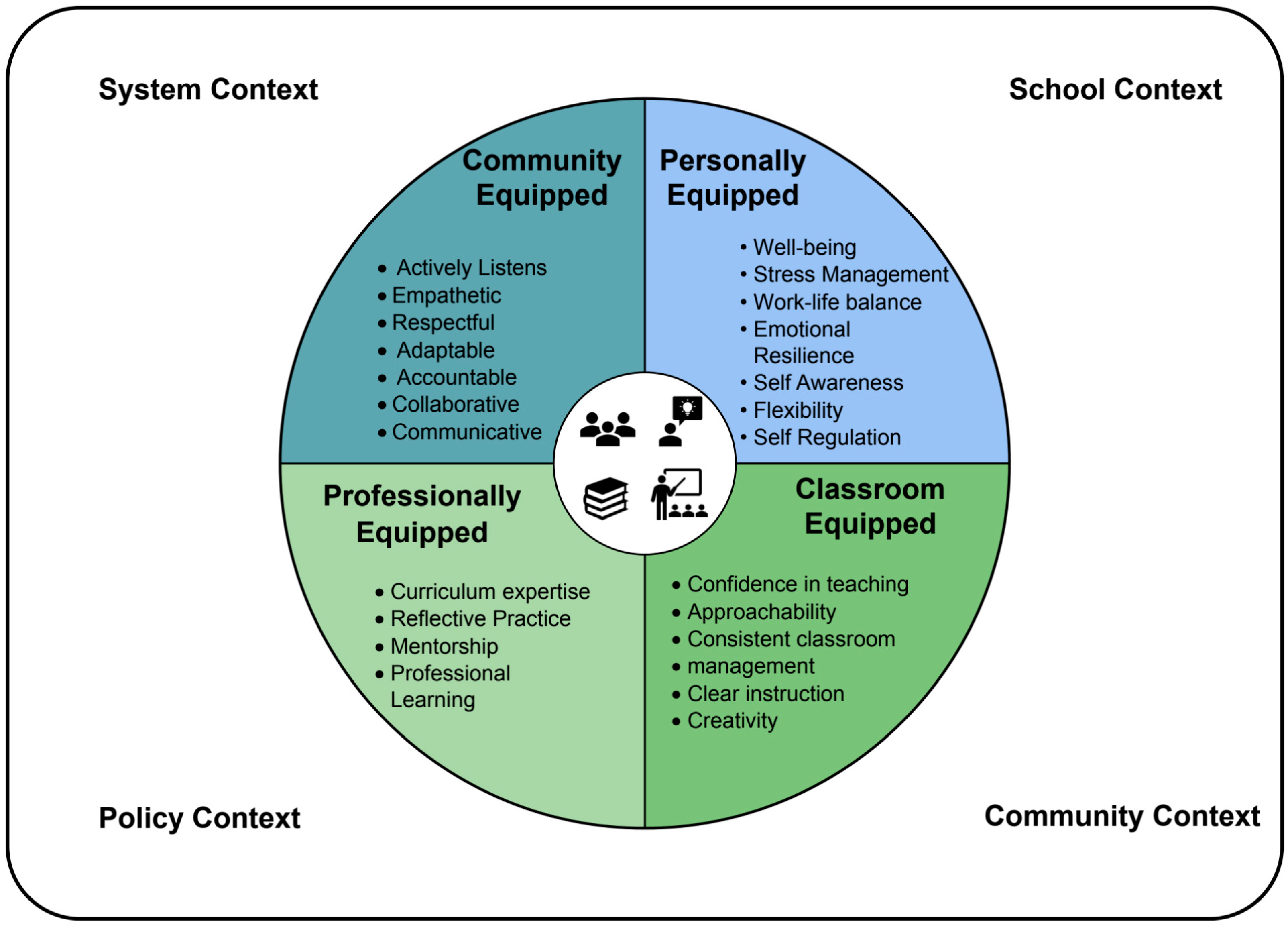
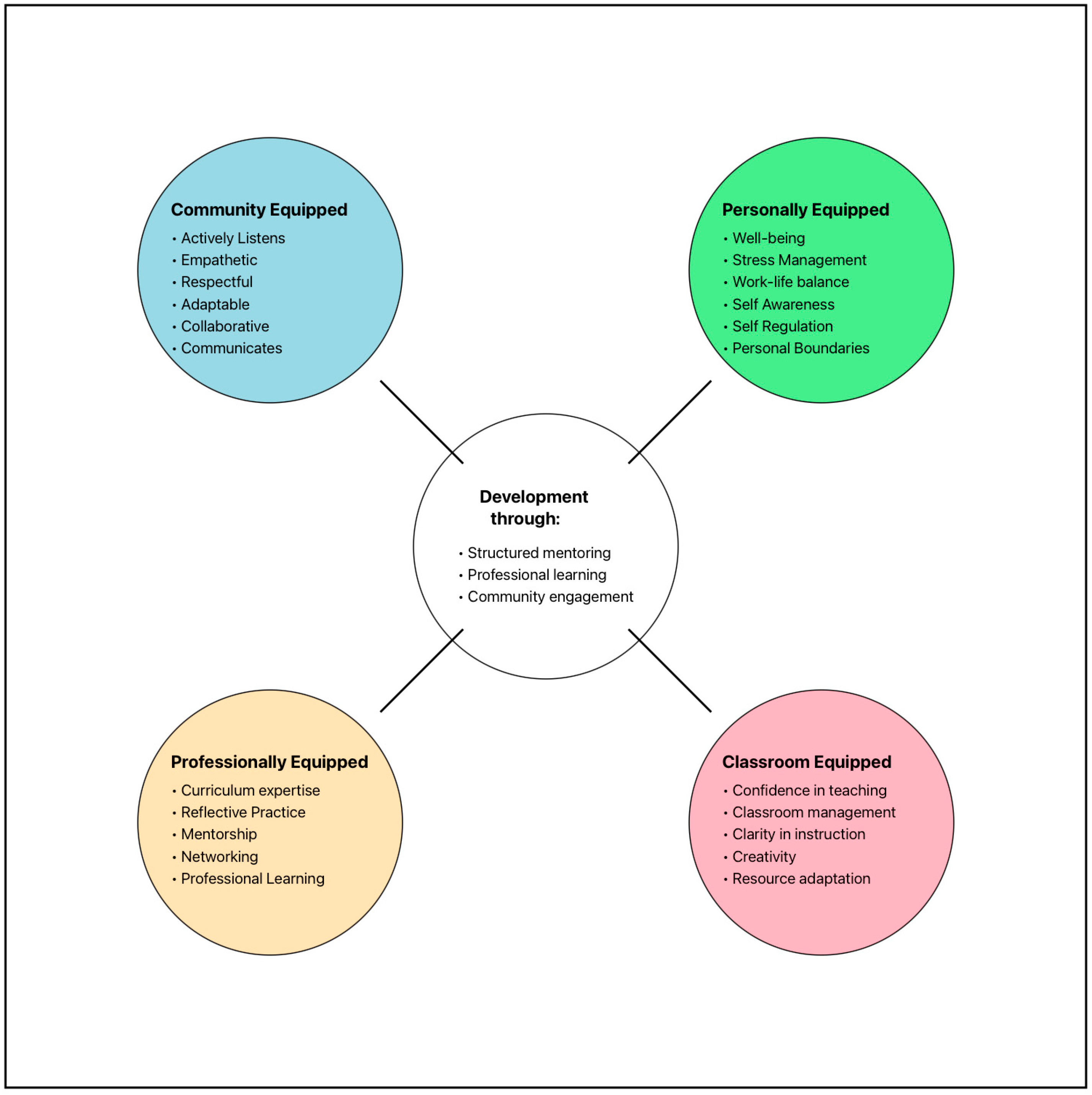
Unique to the findings in this paper is the identification of how standard teaching attributes take on distinctive forms within rural contexts. While individual attributes such as classroom management or professional networking are not entirely novel in the literature, our findings highlight how rural settings fundamentally reshape their expression and development. Initially, the preliminary framework recognised the importance of teachers being equipped rather than ready and extended the existing notions of readiness beyond the classroom, revealing the importance of teachers being Classroom Equipped, Community Equipped, Professionally Equipped, and Personally Equipped to be successful in rural contexts. The resulting framework (see
Figure 1) identifies four interconnected equipped characteristics and their associated teacher attributes for thriving in rural contexts.
In considering the perspectives of rural stakeholders, we propose the term ‘equipped’ to encapsulate four key attributes. This term signifies that teachers entering rural contexts can navigate diverse contexts by possessing attributes that enable them to facilitate a nuanced interpretation of the environment. This would then ensure that the pre-service teachers or in-service teachers are able to draw upon these attributes once they have more of a detailed understanding of their individual rural context.
Moreover, the findings suggest that thriving educators exhibit foundational attributes while translating these four characteristics into their daily lives.
5.1. Community Equipped Attributes
Teacher’s capacity to connect and contribute to their community through shared expectations hinges on critical intrapersonal attributes, including empathy, adaptability [
36] and accountability. These attributes enable teachers to understand and share the feelings of others, create connections and adjust to new conditions and changes within their environment, building resilience.
This study’s findings broaden the application of critical interpersonal attributes beyond teachers’ professional roles [
37,
38], demonstrating how rural settings demand sophisticated integration of personal and professional dimensions. The findings expand on studies conducted by Johnson and Dempster [
38], and Rennie et al. [
39], who emphasise that connected communities tend to yield more successful outcomes in terms of teacher recruitment, retention, and overall well-being.
5.2. Personally Equipped Attributes
The ability of teachers to feel adequately equipped in rural environments demands distinctive approaches to personal well-being. The focal point of teachers’ experiences in rural settings revolves around dimensions that take on particular significance in small communities: maintaining work-life boundaries when professional and personal spaces overlap, managing stress with limited local support resources, and building emotional resilience despite professional isolation [
39,
40].
The paramount significance of personal attributes in shaping the preparation of pre-service teachers within Australian rural contexts is robustly substantiated by the findings presented in this paper and resonates with international rural education research. This emphasises how rural contexts create unique demands for personal attribute development, suggesting that a holistic approach encompassing wellbeing, stress management, work-life balance, and emotional resilience must be specifically tailored to rural settings [
41]. The research contends that teachers equipped with these characteristics are better positioned to navigate the distinctive challenges posed by rural contexts, emphasising the imperative nature of fostering and prioritising these personal attributes in rural-specific preparation and ongoing professional development.
5.3. Classroom Equipped Attributes
While higher education settings provide support to equip pre-service teachers with the pedagogical skills necessary to be ‘classroom ready”, rural teaching demands distinctive adaptions of these capabilities. Being ‘classroom equipped’ for rural contexts requires specific skills: managing multi-age grade classrooms over several years, adapting resources for limited-resource settings, and integrating local rural knowledge into curriculum delivery. This rural adaptability implies having a diverse intra-personal skill set [
37] specifically developed for rural educational spaces.
The findings emphasised that teachers in rural areas must not only master the curriculum and pedagogical strategies but also possess robust classroom management skills [
42]. This entails utilising intrapersonal skills in unique ways in rural settings, such as organisation to manage and structure teaching activities and responsibilities; consistency as a way of maintaining a stable and reliable approach; conflict resolution to demonstrate emotional regulation and the ability to analyse, address and facilitate conflict resolution practices; clarity in expectations, ideas and practices and approachability as a way of being open-minded, self-aware and welcoming. Together, these skills, shaped by rural contexts, assist teachers in creating a positive learning environment that responds to distinctive rural educational needs.
5.4. Professionally Equipped Attributes
Being professionally equipped in education focuses on the critical skills, knowledge, and support that educators require, encompassing curriculum expertise, mentorship, leadership, and continuous professional development. This multifaceted aspect of teacher preparation and empowerment is indispensable for the effective delivery of education. Kline et al. [
43] emphasise the significance of partnerships between schools, local communities, and government in improving rural student outcomes and contributing to community strengthening.
Central to teachers’ success is their ability to draw from the following intrapersonal skills: reflective practice and goal setting as a way of critically examining their own experiences, actions and decisions for continuous learning and improvements; resilience, adaptability and time management as mechanisms for adapting to challenges and maintaining well-being in the face of adversity.
The findings underscore the importance of teachers possessing a deep understanding of the curriculum. Participants in our study stressed that teachers who are well-versed in the curriculum can tailor their teaching to the individual needs of students. Therefore, being professionally equipped for the rural space emphasises the need for personalised support. New graduates in the rural space, as well as experienced teachers, may require different forms of support and development. This aligns with the idea of consolidating skills, knowledge, and resources to empower teachers.
5.5. Policy Reform: From Classroom Ready to Rurally Equipped
The ‘equipped framework’ emerging from this study, grounded in rural leaders’ insights into successful teaching practice, reveals significant limitations in current policy approaches to teacher preparation. In Australia, current policy frameworks, including AITSL national teacher standards [
44] and TEMAG [
5], shape teacher preparation through both professional standards and accreditation requirements [
44]. However, research findings demonstrate that these and other current policy frameworks predominantly reflect urban-centric assumptions that fail to capture the complex realities of rural teaching success. This misalignment between policy assumptions and the realities of rural teaching success necessitates substantial policy reform.
The research findings demonstrate that rural teaching success requires capabilities beyond those captured in the current metro-centric classroom-ready policy frameworks. Rural leaders consistently identified how effective teachers navigate complexities not acknowledged in standard professional frameworks, managing multi-age classrooms, integrating deeply with rural communities, and adapting professional practice for isolated contexts.
Within the ‘equipped framework’, the study emphasises the pivotal role of partnerships in addressing personal and social isolation, as well as in enhancing teacher-student relationships to deliver context-specific curriculum, assessments, and teaching methods. Building social capacities, forming partnerships, and fostering connections are essential not only for personal and community development but also for professional and classroom readiness. The framework recognises the transformative power of overcoming isolation, fostering professional development, and strengthening educational outcomes through various partnering opportunities. This includes formal systemic partnerships, online collaborations, and the spontaneous social connections that naturally occur within a community.
The identification of attributes provides a comprehensive picture of what contributes to teacher success, spanning personal, professional and classroom-specific attributes. This holistic view highlights the multifaceted nature of effective teaching in rural contexts. The predominance of internal attributes suggests that initial teacher education and early career teacher programs should focus heavily on personal skills development and empowerment. However, the presence of some external factors (e.g., resources) highlights the importance of systemic support. Most attributes are categorised as controllable or partially controllable (
Figure 2), suggesting that targeted training and support can significantly improve teacher effectiveness and well-being.
These expanded understandings suggest that supporting and developing thriving teachers in rural contexts requires the following:
Comprehensive professional development programs that address personal, interpersonal and technical teaching skills;
A focus on building resilience, adaptability and self-management skills;
Creating supportive school environments that provide necessary resources and foster collegial networking;
Encourage ongoing reflection and continuous learning;
Prepare teachers for the specific challenges and opportunities of rural education;
Address both the professional skills and personal well-being of teachers.
This nuanced understanding of thriving teachers’ attributes challenges governments and education sectors to expand on current notions of developing “classroom-ready” teachers to equip teachers beyond a classroom to include being personally, professionally, community and classroom-equipped.
6. Conclusions
The findings from this research offer valuable insights that can significantly inform the preparation of rural teachers in initial teacher education programs. The concept of being “equipped” rather than merely “ready” suggests a need for a more comprehensive approach to teacher preparation that goes beyond traditional classroom readiness, as reflected in current government reviews and policies [
5,
7]. Initial teacher education programs should focus on developing a range of attributes across four key areas: community, personal, classroom and professional equipping.
To effectively prepare preservice teachers for rural contexts, initial teacher education programs need to incorporate opportunities for preservice teachers to develop strong interpersonal skills, adaptability and cultural awareness. This could involve immersive rural experiences, community engagement projects and targeted coursework on rural education issues. Additionally, programs should emphasise the development of personal attributes such as resilience and stress. Management and work-life balance strategies are crucial for thriving in rural settings. By addressing these diverse aspects of teacher preparation, initial teacher education programs can better equip graduates to navigate the unique challenges and opportunities presented by rural teaching contexts, ultimately contributing to improved teacher retention and educational outcomes in rural communities.
Given the stressed workforce and declining numbers of people entering the teaching profession, particularly in rural areas, there is an urgent need for action. The findings of this research provide a roadmap for revitalising teacher education and addressing the critical shortage of well-prepared educators in rural communities. It is imperative that policymakers, educational institutions, and school leaders take immediate steps to implement these insights:
Revise initial teacher education programs to incorporate the “equipped” framework, ensuring graduates are prepared across all four key areas: community, personal, classroom, and professional;
Invest in robust partnerships between universities, rural schools, and communities to provide immersive experiences and ongoing support for pre-service and early career teachers;
Invest in comprehensive rural mentoring and professional development programs that address the specific needs of rural educators, focusing on building resilience, adaptability, and community connection;
Advocate for policy changes and funding allocations that support the unique needs of rural education, including resources for personalised teacher support and community engagement initiatives.
By taking these actions, we can address the current crisis in the teaching workforce to ensure that rural schools have access to well-equipped, resilient educators who are prepared to thrive in these unique contexts.