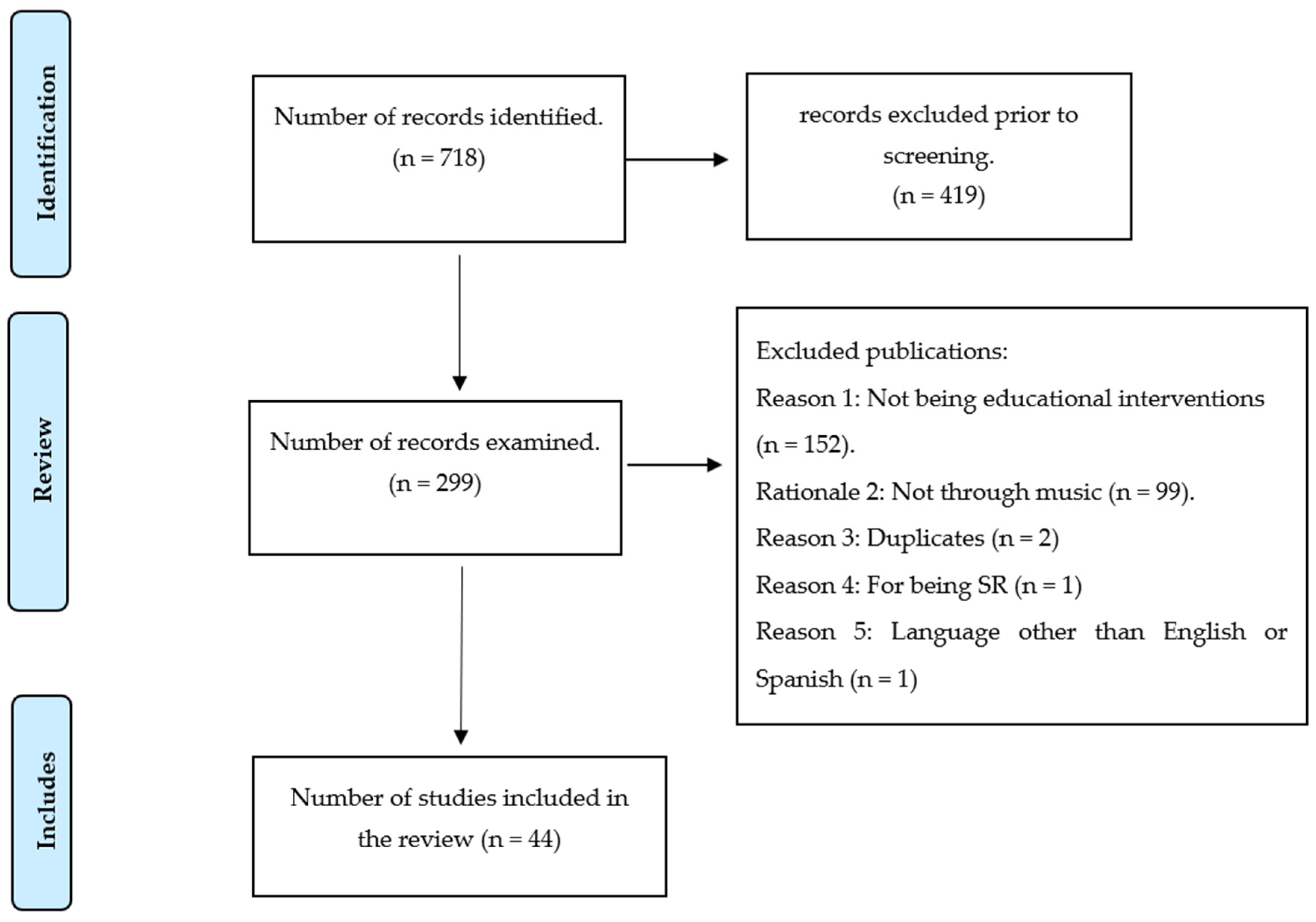
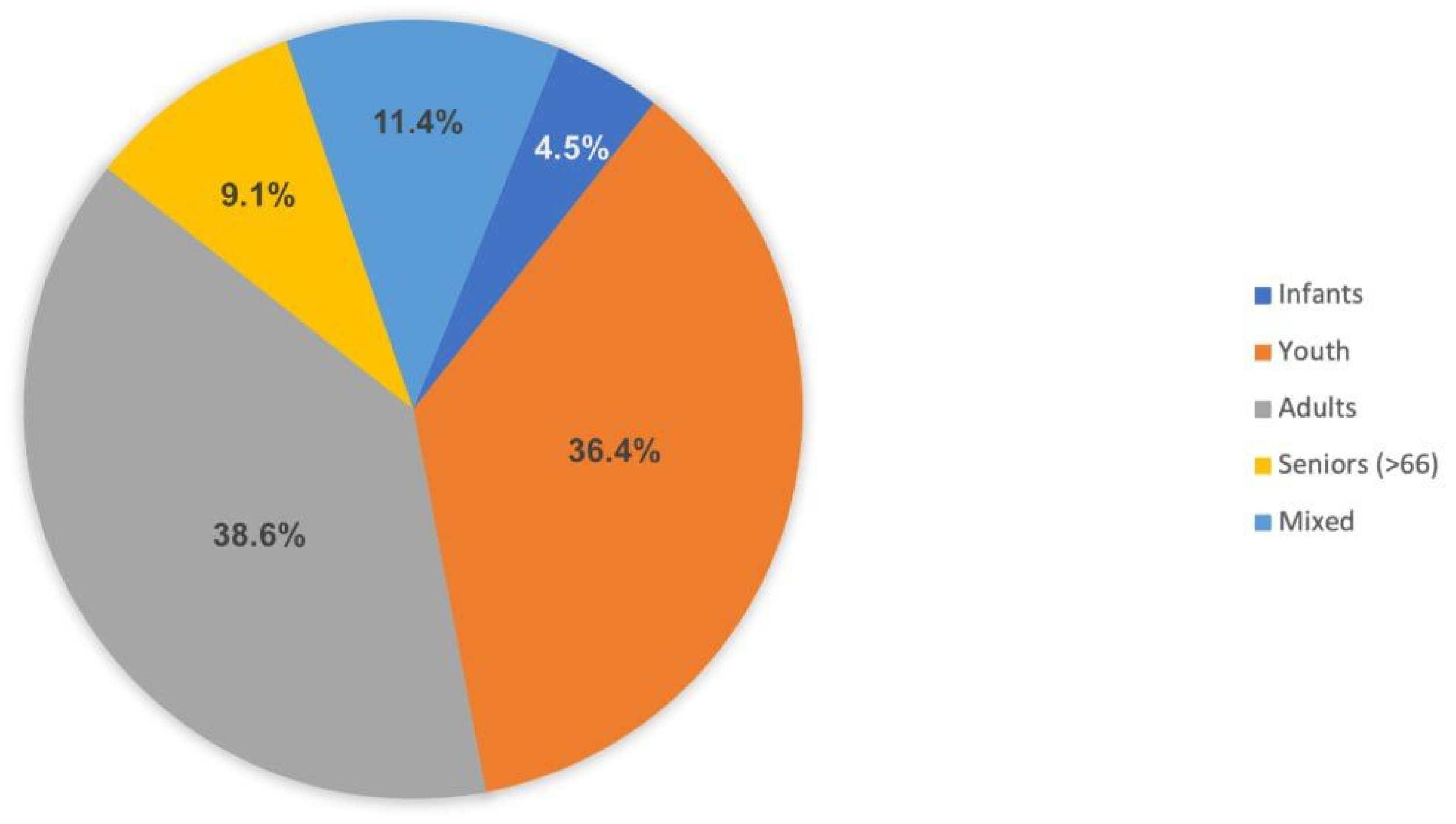
The Development of Soft Skills through Music in Educational Contexts: A Systematic Review

 ,
,  and
and
Abstract
1. Introduction
2. Materials and Methods
2.1. Inclusion and Exclusion Criteria
2.2. Approach and Data Analysis
3. Results
3.1. Bibliometric Results
3.2. Methodological Aspects
3.3. Characteristics of the Programs
3.3.1. Target Group of the Intervention
3.3.2. Musical Specialties Involved
3.3.3. Academic Setting
3.3.4. Benefits of Age-Related Programs
3.4. Soft Skills Improved by Music
3.4.1. Social Skills
3.4.2. Methodological Competencies
3.4.3. Practical Skills
4. Discussion and Conclusions
Study Limitations and Practical Implications
Author Contributions
Funding
Institutional Review Board Statement
Informed Consent Statement
Data Availability Statement
Conflicts of Interest
References
- Gutman, L.M.; Schoon, I. The Impact of Non-Cognitive Skills on Outcomes for Young People: Literature Review; University of London: London, UK, 2013. [Google Scholar]
- Organisation for Economic Co-operation and Development (OECD). Skills for Social Progress: The Power of Social and Emotional Skills, OECD Skills Studies; OECD Publishing: Paris, France, 2015. [Google Scholar]
- Aníbal-Rey, J. Las Soft skills, el reto de la escuela secundaria. Rev. Seres Saberes Y Contextos 2016, 1, 50–54. [Google Scholar] [CrossRef]
- García-Mercado, A.J. The integration of non-technical skills in the classroom. APEC J. 2014, 30, 252–263. [Google Scholar]
- Duckworth, A.L.; Yeager, D.S. Measurement matters: Assessing personal qualities other than cognitive ability for educational purposes. Educ. Res. 2015, 44, 237–251. [Google Scholar] [CrossRef] [PubMed]
- Clares, P.M.; Morga, N.G. The mastery of transversal competencies in Higher Education in different formative contexts. Educ. E Pesqui. 2019, 45. [Google Scholar] [CrossRef]
- Abellán, M.T.; Candeloro, A.; López, C.M.L.; Hernández, D.J., VII. Soft Skills, skills on the rise in Europe. In Spanish Perspectives in Education: Best Practices for the 21st Century; Catholic University of New Spain: Miami, FL, USA, 2020; p. 147. [Google Scholar]
- Cinque, M. Lost in translation, Soft skills development in European countries. Tuning J. High. Educ. 2016, 3, 389–427. [Google Scholar] [CrossRef]
- Dell’Aquila, E.; Marocco, D.; Ponticorvo, M.; Di Ferdinando, A.; Schembri, M.; Miglino, O. Educational Games for Soft Skills Training in Digital Environments; Springer: Berlin/Heidelberg, Germany, 2017. [Google Scholar]
- Gilyazova, O.S.; Zamoschansky, I.I.; Vaganova, O.I. Definition, classification and development of interpersonal skills in higher education: Competency-based and humanistic approaches. Univ. Soc. J. 2021, 13, 242–248. [Google Scholar]
- Matturro, G.; Raschetti, F.; Fontán, C. A Systematic Mapping Study on Soft Skills in Software Engineering. J. Univers. Inform. 2019, 25, 16–41. [Google Scholar]
- Batt-Rawden, K.B.; Stedje, K. Singing as a health-promoting activity in elderly care: A qualitative, longitudinal study in Norway. J. Res. Nurs. 2020, 25, 404–418. [Google Scholar] [CrossRef]
- Villodre, M.D. Importance of Music as a Means of Educational Communication; Ediciones Universidad de Salamanca: Salamanca, Spain, 2012. [Google Scholar]
- Hardiman, M.; Rinne, L.; Yarmolinskaya, J. The effects of arts integration on long-term retention of academic content. Mind Brain Educ. 2014, 8, 144–148. [Google Scholar] [CrossRef]
- Gustems-Carnicer, J.; Calderón-Garrido, D.; Navarro, M.; Segura, G. The recorder in school: The music teacher’s opinion. [The recorder in the school: The opinion of the music teacher]. Rev. Electrón. LEEME 2020, 46, 17–33. [Google Scholar] [CrossRef]
- De Prada Creo, E.; Mareque, M.; Portela-Pino, I. The acquisition of teamwork skills in university students through extracurricular activities. Educ. Train. 2021, 63, 165–181. [Google Scholar] [CrossRef]
- Oriola-Requena, S.; Calderón-Garrido, D.; Gustems-Carnicer, J. Keys to adolescent participation in youth music ensembles: The case of choirs in Catalonia and bands in Valencia, Claves para la participación de los adolescentes en agrupaciones musicales juveniles: El caso de los coros en Catalunya y las bandas en Valencia [Keys to adolescent participation in youth music ensembles: The case of choirs in Catalonia and bands in Valencia]. Per Musi. 2021, 2021, 1–15. [Google Scholar] [CrossRef]
- Kitchenham, B.; Charters, S. Guidelines for Conducting Systematic Literature Reviews in Software Engineering; Keele University and Durham University: Keele, UK, 2007. [Google Scholar]
- Vain, P.D. The interpretive approach in educational research: Some theoretical-methodological considerations. Rev. Educ. 2012, 3, 37–46. [Google Scholar]
- O’Neil, H.F.; Mashburn, D. Core Abilities: Bringing the Mission to the Classroom; Wisconsin Technical College System, Inc.: Madison, WI, USA, 1997. [Google Scholar]
- O’Neil, H.F.; Lee, C.; Wang, S.; Mulkey, J. Final Report for Analysis of the Teamwork Skills Questionnaire; Advanced Design Information: Sherman Oaks, CA, USA, 1999. [Google Scholar]
- Moher, D.; Tetzlaff, J.; Liberati, A.; Altman, D.G.; PRISMA Group. Preferred reporting elements for systematic reviews and meta-analyses: The PRISMA statement. Ann. Intern. Med. 2009, 151, 264–269. [Google Scholar] [CrossRef]
- Shorner-Johnson, K. Visible, legitimate, and beautiful justice: A case study of the formalization of music education in a Haitian NGO. Int. J. Music Educ. 2017, 35, 391–402. [Google Scholar] [CrossRef]
- Abeles, H.; Weiss-Tornatore, L.; Powell, B. Integrating popular music into urban schools: Evaluating the effectiveness of a comprehensive music teacher development program. Int. J. Music Educ. 2021, 39, 218–233. [Google Scholar] [CrossRef]
- Jansson, D.; Elstad, B.; Døving, E. Universality and situatedness in educating choral conductors. Music Educ. Res. 2019, 21, 344–358. [Google Scholar] [CrossRef]
- Jansson, D.; Døving, E.; Elstad, B. Constructing leadership practice: Making sense of leader competencies. Leadership 2021, 17, 560–585. [Google Scholar] [CrossRef]
- Oriola, S.; Gustems, J.; Filella, G. Youth bands and choirs as a resource for the integral development of adolescents, [Youth bands and choirs as a resource for the integral development of adolescents]. Rev. Electrónica Complut. Investig. Educ. Music 2018, 15, 153–173. [Google Scholar] [CrossRef]
- Ros-Morente, A.; Oriola-Requena, S.; Gustems-Carnicer, J.; Filella Guiu, G. Beyond music: Emotional skills and their development in young adults in choirs and bands. Int. J. Music Educ. 2019, 37, 536–546. [Google Scholar] [CrossRef]
- Bishop, L.; Goebl, W. Negotiating a shared performance during a piano duet performance. Music Sci. 2020, 3, 2059204319896152. [Google Scholar] [CrossRef]
- Gaunt, H.; Treacy, D.S. Ensemble practices in the arts: A reflective matrix for enhancing teamwork and collaborative learning in higher education. Arts Humanit. High. Educ. 2020, 19, 419–444. [Google Scholar] [CrossRef]
- Harrop-Allin, S. Higher education student learning beyond the classroom: Findings from a community music service learning project in rural South Africa. Music Educ. Res. 2017, 19, 231–251. [Google Scholar] [CrossRef]
- Kelly, B.L.; Neidorf, J. The adaptability of teaching artists in group music education residencies. Soc. Work. Groups 2021, 45, 228–243. [Google Scholar] [CrossRef]
- Min, X. The practice of interactive knowledge sharing in music education: Student-teacher exchanges. Cult. Educ. 2022, 34, 630–657. [Google Scholar] [CrossRef]
- Treacy, D.; Gaunt, H. Promoting interconnections between reflective practice and collective creativity in higher arts education: The potential of engaging with a reflective matrix. Reflective Pract. 2021, 22, 488–500. [Google Scholar] [CrossRef]
- Vanzella, P.; Balardin, J.B.; Furucho, R.A.; Morais, G.A.Z.; Janzen, T.B.; Sammler, D.; Sato, J.R. fNIRS responses in professional violinists while playing duets: Evidence for distinct leader and follower roles at the brain level. Front. Psychol. 2019, 10, 164. [Google Scholar] [CrossRef]
- Weston, D. The value of ‘Soft Skills’ in popular music education in nurturing musical livelihoods. Music Educ. Res. 2020, 22, 527–540. [Google Scholar] [CrossRef]
- Abramauskienė, J.; Ozarovska, E. Expression of leadership rudiments of preschool children in musical activities, [Ikimokyklinio amžiaus vaikų lyderystės pradmenų raiška muzikinėje veikloje]. Pedagogika 2017, 126, 143–154. [Google Scholar] [CrossRef]
- Anderson, K.; Willingham, L. Environment, intention, and intergenerational music making: Facilitating participatory music making in diverse community music contexts. Int. J. Community Music 2020, 13, 173–185. [Google Scholar] [CrossRef]
- Barrett, M.S.; Zhukov, K. A common obsession: Children and youth perceptions of learning in an intensive summer choral program. Front. Educ. 2022, 7, 827496. [Google Scholar] [CrossRef]
- Clayton, M.; Jakubowski, K.; Eerola, T. Interpersonal entrainment in Indian instrumental music performance: Synchronization and movement coordination relate to tempo, dynamics, and metrical and cadential structure. Music Sci. 2019, 23, 304–331. [Google Scholar] [CrossRef]
- Cores-Bilbao, E.; Fernández-Corbacho, A.; Machancoses, F.H.; Fonseca-Mora, M.C. A music-mediated language learning experience: Students’ Awareness of their Social-Emotional Skills. Front. Psychol. 2019, 10, 2238. [Google Scholar] [CrossRef] [PubMed]
- Dabby, D.S. The Engineer’s Orchestra: A Conductorless Orchestra for Developing 21st Century Professional Skills. In Proceedings of the Paper Presented at the ASEE Annual Conference and Exposition, Conference Proceedings, Online, 26–29 July 2021; Available online: https://www.scopus.com/inward/record.uri?eid=2-s2.0-85124550536&partnerID=40&md5=0e4a6f183c9928bd5268db4034bafdf1 (accessed on 20 January 2023).
- Diaz Abrahan, V.; Justel, N.; Shifres, F. Musical improvisation: A mixed methods study of social interactions in young and older adults. Nord. J. Music Ther. 2022, 32, 48–66. [Google Scholar] [CrossRef]
- Guerrero, R. Facing the unprecedented: Creative youth development guides organizations to adapt, support, and thrive. Arts Educ. Policy Rev. 2021, 123, 14–21. [Google Scholar] [CrossRef]
- Hendry, N.; Lynam, D.S.; Lafarge, C. Singing for wellness: Formulating a Model for Community Group Singing Interventions. Qual. Health Res. 2022, 32, 1399–1414. [Google Scholar] [CrossRef] [PubMed]
- Howe, E. Music brings us together: A comparative ethnographic narrative inquiry of a teacher educator and a teacher candidate on the benefits of music education. J. Educ. Teach. 2022, 48, 115–128. [Google Scholar] [CrossRef]
- Ko, C. A study on learning satisfaction in keyboarding courses with problem-based learning teaching modality. Front. Psychol. 2022, 13, 884311. [Google Scholar] [CrossRef]
- Isabirye, J. Can indigenous music learning processes inform contemporary schooling? Int. J. Music Educ. 2021, 39, 151–166. [Google Scholar] [CrossRef]
- Joseph, D.; Southcott, J. Compassionate dictatorship: Directing elderly singers in community choirs in Australia. Qual. Rep. 2020, 25, 1489–1504. [Google Scholar]
- Kang, H.J. Amateur orchestra participation and subjective well-being in Korea. Arts Psychother. 2019, 65, 101579. [Google Scholar] [CrossRef]
- Kladder, J.R. The nontraditional secondary music performance classroom. In The Student-Centered Music Classroom: Models and Possibilities; Routledge: London, UK, 2019; pp. 141–160. [Google Scholar] [CrossRef]
- Lamont, A.; Murray, M.; Hale, R.; Wright-Bevans, K. Singing in later life: The anatomy of a community choir. Psychol. Music 2018, 46, 424–439. [Google Scholar] [CrossRef]
- MacGregor, E.H. Participatory performance in the secondary music classroom and the paradox of belonging. Res. Music Educ. 2020, 22, 229–241. [Google Scholar] [CrossRef]
- McFerran, K.S.; Crooke, A.H.D.; Bolger, L. Promoting engagement in school through tailored music programs. Int. J. Educ. Arts 2017, 18, 1–28. [Google Scholar]
- O’Donoghue, J.; Egan, G.; Moss, H.; Clements-Cortes, A. Participation in group music therapy: A preliminary study of the experiences and perceptions of adolescents who stutter. Arts Psychother. 2021, 75, 101809. [Google Scholar] [CrossRef]
- Legendre, F.R.; Varela, G.R. Music and Creativity as Educational Strategies of Sociability, Group Dynamics with Students of Educational Degrees at the Francisco de Vitoria University of Madrid. Music Scholarsh. 2020, 1, 110–121. [Google Scholar] [CrossRef]
- Lindblad, K. “No, I guess it’s something sensitive”—Communication patterns in a music listening group with older men. Nord. J. Music Ther. 2021, 30, 424–439. [Google Scholar] [CrossRef]
- Sutherland, A.; Cartwright, P.A. Working together: Implications of leadership style in the musical ensemble. Int. J. Music Educ. 2022, 40, 613–627. [Google Scholar] [CrossRef]
- Jansson, D. Recontextualizing real-life learning to a university setting. Teach. High. Educ. 2021, 28, 1706–1724. [Google Scholar] [CrossRef]
- Price, C. The watchmaker’s screwdriver: Aural competence. In The Routledge Companion to Aural Skills Pedagogy: Before, in, and beyond Higher Education; Routledge: New York, NY, USA, 2021; pp. 222–269. [Google Scholar] [CrossRef]
- Valenzuela, D.G. Pedagogical criteria employed by conductors in adult amateur choirs, [Pedagogical criteria employed by conductors in adult amateur choirs]. Rev. Electrónica LEEME 2021, 48, 115–129. [Google Scholar] [CrossRef]
- Sætre, J.H.; Zhukov, K. Let’s play together: Teachers’ perspectives on collaborative chamber music teaching. Music Educ. Res. 2021, 23, 553–567. [Google Scholar] [CrossRef]
- Soler-Campo. Women, music and leadership. Rev. Estud. Género Ventana 2020, 51, 111–137. [Google Scholar] [CrossRef]
- Jauset-Berrocal, J.A. Music and Neuroscience: Music Therapy. Its Foundations, Effects and Therapeutic Applications; UOC: Barcelona, Spain, 2017. [Google Scholar]
- Barbeau, A.K.; Cossette, I. The effects of participating in a community concert band on quality of life and mental and physical health in older adults. Int. J. Community Music 2019, 12, 269–288. [Google Scholar] [CrossRef] [PubMed]
- Harvey, A.R. Links between the neurobiology of oxytocin and human musicality. Front. Hum. Neurosci. 2020, 14, 1–19. [Google Scholar] [CrossRef] [PubMed]
- Koelsch, S. A coordinate-based meta-analysis of music-evoked emotions. NeuroImage 2020, 223, 117350. [Google Scholar] [CrossRef] [PubMed]
- Sá, M.J.; Serpa, S. Transversal competencies: Their importance and the learning processes of higher education students. Cienc. Educ. 2018, 8, 12. [Google Scholar]



| Categories | Subcategories | Classification |
|---|---|---|
| Bibliometric indicators | Author(s) Geographical location Institution Editorial Magazine | |
| Methodological aspects | Participants Age group Methodological approach | |
| Soft skills that improve with music | Intervention skills | Social, methodological and practical |
| Characteristics of the programs | Application group Musical specialties Academic scope of application Benefits of the programs according to age | Professional, amateur and semi-professional sectors individual or group instrumental practice, voice; non-performance specialties formal or non-formal |
| Types of Competencies | Competencies Defined in the Articles Reviewed | Authors |
|---|---|---|
| Social skills | Positive attitude | (Batt-Rawden and Stedje, 2020) |
| Self-efficacy | (Ko, 2022; Abeles et al., 2021). | |
| Self-esteem | (Isabirye, 2021) | |
| Autonomy | (Hendry et al., 2022; Isabirye, 2021; Kladder, 2021). | |
| Self-perception | (Barret and Zhúkov, 2022; Ros-Morente et al. 2019). | |
| Perception of well-being | (Barret and Zhúkov, 2022; Hendry et al., 2022; Batt-Rawden and Stedje, 2020; Joseph and Southcott, 2020; Lamont et al., 2018; Harrop-Allin, 2017, Mcferran et al., 2017; Guerrero, 2021; Kang, 2019; Lindblad, 2021). | |
| Communication skills | (Min, 2022; Hendry et al., 2022; Howe, 2022; Dabby, 2021; Bishop and Goebl, 2020; De Prada Creo et al., 2021). | |
| Commitment | (Mcferran et al., 2017; Gustems-Carnicer et al., 2020). | |
| Rely on | (O’Donoghue et al., 2021). | |
| Cooperation | (Gaunt and Treacy, 2020; Cores-Bilbao et al., 2019; Howe, 2022; Saetre and Zhukov, 2021; Legendre and Varela, 2020). | |
| Creativity | (Howe, 2022) | |
| Empathy | (Jansson, 2021) | |
| Empowerment | (Jansson, 2021) | |
| Expression | (O’Donoghue et al., 2021). | |
| Social skills | (Saetre and Zhukov, 2021) | |
| Social interaction | (Hendry et al., 2022; Valenzuela, 2021; Joseph and Southcott, 2020; MacGregor, 2020; Cores-Bilbao et al., 2019; Clayton et al., 2019; Kladder, 2021). | |
| Social bonding | (MacGregor, 2020) | |
| Leadership | (Barret and Zhúkov, 2022; Hendry et al., 2022; Valenzuela, 2021; Kelly and Neidorf, 2021; Weston, 2020; Joseph and Southcott, 2020; Jansson et al., 2019; Vanzella et al., 2019; Lamont et al., 2018; Abeles et al., 2021; Harrop-Allin, 2017; Abramauskienė and Ozarovska, 2017; Sutherland and Cartwright, 2022; Howe, 2022; Jansson et al., 2021; Dabby, 2021; Isabirye, 2021; Ros-Morente et al. 2019; Anderson and Willingham, 2020;Oriola-Requena et al., 2021; Saetre and Zhukov, 2021; Legendre and Varela, 2020; Bishop and Goebl, 2020; Jansson, 2021; De Prada Creo et al., 2021; Shorner-Johnson, 2017; Price, 2021; Oriola et al., 2018). | |
| Intrinsic motivation | (Ros-Morente et al. 2019) | |
| Aesthetic pleasure | (Oriola-Requena et al., 2021) | |
| Interpersonal relationships | (Jansson et al., 2019; Lamont et al., 2018; Oriola-Requena et al., 2021). | |
| Social responsibility | (Harrop-Allin, 2017; Howe, 2022) | |
| Sense of responsibility | (Harrop-Allin, 2017) | |
| Vulnerability | (Jansson, 2021) | |
| Methodological competencies | Collaboration | (MacGregor, 2020; Bishop and Goebl, 2020). |
| Check | (Jansson, 2021; Gustems-Carnicer et al., 2020). | |
| Flexibility | (Kladder, 2021; Gustems-Carnicer et al., 2020). | |
| Cultural competencies | (Saetre and Zhukov, 2021) | |
| Teamwork | (Ko, 2022; Min, 2022; Treacy and Gaunt, 2021; Gaunt and Treacy, 2020, Howe, 2022; Dabby, 2021; Jansson, 2021; De Prada Creo et al., 2021; Gustems-Carnicer et al., 2020). | |
| Practical skills | Discipline | (Howe, 2022) |
| Age Groups | Benefits and Improvements | Authors |
|---|---|---|
| Infants (0–11 years) | Leadership | Abramauskienė and Ozarovska (2017). |
| Youth (12–17 years old) | Welfare | Guerrero Bar (2021) |
| Teamwork, communication | De Prada Creo et al. (2021) | |
| Teamwork | Gaunt and Treacy (2020) | |
| Welfare | Kang (2019) | |
| social interaction | Kladder (2021) | |
| Cooperation, leadership | Legendre and Varela (2020) | |
| Cooperation, leadership | MacGregor (2020) | |
| Welfare | McFerran et al. (2017). | |
| Teamwork, communication | Min (2022) | |
| Communication | O’Donoghue et al. (2021). | |
| Leadership | Oriola et al. (2018). | |
| Aesthetic pleasure | Oriola-Requena et al., (2021) | |
| Self-perception | Ros-Morente et al. (2019). | |
| Social skills | Saetre and Zhukov (2021) | |
| Leadership | Shorner-Johnson (2017). | |
| Leadership | Sutherland and Cartwright (2022) | |
| Soft skills in general | Weston (2020) | |
| Adults (18–65 years old) | Self-efficacy | Abeles et al. (2021) |
| Leadership | Anderson and Willingham (2020) | |
| Collaboration, leadership | Bishop and Goebl (2020) | |
| Leadership, teamwork | Dabby (2021) | |
| Self-control, teamwork | Gustems-Carnicer et al. (2020). | |
| Leadership | Harrop-Allin (2017) | |
| Social relations, coordination | Clayton et al. (2019). | |
| Cooperation, social action | Cores-Bilbao et al. (2019). | |
| Leadership | Isabirye (2021) | |
| Self-control, | Jansson (2021) | |
| Social Relationships | Jansson et al. (2019). | |
| Leadership | Jansson, et al. (2021). | |
| Teamwork | Treacy and Gaunt (2021) | |
| Leadership | Kelly and Neidorf (2021) | |
| Teamwork | Ko (2022) | |
| Leadership, social relations | Valenzuela (2021) | |
| Leadership | Vanzella et al. (2019). | |
| Seniors (>66) | Welfare | Batt-Rawden and Stedje (2020) |
| Wellness, leadership | Joseph and Southcott, (2020) | |
| Social Relationships | Lamont et al. (2018). | |
| Welfare | Lindblad (2021) | |
| Mixed | Leadership | Barret and Zhúkov (2022) |
| Leadership | Hendry et al. (2022) | |
| Communication | Díaz Abrahan et al. (2022) | |
| Creativity, leadership | Howe (2022) | |
| Leadership | Price (2021) |
Disclaimer/Publisher’s Note: The statements, opinions and data contained in all publications are solely those of the individual author(s) and contributor(s) and not of MDPI and/or the editor(s). MDPI and/or the editor(s) disclaim responsibility for any injury to people or property resulting from any ideas, methods, instructions or products referred to in the content. |
© 2023 by the authors. Licensee MDPI, Basel, Switzerland. This article is an open access article distributed under the terms and conditions of the Creative Commons Attribution (CC BY) license (https://creativecommons.org/licenses/by/4.0/).
Share and Cite
Diz-Otero, M.; Pino-Juste, M.; Esteve-Faubel, J.M.; Domínguez-Lloria, S. The Development of Soft Skills through Music in Educational Contexts: A Systematic Review. Educ. Sci. 2023, 13, 1194. https://doi.org/10.3390/educsci13121194
Diz-Otero M, Pino-Juste M, Esteve-Faubel JM, Domínguez-Lloria S. The Development of Soft Skills through Music in Educational Contexts: A Systematic Review. Education Sciences. 2023; 13(12):1194. https://doi.org/10.3390/educsci13121194
Chicago/Turabian StyleDiz-Otero, Mario, Margarita Pino-Juste, Jose María Esteve-Faubel, and Sara Domínguez-Lloria. 2023. "The Development of Soft Skills through Music in Educational Contexts: A Systematic Review" Education Sciences 13, no. 12: 1194. https://doi.org/10.3390/educsci13121194
APA StyleDiz-Otero, M., Pino-Juste, M., Esteve-Faubel, J. M., & Domínguez-Lloria, S. (2023). The Development of Soft Skills through Music in Educational Contexts: A Systematic Review. Education Sciences, 13(12), 1194. https://doi.org/10.3390/educsci13121194