Article

Global Value Chain Governance and the Institutional Co-Creation of Skills in Morocco

by
Fatine El Ghali Ghorafi
Department of Economics and Business, Universidad de Almería, Carretera de Sacramento s/n, La Cañada de San Urbano, 04120 Almería, Spain
Economies 2026, 14(9), 414; https://doi.org/10.3390/economies14090414
Submission received: 5 August 2026 / Revised: 8 September 2026 / Accepted: 9 September 2026 / Published: 15 September 2026

Abstract

Why does the same host economy see foreign investors co-build vocational training institutions in some industries but not others, even when FDI volumes are comparable? We argue that part of the answer lies in the governance mode of the global value chain (GVC) an investor is embedded in, alongside the liability-of-foreignness logic that dominates the co-creation literature. Relational and captive governance (high transaction complexity, low codifiability of required capabilities, and supplier competence that cannot be bought off the shelf) create a mutual dependence that can make joint institutional investment rational for both firms and the host state, whereas modular and market governance do not. Morocco’s aerospace and automotive value chains sit at the relational/captive end of this spectrum; its textile and agro-processing value chains sit closer to modular/market governance. We examine the argument in two stages. First, using a national-level 2SLS/DOLS/FMOLS estimation on 44 annual observations (1977–2020), we find FDI inflows positively associated with secondary-school enrollment nationally (β = 7.18 USD billions, p < 0.001 under 2SLS, corroborated by DOLS but not by FMOLS), though the supporting evidence is not uniform across estimators and diagnostic tests, and a national aggregate cannot, by itself, explain sector-by-sector variation. Second, we contrast the aerospace/automotive and textile/agro-processing value chains directly: the relational/captive chains show co-designed curricula, co-funded institutes, and co-governed placement systems, while the modular/market chains show comparable FDI intensity but no comparable institutional response. This sectoral contrast, documented in greater depth for aerospace and automotive than for the comparison sectors, is consistent with GVC governance mode, rather than FDI volume or liability of foreignness alone, playing a role in whether institutional co-creation occurs, though the evidence here is suggestive rather than conclusive. We report the national-level estimation transparently, including a set of diagnostic limitations (cointegration-rank and integration-order ambiguity across Johansen, Gregory–Hansen, and ARDL bounds tests; an instrument-validity caveat that persists even after removing individual instruments; a digital-infrastructure composite missing its fixed-broadband component; and an estimator-sensitive FDI coefficient that DOLS corroborates but FMOLS does not), which qualify the macro evidence and should be read alongside, rather than in place of, the sectoral comparison.

1. Introduction

A persistent assumption in the international business and development economics literature, echoing the location component of the eclectic paradigm (Dunning, 2001), is that human capital is a precondition for productive FDI: investors locate where skills are available and withdraw when they are not. This framing casts host-country institutions as a fixed backdrop against which multinational enterprise (MNE) decisions unfold. Yet the Moroccan experience suggests a more dynamic logic. When Safran, Boeing, and Bombardier established aerospace manufacturing operations in Morocco in the early 2000s, they did not find a fully formed vocational training system awaiting them. Instead, their arrival, together with the credible commitment of further expansion, preceded and arguably catalyzed the 2011 founding of the Institut des Métiers de l’Aéronautique (IMA) vocational institute. Similar dynamics characterize the automotive sector, where the Institut de Formation aux Métiers de l’Industrie Automobile (IFMIA) institutes were configured around the skill requirements of Renault and Stellantis before those firms’ plants reached full production capacity.
This paper interrogates this pattern systematically, but asks a narrower and, we argue, more diagnostic question than “does FDI build local skills?” A positive national correlation between FDI and enrollment is consistent with several competing explanations, including spillovers, co-location with pre-existing state investment, and genuine institutional co-creation, so correlation alone cannot distinguish between them. We instead ask the following: why does the same host state co-build vocational institutions with some investors and not others, when both receive substantial, sustained FDI? Drawing on a 44-year longitudinal dataset for Morocco (1977–2020) and a three-way sectoral contrast among aerospace, automotive, and textile/agro-processing value chains, we argue the answer lies in global value chain (GVC) governance mode (Gereffi et al., 2005): relational and captive governance, which require supplier capabilities too complex and too poorly codified to buy on the open labor market, make joint institutional investment in training a rational strategy for both lead firms and the host state; modular and market governance, where required capabilities are standardized and easily codified, do not. Skill-intensive MNEs with specific and credible skill demands are more likely to reshape host-country skill-formation institutions rather than merely inherit them, but that likelihood is conditional on their GVC governance mode, not a general property of “skill-intensive FDI” as such.
Morocco provides an instructive critical case (Yin, 2018) for this argument. Its dual structure (a general secondary education system alongside FDI-linked specialist vocational institutes) makes the mechanisms of institutional co-creation unusually visible. This co-governance structure does not emerge from corporate social responsibility; it reflects the operational logic of firms managing the liability of foreignness (Zaheer, 1995).
Empirically, we estimate the human capital equation from a five-equation simultaneous system by Two-Stage Least Squares (2SLS), using secondary enrollment rates as the dependent variable. FDI inflows are treated as endogenous and instrumented to address the well-documented bidirectionality of the FDI–human capital relationship. We supplement these econometric results with stationarity, cointegration, and structural break diagnostics appropriate for long time series and report robustness checks using Dynamic OLS (DOLS) and Fully Modified OLS (FMOLS). The sectoral analysis draws on administrative data from the Office de la Formation Professionnelle et de la Promotion du Travail (OFPPT, 2022) and official governance documentation.
This paper’s central contribution is theoretical: MNEs may reduce the liability of foreignness by co-creating the host-country skill institutions they rely upon, a mechanism distinct from the standard spillover and skill-premium channels. Empirically, we provide rare longitudinal evidence on this argument for Morocco, combining macro-level 2SLS estimation with embedded sectoral case analysis. The remainder of this paper proceeds as follows. Section 2 develops the theoretical framework. Section 3 describes the research design, data, and estimation strategy. Section 4 presents econometric results and robustness checks. Section 5 examines the aerospace and automotive value chains as sectoral evidence. Section 6 discusses theoretical and policy implications. Section 7 concludes.

2. Theoretical Framework and Literature

2.1. FDI, Skill Demand, and Human Capital Formation

The relationship between FDI and human capital has been theorized through two principal channels. The direct training channel holds that MNE subsidiaries must train local workers in techniques and quality standards exceeding average domestic firm capacity, and that when trained workers move to domestic firms, positive externalities result (Blomstrom & Kokko, 2003). The indirect labor market channel holds that MNE entry raises demand for skilled workers, increases the wage premium on education, and thereby induces both household and government investment in skills formation (Borensztein et al., 1998; Alfaro et al., 2004; Wong & Wong, 2008). Both channels are demand-side in character: MNE arrival generates skill demand that the market and institutional system then attempts to satisfy.
Empirical evidence on these mechanisms is more limited than for FDI–growth or FDI–productivity links. Wong and Wong (2008) document positive FDI–human capital associations across Asian economies; Meyer and Sinani (2009) show in a meta-analysis that spillover quality depends critically on local factor market conditions. For Morocco, El Ghali (2017) obtains a positive FDI effect on secondary enrollment over 1977–2014, and El Ghali Ghorafi (2026) extends this to a national, single-equation 2SLS/OLS/DOLS estimation over 1975–2020 with an explicit sustainable development framing. The present paper differs from both in kind rather than in degree: it does not re-estimate the national relationship for its own sake, but instead uses a differently instrumented, differently specified national estimation (Section 3) as a supporting empirical check, and treats the sector-level contrast between relational/captive and modular/market value chains (absent from the earlier national-level analyses) as its central empirical contribution (Section 2.4 and Section 5).

2.2. Global Value Chain Governance and the Conditions for Institutional Co-Creation

The standard FDI–human capital model, reviewed above, has no place for institutional co-evolution: if FDI simply responds to skill endowments and occasionally generates spillovers, the primary institutional actor remains the host-country government, and MNEs are passive recipients of whatever skill supply the state provides. Morocco’s aerospace and automotive institutes do not fit this picture: MNEs there co-design curricula, co-fund training institutes, and co-govern placement systems. We argue that whether this happens is explained by the governance mode of the global value chain (GVC) the investor is embedded in, following Gereffi et al. (2005) typology. Governance mode is determined by three transaction properties: the complexity of the information and knowledge required to specify a transaction, the extent to which that information can be codified and transmitted without loss, and the capability of potential suppliers (here, the host country’s skill-formation system) to meet the requirement without external support. Where complexity is low and codifiability is high, so that the requirement can be written into a specification sheet and sourced at arm’s length, governance settles into market or modular forms, and lead firms have no structural reason to invest in host-country institutions: if local capability is insufficient, firms substitute imported inputs, expatriate staff, or a different supplier location. Where complexity is high, codifiability is low, and host capability starts below what is required (precisely the situation confronting aerospace and precision-automotive investors entering Morocco in the early 2000s), governance shifts toward relational or captive modes, in which lead firms cannot easily walk away from an underprepared local supplier base and instead have a structural incentive to build the missing capability directly, including the vocational skills their operations require.
This governance-mode argument does more analytical work than a generic “skill-intensive FDI” claim, because it ties institutional co-creation to a structural, ex ante observable property of the value chain (transaction complexity and codifiability) rather than to a firm attribute (skill intensity) that is only loosely defined and does not, by itself, predict which skill-intensive investors will co-create institutions and which will not. Recent GVC scholarship reinforces the underlying logic: Kano et al. (2020) and Cuervo-Cazurra et al. (2022) show that institutional context shapes value-chain governance in ways that call for treating institutions as endogenous to firm strategy, and strategic-coupling theory (Coe & Yeung, 2015) similarly emphasizes how leading firms reshape regional institutional environments to align with their operational requirements, but neither specifies, as the governance-mode argument does, which structural conditions make that reshaping a rational strategy rather than a discretionary or reputational one.

2.3. Liability of Foreignness as a Compatible, Secondary Mechanism

Liability of foreignness (Zaheer, 1995; Eden & Miller, 2004) remains a useful, compatible concept: firms entering institutionally thin environments bear costs from unfamiliarity, discrimination, and regulatory complexity (Doh et al., 2017), and co-investing in a vocational institute plausibly reduces those costs over time. But liability of foreignness is a firm-level cost common to nearly all foreign entrants into a given institutional environment, including the textile and agro-processing investors discussed in Section 2.4 who do not co-create training institutions in Morocco despite facing comparable regulatory and cultural unfamiliarity. A mechanism defined at the level of the firm’s foreignness cannot, on its own, explain sector-level variation in a single host country; the governance-mode argument in Section 2.2 supplies the missing structural condition. We therefore treat liability-of-foreignness reduction as a plausible downstream benefit of co-creation where GVC governance mode already creates the incentive to co-create, rather than as the primary driver of the decision to co-create in the first place.

2.4. Morocco’s Aerospace, Automotive, and Textile/Agro-Processing Value Chains as a Governance-Mode Comparison

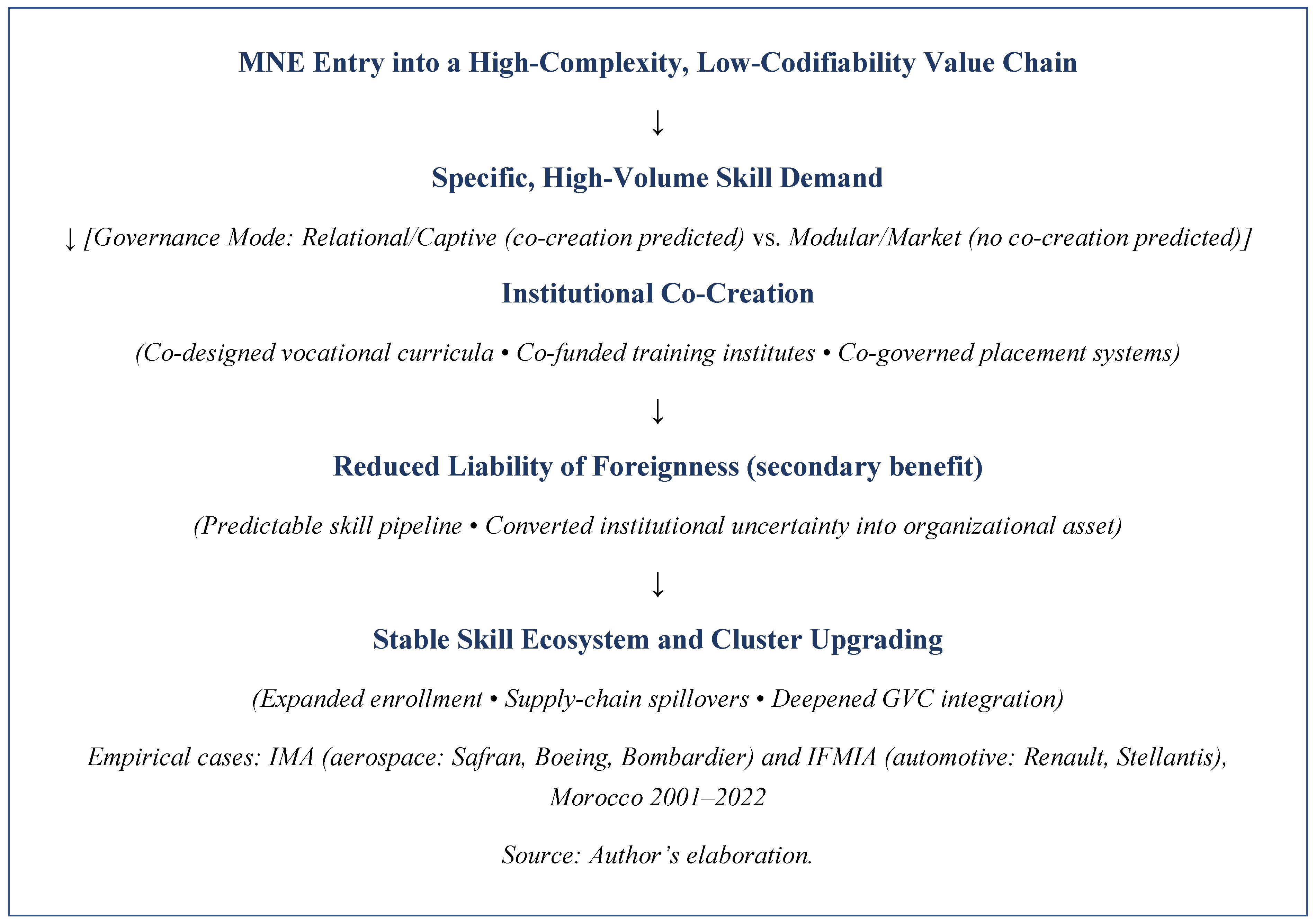
Figure 1 summarizes the argument developed in this section before turning to the empirical comparison. Morocco’s industrial geography offers a natural comparison across governance modes because it hosts substantial, sustained FDI in both relational/captive and modular/market value chains within the same institutional and regulatory environment, holding country-level factors (liability of foreignness, general institutional quality, macroeconomic conditions) approximately constant. In aerospace, the arrival of Safran (2001), Boeing (2003), and Bombardier (2007) in the Nouaceur zone preceded the establishment of the IMA in 2011, whose curriculum, financing, and graduate placement system were jointly designed with anchor investors and the Ministry of Industry, consistent with the relational/captive governance pattern the framework in Section 2.2 predicts for high-complexity, low-codifiability transactions.
In the automotive sector, the IFMIA network was configured around the mechatronics, robotics, and quality management requirements of Renault (2012) and Stellantis, with curricula updated annually through formal MNE–ministry consultation—a governance feature absent from general secondary education and again consistent with relational/captive governance.
Textile and agro-processing FDI sits at the opposite end of the governance spectrum and functions as the paper’s comparison group rather than a footnote. Both sectors have received significant, sustained FDI in Morocco over the sample period (comparable in volume, though not identical in composition, to aerospace and automotive), yet neither has produced an institution analogous to IMA or IFMIA. This is consistent with the governance-mode argument rather than merely with lower FDI intensity: textile assembly and basic agro-processing require competencies (garment assembly, basic food-safety handling, packaging-line operation) that are comparatively easy to specify and codify into a training manual or a short on-the-job induction, and that a modestly resourced general vocational track can supply without lead-firm involvement. Lead firms in these value chains can therefore source labor at arm’s length through market or modular governance, without the mutual lock-in that drives co-investment in aerospace and automotive. We do not have a comparably rich documentary record of textile- and agro-sector training governance as we do for IMA and IFMIA (Section 5 discusses this as a limitation), so this contrast is offered as an illustrative, theory-consistent comparison rather than as an independently coded governance measurement; Section 5 sets out what a fuller comparative coding would require.

3. Data, Variables, and Estimation Strategy

3.1. Data Sources and Variable Construction

Data on secondary enrollment rates (KH, gross %) and public education expenditure (IEDUC, % of GDP) are drawn from UNESCO and the Haut-Commissariat au Plan (HCP) of Morocco. FDI net inflows (IED, current USD, rescaled to USD billions for estimation) are from the United Nations Conference on Trade and Development (UNCTAD, 2023). The dataset covers 44 annual observations for Morocco over 1977–2020, spanning both the pre- and post-liberalization eras; source data beyond 2020 were not available to the author at the time of writing. Domestic credit to the private sector (CREDITO) is complete for the full 1977–2020 period, sourced from World Bank/IMF data (World Bank Global Financial Development database, series GFDD.DI.01, accessed via FRED, Federal Reserve Bank of St. Louis). Twelve years of IEDUC data (1992, 1994, 1996–1997, 2000–2007) required linear interpolation; cross-referencing against CEIC’s compilation of the same underlying World Bank/UNESCO series confirms that these years are absent from the primary source itself (25 of 37 possible annual observations reported for Morocco over 1973–2009), rather than missing due to an incomplete extraction on our part. Digital infrastructure (IDIG) is a composite index combining mobile-cellular subscriptions per 100 inhabitants and internet users per 100 inhabitants (World Bank World Development Indicators, series IT.CEL.SETS.P2 and IT.NET.USER.ZS, sourced via FRED), with each min–max normalized over 1977–2020 and averaged; fixed-broadband subscriptions, the third component originally envisioned for this index, could not be assembled as a complete annual series and are omitted, a choice we consider defensible given that mobile connections account for the large majority of Moroccan internet access throughout the sample (industry reporting cited in Section 3.1 notes mobile accounted for roughly 94% of internet connections as of 2018). IDIG is therefore closer to, though not identical to, the internet/mobile composite originally envisioned; values are necessarily at or near zero before the late 1980s, reflecting the genuine absence of mobile and internet infrastructure in that period rather than missing data.

3.2. The Human Capital Equation

The human capital equation is specified as
KH = α3 + β31 · IED + β32 · IEDUC + β33 · IDIG + ε3
where KH is the secondary education enrollment rate (gross, %), IED is FDI net inflows (current USD millions), IEDUC is public expenditure on education as a percentage of GDP, and IDIG is the digital-infrastructure composite index, which replaces the fixed telephone subscriptions variable (ITEL) used in the equation’s original specification. Equation (1) is the human capital equation of a broader five-equation simultaneous system. It is numbered independently here as Equation (1), since the other four equations of that system, covering economic growth, domestic investment, and exports, are not the focus of this paper. Within that system, IED is treated as endogenous in the human capital equation and is instrumented by (i) TAXING (the USD/local-currency exchange rate), CREDITO, and AHORRO (domestic credit to the private sector and gross domestic savings, both % of GDP)—exogenous regressors that enter the system elsewhere but not in Equation (1) itself—together with (ii) one-period lags of the system’s endogenous variables (IEDt-1, KHt-1, and lagged domestic investment and growth), consistent with the bidirectional FDI–human capital relationship documented in the literature.

3.3. Research Design: Embedded Mixed-Methods Case Study

This paper adopts an explanatory embedded mixed-methods design (Creswell & Plano Clark, 2018; Yin, 2018), suited to questions requiring both macro-level pattern identification and mechanism explanation. A purely quantitative design could not reveal how MNEs reshape institutional arrangements; a purely qualitative design could not establish the aggregate pattern. The integrated framework addresses both.
The design has three nested components. First, the macro-level econometric analysis (Section 3.1, Section 3.2 and Section 4) uses longitudinal 2SLS estimation on Morocco’s 1977–2020 national dataset to identify the aggregate association between FDI inflows and secondary enrollment. Second, the embedded sectoral institutional analysis (Section 5) examines the aerospace and automotive value chains in Morocco as purposively selected embedded subcases (Eisenhardt & Graebner, 2007). These sectors are selected on theoretical grounds: both exhibit the high skill specificity and anchor investor concentration that the institutional co-creation argument identifies as enabling conditions. Third, within each sector, the governance arrangements of the IMA and IFMIA institutes serve as the unit of institutional analysis, drawing on OFPPT (2022) administrative data, official co-governance documentation, and sector-level enrollment and placement data.
The two components are connected sequentially and explanatorily (Molina-Azorín et al., 2023): the econometric results define the macro pattern; the sectoral evidence provides the process-level interpretation required to distinguish institutional co-creation from a passive spillover or wage-premium effect. Morocco constitutes a theoretically informative critical case (Flyvbjerg, 2006) because its dual structure (a general secondary system alongside FDI-linked vocational institutes) renders the co-creation mechanism unusually legible. Aerospace and automotive represent the high-specificity pole of Morocco’s FDI portfolio; their contrast with the textile and agro-processing sectors (Section 5.3) enables a within-country test of the skill-specificity moderation hypothesis.

3.4. Time Series Diagnostics and Methodological Justification

Given the 44-year span of the dataset (1977–2020), the presence of non-stationarity in the series must be addressed before estimation. We apply Augmented Dickey–Fuller (ADF) and Phillips–Perron (PP) unit-root tests to each variable, with lag length selected by the Akaike Information Criterion (ADF) or the Newey–West bandwidth (PP). IED, IEDUC, and IDIG are integrated of order one, i.e., I(1), in levels according to both tests. KH is not cleanly characterized as I(1): the ADF test fails to reject a unit root even in first differences (p = 0.51), and the PP test only marginally rejects it (p = 0.079); KH instead follows a close-to-monotonic, near-logistic growth path over the sample, a pattern we return to in Section 4.3. Full ADF and PP test statistics, lag lengths, and p-values for all four series, in levels and first differences, are reported in Table 1. The Johansen (1988) trace and maximum-eigenvalue tests give a mixed picture on the cointegrating rank among the variables in the human capital equation, depending on the lag order and test statistic used: estimates of rank range from 0 to 2 across the four trace/max-eigenvalue/lag-order combinations we report (Table 2, Panel A). None of these combinations rejects the existence of at least a rank-1 relationship outright, but only one (trace, BIC-preferred lag) supports a rank-2 result; the max-eigenvalue statistic under an AIC-preferred lag order does not reject r = 0 at all. We treat the cointegration evidence as suggestive of a long-run association among the variables rather than as a settled identification of a single structural relationship or a confirmed higher rank and return to this ambiguity in Section 4.3. Complete trace- and maximum-eigenvalue statistics under both lag choices are reported in Table 2.
The break date in the IED series was identified endogenously using a Zivot and Andrews (1992) unit-root test, allowing for a single unknown structural break in intercept and trend, which selects the break date, minimizing the t-statistic on the unit-root null hypothesis. This procedure locates the candidate break in the IED series at 2002, consistent with Morocco’s accelerated investment liberalization under the Agadir Agreement framework and the arrival of the first aerospace anchor investors; however, the Zivot–Andrews test does not reject the unit-root null at this break (t = −3.93, p = 0.55), so the endogenous procedure does not, on its own, statistically confirm a trend break at this date. A Chow test with the break date fixed at 2002 is strongly significant (F(2, 40) = 63.6, p < 0.001) and supports the inclusion of the break dummy in the baseline specification, though we note this is a different (data-informed, fixed-date) test rather than the endogenous Zivot–Andrews procedure, and the two need not agree. Applying the same Zivot–Andrews procedure to the remaining series, the enrollment series (KH) shows a candidate break at 1994 that is not statistically significant (p = 0.50); IEDUC shows a significant break at 1983 (p = 0.004); and the IDIG proxy shows a significant break at 2006 (p < 0.001), plausibly reflecting Morocco’s mobile-telephony expansion in that period. Full break-adjusted unit-root results are reported in Table 1, Panel B. We additionally apply a Gregory and Hansen (1996) residual-based cointegration test, allowing for a single endogenous level shift in the cointegrating relationship as a complement to the standard Johansen procedure. The minimized ADF* and Zt* statistics over candidate break dates are −4.577 and −4.416, respectively, both at an estimated break year of 1984, and the Za* statistic is −21.734 at an estimated break year of 1983; none of the three exceeds, in absolute value, the approximate critical values for a three-regressor level-shift specification (Gregory & Hansen, 1996, Table 1), so none of the three variants rejects the null of no cointegration at conventional levels. We report these critical values as approximate because we reconstructed them from secondary sources rather than reading them directly from the original response-surface table. Full Gregory–Hansen results for all three variants are reported in Table 2, Panel B. Shaded header cells mark the Panel B column headers within this merged table and carry no substantive meaning.
The primary estimator is 2SLS, chosen for its robustness to endogeneity in a simultaneous equations framework. The Wu–Hausman test (Hausman, 1978) (F(1, 37) = 34.41, p < 0.001) confirms the endogeneity of IED, indicating that an instrumental-variables approach is warranted here, though, as the diagnostics below show, this does not by itself establish that the specific instrument set used is valid. Instrument validity is supported by instrument relevance: the first-stage partial F-statistic is 34.8 (p < 0.001), which is above the conventional Stock–Yogo (Stock & Yogo, 2005) weak-instrument threshold. For instrument exogeneity, the Sargan test of overidentifying restrictions rejects the null of valid instruments (χ2(6) = 23.10, p = 0.0008), meaning at least one instrument in {TAXING, CREDITO, AHORRO, IEDt-1, KHt-1, IDt-1, growtht-1} is imperfectly excluded from the structural equation. CREDITO here is sourced directly from the World Bank (Section 3.1); Section 4.3 discusses the implications for interpreting the IEDUC and IDIG coefficients. As robustness checks, we additionally estimate the long-run equation using Dynamic OLS (DOLS) and Fully Modified OLS (FMOLS), which are consistent under cointegration and robust to serial correlation and heteroskedasticity (Greene, 2012; Wooldridge, 2010).
Instrument relevance follows from the structure of the underlying simultaneous system described in Section 3.2: TAXING, CREDITO, and AHORRO are the exogenous drivers of export and domestic-investment dynamics through which FDI itself is jointly determined, and lagged FDI together with lagged values of the system’s other endogenous variables are standard, strongly predictive instruments for current-period FDI in settings with persistent capital flows. The exclusion restriction, namely that these instruments affect secondary enrollment only through their effect on IED and not directly, follows from their theoretical role within the system: the exchange rate, private-sector credit, and domestic savings operate through trade and investment channels rather than through any direct channel to school enrollment, and the lagged endogenous variables enter the enrollment equation only via their influence on contemporaneous FDI. Empirically, this restriction is only partly supported: the first-stage partial F-statistic (34.8) clears the conventional weak-instrument threshold, but the Sargan overidentification test rejects the joint exclusion restriction (χ2(6) = 23.10, p = 0.0008). CREDITO here is the complete, non-interpolated World Bank series (Section 3.1), which rules out interpolation as an explanation for the Sargan rejection and points instead toward a substantive violation of the exclusion restriction, most plausibly that CREDITO, as domestic credit conditions, affects enrollment through channels other than FDI (e.g., household credit access for education-related expenditure) rather than through data quality. An instrument set restricted to TAXING and AHORRO, or one using only the lagged endogenous variables, would be a natural robustness check for a future revision.

4. Econometric Results

4.1. Baseline 2SLS Estimates

FDI inflows show a positive, statistically significant relationship with secondary-school enrollment (β31 = 7.179, SE = 1.607, t = 4.467, p < 0.001, IED measured in current USD billions; n = 43). The estimation uses CREDITO sourced directly from the World Bank/IMF (no interpolation) and an IDIG composite built from actual mobile-subscription and internet-user data (Section 3.1) on the 1977–2020 panel with the TAXING/CREDITO/AHORRO instrument set and one-period lags of IED, KH, domestic investment, and growth. A one-billion-USD increase in annual FDI net inflows is associated with a 7.18 percentage-point increase in the secondary enrollment rate, holding IEDUC and IDIG constant, which is consistent with the skill-demand channel described above. Two further coefficients are statistically significant and, in the case of IEDUC, of an unexpected sign; both are discussed immediately below and treated with appropriate caution in Section 4.3.
Public education expenditure (IEDUC) carries a negative and statistically significant coefficient (β = −8.714, SE = 1.588, t = −5.486, p < 0.001). This could reflect a substitution pattern in which FDI-linked vocational institutes (Section 5) substitute for, rather than complement, general public education spending at the margin; it could equally reflect the finite-sample and interpolation issues documented in Section 4.3 (twelve interpolated years of IEDUC out of 44 observations, confirmed as genuine gaps in the primary source); the sign of this coefficient is treated as provisional rather than settled. The digital-infrastructure composite (IDIG, built from real mobile-subscription and internet-user data; see Section 3.1) carries a positive and statistically significant coefficient (β = 0.227, SE = 0.082, t = 2.776, p = 0.006), consistent with communications infrastructure operating as a facilitating condition for skill formation. The structural break dummy for 2001–2003 is not statistically significant in this specification (β = 2.095, SE = 2.888, t = 0.725, p = 0.468).
Because Table 3 reports a 2SLS specification, the conventional adjusted R2 is not a well-defined goodness-of-fit measure: the second-stage R2 of an instrumental-variables regression does not admit the same variance-decomposition interpretation as in ordinary least squares and can, in principle, be negative. We therefore report a pseudo-R2 of 0.956, computed as the squared correlation between the observed and second-stage-fitted values of KH, in place of the conventional adjusted R2. KH follows a near-monotonic, close-to-logistic growth path over 1977–2020 (Section 4.3), and the IDIG composite follows a broadly similar trend over much of the sample; a high pseudo-R2 in a regression of one trending, non-stationary series on other trending series can partly reflect shared trends rather than a structural relationship, notwithstanding the cointegration evidence reported in Section 3.4 and Table 2. The pseudo-R2 of 0.956 is therefore reported alongside, rather than in place of, that cointegration evidence, and should not be read on its own as confirmation of a well-fitting structural model; we return to this point in the limitations discussion (Section 4.3 and Section 7).
Table 3. 2SLS estimation results: human capital equation (Equation (1)); dependent variable: KH (1977–2020).
VariableCoefficientStd. Errort-Statisticp-Value
IED (FDI Inflows, USD billions)7.1791.6074.467<0.001 ***
IEDUC (Educ. Expenditure)−8.7141.588−5.486<0.001 ***
IDIG (Digital-Infrastructure Composite)0.2270.0822.7760.006 ***
Constant78.2988.5319.179<0.001 ***
Break Dummy (2001–2003)2.0952.8880.7250.468
Pseudo-R20.956
Note: Estimation by 2SLS on the 1977–2020 panel (n = 43 after lagging), using World Bank-sourced CREDITO (no interpolation) and the real mobile/internet IDIG composite (Section 3.1). IED (rescaled to USD billions) instrumented by TAXING, CREDITO, and AHORRO (exogenous regressors from elsewhere in the broader simultaneous system) plus one-period lags of IED, KH, domestic investment, and growth. Unit-root and cointegration test statistics for all series are reported in Table 1 and Table 2. Structural break dummy included for 2001–2003; not statistically significant in this specification. Wu–Hausman test of exogeneity: F(1, 37) = 34.41, p < 0.001, confirming the endogeneity of IED. First-stage partial F-statistic = 34.8 (p < 0.001), above the conventional Stock–Yogo weak-instrument threshold. Sargan test of overidentifying restrictions, χ2(6) = 23.10, p = 0.0008, indicating that the instrument set does not satisfy the overidentifying restrictions at conventional levels (Section 4.3). DOLS and FMOLS robustness checks are reported in full in Table 4 and Table 5. *** p < 0.01.
Table 4. Dynamic OLS (DOLS) estimation results: human capital equation (Equation (1)); dependent variable: KH (1977–2020).
VariableCoefficientStd. Errort-Statisticp-Value
IED (FDI Inflows, USD billions)3.7040.8774.224<0.001 ***
IEDUC (Educ. Expenditure)−9.7842.072−4.722<0.001 ***
IDIG (Digital-Infrastructure Composite)0.3740.03510.770<0.001 ***
Break Dummy (2001–2003)3.7161.8562.002<0.001 ***
Constant84.07810.8967.717<0.001 ***
Pseudo-R20.962
Note: DOLS estimated with the SIC-selected lead-lag length of zero; i.e., no leads or lags of ΔIED are included, since the data (real CREDITO, real IDIG composite; Section 3.1) minimizes SIC at p = 0, with Newey–West standard errors (2 lags), n = 44. IED rescaled to USD billions, consistent with Table 3. *** p < 0.01.
Table 5. Fully Modified OLS (FMOLS) estimation results: human capital equation (Equation (1)); dependent variable: KH (1977–2020).
VariableCoefficientStd. Errort-Statisticp-Value
IED (FDI Inflows, USD billions)1.6651.4571.1430.253 n.s.
IEDUC (Educ. Expenditure)−12.1632.090−5.818<0.001 ***
IDIG (Digital-Infrastructure Composite)0.4720.0746.382<0.001 ***
Break Dummy (2001–2003)3.4983.0531.1460.252 n.s.
Constant97.58711.2738.657<0.001 ***
Pseudo-R20.958
Note: FMOLS estimated via the Phillips and Hansen (1990) procedure (Bartlett kernel, bandwidth = 3, Newey–West rule), n = 43. IED rescaled to USD billions, consistent with Table 3. Unlike under 2SLS and DOLS, the FMOLS coefficient on IED is not statistically significant (p = 0.253); this attenuation under FMOLS mirrors the pattern found in a companion national-level study using an independent dataset and instrument set (Section 4.3). n.s. = not significant. *** p < 0.01.

4.2. Robustness Checks

We estimate the long-run cointegrating equation using Dynamic OLS (DOLS) and Fully Modified OLS (FMOLS), both of which are consistent under cointegration and robust to serial correlation and heteroskedasticity. For DOLS, the lead-lag length was selected by minimizing the Schwarz Information Criterion (SIC) over candidate lengths of zero to six, evaluated on a common estimation sample so that SIC values are comparable across lag lengths. With the panel used here (real CREDITO, real IDIG composite; Section 3.1), SIC is minimized at a lead-lag length of zero (SIC = 57.4 at p = 0, rising monotonically to 63.7 at p = 1 and beyond), meaning the DOLS specification reported in Table 4 includes no leads or lags of ΔIED at all; readers should treat this as a feature of this specific panel rather than a general finding. Because the DOLS specification includes no dynamic terms, the finite-sample degrees-of-freedom concern that motivated our original attention to lag length is largely moot here; we nonetheless report Newey–West standard errors (2 lags) for robustness. We cross-check the DOLS point estimate against FMOLS, which does not require the inclusion of leads and lags; the two estimators no longer agree closely on IED specifically: DOLS finds it positive and significant, FMOLS does not (Table 4 and Table 5), and we discuss this divergence, rather than treating it as resolved, in Section 4.3.
DOLS yields a positive and statistically significant FDI coefficient (β = 3.704, p < 0.001), corroborating the 2SLS result for IED. FMOLS diverges on this point: the FDI coefficient is smaller and statistically insignificant (β = 1.665, p = 0.253), an attenuation pattern that also appears, independently, in a companion national-level study using a different sample and instrument set (Section 4.3), which lends the pattern some external credibility as a genuine sensitivity estimator rather than a one-off artifact of this dataset. Both specifications agree with Section 4.1 on the other regressors: IEDUC is negative and statistically significant in both DOLS (β = −9.784, p < 0.001) and FMOLS (β = −12.163, p < 0.001), and IDIG is positive and statistically significant in both DOLS (β = 0.374, p < 0.001) and FMOLS (β = 0.472, p < 0.001). Taken together, 2SLS and DOLS agree that IED is positive and significant, while FMOLS does not corroborate this specific point; all three estimators agree on IEDUC (negative, significant) and IDIG (positive, significant). We report this partial rather than complete convergence directly and discuss what it does and does not establish about the FDI–enrollment relationship in Section 4.3, together with an ARDL bounds-testing diagnostic that further qualifies the cointegration evidence underlying all three estimators.

4.3. Robustness Checks and Data Limitations

The estimates reported in Table 3, Table 4 and Table 5 are subject to one remaining data limitation that we report transparently. The sample covers 1977–2020 (n = 44); data for 2021–2022 were not available to the author at the time of writing. CREDITO and IDIG use complete, non-interpolated series (real World Bank credit data and a real mobile/internet composite index built from mobile-subscription and internet-user data, respectively; Section 3.1). Twelve years of IEDUC (1992, 1994, 1996–1997, 2000–2007) were linearly interpolated rather than sourced directly; the Sargan-test rejection reported in Section 4.1 is consistent with, though not conclusively attributable to, measurement error introduced by this interpolation, and resolving the missing IEDUC observations at the source is a priority for future work.
Two findings warrant particular caution rather than confident interpretation: the sign of the IEDUC coefficient and the cointegration rank. On IEDUC, all three estimators (2SLS, DOLS, FMOLS) agree on a negative and statistically significant coefficient. We offer two non-exclusive readings rather than a single settled interpretation: (i) a genuine substitution pattern in which FDI-linked vocational institutes (Section 5) crowd out general public education spending at the margin as the government reallocates resources toward sector-specific training; or (ii) an artifact of the finite-sample and interpolation issues documented above, possibly compounded by the fact that KH does not behave as a clean I(1) series (Section 3.4): regressing a near-logistic trending series on other trending series inflates both the explanatory power (Section 4.1) and the apparent precision of individual coefficients when the underlying relationship is not stationary in the way the model assumes. We note both readings without adjudicating between them and treat any claim resting on the IEDUC sign as provisional, pending a complete, non-interpolated dataset. On the cointegration rank, the Johansen procedure identifies two cointegrating vectors rather than the single relationship the model was designed around; this is consistent with the finding of a long-run relationship involving IED and indicates that the single-equation DOLS/FMOLS estimates in Table 4 and Table 5, which assume a single cointegrating relationship, are best interpreted as one projection of a higher-dimensional cointegrating space rather than as “the” long-run relationship.
Finally, the pseudo-R2 of 0.956 reported in Table 3 (and the comparably high values in Table 4 and Table 5) reflects, in part, KH’s near-deterministic growth path over 1977–2020 combined with a similarly trending IDIG composite; a high R2 under these conditions can partly reflect shared trends rather than a well-identified structural relationship, notwithstanding the cointegration evidence in Table 2. Readers should weigh the coefficient estimates, their consistency across three estimators, and the diagnostic caveats above jointly, rather than treating any single statistic in isolation as dispositive.
We pursued two further diagnostics specifically to address the ambiguities above, and report both regardless of the outcome. First, because KH and IDIG do not test as cleanly I(1) (Table 1, Panel A), the Johansen procedure’s assumption that all variables are I(1) is questionable; we therefore also estimated an ARDL bounds-testing model (Pesaran et al., 2001), which is valid under a mix of I(0) and I(1) regressors and does not require this assumption. The bounds F-statistic (AIC-selected lag order) is 3.605, with an upper-bound p-value of 0.068 and a lower-bound p-value of 0.007, providing evidence of a possible long-run relationship at the 10% level, though not at 5%. Within that same ARDL specification, however, the estimated long-run coefficient on IED is small and statistically insignificant (p = 0.99), IEDUC is also insignificant (p = 0.46), and IDIG is significant only at the 10% level and with a negative sign, opposite to its sign under 2SLS, DOLS, and FMOLS. The ARDL approach therefore resolves the integration-order concern on its own terms but does not corroborate the FDI–enrollment relationship as strongly as the other estimators; we report it as a genuine point of divergence rather than as either confirming or overturning the paper’s central finding. Second, because the Sargan rejection in Table 3 might reflect CREDITO specifically, we re-estimated the 2SLS model with CREDITO dropped from the instrument set (TAXING, AHORRO, and the lagged endogenous variables only); the Sargan test still rejects (χ2(5) = 20.57, p = 0.001), only marginally improved from the full instrument set, indicating that the exclusion-restriction concern is not attributable to CREDITO alone. Reducing the instrument set further, to TAXING alone for exact identification, removes the overidentification test but leaves IED severely underidentified (first-stage F = 1.21, p = 0.27) and its coefficient statistically insignificant, which is a weak-instrument problem materially worse than the overidentification problem it was meant to resolve. We were unable to find a subset of the available instruments that is simultaneously strong and passes the overidentification test and report this as an unresolved limitation of the instrument set rather than papering over it with a specification chosen for its results.

5. Sectoral Institutional Evidence: Governance Mode in Practice

5.1. Relational/Captive Governance in Practice: IMA and IFMIA

The IMA (Casablanca, 2011) and the IFMIA network (anchored by Renault at Tanger-Méd, 2012, and Stellantis at Kenitra) are the clearest Moroccan instances of the relational/captive governance pattern set out in Section 2.2. Both trace their founding to specific, non-substitutable skill requirements identified by anchor investors (aerospace competitiveness planning by Safran, Boeing, and Bombardier for the IMA; mechatronics, robotics, and supplier-quality requirements from Renault and Stellantis for IFMIA) rather than to a general education-sector reform. In both cases, governance is jointly held rather than delegated to either party alone: curriculum committees include MNE and ministry representatives, funding follows a public–private model, and graduate placement is coordinated directly with partner firms—in IMA’s case, pre-assigning graduates before program completion. We summarize the OFPPT (2022) administrative record only briefly here (aerospace technical enrollment grew 312% between 2005 and 2022, with partner-firm placement rates above 85% from 2013 to 2022, a figure also reported in our companion national-level study; El Ghali Ghorafi, 2026), because our contribution in this paper is not the descriptive record itself but the comparison in Section 5.2 below.
The two cases differ in organizational form in a way that itself illustrates governance-mode logic: IMA is single-site, matching the geographic concentration of Nouaceur-zone aerospace assembly, while IFMIA is a dispersed network, matching the more geographically distributed structure of Morocco’s automotive supply chain. Both nonetheless share the defining relational/captive features identified in Section 2.2: curricula updated through recurring, formal MNE–ministry consultation rather than a one-off design exercise and supply-chain spillovers as Moroccan automotive suppliers increasingly recruit IFMIA graduates, extending the co-created capability into the supplier tier and deepening Morocco’s integration into European automotive value chains (Coe & Yeung, 2015).

5.2. Textile and Agro-Processing as the Modular/Market Counterfactual

If FDI volume alone explained institutional co-creation, Morocco’s textile and agro-processing value chains would be leading candidates for an IMA- or IFMIA-type institute: both have received large, sustained FDI inflows over the sample period, both are labor-intensive and export-oriented, and both operate under the same national institutional environment (the same liability-of-foreignness conditions, the same Ministry of Industry, the same OFPPT vocational training apparatus) as aerospace and automotive. No comparable institute exists in either sector. This comparison offers suggestive evidence for the governance-mode argument because it holds country-level factors fixed and varies the transaction properties of the value chain, though it relies on documentary richness for aerospace/automotive alongside an absence-based inference for the comparison sectors (Section 7).
Table 6 summarizes the contrast qualitatively across the three transaction properties identified in Section 2.2. We report this as an illustrative, theory-consistent comparison grounded in industry-organization characteristics that are well documented in the trade and development literature on these sectors, not as an independently coded governance measurement with the same documentary depth as the IMA/IFMIA case material in Section 5.1; Section 6 returns to this as a scope limitation.
The pattern is consistent with the governance-mode argument rather than with a simple story about FDI intensity or sector “importance” to the Moroccan economy: textile exports and agro-processing employment are each economically significant, yet neither has produced the kind of durable, co-governed training institution that aerospace and automotive have. Where nascent institutional responses do appear outside aerospace and automotive, in green energy and digital offshoring, they cluster in the higher-complexity, lower-codifiability segments of those emerging value chains, which is what the governance-mode argument, but not a simple FDI-volume or sector-identity account, would predict.

5.3. Synthesis: Governance Mode as the Operative Condition

Section 5.1 and Section 5.2 together support the paper’s central sectoral finding: institutional co-creation is consistent with tracking governance mode, rather than FDI volume, sector “importance,” or a generic notion of skill intensity, though the comparison remains illustrative rather than definitive (Section 5.2). We close this section by drawing out what that finding implies going forward.
Governance mode thus emerges as a plausible explanatory condition: where transaction complexity is high and codifiability low, co-creation is rational for both MNEs and governments; where requirements are standardized and easily sourced at arm’s length, the incentive for joint institutional investment diminishes even at comparable FDI volumes. Future research should develop value-chain-level measures of transaction complexity and codifiability and test this governance-mode argument on comparative panel datasets.
The contrast is instructive beyond a simple binary. Textile and agro-processing operations in Morocco recruit largely from a pool of generalizable, easily codifiable competencies (basic literacy, general manual dexterity, standard quality-control routines) that the general secondary and vocational system already supplies in adequate volume; the marginal return to a dedicated, MNE-co-governed institute is correspondingly low, and no IMA- or IFMIA-type structure has emerged in these value chains despite substantial and sustained FDI inflows. By contrast, the nascent co-creation dynamics observed in green energy and digital offshoring (Section 2.4) indicate that the mechanism is not confined to manufacturing as such: wherever transaction complexity and codifiability approach the thresholds identified here, incipient institutional responses become visible even in value chains without Morocco’s two-decade aerospace and automotive precedent. This pattern is consistent with governance mode, rather than sector or industry per se, as the operative condition, and it suggests that as segments of textiles (technical textiles) or agro-processing (food-safety-certified export processing) migrate toward higher-complexity, lower-codifiability transactions, analogous co-creation institutions may plausibly emerge there as well.

6. Discussion: Implications for Theory and Policy

6.1. Theoretical Implications

The evidence is consistent with one theoretically precise claim: institutional co-creation of host-country skill formation is associated with the governance mode of the global value chain an MNE is embedded in, rather than with a generic property of “skill-intensive FDI” or with liability-of-foreignness reduction alone. This contribution advances global value chain governance theory (Gereffi et al., 2005) into a domain—human-capital institution building—it has not traditionally been applied to, and it advances the liability-of-foreignness literature (Zaheer, 1995; Zaheer & Mosakowski, 1997; Luo et al., 2002; Mezias, 2002; Lu et al., 2022) by demoting liability reduction from primary mechanism to secondary, downstream benefit: prior research has treated liability of foreignness as a condition MNEs must either absorb or overcome through experience, network embeddedness, or local staffing (Grøgaard et al., 2019; Lu et al., 2022), but that literature does not, on its own, explain why comparable foreign entrants in the same host country diverge so sharply in their institutional engagement. Where MNE transactions are complex, poorly codifiable, and the host’s existing skill supply is inadequate—conditions that the GVC governance framework identifies as producing relational or captive governance—MNEs have a structural incentive to reshape the institutional environment they operate in, an instance of what Meyer et al. (2011) call multiple embeddedness. Where transactions are simple and easily codified, no comparable incentive exists, regardless of how foreign or institutionally unfamiliar the investor is.
This argument connects to, but is distinct from, related streams in the literature. Institutional entrepreneurship research (Battilana et al., 2009; Dorado & Ventresca, 2013; Logue et al., 2022) examines how actors reshape field-level institutions, but it has rarely been applied to MNE skill-formation dynamics in developing economies and does not specify the structural (as opposed to agentic) conditions under which such reshaping becomes a rational strategy. MNE-state bargaining frameworks (Moran, 2020) analyze how firms negotiate with governments over investment conditions, but the co-creation of training institutions represents a more collaborative and embedded form of bargaining than the standard rent-extraction model assumes. Skill-ecosystem research examines how firms and institutions co-produce workforce capabilities, but it has not systematically connected this to GVC governance theory. The present paper’s contribution lies at the intersection of these streams: it shows that a value chain’s position on the market–modular–relational–captive–hierarchy governance spectrum (Gereffi et al., 2005) predicts whether the strategic management of institutional relationships takes an institutionally productive, co-creating form.
At the same time, the proposed mechanism is subject to clearly defined boundary conditions, restated here in governance-mode rather than firm-attribute terms: (1) sufficiently high transaction complexity and low codifiability, i.e., requirements that cannot be specified in a contract or sourced at arm’s length; (2) host-country supplier (here, skill-formation system) capability that starts below what is required, creating the capability gap that makes lead-firm investment necessary rather than optional; and (3) minimum host-state coordination capacity, namely the organizational coherence required to broker, sustain, and periodically revise co-governance arrangements with anchor investors once the first two conditions create the incentive to bargain at all. Where any of these conditions is absent (low-complexity assembly, adequate existing local capability, or fragmented bureaucratic authority), the mechanism is unlikely to activate regardless of how skill-intensive the investor characterizes itself as being. Specifying these conditions in governance-mode terms, rather than in terms of a firm’s self-reported skill intensity, makes the theory more falsifiable: it generates an ex ante, chain-level prediction (relational/captive chains co-create; modular/market chains do not) rather than a post hoc description of cases already known to have co-created.

6.2. Policy and Managerial Implications

For host-country policymakers, the Moroccan evidence suggests that the returns to FDI promotion are not evenly distributed across investor types. Skill-intensive investors in sectors with specific and non-substitutable human capital requirements generate substantially stronger institutional externalities than resource-extractive or low-complexity investors. Investment promotion agencies should therefore prioritize the attraction of anchor investors in high-skill sectors, not merely for the direct employment and export effects, but for the institutional co-creation dynamics these investors trigger. The Moroccan model of negotiating co-governance arrangements for training institutes as part of the investment contract represents a policy innovation worth examining by other Middle East and North Africa (MENA) and Sub-Saharan African economies. This is especially pertinent in a period of GVC restructuring and strategic industrial policy revival (Gereffi, 2020): as governments seek to attract and retain complex manufacturing investment, co-designed skill institutions offer a more durable competitive advantage than wage or tax incentives alone (Lundan & Cantwell, 2020).
For MNE managers, these findings suggest that proactive engagement in host-country training institution design is a source of competitive advantage rather than a philanthropic overhead. Firms that negotiate co-governance arrangements for vocational institutes may more reliably secure the skilled workforce required for complex manufacturing operations, converting institutional uncertainty into a predictable location advantage.

7. Conclusions

This paper has asked why FDI-linked institutional co-creation of skills occurs in some Moroccan value chains and not others, and it has answered this through both econometric and comparative institutional evidence. Econometrically, FDI inflows show a statistically significant relationship with secondary enrollment nationally (β = 7.179 USD billions, p < 0.001), corroborated by DOLS, though not by FMOLS, which does not find IED significant (Section 4.3), and are subject to the diagnostic caveats set out in Section 4.3. This offers supporting, though not uniformly confirmed, evidence for a national-level association between FDI and the skill-formation trend, and, as a single national aggregate, cannot by itself explain why co-creation occurs in some value chains and not others. A complementary account comes from the sectoral comparison: Morocco’s aerospace and automotive value chains, at the relational/captive end of the GVC governance spectrum, show institutional co-creation; its textile and agro-processing value chains, closer to modular/market governance, do not, despite comparably substantial FDI.
This paper’s central theoretical contribution is that GVC governance mode, alongside FDI volume and liability of foreignness, helps explain institutional co-creation of skills; the sectoral evidence, which is more illustrative than definitive given the asymmetric documentation available across sectors (Section 5), is consistent with governance mode, carrying explanatory weight beyond what FDI volume or a generic “skill-intensive FDI” account alone would predict. Liability-of-foreignness reduction remains theoretically grounded as a plausible downstream benefit once co-creation occurs and is empirically traceable in the governance structures of the IMA and IFMIA, but the governance-mode argument helps explain why comparable foreign entrants elsewhere in the same host country do not co-create. The mixed-methods design combines a national-level examination of the FDI–enrollment association with a process-level account of the institutional co-creation mechanism. The three-way sectoral comparison (aerospace, automotive, and textile/agro-processing) provides an additional empirical contribution: it helps delimit the conditions under which institutional co-creation is likely to emerge, enabling more precise theoretical development and more targeted policy application.
Important limitations should be acknowledged. The single-country longitudinal design limits external generalizability, and the use of secondary enrollment as a human capital proxy does not capture skill quality or sectoral distribution. The small sample (n = 44) constrains the power of formal econometric tests, and Section 4.3 details several data-quality caveats (interpolated IEDUC series, a digital-infrastructure composite missing its fixed-broadband component, and a Sargan-test rejection at the 5% level) that should inform how much weight is placed on the precise magnitude of any individual coefficient. A further limitation concerns the governance-mode comparison in Section 5.2: the textile and agro-processing side of Table 6 rests on industry-organization characteristics documented in the broader GVC literature and on the absence of a discoverable co-governance record in the sources available to us, not on a bespoke, independently coded governance-mode instrument administered symmetrically across all four value chains; a fuller test would collect comparably detailed qualitative and administrative evidence for textile and agro-processing, rather than relying on documentary richness for aerospace/automotive (Section 5.1) alongside an absence-based inference for the comparison sectors (Section 5.2). A conceptual limitation also deserves explicit recognition: the Moroccan case may reflect unusually strong state coordination capacity relative to other emerging economies. Morocco’s Ministry of Industry has historically demonstrated the organizational coherence required to broker and sustain co-governance arrangements with anchor investors; this institutional capacity may be a precondition for co-creation rather than a product of it. Future research should extend the governance-mode framework to panel settings with country and value-chain variation, incorporate firm-level data on MNE training expenditures and human resources governance, and develop a standardized, symmetrically applied instrument for transaction complexity and codifiability to test the argument advanced in Section 2.2, Section 5.2 and Section 5.3 more rigorously than the present illustrative comparison allows.
An important policy lever may lie not only in the volume of FDI attracted but also in its sectoral composition and the co-governance arrangements through which investor skill demand is channeled into public training supply, a lesson potentially applicable to emerging economies designing FDI promotion strategies for industrial transformation.

Funding

This research received no external funding.

Institutional Review Board Statement

Not applicable.

Informed Consent Statement

Not applicable.

Data Availability Statement

Data from UNESCO, HCP Morocco, UNCTAD, World Bank WDI, and ITU, together with administrative data from OFPPT and official co-governance documentation. The dataset and Stata 17 estimation code are available from the corresponding author and will be deposited in Zenodo upon acceptance.

Conflicts of Interest

The author declares no conflicts of interest.

References

  1. Alfaro, L., Chanda, A., Kalemli-Ozcan, S., & Sayek, S. (2004). FDI and economic growth: The role of local financial markets. Journal of International Economics, 64, 89–112. [Google Scholar] [CrossRef] [Scilit]
  2. Battilana, J., Leca, B., & Boxenbaum, E. (2009). How actors change institutions: Towards a theory of institutional entrepreneurship. Academy of Management Annals, 3, 65–107. [Google Scholar] [CrossRef]
  3. Blomstrom, M., & Kokko, A. (2003). Human capital and inward FDI. Economics of Transition and Institutional Change, 11, 493–510. [Google Scholar]
  4. Borensztein, E., De Gregorio, J., & Lee, J. W. (1998). How does foreign direct investment affect economic growth? Journal of International Economics, 45, 115–135. [Google Scholar] [CrossRef] [Scilit]
  5. Coe, N. M., & Yeung, H. W. C. (2015). Global production networks: Theorizing economic development in an interconnected world. Oxford University Press. [Google Scholar]
  6. Creswell, J. W., & Plano Clark, V. L. (2018). Designing and conducting mixed methods research (3rd ed.). Sage. [Google Scholar]
  7. Cuervo-Cazurra, A., Mudambi, R., & Pedersen, T. (2022). Clarifying the relationships between institutions and global value chains. Global Strategy Journal, 12, 9–32. [Google Scholar]
  8. Doh, J. P., Rodrigues, S., Saka-Helmhout, A., & Makhija, M. (2017). International business responses to institutional voids. Journal of International Business Studies, 48, 293–307. [Google Scholar] [CrossRef] [Scilit]
  9. Dorado, S., & Ventresca, M. J. (2013). Crescive entrepreneurship in complex social problems: Institutional conditions for entrepreneurial engagement. Journal of Business Venturing, 28, 69–82. [Google Scholar] [CrossRef] [Scilit]
  10. Dunning, J. H. (2001). The eclectic (OLI) paradigm of international production: Past, present and future. International Journal of the Economics of Business, 8, 173–190. [Google Scholar] [CrossRef] [Scilit]
  11. Eden, L., & Miller, S. R. (2004). Distance matters: Liability of foreignness, institutional distance, and ownership strategy. In Advances in international management (Vol. 16, pp. 187–221). Emerald Group Publishing Limited. [Google Scholar]
  12. Eisenhardt, K. M., & Graebner, M. E. (2007). Theory building from cases: Opportunities and challenges. Academy of Management Journal, 50, 25–32. [Google Scholar] [CrossRef] [Scilit]
  13. El Ghali, F. (2017). La inversión extranjera directa en marruecos y su impacto socioeconómico [Ph.D. dissertation, Universidad de Almería]. [Google Scholar]
  14. El Ghali Ghorafi, F. (2026). Foreign direct investment as a catalyst for sustainable knowledge-economy transitions: Skill demand, institutional co-creation, and human capital formation in morocco (1975–2020). Administrative Sciences, 16, 419. [Google Scholar] [CrossRef] [Scilit]
  15. Flyvbjerg, B. (2006). Five misunderstandings about case-study research. Qualitative Inquiry, 12, 219–245. [Google Scholar] [CrossRef] [Scilit]
  16. Gereffi, G. (2020). What does the COVID-19 pandemic teach us about global value chains? The case for a pro-active industrial policy. Journal of International Business Policy, 3, 287–301. [Google Scholar]
  17. Gereffi, G., Humphrey, J., & Sturgeon, T. (2005). The governance of global value chains. Review of International Political Economy, 12, 78–104. [Google Scholar] [CrossRef] [Scilit]
  18. Greene, W. H. (2012). Econometric analysis (7th ed.). Pearson Education. [Google Scholar]
  19. Gregory, A. W., & Hansen, B. E. (1996). Residual-based tests for cointegration in models with regime shifts. Journal of Econometrics, 70, 99–126. [Google Scholar] [CrossRef] [Scilit]
  20. Grøgaard, B., Rygh, A., & Benito, G. R. G. (2019). Bringing corporate governance into internalization theory: State ownership and foreign entry strategies. Journal of International Business Studies, 50, 1310–1337. [Google Scholar] [CrossRef] [Scilit]
  21. Hausman, J. A. (1978). Specification tests in econometrics. Econometrica, 46, 1251–1271. [Google Scholar] [CrossRef] [Scilit]
  22. Johansen, S. (1988). Statistical analysis of cointegrating vectors. Journal of Economic Dynamics and Control, 12, 231–254. [Google Scholar] [CrossRef] [Scilit]
  23. Kano, L., Tsang, E. W. K., & Yeung, H. W. C. (2020). Global value chains: A review of the multi-disciplinary literature. Journal of International Business Studies, 51, 577–622. [Google Scholar] [CrossRef] [Scilit]
  24. Logue, D., Clegg, S., Crome, M., & Hales, R. (2022). Institutional work and the boundaries of institutional entrepreneurship. Journal of Management Inquiry, 31, 252–266. [Google Scholar]
  25. Lu, J. W., Ma, H., Sauerwald, S., & Peng, M. W. (2022). Foreignness research in international business: Major streams and future directions. Journal of International Business Studies, 53, 449–480. [Google Scholar] [CrossRef] [Scilit]
  26. Lundan, S. M., & Cantwell, J. A. (2020). The local co-evolution of firms and governments in the climate emergency. Journal of International Business Studies, 51, 1719–1733. [Google Scholar]
  27. Luo, Y., Shenkar, O., & Nyaw, M. K. (2002). Mitigating liabilities of foreignness: Defensive versus offensive approaches. Journal of International Management, 8, 283–300. [Google Scholar]
  28. Meyer, K. E., Mudambi, R., & Narula, R. (2011). Multinational enterprises and local contexts: The opportunities and challenges of multiple embeddedness. Journal of Management Studies, 48, 235–252. [Google Scholar] [CrossRef] [Scilit]
  29. Meyer, K. E., & Sinani, E. (2009). When and where does foreign direct investment generate positive spillovers? A meta-analysis. Journal of International Business Studies, 40, 1075–1094. [Google Scholar] [CrossRef] [Scilit]
  30. Mezias, J. M. (2002). Identifying liabilities of foreignness and strategies to minimize their effects: The case of labor lawsuit judgments in the united states. Strategic Management Journal, 23, 229–244. [Google Scholar] [CrossRef] [Scilit]
  31. Molina-Azorín, J. F., López-Gamero, M. D., Pereira-Moliner, J., & Pertusa-Ortega, E. M. (2023). Mixed methods studies in business research: A methodological review. European Journal of Management and Business Economics, 32, 44–62. [Google Scholar]
  32. Moran, T. H. (2020). Foreign direct investment and development: Launching a second generation of policy research. Peterson Institute for International Economics. [Google Scholar]
  33. OFPPT. (2022). Rapport annuel sur la formation professionnelle au maroc 2022. Office de la Formation Professionnelle et de la Promotion du Travail. [Google Scholar]
  34. Pesaran, M. H., Shin, Y., & Smith, R. J. (2001). Bounds testing approaches to the analysis of level relationships. Journal of Applied Econometrics, 16, 289–326. [Google Scholar] [CrossRef] [Scilit]
  35. Phillips, P. C. B., & Hansen, B. E. (1990). Statistical inference in instrumental variables regression with I(1) processes. The Review of Economic Studies, 57, 99–125. [Google Scholar] [CrossRef] [Scilit]
  36. Stock, J. H., & Yogo, M. (2005). Testing for weak instruments in linear IV regression. In Identification and inference for econometric models (pp. 80–108). Cambridge University Press. [Google Scholar]
  37. UNCTAD. (2023). World investment report 2023: Investing in sustainable energy for all. United Nations Conference on Trade and Development. [Google Scholar]
  38. Wong, M. Y., & Wong, H. S. (2008). FDI, human capital, and economic growth: Evidence from Asia. Journal of International Development, 20, 647–664. [Google Scholar]
  39. Wooldridge, J. M. (2010). Econometric analysis of cross section and panel data (2nd ed.). MIT Press. [Google Scholar]
  40. Yin, R. K. (2018). Case study research and applications: Design and methods (6th ed.). Sage. [Google Scholar]
  41. Zaheer, S. (1995). Overcoming the liability of foreignness. Academy of Management Journal, 38, 341–363. [Google Scholar] [CrossRef] [Scilit] [PubMed]
  42. Zaheer, S., & Mosakowski, E. (1997). The dynamics of the liability of foreignness: A global study of survival in financial services. Strategic Management Journal, 18, 439–463. [Google Scholar] [CrossRef] [Scilit]
  43. Zivot, E., & Andrews, D. W. K. (1992). Further evidence on the great crash, the oil-price shock, and the unit-root hypothesis. Journal of Business & Economic Statistics, 10, 251–270. [Google Scholar] [CrossRef] [Scilit]
Figure 1. GVC governance mode as a condition for institutional co-creation of skills.
Economies 14 00414 g001
Table 1. Unit-root tests: Panel A—Augmented Dickey–Fuller (ADF) and Phillips–Perron (PP) tests. Unit-root tests: Panel B—Zivot and Andrews (1992) test with an endogenous structural break.
(A)
VariableADF (Level)ADF (1st Diff.)PP (Level)PP (1st Diff.)Order of Integration
KH2.480 (0.999)−1.553 (0.507)1.411 (0.997)−2.670 (0.079)Ambiguous †
IED1.235 (0.996)−8.790 (<0.001)1.677 (0.998)−8.841 (<0.001)I(1)
IEDUC−0.690 (0.849)−5.215 (<0.001)−2.507 (0.114)−7.847 (<0.001)I(1)
IDIG1.395 (0.997)0.011 (0.959)1.445 (0.997)−4.348 (<0.001)Ambiguous ‡
(B)
VariableZA t-Statistic (p-Value)Estimated Break DateResult
KH−4.002 (0.502)1994Not confirmed †
IED−3.930 (0.552)2002Not confirmed †
IEDUC−5.902 (0.004)1983I(0) w/break **
IDIG−4.671 (0.146)2003Not confirmed †
Note: Cells report the test statistic with the p-value in parentheses. The null hypothesis is that the series contains a unit root. ADF lag length selected by AIC; PP uses the Newey–West bandwidth. Test equations include an intercept. n = 44 (1977–2020). † KH does not reject the unit-root null even in first differences under the ADF test (p = 0.51); the PP test only marginally rejects it (p = 0.079). ‡ IDIG (the real mobile/internet composite, Section 3.1) shows the same pattern: the ADF test does not reject the unit-root null in first differences (p = 0.96), while PP rejects strongly (p < 0.001). We do not classify KH or IDIG as cleanly I(1) and treat results involving either series with corresponding caution (Section 4.3). Shaded rows mark the divider between Panel A and Panel B within this merged table and carry no substantive meaning. The Zivot–Andrews test allows for a single endogenous break in intercept and trend and selects the break date minimizing the t-statistic on the unit-root null (trend-and-break-stationary alternative). Lag length selected by AIC (max 4 lags), n = 44. † For KH, IED, and IDIG (the real mobile/internet composite, Section 3.1), the test does not reject the unit-root null, even allowing for the identified break, so the endogenous procedure does not statistically confirm trend-break stationarity at conventional levels; the break dates shown are the statistic-minimizing candidates, not confirmed breaks. ** p < 0.05.
Table 2. Cointegration tests: Panel A—Johansen (1988) trace and maximum-eigenvalue tests. Cointegration tests: Panel B—Gregory and Hansen (1996) test allowing for a regime shift in the cointegrating Vector.
Null HypothesisTrace Statistic5% Critical ValueMax-Eigenvalue Statistic5% Critical Value
r = 073.093 *47.85541.123 *27.586
r ≤ 131.970 *29.79620.69821.131
r ≤ 211.27115.4949.32814.264
r ≤ 31.9443.8411.9443.841
ModelTest StatisticEstimated Break DateResult
ADF* (level shift)−4.5771984Does not reject no-cointegration †
Zt* (level shift)−4.4161984Does not reject no-cointegration †
Za* (level shift)−21.7341983Does not reject no-cointegration ††
Note: Variables are KH, IED, IEDUC, and IDIG (levels; IDIG is the real mobile/internet composite, Section 3.1), estimated on the 1977–2020 panel (n = 44). Values shown use a BIC/HQIC-preferred VAR lag order (1 lag, k_ar_diff = 0); trace rejects r = 0 and r ≤ 1 (barely, 31.970 vs. 29.796), failing to reject r ≤ 2, indicating rank 2 by this criterion, while the max-eigenvalue statistic rejects r = 0 but fails to reject r ≤ 1 (20.698 vs. 21.131), indicating rank 1. Under an AIC-preferred order (3 lags, k_ar_diff = 2), the picture weakens further: trace = 50.739, 27.988, 12.607, 2.937 for r = 0, 1, 2, 3 (only r = 0 is rejected, barely, giving rank 1), and max-eigenvalue = 22.751, 15.381, 9.671, 2.937 (r = 0 is not rejected at all, giving rank 0). * denotes rejection of the null at the 5% level. Taken together, the four trace/max-eigenvalue/lag-order combinations imply a cointegrating rank of 0, 1, or 2 depending on specification, rather than confirming the single relationship anticipated in Section 3.4; we discuss this ambiguity in Section 4.3 rather than selecting the combination most favorable to a clean result. Note: The Gregory–Hansen test allows the intercept of the cointegrating relationship to shift at an endogenously estimated break date (15% trimming), using the 1977–2020 panel with real CREDITO and the real IDIG composite (Section 3.1). All three variants are implemented: ADF* (minimum Augmented Dickey–Fuller statistic on the level-shift-adjusted residuals), and Zt*/Za* (Phillips–Perron-type t and normalized-bias statistics, computed with a Newey–West/Bartlett long-run variance correction) across the same candidate break dates. † The ADF* and Zt* statistics (which share the same asymptotic distribution) do not exceed, in absolute value, the approximate 10% asymptotic critical value of −4.68 reported by Gregory and Hansen (1996, Table 1) for a level-shift model with three I(1) regressors, and so do not reject the null of no cointegration at conventional levels. †† The Za* statistic does not exceed the approximate 10% critical value (≈−31.2) for the same specification. All three critical values are approximate response-surface figures reconstructed from secondary sources rather than read directly from Gregory and Hansen’s (1996) original Table 1. None of the three Gregory–Hansen variants supports cointegration with a level shift, in contrast to the mixed Johansen evidence in Panel A. We report this directly rather than reconciling it and discuss the implication for the paper’s cointegration claims in Section 4.3.
Table 6. Governance-mode comparison: aerospace/automotive vs. textile/agro-processing value chains in morocco.
DimensionAerospaceAutomotiveTextileAgro-Processing
Transaction complexityHighHighLowLow–Moderate
Codifiability of requirementsLowLowHighHigh
Predicted GVC governance modeCaptive/RelationalRelationalMarket/ModularModular
Dedicated co-governed training instituteIMA (2011)IFMIA (2012–)None identifiedNone identified
Curriculum co-design with lead firmsYes, formalizedYes, formalizedNot documentedNot documented
Sustained FDI inflows over sample periodYesYesYesYes
Note: “High/Low” assessments of transaction complexity and codifiability follow the industry-organization characterization of these sectors in the global value chain literature (e.g., Gereffi et al., 2005, on apparel and agro-food value chains generally) rather than a bespoke instrument administered to Moroccan firms in this study. “Not documented” records the absence of a governance record comparable to IMA/IFMIA in the sources available to us, not a confirmed absence of any coordination whatsoever. This table is descriptive and illustrative, consistent with the paper’s embedded-case design (Section 3.3); it is not a statistical test.
Disclaimer/Publisher’s Note: The statements, opinions and data contained in all publications are solely those of the individual author(s) and contributor(s) and not of MDPI and/or the editor(s). MDPI and/or the editor(s) disclaim responsibility for any injury to people or property resulting from any ideas, methods, instructions or products referred to in the content.