Article

Global Value Chain Governance and the Institutional Co-Creation of Skills in Morocco

by
Fatine El Ghali Ghorafi
Department of Economics and Business, Universidad de Almería, Carretera de Sacramento s/n, La Cañada de San Urbano, 04120 Almería, Spain
Economies 2026, 14(9), 414; https://doi.org/10.3390/economies14090414

Submission received: 5 August 2026 / Revised: 8 September 2026 / Accepted: 9 September 2026 / Published: 15 September 2026

Abstract

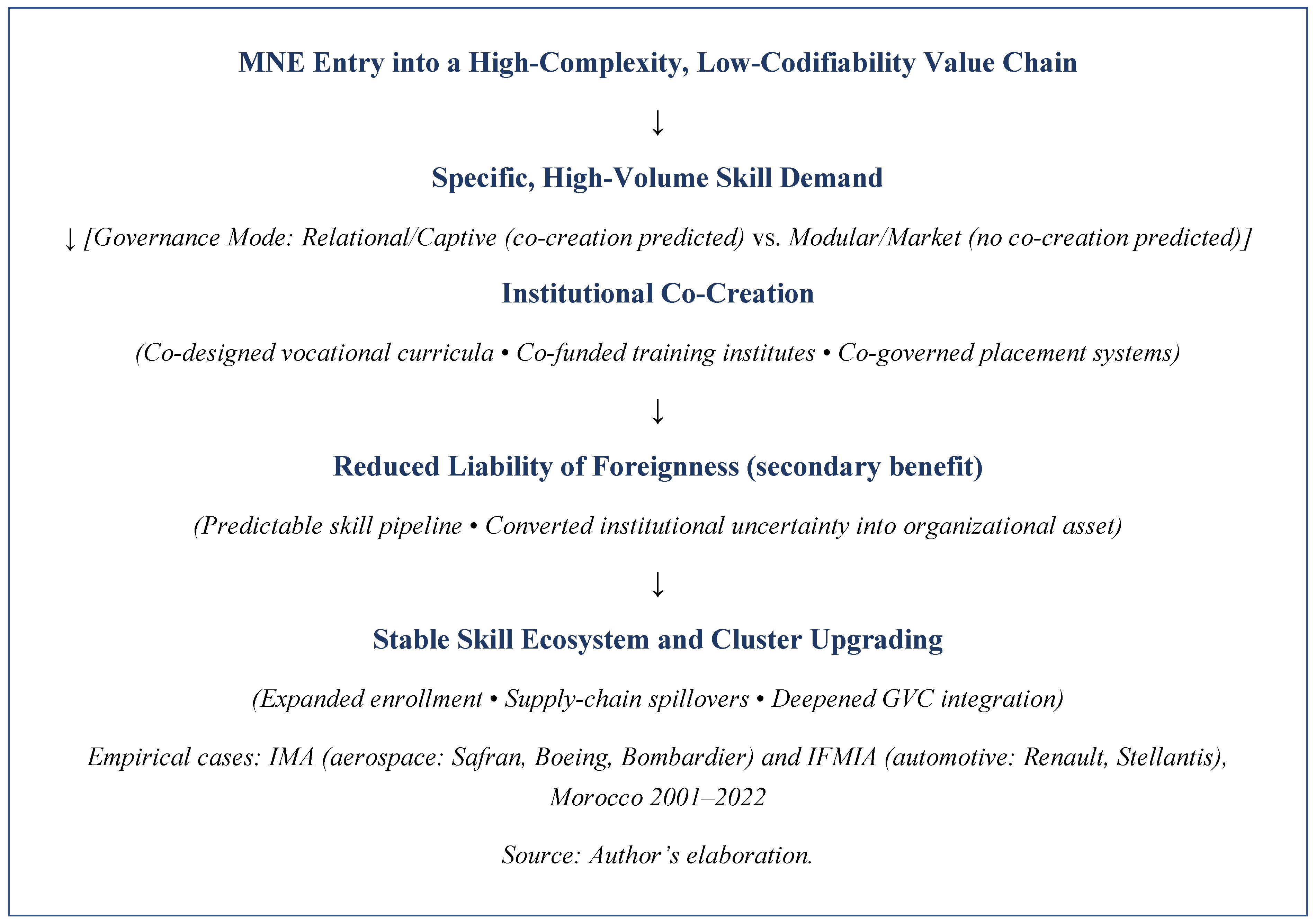
Why does the same host economy see foreign investors co-build vocational training institutions in some industries but not others, even when FDI volumes are comparable? We argue that part of the answer lies in the governance mode of the global value chain (GVC) an investor is embedded in, alongside the liability-of-foreignness logic that dominates the co-creation literature. Relational and captive governance (high transaction complexity, low codifiability of required capabilities, and supplier competence that cannot be bought off the shelf) create a mutual dependence that can make joint institutional investment rational for both firms and the host state, whereas modular and market governance do not. Morocco’s aerospace and automotive value chains sit at the relational/captive end of this spectrum; its textile and agro-processing value chains sit closer to modular/market governance. We examine the argument in two stages. First, using a national-level 2SLS/DOLS/FMOLS estimation on 44 annual observations (1977–2020), we find FDI inflows positively associated with secondary-school enrollment nationally (β = 7.18 USD billions, p < 0.001 under 2SLS, corroborated by DOLS but not by FMOLS), though the supporting evidence is not uniform across estimators and diagnostic tests, and a national aggregate cannot, by itself, explain sector-by-sector variation. Second, we contrast the aerospace/automotive and textile/agro-processing value chains directly: the relational/captive chains show co-designed curricula, co-funded institutes, and co-governed placement systems, while the modular/market chains show comparable FDI intensity but no comparable institutional response. This sectoral contrast, documented in greater depth for aerospace and automotive than for the comparison sectors, is consistent with GVC governance mode, rather than FDI volume or liability of foreignness alone, playing a role in whether institutional co-creation occurs, though the evidence here is suggestive rather than conclusive. We report the national-level estimation transparently, including a set of diagnostic limitations (cointegration-rank and integration-order ambiguity across Johansen, Gregory–Hansen, and ARDL bounds tests; an instrument-validity caveat that persists even after removing individual instruments; a digital-infrastructure composite missing its fixed-broadband component; and an estimator-sensitive FDI coefficient that DOLS corroborates but FMOLS does not), which qualify the macro evidence and should be read alongside, rather than in place of, the sectoral comparison.
Keywords: global value chain governance; skill co-creation; institutional voids; Morocco; vocational training; aerospace; automotive; textile; mixed-methods; skill specificity; MNE-state bargaining; 2SLS global value chain governance; skill co-creation; institutional voids; Morocco; vocational training; aerospace; automotive; textile; mixed-methods; skill specificity; MNE-state bargaining; 2SLS