Innovation Heterogeneity and Employment Structure in Sub-Saharan African Firms



Abstract
1. Introduction
2. Theoretical Framework
2.1. Literature Review and Hypothesis Development
2.1.1. Product Innovation and Employment Outcomes
2.1.2. Process Innovation and Employment Outcomes
2.1.3. Organisational Innovation and Employment
2.1.4. Incremental Innovation and Employment Outcomes
2.1.5. Radical Innovation and Employment Outcomes
3. Methodology
3.1. Data and Sample
3.2. Variable Measurement
3.2.1. Outcome Variables
3.2.2. Treatment Variables
3.2.3. Covariates
3.3. Empirical Strategy
3.3.1. Propensity-Score Matching
3.3.2. Overlap Region
4. Empirical Results
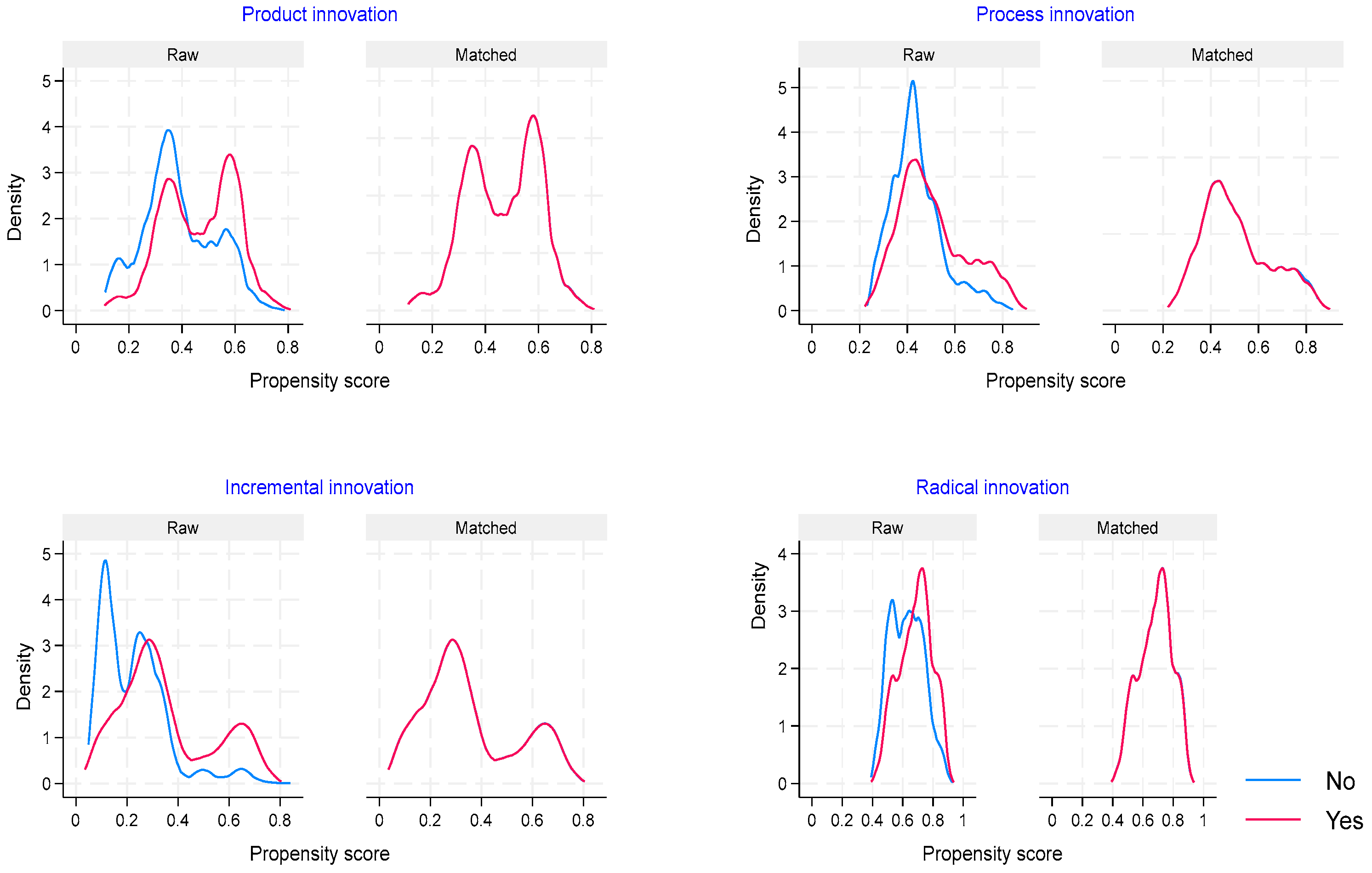
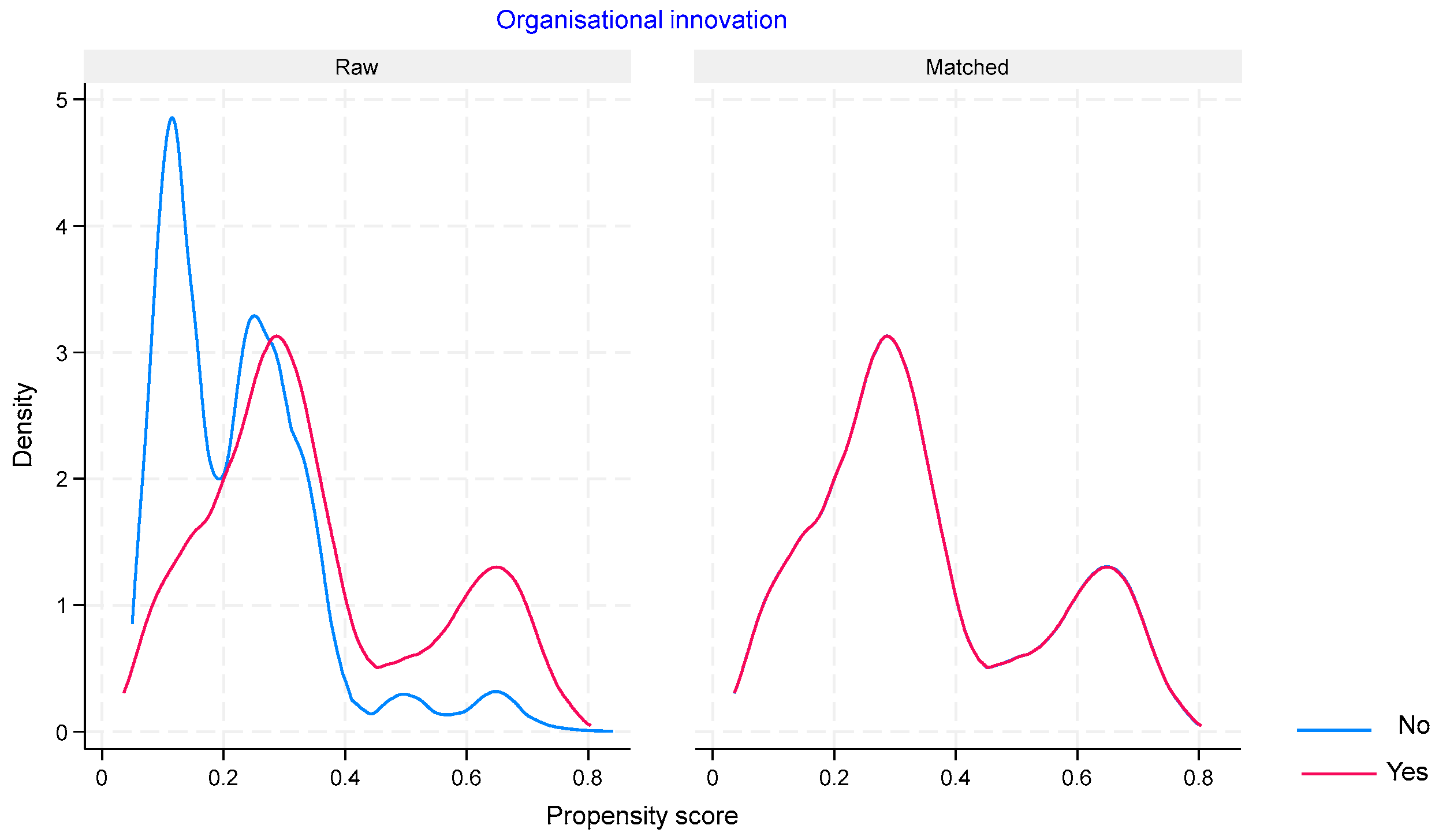
4.1. Covariate Balance Diagnostics Before and After Kernel Matching
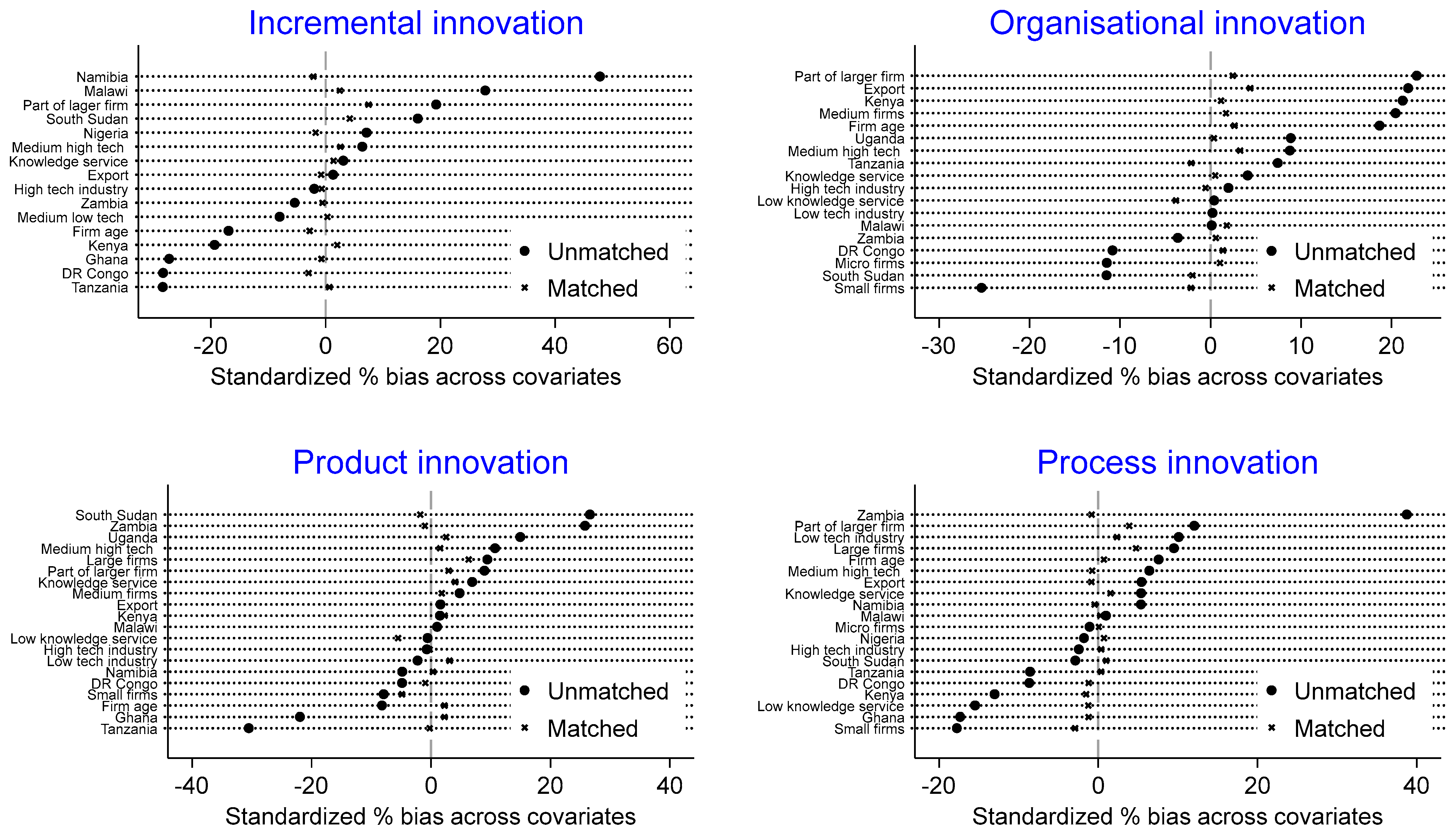
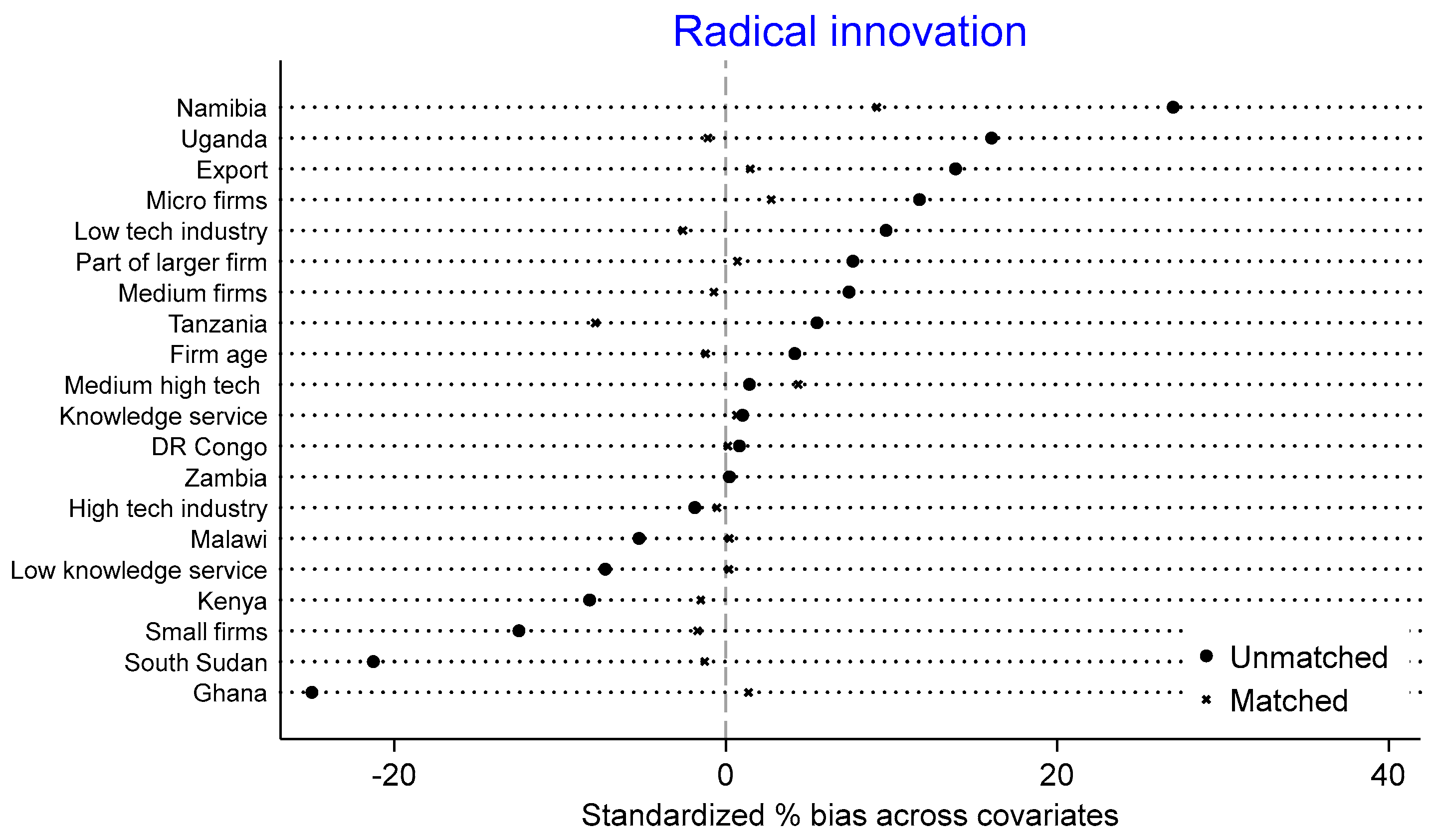
4.2. Standardised Percentage Bias Before and After Kernel Matching
4.3. Kernel Matching Results
4.4. Robustness Check
5. Discussion
5.1. Theoretical Implications
5.2. Policy Implications
5.3. Managerial Implications
5.4. Limitations and Suggestions for Future Research
Author Contributions
Funding
Data Availability Statement
Conflicts of Interest
References
- Acemoglu, D. (1998). Why do new technologies complement skills? Directed technical change and wage inequality. The Quarterly Journal of Economics, 113(4), 1055–1089. [Google Scholar] [CrossRef] [Scilit]
- Acemoglu, D. (2002). Technical change, inequality, and the labour market. Journal of Economic Literature, 40(1), 7–72. [Google Scholar] [CrossRef] [Scilit]
- Acemoglu, D., Akcigit, U., & Celik, M. A. (2022). Radical and incremental innovation: The roles of firms, managers, and innovators. American Economic Journal: Macroeconomics, 14(3), 199–249. [Google Scholar] [CrossRef] [Scilit]
- Acemoglu, D., & Autor, D. (2011). Skills, tasks and technologies: Implications for employment and earnings. In O. Ashenfelter, & D. Card (Eds.), Handbook of labour economics (Vol. 4B, pp. 1043–1171). Elsevier. [Google Scholar]
- African Union Commission & OECD. (2024). Africa’s development dynamics 2024: Skills, jobs and productivity. African Union Commission; OECD Publishing. [Google Scholar]
- Agazu, B. G., & Kero, C. A. (2024). Innovation strategy and firm competitiveness: A systematic literature review. Journal of Innovation and Entrepreneurship, 13, 24. [Google Scholar] [CrossRef] [Scilit]
- Aghion, P., & Howitt, P. (1992). A model of growth through creative destruction. Econometrica, 60(2), 323–351. [Google Scholar] [CrossRef] [Scilit]
- Agostini, L., & Nosella, A. (2017). Enhancing radical innovation performance through intellectual capital components. Journal of Intellectual Capital, 18(4), 789–806. [Google Scholar] [CrossRef] [Scilit]
- Arenas Díaz, G., Córcoles González, D., & Santamaría Sánchez, L. (2024). The effects of product and process innovation on employment: A meta-regression analysis. Eurasian Business Review, 14(1), 35–68. [Google Scholar] [CrossRef] [Scilit]
- Armbruster, H., Bikfalvi, A., Kinkel, S., & Lay, G. (2008). Organizational innovation: The challenge of measuring non-technical innovation in large-scale surveys. Technovation, 28(10), 644–657. [Google Scholar] [CrossRef] [Scilit]
- Atfield, G., Green, A. E., & Purcell, K. (2011). The impact of student and migrant employment on opportunities for low skilled people. Joseph Rowntree Foundation. [Google Scholar]
- Atwine, B., Okumu, I. M., & Nnyanzi, J. B. (2023). What drives the dynamics of employment growth in firms? Evidence from East Africa. Journal of Innovation and Entrepreneurship, 12(1), 33. [Google Scholar] [CrossRef] [Scilit] [PubMed]
- Audretsch, D. B., Coad, A., & Segarra, A. (2014). Firm growth and innovation. Small Business Economics, 43(4), 743–749. [Google Scholar] [CrossRef] [Scilit]
- Austin, P. C. (2011). An introduction to propensity score methods for reducing the effects of confounding in observational studies. Multivariate Behavioral Research, 46(3), 399–424. [Google Scholar] [CrossRef] [Scilit] [PubMed]
- Autor, D., & Salomons, A. (2018). Is automation labor share-displacing? Productivity growth, employment, and the labor share. Brookings Papers on Economic Activity, 49(1), 1–87. [Google Scholar] [CrossRef] [Scilit]
- Autor, D. H., Katz, L. F., & Kearney, M. S. (2006). The polarization of the U.S. labor market. American Economic Review, 96(2), 189–194. [Google Scholar] [CrossRef] [Scilit]
- Autor, D. H., Levy, F., & Murnane, R. J. (2003). The skill content of recent technological change: An empirical exploration. The Quarterly Journal of Economics, 118(4), 1279–1333. [Google Scholar] [CrossRef] [Scilit]
- Avenyo, E. K., Konte, M., & Mohnen, P. (2019). The employment impact of product innovations in sub-Saharan Africa: Firm-level evidence. Research Policy, 48(9), 103806. [Google Scholar] [CrossRef] [Scilit]
- Aw, B. Y., Roberts, M. J., & Winston, T. (2007). Export market participation, investments in R&D and worker training, and the evolution of firm productivity. The World Economy, 30(1), 83–104. [Google Scholar] [CrossRef] [Scilit]
- Ayyagari, M., Demirgüç-Kunt, A., & Maksimovic, V. (2011). Firm innovation in emerging markets: The role of finance, governance, and competition. Journal of Financial and Quantitative Analysis, 46(6), 1545–1580. [Google Scholar] [CrossRef] [Scilit]
- Azar, G., & Ciabuschi, F. (2017). Organizational innovation, technological innovation, and export performance: The effects of innovation radicalness and extensiveness. International Business Review, 26(2), 324–336. [Google Scholar] [CrossRef] [Scilit]
- Baláž, V., Jeck, T., & Balog, M. (2023). Firm performance over innovation cycle: Evidence from a small European economy. Journal of Innovation and Entrepreneurship, 12, 40. [Google Scholar] [CrossRef] [Scilit]
- Becker, S. O., & Ichino, A. (2002). Estimation of average treatment effects based on propensity scores. The Stata Journal, 2(4), 358–377. [Google Scholar] [CrossRef] [Scilit]
- Bell, M., & Pavitt, K. (1993). Technological accumulation and industrial growth: Contrasts between developed and developing countries. Industrial and Corporate Change, 2(2), 157–210. [Google Scholar] [CrossRef] [Scilit]
- Berman, E., Bound, J., & Griliches, Z. (1994). Changes in the demand for skilled labor within U.S. manufacturing: Evidence from the annual survey of manufactures. The Quarterly Journal of Economics, 109(2), 367–397. [Google Scholar] [CrossRef] [Scilit]
- Berman, E., Bound, J., & Machin, S. (1998). Implications of skill-biased technological change: International evidence. The Quarterly Journal of Economics, 113(4), 1245–1279. [Google Scholar] [CrossRef] [Scilit]
- Bessen, J. E. (2019). Automation and jobs: When technology boosts employment. Economic Policy, 34(100), 589–626. [Google Scholar] [CrossRef] [Scilit]
- Bogliacino, F., & Pianta, M. (2016). The Pavitt taxonomy, revisited: Patterns of innovation in manufacturing and services. Economia Politica, 33, 153–180. [Google Scholar] [CrossRef] [Scilit]
- Bogliacino, F., & Vivarelli, M. (2012). The job creation effect of R&D expenditures. Australian Economic Papers, 51(2), 96–113. [Google Scholar] [CrossRef] [Scilit]
- Bresnahan, T. F., Brynjolfsson, E., & Hitt, L. M. (2002). Information technology, workplace organisation, and the demand for skilled labour: Firm-level evidence. The Quarterly Journal of Economics, 117(1), 339–376. [Google Scholar] [CrossRef] [Scilit]
- Brookhart, M. A., Schneeweiss, S., Rothman, K. J., Glynn, R. J., Avorn, J., & Stürmer, T. (2006). Variable selection for propensity score models. American Journal of Epidemiology, 163(12), 1149–1156. [Google Scholar] [CrossRef] [Scilit] [PubMed]
- Caliendo, M., & Kopeinig, S. (2008). Some practical guidance for the implementation of propensity score matching. Journal of Economic Surveys, 22(1), 31–72. [Google Scholar] [CrossRef] [Scilit]
- Calvino, F., & Virgillito, M. E. (2018). The innovation–employment nexus: A critical survey of theory and empirics. Journal of Economic Surveys, 32(1), 83–117. [Google Scholar] [CrossRef] [Scilit]
- Carree, M. A., & Thurik, A. R. (2008). The lag structure of the impact of business ownership on economic performance in OECD countries. Small Business Economics, 30(1), 101–110. [Google Scholar] [CrossRef] [Scilit]
- Chen, J., Yin, X., & Mei, L. (2021). Holistic innovation: An emerging innovation paradigm. International Journal of Innovation Studies, 5(1), 1–13. [Google Scholar]
- Chennells, L., & Van Reenen, J. (1999). Has technology hurt less skilled workers? Institute for Fiscal Studies. [Google Scholar]
- Cirera, X., & Maloney, W. F. (2017). The innovation paradox: Developing-country capabilities and the unrealised promise of technological catch-up. World Bank. [Google Scholar]
- Cirera, X., & Sabetti, L. (2019). The effects of innovation on employment in developing countries: Evidence from enterprise surveys. Industrial and Corporate Change, 28(1), 161–176. [Google Scholar] [CrossRef] [Scilit]
- Coad, A., Segarra, A., & Teruel, M. (2016). Innovation and firm growth: Does firm age play a role? Research Policy, 45(2), 387–400. [Google Scholar] [CrossRef] [Scilit]
- Cohen, W. M., & Levinthal, D. A. (1990). Absorptive capacity: A new perspective on learning and innovation. Administrative Science Quarterly, 35(1), 128–152. [Google Scholar] [CrossRef] [Scilit]
- Conte, A., & Vivarelli, M. (2011). Imported skill-biased technological change in developing countries. The Developing Economies, 49(1), 36–65. [Google Scholar] [CrossRef] [Scilit]
- Crespi, G., Tacsir, E., & Pereira, M. (2019). Effects of innovation on employment in Latin America. Industrial and Corporate Change, 28(1), 139–159. [Google Scholar] [CrossRef] [Scilit]
- Czarnitzki, D., Ebersberger, B., & Fier, A. (2007). The relationship between R&D collaboration, subsidies and R&D performance: Empirical evidence from Finland and Germany. Journal of Applied Econometrics, 22(7), 1347–1366. [Google Scholar] [CrossRef] [Scilit]
- Dachs, B., & Peters, B. (2014). Innovation, employment growth, and foreign ownership of firms: A European perspective. Research Policy, 43(1), 214–232. [Google Scholar] [CrossRef] [Scilit]
- Damanpour, F. (1991). Organisational innovation: A meta-analysis of effects of determinants and moderators. Academy of Management Journal, 34(3), 555–590. [Google Scholar] [CrossRef] [Scilit] [PubMed]
- Damanpour, F., & Aravind, D. (2012). Managerial innovation: Conceptions, processes and antecedents. Management and Organisation Review, 8(2), 423–454. [Google Scholar] [CrossRef] [Scilit]
- De Elejalde, R., Giuliodori, D., & Stucchi, R. (2015). Employment and innovation: Firm-level evidence from Argentina. Emerging Markets Finance and Trade, 51(1), 27–47. [Google Scholar] [CrossRef] [Scilit]
- Dehejia, R. H., & Wahba, S. (2002). Propensity score-matching methods for nonexperimental causal studies. Review of Economics and Statistics, 84(1), 151–161. [Google Scholar] [CrossRef] [Scilit]
- Dosi, G. (1982). Technological paradigms and technological trajectories: A suggested interpretation of the determinants and directions of technical change. Research Policy, 11(3), 147–162. [Google Scholar]
- Downar, B., Ernstberger, J., Reichelstein, S., Schwenen, S., & Zaklan, A. (2021). The impact of carbon disclosure mandates on emissions and financial operating performance. Review of Accounting Studies, 26(3), 1137–1175. [Google Scholar] [CrossRef] [Scilit]
- Evangelista, R., & Pianta, M. (1996). The impact of innovation on employment in Europe. Innovation: The European Journal of Social Science Research, 9(2), 105–118. [Google Scholar]
- Evangelista, R., & Vezzani, A. (2012). The impact of technological and organisational innovations on employment in European firms. Industrial and Corporate Change, 21(4), 871–899. [Google Scholar] [CrossRef] [Scilit]
- Fagerberg, J., Srholec, M., & Verspagen, B. (2010). Innovation and economic development. In B. H. Hall, & N. Rosenberg (Eds.), Handbook of the economics of innovation (pp. 833–872). Elsevier. [Google Scholar]
- Fox, L., & Sohnesen, T. P. (2012). Household enterprises in sub-Saharan Africa: Why they matter for growth, jobs, and livelihoods. World Bank Policy Research Working Paper, No. 6184. World Bank. [Google Scholar]
- Gebreeyesus, M. (2011). Innovation and microenterprises growth in Ethiopia. In A. Szirmai, W. Naudé, & M. Goedhuys (Eds.), Entrepreneurship, innovation, and economic development (pp. 122–146). Oxford University Press. [Google Scholar]
- Giles, D. E. A. (1982). The interpretation of dummy variables in semilogarithmic equations: Unbiased estimation. Economics Letters, 10(1–2), 77–79. [Google Scholar] [CrossRef] [Scilit]
- Goedhuys, M., & Sleuwaegen, L. (2016). High-growth versus declining firms: The differential impact of human capital and R&D. Applied Economics Letters, 23(5), 369–372. [Google Scholar] [CrossRef] [Scilit]
- Goldin, C., & Katz, L. F. (1998). The origins of technology–skill complementarity. The Quarterly Journal of Economics, 113(3), 693–732. [Google Scholar] [CrossRef] [Scilit]
- Gorodnichenko, Y., & Schnitzer, M. (2013). Financial constraints and innovation: Why poor countries don’t catch up. Journal of the European Economic Association, 11(5), 1115–1152. [Google Scholar] [CrossRef] [Scilit]
- Griliches, Z. (1969). Capital-skill complementarity. Review of Economics and Statistics, 51(4), 465–468. [Google Scholar] [CrossRef] [Scilit]
- Guisado-González, M., Vila-Alonso, M., & Guisado-Tato, M. (2016). Radical innovation, incremental innovation and training: Analysis of complementarity. Technology in Society, 44, 48–54. [Google Scholar] [CrossRef] [Scilit]
- Guo, S., & Fraser, M. W. (2015). Propensity score analysis: Statistical methods and applications (2nd ed.). SAGE. [Google Scholar]
- Halvorsen, R., & Palmquist, R. (1980). The interpretation of dummy variables in semilogarithmic equations. American Economic Review, 70(3), 474–475. [Google Scholar]
- Harrison, R., Jaumandreu, J., Mairesse, J., & Peters, B. (2014). Does innovation stimulate employment? A firm-level analysis using comparable micro-data from four European countries. International Journal of Industrial Organisation, 35, 29–43. [Google Scholar] [CrossRef] [Scilit]
- Heckman, J. J., Ichimura, H., Smith, J., & Todd, P. (1998). Characterising selection bias using experimental data. Econometrica, 66(5), 1017–1098. [Google Scholar] [CrossRef] [Scilit]
- Heckman, J. J., Ichimura, H., & Todd, P. E. (1997). Matching as an econometric evaluation estimator: Evidence from evaluating a job training programme. Review of Economic Studies, 64(4), 605–654. [Google Scholar] [CrossRef] [Scilit]
- Heckman, J. J., & Vytlacil, E. J. (2007). Econometric evaluation of social programs, Part I: Causal models, structural models and econometric policy evaluation. In J. J. Heckman, & E. E. Leamer (Eds.), Handbook of econometrics (Vol. 6B, pp. 4779–4874). Elsevier. [Google Scholar]
- Heidenreich, M., & Kraemer, T. (2016). Innovations—Doomed to fail? Investigating strategies to overcome passive innovation resistance. Journal of Product Innovation Management, 33(3), 277–297. [Google Scholar] [CrossRef] [Scilit]
- Henderson, R. M., & Clark, K. B. (1990). Architectural innovation: The reconfiguration of existing product technologies and the failure of established firms. Administrative Science Quarterly, 35(1), 9–30. [Google Scholar] [CrossRef] [Scilit]
- Hou, J., Huang, C., Licht, G., Mairesse, J., Mohnen, P., Mulkay, B., Peters, B., Wu, Y., Zhao, Y., & Zhen, F. (2019). Does innovation stimulate employment? Evidence from China, France, Germany, and The Netherlands. Industrial and Corporate Change, 28(1), 109–121. [Google Scholar] [CrossRef] [Scilit]
- Huergo, E., & Jaumandreu, J. (2004). How does probability of innovation change with firm age? Small Business Economics, 22(3–4), 193–207. [Google Scholar] [CrossRef] [Scilit]
- Imbens, G. W., & Wooldridge, J. M. (2009). Recent developments in the econometrics of program evaluation. Journal of Economic Literature, 47(1), 5–86. [Google Scholar] [CrossRef] [Scilit]
- International Labour Organization. (2023). Women and men in the informal economy: A statistical update. International Labour Organization. [Google Scholar]
- Kennedy, P. E. (1981). Estimation with correctly interpreted dummy variables in semilogarithmic equations. American Economic Review, 71(4), 801. [Google Scholar]
- Kennedy, S., Whiteman, G., & van den Ende, J. (2017). Radical innovation for sustainability: The power of strategy and open innovation. Long Range Planning, 50(6), 712–725. [Google Scholar] [CrossRef] [Scilit]
- Keraga, M. N., Lööf, H., & Stephan, A. (2024). Innovation and employment in sub-Saharan Africa: New evidence from the World Bank Enterprise Survey. In Working Paper Series in Economics and Institutions of Innovation (No. 497). Royal Institute of Technology, CESIS—Centre of Excellence for Science and Innovation Studies. [Google Scholar]
- Kerr, A., Wittenberg, M., & Arrow, J. (2014). Job creation and destruction in South Africa. South African Journal of Economics, 82(1), 1–18. [Google Scholar] [CrossRef] [Scilit]
- Lam, A. (2005). Organisational innovation. In J. Fagerberg, D. C. Mowery, & R. R. Nelson (Eds.), The Oxford handbook of innovation (pp. 115–147). Oxford University Press. [Google Scholar]
- Lundvall, B.-Å. (1992). National systems of innovation: Towards a theory of innovation and interactive learning. Pinter. [Google Scholar]
- Machin, S., & Van Reenen, J. (1998). Technology and changes in skill structure: Evidence from seven OECD countries. The Quarterly Journal of Economics, 113(4), 1215–1244. [Google Scholar] [CrossRef] [Scilit]
- Mahagaonkar, P. (2010). Money and ideas: Four studies on finance, innovation and the business life cycle. Springer. [Google Scholar]
- Managi, S., & Jena, P. R. (2008). Environmental productivity and Kuznets curve in India. Ecological Economics, 65(2), 432–440. [Google Scholar] [CrossRef] [Scilit]
- Medase, K. (2019). The impact of the heterogeneity of employees’ qualifications on firm-level innovation: Evidence from Nigerian firms. African Journal of Science, Technology, Innovation and Development, 11(6), 715–727. [Google Scholar]
- Medase, K., & Barasa, L. (2019). Absorptive capacity, marketing capabilities, and innovation commercialisation in Nigeria. European Journal of Innovation Management, 22(5), 790–820. [Google Scholar] [CrossRef] [Scilit]
- Medase, K., & Wyrwich, M. (2022). The role of innovation for employment growth among firms in developing countries: Evidence from Nigeria. African Journal of Science, Technology, Innovation and Development, 14(3), 610–619. [Google Scholar] [CrossRef] [Scilit]
- Mol, M. J., & Birkinshaw, J. (2009). The sources of management innovation: When firms introduce new management practices. Journal of Business Research, 62(12), 1269–1280. [Google Scholar] [CrossRef] [Scilit]
- Naidoo, V., Urban, B., & Surujlal, J. (2022). Innovation and employment growth in South African firms. African Journal of Science, Technology, Innovation and Development, 14(6), 1479–1490. [Google Scholar]
- OECD. (2005). Oslo manual: Guidelines for collecting and interpreting innovation data (3rd ed.). OECD Publishing. [Google Scholar]
- OECD. (2018). Oslo manual: Guidelines for collecting, reporting and using data on innovation (4th ed.). OECD Publishing. [Google Scholar]
- OECD & International Development Research Centre [IDRC]. (2010). Innovation and the development agenda. OECD Publishing. [Google Scholar]
- Okumu, I. M., Bbaale, E., & Guloba, M. M. (2019). Innovation and employment growth: Evidence from manufacturing firms in Africa. Journal of Innovation and Entrepreneurship, 8(1), 7. [Google Scholar] [CrossRef] [Scilit]
- Parrilli, M. D., & Radicic, D. (2021). STI and DUI innovation modes in micro-, small-, medium- and large-sized firms: Distinctive patterns across Europe and the US. European Planning Studies, 29(2), 346–368. [Google Scholar] [CrossRef] [Scilit]
- Petković, G., Marjanović, D., & Tasić, N. (2023). Propensity score matching in observational studies: Methodological issues and practical guidance. Economic Annals, 68(236), 7–33. [Google Scholar]
- Peugny, C. (2019). The decline in middle-skilled employment in 12 European countries: New evidence for job polarisation. Research & Politics, 6(1), 1–7. [Google Scholar] [CrossRef] [Scilit]
- Pianta, M. (2005). Innovation and employment. In J. Fagerberg, D. C. Mowery, & R. R. Nelson (Eds.), The Oxford handbook of innovation (pp. 568–598). Oxford University Press. [Google Scholar]
- Piva, M., & Vivarelli, M. (2018). Is innovation destroying jobs? Firm-level evidence from the EU. Sustainability, 10(4), 1279. [Google Scholar] [CrossRef] [Scilit]
- Porath, D., Nabachwa, S., Agasha, E., & Kijjambu, N. F. (2021). Innovation and employment in Sub-Saharan Africa. UASM Discussion Paper Series, 10/2021. University of Applied Sciences Mainz. [Google Scholar]
- Radicic, D., Pugh, G., Hollanders, H., Wintjes, R., & Fairburn, J. (2018). The impact of innovation support programs on small and medium enterprises innovation in traditional manufacturing industries: An evaluation for seven European Union regions. Environment and Planning C: Politics and Space, 36(8), 1425–1452. [Google Scholar]
- Reddy, K., Chundakkadan, R., & Sasidharan, S. (2021). Firm innovation and global value chain participation. Small Business Economics, 57(4), 1995–2015. [Google Scholar] [CrossRef] [Scilit]
- Rosenbaum, P. R., & Rubin, D. B. (1983). The central role of the propensity score in observational studies for causal effects. Biometrika, 70(1), 41–55. [Google Scholar] [CrossRef] [Scilit]
- Rosenbaum, P. R., & Rubin, D. B. (1985). Constructing a control group using multivariate matched sampling methods that incorporate the propensity score. The American Statistician, 39(1), 33–38. [Google Scholar] [CrossRef] [Scilit]
- Rubin, D. B. (2001). Using propensity scores to help design observational studies: Application to the tobacco litigation. Health Services and Outcomes Research Methodology, 2, 169–188. [Google Scholar] [CrossRef] [Scilit]
- Salomon, R. M., & Shaver, J. M. (2005). Learning by exporting: New insights from examining firm innovation. Journal of Economics & Management Strategy, 14(2), 431–460. [Google Scholar] [CrossRef] [Scilit]
- Santoleri, P. (2020). Innovation and job creation in high-growth new firms. Industrial and Corporate Change, 29(3), 731–756. [Google Scholar] [CrossRef] [Scilit]
- Schumpeter, J. A. (1934). The theory of economic development: An inquiry into profits, capital, credit, interest, and the business cycle. Harvard University Press. [Google Scholar]
- Schumpeter, J. A. (1942). Capitalism, socialism and democracy. Harper & Brothers. [Google Scholar]
- Shahzad, F., Xiu, G., & Shahbaz, M. (2017). Organisational culture and innovation performance in Pakistan’s software industry. Technology in Society, 51, 66–73. [Google Scholar] [CrossRef] [Scilit]
- Shanker, R., Bhanugopan, R., van der Heijden, B. I. J. M., & Farrell, M. (2017). Organizational climate for innovation and organisational performance: The mediating effect of innovative work behavior. Journal of Vocational Behavior, 100, 67–77. [Google Scholar] [CrossRef] [Scilit]
- Smith, J. A., & Todd, P. E. (2005). Does matching overcome LaLonde’s critique of nonexperimental estimators? Journal of Econometrics, 125(1–2), 305–353. [Google Scholar] [CrossRef] [Scilit]
- Srhoj, S., Lapinski, M., & Walde, J. (2021). Impact evaluation of business development grants on SME performance. Small Business Economics, 57(3), 1285–1301. [Google Scholar] [CrossRef] [Scilit]
- Stuart, E. A. (2010). Matching methods for causal inference: A review and a look forward. Statistical Science, 25(1), 1–21. [Google Scholar] [CrossRef] [Scilit] [PubMed]
- Tushman, M. L., & Anderson, P. (1986). Technological discontinuities and organisational environments. Administrative Science Quarterly, 31(3), 439–465. [Google Scholar] [CrossRef] [Scilit]
- Ungerman, O., Dedkova, J., & Gurinova, K. (2018). The impact of marketing innovation on the competitiveness of enterprises in the context of industry 4.0. Journal of Competitiveness, 10(2), 132–148. [Google Scholar] [CrossRef] [Scilit]
- van Garderen, K. J., & Shah, C. (2002). Exact interpretation of dummy variables in semilogarithmic equations. The Econometrics Journal, 5(1), 149–159. [Google Scholar] [CrossRef] [Scilit]
- Van Roy, V., Vértesy, D., & Vivarelli, M. (2018). Technology and employment: Mass unemployment or job creation? Empirical evidence from European patenting firms. Research Policy, 47(9), 1762–1776. [Google Scholar] [CrossRef] [Scilit]
- Vivarelli, M. (2014). Innovation, employment and skills in advanced and developing countries: A survey of economic literature. Journal of Economic Issues, 48(1), 123–154. [Google Scholar] [CrossRef] [Scilit]
- Wang, C., Kafouros, M. I., & Yi, J. (2010). A model for examining the effects of knowledge sharing and learning on innovation performance. Technovation, 30(9–10), 577–589. [Google Scholar]
- World Bank. (2014). World Bank enterprise surveys: Innovation follow-up survey. World Bank. [Google Scholar]
- Zhu, C., Qiu, Z., & Liu, F. (2021). Does innovation stimulate employment? Evidence from China. Economic Modelling, 94, 1007–1017. [Google Scholar] [CrossRef] [Scilit]



| Variable | Measurement | Mean | Std. Dev. | Min | Max |
|---|---|---|---|---|---|
| Outcome (dependent) variables | |||||
| Permanent employment | Logarithm of number of permanent, full-time employees at end of last fiscal year | 2.627 | 1.147 | 0 | 8.613 |
| Temporary employment | The logarithm of total number of full-time temporary employees at the end of the fiscal year. The temporary employment is constructed by adding 1 to the number of temporary employees before taking the logs to avoid missing firms that do not have temporary employees | 1.968 | 1.273 | 0 | 7.669 |
| Total employment | Natural logarithm of the sum of permanent and temporary employees | 4.757 | 2.282 | 0.693 | 14.152 |
| Skilled employment | The logarithm of full-time skilled employees at the end of the last fiscal year | 2.136 | 1.214 | 0 | 7.601 |
| Unskilled employment | The logarithm of full-time unskilled employees at the end of the last fiscal year. It is constructed by adding 1 to the number of unskilled employees before taking the logs to avoid missing firms that do not have unskilled employees | 1.821 | 1.354 | 0 | 8.132 |
| Treatment variables | |||||
| Product innovation | Dummy variable equals 1 if firm introduced any innovative product or service within the last three years and 0 otherwise | 0.411 | 0.492 | 0 | 1 |
| Process innovation | Dummy variable equals 1 if firm introduced any innovative methods of manufacturing products or offering services within the last three years and 0 otherwise | 0.352 | 0.478 | 0 | 1 |
| Organisational innovation | Dummy variable equals 1 if firm introduced new or significantly improved organisational structure within the last three years and 0 otherwise | 0.446 | 0.497 | 0 | 1 |
| Incremental innovation | Dummy variable equals 1 if a firm made small changes or continuous improvements to existing products, processes or services, and as 0 otherwise | 0.261 | 0.439 | 0 | 1 |
| Radical innovation | Dummy variable equals 1 if the firm has introduced any product or services that are new to the firm’s main establishment market and 0 otherwise | 0.677 | 0.468 | 0 | 1 |
| Matching (control) variables | |||||
| Firm age | Natural logarithm of number of years the firm has been in operation | 2.316 | 0.917 | 0 | 4.883 |
| Export orientation | Dummy variable equals 1 if 10% of the firm’s product is exported and 0 otherwise | 0.081 | 0.274 | 0 | 1 |
| Firm affiliation | Dummy variable equals 1 if a firm is part of a larger firm or equal to 0 otherwise | 0.205 | 0.403 | 0 | 1 |
| Micro firm | Dummy variable equals 1 if the firm has employees up to 5 or less and 0 otherwise | 0.034 | 0.183 | 0 | 1 |
| Small firm | Dummy variable equals 1 if the firm has employees between 5 and 20 and 0 otherwise | 0.608 | 0.488 | 0 | 1 |
| Medium firm | Dummy variable equals 1 if the firm has employees from 20 but less than 100 and 0 otherwise | 0.241 | 0.428 | 0 | 1 |
| Large firm | Dummy variable equals 1 if the firm has employees 100 and above and 0 otherwise | 0.116 | 0.320 | 0 | 1 |
| Ghana | Dummy variable equals 1 if the firm is in Ghana and 0 otherwise | 0.107 | 0.310 | 0 | 1 |
| Nigeria | Dummy variable equals 1 if the firm is in Nigeria and 0 otherwise | 0.178 | 0.382 | 0 | 1 |
| South Sudan | Dummy variable equals 1 if the firm is in South Sudan and 0 otherwise | 0.107 | 0.308 | 0 | 1 |
| Congo | Dummy variable equals 1 if the firm is in Congo and 0 otherwise | 0.076 | 0.264 | 0 | 1 |
| Tanzania | Dummy variable equals 1 if the firm is in Tanzania and 0 otherwise | 0.107 | 0.309 | 0 | 1 |
| Uganda | Dummy variable equals 1 if the firm is in Uganda and 0 otherwise | 0.088 | 0.284 | 0 | 1 |
| Kenya | Dummy variable equals 1 if the firm is in Kenya and 0 otherwise | 0.108 | 0.310 | 0 | 1 |
| Malawi | Dummy variable equals 1 if the firm is in Malawi and 0 otherwise | 0.049 | 0.216 | 0 | 1 |
| Zambia | Dummy variable equals 1 if the firm is in Zambia and 0 otherwise | 0.106 | 0.308 | 0 | 1 |
| Namibia | Dummy variable equals 1 if the firm is in Namibia and 0 otherwise | 0.074 | 0.262 | 0 | 1 |
| High-technology industry | Dummy variable equals 1 if the firm is high-technology industries (precision instruments, publishing, printing, and recorded media) and 0 otherwise | 0.038 | 0.192 | 0 | 1 |
| Medium–high-technology industry | Dummy variable equals 1 if the firm is medium–high-technology industries (electronics chemicals, machinery and equipment, transport machines) and 0 otherwise | 0.049 | 0.216 | 0 | 1 |
| Medium–low-technology industry | Dummy variable equals 1 if the firm is medium–low-technology industries (refined petroleum product, plastics and rubber, non-metallic mineral products, basic metals and fabricated metal products) and 0 otherwise | 0.097 | 0.295 | 0 | 1 |
| Low-technology industry | Dummy variable equals 1 if the firm is low-technology industries (food, tobacco, textiles, garments, leather, wood, paper, furniture, recycling and retail) and 0 otherwise | 0.619 | 0.486 | 0 | 1 |
| Knowledge-intensive services | Dummy variable equals 1 if the firm is knowledge-intensive service (services of motor vehicles, construction section and transport section) and 0 otherwise | 0.121 | 0.326 | 0 | 1 |
| Low knowledge-intensive service | Dummy variable equals 1 if the firm is low knowledge-intensive service (hotel and restaurants section, wholesale and IT) and 0 otherwise | 0.076 | 0.264 | 0 | 1 |
| Innovation Type | Pseudo-R2 | LR p-Value | Mean Bias | Median Bias | Rubin’s B | Rubin’s R | ||||||
|---|---|---|---|---|---|---|---|---|---|---|---|---|
| Before | After | Before | After | Before | After | Before | After | Before | After | Before | After | |
| Product innovation | 0.060 | 0.002 | 0.000 | 0.959 | 9.7 | 2.3 | 7.4 | 2.0 | 50.5 | 10.9 | 0.92 | 1.12 |
| Process innovation | 0.050 | 0.001 | 0.000 | 0.997 | 9.5 | 1.3 | 8.1 | 0.9 | 53.1 | 8.3 | 1.83 | 1.17 |
| Organisational innovation | 0.042 | 0.001 | 0.000 | 0.990 | 11.1 | 1.8 | 9.8 | 1.7 | 49.3 | 7.9 | 1.25 | 1.16 |
| Incremental innovation | 0.102 | 0.002 | 0.000 | 0.985 | 16.5 | 2.1 | 16.5 | 1.9 | 80.6 | 10.9 | 1.52 | 1.14 |
| Radical innovation | 0.045 | 0.003 | 0.000 | 0.920 | 9.4 | 2.0 | 7.6 | 1.2 | 51.7 | 12.2 | 1.13 | 1.08 |
| Employment Outcome | Treated | Control | ATT | 95% Confidence Interval |
|---|---|---|---|---|
| Permanent employment | 2.745 | 2.623 | 0.122 *** (0.039) | [0.045, 0.199] |
| Temporary employment | 2.068 | 1.910 | 0.072 (0.066) | [−0.058, 0.201] |
| Skilled employment | 2.218 | 2.113 | 0.105 * (0.070) | [−0.032, 0.242] |
| Unskilled employment | 1.996 | 1.848 | 0.148 (0.107) | [−0.062, 0.357] |
| Total employment | 4.972 | 4.705 | 0.266 ** (0.125) | [0.022, 0.511] |
| Employment Outcome | Treated | Control | ATT (SE) | 95% Confidence Interval |
|---|---|---|---|---|
| Permanent employment | 2.835 | 2.612 | 0.223 *** (0.038) | [0.147, 0.298] |
| Temporary employment | 2.101 | 1.991 | 0.109 * (0.071) | [−0.031, 0.249] |
| Skilled employment | 2.275 | 2.082 | 0.193 *** (0.060) | [0.075, 0.311] |
| Unskilled employment | 2.116 | 1.773 | 0.343 *** (0.083) | [0.181, 0.505] |
| Total employment | 5.108 | 4.710 | 0.398 *** (0.128) | [0.148, 0.648] |
| Employment Outcome | Treated | Control | ATT (SE) | 95% Confidence Interval |
|---|---|---|---|---|
| Permanent employment | 2.837 | 2.627 | 0.210 *** (0.039) | [0.134, 0.285] |
| Temporary employment | 2.134 | 2.005 | 0.129 * (0.070) | [−0.008, 0.266] |
| Skilled employment | 2.301 | 2.148 | 0.153 *** (0.058) | [0.039, 0.267] |
| Unskilled employment | 1.974 | 1.937 | 0.037 (0.104) | [−0.166, 0.240] |
| Total employment | 5.122 | 4.779 | 0.343 *** (0.127) | [0.093, 0.592] |
| Employment Outcome | Treated | Control | ATT | 95% Confidence Interval |
|---|---|---|---|---|
| Permanent employment | 2.861 | 2.612 | 0.249 *** (0.047) | [0.156, 0.342] |
| Temporary employment | 2.090 | 1.907 | 0.183 ** (0.090) | [0.007, 0.359] |
| Skilled employment | 2.387 | 2.172 | 0.215 *** (0.084) | [0.051, 0.379] |
| Unskilled employment | 2.159 | 1.809 | 0.350 *** (0.122) | [0.110, 0.590] |
| Total employment | 5.181 | 4.627 | 0.553 *** (0.150) | [0.260, 0.847] |
| Employment Outcome | Treated | Control | ATT (SE) | 95% Confidence Interval |
|---|---|---|---|---|
| Permanent employment | 2.804 | 2.716 | 0.088 (0.048) | [−0.007, 0.183] |
| Temporary employment | 2.077 | 2.096 | −0.019 (0.098) | [−0.210, 0.173] |
| Skilled employment | 2.268 | 2.107 | 0.161 ** (0.081) | [0.002, 0.320] |
| Unskilled employment | 2.031 | 1.941 | 0.094 (0.130) | [−0.161, 0.349] |
| Total employment | 5.026 | 5.042 | −0.017 (0.113) | [−0.315, 0.282] |
| Innovation Type | Employment Outcome | ATT (SE) | 95% Confidence Interval |
|---|---|---|---|
| Product innovation | Permanent employment | 0.167 *** (0.042) | [0.085, 0.249] |
| Product innovation | Temporary employment | 0.079 (0.075) | [−0.067, 0.226] |
| Product innovation | Skilled employment | 0.094 (0.072) | [−0.025, 0.213] |
| Product innovation | Unskilled employment | 0.135 (0.120) | [−0.080, 0.350] |
| Product innovation | Total employment | 0.261 * (0.137) | [−0.007, 0.529] |
| Process innovation | Permanent employment | 0.164 *** (0.048) | [0.069, 0.258] |
| Process innovation | Temporary employment | 0.128 (0.079) | [−0.026, 0.283] |
| Process innovation | Skilled employment | 0.217 *** (0.074) | [0.073, 0.362] |
| Process innovation | Unskilled employment | 0.351 *** (0.104) | [0.146, 0.555] |
| Process innovation | Total employment | 0.434 *** (0.143) | [0.153, 0.715] |
| Organisational innovation | Permanent employment | 0.227 *** (0.046) | [0.136, 0.318] |
| Organisational innovation | Temporary employment | 0.141 ** (0.080) | [0.002, 0.280] |
| Organisational innovation | Skilled employment | 0.237 *** (0.085) | [0.070, 0.405] |
| Organisational innovation | Unskilled employment | 0.044 (0.109) | [−0.169, 0.256] |
| Organisational innovation | Total employment | 0.323 ** (0.147) | [0.034, 0.611] |
| Incremental innovation | Permanent employment | 0.294 *** (0.057) | [0.182, 0.405] |
| Incremental innovation | Temporary employment | 0.075 (0.104) | [−0.129, 0.278] |
| Incremental innovation | Skilled employment | 0.294 *** (0.104) | [0.091, 0.497] |
| Incremental innovation | Unskilled employment | 0.434 *** (0.131) | [0.178, 0.691] |
| Incremental innovation | Total employment | 0.411 ** (0.176) | [0.066, 0.756] |
| Radical innovation | Permanent employment | 0.143 ** (0.057) | [0.033, 0.254] |
| Radical innovation | Temporary employment | 0.038 (0.097) | [−0.152, 0.228] |
| Radical innovation | Skilled employment | 0.174 ** (0.077) | [0.023, 0.325] |
| Radical innovation | Unskilled employment | −0.049 (0.131) | [−0.306, 0.208] |
| Radical innovation | Total employment | 0.070 (0.185) | [−0.293, 0.433] |
Disclaimer/Publisher’s Note: The statements, opinions and data contained in all publications are solely those of the individual author(s) and contributor(s) and not of MDPI and/or the editor(s). MDPI and/or the editor(s) disclaim responsibility for any injury to people or property resulting from any ideas, methods, instructions or products referred to in the content. |
© 2026 by the authors. Licensee MDPI, Basel, Switzerland. This article is an open access article distributed under the terms and conditions of the Creative Commons Attribution (CC BY) license.
Share and Cite
Asiamah, S.; Radicic, D.; Parvin, M.; Hou, J. Innovation Heterogeneity and Employment Structure in Sub-Saharan African Firms. Economies 2026, 14, 349. https://doi.org/10.3390/economies14080349
Asiamah S, Radicic D, Parvin M, Hou J. Innovation Heterogeneity and Employment Structure in Sub-Saharan African Firms. Economies. 2026; 14(8):349. https://doi.org/10.3390/economies14080349
Chicago/Turabian StyleAsiamah, Seth, Dragana Radicic, Mehrshad Parvin, and Jun Hou. 2026. "Innovation Heterogeneity and Employment Structure in Sub-Saharan African Firms" Economies 14, no. 8: 349. https://doi.org/10.3390/economies14080349
APA StyleAsiamah, S., Radicic, D., Parvin, M., & Hou, J. (2026). Innovation Heterogeneity and Employment Structure in Sub-Saharan African Firms. Economies, 14(8), 349. https://doi.org/10.3390/economies14080349