Article

Innovation Heterogeneity and Employment Structure in Sub-Saharan African Firms


1
Independent Researcher, Lincoln LN6 0RS, UK
2
Lincoln International Business School, University of Lincoln, Lincoln LN6 7TS, UK
3
Brunel Business School, Brunel University of London, London UB8 3PH, UK
*
Author to whom correspondence should be addressed.
Economies 2026, 14(8), 349; https://doi.org/10.3390/economies14080349
Submission received: 6 June 2026 / Revised: 6 August 2026 / Accepted: 11 August 2026 / Published: 16 August 2026
(This article belongs to the Section Economic Development)

Abstract

This paper examines how innovation heterogeneity is associated with employment structure among firms in Sub-Saharan Africa (SSA). While innovation is often promoted as a pathway to job creation, its employment implications remain contested, particularly in contexts marked by resource constraints, weak infrastructure and uneven skills supply. Using firm-level data from the World Bank Enterprise Survey and the Innovation Follow-up Survey, the study investigates five types of innovation (product, process, organisational, incremental and radical) across five employment outcomes, including total, permanent, temporary, skilled and unskilled employment. Kernel propensity-score matching is used to reduce observable selection bias, with nearest-neighbour matching applied as a robustness check. The findings show that innovation is not uniformly related to employment. While product innovation is mainly linked to permanent and total employment, process innovation is associated with broader employment outcomes. Organisational innovation is more strongly connected to structured, skill-oriented employment than to unskilled employment. Incremental innovation shows the most inclusive employment pattern, whereas radical innovation is largely skill-selective and does not translate into broad-based employment gains. These empirical findings suggest that employment-oriented innovation policy in Sub-Saharan Africa should support adaptive innovation, while complementing advanced innovation with skills development.

1. Introduction

Innovation is widely regarded as an important mechanism through which firms renew their competitive position, improve operational efficiency and respond to changing market conditions (Ungerman et al., 2018; Baláž et al., 2023; Agazu & Kero, 2024). However, the relationship between innovation and employment remains theoretically and empirically contested. Innovative firms may report higher employment levels when new products are associated with market expansion, when improved processes support greater production capacity or when organisational changes strengthen firms’ ability to coordinate a larger workforce. At the same time, innovation may be associated with lower or differently structured employment where efficiency improvements reduce reliance on routine labour, where new technologies complement skills or where organisational restructuring changes the composition rather than the overall level of employment (Santoleri, 2020; Zhu et al., 2021; Arenas Díaz et al., 2024). The relationship between innovation and employment should therefore not be assumed to be uniformly positive or negative. It may vary according to the type of innovation adopted, the category of workers considered and the institutional and productive environment in which firms operate (Schumpeter, 1942; Vivarelli, 2014; Harrison et al., 2014).
This issue is particularly relevant in Sub-Saharan African (SSA) countries, a region widely recognised for limited employment opportunities, high informality, persistent underemployment, poor skill development and sluggish structural transformation. Innovation is increasingly promoted as part of strategies to strengthen productivity, competitiveness and firm development across the region (International Labour Organization, 2023; African Union Commission & OECD, 2024). Nevertheless, the employment characteristics of innovative firms may differ substantially from those of non-innovative firms. Some forms of innovation may be associated with higher levels of permanent or skilled employment, while others may show weaker relationships with temporary or unskilled employment. Examining employment composition is therefore important because development concerns in SSA extend beyond the number of workers employed to include the stability, inclusiveness and skill content of employment.
Despite the growing interest in the relationship between innovation and employment, much of the existing evidence comes from advanced economies (Evangelista & Vezzani, 2012; Harrison et al., 2014). Firms in SSA operate under different conditions, including limited access to finance, weak infrastructure, uneven skills supply and lower technological capabilities. These conditions may shape both innovation and employment structure differently from what is observed in more developed economies (Ayyagari et al., 2011; Cirera & Maloney, 2017; Cirera & Sabetti, 2019). Although some recent studies (Avenyo et al., 2019; Medase & Wyrwich, 2022; Naidoo et al., 2022) have examined innovation and employment in African firms, evidence from the region remains limited, particularly on how innovation is associated with different forms of employment.
A further limitation indicates that existing literature has largely concentrated on product and process innovation, while giving less attention to organisational innovation and differences in the novelty of innovation. This narrow focus may conceal important variations, because different forms of innovation may be associated with employment through different channels, including market expansion, production adjustment, workplace reorganisation and changing skill requirements (Harrison et al., 2014; Vivarelli, 2014; Calvino & Virgillito, 2018). Incremental innovation supports employment through gradual improvements that allow firms to expand without major disruption. Radical innovation, by contrast, often requires new technical capabilities and may, therefore, increase demand for skilled labour, while offering weaker prospects for less-skilled workers. Treating innovation as a single construct or limiting the analysis to product and process innovation risks overlooking these distinct employment channels.
Lastly, employment is commonly treated as an aggregate outcome, even though innovation may be associated differently with permanent, temporary, skilled and unskilled workers. This is particularly important in SSA, where the development concern is not only the level of employment, but also its stability and skill composition. A firm may expand permanent employment but reduce temporary jobs; it may increase skilled employment while leaving unskilled employment unchanged; or it may raise total employment without improving job stability. For SSA, where the challenge is not only to create employment but also to improve the quality and inclusiveness of employment, it is important to distinguish between total, permanent, temporary, skilled and unskilled employment outcomes. This distinction allows the current study to examine whether innovation contributes to broad-based employment expansion or whether its benefits are concentrated among particular groups of workers.
This study addresses the above discussed gaps by examining how five forms of innovation are associated with different employment outcomes among firms in selected SSA countries. The analysis is based on firm-level data from the World Bank Enterprise Survey and Innovation Follow-up Survey covering selected SSA countries. This setting provides an important empirical context because it allows the study to examine the innovation–employment nexus in economies where innovation policy is increasingly framed as a development strategy, but where the labour market consequences of firm-level innovation remain insufficiently understood.
The study addresses the following research question: How are different forms of innovation associated with total, permanent, temporary, skilled and unskilled employment among firms in SSA? By linking innovation heterogeneity with employment disaggregation, the question provides a unified framework for examining whether employment patterns differ across innovation types and worker categories within the SSA context.
The paper makes three contributions to the innovation and employment literature. The main contribution lies in examining innovation heterogeneity and employment composition together within a regional context where evidence remains comparatively limited. First, the study provides firm-level evidence from SSA, a region that remains underrepresented in studies of innovation and labour market outcomes. To be precise, the employment effects of innovation are likely to be shaped by the institutional and productive structures of the economy in which firms operate. Second, the paper broadens the analysis beyond the conventional product–process distinction by incorporating organisational, incremental and radical innovation. This allows us to capture more nuanced innovation pathways and their distinct implications for labour demand. Third, the paper disaggregates employment into total, permanent, temporary, skilled and unskilled categories. This enables a more detailed assessment of whether innovation generates inclusive employment gains or whether its benefits are concentrated in more stable or more skill-intensive forms of work. This distinction is relevant for policy making. If innovation mainly benefits skilled or permanent workers, innovation policy should be complemented by skills development and labour market interventions to avoid widening existing inequalities. If certain types of innovation support broader employment growth, policy can target those innovation activities as part of a wider strategy for inclusive structural transformation.
The remainder of the paper is structured as follows. Section 2 presents the theoretical framework and develops the hypotheses. Section 3 describes the methodology, including the data, sample, variable measurement and empirical strategy. The subsequent sections present the results, robustness checks, implications and limitations of the study.

2. Theoretical Framework

This study draws on the Schumpeterian creative destruction theory and the Skill-Biased Technological Change (SBTC) theory to explain why different forms of innovation may generate different employment outcomes across firms and worker groups (Schumpeter, 1934, 1942; Acemoglu, 1998; D. H. Autor et al., 2003). The Schumpeterian theory views innovation as a process through which firms introduce new products, production methods and organisational arrangements that may renew markets and alter existing production structures (Schumpeter, 1934, 1942). Product innovation might be associated with higher employment where new or improved products increase sales and encourage firms to expand production capacity (Bogliacino & Vivarelli, 2012; Harrison et al., 2014; Van Roy et al., 2018). Process innovation has a less certain employment association because it operates through competing channels. It may reduce labour requirements when new production methods substitute for workers, but it may also be associated with higher employment when efficiency gains reduce costs, remove production constraints, and support output expansion (Pianta, 2005; Harrison et al., 2014; Vivarelli, 2014; Cirera & Sabetti, 2019). Organisational innovation could influence employment through changes in workplace practices, managerial systems and labour coordination, thereby affecting both the level and composition of employment (Damanpour, 1991; Lam, 2005; OECD, 2018).
The SBTC theory complements the Schumpeterian argument by explaining why innovation may affect skilled and unskilled workers differently. The central argument is that technological change often complements skilled labour, while reducing the relative demand for routine or less-skilled work (Griliches, 1969; Berman et al., 1994; Acemoglu, 1998; Goldin & Katz, 1998). D. H. Autor et al. (2003) further show that technology tends to substitute routine tasks, while complementing non-routine cognitive and problem-solving tasks. This argument is relevant for the study because innovation may increase total employment, while still changing the composition of employment in favour of skilled workers.
The SBTC perspective is especially relevant for radical and process innovation. Radical innovation may require new technical, managerial and learning capabilities, which can increase demand for skilled workers and reduce the relative importance of routine labour (Acemoglu, 2002; D. H. Autor et al., 2006; Piva & Vivarelli, 2018). Process innovation may also be skill-biased where improved production systems require workers who can operate, maintain or adapt new technologies (Berman et al., 1998; Conte & Vivarelli, 2011). Incremental innovation, by contrast, may be less disruptive because it improves existing products, services or processes without necessarily transforming the firm’s production structure. It may therefore generate broader employment effects, in which gradual improvements support firm expansion without sharply altering the skill composition of labour demand (Dosi, 1982; Heidenreich & Kraemer, 2016).
In the SSA context, the differentiation between incremental and radical innovation is critical. Due to financial, infrastructural and skills constraints, many firms in the region innovate through adaptation, imitation, learning-by-doing and gradual improvement (Bell & Pavitt, 1993; Fagerberg et al., 2010; Cirera & Maloney, 2017). Consequently, innovation in this environment is less about creating entirely new-to-the-world technologies and more about context-specific upgrades. Incremental innovation is generally compatible with existing technologies, workforce skills and organisational routines and may therefore be associated with a broader employment structure. By contrast, radical innovation involves a greater departure from existing products, technologies or practices and may require stronger technical capabilities, absorptive capacity and organisational adjustment (Dosi, 1982; Tushman & Anderson, 1986; Henderson & Clark, 1990; Aghion & Howitt, 1992). In resource-constrained SSA firms, however, radical innovation should be understood relative to the firm’s existing technological and market position. Even where an innovation is not globally novel, greater novelty to the firm or market may still require more specialised skills and may consequently be associated more strongly with skilled employment than with temporary or unskilled employment.

2.1. Literature Review and Hypothesis Development

Building on the Schumpeterian and SBTC perspectives, the literature review examines whether the employment associations of innovation vary across innovation types and worker categories. Existing studies show that innovation may be associated with employment through several channels, including market expansion, production adjustment, workplace reorganisation and changes in skill requirements (Pianta, 2005; Vivarelli, 2014; Dachs & Peters, 2014; Harrison et al., 2014; Calvino & Virgillito, 2018). These relationships may be particularly context-dependent in SSA, where firms operate under financial, infrastructural, technological and skills constraints that can influence both innovation and employment outcomes (Ayyagari et al., 2011; Goedhuys & Sleuwaegen, 2016; Cirera & Maloney, 2017; Cirera & Sabetti, 2019). Although emerging evidence examines innovation and employment among African firms, knowledge of how different innovation types relate to disaggregated employment outcomes remains limited (Avenyo et al., 2019; Medase & Wyrwich, 2022; Naidoo et al., 2022). The following subsections therefore review the evidence for each innovation type and develop hypotheses concerning total, permanent, temporary, skilled and unskilled employment.

2.1.1. Product Innovation and Employment Outcomes

Product innovation is commonly associated with higher employment through the demand–expansion channel. New or improved products may be linked to higher sales, wider market reach and stronger firm competitiveness, which may correspond with increased labour demand (Harrison et al., 2014; Dachs & Peters, 2014; Van Roy et al., 2018). Harrison et al. (2014), using comparable firm-level evidence from four European countries, report that product innovation is associated with higher employment where sales from new products expand demand. Dachs and Peters (2014) similarly find that product innovation has a more consistent positive relationship with employment than process innovation, while Van Roy et al. (2018) identify a positive association between innovation and employment growth among European patenting firms.
Evidence from developing economies points in a similar direction, although the associations may differ across labour categories. Crespi et al. (2019) find a positive association between product innovation and employment among Latin American firms, mainly through demand expansion. Avenyo et al. (2019) report that innovation is positively associated with labour demand among African firms, while Goedhuys and Sleuwaegen (2016) find that innovative manufacturing firms are associated with higher employment despite financial and technological constraints. In Nigeria, Medase and Wyrwich (2022) identify a positive relationship between innovation and employment growth, while Naidoo et al. (2022) report positive employment associations among South African firms. These findings suggest that product innovation could be particularly relevant to SSA firms as new or improved products may be associated with market expansion and higher employment levels.
However, product innovation may not be associated equally with all employment categories. Where new products require technical, managerial or quality-control capabilities, the association may be stronger for skilled workers (Machin & Van Reenen, 1998; De Elejalde et al., 2015; Crespi et al., 2019). Where product expansion remains labour-intensive, it could also be associated with semi-skilled and unskilled employment (Crespi et al., 2019; Avenyo et al., 2019). Product innovation might also be more closely related to permanent employment where firms anticipate sustained demand, whereas its relationship with temporary employment could depend on whether demand is uncertain or short-term. Based on these arguments, the following hypothesis is proposed.
H1. 
Product innovation is positively associated with total and permanent employment among firms in SSA.

2.1.2. Process Innovation and Employment Outcomes

Process innovation has a more ambiguous effect on employment because it operates through both labour-saving and labour-expanding mechanisms. It could correspond to lower labour demand whereby improved production techniques, automation or delivery systems allow firms to produce the same output with fewer workers (Evangelista & Pianta, 1996; Pianta, 2005; Vivarelli, 2014; Bessen, 2019). Conversely, it might be associated with higher employment, given that efficiency gains may reduce costs, strengthen competitiveness and support output expansion (Harrison et al., 2014; Cirera & Sabetti, 2019; Crespi et al., 2019).
Moreover, the employment pattern associated with process innovation depends partly on the form of production adjustment involved. Where process innovation requires advanced equipment, technical monitoring or problem-solving capabilities, it is likely to be more strongly associated with skilled employment. However, many firms in SSA countries adopt process improvements through better equipment use, improved workflows, delivery systems and reductions in operational bottlenecks, rather than extensive automation. Where such improvements support the expansion of labour-intensive production, they may also be associated with unskilled employment. The relationship with temporary employment may be weaker because process changes are often embedded in continuing production systems and may depend more on permanent workers with firm-specific experience. These competing mechanisms provide a more precise basis for expecting process innovation to be associated with both skilled and unskilled employment, while recognising that the relationship may differ across employment categories.
The empirical literature reflects this ambiguity. Harrison et al. (2014) report that process innovation could be related to higher employment, when productivity improvements are accompanied by output expansion, although the relationship is less direct than for product innovation. Crespi et al. (2019) find that process innovation in Latin America improves efficiency, but does not always generate employment when the innovation is primarily cost-saving. Hou et al. (2019), using harmonised firm-level data from China, France, Germany and the Netherlands, also find that product innovation has a stronger employment effect than process innovation. Calvino and Virgillito (2018) further argue that the employment effect of process innovation depends on whether lower prices, higher demand and output growth are strong enough to offset direct labour-saving effects.
In SSA countries, process innovation might differ from the automation-intensive pattern often observed in advanced economies. Many firms operate with limited automation and high labour intensity, implying that process innovation could involve improved equipment use, better production routines, delivery improvements or workplace reorganisation, rather than extensive labour replacement (Goedhuys & Sleuwaegen, 2016; Avenyo et al., 2019; Medase & Wyrwich, 2022). Under these conditions, process innovation may be reflected in higher employment, as it reduces production bottlenecks and supports labour-intensive output expansion. It might also be linked with skilled employment given that workers are required to operate and adapt to new systems, and with unskilled employment where production remains labour-intensive. However, the direction of these relationships remains theoretically uncertain, because more capital-intensive or routine-replacing process changes might correspond to lower demand for some categories of labour (Chennells & Van Reenen, 1999; Acemoglu, 2002; Bessen, 2019). These competing mechanisms suggest that the relationship between process innovation and employment could vary across employment categories and might not follow a uniformly positive or negative pattern. Therefore, the following is proposed.
H2. 
The associations between process innovation and the five employment outcomes are not uniformly positive or negative.

2.1.3. Organisational Innovation and Employment

Organisational innovation may be associated with employment through changes in coordination, managerial systems, work routines and labour allocation rather than through direct market expansion (Damanpour, 1991; Lam, 2005; Armbruster et al., 2008). By improving communication, strengthening managerial control and reducing internal inefficiencies, organisational innovation may improve firm capacity and support workforce expansion (Mol & Birkinshaw, 2009; Damanpour & Aravind, 2012). This is particularly relevant in SSA, where weak managerial systems and informal work practices often limit firm growth and productivity (Fox & Sohnesen, 2012; Goedhuys & Sleuwaegen, 2016).
The relationship between organisational innovation and employment could, however, be more closely linked to workforce restructuring than to broad employment expansion. New workplace practices, human resource systems and external collaborations might be related to greater demand for workers with administrative, technical and problem-solving capabilities (Lam, 2005; Damanpour & Aravind, 2012; Cirera & Sabetti, 2019). Organisational innovation may therefore correspond to changes in both employment levels and workforce composition.
Among SSA firms, organisational innovation might be associated with permanent employment, in which new routines become embedded in ongoing operations and require stable internal capabilities. It could also be linked to temporary employment, in which firms introduce flexible work arrangements or project-based systems. Its relationship with skilled employment could be stronger because organisational changes often require coordination, administrative and problem-solving capabilities. By contrast, the association with unskilled employment is less certain because such changes may not directly expand routine or manual tasks (Machin & Van Reenen, 1998; Acemoglu, 2002; Cirera & Sabetti, 2019). Based on these arguments, the following hypothesis will be tested.
H3. 
Organisational innovation is positively associated with total, permanent, temporary and skilled employment among firms in SSA.

2.1.4. Incremental Innovation and Employment Outcomes

Incremental innovation is particularly relevant to firms in developing economies, as many firms innovate through adaptation, imitation, learning-by-doing and continuous improvement, rather than through formal research and development (Lundvall, 1992; Bell & Pavitt, 1993; Fagerberg et al., 2010; Cirera & Maloney, 2017). It is generally less disruptive than radical innovation as it entails gradual improvements to existing products, processes or practices without requiring a major technological break or extensive restructuring of production systems (Dosi, 1982; Tushman & Anderson, 1986; Henderson & Clark, 1990; Heidenreich & Kraemer, 2016).
Incremental innovation could be related to broader employment outcomes because it strengthens existing firm activities while remaining compatible with established technologies, skills and work routines. Improvements in product quality, production efficiency and customer retention might support gradual firm expansion without substantially displacing existing labour (Dosi, 1982; Heidenreich & Kraemer, 2016; Cirera & Maloney, 2017). Its compatibility with existing workforce capabilities, therefore, corresponds to both skilled and unskilled employment.
This argument is especially relevant in SSA, where firms often face limited access to finance, weak technological infrastructure and shortages of specialised skills (Ayyagari et al., 2011; Cirera & Maloney, 2017; Avenyo et al., 2019). Under these conditions, incremental innovation may offer a more realistic route to employment association as it enables firms to enhance competitiveness without large-scale technological transformation. It could also generate more inclusive employment effects by building on existing production systems and labour structures. Consequently, the following hypothesis is formulated.
H4. 
Incremental innovation is positively associated with total, permanent, temporary, skilled and unskilled employment among firms in SSA.

2.1.5. Radical Innovation and Employment Outcomes

Radical innovation is likely to have a more selective employment effect, because it often requires new knowledge, technical capabilities, organisational routines and substantial firm-level adjustment (Tushman & Anderson, 1986; Henderson & Clark, 1990; Aghion & Howitt, 1992; Bresnahan et al., 2002). From a Schumpeterian perspective, radical innovation can create new markets and employment opportunities, but it can also make existing tasks, skills and routines less relevant (Schumpeter, 1942; Aghion & Howitt, 1992; Bogliacino & Pianta, 2016).
The literature suggests that radical innovation is more likely to be skill-biased. Skill-Biased Technological Change theory argues that technological change complements skilled labour while reducing the relative demand for routine and manual tasks (Machin & Van Reenen, 1998; Acemoglu, 2002; D. H. Autor et al., 2003; Acemoglu & Autor, 2011). Chennells and Van Reenen (1999) show that technological innovation can reduce demand for manual labour, while Bessen (2019) argues that new technologies can substitute routine tasks even when they raise productivity. D. Autor and Salomons (2018) also show that technological change can increase demand for workers with stronger cognitive and technical capabilities.
Evidence from developing economies also supports this skill-selective interpretation. De Elejalde et al. (2015) find that innovation in Argentina is more strongly associated with skilled than unskilled employment, while Crespi et al. (2019) report that innovation in Latin America is associated with employment, but tends to favour higher-skilled workers. In SSA, where firms often face skills shortages and weaker technological capabilities, innovation involving greater novelty may therefore be more closely associated with workers who possess the technical and cognitive capabilities required to operate in more advanced production systems. Based on this reasoning, the following is proposed.
H5. 
Radical innovation is positively associated with skilled employment among firms in SSA.

3. Methodology

3.1. Data and Sample

The study uses firm-level data from the World Bank Enterprise Survey (WBES) and the World Bank Innovation Follow-up Survey for selected SSA countries. The WBES provides standardised and comparable information on firm characteristics, business environment conditions, employment and performance across developing economies, making it widely used in firm-level studies of innovation and employment (World Bank, 2014; Avenyo et al., 2019; Atwine et al., 2023). The Innovation Follow-up Survey complements the WBES by capturing detailed information on firms’ innovation activities, consistent with the Oslo Manual approach to measuring innovation (OECD, 2005, 2018). Combining the two datasets is therefore appropriate for this study, as it links firms’ innovation behaviour to employment outcomes and observable firm characteristics in a comparable multi-country setting.
The sample is restricted to SSA countries that took part in both the WBES and the Innovation Follow-up Survey during the 2013–2014 survey period. This yields a sample covering Ghana, Nigeria, Tanzania, Uganda, Kenya, Malawi, the Democratic Republic of Congo, Zambia, South Sudan and Namibia. These countries are included based on data availability, survey compatibility, and regional relevance, consistent with related African firm-level innovation studies (Avenyo et al., 2019; Okumu et al., 2019). The two surveys are merged using firm-level identifiers, thereby linking innovation variables to employment outcomes and firm characteristics. After excluding observations with missing information on the key variables required for the analysis, the final sample consists of 5092 firms across manufacturing and service activities. This multi-country, firm-level sample provides an appropriate basis for examining whether product, process, organisational, incremental and radical innovations are associated with different employment outcomes among SSA firms. The summary statistics and variable definitions are presented in Table 1.

3.2. Variable Measurement

3.2.1. Outcome Variables

The outcome variables are five measures of firm-level employment: permanent employment, temporary employment, skilled employment, unskilled employment and total employment. While employment growth is widely used in the innovation–employment literature (Carree & Thurik, 2008; Gebreeyesus, 2011; Harrison et al., 2014; Audretsch et al., 2014; Atwine et al., 2023), it is not used in this study because the available data do not permit a consistent measurement of employment growth over the same period in which innovation activities are observed. The World Bank Enterprise Survey reports employment at the end of a previous fiscal year, whereas the Innovation Follow-up Survey records innovation activities undertaken during the preceding three years. This mismatch in reference periods makes it difficult to establish a reliable measure of employment growth that directly corresponds to firms’ innovation activities. The study therefore follows Avenyo et al. (2019) and Okumu et al. (2019) by using disaggregated employment levels rather than a single employment-growth indicator.
Permanent employment is measured as the natural logarithm of the number of full-time permanent employees at the end of the previous fiscal year. Temporary employment is measured as the logarithm of the number of full-time temporary employees over the same period. Following Managi and Jena (2008), Wang et al. (2010) and Avenyo et al. (2019), one is added to temporary employment before taking logs to retain firms without temporary workers. Total employment is measured as the logarithm of the sum of permanent and temporary employment, consistent with Avenyo et al. (2019). Skilled employment is measured as the logarithm of the number of full-time skilled employees, while unskilled employment is measured as the logarithm of the number of full-time unskilled employees. As with temporary employment, one is added before taking the logarithm where firms report zero unskilled employees, following Atfield et al. (2011), Kerr et al. (2014), Peugny (2019), Avenyo et al. (2019) and Okumu et al. (2019). Using these five outcomes allows the study to examine not only whether innovation is associated with employment but also how it relates to job stability and skill composition.
These outcomes enable the determination of whether the employment associations of different forms of innovation are concentrated within particular worker categories or are uniformly distributed across the workforce. The estimates of the outcomes should be interpreted as conditional differences in employment between innovating firms and comparable non-innovating firms, rather than as changes in employment over time.

3.2.2. Treatment Variables

The treatment variables are five binary indicators of innovation: product innovation, process innovation, organisational innovation, incremental innovation and radical innovation. Each treatment variable is estimated separately to capture heterogeneity across innovation types. This is consistent with empirical studies that distinguish between product innovation (Avenyo et al., 2019; Medase, 2019; Medase & Barasa, 2019; Okumu et al., 2019; Chen et al., 2021), process innovation (Mahagaonkar, 2010; Gorodnichenko & Schnitzer, 2013), organisational innovation (Shanker et al., 2017; Azar & Ciabuschi, 2017; Shahzad et al., 2017), incremental innovation (Guisado-González et al., 2016; Parrilli & Radicic, 2021) and radical innovation (Guisado-González et al., 2016; S. Kennedy et al., 2017; Agostini & Nosella, 2017; Parrilli & Radicic, 2021; Naidoo et al., 2022).
Product innovation is coded as one if a firm introduced an innovative product or service within the three years preceding the survey, and zero otherwise, following the measurement approach used by Avenyo et al. (2019), Medase and Barasa (2019), Okumu et al. (2019) and Chen et al. (2021). Process innovation is coded as 1 if a firm introduced innovative methods of manufacturing products, offering services or improving operational processes within the same period, and 0 otherwise, consistent with Mahagaonkar (2010), and Gorodnichenko and Schnitzer (2013). Organisational innovation is coded as one if a firm introduced a new or significantly improved organisational structure, business practice or workplace arrangement during the reference period, and zero otherwise, following Shanker et al. (2017), Azar and Ciabuschi (2017) and Shahzad et al. (2017).
Incremental innovation is coded as 1 if a firm made small changes or continuous improvements to existing products, processes or services, and as 0 otherwise. This measure follows studies that treat incremental innovation as a distinct form of innovation based on improvement and adaptation rather than full market novelty (Guisado-González et al., 2016; Parrilli & Radicic, 2021; Acemoglu et al., 2022). Radical innovation is coded as 1 if a firm introduced a new or significantly improved product or service that was also new to its main market, and 0 otherwise (Reddy et al., 2021). It captures a higher degree of novelty than product innovation and follows Guisado-González et al. (2016), S. Kennedy et al. (2017), Agostini and Nosella (2017), Parrilli and Radicic (2021) and Naidoo et al. (2022).
Although all five innovation variables are binary, this limitation is particularly important for radical innovation, because the measure does not capture the intensity, scale or technological significance of innovation. Moreover, a product or service that is new to the firm’s main market may not necessarily be technologically disruptive or market-transforming. Radical innovation is, therefore, treated as a survey-based proxy for market-novel product or service innovation, rather than definitive evidence of breakthrough innovation.
The five innovation indicators are not mutually exclusive. Product, process and organisational innovation describe the area in which innovation occurs, while incremental and radical innovation reflect the degree of novelty. A firm may therefore report more than one type of innovation during the three years referred to in the survey questionnaire. Estimating each treatment separately allows the study to examine the employment outcomes associated with each innovation indicator, while, in practice, several forms of innovation may coexist within the same firm.

3.2.3. Covariates

The analysis includes firm-level covariates that may jointly influence innovation adoption and employment outcomes. In matching-based studies, the selection of covariates is important because treated and untreated firms should be compared on observable characteristics that are likely to affect both the probability of innovation and the outcome of interest (Rosenbaum & Rubin, 1983, 1985; Becker & Ichino, 2002; Caliendo & Kopeinig, 2008). Following this logic, the study controls for firm size, firm age, export orientation and firm affiliation. These covariates are used to reduce observable differences between innovative and non-innovative firms before estimating the association between innovation and employment outcomes.
Firm size is included because larger firms often have greater financial resources, managerial capacity and internal capabilities to adopt innovation and expand employment (Schumpeter, 1942; Cohen & Levinthal, 1990; Ayyagari et al., 2011; Avenyo et al., 2019). Firm age is controlled for because older firms may have accumulated market knowledge, routines and networks that shape both their innovation decisions and employment structures, while younger firms may be more flexible, but more resource constrained (Huergo & Jaumandreu, 2004; Coad et al., 2016; Avenyo et al., 2019). Export orientation is included because exporting firms are exposed to larger markets, stronger competition and learning opportunities, all of which can influence both innovation and labour demand (Aw et al., 2007; Salomon & Shaver, 2005; Gorodnichenko & Schnitzer, 2013). Firm affiliation captures whether a firm belongs to a larger business group or network, which may provide access to finance, knowledge, technology and managerial support that can affect innovation adoption and employment outcomes (Ayyagari et al., 2011; Medase & Barasa, 2019; Okumu et al., 2019). Including these covariates strengthens the matching design by improving comparability between firms that innovate and those that do not.

3.3. Empirical Strategy

This study estimates the employment differences associated with innovation among firms in SSA. The key empirical concern is that innovation is not adopted at random. Firms that introduce innovation may already differ from non-innovative firms in size, age, export orientation, firm affiliation, workforce education, industry characteristics and country-level business conditions. These differences matter because they may influence both the likelihood of innovation and employment outcomes. A direct comparison between innovative and non-innovative firms may therefore reflect pre-existing firm characteristics rather than the employment effects associated with innovation.
To address this concern, the study adopts a treatment-effect framework based on propensity-score matching (PSM). The innovation variables are estimated as separate treatments because different forms of innovation may affect employment outcomes in distinct ways (Schumpeter, 1934, 1942; Harrison et al., 2014; Vivarelli, 2014; Piva & Vivarelli, 2018; Calvino & Virgillito, 2018). Instead of directly comparing innovative and non-innovative firms, PSM matches each treated firm with comparable non-treated firms based on observable characteristics, thereby reducing selection bias (Rosenbaum & Rubin, 1983; Heckman et al., 1997; Dehejia & Wahba, 2002; Smith & Todd, 2005; Caliendo & Kopeinig, 2008; Austin, 2011). This approach also reflects the Skill-Biased Technological Change view that innovation may alter labour demand across skill groups (Acemoglu, 2002; D. H. Autor et al., 2003; Acemoglu & Autor, 2011; Avenyo et al., 2019; Parrilli & Radicic, 2021).
PSM is preferred to a simple regression comparison because it explicitly constructs a comparable control group. Since the data are observational, the same firm cannot be observed both as an innovator and as a non-innovator. PSM addresses this problem by matching innovative firms to non-innovative firms with similar observable characteristics. This creates a more credible counterfactual and reduces selection bias arising from observable firm-level differences (Rosenbaum & Rubin, 1983; Heckman et al., 1997; Smith & Todd, 2005; Caliendo & Kopeinig, 2008; Stuart, 2010; Austin, 2011).
The study focuses on the Average Treatment Effect on the Treated (ATT). This is appropriate because the objective is to estimate the employment difference associated with innovation among firms that actually introduced innovation, rather than the effect of innovation on all firms in the sample. The ATT is expressed as:
A T T = E [ Y 1 D = 1 ] E [ Y 0 D = 1 ]
where E [ Y 1 D = 1 ] represents the expected employment outcome for firms that introduced innovation, while E [ Y 0 D = 1 ] represents the counterfactual expected employment outcome for those same firms had they not introduced innovation.
The matching covariates include firm size, firm age, export orientation, firm affiliation, industry dummies and country dummies. These variables capture firm capabilities, market exposure, organisational resources and institutional conditions that may influence both innovation adoption and employment outcomes. Their inclusion follows the matching principle that covariates should be related to both treatment assignment and the outcome variable (Rosenbaum & Rubin, 1983; Brookhart et al., 2006; Czarnitzki et al., 2007; Stuart, 2010; Guo & Fraser, 2015; Petković et al., 2023).
The empirical strategy follows four stages. First, the probability of adopting each innovation type is estimated using observed firm-level characteristics. Second, innovative firms are matched with comparable non-innovative firms using their propensity scores. Third, the ATT is estimated by comparing employment outcomes between treated and matched control firms. Fourth, the quality of the matching is assessed through covariate balance and common support diagnostics.

3.3.1. Propensity-Score Matching

Propensity-score matching estimates the probability that a firm receives treatment conditional on observed pre-treatment characteristics. In this study, treatment refers to the introduction of a specific type of innovation. Let D i denote the treatment status of a firm i , where D i = 1 if a firm introduced a given innovation and D i = 0 otherwise. Let X i represent the vector of observed firm characteristics used for matching. The propensity score is defined as:
P ( D = 1 X )
where P ( D = 1 X ) is the probability of receiving treatment conditional on covariates X . The propensity score is estimated using a logit model because the treatment variables are binary and logit models are widely used in matching studies (Caliendo & Kopeinig, 2008; Austin, 2011; Guo & Fraser, 2015; Radicic et al., 2018; Parrilli & Radicic, 2021). The logit specification is expressed as:
l o g i t [ P ( D = 1 X ) ] = l o g P ( D = 1 X ) 1 P ( D = 1 X ) = α + β X
where P ( D = 1 X ) is the probability of receiving treatment, α is the intercept, and β represents the coefficients of the matching covariates.
Kernel matching is used as the preferred estimator. Unlike methods that rely on only one comparison firm, kernel matching uses all comparable control observations and gives greater weight to control firms that are closer to the treated firm. This is useful in multi-country firm-level data, where exact matches may be difficult to obtain. Kernel matching therefore helps construct a more stable counterfactual for innovative firms (Heckman et al., 1997, 1998; Smith & Todd, 2005; Caliendo & Kopeinig, 2008).
The kernel matching estimator for the ATT is specified as:
A T T = 1 N D i : D i = 1 Y i j : D j = 0 W ( i , j ) Y j
where N D is the number of treated firms, Y i is the employment outcome for treated firm i , Y j is the employment outcome for control firm j , and W ( i , j ) is the weight assigned to each control firm when constructing the counterfactual outcome. The weight assigned to each control firm is defined as:
W ( i , j ) = K X i X j h k : D k = 0 K X i X k h
where K is the kernel function, X i X j measures the distance between treated and control firms, h is the bandwidth parameter, and X i , X k , and X j are the vectors of observed characteristics (covariates) or propensity scores for firms i, k and j.
A smaller bandwidth gives greater weight to closer matches, while a larger bandwidth uses a wider range of control observations. The ATT is then calculated as:
A T T = E [ Y 1 D = 1 ] E [ Y 0 D = 1 ]
The validity of PSM depends on two main assumptions. The first is the Conditional Independence Assumption, which requires that, after controlling for observed firm characteristics, treatment assignment is independent of the potential untreated outcome. The second is the common support condition, which requires treated and untreated firms to have overlapping propensity scores. These assumptions ensure that the comparison between innovative and non-innovative firms is based on comparable observations rather than extrapolation (Rosenbaum & Rubin, 1983; Heckman & Vytlacil, 2007; Caliendo & Kopeinig, 2008; Imbens & Wooldridge, 2009).
Although PSM reduces differences in observed characteristics, it cannot account for unobserved factors, such as managerial ability, entrepreneurial orientation, firm culture or innovation capability. The cross-sectional data also prevent the analysis of employment changes over time. The ATT estimates are therefore interpreted as conditional employment differences rather than causal effects of innovation.

3.3.2. Overlap Region

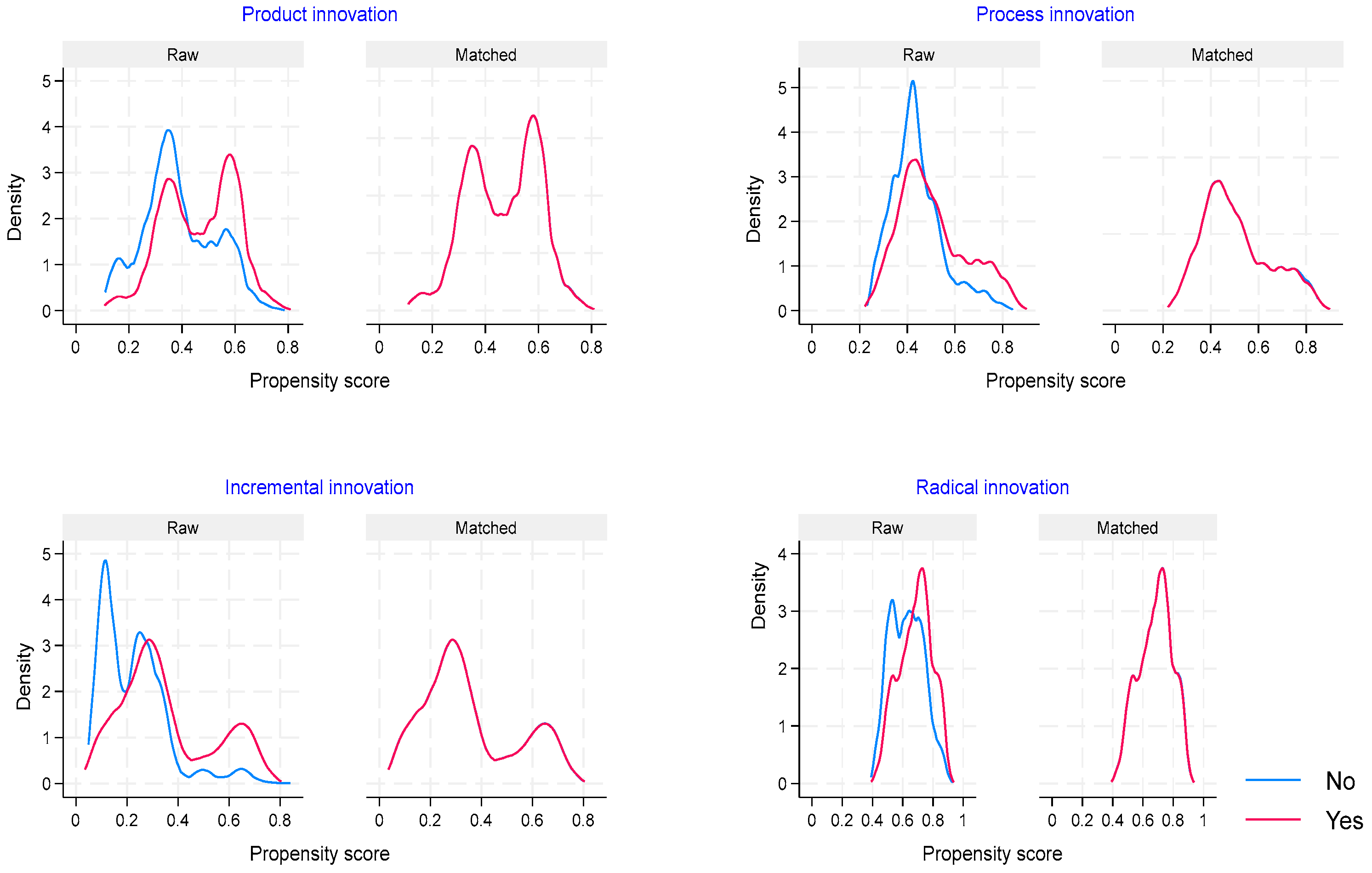
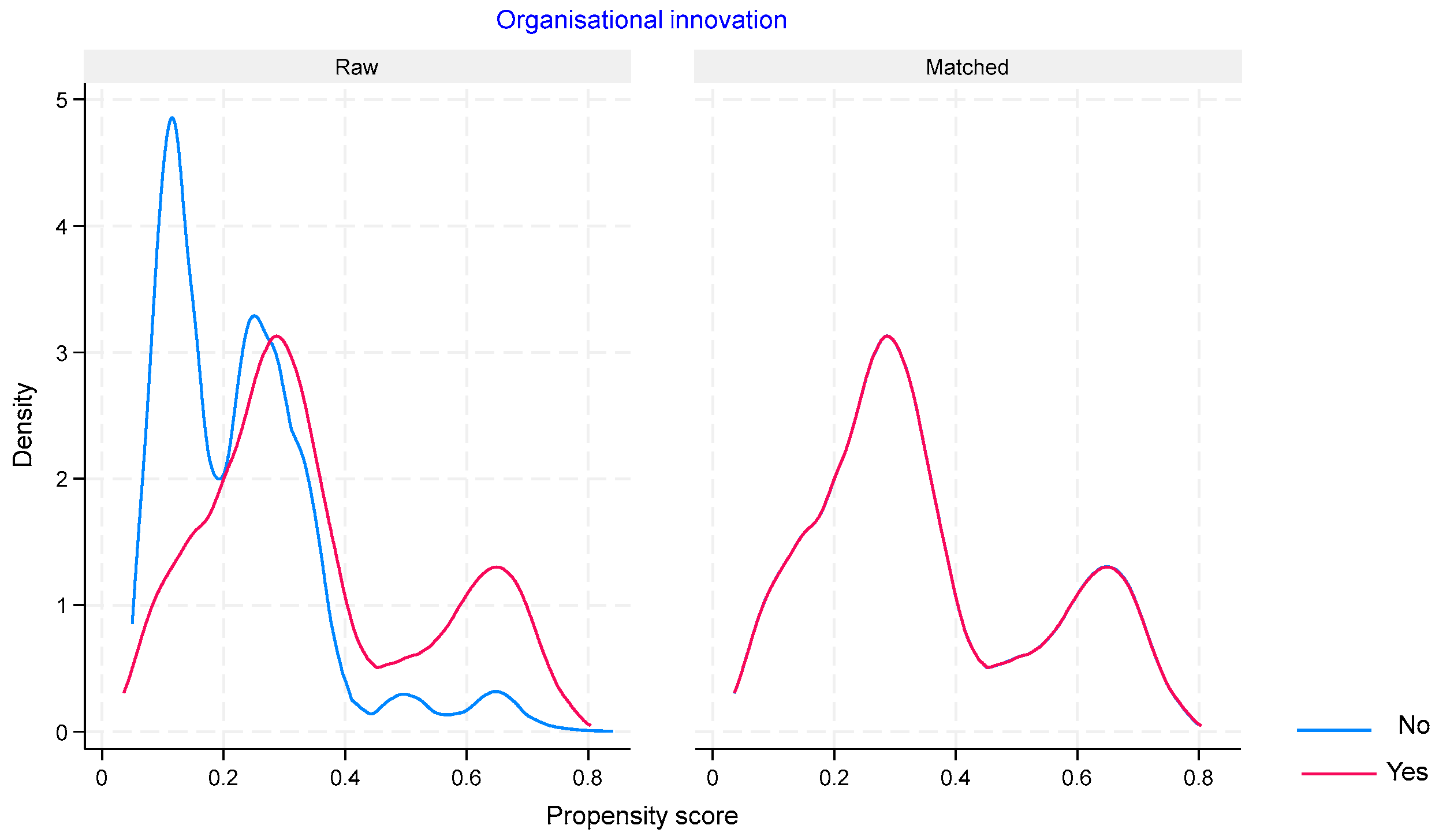
Figure 1 and Figure 2 provide visual evidence of the common-support condition across the five innovation treatments. Figure 1 presents the overlap plots for product, process, incremental and radical innovation, while Figure 2 presents the plot for organisational innovation. In the raw samples before matching, the propensity-score distributions of innovative and non-innovative firms differ to varying degrees, indicating observable differences between the treated and control groups and suggesting that unmatched comparisons may be affected by selection bias (Rosenbaum & Rubin, 1983; Heckman et al., 1997; Caliendo & Kopeinig, 2008). Following kernel matching, the propensity-score distributions of the treated and matched control firms become closely aligned across the five innovation treatments. This improved alignment suggests that the matching procedure enhanced comparability between the groups and that the ATT estimates are based on firms located within a shared range of propensity scores, rather than on observations outside the common-support region (Dehejia & Wahba, 2002; Smith & Todd, 2005; Austin, 2011).

4. Empirical Results

4.1. Covariate Balance Diagnostics Before and After Kernel Matching

Standardised mean differences, pseudo-R2 and joint significance tests are commonly used to assess whether propensity-score matching has achieved satisfactory covariate balance (Caliendo & Kopeinig, 2008; Austin, 2011). Before estimating the kernel matching results, covariate balance diagnostics were conducted to assess whether the matching procedure improved the comparability of innovative and non-innovative firms across the five innovation treatments. Table 2 shows that, after matching, the pseudo-R2 values declined considerably, the likelihood-ratio tests became statistically insignificant, and the mean and median standardised biases were markedly reduced. These changes indicate that systematic differences in the observed characteristics of the treated and control firms were substantially reduced. The Rubin diagnostics provide further evidence of satisfactory balance. After matching, Rubin’s B was below the recommended threshold of 25 for all five innovation treatments, while Rubin’s R remained within the acceptable range of 0.5 to 2 (Rubin, 2001). These results indicate that the kernel matching procedure improved the comparability of the treated and control firms based on observed characteristics. Nevertheless, the procedure cannot eliminate possible differences arising from unobserved firm characteristics, and the subsequent estimates should therefore be interpreted as conditional associations rather than causal effects (Caliendo & Kopeinig, 2008).

4.2. Standardised Percentage Bias Before and After Kernel Matching

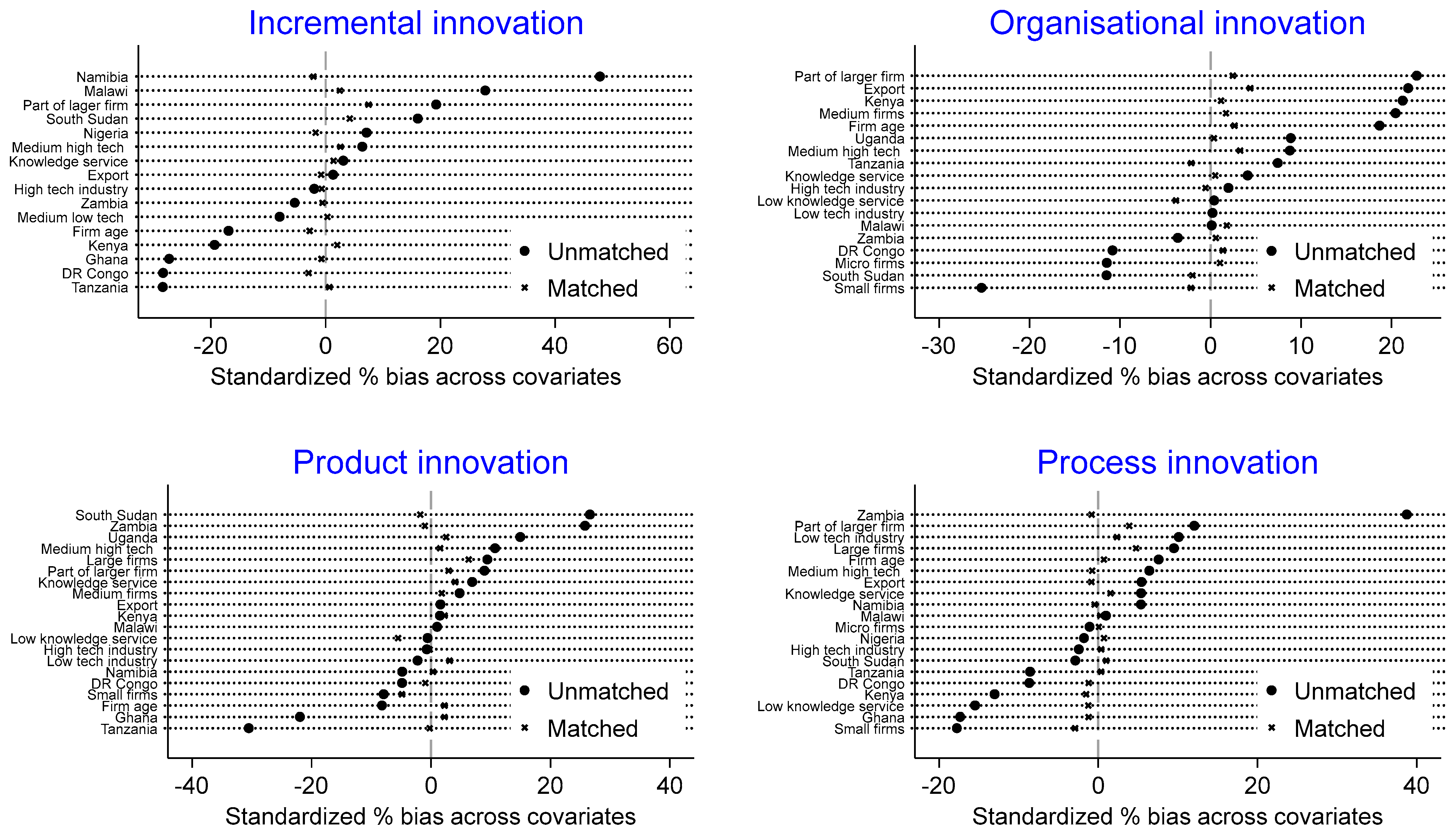
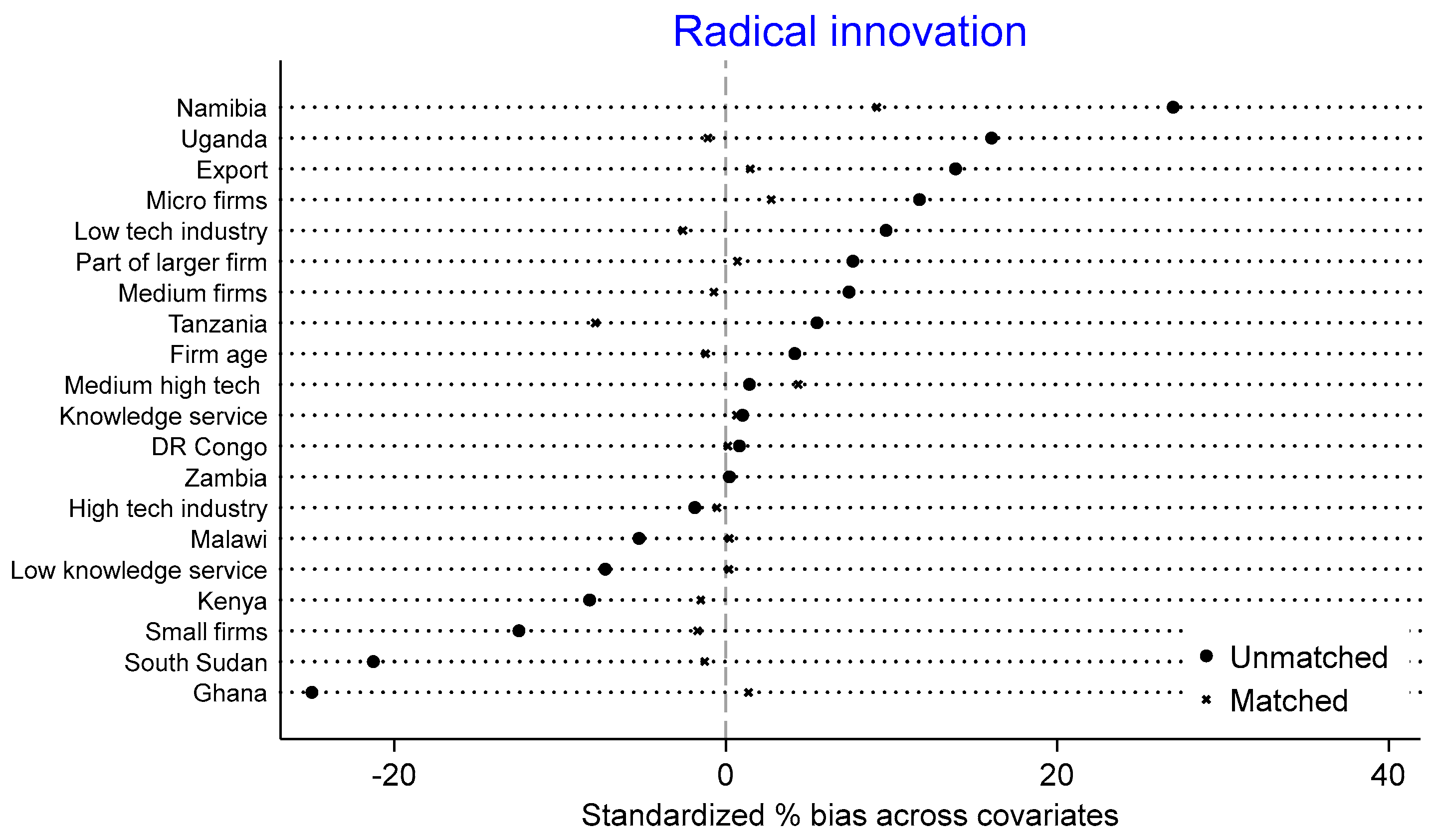
Figure 3 and Figure 4 present the standardised percentage bias before and after kernel matching across the different innovation treatments. In the unmatched samples, several covariates are widely dispersed from the zero line, whereas the matched covariates are clustered much closer to zero. This visual pattern indicates that the matching procedure substantially reduced observable differences between innovative and non-innovative firms. Standardised percentage bias is commonly used to assess covariate balance, with values closer to zero indicating greater similarity between treated and control groups (Caliendo & Kopeinig, 2008; Austin, 2011).

4.3. Kernel Matching Results

The empirical analysis employs a kernel propensity-score matching estimator to examine differences in employment associated with innovation adoption. Each innovation variable is specified as a separate binary treatment, enabling the analysis to estimate the ATT for product, process, organisational, incremental and radical innovation independently. The outcome variables comprise permanent, temporary, total, skilled and unskilled employment. To minimise observable selection bias, the propensity-score model conditions treatment assignment on a set of pre-treatment covariates, including firm age, firm size, firm affiliation, export status, industry fixed effects and country fixed effects. The estimates are reported as Average Treatment Effect on the Treated (ATT), with bootstrapped standard errors used for statistical inference. Because the employment outcomes are expressed in natural logarithms, the statistically supported ATT estimates are converted into percentage using the formula 100 e x p A T T 1 . This transformation provides a more accurate interpretation than simply multiplying the ATT by 100 (Halvorsen & Palmquist, 1980; P. E. Kennedy, 1981; Giles, 1982; van Garderen & Shah, 2002; Downar et al., 2021; Srhoj et al., 2021).
Table 3 presents the estimates for product innovation. Product-innovating firms report approximately 13.0% higher permanent employment and 30.5% higher total employment than matched firms without product innovation. The estimates for temporary and unskilled employment are not statistically significant at any conventional level. Although the estimate for skilled employment is positive, it is significant only at the 10% level. The results therefore indicate that the association between product innovation and employment is evident mainly in permanent and total employment. This evidence is consistent with H1.
Table 4 presents the estimates for process innovation. Process-innovating firms report approximately 25.0% higher permanent employment, 21.3% higher skilled employment, 40.9% higher unskilled employment and 48.9% higher total employment than matched firms without process innovation. These estimates are statistically significant at the 1% level. The estimate for temporary employment is positive, but marginally significant at the 10% level. The findings indicate that process innovation is associated with employment differences across several categories, particularly permanent, skilled, unskilled and total employment. The evidence is not consistent with H2, which posits that the associations would differ depending on the type of employment.
The results from Table 5 show that firms that adopt organisational innovation report approximately 23.4% higher permanent employment, 16.5% higher skilled employment and 40.9% higher total employment than matched firms without organisational innovation. These estimates are statistically significant at the 1% level. No statistically significant difference is observed for unskilled employment. The estimate for temporary employment is positive but significant only at the 10% level. The results indicate that organisational innovation is associated primarily with permanent, skilled and total employment. The evidence is therefore consistent with the central expectations of H3, while the association with temporary employment remains weak.
Table 6 presents the estimates for incremental innovation. Incrementally innovative firms report approximately 28.3% higher permanent employment, 20.1% higher temporary employment, 24.0% higher skilled employment, 41.9% higher unskilled employment and 73.9% higher total employment than matched firms without incremental innovation. The estimates for permanent, skilled, unskilled and total employment are statistically significant at the 1% level, while the estimate for temporary employment is significant at the 5% level. Incremental innovation is therefore associated with statistically supported differences across all five employment categories. Compared with the other innovation types examined, it shows the most extensive association across the employment outcomes. The findings are consistent with H4.
The results from Table 7 show that radical innovation is associated with skilled employment. Radical innovators report approximately 17.5% higher skilled employment than matched firms without radical innovation, with the estimate statistically significant at the 5% level. The estimates for permanent, temporary, unskilled and total employment are not statistically significant. The association between radical innovation and employment is therefore limited to skilled employment, rather than extending across the wider employment structure of firms. This evidence is consistent with H5.

4.4. Robustness Check

To assess whether the baseline kernel matching results are sensitive to the choice of matching algorithm, the study re-estimates the ATT using nearest-neighbour matching. Unlike kernel matching, which constructs the counterfactual outcome using a weighted average of comparable untreated firms, nearest-neighbour matching compares each treated firm with the closest untreated firm based on the estimated propensity score. This provides a useful robustness check by testing whether the main employment patterns remain stable under a stricter matching procedure.
The nearest-neighbour estimates, reported in Table 8, are broadly consistent with the baseline kernel matching results. Therefore, the robustness check confirms the main conclusion that the employment association of innovation is heterogeneous across innovation types and labour categories. The strongest and most stable evidence is observed for process and incremental innovation, while product and organisational innovation show more selective employment associations. Radical innovation remains limited in its employment reach, with the most consistent evidence concentrated on skilled employment. Importantly, not all baseline results are reproduced with the same level of significance under nearest-neighbour matching, especially for temporary employment and the permanent employment result for radical innovation. The robustness evidence should therefore be interpreted as broadly supportive of the baseline findings, rather than as a complete one-to-one replication of every estimate.

5. Discussion

Innovation has uneven employment implications for firms in SSA. The findings show that different types of innovation are associated with distinct employment outcomes, reinforcing the argument that innovation does not affect labour demand through a single pathway. This pattern is consistent with recent evidence that innovation is not uniformly related to employment in the region. Porath et al. (2021) focus mainly on permanent full-time employment, while Keraga et al. (2024) examine product and process innovation in relation to employment and spillovers. Our findings provide a broader comparison by showing how product, process, organisational, incremental and radical innovation relate differently to five employment outcomes. These differences suggest that the employment associations of innovation depend on both the form of innovation and the category of labour considered. They are also consistent with the Schumpeterian view that innovation could be linked to competing displacement and compensation mechanisms, while the concentration of some associations in skilled employment reflects the expectations of Skill-Biased Technological Change.
Product innovation is associated mainly with permanent and total employment. This pattern is consistent with the compensation mechanism in the Schumpeterian theory, under which the market opportunities related to new or improved products may be accompanied by higher output requirements and stronger demand for labour. Previous studies similarly relate product innovation to employment through market expansion, increased sales and additional production requirements (Harrison et al., 2014; Dachs & Peters, 2014; Van Roy et al., 2018; Piva & Vivarelli, 2018). In the SSA context, one possible explanation is that firms introducing new or improved products depend more heavily on permanent workers who possess firm-specific knowledge and can support production continuity, quality assurance, marketing and customer relationships. The absence of associations with temporary and unskilled employment indicates that the relationship is concentrated in selected employment categories rather than extending across the entire workforce.
Process innovation is associated with permanent, skilled, unskilled and total employment, while the evidence for temporary employment is weaker. The breadth of this pattern differs from the labour-displacement mechanism frequently linked to process innovation, which is in line with the Schumpeterian compensation mechanisms. In many SSA firms, improved production methods, delivery systems and operational routines might be associated with better use of existing capacity and fewer production bottlenecks, rather than the replacement of workers. This interpretation is particularly relevant to labour-intensive firms operating below their productive capacity, where improved processes could complement both skilled and unskilled labour. The findings align with studies showing that the employment implications of process innovation depend on firms’ production conditions and the relationship between productivity and output demand (Pianta, 2005; Vivarelli, 2014; Harrison et al., 2014; Cirera & Sabetti, 2019). The weaker association with temporary employment is consistent with firms placing greater value on continuity and firm-specific experience when introducing new production routines.
Organisational innovation is associated with permanent, skilled and total employment, while no clear association is observed with unskilled employment and the association with temporary employment is comparatively weak. One possible explanation is that changes in management practices, reporting systems, task coordination and workplace organisation are more closely related to formal and skill-oriented employment arrangements. Organisational innovation may be associated with greater reliance on workers who can adapt to structured routines, undertake problem-solving responsibilities and operate within formal systems of coordination (Damanpour, 1991; Lam, 2005; Armbruster et al., 2008; Damanpour & Aravind, 2012). This pattern is also consistent with Skill-Biased Technological Change, as organisational upgrading may be more closely linked to workers with stronger technical, managerial and cognitive capabilities. In SSA firms, where managerial limitations and informal organisational practices often constrain firm development, organisational innovation could be more closely associated with permanent and skilled employment than with unskilled labour.
Incremental innovation is associated with all five employment outcomes and displays the broadest employment pattern among the innovation categories examined. This finding is especially relevant for SSA because many firms innovate through adaptation, imitation, gradual improvement and learning-by-doing rather than through frontier-level research. Our study aligns with the literature on technological learning and capability accumulation in developing economies (Lundvall, 1992; Bell & Pavitt, 1993; Fagerberg et al., 2010; Cirera & Maloney, 2017). The finding also suggests that, in resource-constrained environments, gradual, incremental innovation may be more employment-inclusive than more disruptive innovation.
Radical innovation is associated only with skilled employment. This selective pattern is consistent with Skill-Biased Technological Change, which maintains that technologically demanding activities are more strongly related to workers possessing advanced technical, analytical and cognitive skills than to routine or less-skilled labour (Griliches, 1969; Berman et al., 1994; Acemoglu, 1998; D. H. Autor et al., 2003). Unlike incremental innovation, radical innovation often requires new technologies, specialised skills, finance, managerial depth and absorptive capacity. Many SSA firms lack these complementary resources, limiting their ability to translate radical innovation into wider workforce expansion. This could explain why radical innovation does not show a broad association with permanent, temporary, unskilled or total employment. Its employment associations are more likely to be concentrated among workers with the technical and cognitive capabilities needed to implement and manage complex innovations. This interpretation is consistent with Skill-Biased Technological Change, which argues that advanced technological change tends to complement skilled labour while offering weaker benefits for routine or less-skilled workers. Thus, in the SSA context, radical innovation could deepen skill-selective labour demand, rather than generate broad-based employment growth.

5.1. Theoretical Implications

The findings have important theoretical implications for the innovation–employment literature because they show that innovation is not a single employment-generating mechanism. Instead, the employment relevance of innovation depends on the type of innovation introduced and the employment category affected. This strengthens the argument that innovation theory should move beyond aggregate employment effects and pay closer attention to how different forms of innovation are linked to permanent, temporary, skilled, unskilled and total employment outcomes.
First, the findings refine the Schumpeterian view of innovation as a driver of firm renewal and labour demand. Product innovation supports the demand–expansion channel, because it is mainly associated with permanent and total employment. This suggests that new or improved products may create employment by increasing market demand and requiring firms to expand production capacity. Process innovation also extends the Schumpeterian argument by showing that efficiency-oriented innovation does not necessarily reduce employment. In the SSA context, improved production methods and operational routines appear to support employment when they help firms increase output rather than simply replace labour.
Second, the findings extend the theoretical role of organisational innovation. The association between organisational innovation and permanent, skilled and total employment suggests that innovation affects labour demand not only through new products or production technologies, but also through changes in coordination, management systems and workplace routines. This shows that work reorganisation is an important employment channel in resource-constrained firms, where managerial upgrading can shape both the scale and composition of employment.
Third, the findings refine Skill-Biased Technological Change theory by showing that skill bias is not a uniform outcome of all innovation. Radical innovation is associated mainly with skilled employment, suggesting that more novel forms of innovation may require technical and specialised capabilities. However, incremental innovation is associated with a broader range of employment outcomes, indicating that gradual improvements may be more compatible with existing workforce structures. This means that skill bias should be understood as conditional on the type of innovation, firm capability and the availability of complementary skills.

5.2. Policy Implications

For policymakers, the findings suggest that innovation support in Sub-Saharan Africa may benefit from a more differentiated approach. Product innovation may be supported through measures that strengthen commercialisation, product quality, production readiness and access to wider markets. Such support may help firms translate new or improved products into sustained business activity. Process innovation may also warrant attention within production-upgrading programmes, particularly where firms face operational bottlenecks, weak delivery systems and limited productive capacity.
Organisational innovation may be supported through programmes that strengthen managerial practices, workplace coordination and formal systems of organisation. These forms of support may be especially relevant for firms whose development is constrained by weak internal structures and informal management practices. The findings also indicate that incremental innovation should not be regarded as less valuable than radical or frontier innovation. In economic contexts characterised by limited finance, infrastructure gaps and shortages of specialised skills, gradual improvements to existing products, processes and routines may be more closely aligned with firms’ current capabilities and employment structures (OECD & IDRC, 2010; Cirera & Maloney, 2017).
Policy support may, therefore, place greater emphasis on adaptation, continuous improvement, learning by doing and technological upgrading. Support for radical innovation may be complemented by technical training and skills development, given its stronger association with skilled employment.

5.3. Managerial Implications

For managers, the findings indicate that innovation decisions should be considered alongside workforce requirements. Firms introducing product innovation should assess whether new or improved products are aligned with their permanent workforce, production capacity and market-facing capabilities. Firms undertaking process innovation should also consider how changes in production methods, delivery systems and operating routines relate to the deployment of skilled and unskilled workers.
Organisational innovation might require attention to the capabilities employees need to function within revised reporting structures, coordination systems and workplace routines. Managers should, therefore, consider training, communication and employee adjustment when introducing organisational changes. Incremental innovation may offer particular strategic value, because gradual improvements can be aligned more easily with existing technologies, routines and workforce capabilities. Encouraging continuous improvement and employee learning, therefore, supports innovation without requiring an abrupt departure from current production arrangements.
When firms pursue radical innovation, investment in technical skills, managerial capability and employee preparedness could be particularly relevant. Aligning innovation ambitions with available workforce capabilities could reduce skill mismatches and support more effective implementation.

5.4. Limitations and Suggestions for Future Research

This study has some limitations. First, the use of cross-sectional firm-level data means that the results should be interpreted as conditional associations rather than definitive causal effects, since propensity-score matching reduces observable selection bias but cannot fully account for unobserved factors such as managerial ability, firm culture or entrepreneurial orientation. Second, the study uses employment levels rather than employment growth because the employment and innovation variables do not share the same reference period. Third, the innovation measures are binary and therefore do not capture the scale, quality or intensity of innovation. Fourth, the study does not examine whether the findings vary by firm size, sector, export status or foreign ownership. Future research could explore these differences to provide more fine-grained understanding of how innovation and employment relationships differ across firms. Finally, the study focuses on selected Sub-Saharan African countries and does not directly examine employment quality, such as wages, job security or working conditions. Future research should use longitudinal data, intensity measures of innovation and broader employment-quality indicators to examine whether innovation produces lasting and inclusive employment outcomes across countries, sectors and firm groups.

Author Contributions

Conceptualization, S.A., D.R., M.P. and J.H.; methodology, S.A., D.R., M.P. and J.H.; software, S.A., D.R., M.P. and J.H.; validation, S.A., D.R., M.P. and J.H.; formal analysis, S.A.; investigation, S.A., D.R., M.P. and J.H.; writing—original draft preparation, S.A., D.R., M.P. and J.H.; writing—review and editing, D.R., M.P. and J.H.; visualization, S.A. and D.R.; supervision, D.R., M.P. and J.H. All authors have read and agreed to the published version of the manuscript.

Funding

This research received no external funding.

Data Availability Statement

The data presented in this study are available at the World Bank website https://www.enterprisesurveys.org/en/data (10 August 2026).

Conflicts of Interest

The authors declare no conflicts of interest.

References

  1. Acemoglu, D. (1998). Why do new technologies complement skills? Directed technical change and wage inequality. The Quarterly Journal of Economics, 113(4), 1055–1089. [Google Scholar] [CrossRef] [Scilit]
  2. Acemoglu, D. (2002). Technical change, inequality, and the labour market. Journal of Economic Literature, 40(1), 7–72. [Google Scholar] [CrossRef] [Scilit]
  3. Acemoglu, D., Akcigit, U., & Celik, M. A. (2022). Radical and incremental innovation: The roles of firms, managers, and innovators. American Economic Journal: Macroeconomics, 14(3), 199–249. [Google Scholar] [CrossRef] [Scilit]
  4. Acemoglu, D., & Autor, D. (2011). Skills, tasks and technologies: Implications for employment and earnings. In O. Ashenfelter, & D. Card (Eds.), Handbook of labour economics (Vol. 4B, pp. 1043–1171). Elsevier. [Google Scholar]
  5. African Union Commission & OECD. (2024). Africa’s development dynamics 2024: Skills, jobs and productivity. African Union Commission; OECD Publishing. [Google Scholar]
  6. Agazu, B. G., & Kero, C. A. (2024). Innovation strategy and firm competitiveness: A systematic literature review. Journal of Innovation and Entrepreneurship, 13, 24. [Google Scholar] [CrossRef] [Scilit]
  7. Aghion, P., & Howitt, P. (1992). A model of growth through creative destruction. Econometrica, 60(2), 323–351. [Google Scholar] [CrossRef] [Scilit]
  8. Agostini, L., & Nosella, A. (2017). Enhancing radical innovation performance through intellectual capital components. Journal of Intellectual Capital, 18(4), 789–806. [Google Scholar] [CrossRef] [Scilit]
  9. Arenas Díaz, G., Córcoles González, D., & Santamaría Sánchez, L. (2024). The effects of product and process innovation on employment: A meta-regression analysis. Eurasian Business Review, 14(1), 35–68. [Google Scholar] [CrossRef] [Scilit]
  10. Armbruster, H., Bikfalvi, A., Kinkel, S., & Lay, G. (2008). Organizational innovation: The challenge of measuring non-technical innovation in large-scale surveys. Technovation, 28(10), 644–657. [Google Scholar] [CrossRef] [Scilit]
  11. Atfield, G., Green, A. E., & Purcell, K. (2011). The impact of student and migrant employment on opportunities for low skilled people. Joseph Rowntree Foundation. [Google Scholar]
  12. Atwine, B., Okumu, I. M., & Nnyanzi, J. B. (2023). What drives the dynamics of employment growth in firms? Evidence from East Africa. Journal of Innovation and Entrepreneurship, 12(1), 33. [Google Scholar] [CrossRef] [Scilit] [PubMed]
  13. Audretsch, D. B., Coad, A., & Segarra, A. (2014). Firm growth and innovation. Small Business Economics, 43(4), 743–749. [Google Scholar] [CrossRef] [Scilit]
  14. Austin, P. C. (2011). An introduction to propensity score methods for reducing the effects of confounding in observational studies. Multivariate Behavioral Research, 46(3), 399–424. [Google Scholar] [CrossRef] [Scilit] [PubMed]
  15. Autor, D., & Salomons, A. (2018). Is automation labor share-displacing? Productivity growth, employment, and the labor share. Brookings Papers on Economic Activity, 49(1), 1–87. [Google Scholar] [CrossRef] [Scilit]
  16. Autor, D. H., Katz, L. F., & Kearney, M. S. (2006). The polarization of the U.S. labor market. American Economic Review, 96(2), 189–194. [Google Scholar] [CrossRef] [Scilit]
  17. Autor, D. H., Levy, F., & Murnane, R. J. (2003). The skill content of recent technological change: An empirical exploration. The Quarterly Journal of Economics, 118(4), 1279–1333. [Google Scholar] [CrossRef] [Scilit]
  18. Avenyo, E. K., Konte, M., & Mohnen, P. (2019). The employment impact of product innovations in sub-Saharan Africa: Firm-level evidence. Research Policy, 48(9), 103806. [Google Scholar] [CrossRef] [Scilit]
  19. Aw, B. Y., Roberts, M. J., & Winston, T. (2007). Export market participation, investments in R&D and worker training, and the evolution of firm productivity. The World Economy, 30(1), 83–104. [Google Scholar] [CrossRef] [Scilit]
  20. Ayyagari, M., Demirgüç-Kunt, A., & Maksimovic, V. (2011). Firm innovation in emerging markets: The role of finance, governance, and competition. Journal of Financial and Quantitative Analysis, 46(6), 1545–1580. [Google Scholar] [CrossRef] [Scilit]
  21. Azar, G., & Ciabuschi, F. (2017). Organizational innovation, technological innovation, and export performance: The effects of innovation radicalness and extensiveness. International Business Review, 26(2), 324–336. [Google Scholar] [CrossRef] [Scilit]
  22. Baláž, V., Jeck, T., & Balog, M. (2023). Firm performance over innovation cycle: Evidence from a small European economy. Journal of Innovation and Entrepreneurship, 12, 40. [Google Scholar] [CrossRef] [Scilit]
  23. Becker, S. O., & Ichino, A. (2002). Estimation of average treatment effects based on propensity scores. The Stata Journal, 2(4), 358–377. [Google Scholar] [CrossRef] [Scilit]
  24. Bell, M., & Pavitt, K. (1993). Technological accumulation and industrial growth: Contrasts between developed and developing countries. Industrial and Corporate Change, 2(2), 157–210. [Google Scholar] [CrossRef] [Scilit]
  25. Berman, E., Bound, J., & Griliches, Z. (1994). Changes in the demand for skilled labor within U.S. manufacturing: Evidence from the annual survey of manufactures. The Quarterly Journal of Economics, 109(2), 367–397. [Google Scholar] [CrossRef] [Scilit]
  26. Berman, E., Bound, J., & Machin, S. (1998). Implications of skill-biased technological change: International evidence. The Quarterly Journal of Economics, 113(4), 1245–1279. [Google Scholar] [CrossRef] [Scilit]
  27. Bessen, J. E. (2019). Automation and jobs: When technology boosts employment. Economic Policy, 34(100), 589–626. [Google Scholar] [CrossRef] [Scilit]
  28. Bogliacino, F., & Pianta, M. (2016). The Pavitt taxonomy, revisited: Patterns of innovation in manufacturing and services. Economia Politica, 33, 153–180. [Google Scholar] [CrossRef] [Scilit]
  29. Bogliacino, F., & Vivarelli, M. (2012). The job creation effect of R&D expenditures. Australian Economic Papers, 51(2), 96–113. [Google Scholar] [CrossRef] [Scilit]
  30. Bresnahan, T. F., Brynjolfsson, E., & Hitt, L. M. (2002). Information technology, workplace organisation, and the demand for skilled labour: Firm-level evidence. The Quarterly Journal of Economics, 117(1), 339–376. [Google Scholar] [CrossRef] [Scilit]
  31. Brookhart, M. A., Schneeweiss, S., Rothman, K. J., Glynn, R. J., Avorn, J., & Stürmer, T. (2006). Variable selection for propensity score models. American Journal of Epidemiology, 163(12), 1149–1156. [Google Scholar] [CrossRef] [Scilit] [PubMed]
  32. Caliendo, M., & Kopeinig, S. (2008). Some practical guidance for the implementation of propensity score matching. Journal of Economic Surveys, 22(1), 31–72. [Google Scholar] [CrossRef] [Scilit]
  33. Calvino, F., & Virgillito, M. E. (2018). The innovation–employment nexus: A critical survey of theory and empirics. Journal of Economic Surveys, 32(1), 83–117. [Google Scholar] [CrossRef] [Scilit]
  34. Carree, M. A., & Thurik, A. R. (2008). The lag structure of the impact of business ownership on economic performance in OECD countries. Small Business Economics, 30(1), 101–110. [Google Scholar] [CrossRef] [Scilit]
  35. Chen, J., Yin, X., & Mei, L. (2021). Holistic innovation: An emerging innovation paradigm. International Journal of Innovation Studies, 5(1), 1–13. [Google Scholar]
  36. Chennells, L., & Van Reenen, J. (1999). Has technology hurt less skilled workers? Institute for Fiscal Studies. [Google Scholar]
  37. Cirera, X., & Maloney, W. F. (2017). The innovation paradox: Developing-country capabilities and the unrealised promise of technological catch-up. World Bank. [Google Scholar]
  38. Cirera, X., & Sabetti, L. (2019). The effects of innovation on employment in developing countries: Evidence from enterprise surveys. Industrial and Corporate Change, 28(1), 161–176. [Google Scholar] [CrossRef] [Scilit]
  39. Coad, A., Segarra, A., & Teruel, M. (2016). Innovation and firm growth: Does firm age play a role? Research Policy, 45(2), 387–400. [Google Scholar] [CrossRef] [Scilit]
  40. Cohen, W. M., & Levinthal, D. A. (1990). Absorptive capacity: A new perspective on learning and innovation. Administrative Science Quarterly, 35(1), 128–152. [Google Scholar] [CrossRef] [Scilit]
  41. Conte, A., & Vivarelli, M. (2011). Imported skill-biased technological change in developing countries. The Developing Economies, 49(1), 36–65. [Google Scholar] [CrossRef] [Scilit]
  42. Crespi, G., Tacsir, E., & Pereira, M. (2019). Effects of innovation on employment in Latin America. Industrial and Corporate Change, 28(1), 139–159. [Google Scholar] [CrossRef] [Scilit]
  43. Czarnitzki, D., Ebersberger, B., & Fier, A. (2007). The relationship between R&D collaboration, subsidies and R&D performance: Empirical evidence from Finland and Germany. Journal of Applied Econometrics, 22(7), 1347–1366. [Google Scholar] [CrossRef] [Scilit]
  44. Dachs, B., & Peters, B. (2014). Innovation, employment growth, and foreign ownership of firms: A European perspective. Research Policy, 43(1), 214–232. [Google Scholar] [CrossRef] [Scilit]
  45. Damanpour, F. (1991). Organisational innovation: A meta-analysis of effects of determinants and moderators. Academy of Management Journal, 34(3), 555–590. [Google Scholar] [CrossRef] [Scilit] [PubMed]
  46. Damanpour, F., & Aravind, D. (2012). Managerial innovation: Conceptions, processes and antecedents. Management and Organisation Review, 8(2), 423–454. [Google Scholar] [CrossRef] [Scilit]
  47. De Elejalde, R., Giuliodori, D., & Stucchi, R. (2015). Employment and innovation: Firm-level evidence from Argentina. Emerging Markets Finance and Trade, 51(1), 27–47. [Google Scholar] [CrossRef] [Scilit]
  48. Dehejia, R. H., & Wahba, S. (2002). Propensity score-matching methods for nonexperimental causal studies. Review of Economics and Statistics, 84(1), 151–161. [Google Scholar] [CrossRef] [Scilit]
  49. Dosi, G. (1982). Technological paradigms and technological trajectories: A suggested interpretation of the determinants and directions of technical change. Research Policy, 11(3), 147–162. [Google Scholar]
  50. Downar, B., Ernstberger, J., Reichelstein, S., Schwenen, S., & Zaklan, A. (2021). The impact of carbon disclosure mandates on emissions and financial operating performance. Review of Accounting Studies, 26(3), 1137–1175. [Google Scholar] [CrossRef] [Scilit]
  51. Evangelista, R., & Pianta, M. (1996). The impact of innovation on employment in Europe. Innovation: The European Journal of Social Science Research, 9(2), 105–118. [Google Scholar]
  52. Evangelista, R., & Vezzani, A. (2012). The impact of technological and organisational innovations on employment in European firms. Industrial and Corporate Change, 21(4), 871–899. [Google Scholar] [CrossRef] [Scilit]
  53. Fagerberg, J., Srholec, M., & Verspagen, B. (2010). Innovation and economic development. In B. H. Hall, & N. Rosenberg (Eds.), Handbook of the economics of innovation (pp. 833–872). Elsevier. [Google Scholar]
  54. Fox, L., & Sohnesen, T. P. (2012). Household enterprises in sub-Saharan Africa: Why they matter for growth, jobs, and livelihoods. World Bank Policy Research Working Paper, No. 6184. World Bank. [Google Scholar]
  55. Gebreeyesus, M. (2011). Innovation and microenterprises growth in Ethiopia. In A. Szirmai, W. Naudé, & M. Goedhuys (Eds.), Entrepreneurship, innovation, and economic development (pp. 122–146). Oxford University Press. [Google Scholar]
  56. Giles, D. E. A. (1982). The interpretation of dummy variables in semilogarithmic equations: Unbiased estimation. Economics Letters, 10(1–2), 77–79. [Google Scholar] [CrossRef] [Scilit]
  57. Goedhuys, M., & Sleuwaegen, L. (2016). High-growth versus declining firms: The differential impact of human capital and R&D. Applied Economics Letters, 23(5), 369–372. [Google Scholar] [CrossRef] [Scilit]
  58. Goldin, C., & Katz, L. F. (1998). The origins of technology–skill complementarity. The Quarterly Journal of Economics, 113(3), 693–732. [Google Scholar] [CrossRef] [Scilit]
  59. Gorodnichenko, Y., & Schnitzer, M. (2013). Financial constraints and innovation: Why poor countries don’t catch up. Journal of the European Economic Association, 11(5), 1115–1152. [Google Scholar] [CrossRef] [Scilit]
  60. Griliches, Z. (1969). Capital-skill complementarity. Review of Economics and Statistics, 51(4), 465–468. [Google Scholar] [CrossRef] [Scilit]
  61. Guisado-González, M., Vila-Alonso, M., & Guisado-Tato, M. (2016). Radical innovation, incremental innovation and training: Analysis of complementarity. Technology in Society, 44, 48–54. [Google Scholar] [CrossRef] [Scilit]
  62. Guo, S., & Fraser, M. W. (2015). Propensity score analysis: Statistical methods and applications (2nd ed.). SAGE. [Google Scholar]
  63. Halvorsen, R., & Palmquist, R. (1980). The interpretation of dummy variables in semilogarithmic equations. American Economic Review, 70(3), 474–475. [Google Scholar]
  64. Harrison, R., Jaumandreu, J., Mairesse, J., & Peters, B. (2014). Does innovation stimulate employment? A firm-level analysis using comparable micro-data from four European countries. International Journal of Industrial Organisation, 35, 29–43. [Google Scholar] [CrossRef] [Scilit]
  65. Heckman, J. J., Ichimura, H., Smith, J., & Todd, P. (1998). Characterising selection bias using experimental data. Econometrica, 66(5), 1017–1098. [Google Scholar] [CrossRef] [Scilit]
  66. Heckman, J. J., Ichimura, H., & Todd, P. E. (1997). Matching as an econometric evaluation estimator: Evidence from evaluating a job training programme. Review of Economic Studies, 64(4), 605–654. [Google Scholar] [CrossRef] [Scilit]
  67. Heckman, J. J., & Vytlacil, E. J. (2007). Econometric evaluation of social programs, Part I: Causal models, structural models and econometric policy evaluation. In J. J. Heckman, & E. E. Leamer (Eds.), Handbook of econometrics (Vol. 6B, pp. 4779–4874). Elsevier. [Google Scholar]
  68. Heidenreich, M., & Kraemer, T. (2016). Innovations—Doomed to fail? Investigating strategies to overcome passive innovation resistance. Journal of Product Innovation Management, 33(3), 277–297. [Google Scholar] [CrossRef] [Scilit]
  69. Henderson, R. M., & Clark, K. B. (1990). Architectural innovation: The reconfiguration of existing product technologies and the failure of established firms. Administrative Science Quarterly, 35(1), 9–30. [Google Scholar] [CrossRef] [Scilit]
  70. Hou, J., Huang, C., Licht, G., Mairesse, J., Mohnen, P., Mulkay, B., Peters, B., Wu, Y., Zhao, Y., & Zhen, F. (2019). Does innovation stimulate employment? Evidence from China, France, Germany, and The Netherlands. Industrial and Corporate Change, 28(1), 109–121. [Google Scholar] [CrossRef] [Scilit]
  71. Huergo, E., & Jaumandreu, J. (2004). How does probability of innovation change with firm age? Small Business Economics, 22(3–4), 193–207. [Google Scholar] [CrossRef] [Scilit]
  72. Imbens, G. W., & Wooldridge, J. M. (2009). Recent developments in the econometrics of program evaluation. Journal of Economic Literature, 47(1), 5–86. [Google Scholar] [CrossRef] [Scilit]
  73. International Labour Organization. (2023). Women and men in the informal economy: A statistical update. International Labour Organization. [Google Scholar]
  74. Kennedy, P. E. (1981). Estimation with correctly interpreted dummy variables in semilogarithmic equations. American Economic Review, 71(4), 801. [Google Scholar]
  75. Kennedy, S., Whiteman, G., & van den Ende, J. (2017). Radical innovation for sustainability: The power of strategy and open innovation. Long Range Planning, 50(6), 712–725. [Google Scholar] [CrossRef] [Scilit]
  76. Keraga, M. N., Lööf, H., & Stephan, A. (2024). Innovation and employment in sub-Saharan Africa: New evidence from the World Bank Enterprise Survey. In Working Paper Series in Economics and Institutions of Innovation (No. 497). Royal Institute of Technology, CESIS—Centre of Excellence for Science and Innovation Studies. [Google Scholar]
  77. Kerr, A., Wittenberg, M., & Arrow, J. (2014). Job creation and destruction in South Africa. South African Journal of Economics, 82(1), 1–18. [Google Scholar] [CrossRef] [Scilit]
  78. Lam, A. (2005). Organisational innovation. In J. Fagerberg, D. C. Mowery, & R. R. Nelson (Eds.), The Oxford handbook of innovation (pp. 115–147). Oxford University Press. [Google Scholar]
  79. Lundvall, B.-Å. (1992). National systems of innovation: Towards a theory of innovation and interactive learning. Pinter. [Google Scholar]
  80. Machin, S., & Van Reenen, J. (1998). Technology and changes in skill structure: Evidence from seven OECD countries. The Quarterly Journal of Economics, 113(4), 1215–1244. [Google Scholar] [CrossRef] [Scilit]
  81. Mahagaonkar, P. (2010). Money and ideas: Four studies on finance, innovation and the business life cycle. Springer. [Google Scholar]
  82. Managi, S., & Jena, P. R. (2008). Environmental productivity and Kuznets curve in India. Ecological Economics, 65(2), 432–440. [Google Scholar] [CrossRef] [Scilit]
  83. Medase, K. (2019). The impact of the heterogeneity of employees’ qualifications on firm-level innovation: Evidence from Nigerian firms. African Journal of Science, Technology, Innovation and Development, 11(6), 715–727. [Google Scholar]
  84. Medase, K., & Barasa, L. (2019). Absorptive capacity, marketing capabilities, and innovation commercialisation in Nigeria. European Journal of Innovation Management, 22(5), 790–820. [Google Scholar] [CrossRef] [Scilit]
  85. Medase, K., & Wyrwich, M. (2022). The role of innovation for employment growth among firms in developing countries: Evidence from Nigeria. African Journal of Science, Technology, Innovation and Development, 14(3), 610–619. [Google Scholar] [CrossRef] [Scilit]
  86. Mol, M. J., & Birkinshaw, J. (2009). The sources of management innovation: When firms introduce new management practices. Journal of Business Research, 62(12), 1269–1280. [Google Scholar] [CrossRef] [Scilit]
  87. Naidoo, V., Urban, B., & Surujlal, J. (2022). Innovation and employment growth in South African firms. African Journal of Science, Technology, Innovation and Development, 14(6), 1479–1490. [Google Scholar]
  88. OECD. (2005). Oslo manual: Guidelines for collecting and interpreting innovation data (3rd ed.). OECD Publishing. [Google Scholar]
  89. OECD. (2018). Oslo manual: Guidelines for collecting, reporting and using data on innovation (4th ed.). OECD Publishing. [Google Scholar]
  90. OECD & International Development Research Centre [IDRC]. (2010). Innovation and the development agenda. OECD Publishing. [Google Scholar]
  91. Okumu, I. M., Bbaale, E., & Guloba, M. M. (2019). Innovation and employment growth: Evidence from manufacturing firms in Africa. Journal of Innovation and Entrepreneurship, 8(1), 7. [Google Scholar] [CrossRef] [Scilit]
  92. Parrilli, M. D., & Radicic, D. (2021). STI and DUI innovation modes in micro-, small-, medium- and large-sized firms: Distinctive patterns across Europe and the US. European Planning Studies, 29(2), 346–368. [Google Scholar] [CrossRef] [Scilit]
  93. Petković, G., Marjanović, D., & Tasić, N. (2023). Propensity score matching in observational studies: Methodological issues and practical guidance. Economic Annals, 68(236), 7–33. [Google Scholar]
  94. Peugny, C. (2019). The decline in middle-skilled employment in 12 European countries: New evidence for job polarisation. Research & Politics, 6(1), 1–7. [Google Scholar] [CrossRef] [Scilit]
  95. Pianta, M. (2005). Innovation and employment. In J. Fagerberg, D. C. Mowery, & R. R. Nelson (Eds.), The Oxford handbook of innovation (pp. 568–598). Oxford University Press. [Google Scholar]
  96. Piva, M., & Vivarelli, M. (2018). Is innovation destroying jobs? Firm-level evidence from the EU. Sustainability, 10(4), 1279. [Google Scholar] [CrossRef] [Scilit]
  97. Porath, D., Nabachwa, S., Agasha, E., & Kijjambu, N. F. (2021). Innovation and employment in Sub-Saharan Africa. UASM Discussion Paper Series, 10/2021. University of Applied Sciences Mainz. [Google Scholar]
  98. Radicic, D., Pugh, G., Hollanders, H., Wintjes, R., & Fairburn, J. (2018). The impact of innovation support programs on small and medium enterprises innovation in traditional manufacturing industries: An evaluation for seven European Union regions. Environment and Planning C: Politics and Space, 36(8), 1425–1452. [Google Scholar]
  99. Reddy, K., Chundakkadan, R., & Sasidharan, S. (2021). Firm innovation and global value chain participation. Small Business Economics, 57(4), 1995–2015. [Google Scholar] [CrossRef] [Scilit]
  100. Rosenbaum, P. R., & Rubin, D. B. (1983). The central role of the propensity score in observational studies for causal effects. Biometrika, 70(1), 41–55. [Google Scholar] [CrossRef] [Scilit]
  101. Rosenbaum, P. R., & Rubin, D. B. (1985). Constructing a control group using multivariate matched sampling methods that incorporate the propensity score. The American Statistician, 39(1), 33–38. [Google Scholar] [CrossRef] [Scilit]
  102. Rubin, D. B. (2001). Using propensity scores to help design observational studies: Application to the tobacco litigation. Health Services and Outcomes Research Methodology, 2, 169–188. [Google Scholar] [CrossRef] [Scilit]
  103. Salomon, R. M., & Shaver, J. M. (2005). Learning by exporting: New insights from examining firm innovation. Journal of Economics & Management Strategy, 14(2), 431–460. [Google Scholar] [CrossRef] [Scilit]
  104. Santoleri, P. (2020). Innovation and job creation in high-growth new firms. Industrial and Corporate Change, 29(3), 731–756. [Google Scholar] [CrossRef] [Scilit]
  105. Schumpeter, J. A. (1934). The theory of economic development: An inquiry into profits, capital, credit, interest, and the business cycle. Harvard University Press. [Google Scholar]
  106. Schumpeter, J. A. (1942). Capitalism, socialism and democracy. Harper & Brothers. [Google Scholar]
  107. Shahzad, F., Xiu, G., & Shahbaz, M. (2017). Organisational culture and innovation performance in Pakistan’s software industry. Technology in Society, 51, 66–73. [Google Scholar] [CrossRef] [Scilit]
  108. Shanker, R., Bhanugopan, R., van der Heijden, B. I. J. M., & Farrell, M. (2017). Organizational climate for innovation and organisational performance: The mediating effect of innovative work behavior. Journal of Vocational Behavior, 100, 67–77. [Google Scholar] [CrossRef] [Scilit]
  109. Smith, J. A., & Todd, P. E. (2005). Does matching overcome LaLonde’s critique of nonexperimental estimators? Journal of Econometrics, 125(1–2), 305–353. [Google Scholar] [CrossRef] [Scilit]
  110. Srhoj, S., Lapinski, M., & Walde, J. (2021). Impact evaluation of business development grants on SME performance. Small Business Economics, 57(3), 1285–1301. [Google Scholar] [CrossRef] [Scilit]
  111. Stuart, E. A. (2010). Matching methods for causal inference: A review and a look forward. Statistical Science, 25(1), 1–21. [Google Scholar] [CrossRef] [Scilit] [PubMed]
  112. Tushman, M. L., & Anderson, P. (1986). Technological discontinuities and organisational environments. Administrative Science Quarterly, 31(3), 439–465. [Google Scholar] [CrossRef] [Scilit]
  113. Ungerman, O., Dedkova, J., & Gurinova, K. (2018). The impact of marketing innovation on the competitiveness of enterprises in the context of industry 4.0. Journal of Competitiveness, 10(2), 132–148. [Google Scholar] [CrossRef] [Scilit]
  114. van Garderen, K. J., & Shah, C. (2002). Exact interpretation of dummy variables in semilogarithmic equations. The Econometrics Journal, 5(1), 149–159. [Google Scholar] [CrossRef] [Scilit]
  115. Van Roy, V., Vértesy, D., & Vivarelli, M. (2018). Technology and employment: Mass unemployment or job creation? Empirical evidence from European patenting firms. Research Policy, 47(9), 1762–1776. [Google Scholar] [CrossRef] [Scilit]
  116. Vivarelli, M. (2014). Innovation, employment and skills in advanced and developing countries: A survey of economic literature. Journal of Economic Issues, 48(1), 123–154. [Google Scholar] [CrossRef] [Scilit]
  117. Wang, C., Kafouros, M. I., & Yi, J. (2010). A model for examining the effects of knowledge sharing and learning on innovation performance. Technovation, 30(9–10), 577–589. [Google Scholar]
  118. World Bank. (2014). World Bank enterprise surveys: Innovation follow-up survey. World Bank. [Google Scholar]
  119. Zhu, C., Qiu, Z., & Liu, F. (2021). Does innovation stimulate employment? Evidence from China. Economic Modelling, 94, 1007–1017. [Google Scholar] [CrossRef] [Scilit]
Figure 1. Propensity-score overlap before and after kernel matching for product, process, incremental and radical innovation.
Economies 14 00349 g001
Figure 2. Propensity-score overlap before and after kernel matching for organisational innovation.
Economies 14 00349 g002
Figure 3. Standardised percentage bias before and after kernel matching for product, process, incremental and organisational innovation.
Economies 14 00349 g003
Figure 4. Standardised percentage bias before and after kernel matching for radical innovation.
Economies 14 00349 g004
Table 1. Variable definition and descriptive statistics.
VariableMeasurementMeanStd. Dev.MinMax
Outcome (dependent) variables
Permanent employmentLogarithm of number of permanent, full-time employees at end of last fiscal year2.6271.14708.613
Temporary employmentThe logarithm of total number of full-time temporary employees at the end of the fiscal year. The temporary employment is constructed by adding 1 to the number of temporary employees before taking the logs to avoid missing firms that do not have temporary employees1.9681.27307.669
Total employmentNatural logarithm of the sum of permanent and temporary employees4.7572.2820.69314.152
Skilled employmentThe logarithm of full-time skilled employees at the end of the last fiscal year2.1361.21407.601
Unskilled employmentThe logarithm of full-time unskilled employees at the end of the last fiscal year. It is constructed by adding 1 to the number of unskilled employees before taking the logs to avoid missing firms that do not have unskilled employees1.8211.35408.132
Treatment variables
Product innovationDummy variable equals 1 if firm introduced any innovative product or service within the last three years and 0 otherwise0.4110.49201
Process innovationDummy variable equals 1 if firm introduced any innovative methods of manufacturing products or offering services within the last three years and 0 otherwise0.3520.47801
Organisational innovationDummy variable equals 1 if firm introduced new or significantly improved organisational structure within the last three years and 0 otherwise0.4460.49701
Incremental innovationDummy variable equals 1 if a firm made small changes or continuous improvements to existing products, processes or services, and as 0 otherwise0.2610.43901
Radical innovationDummy variable equals 1 if the firm has introduced any product or services that are new to the firm’s main establishment market and 0 otherwise0.6770.46801
Matching (control) variables
Firm ageNatural logarithm of number of years the firm has been in operation2.3160.91704.883
Export orientationDummy variable equals 1 if 10% of the firm’s product is exported and 0 otherwise0.0810.27401
Firm affiliationDummy variable equals 1 if a firm is part of a larger firm or equal to 0 otherwise0.2050.40301
Micro firmDummy variable equals 1 if the firm has employees up to 5 or less and 0 otherwise0.0340.18301
Small firmDummy variable equals 1 if the firm has employees between 5 and 20 and 0 otherwise0.6080.48801
Medium firmDummy variable equals 1 if the firm has employees from 20 but less than 100 and 0 otherwise0.2410.42801
Large firmDummy variable equals 1 if the firm has employees 100 and above and 0 otherwise0.1160.32001
GhanaDummy variable equals 1 if the firm is in Ghana and 0 otherwise0.1070.31001
NigeriaDummy variable equals 1 if the firm is in Nigeria and 0 otherwise0.1780.38201
South SudanDummy variable equals 1 if the firm is in South Sudan and 0 otherwise0.1070.30801
CongoDummy variable equals 1 if the firm is in Congo and 0 otherwise0.0760.26401
TanzaniaDummy variable equals 1 if the firm is in Tanzania and 0 otherwise0.1070.30901
UgandaDummy variable equals 1 if the firm is in Uganda and 0 otherwise0.0880.28401
KenyaDummy variable equals 1 if the firm is in Kenya and 0 otherwise0.1080.31001
MalawiDummy variable equals 1 if the firm is in Malawi and 0 otherwise0.0490.21601
ZambiaDummy variable equals 1 if the firm is in Zambia and 0 otherwise0.1060.30801
NamibiaDummy variable equals 1 if the firm is in Namibia and 0 otherwise0.0740.26201
High-technology industryDummy variable equals 1 if the firm is high-technology industries (precision instruments, publishing, printing, and recorded media) and 0 otherwise0.0380.19201
Medium–high-technology industryDummy variable equals 1 if the firm is medium–high-technology industries (electronics chemicals, machinery and equipment, transport machines) and 0 otherwise0.0490.21601
Medium–low-technology
industry
Dummy variable equals 1 if the firm is medium–low-technology industries (refined petroleum product, plastics and rubber, non-metallic mineral products, basic metals and fabricated metal products) and 0 otherwise0.0970.29501
Low-technology industryDummy variable equals 1 if the firm is low-technology industries (food, tobacco, textiles, garments, leather, wood, paper, furniture, recycling and retail) and 0 otherwise0.6190.48601
Knowledge-intensive
services
Dummy variable equals 1 if the firm is knowledge-intensive service (services of motor vehicles, construction section and transport section) and 0 otherwise0.1210.32601
Low knowledge-intensive serviceDummy variable equals 1 if the firm is low knowledge-intensive service (hotel and restaurants section, wholesale and IT) and 0 otherwise0.0760.26401
Table 2. Covariate balance diagnostics before and after kernel matching.
Innovation TypePseudo-R2LR p-ValueMean BiasMedian BiasRubin’s BRubin’s R
BeforeAfterBeforeAfterBeforeAfterBeforeAfterBeforeAfterBeforeAfter
Product
innovation
0.0600.0020.0000.9599.72.37.42.050.510.90.921.12
Process
innovation
0.0500.0010.0000.9979.51.38.10.953.18.31.831.17
Organisational innovation0.0420.0010.0000.99011.11.89.81.749.37.91.251.16
Incremental
innovation
0.1020.0020.0000.98516.52.1 16.51.980.610.91.521.14
Radical
innovation
0.0450.0030.0000.9209.42.07.61.251.712.21.131.08
Notes: “Before” refers to the unmatched sample, and “After” refers to the matched sample. A low post-matching pseudo-R2, an insignificant likelihood-ratio test, low mean and median bias, Rubin’s B below 25 and Rubin’s R between 0.5 and 2 indicate satisfactory covariate balance.
Table 3. Kernel matching estimation results of product innovation on employment outcome (N = 4530).
Employment OutcomeTreatedControlATT95% Confidence Interval
Permanent employment2.7452.6230.122 ***
(0.039)
[0.045, 0.199]
Temporary employment2.0681.9100.072
(0.066)
[−0.058, 0.201]
Skilled employment2.2182.1130.105 *
(0.070)
[−0.032, 0.242]
Unskilled employment1.9961.8480.148
(0.107)
[−0.062, 0.357]
Total employment4.9724.7050.266 **
(0.125)
[0.022, 0.511]
Notes: Average treatment effect on the treated (ATT); standard errors in the parentheses are bootstrapped with 200 bootstrap replications; *** p < 0.01, ** p < 0.05 and * p < 0.1.
Table 4. Kernel matching estimation results of process innovation on employment outcome (N = 4551).
Employment OutcomeTreatedControlATT
(SE)
95% Confidence Interval
Permanent employment2.8352.6120.223 ***
(0.038)
[0.147, 0.298]
Temporary employment2.1011.9910.109 *
(0.071)
[−0.031, 0.249]
Skilled employment2.2752.0820.193 ***
(0.060)
[0.075, 0.311]
Unskilled employment2.1161.7730.343 ***
(0.083)
[0.181, 0.505]
Total employment5.1084.7100.398 ***
(0.128)
[0.148, 0.648]
Notes: Average treatment effect on the treated (ATT); standard errors in the parentheses are bootstrapped with 200 bootstrap replications; *** p < 0.01, and * p < 0.1.
Table 5. Kernel matching estimation results of organisational innovation on employment outcome (N = 4512).
Employment OutcomeTreatedControlATT
(SE)
95% Confidence Interval
Permanent employment2.8372.6270.210 ***
(0.039)
[0.134, 0.285]
Temporary employment2.1342.0050.129 *
(0.070)
[−0.008, 0.266]
Skilled employment2.3012.1480.153 ***
(0.058)
[0.039, 0.267]
Unskilled employment1.9741.9370.037
(0.104)
[−0.166, 0.240]
Total employment5.1224.7790.343 ***
(0.127)
[0.093, 0.592]
Notes: Average treatment effect on the treated (ATT); standard errors in the parentheses are bootstrapped with 200 bootstrap replications; *** p < 0.01, and * p < 0.1.
Table 6. Kernel matching estimation results of incremental innovation on employment outcome (N = 4357).
Employment OutcomeTreatedControlATT95% Confidence Interval
Permanent employment2.8612.6120.249 ***
(0.047)
[0.156, 0.342]
Temporary employment2.0901.9070.183 **
(0.090)
[0.007, 0.359]
Skilled employment2.3872.1720.215 ***
(0.084)
[0.051, 0.379]
Unskilled employment2.1591.8090.350 ***
(0.122)
[0.110, 0.590]
Total employment5.1814.6270.553 ***
(0.150)
[0.260, 0.847]
Notes: Average treatment effect on the treated (ATT); standard errors in the parentheses are bootstrapped with 200 bootstrap replications; *** p < 0.01, ** p < 0.05.
Table 7. Kernel matching estimation results of radical innovation on employment outcome (N = 2563).
Employment OutcomeTreatedControlATT
(SE)
95% Confidence Interval
Permanent employment2.8042.7160.088
(0.048)
[−0.007, 0.183]
Temporary employment2.0772.096−0.019
(0.098)
[−0.210, 0.173]
Skilled employment2.2682.1070.161 **
(0.081)
[0.002, 0.320]
Unskilled employment2.0311.9410.094
(0.130)
[−0.161, 0.349]
Total employment5.0265.042−0.017
(0.113)
[−0.315, 0.282]
Notes: Average treatment effect on the treated (ATT); standard errors in the parentheses are bootstrapped with 200 bootstrap replications; ** p < 0.05.
Table 8. Estimated treatment effects from nearest-neighbour matching.
Innovation TypeEmployment OutcomeATT
(SE)
95% Confidence Interval
Product innovationPermanent employment0.167 ***
(0.042)
[0.085, 0.249]
Product innovationTemporary employment0.079
(0.075)
[−0.067, 0.226]
Product innovationSkilled employment0.094
(0.072)
[−0.025, 0.213]
Product innovationUnskilled employment0.135
(0.120)
[−0.080, 0.350]
Product innovationTotal employment0.261 *
(0.137)
[−0.007, 0.529]
Process innovationPermanent employment0.164 ***
(0.048)
[0.069, 0.258]
Process innovationTemporary employment0.128
(0.079)
[−0.026, 0.283]
Process innovationSkilled employment0.217 ***
(0.074)
[0.073, 0.362]
Process innovationUnskilled employment0.351 ***
(0.104)
[0.146, 0.555]
Process innovationTotal employment0.434 ***
(0.143)
[0.153, 0.715]
Organisational innovationPermanent employment0.227 ***
(0.046)
[0.136, 0.318]
Organisational innovationTemporary employment0.141 **
(0.080)
[0.002, 0.280]
Organisational innovationSkilled employment0.237 ***
(0.085)
[0.070, 0.405]
Organisational innovationUnskilled employment0.044
(0.109)
[−0.169, 0.256]
Organisational innovationTotal employment0.323 **
(0.147)
[0.034, 0.611]
Incremental innovationPermanent employment0.294 ***
(0.057)
[0.182, 0.405]
Incremental innovationTemporary employment0.075
(0.104)
[−0.129, 0.278]
Incremental innovationSkilled employment0.294 ***
(0.104)
[0.091, 0.497]
Incremental innovationUnskilled employment0.434 ***
(0.131)
[0.178, 0.691]
Incremental innovationTotal employment0.411 **
(0.176)
[0.066, 0.756]
Radical innovationPermanent employment0.143 **
(0.057)
[0.033, 0.254]
Radical innovationTemporary employment0.038
(0.097)
[−0.152, 0.228]
Radical innovationSkilled employment0.174 **
(0.077)
[0.023, 0.325]
Radical innovationUnskilled employment−0.049
(0.131)
[−0.306, 0.208]
Radical innovationTotal employment0.070
(0.185)
[−0.293, 0.433]
Notes: ATT denotes the average treatment effect on the treated. Standard errors are reported in parentheses below the ATT estimates and are bootstrapped with 200 replications. ***, ** and * denote statistical significance at the 1%, 5% and 10% levels, respectively.
Disclaimer/Publisher’s Note: The statements, opinions and data contained in all publications are solely those of the individual author(s) and contributor(s) and not of MDPI and/or the editor(s). MDPI and/or the editor(s) disclaim responsibility for any injury to people or property resulting from any ideas, methods, instructions or products referred to in the content.