1. Introduction
Economic uncertainty occurs when economic agents fail to make correct prediction on future economic conditions, policies, or market outcomes (
Baker et al., 2016). Economic uncertainty impacts, among others, labor markets, social stability, and economic growth. Notably, financial crises, pandemics, geopolitical conflicts, inflationary pressures, and fluctuations in international trade are among the events that have caused uncertainty shocks to the global economy. All these, according to
Bloom (
2009), have significant impact on investment decisions, employment patterns, and even household behavior. In macroeconomic, uncertainty is perceived to affect individual expectations, the processes of decision-making, and labor market participation. When uncertainty is high, companies often would suspend investment decisions and employment, while households would be more cautious in their spending, consumption and labor market participation. In developing countries, the effects of uncertainty are more intense because labor markets in these countries are generally more susceptible to external shocks and structural imbalances.
Jordan is a developing country. In the past decade, Jordan has been facing an intensifying economic uncertainty caused by a number of factors including regional instability, unemployment, fiscal pressures, mounting inflation, as well as global economic disruptions. In addition, women in Jordan have been discriminated in labor market despite improvements in their educational accomplishment. In fact, the rates of unemployment for women in Jordan are significantly higher in comparison to their male counterparts. Not only that, the participation of women in Jordanian labor market remains the lowest in the Middle East region. In other words, the opportunities and participations of Jordanian women in the labor market have been restricted by the economic and structural barriers.
Compared to men, women appear to be more susceptible to economic shocks. This phenomenon, according to
Alon et al. (
2020), can be attributed to the unequal representation of women in the labor market. This issue is further exacerbated by factors such as unstable employment sectors that many women are in, informal work arrangements, and unpaid care responsibilities. As suggested by macroeconomic, uncertainty affects each group of people differently, and when the economy is unstable, employers may be more conservative in their hiring and promotion decisions. This can increase the gender gaps in employment and wages. As such, in developing comprehensive economic policies, the link between economic uncertainty and gender inequality should be considered.
Many studies have examined uncertainty and its relationship with and impact on the labor market outcomes. For instance, in examining uncertainty,
Bloom (
2009) saw that it has negative impact on employment and investment decisions. In another study
Baker et al. (
2016) found that economic policy uncertainty causes the economic activity to decrease and unemployment rates to increase. Additionally, according to
OECD (
2024), economic uncertainty periods often would cause wage gaps to widen and female participation in the workforce to decrease. Relevantly,
Alon et al. (
2020) reported that crises like COVID-19 pandemic have unequal impact on employment on women, and in labor markets, such crises intensify gender inequality.
The subject of economic uncertainty has been examined rather extensively. However, the relationship between economic uncertainty and gender gap, especially in developing nations like Jordan, has not been adequately explored. In fact, extant studies in Jordan were mainly focusing on the subjects of unemployment, inflation, or economic growth, and each subject was examined separately. Thus far, no study has included the indicators of uncertainty and the perspectives of behavioral economics into gender-related labor market analysis. To address this gap, this study examined the impact of economic uncertainty on gender gap in Jordan. Annual data and modern econometric techniques were employed for the purpose (
Baker et al., 2016).
Global and domestic shocks are intensifying the economic uncertainty in Jordan. Meanwhile, gender inequalities in the Jordanian labor market remain a pressing issue. Jordanian women, despite having high-level education today, still have limited participation in economic activities when compared to the men. This situation has led to the question of whether economic uncertainty plays a role in the amplification of gender gap in employment opportunities and labor market in this kingdom.
The main aim of this study was to examine the relationship between economic uncertainty and gender inequality in Jordan using the gender inequality index (GII) as a comprehensive measure of gender disparities. The period of this study spanned from 1990 to 2025. Accordingly, the relationship between economic uncertainty, macroeconomic conditions, and gender inequality was examined. Furthermore, policy measures that may alleviate the adverse impacts of uncertainty on the economic participation of women and promote gender equality in Jordan were identified.
This study is a valuable addition both in theory and in practice. In theory, by connecting the indicators of global uncertainty to gender inequality in labor markets, this study enriches the literature on macroeconomic, uncertainty economics, and gender economics, particularly within the Jordanian context. In practice, this study could facilitate Jordanian policymakers in developing the policies that would improve the economic resilience of women during economic uncertainty and instability. Not only that, this study could facilitate the achievement of gender equality and inclusive economic growth to ultimately achieve the sustainable development goals.
The remainder of this study is organized as follows.
Section 2 presents the theoretical framework and discusses the main concepts and variables underlying the relationship between economic uncertainty and gender inequality.
Section 3 reviews the relevant empirical literature and identifies the research gap addressed by this study.
Section 4 describes the econometric methodology, including the ARDL model specification, data sources, and diagnostic procedures.
Section 5 presents and discusses the empirical results, including short-run and long-run estimations. Finally,
Section 6 concludes the study by summarizing the main findings and providing policy implications.
2. Theoretical Framework
Macroeconomic perspective was applied in this study, in examining the relationship between economic uncertainty and gender gap in the context of Jordan. From a macroeconomic perspective, economic decisions are influenced by expectations, uncertainty, risks, and prevailing economic conditions; the economic decisions made by individuals are not always rational. In fact, their decisions are often impelled by expectations, uncertainty, risks, and also by the pressures of the society and the economy. Compared to men, women in Jordan are more likely to be unemployed. Not only that, they participate less in the country’s economy, and face greater structural inequalities. As such, during economic uncertainty, they are more affected than men.
In analyzing the relationship between economic uncertainty and gender gap in Jordan, this study employed five indicators namely gender inequality index, world uncertainty index, inflation rate, economic growth rate, and unemployment rate. Each is described in the following section.
2.1. Gender Inequality Index (GII)
Gender inequality index (GII) was developed by the United Nations Development Programme. This composite index measures the disparity level between men and women in society in three main dimensions namely reproductive health, empowerment, and labor market participation. The dimension of reproductive health covers maternal mortality rate and adolescent birth rate, while the dimension of empowerment measures the proportion of parliamentary seats held by women and the level of secondary education and higher for both genders. As for the dimension of labor market participation, it is measured by the participation rate of women and men in the labor force (
UNDP, 2024).
In measuring this dimension, perfect gender equality receives an index value of “0” while maximum gender inequality receives the value of “1”. The higher the value of the index, the greater the level of gender inequality in society, and the index is expressed as follows:
In this study, GII was used as a proxy for gender gap because it captures inequality in health, empowerment, and labor market participation between women and men in Jordanian context (
UNDP, 2024).
2.2. World Uncertainty Index (WUI)
World uncertainty index (WUI) evaluates the global economic and political uncertainty levels during a specified period. This index basically shows the scale of fluctuations and shocks caused by political tensions, financial instability, and global economic crises (
Kim, 2026). High economic uncertainty could cause reduction in consumption, investment, and employment opportunities, and this could consequently reduce economic participation of women, and expand gender gap. Data for WUI were furnished by the Federal Reserve Bank of St. Louis through the Federal Reserve Economic Data database (
Federal Reserve Bank of St. Louis, n.d.,
2026) (FRED), World Uncertainty Index for Jordan (WUIJOR).
2.3. Inflation Rate
The inflation rate shows the overall price increase in the goods and services in a country, and in this context, in Jordan. Inflation rate can be used as an indicator of economic pressure and economic stability of a country. High inflation results in decreased purchasing power and increased cost of living, and women and the economically susceptible groups are often more severely affected (
World Bank, 2025).
2.4. Economic Growth Rate
The economic growth rate indicates the economic activity level and the overall performance of a country, and economic growth rate is generally evaluated based on the yearly change in percentage in real gross domestic product (real GDP). Growth of economy results in job opportunity creations, greater levels of income, and for women, growth of economy results in the increase in their economic participation, and consequently the decrease in gender gap (
World Bank, 2025).
2.5. Unemployment Rate
The unemployment rate, which is a vital indicator of weak economic activity, shows the fraction of people with the ability and willingness to work but fail in finding employment. Women appear to be more affected by high unemployment rates as their participation in the labor market is often lower compared to men. This causes the widening of gender inequality.
2.6. Hypotheses
Based on previous findings, the present study accordingly proposed the following hypotheses concerning economic uncertainty and gender gap in the Jordanian context:
H0. In Jordan, economic uncertainty and gender gap show no statistically significant relationship.
H1. In Jordan, world uncertainty index (WUI) and gender inequality show statistically significant relationship.
H2. In Jordan, inflation rate (INF) and gender inequality show statistically significant relationship.
3. Literature Review
The link between economic uncertainty and labor market performance has been scrutinized in various studies, and most of these studies were focusing on employment, economic growth, and gender gaps;
Bloom (
2009) for instance, studied the effect of uncertainty shocks on the economy of the USA in an attempt to illustrate the impact of economic uncertainty on labor market conditions and employment outcomes relating to gender. A VAR model and time-series analysis were employed in this study. The author concluded from the outcomes that higher levels of economic uncertainty cause investment, employment, and industrial production to decline, and this has adverse impact on the economic growth.
Baker et al. (
2016) evaluated the economic and political uncertainty in their study using economic policy uncertainty index (EPU Iindex). From the outcomes of time-series regression models, the author saw a connection between economic uncertainty, the increase in unemployment rates, and the decrease in the economic and investment activities.
In another study,
Lefilef et al. (
2025) studied the impact of economic uncertainty on the outcomes of labor market. The short-run and long-run relationships between uncertainty, unemployment, and employment were analyzed using ARDL model. Results showed that economic uncertainty adversely affects labor market performance.
Utilizing macroeconomic and econometric models,
Seguino (
2010) studied the relationship between gender inequality and economic growth in developing countries, and reported that economic growth and stability could be improved by increasing the involvement of women in the labor market.
Utilizing panel data and panel regression models,
Alon et al. (
2020) examined the impact of COVID-19 pandemic on gender equality in the labor market, and concluded from the outcomes that women, as opposed to men, appeared to be adversely impacted during the health and economic crises, particularly with respect to working hours and employment in general. In other words, in labor market, economic and health crises are likely to cause gender gaps to widen. In another study, utilizing the difference-in-differences (DiD) model,
Bandiera et al. (
2019) examined the effect of health crises and uncertainty on women amid the Ebola outbreak, and observed that the negative effect experienced by women was greater compared to men, as women seemed to be facing greater level of unemployment and lesser opportunities to receive education and find work.
Utilizing panel data of 148 developing economies for a 4-year period (2000–2003),
Henri and Youssouf (
2026) analyzed the relationship between macroeconomic volatility and gender inequality. Generalized method of moments (GMM) were applied, and results showed significant increase in gender inequality in labor market participation and wage outcomes amid macroeconomic instability. Also, the authors found that macroeconomic volatility and gender wage inequality had a nonlinear relationship, where economic shocks could cause the wage gaps to widen, but after that, the gaps would be partially reduced through institutional adjustments. In minimizing the susceptibility of women to economic shocks in developing economies, the authors proposed the implementation of gender-sensitive macroeconomic policies and the reinforcement of labor market institutions.
In a study carried out by
Shittu et al. (
2025), the link between uncertainty and gender equality was investigated. Data were obtained from 45 developing countries within a 17-year period (2005–2021) and analyzed using generalized method of moments (GMM). Results showed negative impact of uncertainty on gender equality. The authors further mentioned that gender equality could be improved through effective economic management policies, institutional quality, and policies that support social inclusion and equity. Also, the aforementioned factors could reduce the adverse effects of uncertainty. In this study, the authors mentioned the phenomenon of gender Kuznets hypothesis, by explaining that at first economic development will increase gender inequality, and after that gender inequality will decrease at higher development levels, and the decrease in gender inequality is also attributed to economic development. In minimizing gender disparities amid economic uncertainty, this study proved the importance of institutional reforms and public policies.
Seguino’s (
2019) article synthesizes and elaborates the major contributions of this body of gender and macro-research and, from this, extrapolates macro-level policies and tools that support gender equality. Among the tools identified is the targeted government spending on physical and social infrastructure, the latter a relatively new conceptual tool that is discussed in detail. A key argument is that financing for gender equality that raises economy-wide productivity can be self-sustaining. As a result, both physical and social infrastructure spendings have the ability to create fiscal space. This possibility offers a financing framework for gender equality expenditures. A contribution of this article is to critique mainstream monetary policies and identify alternative approaches that expand the toolkit to achieve gender equality goals.
Relevantly, a report by
International Labour Organization (
2021) on the impact of economic crises and instability on women employed in the informal economy showed that during economic uncertainty, women are more likely to lose their job, in comparison to men. Utilizing panel data analysis on international data,
World Bank (
2022) investigated labor market recovery, specifically gender inequality, following economic crises. Based on the outcomes, the institution reported that during economic uncertainty, the recovery of women in the labor market is often slower in comparison to their male counterparts. Utilizing the dynamic panel GMM model,
International Monetary Fund (
2023) analyzed the impact of macroeconomic uncertainty on employment among women, and concluded from the results that the adverse effects of global economic shocks were stronger on women, especially those in developing countries.
Nguyen (
2022) studied the effect of economic uncertainty on gender inequality in 100 countries within a 27-year period (1991–2017). World uncertainty index (WUI) and some other uncertainty indicators were employed in examining the impacts of economic uncertainty on some dimensions of gender inequality namely education, health, rights and employment. From the results, it was concluded that in labor markets, the increase in uncertainty leads to the increase in gender inequality as female unemployment increases, especially those employed in vulnerable and unstable sectors, resulting in the decrease in labor force participation and wage employment among women. Results also showed negative impacts of uncertainty on women’s health indicators. Equally, results showed limited positive impact of uncertainty on education and legal rights of women.
Utilizing a panel VAR model,
OECD (
2024) and (
Sharaf, 2024) investigated the relationship between economic uncertainty and gender gaps, and found that the widening of wage gaps is partly a result of higher uncertainty levels, and this causes an increase in female unemployment and a decrease in economic participation among women.
Mugo et al. (
2026) investigated gender differences in financial literacy among professionals. Data were analyzed utilizing OECD financial literacy measurement toolkit, and results showed that men and women are not significantly different in terms of overall financial literacy, but in certain dimensions, they differ. Specifically, results showed that women demonstrate stronger saving behavior and financial attitudes, whereas for men, they appear to have greater financial knowledge. The persistence of gender-related differences in economic and financial behaviors potentially contribute to broader labor market and economic inequalities.
Recent empirical literature underscores that gender disparities in labor market outcomes are deeply linked to structural economic transformations and institutional characteristics across developing and transition economies. A central mechanism driving these disparities is occupational segregation and labor market segmentation, which restrict female participation to specific sectors or informal employment. For instance,
Teignier and Cuberes (
2024) demonstrate how structural barriers and occupational friction significantly reduce aggregate productivity and widen gender gaps in transition context of the South Caucasus. Similarly, under conditions of rapid technological transformation and shifting industrial composition,
Jamil et al. (
2026) show that routine-biased technological change in Indonesia predominantly affects formal female employment, leading to persistent wage differentials despite ongoing market modernization. Furthermore, in resource-dependent economies, macroeconomic shocks and sector-specific concentration aggravate these disparities;
Abdulla and Serikbayeva (
2024) highlight that heavy reliance on resource sectors intensifies labor market segmentation, limiting female labor absorption in high-productivity industries. Synthesizing these findings reveals that gender gaps are not merely nation-specific artifacts, but rather systemic outcomes of structural constraints, technological shifts, and macroeconomic volatility—a framework that directly motivates the present analysis for Jordan.
Despite the growing literature on economic uncertainty and gender inequality, several research gaps remain. First, most existing studies have focused on cross-country panel analyses, while country-specific evidence, particularly for developing economies such as Jordan, remains limited. Second, previous studies have mainly examined specific labor market outcomes, such as female employment, unemployment, or labor force participation, whereas fewer studies have considered comprehensive measures of gender inequality, such as the gender inequality index (GII), which incorporates multiple dimensions of gender disparities. Third, although economic uncertainty has been widely examined in relation to macroeconomic performance and labor markets, limited attention has been given to its association with gender inequality in the context of countries characterized by persistent structural and labor market challenges. Finally, empirical evidence using time-series approaches that capture both short-run dynamics and long-run relationships between uncertainty and gender inequality remains scarce. Therefore, this study contributes to the existing literature by examining the relationship between economic uncertainty and gender inequality in Jordan using an autoregressive distributed lag (ARDL) framework and the gender inequality index (GII) as a comprehensive measure of gender disparities.
4. Econometric Model
The autoregressive distributed lag (ARDL) model with annual time-series data was employed in this study to examine the relationship between economic uncertainty and gender inequality in Jordan. The ARDL approach, introduced by
Pesaran et al. (
2001), is appropriate for this study because it can be applied to small sample sizes and allows for the estimation of relationships among variables integrated at different orders, namely I(0) and I(1), provided that none of the variables is integrated of order I(2). The econometric model is specified as follows:
where
GIIt: gender inequality index in Jordan at time t (e.g., female unemployment rate or female labor force participation rate);
WUIt: world uncertainty index;
INFt: inflation rate;
GDPt: economic growth rate;
UNEMPt: overall unemployment rate;
εt: error term.
To capture both short-run and long-run relationships, the ARDL framework can equally be articulated in an error correction model (ECM) as follows:
where,
Δt: first difference operator;
ECMt−i: error correction term representing long-run equilibrium;
λ: speed of adjustment toward equilibrium;
µt: error term.
This study is grounded in macroeconomic and uncertainty theories, which emphasize that economic expectations, decision-making processes, investment behavior, and labor market outcomes are influenced by uncertainty. During periods of elevated uncertainty, firms may postpone investment and hiring decisions, which may affect labor market opportunities and contribute to changes in gender inequality (
Singh et al., 2020).
4.1. Study Period and Data Justification
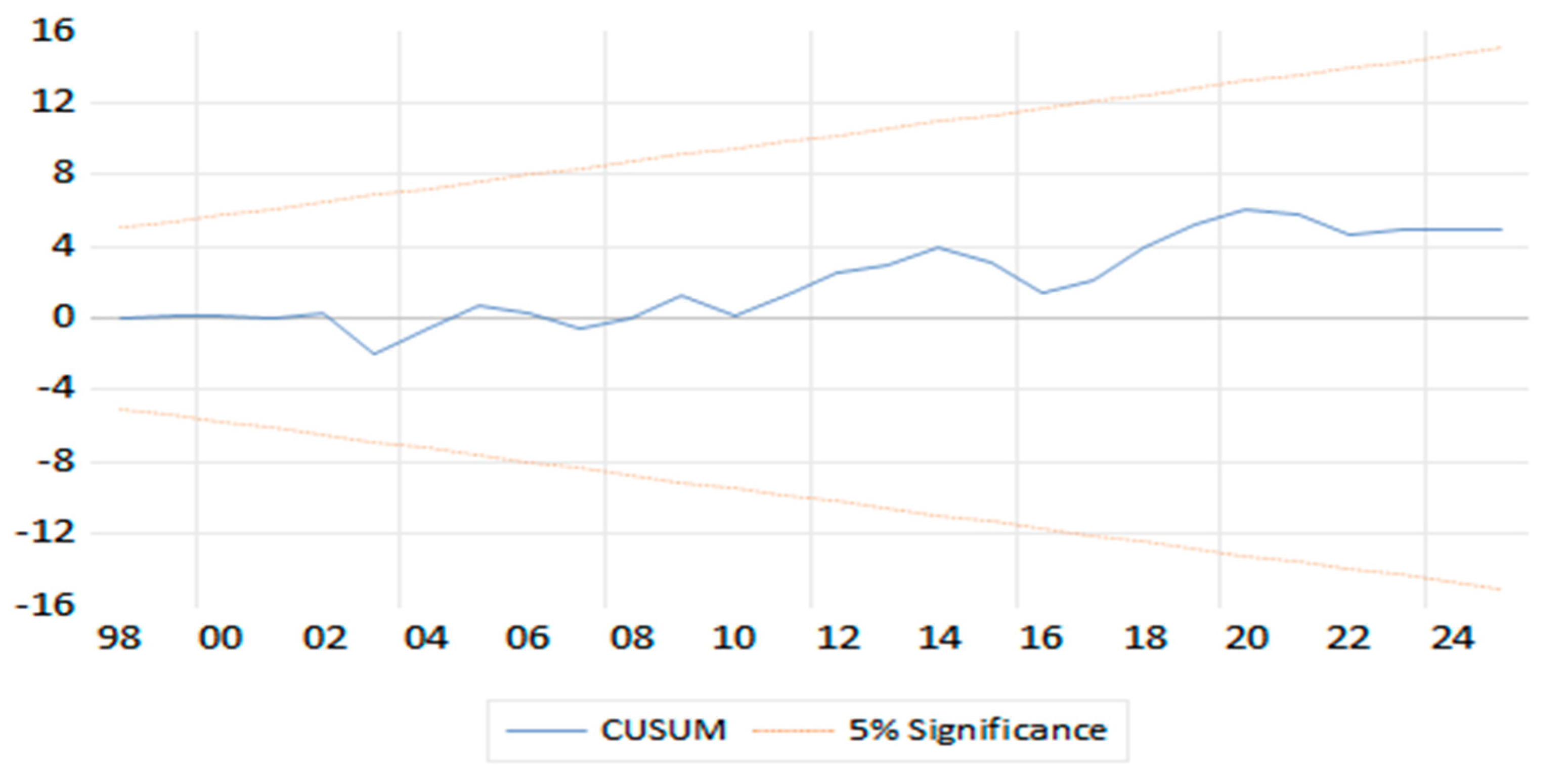
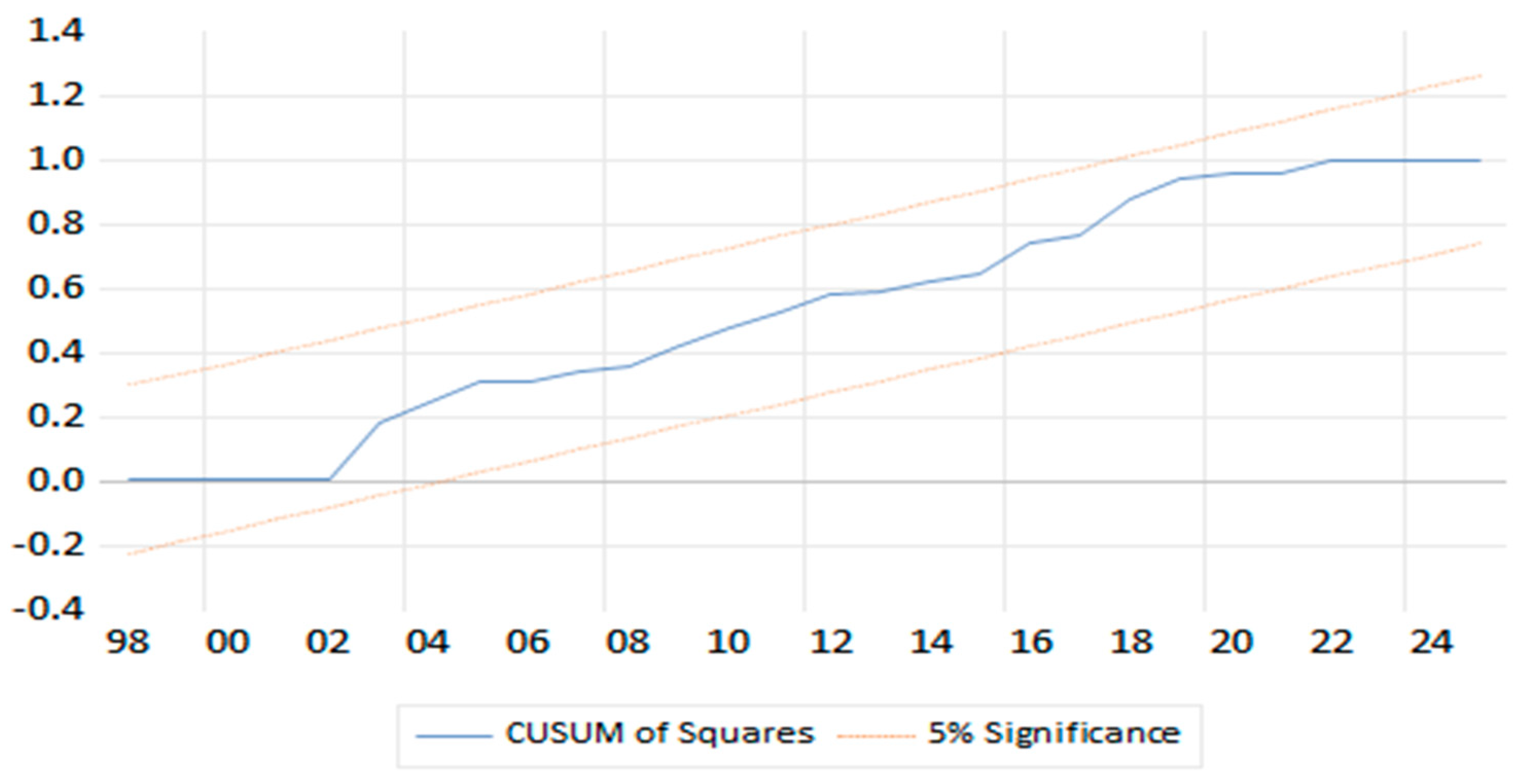
The study covers the period from 1990 to 2025 using annual data for Jordan. This sample period was selected primarily based on the availability, consistency, and comparability of data for all variables included in the analysis, namely the gender inequality index (GII), the world uncertainty index (WUI), economic growth, inflation, and unemployment. Using a balanced annual dataset ensures methodological consistency and allows the estimation of both short-run and long-run relationships within the ARDL framework. Although the sample spans several major economic and geopolitical events, including the global financial crisis, the Arab Spring, the Syrian refugee crisis, the COVID-19 pandemic, and recent inflationary pressures, explicit structural-break models were not incorporated into the baseline specification. Nevertheless, potential parameter instability was assessed using the CUSUM and CUSUMSQ stability tests, both of which indicate that the estimated coefficients remain stable over the sample period.
The world uncertainty index (WUI) data were obtained from the world uncertainty index database through the Federal Reserve Economic Data (FRED) platform. The data were converted to annual observations using a consistent annual aggregation procedure. All observations were carefully verified against the original source to ensure data accuracy. No missing values were replaced or inputed, and the reported values correspond to those available in the original dataset.
It should also be acknowledged that the annual dataset consists of a relatively limited number of observations, which is a common characteristic of macroeconomic time-series studies for individual countries. To address this limitation, the autoregressive distributed lag (ARDL) approach was employed because it is well suited to small samples and can accommodate variables integrated of order I(0) and I(1). Accordingly, the findings should be interpreted in light of the sample size and the possibility that unobserved structural changes may influence the estimated relationships.
4.2. Unit Root Test
Unit root test is often carried out prior to econometric analysis. This test examines the stationarity of time series data. Stationarity refers to the variables’ statistical properties (i.e., mean and variance) remaining the same despite the passing of time. Notably, non-stationary data may cause inauthentic regression outcomes and untrustworthy statistical inferences. Hence, it is vital to test the stationarity of the data. Unit root test was performed on all the variables in this study. Gender inequality index (GII), world uncertainty index (WUI), inflation rate, economic growth rate, and unemployment rate were also included in the test, to ascertain the order of integration for each variable.
The results are presented in
Table 1 of the augmented Dickey–Fuller (ADF) and Phillips–Perron (PP) unit root tests indicate that the variables in the model exhibit a mixed order of integration within the context of the Jordanian economy. Specifically, the results show that GII and UR are non-stationary at level, as the null hypothesis of a unit root cannot be rejected at conventional significance levels. However, after the first differencing, both variables become stationary, indicating that they are integrated of order one, I(1). In contrast, EGR, INF, and WUI are stationary at level, as the null hypothesis of a unit root is rejected at conventional significance levels; therefore, these variables are integrated of order zero, I(0).
The results of both unit root tests consistently indicate that the dataset contains a combination of I(0) and I(1) variables. Since none of the variables is integrated of order two, the ARDL approach is considered appropriate for examining the short-run and long-run relationships between economic uncertainty and gender inequality in Jordan.
4.3. Diagnostic Tests
Diagnostic tests were conducted to examine whether the estimated ARDL model satisfies the main assumptions related to residual behavior and model adequacy. These tests provide supporting evidence regarding the absence of serial correlation, heteroskedasticity, and non-normality of residuals, as well as the appropriateness of the estimated specification. However, these tests should be interpreted as diagnostic checks rather than complete evidence of model robustness. In this study, the diagnostic framework included three tests: the normality test, serial correlation test, and heteroskedasticity test, as presented in the following subsections. The results are summarized in
Table 2.
The results indicate that the estimated ARDL model satisfies the key diagnostic assumptions. The Jarque–Bera test confirms that the residuals are normally distributed, while the Breusch–Godfrey LM test indicates the absence of serial correlation. The ARCH test also confirms homoskedastic residuals. Since all p-values exceed the 5% significance level, the null hypotheses of the respective tests cannot be rejected, suggesting that the model is statistically adequate and the estimated results are reliable.
4.3.1. CUSUM Test
Figure 1 presents the CUSUM test used to examine the stability of the estimated coefficients over the sample period. As shown in the figure, the CUSUM statistic remains entirely within the 5% critical bounds throughout the study period. This indicates the absence of structural instability and confirms that the estimated coefficients are stable over time. Therefore, the model is considered structurally stable and suitable for reliable statistical inference and policy analysis.
4.3.2. CUSUM of Squares Test
Figure 2 illustrates the CUSUM of squares (CUSUMSQ) test, which assesses the stability of the variance of the recursive residuals. The CUSUMSQ statistic remains within the 5% critical bounds during the entire sample period, indicating that no significant structural changes occurred in the variance of the residuals. These results provide further evidence of the robustness and stability of the estimated model over time.
4.4. ARDL Bounds Test
ARDL bounds test is used to examine the existence of a long-run equilibrium relationship (cointegration) among the variables in the model. The test involves comparison of the calculated F-statistic with the critical value bounds at different significance levels. The null hypothesis of the bounds test states that there is no long-run relationship among the variables. If the calculated F-statistic exceeds the upper bound critical value, the null hypothesis is rejected, indicating the presence of cointegration. In this study, the ARDL bounds test results indicated that the calculated F-statistic is higher than the upper bound critical value at conventional significance levels. Therefore, the null hypothesis of no long-run relationship was rejected. This confirms the existence of a stable long-run equilibrium relationship between gender inequality in Jordan and the selected macroeconomic variables, including economic growth, inflation, unemployment, and global uncertainty.
4.5. The Optimal Lag
The optimal lag structure was selected based on the Akaike information criterion (AIC). Considering the annual nature of the data and the relatively small sample size, the maximum lag length was restricted appropriately during the selection process. The automatic lag selection procedure identified ARDL(0, 0, 0, 2, 2) as the optimal specification, where the lags correspond to GII, EGR, INF, UR, and WUI, respectively.
As shown in
Table 3, the results of the bounds test within the ARDL framework indicate the existence of a long-run equilibrium relationship among the variables included in the model. The calculated F-statistic reached 14.84970, which exceeds the upper bound critical value even at the 1% significance level (I(1) bound = 5.72). Therefore, the null hypothesis of no long-run relationship among the variables is rejected. This finding confirms the presence of cointegration among the variables, suggesting that variations in economic growth, inflation, unemployment, and global uncertainty are linked to a long-run equilibrium relationship with gender inequality in Jordan.
Table 4 shows that the coefficient of determination (R
2) is 0.876686, while the adjusted R
2 is 0.726948. These results indicate that the model explains a substantial proportion of the variation in gender inequality in Jordan. Furthermore, the F-statistic probability value of 0.000877 confirms the overall statistical significance of the model. The Durbin–Watson statistic value of 1.903051 suggests that the residuals do not exhibit serious autocorrelation concerns, which supports the reliability of the estimated results. Overall, the findings indicate the existence of a stable long-run relationship between gender inequality and the selected macroeconomic variables, including economic growth, inflation, unemployment, and global.
6. Discussion
The findings of this study provide important insights into the relationship between macroeconomic conditions and gender inequality in Jordan. The results indicate that economic growth is negatively associated with gender inequality in the long run, suggesting that improvements in economic performance may contribute to reducing gender disparities. This finding is consistent with the broader macroeconomic literature emphasizing that sustained economic development can enhance women’s economic opportunities through improved labor market conditions, higher income opportunities, and greater access to productive resources. For example,
Seguino (
2019) highlighted the importance of gender-sensitive macroeconomic policies and productive investment in supporting gender equality outcomes.
The positive and statistically significant relationship between inflation and gender inequality suggests that rising prices and economic pressures may have unequal effects across genders. This result is consistent with previous studies indicating that economic instability can disproportionately affect women, particularly those working in vulnerable employment sectors or facing limited access to social protection. Similarly, international evidence from the
International Labour Organization (
2021) and the
International Monetary Fund (
2023) shows that women are often more exposed to the negative consequences of economic crises and macroeconomic instability.
The results also show that unemployment is positively associated with gender inequality in the long run. This finding supports previous evidence that labor market weaknesses tend to affect women disproportionately due to existing structural barriers, lower labor force participation, and unequal employment opportunities. The findings are in line with that from
World Bank (
2022), which reported that women’s labor market recovery after economic shocks is often slower than that of men.
Regarding economic uncertainty, the world uncertainty index (WUI) does not show a statistically significant long-run relationship with gender inequality in Jordan. This result differs from some international studies, such as
Nguyen (
2022),
Shittu et al. (
2025), and
OECD (
2024), which found that higher uncertainty is associated with greater gender inequality through labor market and income channels. The difference may be explained by the country-specific nature of the present study, the relatively small annual sample size, and Jordan’s institutional and economic characteristics that may moderate the direct impact of global uncertainty on domestic gender inequality.
The insignificant long-run coefficient of WUI does not necessarily imply that economic uncertainty is irrelevant to gender outcomes; rather, it suggests that its direct association with GII is not statistically confirmed within the estimated model. Potential transmission channels, such as investment decisions, labor market adjustments, and inflationary pressures, require additional empirical investigation beyond the current ARDL specification.
The negative and significant time trend coefficient indicates a gradual improvement in gender inequality over the study period. This finding may reflect long-term structural changes in Jordan, including improvements in women’s education, institutional reforms, and gradual changes in social and economic conditions. However, the persistence of gender disparities indicates that economic growth alone may not be sufficient, and targeted policies addressing labor market barriers and women’s economic participation remain important.
Overall, the findings contribute to the existing literature by providing country-specific evidence for Jordan using an ARDL framework. Unlike previous cross-country studies that examine average effects across developing economies, this study focuses on the Jordanian context and highlights the role of domestic macroeconomic conditions in shaping gender inequality outcomes.
7. Conclusions
The results indicate the existence of a long-run equilibrium relationship between gender inequality and the examined macroeconomic variables in the Jordanian context. This suggests that variations in gender inequality are associated with both short-run economic shocks and long-term economic structures and labor market dynamics. The findings show that economic growth is associated with lower gender inequality, indicating that improved economic performance may enhance employment opportunities, women’s labor market participation, and access to economic resources. Conversely, inflation and unemployment are positively associated with gender inequality, suggesting that economic pressures and labor market difficulties may disproportionately affect women, particularly those engaged in vulnerable employment sectors and those with limited access to social protection.
Furthermore, the findings indicate that global uncertainty does not have a statistically significant direct effect on gender inequality in Jordan. However, potential indirect channels through investment, inflation, and labor market conditions may contribute to the transmission of external shocks. This reflects the role of domestic economic structures in absorbing and transmitting global uncertainty. The negative and significant time trend coefficient also indicates gradual structural improvements in reducing gender inequality over time, potentially associated with institutional development, educational progress, and policies supporting women’s empowerment.
The significant error correction term confirms the stability of the model and the adjustment process toward a long-run equilibrium following short-run deviations. Based on these findings, the study highlights the importance of promoting inclusive economic growth, expanding quality employment opportunities for women, reducing female unemployment, and strengthening social protection mechanisms. In addition, policies supporting women’s entrepreneurship, flexible work arrangements, education, and institutional reforms remain important for sustaining long-term improvements in gender equality in Jordan.