Article

Navigating Sustainability: The Interplay of Energy Consumption, Economic Growth, and FDI on Carbon Emissions in India Using ARDL Analysis

1
Alliance School of Economics, Alliance University, Bengaluru 562106, Karnataka, India
2
College of Business Administration, Ajman University, Ajman P.O. Box 346, United Arab Emirates
*
Author to whom correspondence should be addressed.
Economies 2026, 14(7), 253; https://doi.org/10.3390/economies14070253 (registering DOI)
Submission received: 7 March 2026 / Revised: 18 May 2026 / Accepted: 19 May 2026 / Published: 4 July 2026
(This article belongs to the Special Issue Advances in Applied Economics: Trade, Growth and Policy Modeling)

Abstract

This study empirically analyses the influence of energy consumption, economic growth, and foreign direct investment (FDI) on carbon emission in India. The Autoregressive Distributed Lag (ARDL) bounds-testing approach is applied on time series data from 1990 to 2022 to determine the cointegration between series variables. The findings show that all variables are cointegrated. The Granger Causality test confirms unidirectional causality running from economic growth to carbon emissions, from carbon emissions to energy consumption, from energy consumption to foreign direct investment, and from foreign direct investment to renewable energy consumption. Also, the results presented a bidirectional causal relationship between foreign direct investment and carbon emission. Thus, the level of carbon emissions is significantly connected with economic growth and energy consumption. The rising energy demand further supports investment in the energy sector. Based on our findings, this study suggests the creation of policies towards mitigation of environmental pollution and promotion of investment in clean energy sources.

1. Introduction

Concerns about environmental degradation primarily from carbon dioxide emission (CO2) is a key focus of environmental studies, thus indicating a drive towards policy development by regulatory bodies to lessen the adverse effects of climate change (Hunjra et al., 2024). The energy literature presents the dynamics of CO2 and its impact on countries’ energy policies that directs the development of clean energy sources for a developed nation. Thus, it is a central concern for both developed and emerging economies regarding global warming and climate change primarily caused by greenhouse gas emissions (GHG) that significantly affect the environment worldwide (Li et al., 2023).
The Paris Agreement, adopted by 195 parties at the UN Climate Change Conference (COP21) in 2015, provides a global aim to keep average temperature below 2 degrees Celsius by 2030 to reduce the effects of climate change (The Paris Agreement, 2016). Most nations have ratified the Paris Agreement, which advocates the limiting of global warming by 2050 through emission reduction practices (Tan & Uprasen, 2022). This requires cutting annual emissions, which currently stand at around thirty-seven gigatons (Gt), by 2050 by adopting sustainable pathways in energy use, primarily through replacement of fossil fuels. Energy is a crucial input for economic activity to achieve economic growth. However, falling economic growth has partially lessened the importance of environmental pollution, since the primary focus of many nations is still to move on to the economic growth path that results in increasing energy consumption that further deteriorates environmental conditions (Cakmak & Acar, 2022). Additionally, rising energy demand and consumption posed a threat to the shortage of energy resources which further leads to inflationary pressure and even regional conflict. Environmental pollution, rising temperature, and energy shortage motivate countries worldwide to search for alternative energy sources that are clean and emission-free and enhance consumption efficiency (Addis & Cheng, 2023).
Economic growth shows an increase in per capita gross domestic product (GDP), typically measured as the annual change in real GDP. It is driven by the improvements in productivity, by producing more goods and services with the use of inputs such as labor, capital, energy, and other materials (Osano & Koine, 2016; Klein & Rosengren, 1994). The relationship between economic activities and energy utilization has a multifaceted influence on the environment. Energy is extracted from traditional and modern sources. Traditional energy comprises oil, fossil fuels, gas, etc., whereas renewable energy is considered modern energy (clean energy). The economic scenario of a nation may primarily determine the energy utilization and maintenance that has an effect on the environment. Such an impact appears in the form of emission primarily gaseous emission. The energy sector is the primary source of carbon emission that utilizes traditional sources of energy to run economic activities. The combination of energy, economy and environment therefore becomes significant in the economics literature. Economic growth is intricately linked to increasing CO2 emission and energy consumption, leading to negative impacts on the environment (Gonzalez-Álvarez & Montanes, 2023).
The sustained economic growth associated with carbon emission has been seen in developed countries in recent years. Additionally, developing countries such as India and China have also experienced rapid economic growth and have thus focused on reducing per capita emission. BRICS nations have shown impressive economic growth in recent years. Exponential economic growth influences exports, investment, energy consumption, and carbon emission. China is a major emitter of CO2 worldwide. Moreover, India also accounted for the high emission growth (Iqbal et al., 2023; Hu et al., 2021). It indicates the shifting of economic empowerment from developed to developing economies. These economies are expected to account for more than fifty percent of world economic growth by the end of 2030. The continuous demand for energy is one of the key concerns due to greenhouse gas emission and global climate change (Akram et al., 2022b; H. Liu et al., 2021; Umar et al., 2021). All nations are trying to achieve sustained economic growth, and energy plays a critical role in it. Rising economic activities influence trade which later attracts investment flow from domestic to international sources in the form of foreign direct investment (FDI).
Economic prosperity plays a key role in accelerating socio-economic characteristics of a nation (Iqbal et al., 2023). It depends upon the national production, consumption and external transaction associated with goods and services. This is affected by environmental and economic variables such as carbon dioxide, renewable energy consumption, innovation, unemployment, FDI, public expenditure, and trade. However, cleaner production is considered an essential factor to achieve sustainable economic progress (Iqbal et al., 2023; Z. H. Wang et al., 2018). The continuous rise in energy consumption and economic growth is seen in various developing countries (Ahmad et al., 2016). India (an emerging economy) ranks fifth in energy consumption and seventh in energy production, respectively. Consequently, this has placed India third in the world for carbon emissions. India’s economic growth has been steady since 1990 and has been dependent on traditional energy, which resulted in increased carbon pollution. Plausible reasons such as a large population, the consumer market, and urbanization have put pressure on environmental sustainability and demand for goods and services (M. M. Rahman et al., 2024).
FDI also promotes economic growth, technological innovation, trade expansion, and employment opportunities and develops global markets (Iqbal et al., 2023; Mohanty & Sethi, 2019). In an emerging economy, FDI is recognized as a significant factor for promoting economic prosperity and development. FDI promotes global economic integration and internalization worldwide through financial flows, resource modelling, capital inflows, advanced technologies, knowledge integration, job creation, and managerial skills for income generation (Mohanty & Sethi, 2019; Crespo & Fontoura, 2007; Romer, 1993). FDI inflow comprises knowledge of modern technologies, material production methods, and organizational skills (Osano & Koine, 2016; Bodman & Le, 2013). It is considered a key contributor to technology diffusion. FDI contributes towards the requirement of capital in the domestic market that eventually creates employment opportunities and money flow (Iqbal et al., 2022). FDI also assists in the transfer of managerial skills and technology, which contributes to economic development of a nation. In addition, FDI raises investment opportunities in local economies, which opens employment opportunities, while the quality of technology also contributes to the development (Malik & Sah, 2023; Rakhmatullayeva et al., 2020).
FDI primarily flows from high- to middle-income countries to increase the share of business profit, create jobs, and provide goods and services in emerging and developing economies (more than 70%), which creates spillovers in the host countries (Muhammad & Khan, 2019). Such investment has affected environmental aspects across the globe especially after the financial crises of 1997 and 2008. FDI is a key source of funding in developing countries for reallocating energy-intensive and carbon-polluting industries (Sarkodie & Strezov, 2019). Further, it becomes a significant challenge to attain Sustainable Development Goals (SDGs) when transfer, dissemination, and diffusion of FDI in polluting industries is experienced in developing countries. Moreover, FDI has even become more important for long-term economic growth along with the need to address the global environmental emergency (Addis & Cheng, 2023; Cheng et al., 2023).
India is the fifth largest economy by market exchange rate and third largest in terms of purchasing power parity respectively (Kumari et al., 2025). As a fastest growing economy, the country is primarily dependent on fossil fuels for energy requirements, which causes significant amounts of emissions. India’s incredible advance in recent years has made it the world’s fastest growing economy and has resulted in the rise in carbon dioxide emission. The growth of industrial activities, infrastructure sectors and metropolitan areas has increased the dependence on fossil fuels for energy requirements, thus raising carbon emission (M. M. Rahman et al., 2024; M. H. Rahman, 2023). Consequently, emphasis has been given to renewable energy sectors. Additionally, economic growth requires energy consumption to catch up with developed countries (Pradhan et al., 2024). However, the difference is seen in the energy use efficiency, clean energy promotion, and carbon emission due to the varying technological usage that further indicates the need for development of technologies. Such a difference creates a challenge of energy diversification and switching of oil to renewable energy production and consumption. To reduce carbon emission, India has emphasized the expansion of renewable energy sources (solar and wind energy) and motivated towards renewable energy use, promotion of solar parks and wind farms, and investment in different types of clean energy technologies (M. M. Rahman et al., 2024). The nation has enormous potential in renewable energy usage which needs to be harnessed to catch up with rising electricity demand and bring down emissions (Mittal et al., 2016). Further, energy security and political pressure may motivate Indian regulators to formulate concrete policies to accelerate renewable energy deployment and mitigate carbon emission.
Over the past two decades, improving alternative energy sources has been a continuous development process for higher and reliable energy generation. However, developing countries have experienced challenges in securing FDI in climate friendly technologies (renewable energy technologies) due to multiple reasons, such as higher investment risk, currency fluctuation, and government instability. The adoption of such technologies helps to slow down global carbon emission due to improved environmentally friendly power generation technologies (Pfeiffer & Mulder, 2013; Popp, 2011; Watson & Sauter, 2011).
This study re-examines the available theories in the literature. Initially, thesis, conservation hypothesis, feedback hypothesis, and neutrality hypothesis. Further, the Environmental Kuznets Curve (EKC) hypothesis links economy, energy, and environment and provides a good understanding of the associations between the variables. Moreover, the addition of foreign direct investment and environmental degradation helps in examining the topic through a theoretical lens which highlights four dimensions: pollution haven, halo effect, scale effect, and composition effect.
The objective of this study is to empirically examine the influence of energy consumption, economic growth, FDI and renewable energy consumption on carbon emission in India by applying the ARDL model. The choice of India is justified for multiple reasons. First, India is a fast-developing economy that is facing energy challenges and emission challenges. Second, India has committed to accelerating production of renewable sources of energy (primarily solar and wind power). Third, the investment landscape in India is expanding and has widely shifted to investment in the clean energy sector.
The proposed research questions (RQ) of this study are:
  • RQ1: How does energy consumption effect carbon emission in India?
  • RQ2: Does the usage of renewable energy mitigate carbon emission in India?
  • RQ3: Do FDI and economic growth have any influence on carbon emission in India?
The study contributes to the existing literature in the following ways. First, to examine the influence of variable, we have utilized time series data exclusively for India, rather than panel data for multiple countries. Second, we have the used ARDL model which is suitable for applying in long-time-series data. Moreover, the methodology used helps to investigate the short-run and long-run associations between energy consumption, economic growth, FDI and carbon emission in India and provides a good discussion for policy formulation.
The rest of this manuscript is structured as follows: Section 2 presents a review of the relevant literature; Section 3 provides data and methodology; Section 4 presents the results and the discussion; Section 5 concludes the study.

2. Literature Review

The interconnections between energy consumption, economic growth, FDI and carbon emission have been evaluated by several authors. Their findings and implications differ; however, the key focus is to mitigate environmental pollution. Research on carbon emission and related determinants has gained wider attention worldwide. Such factors explain why and how energy consumption and economic growth are posing threats to increasing carbon emission.

2.1. Energy–Economy–Emission Growth Nexus

The energy–economic growth nexus is found in developed, developing and emerging economies (Mardani et al., 2019); however, such a relationship is either unidirectional or bidirectional. Developed economies are widely responsible for higher energy consumption in all sectors, namely industry, commercial, households, transportation, etc. Additionally, developing nations are demonstrating the energy–economic growth nexus. As a result, countries continue to grow, and such development comes at the cost of environmental degradation, with the focus shifting to sustainable energy creation. A study by Khan et al. (2022) examined the causality between economic growth, energy consumption, and carbon emission in a sample of selected South Asian countries using data from 1970 to 2017. The findings showed a bidirectional causal relationship from economic growth and non-renewable energy consumption. Additionally, the existence of a unidirectional relationship from economic growth to carbon emission and non-renewable energy consumption to carbon emission is presented in the study. In the case of BRICS and OECD countries, Nawaz et al. (2021) observed the relationship between energy consumption, economic growth, and carbon emission during the period from 1980 to 2016. Results from applying the Quantile ARDL model show that non-renewable energy consumption and economic growth results in carbon emissions, whereas the use of renewable energy mitigates carbon emission. It is also notable that energy usage and carbon emission are significantly associated in the global context. Thus, considerable utilization of renewable energy sources is necessary to decrease emission and primarily greenhouse gas emissions. Additionally, Saidi and Omri (2020) examined the nexus comprising economic growth, carbon emission, and renewable energy consumption in fifteen countries during the period 1990–2014. Findings from the latter study show that there is bidirectional causality between: economic growth and carbon emission; economic growth and renewable energy consumption; and carbon emission and renewable energy consumption. Moreover, unidirectional causality between renewable energy consumption and economic growth also exists. Waheed et al. (2019) investigated the relationship between energy consumption, economic growth and carbon emission within single and across multiple countries covering underdeveloped, developing, and developed countries up to 2019. The latter findings show that there is causality between economic growth and carbon emission, economic growth and energy consumption, and energy consumption and carbon emission in both single and multi-country studies respectively. The key determinants of carbon emission are economic growth, energy consumption, trade openness, and financial development, as identified via study in Turkey (Cetin et al., 2018). The results from the Granger Causality test also confirmed that unidirectional causality from energy consumption, economic growth, FDI and trade openness to carbon emission was eventually found in Turkey. Gorus and Aydin (2019) investigated the association between energy consumption, economic growth, and carbon emission in the MENA region during the period 1975 to 2014. The outcomes from causality results showed that there was an influence of economic growth on carbon emission in the short run, but there was also a bidirectional relationship in the medium and long term. Moreover, a unidirectional relationship from energy consumption to emission levels was observed in the short run. Akadiri et al. (2019) analyzed the relationship between energy consumption, economic growth, and carbon emission in Iraq during the period 1972 to 2013. Findings from ARDL estimates confirmed unidirectional causality from energy consumption to carbon emission and from economic growth to energy consumption, respectively. Further, no causality existed from carbon emission and energy consumption to economic growth. A study by Chen et al. (2016) empirically examined the energy–economy–emission nexus at a global level using data from 1993 to 2010. Findings from panel causality showed that all the variables were associated eventually. A negative impact of energy consumption on economic growth was seen in the developing countries. Moreover, unidirectional causality from energy consumption to carbon emission was found in countries. Esso and Keho (2016) investigated the nexus between energy consumption, economic growth, and carbon emission in a sample of twelve Sub-Saharan African countries using data from 1971 to 2010. Findings from causality results showed that variables were cointegrated both in the short and long term. Bidirectional causality was found between economic growth and carbon emission in the short run (Nigeria) and long run (Congo and Gabon). In addition, unidirectional causality from economic growth to carbon emission also appeared in the following countries: Benin, Democratic Republic of Congo, Ghana, and Senegal. Furthermore, unidirectional causality from carbon emission to economic growth was found in Togo, Gabon, and Nigeria. Salahuddin and Gow (2014) examined the association between energy consumption, economic growth and carbon emission in Persian Gulf countries using data from 1980 to 2012. The findings presented bidirectional causality from energy consumption to economic growth, and unidirectional causality from economic growth to energy consumption. Moreover, neutrality hypotheses existed between economic growth and carbon emission in the GCC region. Alam et al. (2011) examined the association between income, energy consumption, and carbon emission along with total labor force and gross capital formation in India from 1991 to 2006. Finding from the Granger Causality test exhibits bidirectional causal relationship between energy consumption and carbon emission. On the basis of the literature above, the following hypothesis is drawn:
H1. 
There are significant impacts of economic growth and energy consumption on carbon emission.

2.2. Energy–Economy–Emission–FDI Nexus

Fan and Hao (2020) analyzed the association between energy consumption, economic growth, and carbon emission in China during the period 2000–2015. Empirical results highlighted that a long-term relationship was established between the above variables. A causal relationship exists from FDI to GDP and from renewable energy consumption to economic growth to FDI in the short and long run. Dogan et al. (2020) investigated the relationship between energy consumption, economic growth, FDI, trade and economic complexity in 32 European countries during the period 1995–2014. Using a panel data modelling approach, the findings showed the effects of economic complexity on economic growth, energy consumption (renewable and non-renewable energy) on economic growth, trade openness on growth FDI, and institutional quality on economic growth, respectively. Hanif et al. (2019) examined the relationship between fossil fuel consumption, economic growth, FDI and carbon emission on the ASEAN economies during the period (1990–2013) using the ARDL modelling approach. The findings showed that a one percent increase in economic growth eventually resulted in a 0.22% increase in carbon emission. Additionally, a one percent increase in fossil fuel consumption led to an increase of 0.29% in carbon emissions. Moreover, a one percent increase in FDI caused a 0.12% increment in carbon emissions, and a one percent increase in population increased carbon emissions by 0.1% in the selected region (ASEAN countries). Shahbaz et al. (2019) analyzed the links within the FDI–energy consumption–carbon emission nexus in the Middle East and North Africa (MENA) region during the period from 1990 to 2015. Their findings showed the existence of bidirectional causality from economic growth and energy use to carbon emission, and unidirectional causality from FDI to carbon emission, respectively. Consequently, the role of FDI is crucial in the MENA region due to investment requirements, environmental degradation and strict environmental regulation. Further, FDI is encouraged in green energy technology transfer and promotion of renewable energy sources. Zhu et al. (2016) examined the effect of energy consumption, economic growth, and FDI on carbon emission in the Association of South-East Asian Nations (ASEAN)—namely, Indonesia, Malaysia, the Philippines, Singapore, and Thailand—from 1980 to 2011. The latter findings confirm that there is a positive but insignificant impact of FDI on carbon emission. It implies that FDI benefits ASEAN countries in pollution mitigation. Similarly, energy consumption, population, and trade openness influence carbon emission in different countries. Also, a study by Baek (2016) in ASEAN countries from 1981 to 2010 revealed that FDI affects carbon emission and supports the pollution haven hypothesis. Moreover, energy consumption and economic growth also adversely affect carbon emission which implies that shifting from traditional to modern energy is a wise decision to maintain economic growth and environmental quality in the ASEAN region. Ozturk and Acaravci (2016) examined causality between energy consumption, economic growth, FDI and employment in two mediterranean counties (Cyprus and Malta) during the period 1980–2006 using a time series ARDL model. Findings from the Granger Causality test showed that unidirectional causality runs from trade to economic growth, employment to real GDP per capita, and energy consumption to foreign trade. It confirms that a long-run relationship was found in Malta and a short-run relationship in Cyprus, respectively. Tang and Tan (2015) investigated whether energy consumption, economic growth and FDI were the key determinants of carbon emission in Vietnam during the period 1976 to 2009. Results of the Granger Causality test showed that there was a positive influence of energy consumption and economic growth on carbon emissions. There was bidirectional causality between economic growth and carbon emission, and between FDI and carbon emission, respectively. Kivyiro and Arminen (2014) analyzed the relationship between energy consumption, carbon emission, economic growth, and FDI in six Sub-Saharan African countries in the period 1971 to 2009. Findings from the ARDL and Granger Causality tests confirm that the impact of variables upon carbon emission is significant. The latter results confirm a unidirectional relationship from economic growth to FDI and from FDI to carbon emission, respectively. Consequently, the study supported the Environmental Kuznets Curve (EKC) hypothesis, pollution haven hypothesis, and pollution halo hypotheses in the Sub-Saharan African countries. Lee (2013) analyzed the relationship between energy use, economic growth, carbon emission, and FDI in G20 nations using panel data from 1971 to 2009. The results indicate that FDI directly affects economic growth and indirectly affects carbon emission. Moreover, a positive impact of FDI on clean energy use (via economic growth) is found to reduce carbon emission. Shahbaz et al. (2013) investigated the energy–economy–FDI–carbon emission nexus along with trade in Indonesia during the period 1975–2011. Their findings presented that all variables are cointegrated. Results confirm bidirectional causality between energy consumption and carbon emission, and between carbon emission and trade openness. In addition, financial development causes energy consumption, carbon emission, economic growth and trade openness in Indonesia. Omri et al. (2014) analyzed the interaction between economic growth, FDI and carbon emission in fifty-four countries during the period 1990–2011. Using an SEM (simultaneous equation model) approach, the analysis shows the existence of bidirectional causality between FDI and economic growth, and between FDI and carbon emission, respectively. Furthermore, unidirectional causality from carbon emission to economic growth is also observed in several countries. Moreover, Pao and Tsai (2011) also investigated the energy–economic growth–emission–FDI nexus in the BRICS countries during the period from 1980 to 2007, except for Russia (1992–2007). Findings from panel data modelling showed that unidirectional causality existed from energy consumption to carbon emission and from economic growth to FDI in the short run. Additionally, the existence of bidirectional causality between FDI and carbon emission was found. In addition, unidirectional causality from energy consumption and economic growth to carbon emission and FDI appeared in the study. The following hypothesis is developed from the above literature:
H2. 
There is significant impact of FDI on carbon emission through GDP growth.
The above literature confirms that there are multiple determinants that influence carbon emission around the world, as show in this study. The selected group of countries selected, from developed to developing, provide valuable evidence highlighting the importance of energy for economic development. Subsequently, carbon emission is influenced by the growth of a nation due to economic activities. Further, clean energy consumption reduces emissions, as supported through clean technological development, which is possible with sufficient capital. The nexus between variables in multicounty analysis provides a direction towards filling a key research gap (based on the characteristics which we have addressed) with the use of relevant data in a single-country case. The abovementioned variables may have a significant effect in our study’s context that can provide a good direction for re-examination.

3. Data and Methodology

3.1. Data Source

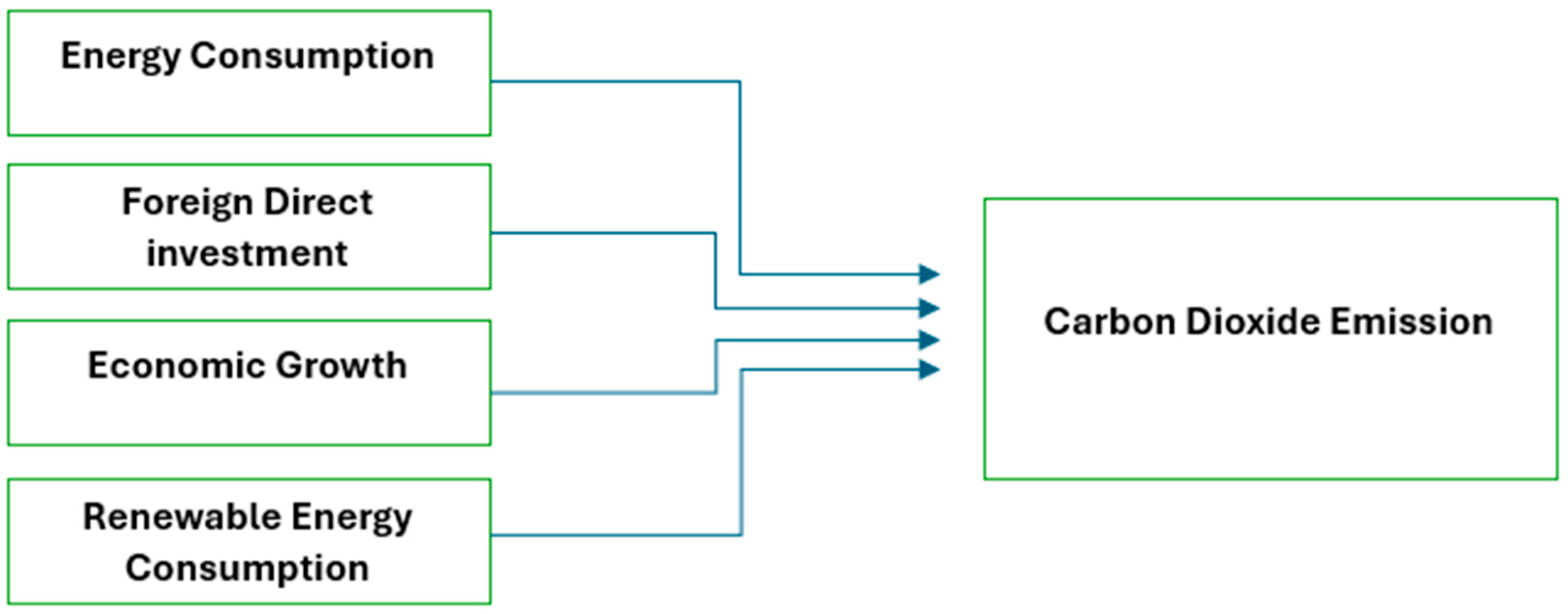
This study uses annual time-series data from the World Bank (2023) and Our World Data (2022) for India for the period 1990 to 2022. The variables of interest are carbon dioxide emissions (metric tons per capita), foreign direct investment net inflows (BoP, current US$), economic growth per capita (current US$), and fossil fuel (TWh) use as a proxy of energy consumption and renewable energy consumption (% of total final energy consumption). The conceptual framework is clearly presented in Figure 1. A very small section of missing data was computed by taking an average for the last three years assuming no significant changes occurred. All data are converted in logarithmic form for the purposes of the study. The analysis was done using E-VIEWS 12 data analysis software. Table 1 presents the summary statistics of each variable to understand the nature and the variability of data, and Table 2 shows the correlation analysis, respectively.
Table 2 shows the correlation between the variables. Further, diagnostic test results provided the VIF (Variance Inflation Factor) value of LENG (69.9), FDI (8.9), LGDP (49.4) and LREN (31.1) respectively. High correlation between the variables shows the possibility of multicollinearity. Multicollinearity does not bias or invalidate ARDL estimates. As established in the econometrics literature, multicollinearity inflates the variance of OLS Estimators but does not affect their unbiasedness or consistency (Gujarati, 2011). Since ARDL models are estimated using OLS techniques, they inherit this property. Furthermore, the ARDL bounds-testing framework relies on joint F-statistics for lagged level variables rather than individual t-statistics, making inference less sensitive to multicollinearity (Pesaran et al., 2001; Wooldridge, 2019; Adeleye et al., 2018; Ghosh et al., 2023). The approach is specifically designed to identify long-run equilibrium relationships (cointegration), which are typically more stable and robust than short-run dynamics (Pesaran et al., 2001; Nkoro & Uko, 2016; Okoro et al., 2021). In addition, the dynamic lag structure of ARDL models distributes relationships over time, partially mitigating contemporaneous collinearity. Finally, high correlation between macroeconomic variables is well recognized as a common feature of economic data rather than a specification flaw (Gujarati, 2011; Kripfganz & Schneider, 2023), and excluding such variables may introduce more serious omitted variable bias. Thus, high multicollinearity does not compromise the reliability of the results.

3.2. Econometric Model

The basic equation utilized in this study is written as follows:
CO2 = f (ENG, GDP, FDI, REN)
where, CO2 represents carbon dioxide emission, ENG denotes energy consumption (fossil fuel consumption), FDI stands for foreign direct investment, GDP indicates economic growth and REN measures renewable energy consumption, respectively.
An empirical model by linear econometric equation is specified as:
lnCO2 = α0 + α1 lnENGt + α2 lnFDIt + α3 lnGDPt + α4 lnREN + εt
where, lnCO2 is the logarithm of carbon dioxide emission, lnENG is the logarithm of energy consumption, lnFDI is the logarithm of FDI, lnGDP is the logarithm of economic growth, and lnREN is the logarithm of renewable energy consumption. α0 is a constant term; α1, α2, α3 and α4 are the parameter values; εt is the error term; and t is the time variant.
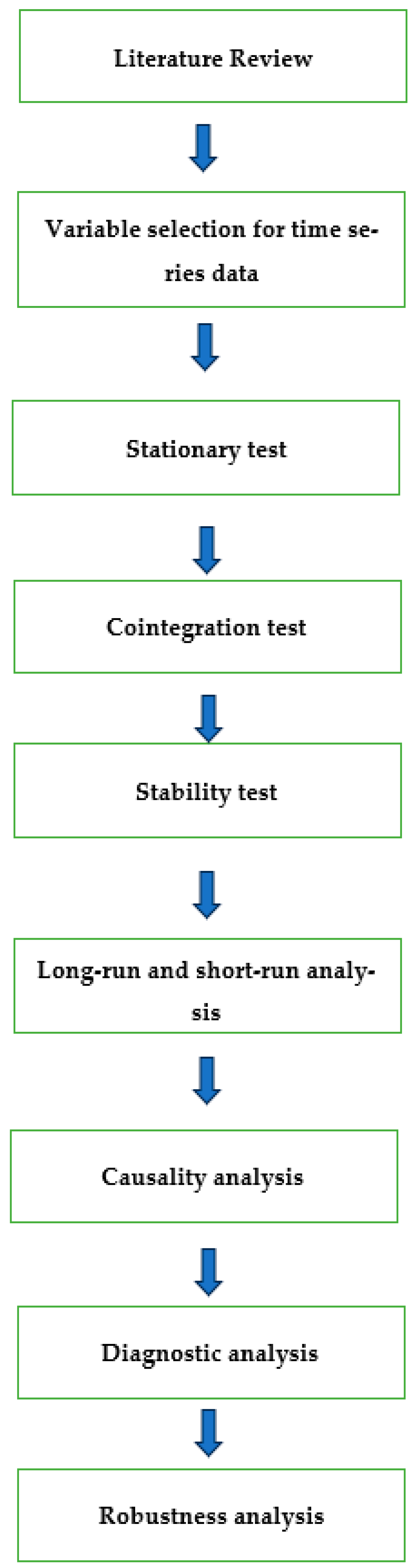
We applied Autoregressive Distributed Lag (ARDL) model (Pesaran & Shin, 1995) to analyze the associations between the variables used in this study. The steps for using the ARDL model are shown in a methodological flow diagram (Figure 2). We first checked the stationarity of the data and applied the unit root test. Second, we examined the short- and long-run relationships. Later, ARDL bounds-testing approach was applied to investigate cointegration between the variables (Pesaran et al., 2001).
  • ARDL model equation
The ARDL model is expressed as follows:
Δ l n C O 2 i t = a 0 + i = 1 p b 0   Δ l n C O 2 t i + i = 1 q b 1   Δ l n E N G t i + i = 1 q b 2   Δ l n F D I t i   + i = 1 q b 3   Δ l n G D P + i = 1 q b 4   Δ l n R E N t i + λ 1 l n C O 2 t i + λ 2 l n E N G t i + λ 3 l n F D I t i + λ 4 l n G D P t i + λ 5 l n R E N t i + ε t
where, a0 is a constant term. The dynamics of error correction in the short run are represented by the term summation signs, while the long-run relation is shown in the next half of the equation shown by λ. λ1, λ2, λ3, λ4, λ5 and b0, b1, b2, b3, b4 are coefficients. i, p and q represent the optimal lag order, t is time and εt is the error term. Then, Error Correction Term (ECT) is found to evaluate the movement toward the equilibrium of the variable. Later, cumulative sum (CUSUM) and the cumulative sum of squares (CUSUMSQ) are applied to check the stability of the model. Further, the diagnostic test of autocorrelation, heteroscedasticity and normality are applied to check the goodness of fit of the model. Finally, the Granger Causality test is applied to check the direction of causality between the variables.
  • ARDL model equation along with Error Correction Term
ARDL with the addition of Error Correction Term (ECT) after confirmation of long-run equilibrium can be written as follows,
Δ l n C O 2 i t = a 0 + i = 1 p b 0   Δ l n C O 2 t i + i = 1 q b 1   Δ l n E N G t i + i = 1 q b 2   Δ l n F D I t i   + i = 1 q b 3   Δ l n G D P t i + i = 1 q b 4   Δ l n R E N t i + λ E C T t i + ε t
where, the ECTt−1 term represents the long-run equilibrium speed of adjustment after the short-run shock.

4. Result and Discussion

4.1. Unit Root Test

The first requirement of the time series model is that data must be stationary—i.e., the mean and the medium should be same. The unit root test allows us to check whether our data is stationary in nature or not. Our study focused on the Augmented Dickey–Fuller (ADF) (Dickey & Fuller, 1979), Phillips–Perron (PP), and Kwiatkowski–Phillips–Schmidt–Shin (KPSS) tests to generate order integration of the variables.
We applied unit root testing in the natural logarithms of the variables in level I (0) and difference form I (1) respectively. The test results in Table 3 show that the variables have unit roots at level form, but when the first difference is applied, the data becomes stationary. The optimal lag length was selected automatically by using Schwarz information criteria for the unit root test.
The bound test result (Table 4) of the “F” statistic value is significant and rejects the null hypothesis of no cointegration between the variables at 1% significance level. So, we applied cointegration when taking carbon emission as a dependent variable.

4.2. Stability Test

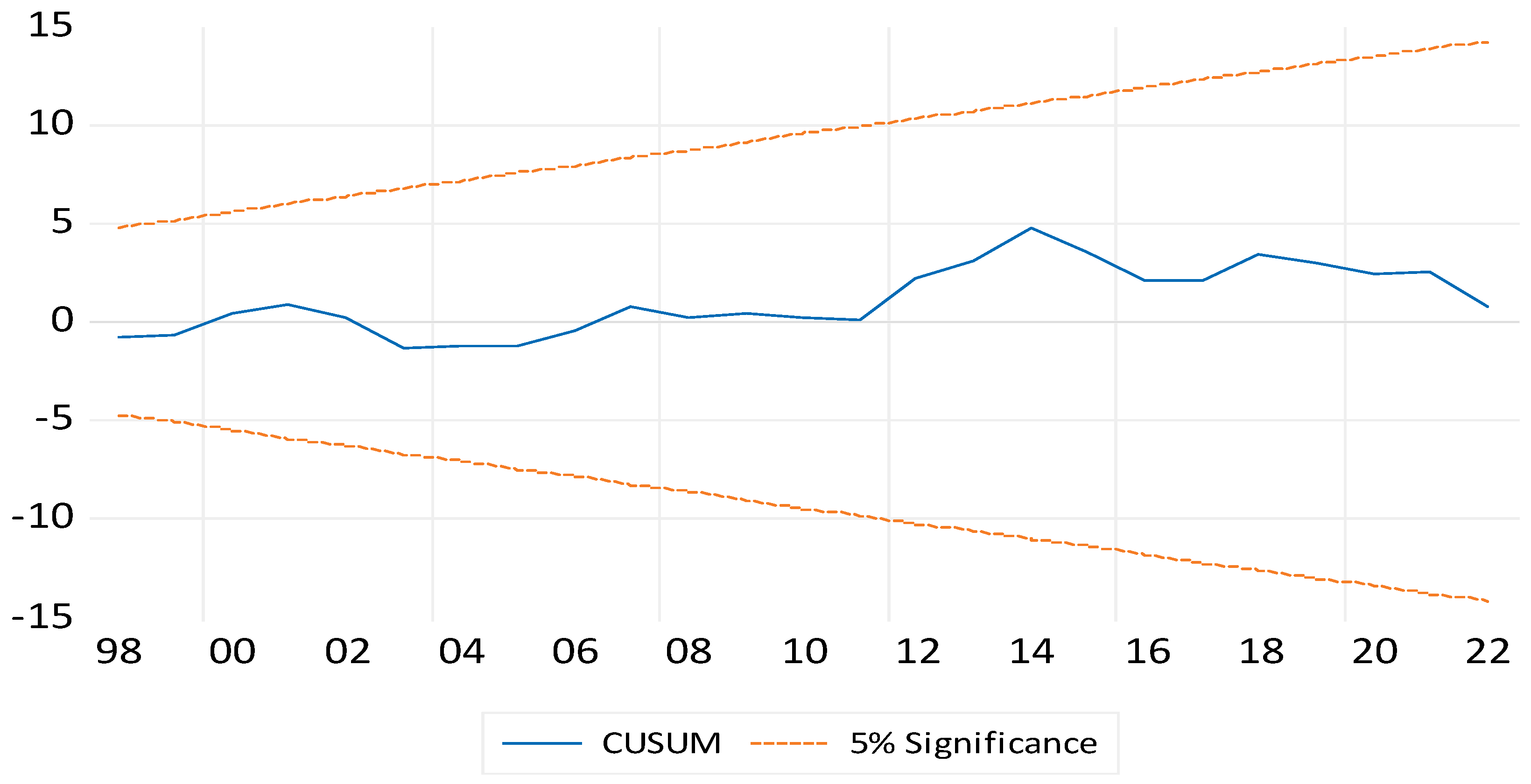
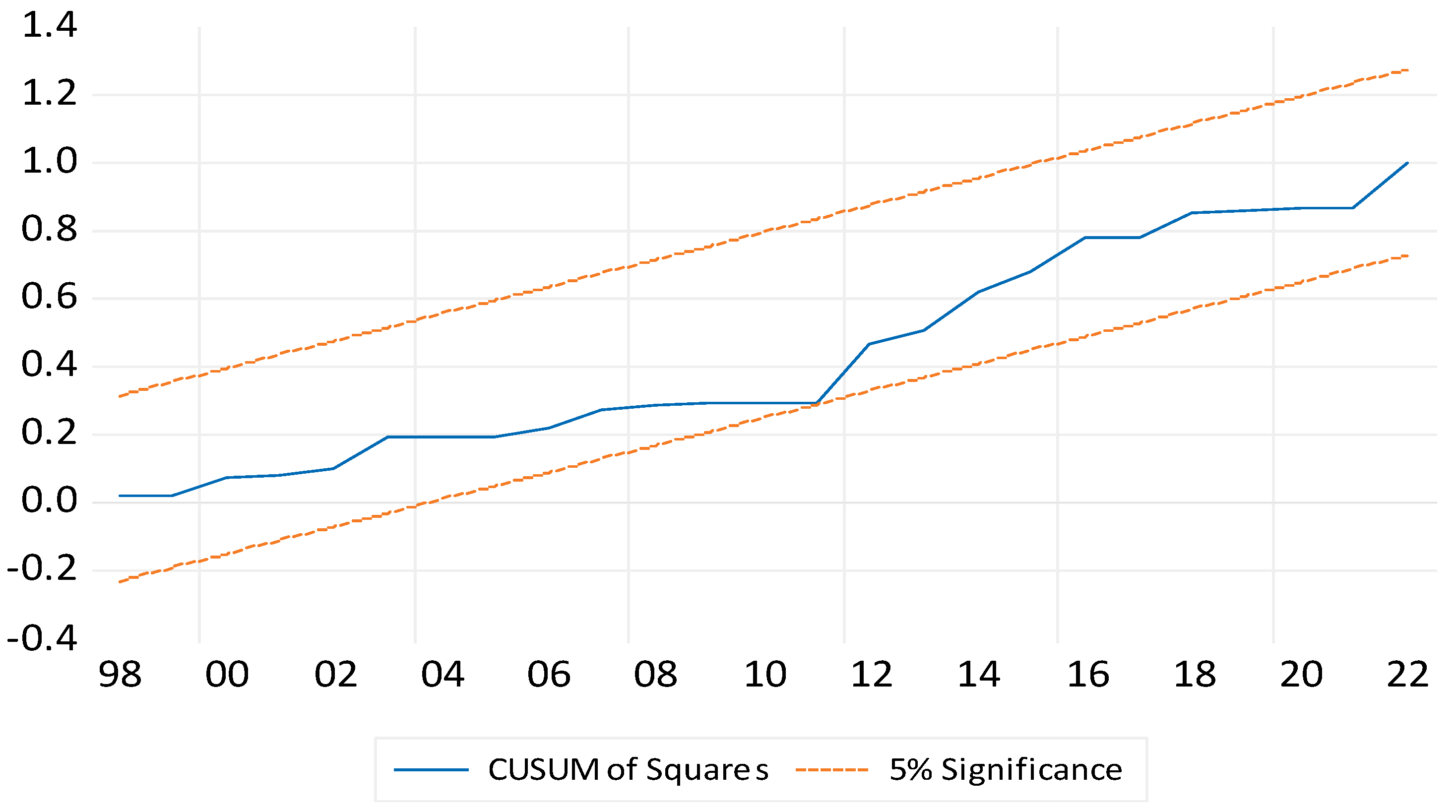
The CUSUM and CUMSUMSQ test (Brown et al., 1975) is used to show the stability of the model (Figure 3 and Figure 4). It shows that parameter values are observed to be under a 5% level of significance of the critical bound. Multiple recent studies have also used a similar method to address their research questions (Soti et al., 2024; Daboh & Jackson, 2023; Itoo & Ali, 2023; Zhang et al., 2022). The Chow test is performed to check the structural break during the time period. The test highlights two points (2008 & 2014). The Chow test result confirms that F-statistics (1.6655) and correspondence probability values (0.1663) fail to reject the null hypothesis at a 5% significance level of no breaks at the specified period. This implies that the sensitiveness of the event did not affect the model stability (which is confirmed with the CUSUM test).

4.3. ARDL Long-Run Cointegration Test Results

The long-run estimates of the ARDL approach are presented in Table 5. The result shows that energy consumption eventually has a positive and significant impact on carbon emission. It means that an increase in energy consumption of 1% further increased carbon emission by 0.35% in the long run in India. Further, the effect of FDI on carbon emission is negative (although not significant). It implies that FDI helps to reduce carbon emission. An increase in FDI of 1% results in a carbon emission reduction of 0.0079% (low magnitude). It means FDI helps in establishing clean energy sources and emission reduction techniques in the country. Additionally, carbon emissions are related to economic growth (although not significantly). It implies that economic prosperity promotes environmental protection with the application of clean energy production and utilization. Furthermore, the impact of renewable energy consumption on carbon emissions is highly significant. The result shows that a 1% increase in renewable energy consumption helps to reduce carbon emissions by 1.17%. It implies that renewable energy is considered a source of clean and environmentally friendly energy.

4.4. ARDL Short-Run Result

The short-run result of ARDL in Table 5 indicates that energy consumption has a positive and significant influence on carbon emission. The result confirms that an increase in energy consumption of 1% will lead to an increase in CO2 emission of 0.56% in the short run. It implies that fossil fuels are the main source of environmental pollution and that the economy is highly dependent on fossil fuels. Further, the role of renewable energy in the short run is highly influential on carbon emission. The results show that a 1% increase in renewable energy reduces carbon emission by 0.73% in the short run which is a good sign to focus on renewable energy generation. It implies that renewable energy serves as an environmentally friendly clean energy source that mitigates carbon emission.

4.5. Speed of Adjustment

The Error Correction Term (ECT) (Table 5) shows the speed of adjustment at which the model returns to equilibrium if any disequilibrium occurs. If the ECT is negative and the p-value is significant, then it is evident that there is convergence from short-run towards long-run equilibrium. But if the ECT is positive and the p-value is significant, it indicates that there is a lack of significant adjustment towards long-run equilibrium if any disequilibrium exists (Ali et al., 2017). Table 4 shows that the value of the ECT is negative and significant at the 1% level (p-value < 0.01) for the model (when carbon emission is a dependent variable and energy consumption, economic growth, FDI and renewable energy are independent variables). The value of the ECT indicates that any disequilibrium model will converge towards equilibrium with 62% annually.

4.6. Granger Causality Test

The results from the Granger Causality test (Granger, 1969) in Table 6 show the directional relationship between the variables used. The optimal lag length for the Granger Causality test is based on the Akaike Information Criterion (AIC). Numerous studies have applied this test to examine causality between variables (Kumari et al., 2025; Munir et al., 2020; Ali et al., 2017).
This shows that a unidirectional relationship exists from GDP to CO2, CO2 to energy consumption, energy consumption to FDI, and FDI to renewable energy, respectively. Moreover, a bidirectional relationship is found between FDI and CO2.

4.7. Diagnostic Test

Table 7 presents the results from diagnostic testing—serial correlation, heteroscedasticity, and normality—of residuals. The results of the correlation LM test show that the Chi square value (p-value) is 2.6216 (0.2696), which does not reject the null hypothesis. Further, the study reveals no heteroscedasticity as the Chi-square value (p-value) is 5.5916 (0.4704), which also fails to reject the null hypothesis of homoscedasticity. Further, the normality test of residuals shows that the Chi-square value (p-value) is 0.8339 (0.6590), which is greater than the 0.05 significance level and cannot reject the null hypothesis of normal distribution of residuals.

4.8. Robustness Analysis

To check the robustness of the model, the Fully Modified Ordinary Least Square (FMOLS) estimator technique is used (Table 8). The results show that energy consumption (positive), FDI (negative) and renewable energy consumption (negative) significantly influence carbon emission.

4.9. Discussion

The discussion is based upon the Granger Causality results shown in Table 6. The results demonstrate the existence of unidirectional causality from carbon emission to energy consumption (Affuso & Sharland, 2024; Akadiri et al., 2019) and support the scale effect. It implies that production activities heavily rely on emission-intensive energy resources which are vital to powering economic activity. Further, the availability of and access to such resources are easy and cheap as compared with clean energy sources.
Moreover, our findings reveal that economic growth is unidirectionally related to carbon emission, thus aligning with several other studies (Nguyen et al., 2023; Sunde, 2020; Uddin et al., 2016; Y. Liu et al., 2016; Hou et al., 2013; Odhiambo, 2011; Kuo et al., 2012) that focus on the conservation hypothesis. It can be inferred that developing nations are primarily in the phase of rising economic activities. In a growing economy, each sector is in an early stage of growth and tries to gain comparative advantages and maintain their position in the competitive market. Furthermore, economic prosperity leads to employment and income generation that support residents’ standards of living. Consequently, demand for goods and services increases substantially. All these activities require energy to support economic development. Such activities are primarily supported by traditional sources of energy that emit significant amounts of emissions. In such a situation, the adoption of clean energy sources is recommended to mitigate carbon emissions and support economic activity.
From causality analysis our results also show that economic growth and energy consumption cause FDI in a unidirectional way (Rath et al., 2024; M. M. Rahman, 2021; Adom et al., 2019; Naz et al., 2019; Saidi et al., 2018; Salim et al., 2017), which aligns with the EKC hypothesis (Odhiambo, 2022; Udemba et al., 2020). This implies that rising economic activity promotes financial flow in the economy to create markets for the people. The inflow of finance promotes a competitive market in the form of opening new industrial bases, building manufacturing units, supporting infrastructure development, and launching retail outlets with the intention of profit making and organizational expansion. Such spillovers attract investors to avail themselves of profits from the market. Consequently, there is increased inflow of investment from both domestic and international sources. Foreign firms set up their branches in destination countries, which further results in profit that attracts more FDI from additional countries. Additionally, to run any organization, there needs to be a regular energy supply. FDI further supports energy sectors in the form of investing in energy infrastructure, generation, and transmission for energy requirements. Another point that can be inferred is that the energy market in a developing country is also in the initial stage which offers immense opportunities to invest in the sector. The energy demand–supply gap primarily attracts investment in the energy sector.
In addition, it is notable that the unidirectional causality from FDI to renewable energy (Jinapor et al., 2025; Chowdhury & Chowdhury, 2022; Uzar & Eyuboglu, 2019; Mert & Bölük, 2016) also supports the pollution halo hypothesis. This implies that FDI supports the position that infrastructure needs to be developed for clean energy generation to maintain energy requirements and adhere to environmental rules and regulations. Another reason is rising environmental problems due to energy consumption (traditional energy sources), whereby the role of regulatory bodies becomes crucial to propose and implement strict rules and regulations. When regulatory bodies follow stringent regulations in energy sectors, investors must heed environmental concerns and follow the necessary steps for investing in energy sectors. Thus, foreign investors try to minimize their emission levels and use clean energy (renewable energy sources) by promoting research and development in modern energy sectors. Such activities are further incentivized by the government with the provision of tax rebates, credit availability, and subsidies to promote FDI in clean energy.
Moreover, bidirectional causality in FDI and carbon emission in line with relevant studies (Abdul-Mumuni et al., 2023; Akram et al., 2022a; Ren et al., 2021; Abdouli & Hammami, 2020, 2018; Gökmenoğlu & Taspinar, 2016; Hassaballa, 2014) highlights the feedback hypothesis. Thus, profit-making companies attract significant FDI to set up and expand their branches to accelerate production activity to meet rising demand. Consequently, more energy is consumed to produce goods and services, which results in carbon emission. In other words, more energy consumption to support production activity further attracts investment to expand output.

5. Conclusions

This study analyzes the impact of energy consumption, economic growth, and FDI on carbon emission in India over the period from 1990 to 2022. The Autoregressive Distributed Lag (ARDL) model is applied to check the cointegration between the variables. The study findings show that our variables are associated with each other in the short and long run. The bounds-testing approach for coefficient estimation confirms that variables are eventually cointegrated. Empirical findings show that variables are significantly associated with each other in the short and long run. Energy consumption, economic growth, and FDI are key determinants of carbon emission in India. Moreover, economic growth and energy consumption are related to FDI. Additionally, FDI is related to carbon emission and renewable energy generation.
Our findings confirm that the impact of energy consumption on carbon emission is positive and significant in both the short and long run. Further, the influence of renewable energy consumption on carbon emission is negative in the short and long run. Thus, the causality result of the study confirms that carbon emission is related to its determinant in either a unidirectional or bidirectional way.
The influence of energy consumption on carbon emission (Sisodia et al., 2023; Kais & Sami, 2016) highlights the importance of energy for a developing country like India, mostly for production and consumption purposes. India is a developing country which necessitates continuous supply of energy to meet demand. Any conservative policy may restrict the growth of economic activities. The manufacturing industry is the major sector with its ability to offer higher goods production and job opportunities. The continuous and cheaper supply of energy is the key to success of such an industry which further motivates medium and small manufacturing units to be established. A conservative policy may have a negative effect on both industry and the country. Therefore, the provision of clean energy to replace traditional energy sources is recommended. Such provision could be made easier with further transition to clean energy sources with appropriate policies.
The nexus between carbon emission and economic growth highlights the importance of economic activities, implying that higher levels of emission result from producing goods and services that are demanded by consumers. The demand for such production is high to sustain day-to-day usage of technological devices, which require continuous supply of energy. As a developing country, India is on the growth momentum to maintain its production capacity and gradually increase it. Thus, promotion of clean sources of energy is advised, such as power generation through solar power, wind energy, and biomass, in place of traditional sources of energy (fossil fuels). Policymakers may support renewable energy production, and consumers may demand it as well. Through investor and government support, the number of production facilities can be increased through tax rebates, subsidy provision, and moderating regulatory requirements to promote clean energy production. As a developing country, India can manage its environmental pollution which is a key focus for adhering to sustainability goals. In the current situation, energy conservation policy is advised along with the promotion of clean energy sources, and also the usage of technologies that require less energy.
Moreover, the government can consider the inflow of FDI through environmental regulations that can influence energy consumption and sustainable economic growth. This inflow is highly recommended for the clean energy sector; however, it depends upon factors such as political stability, financial stability, banking regulation, and transaction channels. To support FDI, liberal licensing policies, suitable infrastructure and institutional frameworks are required that solely focus on the FDI in the energy sector. Additionally, FDI in green energy, green fund provision, green finance, green technologies, etc., can also be supported. This can be further assisted with technological exchange, skill, and knowledge enhancement, as well as managerial and worker ability to understand such technology and apply that skill in the support of clean energy provision.
In economic scenarios, FDI is generally attracted to highly competitive and growth-oriented sectors which raises income and supports economic growth; therefore, FDI in diverse sectors may be required. It is advisable for the government to shift FDI from dirty industries (energy-intensive sector) to information technology and tertiary sectors to ensure energy efficiency and lower carbon emissions. Consequently, the inflow of FDI into green technology and renewable energy sectors can be considered (Uzar & Eyuboglu, 2019; Salim et al., 2017). To attract FDI into the information technology (IT) and renewable energy sectors, land allocation and financing policies can assist in future energy security.
As the literature suggests, FDI is traditionally associated with dirty and energy-intensive industries that can be controlled by strict environmental rules and regulations focusing on sustainable development (Yue et al., 2024). The focus on industrial transition to low carbon and support for green technology needs to be supported by cutting-edge technology and managerial know-how. Moreover, FDI in low-carbon sectors further supports the creation of the green economy to achieve sustainable development. Additionally, the government can focus on attracting foreign capital into advanced environmentally friendly technology through the implementation of financial benefits such as special tax measures and supporting enterprises through technology and knowledge diffusion, energy efficiency improvement, and carbon emission reduction (Y. Wang et al., 2021).
From a policy perspective, the data shows that the Indian government is committed to reducing carbon emission in the coming future to meet its net zero emission target. Energy consumption and economic growth are significantly associated with each other (causal relation); the focus on sustainable growth and development can assist in meeting the sustainability goals as advocated in the COP 28 meeting. Such a transition mitigates carbon emission, increases energy security, and drives economic development (Iqbal et al., 2025). This transition can be accelerated with financial incentives including tax breaks, subsidies and supporting the promotion of eco-friendly technologies. The development of solar and wind energy generation is preferable due to the availability of suitable geographic conditions. Such efforts help towards India’s commitment to renewable energy generation in the targeted period (2030). Investment in clean energy sources can supply more power to urban infrastructure, and higher supply can mitigate fossil fuel dependency (Wei et al., 2025). Moreover, energy conservation policy could be applied that can assist in creating and implementing energy efficiency measures. Policy on carbon pricing, redirecting investment to infrastructure, production systems, and technologies can reduce the environmental cost (Murad et al., 2019; Schandl et al., 2016). Additionally, foreign direct investment can promote clean energy development to achieve the twin target of clean energy promotion and employment generation. FDI can be promoted through incentives, subsidies, and other monetary support for cleaner energy production. Green finance can also boost the expansion of environmentally friendly and cleaner energy-based projects.
This study has a few limitations. The first limitation is the exclusion of the impact of the financial market on emission in the Indian context. The development of financial activity and banking services smooth the flow of money in the economy. Such a market can significantly support FDI. The second limitation is the exclusion of credit growth in the economy, which has an influence on the Indian economy. Another limitation of this study is that we have not checked the impact of institutions on CO2 emission. The role of institutions in emission mitigation is significant in the present scenario. When considering environmental pollution and Sustainable Development Goals (SDGs), countries’ institutional rules and regulations are even more crucial in mitigating carbon emission along with economic activities to meet the goal of net zero. Future studies will incorporate the abovementioned variables in cases for different countries across different time periods. Also, such studies can be extended with the application of advanced time series (Fourier ARDL) and panel data models.


Author Contributions

Conceptualization, formal analysis, writing—original draft preparation, H.K.S.; data curation, supervision, S.K.; writing—review and editing, funding acquisition, G.S.S.; methodology, validation, H.K. All authors have read and agreed to the published version of the manuscript.

Funding

This research received no external funding.

Institutional Review Board Statement

Not applicable.

Informed Consent Statement

Not applicable.

Data Availability Statement

The contribution of this study is mentioned in the article. Further, inquiries can be directed at the corresponding author.

Acknowledgments

The authors are thankful to Bosede Ngozi Adeleye, Anusuya Biswas, and Mihir Das for their valuable assistance and contribution towards revising the methodology section. Authors are thankful to Ajman University for providing APC support.

Conflicts of Interest

The authors declare no conflicts of interest.

References

  1. Abdouli, M., & Hammami, S. (2018). The dynamic links between environmental quality, foreign direct investment, and economic growth in the Middle Eastern and North African countries (MENA region). Journal of the Knowledge Economy, 9(3), 833–853. [Google Scholar]
  2. Abdouli, M., & Hammami, S. (2020). Economic growth, environment, fdi inflows, and financial development in Middle East countries: Fresh evidence from simultaneous equation models. Journal of the Knowledge Economy, 11(2), 479–511. [Google Scholar]
  3. Abdul-Mumuni, A., Amoh, J. K., & Mensah, B. D. (2023). Does foreign direct investment asymmetrically influence carbon emissions in sub-Saharan Africa? Evidence from nonlinear panel ARDL approach. Environmental Science and Pollution Research, 30(5), 11861–11872. [Google Scholar] [PubMed]
  4. Addis, A. K., & Cheng, S. (2023). The nexus between renewable energy, environmental pollution, and economic growth across BRICS and OECD countries: A comparative empirical study. Energy Reports, 10, 3800–3813. [Google Scholar] [CrossRef]
  5. Adeleye, N., Osabuohien, E., Bowale, E., Matthew, O., & Oduntan, E. (2018). Financial reforms and credit growth in Nigeria: Empirical insights from ARDL and ECM techniques. International Review of Applied Economics, 32(6), 807–820. [Google Scholar]
  6. Adom, P. K., Opoku, E. E. O., & Yan, I. K. M. (2019). Energy demand–FDI nexus in Africa: Do FDIs induce dichotomous paths? Energy Economics, 81, 928–941. [Google Scholar] [CrossRef]
  7. Affuso, E., & Sharland, A. (2024). Energy consumption, income and carbon emissions in the Caribbean community. International Journal of Global Energy Issues, 46(5), 407–418. [Google Scholar] [CrossRef]
  8. Ahmad, A., Zhao, Y., Shahbaz, M., Bano, S., Zhang, Z., Wang, S., & Liu, Y. (2016). Carbon emissions, energy consumption and economic growth: An aggregate and disaggregate analysis of the Indian economy. Energy Policy, 96, 131–143. [Google Scholar] [CrossRef]
  9. Akadiri, S. S., Bekun, F. V., Taheri, E., & Akadiri, A. C. (2019). Carbon emissions, energy consumption and economic growth: Causality evidence. International Journal of Energy Technology and Policy, 15(2–3), 320–336. [Google Scholar] [CrossRef]
  10. Akram, R., Fareed, Z., Xiaoli, G., Zulfiqar, B., & Shahzad, F. (2022a). Investigating the existence of asymmetric environmental Kuznets curve and pollution haven hypothesis in China: Fresh evidence from QARDL and quantile Granger causality. Environmental Science and Pollution Research, 29(33), 50454–50470. [Google Scholar]
  11. Akram, R., Umar, M., Xiaoli, G., & Chen, F. (2022b). Dynamic linkages between energy efficiency, renewable energy along with economic growth and carbon emission. A case of MINT countries an asymmetric analysis. Energy Reports, 8, 2119–2130. [Google Scholar]
  12. Alam, M. J., Begum, I. A., Buysse, J., Rahman, S., & Van Huylenbroeck, G. (2011). Dynamic modeling of causal relationship between energy consumption, CO2 emissions and economic growth in India. Renewable and Sustainable Energy Reviews, 15(6), 3243–3251. [Google Scholar] [CrossRef]
  13. Ali, W., Abdullah, A., & Azam, M. (2017). Re-visiting the environmental Kuznets curve hypothesis for Malaysia: Fresh evidence from ARDL bounds testing approach. Renewable and Sustainable Energy Reviews, 77, 990–1000. [Google Scholar] [CrossRef]
  14. Baek, J. (2016). A new look at the FDI–income–energy–environment nexus: Dynamic panel data analysis of ASEAN. Energy Policy, 91, 22–27. [Google Scholar]
  15. Bodman, P., & Le, T. (2013). Assessing the roles that absorptive capacity and economic distance play in the foreign direct investment-productivity growth nexus. Applied Economics, 45(8), 1027–1039. [Google Scholar] [CrossRef]
  16. Brown, R. L., Durbin, J., & Evans, J. M. (1975). Techniques for testing the constancy of regression relationships over time. Journal of the Royal Statistical Society Series B: Statistical Methodology, 37(2), 149–163. [Google Scholar] [CrossRef]
  17. Cakmak, E. E., & Acar, S. (2022). The nexus between economic growth, renewable energy, and ecological footprint: An empirical evidence from most oil-producing countries. Journal of Cleaner Production, 352, 131548. [Google Scholar] [CrossRef]
  18. Cetin, M., Ecevit, E., & Yucel, A. G. (2018). The impact of economic growth, energy consumption, trade openness, and financial development on carbon emissions: Empirical evidence from Turkey. Environmental Science and Pollution Research, 25(36), 36589–36603. [Google Scholar] [CrossRef] [PubMed]
  19. Chen, P. Y., Chen, S. T., Hsu, C. S., & Chen, C. C. (2016). Modeling the global relationships among economic growth, energy consumption and CO2 emissions. Renewable and Sustainable Energy Reviews, 65, 420–431. [Google Scholar]
  20. Cheng, S., Addis, A. K., Chen, L., & Zhu, Z. (2023). Sustainable development efficiency and its influencing factors across BRICS and G7 countries: An empirical comparison. Frontiers in Energy Research, 11, 1115459. [Google Scholar] [CrossRef]
  21. Chowdhury, E. K., & Chowdhury, R. (2022). Empirical research on the relationship between renewable energy consumption, foreign direct investment and economic growth in South Asia. Journal of Energy Markets, 15(2). [Google Scholar] [CrossRef]
  22. Crespo, N., & Fontoura, M. P. (2007). Determinant factors of FDI spillovers—What do we really know? World Development, 35(3), 410–425. [Google Scholar]
  23. Daboh, F. I., & Jackson, E. A. (2023). Effects of interest rates volatility on money demand in sierra leone: An Autoregressive Distributed Lag (ARDL) and bounds testing model. Economic Insights–Trends and Challenges, 12(2), 11–23. [Google Scholar] [CrossRef]
  24. Dickey, D. A., & Fuller, W. A. (1979). Distribution of the estimators for autoregressive time series with a unit root. Journal of the American Statistical Association, 74(366a), 427–431. [Google Scholar] [CrossRef]
  25. Dogan, B., Balsalobre-Lorente, D., & Nasir, M. A. (2020). European commitment to COP21 and the role of energy consumption, FDI, trade and economic complexity in sustaining economic growth. Journal of Environmental Management, 273, 111146. [Google Scholar] [CrossRef] [PubMed]
  26. Esso, L. J., & Keho, Y. (2016). Energy consumption, economic growth, and carbon emissions: Cointegration and causality evidence from selected African countries. Energy, 114, 492–497. [Google Scholar] [CrossRef]
  27. Fan, W., & Hao, Y. (2020). An Empirical research on the relationship amongst renewable energy consumption, economic growth, and foreign direct investment in China. Renewable Energy, 146, 598–609. [Google Scholar] [CrossRef]
  28. Ghosh, B. C., Eyasmin, F., & Adeleye, B. N. (2023). Climate change and agriculture nexus in Bangladesh: Evidence from ARDL and ECM techniques. PLoS Climate, 2(7), e0000244. [Google Scholar] [CrossRef]
  29. Gonzalez-Álvarez, M. A., & Montanes, A. (2023). CO2 emissions, energy consumption, and economic growth: Determining the stability of the 3E relationship. Economic Modelling, 121, 106195. [Google Scholar] [CrossRef]
  30. Gorus, M. S., & Aydin, M. (2019). The relationship between energy consumption, economic growth, and CO2 emission in MENA countries: Causality analysis in the frequency domain. Energy, 168, 815–822. [Google Scholar] [CrossRef]
  31. Gökmenoğlu, K., & Taspinar, N. (2016). The relationship between CO2 emissions, energy consumption, economic growth and FDI: The case of Turkey. The Journal of International Trade & Economic Development, 25(5), 706–723. [Google Scholar]
  32. Granger, C. W. (1969). Investigating causal relations by econometric models and cross-spectral methods. Econometrica: Journal of the Econometric Society, 37, 424–438. [Google Scholar] [CrossRef]
  33. Gujarati, D. N. (2011). Econometrics by example. Palgrave Macmillan. [Google Scholar]
  34. Hanif, I., Raza, S. M. F., Gago-de-Santos, P., & Abbas, Q. (2019). Fossil fuels, foreign direct investment, and economic growth have triggered CO2 emissions in emerging Asian economies: Some empirical evidence. Energy, 171, 493–501. [Google Scholar] [CrossRef]
  35. Hassaballa, H. (2014). Testing for Granger causality between energy use and foreign direct investment inflows in developing countries. Renewable and Sustainable Energy Reviews, 31, 417–426. [Google Scholar] [CrossRef]
  36. Hou, Y. B., Wang, J. M., Shi, S. S., Zhang, X., Liu, C. L., & Li, Z. D. (2013). Causality between energy conservation and economic growth in China. Applied Mechanics and Materials, 291, 1251–1254. [Google Scholar] [CrossRef]
  37. Hu, D., You, K., & Esiyok, B. (2021). Foreign direct investment among developing markets and its technological impact on host: Evidence from spatial analysis of Chinese investment in Africa. Technological Forecasting and Social Change, 166, 120593. [Google Scholar] [CrossRef]
  38. Hunjra, A. I., Bouri, E., Azam, M., Azam, R. I., & Dai, J. (2024). Economic growth and environmental sustainability in developing economies. Research in International Business and Finance, 70, 102341. [Google Scholar] [CrossRef]
  39. Iqbal, A., Tang, X., Jahangir, S., & Hussain, S. (2022). The dynamic nexus between air transport, technological innovation, FDI, and economic growth: Evidence from BRICS-MT countries. Environmental Science and Pollution Research, 29(45), 68161–68178. [Google Scholar] [CrossRef] [PubMed]
  40. Iqbal, A., Tang, X., & Rasool, S. F. (2023). Investigating the nexus between CO2 emissions, renewable energy consumption, FDI, exports and economic growth: Evidence from BRICS countries. Environment, Development and Sustainability, 25(3), 2234–2263. [Google Scholar]
  41. Iqbal, A., Zhang, W., & Jahangir, S. (2025). Building a sustainable future: The nexus between artificial intelligence, renewable energy, green human capital, geopolitical risk, and carbon emissions through the moderating role of institutional quality. Sustainability, 17(3), 990. [Google Scholar] [CrossRef]
  42. Itoo, H. H., & Ali, N. (2023). Analyzing the causal nexus between CO2 emissions and its determinants in India: Evidences from ARDL and EKC approach. Management of Environmental Quality: An International Journal, 34(1), 192–213. [Google Scholar]
  43. Jinapor, J. A., Abor, J. Y., & Graham, M. (2025). Energy consumption and inclusive growth in Sub-Saharan Africa: Does foreign direct investment make a difference? Energy Policy, 198, 114500. [Google Scholar] [CrossRef]
  44. Kais, S., & Sami, H. (2016). An econometric study of the impact of economic growth and energy use on carbon emissions: Panel data evidence from fifty eight countries. Renewable and Sustainable Energy Reviews, 59, 1101–1110. [Google Scholar] [CrossRef]
  45. Khan, M. B., Saleem, H., Shabbir, M. S., & Huobao, X. (2022). The effects of globalization, energy consumption and economic growth on carbon dioxide emissions in South Asian countries. Energy & Environment, 33(1), 107–134. [Google Scholar]
  46. Kivyiro, P., & Arminen, H. (2014). Carbon dioxide emissions, energy consumption, economic growth, and foreign direct investment: Causality analysis for Sub-Saharan Africa. Energy, 74, 595–606. [Google Scholar] [CrossRef]
  47. Klein, M. W., & Rosengren, E. (1994). The real exchange rate and foreign direct investment in the United States: Relative wealth vs. relative wage effects. Journal of International Economics, 36(3–4), 373–389. [Google Scholar]
  48. Kripfganz, S., & Schneider, D. C. (2023). ardl: Estimating autoregressive distributed lag and equilibrium correction models. The Stata Journal, 23(4), 983–1019. [Google Scholar] [CrossRef]
  49. Kumari, D., Shashwat, S., Verma, P. K., & Giri, A. K. (2025). Examining the nexus between carbon dioxide emissions, economic growth, fossil fuel energy use, urbanization and renewable energy towards achieving environmental sustainability in India. International Journal of Energy Sector Management, 19(3), 731–746. [Google Scholar]
  50. Kuo, K. C., Chang, C. Y., Chen, M. H., & Chen, W. Y. (2012). In search of causal relationship between FDI, GDP, and energy consumption-Evidence from China. Advanced Materials Research, 524, 3388–3391. [Google Scholar]
  51. Lee, J. W. (2013). The contribution of foreign direct investment to clean energy use, carbon emissions and economic growth. Energy policy, 55, 483–489. [Google Scholar] [CrossRef]
  52. Li, J., Irfan, M., Samad, S., Ali, B., Zhang, Y., Badulescu, D., & Badulescu, A. (2023). The relationship between energy consumption, CO2 emissions, economic growth, and health indicators. International Journal of Environmental Research and Public Health, 20(3), 2325. [Google Scholar] [CrossRef] [PubMed]
  53. Liu, H., Liang, S., & Cui, Q. (2021). The nexus between economic complexity and energy consumption under the context of sustainable environment: Evidence from the LMC countries. International Journal of Environmental Research and Public Health, 18(1), 124. [Google Scholar] [PubMed]
  54. Liu, Y., Yan, B., & Zhou, Y. (2016). Urbanization, economic growth, and carbon dioxide emissions in China: A panel cointegration and causality analysis. Journal of Geographical Sciences, 26(2), 131–152. [Google Scholar]
  55. Malik, A., & Sah, A. N. (2023). Does FDI impact the economic growth of BRICS economies? Evidence from Bayesian VAR. Journal of Risk and Financial Management, 17(1), 10. [Google Scholar] [CrossRef]
  56. Mardani, A., Streimikiene, D., Cavallaro, F., Loganathan, N., & Khoshnoudi, M. (2019). Carbon dioxide (CO2) emissions and economic growth: A systematic review of two decades of research from 1995 to 2017. Science of the Total Environment, 649, 31–49. [Google Scholar] [CrossRef] [PubMed]
  57. Mert, M., & Bölük, G. (2016). Do foreign direct investment and renewable energy consumption affect the CO2 emissions? New evidence from a panel ARDL approach to Kyoto Annex countries. Environmental Science and Pollution Research, 23(21), 21669–21681. [Google Scholar] [CrossRef] [PubMed]
  58. Mittal, S., Dai, H., Fujimori, S., & Masui, T. (2016). Bridging greenhouse gas emissions and renewable energy deployment target: Comparative assessment of China and India. Applied Energy, 166, 301–313. [Google Scholar] [CrossRef]
  59. Mohanty, S., & Sethi, N. (2019). Outward FDI, human capital and economic growth in BRICS countries: An empirical insight. Transnational Corporations Review, 11(3), 235–249. [Google Scholar] [CrossRef]
  60. Muhammad, B., & Khan, S. (2019). Effect of bilateral FDI, energy consumption, CO2 emission and capital on economic growth of Asia countries. Energy Reports, 5, 1305–1315. [Google Scholar] [CrossRef]
  61. Munir, Q., Lean, H. H., & Smyth, R. (2020). CO2 emissions, energy consumption and economic growth in the ASEAN-5 countries: A cross-sectional dependence approach. Energy Economics, 85, 104571. [Google Scholar] [CrossRef]
  62. Murad, M. W., Alam, M. M., Noman, A. H. M., & Ozturk, I. (2019). Dynamics of technological innovation, energy consumption, energy price and economic growth in Denmark. Environmental Progress & Sustainable Energy, 38(1), 22–29. [Google Scholar]
  63. Nawaz, M. A., Hussain, M. S., Kamran, H. W., Ehsanullah, S., Maheen, R., & Shair, F. (2021). Trilemma association of energy consumption, carbon emission, and economic growth of BRICS and OECD regions: Quantile regression estimation. Environmental Science and Pollution Research, 28, 16014–16028. [Google Scholar] [PubMed]
  64. Naz, S., Sultan, R., Zaman, K., Aldakhil, A. M., Nassani, A. A., & Abro, M. M. Q. (2019). Moderating and mediating role of renewable energy consumption, FDI inflows, and economic growth on carbon dioxide emissions: Evidence from robust least square estimator. Environmental Science and Pollution Research, 26, 2806–2819. [Google Scholar] [PubMed]
  65. Nguyen, T. C., Lam, T. T. H., & Nguyen, H.-S. (2023). Energy consumption, economic growth and development finance: Evidence from the middle-income countries and innovative solutions for effective energy management in smart cities. MM Science Journal, 6538–6544. [Google Scholar] [CrossRef]
  66. Nkoro, E., & Uko, A. K. (2016). Autoregressive Distributed Lag (ARDL) cointegration technique: Application and interpretation. Journal of Statistical and Econometric Methods, 5(4), 63–91. [Google Scholar]
  67. Odhiambo, N. M. (2011). Economic growth and carbon emissions in South Africa: An empirical investigation. The International Business & Economics Research Journal, 10(7), 75. [Google Scholar] [CrossRef]
  68. Odhiambo, N. M. (2022). Foreign direct investment and economic growth in Kenya: An empirical investigation. International Journal of Public Administration, 45(8), 620–631. [Google Scholar]
  69. Okoro, E. E., Adeleye, B. N., Okoye, L. U., & Maxwell, O. (2021). Gas flaring, ineffective utilization of energy resource and associated economic impact in Nigeria: Evidence from ARDL and Bayer-Hanck cointegration techniques. Energy Policy, 153, 112260. [Google Scholar] [CrossRef]
  70. Omri, A., Nguyen, D. K., & Rault, C. (2014). Causal interactions between CO2 emissions, FDI, and economic growth: Evidence from dynamic simultaneous-equation models. Economic Modelling, 42, 382–389. [Google Scholar] [CrossRef]
  71. Osano, H. M., & Koine, P. W. (2016). Role of foreign direct investment on technology transfer and economic growth in Kenya: A case of the energy sector. Journal of Innovation and Entrepreneurship, 5, 31. [Google Scholar] [CrossRef]
  72. Our World Data. (2022). Available online: https://ourworldindata.org/fossil-fuels (accessed on 13 August 2023).
  73. Ozturk, I., & Acaravci, A. (2016). Energy consumption, CO2 emissions, economic growth, and foreign trade relationship in Cyprus and Malta. Energy Sources, Part B: Economics, Planning, and Policy, 11(4), 321–327. [Google Scholar]
  74. Pao, H. T., & Tsai, C. M. (2011). Multivariate Granger causality between CO2 emissions, energy consumption, FDI (foreign direct investment) and GDP (gross domestic product): Evidence from a panel of BRIC (Brazil, Russian Federation, India, and China) countries. Energy, 36(1), 685–693. [Google Scholar] [CrossRef]
  75. Pesaran, M. H., & Shin, Y. (1995). An autoregressive distributed lag modelling approach to cointegration analysis (Vol. 9514, pp. 371–413). Department of Applied Economics, University of Cambridge. [Google Scholar]
  76. Pesaran, M. H., Shin, Y., & Smith, R. J. (2001). Bounds testing approaches to the analysis of level relationships. Journal of Applied Econometrics, 16(3), 289–326. [Google Scholar] [CrossRef]
  77. Pfeiffer, B., & Mulder, P. (2013). Explaining the diffusion of renewable energy technology in developing countries. Energy Economics, 40, 285–296. [Google Scholar] [CrossRef]
  78. Popp, D. (2011). International technology transfer, climate change, and the clean development mechanism. Review of Environmental Economics and Policy, 5(1), 131–152. [Google Scholar] [CrossRef]
  79. Pradhan, K. C., Mishra, B., & Mohapatra, S. M. (2024). Investigating the relationship between economic growth, energy consumption, and carbon dioxide (CO2) emissions: A comparative analysis of South Asian nations and G-7 countries. Clean Technologies and Environmental Policy, 26(10), 3349–3367. [Google Scholar] [CrossRef]
  80. Rahman, M. H. (2023). Does the current account balance influence foreign direct investment in the Indian economy? Application of quantile regression model. SN Business & Economics, 3(5), 94. [Google Scholar] [CrossRef]
  81. Rahman, M. M. (2021). The dynamic nexus of energy consumption, international trade and economic growth in BRICS and ASEAN countries: A panel causality test. Energy, 229, 120679. [Google Scholar] [CrossRef]
  82. Rahman, M. M., Mohanty, A. K., & Rahman, M. H. (2024). Renewable energy, forestry, economic growth, and demographic impact on carbon footprint in India: Does forestry and renewable energy matter to reduce emission? Journal of Environmental Studies and Sciences, 14(2), 415–427. [Google Scholar] [CrossRef]
  83. Rakhmatullayeva, D., Kuliyev, I., Beisenbaiyev, Z., & Tabeyev, T. (2020). Assessment of the influence of FDI on the economic growth of the host country: Evidence from Kazakhstan. E3S Web of Conferences, 159, 06007. [Google Scholar] [CrossRef]
  84. Rath, B. N., Dash, A. K., & Mishra, A. K. (2024). The linkage between FDI and energy use in the case of emerging market economies. Environment, Development and Sustainability, 1–19. [Google Scholar] [CrossRef]
  85. Ren, Y. S., Apergis, N., Ma, C., Baltas, K., Jiang, Y., & Liu, J. L. (2021). FDI, economic growth, and carbon emissions of the Chinese steel industry: New evidence from a 3SLS model. Environmental Science and Pollution Research, 28(37), 52547–52564. [Google Scholar] [CrossRef] [PubMed]
  86. Romer, P. (1993). Idea gaps and object gaps in economic development. Journal of Monetary Economics, 32(3), 543–573. [Google Scholar] [CrossRef]
  87. Saidi, K., Mbarek, M. B., & Amamri, M. (2018). Causal dynamics between energy consumption, ICT, FDI, and economic growth: Case study of 13 MENA countries. Journal of the Knowledge Economy, 9(1), 228–238. [Google Scholar]
  88. Saidi, K., & Omri, A. (2020). The impact of renewable energy on carbon emissions and economic growth in 15 major renewable energy-consuming countries. Environmental Research, 186, 109567. [Google Scholar] [CrossRef] [PubMed]
  89. Salahuddin, M., & Gow, J. (2014). Economic growth, energy consumption and CO2 emissions in Gulf Cooperation Council countries. Energy, 73, 44–58. [Google Scholar] [CrossRef]
  90. Salim, R., Yao, Y., Chen, G., & Zhang, L. (2017). Can foreign direct investment harness energy consumption in China? A time series investigation. Energy Economics, 66, 43–53. [Google Scholar] [CrossRef]
  91. Sarkodie, S. A., & Strezov, V. (2019). Effect of foreign direct investments, economic development, and energy consumption on greenhouse gas emissions in developing countries. Science of the Total Environment, 646, 862–871. [Google Scholar] [CrossRef] [PubMed]
  92. Schandl, H., Hatfield-Dodds, S., Wiedmann, T., Geschke, A., Cai, Y., West, J., Newth, D., Baynes, T., Lenzen, M., & Owen, A. (2016). Decoupling global environmental pressure and economic growth: Scenarios for energy use, materials use and carbon emissions. Journal of Cleaner Production, 132, 45–56. [Google Scholar] [CrossRef]
  93. Shahbaz, M., Balsalobre-Lorente, D., & Sinha, A. (2019). Foreign direct investment–CO2 emissions nexus in Middle East and North African countries: Importance of biomass energy consumption. Journal of Cleaner Production, 217, 603–614. [Google Scholar] [CrossRef]
  94. Shahbaz, M., Hye, Q. M. A., Tiwari, A. K., & Leitão, N. C. (2013). Economic growth, energy consumption, financial development, international trade, and CO2 emissions in Indonesia. Renewable and Sustainable Energy Reviews, 25, 109–121. [Google Scholar] [CrossRef]
  95. Sisodia, G. S., Sah, H. K., Kratou, H., Mohnot, R., Ibanez, A., & Gupta, B. (2023). The long-run effect of carbon emission and economic growth in European countries: A computational analysis through vector error correction model. International Journal of Energy Economics and Policy, 13(3), 271–278. [Google Scholar] [CrossRef]
  96. Soti, N., Kumar, A., Gupta, S., & Batra, V. (2024). Divergence or convergence: Trade globalization, regulatory and environmental quality in QUAD countries–a robust ARDL and decoupling index inquiry. Management of Environmental Quality: An International Journal, 35(7), 1650–1670. [Google Scholar]
  97. Sunde, T. (2020). Energy consumption and economic growth modelling in SADC countries: An application of the VAR Granger causality analysis. International Journal of Energy Technology and Policy, 16(1), 41–56. [Google Scholar] [CrossRef]
  98. Tan, Y., & Uprasen, U. (2022). The effect of foreign direct investment on renewable energy consumption subject to the moderating effect of environmental regulation: Evidence from the BRICS countries. Renewable Energy, 201, 135–149. [Google Scholar] [CrossRef]
  99. Tang, C. F., & Tan, B. W. (2015). The impact of energy consumption, income, and foreign direct investment on carbon dioxide emissions in Vietnam. Energy, 79, 447–454. [Google Scholar] [CrossRef]
  100. The Paris Agreement. (2016). Available online: https://unfccc.int/sites/default/files/resource/parisagreement_publication.pdf (accessed on 2 June 2025).
  101. Uddin, M. G. S., Bidisha, S. H., & Ozturk, I. (2016). Carbon emissions, energy consumption, and economic growth relationship in Sri Lanka. Energy Sources, Part B: Economics, Planning, and Policy, 11(3), 282–287. [Google Scholar] [CrossRef]
  102. Udemba, E. N., Magazzino, C., & Bekun, F. V. (2020). Modeling the nexus between pollutant emission, energy consumption, foreign direct investment, and economic growth: New insights from China. Environmental Science and Pollution Research, 27(15), 17831–17842. [Google Scholar] [CrossRef] [PubMed]
  103. Umar, M., Ji, X., Kirikkaleli, D., & Alola, A. A. (2021). The imperativeness of environmental quality in the United States transportation sector amidst biomass-fossil energy consumption and growth. Journal of Cleaner Production, 285, 124863. [Google Scholar] [CrossRef]
  104. Uzar, U., & Eyuboglu, K. (2019). Is foreign direct investment an engine for energy consumption? An empirical investigation for Turkey. Environmental Science and Pollution Research, 26(27), 28092–28105. [Google Scholar] [CrossRef] [PubMed]
  105. Waheed, R., Sarwar, S., & Wei, C. (2019). The survey of economic growth, energy consumption and carbon emission. Energy Reports, 5, 1103–1115. [Google Scholar] [CrossRef]
  106. Wang, Y., Liao, M., Xu, L., & Malik, A. (2021). The impact of foreign direct investment on China’s carbon emissions through energy intensity and emissions trading system. Energy Economics, 97, 105212. [Google Scholar]
  107. Wang, Z. H., Danish, Zhang, B., & Wang, B. (2018). Renewable energy consumption, economic growth and human development index in Pakistan: Evidence form simultaneous equation model. Journal of Cleaner Production, 184, 1081–1090. [Google Scholar] [CrossRef]
  108. Watson, J., & Sauter, R. (2011). Sustainable innovation through leapfrogging: A review of the evidence. International Journal of Technology and Globalisation, 5(3–4), 170–189. [Google Scholar] [CrossRef]
  109. Wei, Z., Iqbal, A., Jahangir, S., Ali, M. S. E., & Hussain, M. (2025). Financing the green transition: How green finance, green innovation, green growth, and environmental taxes can drive carbon neutrality. Environment, Development and Sustainability, 1–33. [Google Scholar] [CrossRef]
  110. Wooldridge, J. M. (2019). Introductory econometrics: A modern approach (7th ed.). Cengage Learning. [Google Scholar]
  111. World Bank. (2023). Available online: https://data.worldbank.org/indicator (accessed on 13 August 2023).
  112. Yue, L., Yan, H., & Han, L. (2024). The carbon emission reduction effect of two-way foreign investment from the perspective of government environmental attention. Environment, Development and Sustainability, 1–26. [Google Scholar] [CrossRef]
  113. Zhang, W., Huang, Y., & Wu, H. (2022). The symmetric and asymmetric effects of economic policy uncertainty and oil prices on carbon emissions in the USA and China: Evidence from the ARDL and non-linear ARDL approaches. Environmental Science and Pollution Research, 29(18), 26465–26482. [Google Scholar] [PubMed]
  114. Zhu, H., Duan, L., Guo, Y., & Yu, K. (2016). The effects of FDI, economic growth and energy consumption on carbon emissions in ASEAN-5: Evidence from panel quantile regression. Economic Modelling, 58, 237–248. [Google Scholar] [CrossRef]
Figure 1. Conceptual framework of the study.
Economies 14 00253 g001
Figure 2. Methodological flow of the study.
Economies 14 00253 g002
Figure 3. The plot of cumulative sum of recursive residuals.
Economies 14 00253 g003
Figure 4. The plot of cumulative sum of squares of the recursive residuals.
Economies 14 00253 g004
Table 1. Descriptive statistics.
VariablesRaw DataLog Data
CO2ENGFDIGDPRENLCO2LENGLFDILGDPLREN
Mean1.1675005.0652.121027.2641.80.0988.41822.8316.7033.718
Median1.0364427.842802.0143.160.0358.39523.726.6873.764
Maximum1.7958954.856.442410.8852.950.5859.09924.8877.7873.969
Minimum0.6472086.0173,537301.532.57−0.4347.64318.1135.7083.483
Std. Dev.0.3922203.551.99674.877.1030.3410.4611.8290.7080.171
Skewness0.2590.3330.4010.5180.0410.03-0.819−0.8520.043−0.058
Kurtosis1.4861.6981.7341.8541.4221.4941.6682.8191.4301.38
Source: Authors’ calculations. CO2—carbon dioxide emission; ENG—energy consumption; FDI—foreign direct investment; GDP—gross domestic product (economic growth); REN—renewable energy consumption. LCO2—logarithm of carbon dioxide emission; LENG—logarithm of energy consumption; LFDI—logarithm of FDI; LGDP—logarithm of economic growth; LREN—logarithm of renewable energy consumption.
Table 2. Correlation matrix.
VariablesLCO2LENGLFDILGDPLREN
LCO21
LENG0.9931
LFDI0.9160.9371
LGDP0.9860.9870.911
LREN−0.994−0.98−0.905−0.891
Source: Authors’ calculations.
Table 3. Unit root test results.
ADF Test
Level FormFirst Difference
VariablesConstantConstant and Linear TrendConstantConstant and Linear Trend
lnCO2−1.1022 (0.7027)−3.3268 (0.0833)−5.3997 (0.0001) ***−5.4198 (0.0006) ***
lnENG−1.1950 (0.6643)−1.3061 (0.8682)−5.6079 (0.0001) ***−5.7397 (0.0003) ***
lnFDI−1.7834 (0.3816)−1.7813 (0.6901)−6.7008 (0.0000) ***−7.9551 (0.0000) ***
lnGDP0.5045 (0.9842)−3.1601 (0.1104)−6.1923 (0.0000) ***−6.0067 (0.0001) ***
lnREN−1.0560 (0.7206)−4.3229 (0.0112)−4.8268 (0.0005) ***−4.8565 (0.0025) ***
PP Test
Level FormFirst Difference
VariablesConstantConstant and Linear TrendConstantConstant and Linear Trend
lnCO2−1.0751 (0.7133)−1.1745 (0.8989)−5.4536 (0.0001) ***−5.4607 (0.0005) ***
lnENG−1.2307 (0.6487)−1.4039 (0.8404)−5.6077 (0.0001) ***−5.7399 (0.0003) ***
lnFDI−2.3266 (0.1702)−1.6295 (0.7584)−6.4384 (0.0000) ***−7.9551 (0.0000) ***
lnGDP0.4915 (0.9837)−3.1915 (0.1040)−6.2150 (0.0000) ***−6.0217 (0.0001) ***
lnREN−1.0214 (0.7335)−1.2126 (0.8908)−4.9688 (0.0003) ***−4.9775 (0.0018) ***
KPSS Test
Level FormFirst Difference
VariablesConstantConstant and Linear TrendConstantConstant and Linear Trend
lnCO20.6409 ***0.0930 *0.1933 *0.1473 ***
lnENG0.6602 ***0.1029 *0.1950 *0.0829 *
lnFDI0.7212 ***0.1693 ***0.2093 *0.1125 *
lnGDP0.6425 ***0.1050 *0.2413 *0.1632 ***
lnREN0.6206 ***0.0962 *0.1751 *0.1410 **
Note: ***, ** and * represent 1%, 5% and 10% significance levels, respectively. Respective t-statistics and probability value (brackets) are shown. ADF: Augmented Dickey–Fuller; PP: Phillips–Perron; KPSS: Kwiatkowski–Phillips–Schmidt–Shin.
Table 4. Critical bound test results.
Critical Bound Test Values for F-StatLower I (0)Upper I (1)F-Test Probability
10%2.453.526.0424 (cointegration) *
5%2.864.01
2.5%3.254.49
1%3.745.06
Note: * shows cointegration value of F-statistics.
Table 5. Cointegration estimates based on ARDL.
Long Run Estimates
VariablesCoefficientt-Statisticsp-Value
lnENG0.35453.14100.0043 **
lnFDI−0.0079−1.0210.3169
lnGDP−0.0129-0.22280.8255
lnREN−1.1762−7.00490.0000 ***
Short Run Estimates
VariablesCoefficientt-Statisticsp-Value
D(lnENG)0.56703.62660.0013 ***
D(lnFDI)−0.0049−0.94240.3550
D(lnGDP)−0.0081−0.22060.8272
D(lnREN)−0.7359−5.05670.0000 ***
C1.09471.73970.0942
ECT Estimate
Coefficientt-Statisticsp-Value
ECT (−1)−0.6257−5.91990.0000 ***
Note: *** and ** represent 1% and 5% level of significance respectively. ECT: Error Correction Term.
Table 6. Granger Causality flows.
VariablesCausalityp-ValueDirection
lnCO2CO2 → ENG *0.0914 *unidirectional
lnFDIFDI → CO2 *0.0740 *
lnCO2CO2 → FDI *0.0520 *
FDI ←→ CO2 bidirectional causality
lnGDPGDP → CO2 *0.0662 *unidirectional
lnENGENG → FDI **0.0407 **unidirectional
lnGDPGDP → FDI ***0.0029 ***unidirectional
lnFDIFDI → REN *0.0581 *unidirectional
Note: ***, ** and * represent the significance level of 1%, 5% and 10% respectively.
Table 7. Diagnostic test.
TestsF-Statistics (p-Value)Prob. Chi-Square Value (p-Value)
Serial correlation—LM test1.0262 (0.3742)2.6216 (0.2696)
Heteroscedasticity 0.8822 (0.5222)5.5916 (0.4704)
Normality (Jarque-Bera p-Value)Not applicable 0.8339 (0.6590)
Note: probability value is shown in brackets.
Table 8. Results of the Fully Modified Ordinary Least Square estimator.
VariablesCoefficientt-Statisticsp-Value
lnENG0.45328.28750.0000 ***
lnFDI−0.0107−2.53210.0175 **
lnGDP−0.0528−1.62990.1147
lnREN−1.1176−13.25600.0000 ***
C1.03761.90310.0677
Note: *** and ** represent the significance level of 1% and 5% respectively.
Disclaimer/Publisher’s Note: The statements, opinions and data contained in all publications are solely those of the individual author(s) and contributor(s) and not of MDPI and/or the editor(s). MDPI and/or the editor(s) disclaim responsibility for any injury to people or property resulting from any ideas, methods, instructions or products referred to in the content.