1. Introduction
Industrial structure upgrading—the reallocation of productive resources from labour-intensive secondary industries toward knowledge-intensive, service-oriented, and technology-enabled activities—is central to long-run regional development (
Kuznets, 1966;
Herrendorf et al., 2014;
Chenery & Taylor, 1968;
Baumol, 1967;
Ngai & Pissarides, 2007). In China, the transition from investment-led manufacturing toward service-oriented and innovation-driven growth has become an explicit policy priority. Yet such structural transformation remains sensitive to macroeconomic disruptions. Among the most consequential sources of disruption in recent years has been economic policy uncertainty (EPU), which refers to ambiguity surrounding future taxation, regulation, trade policy, fiscal stance, and broader macroeconomic policy.
EPU constrains industrial upgrading through several economic channels. Via the real-options mechanism, uncertainty raises the option value of waiting before committing to irreversible investment and structural adjustment (
Bloom, 2009). Via the financial frictions channel, lenders tighten credit under uncertainty, raising the cost of capital for longer-horizon service and technology activities (
Gulen & Ion, 2016;
Phan et al., 2019). Via the risk-premia channel, elevated uncertainty increases the required return on investment projects (
Pástor & Veronesi, 2013;
Julio & Yook, 2012). These mechanisms are especially relevant for industrial upgrading because upgrading involves cross-sector resource reallocation, the development of producer-service ecosystems, technology-market transactions, and the formation of new institutional arrangements. Unlike short-run output fluctuations, which can often be absorbed through changes in capacity utilisation, industrial upgrading requires long-term commitments that are difficult to reverse. Recent evidence from China confirms that EPU restrains industrial upgrading at the provincial level (
Ye et al., 2024;
Zhu et al., 2022).
Two potential buffering mechanisms motivate this paper. The first is the digital economy. Digital infrastructure and digital financial inclusion can reduce search costs, information frictions, verification costs, and financing barriers, thereby sustaining credit flows, market matching, and resource reallocation under uncertainty (
Goldfarb & Tucker, 2019;
Beck et al., 2007;
Brynjolfsson & Hitt, 2000). A large body of Chinese literature documents that digital finance and the digital economy are positively associated with industrial upgrading, innovation, and high-quality development (
Wu & Shao, 2022;
Ren et al., 2023;
Y. Shen & Ren, 2023;
Zheng et al., 2023;
Jiao et al., 2024;
Li et al., 2024;
H. Shen et al., 2024;
Chen et al., 2025). However, much of this literature focuses on average effects. Whether digital infrastructure functions as uncertainty-buffering infrastructure—providing stronger support for industrial upgrading when EPU is high—has not been systematically examined.
The second mechanism is regional AI orientation. Artificial intelligence is a general-purpose technology that reduces the cost of prediction, supports adaptive decision-making, and reshapes the organisation of tasks and production (
Brynjolfsson & McElheran, 2016;
Agrawal et al., 2018,
2019;
Acemoglu & Restrepo, 2019;
Autor, 2015). Provinces where listed firms strategically engage with AI-related technologies may be better positioned to use digital infrastructure for industrial upgrading, particularly under high-EPU conditions when prediction, adaptation, and rapid reallocation become more valuable. Nevertheless, AI orientation is unlikely to operate as an independent regional buffer by itself. Without deep digital financial services, functioning technology markets, and knowledge-intensive producer services, strategic AI engagement may not translate into aggregate structural upgrading. AI orientation is therefore more plausibly understood as a complementary capability that amplifies the role of digital infrastructure.
China’s provincial panel provides a suitable setting for examining this complementarity. EPU in China is largely driven by national policy cycles that are common to all provinces in a given year. At the same time, provinces differ substantially in their digital economy development, the AI orientation of their listed firms, and their industrial structures. This combination of common national uncertainty shocks and cross-provincial variation in digital and AI capabilities provides the basis for testing whether provinces that are both digitally developed and AI-oriented respond differently to high-EPU periods.
This paper uses a balanced province–year panel of 30 mainland Chinese provinces from 2015 to 2023. The dependent variable is the logarithm of the ratio of tertiary industry value added to secondary industry value added. Digital economy development is measured by the standardised logarithm of a provincial digital economy index. The measurement follows the entropy-weighting approach widely used in digital economy studies and draws on a multidimensional framework covering digital infrastructure, digital industrialisation, and industrial digitisation (
Zhao et al., 2020;
Peng & Dan, 2023). The index is strictly positive in the sample, so log(Score) is used without adding a shift term. Regional AI orientation is constructed by aggregating annual report-based AI text-mining scores of A-share listed firms to the province–year level.
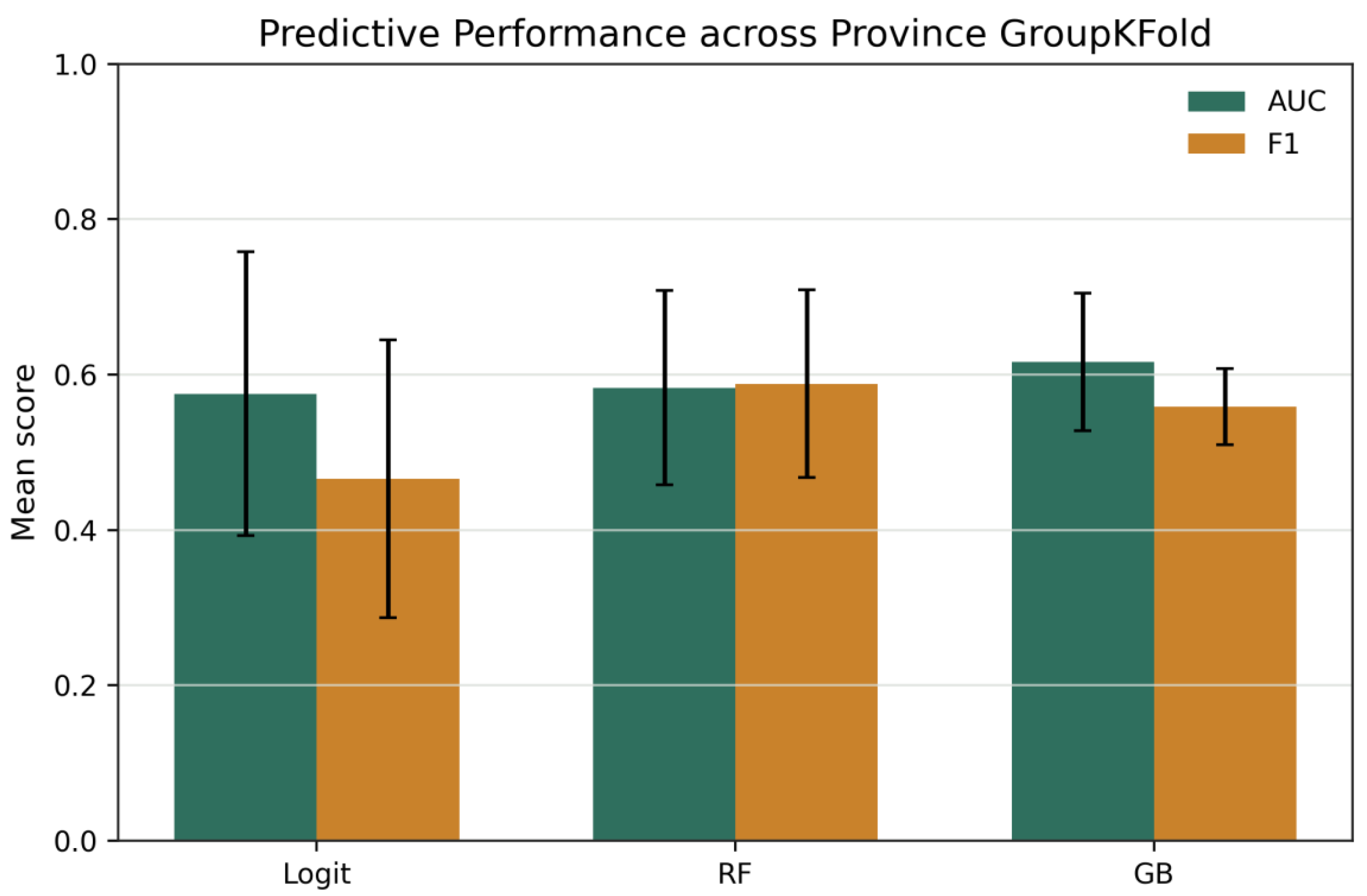
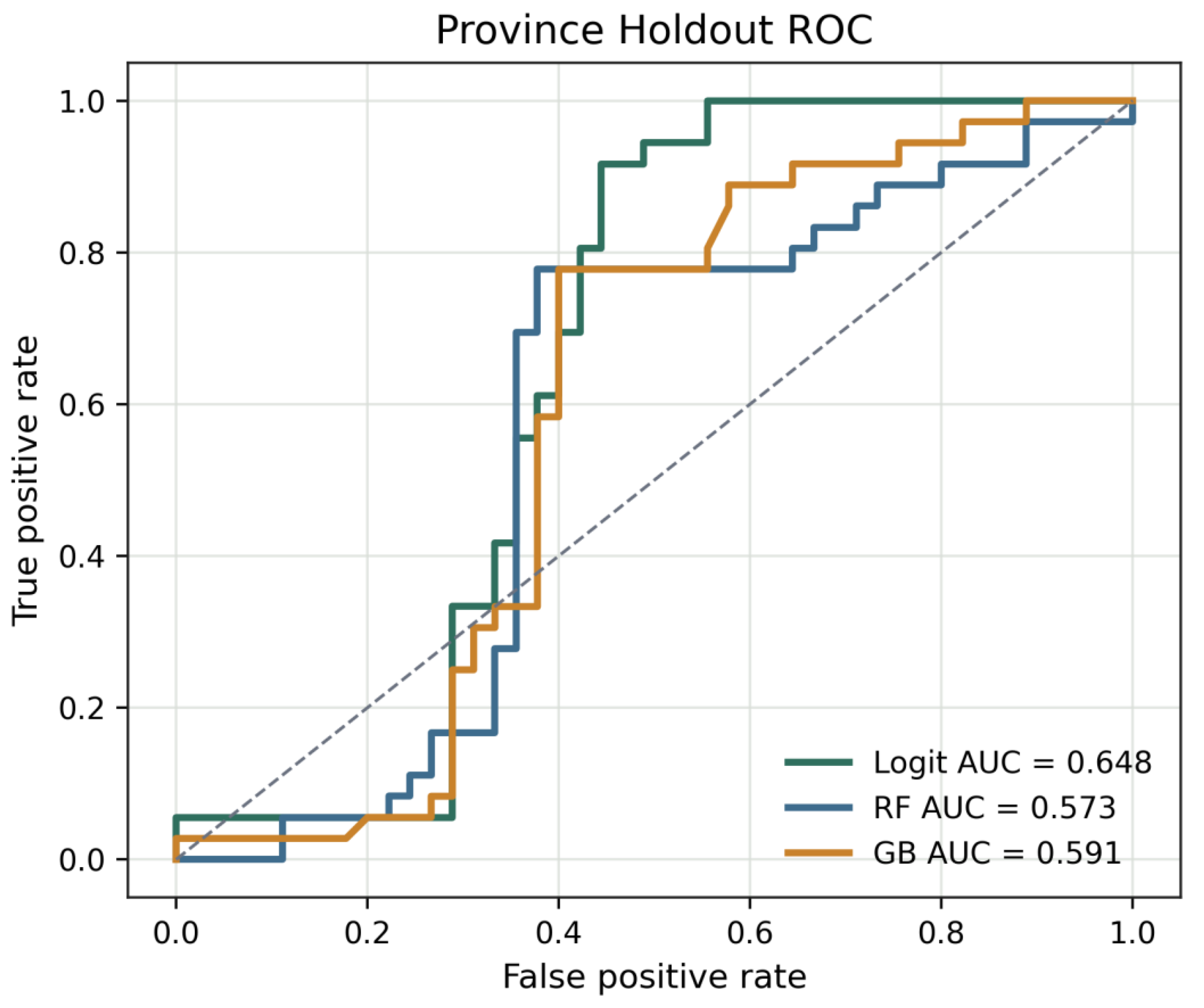
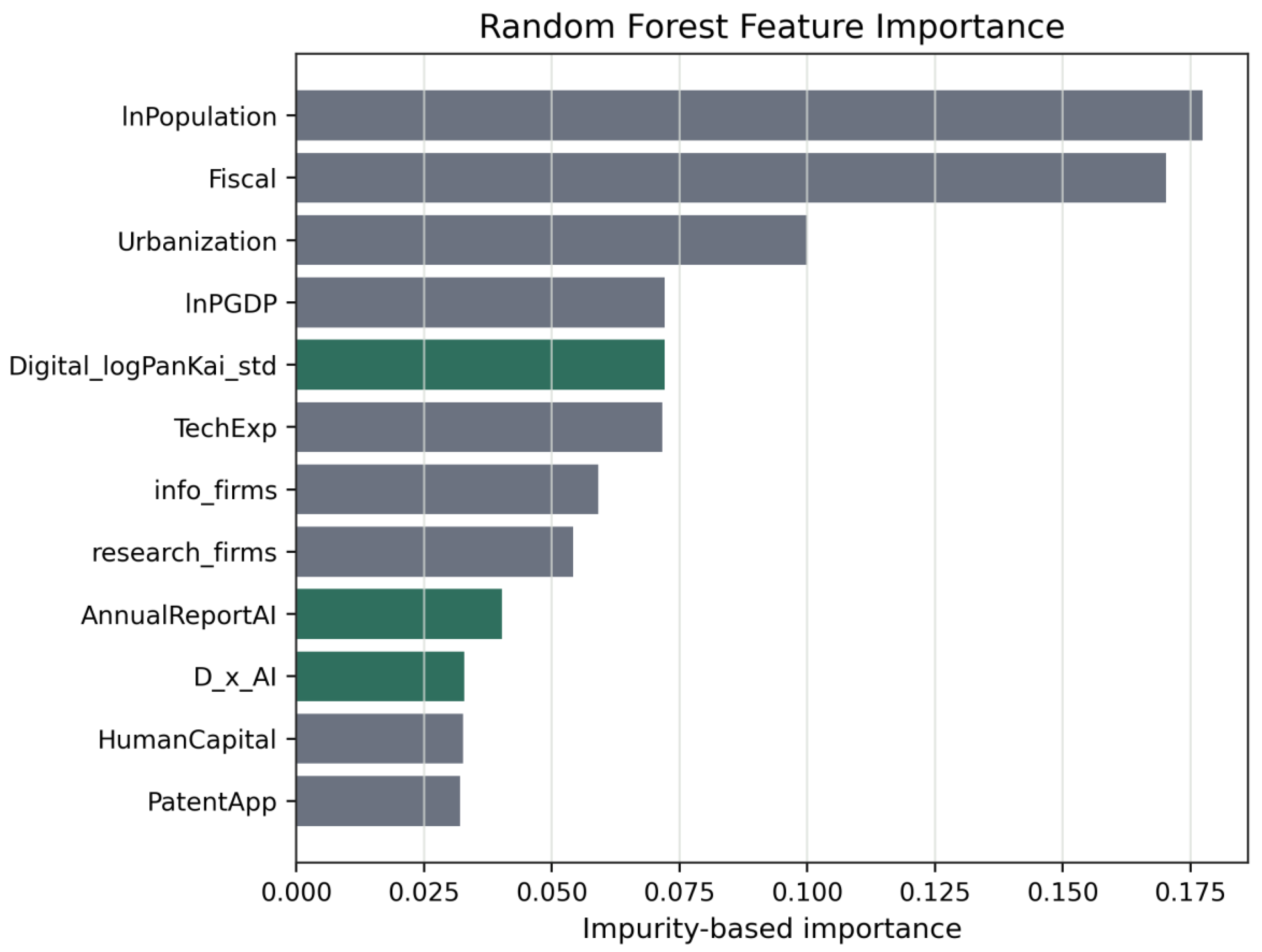
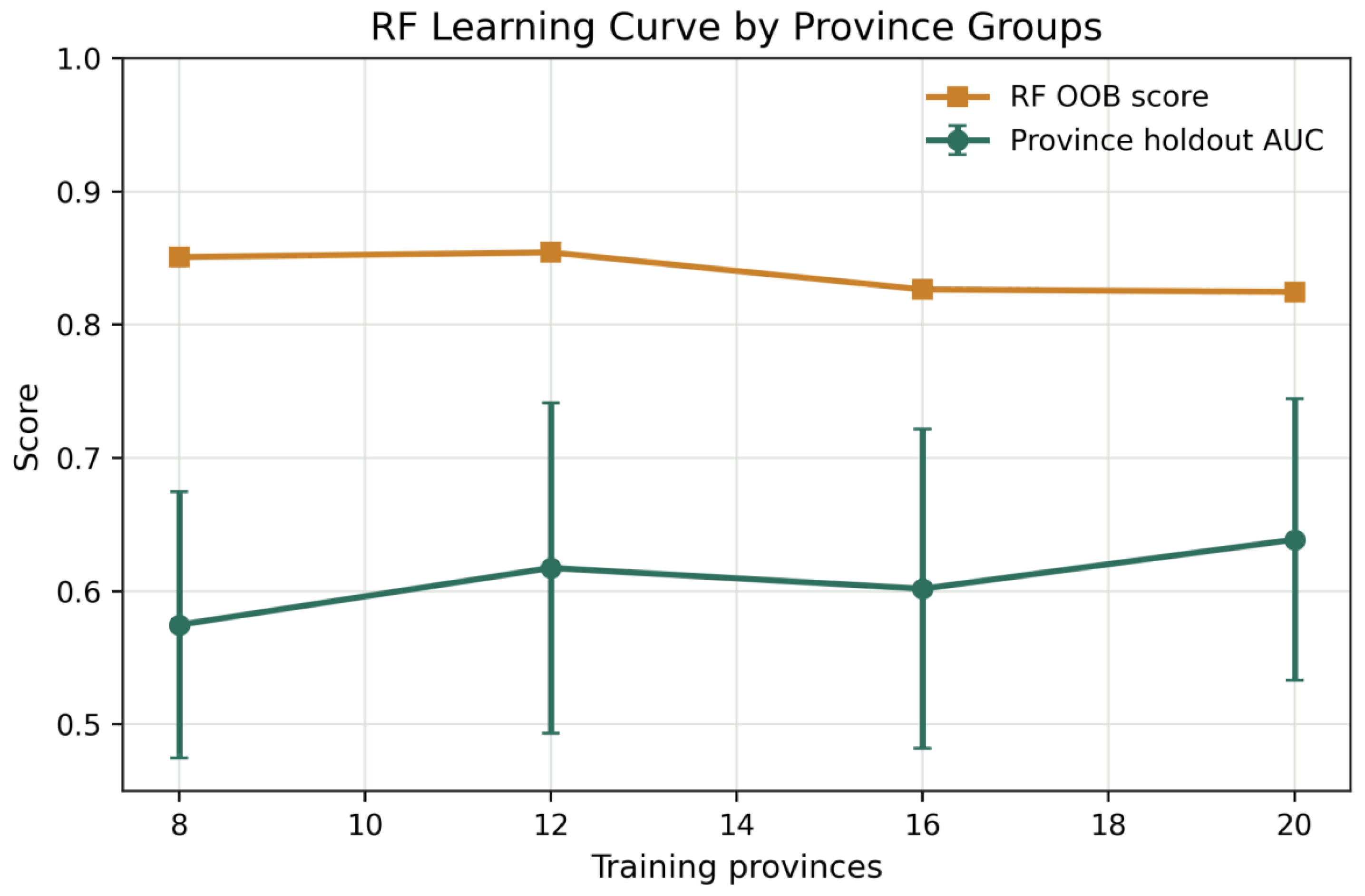
This study makes four contributions. First, it introduces a state-dependent perspective into the literature on the digital economy and industrial upgrading. Existing studies mainly estimate average effects, whereas this paper asks whether the digital economy plays a stronger role during high-EPU periods. Second, it constructs a regional AI orientation measure by aggregating firm-level annual report AI signals to the province–year level, thereby linking firm-level technology orientation to regional structural transformation. Third, it examines the three-way relationship among digital economy development, regional AI orientation, and economic policy uncertainty. This allows the paper to distinguish between AI as an independent regional driver and AI as a complement to digital infrastructure. Fourth, it asks whether the digital–AI combination carries additional predictive information for upgrading using cross-validated machine learning models; this evidence is predictive only and is not used for causal identification.
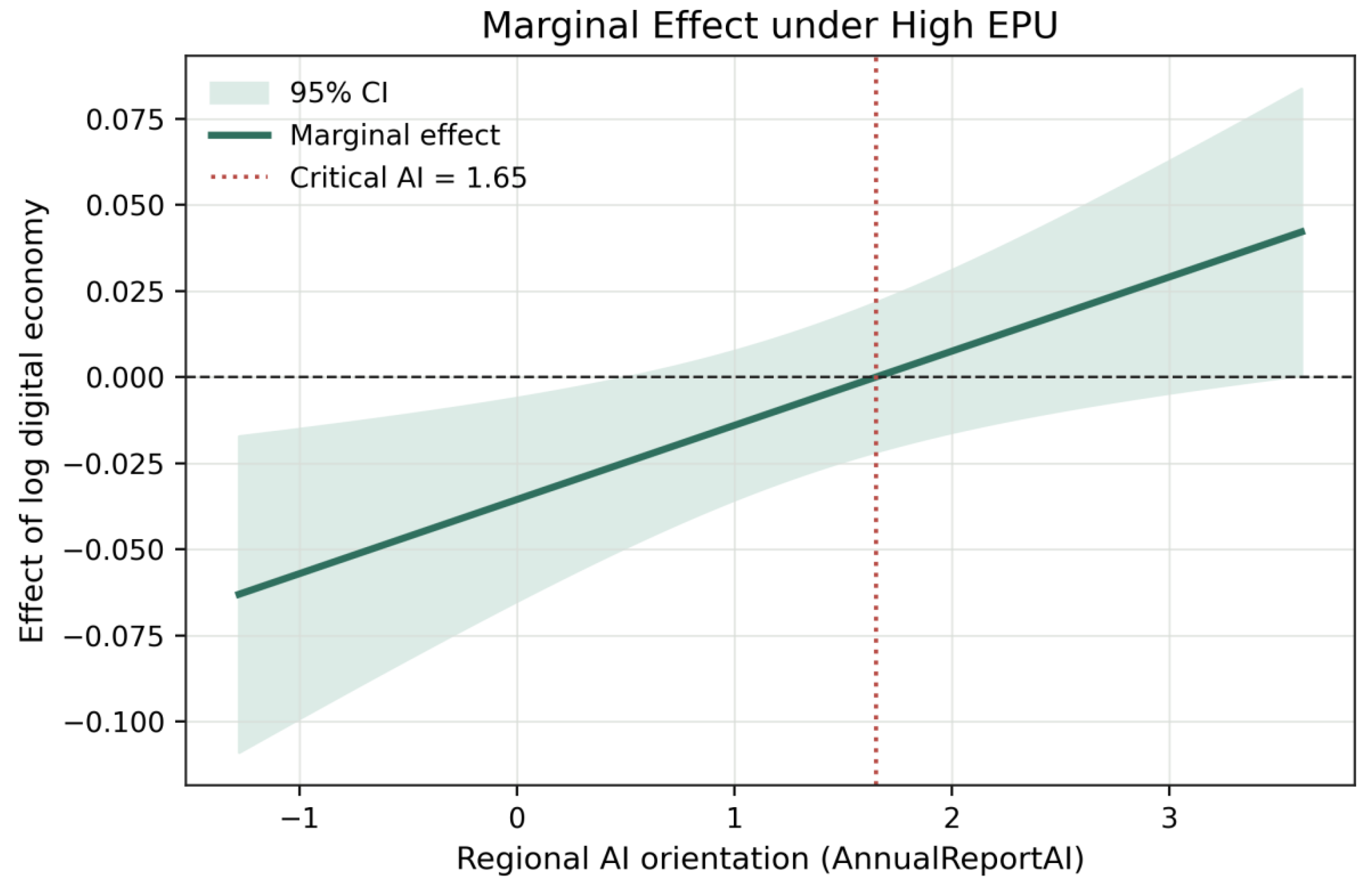
The empirical results support a conditional complementarity argument. The triple interaction among digital economy development, regional AI orientation, and high EPU is positive and statistically significant. The marginal effect analysis (
Figure 1) shows that the digital economy is not an unconditional buffer: its positive association with upgrading under high EPU appears mainly when regional AI orientation is sufficiently high. Robustness checks show that the finding is not driven by the exclusion of Tibet, by the digital finance component of the index, or by overlapping controls. Supplementary policy exposure and machine learning exercises provide additional, non-causal evidence consistent with the main mechanism.
2. Literature Review and Hypothesis Development
2.1. Economic Policy Uncertainty and Industrial Upgrading
Economic policy uncertainty (EPU) has become an important framework for understanding how ambiguity in future policy conditions affects investment, innovation, and structural adjustment.
Baker et al. (
2016) formalise EPU as a distinct macroeconomic risk and construct widely used text-based EPU indices (see (
Al-Thaqeb & Algharabali, 2019) for a review). Unlike general macroeconomic volatility, EPU captures uncertainty about the direction, timing, and intensity of government policy, including taxation, fiscal expenditure, industrial regulation, trade policy, financial supervision, and other forms of macroeconomic intervention. Because policy rules shape firms’ expectations about future costs, demand, financing conditions, and regulatory constraints, elevated EPU can affect both firm-level decision-making and regional economic transformation.
The economic consequences of EPU are usually explained through three channels. First, the real-options channel suggests that uncertainty raises the value of waiting before committing to irreversible investment (
Bloom, 2009). When firms face uncertainty about future policy conditions, they may postpone investment in new technologies, new service activities, and new organisational capabilities. This delay effect is especially important for industrial upgrading because upgrading often requires long-term and partially irreversible commitments. Second, the financial frictions channel suggests that lenders become more cautious under uncertainty, reducing credit supply and increasing financing costs for firms undertaking long-horizon projects (
Gulen & Ion, 2016;
Phan et al., 2019). Since industrial upgrading often depends on technology adoption, producer-service expansion, and intangible investment, tighter credit conditions can directly slow structural transformation. Third, the risk-premia channel suggests that investors require higher returns when policy uncertainty increases, thereby raising the threshold for new investment and discouraging projects with uncertain payoffs (
Pástor & Veronesi, 2013;
Julio & Yook, 2012).
Industrial structure upgrading is likely to be more sensitive to EPU than ordinary output growth. Short-run output fluctuations can often be absorbed through changes in capacity utilisation, inventories, or temporary labour adjustments. By contrast, industrial upgrading requires the reallocation of capital, labour, technology, and managerial attention from traditional secondary industries toward services, knowledge-intensive activities, and technology-enabled sectors. This process involves coordination among firms, financial institutions, labour markets, technology suppliers, and local governments. It also requires the formation of complementary institutions such as technology markets, producer-service platforms, and digital financial channels. These forms of structural adjustment are difficult to reverse once implemented, and their returns depend heavily on expectations about future policy stability.
Under high EPU, firms may therefore delay or scale down upgrading-related activities. Manufacturing firms may postpone service-oriented transformation, technology adoption, or participation in technology-market transactions. Financial institutions may become more conservative in extending credit to emerging service sectors or technology-intensive businesses. Local governments may also face greater difficulty in coordinating industrial policy, attracting investment, and supporting new market institutions when macroeconomic and regulatory signals are uncertain. As a result, high-EPU periods may slow the transition from manufacturing-oriented growth toward service-oriented and innovation-driven development.
Recent studies provide evidence that EPU affects structural transformation in China.
Ye et al. (
2024) and
Zhu et al. (
2022) show that EPU can restrain provincial industrial upgrading and that its effects may vary across regions and resource endowments. Related research also documents that policy uncertainty influences firm investment, cash holdings, innovation behaviour, and environmental adjustment (
Yu et al., 2021). These studies indicate that EPU is not only a macroeconomic background condition, but also a constraint on regional resource allocation and industrial transformation.
However, the existing EPU-and-upgrading literature pays less attention to the conditions under which regions can mitigate the adverse effects of uncertainty. If EPU works by increasing waiting incentives, financing constraints, information frictions, and coordination costs, then regional capabilities that reduce these frictions should help sustain upgrading during uncertain periods. Digital infrastructure is one such capability. Digital finance, digital platforms, and data-based matching mechanisms may help maintain credit access, reduce search and verification costs, and support cross-sector resource reallocation when policy uncertainty is high. Therefore, the role of the digital economy may be especially important in high-EPU periods rather than uniform across all macroeconomic conditions.
This reasoning suggests a state-dependent relationship between the digital economy and industrial upgrading. During normal periods, digital finance may promote upgrading by improving efficiency and supporting market expansion. During high-EPU periods, its role may become more defensive and resilience-oriented: it may help firms and regions continue structural adjustment despite weaker expectations and tighter financing conditions. This leads to the first hypothesis.
H1: Digital economy development is positively associated with industrial structure upgrading during high-EPU periods.
2.2. Digital Economy as Uncertainty-Buffering Infrastructure
The digital economy affects regional development by changing the cost structure of economic exchange.
Goldfarb and Tucker (
2019) argue that digital technologies reduce several fundamental economic costs, including search, replication, transportation, tracking, and verification costs. These reductions are directly relevant to industrial upgrading because structural transformation depends on the efficient movement of capital, labour, technology, and services across sectors. When search and verification costs are lower, firms can more easily identify new suppliers, customers, technology partners, and financing channels. When digital transactions and digital platforms become more widespread, market matching improves, and the cost of entering new service-oriented activities declines.
In the financial domain, digital finance can broaden access to financial services and reduce information asymmetry between borrowers and lenders. Traditional financial institutions often rely on collateral, long-term relationships, and balance-sheet indicators, which may disadvantage smaller firms, service firms, and firms engaged in intangible or technology-oriented activities. Digital finance uses transaction records, platform data, payment information, and other digital traces to improve credit assessment and risk monitoring. This can ease financing constraints and support more inclusive resource allocation (
Beck et al., 2007;
Guo et al., 2020). For industrial upgrading, this matters because new service activities, producer services, and technology-intensive businesses often require flexible financing and have fewer tangible assets than traditional manufacturing.
In China, the Peking University Digital Financial Inclusion Index has become a widely used measure of provincial digital finance development. The index captures three dimensions: coverage breadth, usage depth, and the digitisation level of financial services (
Guo et al., 2020). Coverage breadth reflects the extent to which digital financial services reach users. Usage depth captures how intensively these services are used for payments, credit, insurance, investment, and other financial activities. The digitisation level reflects the convenience, affordability, and digital intensity of financial transactions. The growing literature links digital financial inclusion and the broader digital economy to industrial upgrading, innovation, green development, and high-quality growth in China (
Wu & Shao, 2022;
Ren et al., 2023;
Y. Shen & Ren, 2023;
Zheng et al., 2023;
Jiao et al., 2024;
Li et al., 2024;
H. Shen et al., 2024;
Chen et al., 2025). Digital finance is treated here as one important resource-allocation channel within the broader digital economy, rather than as a substitute for the broader digital economy concept; the empirical section uses a multidimensional provincial digital economy index that encompasses digital infrastructure, digital industrialisation, and industrial digitisation alongside digital financial inclusion.
However, much of the existing literature focuses on the average effect of the digital economy. It usually asks whether provinces or cities with higher levels of digital finance experience faster industrial upgrading on average. This approach is useful, but it does not fully capture the state-dependent role of digital infrastructure. From a friction-reduction perspective, the economic value of digital infrastructure should be especially visible when frictions are severe. High EPU increases information asymmetry, weakens confidence, tightens financing conditions, and makes firms more cautious about entering new sectors or investing in new technologies. Under these conditions, digital finance and digital platforms may not merely promote growth; they may help preserve the functioning of resource-allocation channels that would otherwise weaken.
The uncertainty-buffering role of the digital economy can be understood through four mechanisms. First, digital infrastructure reduces information frictions. Digital platforms, payment systems, and data-based financial services generate information about firms, consumers, and transactions. This information helps reduce uncertainty about borrower quality, customer demand, supplier reliability, and market conditions. During high-EPU periods, when traditional signals become less reliable, these digital information channels can help firms and financial institutions continue making allocation decisions.
Second, digital finance can mitigate financial frictions. EPU often induces banks and investors to become more conservative. Firms engaged in service-oriented or technology-intensive upgrading may face greater difficulty obtaining credit because their assets are intangible and their returns are uncertain. Digital credit channels, online supply-chain finance, and platform-based risk assessment can provide alternative financing routes. These tools may be particularly valuable for firms attempting to maintain upgrading-related investment when traditional bank credit tightens.
Third, digital infrastructure reduces transaction costs. Digital payment systems, online platforms, logistics systems, and digital business services lower the cost of market entry and exchange. This is important for the emergence of producer services and new service activities because many such activities depend on frequent interactions, small transactions, and cross-regional service delivery. Lower transaction costs make it easier for firms to experiment with new business models and participate in service-sector expansion even under uncertain policy conditions.
Fourth, digital platforms improve spatial matching. Industrial upgrading often requires firms to connect with technology suppliers, financial service providers, professional service firms, and customers beyond their local market. Digital platforms expand the geographic scope of matching by allowing firms to access external knowledge, services, and financing. This can reduce the dependence of upgrading on local market conditions and help provinces sustain structural transformation even when local demand or policy expectations are weak.
These four mechanisms suggest that the digital economy should be interpreted not only as a source of average productivity improvement, but also as a form of uncertainty-buffering infrastructure. When EPU is low, digital infrastructure may support upgrading by improving efficiency and market expansion. When EPU is high, its role may become even more important because it helps reduce the very frictions that uncertainty amplifies. A province with stronger digital economy infrastructure is therefore expected to be better able to sustain industrial upgrading during high-EPU periods.
This state-dependent view extends the existing digital economy literature. Instead of only asking whether digital economy development promotes industrial upgrading on average, this paper asks whether the digital economy becomes more valuable when policy uncertainty is high. This distinction is important because a purely average effect approach may underestimate the resilience function of digital infrastructure. If digital economy development helps provinces maintain credit access, market matching, and resource reallocation under uncertainty, then its association with industrial upgrading should be particularly visible in high-EPU years.
2.3. Regional AI Orientation as a Complementary Capability
Artificial intelligence is widely regarded as a general-purpose technology that can reshape prediction, decision-making, task organisation, and resource allocation. Its economic significance does not only lie only in automation but also in its ability to reduce the cost of prediction and improve the quality of decisions under uncertainty (
Brynjolfsson & McElheran, 2016;
Agrawal et al., 2018,
2019;
Acemoglu & Restrepo, 2019;
Autor, 2015;
Acemoglu et al., 2022). When firms face uncertain demand, changing regulation, and unstable market conditions, AI-related capabilities can help them process information, forecast risks, identify new opportunities, and adjust production or service strategies more quickly. These functions are particularly relevant under high economic policy uncertainty, when traditional decision-making based on historical experience becomes less reliable.
However, AI does not automatically translate into regional industrial upgrading. AI-related technologies require complementary digital infrastructure, data resources, organisational routines, skilled labour, and market institutions. Without digital financial services, technology markets, and producer-service platforms, AI-related strategic attention may remain symbolic or confined to individual firms. This is why AI orientation should be understood as a complementary capability rather than a stand-alone driver. It may strengthen the effect of digital infrastructure, but it is unlikely to generate broad regional upgrading outcomes in isolation.
The growing literature has examined AI adoption, automation, and digital transformation at the firm, sectoral, and macroeconomic levels. These studies show that AI and related digital technologies can affect productivity, innovation, labour demand, task structure, and firm performance. In the Chinese context, recent studies also link AI adoption or digital transformation to industrial upgrading and high-quality development. Yet much of this literature treats AI either as a firm-level technology adoption decision or as a macro-level technological trend. Less attention has been paid to the regional aggregation of firm-level AI orientation and how this regional AI orientation interacts with digital infrastructure under policy uncertainty.
The measurement of AI orientation increasingly relies on textual information from firms’ public disclosures. Corporate annual reports contain information about firms’ strategic priorities, technology adoption, and managerial attention.
Loughran and McDonald (
2011) show that textual information in corporate disclosures can capture economically meaningful firm characteristics.
Gentzkow et al. (
2019) provide a broader methodological foundation for text-as-data approaches in economics.
Hassan et al. (
2019) demonstrate that textual disclosures can be used to measure firm-level political risk. In the Chinese context,
Yao et al. (
2024) construct firm-level AI indicators from annual reports using a machine learning-based AI dictionary.
This paper builds on this text-based measurement literature by constructing a province–year measure of regional AI orientation. The measure aggregates firm-level annual report AI signals from A-share listed companies to the provincial level. Conceptually, this variable captures the extent to which the listed corporate sector within a province displays strategic attention to AI-related technologies. It is not intended to measure the total stock of AI capital or the exact amount of AI investment. Rather, it captures a broader orientation toward AI, including managerial attention, organisational readiness, and technology absorption capacity.
This distinction between AI orientation and AI investment is important. Direct AI investment may be highly concentrated in a few large firms or technology-intensive industries. It may also reflect financial capacity rather than the breadth of AI engagement across the regional firm population. By contrast, annual report-based AI orientation can capture whether AI-related ideas and technologies have diffused across a wider set of firms. A province where many listed firms discuss AI-related technologies may have a broader base of AI awareness and organisational readiness than a province where AI investment is concentrated in a small number of firms. This breadth is especially relevant for regional industrial upgrading, which depends on a collective adjustment across sectors rather than isolated technological investment by a few leading firms.
At the regional level, AI orientation may strengthen industrial upgrading through several channels. AI-oriented firms are more likely to use digital information for prediction, risk assessment, and market analysis. They may be more capable of identifying suitable technologies in technology markets, adopting digital financial tools, and demanding sophisticated producer services such as data analytics, intelligent logistics, and IT consulting. These capabilities can improve the effectiveness of digital infrastructure. In a province with strong digital finance but weak AI orientation, digital infrastructure may exist but may not be fully exploited by firms. In a province with both strong digital infrastructure and broad AI orientation, firms may be better able to transform digital resources into upgrading outcomes.
This complementarity is especially important under high EPU. Policy uncertainty makes future market conditions more difficult to predict and increases the risks of structural adjustment. AI-oriented firms may be better able to process uncertain signals, evaluate alternative strategies, and adapt to changing policy and market conditions. Yet these advantages depend on access to digital platforms, financial data, technology markets, and producer-service ecosystems. Therefore, regional AI orientation should amplify the digital economy’s uncertainty-buffering role rather than replace it.
The expected empirical pattern follows directly from this logic. If AI orientation is a stand-alone driver, then the interaction between AnnualReportAI and HighEPU should be positive and significant even without considering digital economy development. However, if AI orientation is a complementary capability, its effect should appear mainly through the triple interaction among digital economy development, AI orientation, and high EPU. In other words, AI orientation should matter most when it is combined with a strong digital infrastructure during periods of elevated policy uncertainty.
This leads to the second hypothesis:
H2: Regional AI orientation amplifies the positive association between digital economy development and industrial structure upgrading during high-EPU periods but does not function as an independent buffer on its own.
2.4. Observable Implications: Producer Services and Regional Upgrading
The digital-AI complementarity should be visible not only in the aggregate upgrading indicator but also in service-oriented dimensions of regional structural transformation. Industrial upgrading in China is increasingly linked to producer services such as finance, logistics, information services, business services, technology consulting, and other knowledge-intensive intermediate inputs. These activities connect manufacturing firms to data, technology, professional services, and market information, and therefore provide a useful alternative outcome for assessing whether the main result reflects a broader upgrading process rather than a mechanical movement in the tertiary–secondary ratio.
Digital infrastructure can support producer-service expansion by lowering the cost of service delivery, improving cross-regional matching, and making specialised services more accessible to firms. Regional AI orientation can increase the demand for such services because AI-oriented firms are more likely to require data analytics, intelligent logistics, IT consulting, digital finance, technology brokerage, and other knowledge-intensive inputs. Under high EPU, external producer services may also reduce the irreversibility of adjustment by allowing firms to access specialised capabilities without building all of them internally.
This reasoning leads to an observable implication: if the digital-AI complementarity supports industrial upgrading under high EPU, the triple interaction should also be positively associated with producer-service expansion. Accordingly, the empirical section reports producer-service share as the main alternative dependent variable. Other mechanism-related indicators and exploratory outcomes are not treated as confirmatory evidence and are available from the authors upon request.
This mechanism framework also helps distinguish the paper’s argument from a simple “digital economy promotes services” explanation. The central claim is not only that digital finance is correlated with a higher tertiary sector share, but that digital infrastructure and AI orientation jointly support the institutional and market conditions needed for upgrading under uncertainty. In this sense, technology markets, producer services, and digital finance usage depth are not merely outcome variables; they are components of the regional capability system through which provinces adapt to high-EPU environments.
5. Discussion
The evidence supports a state-dependent complementarity between the digital economy and regional AI orientation under policy uncertainty, extending the existing literature in several respects. First, the digital economy should be interpreted as a broad regional capability rather than only as digital financial inclusion. The main result remains significant when a broader provincial digital economy index is used, and it also survives the removal of the digital financial inclusion component. Second, the effect is conditional. Digital economy development does not uniformly promote upgrading under high uncertainty; its positive association emerges mainly when regional AI orientation is sufficiently high. This conditionality distinguishes the present findings from average effect studies that document a generally positive link between digital finance and industrial upgrading (
H. Shen et al., 2024;
Yang, 2023;
Zheng et al., 2023). Those studies pool high- and low-EPU periods and treat the digital economy as uniformly beneficial, and the marginal effect analysis here shows that approximately 58.5% of sample observations have a non-positive conditional effect. The result is also consistent with
Ye et al. (
2024) and
Zhu et al. (
2022), who find that EPU constrains industrial upgrading at the provincial level; the present paper extends their work by showing that digital–AI complementarity may help mitigate this constraint under high-EPU conditions. The AI orientation finding complements
Zhang (
2025), who documents a positive AI–upgrading association at the provincial level with inclusive finance as a moderator, by showing that AI orientation matters primarily as a complement to digital infrastructure rather than as a stand-alone driver.
The heterogeneity results are treated as exploratory. Formal group-difference tests do not support strong claims that one region has a systematically larger effect. In particular, the Eastern subsample has only ten clusters, and the wild-cluster bootstrap confirms that its triple interaction is not statistically significant. The paper, therefore, avoids presenting regional heterogeneity as a core confirmatory result.
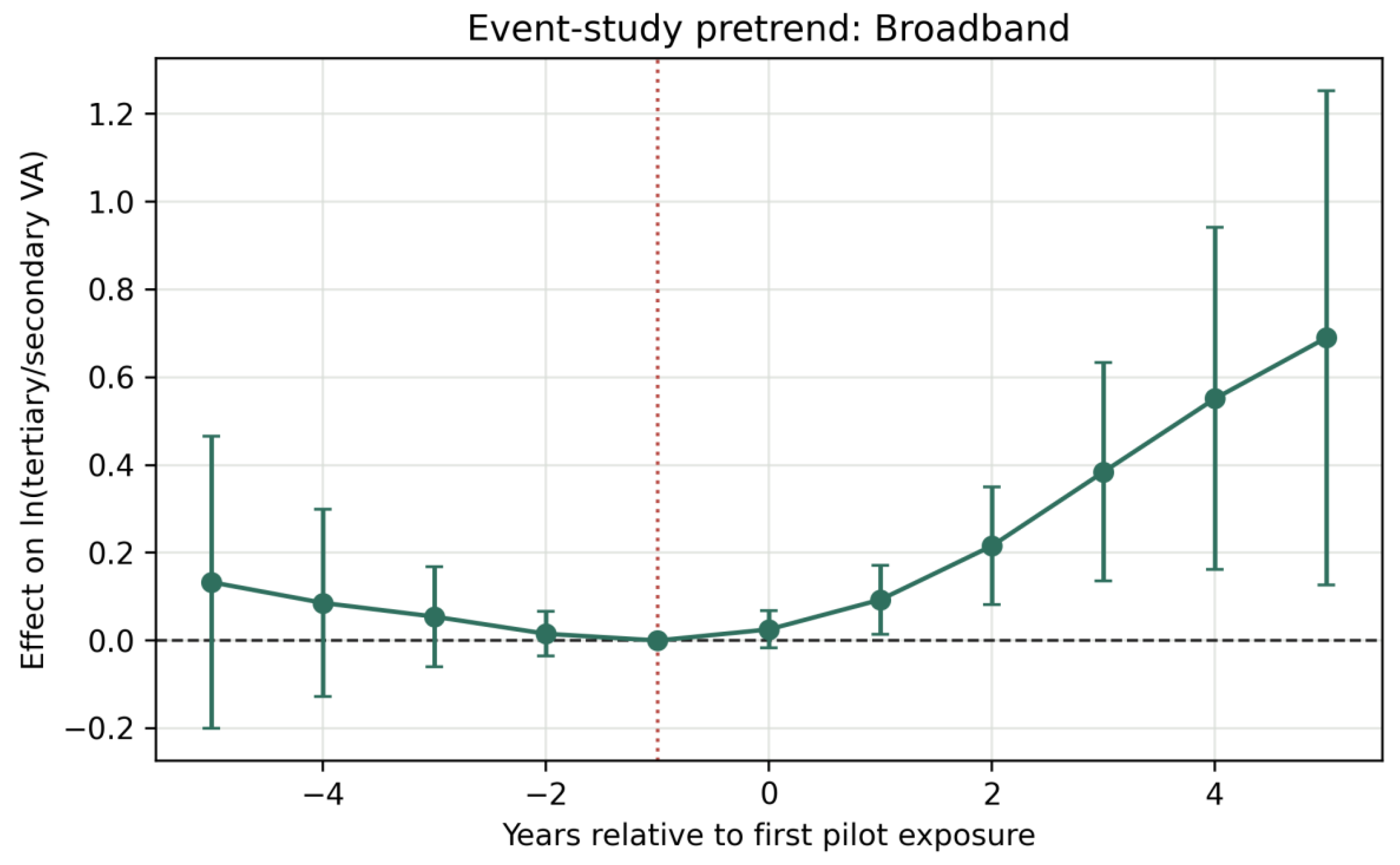
The endogeneity checks also require caution. Lagged-variable and policy exposure results are consistent with the main interpretation, and the Broadband China pre-trend evidence helps address concerns about pre-existing trends. However, policy pilots were not randomly assigned, and the IV estimates are not strong. In addition, the sample period spans only nine years (T = 9), which limits the degrees of freedom available for estimating multiple interaction terms, mechanism regressions, and heterogeneity splits within a fixed-effects framework. With a short time dimension, the stability and precision of the estimated interaction effects should be interpreted cautiously, and readers should note that the reliability of these estimates may improve as future data extend the panel. Accordingly, the findings are interpreted as conditional associations supported by supplementary evidence, rather than as definitive causal estimates.
6. Conclusions and Policy Implications
This paper examines whether the digital economy helps provincial economies sustain industrial structure upgrading under economic policy uncertainty and whether regional AI orientation strengthens this role. Using a balanced panel of 30 Chinese provinces from 2015 to 2023 and the standardised logarithm of a provincial digital economy index, the results show a positive and statistically significant triple interaction among digital economy development, regional AI orientation, and high EPU. The evidence supports a state-dependent complementarity: digital economy development is more closely associated with industrial upgrading under high uncertainty when regional AI orientation is high.
The marginal effect analysis is central to this interpretation. The digital economy effect under high EPU turns positive only after AnnualReportAI exceeds approximately 1.65, and a majority of the observations remain at or below zero conditional marginal effect. This means that the policy implication is not simply to expand digital infrastructure in isolation, but to coordinate digital economy development with firms’ AI-related capabilities and organisational readiness.
Several tentative policy implications follow, subject to the observational nature of the evidence. First, digital economy infrastructure may serve as a resilience resource during high-uncertainty periods, but its effectiveness appears to depend on complementary regional capabilities; policies aimed at deepening digital infrastructure alone may yield weaker upgrading effects without parallel investments in AI-related organisational capacity. Second, AI policy may benefit from emphasising broad organisational adoption, managerial attention, and application capacity rather than concentrating support on a small number of leading AI firms. Third, producer-service ecosystems, technology markets, and digital platforms may be most effective when developed as connected institutions that allow digital and AI capabilities to translate jointly into structural upgrading. Finally, policymakers should recognise that the evidence is conditional rather than universal: the findings do not support a blanket claim that digital economy development automatically promotes upgrading in all regions or under all conditions.
This study has limitations. Province and year fixed effects, lagged specifications, and policy exposure checks mitigate but do not eliminate endogeneity concerns. The sample covers only nine years (T = 9), which constrains the degrees of freedom for estimating interaction effects and conducting subgroup analyses within a fixed-effects framework; this short time dimension means that the reliability and stability of the estimated effects should be assessed against future data as additional years become available. The dependent variable, ln(tertiary VA/secondary VA), captures the sectoral composition of output rather than the productivity, sophistication, or technological content of industrial activity; a province can exhibit apparent “upgrading” through arithmetic expansion of services without genuine productivity improvement. AnnualReportAI is based on A-share listed firms and may not fully represent unlisted enterprises, particularly small and medium-sized firms whose AI adoption patterns may differ substantially. The text-based measure captures disclosed strategic attention to AI, which may partly reflect managerial framing or signalling incentives rather than realised AI capabilities; it is therefore best understood as AI orientation rather than verified AI adoption. The policy exposure tests are supplementary because policy pilots were not randomly assigned. Future research could combine firm-level AI adoption data, more detailed policy shocks, and micro-level industrial upgrading outcomes to sharpen causal identification.