
Article

Fiscal Antibodies: How Public Health Expenditures Strengthen National Economic Vulnerability to Climate Change


by
Abdelmoneim Bahyeldin Mohamed Metwally
1 and
Mai M. Yasser
2,*
1
Department of Accounting, College of Business Administration, King Faisal University, Al-Ahsa 31982, Saudi Arabia
2
Economics Department, Faculty of Management Sciences, October University of Modern Arts and Sciences, 6th of October City 12451, Egypt
*
Author to whom correspondence should be addressed.
Economies 2026, 14(6), 225; https://doi.org/10.3390/economies14060225
Submission received: 24 April 2026 / Revised: 9 June 2026 / Accepted: 10 June 2026 / Published: 12 June 2026
(This article belongs to the Special Issue Health Expenditures and Economic Resilience: Macro Perspectives)

Abstract

This study investigates the relationship between public health expenditures and national climate vulnerability, measured by the Notre Dame Global Adaptation Initiative (ND-GAIN) Index, across 62 developed and developing countries from 2000 to 2023. Motivated by contradictory findings in the prior literature and a lack of large-scale panel econometric evidence, this research aims to determine whether health investments significantly increase climate vulnerability. Using a dynamic generalized method of moments (GMM), the findings show that public health expenditure per capita has a statistically significant positive impact on the ND-GAIN composite index. Findings show that public health expenditure per capita has a statistically significant positive impact on the ND-GAIN composite index—where higher ND-GAIN values indicate lower climate vulnerability and greater adaptive capacity—implying that increased public health spending is associated with reduced national climate vulnerability. In high-income countries, health spending may improve adaptive capacity by leveraging established infrastructure and governance. As a result, policymakers should make funding for public health a top priority in their plans for adapting to climate change. This is because investing in health alone is not enough; they also need to invest in infrastructure, governance, and adaptive capacity, especially in developing countries.

1. Introduction

Climate change is now widely recognized as one of the defining challenges of the 21st century. Its effects reach far beyond rising temperatures, touching nearly every aspect of life—from natural ecosystems and economic stability to human health (Watts et al., 2015). The World Health Organization has gone so far as to call “climate change the single greatest threat to health in the modern era, because it fuels more frequent and more intense extreme weather events, helps infectious diseases spread to new regions”, and erodes the environmental and social conditions that keep people healthy (Atwoli et al., 2022). Vulnerable populations and countries with fewer resources to adapt are hit the hardest, further widening existing health gaps both within and between nations.
Over the past few years, researchers have started paying closer attention to how climate vulnerability interacts with health systems. One tool that has gained traction in this space is the Notre Dame Global Adaptation Initiative (ND-GAIN) Index. It offers a broad, country-level snapshot of climate vulnerability and a nation’s readiness to build vulnerability. The index covers 185 countries and looks at six key sectors: food, water, health, ecosystem services, human habitat, and infrastructure. From these, it produces a single score that reflects both how susceptible a country is to climate impacts and how well it can adapt (C. Chen et al., 2023). Importantly, the ND-GAIN composite index is scaled such that higher scores indicate lower vulnerability and greater adaptive capacity. Scores range from 0 (most vulnerable, least ready) to 100 (least vulnerable, most ready). Throughout this study, a positive coefficient on any independent variable means that an increase in that variable is associated with reduced climate vulnerability (improved ND-GAIN), while a negative coefficient indicates increased vulnerability.
However, aggregating these two conceptually distinct dimensions—vulnerability (exposure and sensitivity) and readiness (adaptive capacity)—into a single index inevitably simplifies complex realities. A country might score well on readiness but poorly on vulnerability, or vice versa. This study acknowledges this limitation and uses the overall ND-GAIN composite index as a parsimonious summary measure, while recognizing that future research should examine its sub-components separately. Understanding the determinants of this index, particularly the role of health expenditures, has become a pressing research priority.
Interestingly, existing theories point in different directions when it comes to the link between health spending and climate vulnerability. On one hand, endogenous growth theory (Romer, 1986) suggests that health expenditure is not just consumption—it is an investment in human capital that pays off through a healthier, more productive workforce. The health-led growth hypothesis follows a similar logic: healthier populations tend to be more productive, possess more human capital, and are better equipped to adapt to environmental changes. From a human capital standpoint, better health boosts productivity in several ways—greater efficiency, less sick leave, and longer working lives (Becker, 1962). On the other hand, there is a counterargument: too much health spending can become a fiscal burden, especially in poorer countries. It might crowd out investments in education, infrastructure, or other areas that also drive growth and vulnerability.
It is precisely these contradictions and gaps in the evidence that motivated the current study. We set out to analyze 62 developed and developing countries between 2000 and 2023, using fixed-effects and dynamic GMM models to see how health expenditures relate to climate vulnerability, measured by the ND-GAIN index. Along the way, we aimed to make a few key contributions. First, we provide broad empirical evidence on the health spending–climate vulnerability relationship across a diverse set of countries, which allows for meaningful comparisons between richer and poorer nations. Second, we separate public health spending from out-of-pocket payments, offering a clearer picture of how different financing models affect adaptive capacity. Third, by using dynamic panel GMM, we directly tackle the endogeneity issues that have clouded earlier cross-sectional and descriptive work. And fourth, we include a range of control variables—GDP per capita, life expectancy, physician density, population aging, and urbanization—so the authors isolate the effect of health spending from other factors that also shape climate vulnerability.
A critical limitation of prior studies—and a potential explanation for their contradictory findings—is the systematic omission of key direct and indirect factors that simultaneously influence health expenditures and climate vulnerability. For instance, governance quality affects both public health spending efficiency and a nation’s adaptive capacity; infrastructure stock mediates whether health investments translate into resilience; and institutional trust influences the uptake of public health interventions. Two countries with identical health expenditure per capita may exhibit divergent climate vulnerability outcomes precisely because one possesses robust infrastructure and effective governance while the other does not. Cross-sectional and descriptive analyses (e.g., Sabiruzzaman et al., 2021; Pinho-Gomes & Jamart, 2024) cannot account for such unobserved heterogeneity, whereas panel econometric methods can. This study explicitly addresses this omission by employing dynamic GMM estimation, which controls for time-invariant unobserved factors and potential endogeneity, thereby providing a more comprehensive and integrated analysis of the health expenditure–climate vulnerability nexus.
The rest of the paper is organized as follows. Section 2 walks through the theoretical and empirical literature on health spending and climate vulnerability. Section 3 describes the data, variables, and econometric approach. Section 4 presents the results, including descriptive stats, correlation, unit root tests, diagnostics, and panel regressions. Section 5 discusses what those findings mean in light of previous research and theoretical expectations. Finally, Section 6 wraps up with policy implications and ideas for future research.

2. Literature Review

Empirical investigations into the relationship between health expenditures and climate adaptation, as measured by the Notre Dame Global Adaptation Initiative (ND-GAIN) Index, have expanded considerably over the past decade. Unlike theoretical work that posits causal mechanisms, empirical studies have sought to quantify the strength, direction, and significance of associations between various forms of health spending—public, private, and external—and countries’ vulnerability and readiness scores (C. Chen et al., 2023; Keim, 2008).
This section will be divided into two main subsections, with the first covering the most important theories that address the relationship between public health determinants and the vulnerability of nations. In contrast, the second subsection will provide an overview of the empirical literature examining that relationship.

2.1. Theoretical Background

This part tackles two of the main theories that explain the relationship between vulnerability and public health expenditures, while introducing a theoretical overview of the ND-GAIN index.

2.1.1. Health-Led Growth

The health-led growth hypothesis argues that public investments can act as a strong engine of economic growth. This proposition draws directly from endogenous growth theory, which emphasizes human capital accumulation and investment as fundamental engines of economic expansion (Klotzbach et al., 2003). The underlying logic is straightforward: healthier populations are more productive and embody greater human capital, which in turn generates higher output, fosters innovation, and enhances the economy’s ability to adapt to changing circumstances. Within this framework, health expenditure is conceptualized not as mere consumption but as an investment that yields economic dividends through improved population health, increased labor productivity, and demographic dividends (Romer, 1986).
The relationship between health expenditures and economic vulnerability can be explained through different mechanisms; one of them is the ND-GAIN’s vulnerability and readiness index. These can be done by:
  • Labor productivity channel: Healthier populations exhibit higher physical and cognitive capacity, lower absenteeism, and longer working lives. Bloom and Canning (2000) established that a 1-year increase in life expectancy raises output by approximately 4%. In the context of climate vulnerability, a productive workforce is better able to implement adaptive measures, rebuild after disasters, and diversify livelihoods.
  • Human capital formation channel: Health spending in early childhood improves cognitive development and educational attainment (Becker, 1962). Better-educated populations are more likely to understand climate risks, adopt early warning systems, and demand adaptive infrastructure. This mechanism is particularly relevant for ND-GAIN’s readiness component, which includes indicators of education and innovation capacity.
  • Institutional effectiveness channel: Public health spending that strengthens ministries of health, disease surveillance systems, and regulatory agencies also enhances the broader institutional capacity to manage climate risks. Effective institutions can coordinate multi-sectoral adaptation—integrating health warnings with evacuation orders, linking disease monitoring with weather forecasting (E. Chen & Zhang, 2025).

2.1.2. Theory of Human Capital

This theory refers to the acquisition of knowledge, skills, education, and health that are characterized by three main characteristics: productive (to enhance economic growth), investable that can be developed by the investment in education and training, health, and nutrition, and depreciable by age or disease (Becker, 1962). The healthier the individual is, the more productive they will be and the less of a threat to the country’s vulnerability. Thus, these characteristics are vital to any human capital that is the main engine for the vulnerability of nations.
From a human capital perspective, health expenditures enhance labor productivity through several mechanisms. Healthy populations demonstrate higher efficiency, lower absenteeism, and extended working lives, thereby augmenting both the quality and quantity of labor available for production. Bloom and Canning (2000) established that improvements in life expectancy correlate directly with increased economic growth rates, providing an empirical foundation for the human capital channel.
E. Chen and Zhang (2025) provide empirical evidence that public health expenditure enhances urban economic vulnerability through technological innovation and per capita GDP as mediating pathways. Their spatial econometric analysis reveals significant positive spillover effects to neighboring regions, suggesting that health investments generate external benefits beyond administrative boundaries.
Conversely, excessive health spending can create fiscal burdens, particularly in less wealthy countries. High public health expenditure may necessitate higher taxes or crowd out investment in education, infrastructure, and other growth-enhancing sectors.

2.1.3. Notre-Dame Adaptive Initiative Index (ND-GAIN)

Since the 1980s, vulnerability has become more common, especially in research on environmental and climate risks. To understand vulnerability in the context of climate change, it is important to define climate change itself as the shift in climate patterns caused directly or indirectly by human activities, beyond natural climate variability. The negative effects include changes to the physical environment that harm ecosystems, socioeconomic systems, and human health (Torres, 2025).
Vulnerability has many factors, such as the ability to respond to climate change and respond to it (Wisner et al., 2004). Although every country faces some level of climate vulnerability, its intensity varies. People and nations with fewer resources struggle the most to cope with and adapt to climate change. Understanding vulnerability requires considering social, economic, and political dimensions. For countries, it is essential to examine these factors along with their economic and political resources to address and adapt to climate impacts.
The Notre Dame Global Adaptation Initiative (ND-GAIN) measures a country’s climate vulnerability alongside its readiness to build resilience. ND-GAIN currently evaluates 185 countries based on two dimensions: vulnerability and readiness. The overall index combines both (C. Chen et al., 2023). ND-GAIN measures vulnerability across six sectors—food, water, health, ecosystem services, human habitat, and infrastructure—using 36 indicators.
The ND-GAIN composite index is scaled such that higher scores indicate lower vulnerability and greater adaptive capacity. Scores range from 0 (most vulnerable, least ready) to 100 (least vulnerable, most ready). This inverse relationship between the index value and vulnerability is critical for correctly interpreting regression coefficients throughout this study. A positive coefficient on any independent variable indicates that an increase in that variable is associated with reduced climate vulnerability (improved adaptive capacity), while a negative coefficient suggests increased vulnerability.

2.1.4. Climate Adaptation Spending as Indirect Health Protection

A third theoretical perspective, distinct from both the health-led growth hypothesis and standard human capital theory, emphasizes the health co-benefits of public spending that is not explicitly labeled “health” but nonetheless reduces climate-related morbidity and mortality. Governments allocate substantial resources to climate adaptation—defined by the IPCC as “adjustments in ecological, social, or economic systems in response to actual or expected climatic stimuli and their effects”. These adaptation expenditures include flood defense systems, heatwave early warning protocols, climate-resilient housing and infrastructure, coastal protection (e.g., mangrove restoration, seawalls), and drought-resistant water supply systems. Each of these investments indirectly protects public health by reducing exposure to climate hazards, decreasing sensitivity to those hazards, or enhancing adaptive capacity.
The health protection value of adaptation spending is well-documented. Flood defenses reduce drowning risk, waterborne disease outbreaks (e.g., cholera, leptospirosis), and mental health sequelae of displacement (Few et al., 2004). Heatwave early warning systems, when combined with cooling centers and public outreach, have been shown to reduce excess mortality by 40–50% in European cities (Toloo et al., 2013). Climate-resilient housing—elevated structures, storm-resistant roofing, improved ventilation—reduces injury risk from extreme weather events and ameliorates heat-related illness. Coastal protection investments, including mangrove restoration and coral reef conservation, attenuate storm surges and reduce mortality from tropical cyclones (Das & Vincent, 2009).
From a fiscal perspective, adaptation spending can be viewed as primary prevention for climate-sensitive health outcomes, whereas direct health spending represents tertiary prevention (treatment and rehabilitation). This study acknowledges that our empirical specification does not directly measure adaptation spending due to data availability constraints. Cross-nationally comparable indicators of public adaptation expenditure are not systematically reported in World Bank or IMF fiscal databases, and where reported, they are often aggregated with broader environmental protection budgets. However, we explicitly recognize this omission as a source of potential bias and interpret our results with appropriate caution. The GMM estimator partially mitigates this concern by controlling for time-invariant country-specific factors (including stable differences in adaptation spending patterns) and by using lagged instruments that absorb persistent unobserved heterogeneity.

2.1.5. Differential Pathways in Developed Versus Developing Countries

The mechanisms linking health spending to climate vulnerability are not universal; they depend critically on existing institutions, infrastructure, and governance quality. Developed and developing countries, therefore, exhibit fundamentally different pathways. In developed countries (high income, strong institutions, established infrastructure):
  • Public health expenditures operate as enabling investments. Because water systems, early warning networks, and disaster preparedness are already functional, additional health spending can focus on marginal improvements in adaptive capacity—e.g., heatwave response plans, vector control programs, climate-resilient hospital design.
  • Strong good governance ensures that health spending complements rather than crowds out other adaptation sectors. Ministries (health, water, agriculture, disaster management) have institutional coordination.
  • High baseline infrastructure implies that investments in health translate directly into lower morbidity and mortality from climate-sensitive health outcomes, as captured by ND-GAIN’s health vulnerability.
  • Expected relationship: Negative coefficient on ND-GAIN (i.e., health spending reduces vulnerability) or positive coefficient with small magnitude.
In developing countries (low to middle-income, weak institutions, incomplete infrastructure):
  • Public health expenditures may face crowding-out effects. When governments increase health budgets without increasing total fiscal space, funds must be diverted from other sectors—often water infrastructure, irrigation systems, coastal protection, or disaster preparedness. These omitted investments are themselves critical for climate adaptation.
  • Weak governance and coordination failures mean that health spending may not reach intended populations or may duplicate efforts across agencies. Corruption and inefficient procurement further reduce effectiveness.
  • Inadequate infrastructure (unpaved roads, unreliable electricity, limited telecommunications) constrains the ability of health investments to translate into reduced vulnerability. A new hospital is useless if roads to reach it wash out in floods.
  • Household out-of-pocket spending (PKT) may become the de facto adaptation mechanism, as observed by Hassan (2024) in Bangladesh. This impoverishes vulnerable populations and erodes long-term adaptive capacity.
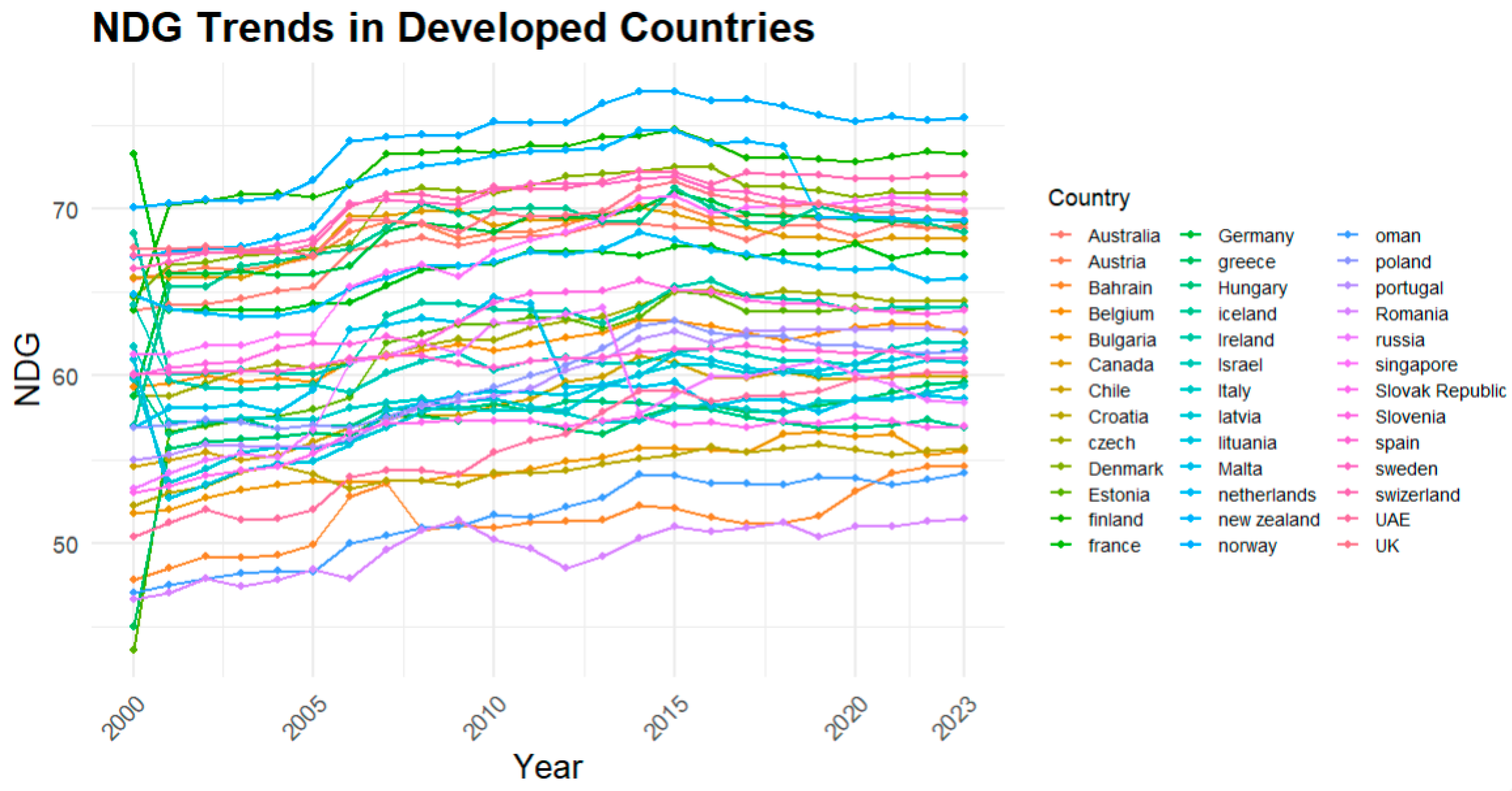
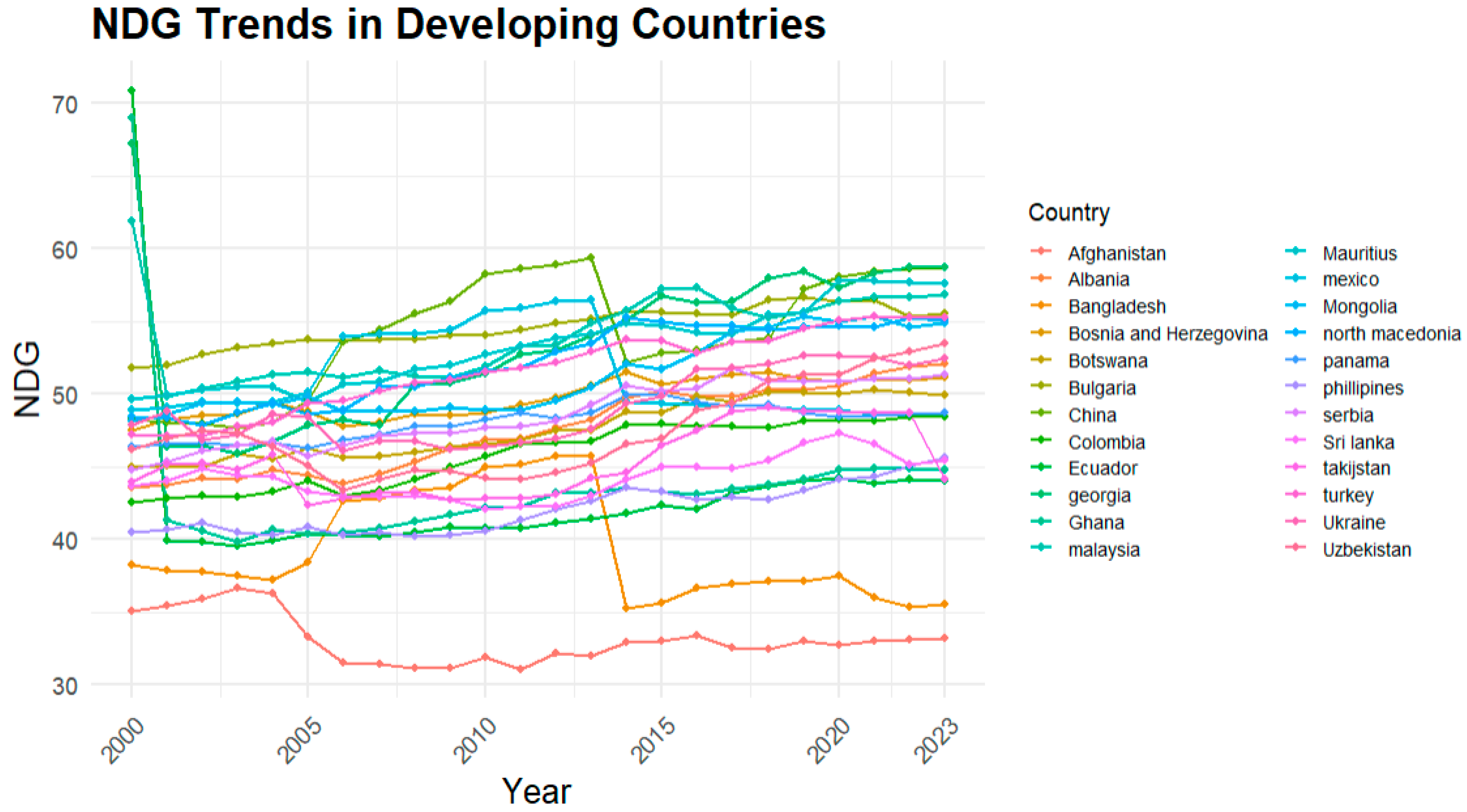
Expected relationship: This was reflected in Figure 1 and Figure 2, explaining the trends of ND-GAIN in each group, whether developed or developing. Here in Figure 1, it presents ND-GAIN trajectories for 27 developed countries over the same period, showing generally higher absolute scores (ranging from 44 to 73) but a distinctly different pattern—many developed economies, including Australia, Germany, and Poland, experienced modest declines or stagnation after 2015, with scores plateauing or slightly decreasing from peak values reached around 2010–2015. In contrast, in Figure 2, the temporal trends in ND-GAIN scores across 24 developing countries from 2000 to 2023 reveal a consistent upward trajectory in climate adaptive capacity (reducing vulnerability) for all nations in this subsample. Uzbekistan and Ukraine consistently score higher on the ND-GAIN (71–74 by 2023) than Afghanistan and Albania (56–60). This pattern of convergent improvements suggests that global efforts and investments in health systems have been collectively beneficial for developing countries, but the maintained ranking implies that initial conditions and structural factors continue to play a role in relative vulnerability positions. This divergence between the two figures carries important substantive implications: while developing countries exhibit consistent, linear improvement in climate adaptive capacity, developed countries show signs of saturation or even reversal, potentially reflecting the mounting costs of climate impacts that outpace adaptation investments, aging infrastructure, or the diminishing marginal returns of additional health spending once basic adaptive capacity is established. Taken together, these contrasting trajectories validate the authors’ decision to analyze developed and developing countries separately, as the underlying dynamics of climate vulnerability reduction appear fundamentally different across income groups—a pattern that the subsequent GMM regression analysis quantifies and explains through heterogeneous coefficients for public health expenditures and other determinants.

2.2. Empirical Literature

The idea of climate change and the vulnerability of nations to changes in climate is widely studied in the literature. Climate change is affected by many factors, such as global warming, water stress, overproduction, and ocean acidification (Tang, 2010). These factors affect individuals and animals as well as the environment, and finally, the health of humans.
The literature in the sense of the relationship between public health expenditures on one side and vulnerability of nations on the other side was divided into three main streams. In the first stream, the studies concluded that there is a positive relationship. (Hassan, 2024) found that the relationship between health expenditures and vulnerability is positive by adding remittances, migration, and out-of-pocket payments in Bangladesh using the instrumental variable approach for a questionnaire of 610 households. Also, (Sabiruzzaman et al., 2021) studied this relationship in 11 Southeast Asian countries using ND-GAIN, the WHO database, and World Bank data using a descriptive approach, not an econometric one. This study concluded that five high-income countries exhibit a positive relationship and rapid action on climate change.
Vulnerability to climate change refers to the degree to which nations are sensitive to the negative consequences of climate change and the systems or actions adopted by individuals to adapt to those changes (Kc et al., 2015; Smit & Wandel, 2006). As adaptations differ across countries, vulnerability should be studied. One of these indicators is Notre-Dame (ND-GAIN), which will be studied in 62 developed and developing countries.
Also, Pinho-Gomes and Jamart (2024) found that there is no association between health expenditures and vulnerability of nations using ND-GAIN in 48 projects in the health sector in many countries, using a descriptive approach between 2019 and 2024. It concluded that there is no relationship between them due to the presence of some other factors, such as the ability of economies to adopt these projects in an efficient way. Thus a list of summary of refrences as explained in Table 1.
While the existing literature has examined the relationship between health expenditures and ND-GAIN vulnerability scores, findings remain contradictory and methodologically fragmented. Previous studies that were conducted using descriptive analytical methods without econometric rigor (Sabiruzzaman et al., 2021), single-country designs that restrict generalizability (Hassan, 2024), or null results that do not investigate moderating factors (Pinho-Gomes & Jamart, 2024) suffer from critical methodological limitations. Furthermore, no study has systematically compared this relationship across a large panel of both developed and developing countries using panel econometric techniques controlling for country-specific heterogeneity, time trends and potential endogeneity. This study seeks to fill this gap by looking at 62 developed and developing countries over a long period, employing fixed-effects and instrumental-variable regressions to assess if health expenditures significantly reduce climate vulnerability, measured by ND-GAIN. This will be done by testing the following hypothesis:
H1. 
There is a positive relationship between health expenditures and ND-GAIN.
H2. 
Economic growth is positively associated with better vulnerability across nations.
H3. 
Life expectancy is positively associated with vulnerability across nations.

3. Methodology

This study aims to examine the relationship between public expenditures and the vulnerability of nations across 62 countries from 2000 to 2023. The choice of these countries is due to data availability and to consider the variations in countries’ locations and income levels. The authors relied on variables common in most of the literature, as stated in Table 2. The authors depend on ND-GAIN as the dependent variable, while all other variables will be independent variables. The data were lagged due to the large gap between the maximum and minimum during the descriptive statistics run and the variation in the units of the variables.
In studying the vulnerability of nations, the authors used the Notre-Dame Global Adaptive Initiative (ND-GAIN). It was created for 182 nations by the University of Notre-Dame. This index ranged from 0 to 100 and tests the ability of nations to handle climate change depending on two sub-indices: vulnerability and readiness (Dekhkanova et al., 2025). Regarding vulnerability, it discusses the ability of these nations to be negatively impacted by climate change, while readiness refers to the use of different investments to take adaptive actions to these climate changes (Pei et al., 2025).
In all regression models that follow, the dependent variable is the log-transformed ND-GAIN composite index. Because higher ND-GAIN values indicate lower climate vulnerability and greater adaptive capacity, a positive estimated coefficient implies that an increase in the independent variable reduces climate vulnerability, while a negative coefficient implies that an increase in the independent variable increases climate vulnerability. Readers should keep this inverse interpretation in mind when reviewing the results tables.
The authors used the Notre-Dame Global Adaptive Initiative (ND-GAIN) as the dependent variable, while all other variables were independent variables. Firstly, descriptive statistics, correlation, unit root tests, and diagnostic tests will be run to examine the data. Then, a different regression econometric model will be used to test the data across all countries and within each group of countries (developed and developing), which will be presented in Appendix A and Appendix B. That said, the current study uses secondary country-level data from publicly available international databases. The data are fully aggregated and contain no personal, identifiable, or confidential information. As the research does not involve human participants, surveys, interviews, experiments, or access to sensitive personal data, formal ethical approval and informed consent were not required. The study was conducted in accordance with accepted standards of research integrity, transparency, and responsible use of publicly available data.
These models will be pooled OLS and dynamic GMM. The reason for using GMM is its ability to deal with endogeneity by using lagged values of the independent variables as instruments, which is important when the current values of the predictors are determined by previous realizations of the dependent variable. Such a dynamic structure is often observed in disciplines such as international business studies (Li & Liu, 2025). To deal with potential endogeneity (Blundell & Bond, 1998; Kruiniger, 2009), we use the GMM estimator, which is well suited for panels with more cross sections than time points. This regression model will be extracted from the following function number (1):
N D G = f ( P K T , E X P , G D P , L I F E , L A B O R , P O P , U R B )
Due to the endogeneity in panel data and differences in elasticities between countries, the GMM model will be applied depending on the following function in Equation (2):
log N D G = a 0 +   a 1 log P K T +   a 2 log E X P +   a 3 log N D G ( 1 ) + a 4 log G D P +   a 5 log L I F E +   a 6 log L A B +   a 7 P O P +   a 8 U R B +   ε  
In dynamic panel data models that include a lagged dependent variable, the ordinary least squares (OLS) estimator with fixed effects is biased and inconsistent due to correlation between the lagged outcome and the transformed error term (Nickell, 1981). This bias is severe in panels with a small time dimension (T) and a large cross-section (N), which characterizes our dataset. To overcome this issue, the system generalized method of moments (GMM) estimator introduced by Blundell and Bond (1998) is preferred, as it combines difference and level equations with appropriate internal instruments, yielding consistent and efficient estimates. Therefore, we rely on system GMM for our main inference, while OLS results are presented only for comparison in the Appendix A.
To address the risk of instrument proliferation—a common criticism of dynamic GMM (Roodman, 2009)—we restrict instruments to lags 2 through 4 of the endogenous variables and collapse the instrument matrix. This reduces the instrument count to 34, which is below the number of countries (62). The Hansen J-test confirms the validity of our instrument set (χ2 = 31.47, p = 0.29), and the number of instruments does not exceed the cross-sectional dimension.

4. Results

The results section will be divided into subsections: first, the validity of the data will be examined using descriptive, integration, and unit root tests; second, diagnostic tests and GMM tests.

4.1. Validity of Data

Descriptive statistics integration tests were run first to examine the validity of the data. Table 3 shows descriptive statistics, with the highest mean for NDG (56.9300) compared to LABOR (2.73641). The standard deviations explain the variability of the data. The highest variability was in PKT, which expresses the individuals’ expenditures on health, while the lowest was in URB, as most countries have a steady-state urbanization rate with limited changes in some countries.
A correlation test was performed in Table 4, as it shows positive relationships between NDG and other variables except for PT and URB. Also, there are negative relationships between GDP and PKT and URB. There are negative relations between PT and all other variables.
Table 5 shows the results of unit root tests testing the stationarity of the data. It shows that all variables are stationary at the 1st difference with limited significance at the level.
Then, diagnostic tests were performed as shown in Table 6. The diagnostic analysis reveals three key findings. First, cross-sectional dependence is strongly present, suggesting that unobserved common shocks or spatial spillovers affect all cross-sectional units simultaneously. Second, the Breusch–Pagan LM test rejects homoskedasticity, indicating that error variances differ systematically across units or over time. Third, the Arellano–Bond test for serial correlation yielded an AR(1) m-statistic of 1.45768 (p = 0.014) and an AR(2) m-statistic of 0.588 (p = 0.560). While the insignificant AR(2) confirms the validity of our instrument set, the significant first-order autocorrelation is typical for differenced GMM models.

4.2. Panel Regression Tests

Then, panel regression tests were used to estimate the relationship between health expenditures and vulnerability of nations, beginning with ordinary least squares (OLS) in its fixed effect, then generalized method of moments (GMM).
Appendix A shows the results of panel regression tests (OLS, dynamic GMM). The use of dynamic GMM is confirmed, as most of the results of OLS inherit bias or endogeneity in large data sets.
Regarding the results shown in panel A, OLS results were represented as there is a positive impact of all variables on ND-GAIN, except that out-of-pocket has a negative impact. Also, URB, LIFE, and POP, they have a positive impact on NDG, except in developed countries. Regarding EXP, it has a positive impact on NDG, except in developing countries, as well as on GDP.
The analysis was run for the full sample and then divided into developed and developing. Regarding the results of dynamic GMM for the full sample, the results show that a higher ND-GAIN will lead to lower vulnerability. All variables were positively related to vulnerability, such as public health expenditures, GDP per capita, out-of-pocket spending, health labor, urbanization and life expectancy. Also, the value of NDG(−1) suggests that vulnerability persists over time.
Compared to developed countries, improvements in public health in developing countries show a positive coefficient (+3.088), indicating that health spending is associated with reduced vulnerability. The negative coefficient in developed countries (−1.443) suggests that additional health spending in high-income nations is associated with increased vulnerability. For developing countries, the positive effect was obvious in the results of out-of-pocket on ND-GAIN, but the significance was found in health labor, out-of-pocket, population above 65 and urbanization rate.

5. Discussion

The significant positive impact of public health expenditures on the ND-GAIN index—and therefore on reduced climate vulnerability—was confirmed through the use of OLS and dynamic GMM tests as shown in Appendix A. That is, higher public health spending is associated with higher ND-GAIN scores, which signify lower vulnerability and greater adaptive capacity. These results aligned with the United Nations Sustainable Development Goals (UN-SDGs), which aim to increase the economies’ ability to combat health poverty (goal 3) and therefore enhance the economic growth of nations (goal 8), ending with the sustainability of nations (goal 11). Also, these results are consistent with (Baumgart, 2022; Sabiruzzaman et al., 2021; Saidmamatov et al., 2024), which show the positive impact of public health expenditures on economic growth in East Asian countries and the MENA region. Also, these results were confirmed in the long run as well as in the short run (Wang et al., 2019), which were examined in Pakistan.
Because both dependent and independent variables (with the exception of POP and URB, which enter at levels due to theoretical considerations regarding demographic transitions) are log-transformed, the coefficients reported in Table A1 can be interpreted directly as elasticities. This facilitates meaningful comparisons across variables and subsamples.
A 1% increase in public health expenditure per capita (EXP) is associated with a 0.738% increase in ND-GAIN, implying reduced climate vulnerability. GDP per capita exhibits the largest elasticity among continuous variables (1.262), indicating that economic growth is the strongest driver of adaptive capacity in the full sample. Life expectancy (LIFE) shows a substantial elasticity of 5.691—though this should be interpreted cautiously given that life expectancy changes only gradually over time; a 1% increase (approximately 0.76 years at the mean of 76.2 years) would require multiple decades to materialize.
The elasticity of EXP is negative in developed countries (−1.443) and positive in developing countries (3.088). Following our interpretation rule, in developed countries, health spending is associated with increased vulnerability (negative coefficient = higher vulnerability). In contrast, for developing countries, health spending is associated with reduced vulnerability (positive coefficient = lower vulnerability).
This pattern suggests that health investments are more effective at reducing climate vulnerability in settings with lower baseline adaptive capacity, possibly due to diminishing marginal returns in high-income countries. The latter result may reflect crowding-out effects: in resource-constrained settings, increased health expenditure may divert funds from water infrastructure, early warning systems, or disaster preparedness—indirect adaptation investments omitted from our specification.
The elasticity of out-of-pocket expenditures (PKT) is positive (0.671) in the full sample, but coefficients differ markedly by income group: −1.219 (developed) versus 0.368 (developing, p < 0.10). In developing countries, a 1% increase in household out-of-pocket health spending is associated with a 0.368% increase in ND-GAIN (i.e., lower vulnerability)—though the weak significance suggests caution. This finding may reflect that in the absence of robust public systems, out-of-pocket payments enable access to curative care that would otherwise be unavailable, temporarily buffering health impacts.
The coefficient on NDG(−1) is 0.762 in the full sample, indicating substantial persistence. Approximately 76% of a shock to climate vulnerability persists into the next period, with a half-life of ln(0.5)/ln(0.762) ≈ 2.5 years. Persistence is highest in developed countries (0.852) and lowest in developing countries (0.547), suggesting that adaptive capacity locks in more strongly in high-income contexts.
Then the authors divided the results into two main parts: developed and developing countries. The reason behind this division is the differences in income levels and the infrastructure. These results were applicable through the use of the dynamic GMM model to avoid endogeneity. In developed countries, the negative coefficient on EXP (−1.443) indicates that increased public health spending is associated with lower ND-GAIN scores. Following our stated interpretation rule (Section 3), a negative coefficient implies higher climate vulnerability. This finding suggests that in high-income countries with already robust health systems, additional health spending may face diminishing returns or crowd out other adaptation investments. This was confirmed by (Khan et al., 2020), who studied this impact in developed ASEAN countries, but further research is needed to determine its exact effect on the long-term sustainability of environmental performance.
The different findings between developed and developing countries (negative association in high-income countries and positive association in low-income nations) can be accounted for by the idea of omitted indirect pathways. In developed countries, public health spending likely works through unobserved enabling factors, such as established infrastructure, strong governance, and effective regulatory frameworks. The omitted variables enable health investments to raise adaptive capacity without crowding out other sectors that build resilience. By contrast, in developing countries, the positive relationship between health spending and ND-GAIN (i.e., more vulnerability) may be the result of the absence of these enabling conditions. Where governance is weak and infrastructure is inadequate, increased public health expenditure may crowd out investments in water systems, early warning infrastructure, or disaster preparedness—indirect effects that prior studies have omitted. Our GMM approach, by controlling for time-invariant unobserved heterogeneity, reduces but does not eliminate the need to measure these pathways directly. This finding underscores that health spending is neither sufficient nor unconditional; its effect depends critically on complementary investments that previous research has largely omitted.
In developing countries, the positive coefficient on EXP (3.088) indicates that higher public health spending is associated with lower climate vulnerability, consistent with the full sample results. However, the magnitude of this effect is substantially larger than in developed countries, suggesting that health investments yield greater marginal returns in settings with lower baseline adaptive capacity. This seemingly paradoxical result is explicable when indirect health expenditures are considered. Many developing countries face severe environmental pollution—rapidly industrializing cities with PM2.5 concentrations several times above WHO guidelines, untreated wastewater, and inadequate green space. In such contexts, increasing direct health spending without complementary environmental investments may simply finance the treatment of pollution-induced diseases while leaving the underlying exposure unchanged. This creates an increase in public health expenditures, but population health improves only marginally because the environmental determinants of disease are unaddressed. The ND-GAIN index captures many aspects of vulnerability, including how sensitive health systems are. The index may stay high or even rise as the demand for health services exceeds the supply. This matches the finding that out-of-pocket expenses (PKT) are positively linked to ND-GAIN in developing countries (0.37, p < 0.10). This suggests that households face the financial strain of illnesses caused by pollution, which further weakens their ability to adapt.
In contrast, the developing countries experienced a positive impact of health expenditures on ND-GAIN due to improvement in the quality of the health sector to offer more services as a result of an increase in public health expenditures, which ends with economic growth and the vulnerability of the environment over time and is consistent with (Bedir, 2016; Nasreen, 2021).
Regarding the health of labor and life expectancy, their results were consistent through OLS and dynamic GMM regression, as they have a positive impact on ND-GAIN that aligned with (Cavalheiro et al., 2025). The increase in life expectancy will lead to an increase in the vulnerability of nations, except in developed countries, and this was explained due to the increase in the quality of health care services.
Out-of-pocket health expenditures have a positive impact on the ND-GAIN index, as the increase in PKT will increase the health expenditures and act as an alert for climate catastrophe (Begum & Hamid, 2021) and will end with poverty and a decrease in life expectancy (Sabiruzzaman et al., 2021).
Finally, urbanization has a negative impact on ND-GAIN—as confirmed by (Albahouth & Tahir, 2025; Dekhkanova et al., 2025; Ul-Haq et al., 2024) except in developed countries. This was explained as the urbanization in developed countries is accompanied by the availability of healthcare facilities and efficient infrastructure (Abid et al., 2024). Moreover, the well-planned urbanization will use adaptive capacity and enable efficient deployment for climate vulnerability (Akinsanola et al., 2025).
All of the results were confirmed by the robust test shown in Appendix A. The dynamic system GMM results shown in the table highlight several important patterns. The lagged dependent variable (NDG(−1)) remains highly persistent across all three samples, with a range of 0.69 in developing countries to 0.93 in developed countries. This persistence suggests strong path dependence in climate vulnerability, but it also increases the risk of adding too many instruments, which is a common issue in dynamic panel estimation. The authors do not mention or address this problem.

6. Conclusions

This paper studies the impact of public health expenditures and economic growth on the vulnerability of 62 nations from 2000 to 2023. The results were run on three main levels: the aggregate one for all countries, then divided into developed and developing countries according to World Bank classifications. The results of the aggregate countries show that the public health expenditures and economic growth are positively significant with the ND-GAIN index. Recalling that higher ND-GAIN values indicate lower climate vulnerability, this positive association implies that increases in public health spending and GDP per capita are associated with reduced national vulnerability to climate change. Although these relationships are positive, the magnitude of impact varies across the countries due to the differences in urbanization, labor health, and population growth rates.
This study employs the ND-GAIN index as the dependent variable for three principal reasons. First, the theoretical frameworks motivating the analysis (health-led growth and human capital theory) specify mechanisms that directly reduce vulnerability (susceptibility and coping capacity) rather than readiness (investment capacity). Second, using the composite index would confound two distinct causal pathways: a positive coefficient could arise from genuine vulnerability reduction, readiness improvement, or both, rendering policy implications ambiguous. Third, the study’s hypotheses (H1–H3) explicitly refer to vulnerability as the outcome of interest; using the ND-GAIN composite index maintains conceptual alignment between theory, hypothesis, and empirical test.
The study has several implications, such as the establishment of an early warning climate system to help put in place regulations and to evaluate the climate change risks. Secondly, encourage the governments to act green in their policies. Thirdly, the incentives should be offered to firms to go green, such as tax incentives or subsidies to act green. Fourth increase in the amount devoted to health from the governmental budget in countries that suffer from high CO2 emissions, as most of these countries suffer from a high probability of respiratory system diseases.
For further study, more concern can be given to comparing the elderly (above 65), the young (below 16), and middle-aged people to study their expenditures and the amount devoted from their income to health, and the relationship with the vulnerability of the whole society. Also, the engagement of the HDI index can reflect the quality of life and its impact on the vulnerability of different societies. One more thing is to divide the ND-GAIN index into its two sub-indices—vulnerability and readiness—to conduct the models.

Author Contributions

Conceptualization: M.M.Y.; methodology: A.B.M.M. and M.M.Y.; software: A.B.M.M. and M.M.Y.; validation: A.B.M.M. and M.M.Y.; formal analysis: A.B.M.M. and M.M.Y.; investigation: A.B.M.M. and M.M.Y.; resources: A.B.M.M. and M.M.Y.; data curation: A.B.M.M. and M.M.Y.; writing—original draft preparation: A.B.M.M. and M.M.Y.; writing—review and editing: A.B.M.M. and M.M.Y.; visualization: A.B.M.M. and M.M.Y.; supervision: A.B.M.M. and M.M.Y., project administration: A.B.M.M. and M.M.Y.; funding acquisition: A.B.M.M. and M.M.Y. All authors have read and agreed to the published version of the manuscript.

Funding

This work was funded by the Deanship of Scientific Research, Vice Presidency for Graduate Studies and Scientific Research, King Faisal University, Saudi Arabia [Project No. KFU262129].

Institutional Review Board Statement

The study was conducted in accordance with the Declaration of Helsinki and approved by the deanship of the scientific research ethical committee of King Faisal University (protocol code KFU262129 and 1 February 2026).

Informed Consent Statement

Not applicable.

Data Availability Statement

Data is available on the World Development Indicators site of the World Bank.

Conflicts of Interest

The authors declare no conflicts of interest.

Abbreviations

The following abbreviations are used in this manuscript:
GMMGeneralized method of moments
OLSOrdinary least squares
ND-GAINNotre-Dame Global Adaptive Index
CO2Carbon Dioxide emissions

Appendix A

Table A1. Regression results.
OLS regression results
variableCoefficient t-static (all countries)Coefficient t-static (developed countries)Coefficient t-static (Developing countries)
EXP1.282143 ***7.930212 ***−3.909347 ***
GDP4.520710 ***7.181173 ***2.369939 ***
LAB1.085988 ***−0.445957 ***2.536031 ***
PKT−0.947795 ***−0.157104−1.123361 ***
LIFE3.116117−33.47364 ***1.067601
URB0.099639−0.44736 ***0.172033 **
POP0.176103 ***−0.0704570.138575 ***
C−3.612603 ***122.2680 ***28.86531 **
R277.9%70%60%
dynamic GMM results
EXP0.737756 ***−1.442707 **3.087501 *
GDP1.261955 ***0.916446 ***0.942823 *
LAB0.134826 **0.188144*0.739002
PKT0.671042 ***−1.219294 ***0.367780 *
LIFE5.691086 **4.25706410.13342 **
URB0.023586 *−0.0880570.005787
POP0.120865 *−0.18581−0.479287
NDG(−1)0.762430 ***0.852155 ***0.547400 ***
Robust (system-GMM)
EXP0.032943 ***0.058889 *0.126642 ***
GDP0.818745 ***0.650031 ***0.982527 ***
LAB0.146901 ***0.0389270.756986 ***
PKT0.005920 **−0.0041680.0082669
LIFE0.009545 *0.0592500.010267
URB0.072197 **−0.0800030.008473
POP0.007754 *−0.019680−0.003731
NDG(−1)0.872948 ***0.931021 ***0.692671 ***
* significant at 10%, ** significant at 5%, *** significant at 1%, Source: authors’ calculations.

Appendix B

Countries included in the sample
Afghanistan–Albania–Australia–Croatia–China–Austria–Bangladesh–Bahrain–Belgium–Bosnia–Botswana–Bulgaria–Canada–Chile–Colombia–Czech–Denmark–Ecuador–Estonia–Finland–France–Georgia–Germany–Ghana–Greece–Hungary–Iceland–Ireland–Israel–Italy–Latvia–Lithuania–Malaysia–Malta–Mauritius–Mexico–Mongnolia–Netherlands–New Zealand–North Macedonia–Norway–Oman–Panama–Philippines–Portugal–Poland–Romania–Russia–Serbia–United Arab Emirates–United Kingdom–Singapore–Slovak Republic–Slovenia–Spain–Sri Lanka–Sweden–Switzerland–Tajikistan–Turkey–Ukraine.

References

  1. Abid, M., Batool, I., & Amjad, M. (2024). Estimating the non-linear impact of environmental degradation on climate vulnerability in developed and developing economies: A pathway to achieve sustainable development. Indus Journal of Social Sciences, 2(2), 126–148. [Google Scholar] [CrossRef]
  2. Akbar, S., Iqbal, M., & Kausar, R. (2026). Climate change, environmental degradation, and public health spending: Drivers of life expectancy in central Asian economies. Pakistan Journal of Social Sciences Review, 5, 952–968. [Google Scholar] [CrossRef]
  3. Akinsanola, A. A., Singhai, P., Taguela, T. N., Folorunsho, A. H., Adeyeri, O. E., Morakinyo, T. E., & Adebiyi, A. A. (2025). A review of urban resilience to weather and climate extremes. City and Built Environment, 3(1), 24. [Google Scholar] [CrossRef]
  4. Albahouth, A. A., & Tahir, M. (2025). Institutional quality and climate vulnerability: Empirical evidence from GCC economies. Sustainability, 17(5), 2047. [Google Scholar] [CrossRef]
  5. Atwoli, L., Muhia, J., & Merali, Z. (2022). Mental health and climate change in Africa. BJPsych International, 19(4), 86–89. [Google Scholar] [CrossRef]
  6. Baumgart, N. (2022). Climate change impact, individual countries’ vulnerability, and the preparedness of the health systems: How is the world adapting? [Bachelor’s thesis, University of Groningen]. [Google Scholar]
  7. Becker, G. (1962). Investment in human capital: A theoretical analysis. Journal of Political Economy, 70(12), 9–49. [Google Scholar] [CrossRef]
  8. Bedir, S. (2016). Healthcare expenditure and economic growth in developing countries. Advances in Economics and Business, 4(2), 76–86. [Google Scholar] [CrossRef]
  9. Begum, A., & Hamid, S. A. (2021). Impoverishment impact of out-of-pocket payments for healthcare in rural Bangladesh: Do the regions facing different climate change risks matter? PLoS ONE, 16(6), e0252706. [Google Scholar] [CrossRef]
  10. Bloom, D. E., Canning, D., & Sevilla, J. P. (2001). The effect of health on economic growth: Theory and evidence. National Bureau of Economic Research. [Google Scholar] [CrossRef]
  11. Blundell, R., & Bond, S. (1998). Initial conditions and moment restrictions in dynamic panel data models. Journal of Econometrics, 87(1), 115–143. [Google Scholar] [CrossRef]
  12. Cavalheiro, E. A., Oliveira, I. R., Leandro, D., & Kontz, L. B. (2025). Governance, development, and environment: Pathways to a sustainable future. Sustainable Futures, 10, 100813. [Google Scholar] [CrossRef]
  13. Chen, C., Murillo, M., Coffee, J., Chawla, N., Noble, I., & Hellmann, J. (2023). University of Notre-Dame adaptive initiative country index. University of Notre-Dame. Available online: https://gain.nd.edu/assets/522870/nd_gain_countryindextechreport_2023_01.pdf (accessed on 20 March 2026).
  14. Chen, E., & Zhang, H. (2025). The relationship between public health expenditure and urban economic resilience. Frontiers in Public Health, 13, 1550528. [Google Scholar] [CrossRef]
  15. Das, S., & Vincent, J. R. (2009). Mangroves protected villages and reduced death toll during Indian super cyclone. Proceedings of the National Academy of Sciences USA, 106(18), 7357–7360. [Google Scholar] [CrossRef]
  16. Dekhkanova, N., Azimova, D., Akhunova, E., Saitov, E., Tosheva, S., & Salahodjaev, R. (2025). Renewable energy, innovation and adaptation to climate change: Evidence from Europe and Central Asia. International Journal of Energy Economics and Policy, 15(6), 739–746. [Google Scholar] [CrossRef]
  17. Few, R., Ahern, M., Matthies, F., & Kovats, S. (2004). Floods, health and climate change: A strategic review. Available online: https://researchonline.lshtm.ac.uk/id/eprint/13333/1/Floods,%20health%20and%20climate%20change.pdf (accessed on 20 April 2026).
  18. Hassan, G. M. (2024). Health expenditures, remittances, and climate vulnerability: Evidence from Bangladesh. In Review. Available online: https://www.researchsquare.com/article/rs-5443413/v1 (accessed on 29 March 2026).
  19. Kc, B., Shepherd, J. M., & Gaither, C. J. (2015). Climate change vulnerability assessment in Georgia. Applied Geography, 62, 62–74. [Google Scholar] [CrossRef]
  20. Keim, M. E. (2008). Building human resilience. American Journal of Preventive Medicine, 35(5), 508–516. [Google Scholar] [CrossRef]
  21. Khan, S. A. R., Zhang, Y., Kumar, A., Zavadskas, E., & Streimikiene, D. (2020). Measuring the impact of renewable energy, public health expenditure, logistics, and environmental performance on sustainable economic growth. Sustainable Development, 28(4), 833–843. [Google Scholar] [CrossRef]
  22. Khanchel, I., & Lassoued, N. (2025). Climate vulnerability in Middle East and North African countries: Do social dimensions shape resilience? Journal of Economic Studies, 53, 714–730. [Google Scholar] [CrossRef]
  23. Klotzbach, H., Delling, G., Richter, E., Sperhake, J., & Püschel, K. (2003). Post-mortem diagnosis and age estimation of infants’ fractures. International Journal of Legal Medicine, 117(2), 82–89. [Google Scholar] [CrossRef] [PubMed]
  24. Kruiniger, H. (2009). GMM estimation and inference in dynamic panel data models with persistent data. Econometric Theory, 25(5), 1348–1391. [Google Scholar] [CrossRef]
  25. Li, Z., & Liu, L. (2025). Nonlinear GMM estimation in dynamic panels with serially correlated unobservables. Econometric Reviews, 44(10), 1494–1517. [Google Scholar] [CrossRef]
  26. Nasreen, S. (2021). Association between health expenditures, economic growth and environmental pollution: Long-run and causality analysis from Asian economies. The International Journal of Health Planning and Management, 36(3), 925–944. [Google Scholar] [CrossRef]
  27. Nickell, S. (1984). Biases in dynamic models with fixed effects. Econometrica: Journal of the Econometric Society, 1417–1426. [Google Scholar] [CrossRef]
  28. Pei, X., Wu, J., & Li, Y. (2025). Spatiotemporal assessment of heatwaves adaptation in Chinese cities and urban agglomerations: An integrated ND-GAIN framework and multi-model approach. Journal of Cleaner Production, 520, 146150. [Google Scholar] [CrossRef]
  29. Pinho-Gomes, A.-C., & Jamart, L. (2024). Multilateral funding for health adaptation and the health co-benefits of climate mitigation: An observational study. Environment International, 194, 109172. [Google Scholar] [CrossRef]
  30. Romer, P. M. (1986). Increasing returns and long-run growth. Journal of Political Economy, 94(5), 1002–1037. [Google Scholar] [CrossRef]
  31. Roodman, D. (2009). How to do xtabond2: An introduction to difference and system GMM in Stata. The Stata Journal, 9(1), 86–136. [Google Scholar] [CrossRef]
  32. Sabiruzzaman, M., Golam Hossain, M., & Sayedur Rahman, M. (2021). Climate change and health care vulnerability in South East Asia: A review. In G. M. M. Alam, M. O. Erdiaw-Kwasie, G. J. Nagy, & W. Leal Filho (Eds.), Climate Vulnerability and resilience in the global south (pp. 371–393). Springer International Publishing. [Google Scholar] [CrossRef]
  33. Saidmamatov, O., Saidmamatov, O., Sobirov, Y., Marty, P., Ruzmetov, D., Berdiyorov, T., Karimov, J., Ibadullaev, E., Matyakubov, U., & Day, J. (2024). Nexus between life expectancy, CO2 emissions, economic development, water, and agriculture in aral sea basin: Empirical assessment. Sustainability, 16(7), 2647. [Google Scholar] [CrossRef]
  34. Smit, B., & Wandel, J. (2006). Adaptation, adaptive capacity and vulnerability. Global Environmental Change, 16(3), 282–292. [Google Scholar] [CrossRef]
  35. Tang, C. F. (2010). The determinants of health expenditure in Malaysia: A time series analysis. Available online: https://mpra.ub.uni-muenchen.de/id/eprint/24356 (accessed on 30 March 2026).
  36. Toloo, G., FitzGerald, G., Aitken, P., Verrall, K., & Tong, S. (2013). Are heat warning systems effective? Environmental Health, 12(1), 27. [Google Scholar] [CrossRef]
  37. Torres, M. F. (2025). Brazil’s vulnerability to climate change: An analysis based on the University of Notre Dame’s Global Adaptation Initiative (ND-GAIN). Conjuntura Internacional, 21(1), 12–20. [Google Scholar] [CrossRef]
  38. Ul-Haq, J., Visas, H., Can, M., Adnan Hye, Q. M., & Aslam, N. (2024). Is economic fitness helpful in achieving environmental sustainability in BRICS economies? A risk exposure perspective. Chinese Journal of Population, Resources and Environment, 22(2), 109–117. [Google Scholar] [CrossRef]
  39. Wang, Z., Asghar, M. M., Zaidi, S. A. H., & Wang, B. (2019). Dynamic linkages among CO2 emissions, health expenditures, and economic growth: Empirical evidence from Pakistan. Environmental Science and Pollution Research, 26(15), 15285–15299. [Google Scholar] [CrossRef]
  40. Watts, N., Adger, W. N., Agnolucci, P., Blackstock, J., Byass, P., Cai, W., Chaytor, S., Colbourn, T., Collins, M., Cooper, A., Cox, P. M., Depledge, J., Drummond, P., Ekins, P., Galaz, V., Grace, D., Graham, H., Grubb, M., Haines, A., … Costello, A. (2015). Health and climate change: Policy responses to protect public health. The Lancet, 386(10006), 1861–1914. [Google Scholar] [CrossRef] [PubMed]
  41. Wisner, B., Davis, I., Cannon, T., & Blaiie, P. (2004). At risk: Natural hazards, people’s vulnerability and disasters (2nd ed.). Routledge. Available online: https://www.preventionweb.net/files/670_72351.pdf (accessed on 30 March 2026).
Figure 1. Trends of ND-GAIN in developed countries. Source: Done by authors depending on ND-GAIN data.
Economies 14 00225 g001
Figure 2. Trends of ND-GAIN in developing countries. Source: Done by authors depending on ND-GAIN data.
Economies 14 00225 g002
Table 1. Summary of some literature review.
SourceApplicationVariablesMethodologyResult
(Baumgart, 2022)5-year average (2008–2012, 2009–2013, 2010–2014).
Applied in 185 countries
Health care preparedness, ND-GAIN, global climate risk index, HDI, global peace index, debt as a percentage of GDP, population above 65Ordinary least squares linear regressionpositive relation with health systems vulnerability, except in crude oil-producing countries, which comes out negative
(Sabiruzzaman et al., 2021)2000–2017. Applied to 11 Southeast Asian countriesClimate risk index, ND-GAIN, out-of-pocket spending, maternal mortality ratio, doctors per 10,000 populations, nurses per 10,000 populations, UHC index of health service coverage, poverty levelComparative analysisPositive relationship between vulnerability and health expenditures
(Khanchel & Lassoued, 2025)2016–2022. Applied to the MENA region countriesND-GAIN, vaccination rate, mortality rate, age dependency ratio, life expectancy rate, population growth rate, urbanization growth rate, Gini coefficients, World Bank governance index, health infrastructure and spending index, patents per capita, regulatory quality index, access to financial services, access to adultsGeneralized method of momentsNegative relationship between vulnerability and health expenditures
(Akbar et al., 2026)2004–2022. Applied to Central Asian economiesLife expectancy, CO2 emissions, trade liberalization, foreign direct investment, and government expenditures on healthMean group and augmented mean groupNegative relationship between vulnerability and health expenditures
(Saidmamatov et al., 2024)2000–2028. Applied in 4 countriesLife expectancy, CO2 emissions, health expenditures (percentage of GDP), economic growth, water productivity, agriculture value added, urbanization rate, primary school enrollment, total energy consumption, renewable energy consumptionFMOLS and DOLSPositive relationship between vulnerability and health expenditures
Table 2. Table of variables.
Name of VariableSymbolDefinitionUnitSource
Dependent variable
Notre-Dame global adaptive initiativeNDGThe addition of vulnerability of readinessIndex (0–100)Database for Notre Dame University
Independent variables
Out-of-pocket expendituresPKTThe direct expenditures by households on health services%World development indicators—World Bank
Public health expenditure per capitaEXPThe ratio of the sum of all public expenditures to the total populationRatioWorld development indicators—World Bank
GDP per capitaGDPGDP divided by populationThousandsWorld development indicators—World Bank
Life expectancyLIFEThe number of years that a newborn can liveNumbersWorld development indicators—World Bank
physicians per 1000 individualsLABNumber of physicians divided by the populationNumbersWorld development indicators—World Bank
Control variables
Population above 65 yearsPOPNumber of population above 65 yearsThousandsWorld development indicators—World Bank
Urbanization rateURBNumber of people living in urban areasPercentageWorld development indicators—World Bank
Table 3. Descriptive results.
EXPGDPLABNDGLIFEPKTPOPURB
Mean7.142949.369832.7364156.930076.189529.672612.58641.24514
Median7.1804589.5787782.91150057.2714077.019025.74414.02370.9689
Max23.088111.60159.3440077.024384.056186.06924.218749.865
Min1.663434.919430.0600031.075952.21002.993241.27509−8.34815
Std. Dev.2.4748881.3389681.3134229.5794765.50706017.088346.0706772.158825
N14881488148814881488148814881488
Source: Own elaborations.
Table 4. Pearson correlation results.
NDGEXPGDPLABLIFEPKTPOPURB
NDG1
EXP0.515724 ***1
GDP0.856136 ***0.450743 ***1
LAB0.632989 ***0.529877 ***0.554602 ***1
LIFE0.728046 ***0.413606 ***0.831208 ***0.499471 ***1
PKT−0.631889 ***−0.305793 ***−0.731205 ***−0.340321 ***−0.489143 ***1
POP0.631156 ***0.637414 ***0.556571 ***0.757921 ***0.535772 ***−0.397163 ***1
URB0.20030 ***−0.28153 ***−0.12780 ***−0.39146 ***−0.14351 ***0.09648 ***−0.52967 ***1
*** significant at 1%, Source: Own elaborations.
Table 5. Unit root test results.
VariablesADFPP
At Level1st DifferenceAt Level1st Difference
NDG
Intercept103.974443.088 ***350.531 ***2600.87 ***
Trend & Intercept55.1416351.888 ***1294.24 ***3469.32 ***
None14.8203639.059 ***32.31781100.71 ***
EXP
Intercept170.464 ***667.602 ***149.730 **877.809 ***
Trend & Intercept246.229 ***518.876 ***129.430861.413 ***
None30.6216921.796 ***22.29241058.34 ***
GDP
Intercept250.198 ***400.880 ***277.156 ***587.198 ***
Trend & Intercept130.423352.734 ***74.5547577.724 ***
None4.37850495.907 ***2.43499694.098 ***
LAB
Intercept68.9729379.051 ***71.0422955.572 ***
Trend & Intercept100.022347.791 ***100.3331134.24 ***
None18.0164421.505 ***18.6718752.932 ***
LIFE
Intercept135.780628.747 ***186.844 ***1572.53 ***
Trend & Intercept153.515 **620.629 ***137.0811913.04 ***
None6.53941704.599 ***1.64345935.800 ***
PKT
Intercept142.103483.694 ***158.160 **991.431 ***
Trend & Intercept117.479369.885 ***152.957 **1164.74 ***
None162.238 **748.421 ***183.168 ***1209.81 ***
POP
Intercept57.4590177.286 ***41.829969.7798 **
Trend & Intercept257.186 ***244.533 ***45.9689 *44.4242 *
None13.3070141.294−1.58196−87.3232 *
URB
Intercept245.424 ***603.542 ***467.642 ***1135.48 ***
Trend & Intercept227.774 ***453.095 ***439.331 ***1397.56 ***
None227.683 ***888.2279 ***295.407 ***961.049 ***
* significant at 10%, ** significant at 5%, *** significant at 1%, Source: Own elaborations.
Table 6. Diagnostic test results.
Testt-StatisticComment
Panel cross-sectional LR test146.6132 ***Cross-sectional dependence
Breusch–Pagan LM12,000.18 ***Heteroskedasticity
Pesaran scaled LM164.3824 ***Cross-sectional dependence
Pesaran CD57.0158 ***Cross-sectional dependence
Arellano–Bond testAR(1)  1.45768 (significant)
AR(2)   0.588 (not significant)
First-order correlation
No second-order correlation
Hansen Jχ2 = 31.47, p = 0.29Instrument validity
*** significant at 1%, Source: Authors’ calculations.
Disclaimer/Publisher’s Note: The statements, opinions and data contained in all publications are solely those of the individual author(s) and contributor(s) and not of MDPI and/or the editor(s). MDPI and/or the editor(s) disclaim responsibility for any injury to people or property resulting from any ideas, methods, instructions or products referred to in the content.