Article

The Role of Manufacturing in Economic Growth in the Countries of the Andean Community of Nations (ACN), 1993–2019

by
Diego Alejandro Ochoa Jiménez
,
Alexis Polibio Gaona Albito
* and
Christian Fernando Pereira Jaramillo
Faculty of Economics and Administrative Sciences, Department of Economics, Universidad Técnica Particular de Loja (UTPL), Loja 1101608, Ecuador
*
Author to whom correspondence should be addressed.
Economies 2026, 14(6), 221; https://doi.org/10.3390/economies14060221
Submission received: 30 March 2026 / Revised: 21 May 2026 / Accepted: 22 May 2026 / Published: 11 June 2026

Abstract

Whether Kaldor’s three growth laws still operate in commodity-dependent middle-income economies—and through what transmission mechanism—is an open empirical question after three decades of trade liberalisation, financial opening, and the 2002–2014 commodity super-cycle. This paper provides the first bloc-level panel test of the three laws for the Andean Community of Nations (ACN—Bolivia, Colombia, Ecuador, and Peru) over 1993–2019, combining static feasible generalised regressions with dynamic Arellano–Bond difference-GMM and long-run multipliers. The predictions are as follows: manufacturing growth is positively associated with aggregate output (long-run multiplier 0.91), the Verdoorn coefficient is positive and significant at 0.42, and labour reallocation from non-manufacturing activities is associated with rising aggregate productivity over the time. The headline finding, however, is a decomposition failure: the Verdoorn and employment elasticities coefficients sum up to 0.35 rather than 1 as required by the accounting identity, leaving a residual of 0.65. We term this “jobless manufacturing growth” (capital-deepening). This suggests that the Kaldorian regime in the ACN has neither collapsed nor remained intact, but has mutated into a capital-intensive, labour-saving form consistent with Dutch-disease. Thus, industrial policy alone would deepen the jobless pattern: structural transformation in these economies requires pairing subsidy plans with the macroeconomic management of commodity-dependent exchange rates.
JEL Classification:
O14; O47; C23; L60; F43

1. Introduction

Half a century after Kaldor (1966) formulated his three growth laws, the proposition that manufacturing is a privileged engine of aggregate economic dynamics remains a central reference point in development economics. This theory primarily has informed the empirical work across developed and developing economies for more than five decades. However, still, two contemporary developments have placed renewed pressure on this framework.
The first is the premature-deindustrialisation thesis advanced by Rodrik (2016) and elaborated by recent literature (Lábaj & Majzlíková, 2024; Taguchi et al., 2023), which documents that developing economies are losing manufacturing employment and value-added shares at lower per-capita income levels than today’s advanced economies experienced during their own industrialisation. Thus, if manufacturing is contracting prematurely, the Kaldorian claim becomes empirically harder to sustain. The second is the commodity super-cycle of 2002–2014 and its aftermath, which exposed Latin American economies—and the Andean Community of Nations (ACN), in particular—to extended terms-of-trade shocks, real-exchange-rate appreciation, and the Dutch-disease pressures that the contemporary literature on resource-dependent economies has documented in detail (Cimoli et al., 2019; Alssadek & Benhin, 2023; Warnecke-Berger et al., 2023; Rodríguez Abraham et al., 2025).
Whether the Kaldorian mechanism still operates in these economies, and through what channel, is therefore not a question that the prior evidence settles. The most recent comparative test of Kaldor’s laws covering the four AC countries is Carton (2009), who examined the thirteen Latin American Integration Association (ALADI) economies—including all four AC members—over 1980–2007, and who confirmed the Verdoorn mechanism for Argentina, Brazil, Chile, Uruguay, and Venezuela, but found that the cumulative-causation mechanism was not operative for Bolivia, Colombia, Ecuador, Mexico, Paraguay, or Peru, apparently blocking the virtuous Kaldorian cycle in the Andean bloc. Carton’s evidence is now more than fifteen years old and was obtained over a sample period that pre-dates the commodity super-cycle and the post-cycle adjustment phase, and excludes the structural transformations associated with the deeper trade integration and financial openness over the past two decades.
On the other hand, there is recent evidence on single-country studies for AC members (Agurto, 2018; Zapata Chin et al., 2022 for Ecuador; Martín Rivas, 2008 for Colombia) but they all rely on time-series methods that cannot exploit the cross-sectional variation across countries with similar productive structures. Given the lack of a contemporary empirical analysis of this bloc which possesses particular characteristics under global and regional schemes, assessing its trajectories according to fundamental factors such as the industrial sector is a must.
A second gap in the existing literature is methodological. The contemporary work on Kaldor’s laws has converged on three identification concerns: the accounting-identity problem flagged by McCombie (1981), the reverse-causality concern raised by Rowthorn and Ramaswamy (1999) and recently re-articulated in the theoretical critique of Basu et al. (2021), and the Okun-versus-Verdoorn confounding problem documented by Paternesi Meloni (2024) for OECD samples. None of the existing ACN work has deployed the combined static-dynamic identification strategy—feasible generalised least squares (FGLS) paired with the Arellano–Bond difference-GMM (Arellano & Bond, 1991) and explicit long-run multipliers—that the contemporary literature now treats as standard (Wells & Thirlwall, 2015; Deleidi et al., 2023; Doré et al., 2025).
Notably, we have identified a third gap which is the most important: this is the transmission channel through which manufacturing growth translates into aggregate effects. The recent firm-level evidence from developing economies (Diao et al., 2021), productivity-decomposition evidence (Alkathiri, 2021), and structural-change evidence for Latin America (Paus, 2020; Iasco-Pereira et al., 2024; Palma, 2024) jointly suggest that manufacturing in commodity-dependent middle-income economies may operate primarily through capital deepening rather than through the labour-absorbing learning-by-doing channel that Kaldor and Verdoorn originally emphasised.
Thus, whether this pattern characterises the ACN bloc and what its implications are for the operation of the three laws have not been tested—in other words, to what extent the three Kaldor laws are empirically supported in the Andean Community, and through what transmission mechanism manufacturing growth translates into aggregate effects. We address this question with a balanced panel and twenty-seven years of annual observations on the real value added and employment at the sectoral level, using a two-stage empirical strategy. Additionally, we perform a novel diagnostic on our own results: the Verdoorn relationship implies an accounting identity according to which the productivity-output elasticity and the employment-output elasticity must sum 1. We test this identity directly on our sample, treating its failure or success as informative about the channel through which manufacturing growth is transmitted to aggregate output.
In summary, we made three contribution to the current literature. Empirically, it provides the first bloc-level panel test of all three Kaldor laws for the Andean Community since Carton (2009), covering the full commodity super-cycle and its aftermath, and updating the now-stale finding that cumulative-causation mechanisms are absent in the ACN economies. Methodologically, our dynamic specification is shown to be substantially larger than static estimates clarifying that the cumulative-causation dynamics are not visible in conventional static estimates; last but no least, we perform a Verdoorn-decomposition consistency check that has not been applied to the existing ACN evidence.
Our results also call for a more nuanced reading of the Kaldorian evidence in commodity-dependent economies: the first-order predictions of the three laws are supported in our sample but the Verdoorn decomposition fails. The Kaldorian mechanism in ACN has therefore neither collapsed (as a strict premature-deindustrialisation reading would imply) nor remained intact (as an unqualified Kaldorian reading would suggest), but has mutated into a capital-intensive, labour-saving form. This contribution responds directly to the contemporary debate on how Kaldor’s framework continues to operate in middle-income commodity-exporting economies, building on the structuralist tradition that emerged at the United Nations Economic Commission for Latin America and the Caribbean (ECLAC) under Raúl Prebisch in the 1950s (Prebisch, 1950/1962) and extending into the contemporary structuralist-developmentalist literature (Bresser-Pereira, 2020; Ocampo, 2020; Botta et al., 2023; H.-J. Chang & Andreoni, 2020), and it provides specific policy implications that depart from conventional Kaldorian prescriptions.
The paper proceeds as follows. Section 1 states the literature review and situates the empirical literature on Latin America and other developing regions. Section 2 describes the data, presents the structural and decomposition findings that bound the empirical results, and details the static and dynamic econometric strategies. Section 3 reports the estimation results, and develops the Verdoorn-decomposition. Section 4 discusses the findings in dialogue with the prior empirical literature and acknowledges the limitations of the present design. Finally, Section 5 synthesises the findings and offers policy recommendations.

2. Literature Review

Changes in a country’s economic structure are linked to shifts in the relative importance of sectors over time, measured by their contribution to real aggregate output or employment. Kaldor (1966, 1967), contrary to the neoclassical postulate of cross-country convergence (Solow, 1956) and to the pessimism of Harrod’s (1939) dynamic theory, argued that growth is governed by the rate of change of the sector with the most favourable technical characteristics—manufacturing—which, alone, is subject to increasing returns to scale, while primary activities and most services exhibit diminishing returns.
The pace of economic and productivity growth is therefore associated with the rapid expansion of the secondary sector, and these generalisations are codified in the three laws set out below. Kaldor’s argument is rooted in centre-periphery reasoning, drawing on Young (1928) on the circular process of the division of labour and on the development tradition of Myrdal (1957) and Prebisch (1950/1962): increasing returns are not confined to any single industry but flow through inter-industry linkages, while trade theory’s assumption of non-increasing returns obscures the divergence between rich and poor countries (Ángeles-Castro et al., 2023; Rodrik, 2016).
The framework combines a demand-side account of growth—with a long-run balance-of-payments constraint via the current account (Dixon & Thirlwall, 2015; Pacheco-López & Thirlwall, 2014)—with an endogenous supply-side mechanism in which manufacturing operates under “learning by doing”, absorbs labour from low-productivity sectors, and generates foreign exchange (Trusina & Jermolajeva, 2024). Kaldor’s first law states that aggregate growth is positively related to manufacturing growth, formalised most simply as Equation (1), as shown below:
V A B i t = α + β V A B i t m a n
where V A B i t is the growth rate of the total real value added and V A B i t m a n is the growth rate of the manufacturing real value added. To address the obvious accounting identity concern raised by McCombie (1981, 1983), Kaldor (1967) proposed an alternative formulation in which the dependent variable is non-manufacturing output (see Equation (2)), and Wells and Thirlwall (2015) developed a third specification (see Equation (3)) using the growth-rate surplus of manufacturing over non-manufacturing:
V A B i t n m a n = α + β V A B i t m a n
V A B i t = α + β V A B i t m a n V A B i t n m a n
Kaldor’s second law—Verdoorn’s law (Verdoorn, 1949)—posits that the growth of manufacturing labour productivity is positively related to the growth of manufacturing output through static and dynamic increasing returns, while the growth of manufacturing employment absorbs the residual (Equations (4) and (5)):
V A B / e i t m a n   =   δ   +   λ   V A B i t m a n
e i t m a n = δ + 1 λ V A B i t m a n
By construction, the productivity-output elasticity λ and the employment-output elasticity (1 − λ) must sum to unity: this property we exploit as a diagnostic in the Section 4. Kaldor’s third law combines the first two: total productivity growth is positively related to manufacturing output growth and negatively to non-manufacturing employment growth, capturing the labour-reallocation channel through which manufacturing expansion draws workers from low-productivity activities and raises aggregate productivity (Kaldor, 1975; McCombie & Thirlwall, 1994; Thirlwall, 2015, 2017), which is expressed in Equation (6):
V A B / e i t t o t a l = α + β V A B i t m a n ϕ e i t n m a n
Although Kaldor’s laws remain influential, a growing section of critical literature urges caution before treating a positive Verdoorn coefficient or a correlation between manufacturing and aggregate growth as definitive proof of virtuous industrial dynamics. Five debates are particularly relevant for any contemporary test. First, Basu et al. (2021) show that a Verdoorn coefficient bounded in (0, 1) is jointly determined by the elasticity of factor substitution, the labour-supply elasticity, the profit share, and the increasing-returns parameter, so empirical estimates cannot unambiguously identify aggregate increasing returns. Because these forces are bundled into a single estimated value, the coefficient cannot, by itself, reveal whether genuine aggregate increasing returns exist. The practical implication is as follow: even an ACN economy operating under constant returns to scale—with no true aggregate increasing returns at all—could still produce a Verdoorn coefficient that falls squarely within the canonical range (0,1) routinely read as proof of increasing returns. Our estimated coefficients are therefore consistent with the presence of increasing returns, but they do not constitute unambiguous evidence of it.
Second, Chandra and Sandilands (2020), revisiting the Smith–Young tradition on increasing returns, argue that Kaldor was guided more by empirical observation than by theory when formulating policy implications, and that favouring industry over agriculture and services may distort the intersectoral terms of trade and ultimately generate a demand constraint for industry itself. Third, Di Meglio et al. (2021), testing Kaldor’s first and second laws for thirty-two developing countries between 1970 and 2010, find that market services—particularly business services—also display Kaldorian patterns, especially in Latin America and Asia; the assumption that manufacturing is uniquely capable of generating cumulative-causation dynamics has therefore been challenged. Fourth, Paternesi Meloni (2024) demonstrates that Okun’s law and Verdoorn’s law can be empirically confounded—the short-run cyclical co-movement between output and productivity mimics the long-run structural relationship—and reports OECD short-run coefficients of about 0.3 and long-run elasticities of about 0.5. In this sense, reverse causality (Rowthorn & Ramaswamy, 1999; Nabar-Bhaduri & Vernengo, 2025) compounds the identification problem and motivates dynamic panel estimators with lagged instruments.
Fifth, and most important for the present paper, the channel through which manufacturing growth translates into productivity gains is not uniform across contexts: Diao et al. (2021), using firm-level panels for Tanzania (2008–2016) and Ethiopia (1996–2017), document a dichotomy in which large productive firms use highly capital-intensive techniques and do not expand employment while smaller firms absorb labour without productivity gains. Similarly, Alkathiri (2021), decomposing manufacturing labour productivity in a broad cross-country sample, finds that capital accumulation is the dominant driver, ahead of both technological progress and technical efficiency; Crossa and Cypher (2020) and Iasco-Pereira et al. (2024) report parallel findings for Mexico and Brazil; and Palma (2024) generalises the pattern to resource-rich middle-income economies, where extractivist strategies fail to generate high-productivity linkages. Taken together, these debates imply that the Verdoorn decomposition—productivity growth plus employment growth equals output growth—may fail to close in developing-country manufacturing, with capital-intensity increases absorbing a substantial residual, a hypothesis we examine directly for the ACN bloc in Section 3.
Additionally, the empirical record on Kaldor’s laws is extensive but heterogeneous. In Latin America, single-country time-series work has been the dominant approach—Borgoglio and Odisio (2015), and Iasco-Pereira et al. (2024) for Argentina and Brazil; Loría et al. (2019), and Sánchez Juárez (2011) for Mexico; Cardona et al. (2009) and Martín Rivas (2008) for Colombia; and Vera (2011) for Venezuela—with mixed evidence for the third law. These studies generally confirm a positive correlation between manufacturing and aggregate growth but cannot exploit cross-country variation.
Panel methods address this limitation: Wells and Thirlwall (2015) test the laws for African countries, finding the core relationships and the expected negative association between total productivity and non-manufacturing employment growth; Dasgupta and Singh (2007) test the framework in the context of premature deindustrialisation; Hansen and Zhang (2010) and Guo et al. (2012) document the strong manufacturing-led growth in Chinese regions; Pieper (2003) isolates the sectoral productivity regularities holding technology diffusion constant; and Marconi et al. (2016) and Szirmai and Verspagen (2015) study the evolving relevance of Kaldor’s laws across developed and developing samples.
More recent panel work has updated the picture: Ángeles-Castro et al. (2023) test the Kaldor–Verdoorn laws for twelve of the largest Latin American economies over 1992–2021 using static and dynamic panel methods, reporting a small but dynamically persistent coefficient between manufacturing growth and its productivity; Lábaj and Majzlíková (2024) document the heterogeneous trajectories of premature deindustrialisation across Argentina, Brazil, and Mexico, with sharply different sectoral profiles; and Forero and Tena-Junguito (2024) and Arnaut (2020) develop disaggregated structural-change accounts for the largest Latin American economies. None of these studies, however, isolates the Andean Community as a bloc. Other works, similar to ours, include the one by Wan et al. (2022), applying Arellano–Bond GMM to 130 developing countries over 1996–2019, finding that manufacturing contributes positively to growth but that export-oriented strategies can induce deindustrialisation.
Methodologically, recent work has advanced in three directions: panel structural VAR approaches (Deleidi et al., 2023) allow for simultaneity between output, productivity, and demand; Doré et al. (2025) use Markov-regime-switching models to show that Kaldor’s first and second laws hold for Brazil from 1909 to 2020 only in higher-growth regimes, introducing a non-linear dimension; and spatial panel methods (Sofi et al., 2022) reveal strong spatial interactions, particularly relevant for geographically contiguous blocs like ACN. Magacho and McCombie (2020) provide a multisectoral cumulative-causation extension that incorporates structural-change effects, while Pieper (2003), Dasgupta and Singh (2007), and Atesoglu (1993) provide foundational comparative tests against which the contemporary work measures itself.
Cross-cutting findings indicate that Kaldorian mechanisms operate but with substantial heterogeneity. Resource-dependent economies present a particularly open question: Sadik-Zada (2020) extends the Kaldor–Lewis framework to commodity-exporting countries, showing that the productive re-investment of resource rents—rather than redistribution—determines whether modernisation proceeds; Savona and Bontadini (2023) revisit the resource-curse debate and find empirical support for backward linkages from natural-resource industries to knowledge-intensive services and high-tech manufacturing; Ocampo (2020) argues that industrial policy for natural-resource-dependent economies must be co-ordinated with macroeconomic policy; and Rodríguez Abraham et al. (2025), Alssadek and Benhin (2023), Cimoli et al. (2019), Isabella (2024), and Warnecke-Berger et al. (2023) collectively document Dutch-disease pressures on Latin American manufacturing during commodity-price episodes. Hofman et al. (2020) and Aravena and Hofman (2015) provide the long-run productivity benchmarks against which our ACN findings are read.
In conclusion, we mainly identify three gaps in this literature. The regional gap is that Carton (2009) is the most recent comparative test for the ACN bloc and is now stale; subsequent Latin American panels (Ángeles-Castro et al., 2023) aggregate Andean economies into broader samples dominated by Argentina, Brazil, and Mexico; and country-level updates (Agurto, 2018; Zapata Chin et al., 2022) cannot test cross-country coordination dynamics. The methodological gap is that no existing ACN-relevant work has deployed the combined static–dynamic identification strategy—feasible generalised least squares paired with Arellano and Bond (1991) difference-GMM, with computed long-run multipliers and a Verdoorn-decomposition consistency check—that the contemporary literature now treats as standard. The contextual gap is that the channel through which manufacturing growth translates into aggregate effects in commodity-dependent economies has not been tested for this bloc, despite the firm-level (Diao et al., 2021), productivity-decomposition, and structural-change (Paus, 2020; Iasco-Pereira et al., 2024; Palma, 2024) evidence that points to a capital-intensive, labour-saving transmission mechanism.

3. Data and Methodology

3.1. Exploratory Data Analysis (EDA)

The empirical analysis uses annual observations for the four AC countries—Bolivia, Colombia, Ecuador, and Peru—over the period of 1993–2019, yielding a balanced panel of 108 country–year observations. Output data are based on real Gross Value Added (constant 2010 USD) disaggregated by major sector following the International Standard Industrial Classification (ISIC Rev. 4), drawn from the World Bank (2022).
Employment data are drawn from ILOSTAT of the International Labour Organization (2022). The primary sector comprises agriculture, hunting, forestry, fishing, mining, and quarrying. The secondary sector for the purposes of this paper is restricted to manufacturing, in line with the standard convention in the Kaldorian empirical literature; construction and utilities are excluded from the secondary aggregate to keep the analysis focused on the manufacturing-led mechanism that the three laws describe. The tertiary sector comprises wholesale and retail trade, hotels and restaurants, transportation and communications, financial intermediation, real-estate and business activities, public administration, education, health and social services, and other community and personal service activities. All variables enter the econometric specifications in growth-rate form, computed as first differences of natural logarithms.
The four countries share comparable productive structures—high primary-sector dependence, moderate manufacturing shares, and large informal services—that justify a pooled treatment, while exhibiting enough heterogeneity in commodity specialisation (hydrocarbons in Bolivia, mining in Peru, oil in Ecuador, and hydrocarbons-and-coffee in Colombia) to generate the cross-country variation that identifies the panel coefficients.
Two preliminary descriptive findings, reported in Table 1 and Table 2, motivate the analysis that follows. The ACN economies grew at an average annual rate of 3.90% over 1993–2019 (Table 1), with services contributing the largest share of output growth, followed by primary activities, with manufacturing growing slightly more slowly than the aggregate. Aggregate productivity growth was modest at 1.12%, with primary-sector productivity growing the most quickly (1.96%)—a consequence of the well-documented contraction of agricultural employment shares—and services productivity growing the most slowly (0.98%).
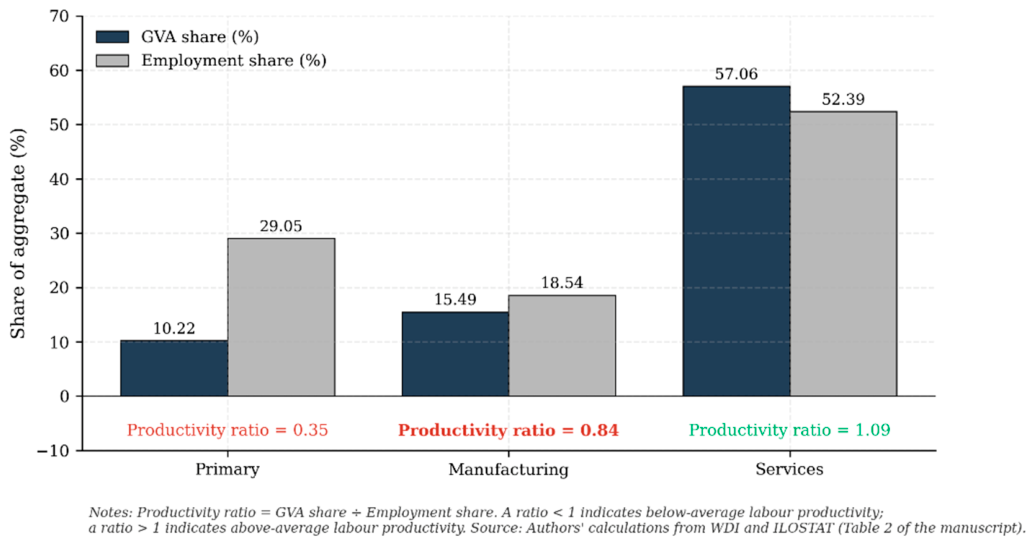
The sectoral structure of output and employment (Table 2) shows that services account for 57.06% of output and 52.39% of employment, manufacturing for 15.49% and 18.54%, and primary activities for 10.22% and 29.05%. The disproportion between primary employment (29%) and primary output (10%) is the most visible structural-transformation gap: 29 of every 100 ACN workers are employed in activities that generate only 10 of every 100 dollars of GVA. The Kaldorian framework predicts that reallocating these workers to higher-productivity sectors should raise aggregate productivity—but whether the receiving sector should be manufacturing or services depends on the relative productivity of those two sectors, which we examine next.

3.2. Sectoral Productivity Structure

Two further calculations from the same data yield insights that the existing literature does not document. The first calculation compares the GVA share and the employment share of each sector. Where the GVA share exceeds the employment share, average labour productivity in the sector is above the economy-wide mean; where the employment share exceeds the GVA share, productivity is below the mean. Table 3 reports this calculation.
This finding is shown graphically in Figure 1. Average labour productivity in manufacturing is 16% below the economy-wide mean. Manufacturing is more productive than the primary sector (0.84 against 0.35) but less productive than services (0.84 against 1.09). The standard Kaldorian narrative—labour reallocation from low-productivity primary to high-productivity manufacturing raises aggregate productivity—is therefore only partially applicable in AC: the primary-to-manufacturing reallocation does raise aggregate productivity, but a services-to-manufacturing reallocation would lower it.
This pattern is the empirical signature of the low-tech, low-value-added manufacturing structure characteristic of resource-dependent middle-income economies, and it bounds the magnitude of the Kaldorian effects we should expect to estimate. The interpretation of this finding is developed in Section 4 (Verdoorn decomposition) and Section 5 (jobless-growth diagnosis).
The second calculation decomposes the 3.90% aggregate growth rate into sectoral contributions, computing the share-weighted growth contribution of each sector. Table 4 reports the result.
The results show that manufacturing contributes 0.50 percentage points (12.9%) of the 3.90% aggregate growth rate, against 2.39 percentage points (61.3%) contributed by services. This bounds the policy claim that follows from the Kaldorian estimates: even under the most ambitious counterfactual in which manufacturing growth doubles, the direct contribution to aggregate growth would rise by approximately 0.5 percentage points. The importance of manufacturing growth therefore lies less in its direct arithmetic share than in the cumulative multipliers and qualitative spillovers that the dynamic specifications in the Section 4 identify. We also return to this distinction in final sections.

3.3. Econometric Specification

According to Wooldridge (2010, 2015), in a panel model, it must be assumed that the model to be estimated exhibits individual heterogeneity; therefore, the dependent variable y i t is a linear function of K explanatory variables x k , where k = 1,2 , 3 , , K ; we have the following relationship (Equation (7)):
y i t = α i + β 1 x 1 i t + β 2 x 2 i t + + β K x K i t + e i t
where y i t is the dependent variable for country i at time t, x k i t are k explanatory variables, α i captures country-specific heterogeneity, and e i t is an idiosyncratic error term. Two estimators of this specification are considered: the random-effects model, in which α i = α + u i , with μ i drawn from a country-specific random distribution, and the fixed-effects model, in which μ i is estimated as a vector of country-specific intercepts. The choice between them is made on the basis of the Hausman (1978) specification test for each equation, comparing the consistency of the two estimators under the null that μ i is uncorrelated with the regressors. Where the null is not rejected (which is the case for all the equations estimated in this paper, with Hausman p-values reported in Appendix A), the random-effects estimator is preferred for its efficiency.
For specifications where diagnostic tests reveal serial correlation or heteroscedasticity in the residuals, the static estimation is performed by feasible generalised least squares (FGLS), which provides consistent and asymptotically efficient estimates under these conditions. The static specification, however, treats manufacturing growth as strictly exogenous and assumes that the relationship between manufacturing and aggregate output is contemporaneous. Both assumptions are demanding in the present empirical setting for three reasons that motivate the additional dynamic stage of the analysis. As discussed in previous sections, the Kaldorian first-law specification regressing total output on manufacturing output is subject to the accounting-identity concern raised by McCombie (1981)—manufacturing is a component of total output, so a positive coefficient may reflect arithmetic decomposition rather than behavioural causation.
While Equation (3) of Section 2 (the surplus specification of Wells & Thirlwall, 2015) is designed to address this concern, a complementary methodological response is a dynamic specification in which lagged values of the regressor serve as instruments. This simultaneously addresses the reverse-causality concern raised by Rowthorn and Ramaswamy (1999), under which aggregate growth might drive manufacturing growth rather than the reverse. The recent methodological literature on dynamic panel data—surveyed by Ullah et al. (2018, 2021)—confirms that GMM with lagged instruments is the standard solution to this identification challenge.
Additionally, recent empirical literature on Kaldor’s laws—particularly Paternesi Meloni (2024)—emphasises the distinction between short-run cyclical comovement (Okun-type effects) and long-run structural elasticities (Verdoorn-type effects). Without dynamic estimation, it is not possible to separate these. The combination of static and dynamic specifications adopted here permits direct contrast of contemporaneous and cumulative magnitudes, allowing us to compute long-run multipliers and interpret the underlying transmission mechanism.
The dynamic specification follows the first-differenced GMM estimator of Arellano and Bond (1991), as Equation (8) shows:
y i t = j = 1 p α j y i , t j + k = 1 K l = 0 q β k l x k , i , t l + μ i + ε i t ,
with first-differencing to eliminate μ i   and lagged levels of y and x used as instruments for the differenced equation. Two lags of the dependent variable and two lags of each main regressor are included, following the specification standard in the Kaldorian panel literature (Wells & Thirlwall, 2015; Ángeles-Castro et al., 2023). Finally, from the estimated coefficients, long-run multipliers are computed as Equation (9), representing the cumulative effect of a sustained one-unit change in regressor k on the dependent variable, after the dynamic adjustment has worked through:
L R M k = l = 0 q β k l ^ 1 j = 1 p α j ^
Even though this approach is standard, we recognise some limitations. The panel comprises N = 4 countries observed over T = 27 years, yielding 108 observations. The asymptotic theory underpinning Arellano–Bond GMM is large-N, fixed-T, which does not strictly apply to this configuration. However, three considerations support the use of the estimator nonetheless. First, the time dimension (T = 27) is substantially larger than the cross-section dimension (N = 4), which is the opposite of the configuration where the strongest small-sample biases of GMM have been documented. The Monte Carlo evidence in Škrabić Perić (2019) indicates that difference-GMM performs reasonably for N = 10, T = 30; the present configuration is more demanding on the cross-section dimension but better on the time dimension. Moral-Benito (2017) documents that the small-sample behaviour of Arellano–Bond can be poor when both N is small and the variables are persistent over time.
Second, the FGLS static estimates serve as a primary specification, with the dynamic GMM as a complementary check. This is the inverse of much applied work that treats GMM as the headline estimator. The choice reflects the small-N concern: where the two stages agree on signs and rough magnitudes, the conclusions are credible; where they disagree, the conclusions are reported with appropriate qualification (as in the third law, where the contemporaneous and lagged employment effects diverge). A final methodological observation concerns the interpretation of the Sargan over-identification test results reported in Appendix A, which yield p-values close to unity for all dynamic specifications. p-values of this magnitude can superficially be read as evidence of instrument validity, but the recent methodological literature urges caution. Cheng et al. (2021) document that passing the Sargan/Hansen test does not guarantee the estimate’s validity in finite samples, particularly when the number of instruments approaches the cross-sectional dimension.

4. Results

In line with the research objectives, this section presents three sets of results. The first set tests Kaldor’s first law. The second set estimates Verdoorn’s law (the second law) and examines whether the implied decomposition satisfies the accounting identity that underpins it. The third set tests Kaldor’s third law. Throughout this section, the causal language is deliberately cautious: the dynamic GMM estimates identify the Granger-type precedence of manufacturing over aggregate output, not structural causality in the strict sense.

4.1. Statistic Results

We proceeded then with the estimation of the three specifications: Equation (1): total GVA regressed on manufacturing GVA; Equation (2): non-manufacturing GVA regressed on manufacturing GVA; and Equation (3): total GVA regressed on the growth-rate surplus of manufacturing over non-manufacturing. Table 5 reports these static results.
First, we can observe that the three static coefficients are all statistically significant at conventional levels and sit within the range reported in the recent Latin American and OECD literature (Ángeles-Castro et al., 2023; Iasco-Pereira et al., 2024; Şahin, 2025). From an economic interpretation, Equation (1) shows that a one-percentage-point increase in the growth rate of manufacturing GVA is associated with a 0.29 percentage point increase in the growth rate of total GVA in the same year. Equation (2) confirms that this association is not a mechanical identity: a one-percentage-point increase in the growth rate of manufacturing GVA is associated with a 0.21 increase in the growth rate of non-manufacturing GVA—evidence of a genuine spillover from manufacturing to the rest of the economy. Equation (3), estimated on the growth-rate surplus, yields the largest coefficient of the three: a one-percentage-point widening of the gap between manufacturing and non-manufacturing growth rates is associated with a 0.49-percentage-point increase in total growth. This is nearly twice the levels coefficient in Equation (1) and is the Kaldorian signature that matters for policy: what drives aggregate dynamics is not manufacturing growth in isolation but its differential dynamism relative to the rest of the economy.

4.2. Dynamic Results

The static coefficients, however, understate the cumulative effect of manufacturing expansions because the cumulative-causation dynamics that Kaldor (1966) emphasised unfold over time. The dynamic GMM estimates in Table 6 confirm this. The specification passes both the Sargan over-identification test (p = 1.00 for all three equations, indicating no rejection of instrument validity; see Appendix A) and the Arellano–Bond test for second-order serial autocorrelation in the differenced errors (all p > 0.05). A caveat is in order on the Sargan statistic: values close to unity can reflect the instrument proliferation bias when the number of instruments approaches the cross-sectional dimension. In the present panel (N = 4, T = 27), the number of instruments is restricted to two lags, which limits but does not fully eliminate this concern. The Hansen J-test (Appendix A) corroborates the Sargan conclusion.
Even with these limitations, three features of Table 6 reshape the economic interpretation of the first law. First, the long-run multiplier on total GVA (0.907) is 3.1 times the static coefficient (0.289). A sustained one-percentage-point acceleration in manufacturing growth is associated—over a two- to three-year horizon—with a 0.91 increase in total GVA growth, much closer to a one-for-one relationship than the static estimate suggests. The spillover effect on non-manufacturing GVA (long-run multiplier 0.716) is similarly strong: a sustained manufacturing acceleration pulls non-manufacturing growth with it over the medium term, consistent with the input–output linkages and cumulative-causation dynamics that Young (1928), Kaldor (1966), and Dixon and Thirlwall (2015) emphasised.
Second, the surplus specification shows a different pattern: the strong contemporaneous effect (0.497) is partially offset by negative and significant lag-1 and lag-2 coefficients, yielding a long-run multiplier of 0.265. This implies that the relative-dynamism channel operates on a shorter horizon than the levels channel—an intuitive finding, since surplus-dynamism effects are typically associated with short-lived catch-up episodes rather than structural transformation. Third, lag-2 coefficients are significant at 0.1% in both the Total-GVA equation and its autoregressive component, indicating a propagation horizon of approximately two years from manufacturing impulses to aggregate effects—consistent with standard investment-to-output lags in industry.
The Kaldorian signal is thus economically substantial in rate terms but bounded in absolute terms. Applying the sectoral decomposition manufacturing accounts for 12.9% of the observed aggregate growth (0.50 percentage points of the 3.90% annual average)—smaller in absolute contribution than services (61.3%) but nonetheless significant and, through the dynamic multiplier, transmitting effects well beyond its direct share.
The combination of a substantial long-run elasticity with a modest absolute share is characteristic of an economy in which manufacturing matters for growth quality (productivity diffusion, technology transfer, and foreign-exchange generation) more than for growth quantity—a distinction that acquires its full economic meaning once the Verdoorn decomposition is examined.
The second law is estimated using Equations (4) and (5): the productivity equation yields the Verdoorn coefficient λ; the employment equation yields (1 − λ). By construction, these two coefficients must sum to unity because productivity growth, employment growth, and output growth are linked by the accounting identity V A B / e m a n ^   +   e m a n ^     V A B m a n ^ in growth rates. Table 7 reports both specifications in static (FGLS panel) and dynamic (Arellano–Bond GMM) forms.
The dynamic contemporaneous coefficient on manufacturing output (0.443) is of the same order of magnitude as the static Verdoorn coefficient. Computing the long-run multiplier—using Formula (9)—yields a value of 0.362, slightly below the contemporaneous estimate. The long-run elasticity of manufacturing productivity with respect to manufacturing output is therefore marginally smaller than its short-run counterpart, indicating that the increasing-returns mechanism in ACN manufacturing operates with limited cumulative amplification over time.
The computations are shown in Equations (10) and (11):
j = 1 2 α j ^ = 0.034 + 0.257 = 0.223
L R M λ = β 0 ^ 1 j = 1 2 α j ^ = 0.443 1 0.223 = 0.362
Both values are below the OECD benchmark of about 0.5 reported by Paternesi Meloni (2024) and the long-run Brazilian coefficient estimated by Doré et al. (2025), indicating that increasing returns in ACN manufacturing are present but attenuated relative to more industrialised economies. This attenuation is in itself informative; its economic meaning becomes clearer when the accounting identity is examined directly.

4.3. The Verdoorn Decomposition

If the Verdoorn relationship and the employment–output relationship jointly describes the response of the manufacturing sector to output growth, their coefficients must sum to unity by identity—the growth in output has nowhere else to go. Equation (13) computes this using Equation (12):
λ V A B i t m a n Ec .   ( 4 ) :   productivity + 1 λ V A B i t m a n Ec .   ( 5 ) :   employment V A B i t m a n
λ ^ + 1 λ ^ est . = 0.419 + 0.074 = 0.345 1
The sum is 0.345, not 1.000. The accounting identity is violated by 0.655 percentage points. Since the identity must hold exactly in logarithmic growth rates (aside from a small second-order approximation error), this residual cannot be dismissed as statistical noise. It reflects an economic phenomenon that neither productivity growth nor employment changes are capturing. The only remaining channel through which manufacturing output can grow is capital deepening: increases in the capital–labour ratio that raise output per worker through physical or technological capital intensification, without a proportional increase in labour input or in Verdoorn-style learning-by-doing productivity gains.
In the ACN sample, roughly two-thirds of manufacturing output growth between 1993 and 2019 was absorbed by capital-intensity increases rather than by labour-force expansion or scale-economy productivity effects. This pattern has a clear empirical signature in the developing country literature that we develop in the Section 5.
Two further implications follow. First, the identification of increasing returns from the positive Verdoorn coefficient must be qualified: Basu et al. (2021) have shown that a coefficient in (0, 1) is consistent with a production technology in which most of the productivity effect is mediated by capital deepening rather than by the learning-by-doing and demand-induced technical change mechanisms that Kaldor originally emphasised. The third law posits a positive relationship between total labour productivity growth and manufacturing growth, and a negative relationship between total productivity growth and non-manufacturing employment growth. Two specifications are estimated, corresponding to Equations (4) and (5): a reduced specification with manufacturing GVA and non-manufacturing employment only, and a fully disaggregated specification including non-manufacturing GVA and manufacturing employment as additional regressors (Equation (14), derived from Equation (6)).
V A B e i t t o t a l = α + β 0 V A B i t m a n + β 1 V A B i t n m a n ϕ 0 e i t n m a n ϕ 1 1 e i t m a n
The static evidence in Table 8 supports the third law in its manufacturing GVA component (coefficients of 0.29 and 0.27, both significant at 0.1%) but is weaker in the non-manufacturing employment component: the coefficient is significant at 0.1% in the reduced specification (−0.055) but becomes insignificant once non-manufacturing GVA and manufacturing employment are added (−0.044, not significant).
This instability is what a prior reading might describe as “mixed evidence” for the third law. The dynamic GMM results clarify the picture. In the total-productivity equation of Table 9, the contemporaneous coefficient on non-manufacturing employment is insignificant (−0.070), the lag-1 coefficient is significant at 0.1% (−0.093), and the lag-2 coefficient is insignificant (−0.080). The long-run multiplier, at −0.228, is roughly four times the static estimate.
Taken together, these results indicate that the labour-reallocation channel identified by the third law operates with a lag, not instantaneously, and that its cumulative magnitude is economically substantial: a sustained one-percentage-point decline in non-manufacturing employment growth is associated, in the long run, with a 0.23-percentage-point increase in total productivity growth. The manufacturing GVA channel reinforces this effect—the long-run multiplier of 0.349 exceeds the static estimate of 0.289 by 21%. The appropriate reading of the third-law evidence is therefore not that it is “mixed” or “weak” in ACN, but rather that it operates slowly and cumulatively, as the theoretical framework of cumulative causation would predict. The comparison with prior studies is supportive: Wells and Thirlwall (2015) and Sichoongwe (2024) situate these results within this developing-country pattern, and the sub-unitary long-run multiplier on manufacturing GVA (0.349) is consistent with the partial labour absorption capacity.

4.4. Diagnostic Tests and Robustness

The diagnostic results for every equation estimated in this section are reported in Appendix A. Three summary remarks are warranted here. First, the Hausman test rejects the fixed-effects specification in favour of random effects for all three laws (p-values ranging from 0.34 to 0.99), which justifies the panel model with individual heterogeneity treated as a random draw. Second, the Breusch–Godfrey/Wooldridge test for serial correlation indicates problems in Equation (5) of the first law (surplus specification) and in the productivity equation of the second law, while the Breusch–Pagan test indicates heteroscedasticity in Equation (5). Both issues are addressed through an FGLS estimation for the affected equations, which is the source of the static coefficients reported above. Third, for every dynamic specification, the Sargan test does not reject the null of instrument validity and the Arellano–Bond second-order autocorrelation test does not reject the null of no AR (2) in differenced residuals.

5. Discussion

The empirical results support the three Kaldor laws in their first-order prediction for the Andean Community during 1993–2019: manufacturing growth is positively associated with aggregate growth, Verdoorn’s coefficient is positive and significant, and the labour-reallocation channel of the third law operates with a lag. However, the magnitude, structure, and decomposition of these relationships reveal a transmission mechanism that differs substantively from the Canonical Kaldorian account. Three features of the ACN evidence—the decomposition failure of the Verdoorn identity, the attenuation of coefficients relative to developed economy benchmarks, and the slow, cumulative character of the productivity effects—converge on a single interpretation we describe below.
The paper’s central conceptual contribution resides in the Verdoorn decomposition result reported before. The accounting identity that links productivity growth, employment growth, and output growth in manufacturing requires the Verdoorn coefficient and the employment–output elasticity to sum to unity. In the ACN sample, their sum is 0.345, leaving a residual of 0.655 that cannot be attributed to either channel. Since the identity must hold exactly one in logarithmic growth rates, this residual reflects an economic phenomenon: approximately two-thirds of manufacturing output growth between 1993 and 2019 was absorbed by capital-intensity increases rather than by labour absorption or by scale-economy learning effects. We term this configuration jobless manufacturing growth—a Kaldorian regime in which the laws operate in their first-order prediction but the transmission mechanism has mutated from the labour-absorbing, learning-intensive form that Kaldor and Verdoorn originally described into a capital-intensive, labour-saving form typical of commodity-dependent middle-income economies.
This finding is not anomalous within the contemporary developing-country literature. It is, in fact, precisely what the most recent microeconomic evidence predicts. Diao et al. (2021), using firm-level panels for Tanzania (2008–2016) and Ethiopia (1996–2017), document a dichotomy within manufacturing: large, productive firms use highly capital-intensive techniques and do not expand employment, while smaller firms absorb labour without achieving productivity gains.
For Latin America specifically, Paus (2020) demonstrates that within-sector productivity gains in nine Latin American economies between 1950 and 2011 have been insufficient to generate cross-sector structural transformation, with the productivity gains that did occur concentrated in capital-intensive pockets that failed to lift aggregate performance. Iasco-Pereira et al. (2024), examining Brazilian manufacturing from 1947 to 2021, show that productivity dynamics have deteriorated under policies that privileged financial openness over productive investment. Palma (2024) generalises the pattern to resource-rich middle-income economies: “extractivist” strategies exhaust themselves precisely because their capital-intensive industrial footprint fails to generate high-productivity linkages, leaving these economies suspended in the middle-income trap.
Why is ACN manufacturing capital-absorbing rather than labour-absorbing? The Dutch-disease literature on commodity-dependent economies offers a cogent mechanism. Rodríguez Abraham et al. (2025), analysing Peruvian quarterly data for 2012–2024, find a negative and statistically significant relationship between terms-of-trade improvements and manufacturing performance—direct evidence of Dutch disease in one of the four ACN economies. Alssadek and Benhin (2023), examining 36 oil-rich economies over 1970–2016, confirm that commodity booms systematically appreciate the real exchange rate and depress manufacturing output. For South America specifically, Isabella (2024) shows that commodity price surges damage productive capabilities specifically when they coincide with the dismantling of state industrial intervention—a configuration that is applied across ACN during the liberalisation episodes of the 1990s and early 2000s. Cimoli et al. (2019) generalise the diagnosis: in Latin America, long periods of real-exchange-rate appreciation combined with the absence of industrial policy have contributed to the loss of productive capabilities. Warnecke-Berger et al. (2023) document that the commodity super-cycle of the 2000s failed to translate into diversification and structural transformation in Latin America, concluding that neo-extractivism did not enable a shift toward non-extractivist sectors.
The implication for the ACN regime is a coherent narrative. During the commodity super-cycle (2002–2014), real-exchange-rate appreciation eroded the external competitiveness of manufacturing tradables. Firms that survived the squeeze did so primarily by adopting labour-saving capital-intensive technologies that raised the output per worker without expanding employment. After 2014, when commodity prices fell, the manufacturing deceleration became visible in the growth-rate data: Peru’s manufacturing growth collapsed from 6.0% in 2002–2010 to 1.9% in 2011–2019, Colombia fell by 1.9 pp, Ecuador by 1.6 pp, and only Bolivia accelerated by 0.3 pp. The Verdoorn decomposition failure reported above is the cross-sectional fingerprint of this adjustment: the capital-deepening that allowed manufacturing to survive exchange-rate appreciation during the boom also means that manufacturing output growth now maps onto capital accumulation rather than onto labour productivity gains or employment expansion.
This diagnosis reconciles two apparently competing readings of the ACN evidence. A strict reading of the premature-deindustrialisation literature (Rodrik, 2016; Lábaj & Majzlíková, 2024; Taguchi et al., 2023) would predict that Kaldorian mechanisms have been extinguished in commodity-dependent economies, with manufacturing losing its “engine” status. A strict reading of the classical Kaldorian literature would predict that the mechanism operates unchanged once its empirical footprint is recovered. Neither reading describes the ACN evidence. Manufacturing is still associated with aggregate growth (Law 1), still exhibits positive but attenuated increasing returns (Law 2), and still generates labour-reallocation benefits over time (Law 3). But the decomposition fails as we have already noticed.
The policy consequences are substantial and depart from conventional Kaldorian prescriptions. An industrial-policy response that relied on capital subsidies alone—investment tax credits, accelerated depreciation, and subsidised credit for machinery—would deepen rather than correct the jobless-growth pattern. Instead, the ACN evidence supports the structuralist–developmentalist prescription articulated by Botta et al. (2023), Bresser-Pereira (2020), and Ocampo (2020): a combination of (i) real-exchange-rate management to neutralise Dutch-disease pressures, (ii) targeted industrial policy for labour-absorbing sub-sectors, and (iii) deliberate skill-upgrading strategies aligned with the productive matrix.
H.-J. Chang and Andreoni (2020) articulate the broader doctrine: the contemporary industrial policy must manage uncertainty, learning, demand, and political–economic conflicts simultaneously, rather than relying on individual market-failure arguments. Sadik-Zada (2020) and Savona and Bontadini (2023) offer complementary prescriptions for commodity-exporting economies: the productive re-investment of resource rents into backward and forward linkages with manufacturing and knowledge-intensive services, rather than redistribution or capital-intensity subsidy alone.
Last, but not least, we discuss the reverse-causality and identity debate. McCombie (1981) pointed out that regressing total output on its manufacturing component risks recovering an accounting relationship rather than a behavioural one. Our response, following Wells and Thirlwall (2015), is to estimate Equation (3) in the surplus specification, regressing the total GVA on the growth-rate gap between manufacturing and non-manufacturing. This specification cannot be reduced to an identity because the surplus variable is not a mechanical component of the dependent variable. The resulting coefficient (0.493 static; 0.265 long-run) is comparable to the level’s specification in sign and significance, which supports the view that the Equation (1) coefficient reflects a behavioural relationship rather than a decomposition artefact.
Regarding the reverse-causality concern, Rowthorn and Ramaswamy (1999) raised the concern that aggregate growth might drive manufacturing growth rather than the reverse. Our response is the Arellano–Bond difference-GMM specification with lagged instruments, which identifies Granger-type precedence rather than structural causality. The finding that lagged manufacturing growth carries significant coefficients even after controlling for lagged aggregate growth supports the directional interpretation that manufacturing precedes aggregate output in the ACN data. Nabar-Bhaduri and Vernengo (2025) adopt a similar strategy for China and India and arrive at compatible conclusions. We stress, however, that Granger precedence is not structural causality in the Rubin (1974) sense.
On the other hand, regarding the Verdoorn-interpretation concern, Basu et al. (2021) have shown that a Verdoorn coefficient bounded in the (0, 1) interval does not by itself identify aggregate increasing returns to scale, because that coefficient is jointly determined by factor-substitution elasticities, the labour-supply elasticity, the profit share, and the increasing-returns parameter. Our response is that the Verdoorn coefficient is here interpreted not as proof of increasing returns but as one component of a decomposition whose identity failure is itself informative. The 0.655 residual is, in fact, exactly the kind of evidence that Basu et al. (2021) would read as inconsistent with a pure increasing-returns interpretation of the estimated coefficient.
Similarly, the Okun–Verdoorn confounding critic is discussed following Paternesi Meloni (2024), who shows that the short-run cyclical co-movement between output and productivity (Okun-like) can contaminate estimates of the Verdoorn relationship. The panel cointegration shows a short-run coefficient of about 0.3 and a long-run one of about 0.5 for OECD data. Our ACN short-run static estimate of 0.42 sits between these benchmarks, and the long-run multiplier from the dynamic specification (0.36) indicates that the structural effect is of similar magnitude to the short-run coefficient. This contrast is itself informative about the ACN regime: the absence of a long-run amplification in Verdoorn (unlike the first law, where the long-run multiplier is 3× the static) is consistent with the capital-deepening interpretation since capital-intensity adjustments transmit faster and do not compound in the same way as learning-by-doing effects would.
Finally, we discuss the services behaving like manufacturing. Di Meglio et al. (2021) demonstrate that business services in developing economies display Kaldorian patterns comparable to manufacturing. Our design aggregates services into a single non-manufacturing category, which cannot separate business from personal services. This limits the conclusions in two directions. On one hand, it likely attenuates our non-manufacturing coefficient on growth spillovers, since the business-services subset that might exhibit its own Kaldorian dynamics is bundled with less dynamic activities.

6. Caveats and Future Research

Three limitations of the present study warrant acknowledgment, each opening a distinct avenue for future research. First, the study treats manufacturing as a monolithic entity because the WDI data used for the value added are not disaggregated below the one-digit ISIC Rev. 4 level. This design cannot distinguish the productivity spillovers generated by low-technology manufacturing branches (food, textiles, and basic materials) from those generated by medium- and high-technology branches (chemicals, machinery, and electronics). The jobless-growth finding is therefore a sector-average phenomenon; it is consistent with a regime in which capital-intensive, high-technology sub-sectors drive the decomposition failure while labour-intensive sub-sectors absorb what employment growth exists, but the available data cannot verify or refute this. Future work using GGDC 10-Sector Database extensions, or national industrial censuses at the 2- or 3-digit ISIC level, would permit this disaggregation.
Second, the panel includes four countries, which is small relative to the typical recommendations for dynamic GMM. The cross-country heterogeneity is substantial: the coefficient of variation (CV) of manufacturing productivity growth across ACN countries within any single sub-period exceeds 80% in all three sub-periods examined (117% in 1993–2001, 103% in 2002–2010, and 82% in 2011–2019). The declining CV over time suggests regional convergence in manufacturing productivity dynamics, but the heterogeneity within each period is large enough that a pooled coefficient necessarily averages over meaningfully different national trajectories. Škrabić Perić (2019) documents the performance limitations of the difference-GMM in small panels; a longer time dimension (T = 27 here) partially compensates for but does not eliminate the concern. Future work should exploit longer time series as they become available (WDI and ILOSTAT are progressively backfilling data for earlier decades) and consider panel structural-VAR approaches along the lines of Deleidi et al. (2023).
Third, we interpret the Verdoorn decomposition residual as capital deepening, but the sample as currently assembled does not contain direct measurements of the manufacturing capital stock or of the capital–labour ratio. The identification of capital deepening is therefore indirect—it relies on the logic of the accounting identity combined with comparative evidence from Diao et al. (2021) and Alkathiri (2021), which document the same pattern directly using firm-level and production-frontier methods. Future work extending would permit a direct test of the capital-deepening hypothesis and its decomposition (J.-J. Chang et al., 2025) against alternative explanations such as the measurement error in employment statistics (Gollin et al., 2014; McCullough, 2017) or cross-sector labour misallocation (Marconi et al., 2016; Gangopadhyay et al., 2024).
To advance in this field, we also suggest some research lines to answer more questions regarding the Kaldorian framework. For example, for the sub-sectoral disaggregation of manufacturing (Sofi et al., 2022), the direct integration of capital-stock measurements, available for some Latin American economies from the Penn World Tables and LA-KLEMS database, would convert the indirect capital-deepening interpretation into a direct test against alternative explanations. Similarly, service disaggregation would permit testing whether business-services sub-sectors behave like manufacturing in Kaldorian terms. Last, integrating the Kaldorian framework with the Thirlwall balance-of-payments-constrained growth model—as surveyed by Blecker (2021) and modelled by Botta et al. (2023)—would also provide a holistic account of the external macroeconomic limits to ACN industrialisation, since the Dutch-disease channel identified here operates partly through the external constraint.
Taken together, these limitations define a research programme rather than a defensive posture. The paper’s central claim that Kaldorian dynamics operate through capital-deepening and that this regime requires a policy response combining industrial policy with macroeconomic management is robust. What the limitations affect is the precise magnitude and sub-sectoral granularity of the effect, not its existence.

7. Conclusions

This paper asked to what extent Kaldor’s three growth laws are empirically supported in the Andean Community of Nations over 1993–2019, and through what transmission mechanism manufacturing growth translates into aggregate effects. Using a balanced panel of 4 countries and 27 years of annual observations on the real value added and employment, and combining static panel models with FGLS corrections with the dynamic Arellano–Bond difference that allows the computation of long-run multipliers, the evidence supports the first-order prediction of the three laws but reveals a transmission mechanism that differs substantively from the Canonical Kaldorian account.
The first law is supported: the contemporaneous elasticity of the total value added on the manufacturing value added is 0.29 in the static specification, rising to a long-run multiplier of 0.91 in the dynamic specification. The surplus-specification coefficient of 0.49 indicates that the relative dynamism—manufacturing growing faster than non-manufacturing—is a stronger correlate of aggregate growth than absolute manufacturing expansion. Similarly, the second law is supported in its core prediction—the Verdoorn coefficient of 0.42 is positive, statistically significant, and consistent with the presence of increasing returns—but the accounting decomposition that underpins Verdoorn’s law does not close. In fact, the productivity-output elasticity (0.42) and the employment-output elasticity (−0.07) sum to 0.35 rather than to the unity required by the underlying identity. The residual of approximately 0.65 implies that roughly two-thirds of manufacturing output growth in the ACN was absorbed by capital-intensity increases rather than by labour absorption or by sector-wide learning effects.
We term this configuration jobless manufacturing growth, and it is the paper’s main contribution: the Kaldorian regime has neither collapsed nor remained intact, but has mutated into a capital-intensive, labour-saving form consistent with the Dutch-disease adjustment expected in commodity-dependent economies under sustained terms-of-trade improvements and real-exchange-rate appreciation. Last, the third law is also supported with important caveats: the contemporaneous coefficient on non-manufacturing employment is fragile across specifications, but the long-run multiplier of −0.23 is roughly four times the static estimate, indicating that the labour-reallocation channel operates slowly and cumulatively rather than instantaneously—a profile consistent with the capital-deepening regime identified under the second law. Despite the statistical significance of the Kaldorian relationships, manufacturing contributes only 0.5 percentage points of the region’s 3.9 per cent annual aggregate growth—roughly 13 per cent of the observed growth, against 61 per cent contributed by services—so its importance lies in cumulative multipliers and qualitative spillovers rather than in the direct arithmetic share. The cross-country heterogeneity within the bloc is also substantial, with the coefficient of variation of manufacturing productivity growth exceeding 80 per cent across countries within any single sub-period and with manufacturing growth declining sharply after 2011 in Peru, Colombia, and Ecuador and accelerating mildly in Bolivia. Thus, the region-wide coefficients summarise four distinct national trajectories.
From these findings, three policies depart from conventional Kaldorian prescriptions that treat manufacturing expansion as an unalloyed good. Industrial policy in ACN cannot rely on capital-subsidy instruments alone: investment tax credits, accelerated depreciation, and subsidised credit for machinery would reinforce rather than correct the jobless-growth pattern, since two-thirds of manufacturing output growth is already absorbed by capital-intensity increases. In other words, capital-support instruments remain necessary but must be paired with skill-upgrading programmes and with selective support for labour-intensive sub-sectors capable of absorbing workers reallocating from primary activities.
Thus, ACN requires macroeconomic instruments that neutralise Dutch-disease pressures, since prolonged real-exchange-rate appreciation during commodity booms erodes the external competitiveness of manufacturing tradable and is the principal cause of the capital-intensive adjustment margin documented here; real-exchange-rate management—through variable export taxation on commodity exports during boom periods, countercyclical capital controls, and the productive re-investment of resource rents—is therefore not separable from industrial policy but a necessary complement to it. The region’s resource endowments should also be leveraged through backward and forward linkages rather than substituted for, with industrial policy building on the existing extractive-sector capability base through resource-based transformation industries (agro-processing, chemicals, metallurgy, and cement) and through high-value services whose linkages to manufacturing have blurred in recent decades.
That being said, our paper’s central contribution was to identify this regime and to reconcile its existence with both the classical Kaldorian framework and the contemporary premature-deindustrialisation debate; the question of what policies can most effectively transform it remains open and invites the empirical work to refine the diagnosis developed here.


Author Contributions

Conceptualization, D.A.O.J. and A.P.G.A.; methodology, C.F.P.J.; software, C.F.P.J.; validation, A.P.G.A., D.A.O.J.; formal analysis, A.P.G.A.; investigation, A.P.G.A.; resources, D.A.O.J.; data curation, D.A.O.J.; writing—original draft preparation, D.A.O.J.; writing—review and editing, A.P.G.A.; visualization, A.P.G.A.; supervision, D.A.O.J.; project administration, D.A.O.J.; funding acquisition, no funding. All authors have read and agreed to the published version of the manuscript.

Funding

This research received no external funding.

Institutional Review Board Statement

Not applicable.

Informed Consent Statement

Not applicable.

Data Availability Statement

The data presented in this study are derived from publicly available sources. Macroeconomic and manufacturing value-added data were obtained from the World Bank World Development Indicators, available at https://databank.worldbank.org/source/world-development-indicators (accessed on 21 May 2026). Employment data were obtained from ILOSTAT, available at https://ilostat.ilo.org/data (accessed on 21 May 2026). The compiled panel dataset used in the estimations is available from the corresponding author upon reasonable request.

Conflicts of Interest

The authors declare no conflict of interest.

Appendix A

Table A1. Hausman test for fixed versus random effects (static specifications).
EquationDescriptionChi2p-ValueDecision
(1)Total GVA ← Manuf GVA0.0140.906Random effects
(3)Non-manuf GVA ← Manuf GVA0.0490.825Random effects
(5)Total GVA ← Surplus0.9220.337Random effects
(7)Manuf productivity ← Manuf GVA0.2110.646Random effects
(9)Manuf employment ← Manuf GVA0.0230.880Random effects
(11)Total productivity ← Manuf GVA, nman emp0.0020.967Random effects
(13)Total productivity ← extended specification0.2220.994Random effects
Table A2. Breusch–Godfrey/Wooldridge and Breusch–Pagan tests (static specifications).
EquationBreusch–Godfrey/Wooldridge Chi2p-ValueBreusch–Pagan BPp-ValueCorrection Applied
(1)33.9010.1691.0320.310None required
(3)37.5130.0860.7920.374None required
(5)42.2360.0316.8060.009FGLS
(7)24.2110.6191.1610.281None required
(9)24.5870.5982.0980.148None required
(11)30.8800.2763.2420.072None required
(13)25.5300.5456.5650.163None required
Table A3. Sargan over-identification test and Arellano–Bond AR (2) test (dynamic specifications).
EquationDescriptionSargan Chi2p-ValueAR (2) z-Statisticp-Value
(2)Total GVA ← Manuf GVA (dynamic)4.0001.000−1.7640.078
(4)Non-manuf GVA ← Manuf GVA (dynamic)4.0001.000−1.4410.150
(6)Total GVA ← Surplus (dynamic)4.0001.000−1.3230.186
(8)Manuf productivity ← Manuf GVA (dynamic)4.0001.0001.1030.270
(10)Manuf employment ← Manuf GVA (dynamic)4.0001.0000.3790.705
(12)Total productivity ← Manuf GVA (dynamic)4.0001.000−0.5810.561

References

  1. Agurto, A. (2018). Relationship between economic growth and manufacturing in Ecuador using cointegration techniques. Revista Vista Económica, 4, 70–82. Available online: https://revistas.unl.edu.ec/index.php/economica/article/view/509 (accessed on 21 May 2026).
  2. Alkathiri, N. (2021). Labour productivity growth and convergence in manufacturing: A nonparametric production frontier approach. Applied Economics, 53, 3408–3433. [Google Scholar] [CrossRef]
  3. Alssadek, M., & Benhin, J. (2023). Natural resource curse: A literature survey and comparative assessment of regional groupings of oil-rich countries. Resources Policy, 84, 103741. [Google Scholar] [CrossRef]
  4. Aravena, C., & Hofman, A. (2015). Economic growth and productivity in Latin America: An industry-by-industry perspective based on the LA-KLEMS database. ECLAC Macroeconomics of Development Series, No. 173. United Nations Economic Commission for Latin America and the Caribbean. [Google Scholar]
  5. Arellano, M., & Bond, S. (1991). Some tests of specification for panel data: Monte Carlo evidence and an application to employment equations. Review of Economic Studies, 58, 277–297. [Google Scholar] [CrossRef]
  6. Arnaut, J. (2020). Did structural change account for productivity growth within manufacturing during the import substitution era? A historical appraisal of Mexico, Argentina, and Brazil. The Journal of International Trade & Economic Development, 29(1), 1–35. [Google Scholar] [CrossRef]
  7. Atesoglu, H. S. (1993). Manufacturing and economic growth in the United States. Applied Economics, 25, 67–69. [Google Scholar] [CrossRef]
  8. Ángeles-Castro, G., Domínguez-Blancas, C. S., & Fraga-Castillo, C. A. (2023). Kaldor-Verdoorn laws in the Latin American countries, 1992–2021. Investigación Económica, 82, 156–184. Available online: https://www.redalyc.org/journal/601/60179530006/ (accessed on 22 March 2026). [CrossRef]
  9. Basu, D., & Budhiraja, M. (2021). What to make of the Kaldor-Verdoorn law? Cambridge Journal of Economics, 45(6), 1243–1268. [Google Scholar] [CrossRef]
  10. Blecker, R. A. (2021). New advances and controversies in the framework of balance-of-payments-constrained growth. Journal of Economic Surveys, 36, 429–467. [Google Scholar] [CrossRef]
  11. Borgoglio, L., & Odisio, J. (2015). Manufacturing productivity in Argentina, Brazil, and Mexico: An estimation of the Kaldor-Verdoorn law, 1950–2010. Investigación Económica, 74, 185–211. [Google Scholar] [CrossRef]
  12. Botta, A., Yajima, G. T., & Porcile, G. (2023). Structural change, productive development, and capital flows: Does financial “bonanza” cause premature deindustrialization? Industrial and Corporate Change, 32(2), 433–473. [Google Scholar] [CrossRef]
  13. Bresser-Pereira, L. C. (2020). New developmentalism: Development macroeconomics for middle-income countries. Cambridge Journal of Economics, 44, 629–646. [Google Scholar] [CrossRef]
  14. Cardona, J., Gil, A., & Martínez, H. (2009). A Kaldorian analysis of the manufacturing industry in Risaralda, 1980–2007. Revista Gestión y Región, 8, 65–92. (In Spanish) [Google Scholar]
  15. Carton, C. (2009). Kaldorian mechanisms of economic growth: An empirical application for the ALADI case (1980–2007). Documentos de Trabajo de la Universidad Loyola Andalucía, DT-E-2009-08. Universidad Loyola Andalucía. [Google Scholar]
  16. Chandra, R., & Sandilands, R. J. (2020). Nicholas Kaldor, increasing returns and Verdoorn’s law. Journal of Post Keynesian Economics, 43, 315–339. [Google Scholar] [CrossRef]
  17. Chang, H.-J., & Andreoni, A. (2020). Industrial policy in the 21st century. Development and Change, 51, 324–351. [Google Scholar] [CrossRef]
  18. Chang, J.-J., Cheung, T., & Yang, H. (2025). Capital deepening, technology choice, and labor share dynamics (SSRN Working Paper No. 5123389). SSRN. [Google Scholar] [CrossRef]
  19. Cheng, N., Liu, H., Wu, B., & Yang, J. (2021). A comment on the practice of the Arellano-Bond/Blundell-Bond generalized method of moments estimator in IS research. Communications of the Association for Information Systems, 49, 487–516. [Google Scholar] [CrossRef]
  20. Cimoli, M., Pereima, J. B., & Porcile, G. (2019). A technology gap interpretation of growth paths in Asia and Latin America. Research Policy, 48(1), 125–136. [Google Scholar] [CrossRef]
  21. Crossa, M., & Cypher, J. M. (2020). Automotive global value chains in Mexico: A mirage of development? Third World Quarterly, 41, 1525–1543. [Google Scholar] [CrossRef]
  22. Dasgupta, S., & Singh, A. (2007). Manufacturing, services, and premature deindustrialization in developing countries: A Kaldorian analysis. In G. Mavrotas, & A. Shorrocks (Eds.), Advancing development (pp. 435–454). Palgrave Macmillan. [Google Scholar] [CrossRef]
  23. Deleidi, M., Fontanari, C., & Gahn, S. J. (2023). Autonomous demand and technical change: Exploring the Kaldor-Verdoorn law on a global level. Economia Politica, 40, 57–80. [Google Scholar] [CrossRef] [PubMed]
  24. Diao, X., Ellis, M., McMillan, M. S., & Rodrik, D. (2021). Africa’s manufacturing puzzle: Evidence from Tanzanian and Ethiopian firms. NBER Working Paper No. 28344. National Bureau of Economic Research. [Google Scholar] [CrossRef]
  25. Di Meglio, G., Gallego, J., Maroto, A., & Savona, M. (2021). Disentangling services in developing regions: A test of Kaldor’s first and second laws. Structural Change and Economic Dynamics, 60, 221–229. [Google Scholar] [CrossRef]
  26. Dixon, R. J., & Thirlwall, A. P. (2015). A model of regional growth-rate differences on Kaldorian lines. In A. P. Thirlwall (Ed.), Essays on Keynesian and Kaldorian economics (pp. 286–301). Palgrave Macmillan. [Google Scholar] [CrossRef]
  27. Doré, N. I., & Araújo, E. (2025). Long-term analysis of Kaldor’s law applied to Brazil (1909-2020). Structural Change and Economic Dynamics, 74, 147–157. [Google Scholar] [CrossRef]
  28. Forero, D., & Tena-Junguito, A. (2024). Industrialization as an engine of growth in Latin America throughout a century 1913–2013. Structural Change and Economic Dynamics, 68, 98–115. [Google Scholar] [CrossRef]
  29. Gangopadhyay, K., Mondal, D., & Thasni, T. (2024). The decomposition of productivity growth for India: Before and after 1991. IIM Kozhikode Society & Management Review, 13(1), 90–100. [Google Scholar] [CrossRef]
  30. Gollin, D., Lagakos, D., & Waugh, M. E. (2014). The agricultural productivity gap. The Quarterly Journal of Economics, 129(2), 939–993. [Google Scholar] [CrossRef]
  31. Guo, D., Dall’erba, S., & Le Gallo, J. (2012). The leading role of manufacturing in China’s regional economic growth. International Regional Science Review, 36, 139–166. [Google Scholar] [CrossRef]
  32. Hansen, J. D., & Zhang, J. (2010). A Kaldorian approach to regional economic growth in China. Applied Economics, 28, 679–685. [Google Scholar] [CrossRef]
  33. Harrod, R. F. (1939). An essay in dynamic theory. Economic Journal, 49, 14–33. [Google Scholar] [CrossRef]
  34. Hausman, J. A. (1978). Specification tests in econometrics. Econometrica, 46, 1251–1271. [Google Scholar] [CrossRef]
  35. Hofman, A., Mas, M., Aravena, C., & Fernández de Guevara, J. (2020). Long-run economic growth performance in Latin America 1820–2016. Journal of Economic Surveys, 34, 1175–1206. [Google Scholar] [CrossRef]
  36. Iasco-Pereira, H. C., & Morceiro, P. C. (2024). Industrialization and deindustrialization: An empirical analysis of some drivers of structural change in Brazil, 1947–2021. Brazilian Journal of Political Economy, 44(3), e243645. [Google Scholar] [CrossRef]
  37. International Labour Organization. (2022). ILOSTAT [Data set]. International Labour Organization. Available online: https://ilostat.ilo.org/data/ (accessed on 15 March 2022).
  38. Isabella, F. (2024). Commodity dependence, structural reforms, and commodity trap: South America 1970–2017. Brazilian Journal of Political Economy, 44(3), e243643. [Google Scholar] [CrossRef]
  39. Kaldor, N. (1966). Causes of the slow rate of economic growth of the United Kingdom: An inaugural lecture. Cambridge University Press. [Google Scholar]
  40. Kaldor, N. (1967). Strategic factors in economic development. New York State School of Industrial and Labor Relations, Cornell University. [Google Scholar]
  41. Kaldor, N. (1975). Economic growth and the Verdoorn law: A comment on Mr. Rowthorn’s article. Economic Journal, 85, 891–896. [Google Scholar] [CrossRef]
  42. Lábaj, M., & Majzlíková, E. (2024). Premature deindustrialization and regional heterogeneity in Latin America: A comparison of Argentina, Brazil and Mexico. The Japanese Political Economy, 50, 169–196. [Google Scholar] [CrossRef]
  43. Loría, E., Moreno-Brid, J. C., Salas, E., & Sánchez-Juárez, I. (2019). A Kaldorian explanation of low economic growth in Mexico. Problemas del Desarrollo, 50, 3–26. [Google Scholar] [CrossRef]
  44. Magacho, G. R., & McCombie, J. S. L. (2020). Structural change and cumulative causation: A Kaldorian approach. Metroeconomica, 71, 633–660. [Google Scholar] [CrossRef]
  45. Marconi, N., Rocha, I. L., & Magacho, G. R. (2016). Sectoral capabilities and productive structure: An input-output analysis of the key sectors of the Brazilian economy. Revista de Economia Política, 36(3), 470–492. [Google Scholar] [CrossRef]
  46. Martín Rivas, Á. M. (2008). Las leyes del desarrollo económico endógeno de Kaldor: El caso colombiano (vol. 10, pp. 129–147). Revista de Economía Institucional, Universidad Externado de Colombia—Facultad de Economía. Available online: https://ideas.repec.org/a/rei/ecoins/v10y2008i18p129-147.html (accessed on 21 May 2026).
  47. McCombie, J. S. L. (1981). What still remains of Kaldor’s laws? Economic Journal, 91, 206–216. [Google Scholar] [CrossRef]
  48. McCombie, J. S. L. (1983). Kaldor’s laws in retrospect. Journal of Post Keynesian Economics, 5, 414–430. [Google Scholar] [CrossRef]
  49. McCombie, J. S. L., & Thirlwall, A. P. (1994). Economic growth and the balance-of-payments constraint. St. Martin’s Press. [Google Scholar]
  50. McCullough, E. B. (2017). Labor productivity and employment gaps in Sub-Saharan Africa. Food Policy, 67, 133–152. [Google Scholar] [CrossRef] [PubMed]
  51. Moral-Benito, E. (2017). Dynamic panel data modelling using maximum likelihood: An alternative to Arellano-Bond. Applied Economics, 50, 3211–3221. [Google Scholar] [CrossRef]
  52. Myrdal, G. (1957). Economic theory and underdeveloped regions. Duckworth. [Google Scholar]
  53. Nabar-Bhaduri, S., & Vernengo, M. (2025). Economic growth and technological progress in developing economies: Okun and Kaldor-Verdoorn Effects in China and India (1991–2019). Review of Political Economy, 37(5), 2117–2131. [Google Scholar] [CrossRef]
  54. Ocampo, J. A. (2020). Industrial policy, macroeconomics, and structural change. ECLAC Production Development Series, No. 230. United Nations Economic Commission for Latin America and the Caribbean. [Google Scholar]
  55. Pacheco-López, P., & Thirlwall, A. P. (2014). A new interpretation of Kaldor’s first growth law for open developing economies. Review of Keynesian Economics, 2, 384–398. [Google Scholar] [CrossRef]
  56. Palma, J. G. (2024). Is Southeast Asia falling into a Latin American-style middle-income trap? The Japanese Political Economy, 50, 30–93. [Google Scholar] [CrossRef]
  57. Paternesi Meloni, W. (2024). Paternesi Meloni, W. Okun vs. Verdoorn: Distinguishing between cyclical and structural effects of output on productivity. Economia Politica, 41, 295–325. [Google Scholar] [CrossRef]
  58. Paus, E. (2020). Productivity, structural change and the middle-income trap in Latin America. Working paper. Mount Holyoke College McCulloch Center for Global Initiatives. [Google Scholar]
  59. Pieper, U. (2003). Sectoral regularities of productivity growth in developing countries: A Kaldorian interpretation. Cambridge Journal of Economics, 27, 831–850. [Google Scholar] [CrossRef]
  60. Prebisch, R. (1950/1962). The economic development of Latin America and its principal problems. United Nations Department of Economic Affairs. (Reprinted in 1962, Economic Bulletin for Latin America, 7, 1–22). Available online: https://repositorio.cepal.org/handle/11362/29973 (accessed on 21 May 2026).
  61. Rodrik, D. (2016). Premature deindustrialization. Journal of Economic Growth, 21, 1–33. [Google Scholar] [CrossRef]
  62. Rodríguez Abraham, A. R., García Juárez, H. D., Sánchez García, I. E., & Arias Pereyra, G. P. (2025). Dutch Disease and the Structural Sustainability of the Manufacturing Sector: Empirical Evidence from Peru. Sustainability, 18(1), 32. [Google Scholar] [CrossRef]
  63. Rowthorn, R., & Ramaswamy, R. (1999). Growth, trade, and deindustrialization. IMF Staff Papers, 46, 18–41. [Google Scholar] [CrossRef]
  64. Rubin, D. B. (1974). Estimating causal effects of treatments in randomized and nonrandomized studies. Journal of Educational Psychology, 66(5), 688–701. [Google Scholar] [CrossRef]
  65. Sadik-Zada, E. R. (2020). Distributional bargaining and the speed of structural change in the petroleum exporting labor surplus economies. European Journal of Development Research, 32, 51–98. [Google Scholar] [CrossRef]
  66. Savona, M., & Bontadini, F. (2023). Revisiting the natural resource curse: Backward linkages for export diversification and structural economic transformation. Development and Change, 54(2), 378–421. [Google Scholar] [CrossRef]
  67. Sánchez Juárez, I. L. (2011). Economic stagnation in Mexico, manufacturing, and increasing returns: A Kaldorian approach. Investigación Económica, 70, 87–126. Available online: https://www.scielo.org.mx/scielo.php?script=sci_arttext&pid=S0185-16672011000300005 (accessed on 21 May 2026).
  68. Sichoongwe, K. (2024). Manufacturing and economic growth in Uganda: A test of Kaldor’s first law. International Journal of Development and Sustainability, 13, 946–957. [Google Scholar]
  69. Sofi, A. A., Bhat, M. Y., & Mishra, A. K. (2022). Testing spatial interactions in Kaldor’s growth laws: A cross-country analysis. Journal of Public Affairs, 22(3), e2536. [Google Scholar] [CrossRef]
  70. Solow, R. M. (1956). A contribution to the theory of economic growth. Quarterly Journal of Economics, 70, 65–94. [Google Scholar] [CrossRef]
  71. Szirmai, A., & Verspagen, B. (2015). Manufacturing and economic growth in developing countries, 1950–2005. Structural Change and Economic Dynamics, 34, 46–59. [Google Scholar] [CrossRef]
  72. Şahin, D. K. (2025). Empirical Analysis of Kaldor’s Growth Law: The Sample of OECD Countries. Fiscaoeconomia, 9(3), 1609–1618. Available online: https://www.ceeol.com/search/article-detail?id=1388496 (accessed on 21 May 2026). [CrossRef]
  73. Škrabić Perić, B. (2019). Do the most frequently used dynamic panel data estimators have the best performance in a small sample? A Monte Carlo comparison. Croatian Operational Research Review, 10, 47–58. [Google Scholar] [CrossRef]
  74. Taguchi, H., & Kosegawa, R. (2023). An empirical analysis of premature deindustrialization in latecomer developing countries. The Economics and Finance Letters, 10(3), 205–215. [Google Scholar] [CrossRef]
  75. Thirlwall, A. P. (2015). A plain man’s guide to Kaldor’s growth laws. In A. P. Thirlwall (Ed.), Essays on Keynesian and Kaldorian economics (pp. 326–338). Palgrave Macmillan. [Google Scholar] [CrossRef]
  76. Thirlwall, A. P. (2017). Nicholas Kaldor’s life and insights into the applied economics of growth. Acta Oeconomica, 67(S1), 11–30. [Google Scholar] [CrossRef]
  77. Trusina, I., & Jermolajeva, E. (2024). Assessing the sustainability of advanced and developing countries: A different perspective. Business, Management and Economics Engineering, 22, 96–111. [Google Scholar] [CrossRef]
  78. Ullah, S., Akhtar, P., & Zaefarian, G. (2018). Dealing with endogeneity bias: The generalized method of moments (GMM) for panel data. Industrial Marketing Management, 71, 69–78. [Google Scholar] [CrossRef]
  79. Ullah, S., Zaefarian, G., & Ullah, F. (2021). How to use instrumental variables in addressing endogeneity? A step-by-step procedure for non-specialists. Industrial Marketing Management, 96, A1–A6. [Google Scholar] [CrossRef]
  80. Vera, L. (2011). Paradojas de la desindustrialización:¿ hay evidencia de la tercera Ley de Kaldor para Venezuela. Nueva Economía, 33, 89–107. Available online: https://www.academia.edu/download/32661250/Paradojas_de_la_Industrializacion_NE__33.pdf (accessed on 21 May 2026).
  81. Verdoorn, P. J. (1949). Fattori che regolano lo sviluppo della produttività del lavoro [Factors that regulate the development of labour productivity]. L’Industria, 1, 3–10. [Google Scholar]
  82. Wan, X., Kazmi, S. A. A., & Wong, C. Y. (2022). Manufacturing, Exports, and Sustainable Growth: Evidence from Developing Countries. Sustainability, 14(3), 1646. [Google Scholar] [CrossRef]
  83. Warnecke-Berger, H., Burchardt, H. J., & Dietz, K. (2023). The failure of (neo-) extractivism in Latin America–explanations and future challenges. Third World Quarterly, 44(8), 1825–1843. [Google Scholar] [CrossRef]
  84. Wells, H., & Thirlwall, A. P. (2015). Testing Kaldor’s growth laws across the countries of Africa. In A. P. Thirlwall (Ed.), Essays on Keynesian and Kaldorian economics (pp. 339–376). Palgrave Macmillan. [Google Scholar] [CrossRef]
  85. Wooldridge, J. M. (2010). Econometric analysis of cross section and panel data (2nd ed.). MIT Press. [Google Scholar]
  86. Wooldridge, J. M. (2015). Introductory econometrics: A modern approach (6th ed.). Cengage Learning. [Google Scholar]
  87. World Bank. (2022). World development indicators [Data set]. World Bank. Available online: https://databank.worldbank.org/source/world-development-indicators (accessed on 21 May 2026).
  88. Young, A. A. (1928). Increasing returns and economic progress. Economic Journal, 38, 527–542. [Google Scholar] [CrossRef]
  89. Zapata Chin, K. P., Nieves, W. J. N., & Granda, A. C. V. (2022). Manufacturing and economic growth in Ecuador, 1990–2019: Validity of Kaldor’s first law. Revista Metropolitana de Ciencias Aplicadas, 5, 169–178. Available online: https://www.redalyc.org/articulo.oa?id=721778113021 (accessed on 21 May 2026). [CrossRef]
Figure 1. Sectoral productivity structure in the ACN, 1993–2019.
Economies 14 00221 g001
Table 1. Average figures for sectoral production and productivity in the ACN, 1993–2019.
SectorAverage Growth
Growth of the primary sector3.45%
Growth of the manufacturing sector3.25%
Growth in the services sector4.19%
Total growth3.90%
Growth in primary sector productivity1.96%
Manufacturing sector productivity growth1.32%
Productivity growth in the services sector0.98%
Total productivity growth1.12%
Source: World Development Indicators. 2022, ILOSTAT Database. 2022.
Table 2. Average values of the share of production and employment by sector in the ACN, 1993–2019.
SectorAverage Share
Share of the primary sector10.22%
Share of the manufacturing sector15.49%
Share of the service sector57.06%
Share of employment in the primary sector29.05%
Share of employment in the manufacturing sector18.54%
Share of employment in the service sector52.39%
Source: World Development Indicators. 2022, ILOSTAT Database. 2022.
Table 3. Labour productivity structure by sector: GVA share versus employment share, 1993–2019.
SectorGVA Share (%)Employment Share (%)Productivity RatioInterpretation
Primary10.2229.050.35Strongly below-average productivity
Manufacturing15.4918.540.84Below-average productivity
Services57.0652.391.09Above-average productivity
Table 4. Decomposition of aggregate growth by sector, 1993–2019.
SectorGVA Share (%)Annual Growth Rate (%)Contribution (pp)Share of Aggregate Growth (%)
Primary10.223.450.3539.0
Manufacturing15.493.250.50312.9
Services57.064.192.39161.3
Other (construction, utilities, and taxes net)17.230.65316.7
Total100.003.903.900100.0
Table 5. Results of Kaldor’s first law.
Independent/Dependent VariablesNon-Manufacturing GVATotal GVATotal GVA
Manufacturing GVA0.205 ***0.289 ***
(3373)(109.8)
GVA-man–GVA-non-man 0.493 ***
(10,979)
Observations108108108
*** p < 0.001. Observations = 96 in each equation.
Table 6. Dynamic GMM results with long-run multipliers (partial: Law 1 panel).
Dependent VariableRegressorβ(t0)β(t−1)β(t−2)α(t−1)α(t−2)ΣβΣαLR MultiplierStatic β
Total GVAManufacturing GVA0.423 ***−0.0660.351 ***−0.0130.232 ***0.7080.2190.9070.289 ***
Non-manuf GVAManufacturing GVA0.215 ***0.2200.0210.394 ***−0.0310.4560.3630.7160.205 ***
Total GVAGVA surplus (man–nman)0.497 ***−0.080 ***−0.152 ***0.2650.2650.493 ***
*** p < 0.001. Observations = 96 in each equation.
Table 7. Kaldor’s second law (Verdoorn).
Independent/DependentStatic Panel Dynamic GMM
Manuf. EmploymentManuf. ProductivityManuf. EmploymentManuf. Productivity
Manufacturing employment (t−1)−0.213 ***
Manufacturing employment (t−2)−0.165 *
Manufacturing productivity (t−1)0.034
Manufacturing productivity (t−2)−0.257
Manufacturing GVA (t0)−0.074 *0.419 ***−0.0890.443 ***
Manufacturing GVA (t−1)0.138−0.024
Manufacturing GVA (t−2)0.2780.087
Observations1081089696
* p < 0.05, *** p < 0.001. t/z-statistics omitted for brevity; available in Appendix A.
Table 8. Kaldor’s third law, static FGLS panel model.
Independent/DependentTotal ProductivityTotal Productivity
Manufacturing GVA0.289 ***0.272 ***
(3.48)(34.99)
Non-manufacturing GVA0.125
(0.93)
Non-manufacturing employment−0.044−0.055 ***
(−0.08)(−6.91)
Manufacturing employment−0.043
(−0.08)
Observations108108
*** p < 0.001. t-statistics in parentheses.
Table 9. Consolidated dynamic GMM results with long-run multipliers (partial: Law 3 panel).
Dependent VariableRegressorβ(t0)β(t−1)β(t−2)α(t−1)α(t−2)ΣβΣαLR MultiplierStatic β
Total productivityManufacturing GVA0.304 ***0.0220.0460.040−0.1050.372−0.0650.3490.289 ***
Total productivityNon-manuf employment−0.070−0.093 ***−0.0800.040−0.105−0.243−0.065−0.228−0.055 ***
*** p < 0.001. Observations = 96.
Disclaimer/Publisher’s Note: The statements, opinions and data contained in all publications are solely those of the individual author(s) and contributor(s) and not of MDPI and/or the editor(s). MDPI and/or the editor(s) disclaim responsibility for any injury to people or property resulting from any ideas, methods, instructions or products referred to in the content.