


Abstract
Despite the growing importance of the Saudi capital market, sectoral-level volatility connectedness within Tadawul remains largely unexplored. This study contributes to the literature by applying the Diebold–Yılmaz framework to examine volatility connectedness across 16 Tadawul sectors over the period January 2017 to December 2024. Total, directional, and net pairwise volatility spillovers are quantified from daily closing prices using a VAR(4) model combined with generalized forecast error variance decomposition. The static analysis reveals a high overall connectedness of 80.49%, indicating that cross-sectoral spillovers account for the majority of volatility fluctuations. Materials, Transportation, and Real Estate Management and Development are identified as the dominant net transmitters of volatility, while Utilities and Telecommunication Services are persistent net receivers. The dynamic analysis shows that sectoral connectedness is highly time-varying, peaking at 93.70% during the COVID-19 period, with additional episodes of elevated spillovers during 2022–2023. The network analysis reveals that the strongest pairwise linkages exist among Materials, Transportation, Real Estate Management and Development, and Banks, forming the core of the spillover network. While block-bootstrap results reinforce the identification of dominant net transmitters and receivers, they reveal substantial uncertainty in the rank-order of intermediate sectors, necessitating a more nuanced interpretation. The results are robust to alternative rolling window sizes and forecast horizons. These findings have important implications for portfolio diversification, sectoral risk monitoring, and macroprudential policy in the Saudi capital market.
1. Introduction
Stock markets play a pivotal role in economic development by facilitating capital allocation, enhancing liquidity, and channeling savings toward productive investments (Levine & Zervos, 1996). Understanding how volatility is connected across sectors is particularly important for economies undergoing structural transformation, where shifts in economic policy can alter the channels through which volatility connects across industries. Recent sectoral evidence confirms that volatility spillovers intensify substantially during crisis episodes (Dang et al., 2023). These spillovers can amplify risks, reduce the effectiveness of diversification strategies, with recent evidence documenting pronounced regime-dependent and sector-specific patterns across different market conditions (Agrawal et al., 2026; Gökgöz et al., 2026). For policymakers concerned with financial stability and sustainable economic growth, identifying the sources and connectedness patterns of sectoral volatility is therefore of paramount importance.
The Saudi stock exchange (Tadawul) is the largest capital market in the Middle East and North Africa (MENA) region, with a market capitalization of approximately USD 2.75 trillion as of end-2024 (World Federation of Exchanges, 2025). The Saudi stock market has undergone significant structural transformations in recent years, driven by the ambitious Vision 2030 reform agenda, which aims to reduce the economy’s dependence on hydrocarbon revenues and promote the development of non-oil sectors such as tourism, entertainment, financial services, and technology. Key milestones include the inclusion of Tadawul in major global indices, such as the MSCI Emerging Markets Index and the FTSE Russell Index, in 2019; the historic initial public offering (IPO) of Saudi Aramco in December 2019; and the ongoing liberalization of investment regulations. These developments have attracted substantial international capital flows and have fundamentally changed the dynamics of sectoral interdependencies within the market. Specifically, the increased foreign participation following MSCI inclusion is expected to heighten cross-sectoral volatility linkages through synchronized portfolio flows, while the Aramco listing has elevated the systemic importance of the Energy and Materials sectors within the sectoral spillover network. In this context, understanding the structure of volatility connectedness across sectors is crucial not only for investors and portfolio managers but also for policymakers aiming to track the financial effects of the ongoing economic diversification.
Furthermore, Saudi Arabia’s ongoing economic transformation under Vision 2030 has introduced a series of structural changes that have reshaped Tadawul’s sectoral landscape. The Financial Sector Development Program, launched in 2017, aims to improve the efficiency of financial institutions, develop the domestic capital market into a globally competitive marketplace, and promote fintech innovation, including the licensing of three digital banks (Saudi Vision 2030, n.d.). These reform efforts have been associated with notable developments, with foreign direct investment tripling from under USD 5 billion before the announcement of Vision 2030 to approximately USD 19 billion by 2021 (Sultan & AlTunisi, 2025). Regulatory reforms, the expansion of non-oil industries, and the increasing participation of foreign institutional investors may have gradually deepened sectoral interdependencies within the market. The COVID-19 pandemic in early 2020 served as a major stress test for the Saudi stock market, revealing notable differences in how individual sectors co-move with and influence volatility patterns in the broader market. This sectoral variation in responding to economic transitions highlights the need for a detailed, sector-level analysis of volatility connectedness, which can inform both investment strategies and economic diversification policies aligned with Vision 2030 objectives.
Despite the growing importance of the Saudi capital market and its increasing integration with global financial markets, to the best of our knowledge, limited evidence exists on sectoral volatility spillovers in Tadawul using the Diebold–Yılmaz framework. Previous studies on the Saudi stock market have mainly focused on modeling aggregate market volatility using GARCH-family models (Kalyanaraman, 2014; Al Rahahleh & Kao, 2018). Regional studies, such as Ziadat and AlKhouri (2022), have examined return and volatility spillovers across GCC markets but have not disaggregated the analysis to the sectoral level within individual markets.
The Diebold and Yılmaz (2012) approach provides a well-established and intuitive framework for measuring volatility spillovers. It is based on a vector autoregressive (VAR) model combined with generalized forecast error variance decomposition (GFEVD), which allows for the quantification of both total and directional spillovers across multiple variables simultaneously. Unlike static correlation-based measures, this methodology enables the identification of sectors with persistently positive and negative net directional connectedness, as well as the construction of network representations of sectoral interdependencies. The rolling window extension of the methodology further enables analysis of time-varying dynamics, capturing how the intensity and direction of volatility connectedness evolve in response to changing market conditions and external shocks. This dynamic modeling approach is essential for understanding how the Saudi market’s sectoral interconnectedness has responded to the rapid economic and institutional changes associated with Vision 2030.
This study aims to fill the identified gap by providing a comprehensive analysis of sectoral volatility spillovers in the Saudi stock market. Specifically, the objectives of this study are fourfold: (1) to quantify the overall level of volatility connectedness among 16 sector indices listed on Tadawul over the period January 2017 to December 2024; (2) to identify which sectors exhibit positive net directional connectedness and which exhibit negative net directional connectedness; (3) to examine the dynamic evolution of total and directional connectedness over time in relation to economic transitions and market developments over the sample period; and (4) to construct a network visualization of net pairwise volatility spillovers to reveal the structure of sectoral interdependencies.
The findings of this study are expected to contribute to both the academic literature and practical applications. From an academic perspective, this paper extends the sectoral volatility spillover literature to the Saudi stock market by studying the largest emerging market in the MENA region. From a practical standpoint, the results can inform portfolio diversification strategies by identifying sectors that are more susceptible to elevated cross-sectoral volatility linkages, help regulators monitor systemic risk at the sectoral level, and support policymakers in designing targeted regulatory frameworks that account for sectoral heterogeneity in volatility connectedness, which is critical for achieving the economic diversification goals of Vision 2030.
The remainder of this paper is organized as follows: Section 2 reviews the literature. Section 3 describes the data and methodological framework. Section 4 presents and discusses the empirical results. Section 5 reports the robustness checks. Section 6 provides a discussion of the findings, and Section 7 concludes the paper and offers policy recommendations.
2. Literature Review
Volatility spillovers reflect the statistical interconnectedness of risks across financial markets, with connectedness patterns typically intensifying during periods of stress and weakening in calmer conditions (Dang et al., 2023). Within a single equity market, sectors are bound together through production and input-output linkages, so that industry- specific volatility movements can become associated with broader system-wide spillovers (Nguyen et al., 2020). Because sectors differ in their structural characteristics and sensitivity to risks, they exhibit heterogeneous spillover patterns, with some exhibiting persistently positive and others persistently negative net directional connectedness (Maurya et al., 2025). Evidence from other emerging markets reinforces this view; Chirilă (2022), for instance, documents highly time-varying sectoral connectedness in the Polish stock market, with the banking sector emerging as the dominant source of net directional connectedness.
The measurement of volatility spillovers has evolved substantially within the broader literature on market interdependence and financial connectedness. A major methodological advancement was introduced by Diebold and Yılmaz (2009), who proposed a spillover index based on forecast error variance decompositions within a VAR framework. Their subsequent work (Diebold & Yılmaz, 2012) adopted the generalized variance decomposition framework of Koop et al. (1996) and Pesaran and Shin (1998), which overcomes the sensitivity to variable ordering inherent in Cholesky-based decompositions and enables simultaneous measurement of both total and directional spillovers across multiple markets or sectors. The framework was further extended to a network topology perspective (Diebold & Yılmaz, 2014), demonstrating that variance decomposition can define a weighted, directed network that provides an intuitive representation of the connectedness structure among financial variables. This approach has since become one of the most widely used tools in the financial connectedness literature.
At the international level, a consistent finding is that developed markets display dominant positive net directional connectedness to emerging economies, with the United States and other G7 economies playing particularly central roles (Kakran et al., 2023; Zhang et al., 2025). However, these spillovers do not always translate into strong long-term integration; Endri et al. (2024), for instance, find that the Indonesian stock market remains only loosely integrated with its eight major trading partners in the long run, creating opportunities for cross-border portfolio diversification. Within emerging market blocs, volatility spillovers are not uniform: certain markets, such as Brazil and Russia, exhibit positive net directional connectedness, whereas India, China, and South Africa are characterized by predominantly negative net directional connectedness (Das et al., 2025). Beyond the net direction of connectedness, Joo et al. (2023) document statistically significant bidirectional spillovers, both symmetric and asymmetric, among BRICS stock markets, pointing to long-term integration across these economies. Furthermore, both the intensity and direction of connectedness shift significantly across economic regimes, with crisis periods generating markedly stronger spillover effects than tranquil periods (Agrawal et al., 2026).
Turning to the Gulf Cooperation Council (GCC) region, a growing body of evidence documents pronounced time variation in cross-market linkages, with connectedness rising sharply during episodes of financial stress and peaking during the COVID-19 outbreak (Ziadat & AlKhouri, 2022). More recent work on the connectedness of external shocks to GCC economies suggests that liquidity conditions, rather than sovereign credit spreads, constitute the dominant channel of connectedness and that local equity markets bear a significant share of the adjustment to global cycles (Morshed, 2025). At the sectoral level, the contributions of individual industries to market resilience are heterogeneous: while insurance and transportation appear to boost market activity only temporarily, materials, utilities, and real estate have been found to exert persistent positive effects on long-run financial stability and economic diversification in the GCC bloc (Alotaibi et al., 2025).
While cross-market dynamics are well documented, research on intra-market sectoral volatility connectedness remains relatively limited, though several recent contributions have begun to address this gap. Evidence from the Chinese stock market identifies the Industrial sector as the systemically most important sector, with positive net directional connectedness to a wide range of other sectors over time (Wu et al., 2019). More recently, Shahzad et al. (2021) document that asymmetric inter-sectoral spillovers in the Chinese market intensified substantially during the COVID-19 period, with bad volatility connectedness dominating good volatility connectedness. Within the US sectoral literature, Costa et al. (2022) document a sharp rise in total sectoral connectedness during the pandemic and identify the Financial sector as exhibiting positive net directional connectedness. In a more methodologically sophisticated study, Ouyang and Tang (2026) apply a hybrid framework that integrates Empirical Mode Decomposition with a LASSO-VAR spillover index to examine volatility linkages across ten sectors in the Chinese stock market at multiple time horizons. They report that short-horizon connectedness substantially exceeds long-horizon connectedness, and that the Industrials, Materials, and Consumer Discretionary sectors exhibit dominant positive net directional connectedness. In South Africa, Lawrence et al. (2024) apply a TVP-VAR framework to the Johannesburg Stock Exchange and find that the Financial and Energy sectors consistently show negative net directional connectedness during both the COVID-19 pandemic and the domestic load-shedding crisis. Taken together, these studies underscore that the structure of sectoral volatility spillovers is highly context-dependent. In the Chinese market, Industrials, Materials, and Consumer Discretionary consistently exhibit dominant positive net directional connectedness, whereas in the United States, the Financial sector plays a central role as a source of net directional connectedness, particularly during crisis periods. In the South African market, the Financial and Energy sectors occupy systemically important positions but exhibit predominantly negative net directional connectedness. These differences reflect variations in industrial composition, regulatory environments, and the nature of the shocks under consideration.
Research on volatility in the Saudi stock market has followed a similar trajectory, with studies predominantly focused on aggregate market-level analysis. Earlier contributions employed univariate GARCH models to examine the conditional volatility of the Tadawul All Share Index (TASI), documenting volatility clustering, persistence, and time-varying behavior (Kalyanaraman, 2014), and assessing the forecasting performance of various GARCH specifications (Al Rahahleh & Kao, 2018). At the methodological level, Hamadneh et al. (2024) developed a hybrid model integrating the DENFIS (dynamic evolving neural fuzzy inference system) with wavelet decomposition (MODWT) to forecast TASI volatility, while AL-Besher and AL-Najjar (2026) conducted a comparative analysis of GARCH-family models and Long Short-Term Memory (LSTM) neural networks, reporting that LSTM outperforms GARCH variants in forecasting nonlinear volatility dynamics, whereas the GJR-GARCH specification provides more accurate return forecasts. At the sectoral level, Kumaran (2023) applies asymmetric GARCH specifications to the TASI and 16 Tadawul sectoral indices, reporting strong evidence of conditional heteroskedasticity, persistent volatility dynamics, and asymmetric responses of volatility to negative shocks across sectors. However, this analysis treats each sector in isolation and does not address how volatility is connected across sectors, leaving the structure of inter-sectoral connectedness in the Saudi market unexamined.
The preceding review illustrates that the Diebold–Yılmaz connectedness framework has been widely applied across various markets globally, including China (Wu et al., 2019; Ouyang & Tang, 2026), the United States (Costa et al., 2022), South Africa (Lawrence et al., 2024), and cross-country contexts (Kakran et al., 2023; Zhang et al., 2025). However, its application to the Saudi stock market at the sectoral level remains notably absent. This gap is particularly significant given that Tadawul is the largest capital market in the MENA region and is undergoing rapid structural transformation under Vision 2030, which has contributed to reshaping sectoral interdependencies through market liberalization, the expansion of non-oil industries, and the growing participation of foreign institutional investors. Moreover, existing studies on Saudi market volatility have largely relied on univariate or bivariate GARCH-based approaches that capture volatility dynamics within individual series but do not quantify the magnitude, direction, or time-varying nature of inter-sectoral volatility connectedness. This study addresses these gaps by providing one of the first comprehensive analyses of sectoral volatility connectedness across all 16 sector indices in the Saudi stock market, applying the Diebold and Yılmaz (2012) spillover framework with rolling window estimation over the period from January 2017 to December 2024, a phase marked by transformative structural reforms.
3. Data and Methodology
3.1. Data Description
This study utilizes daily closing prices of 16 sector indices listed on the Saudi Stock Exchange (Tadawul) from 1 January 2017, to 31 December 2024. Daily frequency is employed to capture short-term volatility dynamics and rapid shifts in sectoral connectedness that would be obscured at lower frequencies. The 16 sectors include Telecommunication Services (Telecom), Banks, Insurance, Consumer Services (ConSvc), Commercial and Professional Services (ComProf), Financial Services (FinSvc), Health Care Equipment and Services (Health), Capital Goods (CapGoods), Energy, Utilities, Materials, Transportation (Transport), Real Estate Management and Development (RealEst), Food and Beverages (Food), Consumer Staples Distribution and Retail (ConStaples), and Consumer Discretionary Distribution and Retail (ConDisc).
Sectors introduced after January 2017 are excluded to ensure a consistent and complete time series across the full sample period. The dataset includes 1997 daily observations, yielding 1996 return observations after computing log returns. The extraction and processing workflow proceeded as follows. Daily closing prices in Saudi Riyal (SAR) were obtained from the official Saudi Exchange historical prices service (https://www.saudiexchange.sa, accessed on 15 January 2025) and cross-verified against major financial data providers. The extraction was performed in January 2025. Series alignment was conducted on a common trading-day calendar, with weekends and official market holidays excluded uniformly across all 16 sectors. No outlier adjustments or interpolation were applied to the raw price series. All empirical analyses were performed in R. The lag order was selected using AIC with a maximum of 4 lags, yielding p = 4, which remains fixed across all rolling window estimations. VAR stability was verified by confirming that all eigenvalues of the companion matrix lie within the unit circle for each rolling window. Daily logarithmic returns are calculated as:
where denotes the closing price of sector index i at time t. Log returns are expressed as percentages by multiplying by 100. The squared-return volatility proxy, the VAR(4) model with generalized forecast error variance decomposition, the spillover measures, and the rolling-window analysis (H = 10 days, window = 200 trading days) follow the original specification of Diebold and Yılmaz (2012) and are described in detail in Section 3.2, Section 3.3, Section 3.4, Section 3.5 and Section 3.6.
3.2. Volatility Proxy
Following the standard practice in the Diebold and Yılmaz (2012) literature, we employ squared returns as a model-free proxy for daily volatility:
where denotes the logarithmic return of sector i at time t. Squared returns provide a simple, widely used measure of realized volatility that avoids potential misspecification associated with parametric models such as GARCH while preserving the essential time-varying characteristics of volatility (Diebold & Yılmaz, 2012). While squared returns can be noisier than GARCH-based or intraday realized volatility measures, they provide a transparent and parameter-free proxy that is consistent with the standard practice in the Diebold–Yılmaz literature.
The diagnostic tests reported in Table 1, including ADF unit root tests and ARCH-LM tests, are computed on log returns. The significant ARCH effects detected in the return series provide direct justification for employing squared returns as the volatility input to the VAR model. Additionally, ADF tests conducted on the squared return series confirm stationarity at the 1% significance level for all 16 sectors, satisfying the covariance-stationarity assumption required for VAR estimation.
Table 1.
Descriptive statistics of daily log returns (%) for Tadawul sector indices, January 2017–December 2024.
Descriptive statistics, ADF tests, and VAR(4) residual diagnostics for the squared-return series are reported in Table A1 in Appendix A. Although the residual diagnostics indicate departures from independent and identically distributed behavior, consistent with well-documented stylized features of high-frequency financial data, these departures do not invalidate the GFEVD-based connectedness measures, which are derived from the moving-average representation rather than from independent and identically distributed residual assumptions.
3.3. The Diebold–Yılmaz Spillover Framework
We follow the methodology introduced in Diebold and Yılmaz (2012) to examine the volatility spillover effects across Tadawul sectors. This framework is based on a vector autoregressive (VAR) model combined with generalized forecast error variance decomposition (GFEVD), which produces variance decompositions that are invariant to the ordering of variables. The framework captures connectedness and interdependence among sectors, rather than structural causation.
Let Yt = [σ21,t, σ22,t, …, σ2N,t]’ denote an N-dimensional vector of sectoral volatilities (N = 16). We estimate a covariance-stationary VAR(p) model:
where are N × N coefficient matrices and ~ (0, Σ) is a vector of independently and identically distributed disturbances. The optimal lag order p is selected using the Akaike Information Criterion (AIC), subject to a maximum of 4 lags. Assuming covariance stationarity, the moving-average representation exists:
where the N × N coefficient matrices Ai obey the recursion
3.4. Generalized Forecast Error Variance Decomposition
Using the generalized variance decomposition framework of Koop et al. (1996) and Pesaran and Shin (1998), the H-step-ahead GFEVD entry, denoted , measures the proportion of the forecast error variance of sector i attributable to shocks from sector j:
where Σ is the variance-covariance matrix of the error vector, is the jth diagonal element of Σ (i.e., the variance of the jth error term in the VAR), and ei is the selection vector with unity at its ith element and zero elsewhere. Since the generalized approach does not orthogonalize shocks, the row sums of the variance decomposition matrix do not necessarily equal unity. We therefore normalize each entry by the row sum.
where = 1 for each i, and = N.
3.5. Spillover Measures
Using the normalized GFEVD matrix, we calculate the spillover measures as defined by Diebold and Yılmaz (2012). To measure the total directional connectedness, the following steps are applied:
First, the total connectedness index (TCI) measures the average contribution of cross-sectoral spillovers to the total forecast error variance across all sectors.
Second, the directional spillovers FROM other sectors measure the total volatility spillover received by sector i from all other sectors.
Third, the directional spillovers TO others measure the total volatility spillover transmitted by sector i to all other sectors.
Fourth, the net directional connectedness captures the difference between how much a sector transmits and receives volatility from all other sectors. A positive net spillover means the sector is a net transmitter of volatility, while a negative value indicates it is a net receiver.
Finally, the net pairwise spillover measures the bilateral net volatility transmission between any two sectors i and j, calculated as follows:
This study sets the forecast horizon H = 10 days, consistent with the standard in the literature (Diebold & Yılmaz, 2012).
3.6. Static and Dynamic Analysis
The static analysis applies the spillover framework to the full sample to obtain an overall picture of the average volatility connectedness structure across all 16 sectors over the entire period from 1 January 2017 to 31 December 2024.
The dynamic analysis employs a rolling window approach with a window size of 200 trading days. At each point in time, a VAR model is re-estimated using the most recent 200 observations, and the corresponding spillover measures are computed. This produces a time series of the total connectedness index (TCI) and directional spillover measures, allowing us to capture time-varying patterns in sectoral volatility connectedness and relate them to key economic transitions and market developments during the sample period.
3.7. Network Visualization
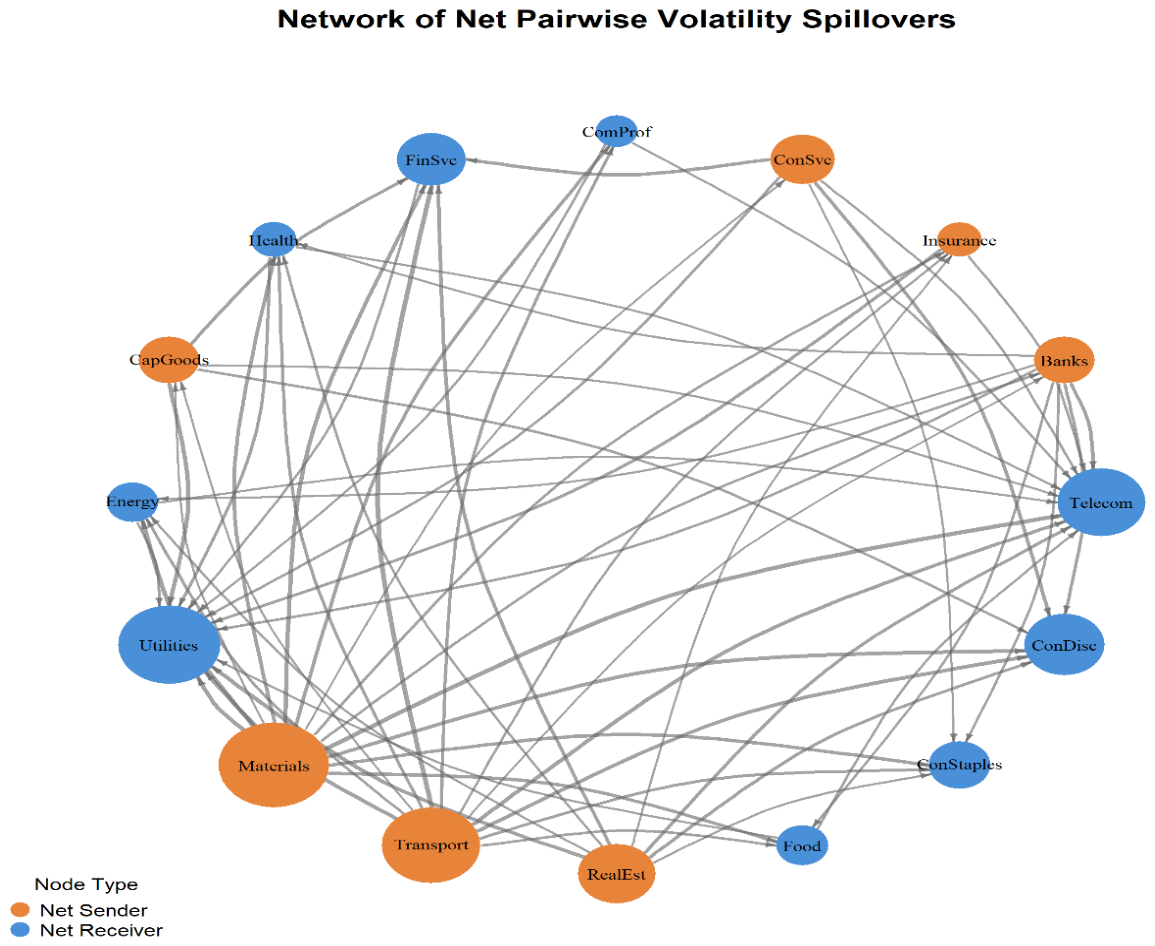
To illustrate the structure of inter-sectoral volatility transmission, we construct a directed network graph based on the net pairwise spillover matrix. In this network, each node represents a sector, and directed edges indicate the net direction and magnitude of volatility spillovers between sector pairs. Node color distinguishes net transmitters (orange) from net receivers (blue), and node size reflects the magnitude of net connectedness. Edge width is proportional to the spillover intensity between sector pairs. This visualization provides an intuitive representation of the sectoral volatility transmission structure within Tadawul.
3.8. Robustness Checks Design
To verify the sensitivity of the results to the choice of rolling window size, the dynamic spillover analysis is re-estimated using alternative window sizes of 150 and 250 trading days, in addition to the baseline window of 200 days. Robustness to the choice of forecast horizon is also assessed by re-computing all spillover measures at H = 5 and H = 20 days, alongside the baseline H = 10. Consistency across different window sizes and horizons indicates that the main findings are robust and not driven by a specific choice of parameter.
4. Empirical Results
4.1. Descriptive Statistics
Table 1 presents the descriptive statistics of daily log returns for the 16 Tadawul sector indices over the period 2017–2024. The mean daily returns are positive for most sectors, with Capital Goods (0.055%), Utilities (0.052%), and Banks (0.044%) exhibiting the highest average returns. In contrast, Real Estate (–0.016%), Consumer Services (–0.002%), and Commercial and Professional Services (–0.002%) are the only sectors with negative mean returns, suggesting persistent underperformance during the sample period.
The standard deviation of returns ranges from 1.10% for Materials to 1.62% for Utilities, indicating considerable variation in risk levels across sectors. Notably, Utilities exhibits the highest volatility (1.62%) along with one of the highest average returns, reflecting a clear risk-return trade-off. All sectors exhibit negative skewness except Consumer Staples (0.31), indicating that extreme negative returns are more frequent than extreme positive returns across most sectors. The kurtosis values substantially exceed the normal distribution benchmark of 3 for all sectors, with Transportation (13.23) and Materials (12.49) showing the most pronounced leptokurtic distributions. The Jarque–Bera test statistics confirm the rejection of normality for all sectors at the 1% significance level. The results of the Augmented Dickey–Fuller (ADF) test indicate that all return series are stationary, fulfilling a prerequisite for VAR estimation. Furthermore, the ARCH-LM test confirms the presence of significant ARCH effects across all sectors, thereby justifying the application of volatility-based spillover analysis.
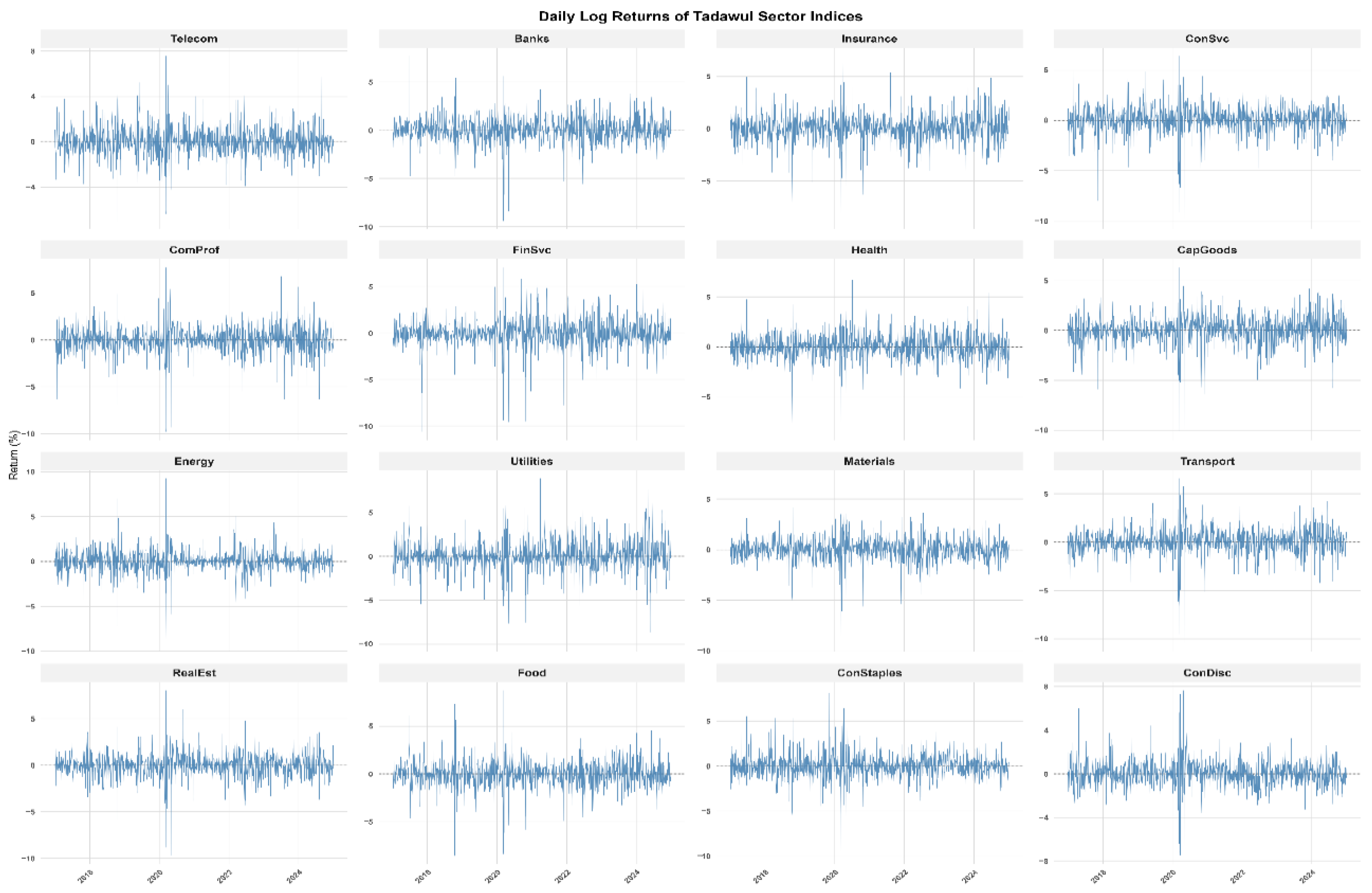
Figure 1 shows the return series for the 16 sectors over the full sample period from January 2017 to December 2024. All return series exhibit clear volatility clustering, characterized by alternating periods of high and low volatility, indicating conditional heteroskedasticity. The magnitude of volatility increases noticeably during crisis episodes, particularly around the COVID-19 pandemic selloff in early 2020, reflecting the sensitivity of Saudi sectoral equity markets to both domestic and global shocks. Notable cross-sectional variation is also evident, with some sectors exhibiting wider fluctuations in returns than others. These characteristics, combined with the visible co-movement across sectors during stress periods, provide strong motivation to apply the Diebold and Yılmaz (2012) connectedness framework to analyze volatility spillover dynamics across Tadawul sectors.
Figure 1.
Daily log returns (%) of 16 Tadawul sector indices, January 2017–December 2024.
4.2. Static Spillover Analysis
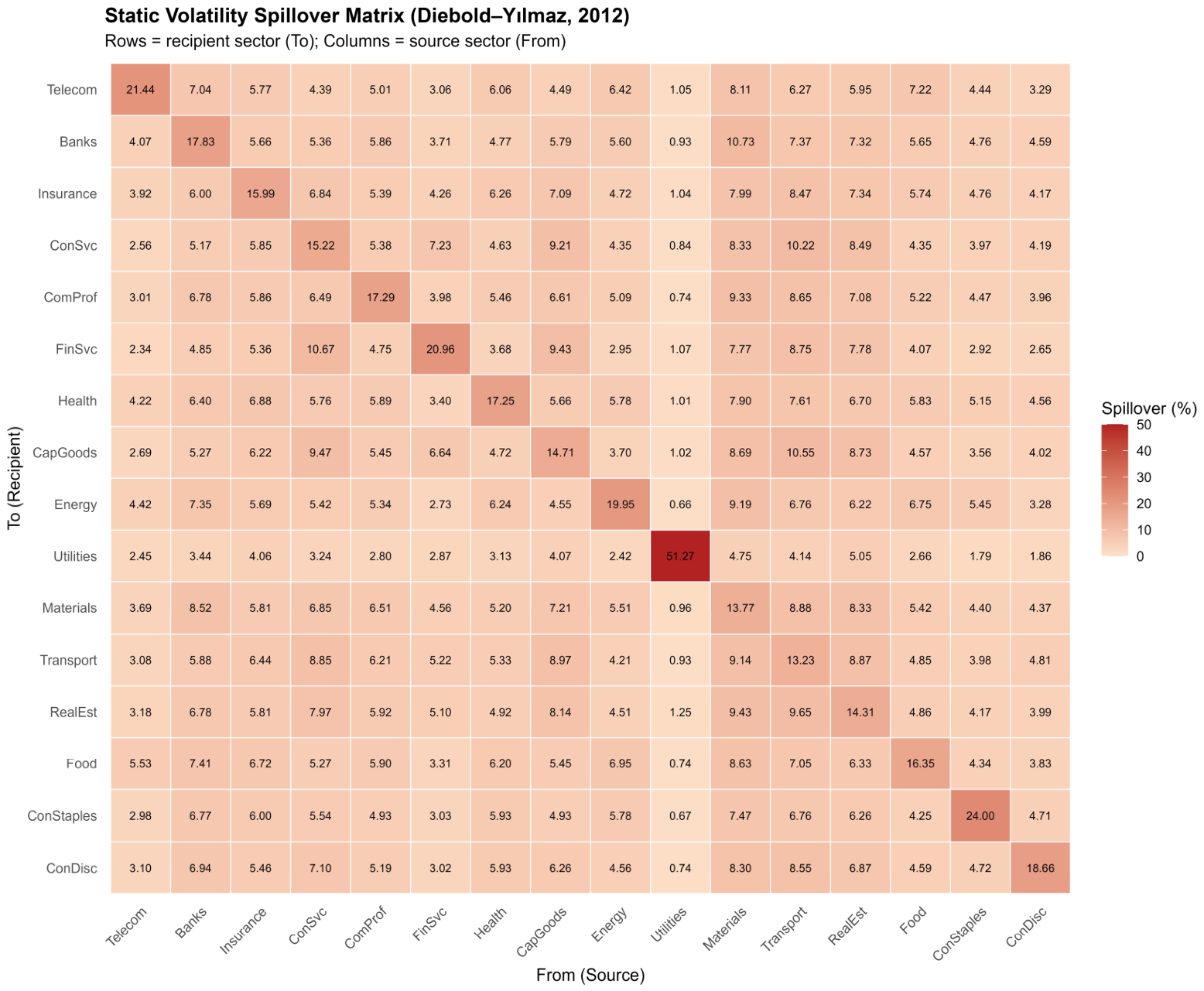
Table 2 presents the full-sample static volatility spillover table estimated from a VAR(4) model with a 10-step-ahead forecast horizon. A heatmap representation of the matrix is provided in Figure 2. The overall total spillover index (TCI) is 80.49%, indicating that approximately four-fifths of the total forecast error variance across the 16 sectors is attributable to cross-sectoral volatility spillovers. This high level of interconnectedness suggests that sector-specific volatility is closely linked across the Saudi stock market, leaving limited scope for sectoral diversification.
Table 2.
Full-sample volatility connectedness matrix across 16 Tadawul sectors (%).
Figure 2.
Heatmap of the static volatility spillover matrix across 16 Tadawul sectors (Diebold & Yılmaz, 2012). Rows represent the recipient sector (To) and columns the source sector (From). Diagonal elements reflect own-variance contributions; off-diagonal elements indicate cross-sectoral spillovers (%).
Examining the directional spillovers, Materials emerges as the dominant net transmitter with a net spillover of (+39.5%), followed by Transportation (+32.9%), Real Estate (+21.7%), Consumer Services (+14.5%), Capital Goods (+12.6%), and Banks (+12.4%). These sectors contribute the most to system-wide volatility. The prominence of Materials is consistent with the dominant role of the petrochemical industry led by SABIC in the Saudi economy, while the strong contribution of Banks reflects the financial sector’s systemic importance in channeling credit and liquidity across the economy.
On the receiving end, Utilities is the largest net receiver of volatility with a net spillover of (−35.1%), followed by Telecommunication Services (−27.3%), Consumer Discretionary (−23.1%), and Financial Services (−16.9%). The Utilities sector exhibits the highest own-variance share (51.27%), substantially above the average of other sectors (13–24%), indicating that it operates in relative isolation from the broader market. This is consistent with the regulated nature of utility companies in the Saudi stock market, which are largely government-controlled and less sensitive to market-wide volatility. The high level of overall connectedness (80.49%) is consistent with the first research objective, confirming that sectors in the Saudi stock market are significantly interconnected through volatility spillovers rather than operating independently. The statistical robustness of these net spillover rankings is formally assessed in Section 5 through a block bootstrap procedure.
4.3. Dynamic Spillover Analysis
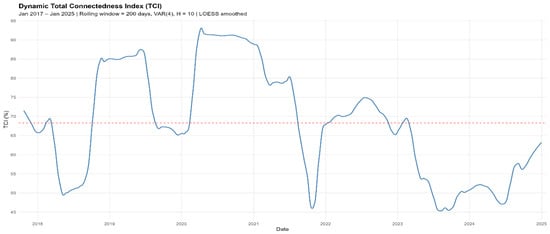
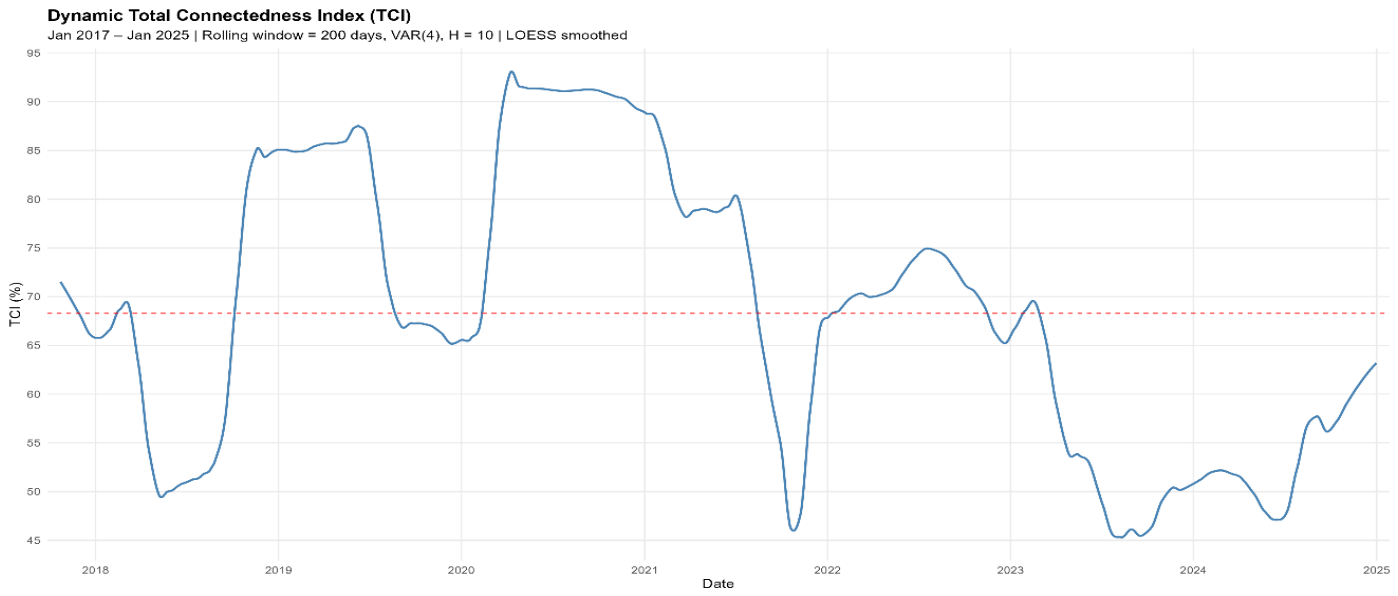
Figure 3 presents the dynamic total connectedness index (TCI) estimated using a 200-day rolling window over the sample period. The TCI ranges from a minimum of 42.74% to a maximum of 93.70%, with a mean of 68.29% and a standard deviation of 14.45%. This substantial variation confirms that sectoral volatility connectedness in the Saudi market is highly time-varying and sensitive to evolving market structures and economic conditions.
Figure 3.
Dynamic Total Connectedness Index (TCI) across 16 Tadawul sectors, January 2017–December 2024. Rolling window = 200 days, VAR(4), H = 10, LOESS smoothed. The red dashed line indicates the full-sample mean (68.29%).
Several distinct episodes of elevated connectedness are evident. The TCI rises sharply in early 2020, peaking near 93.70% during the COVID-19 pandemic—a stress test that revealed the full depth of sectoral interdependencies in the Saudi market. This finding is consistent with international evidence that extreme events significantly amplify cross-sectoral volatility connectedness (Costa et al., 2022; Shahzad et al., 2021).
Following this peak, the TCI gradually declines through the post-pandemic recovery period before experiencing renewed elevation in 2022–2023, consistent with the pattern of time-varying connectedness documented in emerging markets (Kakran et al., 2023). By 2024, the TCI declines to below-average levels, suggesting a normalization of sectoral interdependencies as the Saudi market consolidates its structural reforms under the Financial Sector Development Program.
4.4. Net Directional Spillovers
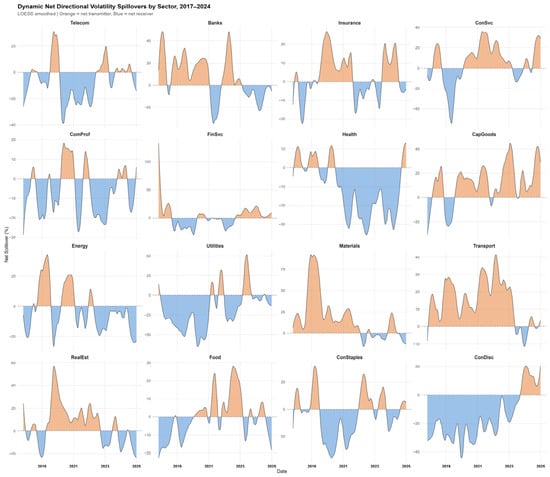
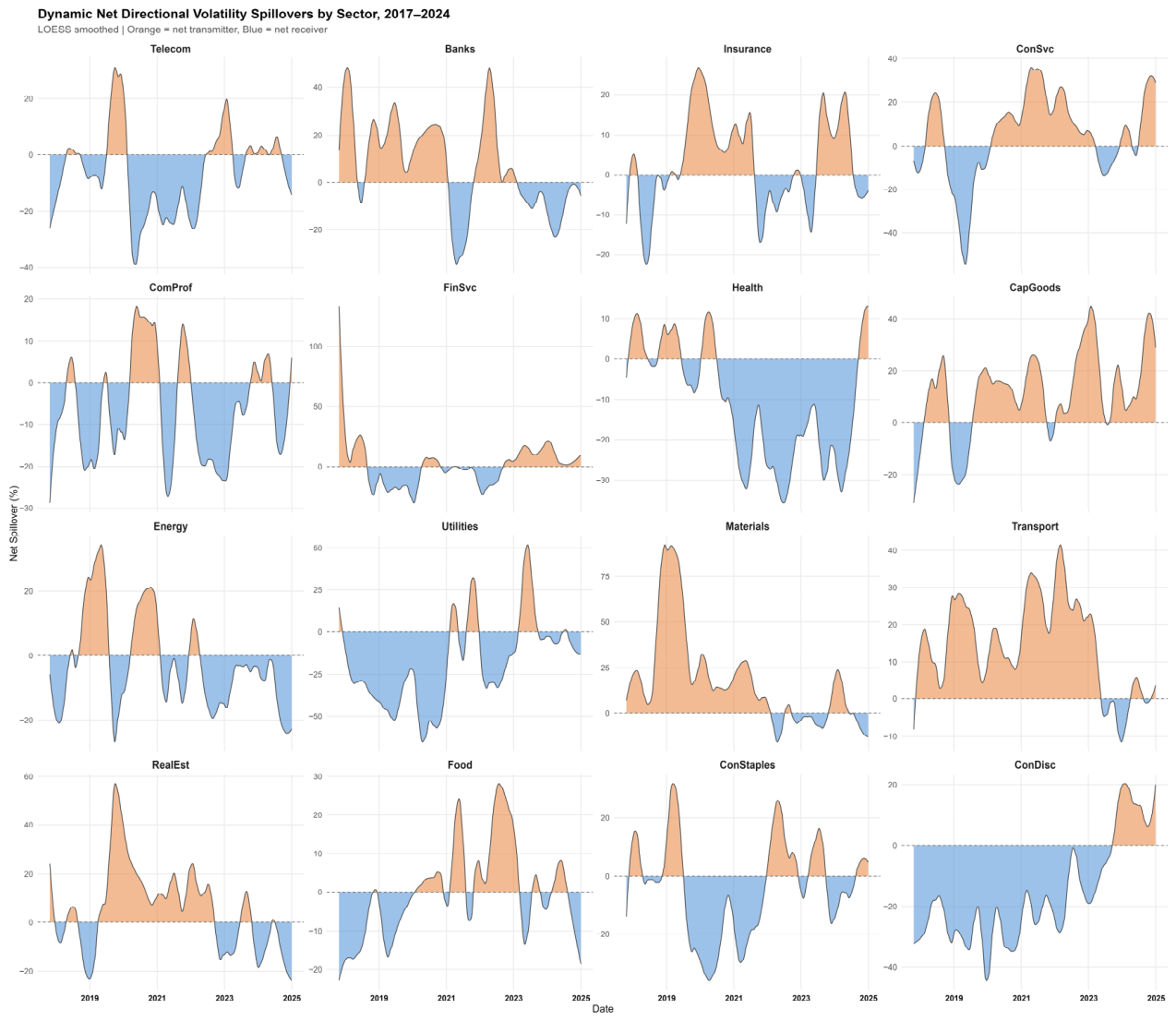
Figure 4 and Figure 5 present the dynamic net directional spillovers for each of the 16 sectors over time. The results reveal that certain sectors consistently act as net transmitters or receivers throughout the sample period, while others switch roles depending on market conditions.
Figure 4.
Dynamic net directional volatility spillovers across 16 Tadawul sectors, January 2017–December 2024. Orange shading = net transmitter; Blue shading = net receiver. LOESS smoothed.
Figure 5.
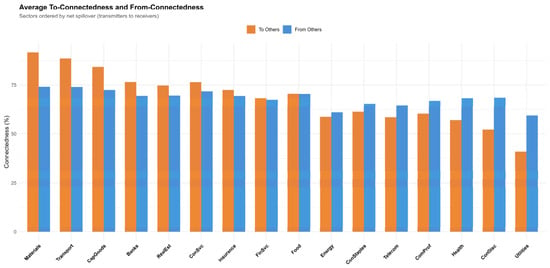
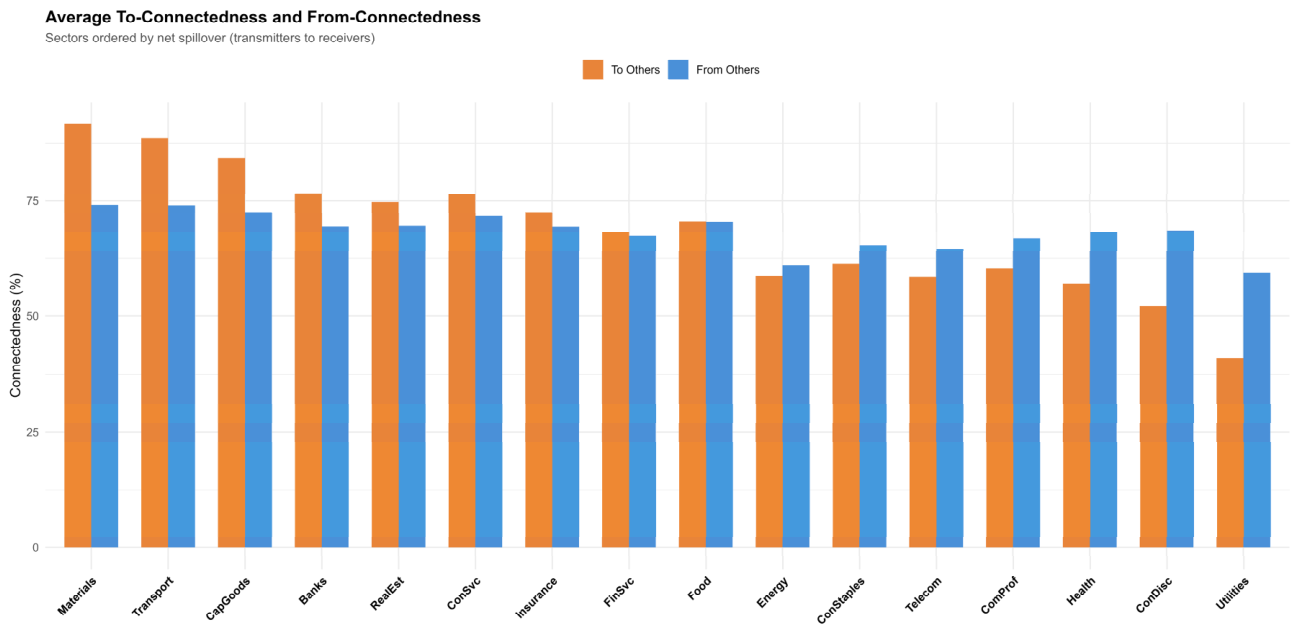
Average to-connectedness and from-connectedness across 16 Tadawul sectors. Sectors ordered from largest net transmitter (Materials) to largest net receiver (Utilities).
Figure 4 reveals that Materials, Transportation, and Capital Goods are persistent net transmitters of volatility throughout most of the sample period. While Real Estate ranks third in the static analysis (+21.7%), Capital Goods appears more consistently positive across the rolling window. The two measures capture different aspects of net transmission: full-sample magnitude versus rolling-window persistence. Banks alternate between net-transmitting and net-receiving roles, with a notable shift toward strong net transmission during the COVID-19 period. Utilities and Consumer Discretionary are persistent net receivers, exhibiting consistently negative net spillovers throughout the sample. Telecommunication Services is predominantly a net receiver but exhibits brief episodes of net transmission during periods of elevated market volatility. The Financial Services sector displays pronounced spikes in net directional spillovers during 2018, coinciding with sector-specific regulatory developments and large institutional flows that temporarily elevated its systemic connectedness.
Figure 5 corroborates these findings by presenting the average to-connectedness and from-connectedness across all sectors over the full sample. Materials, Transportation, and Capital Goods consistently show higher to-connectedness than from-connectedness, confirming their role as dominant transmitters, while Utilities and Consumer Discretionary display the opposite pattern.
The identification of Materials, Transportation, and Capital Goods as persistent net transmitters is consistent with the second research objective. The observed role reversals, particularly in Banks and Financial Services, align with the third research objective, confirming that net directional spillover roles are not static but evolve in response to shifting economic conditions. This pattern is consistent with the structural transformation underway in the Saudi capital market under Vision 2030.
4.5. Network Analysis
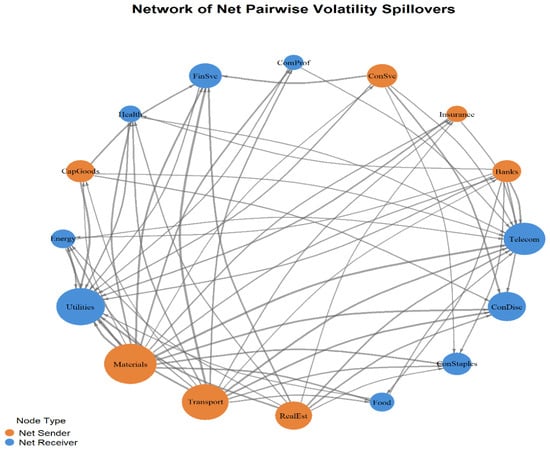
Figure 6 shows a network visualization of pairwise volatility spillovers from the full-sample static analysis. The network clearly differentiates between net transmitters (orange nodes) and net receivers (blue nodes), with node size proportional to the magnitude of net connectedness.
Figure 6.
Network visualization of net pairwise volatility spillovers across 16 Tadawul sectors. Orange nodes = net transmitters; Blue nodes = net receivers. Node size proportional to the magnitude of net spillover.
Materials, Transportation, and Real Estate emerge as the largest nodes among net transmitters, positioned centrally in the network with multiple strong outgoing connections. Their prominent role suggests that volatility associated with these sectors has the broadest reach across the market. Banks and Capital Goods also occupy transmitter positions, consistent with their positive net spillover values reported in Table 2.
Among net receivers, Utilities and Telecommunication Services are the largest nodes, indicating that they receive the most volatility from the system. Consumer Discretionary and Consumer Staples also appear as notable receivers. The network reveals that the strongest pairwise spillover linkages exist between Materials and Banks, Materials and Transportation, and Capital Goods and Transportation, reflecting the real-economy supply chain connections among these sectors. It is worth noting that these pairwise linkages identify the strongest individual sector-to-sector connections and are conceptually distinct from the most central nodes in the network. A sector can be highly central by aggregate net spillover, as in the case of Real Estate, without necessarily appearing among the strongest bilateral pairs.
5. Robustness Checks
To assess the sensitivity of our empirical findings to the choice of rolling window size, we re-estimate the dynamic total connectedness index (TCI) using two alternative window sizes: 150 and 250 trading days, in addition to the baseline window of 200 days. Table 3 reports summary statistics for the total connectedness index across the three window specifications.
Table 3.
Summary statistics of total connectedness index (TCI) under alternative rolling window sizes.
The mean TCI is 71.48% for the 150-day window, 68.29% for the 200-day window, and 67.42% for the 250-day window. The slight decrease in the mean TCI with increasing window size is expected, as larger windows smooth out short-lived volatility episodes and place greater weight on tranquil periods. The maximum TCI values are remarkably consistent across the three specifications: 93.74%, 93.70%, and 93.65%, indicating that the peak connectedness during the COVID-19 period is robustly captured regardless of the window choice. The standard deviation increases with window size (from 11.67% to 15.78%), reflecting the wider range of TCI values captured by larger windows, which record lower minimum values during tranquil periods while maintaining similar peaks during high-volatility episodes.
The robustness analysis confirms that all three TCI series follow the same overall temporal pattern, with synchronized peaks during the COVID-19 pandemic, elevated connectedness during 2022–2023, and a general decline toward 2024. The 150-day window yields a more volatile TCI series that responds more rapidly to short-term shocks, whereas the 250-day window produces a smoother series that captures longer-term trends. The 200-day baseline window offers an appropriate balance between responsiveness and stability. This is consistent with the standard adopted in the literature (Diebold & Yılmaz, 2012; Ouyang & Tang, 2026). These results confirm that the main findings of this study, including the identification of dominant transmitters and receivers, the time-varying nature of sectoral connectedness, and the elevated connectedness during crisis periods, are robust to the choice of rolling window size.
As a further robustness exercise, the static spillover analysis (200-day rolling window) is re-estimated using alternative forecast horizons of H = 5 and H = 20, in addition to the baseline H = 10. As reported in Table 4, the total connectedness index is remarkably stable across the three horizons, at 80.36%, 80.49%, and 80.49%, respectively. More importantly, the ranking of sectors by net directional spillovers is preserved across all three specifications, with Materials, Transportation, and Real Estate Management and Development consistently identified as the top net transmitters, and Utilities, Telecommunication Services, and Consumer Discretionary as the largest net receivers. The negligible differences between net spillover values across horizons confirm that the baseline results are not sensitive to the choice of forecast horizon.
Table 4.
Robustness of spillover measures to alternative forecast horizons (H = 5, 10, 20).
To complement the robustness analyses across rolling windows and forecast horizons, we conduct formal statistical inference on the spillover measures using a block bootstrap procedure. While robustness tests assess parameter sensitivity, they do not establish whether net spillover differences across sectors are statistically distinguishable. To address this, we resample VAR residuals using overlapping blocks of length L = 20 trading days and re-estimate the full GFEVD across B = 1000 bootstrap replications. Replications producing non-stable companion matrices are discarded; in our application, all 1000 replications were retained. 95% confidence intervals are constructed from the empirical 2.5–97.5% percentiles of the bootstrap distribution.
The bootstrap evidence supports three conclusions. First, Materials, Transportation, and Consumer Services are statistically confirmed as net transmitters, with 95% confidence intervals lying entirely in the positive region. Real Estate Management and Development is also identified as a net transmitter, with a confidence interval (−0.30, +29.97) that lies overwhelmingly in the positive domain but marginally crosses zero, suggesting strong but slightly less precise evidence of net transmission. Second, Utilities, Telecommunication Services, Consumer Discretionary, and Financial Services are confirmed as net receivers, with confidence intervals bounded entirely below zero. Third, net spillover differences between adjacent sectors, most notably Banks (+12.43%, [−12.86, +28.39]) and Capital Goods (+12.56%, [−4.71, +23.72]), are not statistically distinguishable, as their confidence intervals overlap substantially. Accordingly, rank-order distinctions between adjacent sectors warrant conservative interpretation. The Total Connectedness Index is estimated at 80.49% with a 95% confidence interval of [56.34%, 86.79%], confirming that system-wide connectedness is robustly elevated.
The full set of point estimates and 95% confidence intervals for net, TO, and FROM directional spillovers across all 16 sectors is reported in Table 5.
Table 5.
Block Bootstrap 95% Confidence Intervals for Directional Volatility Spillovers.
6. Discussion
The empirical findings of this study provide new insights into the structure and dynamics of sectoral volatility connectedness within the Saudi stock market. This section contextualizes the key results within the broader literature on sectoral spillovers and discusses their implications for portfolio management.
The full-sample total connectedness index of 80.49% indicates a high degree of cross-sectoral volatility linkage within the Saudi market. This level of connectedness is broadly comparable to that reported in other national stock markets. Ngene (2021) documented a TCI of approximately 76% across nine US equity sectors. In the Chinese stock market, Ouyang and Tang (2026) found that short-term total volatility connectedness among ten sectors was substantially higher than long-term connectedness, highlighting the importance of time-scale considerations in interpreting aggregate spillover measures, which represents a promising direction for future research on the Saudi market.
The empirical findings reveal a clear asymmetry between aggressive and defensive sectors in their connectedness profiles. On the aggressive side, the identification of Materials as the dominant net transmitter of volatility (+39.5%) is consistent with findings from comparable sectoral studies. Ouyang and Tang (2026) identified the Materials sector among the key sources of volatility spillovers in the Chinese stock market, attributing its prominence to its upstream position in the supply chain and its sensitivity to international commodity price fluctuations. In the Saudi context, the dominance of Materials is further amplified by the outsized role of the petrochemical industry, led by SABIC, which serves as a primary conduit through which global commodity price movements are transmitted to the domestic sectoral network. On the defensive side, the finding that Utilities operates as the largest net receiver of volatility (−35.1%) with the highest own-variance share (51.27%) aligns with the broader literature on defensive sector behavior. Ngene (2021) demonstrated that defensive sectors, characterized by low beta and inelastic demand, consistently function as net receivers of volatility in the US market.
The dynamic analysis reveals that sectoral connectedness is highly time-varying, peaking at 93.70% during the COVID-19 pandemic. This finding is consistent with the international evidence. Costa et al. (2022) and Shahzad et al. (2021) documented similar intensification of sectoral spillovers during the pandemic in the US and Chinese markets, respectively. Ouyang and Tang (2026) further confirmed that total volatility connectedness in the Chinese market exhibited a pronounced increase during extreme events, with the COVID-19 period producing the highest observed values. The sharp increase in connectedness during the pandemic is consistent with the simultaneous exposure of all sectors to a common uncertainty shock, which temporarily overwhelmed sector-specific fundamentals and amplified cross-sectoral co-movement.
The network analysis further reveals that Materials, Transportation, Real Estate Management and Development, and Banks form the core of the spillover network, with the strongest pairwise linkages existing between Materials and Banks, and between Materials and Transportation. These linkages reflect the real-economy supply chain connections among these sectors, a pattern also observed by Ouyang and Tang (2026), who found that the high out-degree of Materials and Industrials in the Chinese sectoral network underscored their role as suppliers and connectors within the broader economy.
From a portfolio management perspective, the high level of sectoral interconnectedness documented in this study suggests that diversification strategies based solely on sector allocation may offer limited risk-reduction benefits during periods of market stress. This finding is consistent with Ngene (2021), who noted that when volatility changes across different sectors are highly correlated, risk reduction through sectoral diversification becomes a challenging undertaking. Investors may benefit from incorporating defensive sectors such as Utilities and Telecommunication Services as hedging components, while monitoring the dynamic TCI as an early indicator of rising systemic risk.
The empirical findings of this study address the four research objectives outlined in Section 1. First, the high Total Connectedness Index of 80.49% indicates that approximately four-fifths of the forecast error variance across Tadawul sectors is associated with cross-sectoral spillovers. Second, the analysis identifies Materials, Transportation, and Real Estate Management and Development as the sectors with the strongest positive net directional connectedness, whereas Utilities, Telecommunication Services, and Consumer Discretionary display the strongest negative net directional connectedness. Third, the dynamic analysis reveals substantial time variation in connectedness, with the highest values observed during the COVID-19 episode and a gradual decline thereafter. Fourth, the network visualization identifies Materials, Transportation, Real Estate Management and Development, and Banks as the core of the spillover network, consistent with the broader interdependencies among these sectors.
7. Conclusions
This study employs the Diebold and Yılmaz (2012) volatility spillover framework to examine sectoral connectedness across 16 Tadawul sectors from January 2017 to December 2024. The full-sample total connectedness index of 80.49% indicates that approximately four-fifths of forecast error variance is attributable to cross-sectoral spillovers, confirming that Saudi stock market sectors are deeply interconnected and that sector-specific volatility is closely linked across the broader market.
The static analysis identifies Materials, Transportation, and Real Estate Management and Development as the dominant net transmitters of volatility, while Utilities, Telecommunication Services, and Consumer Discretionary emerge as persistent net receivers. The prominence of Materials reflects the petrochemical industry’s central role in the Saudi economy, while the banking sector’s positive net spillover underscores its systemic importance in credit intermediation and capital allocation. Utilities, by contrast, exhibit the highest own-variance share and the lowest to-connectedness, consistent with the regulated and government-controlled nature of this sector.
The dynamic analysis reveals that sectoral connectedness is highly time-varying, reaching a peak of 93.70% during the COVID-19 pandemic before gradually normalizing through the post-pandemic recovery period. The network visualization further confirms that Materials, Transportation, Real Estate Management and Development, and Banks form the core of the spillover network, while Utilities occupies a peripheral position. These patterns are robust to alternative rolling window specifications of 150 and 250 days, with peak connectedness values remaining stable across all three specifications. Block-bootstrap inference further confirms the statistical significance of the dominant transmitters and receivers, while indicating that finer rank-order distinctions among intermediate sectors warrant conservative interpretation.
These findings carry important implications for investors and policymakers. The high degree of sectoral interconnectedness suggests that diversification strategies based solely on sector allocation may offer limited risk-reduction benefits during periods of market stress. Investors should consider incorporating defensive sectors such as Utilities and Telecommunication Services as hedging components, while monitoring the dynamic TCI as an early indicator of rising systemic risk. Sectors aligned with Vision 2030 growth priorities, including Consumer Services, Health Care, and Financial Services, may offer attractive risk-return profiles during periods of low connectedness. For regulators, the identification of Materials, Transportation, and Banks as systemically important sectors underscores the need for targeted macroprudential oversight and stress testing frameworks that account for cross-sectoral volatility linkages. The continued implementation of Vision 2030 reforms, including the expansion of non-oil sectors and the development of capital market instruments, is expected to gradually reshape spillover dynamics toward a more balanced and resilient market structure.
This study is subject to limitations that open avenues for future research. Future research could extend this analysis by investigating the role of macroeconomic and financial uncertainty variables in driving time-varying sectoral connectedness, constructing optimal portfolio allocation strategies based on minimum connectedness measures, and decomposing sectoral spillovers across multiple time scales to distinguish short-term from long-term dynamics. The VAR(4) residual diagnostics also indicate persistent serial dependence and conditional heteroskedasticity, characteristic of high-frequency financial data, which could be modeled more explicitly through multivariate GARCH or time-varying parameter VAR extensions. It should be acknowledged that the empirical effects of Vision 2030 reforms on sectoral connectedness cannot be fully disentangled from concurrent global events, particularly the COVID-19 pandemic. Future research employing structural break tests or event-study designs may help isolate the independent effect of specific reform milestones on spillover dynamics. Extending the framework to examine cross-border spillovers between Tadawul sectoral indices and international markets would further enrich the understanding of Saudi Arabia’s integration into the global financial system.
Funding
This research received no external funding.
Institutional Review Board Statement
Not applicable.
Informed Consent Statement
Not applicable.
Data Availability Statement
The data analyzed in this study are publicly available from the Saudi Exchange historical prices service at https://www.saudiexchange.sa, accessed on 15 January 2025. Processed data and analysis code are available from the author upon request.
Conflicts of Interest
The author declares no conflicts of interest.
Appendix A
Table A1.
Diagnostics for the Squared-Return Series and the VAR(4) Residuals.
References
- Agrawal, P. K., Syed, A. A., Singh, A., & Kumar, M. (2026). Volatility spillover effects in founding members of BRICS stock markets: A DCC-GARCH perspective. Economies, 14(2), 41. [Google Scholar] [CrossRef] [Scilit]
- AL-Besher, S., & AL-Najjar, D. (2026). Modeling Saudi stock index returns and volatility: A dual approach using GARCH and neural networks. Frontiers in Artificial Intelligence, 9, 1714822. [Google Scholar] [CrossRef] [Scilit]
- Alotaibi, K. O., Al-Shurafa, M. A., Al-Daihani, M., & Bouteraa, M. (2025). Sectoral contributions to financial market resilience: Evidence from GCC countries. Journal of Risk and Financial Management, 18(8), 460. [Google Scholar] [CrossRef] [Scilit]
- Al Rahahleh, N., & Kao, R. (2018). Forecasting volatility: Evidence from the Saudi stock market. Journal of Risk and Financial Management, 11(4), 84. [Google Scholar] [CrossRef] [Scilit]
- Chirilă, V. (2022). Connectedness between sectors: The case of the Polish stock market before and during COVID-19. Journal of Risk and Financial Management, 15(8), 322. [Google Scholar] [CrossRef] [Scilit]
- Costa, A., Matos, P., & da Silva, C. (2022). Sectoral connectedness: New evidence from US stock market during COVID-19 pandemics. Finance Research Letters, 45, 102124. [Google Scholar] [CrossRef] [Scilit]
- Dang, T. H. N., Nguyen, N. T., & Vo, D. H. (2023). Sectoral volatility spillovers and their determinants in Vietnam. Economic Change and Restructuring, 56(1), 681–700. [Google Scholar] [CrossRef] [Scilit]
- Das, N. M., Rout, B. S., & Bal, G. R. (2025). Stock market integration, risk and spillovers across BRICS nations: An assessment during COVID-19. Management and Labour Studies, 50(3), 337–356. [Google Scholar] [CrossRef] [Scilit]
- Diebold, F. X., & Yılmaz, K. (2009). Measuring financial asset return and volatility spillovers, with application to global equity markets. The Economic Journal, 119(534), 158–171. [Google Scholar] [CrossRef] [Scilit]
- Diebold, F. X., & Yılmaz, K. (2012). Better to give than to receive: Predictive directional measurement of volatility spillovers. International Journal of Forecasting, 28(1), 57–66. [Google Scholar] [CrossRef] [Scilit]
- Diebold, F. X., & Yılmaz, K. (2014). On the network topology of variance decompositions: Measuring the connectedness of financial firms. Journal of Econometrics, 182(1), 119–134. [Google Scholar] [CrossRef] [Scilit]
- Endri, E., Fauzi, F., & Effendi, M. S. (2024). Integration of the Indonesian stock market with eight major trading partners’ stock markets. Economies, 12(12), 350. [Google Scholar] [CrossRef] [Scilit]
- Gökgöz, H., Syed, A. A., Gheorghe, C., & Jeribi, A. (2026). Quantile-frequency dependence between U.S. sector stock indices and macro-financial indicators: A quantile coherence approach. The North American Journal of Economics and Finance, 81, 102552. [Google Scholar] [CrossRef] [Scilit]
- Hamadneh, N. N., Jaber, J. J., & Sathasivam, S. (2024). Estimating volatility of Saudi stock market using hybrid dynamic evolving neural fuzzy inference system models. Journal of Risk and Financial Management, 17(8), 377. [Google Scholar] [CrossRef] [Scilit]
- Joo, B. A., Ghulam, Y. A., & Mir, S. I. (2023). Symmetric and asymmetric volatility spillover among BRICS countries’ stock markets. Decision, 50(4), 473–488. [Google Scholar] [CrossRef] [Scilit]
- Kakran, S., Sidhu, A., Bajaj, P. K., & Dagar, V. (2023). Novel evidence from APEC countries on stock market integration and volatility spillover: A Diebold and Yilmaz approach. Cogent Economics and Finance, 11(2), 2254560. [Google Scholar] [CrossRef] [Scilit]
- Kalyanaraman, L. (2014). Stock market volatility in Saudi Arabia: An application of univariate GARCH model. Asian Social Science, 10(10), 142–152. [Google Scholar] [CrossRef] [Scilit]
- Koop, G., Pesaran, M. H., & Potter, S. M. (1996). Impulse response analysis in nonlinear multivariate models. Journal of Econometrics, 74(1), 119–147. [Google Scholar] [CrossRef] [Scilit]
- Kumaran, S. (2023). Forecasting volatility of Saudi stock market (TASI) and sectoral indices. Afro-Asian Journal of Finance and Accounting, 13(6), 819–842. [Google Scholar] [CrossRef] [Scilit]
- Lawrence, B., Obalade, A. A., Tita, A. F., & French, J. J. (2024). Stock market connectedness during an energy crisis: Evidence from South Africa. Emerging Markets Review, 63, 101194. [Google Scholar] [CrossRef] [Scilit]
- Levine, R., & Zervos, S. (1996). Stock market development and long-run growth. The World Bank Economic Review, 10(2), 323–339. [Google Scholar] [CrossRef] [Scilit]
- Maurya, P. K., Bansal, R., & Mishra, A. K. (2025). Sectoral connectedness, volatility spillover and hedging opportunities: Evidence from Indian stock market. Eurasian Economic Review, 15, 1099–1134. [Google Scholar] [CrossRef] [Scilit]
- Morshed, A. (2025). Graph neural networks and explainable spillovers: Global monetary and oil shocks in GCC financial markets. Economies, 13(11), 308. [Google Scholar] [CrossRef] [Scilit]
- Ngene, G. M. (2021). What drives dynamic connectedness of the U.S. equity sectors during different business cycles? North American Journal of Economics and Finance, 58, 101493. [Google Scholar] [CrossRef] [Scilit]
- Nguyen, L. X. D., Mateut, S., & Chevapatrakul, T. (2020). Business-linkage volatility spillovers between US industries. Journal of Banking and Finance, 111, 105699. [Google Scholar] [CrossRef] [Scilit]
- Ouyang, M., & Tang, C. (2026). Sectoral volatility connectedness in China’s stock market: A multiscale analysis. Finance Research Open, 2(1), 100095. [Google Scholar] [CrossRef] [Scilit]
- Pesaran, H. H., & Shin, Y. (1998). Generalized impulse response analysis in linear multivariate models. Economics Letters, 58(1), 17–29. [Google Scholar] [CrossRef] [Scilit]
- Saudi Vision 2030. (n.d.). Financial sector development program. Available online: https://www.vision2030.gov.sa/en/explore/programs/financial-sector-development-program (accessed on 15 January 2025).
- Shahzad, S. J. H., Naeem, M. A., Peng, Z., & Bouri, E. (2021). Asymmetric volatility spillover among Chinese sectors during COVID-19. International Review of Financial Analysis, 75, 101754. [Google Scholar] [CrossRef] [Scilit]
- Sultan, B., & AlTunisi, M. (2025). Sustaining foreign direct investment in Saudi Arabia: An analysis of investment protection frameworks and their impact on economic growth within Vision 2030. Sustainability, 17(19), 8845. [Google Scholar] [CrossRef] [Scilit]
- World Federation of Exchanges. (2025). Market statistics—January 2026. WFE. Available online: https://focus.world-exchanges.org/issue/january-2026/market-statistics (accessed on 15 February 2026).
- Wu, F., Zhang, D., & Zhang, Z. (2019). Connectedness and risk spillovers in China’s stock market: A sectoral analysis. Economic Systems, 43(3–4), 100718. [Google Scholar] [CrossRef] [Scilit]
- Zhang, Y., Zhou, L., Liu, Z., & Wu, B. (2025). Spillover of fear among the US and BRICS equity markets during the COVID-19 crisis and the Russo-Ukrainian conflict. The North American Journal of Economics and Finance, 75, 102308. [Google Scholar] [CrossRef] [Scilit]
- Ziadat, S. A., & AlKhouri, R. (2022). Revisiting volatility spillovers in the Gulf cooperation council. Cogent Economics and Finance, 10(1), 2031683. [Google Scholar] [CrossRef] [Scilit]

Disclaimer/Publisher’s Note: The statements, opinions and data contained in all publications are solely those of the individual author(s) and contributor(s) and not of MDPI and/or the editor(s). MDPI and/or the editor(s) disclaim responsibility for any injury to people or property resulting from any ideas, methods, instructions or products referred to in the content. |
© 2026 by the author. Licensee MDPI, Basel, Switzerland. This article is an open access article distributed under the terms and conditions of the Creative Commons Attribution (CC BY) license.