1. Introduction
Measuring the financial performance of the banking sector in a reliable and comprehensive manner represents a critical research issue that extends beyond monitoring sectoral efficiency. It is also closely associated with macroeconomic stability, the sustainability of financial intermediation, and the management of systemic risk. Although financial deepening and efficient intermediation mechanisms can foster long-term economic growth (
Levine, 2005), periods characterized by rapid credit expansion and the accumulation of balance-sheet vulnerabilities increase the likelihood that deteriorations in the banking sector may evolve into systemic crises. Such crises often generate substantial output losses and long-lasting economic costs (
Laeven & Valencia, 2013;
Schularick & Taylor, 2012). Empirical evidence further indicates that recessions following credit-intensive expansions tend to be significantly more severe than typical economic downturns, highlighting the decisive role of credit accumulation in shaping recession dynamics (
Jordà et al., 2013).
Within this context, evaluating banking performance solely through profitability indicators may obscure the risk and resilience components that determine the sustainability of financial performance. Following the Global Financial Crisis, the literature increasingly emphasizes the necessity of complementing traditional performance assessments with a macroprudential perspective that prioritizes financial system stability and strengthens banks’ shock-absorption capacity (
Hanson et al., 2011). During crisis episodes, disruptions in financial market liquidity channels can rapidly propagate across the banking system through interactions with balance-sheet weaknesses, while feedback mechanisms between funding liquidity and market liquidity may amplify shocks (
Brunnermeier, 2009). Despite this growing body of literature, most existing studies rely on single-method evaluation frameworks, which may lead to method-dependent results and limit the robustness of comparative performance assessments.
In addition, comparative banking sector studies frequently face an important methodological challenge related to the sensitivity of ranking outcomes to weighting structures and evaluation techniques. Since banking sector soundness is shaped simultaneously by profitability, liquidity conditions, capital adequacy, and credit risk indicators, different weighting assumptions may generate substantially different performance outcomes across countries. This issue becomes particularly important in cross-country analyses because unstable rankings may weaken the reliability of comparative policy interpretations and macroprudential evaluations. Although the multi-criteria decision-making (MCDM) literature provides alternative approaches for evaluating multidimensional financial structures, many studies continue to rely on a single weighting or ranking method, which may increase dependence on method-specific assumptions and reduce the stability of empirical findings.
In line with these considerations, the present study constructs a comprehensive evaluation framework that captures multiple dimensions of banking performance, including profitability (return on assets and return on equity), asset quality and credit risk (non-performing loan ratio), capital adequacy (Tier 1 capital to assets), and liquidity strength (liquid assets to short-term liabilities). The empirical analysis is conducted for 31 OECD countries with complete Financial Soundness Indicator (FSI) data obtained from the International Monetary Fund (IMF). The OECD context provides a suitable setting due to the diversity of financial structures and regulatory environments, enabling meaningful cross-country comparisons.
The methodological contribution of this study lies in proposing a multi-criteria decision-making (MCDM) protocol that integrates objective weighting techniques and robustness analysis within a unified performance assessment framework. Criterion weights are independently derived using the Modified Standard Deviation (MSD) and Modified Preference Selection Index (MPSI) methods. These weight vectors are subsequently combined through arithmetic aggregation to obtain a balanced and methodologically consistent final weighting structure. Unlike many previous studies, this integrated approach combines multiple objective weighting methods within a single framework, thereby reducing dependence on any single technique. This approach aims to mitigate method-induced volatility arising from the differing sensitivity of objective weighting techniques to data distributions (
Gligorić et al., 2022;
Maniya & Bhatt, 2010;
Puška et al., 2022).
Country rankings are generated using the MABAC method, which is preferred due to its ability to produce stable ranking results and its relatively low sensitivity to extreme values. Furthermore, the stability of the obtained rankings is examined through scenario-based sensitivity analysis, including equal-weight scenarios and alternative weighting structures that emphasize profitability or risk-resilience dimensions. By directly addressing concerns related to reproducibility and methodological transparency, the proposed framework evaluates whether ranking outcomes are driven by a single weighting scheme or reflect structural performance differences among countries. In this respect, the study aims to contribute not only to the methodological MCDM literature but also to the broader macroprudential monitoring literature by providing comparative evidence on how differences in credit risk, capital strength, liquidity conditions, and profitability shape banking sector soundness across OECD economies.
Accordingly, the study seeks to address the following research questions:
- (1)
How can banking sector soundness in OECD countries be comparatively evaluated using FSI-based indicators within a multi-criteria framework?
- (2)
Which financial dimensions—profitability, liquidity, capital adequacy, and asset quality—play the most significant role in differentiating country-level banking sector soundness?
- (3)
To what extent are the ranking results sensitive to alternative weighting schemes, and how do these results inform macroprudential policy considerations?
The remainder of the paper proceeds as follows. The next section reviews the relevant literature. Subsequently, the data and methodological framework are presented, followed by the empirical findings and sensitivity analysis results. The final section discusses policy implications and concludes the study.
2. Literature Review
The recent literature has increasingly emphasized the multidimensional assessment of banking sector performance and financial soundness, both from methodological and policy-oriented perspectives. The growing complexity of financial systems and the experience of global financial crises have reinforced the need for comprehensive analytical frameworks that simultaneously consider profitability, risk exposure, capital strength, and liquidity conditions.
Studies focusing on Financial Soundness Indicators (FSIs) highlight their importance as early warning tools for monitoring financial sector vulnerabilities and systemic risk. Empirical evidence suggests that indicators related to capital adequacy, asset quality, and profitability play a significant role in explaining banking crisis episodes and financial distress dynamics (
Costa Navajas & Thegeya, 2013;
Kasselaki & Tagkalakis, 2014). Furthermore, the standardization of FSI compilation by the International Monetary Fund has enhanced cross-country comparability, thereby facilitating comparative performance analyses at the international level (
International Monetary Fund (IMF), 2019).
Parallel to developments in financial stability research, the multi-criteria decision-making (MCDM) literature has expanded considerably, offering advanced tools for evaluating complex decision problems involving multiple and often conflicting performance dimensions. Objective weighting approaches, including the CRITIC method proposed by
Diakoulaki et al. (
1995) and hybrid MCDM frameworks have been increasingly adopted to reduce decision-maker subjectivity and improve the reproducibility of empirical findings (
Gligorić et al., 2022;
Puška et al., 2022). Within this context, the integration of different ranking algorithms has emerged as an effective strategy for enhancing methodological robustness and mitigating potential biases arising from the selection of a single evaluation method.
In banking sector evaluations, alternative MCDM approaches such as TOPSIS, VIKOR, DEA, and fuzzy-based ranking models have also been widely employed in the literature to evaluate multidimensional financial performance and banking efficiency (
Opricovic & Tzeng, 2004;
Seçme et al., 2009). These approaches provide useful comparative frameworks for assessing banking sector performance under multiple criteria. However, the resulting rankings may remain sensitive to weighting structures, normalization procedures, and method-specific assumptions, particularly in cross-country analyses involving heterogeneous financial systems. For this reason, recent studies increasingly emphasize the importance of integrated and robustness-oriented evaluation frameworks in order to improve the stability and comparability of empirical findings.
Recent methodological contributions have extended traditional MCDM approaches by adapting ranking techniques to various uncertainty environments and group decision-making contexts (
Razavi Hajiagha et al., 2013). Nevertheless, despite these methodological developments, the issue of ranking stability under alternative weighting structures remains relatively underexplored in banking sector applications. Similarly, the development of alternative ranking algorithms such as MABAC has provided researchers with more stable comparison mechanisms under trade-off conditions among criteria (
Pamučar & Ćirović, 2015). In banking sector applications, the integration of MCDM methods with data-driven approaches, including artificial neural networks and self-organizing maps, has demonstrated the potential of hybrid analytical models to capture multidimensional performance patterns (
Ozcalici & Bumin, 2020).
From a financial economics perspective, the determinants of banking performance are closely associated with balance-sheet resilience factors such as liquidity creation capacity, capital buffers, and credit risk management. Empirical studies show that higher capital adequacy and stronger liquidity positions enhance banks’ performance and survival probability during crisis periods, although the magnitude of these effects may vary across institutional contexts (
Berger & Bouwman, 2009,
2013;
Distinguin et al., 2013). Similarly, the dynamics of non-performing loans are shaped by both macroeconomic conditions and bank-specific characteristics, reinforcing their central role in performance and stability assessments (
Louzis et al., 2012;
R. Beck et al., 2015).
Earlier research has also documented the interaction between financial intermediation, credit cycles, and economic growth, highlighting that excessive credit expansions may increase systemic fragility and deepen recessionary outcomes (
Boyd & De Nicoló, 2005;
T. Beck et al., 2006;
Jordà et al., 2013;
Schularick & Taylor, 2012). The macroprudential policy framework, therefore, emphasizes the need to evaluate banking sector performance within a broader risk–return–resilience nexus rather than through isolated profitability measures (
Demirgüç-Kunt & Detragiache, 2002;
Hanson et al., 2011).
Despite the growing body of research, existing studies often rely on single-method ranking approaches or limited indicator sets, which may constrain the robustness and comparability of empirical results. In addition, cross-country comparative analyses based on fully observed and standardized FSI datasets remain relatively limited. More importantly, the combined effect of alternative objective weighting schemes and multiple ranking techniques on cross-country banking sector assessment has not been sufficiently explored. To the best of our knowledge, studies jointly incorporating multiple objective weighting methods together with robust ranking techniques in a unified framework remain limited. This limitation becomes particularly important in macroprudential evaluations where unstable or method-dependent rankings may weaken the reliability of comparative policy interpretations.
To address this gap, the present study proposes an integrated MCDM framework that combines objective weighting techniques and multiple ranking methods to provide a more comprehensive and methodologically consistent assessment of banking sector soundness across OECD countries. Unlike many previous studies that rely on a single weighting or ranking procedure, the proposed framework jointly evaluates ranking stability, methodological robustness, and multidimensional banking sector resilience within the same analytical structure. In this respect, the study attempts to move beyond purely technical ranking exercises by linking comparative banking sector performance with broader macroprudential stability considerations. Accordingly, the study also seeks to contribute to the financial stability literature by emphasizing that comparative banking sector evaluations should jointly consider profitability, resilience, and credit risk dimensions within a multidimensional macroprudential framework.
3. Methodology
3.1. Data Set
In this study, the financial performance of banking sectors in OECD countries is measured by using five ratio indicators that are consistent with the Financial Soundness Indicator (FSI) framework developed by the International Monetary Fund (IMF). These indicators are internationally comparable and their data are fully available for all countries included in the analysis. The selection of these indicators is mainly based on two methodological reasons.
First, in cross-country multi-criteria decision-making (MCDM) applications, missing observations in the decision matrix may cause biased ranking results and also reduce the sample size. Therefore, it is important to work with a fully observed set of criteria in order to ensure more reliable and comparable findings. Second, the study does not aim to evaluate banking performance only in terms of profitability. Instead, it tries to represent performance in a more holistic way by considering profitability, resilience and risk dimensions together through well-known indicators in the literature.
Within this context, five indicators collected from IMF data for the most recent available year (2024) are defined with the codes presented in
Table 1. A single-period framework is preferred to ensure cross-country comparability and to avoid potential distortions arising from structural breaks or data inconsistencies across time. The empirical analysis is limited to 31 OECD countries for which complete FSI data can be obtained.
The selection of the criteria shown in
Table 1 is based on the idea of capturing the main components of banking sector soundness highlighted in the FSI literature, namely profitability, capital adequacy, liquidity and asset quality/credit risk, while maintaining the highest possible level of representation under data limitations. The IMF’s FSI framework especially emphasizes that profitability indicators should be monitored together with risk and resilience indicators in order to better assess financial stability and detect potential vulnerabilities at an early stage (
International Monetary Fund (IMF), 2002). While additional indicators could be considered, the selected set represents the most commonly used and comparable measures within the FSI framework.
For this reason, the criterion set considers not only the income-generating ability of banks but also the balance-sheet buffers that determine their capacity to absorb shocks, such as liquidity strength and core capital adequacy, as well as the quality of loan portfolios measured by the non-performing loans (NPL) ratio. This integrated approach aims to reduce the “high return–high fragility” problem that may arise when banking performance is evaluated using single-dimensional indicators like only ROA or ROE, by applying a multidimensional evaluation structure within the MCDM framework (
International Monetary Fund (IMF), 2002). Accordingly, the key dimensions, corresponding indicators, and their directional properties used in the analysis are summarized in
Table 1.
As shown in
Table 1, the criterion coded as C1, bank return on assets (ROA), measures how efficiently the banking sector converts its total assets into profit and provides a direct signal regarding management quality and asset utilization efficiency. In the bank profitability literature, ROA is considered one of the most commonly used performance indicators together with bank-specific, industry-related and macroeconomic determinants, and it helps to reveal persistent profitability dynamics (
Athanasoglou et al., 2008).
The criterion coded as C2, bank return on equity (ROE), reflects the return generated on shareholders’ invested capital and therefore represents performance from an investor perspective. Since ROE also captures the interaction between profitability and capital structure (leverage), it is able to identify structural differences that may be overlooked in evaluations based only on asset profitability. For this reason, using ROE together with ROA enables a more consistent measurement of profitability in terms of both asset efficiency and return on equity dimensions (
Athanasoglou et al., 2008).
The ratio of liquid assets to short-term liabilities (C3) indicates the strength of banks’ “liquidity buffer” against short-term payment pressures. In banking theory, maturity transformation is generally accepted as one of the main sources of systemic fragility, and liquidity shocks may trigger bank run dynamics (
Diamond & Dybvig, 1983). The importance of liquidity creation and liquidity risk for financial stability and their link with real economic activity have also been strongly documented in empirical studies (
Berger & Bouwman, 2009). Therefore, C3 is included as a key criterion representing not only the return dimension but also the short-term resilience component of performance.
The ratio of Tier 1 capital to total assets (C4) represents a core capital indicator reflecting the bank’s ability to absorb losses and the overall strength of its balance sheet. Especially during financial crisis periods, banks with higher capital buffers have been shown to exhibit stronger survival probabilities and performance outcomes such as market share. However, the magnitude of this relationship may vary depending on bank size and the nature of the crisis (
Berger & Bouwman, 2013). The literature also emphasizes the joint determination of capital and liquidity as well as the need to evaluate them together within the regulatory framework (
Distinguin et al., 2013). In this context, criterion C4 captures the solvency and capital resilience dimension of banking performance.
The ratio of non-performing loans to total gross loans (C5) represents asset quality by measuring the realized component of credit risk in loan portfolios. NPL dynamics are influenced by both bank-specific characteristics and macroeconomic conditions, and they play an important role in transmitting accumulated risks to overall performance (
Louzis et al., 2012). Moreover, in FSI-based cross-country studies, asset quality indicators such as the NPL ratio have been found to play a central role in explaining crisis episodes and financial vulnerabilities (
Kasselaki & Tagkalakis, 2014). For this reason, C5 is defined as a minimization-oriented criterion. Taken together, these indicators collectively provide a multidimensional representation of banking sector soundness by jointly capturing profitability, risk exposure, capital strength, and liquidity conditions.
The selection of these criteria is also consistent with applications in the MCDM literature that aim to capture the multidimensional nature of banking systems. Reducing bank performance evaluation to a single data source or a single group of indicators may create the risk of a “one-sided” assessment. Therefore, it is recommended to consider different performance components simultaneously through a multidimensional ratio set (
Ozcalici & Bumin, 2020).
The criterion structure adopted in this study is designed not only to address the question of “which indicators should be used?” but also to examine how the relative information contribution of these indicators can be determined within the sample context. Accordingly, the study employs the MSD and MPSI methods to determine criterion weights in a fully objective manner. The use of multiple objective weighting techniques allows for cross-validation of criterion importance and reduces the potential bias associated with relying on a single method. To reduce potential deviations arising from method sensitivity, the two objective weighting vectors are integrated using the arithmetic mean. The expected contribution of this design to the literature can be summarized in three aspects: (i) providing a fully observed and internationally comparable performance framework at the OECD level based on FSIs, thus reducing sample bias caused by missing data; (ii) modeling banking performance within a risk–return–resilience perspective by moving beyond narrow ROA/ROE-focused evaluations and incorporating liquidity, capital strength and asset quality dimensions; and (iii) proposing a reproducible MCDM protocol that enhances methodological robustness in country rankings by integrating two different objective weighting techniques (
Gligorić et al., 2022;
Maniya & Bhatt, 2010;
Puška et al., 2022). In addition, all calculations and sensitivity analyses were conducted using IBM SPSS Statistics 23 and Microsoft Excel.
3.2. Method
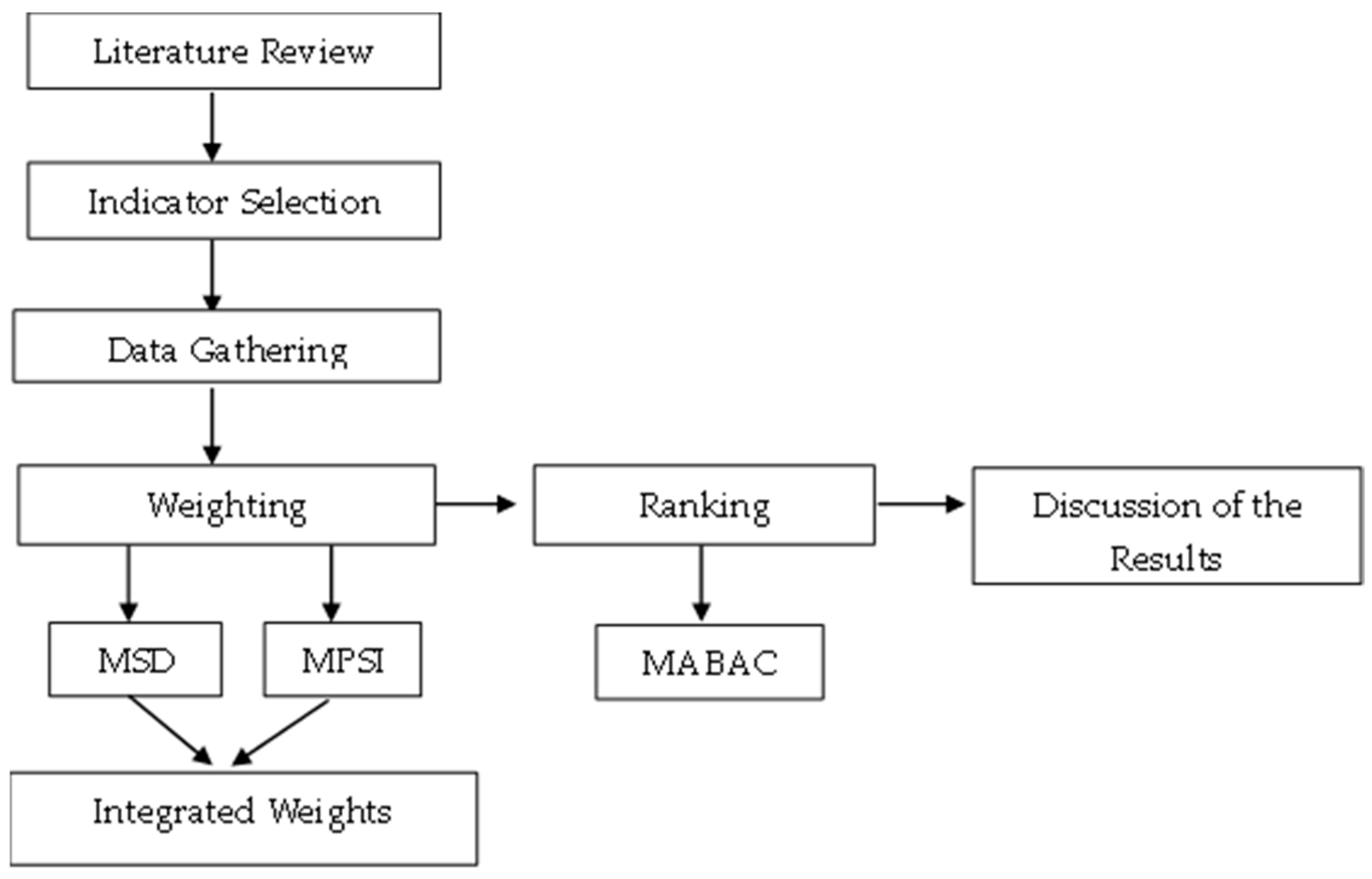
In the study, 31 OECD countries for which complete data were available in the IMF database were included in the analysis. The weights of the five indicators were calculated by using the Modified Standard Deviation (MSD) and Modified Preference Selection Index (MPSI) methods. Afterwards, the weights obtained from these two approaches were combined through the arithmetic mean in order to obtain a more balanced and reliable final set of criterion weights. For ranking the countries, the MABAC method was applied. The overall methodological framework of the study is illustrated in
Figure 1, which summarizes the sequential integration of data collection, objective weighting, and ranking procedures. The simultaneous use of the MSD and MPSI methods is intended to reduce possible method-dependent deviations in criterion weighting. While the MSD method emphasizes the dispersion structure of the data, the MPSI method considers the relative discriminatory power of criteria across alternatives. Integrating these two objective weighting approaches helps provide a more balanced weighting structure and helps improve the robustness of comparative rankings.
As shown in
Figure 1, the analysis begins with indicator selection and data collection, followed by the application of objective weighting techniques (MSD and MPSI). The resulting weights are then integrated and used within the MABAC method to obtain comparative country rankings, which are subsequently interpreted in the discussion of results.
3.2.1. MSD Method
The MSD method was developed by
Puška et al. (
2022) as an improved extension of the objective weighting approach based on Standard Deviation (SD). The MSD approach mainly considers the distribution of observed values related to each criterion and is based on the assumption that criteria with higher variation levels are more discriminative in the decision-making process. An important advantage of the method is that it does not require expert judgment and directly relies on the statistical distribution of data. In addition, due to its relatively simple computational procedure, it has been shown to produce strong empirical results by reflecting the differentiation power among criteria.
Step 1: Construction of the decision matrix
Step 2: Formation of the normalized decision matrix
In order to make the data comparable, normalization is applied.
For benefit-type criteria:
As a result of this procedure, the normalized decision matrix is obtained.
Step 3: Calculation of the standard deviation for each criterion
First, the mean value of each criterion is calculated:
Then, the standard deviation is computed:
Step 4: Calculation of column sums
For each criterion, the sum of normalized values is calculated:
Step 5: Calculation of adjusted standard deviation
The standard deviation values are adjusted using the column sums:
Step 6: Determination of final criterion weights
3.2.2. MPSI Method
The Modified Preference Selection Index (MPSI) method is an improved version of the Preference Selection Index (PSI) technique that was originally proposed by
Maniya and Bhatt (
2010). The MPSI approach is mainly based on the discriminative power of criteria among different alternatives. One of the important advantages of this method is that it can generate more balanced objective weights by considering the relative performance differences between alternatives.
In addition, the method does not require complex parameters and its computational steps are relatively systematic, which makes it practical for empirical applications. Especially in multidimensional decision problems such as financial performance evaluation, MPSI is often preferred because it is capable of reflecting the information intensity embedded in different criteria.
Step 1: Construction of the decision matrix
Step 2: Formation of the normalized decision matrix
In order to make the data comparable, a normalization procedure is applied. Through this process, the values in the decision matrix are transformed into a common scale so that the performance of alternatives can be evaluated more consistently across different criteria.
As a result of this procedure, the normalized decision matrix is obtained.
Step 3: Calculation of mean values for each criterion
For each criterion, the arithmetic mean of the normalized values is calculated.
This value represents the average preference level of the related criterion across all alternatives.
Step 4: Determination of the variation in preference values
Step 5: Determination of criterion weights
The weights obtained from the MPSI method complement those derived from the MSD approach by incorporating the relative performance differences among alternatives, thereby contributing to a more balanced and robust weighting structure.
3.2.3. Integrated Weights
In this study, the criterion weights obtained from the MSD and MPSI methods were integrated by using the arithmetic mean approach. The use of different objective weighting techniques may lead to variations in weight values since each method can show different sensitivities to the data set. In order to reduce this variation and to obtain a more balanced weighting structure, an integrated weighting approach was adopted. This integration enhances the robustness of the weighting scheme by mitigating method-specific biases and ensuring that the final weights reflect a more stable representation of criterion importance.
The integrated weights calculated through the arithmetic mean consider the information contribution of both methods at an equal level and help to minimize possible deviations that may arise from relying on a single technique.
Accordingly, the integrated weight of the
j-th criterion,
, is obtained as follows:
This approach contributes to improving the reliability and stability of the weighting results by reducing the influence of method-specific variations.
3.2.4. MABAC Method
The MABAC (Multi-Attributive Border Approximation Area Comparison) method was developed by
Pamučar and Ćirović (
2015). The method evaluates the performance of alternatives based on their distances from the border approximation area. In this approach, the deviation of each alternative from the border value is calculated for each criterion, and the sum of these deviations forms the overall performance score of the alternative.
One of the main advantages of the MABAC method is that its computational procedure is mathematically clear and relatively easy to interpret. Moreover, instead of relying on distances from positive and negative ideal solutions, the method is based on the border approximation area, which helps to produce more stable ranking results.
Step 1: Construction of the decision matrix
Step 2: Formation of the normalized decision matrix
The decision matrix is normalized depending on whether the criteria are benefit-oriented (maximization) or cost-oriented (minimization). This normalization process enables the comparison of alternatives on a common evaluation scale.
Step 3: Construction of the weighted normalized decision matrix
Each normalized value is multiplied by its corresponding criterion weight.
Step 4: Calculation of Border Approximation Area (BAA) values
,
the alternative is located above the border area, which indicates an advantageous position.
the alternative is located below the border area, which indicates a disadvantageous position.
Step 5: Calculation of distances from the border approximation area (D matrix)
the alternative is located in the upper approximation area, which indicates good performance.
the alternative is located in the lower approximation area, which indicates poor performance.
Step 6: Calculation of the overall performance value of alternatives
A higher value of indicates better performance of the alternative where represents the overall performance score of alternative , reflecting its relative position with respect to the border approximation area across all criteria.
4. Findings
In the first stage of the analysis, a decision matrix was constructed using financial performance indicators of the banking sectors across OECD countries for the year 2024, as presented in
Table 2.
In the first stage of the analysis, a decision matrix was constructed using financial performance indicators for OECD countries for the year 2024, as presented in
Table 2. The weights obtained from both methods were then combined by taking their arithmetic mean in order to reduce possible method-based biases, and thus, an integrated weight vector was obtained (
Table 3).
According to the integrated weighting structure, the criteria were ranked as C5 > C4 > C1 > C2 > C3. Among these, non-performing loans to total gross loans (C5) emerged as the most important criterion. This result highlights the critical role of asset quality and credit risk in evaluating the financial performance of banking sectors across OECD countries. The prominence of the NPL ratio suggests that cross-country differences in banking performance are largely driven by variations in loan portfolio quality.
The second most important criterion is Tier 1 capital to total assets (C4). This ratio reflects the core capital strength of banks and serves as a key indicator of financial resilience. The relatively high weight assigned to this criterion indicates that capital adequacy plays a crucial role in determining overall banking performance. From a stability perspective, this finding suggests that banking systems with stronger capital buffers are better positioned to absorb financial shocks and sustain long-term performance.
On the other hand, liquid assets to short-term liabilities was found to be the least important indicator. This finding indicates that liquidity indicators play a limited role in distinguishing bank performance within the examined sample, and that performance differences are primarily driven by other indicators. The weights of the evaluation criteria obtained from the MSD and MPSI methods, along with the integrated weights, are presented in
Table 3.
As shown in
Table 3, there are noticeable differences between the weights obtained from the MSD and MPSI methods, reflecting their distinct evaluation mechanisms. However, the integrated weights provide a more balanced distribution by combining the strengths of both approaches. Among the criteria, C5 and C4 receive relatively higher weights, indicating the importance of credit risk and capital adequacy in assessing banking sector performance.
The integrated weights derived from the MSD and MPSI methods were incorporated into the MABAC framework to evaluate the relative performance of countries. By combining objective weighting with a robust ranking technique, the analysis provides a comprehensive assessment of banking sector performance. Based on the MABAC results, the countries were ranked according to their overall financial performance scores, as presented in
Table 4.
Based on the MABAC results, countries were ranked according to their overall financial performance scores, as presented in
Table 4. Mexico (0.2925) achieved the highest performance score, followed by Türkiye (0.2526) and the United States (0.1905). The positive and relatively high
Si values of these countries indicate that they are positioned above the border approximation area, reflecting comparatively stronger banking sector performance. These findings suggest that these countries exhibit a more balanced structure in terms of profitability, capital adequacy, and asset quality indicators. This outcome should be interpreted within the relative evaluation structure of the MABAC framework, where comparative performance is determined simultaneously across multiple indicators rather than by banking system size or overall macroeconomic scale alone. In particular, Mexico and Türkiye achieved relatively high scores due to their strong capital adequacy ratios and comparatively favorable profitability indicators within the selected evaluation framework. Since the MABAC approach evaluates relative performance across all criteria simultaneously, countries demonstrating stronger resilience in capital structure and credit risk management obtained higher overall scores despite differences in macroeconomic size and banking system scale. These findings should not be interpreted as indicating the absolute superiority of particular banking systems, but rather as reflecting relative comparative performance within the selected multidimensional evaluation framework and the specific indicators included in the analysis. Other countries included in the top ten, such as Latvia, Hungary, Lithuania, Estonia, Iceland, Slovenia, and Italy, also demonstrate positive performance scores. A common characteristic of these countries is their relatively balanced financial structure, particularly in terms of capital strength and low levels of non-performing loans. This finding reinforces the importance of credit risk management and capital adequacy in achieving superior banking sector performance.
It is also noteworthy that some large economies such as France (−0.2064), Germany (−0.1758) and the Netherlands (−0.1199) appear among the lower ranks. The negative Si values of these countries indicate relatively weaker performance within the selected criteria, particularly in terms of asset quality, capital adequacy or profitability indicators. France, which is ranked last, is identified as the country that is farthest from the border approximation area and exhibits the lowest relative performance based on the selected financial indicators during the analysis period. The ranking results also reveal the existence of relatively distinct performance clusters among OECD countries. Countries positioned in the upper ranks generally exhibit stronger capital adequacy, lower non-performing loan ratios, and more resilient profitability structures, whereas lower-ranked countries tend to display comparatively weaker performance across these dimensions. These findings may also reflect structural pressures associated with mature banking markets, including lower profitability margins, slower balance sheet growth, and more conservative banking structures compared to relatively dynamic emerging banking systems.
Overall, the findings reveal that banking sector performance across OECD countries is not homogeneous. Instead, it is largely driven by differences in credit risk, capital adequacy, and financial resilience indicators. The results obtained through the MABAC method demonstrate that a comprehensive multi-criteria framework provides a more nuanced evaluation compared to single-indicator approaches, highlighting the importance of integrating multiple financial dimensions in performance assessment.
5. Sensitivity and Robustness Analysis
To assess the robustness of the obtained ranking results, a sensitivity analysis was conducted by constructing six different weighting scenarios. The baseline model (S0) represents the original weighting structure, while alternative scenarios (S1–S5) introduce systematic variations in criterion weights to evaluate the stability of the ranking outcomes. This approach enables a comprehensive examination of how sensitive the ranking results are to changes in criterion importance. The alternative scenarios were also designed to reflect different macroprudential evaluation perspectives. While the equal-weight scenario represents a neutral benchmark in which all financial dimensions are treated symmetrically, the remaining scenarios emphasize alternative banking sector structures such as profitability-oriented and resilience-oriented performance assessments. This design allows the analysis to evaluate whether country rankings remain stable under different financial stability perspectives and alternative criterion importance structures.
In all scenarios, the weights were normalized to ensure that their total sum equals one. The distribution of weights across the scenarios is presented in
Table 5.
As shown in
Table 5, the weight distributions vary across different scenarios, reflecting alternative assumptions regarding the relative importance of the evaluation criteria. In particular, scenarios S1 and S2 assign more balanced weights across criteria, whereas S4 and S5 emphasize specific indicators more strongly. This variation allows for a more comprehensive assessment of the robustness of the ranking results under different weighting structures.
Table 6 presents the changes in country rankings under the baseline model (S0) and alternative scenarios (S1–S5), providing a clear assessment of ranking stability across different weighting structures.
Table 6 presents the changes in country rankings under the baseline model (S0) and alternative scenarios (S1–S5), providing a clear assessment of ranking stability across different weighting structures. The results indicate that the rankings obtained through the MABAC method are highly robust to variations in criterion weights. For the majority of countries, the maximum ranking change remains within the range of 0–2 positions, while only a limited number of countries experience changes of 3 or 4 positions, confirming the overall stability of the ranking structure.
A closer examination reveals that the top-performing countries, particularly Mexico and Türkiye, consistently maintain their leading positions across all scenarios. Similarly, several countries, including Estonia, Israel, Poland, Belgium, the Netherlands, Germany, and France, exhibit no ranking changes, indicating that their performance positions are stable regardless of weighting variations. This suggests that countries located at both the upper and lower ends of the ranking are largely unaffected by changes in criterion importance, and that the results are primarily driven by underlying structural performance differences.
In contrast, moderate ranking fluctuations are observed for countries positioned in the middle of the distribution. For instance, the United States and Iceland experience ranking changes of up to three positions, particularly under the equal-weight scenario (S1). This indicates that mid-ranked countries are relatively more sensitive to variations in weighting structures compared to those at the extremes.
Overall, the findings derived from
Table 6 provide strong evidence of the robustness and reliability of the proposed evaluation framework, demonstrating that the ranking outcomes are not significantly influenced by alternative weighting assumptions. The Spearman correlations between the baseline model and the alternative scenarios are presented in
Table 7.
As presented in
Table 7, the Spearman correlation coefficients range between 0.984 and 1.000, indicating a very high level of consistency between the baseline model and alternative scenarios.
In particular, the perfect correlation (ρ = 1.000) between S0 and S2 indicates that increasing the weight of the most influential criterion does not alter the ranking structure, confirming the robustness of the model with respect to variations in dominant criteria.
Similarly, the high correlation values observed in S0–S3 (ρ = 0.996), S0–S4 (ρ = 0.995), and S0–S5 (ρ = 0.996) further demonstrate that the ranking structure remains largely unchanged even when different groups of criteria are emphasized.
The consistently high correlation coefficients demonstrate that alternative weighting schemes do not significantly alter the relative performance positions of countries. This provides strong evidence that the ranking results are highly stable and not sensitive to changes in criterion weights.
Overall, the Spearman correlation results confirm that the country rankings obtained through the MABAC method are highly stable under different weighting scenarios. This provides strong support for the methodological reliability of the integrated weighting approach and reinforces the robustness of the baseline model results. This indicates that the ranking structure is largely insensitive to alternative weighting schemes, reinforcing the robustness of the proposed framework.
6. Discussion
The results of the study show that banking sector performance across OECD countries is not evenly distributed. Instead, it seems to be shaped mainly by differences in credit risk, capital adequacy, and overall financial structure. In this context, the strong role of non-performing loans (NPLs) and Tier 1 capital is not surprising, as these indicators directly reflect asset quality and financial strength. This finding is consistent with prior studies emphasizing the importance of capital strength and credit risk in determining banking performance and resilience (e.g.,
Berger & Bouwman, 2009;
Louzis et al., 2012). In particular, the dominant role of the NPL ratio may indicate that differences in asset quality remain one of the main factors shaping cross-country banking sector fragility, even among relatively developed financial systems. This finding also supports the argument that profitability indicators alone may not fully capture the sustainability of banking sector performance, especially in periods characterized by financial uncertainty and balance-sheet vulnerabilities. The relatively lower importance assigned to liquidity indicators may also suggest that short-term liquidity differences among OECD banking systems became less discriminatory during the analysis period compared to asset quality and capital-related indicators. This may partly reflect the relatively stronger post-crisis liquidity regulation framework adopted across OECD economies.
The use of two different objective weighting methods (MSD and MPSI) and combining them into an integrated structure provides a more balanced evaluation. Relying on a single method could lead to biased results, so this combined approach helps to reduce that risk and gives more stable outcomes. This is in line with the MCDM literature, where combining different objective weighting methods is often suggested to improve robustness and reduce method-specific bias. In this respect, the integrated weighting structure helps reduce excessive dependence on a single methodological perspective and provides a more balanced representation of criterion importance.
The robustness analysis also supports these findings. As seen in
Table 6, most countries do not experience large ranking changes across scenarios. For many of them, the difference is only one or two positions, which suggests that the results are quite stable. Only a few countries in the middle of the ranking show slightly higher sensitivity, especially when equal weighting is applied. This is also consistent with the Spearman correlation results, where all coefficients are very close to 1, indicating a strong agreement between scenarios. Such stability is generally interpreted as an indication of methodological reliability in multi-criteria evaluation frameworks. From an economic perspective, this result may indicate that the relative positions of many countries are shaped by more persistent structural characteristics rather than temporary weighting assumptions. Therefore, the stability of the rankings strengthens the reliability of the comparative findings derived from the proposed framework.
Another point worth noting is that countries at the top and bottom of the ranking remain almost unchanged. It is also noteworthy that some relatively large economies, such as France and Germany, remain in lower ranking positions despite the size and institutional maturity of their financial systems. This may suggest that banking sector size alone does not necessarily translate into stronger comparative performance within a multidimensional framework that simultaneously considers credit risk, capital structure, profitability, and liquidity conditions. This may indicate that their performance is driven by more structural factors rather than weighting assumptions. In mature banking systems, lower profitability indicators may also reflect stricter regulatory frameworks, higher capital requirements, and more conservative balance-sheet management practices aimed at preserving long-term financial stability. On the other hand, mid-ranked countries appear to be more sensitive to changes in criteria importance, which means that small improvements in certain indicators could affect their position more noticeably.
From a practical perspective, the findings suggest that focusing on credit quality and maintaining strong capital ratios remain critical for banking sector resilience and long-term financial stability. In addition, the results indicate that multidimensional evaluation frameworks may provide a more realistic basis for macroprudential monitoring compared to approaches relying on isolated profitability indicators. In this respect, the proposed framework may offer useful comparative insights for regulators and policymakers in identifying relatively vulnerable banking structures and monitoring sectoral resilience under alternative risk conditions.
Overall, the study offers a comparatively robust and transparent framework for comparing banking performance across countries, while also showing that the results are not excessively sensitive to alternative methodological assumptions.
7. Conclusions
This study evaluated the financial performance of banking sectors across OECD countries by using an integrated weighting structure based on the MSD and MPSI methods together with the MABAC approach. By combining two objective weighting methods, the study provides a more balanced and reliable set of criterion weights, rather than relying on a single method. In this respect, the study attempts to provide a more transparent and comparatively robust framework for evaluating banking sector soundness across OECD countries.
The results show that banking sector performance has a multidimensional structure. In particular, capital adequacy and credit quality appear to be more influential than profitability indicators in explaining differences across countries. This suggests that financial resilience and asset quality play a key role in overall performance. The findings therefore support the argument that banking sector resilience should be evaluated within a broader risk–return–resilience framework rather than through profitability indicators alone. In addition, the findings indicate that the size of the financial system alone does not guarantee better performance, as some medium-sized economies achieve relatively higher rankings due to stronger capital structures and lower credit risk. From a macroprudential perspective, this may indicate that balance-sheet quality and financial resilience remain central determinants of comparative banking sector performance.
The robustness analysis further supports the reliability of the results. Ranking changes remain limited across different weighting scenarios, and the Spearman correlation coefficients are very close to 1. This indicates that the results are stable and not highly sensitive to variations in criterion weights. Therefore, the obtained rankings appear to reflect more persistent structural differences across banking systems rather than temporary methodological assumptions.
7.1. Contributions
This study contributes to the literature in several ways. First, it provides an updated and comparative evaluation of OECD banking sector performance within a multidimensional analytical framework. Second, it proposes an integrated weighting approach by combining MSD and MPSI methods, which helps to reduce potential method-related bias. Third, it demonstrates the applicability of the MABAC method in cross-country banking sector analysis and shows that it can produce stable and consistent results. In addition, the study contributes to the macroprudential monitoring literature by providing comparative evidence regarding the relative importance of credit risk, capital adequacy, and liquidity conditions in banking sector soundness.
7.2. Limitations and Future Research
Despite its contributions, the study has some limitations. The analysis is based on a selected set of financial ratios and does not include macroeconomic variables, institutional factors, or digitalization-related indicators that may also influence banking sector performance. In addition, the study focuses on a single-period cross-country comparison. Therefore, the findings should be interpreted within the limitations of the selected indicators and the specific period analyzed.
Future research may extend this framework by incorporating time-series data, applying alternative weighting and ranking approaches, or including a broader set of indicators. Such extensions could provide a more comprehensive understanding of banking sector dynamics and also offer a broader perspective on cross-country banking sector resilience and financial stability dynamics. More broadly, extending multidimensional and robustness-oriented evaluation frameworks may contribute to the development of more reliable macroprudential monitoring tools for assessing banking sector vulnerabilities under changing financial conditions.




 ,
,