1. Introduction
Fiscal contractions remain one of the most debated topics in macroeconomic policy. Economic resilience is central to this debate, and academics and policymakers have been seeking strategies to avert tail-risk events that can derail long-term development. In this regard, the impact of fiscal policy on GDP and various components of GDP has been extensively explored (
Abdelkawy & Al Shammre, 2024;
Arroyo Marioli et al., 2024;
Pastpipatkul & Ko, 2025b;
Sosvilla-Rivero et al., 2025), and there is scope for examining the structural determinants of extreme capital volatility. This aspect deserves attention because investment is a critical component of aggregate demand and serves as a barometer for market sentiment regarding policy-related concerns. In this context, an “investment collapse” may reflect more than just a cyclical downturn; it may also signal a fundamental shift in investor and private-sector confidence. Such downturns are particularly concerning for policymakers concerned with fiscal aspects, as they may generate hysteresis effects, whereby investment losses can lead to persistent losses in capital stock. While downturns are part and parcel of any business cycle, they are of concern when their effects persist for a longer period.
Policy decisions are better structured based on an understanding of tail risk, as extreme downsides in investment will cascade into equity markets, and these impacts can be exacerbated as they spill over into global markets (
Jia, 2025). However, much of the scholarly literature evaluates the impact of fiscal consolidation on output or average investment (
Carrière-Swallow et al., 2018;
Klein Martins, 2025;
Larch et al., 2024). Studies structured around average investments may underestimate the tail risks. Failure to consider tail risks can be problematic because macroeconomic policy is often judged by its ability to prevent extreme downside risks, which are costly and difficult to reverse. Investment irreversibility can have a detrimental effect on the overall business environment and key business markers (
Xue et al., 2025). This study is motivated by the gap in existing studies that focus largely on changes in average investment rather than on collapses in investment. The primary question of interest in this study is whether fiscal tightening increases the probability of extreme downturns in investment.
For instance, fiscal contractions are linked to crowding-in effects on private investment, with outcomes that are largely dependent on the macroeconomic context (
Afonso et al., 2022). Therefore, the investment response to fiscal tightening is theoretically ambiguous. This is particularly salient in the case of contractionary shocks, as some studies have pointed out that they may exert a stronger impact than expansionary shocks in some settings (
Fazzari et al., 2021).
Jacques (
2021) notes that in some OECD countries, austerity measures tend to decrease gross fixed-capital formation. The impact of fiscal consolidations is also composition-dependent, and
Kasselaki and Tagkalakis (
2016) find that tax-based consolidations in Greece tend to depress private investment and that these effects are mitigated by spending-based programmes. However, what matters is the extent of the impact, and in this regard,
Fatás and Summers (
2018) find evidence that fiscal consolidations can be self-defeating and have a long-lasting impact on economic growth.
In this regard, it is important to distinguish between the long- and short-run impacts of fiscal consolidations.
García (
2025) shows that fiscal consolidation benefits output in the long run, except when the private debt is high. However, the long-term benefits of policy are not automatic and are conditional on a range of events that are often confounded by unexpected events. Therefore, this study concentrates on assessing the short-run impact of policy on investment collapse and whether this risk tends to dissipate over subsequent years. A key strength of this study is that it considers a large panel of 107 countries over the period from 1960 to 2023.
Because the investment channel is critical, this study focuses on three concerns. First, under what conditions does fiscal tightening enhance the probability of a sharp investment decline, which is defined as an extreme downside movement in investment? Second, does fiscal tightening operate mainly through a reduction in aggregate demand, or can credible consolidation stabilize expectations and mitigate downside risks? Third, we examine whether these effects are robust after accounting for institutional quality and other macroeconomic factors.
In keeping with the above research goals, the study tests two related hypotheses.
H1. Fiscal contraction shocks are significantly associated with the probability of an investment collapse.
H2. The impact of fiscal contraction shocks on the probability of investment collapse varies over time.
Existing studies have covered aspects related to the response of GDP to fiscal measures (
Abdelkawy & Al Shammre, 2024;
Gunasinghe et al., 2020;
Papaioannou, 2019). Studies have also examined the impact of fiscal policy on investment (
Afonso & Jalles, 2015;
Li & Wang, 2026). However, the impact of fiscal contractions on investment collapse remains relatively unexplored. Investment-related issues are critical when considering that investment expenditures are irreversible (
Pindyck, 1991;
Xue et al., 2025). This study considers investment collapse an extreme downside change in investment and examines whether episodes of fiscal contraction increase the probability of investment collapse. The analysis also tests the asymmetry between contractionary and expansionary fiscal shocks and evaluates the robustness of the findings by controlling for institutional quality and other macroeconomic parameters of the countries.
This study contributes to the literature by modelling fiscal contractions within a tail risk framework. This study departs from other studies by examining whether tightening episodes increase the probability of extreme downside investments. By distinguishing between contractionary and expansionary shocks, this study traces their effects by studying them within a cross-country panel framework. This study emphasizes the collapse probability as a policy-relevant aspect of economic resilience. Effectively, this study focuses on collapse incidence rather than just magnitude, thereby reframing fiscal contractions as a source of downside macroeconomic risk.
The remainder of this paper is organized as follows.
Section 2 discusses relevant studies on the subject and develops relevant propositions.
Section 3 deals with the methodological aspects and econometric approach adopted in this study.
Section 4 presents the empirical results and robustness checks of the study.
Section 5 discusses the findings in the context of the broader fiscal policy and investment literature. Finally,
Section 6 concludes the study, outlines the implications for policy, and suggests directions for future research.
2. Related Literature and Theoretical Frame of Reference
Academic debates on fiscal policy indicate that it impacts investment (
Alesina et al., 2002;
Wen et al., 2022;
Zezza & Guarascio, 2023). Fiscal policy’s effect on investment operates through multiple channels. Evidence shows that firms tend to adjust their investments around tax-based reforms, indicating that fiscal policy can shape capital formation through various channels (
Gallemore et al., 2024). However, a key feature of these studies is the emphasis on aggregate investment responses (
Afonso & Jalles, 2016) rather than the downside risks of investment.
At the theoretical level, Keynesian economics suggests that government expenditure is a vital component of aggregate demand and supports investment when aggregate demand is weak through the accelerator effect (
Sunny et al., 2025). This implies that fiscal contractions may reduce investment by depressing demand. A decline in government spending has the potential to reduce aggregate demand, lower the marginal returns to capital, and effectively reduce investment. The impact on investment is amplified by the multiplier mechanism, and every unit of reduction in spending adversely impacts demand, with private investment being affected directly by the lowered demand and indirectly through the reduction in factor income. Nevertheless, the literature points to the fact that fiscal consolidations tend to impact investment (
Bamba et al., 2019).
In contrast, the neoclassical perspective considers that government borrowing results in crowding out and thereby reduces private investment (
Hussain & Haque, 2017) either by way of an increase in interest rates or by reducing the pool of loanable funds available to the private sector. From this perspective, fiscal contraction tends to reduce government borrowing and pressure on interest rates, which effectively “crowds in” private investment by freeing funds for the private sector.
However, fiscal consolidation may reduce sovereign risk premia and lead to the stabilization of expectations, thereby offsetting the tightening impact. Interestingly, there is also evidence suggesting that the investment response to consolidation is not uniformly negative (
Ardanaz et al., 2021). The contrast between the Keynesian and neoclassical views implies that the impact of fiscal contractions on the probability of investment collapse is theoretically ambiguous.
The academic literature on the subject further indicates that the impact of fiscal shocks on investment may be dynamic rather than instantaneous.
Mansur (
2022) finds that within the US context, fiscal events crowd out private investment with a lag of about one to six years, although the posterior bands widen over longer horizons. This implies that the impact of fiscal shocks on investment is time-varying. Fiscal consolidation operates through a direct effect on aggregate demand and indirectly by impacting perceptions, which can unfold over different horizons.
Kasselaki and Tagkalakis (
2016) showed that in the case of Greece, the impact of fiscal consolidation on private investment can be protracted and largely depends on the composition of adjustments with tax-based consolidations, generating a more pronounced and longer-lasting impact. Taken together, these studies imply that fiscal tightening may not be uniform across time horizons and can vary across periods.
Based on an assessment of scholarly debates, it is clear that most studies focus on aggregate investments as the dependent variable. In contrast, scholarly studies on fiscal contraction shocks indicate that relatively little attention has been paid to examining the impact of fiscal contraction shocks on the probability of investment collapse. This points to a critical gap, as investment collapses are not merely an ordinary decline in investments but rather extreme events that have the potential to generate hysteresis effects, thereby prolonging a macroeconomic crisis. Studying average effects tends to understate the relevance of the tail risk consequences of fiscal contraction shocks. Therefore, this study seeks to fill this critical gap by examining the impact of fiscal contraction shocks on investment collapses.
Recent evidence substantiates the complexity of the interlinkages between consolidation and investment. For example, the manner in which fiscal communications are announced can shape expectations and ther the transmission mechanism. In the context of fiscal consolidation, studies have shown that announcements tend to influence perceptions (
Venugopal & Talbi, 2025).
Beetsma et al. (
2021) demonstrate that revenue-based announcements are seen as more credible but appear to impact economic activity much more adversely than spending-based announcements.
To further this study, we devised an empirical model based on the formulated hypothesis. The model is derived in the next subsection.
3. Methodology
3.1. Empirical Model
To test this hypothesis, we formulated an empirical model by modelling investment collapse based on the historical distribution of investment. For this study, we consider the investment collapse indicator as a tail event that corresponds to country-year observations falling in the bottom decile of the distribution of changes in the share of investment in the GDP. To address the question of the arbitrariness of the threshold, we also consider a robustness check at a threshold in the bottom 5th percentile. The decile threshold has been taken as the appropriate yardstick, given that there can be variations among countries that are inherent in large country-year panels.
Given the variance in the Keynesian and neoclassical approaches, the sign of the coefficient must be empirically assessed. A positive coefficient indicates a higher risk of collapse following contraction shocks, whereas a negative coefficient indicates a lower risk of collapse.
is the Investment collapse indicator
is the fiscal contraction shock (lagged)
is the vector of controls
is the country fixed effects
is the year fixed effects
is coefficient of the lagged contraction shock
Countries are indexed by “i” and time is indexed by “t”. We model the probability, where 1 represents a collapse in investment and 0 indicates no collapse. The variables for the control vector include GDP growth, the human capital index, and the rule of law. These controls are in place to account for institutional quality, which may independently influence the risk of investment collapse.
The effectiveness of fiscal consolidation in stabilizing expectations depends on institutional quality.
Afonso and Jalles (
2016) demonstrate that institutional quality affects the economy, with weaker institutions amplifying the negative effects. Hypothesis 1 is formally structured as
whereby contractions increases collapse risk and a negative coefficient indicates that contraction shocks reduce the probability of a collapse in investment.
3.2. Data Sources and Estimation Strategy
For this study, we considered data from the Penn World Table (PWT 10.0), Varieties of Democracy, and the World Bank. Data related to real GDP, population, total factor productivity, investment share of GDP, and the human capital index were extracted from the PWT. The rule of law index data were sourced from the V-DEM dataset. Data on the government’s share of expenditures were sourced from the World Bank database. We merged the datasets, given that the indicators were not uniformly available across all countries from 1960 to 2023; therefore, we obtained an unbalanced panel. A list of countries and regions is provided in
Appendix A. The sample is geographically diverse but not uniform, as North America and South Asia have about two countries each on account of data sparsity.
The data and sources of the variables are presented in
Table 1. We considered fixed-effects estimators, as they are commonly used to assess heterogeneous panels (
Fernández-Val & Weidner, 2018). We consider country fixed effects, as they account for time-invariant country characteristics, and year fixed effects to control for common global shocks. We used the Driscoll–Kraay standard errors to strengthen the overall results by accounting for heteroscedasticity, cross-sectional dependence, and serial correlation.
3.3. Dependent Variable: Investment Collapse
The dependent variable is the investment collapse indicator, which is constructed from the investment share of the GDP. We construct the indicator by considering country-year observations that fall in the bottom decile of the distribution of these annual changes. For the purposes of this study, we consider a binary construction, in which a country-year observation is coded 1 if the annual change in the investment share of GDP falls in the bottom decile of the distribution and 0 if it does not. Therefore, the dependent variable is structured to capture extreme declines in investment rather than normal business cycle fluctuations. The bottom decile is considered because we are studying extreme collapses, and this idea is consistent with studies that use lower quantiles to examine the impact of fiscal events (
Adrian et al., 2019;
Giglio et al., 2016;
Linnemann & Winkler, 2016).
Dabla-Norris et al. (
2015) consider the bottom decile of a growth distribution as a variable of interest in their study of macroeconomic shocks.
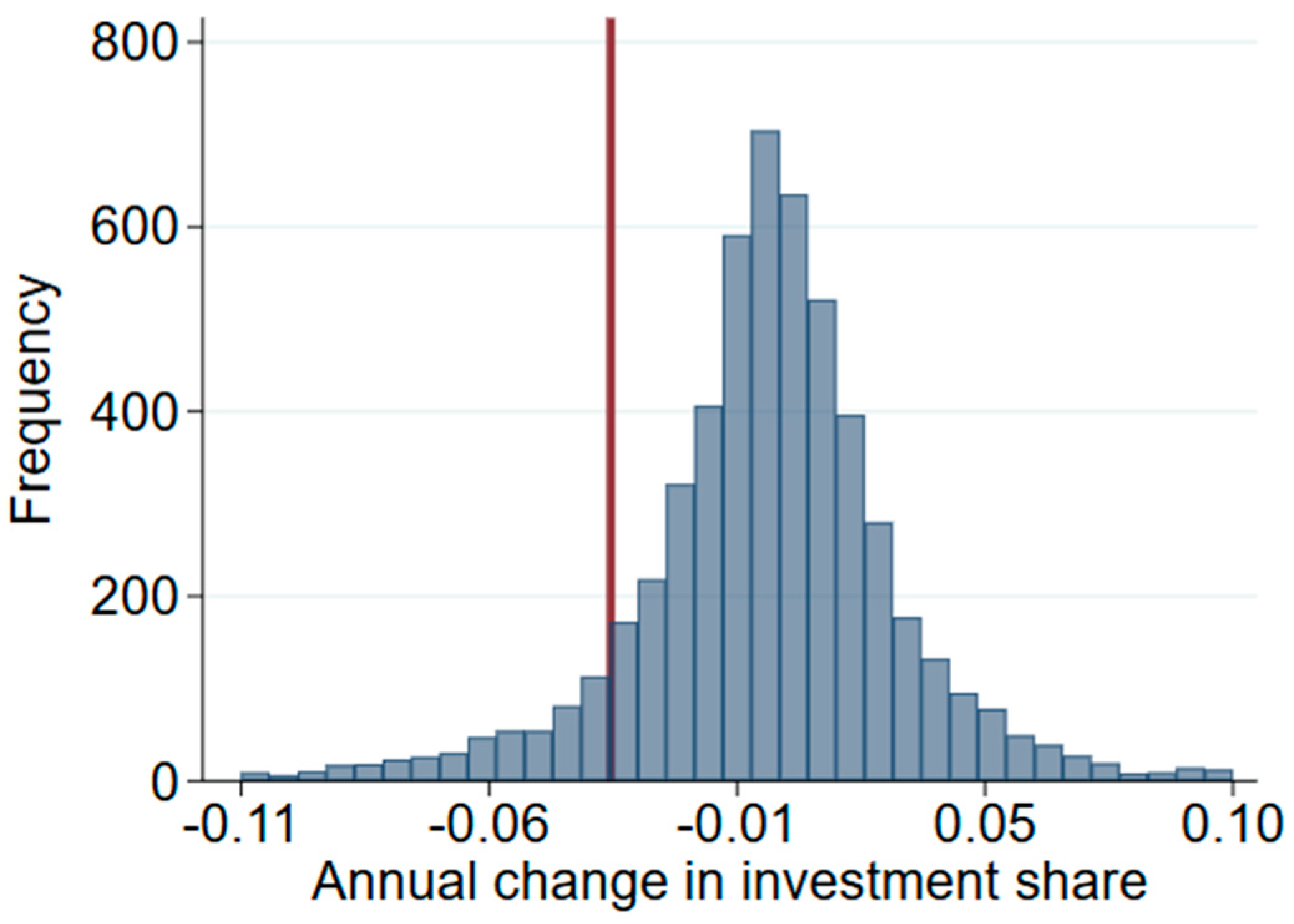
The construction of the dependent variable and its underlying logic are shown in
Figure 1.
Figure 1 shows the distribution of annual changes in the investment share of GDP and the cutoff point at the 10th percentile for the sample.
The figure shows that the values cluster closer to zero, suggesting that moderate fluctuations are common across countries and years. The 10th percentile cutoff, indicated by the red vertical line, effectively captures the severe downturns associated with sharp declines in investment. The values captured by the 10th percentile are rare and meaningful contractions, rather than cyclical variations.
3.4. Explanatory Variable: Fiscal Contraction Shock
The independent variable, fiscal contraction shock, is constructed using the fiscal pressure measure. The fiscal pressure measure was constructed in two stages. We construct a fiscal pressure measure by evaluating government expenditure relative to a country-specific seven-year rolling minimum. The idea of a seven-year rolling window is consistent with the rationale provided by
Bauer et al. (
2024) that the seven-year period is sufficiently short to account for time-related variations and long enough to achieve precision. This choice is also consistent with the idea that the effects of pure fiscal consolidation may unfold over a seven-year time horizon rather than a shorter one (
Clinton et al., 2011).
In the second stage, the fiscal pressure measure, which is a continuous variable, was transformed into a binary fiscal contraction shock indicator. More specifically, the indicator takes a value of 1 for observations in the top decile of the fiscal pressure distribution and 0 otherwise. This approach helps to identify unusually severe fiscal tightening episodes.
3.5. Rationale for Percentile-Based Thresholds and Use of Binary Indicators
We consider percentiles because we are dealing with a large country-year panel, and a percentile-based threshold is well adapted to the heterogeneous nature of the panel (
Cerovic et al., 2018). A percentile approach helps define extreme events relative to each country’s distribution. This approach is also consistent with studies examining extreme macroeconomic events that consider a common reference percentile (
Chen & Svirydzenka, 2021) We specify the collapse event at the lower tails at the 5th and 10th percentiles, in keeping with usage in the broader macroeconomic literature (
Adrian et al., 2022;
Loria et al., 2024).
The use of a binary fiscal contraction shock indicator is consistent with broader fiscal consolidation studies. The academic literature on this subject suggests that fiscal consolidation or fiscal adjustment events have been assessed using binary response frameworks, such as logit or probit-based models (
Giudice et al., 2007;
McDermott & Wescott, 1996). As the dependent variable is binary, we also estimated the conditional fixed-effects-based logit model as a robustness check. The logit model was considered because it provides statistical advantages for binary outcomes (
Afonso et al., 2006). This approach helps assess whether the main pattern is sensitive to the functional form; however, this should not be interpreted as a solution to concerns related to endogeneity.
3.6. Endogeneity-Related Considerations
A potential issue is that fiscal consolidations may be endogenous to macroeconomic conditions that also affect investment. Countries may adopt tighter budgets in response to weak growth, instability, or fiscal stress, all of which may independently influence the possibility of investment collapse. Therefore, reverse causality is a possible source of endogeneity, as fiscal tightening may partly be a follow-through response to deteriorating economic conditions rather than being mainly an exogenous shock.
To mitigate this concern, our empirical strategy considers lagged fiscal contraction shocks, lagged GDP growth, year-fixed effects, and country-fixed effects, and includes controls for human capital and the rule of law. Country-fixed effects account for time-invariant unobserved heterogeneity, and year-fixed effects capture the global shocks. Following
Gao et al. (
2025), we employed a placebo test to examine reverse causality. More specifically, we implement a placebo test by adding one- and two-year future contraction shocks. The idea is that under reverse causality, the leads are likely to be significant. This caution is in keeping with the fiscal literature, which notes that fiscal consolidation-related decisions may not be exogenous to macroeconomic performance and that output growth itself may impact the fiscal tightening process (
Hernández de Cos & Moral-Benito, 2013).
Considering these factors, the estimates provided should be interpreted as conditional associations rather than evidence of causality.
3.7. Control Variables
We have seen that expectations affect policy transmission. However, expectations depend on whether the policy is perceived as credible. The effectiveness of fiscal consolidation in stabilizing expectations also depends on institutional quality (
Nguyen & Luong, 2021;
Temsumrit, 2021).
Afonso and Jalles (
2016) demonstrated that institutional quality impacts the economy, with weaker institutions amplifying negative effects.
Pastpipatkul and Ko (
2025a) notes that strong institutions amplify the efficacy of policies. In this context, the rule of law can be considered a key institutional dimension that impacts the policy environment (
Al-Naser & Hamdan, 2021)and, thereby, the response of investment to fiscal contractions.
Martínez-Baltodano and Fonseca-Mairena (
2025) note that human capital is essential for long-term growth.
This study envisages a large panel, and because there can be differences between countries, we control for human capital and the rule of law, as this can help capture critical cross-country differences. This consideration is important because these differences can affect not only the transmission aspect of fiscal policy but also the level of investment in the economy. As human capital reflects productive capacity and, thereby, long-run structural capacity, it can be argued that countries with a larger human capital base may have greater investment potential, better adaptability, and possibly different responses to fiscal contraction shocks.
4. Results
Table 2 presents the summary statistics for the main variables used in the analysis. The data spanned the period from 1960 to 2023. The dependent variable, investment collapse, is a binary indicator with 1 denoting collapse and has a mean value of 0.102, which is consistent with the reasoning on which we derive the investment collapse. Fiscal contraction shocks are identified as top decile tightening events.
Table 1 shows that approximately 5.2% of the observations show fiscal contraction shocks, indicating that these shocks are rare.
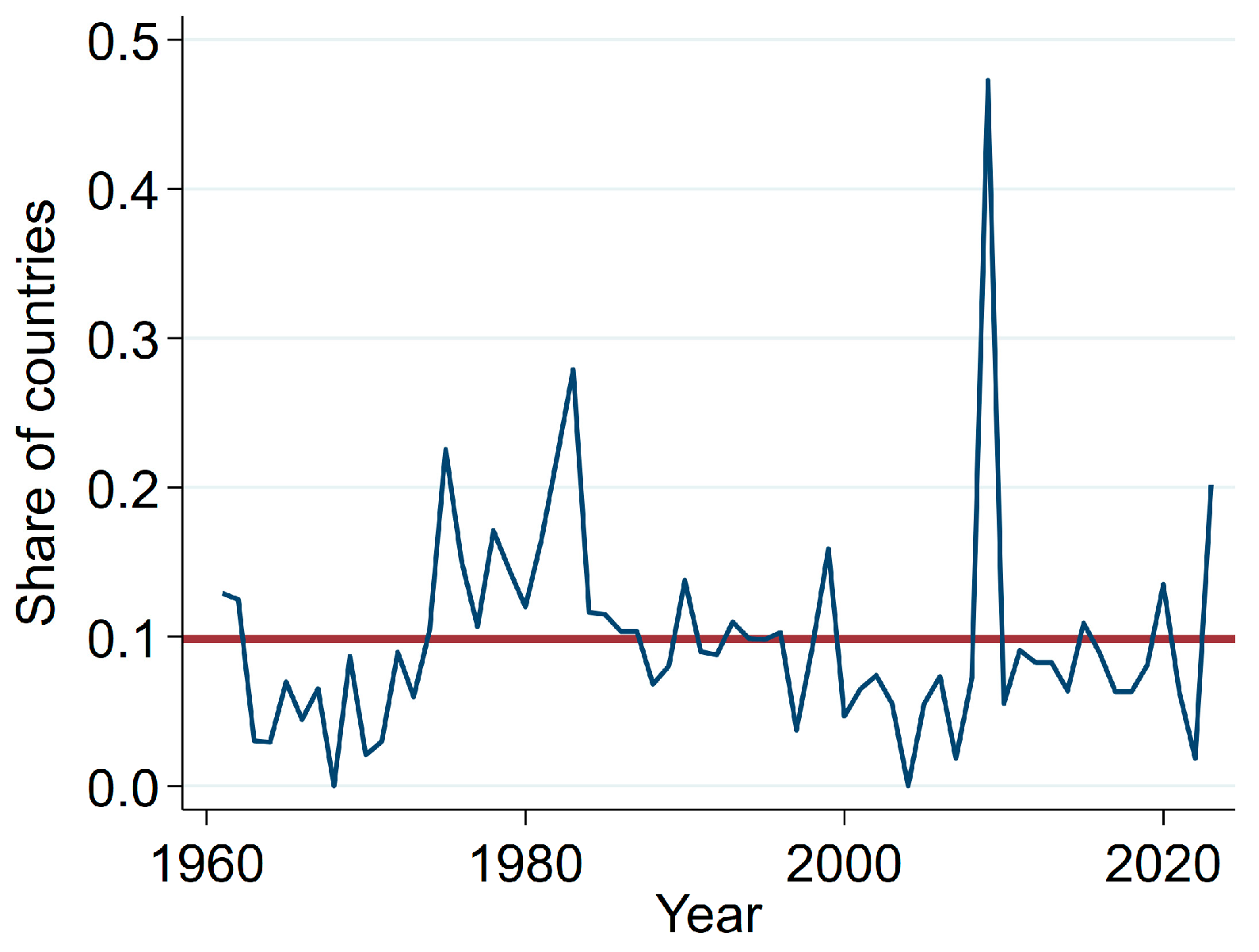
Table 2 tabulates the average frequency of investment decline; nevertheless, it does not show how these events are distributed. We examine this by profiling collapse episodes across the sample based on the time periods.
As shown in
Figure 2, collapse episodes are not evenly distributed but rather appear to cluster around periods that mark global downturns. There is a marked shift in 2008 and 2009, which coincides with the financial crisis of 2008–2009. This indicates that extreme investment contractions are linked to systemic stress and not primarily due to idiosyncratic country-level shocks.
The inclusion of lags reduces the available country-year observations in the panel because the conditional fixed effects logit estimator tends to exclude countries with no within-country variation in the dependent variable or countries with all zero or all investment outcomes classified as one. These sample adjustments are in keeping with the nature of large unbalanced panels; nevertheless, they do not impact the interpretation of the direction of the coefficients or their statistical significance. To ensure consistency in the analysis, we base all our results on a synchronized data sample that was used for estimation.
Table 3 reports the relationship between fiscal policy and the probability of an investment collapse. The dependent variable, investment collapse, is coded as one when the annual change in the investment share of GDP falls within the bottom decile of the sample distribution. We construct fiscal shocks as extreme events, with contraction shocks indicating top decile contraction events. Driscoll–Kraay standard errors are considered to allow for heteroscedasticity, serial correlation, and cross-sectional dependence.
The estimates clearly show that a lagged fiscal contraction shock is associated with a lower probability of investment collapse (β = −0.051, p < 0.10). The negative sign in the coefficient indicates that a fiscal contraction shock in the previous period is associated with a reduction in the probability of collapse in the current period; however, this does not persist in subsequent years. Lagged economic growth, as indicated by GDP growth, is negative and significant, suggesting that stronger economic performance reduces the risk of collapse. Human capital and the rule of law were not statistically significant.
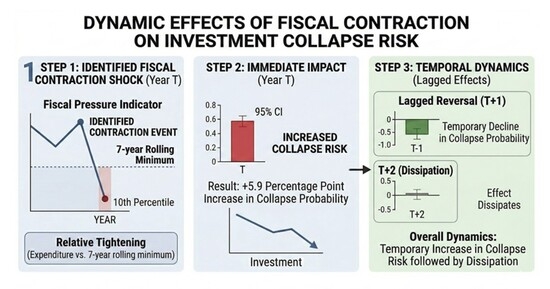
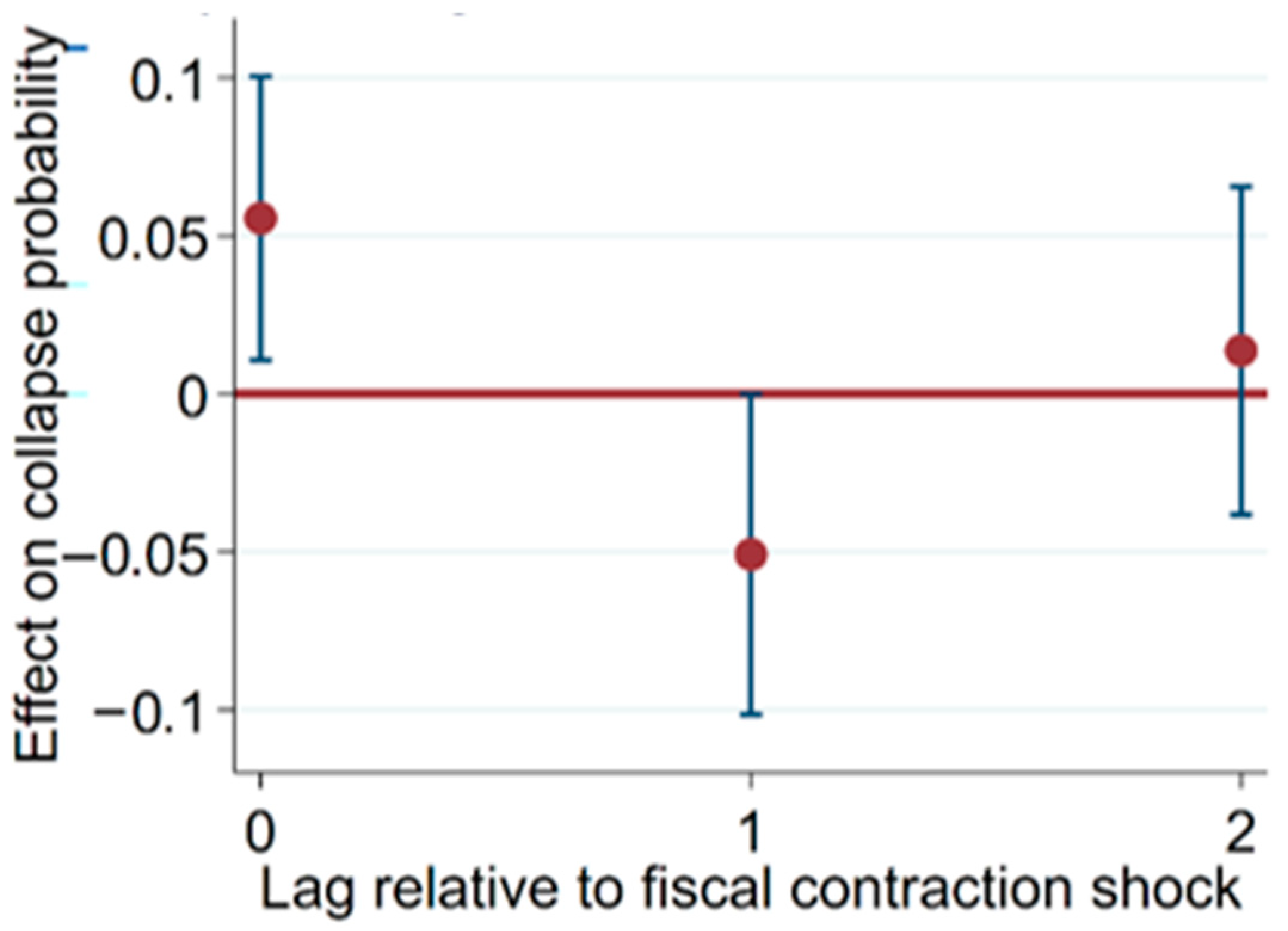
The distributed lag specification that assesses the dynamic effects of fiscal contraction shocks is presented in
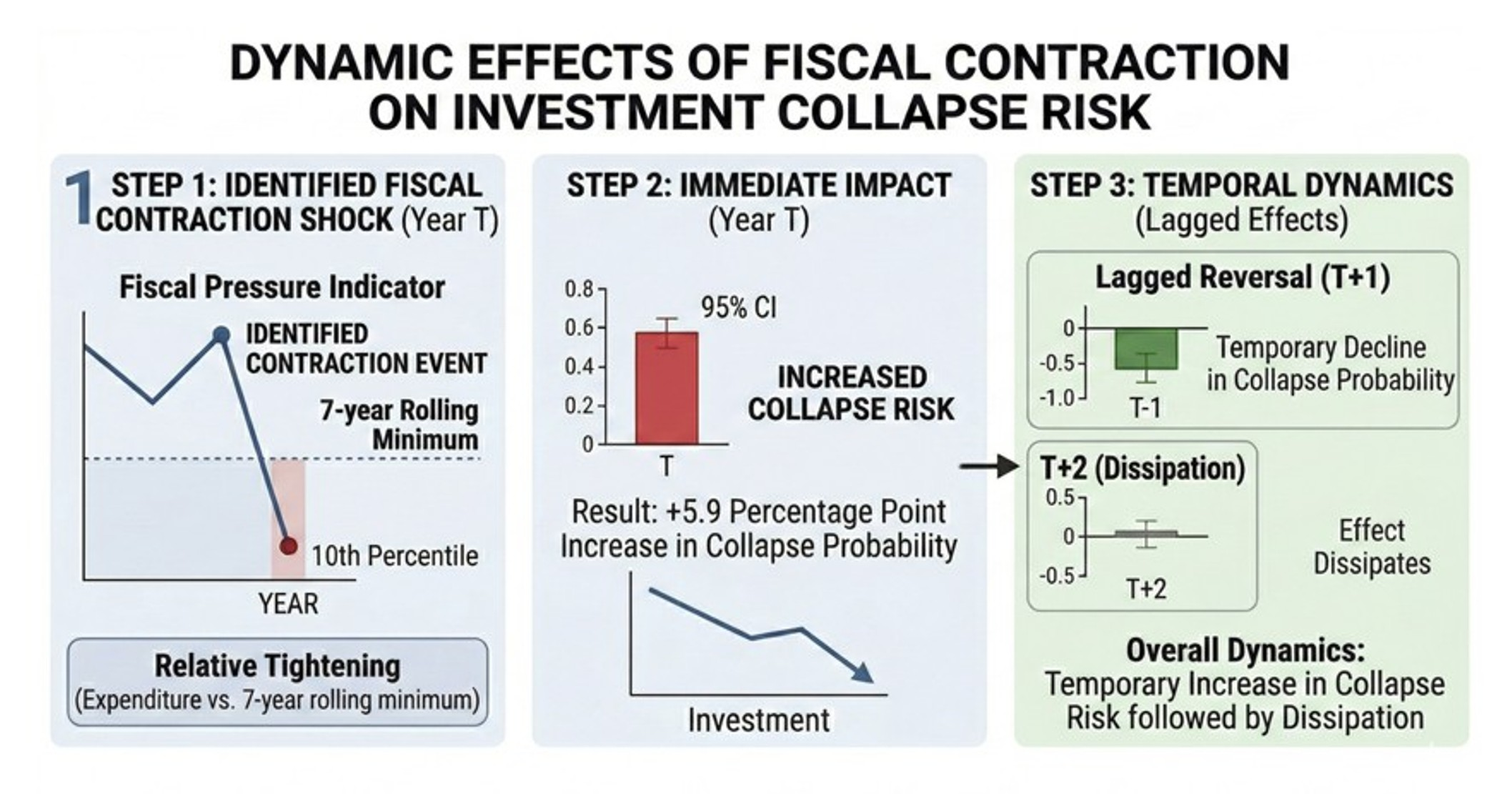
Table 4. It is clear from the estimated values that there is a time-varying pattern. The positive coefficient (β = 0.059,
p < 0.05) indicates that fiscal contraction shocks are linked to an immediate increase in the probability of investment collapse. However, this effect is reversed in the subsequent period, as indicated by the negative coefficient (β = −0.052,
p < 0.10). The results suggest that a reduction in the collapse risk is achieved one year after the tightening episode. However, by the second lag (
t −
2), the coefficient is statistically insignificant, indicating that the impact is short-lived and tends to dissipate over time.
The results indicate an adjustment process in which fiscal contractions coincide with heightened collapse risk in the shock year, followed by stabilization in the year after the impact. The coefficient related to the rule of law remains stable across these specifications, suggesting that institutional controls are a robust specification. These findings support Hypothesis 2 and lend credence to the proposition that fiscal contraction shock varies over time. Overall, the results show that fiscal contractions generate short-term downward pressure on investment, but these effects do not persist over time. Human capital is not statistically significant, possibly because it does not move at the same pace or because of the absorption of cross-country differences occasioned by the country fixed-effects specification. GDP growth is negative and highly significant in the t − 1 specification but not in the second lag, suggesting that stronger economic performance reduces the probability of an investment downturn in the short term but not in the year following the impact.
To visually represent the dynamic effects, we plot the estimated coefficients and their 95% confidence intervals across time horizons.
Figure 3 confirms that the impact of fiscal contractions is positive, suggesting that fiscal contractions increase the probability of a collapse in investment within the same year. The first lag was negative, and the second lag was statistically aligned to zero. This suggests that the transmission of fiscal contractions to investment collapse operates in the short term, and there is a stabilization in the period following the year in which there is a substantial decline in investment.
The baseline models discussed are based on the assumption of linearity. Linear fixed-effects-based specifications provide an intuitive understanding of the nature of the data. Nevertheless, to avoid being limited to interpretations that are primarily linear approximations, we consider a nonlinear robustness check, for which we use a conditional fixed effects logit model. The conditional fixed-effects logit estimator is well adapted to panel data with binary outcomes, as it models the probability of extreme downsides in investments using the logistic distribution. The approach also controls for time-invariant country effects, thereby accounting for structural differences across countries, such as differing levels of development, strength of institutions, and other aspects that could bias the relationship between fiscal shocks and collapse risk. Unlike pooled models, the conditional fixed effects logit estimator avoids assumptions about the correlation between unobserved heterogeneity and explanatory variables, making it an appropriate method for assessing policy-related panel data.
Robustness checks using conditional fixed-effects logit estimates are presented in
Table 5. The results confirm the main findings of this study. Under the P90 shock readings, it can be seen that the fiscal contraction shock significantly increases the odds of downside risk in investment (odds ratio = 1.74,
p < 0.01), thereby suggesting that tightening episodes are linked with a substantially higher possibility of investment collapse in the shock year. The lagged shock impact at is negative and marginally significant (odds ratio = 0.62,
p < 0.10), suggesting that collapse risk declines in the year following the contractions. The second lag does not show statistical significance, suggesting that the effect tends to reduce or dissipate over time.
We also conducted a more stringent assessment at p95, which yielded similar results. The lagged shock effect was negative and statistically significant (odds ratio = 0.47, p < 0.05), implying a reduction in the collapse risk following severe tightening events. The stronger lagged effect aligns with the idea that intense tightening episodes tend to drive sharper short-term adjustments, followed by stabilization. Across both specifications, lagged GDP growth was negative and highly significant, supporting the proposition that stronger macroeconomic performance reduces the probability of investment collapse. Human capital and the rule of law were not statistically significant, consistent with earlier results. In summary, the nonlinear estimates are more or less aligned with the baseline findings and strengthen the confidence in the robustness of the findings.
We conduct a placebo lead regression, and the output is given in
Table 6. The placebo regression adds future fiscal contraction shocks at t + 1 and t + 2 to test for reverse causality in the relationship between fiscal contraction and investment collapse. We examine this specification to verify whether the baseline relationship is driven by reverse causality or the possibility of an investment collapse predicting later fiscal tightening. Columns 2 and 3 indicate that future contraction shocks are not statistically significant at the t + 1 and t + 2 levels. Overall, we consider the absence of predictive power to support the idea that reverse causality may not be driving the main results. Nevertheless, we interpret the estimates as conditional associations and not definite proof of the absence of endogeneity.
The robustness of our main findings to alternative thresholds indicates that the pattern is not driven by an arbitrary threshold choice. The coefficient on lagged shocks is negative and significant across all thresholds. This robustness is critical as it addresses concerns that the investment collapse definition of being in the bottom decile or, for that matter, the statistical approach being linear or non-linear is driving the conclusions.
5. Discussion
Fiscal consolidation can narrow sovereign risk premia, particularly in countries with high levels of debt, which improves financing conditions and stabilizes private investments (
Baldacci et al., 2011). The literature on fiscal consolidations indicates that the impact of fiscal contractions on GDP is state-dependent, with output- and investment-related responses moving in tandem with the macroeconomic environment (
Arizala et al., 2017;
Bamba et al., 2019). In this regard,
Woldu and Szakálné Kanó (
2023) find evidence of short-run contractionary effects on private demand and investment in sub-Saharan Africa. They also note that spending-based consolidation leads to a lesser loss of output than revenue-based consolidation (
Woldu & Szakálné Kanó, 2023). Although we find that the impact is short-run, there are strands of literature that indicate that there are certain contexts in which the effect may cascade into the longer term (
Adegboyo et al., 2021).
Beyond the macroeconomic context, fiscal consolidation is also dependent on the composition of the fiscal mix. In the context of OECD countries, there is some evidence that the investment response to fiscal adjustments depends on the nature and composition of government spending and that reductions in public investment can adversely impact capital formation (
Argimon et al., 1997). In this regard, more recent studies suggest that fiscal consolidation can crowd in private investment by boosting confidence in policy (
Afonso et al., 2022). These mechanisms are consistent with the findings that fiscal contractions are associated with an increase in collapse risk in the impact year. This also resonates with ideas related to the real options view of uncertainty, whereby fiscal contraction shocks can raise uncertainty related to aggregate demand and overall financial conditions, thereby inducing firms to postpone investment even when profitability conditions should normally induce capital formation (
Dixit, 1992). This pattern is also in tune with the evidence that fiscal multipliers are higher during protracted periods of tightening, thereby suggesting that consolidation undertaken at weak macroeconomic junctures can trigger an outsized impact and possible hysteresis (
Dell’Erba et al., 2018).
The finding that an initial investment collapse is followed by stabilization is consistent with the irreversible choice framework used to explain investment fluctuations.
Bernanke (
1983) observes that agents make investment-related decisions that trade off the additional returns from early commitment against the benefits of information that is acquired after a period of time. This is consistent with the idea that policy-level uncertainty is linked to lower investment by firms, and this impact is bolstered when investment irreversibility is high, and even more so when firms are dependent on government support (
Gulen & Ion, 2015). In the context of our findings, fiscal contractions can temporarily raise the level of uncertainty about demand, but a period of waiting is conducive to reviving postponed projects, as there is a degree of stability following the period of investment collapse. This interpretation is also consistent with findings showing that investment responses to fiscal events are state-dependent.
Bournakis and Ramírez-Rondán (
2024) show that fiscal tightening has a significantly higher negative impact during periods of uncertainty.
The finding that the rule of law is not a significant predictor of investment collapse warrants interpretation, as extant research supports the finding that the rule of law is associated with investment (
Bano et al., 2024;
Luong et al., 2020). The rationale behind this idea is that securing property rights helps protect investments and propels economic growth (
Haggard et al., 2008). Our findings are based on a global panel involving a large panel of countries; therefore, we consider that the aggregates do not convey the same information as that conveyed by studies conducted within specific contexts, such as the finding that the rule of law impacts the economic performance of low-income countries (
Shamugia, 2025). The study also does not support the idea that human capital affects investment. This might be because the human capital component used in the study is largely an indication of educational aspects, and as suggested by
Pritchett (
2001), educational quality might be low in some contexts, implying that it may not cascade into economic productivity. Furthermore, in fixed effect settings, it is possible that the long-run cross-country variation gets absorbed; therefore, the remaining within-country variation in schooling-based indices, such as the human capital index, may not have much explanatory power.
We find that the association between lagged GDP growth and collapse risk is consistently negative (β = −0.003), which suggests state dependence in how fiscal contractions transmit to investment outcomes. When economic growth is weak, it is more likely that fiscal contractions coincide with adverse private sector expectations. This is consistent with the broader evidence that fiscal multipliers are larger in downturns than in periods of expansion, which essentially supports our earlier discussion that macroconditions shape the magnitude of contractionary effects (
David et al., 2022).
A key concern is whether fiscal tightening is a pre-emptive response to an anticipated fall in output. The placebo lead test is insignificant, suggesting that fiscal tightening may not necessarily be driven by reverse causality but rather that it is an unintended consequence. This does not necessarily eliminate endogeneity, but rather that it is unlikely that the impact and year association is not fully driven by an anticipatory policy.
Overall, the findings point to an adjustment mechanism setting after the initial collapse, supported by the lack of persistence in the results. Fiscal tightening appears to set off a reassessment of expectations and demand prospects, thereby leading firms to either delay or scale back investments, which could be a possible reason for the stabilization following the collapse of the bubble. These mechanisms are in keeping with the ‘wait-and-see’ approach adopted by firms under uncertainty (
Bernanke, 1983).
Because fiscal tightening, which leads to investment collapse, is exacerbated during periods of fragility, it is important for policymakers to consider the timing of consolidation measures, as these are critical for ensuring the stability of the larger economy. Clear medium-term fiscal plans can anchor expectations and help to normalize capital outlays, thereby limiting the duration of downturns.
The empirical findings point to three critical patterns with policy implications. First, contemporaneous fiscal consolidation shocks elevate collapse risk by approximately +5.9 pp, suggesting that the immediate reduction in demand from fiscal contractions directly threatens investments. Second, the lagged effect suggests that firms adjust their expectations (−5.2 percentage points) once their position stabilizes. Third, the findings provide evidence that prior GDP growth has a protective effect (−0.30 percentage points per unit growth). Effective consolidation during periods of boom generates confidence, while consolidation during downturns tends to amplify precautionary investment reductions. In this regard, it is also important to design fiscal rules effectively, as fiscal rules have been shown to impact fiscal adjustment strategies (
Ardanaz et al., 2021).
6. Conclusions
This study examines the proposition that fiscal contraction shocks increase the probability of extreme downside movements in investments and whether these effects vary over time. By framing investment collapse as a tail-risk event, this analysis contributes to the broader discussion of macroeconomic resilience. The findings indicate that fiscal tightening is associated with a short-term increase in the risk of collapse. The findings also show that this impact did not persist in subsequent periods.
The findings of this study have direct implications for policy, and effectively, countries implementing consolidation should design adjustments around fiscal instrument composition, which protects investment. One possible suggestion is to use revenue measures or efficiency gain-related options wherever feasible. Policymakers should also sequence consolidation towards periods of stronger growth. Policies should also be employed to sustain investment during periods of fiscal retrenchment. Overall, the findings suggest that procyclical consolidation carries tail risk costs. External financing or revenue-based adjustment strategies could be considered where available.
The study covers a large country panel period, and the findings are robust. Nevertheless, we acknowledge the following limitations. First, different investment components may react differently, and the investments used in the study are aggregate values, which may mask composition-specific impacts. Second, fiscal shocks are identified based on distributional thresholds, which may not capture other aspects such as those arising from narrative-driven consolidation events. Finally, the empirical design relies on statistical associations and does not consider structural aspects for identification; to that extent, the results should be viewed as conditional relationships within a fixed-effects-based framework.
In practical terms, policies that sustain investment during contractionary phases should prioritize multiyear fiscal frameworks that reduce uncertainty and risk premia. In situations where fiscal space is limited, governments can complement consolidation with measures that ease issues related to capital formation, such as improving the financing climate. Some options to enhance financial provisions include providing temporary tax incentives and credit guarantees for viable firms. The overall idea is that consolidation design and sequencing are important considerations.
The investment collapse indicator proposed in this study aggregates across heterogeneous investment components and sectors; therefore, the results may reflect compositional responses (
Ilzetzki et al., 2013) rather than a uniform contraction across all types of investments. This limitation may also reflect the subsequent stabilization pattern, whereby the aggregate dynamics may not distinguish between broad-based recoveries and offsetting movements across investment categories. Another limitation is that most of the countries are developed countries, and future research could work on assessing the least developed countries. Future research could also consider sectoral investment data to conduct the study at a granular level. Future researchers should consider employing instrumental variables that could strengthen causal claims.