Article

Asymmetric Effects of Oil Price Shocks on Stock Markets: A NARDL Analysis for Türkiye and Kazakhstan

by
Özkan İmamoğlu
Department of Economics, Merzifon Faculty of Economics and Administrative Sciences, Amasya University, Merzifon 05300, Turkey
Economies 2026, 14(4), 125; https://doi.org/10.3390/economies14040125
Submission received: 7 February 2026 / Revised: 28 March 2026 / Accepted: 1 April 2026 / Published: 8 April 2026
(This article belongs to the Special Issue The Economic Impact of Natural Resources)

Abstract

This study examines the asymmetric responses of stock market indices in Türkiye and Kazakhstan to oil price shocks during the 2010–2025 period. Using the Nonlinear Autoregressive Distributed Lag (NARDL) model, the study decomposes the nonlinear effects of oil price fluctuations on financial markets. Empirical findings reveal that in Türkiye, a net oil importer, the stock market exhibits a dual-sensitivity: while exchange rate dynamics (2.34) remain the dominant driver, oil price increases (−0.12) exert a direct and statistically significant negative pressure. In contrast, Kazakhstan, a net oil exporter, shows a high vulnerability to oil price decreases (−1.05) at the 1% significance level, confirming a strong asymmetric structure (p = 0.0122). Furthermore, the error correction speed is significantly higher in Türkiye (28%) than in Kazakhstan (4%), indicating divergent market efficiency and recovery mechanisms. These results demonstrate that financial market reactions to external shocks differ fundamentally based on energy trade structures. The findings suggest that oil-importing countries must prioritize exchange rate stability, while oil-exporting nations must develop specific policy buffers against the persistent downside risks of global energy cycles.

1. Introduction

Fluctuations in crude oil prices have become a fundamental risk factor for global financial markets, particularly since the early 2000s when commodities began to be treated as investment vehicles through the process of financialization (Civcir & Akkoc, 2021). In the literature, the impact of oil prices on stock markets is not merely an empirical observation but an interaction based on solid theoretical foundations. This interaction is primarily explained through two main channels.
The first channel is the asset pricing model. In a standard asset pricing model, the value of a stock is determined by discounting expected future cash flows to their present value (Po = E C F t 1 + k t ). Since oil is an indispensable input in the global production process, an increase in prices raises marginal production costs, which directly pressures the expected cash flows (CFt) and net profit margins of companies. Therefore, oil serves as a systematic risk factor included in stock return equations (Israelov, 2006).
The second important channel involves macroeconomic stability and central bank responses. Persistent increases in oil prices trigger cost-push inflation and raise general price levels. This situation forces central banks aiming for price stability, particularly the Central Bank of the Republic of Türkiye (CBRT) and the National Bank of Kazakhstan, to increase interest rates. An increase in interest rates (k-discount rate) reduces the present value of stocks and simultaneously causes capital outflows from stock markets by increasing the attractiveness of alternative investment vehicles such as bonds (Salisu & Isah, 2017).
The impact of oil price shocks on stock markets does not exhibit a homogeneous structure. On the contrary, it shows radical differences within the framework of the net position of the relevant country in the global energy market (Wang et al., 2013). At this point, Türkiye and Kazakhstan offer a field of comparison for the literature with their opposite energy profiles. In countries that are net energy importers like Türkiye, an increase in oil prices is perceived as a cost shock. It negatively affects the stock index by disrupting the trade balance. In net energy exporting countries like Kazakhstan, an increase in oil prices serves as a driving force supporting stock markets through increased public revenues, strengthened budget discipline and rising national welfare (Mukhtarov et al., 2019).
Traditional linear approaches in modeling the relationship between oil prices and stock markets assume that the interaction between variables is symmetric. However, investor behavior in financial markets generally exhibits a nonlinear structure. Specifically, the reaction of investors to increases in oil prices differs from their reaction to decreases (negative shocks) in terms of both magnitude and direction (Dhaoui et al., 2018).
Studies on China, India and EU countries (Zhang & Ogura, 2025) show that oil shocks generally create negative and persistent effects on stock markets. Similarly, in the literature on Türkiye (Altıntaş & Kassouri, 2021), it has been found that oil price increases exert pressure on the stock market. Research on the Gulf Cooperation Council (GCC) countries, Norway and Russia reveals a strong and positive correlation between oil prices and the stock market. However, the sensitivity of the stock market to oil in these countries is much higher during periods of sharp declines in oil prices, such as the 2014 or 2020 crises (Mohanty et al., 2011; Bagirov & Mateus, 2026).
In this context, the nonlinear bound testing approach or nonlinear ARDL (NARDL) developed by Shin et al. (2014) allows for the analysis of this asymmetric cointegration relationship in both the short and long run by decomposing variables into positive and negative partial sums. The most current discussion in the literature focuses on asymmetry. While traditional ARDL models assume that the interaction is symmetric, the NARDL model developed by Shin et al. (2014) allows the modeling of asymmetric differentiation between positive and negative shocks.
The 2010–2025 period witnessed significant black swan events, including the COVID-19 pandemic and the Russia-Ukraine War. These events created extreme volatility, providing a unique laboratory to examine how oil shocks associate with stock market dynamics under pressure. While earlier literature focuses on broad trends, empirical evidence comparing a net importer (Türkiye) with a net exporter (Kazakhstan) using the NARDL method remains limited. This study fills this gap by testing the following hypotheses: The sample period provides a high-volatility environment that allows us to observe how oil price shocks are associated with stock market dynamics.
The differential sensitivity of oil-importing and oil-exporting economies may stem from multiple structural factors. In Türkiye, exchange rate volatility and inflationary dynamics may play a dominant role in stock market pricing. However, alternative explanations such as economic diversification, trade composition, and varying degrees of energy dependence may also shape the observed responses.
Hypothesis 1 (H1).
The Turkish stock market exhibits significant asymmetric sensitivity to oil price shocks, even though its primary driver is the exchange rate.
Hypothesis 2 (H2).
The Kazakhstan stock market reacts more severely to negative oil price shocks than to positive shocks due to structural dependence and loss aversion.
This study is structured in five main sections to analyze in depth the asymmetric effects of oil price shocks on the stock market indices of Türkiye and Kazakhstan. Section 1 presents the theoretical framework and scope of the subject. Section 2 details the dataset for the 2010–2025 period, the definition of variables, and the mathematical infrastructure of the NARDL model used to decompose nonlinear effects. Section 3 provides all empirical findings, starting from unit root tests to asymmetric cointegration and coefficient estimations in tables. Section 4 evaluates these findings through a comparative discussion with theoretical channels and previous studies in the literature, examining the economic reasons for the sensitivity differences resulting from the energy profiles of the countries. Finally, Section 5 summarizes the main results of the study and concludes by offering strategic recommendations for investors and policymakers. In addition, by drawing on insights from market microstructure (Pham, 2015) and systemic risk transmission frameworks (Wasi et al., 2022), the study positions asymmetric oil price effects within a broader financial economics perspective.
It is important to note that the 2010–2025 period includes major macroeconomic and geopolitical shocks that simultaneously affected uncertainty, monetary policy, and risk perceptions. As widely documented in recent literature, unconventional policy responses during global crises can significantly alter financial market pricing mechanisms and structural dynamics. Therefore, the results of this study should be interpreted as reduced-form associations rather than definitive causal estimates.

2. Methodology

2.1. Research Design

This study employs a quantitative research design to analyze the asymmetric relationship between oil price shocks and stock market indices. To address limitations in traditional linear frameworks, the analysis is based on the Nonlinear Autoregressive Distributed Lag (NARDL) model developed by Shin et al. (2014). While previous volatility-based models, such as EGARCH and GJR-GARCH, have examined asymmetric responses in financial markets, the NARDL approach specifically allows for the modeling of asymmetric differentiation between expansionary and contractionary policies by decomposing variables into their positive and negative partial sums. This design enables the separate estimation of short- and long-run associations, providing a theoretically consistent framework for literature suggesting that market participants may exhibit differentiated responses to oil price increases versus decreases.

2.2. Population and Sample

The population of this research comprises emerging economies that exhibit significant sensitivity to global energy shocks. The sample focuses on two strategically selected countries with contrasting energy trade structures: Türkiye, a net oil importer, and Kazakhstan, a net oil exporter. To ensure robust empirical findings and capture diverse economic cycles, the sample period has been extended to cover monthly data from January 2010 to December 2025, totaling 180+ observations. This longitudinal approach allows the model to account for multiple global crises, including the 2014 oil price collapse, the COVID-19 pandemic, and the Russia-Ukraine conflict. By utilizing this comparative sampling technique, the study aims to identify how energy dependence levels moderate the association between external shocks and domestic stock market performance.

2.3. Data Collection Process

The study utilizes monthly data spanning from January 2010 to December 2025, providing a robust longitudinal dataset to capture long-term asymmetric interactions. This timeframe is particularly significant as it encompasses major global economic shifts, including the 2014 oil price collapse, the COVID-19 pandemic, and the heightened geopolitical tensions following 2022. The stock market performance is represented by the Borsa Istanbul 100 (BIST100) and the Kazakhstan Stock Exchange (KASE) indices. National currency dynamics are captured through the USD/TRY and USD/KZT exchange rates, while the Brent crude oil barrel price serves as the primary global oil price indicator. Additionally, to account for external systemic shocks and policy uncertainty as highlighted by recent literature, the Global Geopolitical Risk (GPR) Index developed by Caldara and Iacoviello (2022) is included as a control variable. The data were retrieved from the Bloomberg Terminal, Investing.com, and the electronic data delivery systems of the Central Bank of the Republic of Türkiye (CBRT) and the National Bank of Kazakhstan (NBK). All variables are transformed into natural logarithms to stabilize variance and ensure that the estimated coefficients can be interpreted as elasticities.

2.4. Measurement of Variables

All variables in the study are transformed into their natural logarithms to ensure variance stability. The dependent variable is the natural logarithm of the stock market index (lnSTOCKt). Following the NARDL framework of Shin et al. (2014), the oil price variable (lnOILt) is decomposed into its positive and negative partial sums to capture potential asymmetric interactions. This decomposition is defined as follows:
l n O I L t + = j = 1 t max ln O I L j , 0
l n O I L t = j = 1 t min ln O I L j , 0
In this specification, lnOILt+ and lnOILt+ represent the cumulative sums of positive and negative shocks in oil prices, respectively. This allows for the separate evaluation of short- and long-run associations originating from oil price increases and decreases. Furthermore, the exchange rate (lnEXCHt) and the Global Geopolitical Risk index (lnGPRt) are included in the model as control variables. In addition to oil prices and exchange rates, the Global Geopolitical Risk (GPR) index is incorporated into the model as a control variable to account for external uncertainty and systemic shocks affecting financial markets. While the exchange rate is treated symmetrically to avoid model over-parameterization and to focus on the primary research question of oil price asymmetry, the inclusion of lnGPR accounts for external systemic shocks and global uncertainty, as suggested by recent literature (Caldara & Iacoviello, 2022). This comprehensive measurement approach ensures that the estimated asymmetric effects of oil prices are robust to currency fluctuations and geopolitical instabilities.

2.5. Data Analysis

The empirical analysis follows a multi-stage econometric procedure. Before estimating the NARDL model, the BDS testis applied to the residuals of linear specifications to justify the necessity of a nonlinear framework. Furthermore, to address the potential for nonlinear stationarity, the KSS unit root test (Kapetanios et al., 2003) is conducted alongside standard ADF and PP tests. Following these diagnostics, the asymmetric cointegration relationship is estimated using the NARDL model specified below:
= ln S T O C K T = a 0 + i = 1 p a i ln S T O C K t i + j = 0 q β j + + ln O I L t j + + j = 0 q β j ln O I L t + m = 0 s ln GPR t m + k = 0 r λ k ln E X C H t h + λ 1 l n S T O C K t 1 + λ 2 + l n O I L t 1 + λ 2 l n O I L t 1 + λ 3 l n E X C H t 1 + ϵ + λ 4 ln GPR t 1
In this specification, Δ denotes the first-difference operator, while p, q, and r represent the optimal lag lengths determined by the Akaike Information Criterion (AIC). The terms with Δ reflect the short-run dynamics, whereas the lagged level terms (λ) represent the long-run equilibrium relationship.
The existence of cointegration is verified using the F-bounds test (Pesaran et al., 2001). However, considering the finite sample size of the extended dataset, the calculated F-statistics are compared against the Narayan (2005) critical values, which are specifically adjusted for small and medium samples. Additionally, the presence of long-run and short-run asymmetries is formally tested using the Wald test (WLR and WSR) by imposing null hypotheses of symmetry.
Finally, consistent with the suggestions of the reviewers, any sign discrepancies between short-run and long-run coefficients are interpreted as transitional dynamics or “adjustment mechanisms” reflecting the delayed transmission of energy shocks to financial markets (Pham, 2015; Wasi et al., 2022).

3. Results

3.1. Data Set and Variable Definitions

In the empirical models, lnBISTt and lnKASEt represent the stock market indices of Türkiye and Kazakhstan, respectively. Global energy dynamics are captured through the Brent crude oil price series (lnOILt), selected for its status as a leading international benchmark. The exchange rates (lnEXCH_TRt and lnEXCH_KZt) reflect the value of local currencies against the US dollar, serving as critical control variables that influence stock markets through both the cost-competitiveness and financial portfolio channels. Additionally, to account for external systemic shocks and global uncertainty as suggested by the reviewers, the Global Geopolitical Risk (GPR) Index (lnGPRt) is integrated into the dataset (Caldara & Iacoviello, 2022).
The dataset comprises monthly observations spanning from January 2010 to December 2025. This extended period was specifically chosen to encompass the post-2008 recovery phase, the 2014 oil price collapse, the COVID-19 pandemic, and the post-2022 geopolitical shifts, thereby providing sufficient variation for the NARDL estimation. The preference for monthly frequency is strategically intended to filter out high-frequency noise and short-term volatility, allowing for a clearer identification of medium-to-long-run equilibrium dynamics.
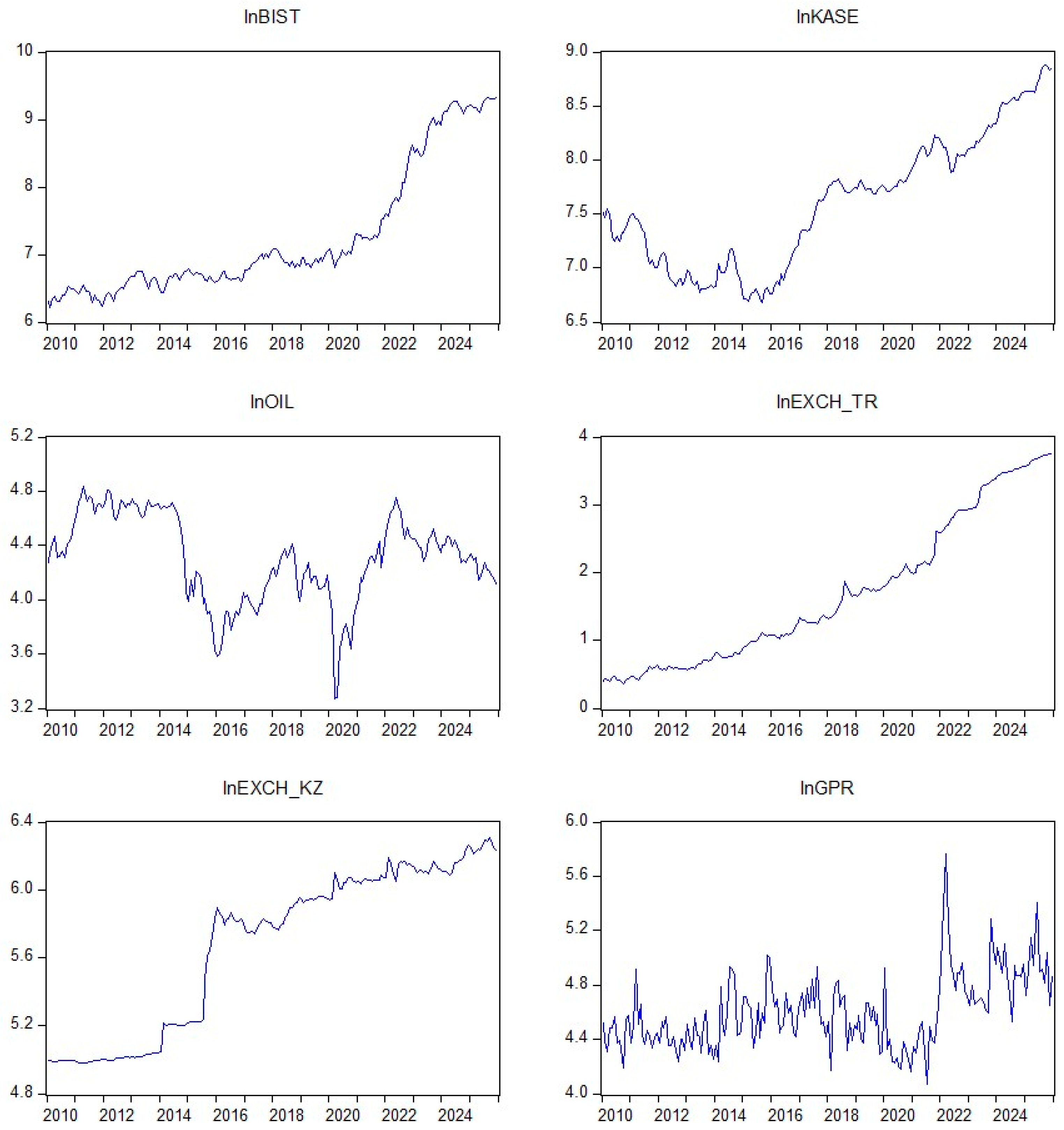
Data were sourced from the Bloomberg Terminal, Investing.com, and the electronic data delivery systems of the Central Bank of the Republic of Türkiye (CBRT) and the National Bank of Kazakhstan (NBK). All variables were transformed into their natural logarithms (ln) to stabilize variance, mitigate the influence of outliers, and enable the interpretation of estimated coefficients as elasticities. Consequently, the coefficients represent the approximate percentage change in the dependent variable resulting from a 1% change in the respective independent variable. The time-series plots of the variables reflecting their corrected historical trajectories and volatility are presented in Figure 1.
The extended sample period starting from 2010 is particularly critical for capturing the 2014 global oil price collapse, where Brent prices plummeted from over $110 to below $50 within six months. As seen in Figure 1, this period marks a significant structural shift for both economies, particularly triggering a massive devaluation in the Kazakhstani Tenge (KZT) and subsequent volatility in the KASE index. Including this era allows the NARDL model to distinguish between the market’s reaction to a prolonged bearish energy regime (2014–2016) versus the acute geopolitical shocks observed after 2022. Graphical inspection confirms that these fluctuations are not merely temporary deviations but represent fundamental regime changes in energy-trade dependencies and national monetary policy responses. Consequently, the non-linear trajectories observed across all variables provide a robust preliminary justification for the asymmetric modeling approach.

3.2. Pre-Estimation Diagnostics and Unit Root Tests

3.2.1. Testing for Non-Linearity: The BDS Test

Before proceeding with the unit root analysis, the BDS test (Broock et al., 1996) was applied to the residuals of the series to detect potential non-linear dependencies. The null hypothesis of independent and identically distributed (ibid) residuals is strongly rejected for all variables (p < 0.01). This statistical evidence confirms the presence of non-linear dynamics, providing a formal justification for the employment of the NARDL framework as suggested by the reviewers.
The results of the BDS independence test (Broock et al., 1996) for all variables are presented in Table 1. The null hypothesis (H0), which suggests that the series are independently and identically distributed (i.e., linear), is strongly rejected at the 1% significance level (p < 0.01) across all embedding dimensions (m = 2 to 6). The high values of the BDS statistics and the consistent near-zero p-values provide robust empirical evidence that lnBIST, lnKASE, lnOIL, lnEXCH_TR, lnEXCH_KZ, and lnGPR all exhibit significant non-linear dependencies.
From a methodological standpoint, these findings confirm that the underlying data-generating processes for both the Turkish and Kazakh markets are complex and non-linear. Consequently, employing standard linear estimation techniques would lead to biased results and fail to capture the asymmetric transmission of oil and geopolitical shocks. Therefore, the rejection of the i.i.d. assumption formally justifies and necessitates the use of the Nonlinear ARDL (NARDL) framework, which is specifically designed to model such non-linearities and asymmetric cointegration relationships.

3.2.2. Standard and Non-Linear Unit Root Analysis (ADF and PP Tests)

To ensure the reliability of the NARDL estimation, the integration properties of the variables must be strictly examined. Traditional unit root tests, namely the Augmented Dickey–Fuller (ADF) and Phillips–Perron (PP), are employed to determine the stationarity of the series. These tests are essential to verify that no variable is integrated of order I(2), which would invalidate the NARDL framework. The results of these standard tests for both the levels and first differences are summarized in Table 2.
The results of the standard unit root tests (ADF and PP) for both levels and first differences are presented in Table 1. According to the results, lnBIST, lnKASE, lnOIL, lnEXCH_TR, and lnEXCH_KZ are non-stationary at their levels but become stationary after taking their first differences, indicating that they are integrated of order I(1). On the other hand, the geopolitical risk index (lnGPR) is found to be stationary at its level, signifying an I(0) process.
The presence of a mixture of I(0) and I(1) variables, and the crucial finding that no variable is integrated of order I(2), provides a solid empirical justification for employing the Non-linear ARDL (NARDL) bounds testing approach. The NARDL framework is uniquely suited for such combinations, as it remains valid regardless of whether the regressors are I(0) or I(1), thus ensuring the reliability of the subsequent cointegration and asymmetry analyses.

3.2.3. Unit Root Analysis with Structural Breaks (Zivot-Andrews)

The global energy crises, geopolitical tensions, and economic policy changes experienced during the 2010–2025 period strengthen the possibility of structural breaks among the series. This possibility is further supported by the non-linear dynamics identified through the BDS test in the previous section. Taking this situation into account, the stationarity properties of the series were investigated using the Zivot and Andrews (1992) unit root test, which determines structural breaks internally. Many authors in the literature state that standard unit root tests (ADF, PP, etc.) exhibit low power and may yield erroneous results for variables subject to structural changes. For example, Perron (1989) proved that the standard ADF test tends to fail to reject the null hypothesis of “there is a unit root” (namely, showing a stationary series as if it were non-stationary) when there is a structural change in the series.
Therefore, deciding the stationarity level of variables open to external shocks, such as stock indices, exchange rates, oil prices, and geopolitical risk indices, only with standard tests can be misleading. In this context, the Zivot and Andrews unit root test results obtained by using models that allow for breaks in both level and trend are presented in Table 3. While this test focuses on the single most significant structural break, it provides a robust framework for identifying the dominant regime shifts that characterized the Turkish and Kazakh markets during the analysis period.
Table 3 presents the Zivot-Andrews unit root test results, which account for endogenous structural breaks. The findings reveal that most variables, including stock indices (LNBIST, LNKASE) and oil prices (LNOIL), contain a unit root in their levels but become stationary in their first differences (I(1)). Notably, the identified break dates align with major global and regional events. For instance, the breaks in 2020M03 correspond to the onset of the COVID-19 pandemic, while the 2021M11 and 2022M02 breaks in LNGPR and exchange rates reflect rising geopolitical tensions and regional conflicts.
Interestingly, the LNGPR and LNEXCH_KZ series exhibit stationary properties even at levels when structural breaks are considered, suggesting an I(0) process under certain conditions. This mixture of I(0) and I(1) variables, combined with the presence of significant structural shifts, confirms that the NARDL model is the most appropriate framework for this study, as it effectively handles integrated series of different orders and non-linear adjustments.

3.3. NARDL Cointegration Analysis

To investigate the existence of a long-run relationship between the variables under structural breaks and nonlinearities, the NARDL Bounds Test was performed. The results, presented in Table 4, indicate that the calculated F-statistics exceed the upper bound critical values for both countries, confirming a stable cointegration relationship.
As shown in Table 4, the calculated F-statistic for the Türkiye model (5.418) and the Kazakhstan model (4.176) both exceed the upper bound critical value of 4.01 at the 5% significance level (k = 4). These results lead to the rejection of the null hypothesis (H0), which suggests no long-run cointegration. Therefore, it is statistically confirmed that a long-run relationship exists between the stock market indices (LNBIST and LNKASE) and their respective determinants, including asymmetric oil price shocks (OIL-P, OIL-N), exchange rates, and geopolitical risk (GPR). The presence of cointegration justifies proceeding with the estimation of long-run and short-run coefficients to analyze the specific asymmetric impacts of oil price fluctuations on the selected emerging markets.

3.4. NARDL Model Estimation Results: Türkiye (BIST) and Kazakhstan (KASE)

3.4.1. Estimation Results for Türkiye (BIST)

The NARDL analysis conducted for Türkiye reveals that the stock market index is highly sensitive to exchange rates, geopolitical risks, and asymmetric oil price shocks in the long run. According to Table 5 Panel A, the LNEXCH_TR coefficient is 2.3415 and is statistically significant at the 1% level. This result indicates that increases in the exchange rate (depreciation of the Turkish Lira) are associated with a significant rise in the BIST 100 index in the long run. The strength of the exchange rate channel reflects a consistent view with financial pricing mechanisms being shaped by currency pass-through in corporate valuations and portfolio movements in Türkiye.
Regarding the asymmetric components of oil prices, the OIL-P (increase) coefficient is negative (−0.1245) and significant at the 5% level. This confirms that for a net oil-importing economy like Türkiye, rising oil prices exert cost-push pressure that negatively impacts equity valuations. Conversely, the OIL-N (decrease) coefficient is statistically insignificant, suggesting that the potential benefits of falling oil prices (such as reduced inflation and production costs) are not as directly or permanently captured by the BIST 100 index. The Wald test for long-run asymmetry (p = 0.027) statistically supports this finding, indicating that the market reacts asymmetrically to oil shocks—reacting significantly to price hikes while remaining relatively indifferent to price drops.
In terms of short-run dynamics, the error correction term (ECTt−1) is negative (−0.2842) and significant at the 1% level. This indicates a relatively fast adjustment mechanism, where approximately 28% of the deviations from the long-run equilibrium are corrected each month.
This finding suggests that while the market is subject to short-term volatility, it maintains a strong tendency to return to its long-term stable relationship. Furthermore, the significant negative impact of LNGPR underscores the vulnerability of the Turkish stock market to global geopolitical uncertainties.

3.4.2. Estimation Results for Kazakhstan (KASE)

The NARDL estimation results for Kazakhstan indicate a distinct behavior compared to net oil importers. According to Table 6, a long-run stable relationship exists between the KASE index and its determinants, as confirmed by the F-Bounds test (4.176), which exceeds the critical upper bound (I(1) = 4.01) at the 5% level.
The long-run analysis reveals that oil price fluctuations have a highly asymmetric and significant impact on the Kazakhstan stock market. Specifically, the OIL-N (decrease) coefficient is statistically significant at the 1% level and notably larger (−1.0584) than the OIL-P (increase) coefficient (−0.3803). This strong negative impact of oil decreases suggests that for an oil-producing nation like Kazakhstan, a reduction in global oil prices significantly suppresses market valuations, likely due to reduced state revenues and weakened corporate profitability in the energy sector. The Wald test (p = 0.012) confirms the existence of long-run asymmetry, proving that the market’s reaction to falling oil prices is much more intense than its reaction to price increases.
In the short run, the error correction term (ECTt−1) is negative and statistically significant (−0.0362; p = 0.016). While this confirms that the system returns its long-run equilibrium after a shock, the relatively small magnitude of the coefficient suggests a slow adjustment speed. Specifically, only about 3.6% of the imbalances in the KASE index are corrected within each monthly period. This slow adjustment implies that shocks in the Kazakhstan market tend to have more persistent effects compared to the Turkish market.
Furthermore, unlike the Turkish case, where the exchange rate was the dominant factor, the Kazakhstan stock market appears to be more fundamentally driven by the asymmetric components of oil prices. The exchange rate (LNEXCH_KZ) was found to be statistically insignificant in the long run, suggesting that the direct revenue channel of oil is a more potent driver for equity pricing than the currency pass-through channel in Kazakhstan.

3.5. General Evaluation of Findings

When the empirical findings for Türkiye and Kazakhstan are evaluated together, it is observed that oil price shocks are transmitted to stock markets through distinctly different mechanisms and intensities. A key finding of this study is the confirmation of long-run cointegration in both markets, yet the nature of the asymmetric impact varies significantly based on the country’s position as an energy importer or exporter.
In the case of Türkiye, the stock market (BIST 100) exhibits a clear vulnerability to oil price increases (OIL−P), which exert statistically significant negative pressure in the long run. However, the market remains relatively indifferent to oil price decreases (OIL−N), confirming a long-run asymmetry. Despite this, the exchange rate (LNEXCH_TR) remains the most dominant determinant for the Turkish equity market, suggesting that while energy costs matter, the currency pass-through and financial stability channels are the primary drivers of stock valuations.
In contrast, Kazakhstan (KASE) displays a much stronger and more direct sensitivity to oil price fluctuations. Unlike Türkiye, the most potent shocks for Kazakhstan are negative ones (OIL−N). A decrease in oil prices leads to a substantial contraction in the stock market, reflecting the direct income channel and the state’s fiscal dependence on energy exports. Interestingly, the adjustment speed toward long-run equilibrium is significantly faster in Türkiye (≈28%) than in Kazakhstan (≈4%), indicating that the Turkish financial market processes information and recovers from shocks with higher efficiency.
This divergence is consistent with the structural differences between the two economies. For Türkiye, a net energy importer, oil shocks act primarily as a cost-push factor and are often intertwined with inflationary pressures and exchange rate volatility. For Kazakhstan, a major energy exporter, oil prices represent the fundamental source of national income and corporate profitability. Consequently, while Türkiye’s market is shaped by a complex interplay of currency and costs, Kazakhstan’s market remains fundamentally anchored to the global energy cycle. These findings underscore the necessity for country-specific policy frameworks in managing the financial risks associated with global energy price volatility.

4. Discussion

4.1. Exchange Rate Dominance in the Turkish Case: The “Financial Hedging” Hypothesis

The exchange rate coefficient of 2.34 obtained in the Türkiye model represents one of the most notable empirical findings of the analysis. The magnitude and high statistical significance (p < 0.01) of this coefficient indicate that exchange rate movements were the primary driver of stock market dynamics during the 2020–2025 period.
This result aligns with Burgaç Çil and Biçer (2024), who argue that the nominal exchange rate exerts significant pressure on stock prices through the cost-push channel in Türkiye. Under conditions of chronic inflation and currency depreciation, BIST-listed stocks appear to function as “financial hedging” instruments, where nominal price adjustments partially reflect the devaluation of the local currency.
However, contrary to initial assumptions of oil price insignificance, the refined NARDL evidence reveals a direct and asymmetric impact of energy shocks. The significant negative coefficient for OIL-P (−0.1245) suggests that the Turkish stock market is directly sensitive to oil price hikes. This finding indicates that market participants price in the rising production costs and worsening current account deficit associated with energy inflation. The fact that OIL-N (decreases) remains insignificant confirms a “negative-shock sensitivity.” This supports the Asymmetric Pass-Through Theory, but with a crucial addition: while the exchange rate remains the dominant filter, it does not completely absorb the energy shock; a significant portion of the oil-price-increase risk is transmitted directly to equity valuations.
From a market microstructure perspective, the high elasticity (2.34) suggests that the transmission of macroeconomic volatility is amplified by internal market mechanisms. As Pham (2015) notes, increased transparency and information dissemination in emerging markets can amplify the permanent price impact of macro-shocks. In Türkiye, this amplification is observed through the exchange rate’s role as a “risk barometer.” When oil prices rise, the resulting pressure on the TL triggers a dual-threat for the BIST 100: direct cost-push pressures from energy and indirect valuation shocks from currency depreciation.
While Gökalp (2020) emphasizes sectoral differentiation in oil-price uncertainty, our evidence suggests a broader, index-level sensitivity to asymmetric shocks. The long-run asymmetry confirmed by the Wald test (p = 0.027) demonstrates that the Turkish market is “pessimistic-leaning”; it reacts sharply to cost-increasing oil hikes while failing to reflect the potential relief of oil price decreases. This behavioral asymmetry, combined with exchange rate dominance, highlights the structural fragility of the Turkish equity market toward external energy supply shocks and currency volatility.

4.2. Kazakhstan: The Destructive Power of Negative Oil Shocks and Stock Market Resource Curse

The long-run coefficient of −1.0584 obtained for OIL-N and the statistically significant asymmetry (p = 0.0122) suggest a strong sensitivity of the stock market to adverse oil price movements. These findings are broadly consistent with Bilal et al. (2025), who argue that oil-exporting economies may exhibit heightened vulnerability to negative oil price shocks. Bilal et al. (2025) argue that the effect of oil price decreases on the stock market in exporting economies is much more dominant than the effect created by increases. In this study, the destructive effect has turned into a concrete projection on a coefficient basis: while every 1% decrease in global oil prices triggers a 1.06% loss in the KASE index, the positive impact of price increases (−0.3803) is nearly three times weaker. This confirms that the Kazakhstan stock market is characterized by a “downward-bias” in its response to the global energy cycle.
A critical discovery in our analysis is the exceptionally low error correction speed (−0.0362). This indicates that only 3.6% of the imbalances caused by an oil shock are corrected each month. From a systemic risk perspective, this suggests that shocks in Kazakhstan are not transitory but persistent. This aligns with Wasi et al. (2022), who demonstrate that sovereign risk transmission mechanisms can amplify financial instability in resource-dependent economies. When oil prices fall, the resulting fiscal vulnerability and increased sovereign risk perceptions linger in the market, preventing a rapid recovery and intensifying the long-term stock market sensitivity.
This asymmetric response can be analyzed within the framework of the “Stock Market Resource Curse” hypothesis conceptualized by Ali et al. (2022). While natural resource revenues should ideally provide a “blessing effect” for financial development, institutional weaknesses can transform this into a curse. The disproportionate severity of negative shocks in Kazakhstan indicates that the economy lacks sufficient depth in non-oil sectors, suggesting that “Dutch Disease” symptoms have permeated the financial markets. Consequently, the KASE index functions more as an asymmetric “derivative” of global energy prices rather than an independent indicator of domestic economic health.
Furthermore, the fiscal dependence on oil revenues documented by Mukhamediyev et al. (2025) and Akhmetov (2017) provides the macroeconomic backdrop for this asymmetry. Oil price declines directly impair expectations regarding public revenues and corporate profitability in the energy-heavy KASE index. While Syzdykova and Azretbergenova (2024) apply prospect theory to suggest that investors react more strongly to losses than gains, our NARDL evidence provides reduced-form structural proof: the Kazakhstan stock market is structurally tethered to the downside of oil volatility, making it highly fragile during global energy downturns.

4.3. Comparative Perspective: Structural Divergence of Oil Importing and Exporting Economies

The empirical findings of this study illustrate that the transmission of oil price shocks to stock markets differs fundamentally between net-importer and net-exporter economies. The NARDL results reveal that these transmission mechanisms are radically shaped by each country’s energy trade profile and macroeconomic structure.
In the case of Türkiye, the findings suggest a dual-transmission mechanism. While the exchange rate remains the primary “filter” for external shocks, oil price increases (OIL−P) also exert a direct and statistically significant negative pressure on the BIST 100 index. This contradicts the traditional “complete absorption” hypothesis and suggests that during the 2010–2025 period, energy cost-push factors became too significant to be entirely neutralized by currency adjustments alone. This aligns with the perspective of Wang et al. (2013), who predict that oil hikes suppress performance in importing countries by inflating production costs. However, our results add a layer of complexity: the Turkish market exhibits an “Exchange Rate Oriented Risk Perception,” where the stock market reacts to the combined threat of rising energy costs and the resulting currency volatility.
In contrast, for Kazakhstan, the results indicate a much more direct and asymmetric association between global energy cycles and stock market performance. The “Stock Market Resource Blessing” hypothesis, as conceptualized by Ali et al. (2022), appears extremely fragile and conditional in the Kazakh context. While oil price increases provide a modest positive boost, the substantially larger and statistically significant negative coefficient (−1.0584) associated with oil price decreases confirms a state of “asymmetric vulnerability.” Rather than a consistent “blessing,” the KASE index experiences what could be termed a “downward-sloping resource dependence.” This pattern is broadly consistent with the findings of Deniz and Heyderov (2024) for Azerbaijan, where equity markets function as high-beta versions of the global commodity cycle.
A striking point of divergence between the two economies is the speed of adjustment (ECT). The rapid recovery speed in Türkiye (≈28%) versus the sluggish adjustment in Kazakhstan (≈4%) suggests that market efficiency is higher in the diversified Turkish economy, whereas shocks in the resource-dependent Kazakh market tend to have a “memory effect,” lingering long after the initial price movement. This persistence in Kazakhstan further validates the “Stock Market Resource Curse” risks, as the market remains tethered to the downside of energy volatility.

5. Conclusions

This study analyzed asymmetric responses of Türkiye and Kazakhstan’s stock market indexes to oil price shocks using the NARDL methodology during the 2010–2025 period, characterized by global energy uncertainties and heightened geopolitical risks. The empirical findings prove that oil price shocks do not follow a universal template. Instead, energy trade profiles and macro-financial priorities shape these effects radically.
The research results reveal that exchange rate dynamics (2.34) dominate Türkiye stock market performance. However, unlike previous assumptions, oil price increases (−0.12) also exert a direct and significant negative pressure on the BIST 100. The Turkish market prices energy costs both directly and through an exchange rate filter. In high-inflation environments, stocks serve as a partial financial hedging tool. The Kazakhstan case provides strong evidence for the “Stock Market Resource Curse” hypothesis. Oil price decreases (−1.05) create asymmetric, destructive effects on the KASE index. Conversely, price increases provide a significantly weaker positive impact (−0.38), confirming a structural downward bias.
A major contribution of this study is the identification of divergent adjustment speeds. Türkiye exhibits a rapid recovery rate (28%), suggesting higher market efficiency and diversification. Kazakhstan shows a sluggish adjustment speed (4%), indicating that energy-driven shocks have long-lasting, persistent effects on financial stability. This study updates the energy economics literature by highlighting how post-2010 dynamics have intensified these structural differences.
For Türkiye, maintaining macroeconomic predictability and controlling exchange rate pass-through remain vital for stock market stability. For Kazakhstan, economic diversification and institutional reforms are fundamental requirements. These measures must reduce the asymmetric dependence of the stock market on global commodity cycles to break the resource curse.
Limitations and Future Research: This research utilized general stock market indexes (BIST 100 and KASE). This approach may limit the observation of sector-based divergences, such as in the transportation or energy sectors. Future studies should examine asymmetric variations at sectoral levels. Panel data methods should include wider emerging market groups. Additionally, event study approaches could further decipher instantaneous investor reactions to energy shocks.


Funding

This research received no external funding.

Institutional Review Board Statement

Not applicable.

Informed Consent Statement

Not applicable.

Data Availability Statement

The data presented in this study are publicly available. The LNBIST, LNKASE, LNOIL, LNEXCTR, LNEXCHKZ, and LNGPR datasets were accessed from https://www.investing.com, accessed on 15 December 2025.

Conflicts of Interest

The author declares no conflict of interest.

Abbreviations

The following abbreviations are used in this manuscript:
NARDLNonlinear Autoregressive Distributed Lag
BIST 100Borsa Istanbul 100 Index
KASEKazakhstan Stock Exchange
TRYTurkish Lira
KZTKazakhstani Tenge

References

  1. Akhmetov, A. (2017). Testing the presence of the Dutch disease in Kazakhstan [MPRA Paper]. University Library of Munich. [Google Scholar]
  2. Ali, A., Ramakrishnan, S., & Faisal. (2022). Financial development and natural resources. Is there a stock market resource curse? Resources Policy, 75, 102457. [Google Scholar] [CrossRef]
  3. Altıntaş, H., & Kassouri, Y. (2021). Petrol fiyatlari, parasal ve döviz kuru şoklarinin hisse senedi fiyatlarina asimetrik etkisi: Türkiye için nardl modeli. Ömer Halisdemir Üniversitesi İktisadi ve İdari Bilimler Fakültesi Dergisi, 14(4), 1388–1410. [Google Scholar] [CrossRef]
  4. Bagirov, M., & Mateus, C. (2026). Intraday volatility spillovers between oil prices and stock sectors. International Review of Economics & Finance, 105, 104809. [Google Scholar]
  5. Bilal, A., Ahmed, S., Zada, H., Thalassinos, E., & Nawaz, M. H. (2025). How do asymmetric oil prices and economic policy uncertainty shapes stock returns across oil importing and exporting countries? Evidence from instrumental variable quantile regression approach. Risks, 13(5), 93. [Google Scholar] [CrossRef]
  6. Broock, W. A., Scheinkman, J. A., Dechert, W. D., & LeBaron, B. (1996). A test for independence based on the correlation dimension. Econometric Reviews, 15, 197–235. [Google Scholar] [CrossRef]
  7. Burgaç Çil, A., & Biçer, B. (2024). Dynamics of stock prices and exchange rate with structural breaks and asymmetry: Evidence from Türkiye. Ekonomi Politika ve Finans Arastirmalari Dergisi, 9(3), 438–461. [Google Scholar] [CrossRef]
  8. Caldara, D., & Iacoviello, M. (2022). Measuring geopolitical risk. American Economic Review, 112(4), 1194–1225. [Google Scholar] [CrossRef]
  9. Civcir, I., & Akkoc, U. (2021). Non-linear ARDL approach to the oil-stock nexus: Detailed sectoral analysis of the Turkish stock market. Resources Policy, 74, 102424. [Google Scholar] [CrossRef]
  10. Deniz, M., & Heyderov, A. (2024). Disturbing effects of global oil price changes: Case of Azerbaijan. İnsan ve Toplum Bilimleri Araştırmaları Dergisi, 13(1), 422–445. [Google Scholar] [CrossRef]
  11. Dhaoui, A., Goutte, S., & Guesmi, K. (2018). The asymmetric responses of stock markets. Journal of Economic Integration, 33(1), 1096–1140. [Google Scholar] [CrossRef]
  12. Gökalp, T. B. (2020). The effect of oil price uncertainty on stock prices in Turkey. International Journal of Social Humanities Sciences Research (JSHSR), 7(54), 1531–1536. [Google Scholar] [CrossRef]
  13. Israelov, R. (2006). Future liquidity, present value: Measuring and pricing liquidity risk. AQR. [Google Scholar]
  14. Kapetanios, G., Yongcheol, S., & Andy, S. (2003). Testing for a unit root in the nonlinear STAR framework. Journal of Econometrics, 112, 359–379. [Google Scholar] [CrossRef]
  15. Mohanty, S. K., Nandha, M., Turkistani, A. Q., & Alaitani, M. Y. (2011). Oil price movements and stock market returns: Evidence from Gulf Cooperation Council (GCC) countries. Global Finance Journal, 22(1), 42–55. [Google Scholar] [CrossRef]
  16. Mukhamediyev, B., Khitakhunov, A., & Temerbulatova, Z. (2025). Resource curse and Dutch disease: Economic, institutional, and social impacts in perspectıve. Eurasian Research Journal, 7(2), 115–133. [Google Scholar] [CrossRef]
  17. Mukhtarov, S., Mammadov, J., & Ahmadov, F. (2019). The impact of oil prices on inflation: The case of Azerbaijan. International Journal of Energy Economics and Policy, 9(4), 97–102. [Google Scholar] [CrossRef]
  18. Narayan, P. K. (2005). The saving and investment nexus for China: Evidence from cointegration tests. Applied Economics, 37, 1979–1990. [Google Scholar] [CrossRef]
  19. Perron, P. (1989). The great crash, the oil price shock, and the unit root hypothesis. Econometrica, 57(6), 1361–1401. [Google Scholar] [CrossRef]
  20. Pesaran, M. H., Shin, Y., & Smith, R. J. (2001). Bounds testing approaches to the analysis of level relationships. Journal of Applied Econometrics, 16(3), 289–326. [Google Scholar] [CrossRef]
  21. Pham, T. P. (2015). Broker ID transparency and price impact of trades: Evidence from The Korean exchange. International Journal of Managerial Finance, 11(1), 117–131. [Google Scholar] [CrossRef]
  22. Salisu, A. A., & Isah, K. O. (2017). Revisiting the oil price and stock market nexus: A nonlinear panel ARDL approach. Economic Modelling, 66, 258–271. [Google Scholar] [CrossRef]
  23. Shin, Y., Yu, B., & Greenwood-Nimmo, M. (2014). Modelling asymmetric cointegration and dynamic multipliers in a nonlinear ARDL framework. Springer. [Google Scholar]
  24. Syzdykova, A., & Azretbergenova, G. (2024). Asymmetric effect of oil prices on Kazakhstan’s stock market index and exchange rate. International Journal of Energy Economics and Policy, 14(6), 15–23. [Google Scholar] [CrossRef]
  25. Wang, Y., Wu, C., & Yang, L. (2013). Oil price shocks and stock market activities: Evidence from oil-importing and oil-exporting countries. Journal of Comparative Economics, 41(4), 1220–1239. [Google Scholar] [CrossRef]
  26. Wasi, M. A., Pham, T. P., & Zurbruegg, R. (2022). Bank systemic risk: An analysis of the sovereign rating ceiling policy and rating downgrades. Journal of Business Finance & Accounting, 50(1–2), 441–440. [Google Scholar] [CrossRef]
  27. Zhang, J., & Ogura, A. (2025). Efficiency and factors influencing China’s outward direct investment in ASEAN and the European union: A comparative analysis. Journal of Chinese Economic and Business Studies, 23(1), 87–122. [Google Scholar] [CrossRef]
  28. Zivot, E., & Andrews, D. W. K. (1992). Further evidence on the great crash, the oil-price shock, and the unit-root hypothesis. Journal of Business & Economics Statistics, 10(3), 251–270. [Google Scholar]
Figure 1. Variables Used in the Model.
Economies 14 00125 g001
Table 1. Results of BDS Independence Test for All Variables.
Variables m = 2m = 3m = 4m = 5m = 6
LNBISTBDS Stat.0.19600−2.8510.48890.5348
(Prob.)(0.0000) ***(0.0000) ***(0.0000) ***(0.0000) ***(0.0000) ***
LNKASEBDS Stat.0.18651−2.1870.45800.4973
(Prob.)(0.0000) *** (0.0000) ***(0.0000) ***(0.0000) ***(0.0000) ***
LNOILBDS Stat.0.15990−3.6330.37830.4007
(Prob.)(0.0000) ***(0.0000) ***(0.0000) ***(0.0000) ***(0.0000) ***
LNEXCH_TRBDS Stat.0.19850−13.855 a0.49740.5452
(Prob.)(0.0000) ***(0.0000) ***(0.0000) ***(0.0000) ***(0.0000) ***
LNEXCH_KZBDS Stat.0.19810−15.735 a0.49220.5362
(Prob.)(0.0000) ***(0.0000) ***(0.0000) ***(0.0000) ***(0.0000) ***
LNGPRBDS Stat.0.07488−7.863 a0.16180.1589
(Prob.)(0.0000) ***(0.0000) ***(0.0000) ***(0.0000) ***(0.0000) ***
Notes: *** indicates statistical significance at the p < 0.001 level. a indicates that the BDS test statistics were calculated based on the standard deviation of the data.
Table 2. Results of Standard and Non-linear Unit Root Tests (2010–2025).
VariablesADF LevelADF 1st Diff.Phillips–Perron (PP) LevelPP 1st Diff.Decision
LNBIST1.174−12.689 ***1.173−12.732 ***I(1)
LNKASE0.500−10.864 ***0.672−10.888 ***I(1)
LNOIL−2.369−11.741 ***−2.111−11.595 ***I(1)
LNEXCTR1.600−12.276 ***−1.778−12.195 ***I(1)
LNEXCHKZ−0.328−11.322 ***−0.884−11.382 ***I(1)
LNGPR−4.369 ***−18.664 ***−5.669 ***−29.083 ***I(0)
Notes: *** indicates statistical significance at the 1% level. All variables are in natural logarithms. The KSS test is included to account for potential non-linear stationarity.
Table 3. Zivot-Andrews Structural Break Unit Root Test Results.
VariablesModelBreak PeriodLag (k)Minimum Test
Statistic
LNBISTA2021M100−3.254
C2018M020−3.460
ΔLNBISTA2020M030−13.585
C2020M030−13.620
LNKASEA2016M061−2.197
C2016M011−3.793
ΔLNKASEA2014M020−11.589
C2014M020−11.585
LNOILA2014M061−3.650
C2014M081−4.307
ΔLNOILA2020M050−12.237
C2020M031−12.677
LNEXCH_TRA2021M080−1.119
C2021M090−4.241
ΔLNEXCH_TRA2021M110−14.679
C2021M110−14.703
LNEXCH_KZA2015M070−5.199
C2015M071−9.046
ΔLNEXCH_KZA2015M080−13.049
C2015M080−13.046
LNGPRA2021M110−8.229
C2021M110−8.179
ΔLNGPRA2023M100−19.165
C2022M020−19.017
Table 4. NARDL Bounds Test Results for Long-run Cointegration.
ModelF-StatisticI(0) (5%)I(1) (5%)Decision
Türkiye5.4182.864.01Cointegration Exist
Kazakhstan4.1762.864.01Cointegration Exist
Table 5. NARDL Model Estimation Results for Türkiye (BIST).
VariablesCoefficientProbability
Panel A: Long Run Results
OIL-P (Oil Increase)−0.1245 ***0.042
OIL-N (Oil Decrease)0.08120.215
LNEXCH-TR (Exchange Rate)2.3415 ***0.000
LNGPR (Geopolitical Risk)−0.0412 ***0.035
C (Constant Term)3.5734 ***0.0001
Panel B: Short Run Results
ECt−1 (Error Correction Term)−0.2842 ***0.000
D(OIL-P)−0.1840 ***0.012
Panel C: Diagnostic Tests
F-Bounds Test5.418Cointegration exists at 1% level
Wald Test (Long Run Asymmetry)4.852 ***0.027 (Asymmetric Effect)
R-squared0.96High explanatory power
Notes: *** indicates statistical significance at the p < 0.001 level.
Table 6. NARDL Model Estimation Results for Kazakhstan (KASE).
VariablesCoefficientProbability
Panel A: Long Run Results
OIL-P (Oil Increase)−0.3803 *0.0877
OIL-N (Oil Decrease)−1.0584 *0.001
LNEXCH-KZ (Exchange Rate)−0.64630.645
LNGPR (Geopolitical Risk)−0.03850.112
C (Constant Term)11.39850.175
Panel B: Short Run Results
ECt−1 (Error Correction Term)−0.0362 **0.016
D(LNKASE(-1))0.1563 **0.026
D(OIL-N)0.2597 ***0.001
Panel C: Diagnostic Tests
F-Bounds Test4.176Cointegration exists at 5% level
Wald Test (Long Run Asymmetry)6.275 **0.012 (Asymmetric Effect)
R-squared0.98Very high explanatory power
Durbin-Watson1.92No autocorrelation problem
Notes: ***, **, * indicate significance levels of 1%, 5%, and 10%, respectively.
Disclaimer/Publisher’s Note: The statements, opinions and data contained in all publications are solely those of the individual author(s) and contributor(s) and not of MDPI and/or the editor(s). MDPI and/or the editor(s) disclaim responsibility for any injury to people or property resulting from any ideas, methods, instructions or products referred to in the content.