1. Introduction
Regional economic inequality remains one of the most persistent challenges in developing countries (
Cartone et al., 2022;
Eva et al., 2022). Economic development is often unevenly distributed across regions, generating pronounced disparities between core and peripheral areas, even as national economic growth continues to advance in certain locations (
Pinar & Karahasan, 2026;
Fatima & Yadav, 2025;
Pietak, 2024). Such spatial inequalities not only hinder inclusive growth but also give rise to long-term structural problems, including unequal access to economic opportunities, infrastructure, and public services (
Lynam et al., 2023;
Su et al., 2024). Understanding the spatial mechanisms underlying regional economic inequality therefore constitutes a central issue in regional economics and development policy formulation.
The growing body of the regional economic literature indicates that regional inequality is inherently spatial in nature. Economic conditions in one region are rarely independent of those in surrounding areas, as labor mobility, capital flows, infrastructure networks, and market access create spatial interconnections (
Churski et al., 2025;
Cuadrado-Roura et al., 2025). These interactions generate spatial spillovers, whereby economic advantages or constraints in one location can influence neighboring regions. Ignoring such spatial dependence may lead to biased estimates and incomplete policy conclusions, particularly in geographically fragmented and developmentally heterogeneous regions (
Gerolimetto & Magrini, 2023).
Peripheral regions in developing countries are especially relevant contexts for examining spatial spillovers in regional inequality. These regions typically face multiple structural constraints, such as limited connectivity, inadequate infrastructure, and unequal resource distribution, which ultimately reinforce spatial disparities (
Azaliah et al., 2023;
Kazemi & Amini, 2024;
Gnangnon, 2022). Eastern Indonesia exemplifies these conditions. Characterized by an archipelagic geography, uneven urbanization, and substantial variation in economic activities across districts and municipalities, the region exhibits strong core–periphery dynamics, making it particularly well suited for spatial economic analysis (
Yusuf et al., 2023;
Kaiser & Barstow, 2022;
Trenggono et al., 2025).
Measuring regional economic inequality at a fine spatial scale remains challenging, especially in data-scarce peripheral regions. Conventional indicators such as Gross Regional Domestic Product (GRDP) per capita remain important benchmarks but often fail to fully capture spatial heterogeneity within administrative units. To address this limitation, this study employs a relative measure of regional economic inequality at the district/municipality level, based on deviations in per capita economic performance within provincial contexts. This approach allows for a more spatially meaningful assessment of inequality and enhances its relevance for policy analysis.
Recent advances in remote sensing technology have opened new avenues for measuring economic activity and spatial development patterns (
Wu et al., 2025;
Mihkhaylov et al., 2021;
Cao et al., 2020). Satellite-based indicators, such as nighttime light intensity (
Pérez-Sindín et al., 2021;
McCord & Rodriguez-Heredia, 2022), built-up area indices (
Manapragada et al., 2025), and energy potential measures (
Anand & Deb, 2024;
Nastasi & Nezhad, 2021), provide high-resolution and spatially consistent proxies for economic intensity, urbanization, and natural resource endowments. These indicators are particularly valuable in regions where conventional statistical data are limited, irregularly available, or insufficient to capture informal and spatially dispersed economic activities.
Despite the increasing use of remote sensing indicators in economic research, their integration into spatial econometric models for analyzing regional inequality remains relatively limited. Combining satellite-based measures with spatial regression frameworks offers a unique opportunity to capture both observable spatial patterns and the underlying spillover mechanisms. By incorporating remote sensing indicators into spatial econometric models, this study examines how economic activity, urbanization, and energy potential affect regional inequality both directly and indirectly across neighboring regions.
This study aims to identify and explain the spatial determinants of regional economic inequality across districts and municipalities in Eastern Indonesia. Specifically, it seeks to assess whether local economic development, satellite-derived indicators of economic activity, urbanization, geothermal potential, and investment contribute to intra-provincial inequality patterns, and to evaluate the extent to which these effects operate through spatial spillover mechanisms. By doing so, the study provides a district-level diagnosis of inequality dynamics in a peripheral archipelagic context and evaluates whether spatial dependence constitutes a significant structural feature of regional disparities.
The novelty of this study lies in its integration of remote sensing-based indicators into a spatial econometric analysis of regional economic inequality within the context of peripheral regions in a developing country. By combining conventional economic indicators with satellite-based proxies for economic activity, urbanization, and energy potential, this study offers a multidimensional and explicitly spatial perspective on the formation of inequality. This approach contributes to the regional economics literature by demonstrating how emerging data sources can enrich the analysis of spatial spillovers and support more nuanced, place-based development policy formulation, particularly in peripheral regions.
2. Literature Review
Regional economic inequality has long been a central concern in the fields of regional economics and development economics (
Filenta & Kydros, 2022;
Shankar & Shah, 2003;
Rey & Janikas, 2005). Classical and structuralist perspectives emphasize that uneven spatial development is an inherent characteristic of economic growth, arising from differences in initial endowments, industrial structures, and access to markets (
L. Tang et al., 2025;
Tian & Liu, 2024;
F. Liu et al., 2023). Rather than converging automatically, regions often diverge as economic activities become increasingly concentrated in locations with more favorable conditions, thereby reinforcing spatial disparities over time (
Kemeny et al., 2025;
Chan et al., 2025). This perspective underpins much of the literature on core–periphery dynamics and uneven regional development.
Theories of agglomeration and cumulative causation provide key explanations for the persistence of regional inequality. Agglomeration economies suggest that firms and workers benefit from spatial concentration through knowledge spillovers, shared inputs, and thicker labor markets (
Meekes & Hassink, 2023;
Corradini et al., 2025;
Bolter & Robey, 2022;
Helm, 2020). These advantages tend to attract additional investment and population, generating self-reinforcing growth processes in core regions. Conversely, peripheral regions may experience cumulative disadvantages as capital and skilled labor flow outward, ultimately deepening spatial inequality rather than mitigating it. More recent contributions in regional science emphasize that regional inequality cannot be adequately understood without explicitly considering spatial dependence. Regions are embedded within spatial networks, where economic outcomes in one location influence neighboring areas through trade linkages, commuting flows, infrastructure connectivity, and policy diffusion (
Tan et al., 2025;
Ouwehand et al., 2022). Empirical studies employing spatial econometric techniques consistently demonstrate that ignoring spatial spillovers leads to biased estimates and underestimates the interconnected nature of regional development processes (
Fan & Hackl, 2024;
Fu et al., 2022;
Z. Tang et al., 2020).
Empirical research on regional inequality in developing countries highlights the particular vulnerability of peripheral regions. These areas often face fragmented geography, limited infrastructure, and weak institutional capacity, which constrain their ability to benefit from national economic growth (
Pappa et al., 2025;
Kataishi et al., 2025;
Rodríguez-Pose et al., 2024;
Rasul & Nepal, 2026). Studies conducted at the subnational level in developing economies show that spatial spillovers may operate asymmetrically, with core regions exerting stronger influences on surrounding areas than vice versa.
Vardopoulos et al. (
2024),
Tsiotas and Tselios (
2023) and
Oppido et al. (
2023) also findings underscore the importance of spatially explicit analytical approaches in peripheral contexts. A parallel strand of the literature addresses the challenges of measuring regional economic inequality at disaggregated spatial scales. While aggregate indices provide useful summaries, they often mask substantial intra-regional variation. To overcome this limitation, several studies employ relative measures of inequality that capture deviations from regional benchmarks, allowing for a more nuanced assessment of spatial disparities within broader administrative units (
Bergantino et al., 2025;
Kadi et al., 2022;
Salar Khan & Siddique, 2021;
Saeidishirvan et al., 2026;
Panzera & Postiglione, 2019). This approach is consistent with the growing emphasis on place-based analysis in regional economics.
Advances in remote sensing technology have increasingly influenced empirical economic research, particularly in contexts where conventional data are limited or unreliable (
Sigopi et al., 2024;
Zaka & Samat, 2024;
Li et al., 2023). Satellite-based indicators, such as nighttime light intensity, have been widely validated as proxies for economic activity, capturing both formal and informal sectors (
Zhai et al., 2025;
Mellander et al., 2015;
Rybnikova, 2022). More recent studies extend this approach by utilizing remotely sensed measures of urbanization (
Goldblatt et al., 2018;
Zhou et al., 2016), and natural resource potential (
Kaczmarek & Blachowski, 2025;
Pei et al., 2021) to analyze spatial development patterns, offering high-resolution insights that traditional statistics often fail to provide (
Dritsas & Trigka, 2025;
Lin et al., 2024;
Yu & Fang, 2023). Despite the growing use of remote sensing data in economics, its application to the study of regional economic inequality remains relatively limited. Many studies rely on satellite-based indicators primarily as substitutes for missing economic data or as descriptive tools, without integrating them into formal spatial econometric frameworks. As a result, the potential of remote sensing to illuminate spatial spillover mechanisms in regional inequality has not yet been fully realized, particularly in heterogeneous peripheral regions.
At the same time, the spatial econometrics literature has developed sophisticated models capable of capturing both direct and indirect effects across regions (
Griffith et al., 2025;
Gambino et al., 2024;
Hou & Ma, 2026;
Abban et al., 2025). Spatial lag and spatial Durbin models, in particular, allow researchers to disentangle local influences from spillover effects originating in neighboring areas. However, empirical applications often continue to rely heavily on conventional socioeconomic variables, with limited incorporation of spatially rich indicators derived from satellite data. This gap points to an opportunity to bridge methodological advances in spatial econometrics with emerging data sources.
Taken together, the literature reveals two major gaps. First, although regional inequality is widely recognized as a spatially interconnected phenomenon, empirical evidence from peripheral regions in developing countries remains limited, particularly at fine spatial scales. Second, while remote sensing-based indicators offer valuable insights into economic activity, urbanization, and natural resource endowments, they have rarely been systematically integrated into spatial econometric analyses of regional economic inequality. This study addresses these gaps by combining satellite-derived indicators with a spatial econometric framework to analyze spatial spillovers in regional economic inequality across districts and municipalities in Eastern Indonesia, thereby contributing a more spatially explicit and data-integrated perspective to the regional economics literature.
3. Methodology
The unit of analysis consists of 144 districts and municipalities across 14 provinces in Eastern Indonesia. The empirical analysis is based on cross-sectional data for the year 2024, representing the most recent and fully available district-level dataset at the time of study. The selection of 2024 ensures the use of the most up-to-date economic information while maintaining temporal consistency across all explanatory variables. Harmonizing official statistical data and satellite-derived indicators within the same reference year reduces measurement inconsistency and strengthens the internal validity of the spatial econometric estimation.
This region represents a peripheral area within a developing economy, characterized by fragmented geography, heterogeneous development patterns, and pronounced core–periphery dynamics (
Mu’min & Iskandar, 2025;
Hasibuan et al., 2025). The district-level scale is particularly appropriate for capturing intra-regional disparities and spatial interdependence that are often obscured at more aggregated administrative levels. The analysis employs a cross-sectional dataset constructed for a common reference year to ensure consistency across variables. Conventional economic indicators are obtained from official statistical sources, while spatially explicit indicators are derived from satellite-based remote sensing products. All datasets are harmonized to district boundaries and spatially matched using administrative shapefiles, allowing the integration of conventional economic statistics with remotely sensed indicators of spatial development.
The study incorporates both conventional economic indicators and remote sensing-based measures to capture multiple dimensions of regional development. Economic development is measured using real GDPR (Gross Domestic Product Regional), while investment dynamics are captured through total investment inflows. Spatially observable development characteristics are proxied using satellite-derived indicators of economic activity, urbanization, and energy potential. All satellite data downloaded via Google Earth Engine (GEE) were processed to obtain annual average values at the district/municipality level, and the data were normalized using the min–max scaling method (
Gibson & Boe-Gibson, 2021;
Yang et al., 2022).
Regional economic inequality, the dependent variable, is measured using a district-level relative Williamson-type index, which captures the extent to which each district deviates from the economic benchmark of its provincial context (
Williamson, 1965). The index is defined as
where
denotes the inequality level of district
i in provinces
p,
represents real GDPR per capita of district
i, and
the population-weighted average real GDPR per capita of province
. This formulation measures the relative economic distance of each district from its provincial benchmark. Unlike the conventional aggregate Williamson index, which produces a single inequality value at the regional level, this specification generates district-level relative deviations. As such, the index is not bounded between zero and one. Values greater than one may occur when a district’s per capita income exceeds the provincial average by more than 100 percent, thereby allowing the identification of extreme core regions with disproportionately high economic performance. This approach is particularly suitable for spatial econometric modeling, as it preserves cross-district variation and avoids aggregation bias.
Following the conceptual foundation of population-weighted regional income dispersion proposed by
Williamson (
1965), this study adopts a district-level relative Williamson-type index to capture intra-provincial economic inequality. The standard aggregate Williamson index is not suitable for the present analysis, as it produces a single inequality measure and masks local variation. The relative formulation employed here allows inequality to vary across districts, which is essential for identifying spatial spillovers and conducting spatial econometric analysis. The variable used in
Table 1.
In relation to the construction of the empirical model, the explanatory variables are conceptually classified according to their expected directional impact on regional economic inequality (IW). Gross Regional Domestic Product (GDPR) and Total Investment (INV) are treated as potential stimulants of inequality, as higher levels of economic output and capital accumulation may increase spatial disparities when growth is unevenly distributed across districts. Night-Time Lights (NTL) and the Normalized Difference Built-up Index (NDBI) may function as destimulants if higher economic integration and urban density contribute to reducing intra-provincial gaps through spillover and agglomeration effects. Geothermal potential (GHEO), measured in °C, represents structural natural endowment and does not have a fixed directional classification; it may act as a stimulant in the presence of enclave-type resource concentration or as a destimulant if energy development promotes broader regional diffusion. This classification does not involve variable transformation but informs the theoretical expectation and interpretation of coefficient signs within the spatial econometric framework.
To explicitly account for spatial dependence, the study considers several spatial econometric specifications commonly used in regional economics, Spatial autoregressive model (SAR), Spatial Error Model (SEM), Spatial Durbin model (SDM), and Spatial Durbin Error Model (SDEM). The SAR model captures endogenous interaction effects, where inequality in one district is directly influenced by inequality in neighboring districts (
Qu et al., 2021).
The SEM accounts for spatial dependence arising from unobserved factors that are spatially correlated across regions (
Marsono et al., 2024).
The SDM extends the SAR specification by incorporating spatial lags of the explanatory variables, allowing inequality to be influenced by neighboring characteristics (
Koley & Bera, 2024).
In these equations, denotes the vector of regional economic inequality across districts, is the matrix of explanatory variables, represents the spatial weight matrix, captures endogenous spatial dependence, measures spillover effects from neighboring districts’ characteristics, and captures spatial dependence in the error term.
To formally assess spatial dependence, the study applies global spatial autocorrelation analysis using Moran’s I statistic. This test evaluates whether regional economic inequality exhibits systematic spatial clustering across neighboring districts (
X. Liu & Lv, 2024;
Anggani et al., 2023). The presence of significant spatial autocorrelation provides statistical justification for the use of spatial econometric models and indicates that inequality in one district may be related to inequality in surrounding districts.
Following the detection of spatial autocorrelation, the study proceeds with spatial regression modeling based on spatial autocorrelation structures. To identify the most appropriate spatial econometric specification, Lagrange Multiplier (LM) tests and their robust variants are employed (
Stakhovych & Bijmolt, 2009). These tests help determine whether spatial dependence arises primarily from endogenous interaction effects, spatially correlated errors, or spillovers through explanatory variables, thereby guiding the selection among SAR, SEM, SDM, and SDEM.
To further examine local spatial dynamics, the analysis incorporates Local Indicators of Spatial Autocorrelation (LISA). LISA statistics are used to identify localized clusters of regional economic inequality, such as high–high and low–low clusters, as well as spatial outliers (
Osadebey et al., 2019;
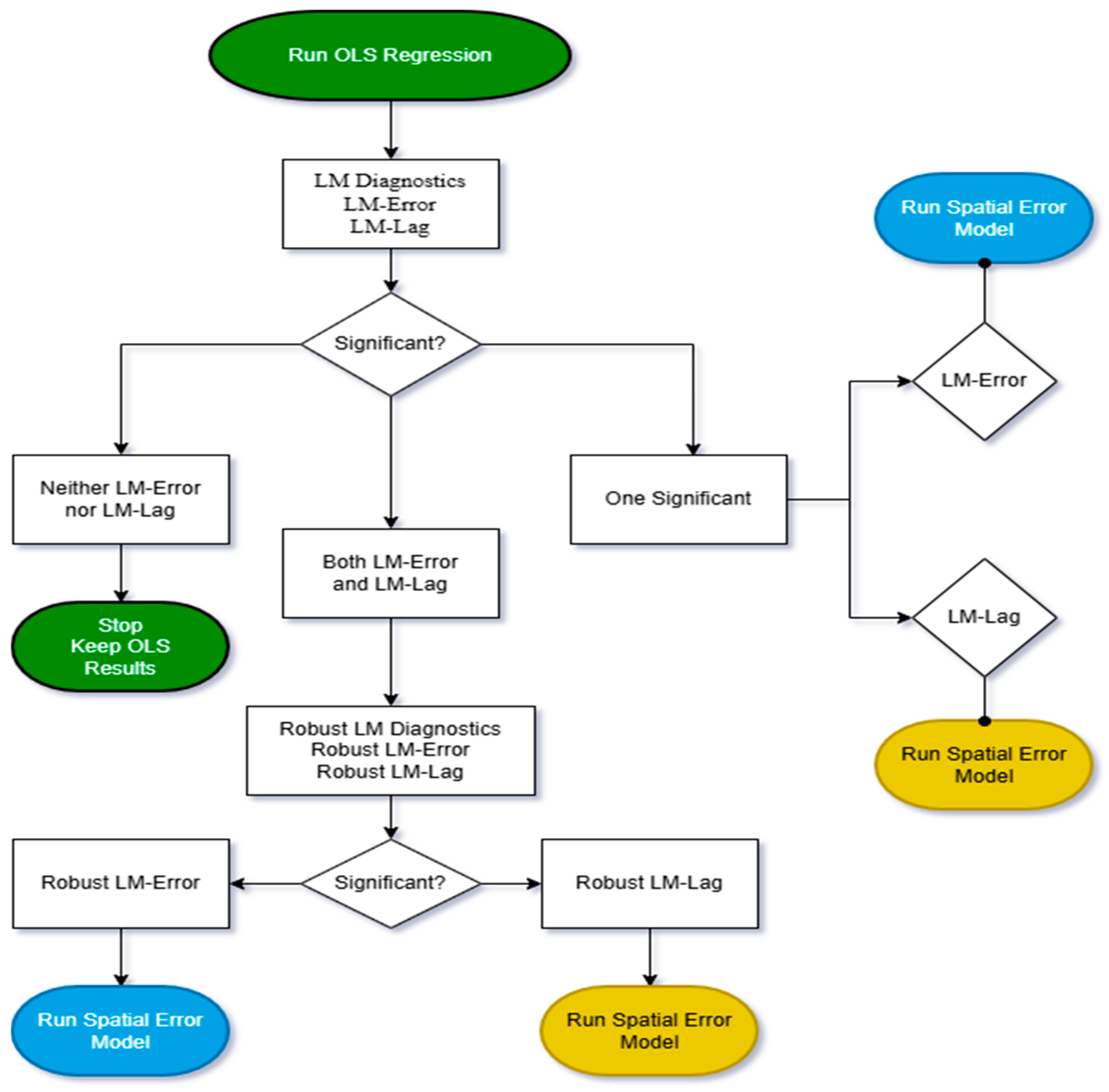
Komeilian & Shabanpour, 2025). This local analysis complements the global spatial models by revealing how inequality patterns vary across space and by identifying districts that play a central role in regional spillover processes. In addition, hot spot and cold spot analysis is conducted to visualize the spatial concentration of economic activity and inequality-related indicators derived from both conventional statistics and remote sensing-based measures. This analysis facilitates the identification of spatial concentrations of high and low economic intensity and provides further insight into the spatial structure of inequality across districts. The stages in estimating the spatial regression model are conducted as illustrated in
Figure 1 below.
Based on
Figure 1, the modeling procedure begins with an OLS regression estimated using all 144 districts (N = 144). Spatial dependence is first assessed using Global Moran’s I on OLS residuals. Subsequently, Lagrange Multiplier (LM) diagnostics (LM-Lag and LM-Error) are implemented to detect potential spatial lag or spatial error dependence. If neither LM test is significant, OLS results are retained. If one LM statistic is significant, the corr sponding spatial model (SAR for LM-Lag or SEM for LM-Error) is estimated. If both LM statistics are significant, robust LM diagnostics (Robust LM-Lag and Robust LM-Error) are applied to determine the appropriate specification.
All diagnostics are conducted using the same spatial weights matrix (queen contiguity, row-standardized) and identical cross-sectional sample (N = 144), ensuring consistency across model selection stages.
4. Results
Table 2 presents descriptive statistics of regional economic inequality and the variables employed at the district/municipality level in Eastern Indonesia. The relative Williamson Index indicates a moderate average level of regional economic inequality, accompanied by substantial variation across regions. This pattern reflects pronounced spatial heterogeneity within the study area. The distribution of the inequality index is asymmetric, suggesting that the proportion of districts/municipalities with inequality levels above the central tendency exceeds that of relatively balanced regions. Such a pattern is consistent with the presence of a core–periphery structure, in which a limited number of economically dominant districts/municipalities coexist with surrounding areas characterized by lower levels of development.
The remaining variables also exhibit high dispersion and non-normal distributional characteristics. Economic development and investment variables display strong right skewness and high kurtosis, indicating that economic activity and investment flows are highly concentrated in a small subset of districts/municipalities, while the majority of regions record relatively low levels. Remote sensing-based indicators further reinforce this spatial heterogeneity: nighttime light intensity and the extent of built-up areas reflect uneven patterns of economic activity and urbanization, whereas geothermal potential exhibits a more spatially balanced distribution, more closely capturing natural resource endowments than centralized economic processes. These findings demonstrate that the dataset effectively captures substantial spatial variation and structural imbalances across districts/municipalities, thereby underscoring the relevance of employing a spatial econometric approach in the subsequent analysis.
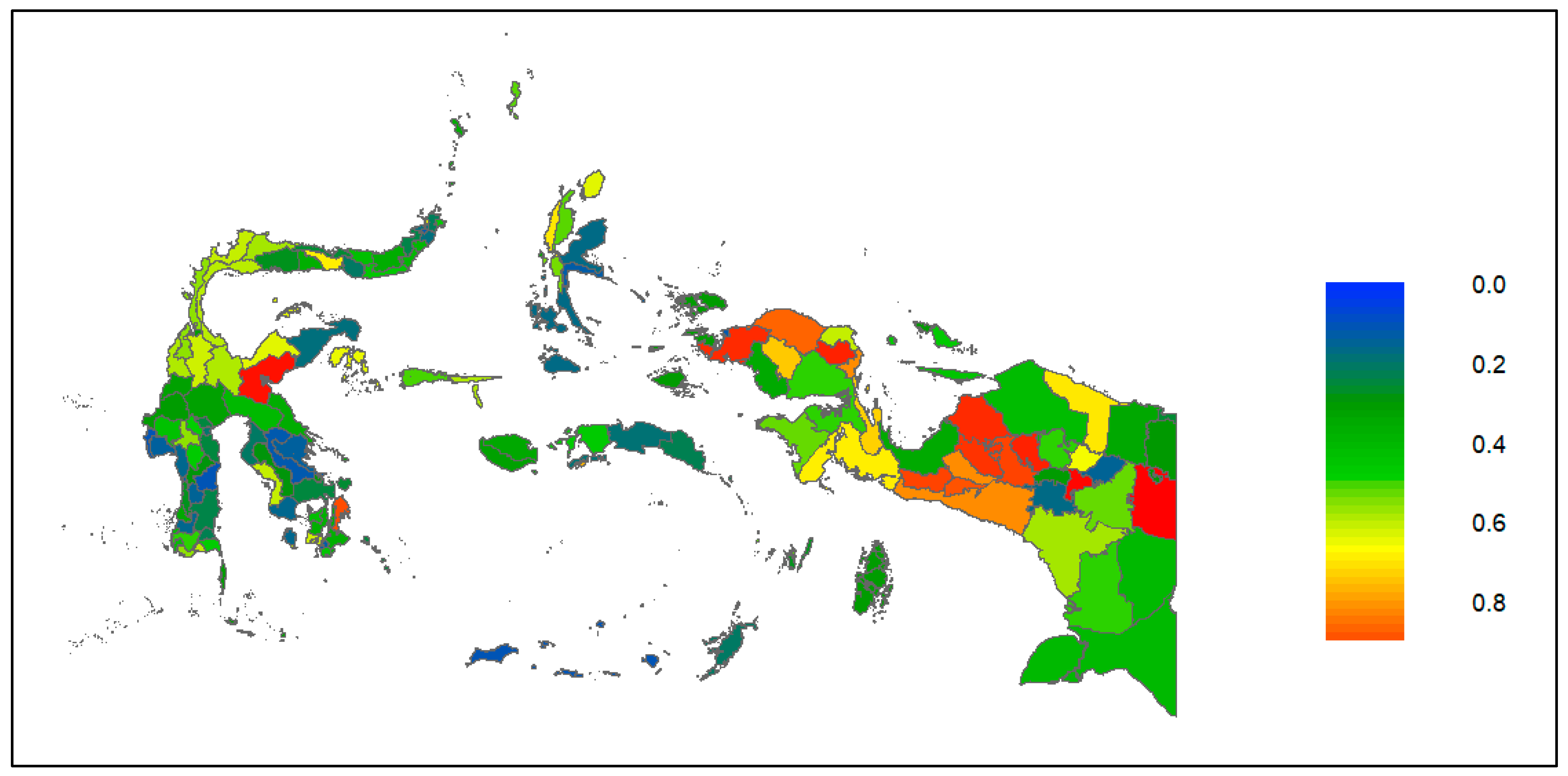
Figure 2 illustrates the spatial distribution of the Williamson Index at the district/municipality level in Eastern Indonesia, revealing substantial variation in economic inequality across regions. Visually, inequality values are not evenly distributed but instead form distinct spatial patterns. Several regions exhibit relatively high levels of inequality, which are generally concentrated in areas with more dominant economic roles, such as urban activity centers, investment-intensive zones, or regions endowed with specific resource advantages. In contrast, other regions display lower levels of inequality, reflecting economic conditions that are relatively closer to their respective provincial averages.
Moreover, the map indicates the presence of spatial clustering, whereby districts/municipalities with similar levels of inequality tend to be geographically proximate. This pattern suggests that economic inequality in a given region does not evolve in isolation but is closely linked to the conditions of neighboring areas. In other words, there is potential spatial interdependence in the formation of economic inequality, whether through the influence of core regions on their surrounding areas or through limited access and connectivity in peripheral regions. These visual findings further underscore the relevance of adopting a spatial approach in subsequent analyses to capture interregional dependence mechanisms in Eastern Indonesia.
The first step of the analysis involves conducting Moran’s I tests to examine the presence of spatial autocorrelation among the variables across Eastern Indonesia. Based on
Table 3, spatial autocorrelation is detected for all variables, with the exception of investment. This finding indicates that the Williamson Index, GRDP, economic activity, urbanization, and energy potential in a given district/municipality in Eastern Indonesia are spatially correlated with the same variables in neighboring districts/municipalities. The Moran’s I statistics exhibit positive spatial correlation, implying that higher values of these variables in one region are associated with higher values in surrounding regions.
Although the Moran’s I statistic for the inequality variable (IW = 0.0033, p = 0.0436) is statistically significant at the 5% level, its magnitude is extremely small. This indicates that while spatial autocorrelation cannot be statistically rejected, the degree of spatial clustering in district-level inequality is substantively weak. In practical terms, inequality levels across neighboring districts exhibit only minimal spatial dependence. The statistical significance may partly reflect the sample size (N = 144), where even very small spatial correlations can become detectable.
Therefore, the result suggests that inequality in Eastern Indonesia does not form strong spatial clusters, but rather displays a relatively dispersed pattern across districts. This finding justifies proceeding with spatial diagnostics, yet it also cautions against overstating the strength of spatial dependence in the dependent variable.
In contrast, geothermal potential (GHEO) exhibits a very high Moran’s I value (0.638, p < 0.001), indicating strong and substantive spatial clustering. This large magnitude reflects the geological structure of Eastern Indonesia, which lies along major tectonic and volcanic belts. Geothermal resources are inherently spatially concentrated due to underlying geological formations rather than economic interactions. Hence, the strong spatial autocorrelation observed for GHEO primarily captures natural endowment clustering instead of spatial economic spillovers. Similarly, NTL (0.234) and NDBI (0.136) show moderate and statistically significant spatial clustering, consistent with the spatial concentration of economic activity and built-up areas.
Overall, these results confirm the presence of spatial dependence in several explanatory variables, while spatial clustering in inequality itself remains weak but statistically detectable.
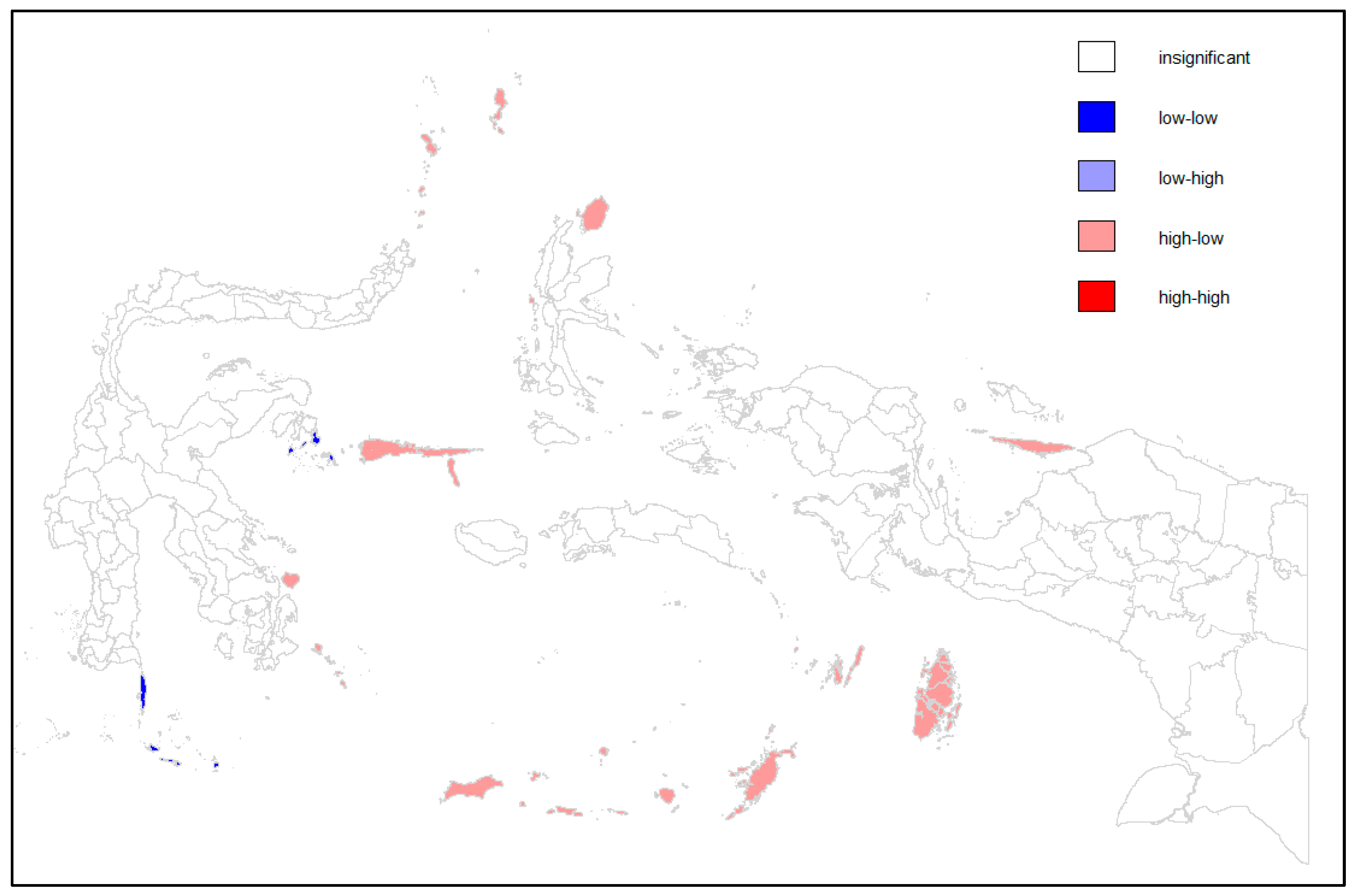
Next, Local Moran’s I is calculated to examine the spatial relationships of the Williamson Index across individual districts/municipalities. Based on the results of the Local Moran’s I statistics and their significance levels, LISA cluster maps are constructed, as presented in
Figure 3 and presents the results of the Local Indicators of Spatial Autocorrelation (LISA) analysis for regional economic inequality across districts in Eastern Indonesia. The LISA cluster map classifies districts into four types of statistically significant local spatial associations—
high–high,
low–low,
high–low, and
low–high—as well as areas where local spatial autocorrelation is not statistically significant. The presence of these clusters indicates that regional economic inequality exhibits localized spatial dependence rather than being randomly distributed across space.
The map reveals that high–high clusters, representing districts with relatively high levels of inequality surrounded by similarly high-inequality neighbors, are spatially concentrated in specific areas. These clusters typically correspond to regions that function as economic cores or possess strong localized advantages, such as concentrated economic activity or resource-based development. In contrast, low–low clusters denote districts with relatively low inequality embedded within similarly low-inequality neighboring districts, reflecting more homogeneous economic conditions across contiguous areas. The spatial separation between these clusters highlights the existence of localized inequality regimes within Eastern Indonesia.
The identification of high–low and low–high clusters indicates the presence of spatial outliers, where a district’s level of inequality differs markedly from that of its surrounding neighbors. Such patterns suggest transitional or boundary zones between core and peripheral areas. A substantial number of districts are classified as statistically insignificant, implying that local spatial dependence is not uniform across the study area. Nevertheless, the existence of significant local clusters provides strong evidence that regional economic inequality in Eastern Indonesia is shaped by localized spatial interactions, thereby reinforcing the relevance of spatial econometric modeling to account for both global and local spatial dependence in subsequent analyses.
Next, Moran’s I tests are conducted to examine whether spatial autocorrelation is present in the residuals of the estimated model. The results of the Lagrange Multiplier (LM) tests are reported in
Table 4. The test results indicate that only the LM Error (SEM) statistic is significant at the
α = 0.05 level. In contrast, the SAR, SDM, and SDEM statistics are not significant, with
p-values exceeding the
α = 0.05 threshold.
These findings provide strong evidence of spatial dependence in the error term of the model. Accordingly, the Spatial Error Model (SEM) is identified as the most appropriate specification for analyzing the Williamson Index. The estimation results obtained using the Spatial Error Model are presented in
Table 5.
Table 5 reports the estimation results of the Spatial Error Model (SEM) for regional economic inequality across districts in Eastern Indonesia. The SEM specification indicates that spatial dependence is present primarily in the error structure, suggesting that unobserved factors influencing regional inequality are spatially correlated across neighboring districts. This implies that regional inequality is not only shaped by observable local characteristics, but also by latent spatial processes such as shared geographic conditions, historical development patterns, or unmeasured institutional factors that extend beyond administrative boundaries.
The results show that economic development, as proxied by real GDPR per capita, is positively associated with regional economic inequality. This pattern suggests that districts with higher levels of economic development tend to exhibit greater deviations from provincial economic benchmarks, reflecting the concentration of economic activity in more advanced locations. In contrast, investment inflows do not display a statistically meaningful association with inequality in this specification, indicating that aggregate investment alone may not systematically translate into more balanced regional economic outcomes across districts.
Among the remote sensing-based indicators, night-time lights intensity exhibits a negative association with regional inequality, suggesting that higher levels of observed economic activity are linked to lower relative inequality at the district level. This pattern may reflect the role of dispersed economic activity in narrowing gaps relative to provincial averages. The coefficient of NTL is negative and statistically significant (−1.308, p < 0.05). NTL is measured using annual average VIIRS night-time light radiance values, which were standardized prior to estimation. Therefore, the coefficient represents the marginal effect of a one-unit increase in standardized night-time luminosity on the district-level relative inequality index. Substantively, the negative sign indicates that districts with higher levels of observed economic luminosity tend to exhibit lower relative inequality vis-à-vis their provincial benchmark. This suggests that greater spatial concentration of economic activity, as proxied by night-time light intensity, may reflect more integrated local economic structures rather than enclave-type growth. In practical terms, a one standard deviation increase in NTL is associated with an approximate 1.31-unit reduction in the relative inequality index, holding other variables constant. This magnitude indicates a non-trivial economic effect, particularly given the scale of the dependent variable. This finding supports the interpretation that economic densification and urban agglomeration effects may reduce intra-provincial disparities in peripheral regions.
Similarly, the built-up area indicator (NDBI) shows a negative relationship with inequality, indicating that more urbanized or spatially developed districts tend to experience more balanced economic conditions relative to their provincial context. By contrast, geothermal potential does not show a statistically significant relationship with inequality, suggesting that the presence of natural energy endowments alone does not automatically translate into spatially balanced economic outcomes.
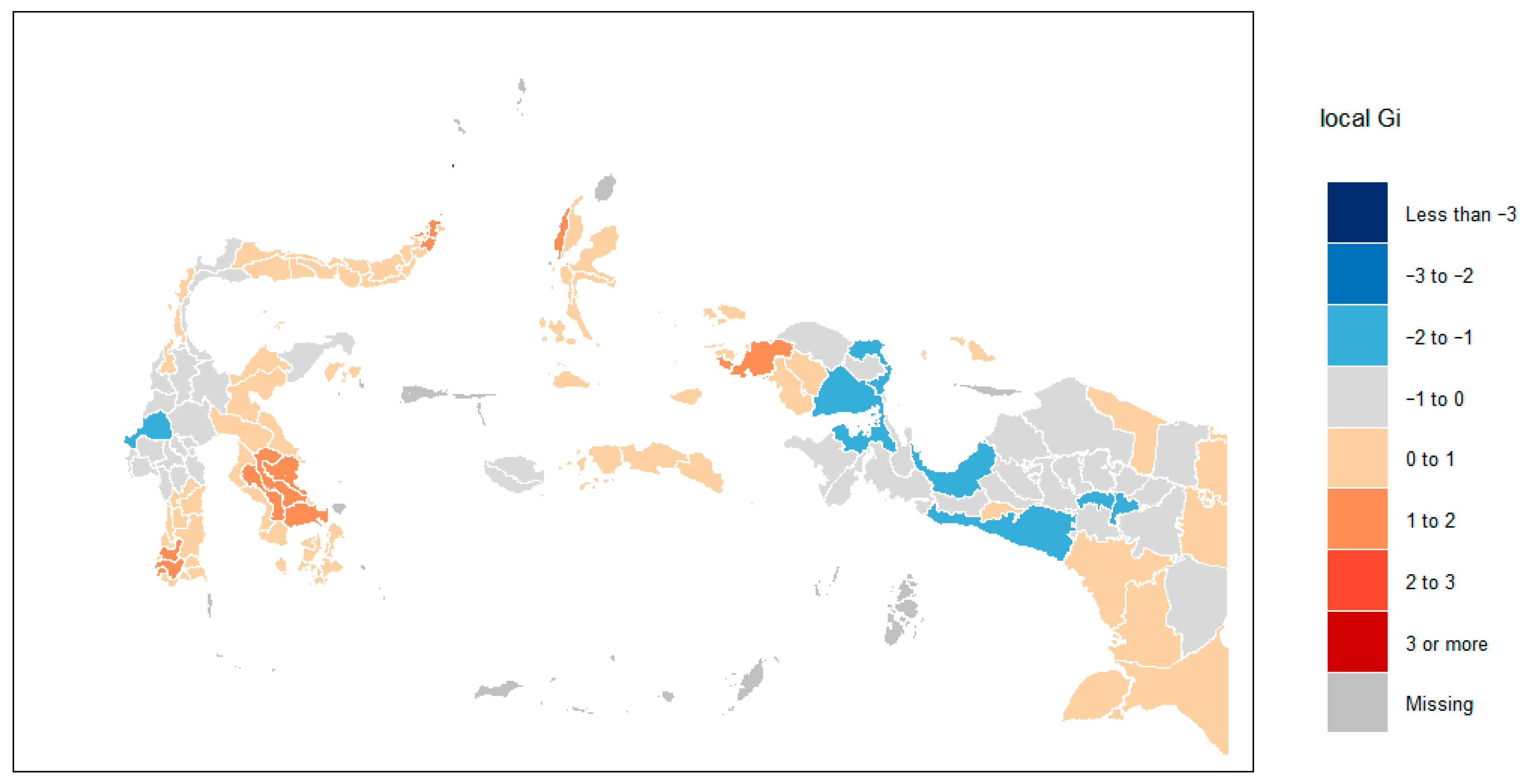
The model demonstrates strong explanatory power and supports the relevance of incorporating spatial error dependence in the analysis of regional economic inequality. The significance of the spatial error structure highlights the importance of accounting for unobserved spatially correlated influences, while the mixed effects of conventional and remote sensing-based variables underscore the multidimensional nature of inequality across districts in Eastern Indonesia. These results provide a coherent empirical foundation for further interpretation within a spatial economic framework. To examine the spatial association between the distribution of the Williamson Index—as a proxy for regional inequality—and economic conditions in Indonesia, particularly economic activity and urbanization, a hot-spot and cold-spot analysis is conducted using the results of Getis and Ord’s G-statistics. Darker shading on the map indicates higher levels of statistical confidence.
The spatial error parameter (λ) is positive and statistically significant, indicating that unobserved spatially correlated factors influence district-level inequality. This confirms the appropriateness of the Spatial Error Model specification and suggests that omitted spatial shocks or regional structural characteristics are correlated across neighboring districts.
Figure 4 presents the results of the hot-spot and cold-spot analysis based on the local Getis–Ord Gi* statistic, illustrating the spatial concentration of high and low values across districts in Eastern Indonesia. Areas classified as hot spots represent districts that are surrounded by neighboring districts with similarly high values, indicating statistically significant spatial clustering of high intensity. Conversely, cold spots denote districts embedded within clusters of low values, reflecting areas where the observed phenomenon is consistently lower than in surrounding regions. Districts categorized as insignificant do not exhibit strong local spatial clustering.
Visually, the map reveals that hot spots and cold spots are not randomly distributed, but instead form distinct geographic patterns across the region. Hot-spot clusters tend to appear in specific sub-regions, suggesting localized concentrations where the underlying variable is persistently elevated relative to neighboring areas. In contrast, cold-spot clusters are concentrated in other parts of Eastern Indonesia, indicating zones where lower values prevail consistently across adjacent districts. The spatial separation between these clusters highlights the existence of geographically differentiated regimes rather than a uniform regional pattern.
The hot-spot and cold-spot analysis provides a clear visualization of local spatial heterogeneity across districts in Eastern Indonesia. By distinguishing statistically significant clusters of high and low values, the map complements the global and local spatial autocorrelation analyses presented earlier. This descriptive evidence underscores that spatial patterns vary markedly across locations, reinforcing the importance of considering localized spatial structures when interpreting regional disparities and conducting further spatial econometric analysis.
5. Discussion
The findings of this study reinforce a central argument in regional economics that interregional economic inequality is fundamentally shaped by spatial processes rather than by isolated local conditions. The observed spatial patterns suggest that inequality emerges through interconnected regional systems, in which development trajectories in one area influence outcomes in surrounding regions. This is consistent with earlier theoretical and empirical work emphasizing that regional disparities are embedded within spatial networks of production, mobility, and exchange, rather than arising solely from internal regional characteristics (
Rey & Janikas, 2005;
Tan et al., 2025).
The presence of geographically concentrated clusters of inequality reflects the persistence of core–periphery dynamics, a key concept in both classical and contemporary theories of regional development. In line with structuralist and cumulative causation perspectives, regions that acquire early advantages tend to reinforce their economic position over time, while adjacent peripheral regions often remain relatively disadvantaged (
Shankar & Shah, 2003;
Kemeny et al., 2025). These spatially differentiated development regimes indicate that inequality is not evenly distributed across space, but instead structured by localized development pathways and historically embedded spatial hierarchies.
The role of economic development in shaping inequality, as observed in this study, is consistent with agglomeration-based explanations of regional divergence. As economic activity becomes increasingly concentrated in specific locations, productivity gains and market access tend to accumulate unevenly, thereby reinforcing spatial disparities. This pattern aligns with recent empirical evidence showing that economic growth does not automatically lead to regional convergence, particularly in developing and peripheral contexts characterized by strong agglomeration forces and limited redistributive mechanisms (
Meekes & Hassink, 2023;
Corradini et al., 2025).
Investment dynamics, however, appear to play a more nuanced role in the spatial configuration of inequality. The absence of a systematic relationship between aggregate investment inflows and regional inequality suggests that investment alone is insufficient to ensure spatially balanced development. This finding corroborates previous studies emphasizing that the developmental impact of investment depends critically on complementary conditions, such as institutional quality, absorptive capacity, and spatial connectivity (
Bolter & Robey, 2022;
Pappa et al., 2025). In the absence of these factors, investment may reinforce existing spatial advantages rather than mitigate disparities.
The integration of remote sensing-based indicators provides important insights into how spatially observable development patterns relate to inequality. The association between a broader spatial dispersion of economic activity and lower relative inequality supports the view that more spatially distributed economic processes may contribute to more balanced regional development outcomes. This finding resonates with recent studies that interpret night-time lights not merely as indicators of growth intensity, but as proxies for the spatial diffusion of economic activity, including informal and small-scale production (
Mellander et al., 2015;
Zhai et al., 2025).
Similarly, the relationship between urbanization patterns and inequality highlights that the spatial form of urban development matters, not merely its scale. More evenly distributed built-up development may facilitate access to markets, services, and employment opportunities across regions, thereby reducing relative disparities. This is consistent with a growing body of the literature emphasizing that urbanization can either mitigate or exacerbate inequality, depending on how urban growth is spatially structured and integrated within broader regional systems (
Goldblatt et al., 2018;
Zhou et al., 2016).
In contrast, natural resource potential does not appear to play a decisive role in shaping regional inequality outcomes on its own. This finding supports a substantial body of the literature arguing that natural endowments are not deterministic drivers of regional development, but rather contingent assets whose economic effects depend on governance structures, institutional arrangements, and levels of spatial integration (
Pei et al., 2021;
Kaczmarek & Blachowski, 2025). From a spatial perspective, resource potential alone does not guarantee more equitable regional development.
This study contributes to the literature by demonstrating the value of integrating remote sensing-based indicators into spatial economic analysis, rather than treating satellite data merely as substitutes for missing statistics. By embedding spatially rich indicators within a regional inequality framework, the analysis directly responds to recent calls to bridge advances in spatial econometrics with emerging data sources (
Griffith et al., 2025;
Gambino et al., 2024). Although the empirical focus is on Eastern Indonesia, the insights are broadly relevant to peripheral regions in developing economies, where fragmented geography, uneven urbanization, and limited spatial integration continue to shape persistent regional inequalities.
6. Conclusions
This study examines spatial spillovers in regional economic inequality by integrating spatial econometric analysis with remote sensing-based indicators. The findings demonstrate that regional economic inequality is not randomly distributed across space, but instead shaped by interconnected spatial processes and localized development patterns. Inequality emerges through spatial structures in which economic conditions, urbanization patterns, and development intensity interact across neighboring regions, highlighting the importance of considering spatial interdependence in regional inequality analysis.
By combining conventional economic indicators with satellite-derived measures of economic activity, urbanization, and energy potential, the study provides a more spatially explicit perspective on inequality formation in peripheral regions. The results underscore that regional inequality reflects not only differences in economic performance, but also the spatial organization of development processes. These insights contribute to the broader regional economics literature by demonstrating how emerging data sources can enhance the understanding of spatial spillovers in regional inequality, particularly in developing and geographically fragmented contexts.
The findings highlight the need for spatially differentiated and place-based development policies. Since regional inequality is shaped by localized spatial interactions rather than uniform national processes, policy interventions should be tailored to regional contexts and spatial configurations. Policies designed without accounting for spatial interdependence risk reinforcing existing core–periphery structures rather than promoting more balanced regional development.
The results suggest that promoting the spatial dispersion of economic activity may contribute to reducing regional inequality. Policies that support the diffusion of economic opportunities—such as improving connectivity between core and peripheral regions, strengthening interregional transport and logistics networks, and facilitating access to markets—can help mitigate spatial concentration effects. Such strategies are particularly relevant in peripheral regions where economic activity remains highly localized.
The role of urbanization patterns implies that the spatial form of urban development matters for inequality outcomes. Policymakers should prioritize integrated urban and regional planning approaches that encourage balanced urban growth across multiple centers rather than excessive concentration in a few dominant cities. Supporting secondary cities and regional growth nodes may enhance spatial inclusiveness and reduce disparities within broader regional systems.
The limited role of natural resource potential in shaping inequality outcomes underscores the importance of institutional and governance frameworks. Resource endowments alone are insufficient to promote equitable regional development. Effective governance, transparent investment frameworks, and coordinated regional planning are essential to ensure that natural resources contribute to inclusive and spatially balanced development rather than reinforcing existing inequalities.
Several limitations should be acknowledged. First, the analysis relies on cross-sectional data, which constrains the ability to capture dynamic changes in regional inequality and spatial spillovers over time. Second, while remote sensing-based indicators provide valuable spatial insights, they may not fully capture qualitative aspects of economic activity or institutional conditions. Finally, the study focuses on district-level interactions, which may overlook multiscalar dynamics operating at national or supranational levels.
Future research could extend this study by employing panel data approaches to examine the temporal evolution of spatial spillovers in regional inequality. Incorporating additional institutional, social, or environmental variables may further enrich the analysis of spatial development processes. Moreover, comparative studies across different developing regions could help assess the generalizability of the findings and deepen understanding of how spatial inequality mechanisms vary across diverse geographic and institutional contexts.