1. Introduction
In recent decades, the Hungarian labour market has undergone a significant transformation, shaped by three mutually reinforcing processes: the regional polarisation of educational inequalities, the rise of automation and the constraints on geographical mobility. In rural areas, in addition to low educational attainment and low rates of higher education, the employment of medium- and low-skilled workers has become more vulnerable due to increasing exposure to mechanisation (
Autor et al., 2003;
PwC, 2018).
At the same time, poor transport infrastructure and long commuting times in rural districts hinder the flexible allocation of labour and contribute to a deterioration in job accessibility. In many municipalities, public works programmes are not used as temporary measures but as a permanent form of employment, resulting in local dependency and structural immobility (
Árendás & Messing, 2022;
Ministry of Employment, 2024).
These factors together contribute to labour market segmentation, which causes not only individual income and skill disadvantages, but also regional disparities (
Rácz & Egyed, 2022;
Goos & Manning, 2007;
Czirfusz et al., 2019). International literature emphasises that labour market polarisation has become a global phenomenon, shaping the development of employment structures in Europe and the United States (
Autor et al., 2008).
The aim of this study is to use empirical data analysis to explore the extent and mechanisms of labour market polarisation in Hungary’s 197 districts. The analysis is based on education statistics (
KSH, 2022), employment and unemployment indicators, and automation risk assessments by
PwC (
2018) and the
OECD (
2024a).
Additionally, although the challenges of labour market polarisation have been well researched for Central and Eastern European countries overall (
Cirillo, 2018;
Lux, 2026;
Nchor & Rozmahel, 2020), together with the effects of skills, technology, and geography, there has been little research focusing simultaneously on district-level (LAU-1) intersections. Therefore, the purpose of the present research is to broaden the focus from the overall country level downwards, in order to highlight the role of constraints in migration and the effects of technological challenges at the regional level in the post-transition context.
2. Literature Review
The concept of labour market polarisation has become a central research topic in labour market structure over the past two decades. In their study,
Autor and Dorn (
2013) examined the effects of technological change on demand, showing that demand for high- and low-skilled jobs has increased, while demand for mid-level, routine jobs has declined. This process can be explained primarily by the rapid spread of information and communication technology and the development of artificial intelligence, which have enabled the mass automation of routine tasks (
Autor et al., 2003;
Fernald, 2014).
Goos and Manning (
2007) also confirmed the pattern of polarisation when examining European labour markets: demand for highly skilled professional and low-skilled basic service jobs increased, while the role of mid-level professions declined. Later research by
Goos et al. (
2014) also highlighted the role of offshoring and globalisation, particularly in Central and Eastern Europe.
Regional differences are also supported by statistical data: Budapest and its surroundings stand out in terms of the proportion of graduates, while the regions of Northern Hungary and Northern Great Plain lag far behind the national average (
KSH, 2022). This phenomenon is further exacerbated by brain drain, which is also significant in Hungary, especially with the emigration of young graduates (
Erdélyi, 2023;
Czirfusz et al., 2019;
Nchor & Rozmahel, 2020;
Szilasi et al., 2025). The shortage of skilled labour in rural areas may cause long-term economic and social decline (
Horeczki & Egyed, 2021;
Bachtler et al., 2019,
Szabó, 2022).
There is a wide range of international literature on the labour market effects of automation (
Acemoglu & Restrepo, 2020;
OECD, 2023). According to
PwC (
2018), rural areas in Hungary are particularly vulnerable to mechanisation, primarily in the manufacturing and agricultural sectors, where routine work processes are being automated rapidly (
Németh et al., 2023;
Maloney & Molina, 2016). This contributes to the decline of jobs requiring medium-level qualifications and reinforces labour market segmentation (
KSH, 2024).
At the same time, digitalisation and Industry 4.0 technologies may open up new opportunities, especially for the SME sector, which is expected to undergo a renewal in terms of competitiveness and sustainability (
IVSZ, 2022;
Magyar Nemzeti Bank, 2023). Geographical mobility constraints and commuting time significantly affect labour market participation.
Árendás and Messing (
2022) illustrated this phenomenon through the mobility difficulties of disadvantaged rural Roma communities, which is also significant at the national level (
KSH, 2023). In underdeveloped regions, inadequate public transport and long commuting times increase immobility, limiting workers’ opportunities (
Balogh, 2009;
Chiquiar & Hanson, 2005).
Public work programmes remain a dominant form of employment in disadvantaged regions. However, numerous studies indicate that, in many cases, these programmes do not promote sustainable labour market integration but rather cause structural immobility (
Molnár et al., 2019;
Lipták, 2023;
Csillag & Varga, 2023).
3. Methodology and Data
3.1. Theoretical Framework and Hypotheses
Based on the literature review, we suggest that the polarisation of the Hungarian labor market results from three reinforcing factors: educational selection, technological bias, and immobility. To empirically test these interrelationships, we propose the following hypotheses:
H1 (Educational Sorting). Regional disparities in employment are primarily driven by the spatial concentration of human capital.
Brain drain and the lack of high-quality jobs in peripheral regions make the “qualification premium”—that is, the gap in employment rates between workers with high and low skills—much larger.
H2 (Automation Risk). Automation does not affect all regions equally.
Accordingly, we hypothesise that lagging districts, which increasingly rely on routine physical labour in manufacturing and agriculture, might be at a higher risk of automation compared to their urban peers, which would further threaten their employment stability.
H3 (The Immobility Trap). Geographical mobility constraints act as a barrier to labour market adjustment.
We would expect a strong negative correlation between commuting opportunities (mobility index) and dependence on public works programmes. This implies that if infrastructure is bad, low-skilled individuals will be stuck in a state of immobility.
3.2. Data Sources and Variables Definitions
The analysis covers all 197 districts of Hungary (LAU-1 level). Data was derived from the Hungarian Central Statistical Office (
KSH, 2022; Census and T-STAR database) and the National Employment Service (NFSZ). To ensure comparability, all indicators were standardized before analysis.
The key variables were constructed as follows:
Dependent Variable: The Employment Rate (employed persons aged 15–64 as a percentage of the working-age population) serves as the primary indicator of labour market performance.
Automation Exposure Index: As data on risks of automation is normally collected at an occupational level (
PwC, 2018;
OECD, 2024b), we aggregate this data to the district level. The mathematical model will compute the weighted average risk of automation in each district according to its occupational structure (i.e., sector/occupation X probability of automation). This will represent the “technological vulnerability” of each district.
Mobility Index: For geographical constraints, we created a Mobility Index composed of three measures: (1) average daily commuting time (in minutes, inverted), (2) density of public transport stops per km2, and (3) motorisation rate (cars per 1000 inhabitants). A higher value represents superior labour mobility.
Skills Mismatch Index: This measure identifies the gap between the amount of available educated human resources (percentage of tertiary graduates) and the jobs available in the local labor market (percentage of high-skilled jobs), according to the Cedefop methodology proposed by the European Centre for the Development of Vocational Training.
3.3. Analytical Strategy
The empirical analysis proceeded in three steps. 1. Descriptive Statistics and Correlation Analysis: Initially, we carried out an analysis of the spatial distribution of the variables and the inter-variable relationships using the correlation coefficient, i.e., Pearson’s r. 2. Cluster Analysis: To examine whether different regional labour market types exist (underpinned by H1 and H2), a hierarchical cluster analysis applying Ward’s method with Squared Euclidean distance was used. All variables were standardized using Z-scores to ensure comparability. The selection of the optimal clusters (k = 3) is based upon the dendrogram and variance ratio. 3. OLS Regression Modeling: In order to quantify the effect of the identified factors on employment gaps, we estimated OLS regression models. We carried out standard tests to validate the results and checked to ensure that the model is not suffering from multicollinearity by evaluating the Variance Inflation Factor (VIF), which must be less than 2.5; this condition has been satisfied. Additionally, we checked the residuals to ensure homoscedasticity.
4. Results
4.1. Qualification Inequalities—Regional Divide and Employment Polarisation
The level of education is closely correlated with employment across all types of regions, but the differences in geographical distribution are striking. In disadvantaged regions, the employment rate for those with only a basic education is only 23%, while for graduates it is 82%. This nearly fourfold difference suggests that a lack of qualifications is a particularly serious disadvantage in lagging regions. In contrast, Budapest has a 44% graduate rate, which is more than three times the 14.7% average in the peripheries. In agglomeration areas, the proportion of graduates is 30.4%, indicating the “suburbanisation of degrees” (
Győri, 2021).
This trend confirms that higher education increases employment opportunities across all types of regions, but the differences in educational attainment are much more dramatic in disadvantaged regions than in the capital or agglomerations.
According to an analysis of employment rates, the qualification premium, i.e., the employment gap between graduates and the low-skilled, is greatest in disadvantaged regions. While there is a difference of 58.2 percentage points here (23.4% vs. 81.6%), in the capital this gap is 49.3 percentage points (41.7% vs. 91.0%).
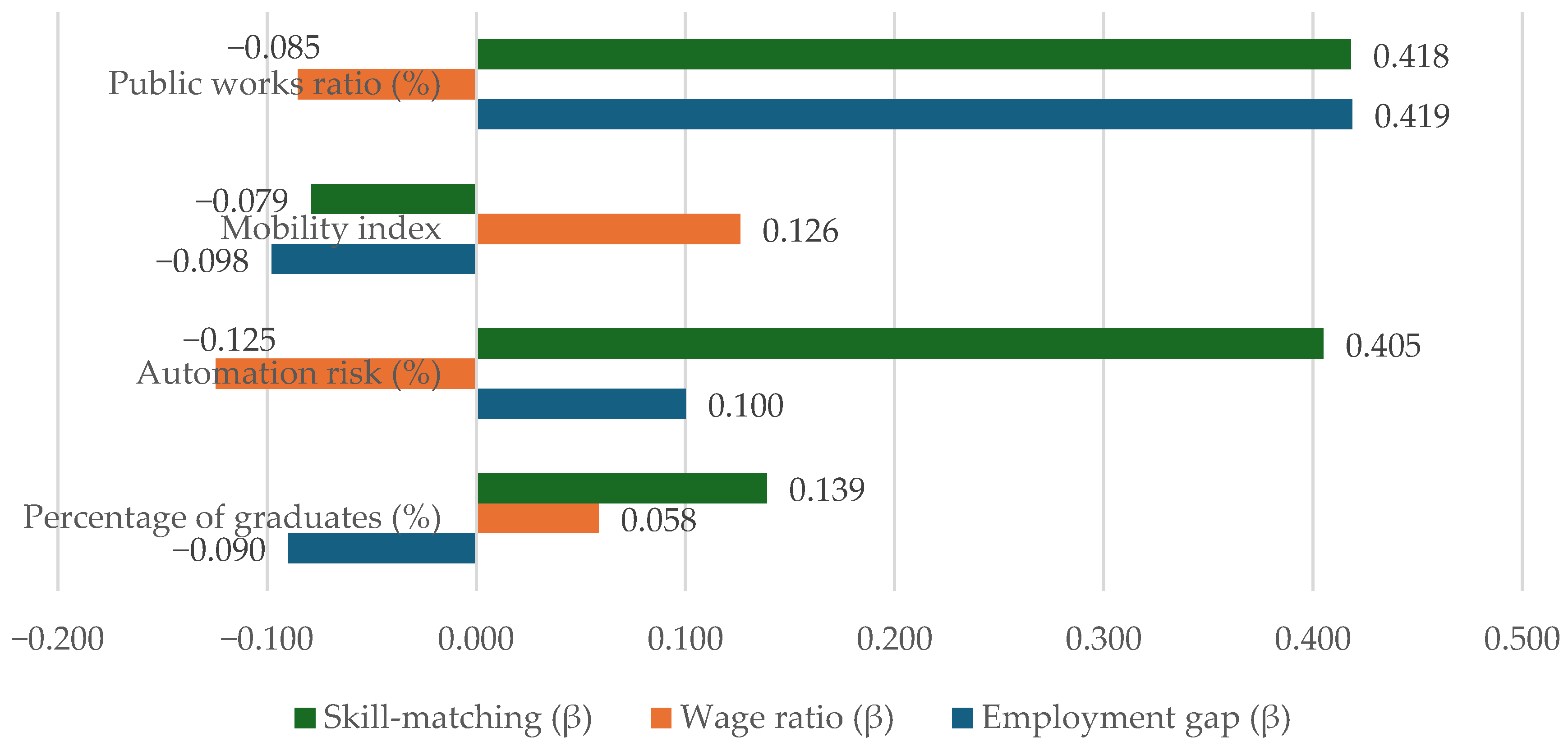
The results of the regression model confirm that 43.7% of the variance in the employment gap (R
2 = 0.437) is explained by the factors analysed. The latter reflects a significant positive relationship, with
β = 0.42 suggesting that the employment gap tends to be wider in districts with high participation in public works schemes. This is consistent with research suggesting that public work represents a structural trap (
Molnár et al., 2019;
Lipták, 2023).
In contrast, the mobility index shows a negative coefficient (
β = −0.10), indicating that better transport conditions are associated with smaller differences in employment rates by educational attainment. This confirms the role of mobility barriers in labour market equality (
Árendás & Messing, 2022).
4.2. Cluster Analysis—Three Labour Market Zones
The cluster analysis identified three distinctly different labour market zones in Hungary.
- (A)
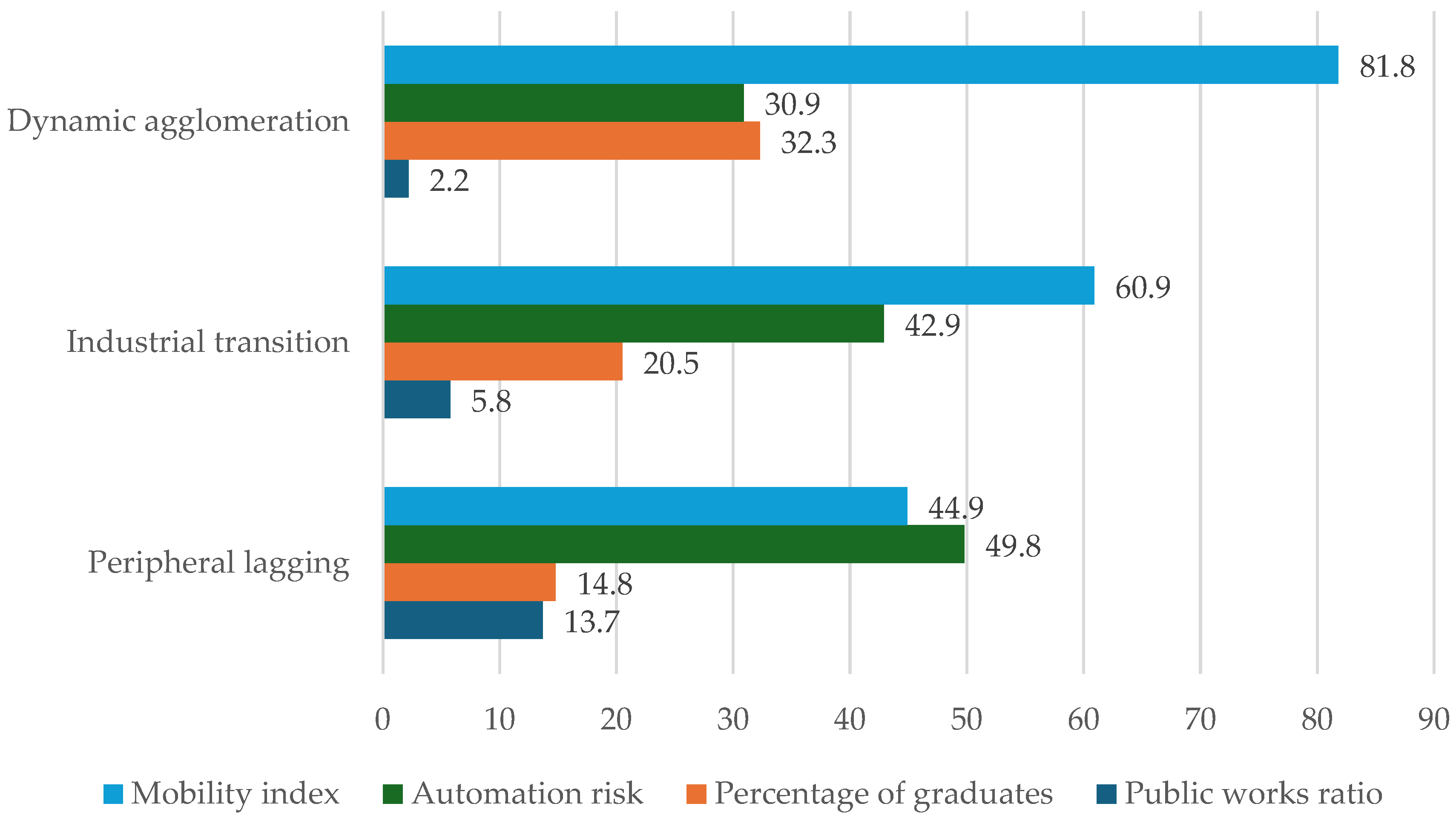
Dynamic agglomeration zone includes Budapest and Pest County, where the proportions of graduates and employed are 32.3% and 68.2%, respectively. The risk of automation is low (30.9%), and the mobility index is high (81.8). The proportion of public works is only 2.2%, which indicates that the open labour market dominates here.
- (B)
Industrial transition zones include Western and Central Transdanubia and the Southern Great Plain. The proportion of graduates is 20.5%, and employment is approximately 65%. Exposure to automation is medium (42.9%), but commuting times are long (71.5 min). The skills-matching index is 1.31, indicating a widening gap between qualifications and employer requirements.
- (C)
Peripheral lagging regions: In the small villages of Northern Hungary, Northern Great Plain and Southern Transdanubia, the proportion of graduates is only 14.8%, while the risk of automation is the highest (49.8%). The average commute time is 98.1 min, and the mobility index is only 44.9. The proportion of public works is 13.7%, which is six times higher than in agglomeration areas. These three zones are shown in
Figure 1.
This three-tier structure clearly highlights the division in the Hungarian labour market: the difference between dynamic, well-educated agglomeration centres and lagging peripheries is reflected not only in employment but also in structural characteristics (
Goos & Manning, 2007;
Autor & Dorn, 2013).
4.3. Automation Risk—Regional Asymmetries and Mobility Constraints
There is a strong negative correlation between exposure to automation and skill levels: low-skilled regions are more vulnerable to the threat of mechanisation. In the capital’s districts, the risk of automation is only 25%, while in lagging regions it is 49.4%.
The regression model examining the relationship between automation risk and the skill-matching index yields an R2 of 0.519, indicating strong explanatory power. Both the risk of automation (β = 0.40) and the proportion of public works (β = 0.42) show significant positive coefficients, suggesting that high automation risk and public work dependency coincide with severe skill-mismatch problems In other words, where automation risk is high and public work is widespread, employment difficulties are more severe.
According to the correlation analysis, labour market variables are strongly correlated with mobility. The results of the correlation analysis are shown in
Table 1.
The results of the correlation analysis clearly show extremely strong correlations between geographical mobility and labour market outcomes. First, a correlation of r = −0.89 was found between the employment rate and the public work rate, which indicates an extremely strong negative relationship. This suggests that where the proportion of participants in public work programmes is high, open labour-market employment is very low, i.e., employment based on public work programmes is characteristic of the most disadvantaged regions in the open labour market.
Secondly, the authors found a correlation of r = +0.86 between the mobility index and the proportion of graduates, which indicates an extremely strong positive relationship. In districts with more favourable commuting conditions (more developed infrastructure, shorter average commuting times), the proportion of people with higher education qualifications is much higher. This suggests that mobility not only helps employees get to work but also makes the region more attractive to skilled labour in the longer term, promoting the concentration of human capital.
Thirdly, there is a correlation of r = −0.83 between commuting time and the employment rate, indicating a strong negative relationship. The longer the average commute time, the lower the open labour market employment rate, as long journeys place a significant burden on employees, reduce their flexibility and decrease their chances of participating in the labour market. This dynamic is particularly evident in peripheral, disadvantaged areas: poor transport infrastructure and long distances create a “stationary workforce”, which, combined with public works programmes, traps people in immobility. As a result, workers are unable to reach areas with labour shortages while facing structural unemployment in their own districts, further reinforcing regional disparities.
This dynamic is particularly strong in peripheral regions, where inadequate transport infrastructure and dependence on public works programmes combine to create an ‘immobility trap’ (
Árendás & Messing, 2022).
4.4. Wage Ratios, Skills Matching and the Mechanism of Polarisation
An analysis of wage ratios shows that although incomes are higher in agglomeration areas, relative wage differences are also greater. The wage ratio between graduates and low-skilled workers is 3.36 times (HUF 830,000 vs. HUF 248,000) in agglomeration areas, 3.15 times in industrial transition zones, and “only” 3.04 times in peripheral areas.
However, it is important to emphasise that the smaller wage gap in the peripheries is not a sign of equality but a consequence of low wages for both groups. The average graduate wage here is 25% lower than in the agglomeration.
The skills-matching index (
Figure 2) also shows large regional differences: 0.77 in the dynamic zone and 2.07 in the peripheral regions, a difference almost three times as large. This indicates that the peripheries of the Budapest agglomeration are experiencing both unemployment and a shortage of skilled workers, i.e., a significant gap between training and market needs.
On the basis of the empirical correlations and clusterings obtained above, we set out three mutually related mechanisms that seem to govern the polarisation of the Hungarian labor market, not independently of one another, but mutually. We thereby establish a kind of spiral effect that permanently reinforces the social and economic contrasts between the developed centers and the periphery.
4.5. Qualification Polarisation and Brain Drain, Automation and Routinisation
Differences in educational and qualification levels determine long-term labour market opportunities. The proportion of graduates is particularly high in Budapest and its agglomeration, while it is much lower in peripheral areas. This difference, in itself, widens the employment and income gap (
Bárány & Siegel, 2018). The situation is further exacerbated by “brain drain”: young, skilled workers are leaving rural areas to seek opportunities in the capital or abroad (
Erdélyi, 2023;
Czirfusz et al., 2019). As a result, disadvantaged regions face not only a lack of jobs but also an increasing exodus of human capital. This leads to a decline in local innovation capacity, a weakening of community institutions and greater difficulty in kick-starting economic development.
Technological advances and automation are increasingly replacing routine jobs that require only a medium level of qualification. This process is known as ‘hollowing out’, in which middle-class workers are gradually pushed out of their stable jobs (
Autor & Dorn, 2013;
Goos & Manning, 2007). The decline in industrial and manufacturing jobs is particularly problematic in rural areas, where most jobs were previously linked to these sectors. Automation does not always immediately create new jobs requiring high qualifications, so workers often find it difficult to adapt to new demands (
Das & Hilgenstock, 2018). In addition, current research points out that the COVID-19 pandemic has hastened the use of technology in the performance of routine roles, and this is likely to increase the vulnerability of the less skilled workforce (
Chernoff & Warman, 2020;
Blit, 2020). This has led to more income inequality, whereby while there is a greater need for the highly skilled workforce, less and medium-skilled workers are being left out. Eventually, the social mobility of the workforce at large is at stake.
4.6. Mobility Trap and Public Work Dependency
Labour market inequalities are also reinforced by constraints on geographical mobility. In disadvantaged regions, inadequate transport infrastructure—such as poor rail and bus services—results in long commuting times, discouraging workers from taking jobs farther away. People living in peripheral areas are therefore often forced to rely on locally available public works programmes. Although public work provides short-term income in certain regions, in the longer term it tends to cause immobility: it perpetuates disadvantage, fails to offer lasting progress towards the open labour market, and fails to develop workers’ skills (
Molnár et al., 2019;
Colombarolli & Gábos, 2024). Therefore, at times, public work is seen as a process of being stuck rather than moving up, while favorable opportunities are out of reach due to poor conditions for moving.
In summary, the three mechanisms—skill polarisation, exposure to automation, and the mobility trap—shape the labour market not separately, but rather in interaction with one another. Their combined effect multiplies the disadvantages: the combination of skilled labour migration, the disappearance of mid-level jobs and transport barriers creates a situation from which disadvantaged regions find it difficult to break out on their own (
Pénzes & Demeter, 2021). Polarisation is therefore not a one-off phenomenon, but a self-reinforcing process which, without appropriate policy intervention, may persist in the long term and seriously undermine Hungary’s economic and social cohesion.
5. Discussion
The results of the study clearly show that the territorial divide in the Hungarian labour market has reached a critical level. There are dramatic differences between the capital and the peripheral areas, not only in the proportion of graduates (44% vs. 14.7%), but also in employment opportunities and incomes. The three mechanisms identified—skill polarisation, exposure to automation and the mobility trap—are not separate processes but form a self-reinforcing spiral that perpetuates the decline of disadvantaged regions.
The role of public works is particularly noteworthy: instead of helping people return to the labour market as a temporary solution, in many districts it deepens the employment gap and exacerbates skills mismatches. In contrast, in districts with better mobility conditions, differences in qualifications are less pronounced, suggesting that improving transport infrastructure can directly reduce labour market inequalities. Policy responses should therefore be based on four pillars.
Education and training reforms. The concentration of graduates in the capital further reinforces regional inequalities. To mitigate this, it is essential to decentralise higher education and vocational training capacities, i.e., to strengthen rural universities and training centres. This can be complemented by ‘brain gain’ programmes that attract graduates who have settled abroad or in the capital back to their home regions, for example, through housing subsidies or targeted job opportunities. Modernising the vocational training system, particularly by strengthening STEM skills and digital competencies, is also key to improving labour market opportunities for young people in rural areas.
Reforming labour market instruments. Public works in their current form do not solve employment problems. Instead, they should be gradually transformed into active labour market tools that offer real progress: personalised retraining, career counselling and job search assistance. The expansion of the dual training system to rural areas is particularly important, as it creates a direct link between local employers and young workers.
Regional development and improving mobility conditions. The analysis has made it clear that transport infrastructure plays a key role in the development of employment disparities. The development of high-speed rail links, regional motorways and rural public transport can directly increase labour mobility. In addition, the expansion of teleworking infrastructure, such as broadband internet, provides opportunities for people living in peripheral areas to join sectors experiencing labour shortages. Local economic development, through SME support and the creation of innovation centres, can also help young people find a realistic alternative to leaving their home regions.
Preparing for automation. Automation is inevitable, but its effects can be mitigated. This requires lifelong learning programmes that equip middle-aged workers with new skills, as well as forecasting systems that signal in good time which professions are at risk. Industry 4.0 adaptation grants can help SMEs to become winners rather than victims of technological change.
5.1. Comparison with Previous Studies
Our findings on the “hollowing out” of the middle-skilled segment are in line with the polarization hypothesis identified for Western Europe (
Goos et al., 2014) but display specific post-socialist features.
While Autor and Dorn (
2013) focus on the growth of the service sector as an absorbent of the workers who have lost their jobs, our findings indicate that this absorbency is limited in rural Hungary. Instead, the workers who have lost their job often enter the public works schemes, which confirms the “lock-in effect” identified by
Lipták (
2023). Finally, strong immobility and unemployment are in line with the findings of
Árendás and Messing (
2022), emphasizing that spatial barriers are as important as skill mismatches in Central Europe.
5.2. Limitations and Future Research Directions
Although with the help of the current research, important insights into the issue of spatial development of labor market polarisation can be attained, there have been certain limitations that must be taken into consideration. Firstly, the study under consideration focuses on the use of cross-sectional data that pertains only to a specific point in time; hence, it becomes easy to establish strong association but it does not allow us to establish causality.
Secondly, while using aggregate district-level data, LAU-1 inherently limits our ability to make inferences about individual worker behaviour, an ecological fallacy. Whereas we could identify regional patterns of immobility, we were not in a position to directly observe individual commuting decisions or migration flows. Future research should aim at integrating micro-level administrative data to better understand the interplay between individual characteristics, such as age, gender, or household structure, and regional constraints.
Third, while we were able to control for crucial structural variables, unobserved spatial heterogeneity still might be a factor. While this study is itself focused on issues other than regional spillovers, further research using spatial econometric models, such as the Spatial Durbin Model, explicitly incorporates spillover effects between neighboring districts. Finally, more research is required to examine the particular contribution that recent interventions by governments-for instance, the extension of the dual vocational training system-have made to combating automation risks in peripheral regions.
6. Conclusions
This paper illustrates how labour market polarisation in Hungary is not simply the result of isolated regional or sectoral imbalances but rather the outcome of a self-reinforcing structural mechanism operating simultaneously through educational inequalities, technological change and mobility constraints. Drawing from the empirical analysis at district level, disparities in educational attainment, exposure to automation and access to labour markets interact in a self-reinforcing way, giving rise to persistent and spatially concentrated disadvantage, especially within rural and peripheral regions.
The data reveals that the overall level of educational attainment continues to be an important factor in determining job market outcomes in different kinds of regions; in addition, the influence in disadvantaged regions is seen to be strongly accentuated. The share of higher-educated persons in the overall population in the Budapest megalopolis is in stark contrast to the overall share of higher-educated persons in peripheral regions. Not only are these regions sensitive to automation threats due to the high dependence on routine jobs in this category of regions, it is also important to note here that these regions are facing job market risks because technology continues to accentuate existing weaknesses.
These processes are further exacerbated by limitations in mobility. Scarce transport infrastructure, long travelling times, and financial costs limit access to employment opportunities outside local labour markets, leaving workers captive in either low-wage employment or public works schemes. The evidence suggests that, far from serving as a stepping stone, public employment frequently becomes a structural element in disadvantaged regions, undermining the incentive and opportunity to develop skills relevant to open labour market participation. The outcome is that skilled labour scarcity coexists with unemployment among the low-skilled in the same region, further entrenching dualism in the labour market.
In combination, these factors create a polarisation trap where disadvantage in education, exposure to automation, and immobility cumulate each other in a vicious cycle over time. This explains why there is inequality in the labor market even though employment rates are quite high at the aggregate level. This is because policy measures have largely failed because they focused solely on one aspect of the challenge. It is clear from the factors mentioned that a further divergence between the capital region and the periphery regions is likely unless something is done about it.
Regarding the implications for policies, it can be said that the results show the importance of having an integrated, place-based approach. The issue of polarisation in the labour market could be countered by simultaneously having policies for the improvement of human capital through education and training reforms and for the mitigation of the challenges posed by automation through reskilling and lifelong learning activities. A crucial dimension of this effort must be the change in labour market policies in Hungary, through programmes like public works programmes, from those that maintain dependency in local areas to those that focus instead on facilitating the transition into the open labour market.
Author Contributions
Conceptualization, Z.A.D. and T.M.; methodology, Z.A.D.; software, Z.A.D.; validation, D.E.K. and T.M.; formal analysis, Z.A.D.; investigation, Z.A.D.; resources, Z.A.D.; data curation, T.M.; writing—original draft preparation, Z.A.D.; writing—review and editing, D.E.K.; visualization, D.E.K.; supervision, D.E.K. All authors have read and agreed to the published version of the manuscript.
Funding
This research received no external funding.
Institutional Review Board Statement
Not applicable.
Informed Consent Statement
Not applicable.
Data Availability Statement
The data that supports the findings of this study are available on request.
Conflicts of Interest
The authors declare no conflicts of interest.
Abbreviations
The following abbreviations are used in this manuscript:
| KSH | Központi Statisztikai Hivatal (Central Statistical Office) |
| OECD | Organisation for Economic Co-operation and Development |
| LAU | Local Administrative Units |
| OLS | Ordinary Least Squares |
References
- Acemoglu, D., & Restrepo, P. (2020). Robots and jobs: Evidence from US labor markets. Journal of Political Economy, 128(6), 2188–2244. [Google Scholar] [CrossRef]
- Autor, D. H., & Dorn, D. (2013). The growth of low-skill service jobs and the polarization of the US labor market. American Economic Review, 103(5), 1553–1597. [Google Scholar] [CrossRef]
- Autor, D. H., Katz, L. F., & Kearney, M. S. (2008). Trends in U.S. wage inequality: Revising the revisionists. Review of Economics and Statistics, 90(2), 300–323. [Google Scholar] [CrossRef]
- Autor, D. H., Levy, F., & Murnane, R. J. (2003). The skill content of recent technological change: An empirical exploration. Quarterly Journal of Economics, 118(4), 1279–1333. [Google Scholar] [CrossRef]
- Árendás, Z., & Messing, V. (2022). ‘I was told the position has already been filled’. Barriers to mobility and coping strategies of highly qualified Roma youth on their way to the business sector in Hungary. Intersections: East European Journal of Society and Politics, 8(2), 41–58. [Google Scholar] [CrossRef]
- Bachtler, J., Mendez, C., & Wishlade, F. (2019). EU cohesion policy and European integration: The dynamics of EU budget and policy. Routledge. [Google Scholar]
- Balogh, K. (2009). Commuting patterns among Hungarian employees. European Foundation for the Improvement of Living and Working Conditions. Available online: https://www.eurofound.europa.eu/en/publications/all/commuting-patterns-among-hungarian-employees (accessed on 10 January 2026).
- Bartik, T. J. (2019). Should place-based jobs policies be used to help distressed communities? In Upjohn institute working paper (pp. 19–308). Upjohn Institute for Employment Research. [Google Scholar] [CrossRef]
- Bartlett, W., & Prica, I. (2013). The deepening crisis in the European super-periphery. Journal of Balkan and Near Eastern Studies, 15(4), 367–382. [Google Scholar] [CrossRef]
- Bárány, Z. L., & Siegel, C. (2018). Job polarization and structural change. American Economic Journal Macroeconomics, 10(1), 57–89. [Google Scholar] [CrossRef]
- Blit, J. (2020). Automation and reallocation: Will COVID-19 usher in the future of work? Canadian Public Policy, University of Toronto Press, 46(2), 192–202. [Google Scholar] [CrossRef]
- Cedefop. (2024). Vocational education and training in Hungary: Short description. Publications Office of the European Union. [Google Scholar]
- Chernoff, A. W., & Warman, C. (2020). COVID-19 and implications for automation (Vol. 27249, pp. 1–28). NBER Working Paper. NBER. [Google Scholar] [CrossRef]
- Chiquiar, D., & Hanson, G. H. (2005). International migration, self-selection, and the distribution of wages: Evidence from Mexico and the United States. Journal of Political Economy, 113(2), 239–281. [Google Scholar] [CrossRef]
- Cirillo, V. (2018). Job polarization in European industries. International Labour Review, 157(1), 39–63. [Google Scholar] [CrossRef]
- Colombarolli, C., & Gábos, A. (2024). Poverty and public works: Evidence from Hungary. International Journal of Social Welfare, 33(5), 1122–1143. [Google Scholar] [CrossRef]
- Csillag, M., & Varga, J. (2023). A foglalkozási mobilitás változása Magyarországon két évtized adatai alapján. Közgazdasági Szemle, 70(12), 1338–1360. [Google Scholar] [CrossRef]
- Czirfusz, M., Ivanics, Z., Kovai, C., & Meszmann, T. (2019). The Hungarian labor force in long decline (A magyarországi munkásság a hosszú lejtmenetben). Fordulat, 26, 142–170. [Google Scholar]
- Das, M., & Hilgenstock, B. (2018). The Exposure to routinization: Labor market implications for developed and developing economies (pp. 1–39). IMF Working Paper WP/18/135. IMF. [Google Scholar]
- Erdélyi, D. (2023). Brain drain vagy brain gain: A magasan képzettek elvándorlása és hazatérése. MTA Közgazdaság- és Regionális Tudományi Kutatóközpont. [Google Scholar]
- Fernald, J. G. (2014). Productivity and potential output before, during, and after the great recession (pp. 1–51). Working paper 20248. National Bureau of Economic Research. [Google Scholar]
- Goos, M., & Manning, A. (2007). Lougsy and lovely jobs: The rising polarization of work in Britain. Review of Economics and Statistics, 89(1), 118–133. [Google Scholar] [CrossRef]
- Goos, M., Manning, A., & Salomons, A. (2014). Explaining job polarization: Routine-biased technological change and offshoring. American Economic Review, 104(8), 2509–2526. [Google Scholar] [CrossRef]
- Grzegorz, G., & Smętkowski, M. (2020). Regional dynamics and structural changes in Central and Eastern European countries. In G. Grzegorz (Ed.), Social and economic development in Central and Eastern Europe (pp. 207–222). Routledge. [Google Scholar]
- Győri, T. (2021). Changes in the territorial distribution of population and job seekers with higher education in Hungary. Studia Mundi—Economica, 8(3), 117–130. [Google Scholar] [CrossRef]
- Hermann, Z., & Kisfalusi, M. (2023). School segregation, student achievement, and educational attainment in Hungary. Corvinus Journal of Sociology and Social Policy, 14(1), 23–56. [Google Scholar] [CrossRef]
- Horeczki, R., & Egyed, I. (2021). Small town development in peripheral areas. DETUROPE—The Central European Journal of Regional Development and Tourism, 13(2), 52–65. [Google Scholar] [CrossRef]
- IVSZ. (2022). Összefogás a digitális Magyarországért: Javaslatok hazánk technológiai fejlődésének felgyorsítása érdekében. Szövetség a Digitális Gazdaságért. [Google Scholar]
- Kazai Ónodi, A., & Holló, S. (2020). A távmunkában rejlő lehetőségek = The potential of teleworking. Köz-gazdaság, 15(2), 130–136. [Google Scholar] [CrossRef]
- Kornai, J. (2006). The great transformation of Central Eastern Europe: Success and disappointment. The Economics of Transition, 14(2), 207–244. [Google Scholar] [CrossRef]
- KSH. (2022). Népszámlálás 2022: Főbb statisztikák/Vegyes adatok. Központi Statisztikai Hivatal. Available online: https://nepszamlalas2022.ksh.hu/ (accessed on 23 December 2025).
- KSH. (2023). Munkaerőpiaci folyamatok, 2023. II. negyedév. Available online: https://www.ksh.hu/s/kiadvanyok/munkaeropiaci-folyamatok-2023-ii-negyedev/index.html (accessed on 12 December 2025).
- KSH. (2024). Foglalkoztatási ráta legmagasabb iskolai végzettség szerint, nemenként. Available online: https://www.ksh.hu/stadat_files/mun/hu/mun0018.html (accessed on 20 January 2026).
- Kumra, S., Simpson, R., & Burke, R. J. (2014). The oxford handbook of gender in organizations. Oxford University Press. [Google Scholar]
- Lengyel, I., & Varga, A. (2018). A magyar gazdasági növekedés térbeli korlátai—Helyzetkép és alapvető dilemmák. Közgazdasági Szemle, 65, 499–524. [Google Scholar] [CrossRef]
- Lipták, K. (2023). The situation of public employment in small villages in Hungary. In Proceedings of the 5th international conference on new trends in management, business and economics (Vol. 1, Issue 1, pp. 36–43). Diamond Scientific Publishing. [Google Scholar] [CrossRef]
- Lux, G. (2026). Supplemental reindustrialisation in Hungary: Transcending the development trap. Regional Science Policy & Practice, 18(1), 100260. [Google Scholar] [CrossRef]
- Magyar Nemzeti Bank. (2023). Versenyképességi jelentés 2023. Magyar Nemzeti Bank. [Google Scholar]
- Maloney, W. F., & Molina, C. (2016). Are automation and trade polarizing developing country labor markets, too? (Vol. 7922, pp. 1–27). World Bank Policy Research Working Paper. World Bank. [Google Scholar]
- Máté, É., Pirisi, G., & Trócsányi, A. (2024). Spatial representations in a marginal and disconnected rural region in Hungary. Applied Geography, 170, 103360. [Google Scholar] [CrossRef]
- Ministry of Employment. (2024). Information on the current status of Public Work Scheme (PWS) in Hungary. Government report. Available online: https://kozfoglalkoztatas.kormany.hu/download/9/3a/51000/Public%20Employment%20in%20Hungary%202014%E2%80%932015.pdf (accessed on 10 February 2026).
- Molnár, G., Bazsalya, B., Bódis, L., & Kálmán, J. (2019). Public works in Hungary: Actors, allocation mechanisms and labour market mobility effects. Socio.hu: Társadalomtudományi Szemle, 7, 117–142. [Google Scholar] [CrossRef]
- Nagy, K. E. (2025). The education of Roma students: Integrated education and teacher preparedness in hungarian-language schools. Education Sciences, 15(4), 454. [Google Scholar] [CrossRef]
- Nchor, P., & Rozmahel, P. (2020). Job polarization in Europe: Evidence from Central and Eastern European countries. DANUBE: Law, Economics and Social Issues Review, 11(1), 52–74. [Google Scholar] [CrossRef]
- Németh, J., Szabó, N., & Sipos, N. (2023). Automation risk and local development in micro-regions: Evidence from Hungary. Research Square, 1–21. [Google Scholar] [CrossRef]
- OECD. (2023). OECD employment outlook 2023: Artificial intelligence and the labour market. OECD Publishing. [Google Scholar] [CrossRef]
- OECD. (2024a). Education at a glance 2024. OECD Publishing. [Google Scholar] [CrossRef]
- OECD. (2024b). Who will be the workers most affected by AI? A closer look at the impact of AI on women, low-skilled workers and other groups (Vol. 26, pp. 1–61). OECD Artificial Intelligence Papers. OECD Publishing. [Google Scholar] [CrossRef]
- Pénzes, J., & Demeter, G. (2021). Peripheral areas and their distinctive characteristics: The case of Hungary. Moravian Geographical Reports, 29(3), 217–230. [Google Scholar] [CrossRef]
- PwC. (2018). How will AI impact the Hungarian labour market? PricewaterhouseCoopers Hungary. [Google Scholar]
- Rácz, S., & Egyed, I. (2022). Territorial disparities and economic processes in Hungary: Editorial. DETUROPE—The Central European Journal of Regional Development and Tourism, 14(3), 4–14. [Google Scholar] [CrossRef]
- Szabó, L. T. (2022). A közfoglalkoztatottak jellemzői. Közgazdasági Szemle, 69(10), 1114–1156. [Google Scholar] [CrossRef]
- Szabó-Morvai, Á., & Pető, R. (2023). Munkaerőpiaci Tükör 2022: Társadalmi egyenlőtlenség és mobilitás. Közgazdaság- és Regionális Tudományi Kutatóközpont. [Google Scholar]
- Szilasi, J., Nguyen Luu, L. A., & Fülöp, M. (2025). Exploring the motivations for migration among Hungarians: Uncovering subjective perspectives on leaving Hungary or staying in Hungary. Psychological Studies, 70, 327–341. [Google Scholar] [CrossRef]
- Velkey, G. (2022). The increasing replication of territorial and social inequalities in public education in Hungary—Causes, components, practices and mechanisms. Social Sciences, 11(3), 95. [Google Scholar] [CrossRef]
| Disclaimer/Publisher’s Note: The statements, opinions and data contained in all publications are solely those of the individual author(s) and contributor(s) and not of MDPI and/or the editor(s). MDPI and/or the editor(s) disclaim responsibility for any injury to people or property resulting from any ideas, methods, instructions or products referred to in the content. |