
Determinants of Preferences for Employment Patriarchy in Turkey

Abstract
1. Introduction
2. Related Literature
3. Data and Methodology
3.1. Data
3.1.1. Dependent Variable
3.1.2. Independent Variables
3.2. Estimation Methodology
4. Empirical Findings
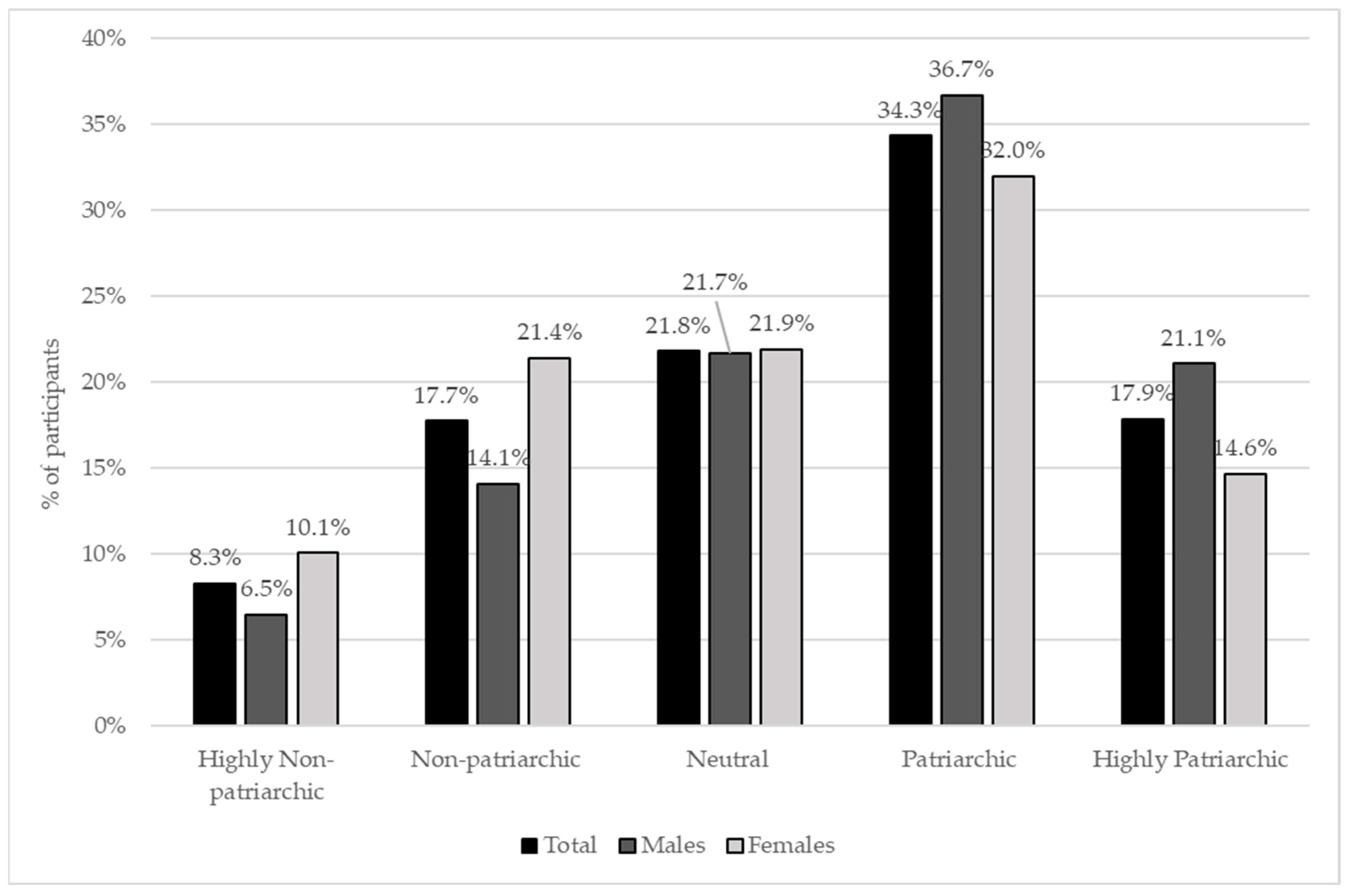
4.1. Descriptive Statistics
4.2. Estimation Results
5. Discussion and Conclusions
Author Contributions
Funding
Institutional Review Board Statement
Informed Consent Statement
Data Availability Statement
Conflicts of Interest
Abbreviations
| MENA | Middle East and North Africa |
| NGO | Non-Governmental Organization |
| OECD | Organization for Economic Co-operation and Development |
| OLS | Ordinary Least Squares |
| UNDP | United Nations Development Program |
| WVS | World Values Survey |
References
- Abouchedid, K. E. (2007). Correlates of religious affiliation, religiosity and gender role attitudes among Lebanese Christian and Muslim college students. Equal Opportunities International, 26(3), 193–208. [Google Scholar] [CrossRef]
- Algan, Y., & Cahuc, P. (2006). Job protection: The macho hypothesis. Oxford Review of Economic Policy, 22(3), 390–410. [Google Scholar] [CrossRef]
- Antecol, H. (2000). An examination of cross-country differences in the gender gap in labor force participation rates. Labour Economics, 7(4), 409–426. [Google Scholar] [CrossRef]
- Atasoy, B. S. (2017). Female labour force participation in Turkey: The role of traditionalism. The European Journal of Development Research, 29(4), 675–706. [Google Scholar] [CrossRef]
- Baslevent, C., & Onaran, O. (2004). The effect of export-oriented growth on female labor market outcomes in Turkey. World Development, 32(8), 1375–1393. [Google Scholar] [CrossRef]
- Boratav, H. B., Fisek, G. O., & Ziya, H. E. (2014). Unpacking masculinities in the context of social change: Internal complexities of the identities of married men in Turkey. Men and Masculinities, 17(3), 299–324. [Google Scholar] [CrossRef]
- Caner, A., Guven, C., Okten, C., & Sakalli, S. O. (2016). Gender roles and the education gender gap in Turkey. Social Indicators Research, 129, 1231–1254. [Google Scholar] [CrossRef]
- Davis, L. S., & Williamson, C. R. (2019). Does individualism promote gender equality? World Development, 123, 104627. [Google Scholar] [CrossRef]
- Davis, S. N., & Greenstein, T. N. (2009). Gender ideology: Components, predictors, and consequences. Annual Review of Sociology, 35, 87–105. [Google Scholar] [CrossRef]
- Di, D. (2020). Are religious women more traditionalist? A cross-national examination of gender and religion. Journal for the Scientific Study of Religion, 59(4), 606–628. [Google Scholar] [CrossRef]
- Dildar, Y. (2015). Patriarchal norms, religion, and female labor supply: Evidence from Turkey. World Development, 76, 40–61. [Google Scholar] [CrossRef]
- Dutta, N., Giddings, L., & Sobel, R. S. (2022). Does trust always help gender role attitudes? The role of individualism and collectivism. Social Indicators Research, 159(1), 379–408. [Google Scholar] [CrossRef]
- Engin, C., & Pals, H. (2018). Patriarchal attitudes in Turkey 1990–2011: The influence of religion and political conservatism. Social Politics: International Studies in Gender, State & Society, 25(3), 383–409. [Google Scholar] [CrossRef]
- Erosa, A., Fuster, L., Kambourov, G., & Rogerson, R. (2022). Hours, occupations, and gender differences in labor market outcomes. American Economic Journal: Macroeconomics, 14(3), 543–590. [Google Scholar] [CrossRef]
- Fortin, N. M. (2005). Gender role attitudes and the labour-market outcomes of women across OECD countries. Oxford Review of Economic Policy, 21(3), 416–438. [Google Scholar] [CrossRef]
- Gevrek, Z. E., & Gevrek, D. (2022). Social norms and the gender gap in labor force participation: Evidence from Turkey. Applied Economics Letters, 30, 2102–2107. [Google Scholar] [CrossRef]
- Glas, S., Spierings, N., & Scheepers, P. (2018). Re-understanding religion and support for gender equality in Arab countries. Gender & Society, 32(5), 686–712. [Google Scholar] [CrossRef]
- Goksel, İ. (2013). Female labor force participation in Turkey: The role of conservatism. Women’s Studies International Forum, 41, 45–54. [Google Scholar] [CrossRef]
- Gunduz-Hosgor, A., & Smits, J. (2008). Variation in labor market participation of married women in Turkey. Women’s Studies International Forum, 31(2), 104–117. [Google Scholar] [CrossRef]
- Ilkkaracan, I. (2012). Why so few women in the labor market in Turkey? Feminist Economics, 18(1), 1–37. [Google Scholar] [CrossRef]
- Kiser, A. I. (2015). Workplace and leadership perceptions between men and women. Gender in Management: An International Journal, 30(8), 598–612. [Google Scholar] [CrossRef]
- Moghadam, V. M. (2003). Modernizing women: Gender and social change in the middle East. Lynne Rienner Publishers. [Google Scholar]
- Moghadam, V. M. (2020). Gender regimes in the middle east and north Africa: The power of feminist movements. Social Politics: International Studies in Gender, State & Society, 27(3), 467–485. [Google Scholar] [CrossRef]
- Muftuler-Bac, M. (2012). Gender equality in Turkey [European Parliament in-depth analysis]. European Parliament. Available online: https://www.europarl.europa.eu/document/activities/cont/201202/20120207ATT37506/20120207ATT37506EN.pdf (accessed on 15 March 2022).
- OECD. (2025). Employment and unemployment by five-year age group and sex—Indicators. Available online: https://stats.oecd.org/Index.aspx?DataSetCode=lfs_sexage_i_r (accessed on 18 December 2025).
- Ones, U., Memis, E., & Kizilirmak, B. (2013). Poverty and intra-household distribution of work time in Turkey: Analysis and some policy implications. Women’s Studies International Forum, 41, 55–64. [Google Scholar] [CrossRef]
- Ozdemir-Sarigil, B., & Sarigil, Z. (2021). Who is patriarchal? The correlates of patriarchy in Turkey. South European Society and Politics, 26(1), 27–53. [Google Scholar] [CrossRef]
- Peng, S., & Feng, X. (2025). The impact of digital literacy on rural women’s non-agricultural employment—Evidence from China. Economies, 13(11), 309. [Google Scholar] [CrossRef]
- Price, A. (2015). How national structures shape attitudes toward women’s right to employment in the middle East. International Journal of Comparative Sociology, 56(6), 408–432. [Google Scholar] [CrossRef]
- Roche, M. (2024). Gender attitudes and trends in MENA: The effects of working women. Arab Barometer. Available online: https://www.arabbarometer.org/wp-content/uploads/AB8-Gender-Report-EN.pdf (accessed on 18 December 2025).
- Sanli, S. (2016). Women and cultural citizenship in Turkey. I.B. Tauris & Co. Ltd. [Google Scholar]
- Savas, G., & Cakir, D. (2024). Breaking the chains: Exploring gender inequality in Türkiye through the eyes of women NGO members. Frontiers in Sociology, 9, 1491058. [Google Scholar] [CrossRef]
- Shurchkov, O., & Eckel, C. C. (2018). Gender differences in behavioral traits and labor market outcomes. In S. L. Averett, L. M. Argys, & S. D. Hoffman (Eds.), The Oxford handbook of women and the economy (pp. 480–512). Oxford University Press. [Google Scholar]
- StataCorp. (2021). Stata statistical software: Release 17. StataCorp. LLC. [Google Scholar]
- Teignier, M., & Cuberes, D. (2024). How important are labor-market gender gaps in the South Caucasus? Economies, 12(12), 332. [Google Scholar] [CrossRef]
- The World Bank. (2018). Turkey country gender assessment 2017. Available online: http://hdl.handle.net/10986/35974 (accessed on 15 March 2022).
- The World Bank. (2025). World development indicators 2025. Available online: https://databank.worldbank.org/source/world-development-indicators (accessed on 18 December 2025).
- UNDP. (2025). Human development reports: Gender Inequality Index (GII). Available online: https://hdr.undp.org/data-center/thematic-composite-indices/gender-inequality-index#/indicies/GII (accessed on 18 December 2025).
- Wooldridge, J. M. (2002). Econometric analysis of cross section and panel data. MIT Press. [Google Scholar]


| Variable | Description |
|---|---|
| Preferences for Employment Patriarchy | It is calculated based on the individual’s level of agreement with the following statement (Q33 in WVS Wave 7): “When jobs are scarce men should have more right to a job than women.” 1 = Disagree strongly; 2 = Disagree; 3 = Neither agree nor disagree; 4 = Agree; 5 = Agree strongly. (1 = Highly Non-patriarchal; 2 = Non-patriarchal; 3 = Neutral; 4 = Patriarchal; 5 = Highly Patriarchal). |
| Political Patriarchy | It is derived from the agreement level of the individual with the following statement (Q29 in WVS Wave 7): “On the whole, men make better political leaders than women do.” 1 = Disagree strongly; 2 = Disagree; 3 = Agree; 4 = Agree strongly. |
| Education Patriarchy | It is derived from the agreement level of the individual with the following statement (Q30 in WVS Wave 7): “A university education is more important for a boy than for a girl.” 1 = Disagree strongly; 2 = Disagree; 3 = Agree; 4 = Agree strongly. |
| Management Patriarchy | It is derived from the agreement level of the individual with the following statement (Q31 in WVS Wave 7): “On the whole, men make better business executives than women do.” 1 = Disagree strongly; 2 = Disagree; 3 = Agree; 4 = Agree strongly. |
| Household Patriarchy | It is derived from the agreement level of the individual with the following statement (Q32 in WVS Wave 7): “Being a housewife is just as fulfilling as working for pay.” 1 = Disagree strongly; 2 = Disagree; 3 = Agree; 4 = Agree strongly. |
| Religious Person | 1 = A religious person 0 = Not a religious person or an atheist; (Q173 in WVS Wave 7). |
| Right-Wing Political View | It ranges from 1 = The far left to 10 = The far right (Q240 in WVS Wave 7). |
| Female | 1 = Female; 0 = Male (Q260 in WVS Wave 7). |
| Age | Reported age by adult respondents (Q262 in WVS Wave 7). |
| Education Level | 0 = No diploma; 1 = Primary education; 2 = Secondary education; 3 = Bachelor’s degree or higher (Q275 in WVS Wave 7). |
| Marital Status | 1 = Married/Living together as married; 2 = Single; 3 = Divorced/Separated/Widowed (Q273 in WVS Wave 7). |
| Employment Status | 1 = Employed; 2 = Unemployed; 3 = Housewife; 4 = Student; 5 = Retired/Pensioned/Other (Q279 in WVS Wave 7). |
| Household Income Level | Reported household income group of respondents. It ranges from 1 = The lowest income group to 10 = The highest income group (Q288 in WVS Wave 7). |
| Number of Children | Reported number of children living in the household (Q274 in WVS Wave 7). |
| Urban Household | 1 = The respondent lives in an urban region (city or town); 0 = The respondent lives in a rural region (village) (H1 in WVS Wave 7). |
| Variable | N | Mean or % | Standard Deviation | Min | Max |
|---|---|---|---|---|---|
| Preferences for Employment Patriarchy | 2368 | 3.35 | 1.19 | 1 | 5 |
| Political Patriarchy | 2336 | 2.56 | 0.86 | 1 | 4 |
| Education Patriarchy | 2365 | 2.12 | 0.89 | 1 | 4 |
| Management Patriarchy | 2307 | 2.47 | 0.85 | 1 | 4 |
| Household Patriarchy | 2319 | 2.75 | 0.83 | 1 | 4 |
| Religious Person | 2208 | 0.72 | 0.44 | 0 | 1 |
| Right-Wing Political View | 2151 | 6.29 | 2.57 | 1 | 10 |
| Female | 2415 | 0.50 | 0.50 | 0 | 1 |
| Age | 2414 | 38.83 | 12.67 | 18 | 95 |
| Education Level | 2406 | 1.57 | 0.90 | 0 | 3 |
| No diploma | 277 | 11.51% | - | - | - |
| Primary education | 876 | 36.41% | - | - | - |
| Secondary education | 841 | 34.95% | - | - | - |
| Bachelor’s degree or higher | 412 | 17.12% | - | - | - |
| Marital Status | - | - | - | - | - |
| Married/Living together as married | 1503 | 62.31% | - | - | - |
| Single | 783 | 32.46% | - | - | - |
| Divorced/Separated/Widowed | 126 | 5.22% | - | - | - |
| Employment Status | - | - | - | - | - |
| Employed | 1349 | 56.18% | - | - | - |
| Unemployed | 161 | 6.71% | - | - | - |
| Housewife | 612 | 25.49% | - | - | - |
| Student | 114 | 4.75% | - | - | - |
| Retired/Pensioned/Other | 165 | 6.87% | - | - | - |
| Household Income Level | 2329 | 5.34 | 1.72 | 1 | 10 |
| Number of Children | 2415 | 1.37 | 1.47 | 0 | 9 |
| Urban Household | 2415 | 0.73 | 0.44 | 0 | 1 |
| Ordered Probit Regression | OLS Regression | |||
|---|---|---|---|---|
| Coefficients | Standard Errors | Coefficients | Standard Errors | |
| Political Patriarchy | 0.238 *** | (0.0444) | 0.212 *** | (0.0388) |
| Education Patriarchy | 0.222 *** | (0.0378) | 0.213 *** | (0.0322) |
| Management Patriarchy | 0.327 *** | (0.0490) | 0.278 *** | (0.0432) |
| Household Patriarchy | 0.282 *** | (0.0391) | 0.241 *** | (0.0343) |
| Religious Person | 0.283 *** | (0.0582) | 0.269 *** | (0.0528) |
| Right-Wing Political View | 0.0325 *** | (0.0119) | 0.0267 *** | (0.0102) |
| Female | −0.154 ** | (0.0639) | −0.155 *** | (0.0585) |
| Age | −0.00092 | (0.0028) | −0.0010 | (0.0025) |
| Education Level | ||||
| No diploma | 0.0582 | (0.0998) | 0.0463 | (0.0881) |
| Primary education | 0.0623 | (0.0629) | 0.0527 | (0.0558) |
| (Base) Secondary education | - | - | - | - |
| Bachelor’s degree or higher | 0.0249 | (0.0729) | 0.00787 | (0.0663) |
| Marital Status | ||||
| Married/Living together as married | 0.00042 | (0.0779) | 0.0185 | (0.0700) |
| (Base) Single | - | - | - | - |
| Divorced/Separated/Widowed | −0.343 ** | (0.141) | −0.313 ** | (0.126) |
| Employment Status | ||||
| Employed | 0.0347 | (0.105) | 0.0476 | (0.0933) |
| (Base) Unemployed | - | - | - | - |
| Housewife | 0.130 | (0.122) | 0.149 | (0.109) |
| Student | −0.043 | (0.173) | −0.0594 | (0.156) |
| Retired/Pensioned/Other | −0.064 | (0.146) | −0.0554 | (0.128) |
| Household Income Level | −0.0979 *** | (0.0161) | −0.0861 *** | (0.0143) |
| Number of Children | 0.0599 ** | (0.0264) | 0.0432 * | (0.0229) |
| Urban Household | 0.224 *** | (0.0571) | 0.205 *** | (0.0509) |
| Wald: χ2 (20)/F (20, 1806) | 682.65 *** | 68.53 *** | ||
| Pseudo R2/R2 | 0.155 | 0.377 | ||
| Observations | 1827 | 1827 | ||
| Variables | Highly Non-Patriarchal | Non-Patriarchal | Neutral | Patriarchal | Highly Patriarchal |
|---|---|---|---|---|---|
| Political Patriarchy | −0.0289 *** | −0.0294 *** | −0.0139 *** | 0.0240 *** | 0.0483 *** |
| Education Patriarchy | −0.0270 *** | −0.0275 *** | −0.0130 *** | 0.0225 *** | 0.0452 *** |
| Management Patriarchy | −0.0398 *** | −0.0405 *** | −0.0192 *** | 0.0331 *** | 0.0665 *** |
| Household Patriarchy | −0.0344 *** | −0.0350 *** | −0.0166 *** | 0.0286 *** | 0.0575 *** |
| Religious Person | −0.0345 *** | −0.0351 *** | −0.0166 *** | 0.0286 *** | 0.0576 *** |
| Right-Wing Political View | −0.0039 *** | −0.0040 *** | −0.0019 *** | 0.0032 *** | 0.0066 *** |
| Female | 0.0187 ** | 0.0190 ** | 0.0090 ** | −0.0156 ** | −0.0313 ** |
| Age | 0.0001 | 0.0001 | 0.0001 | −0.0001 | −0.0001 |
| Education Level | |||||
| No diploma | −0.0071 | −0.0072 | −0.0034 | 0.0059 | 0.0117 |
| Primary education | −0.0075 | −0.0077 | −0.0036 | 0.0063 | 0.0126 |
| (Base) Secondary education | - | - | - | - | - |
| Bachelor’s degree or higher | −0.0030 | −0.0031 | −0.0014 | 0.0026 | 0.0049 |
| Marital Status | |||||
| Married/Living together as married | −0.0001 | −0.0001 | −0.00002 | 0.00004 | 0.00008 |
| (Base) Single | - | - | - | - | - |
| Divorced/Separated/Widowed | 0.0484 ** | 0.0420 ** | 0.0143 *** | −0.0429 ** | −0.0619 *** |
| Employment Status | |||||
| Employed | −0.0043 | −0.0043 | −0.0019 | 0.0036 | 0.0068 |
| (Base) Unemployed | - | - | - | - | - |
| Housewife | −0.0155 | −0.0162 | −0.0078 | 0.0128 | 0.0268 |
| Student | 0.0056 | 0.0053 | 0.0022 | −0.0048 | −0.0083 |
| Retired/Pensioned/Other | 0.0084 | 0.0079 | 0.0032 | −0.0073 | −0.0123 |
| Household Income Level | 0.0119 *** | 0.0121 *** | 0.0057 *** | −0.0099 *** | −0.0199 *** |
| Number of Children | −0.0073 ** | −0.0074 ** | −0.0035 ** | 0.0060 ** | 0.0121 ** |
| Urban Household | −0.0273 *** | −0.0277 *** | −0.0131 *** | 0.0226 *** | 0.0455 *** |
Disclaimer/Publisher’s Note: The statements, opinions and data contained in all publications are solely those of the individual author(s) and contributor(s) and not of MDPI and/or the editor(s). MDPI and/or the editor(s) disclaim responsibility for any injury to people or property resulting from any ideas, methods, instructions or products referred to in the content. |
© 2026 by the authors. Licensee MDPI, Basel, Switzerland. This article is an open access article distributed under the terms and conditions of the Creative Commons Attribution (CC BY) license.
Share and Cite
Kose, T.; Erdinc, D.K. Determinants of Preferences for Employment Patriarchy in Turkey. Economies 2026, 14, 51. https://doi.org/10.3390/economies14020051
Kose T, Erdinc DK. Determinants of Preferences for Employment Patriarchy in Turkey. Economies. 2026; 14(2):51. https://doi.org/10.3390/economies14020051
Chicago/Turabian StyleKose, Tekin, and Dogan Kaan Erdinc. 2026. "Determinants of Preferences for Employment Patriarchy in Turkey" Economies 14, no. 2: 51. https://doi.org/10.3390/economies14020051
APA StyleKose, T., & Erdinc, D. K. (2026). Determinants of Preferences for Employment Patriarchy in Turkey. Economies, 14(2), 51. https://doi.org/10.3390/economies14020051