


Abstract
This study analyzes the determinants of gross saving in Jordan over the period 1991–2023, with particular attention paid to the role of macroeconomic and demographic factors in shaping saving behavior. The empirical analysis employs the Autoregressive Distributed Lag (ARDL) bounds testing approach to examine both short-run and long-run relationships between gross saving, the age dependency ratio, real per capita GDP growth, real interest rates, and unemployment. The results indicate rapid short-run adjustment dynamics in saving behavior and a stable long-run association between saving and its key determinants. In contrast to standard theoretical predictions, a higher dependency ratio is found to increase gross saving. This outcome appears to reflect Jordan’s socio-demographic context, precautionary saving motives, family-based support mechanisms, limited social security coverage, and the role of remittances. Income growth has a positive effect on saving, while unemployment exerts a negative effect. The real interest rate exhibits limited and transitory short-run effects, while remaining insignificant in the long-run. From a policy perspective, the findings underscore the importance of job creation, sustained income growth, and the development of broader saving instruments.
1. Introduction
Shifting Jordan’s economy from its historically low saving rate to a sustained high level represents one of the most critical challenges for Jordanian policymakers. Achieving this transition is essential for Jordan’s future economy to reduce its dependence on external financing, while mobilizing sufficient savings to fund sustainable economic growth and development. Like many developing economies, Jordan’s economy is marked by strong overall consumption, which limits the ability to save domestically (International Monetary Fund [IMF], 2024). This ongoing issue has led to a heavy dependence on external financing, including foreign aid and increasing debt in foreign currencies. Such reliance raises concerns about the economy’s resilience, especially during periods of global uncertainty and tightening financial conditions (International Monetary Fund [IMF], 2025a, 2025b).
Over the past years, Jordan’s macroeconomic performance has been characterized by modest growth, high unemployment, and rising public debt in foreign currencies. The limited capacity of the Jordanian economy to mobilize savings constrains the financing needs of investment and, in turn, weakens its ability to generate sufficient employment opportunities. For a small, open economy like Jordan, marked by limited natural resources and high exposure to external shocks, enhancing savings is a structural prerequisite for achieving sustainable growth and fostering a more self-reliant economy. Jordan’s demographic pressures, coupled with persistently high unemployment, especially among educated youth and women, highlight the urgency of understanding the key determinants of saving. Examining how these forces converge will yield valuable insights for policymakers seeking to design evidence-based strategies that strengthen resource mobilization and promote sustainable economic growth.
Against this background, this research adds to the literature by examining the determinants of gross saving in Jordan, a comprehensive and policy-relevant macroeconomic indicator that reflects the economy’s capacity to mobilize financial resources for investment-led growth. Unlike earlier studies that focus on private saving (Hallaq, 2003) or treat saving as a driver of growth or investment, or current account balance (Basha, 2023; Alzghoul et al., 2023; Arabyat et al., 2023), this study models gross saving as the dependent variable, allowing a direct assessment of how demographic structure, labor market conditions, and income dynamics shape saving behavior. Moreover, the analysis spans 1991–2023, capturing major domestic transitions and global shocks, including the COVID-19 pandemic, and providing new insights into saving behavior under extreme uncertainty in a small, open, and financially constrained economy such as Jordan. Therefore, the research integrates demographic variables, particularly the age dependency ratio and unemployment rate, into an ARDL framework to investigate new evidence on the long-run and short-run dynamics of saving behavior in Jordan in response to economic disruptions and shocks. By identifying the main macroeconomic and demographic factors that influence saving, the research aims to offer practical insights to help guide national policies that strengthen savings and support long-term economic stability.
The remainder of this research is organized as follows: Section 2 reviews the theoretical and empirical literature on the determinants of gross saving. Section 3 describes the data, methodology, and empirical results. Section 4 concludes with key policy implications and recommendations for enhancing saving behavior in Jordan.
2. Literature Review
The economic literature presents several influential theories that explain the relationship between savings and economic fundamentals, each offering valuable insights into Jordan’s key economic challenges. Early classical economists, notably Adam Smith and David Ricardo, viewed saving as the main driver of capital accumulation and economic growth. A major shift occurred with Keynesian thought in the 1930s, when Keynes (1936) argued that investment decisions are the principal forces behind economic growth. Post-Keynesian economists later expanded on these ideas by linking saving behavior to demographic characteristics and sectoral structures.
By the 1950s and 1960s, neoclassical economists began developing a microeconomic foundation for the saving behavior of households and firms. Two of the most influential theories from this period are the Life-Cycle Hypothesis (LCH) and the Permanent Income Hypothesis (PIH). Modigliani and Brumberg (1954) introduced the Life-Cycle Hypothesis (LCH), which suggests that people aim to balance their spending throughout their lives. They tend to save money while they are working and draw from those savings during retirement. Friedman (1957), on the other hand, developed the PIH, which argues that consumption and saving decisions depend on individuals’ expectations of their permanent income rather than short-term income changes.
The years from the 1970s to the 1990s experienced a significant increase in research on saving and its influencing factors. Many studies aimed to understand why saving rates vary across countries, often focusing on broad economic factors. For example, researchers like Giovannini (1985a, 1985b) conducted detailed analyses that considered factors such as GDP growth, inflation, real interest rates, fiscal balances, and dependency ratios. However, some scholars shifted towards emphasizing microeconomic data, a view that has gained popularity over time.
In the late 1990s and early 2000s, researchers began incorporating institutional and policy-related factors into the analysis of saving behavior. They explored how financial sector development, pension systems, and demographic trends influence saving patterns. Notably, Loayza et al. (2000a, 2000b) provided robust cross-country evidence showing that macroeconomic stability, financial development, demographics, and institutional quality significantly affect gross saving. During this period, regional empirical studies also gained momentum, with particular interest in explaining the exceptionally high saving rates in East Asia compared with the more stagnant performance observed in Latin America, the Middle East, and Africa. The emergence of behavioral economics in the early 2000s further enriched the literature on saving determinants. Thaler and Benartzi (2004), for example, demonstrated that behavioral factors can substantially influence saving rates across different social groups. Their findings showed that programs encouraging individuals to commit a portion of their future salary increases to savings can meaningfully boost retirement contributions.
Following the 2008 global financial crisis, attention increasingly turned to the role of uncertainty and precautionary motives in shaping saving behavior. More recently, the COVID-19 pandemic reignited interest in saving under conditions of extreme uncertainty. Studies have documented sharp increases in saving rates driven by heightened precautionary motives during this period. Today, multiple theoretical perspectives offer partial insights into the complex determinants of saving behavior. Empirical research increasingly integrates macroeconomic and demographic data with household- and firm-level microeconomic information, alongside institutional indicators, to construct comprehensive econometric models. As new global challenges emerge, such as shifting demographic structures, climate change risks, and the rise of the digital economy, the study of saving continues to evolve, offering rich opportunities for further theoretical development and empirical exploration.
Cross-country studies highlight the heterogeneity of saving determinants across different economic structures. Dayal-Ghulati and Thimann (1997) found that fiscal policy and financial liberalization have contrasting effects on saving, which is negative in Latin America but positive in Asia. In the MENA region, Metin-Ozcan and Ziya-Ozcan (2005) emphasized the positive roles of financial depth and macroeconomic stability in promoting savings. Khan et al. (2018) examined 18 Asian countries and found that factors like GDP, broad money, and tax revenue have a positive impact on saving. In contrast, they noted that the age dependency ratio tends to negatively affect saving. Meanwhile, in Africa, the evidence shows even more variety in these relationships. In Ghana, Yakubu et al. (2022) found that financial sector stability and inflation significantly increased gross savings; however, counterintuitively, economic growth reduced them.
Country-specific studies provide additional insights. In Turkey, Metin-Ozcan et al. (2003) identified a strong crowding-out effect from public saving and substantial saving inertia. In Malaysia, Tang et al. (2020) highlighted the importance of income growth and financial development. In Egypt, research by Hussein et al. (2017) and Hussein and Thirlwall (1999) revealed varying influences of inflation, interest rates, and public finance on saving behavior. Nagawa et al. (2020), examining Uganda, modeled both the long- and short-run determinants of saving and found that GDP growth, foreign direct investment, and broad money positively affect savings in the long-run, while interest rates were insignificant in the long-run but negatively affected savings in the short-run.
Across the wide-ranging literature, several consistent findings emerge regarding the determinants of saving. GDP growth is positively associated with saving in many countries (e.g., Tang et al., 2020; Abasimi & Martin, 2018). The effect of interest rates, however, remains complex: while higher rates can theoretically encourage saving by increasing returns (Aizenman et al., 2019), numerous studies (e.g., Pervez & Khan, 2020; Akram & Akram, 2016) have reported negative relationships, suggesting that income and liquidity effects often outweigh substitution effects.
Recent research has also explored less traditional determinants. Fredriksson and Staal (2021), drawing on disequilibrium savings theories, found that unexpected income and inflation shocks increase savings due to precautionary motives. Their work also supports the income uncertainty hypothesis, showing that greater income volatility tends to raise savings. Similarly, Pervez and Khan (2020), examining Pakistan, found that both inflation and interest rates have significant negative effects on gross savings, while economic openness has a positive and significant impact. (Samantaraya & Patra, 2014) provided further evidence from India, showing that a wide range of factors, including GDP, financial development, age dependency, inflation, fiscal deficit, real interest rate, and terms of trade, significantly affect domestic savings in both the short and long-run. Their use of the ARDL model highlights the importance of robust econometric approaches in capturing the dynamic nature of saving behavior.
This paper examines the determinants of gross saving in Jordan and relates its findings to the existing empirical literature in several ways. Earlier studies on Jordan, most notably Hallaq (2003), focus primarily on private saving. By contrast, the present analysis considers gross saving, which offers a broader measure of the economy’s saving capacity and is more directly relevant for assessing long-term macroeconomic performance.
Much of the more recent literature treats gross saving as an explanatory variable, examining its relationship with economic growth (Basha, 2023), investment (Alzghoul et al., 2023), or the current account (Arabyat et al., 2023). This study adopts a different perspective by modeling gross saving as the dependent variable using the ARDL bounds testing approach. Doing so allows for an explicit assessment of how demographic structure, labor-market conditions, income growth, and macroeconomic factors are associated with gross saving behavior in Jordan.
3. Data, Methodology, and Empirical Results
3.1. Selecting the Determinants of Gross Saving in Jordan
This research seeks to identify the determinants of gross saving in Jordan using the ARDL bounds testing approach. The choice of the sample period, 1991–2023, is motivated by many considerations. Starting in 1991, it avoided the exceptional and unprecedented instability associated with the 1989 Jordanian dinar crisis and coincided with the implementation of IMF-supported stabilization programs. Extending the analysis through 2023 makes it possible to observe saving behavior during several episodes of heightened uncertainty, including the global financial crisis, the Syrian conflict, and the COVID-19 pandemic. Taken together, these features allow the paper to provide new evidence on the determinants of gross saving in Jordan that complements—and in some cases departs from—earlier findings.
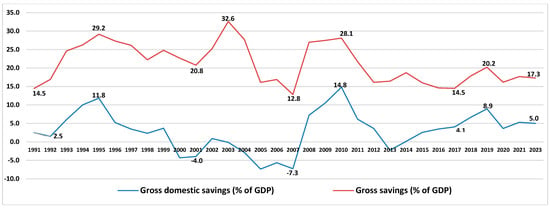
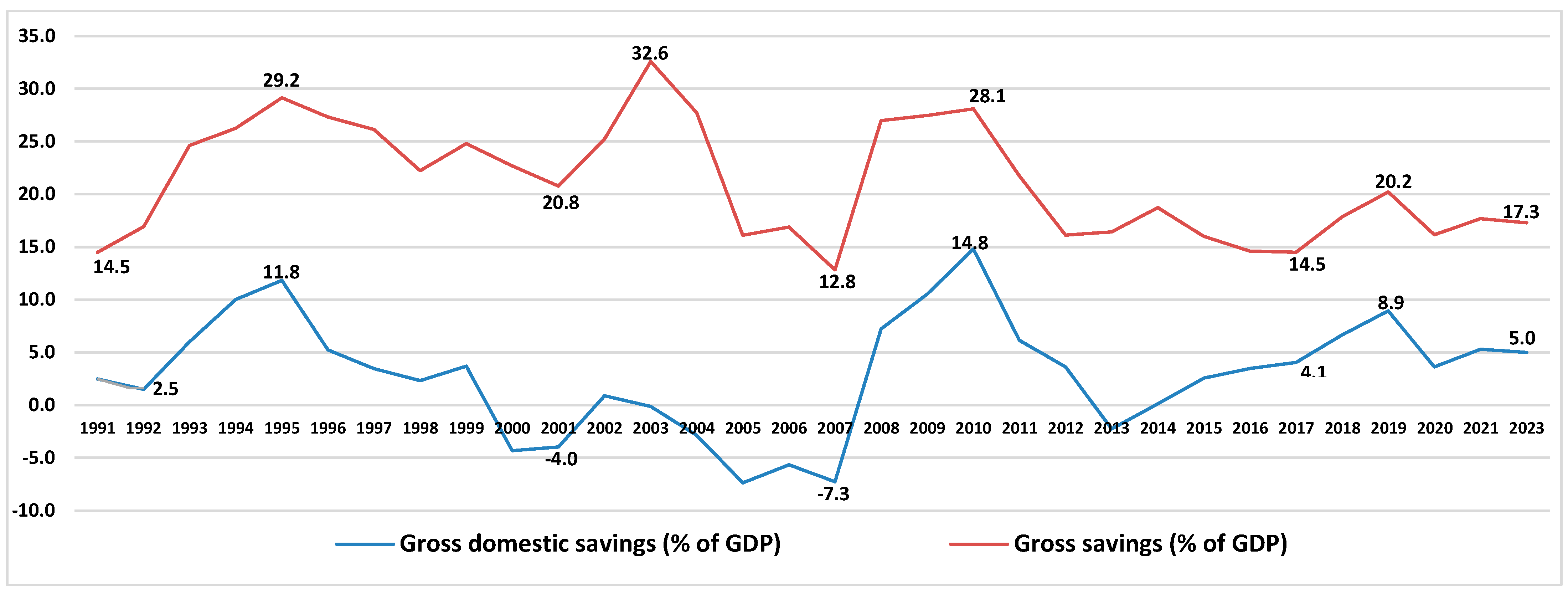
In analyzing the determinants of saving behavior in Jordan, the selection of variables within the ARDL framework is guided by both theoretical foundations and country-specific characteristics, while the definitions, sources, and measurement of all variables are presented later in this section when the model is formally introduced. Gross saving is adopted as the dependent variable because it serves as a comprehensive indicator suitable for empirical investigation and policy analysis in the Jordanian context. This choice is particularly relevant in an economy that relies heavily on external inflows, making gross saving a more accurate measure of the total resources available for capital accumulation, as illustrated in Figure 1.
Figure 1.
Gross Saving versus Domestic Saving as a Percentage of GDP, 1991–2023.
Second, from a policy perspective, the key factor in financing investment and reducing reliance on external funding is the level of gross saving, as it directly reflects the total resources available for capital accumulation. Accordingly, this study adopts gross saving (Saving) as the dependent variable, representing the portion of gross national income (GNI) that is not consumed. It is calculated as gross national income minus total consumption (C) plus net transfers (NT) and expressed as a percentage of GDP.
Figure 1 shows the trends in Domestic Savings (DS) and Gross Savings (GS) in Jordan from 1991 to 2023. Domestic Savings are calculated as GDP minus total consumption, while Gross Savings add net external inflows such as remittances to DS. Together, these indicators provide insights into domestic saving behavior and the significance of external inflows in Jordan’s economy. From the 1990s through the 2000s, Jordan exhibited persistently low domestic savings, reflecting relatively low-income levels alongside high consumption expenditures by households, firms, and the public sector.
In the 2000s, gross savings began to rise steadily, while domestic savings stayed lower and more volatile. This divergence suggests that external financial sources such as remittances have increasingly contributed to Jordan’s overall level of savings. A notable divergence occurred between 2011 and 2013, when domestic savings declined sharply, even turning negative. The growing gap during this time highlights how important external inflows are for maintaining stability. Between 2015 and 2023, gross and domestic savings saw a significant increase. This rise is probably due to stronger remittance inflows and a tendency for Jordanians to save more as a precaution against global and regional economic uncertainties, especially during the COVID-19 pandemic.
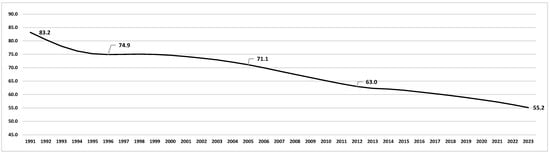
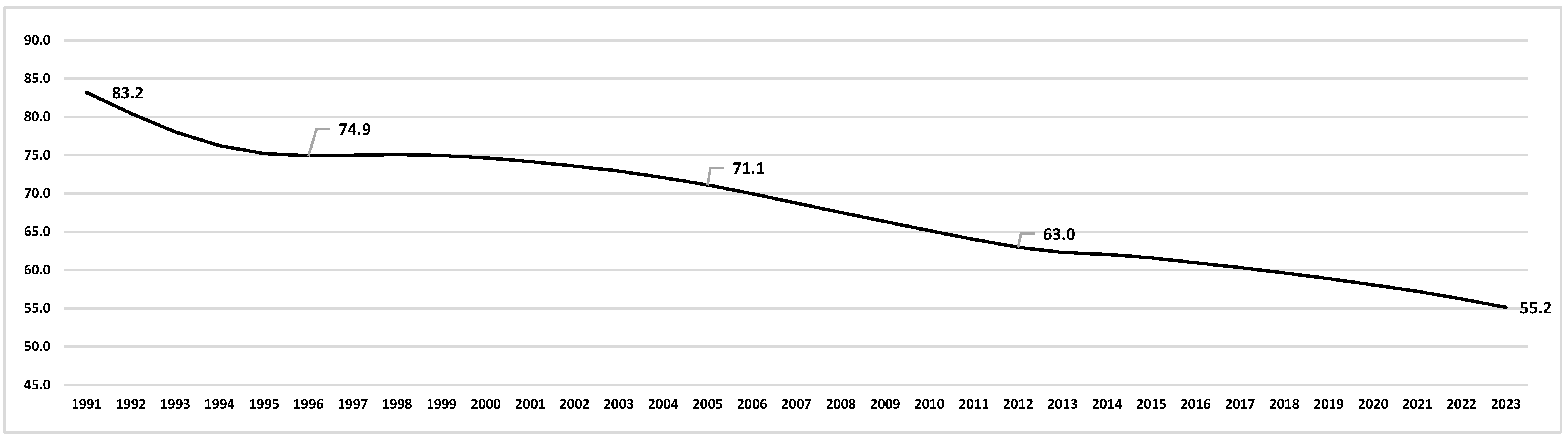
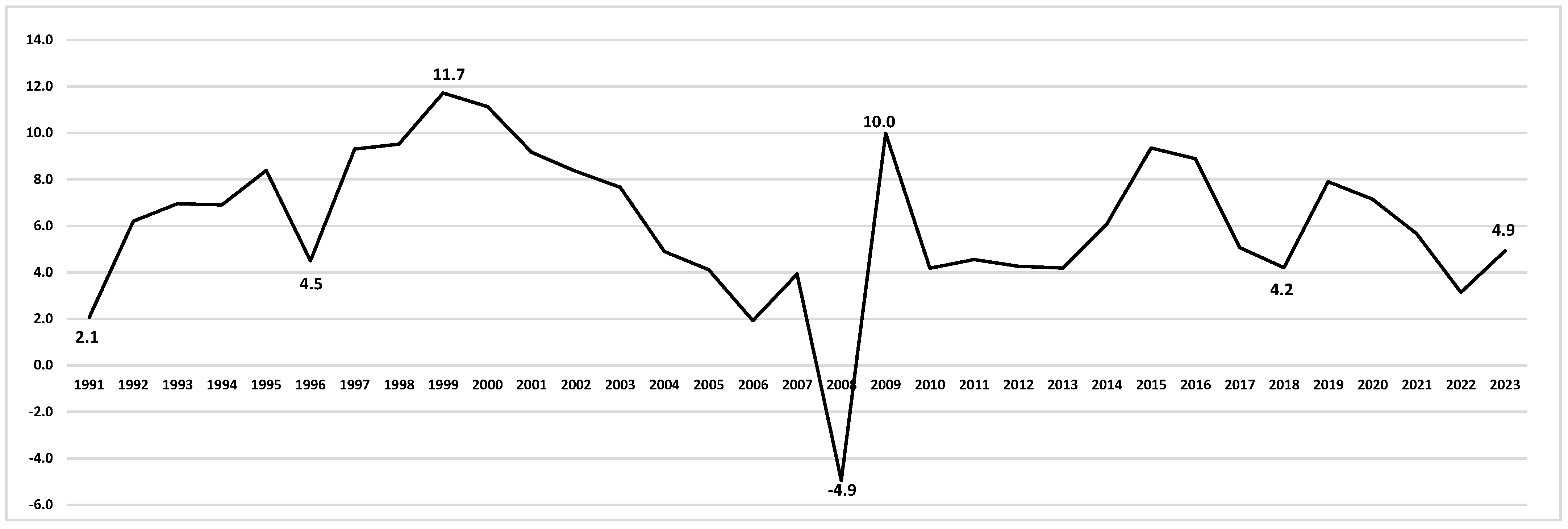
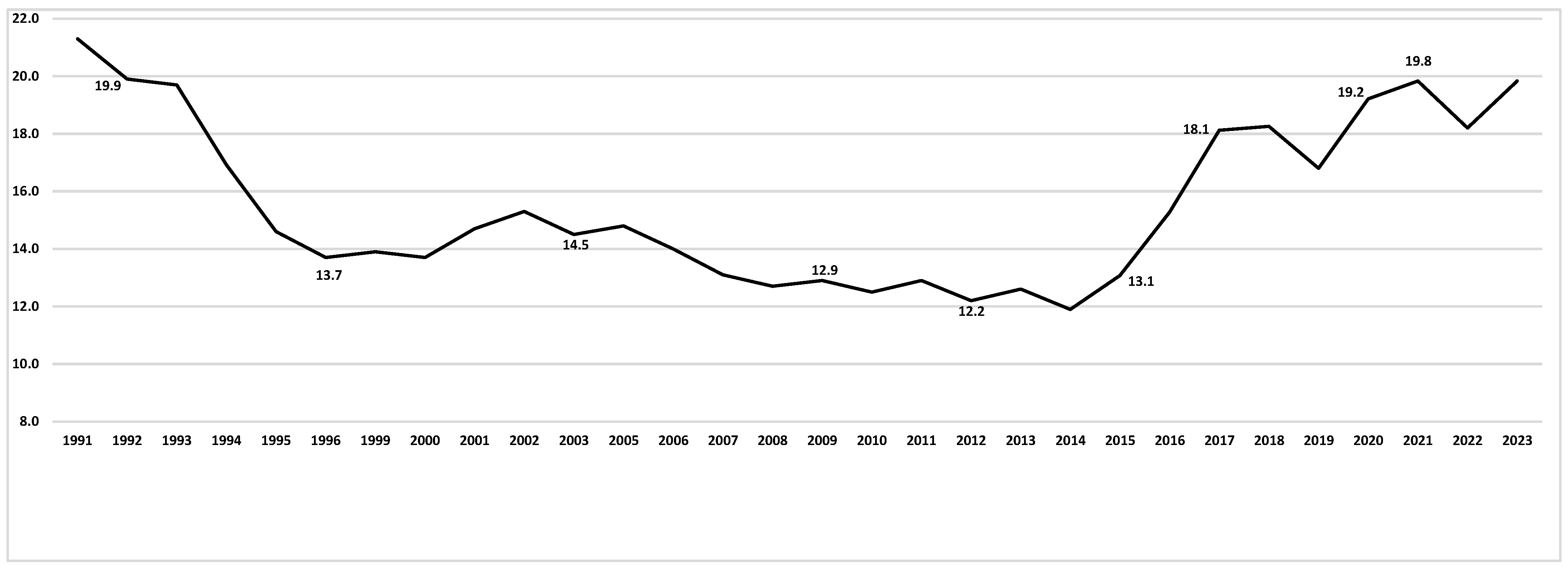
Regarding the determinants of gross saving, it is widely recognized that demographic factors provide a long-term structural framework for understanding saving behavior. A higher number of dependents, whether they are young or elderly, usually means that a household has less ability to save, as more of their income goes toward everyday expenses. In Jordan, this issue is especially pressing because of rapid population growth in recent decades and the arrival of refugees from neighboring countries. As a result, the dependency ratio plays a crucial role in shaping the country’s overall ability to save. Accordingly, the dependency ratio, shown in Figure 2, is included in this study to capture the effect of demographic structure on Jordanians’ saving behavior.
Figure 2.
The Age Dependency Ratio, 1991–2023.
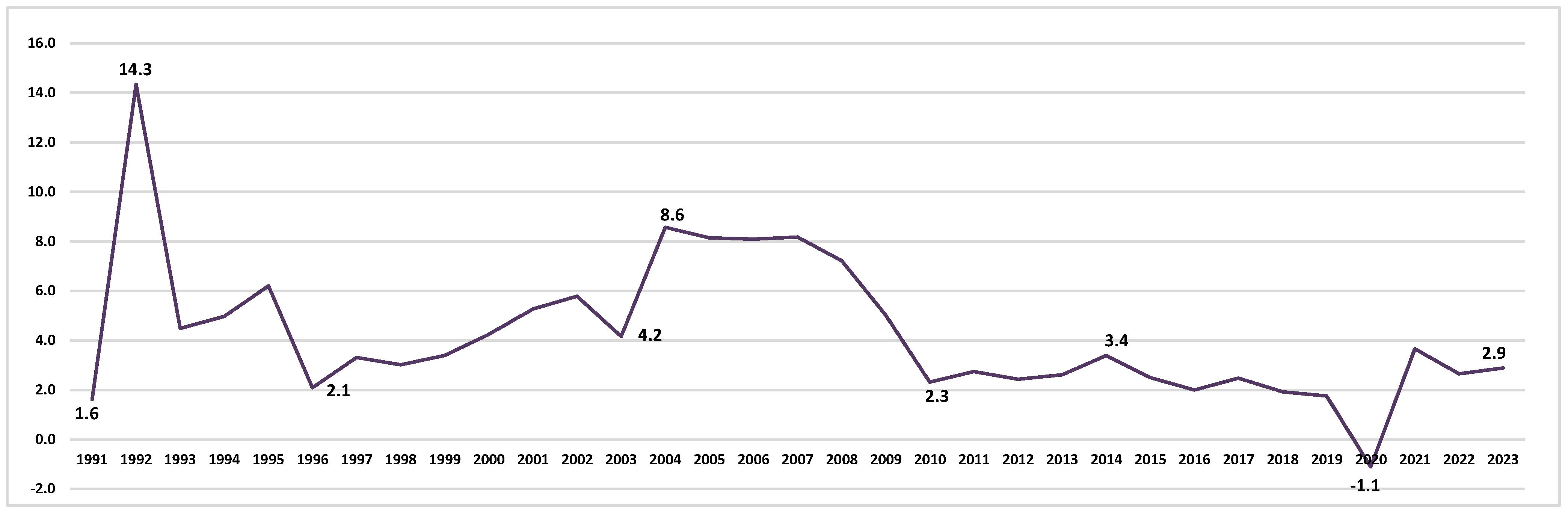
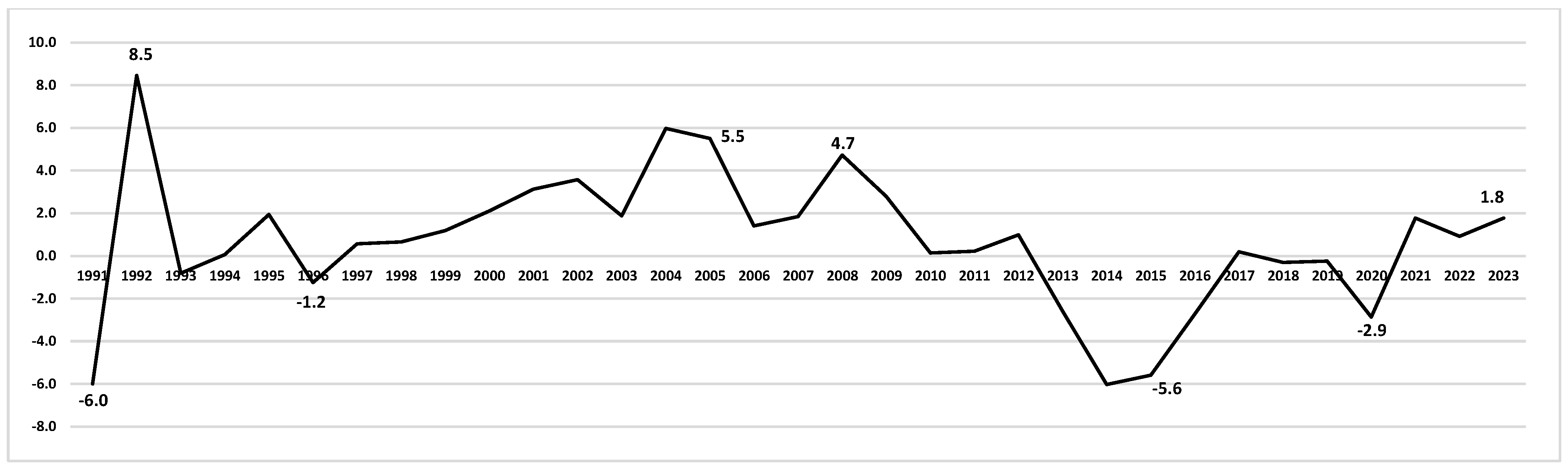
At the macroeconomic level, real economic growth is another critical determinant of gross saving, as economic theories consistently link income dynamics to saving behavior. Higher income growth often leads to increased savings because it raises the real disposable income per person and fosters a sense of confidence in future economic stability. Consequently, countries experiencing sustained GDP growth often exhibit higher saving rates. For Jordan, periods of income growth have been closely linked to external factors such as regional instability and external financing.
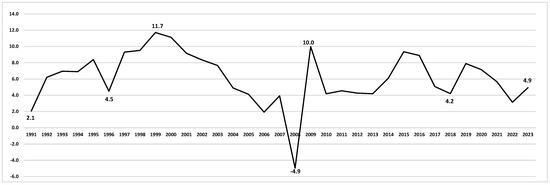
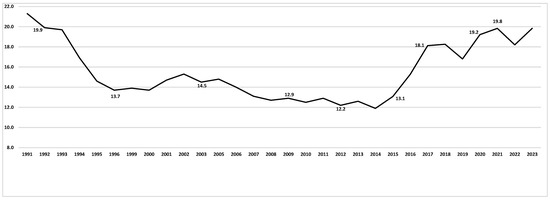
Therefore, including real income growth and derived real per capita income growth in the model, as shown in Figure 3 and Figure 4, helps capture these cyclical effects on saving patterns.
Figure 3.
Real GDP Growth, 1991–2023.
Figure 4.
Real GDP Per Capita Growth, 1991–2023.
The real interest rate is included to capture both the cost of capital and the reward for postponing consumption among Jordanians. However, its influence on saving behavior is complex. Higher real interest rates can have two opposing effects on gross saving. On one hand, they might encourage people to save more by offering better returns on deposits, which is called the substitution effect. On the other hand, higher interest income could help individuals reach their financial goals more easily, making them feel less inclined to save, known as the income effect. These conflicting forces make the overall impact of the real interest rate on gross saving ambiguous. This variable, shown in Figure 5, is particularly relevant in Jordan’s case, as it also reflects the Central Bank of Jordan’s active monetary policy and its influence on household saving behavior.
Figure 5.
The Real Interest Rate 1991–2023.
Unemployment is included in this research to capture the labor market’s influence on Jordan’s gross saving capacity. High unemployment typically reduces gross saving by lowering household income and increasing financial insecurity. In Jordan, unemployment has remained persistently high, particularly among young people and women, reflecting structural challenges within the economy. This variable, illustrated in Figure 6, is particularly important because it can weaken the savings base in two ways: directly, by reducing income, and indirectly, by increasing reliance on family support from Jordanians working abroad.
Figure 6.
The Unemployment rate, 1991–2023.
Taking all together, it is important to emphasize that standard economic theories of saving, particularly the Life-Cycle Hypothesis, the Permanent Income Hypothesis, and neoclassical intertemporal choice theories, provide a clear framework for analyzing the determinants of gross saving in Jordan. Demographic structure plays a central role in this framework, as a higher age dependency ratio increases consumption needs relative to the income-generating capacity of Jordanians, thereby reducing gross saving. Accordingly, Hypothesis (H1) asserts that the dependency ratio has a negative effect on gross saving.
Income dynamics are also fundamental to saving behavior, with higher real per capita income growth reflecting improved lifetime income prospects and a greater ability to save. In line with this reasoning, Hypothesis (H2) proposes that income growth positively influences gross saving. The real interest rate influences saving behavior by affecting the incentive to defer consumption. An increase in the real interest rate raises the return to saving, so the substitution effect is likely to dominate, thereby encouraging higher saving. This leads to Hypothesis H3, which posits a positive relationship between the real interest rate and gross saving. Finally, labor market conditions influence saving primarily through income effects, as higher unemployment reduces household income and weakens saving capacity despite potential precautionary motives. Consequently, Hypothesis H4 asserts that unemployment has a negative effect on gross saving.
It is important to note that a substantial body of studies highlights the importance of incorporating micro- and macro-level approaches when studying saving behavior. While micro-level household data can provide extra insights into saving decisions, this research adopts a macro-level perspective because gross national saving is fundamentally an aggregate economic outcome influenced by broad structural forces (Modigliani & Sterling, 1983; Loayza et al., 2000a, 2000b). Macroeconomic studies emphasize that national saving reflects the combined behavior of households, firms, and the public sector, and therefore responds primarily to economy-wide conditions.
In the Jordanian context, saving behavior is influenced by broad structural factors such as demographic pressures, limited public welfare systems, and the continued reliance on family-based support networks. These determinants operate at the national level, making a macroeconomic approach appropriate and a policy-relevant foundation for analyzing the dynamics of gross saving. Focusing on macro variables also aligns with the study’s objective of informing policymakers and supporting national savings-mobilization strategies. Nevertheless, the research acknowledges that incorporating additional micro-level dimensions could further enrich the savings analysis. Exploring these micro variables represents a promising avenue for future research and would help integrate macro and micro perspectives into a more comprehensive framework for understanding saving behavior in Jordan.
This research seeks to identify the determinants of gross saving in Jordan by applying the new ARDL bounds testing approach, which allows for the examination of both short-run dynamics and long-run relationships. In the case of Jordan, existing studies using the ARDL bounds testing approach remain limited. This research addresses this gap by providing an updated and comprehensive analysis of saving dynamics. In doing so, it provides a strong basis for advancing research and informing policies aimed at enhancing saving capacity and fostering sustainable economic growth.
Based on the previous analysis, this research analyzes the potential determinants of gross saving, drawing on theoretical, empirical, and Jordan-specific factors. It identifies five key variables for examination, leading to the following model:
Saving = F [Dependency, Income-growth, Interest, Unemployment]
The dependent variable, Gross Saving (SAVING), is calculated formally as:
where is gross national income, is consumption, and denotes net transfers. Gross saving is expressed as a percentage of GDP, where measures total income generated from the production of commodities within Jordan during period .
The first explanatory variable, Dependency, represents the age dependency ratio, defined as the ratio of dependents-people younger than 15 or older than 64- to the working-age population-those ages 15–64. Data are shown as the proportion of dependents per 100 working-age population. Income-growth denotes the real per capita GDP growth rate, adjusted for inflation using the GDP deflator. Interest represents the real interest rate defined as the difference between the short-term lending rate and the realized inflation rate via the Consumer Price Index (CPI). Unemployment refers to the unemployment rate, which measures the proportion of the labor force actively seeking employment but not currently working. The data are sourced from the World Development Indicators published by the World Bank and from the Central Bank of Jordan’s database.
The descriptive statistics presented in Table 1 reveal Jordan’s macroeconomic and demographic variability, necessitating robust modeling techniques such as ARDL to account for fluctuations in the variables used in this research.
Table 1.
Descriptive Statistics of the Variables.
Given the volatility inherent in the data, this study applies Heteroskedasticity and Autocorrelation Consistent (HAC) standard errors within the ARDL framework. Following model estimation, the residuals are employed to adjust the variance-covariance matrix of the coefficients using an HAC estimator, ensuring robust inferences. This methodological choice is particularly relevant in the context of the Jordanian economy, where key macroeconomic variables such as income, unemployment, and savings frequently exhibit persistent temporal shocks. To further check for multicollinearity among regressors, the correlation matrix for the variables has been calculated and presented in Table A1 in Appendix A. A correlation coefficient of less than 0.80 implies that the underlying model is not affected by multicollinearity (Pindyck & Rubinfeld, 1998). Hence, this model does not suffer from multicollinearity, as all correlation coefficients are well below 0.80.
3.2. Methodology
This research employs the ARDL bounds testing approach of Pesaran et al. (2001) to examine the long-run relationships between gross saving and its determinants. The ARDL approach is selected for its flexibility in accommodating variables integrated of different orders. That is, a combination of I (0) and I (1) variables.
The order of integration of the variables is examined using the Augmented Dickey–Fuller (ADF) and Phillips–Perron (PP) unit root tests, including a model with a constant only and a model with both a constant and a deterministic time trend. The (ADF) test is applied to the variables using alternative specifications, including a model with a constant only and a model with both a constant and a deterministic time trend. The test is based on an ADF regression in which the lag length is selected automatically using the Akaike Information Criterion (AIC), with a maximum of nine lags. The order of integration of the variables is also examined using the Phillips–Perron (PP) unit root test under the same deterministic specifications (constant only and constant with deterministic trend). The PP test accounts for serial correlation and heteroskedasticity in the error term through a Newey–West heteroskedasticity and autocorrelation consistent (HAC) correction, employing a Bartlett kernel and an automatically selected bandwidth.
Results in Table 2 indicate that Saving and Income-growth are stationary at the level, i.e., I (0), while Dependency, Interest, and Unemployment are stationary at the first difference, i.e., I (1). None of the variables is I (2). Therefore, the ARDL framework permits consistent estimation of both short-run dynamics and long-run equilibrium relationships. The key point is leveraging the ARDL model’s flexibility for dynamic modelling and for testing the existence of a levels relationship.
Table 2.
Augmented Dickey–Fuller (ADF) and Phillips–Perron (PP) Unit Root Test.
The ARDL model in this case is a flexible dynamic framework that captures the lagged adjustments of I (0) gross saving to its determinants of mixed orders. The bounds testing procedure is primarily used to assess the existence of a long-run equilibrium within an ARDL-ECM framework (Pesaran et al., 2001). Stewart (2025) confirms that the ARDL model can detect a long-run levels relationship in cases, even when the dependent variable is I (0). This generalization aligns with earlier work on augmented ARDL bounds tests (Sam et al., 2019). As such, the bounds test is applied as a diagnostic tool to verify a stable conditional long-run relationship, with the error correction term detecting short-run deviations from this long-run equilibrium. In this setting, the ARDL long-run coefficients can be interpreted as conditional equilibrium relationships derived from the underlying dynamic specification. Therefore, the long-run relationship represents the level toward which stationary gross saving converges, conditional on the values of the explanatory variables.
In this research, a systematic econometric framework consistent with the ARDL bounds testing approach proposed by Pesaran et al. (2001) and by Stewart (2025) is applied to examine both the short-run dynamics and long-run relationships among the determinants of gross saving in Jordan.
The general formula of the ARDL (p, q) approach is:
where:
- : the dependent variable observed at time t.
- : the independent variable lagged j periods.
- : the constant term of the model.
- : the coefficient associated with the i-th lag of Y, the Autoregressive (AR) part of the (ARDL) model.
- : the distributed lag coefficients in the ARDL model, measuring the contemporaneous and lagged effects of the explanatory variable on the dependent variable.
- is the error term.
The bounds testing procedure is applied to determine whether a significant level relationship exists between the dependent variable and the explanatory variables. This test is crucial because the presence of a level relationship justifies proceeding to long-run estimation and error correction modeling within the ARDL framework. The test involves comparing the computed F-statistic with the critical bounds, which account for variables integrated of order I (0) and I (1), thereby providing robust evidence of a stable conditional long-run relationship. Importantly, in the ARDL framework, long-run coefficients describe a conditional equilibrium implied by the underlying dynamic structure of the model.
Once the long-run conditional equilibrium is confirmed through the bounds test, the ARDL model is reparametrized into its corresponding Error Correction Model (ECM). The general form of the transformed ECM is as follows:
where:
- : first difference of the dependent variable .
- : first difference of the explanatory variable .
- : the Error Correction Term (ECT), representing the deviation from the long-run equilibrium relationship.
- : the speed of adjustment coefficient.
- : the long-run coefficient, capturing the equilibrium effect of the explanatory variable on the dependent variable.
The ECM specification distinguishes between short-run effects, captured by the differenced terms, and the long-run equilibrium relationships, estimated from the level terms. The coefficient of the error correction term (γ) measures the adjustment toward the long-run equilibrium following short-run shocks.
Finally, a series of diagnostic tests is conducted to assess the model’s adequacy and ensure reliable inference. These tests include checking for serial correlation to confirm residual independence, testing for heteroskedasticity to verify constant error variance, and examining model specification to detect omitted variables or incorrect functional form. Successfully passing these diagnostic checks enhances confidence in the consistency, efficiency, and unbiasedness of the estimators obtained from the ARDL methodology.
3.3. The Empirical Results
To determine the optimal lag structure of the ARDL model, all admissible specifications up to ARDL (2, 2, 2, 2, 2) were estimated using EViews econometric software version 13. Out of 162 alternative models, the optimal specification was automatically selected by the EViews software based on standard information criteria, with the ARDL (2, 0, 0, 1, 0) model being consistently preferred by the Akaike Information Criterion (AIC), the Schwarz Criterion (SC), and the Hannan–Quinn Criterion (HQC).
The model incorporates two lags of the dependent variable (Saving), contemporaneous effects for Dependency and Income-growth, a single lag for Interest to capture the impact of real interest rate and the delayed monetary policy transmission, and a contemporaneous Unemployment effect to reflect labor market developments. This lag structure may reflect the interplay between gradual adjustments in a weak-Jordan growth economy and rapid responses of Jordanians to labor market and income shocks. Specifically, the two lags of gross saving may indicate Jordanians’ gradual consumption smoothing in response to persistent economic weakness. The contemporaneous effects of the dependency ratio and income growth may indicate the immediate influence of Jordan’s social structure, including high obligations and current income fluctuations, on saving decisions. The single lag of the real interest rate may capture the delayed monetary transmission in a financial system with limited depth, while the contemporaneous effect of unemployment may indicate the immediate impact of high unemployment and low wages on Jordanian saving behavior.
To validate the model’s robustness and findings, several diagnostic tests were conducted, as shown in Table 3, Table 4, Table 5 and Table 6. First, the Durbin–Watson statistic of 2.2 in Table 6 suggests no first-order autocorrelation in the residuals of the model. However, to more thoroughly test for higher-order serial correlation, the Breusch–Godfrey Serial Correlation LM test was applied and shown in Table 3. The null hypothesis of no serial correlation could not be rejected, as the p-values associated with both the F-statistic (p = 0.29) and the Obs*R-squared statistic (p = 0.16) are well above conventional significance levels, indicating the absence of autocorrelation.
Table 3.
Serial Correlation (Breusch–Godfrey LM Test).
Table 4.
Heteroskedasticity (Breusch–Pagan–Godfrey Test).
Table 5.
Functional Form (Ramsey RESET Test).
Table 6.
The Estimated ARDL Model Results (Dependent Variable: Saving).
Second, the Breusch–Pagan–Godfrey test was employed to test for heteroskedasticity. As shown in Table 4, the null hypothesis of homoskedasticity could not be rejected, with the p-values associated with both the F-statistic (p = 0.32) and the Obs*R-squared statistic (p = 0.29) again exceeding conventional significance levels. These results imply that the variance of the error terms is constant, thereby validating the efficiency of the model’s estimated coefficients.
Third, the Ramsey RESET test was conducted to check for potential model misspecification. The test statistic (F = 0.98, p = 0.719) does not indicate any evidence of functional form misspecification, further supporting the adequacy of the chosen ARDL model in capturing the relationship between gross saving and its determinants.
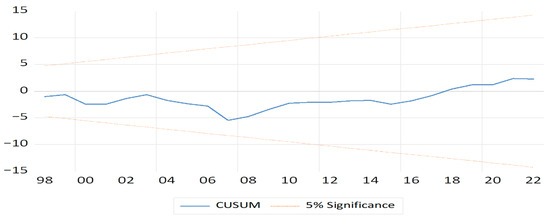
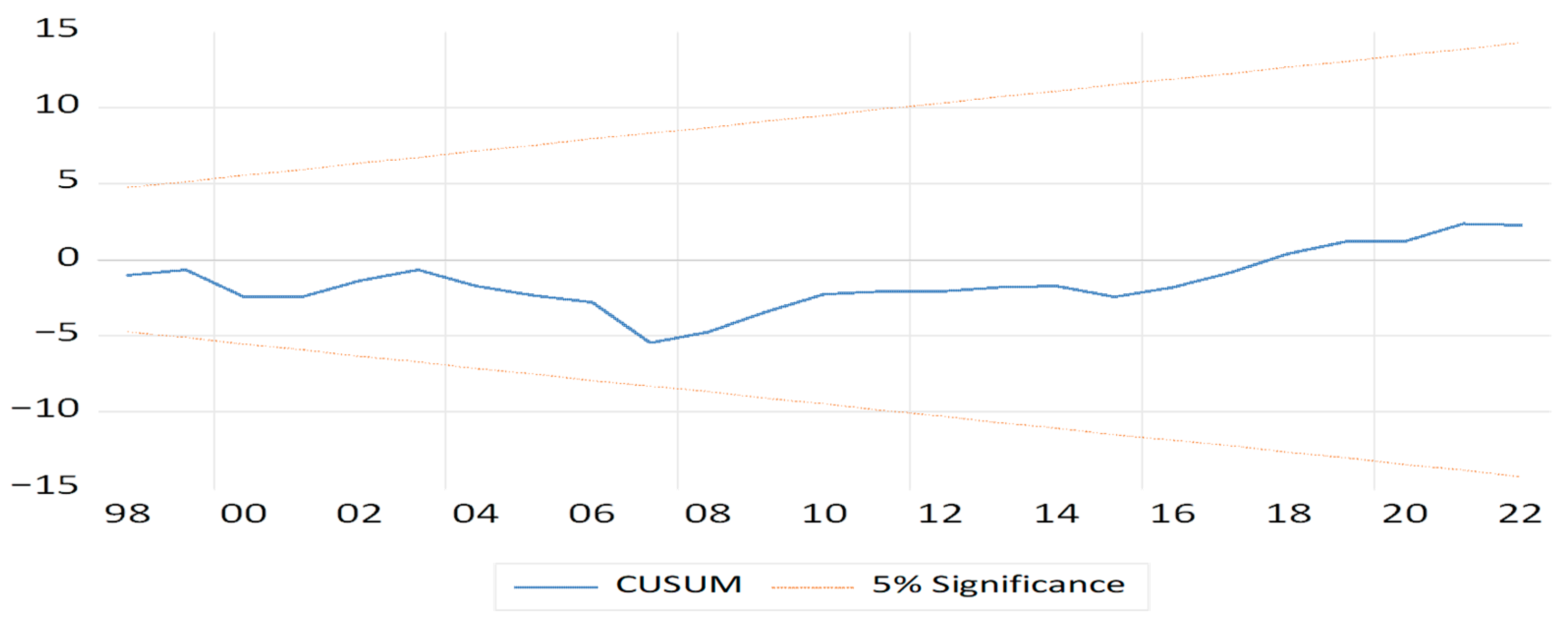
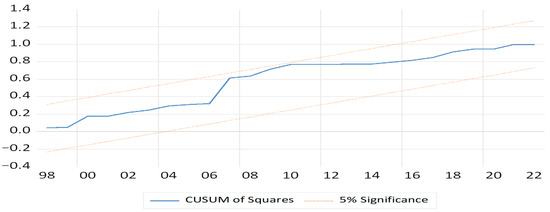
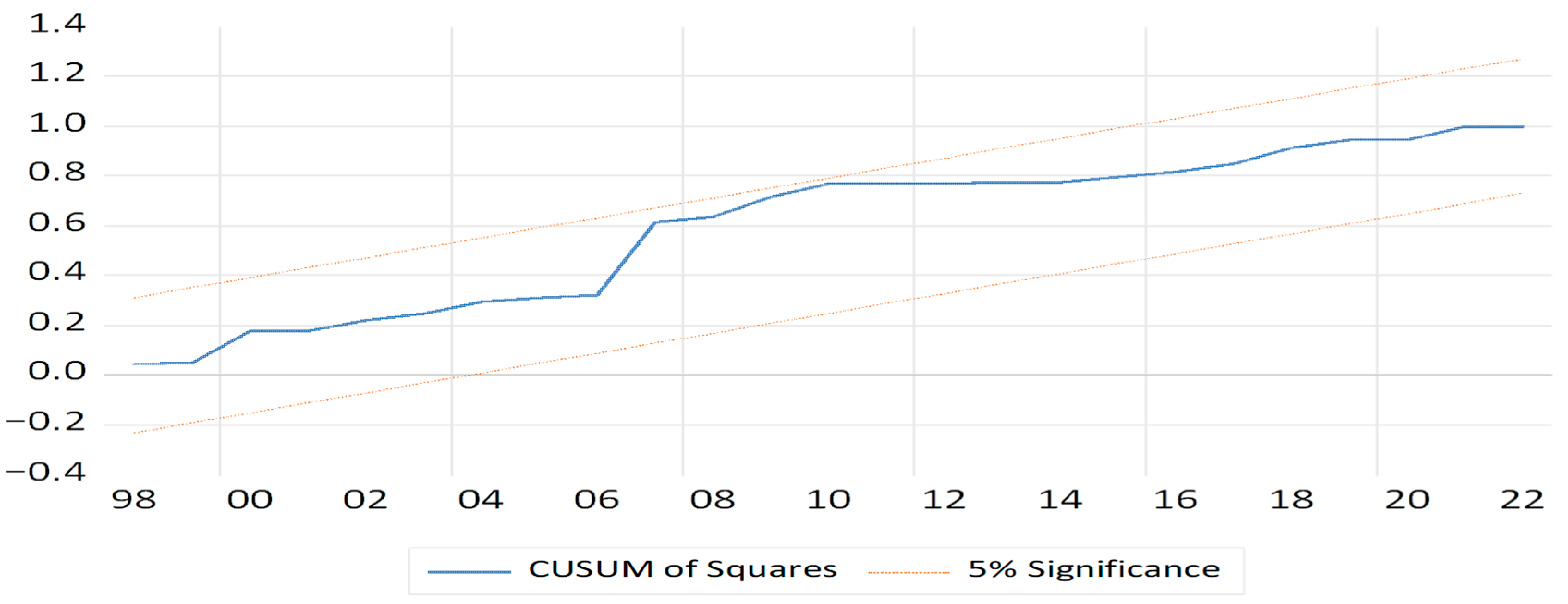
Fourth, the CUSUM and CUSUMSQ tests were conducted to check for the stability of the parameters. The two tests, as shown in Figure 7 and Figure 8 confirm the stability of the model, as the cumulative sum of recursive and squared recursive residuals remains within the 5% significance bounds, indicating no evidence of parameter instability.
Figure 7.
The CUSUM test.
Figure 8.
The CUSUMSQ test.
Taken together, these diagnostic results confirm that the ARDL specification is econometrically sound and that the model’s parameter estimates are reliable, unbiased, and consistent. This strengthens the validity of the inferences and policy implications drawn from the analysis. Importantly, this reliability allows for a meaningful interpretation of both the short-run adjustments and the long-run equilibrium dynamics revealed by the ARDL framework.
As explained earlier, this study employs the ARDL (2, 0, 0, 1, 0) model. Based on the above discussion, the estimation results of the unrestricted ARDL model are presented in Table 6.
In the unrestricted ARDL specification, the significant coefficients on lagged gross saving reflect short-term dynamic adjustments, indicating that current saving responds strongly to past levels. The positive and statistically significant coefficient on the first lag, together with the negative and significant coefficient on the second lag, as shown in Table 6, suggests a combination of a strong short-run and an oscillatory adjustment process over time. The coefficient of the dependency ratio is positive and statistically significant, indicating that an increase in the dependency ratio is associated with higher gross saving. Although this positive relationship is counterintuitive to standard economic hypotheses, it can be explained by Jordan’s distinctive socio-economic and demographic structure, weak social welfare coverage, and large flows of remittances, which lead households to rely heavily on precautionary and forward-looking saving behavior. It is observed that the age dependency ratio has declined over the sample period; however, despite this downward trend, the ratio continues to represent a relatively high burden on households. Jordan’s traditional family structure and very limited public social protection schemes place primary responsibility for financing education, healthcare, housing, and future expenses on families themselves. As a result, households tend to increase savings to meet anticipated future obligations. High household expenditures on education, substantial healthcare spending, and narrow social security coverage further reinforce this behavior, while remittances expand disposable income and support saving motives. Consequently, in the Jordanian context, a higher dependency ratio may act as a motivator for precautionary saving.
Although the standard theories predict a negative relationship between dependency ratios and gross saving, much empirical evidence suggests that this effect can be non-negative under certain conditions. Demographic and macroeconomic studies emphasize that the impact of dependency on saving is highly contingent on country-specific settings. In countries with limited social protection, high education and healthcare costs, and strong family support systems, households often respond to higher youth dependency by increasing precautionary and forward-looking savings (World Bank & International Monetary Fund, 2015). Consistent with this perspective, country-level studies in Pakistan and other Asian economies report mixed effects of dependency on gross saving, reflecting variations in local institutional and economic conditions. In populated Asian countries, higher dependency may generate a positive or neutral impact on savings as households engage in precautionary accumulation strategies (Ahmad & Ali Shah, 2021; Athukorala & Suanin, 2024). Remittance inflows provide additional resources, helping to offset potential negative impacts of dependency on savings (Gani, 2016). Similarly, in transition economies of Central and Eastern Europe, underdeveloped welfare systems and reliance on self-insurance allow households to maintain or even increase savings despite high youth dependency (Kabrt, 2024). These findings underscore that the relationship between dependency and saving is country-specific, shaped by economic, institutional, and social factors. In Jordan, where households face relatively high education and healthcare costs and depend on informal family support largely financed by remittances, similar mechanisms—precautionary accumulation and self-insurance—are likely to influence saving behavior.
The positive and statistically significant effect of income per capita growth on gross saving supports both Keynesian and modern income–saving theories. Higher income growth enhances Jordanians’ capacity to save and reflects a procyclical saving pattern. This finding suggests that economic growth promotes higher savings, thereby reinforcing a virtuous cycle of capital accumulation and economic expansion in Jordan.
The interest rate enters the model with both contemporaneous and lagged terms, indicating that changes in interest rates influence saving decisions both immediately and with a short lag. It is important to note that the effect of interest rates on gross saving arises from two opposing forces. In Jordan, the results are somewhat mixed. The immediate impact shows a negative effect that is significant only at the 10% level, suggesting that the substitution effects outweigh the income effects. This suggests that increases in interest rates may initially reduce saving behavior. However, the effect over time turns out to be positive. This suggests that while immediate rate hikes may dampen savings due to higher borrowing costs, households eventually respond to higher returns on savings. In the long-run, however, as shown later, the interest rate becomes statistically insignificant, possibly due to weak financial development or delayed behavioral responses to interest rate changes.
Unemployment exhibits a negative and statistically significant effect, indicating that changes in labor market conditions exert short-run pressure on household saving behavior. Higher unemployment reduces disposable income and increases uncertainty, undermining the ability and willingness of Jordanians to save. This finding is particularly relevant in the Jordanian context, where youth and female unemployment remain persistently high. According to the World Development Indicators published by the World Bank, female youth unemployment (ages 15–24) was 48% in 2022 and 40% in 2023, while total youth unemployment for the same age group was around 42% in 2022 and 39% in 2023.
To check for the existence of a statistically significant long-run level relationship among the variables, this research uses the Bounds Testing approach suggested by Pesaran et al. (2001).
The findings shown in Table 7 indicate that there is a stable conditional long-run relationship between gross saving and its influencing factors. According to the computed F-statistic, there is sufficient evidence to reject the null hypothesis at the 1% significance level. In other words, the computed F-statistics exceed the upper-bound critical value. This result suggests the existence of a stable conditional long-run equilibrium relationship between savings and the key variables discussed above.
Table 7.
ARDL Bounds Test for Cointegration.
Since a stable conditional long-run equilibrium relationship among the variables is established, the ARDL model can be reparametrized into its Error Correction Model (ECM) form. ECM connects short-term changes with long-term stability, ensuring that important long-term information is not overlooked. In this approach, immediate changes are represented by first differences, while the lagged level variables illustrate the enduring relationships over time. This formulation is crucial for distinguishing short-run fluctuations from the underlying long-run equilibrium path of Jordan’s gross saving function.
The estimation results of the conditional ECM representation of the ARDL model are presented in Table 8 and Table 9, where the coefficients are divided into short-run and long-run dynamics. The short-run coefficients correspond to the differenced variables (Δ) and capture short-term adjustments in gross saving in response to changes in the explanatory variables. The long-run coefficients are obtained by normalizing the ARDL coefficients with the adjustment coefficient (γ = −0.86), representing the long-run equilibrium relationships between saving and the explanatory variables.
Table 8.
Short-Run Dynamics and Error Correction Term.
Table 9.
Long-Run Coefficient Estimates.
To compute the long-run coefficients for each variable, this research first sums the contemporaneous and lagged coefficients. Then it divides this total by one minus the sum of the lagged dependent variable coefficients. Specifically, saving is positively related to the dependency ratio (0.19), income growth (0.32), and the interest rate (0.14), while unemployment exerts a significant negative impact (−0.72). These results indicate that, over time, economic growth and dependency tend to boost gross saving, while a weak labor market has a negative impact on it.
Taken together, the short- and long-run results indicate that both the dependency ratio and income growth have positive and statistically significant effects on gross saving in the short and long-run, while unemployment is negatively associated with gross saving in both periods. As discussed earlier, a higher dependency ratio may act as a motivator for precautionary or goal-oriented saving among Jordanians. Furthermore, the results confirm that stronger economic growth serves as a key driver of sustained saving over time in Jordan.
Conversely, the large negative impact of unemployment shows that ongoing weak job market conditions seriously reduce the savings ability of people in Jordan. The negative effect of unemployment on savings in Jordan highlights that, in practice, income constraints can impact precautionary motives. During periods of prolonged high unemployment and weak economic growth, many households experience sustained reductions in disposable income and have limited access to social protection, compelling them to prioritize current consumption over saving. Although precautionary saving behavior predicts that uncertainty may increase saving, the aggregate effect is negative because a large share of households simply cannot afford to save. The ARDL results suggest that this effect stays in both the short and long-run, indicating that extended labor-market slack can have lasting adverse impacts on gross saving. This dynamic is particularly important for Jordan, as reduced aggregate saving can limit domestic investment, slow capital accumulation, and constrain long-term economic growth.
Interestingly, while the interest rate variable is insignificant in the long-run, its short-run dynamics are significant only at the 10% level, which may reflect the debt-servicing burdens or consumption-smoothing behavior of Jordanians.
More importantly, the presence of a stable long-run relationship is confirmed by the statistically significant error correction term (ECT) with a coefficient of –0.86, indicating a rapid annual adjustment toward equilibrium following exogenous shocks. This implies that disequilibria do not persist for long in the Jordanian economy. In this context, this study suggests that the high adjustment observed in saving dynamics can be attributed primarily to the limited availability of alternative saving options in Jordan. Households and businesses rely mainly on the banking sector for their financial needs, with limited access to a diverse range of financial instruments. In addition, financial inclusion remains a major challenge, particularly for lower-income groups and small and medium-sized enterprises. In the absence of sophisticated saving mechanisms, households and businesses in Jordan have fewer tools at their disposal to buffer short-term economic shocks. As a result, their only viable option is to adjust their saving behavior directly in response to such shocks.
4. Conclusions and Policy Implications
This study set out to investigate the determinants of gross saving in Jordan using the ARDL approach, based on annual data for the period 1991–2023. Standard economic theories provide a clear framework for analyzing the determinants of gross saving in Jordan. Demographic structure plays a central role, as a higher age dependency ratio increases consumption relative to income, reducing gross saving (H1: negative effect). Income dynamics are fundamental to saving behavior, with higher real per capita income growth enhancing lifetime income prospects and saving capacity (H2: positive effect). The real interest rate affects saving by influencing the incentive to defer consumption; higher rates raise the return to saving, so the substitution effect dominates (H3: positive effect). Finally, labor market conditions shape saving through income effects, as higher unemployment reduces household income and weakens saving capacity (H4: negative effect).
The empirical evidence of this research confirms the existence of a stable conditional long-run equilibrium relationship between gross saving, the dependency ratio, real per capita income growth, the real interest rate, and the unemployment rate. Both short-run and long-run dynamics reveal important insights into how macroeconomic and demographic factors shape saving behavior in Jordan.
The results demonstrate that saving in Jordan exhibits short-term dynamic adjustments, as past saving behavior significantly influences current saving decisions. Our analysis shows that the age dependency ratio continues to exert a positive and statistically significant effect on household saving in both the short and long-run, despite having declined from 82% to 55% over the sample period. This suggests that saving behavior in Jordan is shaped not only by demographic dynamics but also by underlying structural and socio-economic conditions. Weak social security coverage, limited public protection, high household expenditures on education and healthcare, and substantial remittance inflows encourage precautionary saving, even as the dependency burden—though declining—remains relatively high. Although the reduction in the dependency ratio eases burdens on households and potentially creates greater scope for consumption, persistent socio-economic constraints tend to dampen this effect. These findings underscore the importance of complementary economic policies that promote supply-side growth, including fostering innovation and improving infrastructure, in order to channel household savings toward productive investment and support long-term economic development in Jordan.
Unemployment, on the other hand, has a consistently negative effect on savings, revealing how vulnerable Jordanian families are to struggles in the job market. This situation emphasizes the ongoing issue of high youth and female unemployment, which makes it difficult for people to save. According to the World Development Indicators published by the World Bank, female youth unemployment (ages 15–24) was 48% in 2022 and 40% in 2023, while total youth unemployment for the same age group was around 42% in 2022 and 39% in 2023.
The effect of interest rates is mixed: while short-run coefficients suggest that substitution and income effects are at play, the long-run effect is statistically insignificant, likely reflecting the limited availability of savings instruments. The rapid adjustment observed in the error correction term (86% annually) indicates that deviations from the long-run equilibrium are corrected quickly. This rapid adjustment may reflect the absence of sophisticated saving mechanisms, which compels households and firms to adjust their saving behavior directly and immediately in response to shocks.
These findings carry several important policy implications. Unemployment remains one of the main constraints on gross saving in Jordan. High unemployment weakens people’s ability to save, making it crucial to tackle joblessness, especially among young people and women. Creating more opportunities through private sector growth, entrepreneurship support, and labor market reforms can help individuals earn stable incomes and plan for the future. During periods of prolonged high unemployment and weak economic growth, many households experience sustained reductions in disposable income and have limited access to social protection, compelling them to prioritize current consumption over saving. These findings underscore the need for policy measures such as enhanced social protection, unemployment benefits, and targeted transfers to support household saving capacity, mitigate the negative effects of labor-market weakness, and foster more resilient economic growth.
Income growth also emerges as a critical driver of saving, reinforcing the importance of policies that sustain economic expansion. Efforts to boost productivity and attract foreign investment will not only raise household incomes but also support higher levels of gross saving, reducing dependence on external financing and enhancing economic resilience. At the same time, the weak long-run role of interest rates suggests that the connection between financial markets and household saving decisions remains underdeveloped. Expanding access to savings instruments and promoting financial literacy can enhance the responsiveness of savings to monetary policy, providing households with more attractive avenues for mobilizing their surplus funds.
The positive and counterintuitive link between the dependency ratio and saving has important policy implications. Rather than seeing a high dependency ratio as a burden, policymakers can leverage households’ precautionary savings through financial instruments such as pension schemes, education funds, or long-term investments. Although Jordan’s dependency ratio has declined from 82% to 55%, socio-economic pressures sustain saving. Supply-side policies promoting innovation, entrepreneurship, and infrastructure can channel these savings into productive investment, supporting sustainable long-term economic growth. The rapid adjustment revealed by the error correction term indicates that saving behavior in Jordan responds quickly to shocks, reflecting the limited availability of flexible and diversified saving instruments. To address this, policymakers should aim to broaden the range of saving options available to households and firms. Doing so would enable households to smooth consumption more effectively over time while providing the economy with a larger and more stable pool of domestic funds to finance investment and development projects.
Finally, this study is subject to several limitations that warrant careful consideration and open avenues for future research. First, while the analysis focuses on macroeconomic determinants of gross saving in Jordan, key channels such as remittances and welfare institutions are not directly incorporated into the empirical framework. Future studies could explicitly integrate these variables to better capture the institutional and external dimensions influencing saving behavior. Second, the estimated error correction term suggests a very rapid adjustment toward the long-run equilibrium. While this magnitude is statistically plausible, the economic explanations—such as limited availability of financial instruments or constraints on portfolio diversification—are not empirically tested in this study. Therefore, this interpretation should be considered indicative. Third, the study employs the ARDL approach, which is suitable for small samples and captures long-run conditional relationships. Future research may verify the results using alternative lag structures, variable definitions, or estimation methods.
The analysis is based on a parsimonious model specification, while acknowledging that income growth and saving may exhibit endogeneity. Addressing this issue more explicitly and exploring alternative model specifications represent promising avenues for future research. More broadly, extending the analysis to include micro-level dimensions would further enrich the framework, as household-level behavioral factors could complement macroeconomic fundamentals. Cross-country comparisons within emerging and Middle Eastern economies, as well as the application of alternative econometric techniques, would also help generalize the findings and deepen our understanding of saving behavior in Jordan. Addressing these limitations would provide a more comprehensive and causally robust framework for analyzing saving behavior in Jordan.
Author Contributions
Conceptualization, N.I.S.; Methodology, O.M.A.; Software, O.M.A.; Formal analysis, O.M.A. & N.I.S.; Investigation, O.M.A. & N.I.S.; Resources, O.M.A.; Data curation, O.M.A.; Writing—original draft, O.M.A.; Writing—review & editing, O.M.A. & N.I.S.; Visualization, O.M.A.; Project administration, N.I.S. All authors have read and agreed to the published version of the manuscript.
Funding
This research was funded by the University of Jordan.
Institutional Review Board Statement
Not applicable.
Informed Consent Statement
Not applicable.
Data Availability Statement
The authors primarily used data from the World Development Indicators published by the World Bank and from the Central Bank of Jordan’s database, which are publicly available.
Conflicts of Interest
The authors declare no conflict of interest.
Appendix A
- (1)
- The Correlation Matrix in Table A1Table A1. The Correlation Matrix.
- (2)
- (3)
- CUSUM and CUSUMSQ Tests
- CUSUM Testwhere:
- = recursive residual at time
- = standard deviation of residuals
- = total number of observations
- = number of regressors
- CUSUMSQ Testwhere is the squared recursive residual at time .
References
- Abasimi, R., & Martin, F. (2018). Determinants of household savings in emerging economies. Journal of Development Economics, 22(4), 45–62. [Google Scholar]
- Ahmad, D., & Ali Shah, S. Z. (2021). Impact of dependency ratio on economic growth among most populated Asian countries. Journal of Development and Social Sciences, 2(4), 563–579. [Google Scholar] [CrossRef] [Scilit]
- Aizenman, J., Jinjarak, Y., & Park, D. (2019). Saving rates and interest rates: Evidence from developing countries. Emerging Markets Review, 39, 12–32. [Google Scholar] [CrossRef] [Scilit]
- Akram, Q. F., & Akram, N. (2016). The effect of monetary policy on household savings in Pakistan. Asian Economic Review, 58(3), 201–219. [Google Scholar]
- Alzghoul, A., Al-kasasbeh, O., Alsheikh, G. A. A., & Yamin, I. (2023). The relationship between savings and investment: Evidence from Jordan. International Journal of Professional Business Review, 8(3), e01724. [Google Scholar] [CrossRef] [Scilit]
- Arabyat, Y. A., Aldabbas, M., Abdo, K. K., Al-Shawawreh, T. B., & Alqudah, M. Z. (2023). The impact of domestic savings gap on the current account balance in Jordan during 1995–2020: An ARDL approach. WSEAS Transactions on Business and Economics, 20, 985–997. [Google Scholar] [CrossRef] [Scilit]
- Athukorala, P. C., & Suanin, W. (2024). Saving transition in Asia. The Journal of Development Studies, 60, 1211–1226. [Google Scholar] [CrossRef] [Scilit]
- Basha, M. (2023). Evaluating the impact of domestic savings on Jordan’s economic growth. WSEAS Transactions on Business and Economics, 20, 485–491. [Google Scholar] [CrossRef] [Scilit]
- Dayal-Ghulati, A., & Thimann, C. (1997). Saving in Southeast Asia and Latin America compared: Searching for policy lessons (IMF Working Paper No. 97/110). International Monetary Fund. Available online: https://www.imf.org/external/pubs/ft/wp/wp97110.pdf (accessed on 5 February 2026).
- Fredriksson, C., & Staal, K. (2021). Determinants of household savings: A cross-country analysis. International Advances in Economic Research, 27(4), 257–272. [Google Scholar] [CrossRef] [Scilit]
- Friedman, M. (1957). A theory of the consumption function. Princeton University Press. [Google Scholar] [CrossRef] [Scilit]
- Gani, A. (2016). Remittances and savings in Asia: Some empirical evidence based on the life-cycle model. Journal of Finance and Economics, 4(1), 24–35. [Google Scholar] [CrossRef] [Scilit]
- Giovannini, A. (1985a). Government deficits and private savings: International evidence. Economic Journal, 95(378), 67–78. [Google Scholar]
- Giovannini, A. (1985b). Savings and the real interest rate in LDCs. Journal of Economic Development, 18, 197–217. [Google Scholar] [CrossRef] [Scilit]
- Hallaq, S. (2003). Determinants of private savings: The case of Jordan (1976–2000). Journal of King Saud University: Administrative Sciences, 15(2), 83–94. [Google Scholar]
- Hussein, K., Mohieldin, M., & Rostom, A. (2017). Savings, financial development, and economic growth in the Arab Republic of Egypt revisited (Policy Research Working Paper No. 8020). World Bank. Available online: http://hdl.handle.net/10986/26365 (accessed on 5 February 2026).
- Hussein, K., & Thirlwall, A. P. (1999). Explaining differences in the domestic savings ratio across countries: A panel data study. Journal of Development Studies, 36(1), 31–52. [Google Scholar] [CrossRef] [Scilit]
- International Monetary Fund (IMF). (2024). Jordan: 2024 article IV consultation and second review under the extended arrangement under the extended fund facility (Country Report No. 24/345). IMF Publication Services.
- International Monetary Fund (IMF). (2025a). IMF projects continued recovery for Jordanian economy, growth to reach 2.9% in 2026. In Regional economic outlook: Middle east and central Asia—Fall 2025. IMF. [Google Scholar]
- International Monetary Fund (IMF). (2025b). Jordan: Fourth review under the extended arrangement under the extended fund facility (Country Report No. 25/338). IMF Publication Services.
- Kabrt, T. (2024). The economic implications of population aging on current account balance. Economic Analysis and Policy, 84, 1895–1909. [Google Scholar] [CrossRef] [Scilit]
- Keynes, J. M. (1936). The general theory of employment, interest, and money. Macmillan. [Google Scholar]
- Khan, F., Sharma, A., & Lee, H. (2018). Macroeconomic determinants of savings in Asia: A panel data approach. Asian Economic Journal, 32(1), 25–50. [Google Scholar]
- Loayza, N., Schmidt-Hebbel, K., & Servén, L. (2000a). Saving in developing countries: An overview. The World Bank Economic Review, 14(3), 393–414. [Google Scholar] [CrossRef] [Scilit]
- Loayza, N., Schmidt-Hebbel, K., & Servén, L. (2000b). What drives private saving across the world? Review of Economics and Statistics, 82(2), 165–181. [Google Scholar] [CrossRef] [Scilit]
- Metin-Ozcan, K., Özmucur, S., & Uysal, B. (2003). Determinants of private saving: Evidence from Turkey. Applied Economics Letters, 10(9), 547–551. [Google Scholar]
- Metin-Ozcan, K., & Ziya-Ozcan, B. (2005). Financial development, macroeconomic stability, and private saving in the MENA region. Middle East Development Journal, 2(1), 77–94. [Google Scholar]
- Modigliani, F., & Brumberg, R. (1954). Utility analysis and the consumption function: An interpretation of cross-section data. In K. K. Kurihara (Ed.), Post-keynesian economics (pp. 388–436). Rutgers University Press. [Google Scholar]
- Modigliani, F., & Sterling, A. (1983). Determinants of private saving with special reference to the role of social security—Cross-country tests. In F. Modigliani, & R. Hemming (Eds.), The determinants of national saving and wealth (pp. 65–102). St. Martin’s Press. [Google Scholar]
- Nagawa, V., Wasswa, F., & Bbaale, E. (2020). Determinants of gross domestic savings in Uganda: An autoregressive distributed lag (ARDL) approach to cointegration. Journal of Economic Structures, 9, 39. [Google Scholar] [CrossRef] [Scilit]
- Pervez, S., & Khan, A. (2020). Macroeconomic determinants of gross savings in Pakistan: An econometric analysis. Pakistan Journal of Applied Economics, 30(2), 45–63. [Google Scholar]
- Pesaran, M. H., Shin, Y., & Smith, R. J. (2001). Bounds testing approaches to the analysis of level relationships. Journal of Applied Econometrics, 16(3), 289–326. [Google Scholar] [CrossRef] [Scilit]
- Pindyck, R. S., & Rubinfeld, D. L. (1998). Econometric models and economic forecasts (4th ed.). Irwin/McGraw-Hill. [Google Scholar]
- Sam, C. Y., McNown, R., & Goh, S. K. (2019). An augmented autoregressive distributed lag bounds test for cointegration. Economic Modelling, 80(C), 130–141. [Google Scholar] [CrossRef] [Scilit]
- Samantaraya, A., & Patra, S. K. (2014). Determinants of household savings in India: An empirical analysis using ARDL approach. Economics Research International, 2014, 454675. [Google Scholar] [CrossRef] [Scilit]
- Stewart, C. (2025). Demonstrating that the autoregressive distributed lag bounds test can detect a long-run levels relationship when the dependent variable Is I(0). Econometrics, 13(4), 39. [Google Scholar] [CrossRef] [Scilit]
- Tang, C. F., Tan, B. W., & Wong, K. F. (2020). Determinants of household savings in Malaysia. Journal of Asian Economics, 69, 101221. [Google Scholar]
- Thaler, R. H., & Benartzi, S. (2004). Save more tomorrow: Using behavioral economics to increase employee saving. Journal of Political Economy, 112(1), S164–S187. [Google Scholar] [CrossRef] [Scilit]
- World Bank & International Monetary Fund. (2015). Global monitoring report 2015/2016: Development goals in an era of demographic change. World Bank. Available online: http://hdl.handle.net/10986/22547 (accessed on 5 February 2026).
- Yakubu, I., Mensah, A., & Boateng, F. (2022). Determinants of household saving in Ghana: Evidence from panel data. African Development Review, 34(1), 115–130. [Google Scholar]

Disclaimer/Publisher’s Note: The statements, opinions and data contained in all publications are solely those of the individual author(s) and contributor(s) and not of MDPI and/or the editor(s). MDPI and/or the editor(s) disclaim responsibility for any injury to people or property resulting from any ideas, methods, instructions or products referred to in the content. |
© 2026 by the authors. Licensee MDPI, Basel, Switzerland. This article is an open access article distributed under the terms and conditions of the Creative Commons Attribution (CC BY) license.