


Abstract
This article examines labor market dynamics in Bulgaria, Italy, and the United Kingdom by integrating demographic pressures, wage and labor cost adjustment, redistribution mechanisms, inequality outcomes, and digital readiness into a single comparative framework. This study first applies hierarchical clustering to a harmonized EU country panel for 2017–2024, using GDP per capita in PPS, average annual wage, and unemployment rate to position the three countries within the European convergence space and income–labor cost groupings. The results show that Bulgaria belongs to a low-income, fast-converging group, with nominal wages and hourly labor costs more than doubling, strong real-wage growth from a low base, and an improving price level index. At the same time, unemployment fell to below the EU average, yet income inequality remains persistently high. Italy represents a high-income but slow-growing labor market, in which real wages have declined, and labor costs per hour remain above the EU mean with a significant non-wage component. Unemployment remains relatively elevated, indicating divergence in workers’ purchasing power despite high income levels. The UK has labor costs in the mature high-income range, low unemployment, and the lowest tax wedge for low-wage workers, but with relatively high and volatile inequality. This study shows that wage dynamics, labor cost composition, and tax–benefit structures jointly mediate the translation of macroeconomic performance into household outcomes, generating distinct policy trade-offs across the three labor market configurations. Digital indicators further suggest that income level is not a sufficient predictor of digital engagement and that the observed aggregate labor market trends do not indicate a sharp employment contraction contemporaneous with the diffusion of technical innovations, such as generative AI.
Keywords:
labor market; unemployment; digitalization; labor costs; wage; salary; tax wage; cluster analysis; economic analysis 1. Introduction
The labor markets of European countries are undergoing profound, simultaneous transformations driven by demographic change, rising wealth inequality, and rapid digitalization, including the diffusion of artificial intelligence (AI). An aging workforce, changing migration patterns, and shifts in family and household structures are reshaping labor supply and participation across the continent (Borissova-Marinova, 2021; Keeble-Ramsay, 2018). At the same time, the distribution of income and wealth has become more polarized, with growing regional and intergenerational gaps that directly affect households’ capacity to adapt to shocks and structural change (Acciari et al., 2024; Fabiani, 2024; Peshev, 2024). These long-term labor market problems are increasingly exacerbated by the consequences of digital transformation, which alters job content, skill requirements, and bargaining power in both traditional and new forms of employment (Andreeva et al., 2019; Freddi, 2018; Zherlitsyn et al., 2025; Segarra-Blasco et al., 2025).
Bulgaria, Italy, and the United Kingdom provide distinct cases within this broader European context. Bulgaria and Italy are EU member states, while the UK, having left the EU, remains a primary European labor market. Bulgaria, as a relatively new member of the EU, is characterized by substantial outward and return migration. At the same time, pronounced regional and ethnic disparities and persistent difficulties in labor market integration remain (Imdorf et al., 2022; Loukanova & Tzanov, 2015). Moreover, composite indicators of digital development point to comparatively low levels of digitalization and AI readiness relative to the EU average (DESI, n.d.; Zherlitsyn et al., 2025). Italy combines high wealth concentration and persistent north–south dualism with selective adoption of Industry 4.0 technologies in manufacturing and services (Berton et al., 2025; Cirillo et al., 2022; Gaddi et al., 2021). The UK has undergone deep labor market and income restructuring, closely linked to financialization, housing market dynamics, and the rise of platform work and algorithmic management (Blakeley, 2021; Collins & Atkinson, 2023; Cribb, 2024). While each country and its related labor market have been analyzed in the scientific literature, there remains a lack of integrated cross-country studies that jointly consider demographics, wealth trends, and digital transformation as mutually reinforcing determinants of labor market outcomes, particularly in the context of pan-European development.
Existing research highlights several controversial, partly divergent hypotheses. One strand of the literature argues that digitalization and AI may raise productivity and support new innovation-intensive activities, provided that human capital, institutional frameworks, and complementary investments are adequate (Cirillo et al., 2022; Freddi, 2018; Segarra-Blasco et al., 2025). Other authors stress that automation and platformization can intensify job polarization, weaken collective bargaining, and widen regional and social inequalities, especially where regulation and social protection lag behind technological change (Buzzelli, 2025; Collins & Atkinson, 2023; Minniti et al., 2025; Rolf et al., 2022). Similarly, empirical studies disagree on the extent to which fiscal, social transfer, and macroprudential policies can offset the distributional effects of labor market and technological shocks (Mihaylova & Bratoeva-Manoleva, 2017; Tarne et al., 2022). These debates point to the need for comparative analyses that link macro-level structures (such as GDP per capita, price levels, and wage dynamics) to inequality measures (the Gini coefficient and the S80/S20 ratio) and to structural and digital indicators, including the Digital Economy and Society Index.
Recent empirical evidence reveals complex, often contradictory patterns. Studies of AI-related innovation in European regions suggest limited employment effects but significant distributional impacts, with AI adoption reducing the labor share and amplifying regional income gaps (Minniti et al., 2025). In Italian manufacturing, digitalization has increased productivity but has yielded only modest, uneven wage gains, with more potent effects in small- and medium-sized enterprises and in more mature firms (Cirillo et al., 2022). Meanwhile, platform work in the UK has created new employment opportunities but simultaneously fragmented worker protections and undermined traditional collective bargaining mechanisms (Collins & Atkinson, 2023; Rolf et al., 2022).
Demographic pressures interact with these technological shifts in country-specific ways. Bulgaria faces pronounced regional and ethnic disparities in labor market integration, particularly affecting Roma and Turkish minorities, with the strength of local economies proving crucial for youth employment transitions (Imdorf et al., 2022). Italy confronts rapid workforce aging, while evidence from unionized firms shows that workplace employee organizations can significantly increase the adoption of advanced digital technologies, with important implications for work organization and industrial relations (Berton et al., 2025). The UK’s post-Brexit labor market combines increased involvement of older workers with persistent early-exit patterns and growing concerns about algorithmic management in the expanding gig economy (Cribb, 2024; Collins & Atkinson, 2023).
Wealth distribution patterns further complicate these dynamics. Italy exhibits rising wealth concentration and a persistent north–south divide, both of which directly affect technological adoption and wage inequality (Gaddi et al., 2021; Acciari et al., 2024). In Bulgaria, social transfers mitigate part of income inequality, but active labor market policies remain insufficient to address sharp regional and ethnic disparities (Mihaylova & Bratoeva-Manoleva, 2017). The UK’s wealth inequality is increasingly driven by housing market financialization and intergenerational transfers, thereby creating additional barriers to labor market flexibility and geographic mobility (Blakeley, 2021).
Despite the richness of the evidence, the comparative literature remains incomplete in two respects that are directly relevant to European convergence debates. First, empirical studies often treat convergence as a macroeconomic ranking problem, focusing on GDP per capita or nominal wage growth. At the same time, worker well-being and the competitiveness of national businesses depend on real income dynamics, price levels, the structure of labor costs, and the mechanisms of redistribution that mediate the translation of aggregate growth into household outcomes. This creates the risk of drawing convergence conclusions from nominal indicators, even when purchasing power and inequality diverge. Second, the digital transformation literature is typically analyzed in single-country settings, and it rarely connects digital readiness to national labor market institutions, taxation, and inequality dynamics in a unified cross-country framework. As a result, the field lacks an analytical perspective on whether digital development complements convergence by expanding productivity and improving worker well-being, or, conversely, increases cross-border labor cost competition and employment pressures under specific institutional configurations. In this context, international labor competition can operate not only through physical mobility (e.g., workers relocating from Bulgaria to the United Kingdom) but also through cross-border remote work and online service provision.
These gaps motivate the present study. Clustering is used as a validation tool for case selection within the European country space based on differences in income and unemployment, after which the analysis proceeds to a multidimensional comparative assessment of the mechanisms linking wages, labor costs, taxation, inequality, inequality indicators (the Gini coefficient, the S80/S20 ratio), and digital readiness. Therefore, this study aims to conduct a comparative analysis that combines clustering of EU countries with a detailed comparative assessment of Bulgaria, Italy, and the UK. To guide the analysis, this study addresses two research questions.
- RQ1: How do Bulgaria, Italy, and the United Kingdom exemplify distinct patterns of European convergence space defined by GDP per capita in PPS, wage dynamics, and unemployment outcomes?
- RQ2: How do the relationships between wage growth, labor cost and taxation structures, income inequality, and digital transformation differ across the three labor market configurations, and what do these patterns imply for worker well-being and social cohesion in Europe?
The following hypotheses address these research questions:
H1:
Higher GDP per capita in PPS does not necessarily imply higher worker well-being, proxied by real-wage growth and purchasing power.
H2:
Labor cost structures and labor taxation can limit inequality, but they may not prevent weak real earnings and welfare dynamics.
H3:
Higher digital development does not necessarily translate into better or worse labor market outcomes.
2. Methodology
This study presents an introduction and a short literature review, followed by a data-driven clustering of EU member states and a focused, indicator-rich analysis of three contrasting national labor market models. Rather than treating demographics, wealth, and digitalization as separate topics, this study examines how their joint configuration shapes labor market risks and opportunities in Bulgaria, Italy, and the UK. The results are used to identify common structural challenges, country-specific vulnerabilities, and the relative competitiveness of national labor markets within the European context.
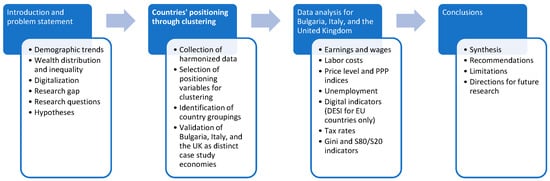
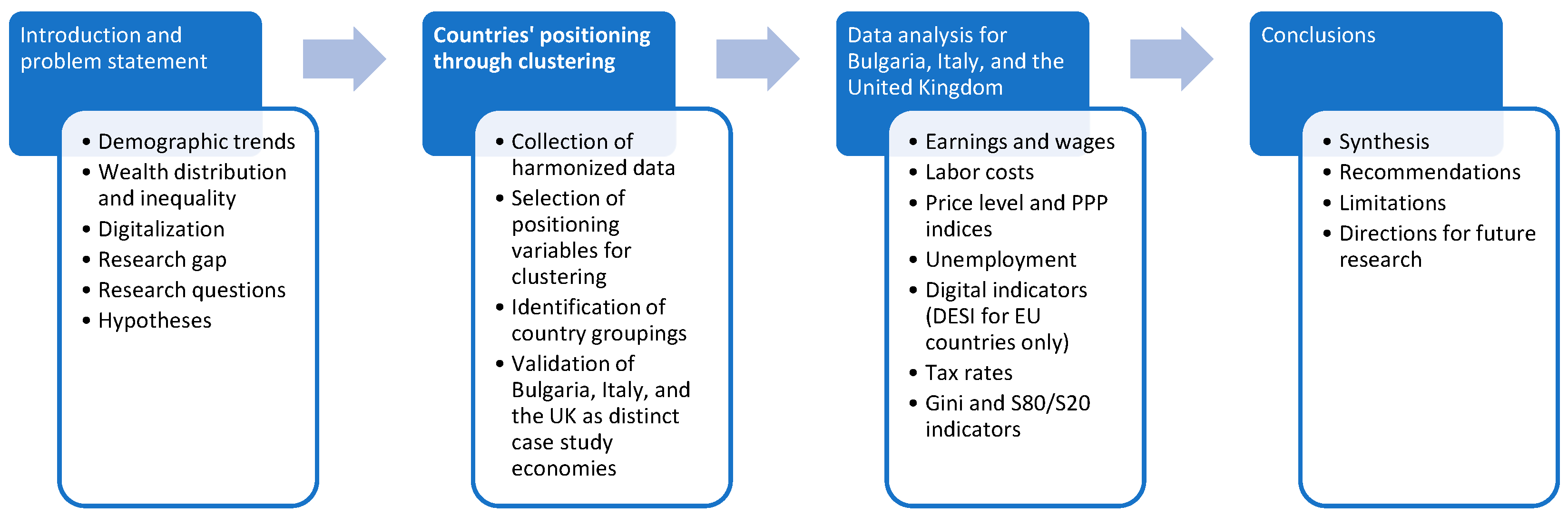
The core methodology centers on synthesizing theoretical approaches, clustering and statistical methods, and data visualization techniques. Figure 1 summarizes the research workflow and the sequence of empirical steps.
Figure 1.
Flowchart of this study.
Thus, this research proceeds in four main stages. First, a literature review based on Scopus-indexed papers (using 74 papers retrieved via Scopus AI recommendations and analyzed according to topical relevance) identifies key findings and gaps across core labor market trends, wealth distribution and inequality, and digitalization. Second, EU member states and the UK are clustered into a harmonized macro-indicator set for 2017–2024, comprising Eurostat GDP per capita in PPS, OECD average annual wage in EUR, and Eurostat unemployment rate (Eurostat, n.d.; OECD, n.d.). All indicators are standardized using z-scores before clustering. Candidate factor sets are screened using k-means internal validity metrics and repeated random seeds to verify seed robust silhouette performance, and Ward hierarchical clustering is applied to define groups of countries with similar profiles (Muharram et al., 2024; Zherlitsyn, 2024). Clustering is used as a positioning and case selection validation tool within the European country space rather than as a stand-alone structural classification of labor market models. The resulting grouping supports the selection of Bulgaria, Italy, and the UK as representative case study economies. Third, a comparative time-series analysis is conducted for Bulgaria, Italy, and the United Kingdom, integrating information on earnings and wages, labor costs and price level and PPP-related indices, unemployment, digital transformation (DESI for EU member states only), tax rates, and inequality measures (Gini and S80/S20), based on official open-data sources (Eurostat, n.d.; OECD, n.d.; DESI, n.d.; ONS, n.d.; WB, n.d.). Given the descriptive comparative design, the analysis focuses on harmonized definitions where available and explicitly treats remaining cross-country definitional differences as a methodological limitation in interpretation. Fourth, the results are synthesized to derive conclusions, identify limitations, and outline avenues for future research.
Python 3.12.9 libraries are used for data preparation, standardization, clustering, robustness diagnostics, and visualization, relying on pandas v2.3.3 and NumPy v1.26.4 for data handling, scikit-learn v1.7.2 and SciPy v1.16.1 for clustering and internal validity metrics, and matplotlib v3.10.6 and seaborn v0.13.2 for figures.
3. Results
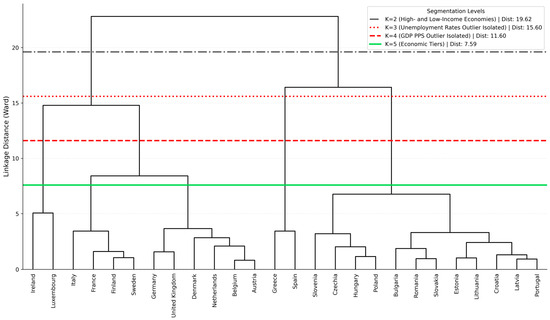
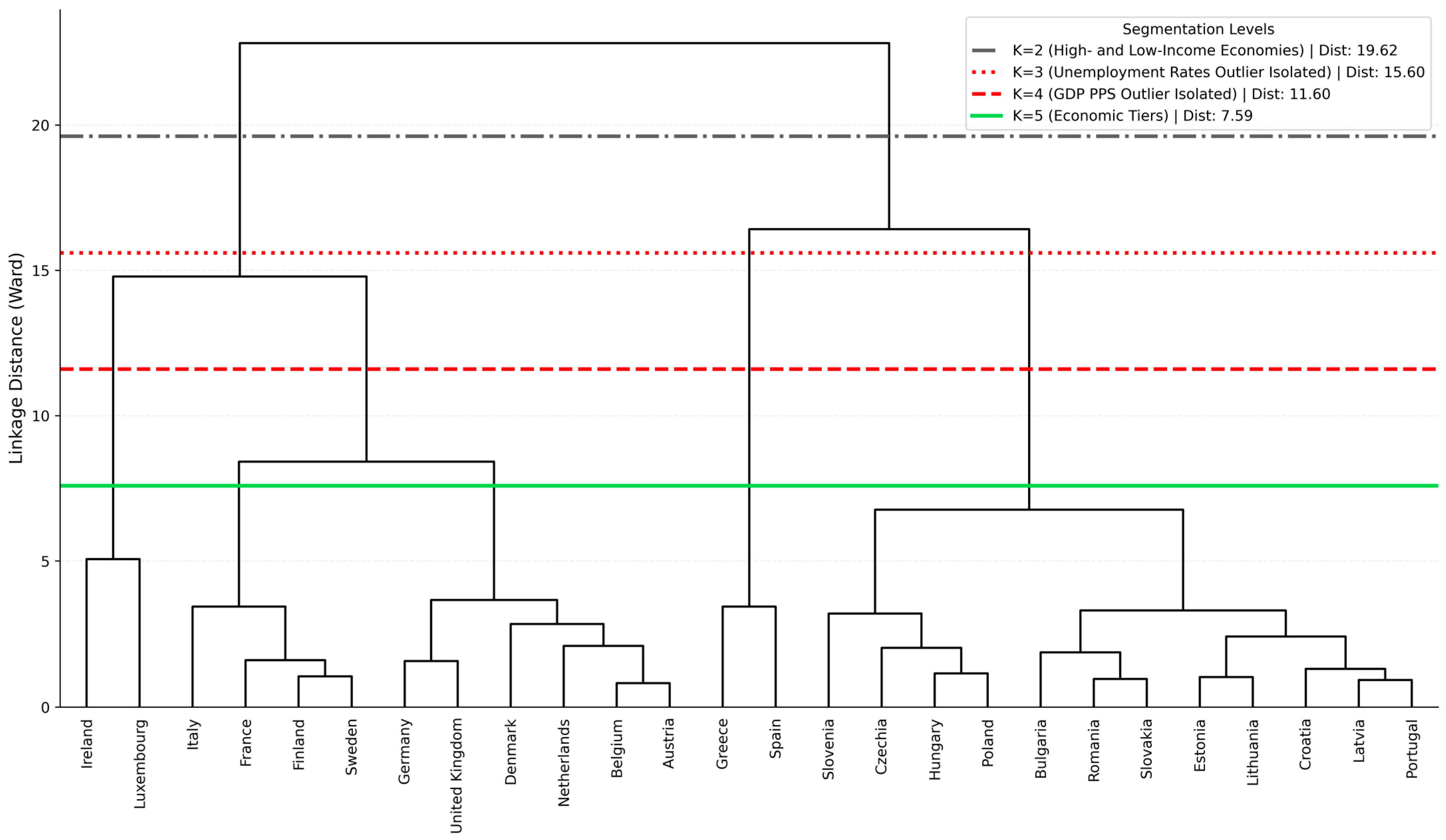
At the initial stage of the empirical research, the analysis starts with a parsimonious representation of cross-country differences based on three core indicators computed for 2017–2024 for the EU countries and the United Kingdom. The first is GDP per capita in PPS (tec00114 from Eurostat, n.d.), which captures the overall level of economic development and the standard of living. The second index is the average annual wage in EUR (OECD, n.d.), which reflects the level of labor income and cross-country differences in earnings capacity over the period. The third indicator is the unemployment rate (tipsun20 from Eurostat, n.d.; OECD, n.d., for UK data), capturing labor market slack and the degree of employment risk. The final clustering model was evaluated after alternative specifications, using four indicator combinations (GDP PPP, wage growth indices, annual wage in EUR, and unemployment) and two time series (2020–2024 and 2017–2024). However, the three-indicator segmentation proved the most robust and empirically meaningful with respect to internal validity and stability (Silhouette Score is around 0.5, seed stability 100%, and economic tiers and clusters are practically justified). Together, these indicators capture systematic cross-country differences in income levels and unemployment outcomes, which are closely related to fundamental managerial decisions shaping labor demand and hiring strategies for employers, as well as job choice, mobility, and human capital investment decisions for workers. The clustering analysis results are visualized in Figure 2.
Figure 2.
Clustering hierarchical structure of EU countries according to GDP per capita in PPS, annual average wage, and unemployment rate in 2017–2024.
Figure 2 presents the Ward hierarchical dendrogram constructed from standardized indicators. Standardization is performed using z-score normalization via the StandardScaler from scikit-learn (sklearn, 2025), applied to each indicator for each country. The dendrogram shows a clear tiered structure with two compact branches that behave as outlier-like groups and a broader core that further separates into economically interpretable tiers. Ireland and Luxembourg form a distinct, high-distance branch, driven by exceptionally high GDP per capita in PPS, suggesting that country-specific structural factors strongly influence their profiles and should be interpreted separately within the typology. Greece and Spain constitute a distinct outlier branch characterized by persistently high unemployment, indicating a structurally different labor market regime in which employment risk plays a dominant role relative to wage and income considerations.
To confirm that the observed structure is not an artefact of a single algorithm, k-means clustering is used as an auxiliary robustness check on the same standardized feature space. Stability is assessed across multiple random seeds using pairwise agreement of partitions, where the Adjusted Rand Index (ARI) corrects for chance agreement and is invariant to label permutations (adjusted_rand_score from sklearn, 2025). The obtained values are near unity across k, including a mean pairwise ARI of 0.998 at k equals 3, 1.000 at k equals 4 and 5, implying that the clustering solution is effectively reproducible with respect to initialization and that the partition is strongly identified by the data rather than by random starting conditions. Thus, the k-means clustering also exhibits structural stability from k equals 3 to k equals 5 in the sense that the same country groups remain together.
Although the maximum average silhouette (silhouette_score function from sklearn, 2025) is achieved at k = 4 (silhouette mean = 0.50), this study adopts k = 5 (silhouette mean = 0.47) for the final typology because it yields the most minor cut that simultaneously preserves the economically interpretable outlier-like branches and provides meaningful differentiation within the high-income core. At k = 4, the high-income countries remain in an overly aggregated cluster, obscuring the fact that Italy occupies a distinct position among more prosperous economies due to its combined profile across income, wages, and comparatively elevated unemployment. Therefore, k equals 5 is selected as a methodologically consistent and economically interpretable compromise between internal compactness and regime differentiation.
The solid line on the dendrogram of the hierarchical analysis indicates the final clustering. It is used to justify selecting Bulgaria, Italy, and the United Kingdom as representative case study economies, rather than to serve as this study’s central empirical contribution. Bulgaria represents the catching-up tier, characterized by low-income levels and distinct labor market constraints. The United Kingdom belongs to the high-income core tier, providing an advanced benchmark within the same indicator space. Italy is positioned within the richer group but remains structurally distinct, reflecting the fact that its labor market outcomes and income configuration differ materially from those of the northwestern core, making it a policy-relevant contrasting case. However, the outlier-like branches, notably Ireland and Luxembourg, and the high-unemployment group, Greece and Spain, warrant dedicated analysis in a separate study, and that within-cluster heterogeneity should be examined in more detail using richer covariates and sub-clustering procedures.
The next step is to move from the reduced three-dimensional representation to concrete evidence on wage dynamics in these three labor markets.
Table 1 summarizes nominal average annual wages for Italy, Bulgaria, and the United Kingdom; the cumulative HICP index with 2017 = 100.0; HICP-deflated real salaries for 2017–2024; and PLIs. This combination allows us to distinguish between simple nominal pay increases and genuine changes in purchasing power and to compare wage levels across countries after accounting for differences in price levels.
Table 1.
Nominal and HICP-deflated wages in Italy, Bulgaria, and the United Kingdom, 2017–2024 *.
In Italy, nominal average gross salaries grew only moderately over the period and even fell in 2020 amid the pandemic shock. During the period, the real average gross wage declined from EUR 29,243.1 in 2017 to EUR 27,482.9 in 2024 (around 6% decrease). The PLI also declined gradually from values slightly above the EU benchmark to values below it, from 104.7 in 2017 to 98.1 in 2024. This indicates a gradual decline in relative price levels, but the decrease in real earnings fully covers it. This configuration is consistent with the image of a mature but slow-growing labor market in which workers experience persistent pressure on purchasing power.
In Bulgaria, nominal average gross salaries increased strongly between 2017 and 2024, rising from EUR 7357.9 to EUR 14,387.2, which corresponds to 95.5% nominal growth. The cumulative HICP accelerated after 2021, and real wages increased from EUR 7357.9 in 2017 to EUR 9408.1 in 2021 and further to EUR 10,444.2 in 2024, an overall gain of about 41.9%. At the same time, the PLI remained very low by European standards, rising from around 46.7 to about 56.9. This means that even after strong real wage growth and some price convergence, Bulgarian wage earners still face much lower absolute income levels and cost structures than workers in Italy or the United Kingdom. Thus, the analyzed data confirm the catching-up nature of the Bulgarian labor market, with rapid gains from a very low starting point and a remaining distance to the EU average.
Average annual wages in the United Kingdom, expressed in euros, increased in nominal terms from EUR 39,691.7 in 2017 to EUR 52,923.6 in 2024. When adjusted for the HICP, real wages remain broadly stable and end slightly above the initial level, increasing from EUR 39,691.7 in 2017 to EUR 40,846.1 in 2024, which corresponds to a 2.9% increase over 2017–2024. The PLI was consistently well above the EU benchmark, fluctuating around a high level and rising modestly since 2017, from 121.5 in 2017 to 129.1 in 2024, suggesting that both wages and prices are high by comparative standards. These data indicate that the British labor market combines high wage levels with limited real improvement over the period.
The overall conclusion from Table 1 is that Bulgaria, as a country in a low-income cluster, exhibits substantial real-wage convergence from a very low base, Italy faces mild real-wage erosion in a high-income country, and the United Kingdom maintains high nominal wage levels and high price levels with a slight real decline over time. This wage-based comparison focuses on what workers receive. The next step is to examine what employers pay per hour of labor, including wages and non-wage components, to assess labor cost competitiveness and the distribution of the cost burden between direct pay and social contributions.
Table 2 presents nominal labor costs per hour and their growth rates for the whole economy in Italy, Bulgaria, and the United Kingdom, benchmarked against the EU-27 average. Table 2a reports levels of labor costs per hour and the share of non-wage costs, while Table 2b shows the annual percentage change in labor cost indices.
Table 2.
Nominal labor cost per hour and labor cost growth in Italy, Bulgaria, and the United Kingdom, 2008, 2012, 2016, and 2020–2024, EUR per hour. (a) Labor cost per hour, EUR, whole economy *. (b) Labor cost index growth, percentage change from the previous year.
Table 2a indicates that the EU-27 average labor cost per hour rises from about EUR 21.6 in 2008 to EUR 33.5 in 2024. Over the same period, Bulgaria’s hourly wage rose from EUR 2.6 to 10.6. This implies that Bulgarian labor costs have more than quadrupled in nominal terms yet remain roughly one-third of the EU average in 2024. At the same time, the share of non-wage costs in Bulgaria declined from 18.4% to 13.3%, confirming a relatively light burden of social contributions and payroll taxes compared with the EU average, where the non-wage share remains close to one quarter of total labor costs. Supposing these dynamics are viewed alongside the cumulative HICP from Table 1, they indicate that a significant share of the nominal increase in labor costs in Bulgaria translates into higher real labor costs, since cumulative inflation over 2017–2024 has been relatively contained relative to the fourfold rise in nominal labor costs.
Italy shows high and relatively stable labor costs per hour. Values fluctuate around EUR 25–28 in the pre-pandemic period and reach about EUR 30.9 in 2024, which is slightly above the EU average. The share of non-wage costs is consistently close to 28% and shows little change over the years. This configuration corresponds to a high-cost labor market in which employers pay substantial social contributions on top of wages, and where the relative structure of costs has been stable over time. In combination with the modest cumulative HICP increase in Italy, the slow growth of nominal labor costs suggests only limited growth in real labor costs for employers, consistent with the stagnation of or slight decline in real wages documented in Table 1.
For the United Kingdom, Eurostat labor cost index data in euros are available for earlier years but not for the entire period; therefore, the analysis uses the national measure of annual average labor compensation per hour worked. This series increases from EUR 21.7 in 2008 to EUR 31.5 in 2024. At the beginning of the period, British labor costs per hour are slightly below the EU average and converge to a level only slightly above it by 2024. Earlier information on the non-wage share indicates that social contributions account for a smaller share of labor costs in the United Kingdom than in Italy or the EU average. However, comparable breakdowns are not available for more recent years. When these labor cost developments are compared with the cumulative HICP and real-wage path in Table 1, they indicate that rising nominal labor costs mainly offset higher prices, so that real labor costs and real median earnings change only moderately over time.
Table 2a complements the obtained results and supports the identified trends of the labor cost index, with Italy often below the EU average and even recording slight declines in some years. Bulgaria, in contrast, records persistently high growth rates, several times above the EU figures, which is consistent with a rapid but still incomplete convergence process. The United Kingdom occupies an intermediate position: hourly labor compensation grows steadily and accelerates around 2020–2022, but not at a pace comparable to that of Bulgaria.
From a comparative perspective, Table 2 confirms that Bulgaria is a low-wage, low-cost economy undergoing fast cost convergence with a declining share of non-wage components; Italy is a high-cost economy with a large and stable non-wage share and modest cost growth; and the United Kingdom, as a comparator, has labor costs close to the EU average, growing at moderate rates with a leaner non-wage structure.
This configuration imposes different constraints and incentives on firms and workers across the three labor markets. It lays the groundwork for analyzing unemployment, tax wedges, and inequality in the following subsections.
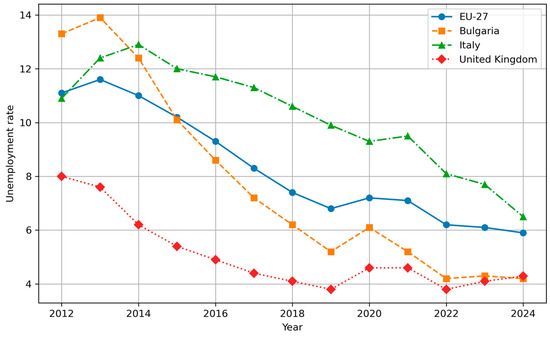
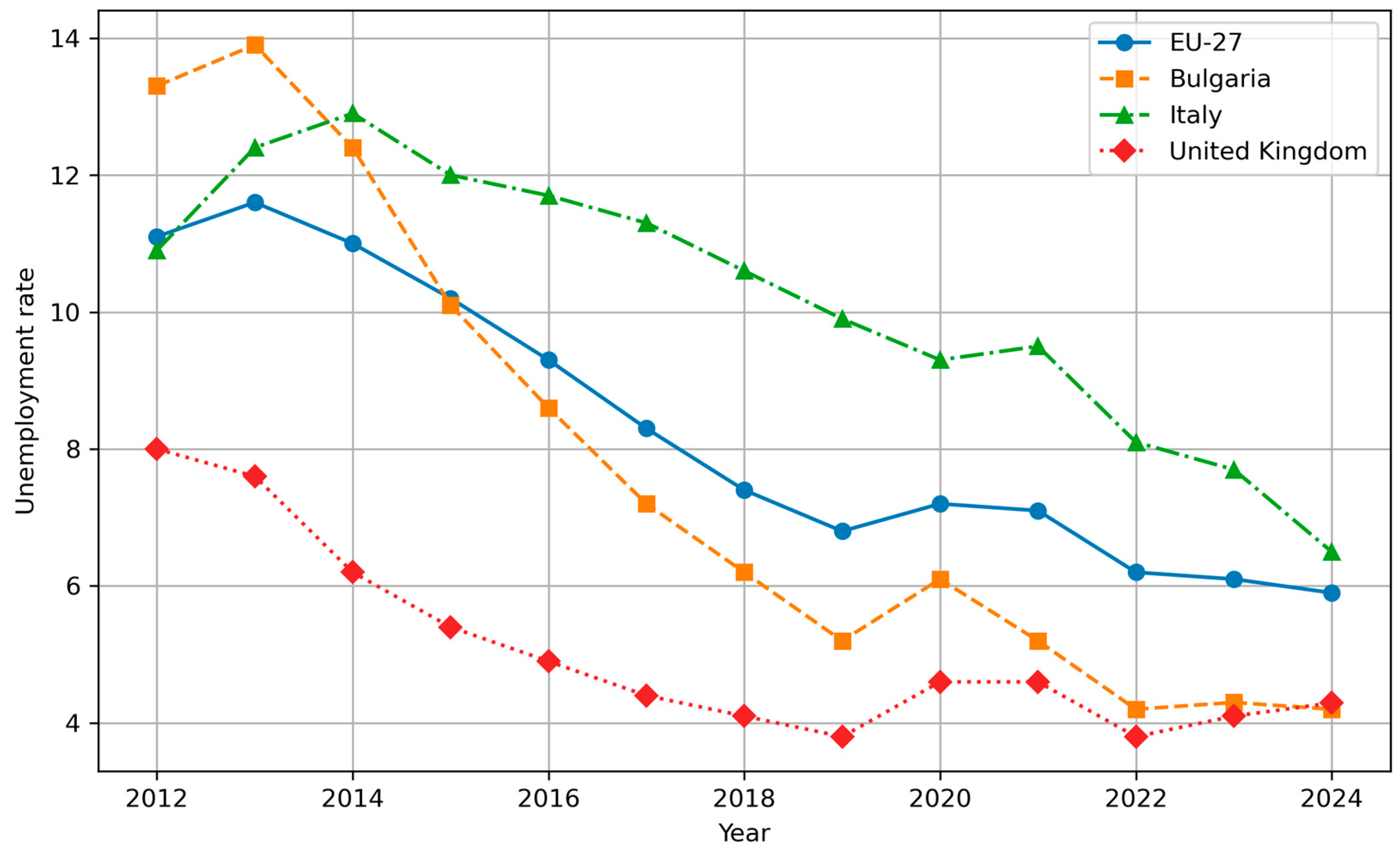
The unemployment series for 2012–2024 provides a first test of how these different wage and cost structures translate into labor absorption capacity. Figure 3 shows that Bulgaria starts the period with one of the highest rates among the three countries, about 13–14% in 2012–2013. However, by 2019, unemployment fell to 5.2% and stabilized around 4.2–4.3% in 2022–2024. This trajectory confirms that the Bulgarian labor market has shifted from mass unemployment to relatively tight conditions, even though wages and labor costs remain well below the EU average.
Figure 3.
Unemployment rate in Bulgaria, Italy, the United Kingdom, and the European Union, 2012–2024, % of labor force. Sources: tipsun20 from (Eurostat, n.d.); percentage of labor force in the same subgroup for the UK from (OECD, n.d.).
The Italian labor market follows another path. Unemployment was around 11–13% in 2012–2015, then decreased slowly, and reached only 6.5% in 2024. Thus, Italy stays mainly above the EU average and well above the United Kingdom. This persistence is consistent with the combination of high labor costs (Table 2), rigid institutions, and regional dualism described in the literature. It helps explain why improvements in employment outcomes do not accompany related wage growth in Italy.
The United Kingdom displays the most stable unemployment dynamic. The rate declines from around 8% in 2012 to around 4% in 2022–2024. Throughout the entire period, British unemployment has remained below the EU average. In conjunction with the wage and cost data, this pattern points to a labor market that combines high income levels with strong employment performance, even if real-wage gains are limited.
The EU-27 average lies between these countries’ trajectories. Unemployment is slightly above 11% in 2013 and declines gradually to around 6% by 2023 and to 5.9% in 2024. Bulgaria converges downward toward this benchmark and eventually slightly below it, while Italy converges more slowly from above, and the United Kingdom remains consistently below it.
Thus, the analysis of the unemployment rate shows the contrast already suggested by wages and labor costs. Bulgaria has managed to sharply reduce unemployment despite rapid wage and labor cost growth from a low base. Italy combines high costs with persistently high unemployment for most of the period. The United Kingdom maintains low unemployment alongside high wages and average labor costs. These differences are essential for understanding how tax wedges and the distribution of income and wealth shape effective labor market outcomes in the next part of the analysis.
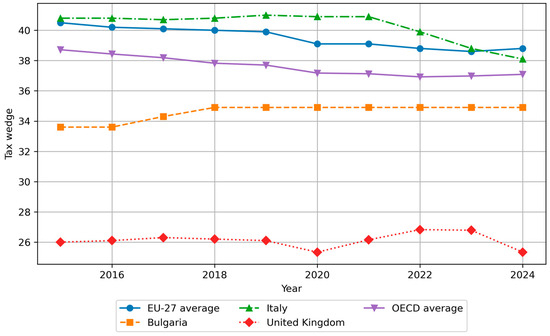
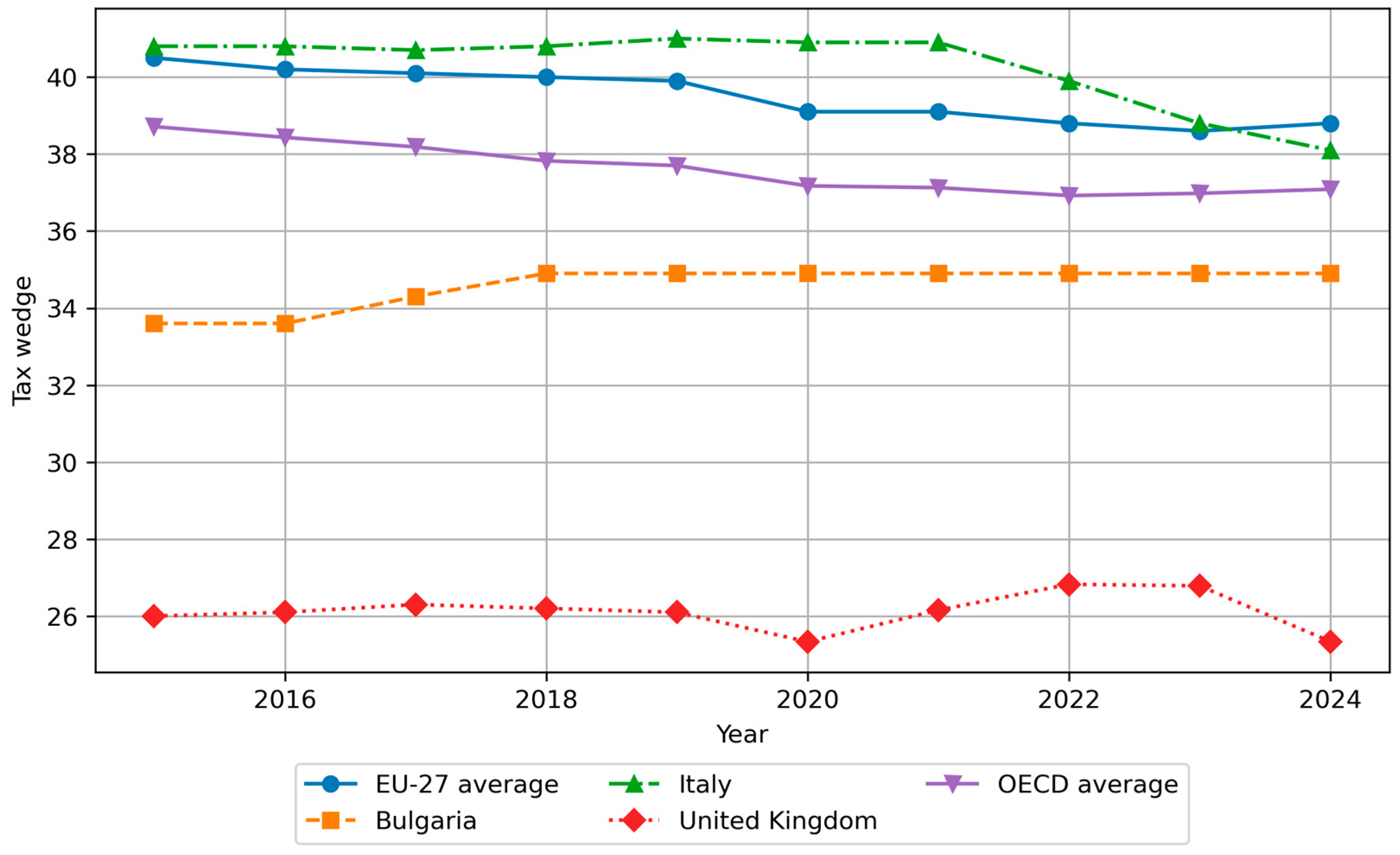
The tax burden on labor is examined in two steps. Table 3 reports effective tax rates on labor for a wide range of household types in 2015, 2019, and 2024, expressed as a share of gross earnings; however, it does not include UK data for 2024. Figure 4 shows the tax wedge, followed by a single benchmark case (a low-wage single worker earning 67% of average earnings) for all countries analyzed. It shows the evolution of the combined burden on labor costs from 2015 to 2024, compared with EU and OECD averages.
Table 3.
Tax rate on labor for selected household types in Italy, Bulgaria, and the United Kingdom, 2015, 2019, and 2024, as a percentage of gross earnings *.
Figure 4.
Tax wedge on labor costs for a low-wage worker in Bulgaria, Italy, the United Kingdom, and the European Union, 2015–2024 (% of labor costs). Sources: Eurostat and OECD datasets: earn_nt_taxwedge from (Eurostat, n.d.); average tax wedge (67% of average wage) from the (OECD, n.d.).
Table 3 reveals several essential regularities in the structure of labor taxation. In Bulgaria, most profiles cluster around a tax rate of approximately 22% of gross earnings across all observed years. This is evident among single persons without children earning between 50 and 167% of the average wage, as well as in most couple profiles. Such a pattern confirms the essentially flat nature of the Bulgarian system. The main deviations from this flat schedule appear in a limited set of family profiles with children, namely a single person with two children earning 67% of the average earnings, a one-earner couple with two children at 100% of the average earnings, and two-earner couples with two children where one partner earns 100%. The other 67% or both earn 100% of the average. In these cases, the effective tax rate is somewhat lower, reflecting modest family-related reliefs. In addition, a comparison between 2015 and 2024 shows that, for most Bulgarian profiles, the overall tax rate is slightly higher in 2024, suggesting that the flat structure is preserved but the aggregate burden has increased.
Italy displays a much more differentiated and clearly progressive pattern. For single persons without children, the effective tax rate rises sharply with income. The tax share for a worker earning 100% of the average wage is already high, and it increases further for those earning 125% and 167% of the average wage, reaching the highest values among all profiles and countries considered. In contrast, several families with children in Italy bear a much lower burden, often about half the rate applied to high-income singles. This is particularly evident for a one-earner couple with two children at average earnings, for a two-earner couple with two children in which one partner earns 100% and the other 33% of average earnings, and for a single person with two children at 67% of average earnings. In these cases, the effective tax rate can fall below the Bulgarian rate. The lowest observed tax rate in Table 3 is, in fact, recorded in Italy for a single person with two children earning 67% of the average wage, where the effective rate becomes negative in some years, which indicates that family benefits and tax credits exceed direct taxes and contributions and that the system acts as a net transfer for this profile.
The United Kingdom shows an intermediate position in 2015 and 2019. For many profiles, effective tax rates are roughly 18%, lower than in Italy but higher than in the most favorable Bulgarian family cases. The schedule is progressive, with tax shares increasing with income for single workers and for couples, though the gradient is less steep than in Italy. The same favorable patterns as in Italy are visible, with low or even negative tax rates for low-wage families with children, driven by targeted benefits and credits. While detailed UK data for 2024 are not available in Table 3, the earlier years suggest a design that combines moderate average tax rates with some progressivity and strong support for low-income families.
For all four lines in Figure 4, the tax wedge on labor costs is relatively stable over time, and year-to-year fluctuations do not exceed about 3–4 p.p. The United Kingdom consistently records the lowest tax wedge in the sample, around 25–26% throughout the period, with only a slight temporary increase in 2022–2023, confirming a persistently lighter burden on low-wage work than in the EU and OECD averages. Bulgaria also maintains a tax wedge below both the EU-27 and the OECD averages. Still, its level remains about 10 p.p. higher than that of the United Kingdom. Italy presents a markedly different profile. Until 2023, its tax wedge is stable, though only moderately, above the EU and OECD lines, reinforcing the view that Italy is close to a typical average EU country in labor market outcomes while still imposing one of the highest tax burdens on low-wage employment among the three cases considered, despite its high or upper-middle level of GDP per capita.
Putting these elements together, Bulgaria combines a moderate but rigid tax burden with a nearly flat schedule and only limited relief for selected family-with-children profiles. Italy exhibits the highest and most progressive tax structure among the three countries, with heavy taxation of high-income singles and much lighter—sometimes even negative—effective rates for some low-income families. The United Kingdom generally applies lower tax rates than Italy and similar or lower rates than Bulgaria, with a milder progression and more substantial support for low-wage families. These differences in the design and level of labor taxation are a key channel through which wage and cost structures are converted into disposable income, and they directly shape the inequality patterns analyzed in the following.
Table 4 summarizes income inequality using the S80/S20 quintile ratio and the Gini index for 2014–2024. For the EU, both measures show a steady improvement. The S80 over S20 ratio drops from about 5.2 in 2014 to 4.7 in 2024, and the Gini index decreases from 30.9 to 29.4. This indicates a moderate narrowing of the income gap in the Union, despite the pandemic and the recent inflation surge.
Table 4.
Income quintile share ratio (S80/S20) and Gini index in Bulgaria, Italy, the United Kingdom, and the European Union, 2014–2024 *. The source of data for the GINI index for the UK is the World Bank Database *.
Bulgaria consistently records the highest inequality among the three countries and remains well above the EU average. The S80-to-S20 ratio rises from 6.8 in 2014 to a peak of 8.2 in 2017 and 8.1 in 2019, then declines gradually to 6.6 in 2023 and increases to 6.96 in 2024. The Gini index fluctuated within a similar range, from 35.4 in 2014 to around 40 in 2017–2020, then declined to 37.2 in 2023, before rising again to 38.4 in 2024. These values confirm that rapid wage and employment gains in Bulgaria coexist with a highly unequal distribution of disposable income, and that the flat tax regime, even with some family reliefs, does not significantly compress the distribution of disposable income.
Italy occupies an intermediate position. Its S80/S20 ratio fluctuates within a narrow range of about 5.6–6.2, starting at 5.8 in 2014 and ending at 5.5 in 2024. The Gini index remains in the low thirties throughout, between 31.5 and 33.4, very close to the EU average and slightly above it in most years. This pattern is consistent with a high-cost labor market coupled with a strongly progressive tax and transfer system that partially offsets market inequalities. Still, it does not reduce them to the levels seen in the EU on average.
The United Kingdom exhibits greater volatility, with no discernible trend. The S80/S20 ratio increases from 5.1 in 2014 to 6.2 in 2019. This indicates a widening gap between the top and bottom income quintiles, resulting in a range of 5.5–5.6 at the end of the period. The Gini index, based on World Bank data, remains above the EU average in all years, peaking at 35.5 in 2022 before falling back to 32.9 in 2024. This suggests that the combination of high wages, a relatively low tax wedge, and targeted state transfers yields higher inequality than the EU average.
Overall, the inequality indicators confirm the broader narrative. Bulgaria is a low-wage, fast-converging economy with the highest inequality among the three cases. Italy represents a high-cost, high-tax, medium-inequality regime that is close to the EU median. The United Kingdom combines high income and good employment performance with comparatively high and more volatile inequality. These results ground the final discussion of how digitalization and the diffusion of artificial intelligence may interact with existing labor market and distributional structures in each country.
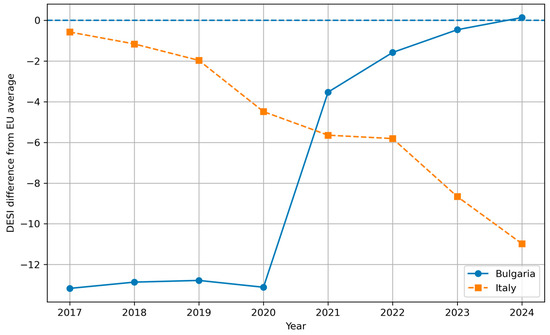
Figure 5 presents the DESI gap relative to the EU average for Bulgaria and Italy. In this context, the DESI gap is simply the distance between a country’s DESI score and the EU benchmark each year.
Figure 5.
DESI difference from EU average (points). Source: The Digital Economy and Society Index datasets (DESI, n.d.).
The figure allows the analysis to move from the question of absolute scores to the more policy-relevant question of which countries are ahead or behind the standard European reference level, and by how many index points. The DESI ranges from 0 to 100 and accounts for several dimensions of digital development, including connectivity, human capital, internet use, corporate digital integration, and digital government services (DESI, n.d.). The gap is measured in index points as the difference between each country’s score and the EU-27 average.
For Bulgaria, the DESI gap is strongly negative and significant at the beginning of the period. In 2017, the Bulgarian score was about 66.2 points, compared with an EU average of 79.3, implying a gap of roughly −13.1 points. The gap remained close to −12.0 to −13.0 points in 2018–2020, indicating a pronounced digital lag despite rapid convergence in wages and employment. From 2021 onwards, the trajectory changes. The gap narrows to about −3.6 points in 2021, further to roughly −1.6 points in 2022, and to around −0.4 points in 2023. In 2024, Bulgaria has slightly exceeded the EU average with a positive gap of approximately 0.1 points. This evolution indicates a rapid reduction in digital inequality over a short period, consistent with accelerated improvements in connectivity, basic skills, and digital public services. However, the earlier years still document a long phase of underinvestment and delay.
Italy follows the opposite path. In 2017, its DESI score was only slightly below the EU average, at approximately 78.8 versus 79.3, indicating a gap of roughly −0.5 points. In 2018–2019, the difference remains small, ranging from about −1.5 to −2.0 points. After 2020, however, Italy started to fall behind. The gap widens to roughly −4.5 points in 2020 and to around −5.6 to −5.8 points in 2021–2022. Divergence has accelerated over the last 2 years, with a gap of about −8.7 points in 2023 and almost −11.0 points in 2024. While Bulgaria moves from a double-digit negative gap to parity with the EU average, Italy moves from near parity to a sizeable deficit. This suggests that, despite its income level, Italy has not kept pace with the European frontier in business digitalization and digital public services, which may constrain its capacity to generate high-productivity, AI-intensive jobs.
Taken together, as seen in Figure 5, the results reveal a double digital divide. First, there is the long-standing gap between early-lagging members and the EU average, which Bulgaria has only closed in the most recent years. Second, there is a new divergence between Italy and the EU average, indicating that a high-income, high-tax labor market does not automatically yield high and stable digital and AI-related capabilities, or suggesting an inverse relationship.
An essential limitation concerns international comparability. The European Commission constructs the DESI for EU member states only. The 2020 edition still reported the United Kingdom, but the subsequent DESI exercises for 2021–2022 are explicitly restricted to the EU-27 and publish country profiles only for these states. In the overall DESI, the UK scored 60.4 points in 2020, against an EU average of 52.6, after 56.6 vs. 49.4 in 2019 and 53.5 vs. 46.5 in 2018. This implies a positive DESI gap of approximately 7–8 points per year and places the UK in rank 8 among the 28 countries, in the upper third of the EU distribution. This short period shows that both the UK and the EU improved steadily between 2018 and 2020. Still, the distance between them was roughly constant, so the EU did not converge to the British level during this period. However, there are no official DESI scores for the United Kingdom that are fully comparable with the more recent DESI values used for Bulgaria and Italy in this study. The United Kingdom has national composite indicators, such as the Consumer Digital Index and the Business Digital Index, which are used to monitor digital skills and the digital maturity of households and SMEs; however, their scope and methodology differ substantially from those of the DESI. Any attempt to include the United Kingdom in the DESI-based gap analysis would therefore require a separate harmonization of these national indicators or the construction of a new, integrated measure of digital and AI readiness.
4. Discussion
The empirical results clarify how Bulgaria, Italy, and the United Kingdom fit within the broader European labor market landscape and answer the two research questions by linking country positioning in the EU convergence space to the distributional and digital mechanisms observed in the country-level indicators.
Regarding RQ1, the evidence indicates three distinct convergence trajectories within a single indicator space. Bulgaria’s position reflects a catching-up pathway in which wage and cost levels converge from a low base alongside improving unemployment outcomes. Italy occupies a high-income position but shows weak wage dynamics and relatively high unemployment, indicating divergence in workers’ purchasing power despite nominal stability. The United Kingdom remains in the mature, high-income group and combines low unemployment with high wage levels, providing a benchmark rather than a convergence target for EU members. These patterns are consistent with earlier descriptions of Bulgaria as a catching-up economy characterized by persistent structural labor market problems and policy-driven post-crisis adjustment (Loukanova & Tzanov, 2015) and by a highly unequal distribution of household wealth despite income convergence (Peshev, 2024) and of Italy as a high-income country with rising wealth concentration (Acciari et al., 2024) and a long-standing north–south dualism that constrains industrial and labor market development (Gaddi et al., 2021). In the UK, the combination of high GDP per capita, relatively modest real-wage growth, and low unemployment is consistent with a liberal labor market model in which income and wealth inequalities are shaped by long-term changes in wages, taxes, and benefits (Cribb, 2024) and by financialization and housing market dynamics (Blakeley, 2021).
At the same time, the detailed indicators show that convergence in wages and labor costs does not automatically translate into convergence in distributional outcomes or perceived well-being. Bulgaria registers the strongest real-wage growth and the sharpest decline in unemployment. However, it remains the most unequal of the three countries, as measured with the Gini coefficient and the S80/S20 ratio. This confirms earlier findings that Bulgaria’s flat tax and relatively limited social transfers leave much of the market income inequality intact, even during strong growth (Mihaylova & Bratoeva-Manoleva, 2017; Peshev, 2024). In other words, the country is converging in average wages but not in equality of outcomes. Italy occupies an almost opposite position: wage and employment dynamics are weak, but a progressive tax–benefit system and sizable non-wage labor costs help contain inequality, even as recent work documents persistent wealth concentration and polarization (Acciari et al., 2024; Fabiani, 2024). The UK combines high wages and low unemployment with relatively high and volatile income inequality. This resonates with studies that stress the role of financialization, housing market dynamics, and flexible labor institutions in shaping British income and wealth gaps (Blakeley, 2021; Tarne et al., 2022). In all three cases, the tax–benefit system and the structure of labor costs clearly mediate the transmission of macroeconomic trends into household incomes. Thus, the evidence answers RQ2 by showing that the wage–inequality relationship differs systematically across the three configurations because it is jointly conditioned by labor cost composition and tax–benefit redistribution, rather than by wage growth alone.
Digitalization and AI readiness provide an essential additional lens for interpreting how European labor markets differ. Bulgaria’s DESI trajectory indicates a rapid narrowing of the digital gap with the EU average over the last decade, in parallel with strong wage and employment convergence. This suggests that latecomer countries can compress digital distance relatively quickly once basic infrastructure and skills are in place. However, the persistence of high inequality and marked regional and ethnic divides (Borissova-Marinova, 2021; Imdorf et al., 2022) shows that digital catch-up alone does not resolve deeper structural problems. Italy, by contrast, exhibits a persistent DESI gap despite its higher income level and industrial base. Firm-level evidence supports this picture of selective and uneven adoption: advanced digital technologies and AI are more frequently implemented in better-positioned firms and regions (Cirillo et al., 2022; Berton et al., 2025; Freddi, 2018). In such a context, digitalization risks reinforcing existing north–south dualism and sectoral divides rather than acting as a general engine of convergence. The UK has emerged as an early adopter of platform work and algorithmic management, with high digital capabilities but clear signs of segmentation between standard and non-standard jobs (Collins & Atkinson, 2023; Rolf et al., 2022). Recent analyses of AI innovation in European regions suggest limited aggregate employment effects but meaningful distributional impacts on the labor share and regional gaps (Minniti et al., 2025; Buzzelli, 2025), which is consistent with the relatively high and volatile inequality indicators observed in the UK and, to a lesser extent, Italy.
The empirical findings support a systematic assessment of H1–H3. H1 is supported by the joint evidence from Table 1. Higher GDP per capita in PPS does not map monotonically onto real-wage dynamics or purchasing power outcomes. Italy remains a high-income economy in PPS terms. However, as Table 1 shows, there is a decline in real average annual wages over 2017–2024, while Bulgaria exhibits substantial real-wage gains from a low-income base. The United Kingdom indicates broadly stable real wages at a high level. H2 is supported with a precise institutional mechanism. Table 2 indicates a significant and stable non-wage component of labor costs in Italy, and Figure 4, together with Table 3, documents a comparatively heavier and more progressive labor tax structure. Table 4 shows inequality levels close to the EU benchmark. However, Table 1 shows that these redistributive and labor cost structures coexist with weak real earnings dynamics, implying that redistribution moderates inequality but does not by itself generate real-wage growth. H3 is partially supported because the digital trajectory does not exhibit a uniform relationship with employment and wage outcomes. Figure 5 shows that Bulgaria closes the DESI gap while maintaining improved unemployment (Figure 3) and real-wage growth (Table 1), whereas Italy’s widening DESI gap coincides with weak wage dynamics. This heterogeneity suggests that digital readiness interacts with institutional and structural conditions rather than acting as an autonomous determinant of labor market performance.
Overall, the results support an interpretation of the debate over digitalization and AI, particularly after 2023, when large language models began to be widely deployed. Across the three countries under study, aggregate unemployment trends do not show a pattern consistent with massive, generalized job destruction during the observed period. Still, this inference should be interpreted as descriptive evidence rather than a causal estimate of AI effects, because multiple concurrent shocks and policies shape unemployment. The analysis does not isolate AI-specific exposure. Instead, the main effects appear to be distributional and structural: differences in who gains from productivity increases, how bargaining power is reshaped, and how regional and sectoral divides evolve (Cirillo et al., 2022; Minniti et al., 2025). Bulgaria’s experience illustrates that rapid wage growth and digital convergence can coexist with persistent inequality when redistribution and regional policy are weak (Mihaylova & Bratoeva-Manoleva, 2017; Peshev, 2024). Italy’s case suggests that high taxes and transfers can moderate income and wealth inequality but are not sufficient to overcome stagnation in real wages and digital adoption if underlying structural dualism and demographic pressures remain unaddressed (Gaddi et al., 2021; Acciari et al., 2024; Cirillo et al., 2022). The UK demonstrates that a flexible, digital-intensive labor market can sustain high employment while still generating pronounced inequalities when combined with financialized housing markets and fragmented worker protections (Blakeley, 2021; Collins & Atkinson, 2023).
These findings point to directions for further research that extend the present framework beyond the current scope rather than revising its core identification strategy. First, the clustering framework used here could be extended to incorporate additional variables, such as inequality, tax rates, poverty traps, social protection efforts, labor market policies, and digital indicators, to develop a richer typology of European labor markets. Second, the interaction between labor market change, digitalization, and institutional settings merits a more granular analysis, for example, at the regional, sectoral, or other structural level, to understand how AI and automation reshape job quality and mobility in specific segments of the workforce. Third, the outlier countries identified in the clustering stage require particular attention, because their systematic deviation from cluster profiles may indicate emerging structural vulnerabilities or policy-specific trajectories that standard group averages do not capture. Finally, given the pace of technological change, repeated comparative assessments of this kind will be needed to determine whether the tentative patterns identified for 2017–2024 persist, intensify, or reverse under future shocks and policy responses.
5. Conclusions
In this article, the two research questions concern, first, the position of Bulgaria, Italy, and the UK within the more expansive European convergence space and its country groupings defined by GDP per capita in PPS, wage level and dynamics, and unemployment outcomes, and second, the main similarities and differences in their labor market structures once distributional and digital aspects are considered. The clustering results clearly differentiate the three countries. Bulgaria is among the low-income EU economies, with relatively rapid growth in wages and labor costs and improving unemployment outcomes. Italy is classified as a high-income country but exhibits slow, sometimes negative, real-wage dynamics and comparatively weak labor market performance. The United Kingdom, used as an external comparator, is close to the mature high-income group, with high earnings and labor costs and low unemployment. In this sense, RQ1 can be answered by noting that the three countries occupy distinct positions along the combined axes of income level, wage dynamics, and unemployment and thus face different trajectories of convergence or divergence.
The comparison of wages, labor costs, tax wedges, inequality indicators, and digitalization measures across countries addresses the second research question. Bulgaria has experienced the strongest real-wage growth and the most significant decline in unemployment. However, it also remained the most unequal of the three countries, according to the Gini and S80/S20 indices. Italy combined high labor costs and a significant non-wage component with weak wage and employment dynamics, while keeping inequality around the EU average through its tax–benefit system. The United Kingdom exhibited high wage levels and persistently low unemployment, along with a relatively low tax wedge on low wages and inequality indicators that exceeded the EU benchmark in most years. At the same time, DESI and related indicators showed that Bulgaria has reduced its digital gap relative to the EU average, while Italy has widened its digital lag despite its income level. These patterns indicate that high income does not necessarily imply high digital engagement. At the same time, aggregate unemployment dynamics over the observed period do not indicate a sharp employment contraction contemporaneous with the diffusion of generative AI. Still, this evidence is descriptive and cannot be interpreted as a causal estimate of AI effects. These analytical results provide evidence supporting RQ2 by demonstrating that the joint interaction of wage dynamics, labor cost and taxation structures, inequality outcomes, and digital readiness differs systematically across the three configurations.
The main contribution of this study lies in bringing these elements together in a single empirical framework, combining cluster analysis with an indicator-rich comparison for three representative European labor market configurations. Rather than focusing on a single dimension, this research considers income levels and wage dynamics jointly with labor costs, redistribution, inequality, and digitalization outcomes. The results suggest that rapid wage and digital convergence, as in Bulgaria, do not automatically imply convergence in distributional outcomes; that high taxation and social contributions, as in Italy, can stabilize inequality but may coexist with weak or declining real wages; and that high employment and income levels, as in the UK, do not preclude relatively high inequality.
Author Contributions
Conceptualization, D.Z. and N.R.; methodology, D.Z.; software, D.Z.; validation, D.Z. and N.R.; formal analysis, D.Z. and N.R.; investigation, D.Z. and N.R.; resources, D.Z.; data curation, D.Z. and N.R.; writing—original draft preparation, D.Z.; writing—review and editing, D.Z. and N.R.; visualization, D.Z.; supervision, D.Z.; project administration, N.R. All authors have read and agreed to the published version of the manuscript.
Funding
This research received no external funding.
Data Availability Statement
All data used in this study are publicly available from official statistical databases, including Eurostat (https://ec.europa.eu/eurostat/ accessed on 15 November 2025), the European Commission Digital Economy and Society Index (https://digital-strategy.ec.europa.eu/en/policies/desi accessed on 15 November 2025), the UK Office for National Statistics (https://www.ons.gov.uk/ accessed on 15 November 2025), World Bank Open Data (https://data.worldbank.org/ accessed on 15 November 2025), and the OECD Data Explorer (https://data-explorer.oecd.org accessed on 15 November 2025).
Acknowledgments
The authors gratefully acknowledge the support provided by the UNITe project BG16RFPR002-1.014-0004, funded by PRIDST, in terms of research infrastructure, collaboration, and thematic discussions; this project did not provide direct financial support for the empirical analysis or the preparation of this manuscript. During the preparation of this manuscript, the authors used Scopus AI (Elsevier) to collect initial references for the literature review; Grammarly Desktop 1.144.1 (Superhuman) and ChatGPT (OpenAI, GPT-5.1 Thinking model) for language polishing, minor text editing, and debugging analytical programming code. The authors have reviewed and edited all AI-assisted output and take full responsibility for the final content of this publication.
Conflicts of Interest
The authors declare no conflicts of interest.
References
- Acciari, P., Alvaredo, F., & Morelli, S. (2024). The concentration of personal wealth in Italy 1995–2016. Journal of the European Economic Association, 22(3), 1228–1274. [Google Scholar] [CrossRef] [Scilit]
- Andreeva, A., Yolova, G., & Dimitrova, D. (2019). Artificial intellect: Regulatory framework and challenges facing the labour market. In CompSysTech’19: Proceedings of the 20th international conference on computer systems and technologies (pp. 74–77). Association for Computing Machinery. [Google Scholar] [CrossRef] [Scilit]
- Berton, F., Dughera, S., & Ricci, A. (2025). Advanced digital technologies in unionized firms. Italian Economic Journal, 11, 1015–1040. [Google Scholar] [CrossRef] [Scilit]
- Blakeley, G. (2021). Financialization, real estate and COVID-19 in the UK. Community Development Journal, 56(1), 79–99. [Google Scholar] [CrossRef] [Scilit]
- Borissova-Marinova, K. (2021). Demographic development and labour force: Dependencies and key changes. Economic Studies (Ikonomicheski Izsledvania), 30(6), 143–168. Available online: http://archive.econ-studies.iki.bas.bg/2021/2021_06/2021_06_08.pdf (accessed on 15 November 2025).
- Buzzelli, G. (2025). Automation and segmentation: Downgrading employment quality among the former “insiders” of Western European labour markets. International Journal of Social Welfare, 34(2), e70011. [Google Scholar] [CrossRef] [Scilit]
- Cirillo, V., Fanti, L., Mina, A., & Ricci, A. (2022). New digital technologies and firm performance in the Italian economy. Industry and Innovation, 30(1), 159–188. [Google Scholar] [CrossRef] [Scilit]
- Collins, P., & Atkinson, J. (2023). Worker voice and algorithmic management in post-Brexit Britain. Transfer: European Review of Labour and Research, 29(1), 37–52. [Google Scholar] [CrossRef] [Scilit]
- Cribb, J. (2024). Labour market and income inequalities in the United Kingdom, 1968–2021. Fiscal Studies, 45, 131–142. [Google Scholar] [CrossRef] [Scilit]
- DESI (Digital Economy and Society Index). (n.d.). European commission. Available online: https://digital-strategy.ec.europa.eu/en/policies/desi (accessed on 15 November 2025).
- Eurostat. (n.d.). Eurostat database. European Commission. Available online: https://ec.europa.eu/eurostat/ (accessed on 15 November 2025).
- Fabiani, M. (2024). Wealth polarization in western countries. Structural Change and Economic Dynamics, 71, 557–567. [Google Scholar] [CrossRef] [Scilit]
- Freddi, D. (2018). Digitalisation and employment in manufacturing: Pace of the digitalisation process and impact on employment in advanced Italian manufacturing companies. AI and Society, 33, 393–403. [Google Scholar] [CrossRef] [Scilit]
- Gaddi, M., Garbellini, N., & Garibaldo, F. (2021). The growing inequalities in Italy—North/South—And the increasing dependency of the successful north upon German and French industries. European Planning Studies, 29(9), 1637–1655. [Google Scholar] [CrossRef] [Scilit]
- Imdorf, C., Ilieva-Trichkova, P., Stoilova, R., Boyadjieva, P., & Gerganov, A. (2022). Regional and ethnic disparities of school-to-work transitions in Bulgaria. Education Sciences, 12, 233. [Google Scholar] [CrossRef] [Scilit]
- Keeble-Ramsay, D. (2018). Exploring the concept of positive ageing in the UK workplace: A literature review. Geriatrics, 3(4), 72. [Google Scholar] [CrossRef] [Scilit]
- Loukanova, P., & Tzanov, V. (2015). The Bulgarian labour market policies at the end of the crisis. Ikonomicheski Izsledvania (Economic Studies), 24(2), 3–30. Available online: https://www.ceeol.com/search/article-detail?id=287889 (accessed on 15 November 2025).
- Mihaylova, S., & Bratoeva-Manoleva, S. (2017). Social transfers and income inequality in Bulgaria. South East European Journal of Economics and Business, 12(1), 38–49. [Google Scholar] [CrossRef] [Scilit]
- Minniti, A., Prettner, K., & Venturini, F. (2025). AI innovation and the labor share in European regions. European Economic Review, 177, 105043. [Google Scholar] [CrossRef] [Scilit]
- Muharram, A. T., Nalawati, R. E., Warsuta, B., Malik Matin, I. M., Pradiptyas, A., & Natanael, M. (2024, October 3–4). Comparison of elbow, silhouette and DBI methods for clustering nutritional status of toddlers using K-means clustering. 12th International Conference on Cyber and IT Service Management (CITSM) (pp. 1–6), Batam, Indonesia. [Google Scholar] [CrossRef] [Scilit]
- OECD. (n.d.). OECD explorer data. Available online: https://data-explorer.oecd.org (accessed on 15 November 2025).
- Office for National Statistics (ONS). (n.d.). Data and publications: Newport, UK. Available online: https://www.ons.gov.uk/ (accessed on 15 November 2025).
- Peshev, P. (2024). Modelling wealth and wealth inequality in Bulgaria. Economic Alternatives, 30(2), 239–262. [Google Scholar] [CrossRef] [Scilit]
- Rolf, S., O’Reilly, J., & Meryon, M. (2022). Towards privatized social and employment protections in the platform economy? Evidence from the UK courier sector. Research Policy, 51(5), 104492. [Google Scholar] [CrossRef] [Scilit]
- Segarra-Blasco, A., Tomàs-Porres, J., & Teruel, M. (2025). AI, robots and innovation in European SMEs. Small Business Economics, 65, 719–745. [Google Scholar] [CrossRef] [Scilit]
- sklearn. (2025). Scikit-learn developers. Clustering documentation. Available online: https://scikit-learn.org/stable/modules/clustering.html (accessed on 15 November 2025).
- Tarne, R., Bezemer, D., & Theobald, T. (2022). The effect of borrower-specific loan-to-value policies on household debt, wealth inequality and consumption volatility: An agent-based analysis. Journal of Economic Dynamics and Control, 144, 104526. [Google Scholar] [CrossRef] [Scilit]
- WB. (n.d.). World Bank open data: Washington, DC, USA. Available online: https://data.worldbank.org/ (accessed on 15 November 2025).
- Zherlitsyn, D. (2024). Financial data analysis using Python. Mercury Learning and Information. [Google Scholar] [CrossRef] [Scilit]
- Zherlitsyn, D., Kolarov, K., & Rekova, N. (2025). Digital transformation in the EU: Bibliometric analysis and digital economy trends highlights. Digital, 5, 1. [Google Scholar] [CrossRef] [Scilit]

Disclaimer/Publisher’s Note: The statements, opinions and data contained in all publications are solely those of the individual author(s) and contributor(s) and not of MDPI and/or the editor(s). MDPI and/or the editor(s) disclaim responsibility for any injury to people or property resulting from any ideas, methods, instructions or products referred to in the content. |
© 2026 by the authors. Licensee MDPI, Basel, Switzerland. This article is an open access article distributed under the terms and conditions of the Creative Commons Attribution (CC BY) license.