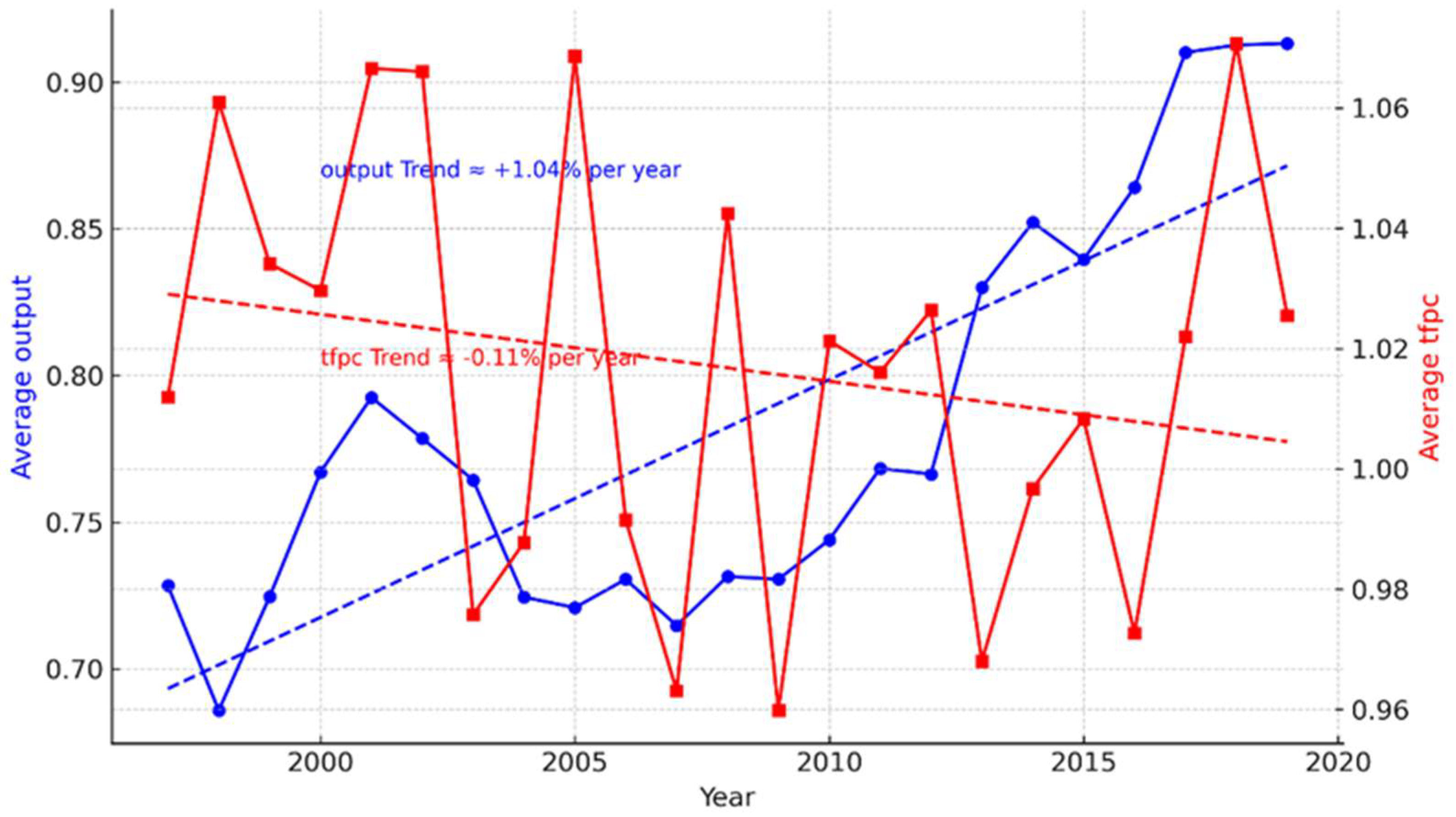

Tourism-Induced Data Envelopment Analysis (T-DEA): An Application in the Eurozone Economic Space



Abstract
1. Introduction
2. Theoretical Background
2.1. Efficiency and Productivity in the Tourism Sector
2.2. Energy Transition and Economic Efficiency
2.3. Criticism of DEA
2.4. Contribution to the Literature
3. Methodology
3.1. Output-Oriented Technical Efficiency T-DEA
3.2. TFPC
3.3. Panel Data Analysis
4. Results
4.1. Results of Output-Oriented Technical Efficiency
4.2. TFPC
4.3. Results of Cross-Section Dependence (CD) Tests
4.4. Results of Unit Root Tests
4.5. Results of Regression Analysis
5. Discussion
6. Conclusions
Author Contributions
Funding
Institutional Review Board Statement
Informed Consent Statement
Data Availability Statement
Conflicts of Interest
References
- Assaf, A. G. (2012). Benchmarking the Asia Pacific tourism industry: A Bayesian combination of DEA and stochastic frontier. Tourism Management, 33, 1122–1127. [Google Scholar] [CrossRef]
- Assaf, A. G., & Josiassen, A. (2012). Identifying and ranking the determinants of tourism performance: A global investigation. Journal of Travel Research, 51(4), 388–399. [Google Scholar] [CrossRef]
- Avkiran, N. K. (2006). Productivity analysis in the service sector with data envelopment analysis. SSRN Electronic Journal. [Google Scholar] [CrossRef]
- Banker, R. D., Charnes, A., & Cooper, W. W. (1984). Some models for estimating technical and scale inefficiencies in data envelopment analysis. Management Science, 30(9), 1078–1092. [Google Scholar] [CrossRef]
- Bano, S., Alam, M., Khan, A., & Liu, L. (2021). The nexus of tourism, renewable energy, income, and environmental quality: An empirical analysis of Pakistan. Environment Development Sustainability, 23, 14854–14877. [Google Scholar] [CrossRef]
- Barros, C. P., Botti, L., Peypoch, N., Robinot, E., Solonandrasana, B., & Assaf, A. (2011). Performance of French destinations: Tourism attraction perspectives. Tourism Management, 32, 141–146. [Google Scholar] [CrossRef]
- Barros, C. P., & Mascarenhas, M. J. (2005). Technical and allocative efficiency in a chain of small hotels. International Journal of Hospitality Management, 24(3), 415–436. [Google Scholar] [CrossRef]
- Bire, R. B., Nugraha, Y. E., & Pellokila, I. M. (2025). Tourist attraction efficiency and its determinants using a two stage, double bootstrap data envelopment analysis: A case study in Indonesia. Journal of Policy Research in Tourism, Leisure and Events, 17(1), 18–35. [Google Scholar] [CrossRef]
- Chiang, W.-H., Tsai, M.-H., & Wang, L.-J. (2004). A DEA evaluation of Taipei hotels. Annals of Tourism Research, 31(3), 712–715. [Google Scholar] [CrossRef]
- Choi, K., & Kim, J. (2024). Measuring hotel service productivity using two-stage network DEA. Sustainability, 16(20), 8995. [Google Scholar] [CrossRef]
- Chudik, A., & Pesaran, M. H. (2015). Common correlated effects estimation of heterogeneous dynamic panel data models with weakly exogenous regressors. Journal of Econometrics, 188(2), 393–420. [Google Scholar] [CrossRef]
- Corne, A. (2015). Benchmarking and tourism efficiency in France. Tourism Management, 51, 91–95. [Google Scholar] [CrossRef]
- Croes, R., & Kubickova, M. (2013). From potential to ability to compete: Towards a performance-based tourism competitiveness index. Journal of Destination Marketing & Management, 2(3), 146–154. [Google Scholar] [CrossRef]
- Cuccia, T., Guccio, C., & Rizzo, I. (2017). UNESCO sites and performance trend of Italian regional tourism destinations: A two-stage DEA window analysis with spatial interaction. Tourism Economics, 23(2), 316–342. [Google Scholar] [CrossRef]
- De Hoyos, R., & Sarafidis, V. (2006). Testing for cross-sectional dependence in panel-data models. The Stata Journal, 6(4), 482–496. [Google Scholar] [CrossRef]
- Destek, M. A., & Aydın, S. (2022). An empirical note on tourism and sustainable development nexus. Environmental Science and Pollution Research, 29, 34515–34527. [Google Scholar] [CrossRef]
- Dirma, V., Neverauskiene, L. O., Tvaronaviciene, M., Danileviciene, I., & Tamosiuniene, R. (2024). The impact of renewable energy development on economic growth. Energies, 17, 6328. [Google Scholar] [CrossRef]
- Ekonomou, G. (2022). Disclosing the unnoticed power of market segments in the tourism growth nexus discussion. Tourism Review International, 26, 183–200. [Google Scholar] [CrossRef]
- Ekonomou, G., & Halkos, G. (2024). Exploring the concept of tourism competitiveness across the OECD countries. Current Issues in Tourism, 28, 3148–3167. [Google Scholar] [CrossRef]
- Emrouznejad, A., & Yang, G. L. (2018). A survey and analysis of the first 40 years of scholarly literature in DEA: 1978–2016. Socio-Economic Planning Sciences, 61, 4–8. [Google Scholar] [CrossRef]
- European Commission. (2025a). Energy, climate change, environment. Affordable Energy. Available online: https://energy.ec.europa.eu/strategy/affordable-energy_en (accessed on 21 January 2026).
- European Commission. (2025b). EU’s new strategy to shape a global clean and resilient transition. Available online: https://ec.europa.eu/commission/presscorner/detail/en/ip_25_2389 (accessed on 21 January 2026).
- Färe, R., Grosskopf, S., Lindgren, B., & Roos, P. (1994). Productivity developments in Swedish hospitals: A Malmquist output index approach. In A. Charnes, W. W. Cooper, A. Y. Lewin, & L. M. Seiford (Eds.), Data envelopment analysis: Theory, methodology, and applications (pp. 253–272). Springer. [Google Scholar] [CrossRef]
- Foris, D. (2020). Improving the management of tourist destinations: A new approach to strategic management at the DMO level by integrating lean techniques. Sustainability, 12, 10201. [Google Scholar] [CrossRef]
- Fyall, A., Garrod, B., & Wang, Y. (2012). Destination collaboration: A critical review of theoretical approaches to a multi-dimensional phenomenon. Journal of Destination Marketing & Management, 1(1–2), 10–26. [Google Scholar] [CrossRef]
- Gossling, S., Ring, A., Dwyer, L., Andersson, A. C., & Hall, C. M. (2016). Optimizing or maximizing growth? A challenge for sustainable tourism. Journal of Sustainable Tourism, 24, 527–548. [Google Scholar] [CrossRef]
- Hadad, S., Hadad, Y., Malul, M., & Rosenboim, M. (2012). The economic efficiency of the tourism industry: A global comparison. Tourism Economics, 18, 931–940. [Google Scholar] [CrossRef]
- Hathroubi, S., Peypoch, N., & Robinot, E. (2014). Technical efficiency and environmental management: The Tunisian case. Journal of Hospitality and Tourism Management, 31, 27–33. [Google Scholar] [CrossRef]
- He, L., Zha, J., & Loo, H. A. (2020). How to improve tourism energy efficiency to achieve sustainable tourism: Evidence from China. Current Issues in Tourism, 23(1), 1–16. [Google Scholar] [CrossRef]
- Hsieh, L.-F., & Lin, L.-H. (2010). A performance evaluation model for international tourist hotels in Taiwan—An application of the relational network DEA. International Journal of Hospitality Management, 29(1), 14–24. [Google Scholar] [CrossRef]
- Huang, C. W., Chiu, Y. H., Tu, C. H., Luo, Z. Y., & Wang, Z. (2016). Using the nonhomogeneous frontier two-stage DEA model to assess the efficiencies of expense utilization and operation of the Taiwanese hotel industry. International Transactions in Operational Research, 23(6), 1067–1087. [Google Scholar] [CrossRef]
- José-Luis, S.-O., Francisco, S.-C., Javier, S.-R. G., & María, P.-R.-G.-D. (2021). Energy efficiency in tourism sector: Eco-innovation measures and energy. In Energy services fundamentals and financing (pp. 239–248). Energy Services and Management. [Google Scholar] [CrossRef]
- Kallioras, D., Tzeremes, N., Tzeremes, P., & Adamakou, M. (2021). Technological change, technological catch-up and market potential: Evidence from the EU regions. Regional Science Inquiry, XIII(1), 135–151. [Google Scholar]
- Lee, J., & Tieslau, M. (2019). Panel LM unit root tests with level and trend shifts. Economic Modelling, 80, 1–10. [Google Scholar] [CrossRef]
- Leitao, N. C., & Balsalobre-Lorente, D. (2021). The effects of tourism, economic growth and renewable energy on carbon dioxide emissions, springer books. In D. Balsalobre-Lorente, O. M. Driha, & M. Shahbaz (Eds.), Strategies in sustainable tourism, economic growth and clean energy (pp. 67–87). Springer. [Google Scholar]
- Levicky, M., Fila, M., Maros, M., & Korenkova, M. (2022). Barriers to the development of the circular economy in small and medium-sized enterprises in Slovakia. Entrepreneurship and Sustainability Issues, 9(3), 76–87. [Google Scholar] [CrossRef]
- Li, Y., Liu, A.-C., Yu, Y.-Y., Zhang, Y., Zhan, Y., & Lin, W.-C. (2022). Bootstrapped DEA and clustering analysis of eco-efficiency in China’s hotel industry. Sustainability, 14(5), 2925. [Google Scholar] [CrossRef]
- Liu, A., & Wu, D. C. (2019). Tourism productivity and economic growth. Annals of Tourism Research, 76, 253–265. [Google Scholar] [CrossRef]
- Marques, A. C., Fuinhas, J. A., & Tomas, C. (2019). Energy efficiency and sustainable growth in industrial sectors in European Union countries: A nonlinear ARDL approach. Journal of Cleaner Production, 239, 118045. [Google Scholar] [CrossRef]
- Mia, M. J., Hossain, M. S., Biswas, R. N., & Akon, M. (2025). Environmental Competitiveness, green energy, and global sustainability. In R. C. Das (Ed.), Green energy investments and economic development (Sustainable Development Goals Series). Palgrave Macmillan. [Google Scholar] [CrossRef]
- Niavis, S., & Kallioras, D. (2021). The efficiency of tourism sector in EU mediterranean coastal regions: The effects of seasonality and spatiality on demand. Region, 8(1), 135–152. [Google Scholar] [CrossRef]
- Nozick, L. K., Borderas, H., & Meyburg, A. H. (1998). Evaluation of travel demand measures and programs: A data envelopment analysis approach. Transportation Research Part A: Policy and Practice, 32(5), 331–343. [Google Scholar] [CrossRef]
- Nurmatov, R., Fernandez, X. L., & Coto Millan, P. P. (2020). The change of the Spanish tourist model: From the sun and sand to the security and sand. Tourism Economics, 27, 1650–1668. [Google Scholar] [CrossRef]
- Nurmatov, R., Lopez, X. L. F., & Millan, P. P. C. (2021). Tourism, hospitality, and DEA: Where do we come from and where do we go? International Journal of Hospitality Management, 95, 102883. [Google Scholar] [CrossRef]
- Ozbek, M. E., de la Garza, J. M., & Triantis, K. (2009). Data envelopment analysis as a decision-making tool for transportation professionals. Journal of Transportation Engineering, 135(11), 822–831. [Google Scholar] [CrossRef]
- Pardo Martínez, C. I., & Poveda, A. C. (2024). Efficiency and sustainability of the tourism industry in Latin America. Regional Sustainability, 5, 100178. [Google Scholar] [CrossRef]
- Perrigot, R., Cliquet, G., & Lepetit, I. P. (2009). Plural form chain and efficiency: Insights from the French hotel chains and the DEA methodology. European Management Journal, 27, 268–280. [Google Scholar] [CrossRef]
- Pesaran, M. H. (2004). General diagnostic tests for cross section dependence in panels (CESifo Working Paper Series No. 1229). Available online: https://docs.iza.org/dp1240.pdf (accessed on 24 January 2026).
- Pesaran, M. H. (2006). Estimation and inference in large heterogeneous panels with a multifactor error structure. Econometrica, 74(4), 967–1012. [Google Scholar] [CrossRef]
- Pesaran, M. H., Shin, Y., & Smith, R. (1999). Pooled mean group estimation of dynamic heterogeneous panels. Journal of the American Statistical Association, 94(446), 621–634. [Google Scholar] [CrossRef]
- Porter, M. E., & van der Linde, C. (1995). Toward a new conception of the environment- competitiveness relationship. Journal of Economic Perspectives, 9(4), 97–118. [Google Scholar] [CrossRef]
- Pulina, M., & Santoni, V. (2018). A two-stage DEA approach to analyse the efficiency of the hospitality sector. Tourism Economics, 24(3), 352–365. [Google Scholar] [CrossRef]
- Qiu, L. D., Zhou, M., & Wei, X. (2018). Regulation, innovation, and firm selection: The porter hypothesis under monopolistic competition. Journal of Environmental Economics and Management, 92, 638–652. [Google Scholar] [CrossRef]
- Radovanov, B., Dudic, B., Gregus, M., Marcikic Horvat, A., & Karovic, V. (2020). Using a two-stage DEA model to measure tourism potentials of EU countries and western Balkan countries: An approach to sustainable development. Sustainability, 12(12), 4903. [Google Scholar] [CrossRef]
- Ramanathan, R. (2003). An introduction to data envelopment analysis: A tool for performance measurement. Sage. [Google Scholar]
- Ramanathan, R., Ramanathan, U., & Zhang, Y. (2016). Linking operations, marketing and environmental capabilities and diversification to hotel performance: A data envelopment analysis approach. International Journal of Production Economics, 176, 111–122. [Google Scholar] [CrossRef]
- Rouse, A. P. B. (1997). A methodological framework of performance measurement with applications using data envelopment analysis [Ph.D. thesis, University of Auckland]. [Google Scholar]
- Shang, J. K., Wang, F. C., & Hung, W. T. (2009). A stochastic DEA study of hotel efficiency. Applied Economics, 42(19), 2505–2518. [Google Scholar] [CrossRef]
- Sharpley, R., & Telfer, D. J. (2015). Tourism and development, concepts and issues (2nd ed.). Channel View Publications. [Google Scholar]
- Sigala, M., Jones, P., Lockwood, A., & Airey, D. (2005). Productivity in hotels: A stepwise data envelopment analysis of hotels’ rooms division processes. Service Industries Journal, 25(1), 61–81. [Google Scholar] [CrossRef]
- Stoiljkovic, A., Marcikic Horvat, A., & Tomic, S. (2025). Assessing the tourism efficiency of European countries using data envelopment analysis: A sustainability approach. Sustainability, 17, 1493. [Google Scholar] [CrossRef]
- Su, W., Wang, Z., Zhang, C., & Balezentis, T. (2023). Determinants of the innovation efficiency of strategic emerging enterprises: Evidence from the robust frontiers. Economic Change and Restructuring, 56(3), 1433–1465. [Google Scholar] [CrossRef]
- Wang, G., Sbai, E., Wen, L., & Sheng, M. S. (2024). The impact of renewable energy on extreme volatility in wholesale electricity prices: Evidence from organization for economic co-operation and development countries. Journal of Cleaner Production, 484, 144343. [Google Scholar] [CrossRef]
- WTTC. (2019). Travel & tourism economic impact 2019: The world. World Travel and Tourism Council. [Google Scholar]
- Wu, D., Li, H., & Wang, Y. (2023). Measuring sustainability and competitiveness of tourism destinations with data envelopment analysis. Journal of Sustainable Tourism, 31(6), 1315–1335. [Google Scholar] [CrossRef]
- Xu, Y., Yu, H., Zeng, X., & Zhang, X. (2022). Impacts of environmental regulation on innovation in the context of the Internet. Environment Development Sustainability, 26, 1–23. [Google Scholar] [CrossRef] [PubMed]
- Yan, C. (2013). An improved city tourism efficiency evaluation model based on data envelopment analysis. International Journal of Digital Content Technology and Applications, 7, 343. [Google Scholar]
- Yang, X., Zhou, H., & Gao, J. (2025). Enhancing renewable energy productivity and energy efficiency of energy projects: How does cost of capital influence? Energy Strategy Reviews, 57, 101608. [Google Scholar] [CrossRef]
- Yu, M. M., & Lee, B. C. (2009). Efficiency and effectiveness of service business: Evidence from international tourist hotels in Taiwan. Tourism Management, 30(4), 571–580. [Google Scholar] [CrossRef]


| Input Variables | Output Variables | |||
|---|---|---|---|---|
| Country | EMP_Tour | INVEST_Tour | GDP_Tour | ARRIVALS |
| Austria | 329,970 | 4890 | 28,772 | 22,181,042 |
| Belgium | 118,493 | 2417 | 11,318 | 7,196,000 |
| Cyprus | 26,569 | 0.420 | 1450 | 2,594,583 |
| Estonia | 24,500 | 0.410 | 0.840 | 2,120,958 |
| Finland | 59,346 | 1632 | 5780 | 3,011,292 |
| France | 1,182,597 | 30,996 | 94,290 | 78,394,417 |
| Germany | 2,847,325 | 26,335 | 130,610 | 25,551,542 |
| Greece | 21,259 | 6150 | 14,165 | 17,199,558 |
| Ireland | 38,475 | 5489 | 4408 | 7,776,917 |
| Italy | 1,189,943 | 14,296 | 96,469 | 44,352,467 |
| Latvia | 28,666 | 0.267 | 0.859 | 1,289,833 |
| Lithuania | 28,822 | 0.270 | 0.754 | 1,759,167 |
| Luxembourg | 13,069 | 0.692 | 2385 | 908,000 |
| Malta | 16,087 | 0.251 | 0.444 | 1,467,917 |
| Netherlands | 483,037 | 4422 | 15,315 | 11,731,458 |
| Portugal | 215,722 | 2865 | 9143 | 10,764,417 |
| Slovakia | 49,668 | 0.605 | 1669 | 2,408,667 |
| Slovenia | 29,958 | 0.640 | 1542 | 2,092,958 |
| Spain | 811,490 | 18,617 | 62,181 | 57,294,042 |
| Mean | 395,526 | 6403 | 25,389 | 15,794,486 |
| Standard deviation | 689,122 | 9050 | 38,674 | 21,151,420 |
| Variables in Equations | Interpretation |
|---|---|
| Dependent variable | |
| Explanatory variable | |
| Short-run change (associations) in the dependent variable | |
| Short-run changes (associations) in the explanatory variable | |
| Unit-specific fixed effect/intercept. | |
| Speed of adjustment—how quickly deviations from long-run equilibrium are corrected (ECM-PMG). Rate of mean reversion toward the long-run equilibrium relationship | |
| Error-Correction Term (ECT)—deviation from long-run equilibrium | |
| Short-run coefficient of x (PMG)—captures short-run associations | |
| Short-run breaks | |
| Structural break or policy dummy | |
| Cross-sectional averages of y and x (CCE) | |
| Loadings on the cross-sectional averages (CCE) | |
| long-run coefficient parameter—can describe systematic levels linkage—conditional long-run associations | |
| m | Index for multiple structural break dummies |
| Heterogeneous effects, the short-run impact of a structural break dummy | |
| Error term in Equation (1) | |
| Unit-specific intercept | |
| Error term in Equation (2) |
| Dependent Variable | Explanatory Variables | |
|---|---|---|
| Baseline models | ||
| Model 1 | Output-oriented technical efficiency | Renewable energy consumption |
| Model 2 | Total factor productivity change | Renewable energy consumption |
| Reverse Models | ||
| Model 3 | Renewable energy consumption | Output-oriented technical efficiency |
| Model 4 | Renewable energy consumption | Total factor productivity change |
| Country | Output | MI (TFPC) |
|---|---|---|
| Austria | 0.94 | 0.94 |
| Belgium | 0.91 | 0.98 |
| Cyprus | 0.84 | 1.05 |
| Estonia | 0.69 | 1.07 |
| Finland | 0.82 | 1.00 |
| France | 0.96 | 0.97 |
| Germany | 0.96 | 0.93 |
| Greece | 0.57 | 1.00 |
| Ireland | 0.87 | 0.97 |
| Italy | 0.96 | 0.97 |
| Latvia | 0.61 | 1.04 |
| Lithuania | 0.76 | 1.02 |
| Luxembourg | 0.98 | 0.96 |
| Malta | 0.81 | 1.06 |
| Netherlands | 0.44 | 1.03 |
| Portugal | 0.69 | 0.98 |
| Slovakia | 0.52 | 1.03 |
| Slovenia | 0.62 | 1.08 |
| Spain | 0.90 | 0.97 |
| Arithmetic mean | 0.78 | |
| Geomean | 1.00 | |
| Stand. Deviation | 0.16 | 0.04 |
| Measure | Formulas (Output Technical Efficiency Score = 0.78) | Values |
|---|---|---|
| Efficiency Gap (compared to a full efficiency score or efficiency score of output = 1) | 1 − output technical efficiency score | 0.22 |
| Improvement Effort (relative to the efficiency frontier) | (1 − output technical efficiency score) × 100 | 22% |
| Improvement Effort (relative to current performance, measure % expansion of outputs needed) | ((1/output technical efficiency score) − 1) × 100 | 28% |
| The efficiency gap (distance to frontier) is 22%, whereas the effort to cover this gap (required output expansion) is 28%. | ||
| Variable | Test | Statistic | p-Values |
|---|---|---|---|
| output | Pesaran CD test | 19.015 | 0.000 |
| TFPC | 0.1052 | 0.9162 | |
| renew | 54.704 | 0.000 |
| Variables Tested | Individual Value | Break 1 | Break 2 | Lags | PDLM | p-Values |
|---|---|---|---|---|---|---|
| output | −7.728 | 1996 | 2011 | 5 | −8.266 | 0.000 |
| TFPC | −19.056 | 2006 | 2001 | 0 | −27.654 | 0.000 |
| renew | −8.748 | 2019 | 2006 | 1 | −9.842 | 0.000 |
| Dependent Variable: D.y | Coeff. | Std. Error | z | P > |z| | [95% Conf. Interval] | |
|---|---|---|---|---|---|---|
| Short-Run Estimates | ||||||
| Mean Group: | ||||||
| D.x | 0.0023 | 0.0047 | 0.48 | 0.629 | −0.006929 | 0.01146 |
| D_posty2011 | 0.0039 | 0.0128 | 0.31 | 0.759 | −0.021203 | 0.02909 |
| _postx2006| | 0.0113 | 0.0191 | 0.59 | 0.554 | −0.026114 | 0.04868 |
| D_postx2019 | −0.0119 | 0.0101 | −1.18 | 0.238 | −0.031818 | 0.00789 |
| Long-Run Estimates | ||||||
| Pooled: | ||||||
| L.y | −0.6221 | 0.07895 | −7.88 | 0.000 | −0.77681 | −0.46731 |
| x | 0.0047 | 0.00716 | 0.65 | 0.513 | −0.00935 | 0.01872 |
| Cross-sectional averaged variables: y (output) × (renew) | ||||||
| Number of lags used: 1 | ||||||
| Dependent Variable: D.y | Coeff. | Std. Error | z | P > |z| | [95% Conf. Interval] | |
|---|---|---|---|---|---|---|
| Short-Run Estimates | ||||||
| Mean Group: | ||||||
| D.x | −0.0075 | 0.0113 | −0.67 | 0.506 | −0.0298 | 0.0146 |
| D_posty2001 | −0.0071 | 0.0656 | −0.11 | 0.914 | −0.1357 | 0.1215 |
| D_posty2006 | 0.0184 | 0.0478 | 0.38 | 0.700 | −0.0753 | 0.1121 |
| D_postx2019 | −0.0042 | 0.0480 | −0.09 | 0.930 | −0.0983 | 0.0898 |
| Long-Run Estimates | ||||||
| Pooled: | ||||||
| L.x | −1.027 | 0.0873 | −11.77 | 0.000 | −1.198 | −0.8565 |
| x | −0.0110 | 0.0070 | −1.57 | 0.117 | −0.0247 | 0.0027 |
| Cross-sectional averaged variables: y (TFPC) × (renew) | ||||||
| Number of lags used: 1 | ||||||
| Dependent Variable: D.y | Coeff. | Std. Error | z | P > |z| | [95% Conf. Interval] | |
|---|---|---|---|---|---|---|
| Short-Run Estimates | ||||||
| Mean Group: | ||||||
| D.x | 1.0234 | 1.4663 | 0.70 | 0.485 | −1.8505 | 3.8974 |
| D_posty2011 | −0.2091 | 0.1946 | −1.07 | 0.283 | −0.5905 | 0.1722 |
| D_postx2006 | −0.0151 | 0.2613 | −0.06 | 0.954 | −0.5274 | 0.4971 |
| D_postx2019 | 0.1454 | 0.2969 | 0.49 | 0.624 | −0.4366 | 0.7274 |
| Long-Run Estimates | ||||||
| Pooled: | ||||||
| L.y | −0.4506 | 0.2729 | −1.65 | 0.099 | −0.9855 | 0.0842 |
| x | −3.1979 | 13.6878 | −0.23 | 0.815 | −30.025 | 23.6296 |
| Cross-sectional averaged variables: y (renew) × (output-oriented technical efficiency) | ||||||
| Number of lags used: 1 | ||||||
| Dependent Variable: D.y | Coeff. | Std. Error | z | P > |z| | [95% Conf. Interval] | |
|---|---|---|---|---|---|---|
| Short-Run Estimates | ||||||
| Mean Group: | ||||||
| D.x | 0.6824 | 0.4154 | 1.64 | 0.100 | −0.1318 | 1.4967 |
| D_posty2001 | −0.4586 | 0.3094 | −1.48 | 0.138 | −1.065 | 0.14776 |
| D_postx2006 | −0.1637 | 0.2692 | −0.61 | 0.543 | −0.6915 | 0.36397 |
| D_postx2019 | 0.0410 | 0.3380 | 0.12 | 0.903 | 0.6214 | 0.70354 |
| Long-Run Estimates | ||||||
| Pooled: | ||||||
| L.y | −0.4136 | 0.2030 | −2.04 | 0.042 | −0.8116 | −0.01559 |
| x | −1.7179 | 2.6350 | −0.65 | 0.514 | −6.8825 | 3.4467 |
| Cross-sectional Averaged Variables: y (renew) × (total factor productivity change) | ||||||
| Number of lags used: 1 | ||||||
Disclaimer/Publisher’s Note: The statements, opinions and data contained in all publications are solely those of the individual author(s) and contributor(s) and not of MDPI and/or the editor(s). MDPI and/or the editor(s) disclaim responsibility for any injury to people or property resulting from any ideas, methods, instructions or products referred to in the content. |
© 2026 by the authors. Licensee MDPI, Basel, Switzerland. This article is an open access article distributed under the terms and conditions of the Creative Commons Attribution (CC BY) license.
Share and Cite
Ekonomou, G.; Kallioras, D. Tourism-Induced Data Envelopment Analysis (T-DEA): An Application in the Eurozone Economic Space. Economies 2026, 14, 46. https://doi.org/10.3390/economies14020046
Ekonomou G, Kallioras D. Tourism-Induced Data Envelopment Analysis (T-DEA): An Application in the Eurozone Economic Space. Economies. 2026; 14(2):46. https://doi.org/10.3390/economies14020046
Chicago/Turabian StyleEkonomou, George, and Dimitris Kallioras. 2026. "Tourism-Induced Data Envelopment Analysis (T-DEA): An Application in the Eurozone Economic Space" Economies 14, no. 2: 46. https://doi.org/10.3390/economies14020046
APA StyleEkonomou, G., & Kallioras, D. (2026). Tourism-Induced Data Envelopment Analysis (T-DEA): An Application in the Eurozone Economic Space. Economies, 14(2), 46. https://doi.org/10.3390/economies14020046