1. Introduction
The 80th anniversary of Friedrich August Hayek’s
The Road to Serfdom provides an occasion to revisit the relationship between economic freedom and economic performance in a polarized political environment (
Hayek, 1944). Originally published in 1944, Hayek analyzed the economic and political implications of centralized planning, highlighting potential trade-offs between extensive state coordination and individual liberties. Subsequent research has examined these issues in light of evolving policy frameworks, including contemporary industrial policies observed across Europe, North America, and Asia (
Autor et al., 2020a). Against this backdrop, our study analyzes eight decades of economic freedom and political dynamics, providing a data-driven assessment of their relevance. The evidence suggests that some of Hayek’s concerns remain empirically salient, particularly regarding the prolonged periods of subdued economic performance in many advanced democracies.
China’s rapid economic convergence and large-scale initiatives, such as the Belt and Road Initiative, have coincided with measurable changes in global trade and production patterns. Empirical research documents shifts in the international allocation of economic activity across countries, with China’s growth experience influencing renewed policy attention toward trade and industrial policies in the United States and the European Union. Concurrently, advanced market economies face persistent structural challenges, including declining labor income shares and sluggish productivity growth, which have been linked to institutional path dependency and long-run secular trends such as demography (
Acemoglu & Restrepo, 2022;
Acemoglu & Robinson, 2023;
Autor et al., 2020a,
2020b).
Observable changes in economic freedom and political preferences across advanced economies remain relatively underexplored. In recent decades, several democracies have experienced shifts in policy platforms toward greater regulatory intensity and administrative expansion, as documented in party manifestos and policy records. Using newly compiled data from the Manifesto Project Database alongside measures of economic freedom, this study systematically documents associations that have received limited attention in the existing literature. The analysis focuses on political–economic dynamics in advanced democratic economies and contrasts these patterns with China, the largest prototypical centralized autocratic country. Our results suggest that prolonged stagnation in advanced democracies is associated, in part, with declining economic freedom and increasing preferences for de-growth.
The analysis situates economic developments within a broader historical and theoretical context, highlighting the role of economic freedom in fostering prosperity and stability. Classical and modern scholars, including
Smith (
1818),
Ricardo (
1981),
Schumpeter (
1942), and
Hayek (
1939), have emphasized the link between economic freedom and growth. Recent empirical studies document a positive, though non-linear and multifaceted, association between economic freedom, productivity, and long-term growth (
Berggren & Bjørnskov, 2022;
Bergh & Bjørnskov, 2021;
Borovic & Radicic, 2023;
Borović et al., 2021;
Compton et al., 2011;
De Haan & Siermann, 1998;
De Haan & Sturm, 2003;
Justesen, 2008;
Pääkkönen, 2010). Building on this literature, the present study employs a Bayesian time-series framework on a newly assembled dataset to examine whether advanced economies, in contrast to China, exhibit sustained changes in economic freedom and how these dynamics are reflected in progressive political preferences.
Consistent with
Gwartney et al. (
2024), our Bayesian time-series analysis shows a persistent decline in economic freedom among advanced democracies since the early 2000s, while China exhibits a gradual increase over the same period. Parallel evidence indicates slower productivity growth and rising administrative overheads in advanced economies (
Autor et al., 2020a;
Pritchett, 2021). Increased bureaucratic complexity is associated with reduced entrepreneurial activity and institutional rigidity, highlighting the importance of further research on how variations in economic freedom relate to observed differences in economic outcomes across political systems.
Drawing on the framework of
Montinola et al. (
1995), a comparative analysis of policy regimes indicates that variations in institutional design, such as government involvement in enterprises and regulatory structures, are associated with differences in economic outcomes (
Bardhan, 2020;
Jun, 2022;
Yang, 2021). These patterns suggest that economic policy alone is unlikely to generate consistent long-term growth (
North, 1990).
Hayek (
1944) emphasized that economic freedom is a scarce institutional resource that may erode over time. Our analysis corroborates that, within advanced democracies, economic freedom has declined relative to historical benchmarks, underscoring its potential role for sustained economic performance.
Overall, this study offers two contributions: First, it integrates newly compiled data on political preferences from the Manifesto Project Database with economic freedom panel data. Second, it employs a Bayesian time-series framework to link these political preferences with established measures of economic freedom, providing an empirical perspective. The results underscore the continuing relevance of economic freedom as a factor associated with long-term economic performance while situating contemporary observations within the historical lens provided by Hayek.
The remainder of the paper is structured as follows:
Section 2 presents a review of the literature.
Section 3 presents the data and methodology, including stylized facts of the data.
Section 4 reports empirical findings.
Section 5 discusses potential implications and avenues for future research.
Section 6 concludes the study.
2. Literature Review
Hayek’s research explores the hidden threats of centralized government policies based on historical developments. His studies emphasize the advantages of economic freedom and the limits of knowledge in public policy.
Hayek (
1939) demonstrated that knowledge is inherently fragmented in a society such that only free markets and the price mechanism, respectively, facilitate the efficient flow of information across households and firms (
Hayek, 1945, p. 519ff.). Equally
Hayek (
1939, p. 9) emphasized the need for an institutional architecture that gives the broadest possible scope for private initiative for households and businesses in order to foster economic development.
Hayek (
2011, pp. 315–317) asserts that rules characterized by generality, equality, and certainty are pivotal for persevering economic freedom.
The modern economic literature is already studying the relationship and determinants of economic freedom and economic success (
Acemoglu, 2008;
Acemoglu et al., 2001,
2002;
North, 1990;
Solow, 1956). The positive linkage between economic growth and economic freedom was explored and confirmed in seminal empirical studies (
Berggren, 2003;
De Haan et al., 2002). The recent literature reveals a robust nexus between various measures of liberalism and economic growth (
Compton et al., 2011;
Justesen, 2008;
Pääkkönen, 2010). The relationship remains robust even when considering productivity (
Berggren & Bjørnskov, 2022;
Bjørnskov & Méon, 2015;
Borovic & Radicic, 2023;
Borović et al., 2021).
Bergh and Bjørnskov (
2021) studied inclusive growth in regard to economic freedom. They confirm the positive impact of economic freedom on the overall economy and society. In addition, the research by
North (
1990) and
Acemoglu and Robinson (
2019) corroborates the positive role of institutions in economic growth. The majority of research on this topic focuses on the differences between various types of aggregate and disaggregate measures of economic freedom and growth (
Balliew et al., 2020;
Bergh, 2020;
Heckelman & Stroup, 2004;
Ott, 2018).
By applying a Bayesian time-series framework, we are able to distinguish long-term trends from cyclical fluctuations in measures of economic freedom. In doing so, the analysis provides a data-driven perspective on the temporal dynamics of economic freedom and offers empirical insights that complement the existing literature.
Finally, our research is related to, but distinct from, the work of
Feld and Nientiedt (
2022), who recently developed a Hayekian framework for assessing effective climate policies. Extending this perspective to economic policy more broadly, our analysis suggests that past policy measures in advanced economies are associated with reductions in economic freedom. At the same time, empirical evidence indicates that economic freedom continues to be positively correlated with innovation, democratic stability, and overall economic performance (
Acemoglu & Robinson, 2019;
Pritchett, 2021).
3. Data and Methodology
3.1. Data
A number of studies on economic freedom rely on the Economic Freedom of the World (EFW) index, published by the Fraser Institute (
Gwartney et al., 2024). Our paper utilizes this measure, specifically the economic freedom scores from 1970 to 2022. The economic freedom metric is an aggregate measure consisting of the average of several sub-dimensions, such as legal freedom, institutional freedom, economic freedom, etc. The index is normalized on a relative scale ranging from 1 to 10. The normalized scores for each country are based on the distribution for that year.
We utilize the chain-linked EFW panel data to construct an annual time-series of economic freedom scores for a set of selected countries. The EFW data are available on a continuous annual basis only from 2000 onward, while prior to the millennium, observations are recorded at five-year intervals. To address this limitation and create a quasi-annual time-series spanning 1970 to 2022, we apply a spline interpolation methodology. It is important to note that this interpolation introduces data uncertainty, particularly for the pre-2000 period. Accordingly, results from this earlier period should be interpreted with caution. While alternative data sets with consistent annual coverage of freedom data are scarce, the spline-based approach provides a practical means to construct a long-term, quasi-annual time-series for our analysis.
Our research focuses on nine advanced democracies, such as the United Kingdom, United States, Canada, Australia, Japan, Germany, France, the Netherlands, and Italy, alongside China as a representative emerging autocracy. Democratic countries were selected to provide a diverse set of institutional frameworks, political preferences, and policy environments, which enables a detailed examination of how variations in economic freedom relate to political preferences and long-term economic performance. China was included as a centralized emerging economy and autocracy, allowing us to explore the role of economic freedom in an alternative globally successful governance system. This specific selection aligns with our research question by providing sufficient cross-country variation in both institutional and political structures, while also accommodating the requirements of our Bayesian methodology. The sample balances the need for temporal resolution and comparability across countries, while explicitly acknowledging the limitations imposed by data availability.
In addition, we incorporate the Manifesto Project Database (MPD), which provides structured information on party manifestos across democratic economies. Our analysis focuses on the period from 1990 to 2020, reflecting data availability. The MPD contains over 5151 manifestos from 67 countries, comprising more than 3,173,068 human-coded quasi-sentences covering party positions, policy proposals, and electoral commitments across a wide range of topics. While the database is widely used in comparative political research, it is subject to coding limitations, including potential inconsistencies in category definitions and cross-country comparability. To mitigate these concerns, our study emphasizes aggregated measures and trends rather than relying on individual sentence-level coding. Specifically, we focus on two dimensions of party policy orientation: (i) positions associated with economic growth, economic freedom, and liberal policy and (ii) orientations linked to greater regulatory intervention, bureaucratic expansion, and de-growth. We extract key terms such as liberalism and de-growth, translate them where necessary, and only count their occurrence in each manifesto, without party weights, in the corresponding year to construct a simple quantitative measure of policy emphasis.
1 By structuring the analysis in this way, the MPD serves as a complementary source of empirical information on political preferences while minimizing the impact of coding noise on our results.
3.2. Methodology
We analyze the evolution of economic freedom using a Bayesian time-series model. To our knowledge, this study is among the first to examine the time-series properties of economic freedom across multiple countries. Our goal is to decompose the observed economic freedom series into long-term trend and cyclical components, distinguishing patterns across advanced democratic marked economies and China, which serves as a representative centralized economic and political system.
The model specification follows the standard approach in Bayesian time-series analysis (
Bezanson et al., 2017;
Prado et al., 2021).
2 We model the observed economic freedom score
for country
i at time
t as the sum of a trend component and one or more cyclical components:
where
represents the long-term trend,
captures cyclical fluctuations around the trend, and
denotes Gaussian observation noise. The trend is modeled as a linear function with a potentially time-varying slope:
while the cyclical component is represented as a sum of Fourier terms to capture oscillatory dynamics:
where
F denotes the number of Fourier frequencies, and
are the selected cycle frequencies. For simplicity, we assume
and
are independent across
k but drawn from hierarchical priors that partially pool information across countries. The prior specifications reflect weakly informative beliefs about the parameters. We impose the following priors:
The hierarchical prior on the Fourier coefficients and allows partial pooling across countries, improving parameter estimation in cases with limited temporal observations. The identification and convergence in our approach is executed by centering the cyclical component around zero, ensuring that the trend captures the long-term mean. To evaluate convergence, we run multiple Markov Chain Monte Carlo (MCMC) chains and examine standard diagnostics, including the potential scale reduction factor (). Posterior predictive checks are conducted to assess the adequacy of the model in capturing both the trend and cyclical dynamics of the data.
The model validation includes (i) posterior predictive checks to compare simulated and observed series, (ii) out-of-sample forecasting for a holdout period to evaluate predictive performance, and (iii) sensitivity analysis with respect to the number of Fourier terms F and hyper-parameters. This approach allows us to obtain the posterior distributions of both the long-term trend and cyclical components of economic freedom, providing an empirically grounded view of its evolution over time.
3.3. Stylized Facts
This subsection presents descriptive patterns observed in the data. We begin by examining the evolution of economic freedom across the countries in our sample.
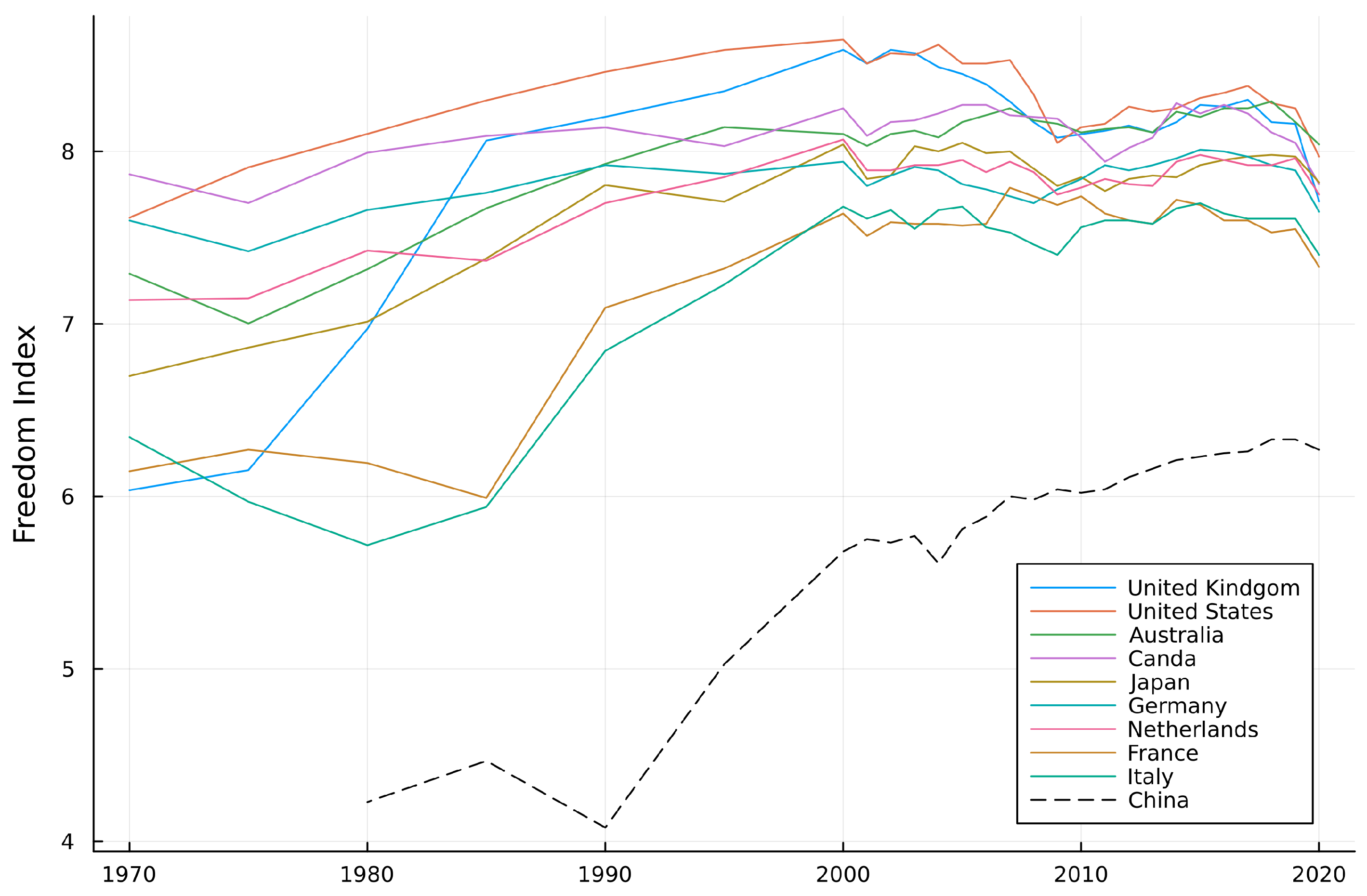
Figure 1 reports the time paths of economic freedom scores over the observation period. The data indicate a gradual increase in economic freedom in democratic economies during the 1980s and 1990s. Over the same period, these economies exhibited real GDP growth rates typically ranging between 3 and 5 percent.
From the early 2000s onward, the data show a moderation and partial decline in economic freedom scores alongside weaker productivity growth, particularly among advanced economies. These developments are consistent with the broader literature documenting structural changes in advanced economies since the turn of the millennium (
Gordon, 2016a,
2016b). In addition,
Philippon (
2019, p. 205) and
De Loecker et al. (
2020) document a concurrent increase in market concentration and barriers to entry in the United States, accompanied by rising regulatory complexity and lobbying activity.
China is represented by the black dashed line in
Figure 1. Throughout the sample period, China exhibits lower levels of measured economic freedom relative to the democratic economies considered. The available data indicate that the increase in China’s economic freedom begins later than in the democratic sample but follows a sustained upward trajectory through 2020. Over the same period, China records high rates of economic growth, followed by a more recent moderation in both growth and economic freedom. Taken together, the descriptive evidence suggests that economic freedom in democratic economies reached relatively high levels around the year 2000 and subsequently declined, whereas China, starting from a lower initial level, experienced a pronounced increase in economic freedom up to 2020.
Next, we turn to political preference data derived from the Manifesto Project Database. Examining the evolution of stated policy orientations provides additional descriptive context for changes in economic freedom over time.
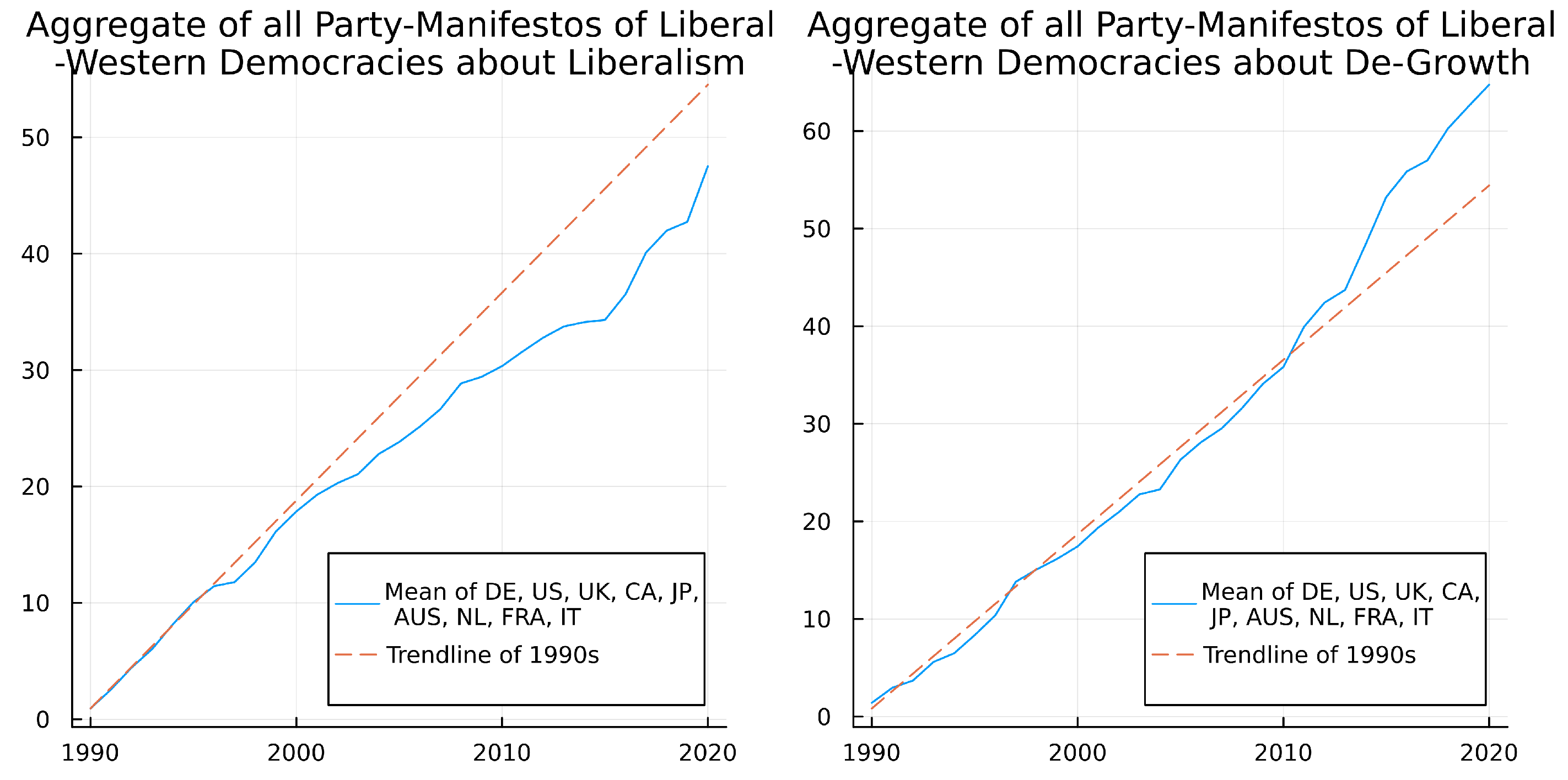
Figure 2 summarizes trends in selected political preferences, including references to liberal policies and anti-liberal policies such as de-growth, across progressive parties in democratic countries.
3The left-hand panel of
Figure 2 displays the cumulative frequency of references to the term “liberalism” in party manifestos over the period from 1990 to 2020. The data show a deceleration of such references, particularly after 2000. This pattern coincides with the evolution of economic freedom scores reported in
Figure 1. The right-hand panel of
Figure 2 reports an increase in references to the term “de-growth”, with a noticeable rise beginning around 2010. Overall, the manifesto data document a shift in stated policy emphasis within democratic societies over the sample period.
In summary, the descriptive evidence indicates a more stationary trend in measured economic freedom in democratic economies over the past two decades, alongside an increase in political references associated with de-growth. These patterns are also reflected in contemporary policy discourse. For example, recent trade initiatives in the United States under both the Trump and Biden administrations and the European Union emphasize concepts such as work-centered trade, tariffs, and domestic production (
Tai, 2021,
2023). Legislative measures such as the Inflation Reduction Act (IRA) are frequently discussed in the context of reshoring and domestic value creation. From a descriptive perspective, these policy orientations are associated with a greater emphasis on domestic objectives and a reduced focus in liberalism such as international markets and cooperation.
In addition, data indicate that most democratic economies have experienced a sustained expansion in government size over time. This development coincides with rising public debt-to-GDP ratios (
Bergh & Henrekson, 2011;
De Soyres et al., 2022). Switzerland represents a notable exception, maintaining comparatively low debt levels, a small government size and high levels of economic liberalism relative to other advanced democracies. At the same time, empirical records document increasing administrative complexity and regulatory scope in advanced economies (
Autor et al., 2020a;
Pritchett, 2021). This broader institutional dynamics has been accompanied by heightened political polarization, as documented in the literature (
Rodrik, 2021).
4. Results of Bayesian Analysis
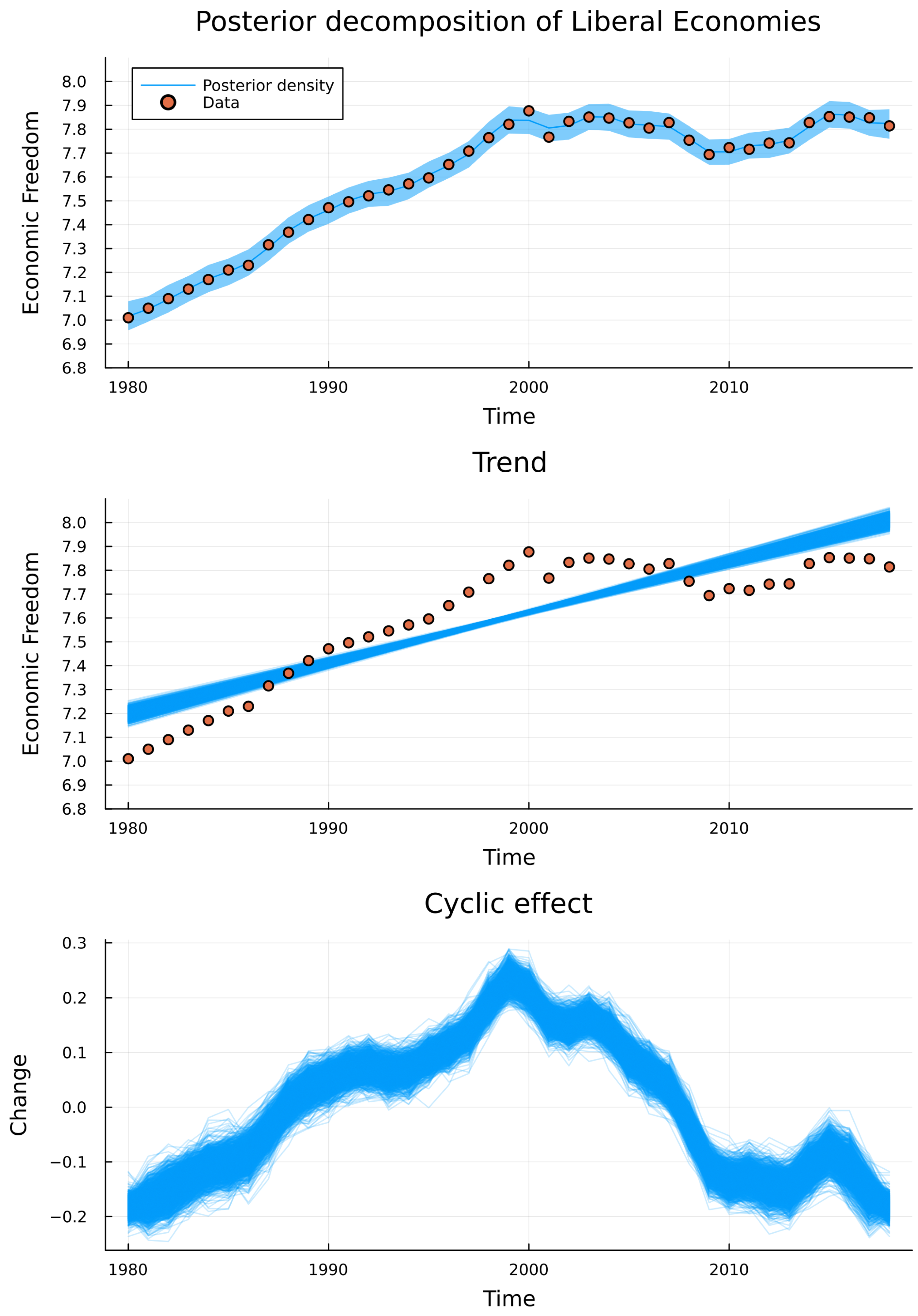
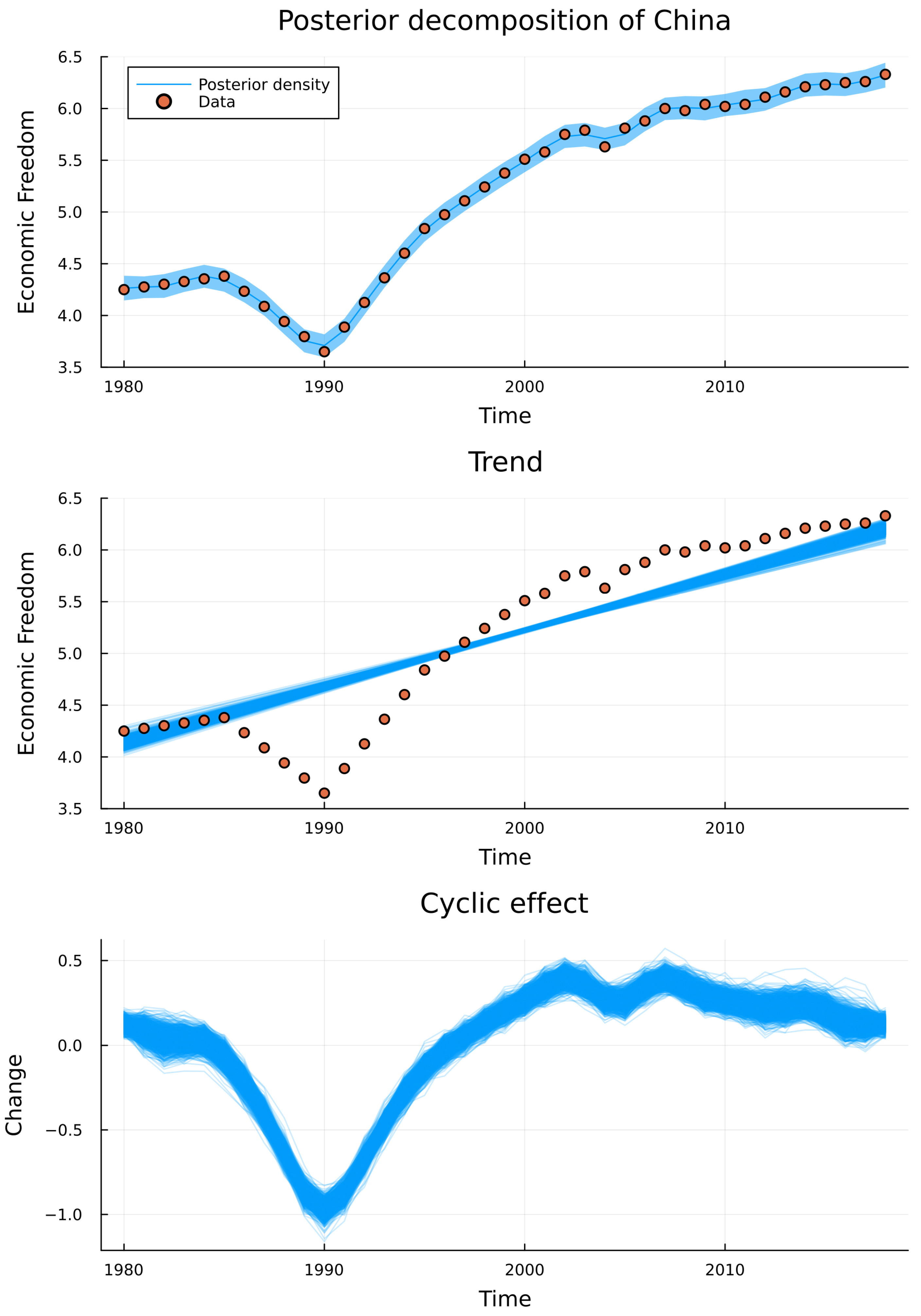
The time-series analysis examines trend and cyclical patterns of economic freedom for the average of the nine democratic economies and for China separately. This decomposition provides a structured description of how economic freedom has evolved over time across different institutional settings. The results are illustrated in
Figure 3 for the democratic sample and in
Figure 4 for China.
The top panel of
Figure 3 displays the posterior density of economic freedom for the average of the nine democracies, together with the observed data. The posterior distribution indicates an upward movement in economic freedom from the 1980s to around 2000, followed by a largely stable pattern thereafter. The middle panel reports the estimated trend component. The data show that observed economic freedom exceeds the long-term trend around the turn of the millennium, while from approximately 2010 onward, it remains below the estimated trend. This pattern is consistent with the descriptive developments shown in
Figure 1 and with the evolution of political preferences regarding liberalism and de-growth reported in
Figure 2.
Additional information is provided by the cyclical component displayed in the bottom panel of
Figure 3. The cyclical estimates indicate elevated values around 2000, followed by lower values in more recent years. At the end of the sample period, the cyclical component lies in a range of approximately
, which is comparable to levels observed in the 1980s. Taken together, the Bayesian decomposition documents a shift in the relative position of economic freedom around its long-term trend in democratic economies around the early 2000s.
Figure 4 presents the corresponding decomposition for China. The top panel shows the observed data alongside the posterior density, indicating a sustained increase in economic freedom beginning in the 1990s. The middle panel reports the estimated trend component, which displays a persistent upward trajectory, with observed values remaining above the long-term trend for much of the post-2000 period. The bottom panel depicts the cyclical component, which exhibits a relatively stable pattern with modest fluctuations and a tentative moderation in recent years. Over most of the sample period, cyclical values remain positive, typically within a range of approximately
.
Overall, the analysis highlights distinct temporal patterns in the evolution of economic freedom between democratic economies and China. The decomposition indicates that the average level of economic freedom in democratic economies has remained relatively stable or slightly below long-term trends over the past two decades. In contrast, the data for China show a continued upward movement in economic freedom until recent years, although observed levels remain lower than those in the democratic sample. When considered alongside the manifesto data, these patterns correspond with a gradual decline in references to liberalism and an increase in references to de-growth within major democracies. In China, the data indicate a sustained increase in economic freedom over the same period, coinciding with the implementation of the opening-up policy doctrine.
For robustness, we additionally conduct a series of supplementary analyses (see
Appendix A and
Appendix B). First, we estimate panel regression models for two subperiods, 1970–2000 and 2000–2020, to summarize cross-country variation in economic freedom. We then examine how this variation is associated with institutional and economic covariates. The results from the panel analysis are broadly consistent with the temporal patterns observed in the Bayesian time-series analysis, providing complementary evidence (see
Appendix A). Second, we apply breakpoint test procedures to detect unknown structural breaks in our data (
Andrews, 1993;
Bai & Perron, 1998,
2003;
Chow, 1960). These tests identify a statistically significant breakpoint around the year 2001 in democratic countries (see
Appendix B). Despite the well-known limitations of structural break tests in long country-level panels, particularly their sensitivity to sample length and model specification, the results are consistent with the findings uncovered by the Bayesian decomposition. Overall, the supplementary analyses corroborate the patterns of economic freedom identified by the time-series approach.
5. Discussion
The empirical evidence presented in this paper documents distinct patterns in economic freedom and political preferences across countries in previous decades. The Bayesian time-series decomposition and manifesto data indicate that, in the advanced democratic economies studied, economic freedom has remained broadly stable or slightly below its long-term trend since around 2000, while references to liberalism have declined and de-growth orientations have increased in party manifestos. In contrast, China exhibits a sustained upward trend in economic freedom over much of the same period, although absolute levels remain below those observed in democracies. These patterns are consistent and are corroborated across the panel regression analysis and robustness checks.
The results provide a descriptive basis for a further examination of the relationship between political preferences and institutional outcomes. Across the democratic sample, further data suggest a broadening of administrative and regulatory scope alongside an increasing government size. These developments coincide with observed patterns of political polarization, changes in party policy emphases, and variations in economic freedom, but no causal interpretation is implied. In China, the data indicate continued liberalization in measured economic freedom since the 1990s, accompanied by substantial growth in economic output and innovation-related indicators, consistent with other empirical studies (
Aghion et al., 2021;
WIPO, 2021). These patterns provide context for a new understanding of the evolution of economic freedom, political preferences, and economic performance.
Future research may explore the mechanisms underlying these descriptive patterns, including the interactions between regulatory complexity, party preferences, and market structure, recognizing that the current results are descriptive and do not provide evidence on the causal effects of specific policies. A further potential avenue for future research is to systematically explore institutional mechanisms that may be associated with the observed patterns in economic freedom and political preferences. Drawing on Hayek’s insights, one empirical approach could involve examining how general rules, rather than specific policy interventions, correlate with sustained levels of economic freedom across countries and over time (
Hayek, 1944,
1979).
In addition, future research could operationalize Hayekian ideas in a systematic and empirically grounded manner, following the approach of
Feld and Nientiedt (
2022), who develop an institutional framework for climate policy within a liberal tradition. In this spirit, the descriptive patterns documented in this study suggest that periods of declining economic freedom coincide with weaker economic dynamics, although such associations do not imply that restoring economic freedom would constitute a comprehensive remedy. Classical contributions, including
Hayek (
1979, pp. 41–64), acknowledge that state activity may be compatible with liberal orders in the presence of public goods, provided that it is embedded in general and non-discriminatory rules. This research agenda would enable an empirical assessment of how institutional characteristics co-move with economic freedom and long-run economic outcomes while remaining firmly within an analytical framework.
In summary, the results provide empirical support for a crisis of liberalism within advanced democratic economies and offer a foundation for future research.
6. Conclusions
This study provides an examination of long-term patterns in economic freedom across a set of advanced democracies and China. The results indicate that measured economic freedom in democracies has experienced a relative decline over the past two decades, whereas China has shown sustained increases from a lower initial level. These observations align with broader discussions in the literature (
Wolf, 2023), which emphasize the importance of institutional and political dynamics in shaping economic outcomes across countries.
By combining a Bayesian time-series approach with data on political preferences from the Manifesto Project Database, this research offers a new perspective on the dynamics of economic freedom. The analysis highlights associations between political preferences and economic freedom, providing a descriptive foundation for understanding how institutional arrangements and policy orientations evolve over time. Importantly, these findings are descriptive and do not constitute causal evidence regarding the effects of specific policies.
In addition, the study identifies avenues for future research. In particular, an empirical exploration of general rules, consistent with Hayekian principles, could provide further insights into the co-evolution of economic freedom and political preferences. Potential policy implications emanating from this kind of research are twofold. First, the findings motivate a reconsideration of Hayekian ideas, under which economic freedom may be associated with economic growth, such as in the existing literature, while preserving the foundations of advanced democratic economies. Second, insufficient consideration of economic freedom may be associated with subdued growth dynamics and increased pressures on democratic institutions in the long run.
Hayek (
1944, p. 52) wrote: “It is now often said that democracy will not tolerate “capitalism”. If “capitalism” means here a competitive system based on free disposal over private property, it is far more important to realise that only within this system is democracy possible.(…) Democracy is essentially a means, a utilitarian device for safeguarding internal peace and individual freedom.” It is high time to thoroughly analyze the drivers of economic freedom and its numerous social achievements. There is no doubt that economic freedom could be a burden, but it is an opportunity alike.
Overall, this study emphasizes the role of economic freedom as a key institutional characteristic that is associated with broader economic and political patterns. By systematically documenting these patterns, this research contributes to a more granular understanding of the interplay between institutions, policy orientation, and economic outcomes in contemporary economies.