
The Hidden Costs of Trade: Institutional and Cultural Determinants of Export Efficiency for Vietnam’s Wood Products



Abstract
1. Introduction
2. Literature Review
2.1. Trade Efficiency and Gravity Models
2.2. Institutional Distance and Trade Efficiency
2.3. Cultural Distance and Trade Efficiency
2.4. Stochastic Frontier Gravity Models and Research Gaps
3. Conceptual Framework and Theoretical Foundations
3.1. Theoretical Foundations
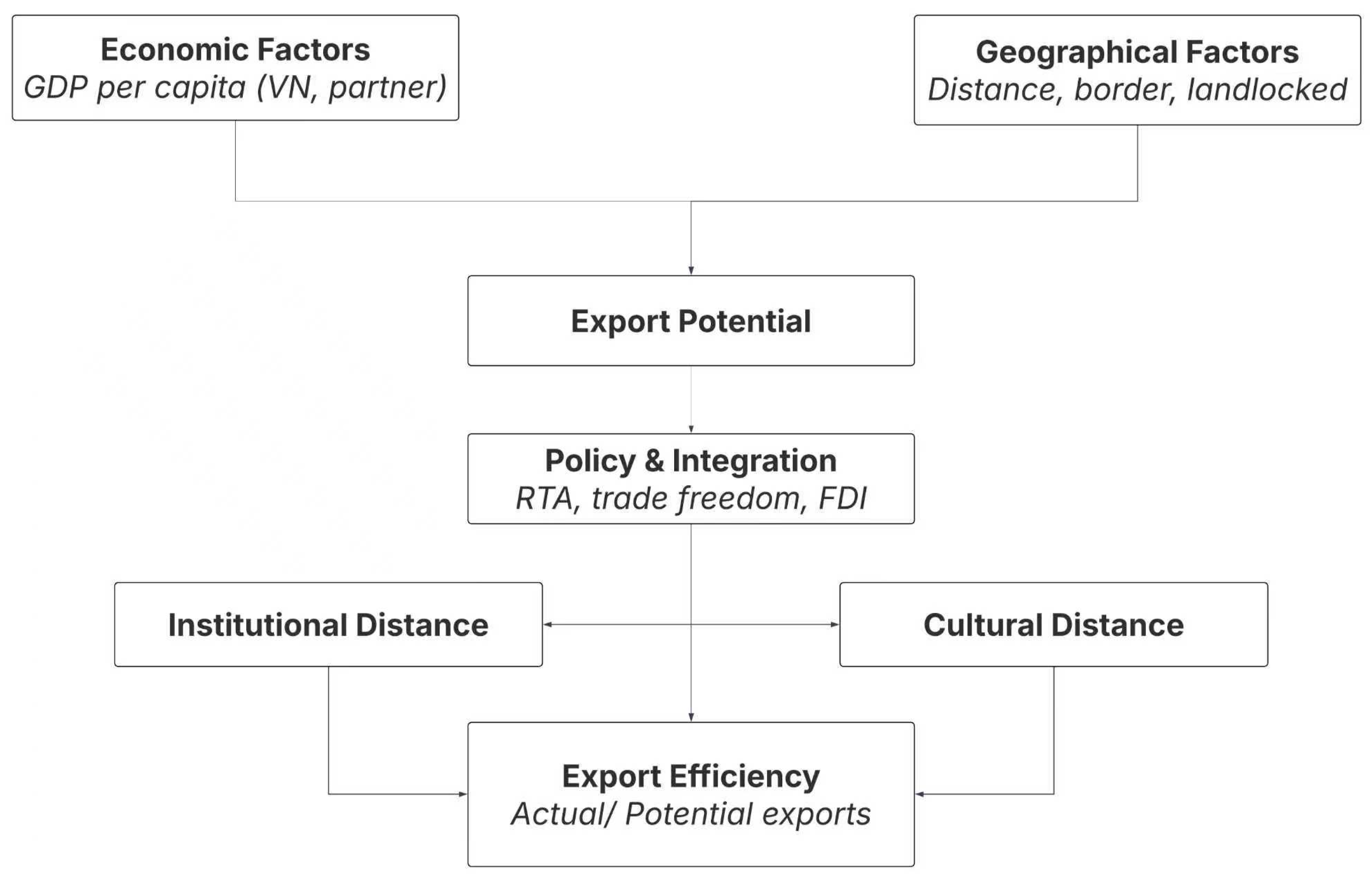
3.2. Conceptual Framework
3.3. IV-SFGM Approach Is Innovative
4. Materials and Methods
4.1. Overview of Vietnam’s Wooden Forest Products Sector
4.2. Study Area and Data Sources
4.3. Data and Their Sources
4.4. Model Specification
4.4.1. Distributional Assumptions
4.4.2. Inefficiency Determinants Equation
4.4.3. Endogeneity Control and Estimation Procedure
4.4.4. Trade Efficiency Measure
4.5. Estimation Technique
5. Results
5.1. Descriptive Statistics
5.2. Correlation Analysis
5.3. Stochastic Frontier Gravity Model (SFGM) Estimates
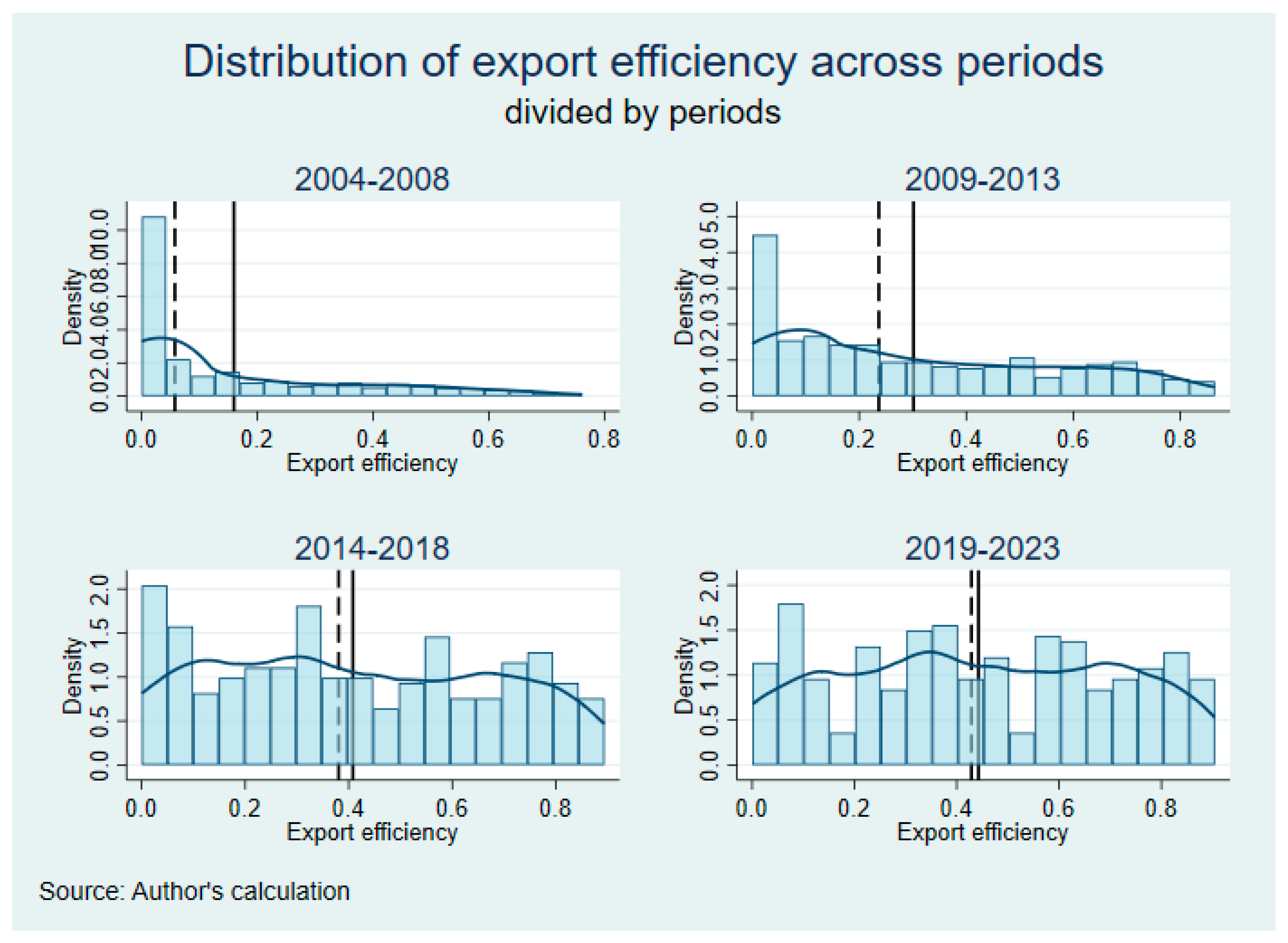
5.4. Export Efficiency Scores
5.5. Impact of Trade Agreements and Other Factors
6. Discussion
6.1. Contributions to Theory, Method, and Practice
6.2. Determinants of Vietnam’s Wooden Forest Product Exports
6.3. Policy Implications
7. Conclusions and Future Research Directions
Supplementary Materials
Author Contributions
Funding
Institutional Review Board Statement
Informed Consent Statement
Data Availability Statement
Conflicts of Interest
References
- Aigner, D., Lovell, C. A. K., & Schmidt, P. (1977). Formulation and estimation of stochastic frontier production function models. Journal of Econometrics, 6(1), 21–37. [Google Scholar] [CrossRef]
- Anderson, J. E., & Marcouiller, D. (2002). Insecurity and the pattern of trade: An empirical investigation. The Review of Economics and Statistics, 84(2), 342–352. [Google Scholar] [CrossRef]
- Anderson, J. E., & Van Wincoop, E. (2003). Gravity with gravitas: A solution to the border puzzle. American Economic Review, 93(1), 170–192. [Google Scholar] [CrossRef]
- Battese, G. E., & Coelli, T. J. (1988). Prediction of firm-level technical efficiencies with a generalized frontier production function and panel data. Journal of Econometrics, 38(3), 387–399. [Google Scholar] [CrossRef]
- Battese, G. E., & Coelli, T. J. (1995). A model for technical inefficiency effects in a stochastic frontier production function for panel data. Empirical Economics, 20(2), 325–332. [Google Scholar] [CrossRef]
- Cruz Navas, K. Y., & Saiz-Álvarez, J. M. (2025). Primary forestry industry cluster in honduras: A SWOT–CAME analysis. World, 6(3), 93. [Google Scholar] [CrossRef]
- De Benedictis, L., & Taglioni, D. (2011). The gravity model in international trade. In The trade impact of european union preferential policies (pp. 55–89). Springer. [Google Scholar] [CrossRef]
- Diop, M., Kpéra, G. N., Segnon, A. C., Totin, E., Ouedraogo, I., Thornton, P., & Zougmoré, R. B. (2022). Soil and water conservation in Africa: State of play and potential role in tackling soil degradation and building soil health in agricultural lands. Sustainability, 14(20), 13425. [Google Scholar] [CrossRef]
- Doan, T. N., & Xing, Y. (2018). Trade efficiency, free trade agreements and rules of origin. Journal of Asian Economics, 55, 33–41. [Google Scholar] [CrossRef]
- Duong, P. B., Nong, H. T. T., Van Nguyen, L., Trinh, T. A., Vu, L. H., & Bui, T. N. (2024). Farmers’ adoption and effects of three aspects of agricultural information systems in emerging economies: Microanalysis of household surveys. Information Development, 40(2), 294–312. [Google Scholar] [CrossRef]
- Epede, M. B., & Wang, D. (2022). Competitiveness and upgrading in global value chains: A multiple-country analysis of the wooden furniture industry. Forest Policy and Economics, 140, 102737. [Google Scholar] [CrossRef]
- Fally, T. (2015). Structural gravity and fixed effects. Journal of International Economics, 97(1), 76–85. [Google Scholar] [CrossRef]
- Faye, B., Diéne, J. C., Du, G., Liang, C., Kouadio, Y. D., Mbaye, E., & Li, Y. (2024a). Decentralization policies and rural socio-economic growth in senegal: An exploration of their contributions to development and transformation. World, 5(4), 1054–1076. [Google Scholar] [CrossRef]
- Faye, B., Du, G., Li, Q., Faye, H. V. M. T., Diéne, J. C., Mbaye, E., & Seck, H. M. (2024b). Lessons learnt from the influencing factors of forested areas’ vulnerability under climatic change and human pressure in arid areas: A case study of the Thiès region, Senegal. Applied Sciences, 14(6), 2427. [Google Scholar] [CrossRef]
- Gereffi, G., Humphrey, J., & Sturgeon, T. (2005). The governance of global value chains. Review of International Political Economy, 12(1), 78–104. [Google Scholar] [CrossRef]
- Gharleghi, B., & Shafighi, N. (2020). Do regional trade agreements increase trade? Empirical evidence from the Asia–Pacific region. Economic Affairs, 40(3), 419–435. [Google Scholar] [CrossRef]
- Global Forest Resources Assessment. (2020). Global forest resources assessment 2020. Food and Agriculture Organization of the United Nations. [Google Scholar] [CrossRef]
- Hofstede, G. (2011). Dimensionalizing cultures: The hofstede model in context. Online Readings in Psychology and Culture, 2(1), 8. [Google Scholar] [CrossRef]
- ITTO. (2016). Review and assessment of the world timber situation | ITTO | The international tropical timber organization. Available online: https://www.itto.int/biennal_review/ (accessed on 22 December 2025).
- Kalirajan, K. (1999). Stochastic varying coefficients gravity model: An application in trade analysis. Journal of Applied Statistics, 26(2), 185–193. [Google Scholar] [CrossRef]
- Kaufmann, D., Kraay, A., & Mastruzzi, M. (2010). The worldwide governance indicators: Methodology and analytical issues. World Bank. [Google Scholar] [CrossRef]
- Khatir, M., & Srivastava, A. (2025). Realisation of trade potential among south asia and southeast asia: Stochastic frontier and structural gravity analyses. Foreign Trade Review. [Google Scholar] [CrossRef]
- Kogut, B., & Singh, H. (1988). The effect of national culture on the choice of entry mode. Journal of International Business Studies, 19(3), 411–432. [Google Scholar] [CrossRef]
- Lankhuizen, M. B. M., & de Groot, H. L. F. (2014). Cultural distance and international trade: A non-linear relationship. Letters in Spatial and Resource Sciences, 9(1), 19–25. [Google Scholar] [CrossRef]
- Leitão, N. C. (2024). Gravity model and international trade: A survey of the literature. Administrative Sciences, 14(9), 219. [Google Scholar] [CrossRef]
- Levchenko, A. A. (2007). Institutional quality and international trade. The Review of Economic Studies, 74(3), 791–819. [Google Scholar] [CrossRef]
- Mehta, K., Ehrenwirth, M., Trinkl, C., & Zörner, W. (2022). Towards sustainable community development through renewable energies in Kyrgyzstan: A detailed assessment and outlook. World, 3(2), 327–343. [Google Scholar] [CrossRef]
- Mtweve, P., Moseti, V., Mahmoud, N., Kramm, T., Bogner, C., Ibisch, P., & Biber-Freudenberger, L. (2025). Exploring socioeconomic and environmental impacts of road infrastructure development in Sub-Saharan Africa: A systematic literature review. Environmental Development, 54, 101177. [Google Scholar] [CrossRef]
- Navarro-Soto, F. C., Morote, E.-S., Macha-Huamán, R., & Saavedra-Soplín, E. A. (2023). Determinants of peruvian export efficiency: Poisson PML estimation approach. Economies, 11(6), 169. [Google Scholar] [CrossRef]
- Nguyen, H. Q. (2020). Determinants of Vietnam’s exports: An application of the gravity model. Journal of Asian Business and Economic Studies, 25(S01), 103–116. [Google Scholar] [CrossRef]
- Nguyen, H. T. H., & Doan, T. N. (2017). The ASEAN free trade agreement and Vietnam’s trade efficiency. Asian Social Science, 13(4), 192. [Google Scholar] [CrossRef]
- Nguyen, N. M., Sun, S., & Welters, R. (2024). The impact of FDI on R&D investment of small and medium-sized enterprises in Vietnam: The role of institutions. International Review of Economics & Finance, 95, 103519. [Google Scholar] [CrossRef]
- Nguyen, S. L., Pham, C. D., Truong, T. V., Phi, T. V., Le, L. T., & Vu, T. T. T. (2023). Relationship between capital structure and firm profitability: Evidence from vietnamese listed companies. International Journal of Financial Studies, 11(1), 45. Available online: https://ideas.repec.org/a/gam/jijfss/v11y2023i1p45-d1090813.html (accessed on 17 November 2025). [CrossRef]
- Nyoni, A. M., & Kaushal, S. (2022). Sustainable knowledge management during crisis: Focus on COVID-19 pandemic. Business Information Review, 39(4), 136–146. [Google Scholar] [CrossRef]
- Ondrich, J., & Ruggiero, J. (2001). Efficiency measurement in the stochastic frontier model. European Journal of Operational Research, 129(2), 434–442. [Google Scholar] [CrossRef]
- Pardo, C. (2021). The vietnamese furniture industry: A trade discrepancy analysis. The Terrorism, Transnational Crime and Corruption Center. [Google Scholar]
- Pendrill, F., Persson, U. M., Godar, J., Kastner, T., Moran, D., Schmidt, S., & Wood, R. (2019). Agricultural and forestry trade drives large share of tropical deforestation emissions. Global Environmental Change, 56, 1–10. [Google Scholar] [CrossRef]
- Qiu, B., Lu, D., Tang, Z., Song, D., Zeng, Y., Wang, Z., Chen, C., Chen, N., Huang, H., & Xu, W. (2017). Mapping cropping intensity trends in China during 1982–2013. Applied Geography, 79, 212–222. [Google Scholar] [CrossRef]
- Santos Silva, J. M. C., & Tenreyro, S. (2011). Further simulation evidence on the performance of the Poisson pseudo-maximum likelihood estimator. Economics Letters, 112(2), 220–222. [Google Scholar] [CrossRef]
- Tadesse, B., & White, R. (2008). Does cultural distance hinder trade in goods? A comparative study of nine OECD member nations. Open Economies Review, 21(2), 237–261. [Google Scholar] [CrossRef]
- Toai, D. B. (2025). Port infrastructure and export efficiency in Vietnam: A regional data perspective. Strategic Management Insights, 2(1), 75–86. [Google Scholar] [CrossRef]
- United Nations. (2015). Transforming our world: The 2030 agenda for sustainable development | department of economic and social affairs. Available online: https://sdgs.un.org/2030agenda (accessed on 22 December 2025).
- Vietnam Country Climate and Development Report. (2022). Vietnam country climate and development report. World Bank. [Google Scholar] [CrossRef]
- Wang, H. J., & Schmidt, P. (2002). One-step and two-step estimation of the effects of exogenous variables on technical efficiency levels. Journal of Productivity Analysis, 18(2), 129–144. [Google Scholar] [CrossRef]
- Williamson, O. E. (2000). The new institutional economics: Taking stock, looking ahead. Journal of Economic Literature, 38(3), 595–613. [Google Scholar] [CrossRef]
- Xu, D., Qi, C., Fang, G., & Gu, Y. (2025). The impact of global digital trade development on China’s grain import trade potential: An empirical analysis based on a time-varying stochastic frontier gravity model. Agriculture, 15(12), 1324. [Google Scholar] [CrossRef]



| Variable | Unit/Type | Definition | Source |
|---|---|---|---|
| EX | Thousand USD (log) | Export value of Vietnam’s wooden forest products to partner i | WITS (2023) |
| GPCVN | USD (log) | GDP per capita of Vietnam | World Bank (WDI) |
| GPC | USD (log) | GDP per capita of partner i | World Bank (WDI) |
| DIST | Kilometers (log) | Great-circle distance between the capitals of Vietnam and partner i | CEPII GeoDist (2022) |
| AREA | km2 (log) | Forest area of partner i | CEPII (2022) |
| LOCKEDLAND | Dummy | 1 = landlocked country; 0 = otherwise | CEPII GeoDist |
| BORDER | Dummy | 1 = shares a land border with Vietnam; 0 = otherwise | CEPII GeoDist |
| INST_DIST | Index | Institutional distance (composite index based on six WGI dimensions) | World Bank WGI (2023) |
| CULT_DIST | Index | Cultural distance (Kogut–Singh index based on Hofstede’s six cultural dimensions) | Hofstede Insights |
| TRADEFREE | Index (0–100) | Trade freedom index of partner i | Heritage Foundation |
| FDI | Million USD | FDI inflows from partner i into Vietnam | World Bank (WDI) |
| FTA/BTA | Dummy | 1 = Vietnam has an FTA/BTA with partner i | WTO; Vietnam Ministry of Industry and Trade |
| WTO | Dummy | 1 = partner i is a WTO member | WTO |
| Variable | Obs | Mean | Std. Dev. | Min | Max |
|---|---|---|---|---|---|
| ln(EX) | 1399 | 24.726 | 4.316 | 0.000 | 32.582 |
| ln(GPCVN) | 1400 | 17.332 | 0.296 | 16.823 | 17.780 |
| ln(GPC) | 1393 | 12.399 | 1.371 | 7.735 | 14.847 |
| ln(DIST) | 1400 | 8.734 | 0.827 | 6.172 | 9.851 |
| ln(RER) | 1393 | 10.966 | 14.203 | 0.001 | 99.596 |
| ln(AREA) | 1400 | 12.359 | 1.988 | 6.578 | 16.611 |
| LOCKEDLAND | 1400 | 0.071 | 0.258 | 0.000 | 1.000 |
| BORDER | 1400 | 0.043 | 0.203 | 0.000 | 1.000 |
| Variables | (1) | (2) | (3) | (4) | (5) | (6) | (7) | (8) |
|---|---|---|---|---|---|---|---|---|
| (1) ln(EX) | 1.000 | |||||||
| (2) ln(GPCVN) | 0.245 *** | 1.000 | ||||||
| (3) ln(GPC) | 0.374 *** | −0.083 *** | 1.000 | |||||
| (4) ln(DIST) | −0.144 *** | 0.000 | 0.230 *** | 1.000 | ||||
| (5) ln(RER) | 0.166 *** | −0.200 *** | 0.511 *** | 0.248 *** | 1.000 | |||
| (6) ln(AREA) | 0.077 *** | 0.000 | −0.240 *** | 0.243 *** | −0.187 *** | 1.000 | ||
| (7) LOCKEDLAND | −0.022 | 0.000 | 0.061 ** | −0.096 *** | −0.022 | −0.136 *** | 1.000 | |
| (8) BORDER | 0.073 *** | 0.000 | −0.298 *** | −0.453 *** | −0.149 *** | 0.121 *** | 0.215 *** | 1.000 |
| Coefficient | Standard Error | z | p-Value | |
|---|---|---|---|---|
| ln(GPCVN) | 0.884 *** | 0.107 | 8.230 | 0.000 |
| ln(GDPC) | 0.815 *** | 0.113 | 7.200 | 0.000 |
| ln(DIST) | −0.381 * | 0.211 | −1.810 | 0.071 |
| ln(RER) | 0.024 ** | 0.011 | 2.090 | 0.036 |
| ln(AREA) | 0.378 *** | 0.067 | 5.610 | 0.000 |
| LOCKEDLAND | −2.195 *** | 0.427 | −5.140 | 0.000 |
| BORDER | 1.429 ** | 0.637 | 2.240 | 0.025 |
| Variable | Coefficient | Std. Error | z | p-Value |
|---|---|---|---|---|
| RTA (Regional Trade Agreements) | 0.267 *** | 0.083 | 3.220 | 0.001 |
| BTA (Bilateral Trade Agreements with the Americas) | 0.091 * | 0.055 | 1.650 | 0.099 |
| WTO Membership | 0.154 ** | 0.074 | 2.080 | 0.038 |
| Institutional Distance | −0.221 *** | 0.061 | −3.620 | 0.000 |
| Cultural Distance | −0.138 ** | 0.067 | −2.060 | 0.040 |
| Trade Freedom | 0.185 *** | 0.058 | 3.190 | 0.001 |
| Foreign Direct Investment (FDI) | 0.204 ** | 0.097 | 2.100 | 0.036 |
Disclaimer/Publisher’s Note: The statements, opinions and data contained in all publications are solely those of the individual author(s) and contributor(s) and not of MDPI and/or the editor(s). MDPI and/or the editor(s) disclaim responsibility for any injury to people or property resulting from any ideas, methods, instructions or products referred to in the content. |
© 2026 by the authors. Licensee MDPI, Basel, Switzerland. This article is an open access article distributed under the terms and conditions of the Creative Commons Attribution (CC BY) license.
Share and Cite
Nguyen, P.; Tran, X.U.; Faye, B. The Hidden Costs of Trade: Institutional and Cultural Determinants of Export Efficiency for Vietnam’s Wood Products. Economies 2026, 14, 33. https://doi.org/10.3390/economies14010033
Nguyen P, Tran XU, Faye B. The Hidden Costs of Trade: Institutional and Cultural Determinants of Export Efficiency for Vietnam’s Wood Products. Economies. 2026; 14(1):33. https://doi.org/10.3390/economies14010033
Chicago/Turabian StyleNguyen, Phong, Xuan Uyen Tran, and Bonoua Faye. 2026. "The Hidden Costs of Trade: Institutional and Cultural Determinants of Export Efficiency for Vietnam’s Wood Products" Economies 14, no. 1: 33. https://doi.org/10.3390/economies14010033
APA StyleNguyen, P., Tran, X. U., & Faye, B. (2026). The Hidden Costs of Trade: Institutional and Cultural Determinants of Export Efficiency for Vietnam’s Wood Products. Economies, 14(1), 33. https://doi.org/10.3390/economies14010033