You are currently viewing a new version of our website. To view the old version click .
Economies
  • Article
  • Open Access

4 December 2025

Assessing the Question of Whether Bitcoin Is a Currency or an Asset in Terms of Its Monetary Role

,
and
1
Department of Organizational Engineering, Business Administration and Statistics, Technical University of Madrid—Universidad Politécnica de Madrid (UPM), 28040 Madrid, Spain
2
Department of Architectural Constructions and Their Control, Technical University of Madrid—Universidad Politécnica de Madrid (UPM), 28040 Madrid, Spain
3
Department of Marketing and Market Research, CEU San Pablo University—Universidad CEU San Pablo, 28003 Madrid, Spain
*
Author to whom correspondence should be addressed.
Economies2025, 13(12), 357;https://doi.org/10.3390/economies13120357 
(registering DOI)
This article belongs to the Section Macroeconomics, Monetary Economics, and Financial Markets

Abstract

Since its launch in 2009, Bitcoin has become a market disruptor due to its primary function as a virtual currency supported by blockchain technology and the high volume of economic transactions it facilitates. This article examines the key theoretical principles that have contributed to Bitcoin’s recognition as a cryptocurrency. It assesses whether Bitcoin meets the criteria for being considered a form of money and evaluates its importance as a financial asset. This analysis of Bitcoin from 2014 to 2025 reveals that it does not sufficiently fulfill all the typical functions of money, such as serving as an internationally accepted means of payment, a unit of account, a securities depository, and a standard for deferred payments. Despite its usual close correlation with stock indices in financial markets, a decentralized digital currency like this still does not meet the requirements of fundamental analysis. In practice, this leads to its exclusion as a currency, since it does not fulfill the functions of money nor fully qualify as a crypto asset, as its value is primarily based on investors’ expectations of high returns. Apart from a lack of foundation in tangible goods or services that justifies their value and dependence on new investors, the findings do not indicate conditions typical of a developed pyramidal model. Nevertheless, this does not prevent future technological innovations from responding positively to the functions of money or from offering real money services, especially those related to service innovation and the digital economy.

1. Introduction

Cryptocurrencies have revolutionized the economy and financial system over the past decade. Bitcoin (hereafter BTC), the pioneer of global digital currencies, introduced the innovative concept of blockchain technology. Currently, digital currency presents itself as a way to redefine the traditional functions of money within a decentralized system. The BTC white paper sets forth this objective: “A purely peer-to-peer version of electronic cash would allow direct online payments without the need for a financial institution” (Nakamoto, 2008, p. 1).
Analysts estimate that more than 19 million BTC are in circulation, with a maximum supply of 21 million units, regardless of market conditions. BTC’s market capitalization exceeds $1.5 trillion (CoinMarketCap, 2025). Despite this, uncertainty persists about whether it is a money asset or an investment asset. This paper presents an analytical and explanatory approach to characterizing BTC as an asset, examining how its issuance in largely unregulated markets influences its interpretation and treatment within the context of digital commerce.
The remainder of the paper is organized as follows: Section 1 presents the theoretical framework and research questions. Section 2 presents the context and the case study. Section 3 outlines the methodology, with a focus on source selection and data mining. Section 4 presents empirical results. Section 5 summarizes the main findings. Section 6 concludes the analysis, and Section 7 acknowledges the study’s limitations and suggests future research lines.

1.1. Preliminary Musings

1.1.1. The Importance of Exchange Means in the Global Economy

Means of exchange are a fundamental instrument for developing economic complexity (Bresser-Pereira, 2020) because they facilitate transactions and contribute to stability and economic growth (McKinnon, 1973; Krugman, 1979; Wade, 1990; Rodrik, 2008; Oreiro et al., 2015). These means of exchange have strengthened, transitioning from those involving simple commodity money to the adoption of precious metals, the use of the gold standard for currency issuance, and current fiat models (Fernández Méndez, 2025). Confidence in the fiduciary system, therefore, rests with the issuing authorities.

1.1.2. The Competent Authority of Central Banks

The central banks, which have established criteria for analysis, creation, and distribution to the market, regulate the most widely used fiat currencies in our economic system, such as the US dollar, the euro, the pound, and the yen. Among all the criteria, price stability is one of the most important objectives (Carlson & Wheelock, 2018), as it allows forecasting and decision-making under conditions of greater security (BaFin, 2022), against the risk of deflation, and ensures a sufficient margin for the accommodation of macroeconomic adjustments, wage rigidities, and measurement biases (ECB, 2025). Some fiat currencies may also have additional (FOMC, 2025). Historical analyses show that the institutional architecture underpinning modern central banking has its roots in the monetary governance frameworks developed around Bretton Woods (James, 2012). Nevertheless, classic liberal perspectives have long questioned the centralization of monetary authority, advocating instead for the competitive issuance of private currencies, as famously argued by Hayek (1976) in his proposal for the denationalization.

1.1.3. The Concept of “We Owe You”

Senner and Sornette (2019) studied the traditional trust in central banks under the concept of “We Owe You” (hereafter, WOU). It represents the global economy’s universal right, not the rights of certain companies or specific individuals. Therefore, the need for individual control of each operation is reduced, as the system serves as the currency’s backing.

1.1.4. The Threat from Monetary Authorities

Fiat currencies can foster distrust among specific sectors of the population. Gisbert (2010) warns about the effects of expansionary monetary policies on inflation and volatility (Cagli, 2019). Furthermore, central banks’ supervisory powers enable them to monitor economic activity at both the aggregate and the individual levels (Von der Becke & Sornette, 2017).

1.1.5. Searching for Alternatives

With fiat currencies, the concentration of monetary power by legal issuers, either from national authorities or public entities, has driven the development of privately sourced alternative means of exchange, with the potential to replace fiat currencies (Baur et al., 2016). Some studies have addressed these alternatives from a legal perspective (Chuen, 2015), analyzing their ability to displace traditional currencies (Luther, 2016) or coexist in dual-currency schemes (Gans & Halaburda, 2013; Weber, 2014; Fung & Halaburda, 2014; White, 2015; Luther, 2016).

1.1.6. Developing Alternatives

Technological advances enabled new exchange models based on computer algorithms. Chaum (1982) introduced this idea, which was later supported by May’s (1988) “Crypto-Anarchist Manifesto” and Dai’s (1998) “B-Money”. This culminated in BTC (Nakamoto, 2008), constituting a milestone in creating a monetary alternative to the fiat system.

1.1.7. Launching Bitcoin from Blockchain-Related Techniques

The introduction of BTC led to two innovations in the digital currency marketplace. The first was the emergence of a separate cryptocurrency under pre-established issuance criteria. The second was a technological model for recording exchanges based on blockchain technology (Bartoletti et al., 2017; Wang et al., 2019), which allows all transactions to be recorded on a decentralized network that is difficult and costly to manipulate (Nizzoli et al., 2020; Notland et al., 2024), thereby ensuring transparency, tamper resistance, and decentralized verification.

1.1.8. Towards Maximum Growth

The technological foundation of cryptocurrencies has enabled the development of a market that, in just over a decade, has grown to encompass more than 20,000 digital currencies (Pourpourides, 2025), with a market capitalization exceeding $3 trillion (CoinMarketCap, 2025). This has sparked interest among central banks in issuing central bank digital currencies (also known as CBDCs) (Adrian & Mancini-Griffoli, 2021; Cooper, 2024; Dionysopoulos et al., 2024), which involve a trade-off among different types of monetary and technological risks (Viñuela et al., 2020).

1.1.9. Bitcoin Predominance

By September 2025, BTC is expected to hold over 50% of the total cryptocurrency market capitalization (CoinGecko, 2025). Nonetheless, Ether (ETH) has established itself as one of the leading alternatives since its launch in 2015, as outlined in Buterin’s (2014) Ethereum white paper.

1.1.10. The Issue of Cryptocurrencies

The significant growth of cryptocurrencies has not been continuous so far, as they have exhibited considerable volatility (Liu & Serletis, 2019). The matter has been widely studied in the previous literature. Phillips et al. (2015) have highlighted some of the most significant periods of volatility, spanning three distinct bubbles from 2011 to 2013 (Corbet & Yarovaya, 2018). Subsequently, Fry (2018) examined the emergence of new bubbles between 2015 and 2018, which have persisted in more recent years (Chowdhury & Damianov, 2024). Corbet et al. studied this problem alongside other cryptocurrencies, such as ETH, and it is not unique to BTC due to its co-explosive behavior (Bouri et al., 2019; Kucheryavenko et al., 2019; Agosto & Cafferata, 2020; Lener, 2022). Moreover, beyond purely financial explanations, recent research emphasizes that users’ trust in BTC also depends on perceived security and structural guarantees derived from the robustness of blockchain technology, which act as determinants of its adoption and perceived success (López-Zambrano et al., 2021).

1.1.11. The Irruption of Stablecoins

The first stablecoins emerged in 2014 to mitigate volatility, with values tied to fiat currencies, cryptocurrencies, or commodities. Indeed, Tether has become an essential reference for cryptocurrencies (Ahmed & Aldasoro, 2025).

1.1.12. Public Approach in Facing the Challenges of Bitcoin’s Irruption in the Mass Media

As a digital currency supported by blockchain-based processes, BTC has been viewed from various perspectives, depending on the region concerned: it is seen as a crypto-asset rather than legal tender. On one hand, the EU sphere can consider BTC a means of payment, but it will not allow BTC to become part of the monetary base. Germany legally recognizes cryptocurrencies as units of account and exempts specific uses from tax (Bundesministerium der Justiz und für Verbraucherschutz, 2023; Bundesfinanzministerium, 2025), although they do not constitute legal tender (BaFin, n.d.). Similarly, the Supreme Court of Spain (2019) stated that BTC cannot be considered money in the legal sense or a tangible object susceptible to restitution. On the other hand, from the US perspective, the Responsible Financial Innovation Act, also known as the Lummis-Gillibrand Act (US Congress, 2022), recognized ‘cryptoassets’ as a legitimate part of the US financial system under the CFTC’s Commodity Exchange Act, originally passed in 1936. After more than two years of debate, the European Union took a similar step with the adoption of the Markets in Crypto-Assets (MiCA) Regulation (OJEU, 2023).

1.1.13. The Challenges of Expanding Bitcoin

BTC’s evolution demonstrates how blockchain innovation and the rise of cryptocurrencies have generated a significant market (Corradi & Höfner, 2018), capturing the attention of governments and regulators. From the perspective of investor protection (OECD, 2023) and financial stability, reaching an international consensus on its regulation and taxation is essential.

1.2. Research Questions

The study grouped leading cryptocurrencies because they have faced various challenges over the past years. On the one hand, it is essential to recognize that, for the time being, all cryptocurrencies exist solely as digital currencies, operate in a decentralized manner, and are stored on a blockchain ledger (Regnerova & Siskova, 2021). On the other hand, public policies aimed at mitigating the substantial risks associated with blockchain-related investments in transferable securities have not been as effective as hoped, thereby generating specific risks and exposing investors to the risk of loss. Indeed, their respective white papers describe the basis of their creation, meaning each one can have significantly unique characteristics. Since other cryptocurrencies do not necessarily share BTC’s features, one should not extend BTC’s implications regarding monetary function, asset classification, or Ponzi schemes (Mukherjee & Larkin, 2022) to them.
The fact that a blockchain network is behind the creation of different cryptocurrencies does not imply that everything created on that network is the same. In this sense, a separation already exists between the concepts of cryptocurrency and stablecoin. Given the rise of BTC internationally, particularly in emerging markets, public policies are aiming to integrate it into the global financial system. This should clarify what BTC is and its fundamental behavior. Not surprisingly, proposals for differentiated regulations across countries have emerged in recent years, including the introduction of new private cryptocurrencies and the development of monetary models with high technological content that depend on central banks. Consequently, their respective central banks have traditionally regulated the most widely used fiat currencies in the global economic system through criteria for analysis, issuance, and market supply.
Nevertheless, among all their features, one stands out as more important than the others: price stability (Carlson & Wheelock, 2018). This fact involves forecasting and decision-making under specific conditions of greater security. Analyzing BTC’s market performance often raises questions about whether it meets the criteria for consideration as a cryptocurrency, a crypto asset, or even a pyramid scheme (Artzrouni, 2009; Bartoletti et al., 2020; Trozze et al., 2022). However, it benchmarks the fees against existing fundraising case studies.
Given BTC’s role in the modern economy and its status as a market driver, it is essential to understand this crypto asset through its fundamentals. Therefore, the article aims to determine whether BTC meets the criteria to be considered a currency and its position in the asset market.
The paper aims to answer the research questions (hereafter, RQ) below due to BTC’s role in current or future economic engagement:
RQ1. Does it meet the criteria for being considered currency?
RQ2. Where is BTC located as an asset?

2. General Remarks

2.1. Background Research

Exchange instruments have become key in shaping the global economy for the last few years, emphasizing the vast diversity of current financial tools (Bresser-Pereira, 2020), not only because of their role in carrying out transactions but also as sources of stability and economic growth (McKinnon, 1973; Krugman, 1979; Wade, 1990; Rodrik, 2008; Oreiro et al., 2015). These instruments have evolved from simple forms of commodity money to the adoption of precious metals, and thus from using the gold standard in issuing currency to the emergence of current fiduciary models (Fernández Méndez, 2025). Since these tools have lost their intrinsic value and moved into fiduciary models, the world economy has placed its trust in the issuing authorities of related exchange markets. The most widely used fiat currencies in our economic system, such as the dollar, the euro, the pound, and the yen, are regulated by the designs of their respective central banks (Carlson & Wheelock, 2018), which have established criteria for analysis, creation, and market supply. Among all the requirements, price stability is one of its primary objectives, if not the greatest, since it enables forecasting and decision-making under conditions of greater security (Corbet et al., 2019; Lotz & Vasselin, 2019; Senner & Sornette, 2019).
The trust placed in central banks has been studied under the concept “We owe you” (WOU) (Corbet et al., 2019; Lotz & Vasselin, 2019; Senner & Sornette, 2019). In other words, it represents a universal right in the global economy, not a privilege reserved for specific companies or individuals. Thus, if this monetary area functioned correctly, all market players would share the risk. At the same time, this would reduce transaction costs and decrease the need for individual control of each operation. Apparently, the BTC-related system could also be considered a ‘cryptobank’.
Nevertheless, fiat currencies have features that must be considered threats to market economies, particularly in Western countries. For example, controlling transactions enables both preventing exchanges and maintaining the goods exchanged, thereby facilitating a comprehensive understanding of economic activity (Von der Becke & Sornette, 2017). Lacalle (2017) also discusses the role of central banks as generators of expansionary monetary policies, which are responsible for the current fundamental imbalance of the economy; this, together with the influence of the economic cycle, makes the monetary system inflationary, volatile, speculative, and cyclical in the occurrence of financial crises (Gisbert, 2010).
There has been a tendency for parts of the market to develop privately promoted alternative means of exchange that can substitute for fiat, in the face of concentrated power by monetary and fiscal authorities, noting that introducing new currencies can alter monetary dynamics (Lotz, 2004). Some researchers have been interested in governance issues and regulatory models, which focus their scientific contribution only from a legal point of view (Chuen, 2015), to how they can displace the more fiat currencies (Luther, 2016), or the coexistence of both models in the same dual-currency “market” (Weber, 2014; Luther, 2016; White, 2015; Gandal & Halaburda, 2014; Fung & Halaburda, 2014; Gans & Halaburda, 2013), including evidence of crowding-out effects when digital and fiat currencies compete within the same regime (Hong et al., 2018). Additionally, in the face of cryptocurrencies’ threat to fiat currencies, monetary authorities can take action to prevent their success (Hendrickson et al., 2016), while broader socio-economic analyses also show that crypto and complementary currencies may reshape exchange dynamics and local economic coordination (Fama et al., 2020).

2.2. Standalone Currencies

The development of computer technology has enabled the creation of alternative means of exchange based on computer algorithms (Karame, 2016; Del Monte et al., 2020), which can guarantee the success of exchanges. In that regard, the basis was introduced by Chaum (1982), followed by “The Crypto Anarchist Manifesto” (May, 1988) and the publication of “B-Money” (Dai, 1998) until the publication by Satoshi Nakamoto of the article “Bitcoin: A Peer-to-Peer Electronic Cash System” with the initial launch in 2009. Since the emergence of blockchain technology supporting the BTC network, more than 20,000 cryptocurrencies have been launched into the cryptomarket.
Although the United States does not recognize BTC as legal tender, given its rise, various companies have begun to accept it as a means of payment for goods and services. The number of small and medium-sized enterprises (SMEs) that accept BTC has been steadily increasing, as documented by BTCmap (https://btcmap.org) (accessed on 25 August 2025). Additionally, various multinational corporations have accepted BTC payments (Polasik et al., 2015).
Parallel with the private sector’s adoption, the public sector has been vigilant in assessing its regulations and taxation. The Responsible Financial Innovation Act (US Congress, 2022), often referred to as the “Lummis-Gillibrand bill,” was introduced in the US financial system under the CFTC’s Commodity Exchange Act, initially enacted in 1936. This fact led to the acceptance of digital assets as a legitimate part of the US financial system.
After more than two years of intense debate, the European Union (EU) has finalized its MiCA-related framework, specifically Regulation (EU) 2023/1114, which establishes a comprehensive legal framework for crypto-asset issuers and service providers. However, each EU member state has been taking different measures. In response to the German Parliament (Bundestag) in 2024, the German government concluded that BTC “does not fulfill the primary functions of money” and that, although it can be used as a medium of exchange, its high volatility prevents widespread adoption as a mandatory means of payment (Fin-Law, 2021). However, this does not necessarily mean there is no legal obligation to accept cryptocurrencies as payment.
Regarding tax exemption, the Court of Justice of the EU (CJEU), in the Hedqvist case (Case C-264/14—Skatteverket vs. David Hedqvist, 2015), determined that exchange transactions between traditional currency and BTCs carried out by a market operator are exempt from Value Added Tax (VAT) because BTC must be considered, for the VAT regime, as a means of payment. This is the European legal basis for arguing for VAT exemption for certain transactions. In fact, the German Federal Ministry of Finance (Bundesfinanzministerium, BFM) published a Circular (Leitfaden) on 6 March 2025, regarding the tax treatment of cryptoassets. This document interprets and applies the CJEU’s reasoning on VAT, while clearly distinguishing between restricted effects (i.e., VAT exemptions for certain transactions or services) and the existence of tax obligations under other taxes (e.g., income tax or capital gains tax). Consequently, there are instances where a VAT exemption applies; however, this does not mean that cryptocurrency purchases are tax-free. This does not imply that cryptocurrencies are equivalent to fiat currency under German law. In the same vein, as noted earlier, the Supreme Court of Spain (2019) concluded that BTC is neither money in a legal sense nor a tangible asset subject to restitution, thereby confirming that cryptocurrencies lack legal tender status under Spanish law.
The introduction of BTC has been a turning point in the financial and monetary markets. Indeed, as an economic asset, its behavior appears to align with investment and liquidity patterns typical of traditional markets, which would contradict its supposed independence from the conventional financial system and regulated capital flows. Additionally, regarding empirical evidence on capital flows and prices, Aiello et al. (2023) analyze inflows and outflows from major exchanges. It suggests a strong elasticity of BTC’s prices relative to net investment flows. They also demonstrate that a marginal increase in capital inflows leads to a disproportionate price increase, suggesting that speculative demand is the primary driver of the assets’ value. Similarly, Anastasopoulos (2024) finds that order flow (aggregate order flow) explains a significant fraction of variations in daily returns, highlighting the potential for short-term dependence on liquid capital movements.
It is also worth noting that a relationship between market capitalization and volatility has been suggested by Gherghina & Constantinescu (2025) and Bakas et al. (2022). They identify that the total market capitalization of the crypto ecosystem acts as an aggregate indicator of exposure to global capital. As the market cap grows, volatility temporarily decreases due to abundant liquidity. However, when capital outflows occur (“crypto winters”), they amplify price declines, reproducing the boom-bust effects seen in emerging markets, suggesting that BTC does not behave as an autonomous store of value but rather as an asset highly dependent on the depth of invested capital.
Lately, a significant inflection in BTC’s performance has been observed, driven by a shift in its relative valuation compared to other cryptocurrencies. Some fundamental earlier works, such as those by the IMF (Cerutti et al., 2024) and the BIS (Auer et al., 2025), argue that an emerging trend is the use of BTC for cross-border financial transactions, most evident in economies subject to capital constraints. Nevertheless, these studies agree that these movements represent only a small fraction of the global volume and may be related to specific episodes of financial stress. On the other hand, Hu et al. (2020) and Von Luckner et al. (2023) provide strong evidence of BTC use as a capital flight mechanism, mostly observed in Asia and Latin America. However, these authors suggest that such flows still depend on banking infrastructure or stablecoins, so BTC’s independence as a financial channel remains partial.
The institutionalization of BTC through exchange-traded funds (BTC-ETFs) and the growing participation of institutional investors have further reinforced its correlation with traditional risk markets (Abid et al., 2023). As Goldbach & Nitsch (2024) point out, there could be a relationship between institutionalization and financial capital. Even national sovereignty adoption, as seen in El Salvador, demonstrates that state adoption does not eliminate dependence on external capital: the liquidity and value of national BTC continue to be determined by global rather than local dynamics. Thus, the institutionalization process has transformed BTC into another financial asset, one that is sensitive to liquidity cycles, interest rates, and global risk appetite.
Furthermore, speculative capital flows have habitually driven BTC’s price dynamics, rather than internal network variables or actual adoption as a payment method. Accordingly, its market capitalization (market cap) often amplifies financial shocks by reproducing the patterns of traditional assets. Since BTC appears to depend on the availability and direction of global capital, it seems to be a liquidity asset rather than a structural haven, and its autonomy from the international financial system as a vehicle for capital transfer is more theoretical than practical.
The introduction of BTC has been a turning point for financial and monetary markets. Given that in its launch publication, it expressly states in its title “(…) Peer to Peer Electronic Cash System” or in its first line “a peer-to-peer version of electronic cash (…)”, statements that make clear its ambition to behave as a means of exchange between people (Nakamoto, 2008). Therefore, to act as a form of money, it is necessary to clarify BTC’s proper function by analyzing its fundamentals. Although BTC’s base layer is limited, there is an opportunity to increase its scalability through Lightning Network solutions, enabling it to process numerous transactions per second.
Since the BTC protocol produces a new block roughly every ten minutes, the network’s adjustments will likely result in a significant increase in the computational demands of mining. The total computing power of the BTC network is measured in terms of ‘hashrate’, expressed in hashes per second (H/s). Securing the network and sustaining the issuance of BTC requires substantial computational power (Kim et al., 2024), which in 2025 reached around 600 exahashes per second (EH/s), according to information provided on the related webpage (https://www.blockchain.com/explorer/charts/hash-rate, accessed on 18 October 2025). Each BTC block is mined in approximately 10 minutes, with a predetermined reward that is halved every four years. Notably, the block issuance schedule remains fixed by design, regardless of the network’s aggregate computing power. The continuous increase in hashrate reflects the rising level of security and energy expenditure required to maintain the blockchain, rather than any change in the issuance pace.
Experts estimate that the worldwide cryptocurrency market trades over 20 million BTC annually, highlighting interactions related to land use, including water, electricity, and computing services. Nowadays, the cryptocurrency sector should promptly focus on short-term priorities regarding the environmental impact of its long-term development. Given the transaction volume escalation in the cryptocurrency market and the associated computational needs, water and electricity consumption are expected to be enormous in the coming years. In fact, according to Liu & Tsyvinski (2021), who analyzed data from 2018, when BTC was worth approximately $7000, the probability of BTC’s price falling to zero in a single day ranged from 0% to 1.3%.
Hence, over the coming years, the theoretical benefits of quantum computing are expected to meet BTC’s needs more efficiently and sustainably.
In summary, BTC emerged in the ‘cryptomarket’ as a standalone digital currency designed to operate outside traditional monetary systems. However, its evolution has brought it closer to global capital cycles, regulatory frameworks, and technological constraints. Its functionality lies between that of a medium of exchange and a financial asset, subject to liquidity conditions and facing environmental sustainability challenges, as summarized in Table 1.
Table 1. Summary of main features (as of 11 December 2023). 1.

3. Research

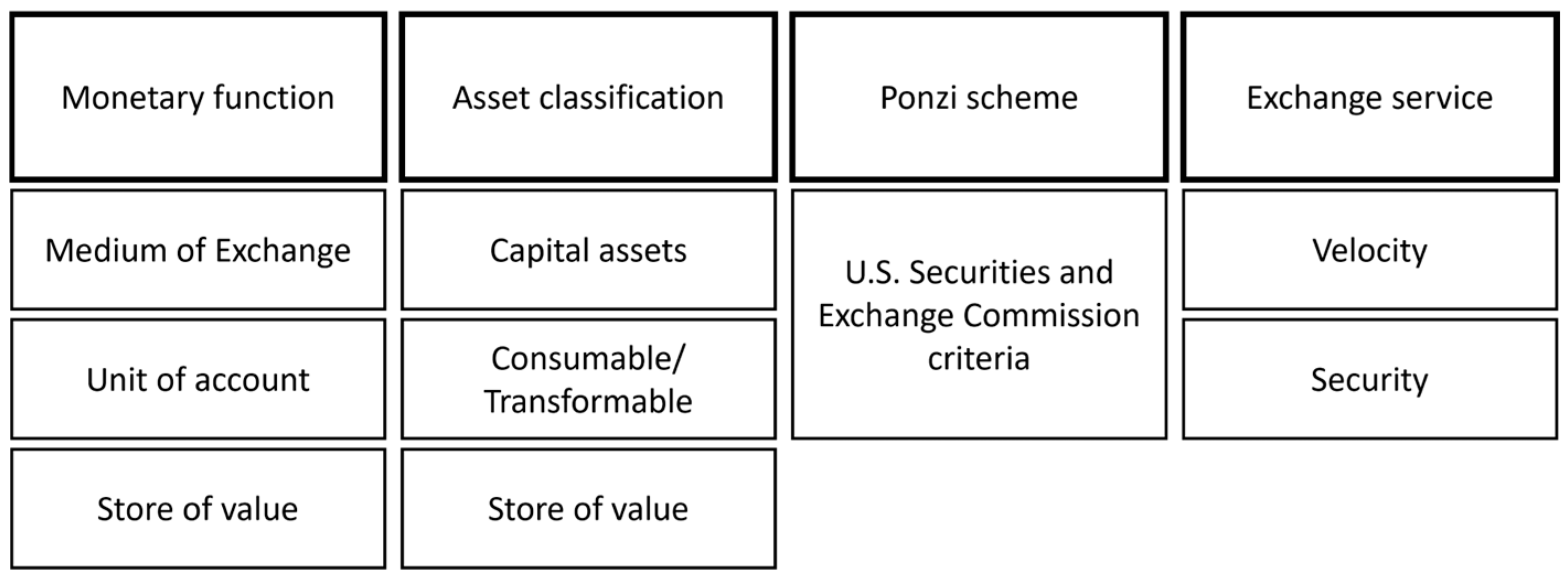
The definition of BTC, its uses, and its classification as an asset are fundamental elements in determining expectations for its future behavior and how institutions should treat it. To this end, this document progressively examines the elements that have formed part of the BTC concept, as shown in Figure 1. It confirms that cryptocurrencies do not have legal tender status under Spanish law.
Figure 1. Research design, key features, and data review processes. Source: authors.
Firstly, it analyzes its behavior in relation to the characteristics of a currency, namely price stability, unit of measurement, and store of value. Secondly, it examines BTC’s behavior as an asset, analyzing the various asset types, including capital goods, tradable goods, and store-of-value assets. It compares BTC’s performance at the analytical level and then examines its correlation and statistical behavior relative to other assets.
Additionally, monetary assets and their classification under a Ponzi pyramid investment scheme (Vasek & Moore, 2019) have been discussed in accordance with the US Securities and Exchange Commission’s definition (US SEC, 2021; US SEC, 2025), as applicable to BTC’s performance. Finally, the analysis of BTC as a means of payment has been deepened by its potential to provide an exchange service for the population. Indeed, the study has analyzed the matter across different BTC performance metrics, subsequently offering new solutions based on technological developments.

3.1. Approaching the Monetary Function of the BTC

As previously noted, the functions of a medium of exchange, unit of account, and store of value must be addressed for monetary consideration. The present study uses historical series on the price of BTC and on currencies (the dollar, euro, and yen) for empirical comparison (price dynamics, volatility, and relative stability).
To understand BTC’s role as a means of payment, it is imperative to assess the volume of transactions carried out, whether for investment or exchange purposes. First, the evolution of BTC use since 19 September 2014 has been studied, as this is the reference date for the availability of data on Yahoo Finance regarding the BTC exchange rate relative to other cryptocurrencies, as shown in Table 2. The analysis spans the period from September 2014 to March 2025, depending on the availability of data for each variable. Thus, unlike fiat currencies, BTC’s capped circulating supply limits its capacity to adjust to changes in economic conditions or shifts in demand. This behavior of BTC reflects, at least partially, its relationship with the dollar. Subsequently, the analysis compares BTC’s performance with that of major fiat currencies (the euro, the pound, and the yen) and with the dollar.
Table 2. Summary of data downloaded for the analysis of the monetary function of BTC. 1.
As noted earlier, this paper aims to address the central question of whether BTC should be classified as a currency or an asset, examining its purported monetary functions in relation to its market behavior between 2014 and 2025. Indeed, BTC is currently classified as a cryptocurrency. However, not an entirely legal tender because it does not reliably fulfill the classic functions of money: a medium of exchange, a unit of account, and a store of value (Mishkin, 2019; Mankiw, 2020). According to Catalini and Gans (2016), BTC represents a technological innovation in recording and transferring value through blockchain technology. However, its use as a currency is limited by its high volatility and limited acceptance. In this sense, the International Monetary Fund (IMF, 2021) and the Bank for International Settlements (BIS, Auer & Claessens, 2018) define it as a ‘cryptoasset’: a digital asset based on cryptography that can serve as a medium of exchange but lacks sovereign backing and is not legal tender.
As a limited medium of exchange, while BTC can be used for transactions, its current commercial adoption is marginal and highly concentrated in digital niches (Baur et al., 2018). As already mentioned, its high volatility limits its usefulness as a stable means of payment because transaction values can fluctuate significantly over short periods (Yermack, 2015). Furthermore, transaction costs and validation times may affect their efficiency compared to traditional fiat or electronic systems (Narayanan et al., 2016). On the other hand, transaction costs and validation time can affect its efficiency compared to conventional fiduciary or electronic systems (Narayanan et al., 2016).
Concerning the inefficient unit of account, companies and corporations do not express their financial statements, balance sheets, or prices in BTC, but rather in fiat currencies (USD, EUR, etc.), which could reinforce the notion that BTC is a speculative asset rather than a monetary one (Böhme et al., 2015). BTC is not used for pricing or accounting purposes. Consequently, its function as a unit of account could be limited to the crypto ecosystem. In that regard, Böhme et al. (2015) pointed out that BTC’s role as a unit of account is negligible, since it is not compromised by its nature with the denomination of goods and services.
In relation to the unstable store of value, as previously discussed, certain factors make BTC less likely to be considered a store of value (Dyhrberg, 2016) due to its high volatility and lack of institutional support to bring it closer to the category of speculative asset, characterized by recurring price bubbles (Cheah & Fry, 2015). Apparently, BTC behaves more like a speculative asset than a haven (Baur & Hoang, 2021) or store of value (Baur & Dimpfl, 2018). Therefore, BTC should be considered a ‘cryptoasset’, i.e., a crypto-based digital asset serving as a medium of exchange, but it is neither a legal tender nor a sovereign currency (IMF, 2021). This definition underscores that its value relies on both algorithmic scarcity and decentralized trust, rather than on backing from a monetary authority. Thus, its economic function is closer to that of an alternative investment asset than to that of a currency (Auer & Claessens, 2018; Corbet et al., 2019).

3.2. Approaching the Asset Functions of the BTC

The research also explored how far BTC can be regarded as an asset. Indeed, as shown below, although Greer (1997) does not explicitly mention BTC, the concept and definition of investment portfolio assets do include it. The classification defines three super asset classes with specific features as indicated in Table 3. In the case of capital assets, first, they share the generation of returns through dividends or interest, their reliability in forecasting their value, and their durability. Second, there are consumable or transformable assets, generally in the form of raw materials, which can be durable (e.g., minerals) or perishable (e.g., food). Certain assets, such as art and coins, store value because they do not directly generate returns, unlike capital goods, which are not consumed or transformed, unlike commodities. As BTC does not generate returns during periods of high volatility, has an indefinite expected life, and is not a consumer good, it meets the classification criteria for store-of-value assets, which are regarded as a ‘superclass’.
Table 3. Classification of super asset classes and analysis of main features.
To contrast with the classification above, asset prices or benchmark indices for these classes have been obtained from BTC’s daily price data (see Table 4) and are available as indicated in the Supplementary Materials.
Table 4. Assets used for analysis, including a description of the value used, its ticker symbol, and the database.
The analysis utilized the daily closing prices of each asset from 30 September 2014 to 10 September 2025. When a quotation was unavailable, primarily due to market closures on weekends or public holidays, the study used the previous trading day’s closing value. This procedure ensures temporal consistency across series and reliability in the computation of static and dynamic correlation measures.

3.3. Approaching the Related Ponzi Schema of BTC

A Ponzi scheme is an investment fraud in which existing investors receive income from new investors, who in turn receive income from the original investors. BTC differs in its definition. The idea of presenting the return on investment as income generation is entirely foreign to BTC, whose performance is driven solely by changes in its value. There is no direct payment of income. Consequently, the study examines the implications of the ‘red flag’, or even common characteristics, according to the US Securities and Exchange Commission (US SEC), specifically those related to high returns without risk, consistent growth, unregistered investments, unlicensed sellers, complex strategies, account statement errors, and uncertain payments.

3.4. Approaching the Threat of Service Obsolescence of BTC

Regarding payment methods, BTC speeds up international transactions and facilitates business development and service automation through technological innovation. It offers advantages such as instant international payments, low transaction fees, high security, and transparency. However, these inherent advantages have limitations: compared to a traditional asset with guaranteed value over time, BTC has demonstrated features that have enabled it to initiate and lead a technological revolution under the guise of a currency.

4. Findings

This section analyzed and plotted all the above data using the R software, specifically under the RStudio “Desert Sunflower” release, in addition to the R-related packages ‘ggplot2’, ‘dplyr’, ‘scales’, ‘lubridate’, ‘tseries’, ‘purrr’, ‘quantmod’, and corrplot. The code used in the analysis is available in Appendix A. BTC’s relationship with each descriptive element is presented below, along with corresponding comparative tables. For data extraction and processing, the R packages “quantmod” and “tidyquant” were used to directly retrieve financial time series from the Yahoo Finance website (https://finance.yahoo.com/, accessed on 13 October 2025). The comparison of asset classes has been carried out using selected tickers [c(“^GSPC”, “BOND”, “^FNAR”, “GD=F”, “^IRX”, “BTC-USD”)]. Additionally, macroeconomic indicators from the Federal Reserve Economic Data (FRED) database were downloaded appropriately from the FRED website (https://fred.stlouisfed.org/series/DTWEXBGS, accessed on 13 October 2025).

4.1. Approaching the Monetary Function of the BTC

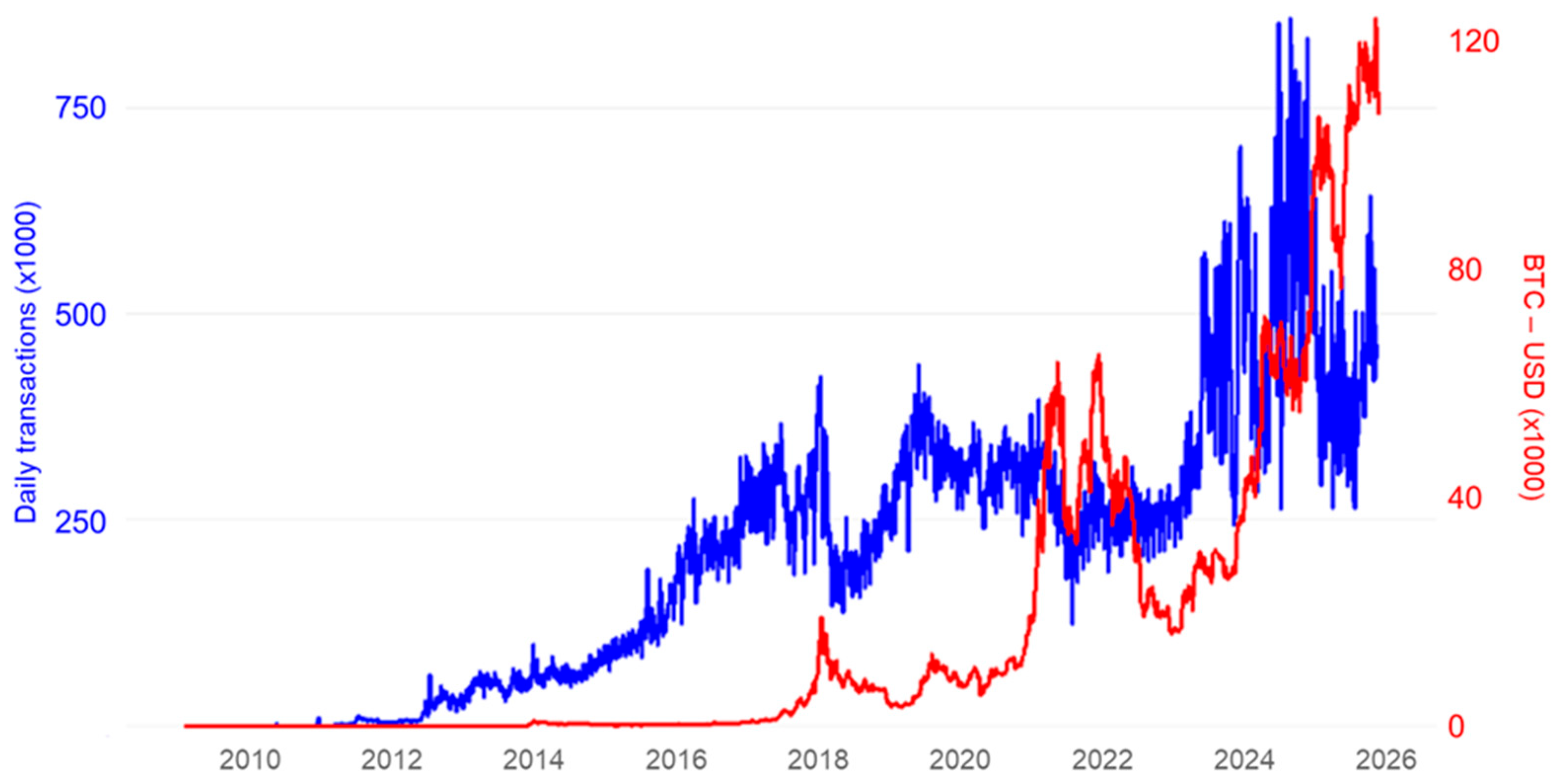
Regarding the monetary function, analyzing its use as a means of payment reveals that growth in its use has increased knowledge of BTC and its price. Figure 2 shows that, from the end of 2015, BTC’s daily transaction volume exceeded 200,000. From that moment, daily transactions remained almost uninterrupted, ranging from a minimum of 200,000 to a maximum of 400,000, until April 2023. From that point onward, the transaction dynamics changed, and volumes increased within a highly variable range, reaching their peak in mid-2024, when for several consecutive daily transactions exceeded 800,000.
Figure 2. Evolution of consolidated transactions, representing the BTC (red-colored) and stock shares (blue-colored) of USD vs. BTC. Source: own elaboration with data from Blockchain.com (n.d.).
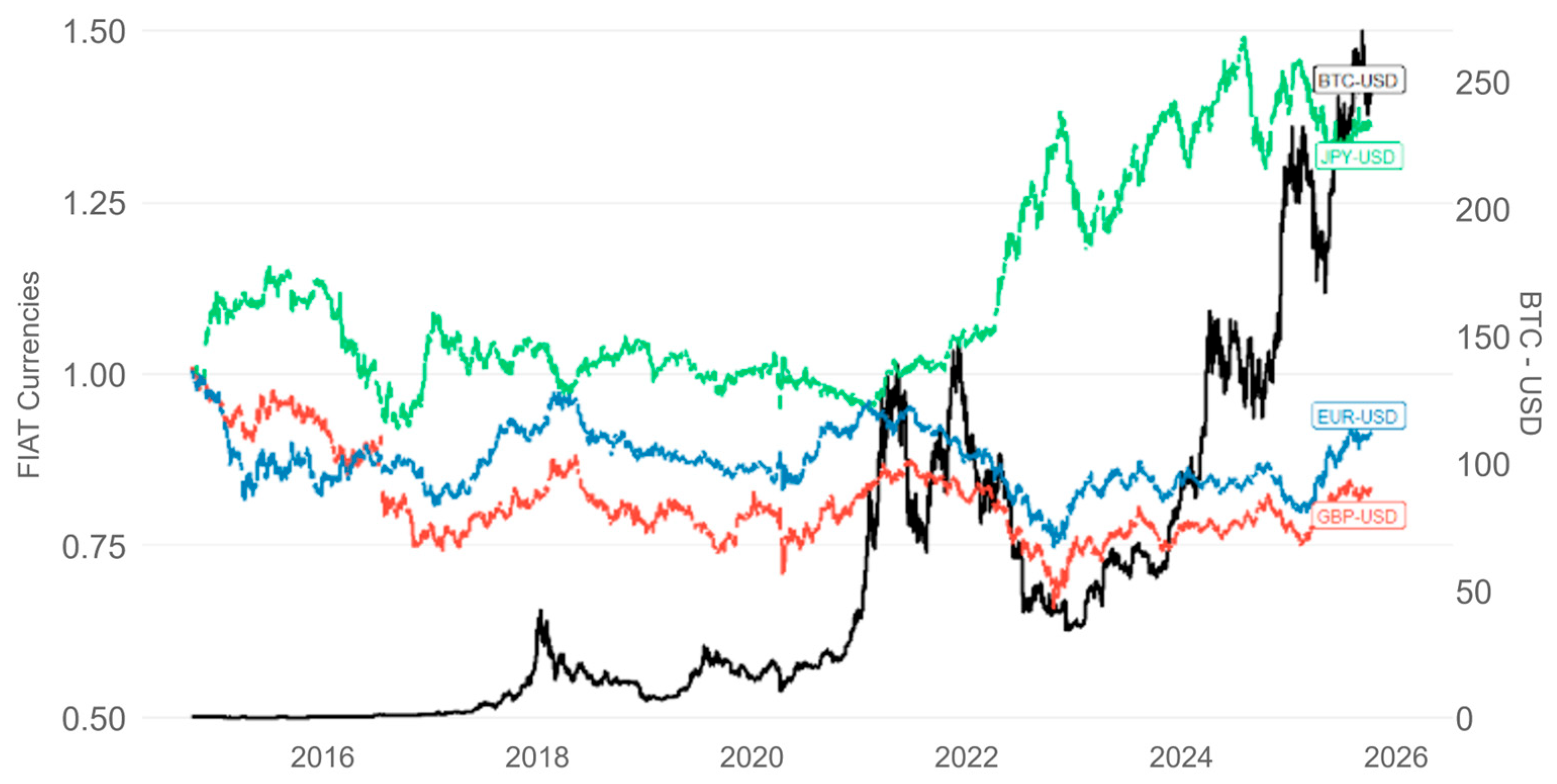
For the unit-of-measure function and given that the world’s major fiat currencies meet that criterion, Figure 3 shows the ratios against the dollar for BTC, the Euro, the Pound, and the Yen. Fiat money showed similar behavior between 0.65 and 1.50 times the September 2014 value for about 11 years. In opposition to that behavior, the BTC has changed its relationship with the dollar, reaching an increase in its revaluation in September 2025 of more than 250 times the value of 19 September 2014, a situation characterized by significant fluctuations in its price, as exemplified by the peak reached on 8 November 2021, with a revaluation of 147 times the initial value of the study, before retreating a year later to 34.5 times the initial value, which represented a fall to 23.5% of the previously reached level. Underlying this currency appreciation is a deflationary process. In this process, on 8 November 2021, 0.00628 BTC would buy the same product that cost one BTC on 17 September 2014, relative to the dollar. Over the same period, any change in the fiat currencies used would not have resulted in a price change of more than 40%.
Figure 3. Historical quotation of Bitcoin (BTC), Euro (EUR), Pound Sterling (GBP), and Yen (JPY) against the dollar ($) between 17 September 2014 and 10 September 2025. Each graph has been plotted in black, blue, red, and green colors. Source: own elaboration with data from Blockchain.com and Yahoo Finance as indicated in Table 2.
The results of this monetary analysis section show BTC’s high market price volatility and limited economic penetration as a medium of exchange. The following section examines BTC as an asset to examine its value-depositing aspect.
The process of retrieving and posting from Finance Yahoo with the R-related packages (“quantmod” and “tidyquant”) has been carried out by using selected tickers for currencies [c(“JPYUSD=X”, “EURUSD=X”, “GBPUSD=X”, “BTC-USD”)].

4.2. Approaching the Asset Functions of the BTC

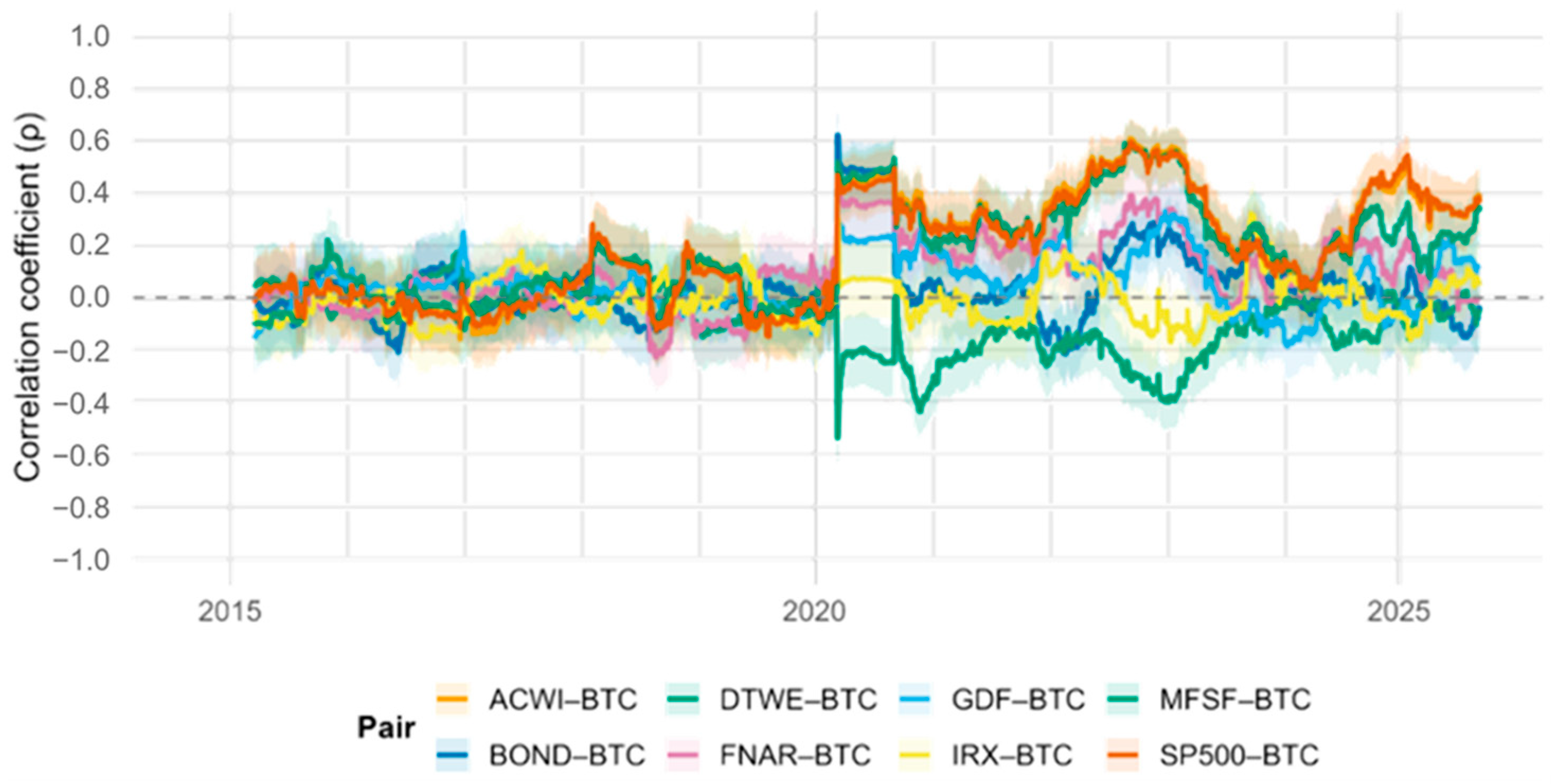
Given their role as assets and based on the identified super asset classes (capital assets, consumption/transformation assets, and value deposit assets), the logarithmic return series of these assets have been analyzed using rolling correlations with a 180-day moving window. To avoid spurious correlations, the stationarity of the series was verified using the Augmented Dickey–Fuller (ADF) and Phillips–Perron (PP) tests. All series were found to be stationary at the 5% significance level, confirming the validity of the correlation analysis. The models assume conditionally Gaussian innovations under an AR(1)–GARCH(1,1) and DCC(1,1) specification, estimated by quasi-maximum likelihood with standard convergence criteria. An 180-day rolling window was adopted to balance responsiveness and smoothness in the correlation dynamics.
The rolling correlations shown in Figure 4 indicate that BTC exhibits a time-varying dependence on different asset classes. Between 2020 and 2021, a marked increase in its correlation with equity indices, such as the S&P 500 and ACWI, brought BTC’s behavior closer to that of traditional risk assets. In 2023, these correlations decrease, and by 2024, they become more unstable. Furthermore, correlations with assets such as IRX, considered safe havens, are low or negative, suggesting that BTC does not exhibit stable hedging behavior.
Figure 4. Pearson correlation between BTC and selected asset classes estimated from log returns (180-day window). Source: calculated by authors.
Table 5 presents the mean value, standard deviation, minimum, and maximum values of the conditional correlations across the three selected periods. Specifically, it analyzes the 2017 expansion phase, the coronavirus disease 2019 (COVID-19) pandemic, the institutional adoption period from 2020 to 2021, and the market normalization phase from 2022 to 2024. In contrast to the high correlation with capital assets, the correlation with monetary indexes tends to zero. These share the main technical characteristics mentioned, as well as the term ‘cryptocurrency’. Although BTC has shown periods of higher correlation with equity indices such as the S&P 500, this relationship is neither stable nor linear. The empirical research suggests that BTC exhibits dynamic dependence, with correlations across time and market conditions, and displays unconventional behavior during episodes of financial stress.
Table 5. Conditional correlations between BTC and selected assets estimated from DCC-GARCH correlation models.
As shown in Table 6 and Table 7, the study calculated the annual skewness and kurtosis coefficients for the daily logarithmic returns of each asset from 2014 to 2025 to better understand the research approach. With skewness, BTC exhibits a marked negative trend in its early years, characterized by sharp falls more frequently than rises, a typical characteristic of the capital asset superclass, such as stocks and bonds. The positive values observed after the 2020 shock, associated with the COVID-19 crisis, suggest a progressive symmetry in the return distribution, with behavior closer to that of store-of-value assets, especially from 2022 onwards, when it exhibits more moderate kurtosis, consistent with that observed in traditional safe-haven assets. The inception of BTC, from characteristics of capital goods to traits closer to value-preserving assets, suggests a maturation of the BTC market and a gradual reduction in its exposure to systemic risk factors. In statistical terms, the kurtosis coefficient is interpreted using conventional thresholds: a leptokurtic distribution is indicated by values greater than three, reflecting the presence of fat tails and, therefore, a higher probability of extreme events. Conversely, the three platykurtic values shown below appear to be associated with thinner tails and lower tail risk. Table 7 shows that BTC exhibits leptokurtic behavior, similar to that of most assets. This pattern intensifies during periods of market turbulence, such as 2020 and 2022, both of which are consistent with heavy tails and volatility clustering.
Table 6. Annual skewness of daily log returns by asset.
Table 7. Annual excess kurtosis of daily log returns by asset.

4.3. Approaching the Related Ponzi Schema of BTC

By comparing BTC’s market risks with the structural characteristics of a Ponzi scheme, one can distinguish between a technical and a legal analysis. This study assumes that both may share certain behavioral risks that affect decision-making, such as speculation or herd behavior. This is paramount in clearly presenting the conceptual and structural differences between them.

4.3.1. Formal Market Risks of BTC

It concerns potential financial losses arising from changes in market variables such as prices, volatility, liquidity, or exchange rates, albeit not necessarily implying improper fraud, but rather reflecting the inherent uncertainty of an asset (according to the BIS, ESMA, BaFin, and IMF). Specifically, investor expectations, technological adoption, and global liquidity cycles influence BTC’s price, driving extreme volatility. This scenario also occurs when liquidity risk is observed, due to either a financial crisis or panic, characterized by a decline in trading volume and an increase in spreads, as well as by the difficulty of selling without incurring a substantial loss. Another reason is counterparty and custody risk, where BTC holders lose their funds due to hacking, custody errors, or exchange fraud, specifically those related to operational risk, although not structural in nature. Further reasons concern regulatory, political, or legal risk, such as when changes in national regulations or restrictions affect the price or usability. Finally, technological or technical risk can be another reason why network vulnerability resulting in the loss of private keys may affect holdings or value.

4.3.2. Associated Risks of BTC

This raises the question of whether there are risks associated with decentralized protocols compared to those tied to platforms or operators, and specifies which concerns relate to custodians and exchanges rather than BTC itself. Indeed, this is a key issue in the regulation and economic-financial analysis of the crypto ecosystem: distinguishing between risks inherent to the decentralized protocol, such as BTC, and operational or custody risks arising in centralized platforms or intermediaries, including exchanges, brokers, or custodians.
Regarding the risks associated with decentralized protocols and centralized platforms in the crypto ecosystem, they fall into two broad categories. At one end, the risks associated with decentralized protocols, including those closely related to architecture, governance, and security (e.g., BTC, ETH); at the other end, those relating to intermediation or custody risks derived from entities managing store or intermediate assets on behalf of users (e.g., Binance, FTX, Coinbase). Risks associated with decentralized protocols stem from the absence of direct human or business mediation, reflected in the level of code design and the degree of mediation.
In the case of BTC-related protocols, there are technological and governance risks, including potential software flaws, bugs, or cryptographic vulnerabilities that compromise the system’s integrity. Risks associated with the centralization of mining power can also compromise security through 51% attacks. Nevertheless, BTC has one of the most resilient structures due to its decentralization and the immutability of its consensus mechanism, primarily through ‘Proof of Work’ (Narayanan et al., 2016). Furthermore, BTC’s consensus mechanism makes it one of the most secure decentralized systems ever developed, despite challenges posed by its governance rigidity (Narayanan et al., 2016).
Concerning environmental and energy risks from BTC-related protocols, the ‘Proof of Work’ mechanism has been criticized nowadays because of high electricity consumption, raising concerns about its sustainability (Stoll et al., 2019).
Connected to systemic regulatory risk, the BTC-related protocols themselves lack legal personality. Therefore, governments cannot be held directly responsible for misuse, such as money laundering or tax evasion, thus creating regulatory gray areas (Auer & Claessens, 2018). While BTC-related protocols themselves are neutral, their pseudonymity indeed creates a regulatory blind spot (Auer & Claessens, 2018).
Another issue is the risk associated with intermediaries, custodians, and exchanges. Most problems and user losses in the crypto world are not due to the BTC-related protocols themselves but rather to failures and fraud by intermediaries that handle user funds. These risks fall within the operational and custody domains and are the primary areas of concern for regulators, including the SEC, ESMA, and the FATF (ESMA, 2023). These risks can be seen depending on the matter assessed. This prevents the fact that, in terms of custody risk, centralized custodians (e.g., exchanges that store private keys) can concentrate assets on wallets under their control, directly contradicting BTC’s decentralized philosophy. This means that users do not directly possess their keys, which implies a risk of loss or misappropriation, as occurred with Mt. Gox in 2014 and FTX in 2022 (Arner et al., 2023).
Additionally, there is a risk of insolvency and fraud, since centralized exchanges can operate without accounting transparency or external audits, making them vulnerable to fraud, embezzlement, or bankruptcy (Easley et al., 2019). BTC, as a protocol, did not collapse in the cases of FTX, Celsius, or BlockFi; it was the centralized operators who mismanaged the funds. Furthermore, there are cybersecurity risks because custodians and platforms are frequent targets of hacks (e.g., Tsuchiya & Hiramoto, 2021), resulting in losses of USD 530 million, as was the case with Mt. Gox, which suffered losses of USD 450 million. In fact, these attacks target custody infrastructure, not the BTC-related blockchain, whose network has not been compromised to date through cryptographic design or the consensus mechanism. Finally, regarding regulatory compliance risk, there are centralized platforms that must comply with policies based on the criteria “Know your Customer/Anti-Money Laundering” (KYC/AML) and investor protection regulations. That is, non-compliance results in penalties and affects overall trust in the ecosystem, though not in the underlying protocol (IMF, 2021). In that regard, Table 8 provides a concise legal taxonomy diagram to maintain clarity among the levels of analysis.
Table 8. Legal taxonomic framework of the crypto-ecosystem.
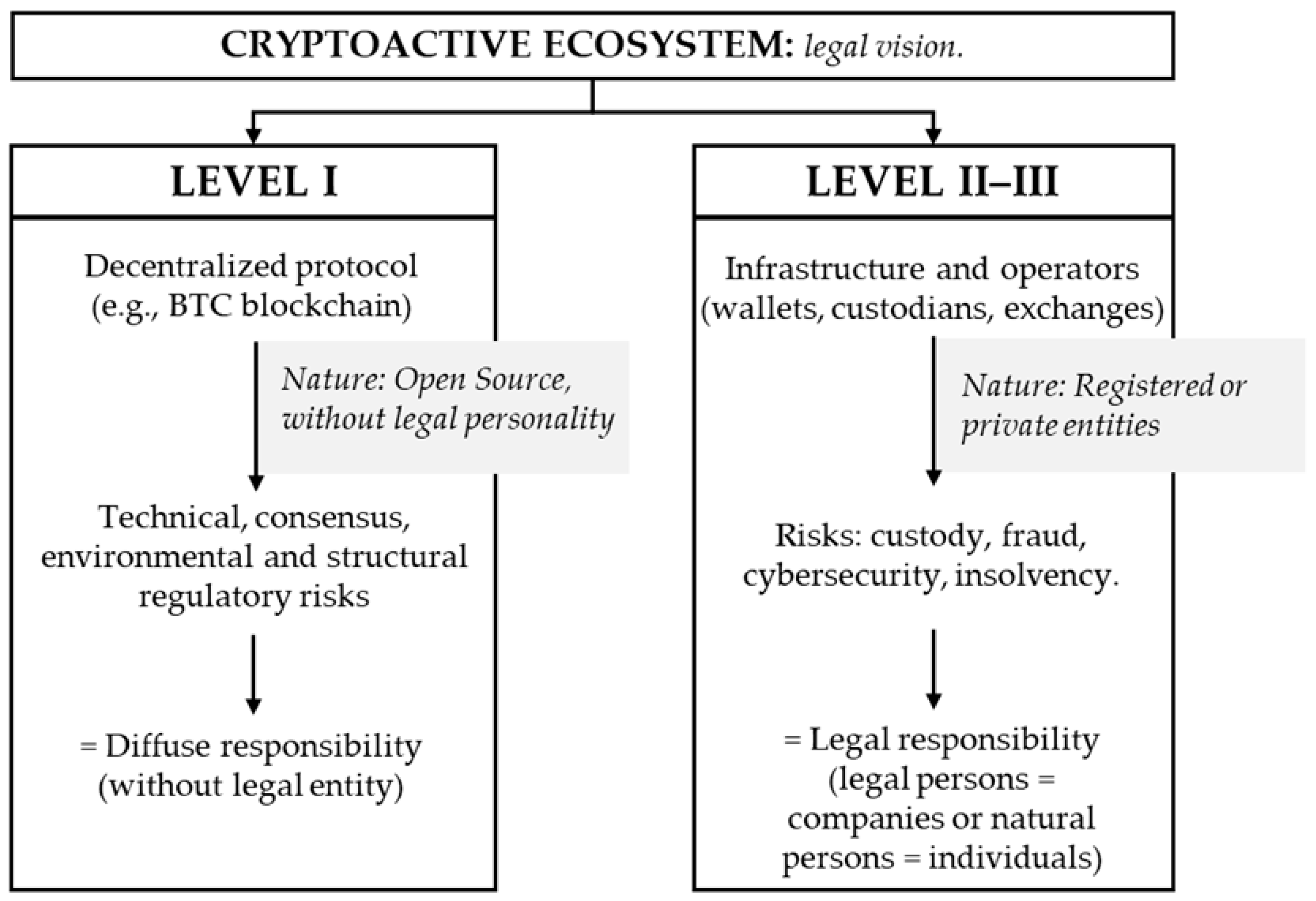
Simultaneously, according to the legal taxonomy shown in Figure 5, the basis of related features can be regarded at three levels, which means they can differentiate into any cryptoasset. There are those to be encompassed within Level I, as an autonomous and decentralized protocol (i.e., a legal entity responsible for its code or operation is not applicable), on the one hand; and those of Levels II and III, as legal entities subject to regulation, supervision, and sanctions, on the other.
Figure 5. Legal taxonomic diagram of the crypto ecosystem. Source: own compilation based on the literature referred to in the manuscript.
Accordingly, the levels mentioned above are subject to specific risks assigned due to exacting criteria. Level I, namely protocol (i.e., BTC), is related to technological risk, particularly those concerning vulnerabilities in the network or consensus (namely, Proof of Work), but also those relating to environmental risk, such as energy consumption (Stoll et al., 2019), and even to governance risk, such as conflicts arising from forks. Nonetheless, BTC’s security and transparency have kept it free of critical failures since its inception in 2009 (Narayanan et al., 2016). Similarly, in relation to level II, namely custodians and services, there are operational risks, such as key loss, hacks, and negligent management. Additionally, there are delegated custody risks, where users lack control over their funds. This is, for example, the case of Mt. Gox in 2014, which suffered a loss of 850,000 BTC due to mismanagement. Finally, regarding level III, namely exchanges and platforms, there is an insolvency (Khan et al., 2025) or fraud risk, such as the misuse of customer deposits (e.g., the FTX case in 2022). Issues have also been observed in regulatory risk, such as non-compliance with KYC/AML regulations (Easley et al., 2019), as well as in systemic reputational risk, which affects overall trust in crypto assets, though not the underlying protocol.
Regarding a comparative regulatory perspective, international organizations, such as the IMF, the BIS, and the EU (European Commission, 2023), recognize this implicit taxonomy by differentiating among them. Consequently, native decentralized cryptoassets (e.g., BTC and ETH) are supported without an identifiable issuer, for two reasons. On the one hand, cryptoassets are issued by identified entities (e.g., tokens, stablecoins); on the other hand, cryptoassets are managed by service providers (CASPs), which require licensing, oversight, and auditing. Thus, regulation does not target the BTC protocol itself, but rather the intermediaries that operate it or facilitate access to it (European Commission, 2023).
All the above provide clear evidence for assessing that the BTC, as a decentralized protocol, falls outside the traditional legal framework. The risks that threaten users (i.e., loss of funds, hacks, fraud) do not only originate from the code or network, but also from centralized intermediaries operating through custodians or platforms. It could also be assumed that the main regulatory challenges in the joint control of ‘cryptomarkets’ (e.g., BTC) include defining the legal responsibilities of the actors who mediate them.

4.3.3. Formal Risks of a Ponzi Scheme

Since the 1920s, Ponzi schemes have traditionally been a highly effective yet unlawful method of defrauding investors. Behind this, however, is the idea that they cause significant investment losses, in addition to the explicit promise of abnormally high guaranteed returns, even in the absence of an empirical financial basis. This is due to accounting opacity and a lack of auditing, since independent, external verification of transactions or alleged investments is not provided. Another reason relates to the absolute dependence on the entry of new investors, who expect to receive the promised returns (i.e., when new contributions cease, the system collapses). Additionally, centralization of control over funds derives from the common fact that one entity or person controls the flow and distribution of the alleged returns. Finally, there is a lack of underlying value or a secondary market, a direct consequence of which is that it is not based on free supply and demand but on pyramidal recruitment. These elements facilitate an objective comparison across four key dimensions: legal structure, source of performance, transparency and verifiability, and system sustainability.
Similarly, it could establish a structural distinction between BTC and a Ponzi scheme, as shown in Table 9.
Table 9. Comparative dimensions of BTC and Ponzi schemes.
Based on the red flags of fraud outlined by the US Securities and Exchange Commission (US SEC, 2021), Table 10 assesses whether the typical warning signs of Ponzi schemes have been identified within the BTC framework, both operationally and structurally. Building on this, Table 11 further examines these SEC-designated red flags specifically from an operational standpoint, highlighting their applicability to BTC´s decentralized architecture.
Table 10. Comparative features of BTC and Ponzi schemes.
Table 11. Operational assessment of SEC-related ‘red flags’ of fraud applied to BTC.
For all the above reasons, BTC cannot be classified as a Ponzi scheme, as it does not promise guaranteed returns, its operation is public, and its value depends on transparent market mechanisms. Although it exhibits high volatility, such risks are inherent in speculative assets rather than indicative of fraud. Moreover, independent of its market price fluctuations, BTC’s ability to provide payment-processing services further distances it from the conceptual framework of a Ponzi scheme. In this way, the common point is that the BTC market and Ponzi schemes can generate massive losses and are influenced by biases in decision-making, such as speculation, the bubble effect, and herd-like behavior. In that sense, a Ponzi scheme is an investment fraud in which existing investors receive income from new investors. BTC differs in its definition. The idea of presenting the return on investment as income generation is entirely foreign to BTC, whose performance is driven solely by changes in its value. There is no direct payment of income. Consequently, the study examines the implications of the ‘red flag’ or common characteristics identified by the US SEC, specifically those related to high returns without risk, consistent growth, unregistered investments, unlicensed sellers, complex strategies, account statement errors, and uncertain payments.

4.4. Approaching the Threat of Service Obsolescence of BTC

As already pointed out, BTC’s rapid expansion in the cryptocurrency markets has become a milestone in the field of decentralized currencies, serving as a paradigm for modern economies, as governments and financial institutions cannot regulate its operations, unlike fiat currencies. However, technological development has continued at a pace, and it is now possible to use other cryptocurrencies whose technology improves BTC’s performance as a means of payment. It is reasonable to assume that other cryptocurrencies may gradually replace BTC in this current role. Consequently, this scenario would lead to a conflict between possible developments that improve BTC’s performance (e.g., the Lightning Network) and those outside BTC’s sphere that offer solutions better suited to users’ needs.
In addition to the currencies above, stablecoins and other virtual currencies dependent on central banks are emerging in a so-called ‘cryptoenvironment’ with growing functionality. In the event of obsolescence, the question remains which elements can maintain BTC’s value when users turn to alternative payment services. The analysis results indicate that BTC does not exhibit the typical characteristics of the elements analyzed. It means that it does not meet the set of monetary criteria, is not solvent in any asset category, does not meet the requirements of a traditional pyramid model, and, as a service, has been surpassed by subsequent developments based on the technology created.
Therefore, the research results align with the literature’s expectations, suggesting that BTC should not be considered a currency but rather an investment asset. It has compelled the individual to examine its characteristics, as seen in the present study. Moreover, unlike earlier works suggest, one should not regard BTC as a pyramid scheme or a novel model, because it cannot be separated from the technological advancements in BTC-related trading.

5. Discussion

BTC was introduced in 2009 as a revolutionary technology offering numerous advantages for transactions. It enabled the reduction, and in some cases elimination, of spatial, temporal, and cost barriers, while providing a secure and reliable cryptographic transaction environment through specific security and information elements. The novelty in security lies in its protection through a combination of public and private keys that confer ownership. A private key is required for the user (i.e., the payer) to transfer cryptocurrency anonymously to another user (i.e., the beneficiary) on the network, without the possibility of reversing the operation (Bonneau et al., 2015).
Under these conditions, it became a revolutionary means of exchange, fulfilling the first criterion of monetary function and even surpassing the performance of other existing monetary options. This situation enabled them to build trust, facilitating their daily exchanges, whether for transactional or investment purposes in BTC.
This paper focuses solely on BTC-related conceptual aspects, assessing its behavior based on the available academic literature and the results obtained. Therefore, this examined its role in society. As can be seen, no mention is made of technical aspects on which BTC is based, such as the reliability of its Blockchain network, its behavior in the face of cyberattacks, or the possibility that agents with large computational capacity could intervene in the network, all aspects in which the BTC network has performed very well to date. In searching for BTC’s place among the elements available in today’s economy, the first element discussed is its monetary behavior.
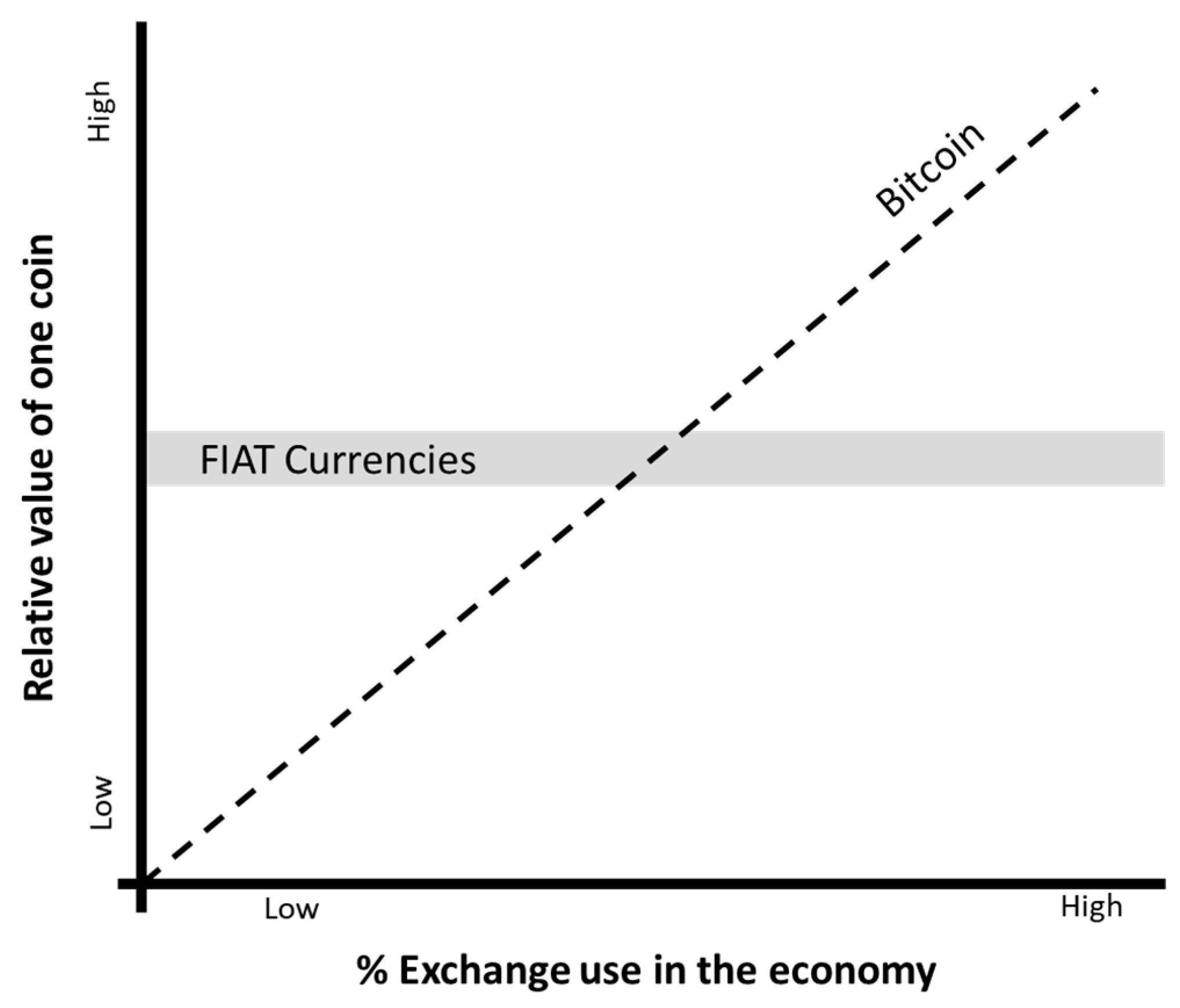
All the analyses concluded that it does not meet the basic criteria for financial consideration. Firstly, as a medium of exchange, the current situation does not show widespread adoption by the population. Even major technology companies have occasionally tried to accept payments using BTCs. However, its level of acceptance is currently minimal. Individuals might adopt it if other monetary issues are resolved, even though they do not currently use it as a payment method. It is also important to note that the limitations associated with BTC’s initial technological capabilities have been overcome, enabling card payments comparable to those offered by commonly used credit or debit cards. Secondly, it has the condition of unit of measure, which, as the data show and the studies analyzed confirm, BTC is currently not satisfied. Given its well-studied volatility, it is unfeasible to measure any economic aspect of BTC with confidence that the measurement will remain valid in the short term. This element also behaves in the opposite way to that of a medium of exchange, because a hypothetical increase in the use of BTC for economic transactions would, if anything, lead to greater demand and deflationary behavior than is currently seen in BTC as a unit of measure. Both elements, units of measure and medium of exchange, are presented in Figure 6, where the relative value of the BTC increases as its utilization grows, as indicated by the dashed line. However, stability in the use of BTC could correct the situation shown in the figures if it were to gain widespread acceptance as a means of payment. It has also proposed a third level of use as a store of value, an aspect that is also highly controversial given its performance to date. Without guarantees of compliance with the unit of accounts, it is impossible to consider it to meet the criterion of a store of value, because, given the history of cryptocurrency, any amount available in BTCs will be subject to high volatility, and therefore, no reliable expectations can be made about the future value of the cryptocurrency. Similarly, since it does not guarantee compliance with the above criteria, it is impossible to use BTC as a standard for future payments. Considering the initial design of BTC and its use for over ten years, it does not meet the criteria for a currency; therefore, it is not a functional currency under current conditions. The concept of cryptocurrency that BTC emerged from is no longer representative of what BTC is today.
Figure 6. Its economic use determines BTC values. Source: own elaboration.
Everything discussed suggests that BTC does not meet the criteria to be considered a currency. However, this cannot be regarded as an insurmountable limitation, as it could meet the requirements set out above if stable conditions of use were to arise in the future. Conditions that could apply to BTC or be incorporated into the design of future monetary solutions, whether they depend on governments or promote the decentralization of economies.
In addition, a fixed and unchangeable issuance volume will constrain the currency if currency stability is achieved. This would mean that, just as fiat currencies are subject to regulated inflation conditions, their monetary use is not neutral with respect to the economy. BTC would be subject to fixed conditions that cannot be adjusted to the economy’s performance, resulting in deflationary conditions during periods of economic growth and inflationary conditions during periods of decline, implying non-neutral monetary conditions in financial behavior. This means that, under conditions of economic development, as expected across different economies, the monetary conditions of BTC promote saving over consumption, driven by the expectation of future increases in purchasing power. Similarly, they would reduce credit’s attractiveness, as their repayments would become progressively more expensive. To illustrate, dividing 21 million BTCs equally among about 8 billion people would give each person 0.0026 BTCs. However, if its use were to spread to an entire society of 10 billion inhabitants, the average would be 0.0021 BTCs per citizen. It implies a 20% drop in the per-unit availability of money. This drop does not account for the impact of the expected increase in economic production needed to meet each person’s needs.
When considering BTC as an asset, the analysis shows behavior that is inconsistent with the classifications of assets available in the economy. Considering BTC as a cryptocurrency could initially place it alongside other monetary assets as a store of value. However, the data shows behavior that is highly correlated with capital goods, with which it does not share the possibility of offering a return on investment in the form of dividends or other forms, but rather through the direct valuation of the asset in the market. In contrast to the above, it presents a distribution of value variations that is more typical of monetary assets than of capital assets. Under these conditions, placing BTC in any asset superclass is impossible, raising the question of whether it should be considered a new asset class.
Under these considerations, the role of gold as a benchmark asset in the conception of BTC stands out once again, as it behaves in two ‘superclasses’ at the same time: on the one hand, as a store of value and, on the other, as an asset subject to transformation. The money market needs this comparison because gold is considered the benchmark asset. Even though BTC and gold share similarities in terms of scarcity and durability, a fundamental difference lies in the fact that modern economies have widely accepted gold as a monetary unit, driven by people’s desire to own it and its inherent scarcity. The desire to own it stems from non-monetary criteria, linked to social status and power, among other factors. Indeed, the secure and stable demand for physical assets allows for their monetary use.
Additionally, BTC is treated as fiat money; its value is determined by the trust placed in its issuer. Its issuer can be determined based on the founding white paper published by Satoshi Nakamoto in November 2008, which established the conditions for BTC issuance. Therefore, considering that its issuer has become a decentralized network of computers that collaborate to record all transactions reliably and predictably, and systematically operate in the issuance of the currency. Under these conditions, the currency’s value rests exclusively on society’s trust in that currency. Considering all the above, the value of BTC depends on its use being of interest to society; that is, it offers a solution that is preferable to others. Among these solutions, two can be considered primary: on the one hand, the monetary function, if it meets the conditions that guarantee compliance with the criteria of unit of measure, medium of exchange, and store of value discussed throughout the document.
On the other hand, considering that it offers a service demanded by society, the main form could be that of a medium of exchange independent of central banks. With this second option, the value would depend on BTC’s ability to offer a service on terms that are more advantageous than those of other services. The exchange service mentioned earlier in this document initially provided advantages over other exchange solutions, including transaction speed, costs, security, anonymity, and order automation, all of which were revolutionary features in 2009 when the first BTC was issued. However, the technological development derived from this innovation has since enabled further advances in services. These developments are likely to continue improving and offering new solutions.
Considering BTC as a service, whose value depends on society’s valuation, means the service can be provided equally regardless of BTC’s value, with the only difference being the number of BTC required to obtain it. In this case, the problem with the service arises when BTC is held for an extended period, at which point the service assumes the risk of BTC volatility. All voluntary exchanges in society occur because people consider the acquired item preferable. Individuals value fiat money for their expected capacity to be exchanged for desired goods and services.
From the perspective of the quantitative theory of money, we find ourselves with a fixed amount of cash, more commonly referred to as “M”, on which it is not possible to make decisions regarding expansion or contraction. This implies that any adjustment in its use in the real market will likely lead to a corresponding adjustment in the P/V ratio. Indeed, this presupposes that the speed of exchange remains relatively constant. In that case, any adjustment in the use of money becomes an adjustment in prices over which there is no remedy due to the absence of an institution responsible for regulating the money supply.
The value of fiat currencies does not depend only on their use in society. When there are variations in its use, central banks can intervene in the currency to prevent inflationary or deflationary episodes, as indicated in their objectives. Figure 6 illustrates the issue with a gray band, as the effect of central bank decisions on economic lag can lead to deviations. In contrast, BTC’s monetary supply or volume is entirely independent of how citizens use it, meaning that when demand for BTC increases, its price will rise, and vice versa. Consequently, its economic behavior causes deflation; therefore, increased usage means it can buy the same goods with fewer BTCs, which central banks are trying to avoid.
BTC emerged over a decade ago as a new form of currency that conferred freedom of action due to its independence from governments or central banks. It was a novel proposal thanks to its reliability of operation and the search for independence from any actor. Furthermore, the collection of extensive data over the past fifteen years has enabled a reassessment of the proposed monetary model’s outcomes from a distinct analytical perspective, using relevant statistical data.
Although BTC has not managed to obtain the properties of a currency, it has paved the way for decentralized monetary models in which no authority can arbitrarily decide on its behavior, while at the same time opening the door to the development of Central Bank Digital Currencies (CBDC) that move in the opposite direction, strengthening the control and decision-making capacity of central banks. BTC has shown how, through technological tools, it is possible to launch an alternative to fiat money that society receives with interest. It has shown how the market is considering its integration into the means of exchange and how different governments are responding, among other things, by incorporating this threat into their tax systems. Thus, this step can be seen as successful in developing an international and independent monetary system. However, the conditions under which it was created have led it to be perceived more as an investment asset than as money itself. The high volatility that has characterized its behavior from the outset has attracted investors seeking profitability more than citizens interested in a new monetary offering.
Beyond the social utility of BTC, which gives it value, a community of investors has invested large sums of money in acquiring such a cryptocurrency and in the significant computing power required for mining. All these people are interested in maintaining BTC’s value. Therefore, they are expected to contribute to this to the extent that they can achieve new gains and avoid further losses. That said, if demand for BTC declines due to a lack of use as a service or a decrease in value expectations, it could continue to maintain a specific value associated with other reasons for its possession. The ‘cryptomarket’ may resemble specific art markets in some respects, but there are also significant differences across cryptocurrencies. The parallel is that, to a certain extent, owning BTC is analogous to owning art, serving as a status symbol or something of that nature. The fact that each BTC is traceable becomes apparent with the value of owning a unique asset after its issuance, even if its value was initially zero. Indeed, the scarcity of BTCs has traditionally been the primary lever to its high demand. It could even reveal details such as the coins’ traceability, issue date, and past owners involved in mining the initial BTC with Satoshi Nakamoto.

5.1. Considerations When Assessing Whether Bitcoin Is a Payment Service

It has been faced with a monetary element whose only real functionality is as a means of exchange. Thanks to the functions described above, transactions can be made quickly, cheaply, securely, and internationally, all in accordance with current standards. This service is also innovative, as physical credit cards and virtual payment terminals have been introduced into the cryptocurrency market. This development, which occurred a generation ago, enabled payments anywhere in the world without carrying cash or needing change. The market has now surpassed these physical cards and has widely adopted cell phones and other wireless devices. Including blockchain technology could technically advance previous payment methods.
Understanding BTC as a service means its use has a beginning and an end, as its users find alternative services to handle the transactions they currently hold with BTC. Those transactions could be performed in other cryptocurrencies or other alternative tools. In addition, companies back credit card services whose business model depends on the quantity and quality of the service they offer, which they will try to maintain. This implies a direct responsibility for service quality, which could result in losses if it fails to meet customers’ expectations.
In contrast, there is the case of BTC, whose operation is supported by a community of miners (whether individuals or companies) whose objective is also to obtain a return on their activity (at the very least, they do not want to suffer losses), but with the difference that the return is based on different foundations than those of the card companies. In this case, they do not depend on the quality of service unique to the blockchain network. They rely on the volume of mining services performed, their costs, and the value of the currency in which they receive BTC rewards, which makes their profitability an element over which they have little scope for action beyond relative cost control.

5.2. Considerations When Assessing Whether Bitcoin Is a Ponzi Model

All the above reasoning leads us to consider that we are faced with a cryptocurrency that does not fulfil monetary functions. This cryptocurrency is, in turn, a non-remunerated financial asset not backed by a central bank. It offers a revolutionary service that is vulnerable to obsolescence as the technology on which it is based evolves. It causes the problem of identifying the proper service to exchange value to fulfill its function. The exchange value depends on its demand, regardless of whether it is based on exchange or investment motives.
According to the present study, BTC appears to be a decentralized service, yet it is regarded as a currency and has behaved more like an investment asset. As a service, it benefits from network effects as more people adopt BTC, thereby expanding opportunities for existing users. For instance, the fact that merchants or chains accept payment in ‘cryptocurrency’ generates value for existing users of ‘cryptocurrency’. Therefore, the question now arises whether BTC behaves like a Ponzi model.
The present study’s findings do not suggest that the value of cryptocurrencies, whether regarded as real or financial assets, depends on the entry of new users or the overall volume of their transactions. If new users trust the currency and conduct more transactions, it will be closer to a monetary model, and therefore, its value can be expected to increase.
This paper has not assessed BTC’s features related to decentralization or technology. However, the study aims to analyze the fundamental aspects, focusing on its economic performance as a currency, asset, or service. In sum, in addition to being an aspiring currency, BTC is an aspiring monetary asset that is currently closer to a capital asset, given the bet on its value increasing as it is recognized as such. Furthermore, it is an international transaction service with distinct advantages over other banking systems in terms of costs, speed, and security.

6. Conclusions

In its classical economic conception, money must fulfill the three functions outlined in Figure 1. That is, it must be a means of payment, a unit of account, and a store of value to be considered a possible alternative to traditional fiat currencies. Its decentralized design and issuance limit of 21 million units reinforce this. However, the analysis presented here reveals that BTC, as a cryptocurrency, exhibits certain structural deficiencies that may hinder its consolidation as a viable alternative to money. The first criterion for money is its ability to facilitate rapid, large-scale exchanges at low transaction costs. In this regard, the use of BTC as a means of payment has increased awareness and driven up its prices. Although individuals can use it as a payment method, its use could be more widespread in niches such as international transfers or exchanges between digital users, albeit limited in other areas, which reduces BTC’s overall efficiency as a universal payment method. The second function of money is as a stable store of value over time. Until now, BTC has been characterized by extreme volatility, with daily fluctuations reaching double-digit levels, further complicating the preservation of economic wealth for individuals and companies.
Furthermore, unlike fiat currencies, which are backed by national economies and central banks, BTC lacks institutional support to guarantee its stability because its price depends on the expectations of its holders, the market itself, and associated speculative phenomena, which would make it more like a high-risk investment asset than a reliable store of value. The third function of money is to act as a standard measure of value or unit of account. In this regard, the prices of goods and services are expressed in fiat currencies such as the euro or the US dollar. At the time of the transaction, the system converts them into BTC at the current exchange rate. This implies that BTC fails to serve as an account unit because it relies on the reference values of traditional currencies. Consequently, the findings suggest that BTC, in its current state, may not be a fully functional currency, as it can be inefficient as a global means of payment in certain instances. As a store of value, it is unstable due to daily fluctuations. Individuals often refer to it using other fiat currencies; therefore, it is practically nonexistent as a unit of account. Rather than a monetary alternative, BTC could be considered a speculative digital asset or an emerging financial asset, with utility dependent on its technological innovation, but limited capacity to replace fiat money.
Finally, with respect to the second research question and after studying BTC’s performance as an asset and analyzing the different types of assets, capital goods, tradable goods, or store-of-value goods, the study focused on BTC’s behavior, concluding that BTC is not fully represented in any of the three prominent asset families, showing behavioral relationships more consistent with capital goods. However, a growing similarity can be observed in characteristics such as symmetry and kurtosis linked to store-of-value assets.
According to research findings, BTC’s evolution reveals a broader monetary challenge beyond its statistical behavior as an asset. Accordingly, BTC faces the inherent problem of being deflationary in relation to economic growth, implying that its monetary function is not neutral to the economy’s functioning. In the event of widespread adoption, such dynamics could distort intertemporal preferences, discouraging spending and investment. Moreover, in its monetary role, technological innovation poses a structural threat to BTC’s long-term viability, as emerging technologies may render its value proposition obsolete, particularly given the technical constraints of Nakamoto’s original network design.

7. Future Research Directions and Research Limitations

This paper lays the groundwork for future research on the use of BTC within the financial sector. In particular, further studies could validate and expand the comparative analysis presented in this paper to include other essential cryptocurrencies, such as Litecoin (LTC), Chainlink (LINK), Cosmos (ATOM), and Monero (XMR). Additionally, a quantitative modeling approach could be applied to identify the potential risks posed by cryptocurrency mixing services, also known as ‘tumbler’ or ‘fogger’, within the expanding ecosystem of blockchain-based decentralized marketplaces.
As previously stated, the results presented in the paper do not provide absolute certainty that BTC should be considered a circulating currency in a traditional monetary sense. This does not prevent future decentralized cryptocurrencies, under very special circumstances, from being entrusted with three basic functions of money: a store of value, a unit of account, and a medium of exchange. However, without a monetary authority regulating the amount of digital cash in the global market, disruptive technologies such as coin-issuing entities pose a significant obstacle to their being considered truly disruptive.
Although this study analyzes many elements common to other cryptocurrencies, not all analyses agree, and the conclusions are not applicable. In addition, given the large daily volume of stablecoin trading and the threat posed by the issuance of central bank digital currencies, it is crucial to analyze their role as currencies rather than as payment services, as outlined here. The primary objective of future analysis should be to determine the issuance conditions that enable a decentralized currency to meet the price-stability criteria required for its general adoption.
Nonetheless, it is reasonable to believe that other cryptocurrencies, such as ETH or BNB, may exhibit different behaviors, either due to the approaches outlined in their white papers at launch or to technological developments that influence their development. Facts such as their mining and issuance conditions or the services associated with their blockchains may yield very different results, and it may even be the case of creating crypto assets that fulfill all monetary functions. In recent years, interest in this regard has shifted to analyzing Ponzi schemes on the Ethereum blockchain, given the opportunities offered by its smart contracts (Zhang et al., 2021). In this sense, each selected coin can be analyzed independently to assess its potential as a stable currency option.
This paper’s primary line of research is the definition of an issuing and payment system configuration that would enable a new cryptocurrency to become a stable and reliable alternative for making payments to the population. Moreover, this approach defines the criteria for launching a BTC alternative, including a more solid foundation, as individuals have sought an independent, free, and secure monetary option since the inception of computing technology.
As with cryptocurrencies, stablecoins require a particular analysis and classification, both from a monetary and a business perspective. In their economic role, a study examines their contribution to developing the financial ecosystem through their services. Their business role involves increasing exchange risk by adding to the base currency’s risk, typically USD-based, as well as the risk associated with the company issuing the stablecoin. Additionally, it involves analyzing the issuing companies’ capitalization, investment, and debt ratios. At this point, it would shift towards an independent value based on neutral conditions concerning economic behavior. In either case, although BTC has been around for 15 years, its behavior can still be considered novel and incipient, given that it is the first monetary proposal based on technology with significant international reach in a globalized world. This means that the time horizon for analyzing monetary behavior remains limited.


Supplementary Materials

The following supporting information can be downloaded at: https://www.mdpi.com/article/10.3390/economies13120357/s1. A dataset for the study has also been prepared by compiling the daily quoted values of selected indices. Consequently, in addition to the DTWE values downloaded from Fred Economic, related data can be downloaded from finance.yahoo.com through the code provided in Appendix A.

Author Contributions

Conceptualization, A.M.R., A.S.-d.-l.-C. and J.E.H.; methodology, A.M.R., A.S.-d.-l.-C. and J.E.H.; software, A.S.-d.-l.-C. and J.E.H.; validation, A.M.R., A.S.-d.-l.-C. and J.E.H.; formal analysis, A.S.-d.-l.-C. and J.E.H.; investigation, A.M.R., A.S.-d.-l.-C. and J.E.H.; resources, J.E.H.; data curation, A.S.-d.-l.-C. and J.E.H.; writing—original draft preparation, A.M.R., A.S.-d.-l.-C. and J.E.H.; writing—review and editing, A.M.R.; visualization, A.S.-d.-l.-C.; supervision, A.M.R.; project administration, A.M.R.; funding acquisition, A.M.R. All authors have read and agreed to the published version of the manuscript.

Funding

This research received no external funding.

Institutional Review Board Statement

Not applicable.

Data Availability Statement

The data collected and analyzed in this study are publicly available with no restrictions alongside the paper.

Conflicts of Interest

The authors declare that they have no conflicts of interest.

Abbreviations

The following abbreviations are used in this manuscript:
ACWIMSCI All Country World Index
ADFAugmented Dickey–Fuller test
ATOMCosmos (cryptocurrency)
BONDPIMCO Bond Exchange-Traded Fund
BISBank for International Settlements
BTCBitcoin (cryptocurrency)
BNBBinance Coin
CBDCCentral Bank Digital Currencies
dAppsDecentralized applications
DCCDynamic Conditional Correlation
DTWEXBGSFRED—Nominal Broad US Dollar Index
EAFEEurope, Australasia, and the Far East
ESMAEuropean Securities and Markets Authority
ETHEther (cryptocurrency)
IMFInternational Monetary Fund
FNARFTSE NAREIT All REITs Index
FREDFederal Reserve Economic Data
FTSEFinancial Times Stock Exchange
GARCHGeneralized Autoregressive Conditional Heteroskedasticity
GDFGold Futures (S&P-GSCI Commodity Index Future)
GSCIGoldman Sachs Commodity Index
IRX13-Week Treasury Bill Index
LINKChainlink (cryptocurrency)
LTCLitecoin (cryptocurrency)
MiCAMarkets in Crypto-Assets
MSCIMorgan Stanley Capital International
MFSFMSCI EAFE Index Futures
NAREITNational Association of Real Estate Investment Trusts
PoSProof of Stake
PoWProof of Work
PIMCOPacific Investment Management Company LLC
SMESmall and Medium-sized Enterprise
VATValue Added Tax
WOUCentral bank trust mechanism: “We owe you”
XMRMonero (cryptocurrency)

Appendix A

The source code used in this research is provided below to clarify the research design and its scientific accuracy, repeatability, and reproducibility.
library(quantmod)
library(dplyr)
library(zoo)
library(rmgarch)
 
start_date <- “2014-09-19”
end_date <- “2025-09-10”
Tickers <- c(“^GSPC”,”BOND”,”^FNAR”,”GD=F”,”^IRX”,”BTC-USD”,”ACWI”,”MFS=F”)
 
# 1—Prices and log-returns (LOCF for missing closes)
price_list <- list()
for (t in tickers) {
 x <- suppressWarnings(getSymbols(t, src=“yahoo”,
              from=start_date, to=end_date,
              auto.assign=FALSE))
 price_list[[t]] <- Cl(x)
}
prices_xts <- Reduce(function(x,y) merge(x,y,join=“outer”), price_list)
colnames(prices_xts) <- tickers
for (j in seq_len(ncol(prices_xts))) prices_xts[,j] <- na.locf(prices_xts[,j], na.rm=FALSE)
 
logret_xts <- diff(log(prices_xts))
logret_xts <- logret_xts[complete.cases(logret_xts), ]
colnames(logret_xts) <- tickers
 
# 2—ADF and PP-style tests on log-returns
adf_test_manual <- function(x){
 x <- as.numeric(x); x <- x[is.finite(x)]; n <- length(x)
 if (n < 10) return(NA_real_)
 dy <- diff(x); dy_lag <- dy[-length(dy)]
 y_lag <- x[-c(1,n)]; y_dep <- dy[-1]
 df <- data.frame(dy=y_dep, y_1=y_lag, d_1=dy_lag)
 coef(summary(lm(dy ~ y_1 + d_1, data=df)))[“y_1”,”t value”]
}
pp_test_manual <- function(x){
 x <- as.numeric(x); x <- x[is.finite(x)]; n <- length(x)
 if (n < 10) return(NA_real_)
 dy <- diff(x); y_lag <- x[-n]
 fit <- lm(dy ~ y_1, data=data.frame(dy=dy, y_1=y_lag))
 rho_hat <- coef(fit)[“y_1”]; e <- residuals(fit); s2 <- sum(e^2)/(n-2)
 L <- max(1,floor(4*(n/100)^(2/9)))
 gamma <- sapply(1:L, function(j)
  sum(e[(j+1):length(e)]*e[1:(length(e)-j)])/(n-2))
 w <- 1-(1:L)/(L+1); longvar <- s2 + 2*sum(w*gamma)
 x_var <- sum((y_lag-mean(y_lag))^2)
 se <- sqrt(longvar/x_var)
 as.numeric(rho_hat/se)
}
adf_pp_results <- lapply(colnames(logret_xts), function(nm){
 x <- logret_xts[,nm]
 data.frame(Series=nm,
      ADF_stat=adf_test_manual(x),
      PP_stat =pp_test_manual(x))
}) |> bind_rows()
print(adf_pp_results)
 
# 3—180-day rolling correlations vs. BTC-USD
window_size <- 180
ref_series <- “BTC-USD”
other_assets <- setdiff(colnames(logret_xts), ref_series)
roll_corr_list <- list()
for (a in other_assets) {
 mat <- logret_xts[,c(a,ref_series)]
 rc <- rollapply(mat, width=window_size,
        FUN=function(z) cor(z[,1],z[,2],use=“pairwise.complete.obs”),
        by=1, align=“right”, by.column=FALSE)
 colnames(rc) <- paste(a,ref_series,sep=“-”)
 roll_corr_list[[a]] <- rc
}
roll_corr_xts <- do.call(merge, roll_corr_list)
 
dev.new(width=9,height=5)
plot(index(roll_corr_xts), coredata(roll_corr_xts)[,1],
  type=“n”, xlab=““, ylab=“180-day rolling correlation (ρ)”,
  ylim=c(-1,1))
abline(h=0,lty=2)
cols <- seq_len(ncol(roll_corr_xts))
for (i in cols)
 lines(index(roll_corr_xts), coredata(roll_corr_xts)[,i], col=cols[i])
legend(“topleft”, legend=colnames(roll_corr_xts),
  col=cols, lty=1, cex=0.7, bty=“n”,
  title=“Pairs vs. BTC-USD”)
 
# 4—DCC-GARCH and Table 5 (BTC vs. ACWI, BOND, GD=F, ^GSPC)
dcc_assets <- c(“ACWI”,”BOND”,”GD=F”,”^GSPC”)
names(dcc_assets) <- c(“BTC-AC”,”BTC-BOND”,”BTC-GDF”,”BTC-SP500”)
uspec <- ugarchspec(
 variance.model=list(model=“sGARCH”,garchOrder=c(1,1)),
 mean.model =list(armaOrder=c(1,0),include.mean=TRUE),
 distribution.model=“norm”)
dcc_spec <- dccspec(uspec=multispec(replicate(2,uspec)),
        dccOrder=c(1,1),distribution=“mvnorm”)
 
dcc_for_pair <- function(asset_name, pair_label, btc_name=“BTC-USD”){
 sub_xts <- na.omit(logret_xts[,c(asset_name,btc_name)])
 fit <- dccfit(dcc_spec, data=sub_xts)
 rho12 <- as.numeric(rcor(fit)[1,2,])
 data.frame(Date=index(sub_xts), Pair=pair_label, rho=rho12)
}
dcc_all <- bind_rows(mapply(dcc_for_pair,
          asset_name=dcc_assets,
          pair_label=names(dcc_assets),
          SIMPLIFY=FALSE))
 
table5 <- dcc_all %>%
 mutate(Year=as.integer(format(Date,”%Y”)),
   Period=dplyr::case_when(
    Year==2017 ~ “2017”,
    Year %in% 2020:2021 ~ “2020-2021”,
    Year %in% 2022:2024 ~ “2022-2024”,
    TRUE ~ NA_character_
   )) %>%
 filter(!is.na(Period), !is.na(rho)) %>%
 group_by(Pair,Period) %>%
 summarise(mean_rho=mean(rho),
    sd_rho =sd(rho),
    min_rho =min(rho),
    max_rho =max(rho),
    .groups=“drop”) %>%
 arrange(Pair,Period)
cat(“\nTable 5. Conditional correlations (DCC-GARCH)\n”)
print(table5)
 
# 5—Tables 6 and 7: annual skewness and excess kurtosis
 
colnames(logret_xts) <- c(“SP500”,”BOND”,”FNAR”,”GDF”,”IRX”,”BTC”,”AC”,”MFSF”)
df_ret <- data.frame(Date=index(logret_xts), coredata(logret_xts))
df_ret$Year <- as.integer(format(df_ret$Date,”%Y”))
asset_cols <- c(“SP500”,”BOND”,”FNAR”,”GDF”,”IRX”,”BTC”,”AC”,”MFSF”)
 
calc_skew <- function(x){
 x <- x[is.finite(x)]; n <- length(x)
 if (n<3) return(NA_real_)
 m <- mean(x); s <- sd(x); if (s==0) return(NA_real_)
 mean(((x-m)/s)^3)
}
calc_kurt_excess <- function(x){
 x <- x[is.finite(x)]; n <- length(x)
 if (n<4) return(NA_real_)
 m <- mean(x); s <- sd(x); if (s==0) return(NA_real_)
 mean(((x-m)/s)^4)-3
}
 
table6 <- df_ret %>%
 group_by(Year) %>%
 summarise(across(all_of(asset_cols), calc_skew),
      .groups=“drop”) %>%
 arrange(Year)
table7 <- df_ret %>%
 group_by(Year) %>%
 summarise(across(all_of(asset_cols), calc_kurt_excess),
      .groups=“drop”) %>%
 arrange(Year)
 
cat(“\nTable 6. Annual skewness of daily log returns\n”)
print(table6)
cat(“\nTable 7. Annual excess kurtosis of daily log returns\n”)
print(table7)

References

  1. Abid, I., Bouri, E., Galariotis, E., Guesmi, K., & Mzoughi, H. (2023). Bitcoin vs. fiat currencies: Insights from extreme dependence and risk spillover analysis with financial markets. International Review of Financial Analysis, 90, 102806. [Google Scholar] [CrossRef]
  2. Adrian, T., & Mancini-Griffoli, T. (2021). The rise of digital money. Annual Review of Financial Economics, 13, 57–77. [Google Scholar] [CrossRef]
  3. Agosto, A., & Cafferata, A. (2020). Financial bubbles: A study of co-explosivity in the cryptocurrency market. Risks, 8(2), 34. [Google Scholar] [CrossRef]
  4. Arner, D. W., Zetzsche, Dirk A., Buckley, Ross P., & Kirkwood, J. M. (2023). The financialization of crypto: Lessons from FTX and the Crypto winter of 2022-2023. Research Paper No. 2023/19, UNSW Law Research Paper No. 23-31. University of Hong Kong Faculty of Law. [Google Scholar] [CrossRef]
  5. Ahmed, R., & Aldasoro, I. (2025). Stablecoins and safe asset prices. Bank for International Settlements (BIS) Working Papers. Bank for International Settlements (BIS). Available online: https://www.bis.org/publ/work1270.pdf (accessed on 2 September 2025).
  6. Aiello, D., Conlon, T., & Corbet, S. (2023). Investment and withdrawal flows and Bitcoin prices. National Bureau of Economic Research Working Paper No. 31856. National Bureau of Economic Research. [Google Scholar] [CrossRef]
  7. Anastasopoulos, A. (2024). Order flow and cryptocurrency returns. SSRN Electronic Journal. Available online: https://papers.ssrn.com/sol3/papers.cfm?abstract_id=5020002 (accessed on 5 November 2025).
  8. Artzrouni, M. (2009). The mathematics of Ponzi schemes. Mathematical Social Sciences, 58(2), 190–201. [Google Scholar] [CrossRef]
  9. Auer, R., & Claessens, S. (2018). Regulating cryptocurrencies: Assessing market structure and stability risks. Bank for International Settlements (BIS). Available online: https://papers.ssrn.com/sol3/papers.cfm?abstract_id=3288097 (accessed on 5 November 2025).
  10. Auer, R., Lewrick, U., & Paulick, J. (2025). DeFiying gravity? An empirical analysis of cross-border Bitcoin, Ether and stablecoin flows. Bank for International Settlements Working Paper No. 1265. Bank for International Settlements. Available online: https://ideas.repec.org/p/bis/biswps/1265.html (accessed on 12 October 2025).
  11. BaFin. (2022). BaFin aktualisiert Warnung zu Risiken bei Kryptowerten. Available online: https://www.bafin.de/SharedDocs/Veroeffentlichungen/DE/Verbrauchermitteilung/weitere/2022/meldung_220822_warnung_krypto.html (accessed on 12 October 2025).
  12. BaFin. (n.d.). Virtual currencies (kryptowährungen). Bundesanstalt für Finanzdienstleistungsaufsicht. Available online: https://www.bafin.de/SharedDocs/Downloads/EN/Bericht/dl_gw_fatf_guidance-rba-virtual-currencies_en.html (accessed on 9 September 2025).
  13. Bakas, D., Magkonis, G., & Oh, E. Y. (2022). What drives volatility in Bitcoin market? Finance Research Letters, 50, 103237. [Google Scholar] [CrossRef]
  14. Bartoletti, M., Carta, S., Cimoli, T., & Saia, R. (2020). Dissecting ponzi schemes on ethereum: Identification, analysis, and impact. Future Generation Computer Systems, 102, 259–277. [Google Scholar] [CrossRef]
  15. Bartoletti, M., Lande, S., Pompianu, L., & Bracciali, A. (2017). A general framework for blockchain analytics. In Proceedings of the 1st workshop on scalable and resilient infrastructures for distributed ledgers (Vol. 7, pp. 1–6). Association for Computing Machinery. [Google Scholar] [CrossRef]
  16. Baur, D. G., & Hoang, L. T. (2021). A crypto safe haven against Bitcoin. Finance Research Letters, 38, 101431. [Google Scholar] [CrossRef]
  17. Bonneau, J., Miller, A., Clark, J., Narayanan, A., Kroll, J. A., & Felten, E. W. (2015, 17–21 May). Sok: Research perspectives and challenges for bitcoin and cryptocurrencies. 2015 IEEE Symposium on Security and Privacy (pp. 104–121), San Jose, CA, USA. [Google Scholar] [CrossRef]
  18. Baur, D. G., Hong, K., & Lee, A. D. (2016). Virtual currencies: media of exchange or speculative asset? SWIFT Institute Working Paper No. 2014-007. Available online: https://ssrn.com/abstract=2803941 (accessed on 4 November 2025).
  19. Baur, D. G., & Dimpfl, T. (2018). Asymmetric volatility in cryptocurrencies. Economics Letters, 173, 148–151. [Google Scholar] [CrossRef]
  20. Baur, D. G., Hong, K., & Lee, A. D. (2018). Bitcoin: Medium of exchange or speculative assets? Journal of International Financial Markets, Institutions and Money, 54, 177–189. [Google Scholar] [CrossRef]
  21. Blockchain.com. (n.d.). Confirmed transactions per day. Blockchain.com explorer. Available online: https://www.blockchain.com/explorer/charts/n-transactions (accessed on 9 September 2025).
  22. Bouri, E., Hussain Shahzad, S. J., & Roubaud, D. (2019). Co-explosivity in the cryptocurrency market. Finance Research Letters, 29, 178–183. [Google Scholar] [CrossRef]
  23. Böhme, R., Christin, N., Edelman, B., & Moore, T. (2015). Bitcoin: Economics, technology, and governance. Journal of Economic Perspectives, 29(2), 213–238. [Google Scholar] [CrossRef]
  24. Bresser-Pereira, L. C. (2020). New developmentalism: Development macroeconomics for middle-income countries. Cambridge Journal of Economics, 44(3), 629–646. [Google Scholar] [CrossRef]
  25. Bundesfinanzministerium. (2025). Ergänzende hinweise zur ertragsteuerlichen behandlung bestimmter kryptowerte. Available online: https://www.bundesfinanzministerium.de/Content/DE/Downloads/BMF_Schreiben/Steuerarten/Einkommensteuer/2025-03-06-einzelfragen-kryptowerte.html (accessed on 12 October 2025).
  26. Bundesministerium der Justiz und für Verbraucherschutz. (2023). Gesetz über das kreditwesen. Available online: https://www.gesetze-im-internet.de/kredwg/__1.html (accessed on 8 October 2025).
  27. Buterin, V. (2014). Ethereum whitepaper: A next-generation smart contract and decentralized application platform. Available online: https://ethereum.org/en/whitepaper/ (accessed on 3 September 2025).
  28. Cagli, E. (2019). Explosive behavior in the prices of Bitcoin and altcoins. Finance Research Letters, 29, 398–403. [Google Scholar] [CrossRef]
  29. Carlson, M., & Wheelock, D. (2018). Did the founding of the federal reserve affect the vulnerability of the interbank system to contagion risk? Journal of Money, Credit and Banking, 50(8), 1711–1750. [Google Scholar] [CrossRef]
  30. Case C-264/14—Skatteverket vs. David Hedqvist. (2015). EU:C:2015:718. Available online: https://eur-lex.europa.eu/legal-content/ES/TXT/?uri=CELEX%3A62014CJ0264 (accessed on 12 October 2025).
  31. Catalini, C., & Gans, J. S. (2016). Some simple economics of the blockchain. Rotman School of Management Working Paper No. 2874598; MIT Sloan Research Paper No. 5191–16. Available online: https://ide.mit.edu/sites/default/files/publications/SSRN-id2874598.pdf (accessed on 4 November 2025). [CrossRef]
  32. Cerutti, E., Cerutti, M. E. M., Chen, M. J., & Hengge, M. (2024). A primer on Bitcoin cross-border flows: Measurement and drivers. International Monetary Fund. ISBN 9798400274879. [Google Scholar]
  33. Chaum, D. L. (1982). Computer systems established, maintained, and trusted by mutually suspicious groups [Ph.D. thesis, University of California]. Available online: https://www.proquest.com/docview/303061992 (accessed on 4 November 2025).
  34. Cheah, E.-T., & Fry, J. (2015). Speculative bubbles in Bitcoin markets? An empirical investigation into the fundamental value of Bitcoin. Economics Letters, 130, 32–36. [Google Scholar] [CrossRef]
  35. Chowdhury, M. S. R., & Damianov, D. S. (2024). Uncertainty and bubbles in cryptocurrencies. International Review of Financial Analysis, 90, 102987. [Google Scholar] [CrossRef]
  36. Chuen, D. L. K. (2015). Handbook of digital currency: Bitcoin, innovation, financial instruments, and big data. Academic Press. [Google Scholar]
  37. CoinGecko. (2025). Global cryptocurrency market charts. Available online: https://www.coingecko.com/es/global-charts (accessed on 3 September 2025).
  38. CoinMarketCap. (2025). Global cryptocurrency market capitalization. Available online: https://coinmarketcap.com/ (accessed on 3 September 2025).
  39. Cooper, J. M. (2024). Everybody wants to rule the world: Central bank digital currencies in the era of decoupling the world’s two largest economies. Washington Journal of Law, Technology & Arts, 19(3). Available online: https://scholarlycommons.law.cwsl.edu/fs/447/ (accessed on 3 September 2025).
  40. Corbet, S., Brian, L., & Yarovaya, L. (2018). Datestamping the Bitcoin and Ethereum bubbles. Finance Research Letters, 26, 81–88. [Google Scholar] [CrossRef]
  41. Corbet, S., Lucey, B., Urquhart, A., & Yarovaya, L. (2019). Cryptocurrencies as a financial asset: A systematic analysis. International Review of Financial Analysis, 62, 182–199. [Google Scholar] [CrossRef]
  42. Corradi, F., & Höfner, P. (2018). The disenchantment of Bitcoin: Unveiling the myth of a digital currency. International Review of Sociology, 28(1), 193–207. [Google Scholar] [CrossRef]
  43. Dai, W. (1998). b-money. Available online: http://www.weidai.com/bmoney.txt (accessed on 3 September 2025).
  44. Del Monte, G., Pennino, D., & Pizzonia, M. (2020). Scaling blockchains without giving up decentralization and security: A solution to the blockchain scalability trilemma. In Proceedings of the 3rd workshop on cryptocurrencies and blockchains for distributed systems (CryBlock’ 20) (pp. 71–76). Association for Computing Machinery. [Google Scholar] [CrossRef]
  45. Dionysopoulos, L., Marra, M., & Urquhart, A. (2024). Central bank digital currencies: A critical review. International Review of Financial Analysis, 91, 103031. [Google Scholar] [CrossRef]
  46. Dyhrberg, A. H. (2016). Bitcoin, gold and the dollar—A GARCH volatility analysis. Finance Research Letters, 16, 85–92. [Google Scholar] [CrossRef]
  47. Easley, D., O’Hara, M., & Basu, S. (2019). From mining to markets: The evolution of Bitcoin transaction fees. Journal of Financial Economics, 134(1), 91–109. [Google Scholar] [CrossRef]
  48. European Central Bank. (2025). Two per cent inflation target. In Monetary policy strategy: Price stability. European Central Bank. Available online: https://www.ecb.europa.eu/mopo/strategy/pricestab/html/index.en.html (accessed on 3 September 2025).
  49. European Commission. (2023). Regulation (EU) 2023/1114 of the European Parliament and of the Council on markets in crypto-assets (MiCA Regulation). Official Journal of the European Union, L 150, 40–205. Available online: https://eur-lex.europa.eu/eli/reg/2023/1114/oj/eng (accessed on 4 November 2025).
  50. European Securities and Markets Authority. (2023). Trends, risks and vulnerabilities report—Crypto-assets and investor protection. European Securities and Markets Authority. Available online: https://www.esma.europa.eu/sites/default/files/library/ESMA50-165-2438_trv_1-23_risk_monitor.pdf (accessed on 20 October 2025).
  51. Fama, M., Lucarelli, S., & Orzi, R. (2020). Rethinking money, rebuilding communities: A multidimensional analysis of crypto and complementary currencies. Partecipazione e Conflitto, 13(1), 337–359. [Google Scholar] [CrossRef]
  52. Federal Open Market Committee (FOMC). (2025). Statement on longer-run goals and monetary policy strategy. Adopted on 24 January 2012; Amended on 22 August 2025. Board of Governors of the Federal Reserve System. Available online: https://www.federalreserve.gov/monetarypolicy/review-of-monetary-policy-strategy-tools-and-communications.htm (accessed on 20 October 2025).
  53. Fernández Méndez, D. (2025). Dinero: Un viaje desde mesopotamia hasta el Bitcoin. Deusto publishing house. [Google Scholar]
  54. Fin-Law. (2021). Are merchants allowed to accept Bitcoin as a means of payment? Fin-Law. Available online: https://fin-law.de/en/2021/03/01/are-merchants-allowed-to-accept-Bitcoin-as-a-means-of-payment/ (accessed on 12 October 2025).
  55. Fry, J. (2018). Booms, busts and heavy-tails: The story of Bitcoin and cryptocurrency markets? Economics Letters, 171, 225–229. [Google Scholar] [CrossRef]
  56. Fung, B., & Halaburda, H. (2014). Understanding platform-based digital currencies. Bank of Canada Review, 2014(Spring), 12–20. [Google Scholar]
  57. Gandal, N., & Halaburda, H. (2014). Competition in the cryptocurrency market. CESifo Working Paper Series No. 4980. Available online: https://www.ifo.de/DocDL/cesifo1_wp4980.pdf (accessed on 4 November 2025).
  58. Gans, J. S., & Halaburda, H. (2013). Some economics of private digital currency. Staff Working Paper, Bank of Canada Working Paper No. 2013-38. Bank of Canada. [Google Scholar]
  59. Gherghina, Ș. C., & Constantinescu, C. A. (2025). Towards examining the volatility of top market-cap cryptocurrencies throughout the COVID-19 outbreak and the Russia–Ukraine war: Empirical evidence from GARCH-type models. Risks, 13(3), 57. [Google Scholar] [CrossRef]
  60. Gisbert, Q. J. (2010). Living without employment: Barter, time banks, social currencies and other alternatives. Los Libros del Lince. [Google Scholar]
  61. Goldbach, S., & Nitsch, V. (2024). Cryptocurrencies and capital flows: Evidence from El Salvador’s adoption of Bitcoin. Applied Economics Letters, 1–6. [Google Scholar] [CrossRef]
  62. Greer, R. J. (1997). What is an asset class, anyway? Journal of Portfolio Management, 23(2), 86–91. [Google Scholar] [CrossRef]
  63. Hayek, F.A. (1976). The denationalisation of money: An analysis of the theory and practice of concurrent currencies. Institute of Economic Affairs. [Google Scholar]
  64. Hendrickson, J. R., Hogan, T. L., & Luther, W. J. (2016). The political economy of Bitcoin. Economic Inquiry, 54(2), 925–939. [Google Scholar] [CrossRef]
  65. Hong, K., Park Kyounghoon, J., & Jongmin, Y. (2018). Crowding out in a dual currency regime? Digital versus fiat currency. Emerging Markets Finance and Trade, 54(11), 2495–2515. [Google Scholar] [CrossRef]
  66. Hu, M. R., Lee, A. D., & Putnins, T. (2020). Capital flight: Evidence from the Bitcoin blockchain (Working Paper). Available online: https://www.efmaefm.org/0EFMAMEETINGS/EFMA%20ANNUAL%20MEETINGS/2020-Dublin/papers/EFMA%202020_stage-1301_question-Full%20Paper_id-338.pdf (accessed on 10 October 2025).
  67. International Monetary Fund (IMF). (2021). Global financial stability report: Cryptoassets and financial stability. Available online: https://www.imf.org/en/Publications/GFSR (accessed on 4 November 2025).
  68. James, H. (2012). The multiple contexts of Bretton Woods. Oxford Review of Economic Policy, 28(3), 411–430. [Google Scholar] [CrossRef]
  69. Karame, G. (2016, October 24–28). On the security and scalability of Bitcoin’s blockchain. ACM SIGSAC, Conference on Computer and Communications Security (CCS’ 16), Vienna, Austria. [Google Scholar] [CrossRef]
  70. Khan, K., Khurshid, A., & Cifuentes-Faura, J. (2025). Causal estimation of FTX collapse on cryptocurrency: A counterfactual prediction analysis. Financial Innovation, 11(16). [Google Scholar] [CrossRef]
  71. Kim, S., Kim, J., & Kim, Y. (2024). Does a higher hashrate strengthen Bitcoin network security? Journal of Financial Innovation, 10, 79. [Google Scholar] [CrossRef]
  72. Krugman, P. R. (1979). Increasing returns, monopolistic competition, and international trade. Journal of International Economics, 9, 469–479. [Google Scholar] [CrossRef]
  73. Kucheryavenko, M. P., Dmytryk, O. O., & Golovashevych, O. O. (2019). Cryptocurrencies: Development, features and classification (trans.). Financial and Credit Activity: Problems of Theory and Practice, 3(30), 371–374. [Google Scholar] [CrossRef]
  74. Lener, R. (2022). Cryptocurrencies and crypto-assets in the Italian and EU perspective. Vestnik Sankt-Peterburgskogo Universiteta. Pravo—Вестник Санкт-Петербургского университета. Правo, 13(1), 219–229. [Google Scholar] [CrossRef]
  75. Lacalle, D. (2017). The Great Trap: Why Central Banks Are Paving the Way for the Next Crisis. Deusto. [Google Scholar]
  76. Liu, J., & Serletis, A. (2019). Volatility in the cryptocurrency market. Open Economies Review, 30, 779–811. [Google Scholar] [CrossRef]
  77. Liu, Y., & Tsyvinski, A. (2021). Risks and returns of cryptocurrency. Revista de Ciencias de la Administración y Economía, 34(6), 2689–2727. [Google Scholar] [CrossRef]
  78. Lotz, S. (2004). Introducing a new currency: Government policy and prices. European Economic Review, 48(5), 959–982. [Google Scholar] [CrossRef]
  79. Lotz, S., & Vasselin, F. (2019). A new monetarist model of fiat and e-money. Economic Inquiry, 57(1), 498–514. [Google Scholar] [CrossRef]
  80. López-Zambrano, C. R., Camberos-Castro, M., & Villarreal-Peralta, E. M. (2021). The determinants of trust and perceived risk on Bitcoin users. Revista de Ciencias de la Administración y Economía, 11(22), 199–215. [Google Scholar] [CrossRef]
  81. Luther, W.J. (2016). Bitcoin and the future of digital payments. The Independent Review, 20(3), 397–404. Available online: https://www.jstor.org/stable/24562161 (accessed on 4 November 2025). [CrossRef]
  82. Mankiw, N. G. (2020). Principles of economics (9th ed.). Cengage Learning. [Google Scholar]
  83. May, T. C. (1988). The crypto anarchist manifesto. Available online: https://nakamotoinstitute.org/crypto-anarchist-manifesto/ (accessed on 8 October 2025).
  84. McKinnon, R. I. (1973). Money and capital in economic development. Brookings Institution. [Google Scholar]
  85. Mishkin, F. S. (2019). The economics of money, banking, and financial markets (12th ed.). Pearson Education. [Google Scholar]
  86. Mukherjee, S., & Larkin, C. (2022). Cryptocurrency Ponzi schemes. In S. Corbet (Ed.), Understanding cryptocurrency fraud: The challenges and headwinds to regulate digital currencies (Vol. 2, pp. 111–120). De Gruyter. [Google Scholar] [CrossRef]
  87. Nakamoto, S. (2008). Bitcoin: A peer-to-peer electronic cash system. Available online: https://bitcoin.org/bitcoin.pdf (accessed on 10 November 2023).
  88. Narayanan, A., Bonneau, J., Felten, E., Miller, A., & Goldfeder, S. (2016). Bitcoin and cryptocurrency technologies: A comprehensive introduction. Princeton University Press. [Google Scholar]
  89. Nizzoli, L., Tardelli, S., Avvenuti, M., Cresci, S., Tesconi, M., & Ferrara, E. (2020). Charting the landscape of online cryptocurrency manipulation. IEEE Access, 8, 113230–113245. [Google Scholar] [CrossRef]
  90. Notland, J. S., Nowostawski, M., & Li, J. (2024). An empirical study on governance in Bitcoin’s consensus evolution. arXiv. [Google Scholar] [CrossRef]
  91. Official Journal of the European Union. (2023). Regulation (EU) 2023/1114 of the European Parliament and of the Council of 31 May 2023 on markets in crypto-assets, and amending Regulations (EU) No 1093/2010 and (EU) No 1095/2010 and Directives 2013/36/EU and (EU) 2019/1937 (Text with EEA relevance). Available online: https://eur-lex.europa.eu/legal-content/EN/TXT/?uri=CELEX%3A32023R1114 (accessed on 8 October 2025).
  92. Oreiro, J. L., Fabricio, M., & Frederico, J. (2015). Capital accumulation, structural change and real exchange rate in a Keynesian-structuralist growth model. Panoeconomicus, 62(2), 237–256. [Google Scholar] [CrossRef]
  93. Organisation for Economic Co-operation and Development. (2023). International Standards for Automatic Exchange of Information in Tax Matters: Crypto-Asset Reporting Framework and 2023 update to the Common Reporting Standard. OECD Publishing. Paris. [Google Scholar] [CrossRef]
  94. Phillips, P. C., Shi, S., & Yu, J. (2015). Testing for multiple bubbles: Historical episodes of exuberance and collapse in the S&P 500. International Economic Review, 56(4), 1043–1078. [Google Scholar] [CrossRef]
  95. Polasik, M., Piotrowska, A. I., Wisniewski, T. P., Kotkowski, R., & Lightfoot, G. (2015). Price fluctuations and the use of Bitcoin: An empirical inquiry. International Journal of Electronic Commerce, 20, 9–49. [Google Scholar] [CrossRef]
  96. Pourpourides, P. M. (2025). Long-term nexus of macroeconomic and financial fundamentals with cryptocurrencies. Frontiers in Blockchain, 8, 1550720. [Google Scholar] [CrossRef]
  97. Regnerova, O., & Siskova, J. (2021). Evaluation of possibilities and risks in keeping Bitcoins in the EU accounting records. SHS Web of Conferences, 129, 03025. [Google Scholar] [CrossRef]
  98. Rodrik, D. (2008). The real exchange rate and economic growth. Brookings Papers on Economic Activity, 2, 365–412. [Google Scholar] [CrossRef]
  99. Senner, R., & Sornette, D. (2019). The holy grail of crypto currencies: Ready to replace fiat money? Journal of Economic Issues, 53(4), 966–1000. [Google Scholar] [CrossRef]
  100. Stoll, C., Klaaßen, L., & Gallersdörfer, U. (2019). The carbon footprint of Bitcoin. Joule, 3(7), 1647–1661. [Google Scholar] [CrossRef]
  101. Supreme Court of Spain. (2019). STS 326/2019, Criminal chamber of the supreme court. Available online: https://vlex.es/vid/797938401 (accessed on 10 October 2025).
  102. Trozze, A., Kamps, J., Akartuna, E. A., Hetzel, F. J., Kleinberg, B., Davies, T., & Johnson, S. D. (2022). Cryptocurrencies and future financial crime. Crime Science, 11(1), 1–35. [Google Scholar] [CrossRef]
  103. Tsuchiya, Y., & Hiramoto, N. (2021). How cryptocurrency is laundered: Case study of Coincheck hacking incident. Forensic Science International: Reports, 4, 100241. [Google Scholar] [CrossRef]
  104. US Congress. (2022). Lummis-gillibrand responsible financial innovation Act. S.4356, 117th Congress. Available online: https://www.congress.gov/bill/117th-congress/senate-bill/4356 (accessed on 10 October 2025).
  105. US Securities and Exchange Commission. (2021). Investor alert—Ponzi schemes Using virtual Currencies. US Securities and Exchange Commission. Available online: https://www.sec.gov/files/ia_virtualcurrencies.pdf (accessed on 10 October 2025).
  106. US Securities and Exchange Commission. (2025). Ponzi scheme. Available online: https://www.investor.gov/protect-your-investments/fraud/types-fraud/ponzi-scheme (accessed on 10 October 2025).
  107. Vasek, M., & Moore, T. (2019). Analyzing the Bitcoin Ponzi scheme ecosystem. In Financial cryptography and data security: FC 2018 international workshops, BITCOIN, VOTING, and WTSC, Nieuwpoort, Curaçao, March 2 2018 (Vol. 22, pp. 101–112). Revised Selected Papers. Springer. [Google Scholar] [CrossRef]
  108. Viñuela, C., Sapena, J., & Wandosell, G. (2020). The future of money and the central bank digital currency dilemma. Sustainability, 12(22), 9697. [Google Scholar] [CrossRef]
  109. Von der Becke, S., & Sornette, D. (2017). Should banks be banned from creating money? An analysis from the perspective of hierarchical money. Journal of Economic Issues, 51(4), 1019–1032. [Google Scholar] [CrossRef]
  110. Von Luckner, C. G., Reinhart, C. M., & Rogoff, K. (2023). Decrypting new age international capital flows. Journal of Monetary Economics, 138, 104–122. [Google Scholar] [CrossRef]
  111. Wade, R. (1990). Governing the market: Economic theory and the role of government in East Asian Industrialization. Princeton University Press. [Google Scholar]
  112. Wang, L., Shen, X., Li, J., Shao, J., & Yang, Y. (2019). Cryptographic primitives in blockchains. Journal of Network and Computer Applications, 127, 43–58. [Google Scholar] [CrossRef]
  113. Weber, B. (2014). Can Bitcoin Compete with Money? Journal of Peer Production, 4. Available online: https://ssrn.com/abstract=2483867 (accessed on 10 October 2025).
  114. White, L. H. (2015). The market for cryptocurrencies. Cato Journal, 35(2), 383–402. Available online: https://www.resistance.money/research/white2015.pdf (accessed on 10 October 2025). [CrossRef]
  115. Yermack, D. (2015). Chapter 2—Is Bitcoin a real currency? An economic appraisal. In D. L. K. Chuen (Ed.), Handbook of digital currency: Bitcoin, innovation, financial instruments, and big data (pp. 31–43). Academic Press. [Google Scholar] [CrossRef]
  116. Zhang, Y., Yu, W., Li, Z., Raza, S., & Cao, H. (2021). Detecting Ethereum Ponzi schemes based on improved LightGBM algorithm. IEEE Transactions on Computational Social Systems, 9(2), 624–637. [Google Scholar] [CrossRef]
Disclaimer/Publisher’s Note: The statements, opinions and data contained in all publications are solely those of the individual author(s) and contributor(s) and not of MDPI and/or the editor(s). MDPI and/or the editor(s) disclaim responsibility for any injury to people or property resulting from any ideas, methods, instructions or products referred to in the content.

Article Metrics

Citations

Article Access Statistics

Article metric data becomes available approximately 24 hours after publication online.