Article

The Efficacy of Monetary and Fiscal Policies on Economic Growth: Evidence from Thailand

Faculty of Economics, Chiang Mai University, Chiang Mai 50200, Thailand
*
Author to whom correspondence should be addressed.
Economies 2025, 13(1), 19; https://doi.org/10.3390/economies13010019

Submission received: 20 December 2024 / Revised: 10 January 2025 / Accepted: 11 January 2025 / Published: 15 January 2025
(This article belongs to the Special Issue Studies on Factors Affecting Economic Growth)

Abstract

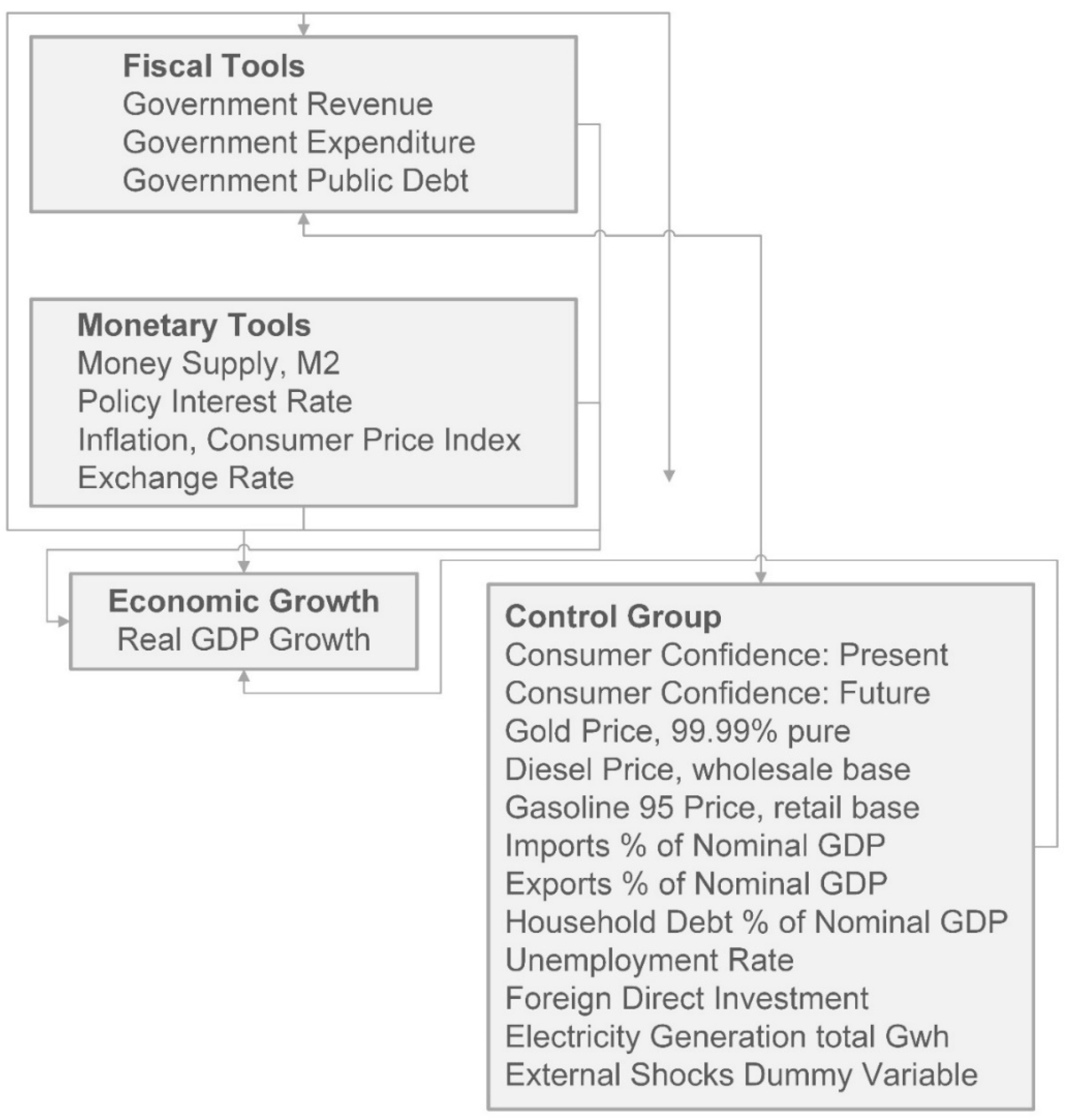
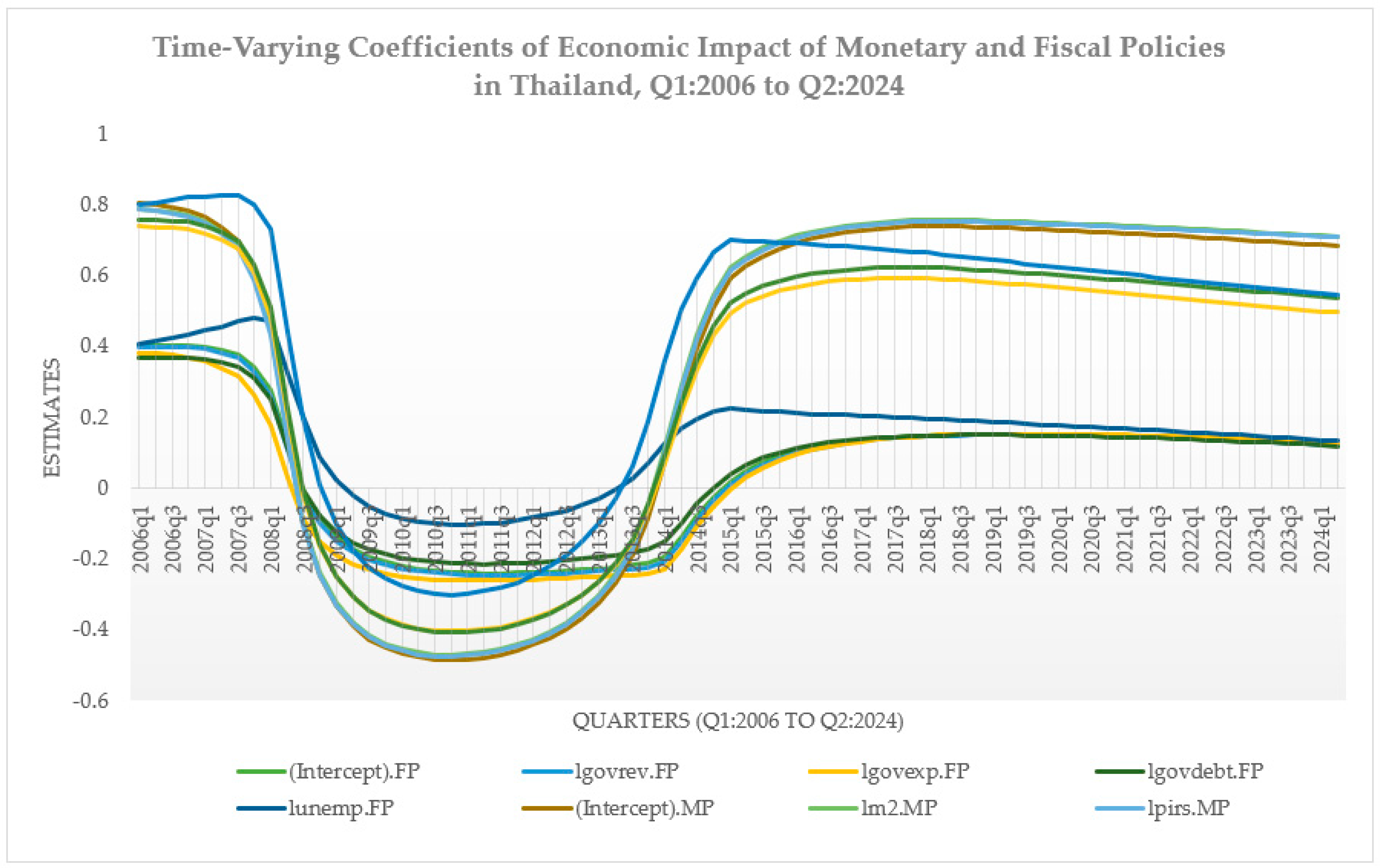
This study empirically explores the dynamic effect of MP and FP on the economic growth of Thailand from Q1:2003 to Q2:2024. In this study, data analysis was conducted using an advanced sequence of the econometric modeling approach to guarantee that the estimated results were more consistent and reliable. First, we used Bayesian additive regression trees (BART) and Bayesian variable selection (BASAD) methods to determine macro factors with the highest probabilities influencing growth, in addition to monetary and fiscal policy tools during the studied periods. Second, we used the time-varying coefficients seemingly unrelated equation (TVSURE) model to examine the economic impact of MP and FP. Last, we also employed the Markov switching regression (MSR) model not only to support the findings from the TVSURE model but also to propose policy recommendations based on regime durations and transitions tempted by MP and FP. The main results from both TVSURE and MSR reveal the following: (1) MP is more consistent with expected growth outcomes while FP is stronger when localized, (2) MP is more effective in sustaining long periods of high growth, (3) FP is significantly stronger in recovering from recessions, and (4) the coordination of MP and FP has a similar performance to MP alone but with shorter transition periods. This study makes an empirical contribution to the ongoing debate on the effectiveness of MP and FP in boosting growth and aiding in the recovery from recessions in the case of Thailand. In addition, this study not only acknowledged certain limitations but also recommended policies to sustain the Thai economy.
Keywords: monetary policy; fiscal policy; growth; TVSURE; Markov switching; Thailand monetary policy; fiscal policy; growth; TVSURE; Markov switching; Thailand