1. Introduction
In disaster scenarios, effective emergency response and resource allocation rely heavily on the timely and accurate interpretation of visual information. With the increasing availability of visual data from drones, surveillance systems, and mobile devices, analyzing disaster scenes has become an urgent and important task [
1,
2]. However, translating raw visual input into actionable insights remains challenging, particularly due to the complex and densely overlapping nature of disaster environments. Ensuring both detection accuracy and real-time performance is therefore critical for improving decision-making efficiency in emergency response.
Object detection is one of the most representative approaches for analyzing disaster images and has been widely validated in various computer vision tasks [
3,
4,
5]. Nevertheless, most object detection models have been developed and evaluated on general-purpose datasets with relatively structured scenes and well-defined object categories [
6,
7], which limits their effectiveness when directly applied to chaotic disaster environments characterized by severe occlusion and ambiguous visual cues.
Recent studies have explored domain-specific detection for rescue scenarios. For instance, prior work investigated personnel detection in flood environments [
8] and object detection in aerial imagery under adverse conditions [
9]. While these studies demonstrate the feasibility of applying deep learning to emergency response, they are typically constrained to specific disaster types, limited object categories, or narrow operational contexts. Comprehensive detection of multiple rescue-related roles across diverse disaster situations remains insufficient.
Meanwhile, the You Only Look Once (YOLO) family [
10,
11] has significantly advanced real-time object detection through successive architectural improvements in feature representation, multi-scale learning, and computational efficiency [
10,
12,
13,
14,
15]. More recent versions have incorporated attention mechanisms to enhance contextual understanding in complex scenes [
16]. Despite these advances, YOLO-based approaches in disaster scenarios are predominantly applied as single-model detectors and are rarely optimized for fine-grained rescue-oriented semantics or densely overlapping entities. In addition, many existing disaster datasets focus primarily on scene-level annotations or coarse human detection [
17,
18], providing limited support for distinguishing between different rescue roles at the instance level. However, existing approaches have largely overlooked cross-generational complementarity in ensemble design, limiting their ability to exploit diverse feature representations across different model architectures.
To address these limitations, this study proposes a multi-generational YOLO ensemble framework for high-precision disaster scene analysis. The proposed approach integrates a curated rescue-oriented dataset derived from disaster news imagery with an ensemble of YOLO models from different architectural generations. By leveraging cross-generational diversity and adopting Weighted Boxes Fusion (WBF) [
19] as an inference-time fusion operator, the framework enhances detection robustness and localization accuracy in chaotic, densely populated disaster scenes. This design provides a reliable foundation for real-time emergency response and automated disaster reporting.
Unlike conventional ensemble strategies that combine closely related model variants, this study explicitly treats cross-generational architectural diversity as a core design principle. Different YOLO generations introduce distinct inductive biases in feature extraction, localization, and contextual reasoning. By integrating these heterogeneous characteristics through consensus-based fusion, the proposed framework achieves more robust rescue-oriented detection than homogeneous or single-model approaches.
The contributions of this work are summarized as follows:
(1) We propose a multi-generational YOLO ensemble framework that systematically integrates detectors across architectural generations, explicitly leveraging cross-generational diversity to improve robustness in complex, densely occluded disaster scenes.
(2) We incorporate Weighted Boxes Fusion (WBF) as an inference-time consensus mechanism, combined with a frozen backbone strategy, enabling effective aggregation of heterogeneous predictions without modifying model architectures.
(3) We construct a fine-grained, rescue-oriented dataset derived from CDNIC19k [
20] with four mission-critical roles and conduct comprehensive experiments to evaluate robustness under varying thresholds and ensemble configurations.
(4) We provide a systematic analysis of accuracy–efficiency trade-offs across model scales and ensemble configurations, providing practical insights into the balance between detection performance and computational cost.
2. Related Works
This section reviews representative studies in disaster-oriented object detection, domain-specific rescue applications, and YOLO-based real-time detection and ensemble strategies. By summarizing their key characteristics and limitations, the research gap addressed by this study is identified.
2.1. Object Detection in Disaster and Emergency Scenes
Object detection has been widely applied to disaster scene analysis due to its ability to provide actionable spatial information. Early studies primarily focused on scene-level tasks, such as damage assessment, classification, or coarse human detection, which provide global situational awareness but offer limited support for fine-grained localization of critical entities.
Recent efforts have explored the application of deep learning–based detection models in disaster response. For example, Bahmanyar et al. [
1] applied YOLOv3 for human detection using drones, while Paik et al. [
4] integrated detection with multi-object tracking in UAV-based systems. Gomez et al. [
21] further developed a YOLOv8-based detection system to improve search-and-rescue efficiency. Although these approaches demonstrate the feasibility of deploying object detection in disaster scenarios, they generally lack the ability to provide fine-grained, role-aware instance-level detection, which is essential for distinguishing between responders, victims, and other critical entities.
2.2. Rescue-Oriented Object Detection and Domain-Specific Studies
To address the limitations of general-purpose models, recent studies have investigated domain-specific detection methods for rescue scenarios. Nehete et al. [
8] focused on human detection under flood conditions, demonstrating the effectiveness of tailored detection pipelines in visually challenging environments. Similarly, Tian et al. [
9] explored victim detection from UAV imagery under adverse conditions, while Hao et al. [
22] proposed YOLO-MSFR to improve multi-scale detection of victims. In addition, Ciccone et al. [
23] developed lightweight AI systems for UAV-based rescue operations.
Despite these advances, existing approaches are typically restricted to narrow operational settings, focusing on specific disaster types or limited detection targets. Furthermore, many existing datasets, including RescueNet [
17], SARD [
18], and EmergencyNet [
24], emphasize scene understanding or damage assessment rather than instance-level role annotation. Although Zhou et al. [
25] provides rich semantic descriptions of disaster events, its lack of spatial annotations limits its direct applicability to object detection tasks.
More importantly, current studies often treat all human subjects as a single category and rarely address fine-grained role differentiation (e.g., rescue personnel, medical staff, injured individuals). In addition, most approaches rely on single-model detection frameworks, which may be insufficient for handling dense object overlaps and complex interactions in disaster scenarios. These limitations highlight the need for detection frameworks that jointly consider semantic granularity and architectural robustness.
2.3. Real-Time Object Detection with YOLO-Based Architectures
The YOLO family has become one of the most widely adopted frameworks for real-time object detection due to its efficiency and end-to-end design [
10,
12]. Successive developments have improved feature representation, multi-scale learning, and computational efficiency [
13,
14,
15], while recent variants incorporate mechanisms such as attention to enhance contextual modeling [
16].
Despite these advancements, YOLO-based detectors are commonly deployed as single-model systems in disaster applications, which can lead to unstable localization and reduced robustness under complex conditions. Additionally, traditional post-processing methods such as non-maximum suppression (NMS) [
26] rely on suppression mechanisms that may discard valid detections in densely populated scenes.
To improve detection performance, ensemble-based approaches have been explored. Among them, Weighted Boxes Fusion (WBF) [
19] provides a confidence-driven fusion strategy that combines overlapping predictions from multiple models rather than suppressing them, allowing more accurate localization in dense scenarios. This approach has been widely adopted in object detection ensembles [
27].
However, existing ensemble strategies are typically constructed from closely related model variants and do not fully exploit the architectural diversity across different YOLO generations. Given that different generations exhibit distinct inductive biases in feature extraction, localization, and contextual reasoning, cross-generational complementarity remains largely underexplored.
This limitation highlights a critical research gap and motivates the development of a multi-generational YOLO ensemble framework with consensus-based fusion to improve detection robustness and role-aware localization in complex disaster environments. To the best of our knowledge, no prior work has systematically investigated cross-generational YOLO ensembles for fine-grained disaster scene understanding.
3. Materials and Methods
This section describes the rescue-oriented dataset, the proposed multi-generational YOLO ensemble framework, the training strategy, the evaluation metrics, and the experimental setup.
3.1. Rescue-Oriented Dataset
3.1.1. Data Collection
To support rescue-oriented disaster scene analysis, this study constructed a domain-specific object detection dataset by re-annotating a subset of the publicly available CDNIC19k dataset, which contains more than 19,000 real-world disaster news images across 15 disaster types. Although CDNIC19k provides rich disaster-related visual content, it was originally developed for image captioning and does not include instance-level spatial annotations required for object detection.
The keyword-based filtering process initially retrieved approximately 4318 images. These images were subsequently subjected to manual inspection and excluded if they met any of the following criteria: (1) irrelevance to rescue scenarios, (2) insufficient visual clarity, or (3) duplicate or near-duplicate content. After this screening process, a total of 2323 images were retained.
These 2323 images were then fully re-annotated. The selection was guided by a keyword matching strategy derived from a manual examination of the CDNIC19k caption vocabulary. Rescue-related Chinese terms were grouped into four predefined categories: rescue personnel, firefighters, medical staff, and injured individuals.
Images were included if their original captions contained manually identified category-specific keywords (including synonyms and related expressions). After filtering, all selected images were re-annotated with bounding boxes, resulting in 3211 labeled instances across the four categories.
Table 1 compares the class distribution between the original CDNIC19k captions and the proposed rescue-oriented dataset. The CDNIC19k counts reflect caption-level semantic references, whereas the proposed dataset provides instance-level bounding-box annotations. Although modest in scale compared with generic object detection benchmarks, this dataset reflects the practical constraints of rescue-oriented annotation and provides fine-grained role-aware labels rarely available in disaster imagery.
3.1.2. Annotation Procedure
Object annotation followed a two-stage expert-involved verification procedure to improve labeling accuracy and semantic consistency. In the first stage, all bounding boxes were manually annotated by a trained research assistant according to unified annotation guidelines. In the second stage, the annotations were independently reviewed and verified by a senior researcher with experience in computer vision–based object detection.
Discrepancies identified during review were resolved through direct expert inspection and correction rather than statistical averaging, to preserve precise localization in visually complex rescue scenes. Although this expert-driven process improves annotation reliability, the current dataset does not include formal quantitative inter-annotator agreement metrics or a fully standardized multi-expert consensus protocol. This limitation reflects the exploratory nature of the present study and practical constraints in rescue-oriented data collection. Future work will incorporate systematic multi-expert validation workflows and quantitative agreement analysis.
3.2. Detection Framework and Ensemble Strategy
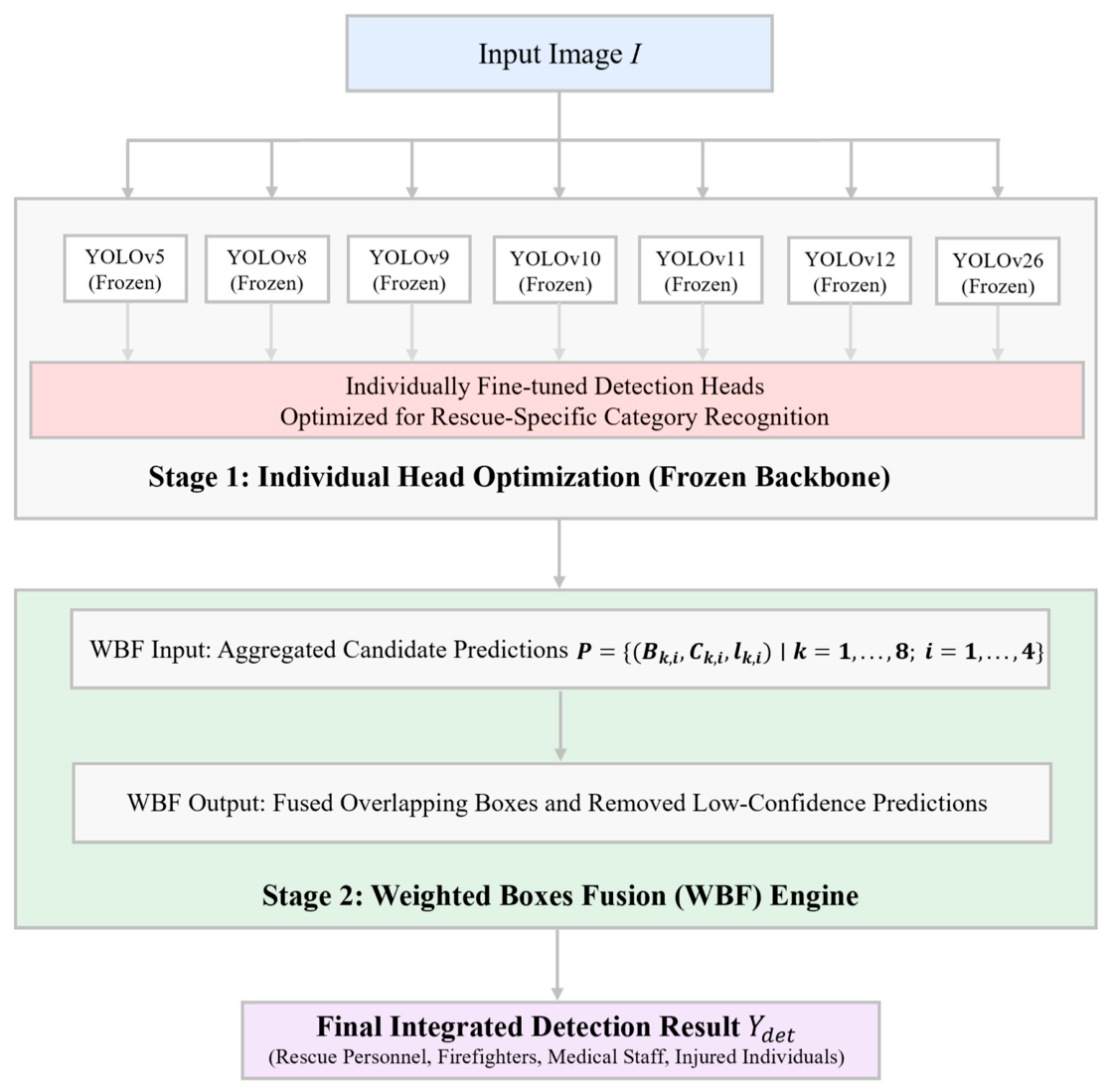
This study proposes a multi-model ensemble detection framework that integrates heterogeneous YOLO variants and fuses their predictions using Weighted Boxes Fusion (WBF). The overall pipeline consists of three main stages: (1) input preprocessing, (2) model inference with frozen backbone fine-tuning, and (3) prediction fusion.
3.2.1. Input Preprocessing
Given an input batch, images are represented as a tensor
where
denotes the batch size, and
and
represent the spatial dimensions.
The preprocessing follows the default Ultralytics YOLO pipeline. Specifically, images are converted to RGB format and pixel values are normalized to the range [0, 1]. During batch processing, a minimum rectangle padding (minimal letterboxing) strategy is applied. Images are proportionally resized and padded only to the minimum size required to ensure consistent spatial dimensions within each batch, rather than being uniformly resized to a fixed resolution.
This approach preserves aspect ratios while maintaining computational efficiency and compatibility with batch inference.
3.2.2. Model Configuration and Fine-Tuning Strategy
We employ multiple YOLO variants spanning different architectural generations to enhance detection diversity. For each model, we adopt a frozen-backbone fine-tuning strategy, where only the detection head layers are updated while the backbone feature extractor remains fixed.
The definition of backbone and detection head modules follows the official Ultralytics YOLO configuration files. Accordingly, the backbone corresponds to the feature extraction layers, while the detection head comprises the prediction layers responsible for bounding box regression, objectness estimation, and class probability outputs.
The number of frozen backbone layers varies across model variants according to their configurations: YOLOv5x (10 layers), YOLOv8x (10 layers), YOLOv9e (30 layers), YOLOv10x (11 layers), YOLOv11x (11 layers), YOLOv12n/x (9 layers), and YOLOv26x (11 layers).
This strategy ensures consistent adaptation to the target dataset while preserving the general feature representations learned from large-scale pretraining.
3.2.3. Prediction Fusion via Weighted Boxes Fusion
For each input image, multiple YOLO models produce a set of predictions, which can be expressed as:
where
denotes
the bounding box coordinates,
represents
the confidence score, and
is
the predicted class label from the
-th model.
Before fusion, predictions are processed through a series of steps: confidence-based filtering to remove low-confidence detections, class-wise grouping to ensure independent processing of each category, and IoU-based clustering to group overlapping bounding boxes.
The WBF algorithm then fuses overlapping boxes by computing a confidence-weighted average of their coordinates, optionally incorporating model-specific weights. The confidence score is
defined as the product of objectness and class probability, following the
standard YOLO formulation.
After fusion, a final confidence threshold is applied to remove low-confidence predictions. No additional post-processing step is introduced beyond this filtering stage, and the resulting outputs are directly treated as the final detection results .
3.2.4. Design Rationale
As illustrated in
Figure 1, the proposed framework is designed to exploit architectural complementarity across different YOLO generations. By combining diverse detection behaviors and aggregating them through WBF, the model achieves improved robustness and accuracy compared to individual detectors.
Meanwhile, the overall pipeline remains computationally streamlined, because final predictions are derived directly from WBF outputs without introducing additional post-processing complexity.
3.3. Selection and Diversity of Multi-Generational YOLO Models
The proposed ensemble includes eight YOLO variants selected to represent different stages of architectural development. Earlier models, such as YOLOv5 and YOLOv8, emphasize hierarchical convolutional feature extraction and efficient multi-scale fusion, whereas newer versions, such as YOLOv12 and YOLOv26, incorporate more advanced designs, including attention-related mechanisms and improved contextual modeling.
These architectural differences introduce complementary inductive biases in feature extraction, localization, and contextual reasoning. By combining models from different generations, the framework aims to capture a broader range of detection behaviors than single-model or same-generation ensembles. This design is particularly relevant for disaster scenes, where dense overlap, scale variation, and ambiguous visual cues can challenge individual detectors.
3.4. Training Strategy
The training strategy consists of two stages: independent model specialization and inference-time fusion.
3.4.1. Stage 1 Training: Frozen Backbone and Head Fine-Tuning
Each YOLO model is trained independently on the curated rescue-oriented dataset. To improve stability under limited domain-specific data and reduce overfitting, only the detection heads are fine-tuned, while the backbone parameters remain fixed. The effectiveness of this design is empirically examined in
Section 4.1.
All backbones are initialized with weights pre-trained on the Microsoft COCO dataset [
28], providing transferable low- and mid-level visual representations for the target task. The detection heads are then adapted to the four rescue-oriented categories.
Bounding-box regression followed the standard YOLO formulation. For localization, this study adopted the Complete Intersection over Union (CIoU) loss [
29], an extension of Intersection over Union (IoU) [
30] that incorporates the overlap area, center-point distance, and aspect-ratio consistency for more comprehensive bounding-box regression. Compared with other IoU-based variants, such as Generalized IoU (GIoU) [
31] and Distance IoU (DIoU), CIoU provides more stable localization and faster convergence, particularly in dense scenes.
The optimization objective is defined by a multi-component loss function:
CIoU loss for bounding-box regression;
Binary cross-entropy loss for object score;
Categorical cross-entropy loss for the four target classes.
3.4.2. Stage 2 Strategy: Fusion During Inference
The second stage does not involve additional training. Instead, the predictions from all independently fine-tuned YOLO models are directly aggregated and fused during inference using Weighted Boundary Fusion (WBF).
Unlike suppression-based methods such as non-maximum suppression (NMS), WBF combines overlapping predictions by computing confidence-weighted spatial averages, thereby preserving valid detections contributed by multiple models. Because all detectors share a unified YOLO-style output format, their predictions can be fused directly without modifying the underlying architecture.
Performing fusion directly during inference helps maintain training stability while improving localization robustness in complex disaster scenarios.
3.5. Evaluation Metrics
Detection performance is evaluated using standard object detection metrics, including precision, recall, F1 score, mAP50, and mAP50–95.
Precision and recall are defined as:
where
,
and
denote true positives, false positives and false negatives, respectively.
The F1 score is defined as the harmonic mean of precision and recall:
The primary metric is mean Average Precision (mAP). This study reports the following:
These metrics jointly evaluate classification confidence, localization precision, and detection completeness.
3.6. Experiment Setup
All experiments were conducted under the same data split, training configuration, and implementation environment to ensure fair comparison across single-model and ensemble settings.
3.6.1. Dataset Split and Preparation
The curated rescue-oriented dataset consists of 2323 images with four annotated categories: rescue personnel, firefighters, medical staff, and injured individuals. In the main experiments, the dataset was divided into 80% training and 20% testing, using a fixed hold-out split.
Given the relatively limited dataset size, introducing an additional validation split could increase evaluation variance. Therefore, the original experiments adopted an 80/20 hold-out protocol to balance training sufficiency and evaluation reliability. To further assess generalization and address potential overfitting concerns, the study additionally includes a 5-fold cross-validation (CV) evaluation, the results of which are compared with the hold-out results in
Section 4.
All models were trained under the same data split and frozen backbone setting, and ensemble fusion was applied only at inference time.
3.6.2. Experimental Design
Three groups of experiments were designed to evaluate the proposed framework:
Detection framework comparison
- •
Single-model baselines;
- •
Ensemble with NMS;
- •
Ensemble with WBF.
Sensitivity analysis of post-processing parameters
- •
Confidence threshold variation;
- •
IoU threshold variation;
- •
Comparison between NMS- and WBF-based ensembles.
Ablation of ensemble composition
- •
Early-generation ensemble;
- •
Recent-generation ensemble;
- •
Full multi-generational ensemble.
Unless otherwise specified, the default inference settings are confidence = 0.25 and IoU = 0.7. Peak results are reported using threshold settings identified through sensitivity analysis.
3.6.3. Training Configuration
All experiments were implemented in PyTorch 2.3.1 with cu121 on a system with an NVIDIA RTX 3090 Ti (24 GB VRAM), an Intel Core i9-12900K CPU, 64 GB RAM (Micro-Star INT’L CO., LTD., Zhonghe, New Taipei, Taiwan), and Windows 11. The Python version was 3.11.12. For YOLOv12 experiments, FlashAttention 2.5.9.post2 was used to support attention operations.
All models were trained using the Ultralytics YOLO training pipeline with identical hyperparameters:
For inference, all models used the same default settings:
No automated hyperparameter optimization (e.g., grid search, Bayesian optimization, or genetic algorithms) was performed in this study. Instead, to maintain a consistent and unbiased training protocol across heterogeneous YOLO architectures, all models were trained using the same set of hyperparameters, including optimizer type, learning rate schedule, momentum, batch size, and number of epochs. This design choice allows the performance differences to be attributed primarily to architectural diversity and ensemble fusion rather than to model-specific tuning.
To mitigate class imbalance among the four annotated categories, we adopted a data-level balancing strategy. Rotation-based augmentations (90°, 180°, and 270°) were selectively applied only to minority classes (“Medical staff” and “Injured Individuals”), increasing effective sample diversity without introducing unrealistic visual distortions. The resulting class distributions before and after augmentation are summarized in
Table 2.
To enhance generalization to chaotic disaster scenes, additional image-level augmentations were applied during training. Brightness adjustments were used to simulate varying illumination conditions, while minor affine transformations accounted for mild viewpoint and geometric variations frequently observed in disaster news imagery. No augmentation was applied during validation or testing to ensure unbiased evaluation.
Class-weighted losses were not employed in this study to preserve a consistent training configuration across heterogeneous YOLO architectures and to isolate the impact of ensemble diversity and weighted box fusion. The evaluation of alternative reweighting strategies is left for future work.
4. Results
Quantitative evaluation results are first reported to compare detection accuracy among baseline models and the proposed ensemble approach. This is followed by a discussion of the observed performance gains, robustness improvements, and the inherent trade-offs between accuracy and computational efficiency.
4.1. Comparison of Frozen vs. Trainable Backbone Networks
This experiment examines the effect of training backbone networks. As shown in
Table 3, backbone fine-tuning does not provide consistent mAP50 improvements for either single models or ensembles. Only one model shows marginal improvement, while most configurations degrade after fine-tuning. The same trend is observed for ensemble methods, where both NMS and WBF exhibit reduced performance under trainable backbone settings (
Table 3). These results suggest that full fine-tuning offers no consistent benefit and may negatively affect ensemble stability. Therefore, frozen backbones are adopted in all subsequent experiments, as they provide more stable detection performance under limited-data conditions.
4.2. Detection Framework Comparison
When integrating multiple YOLO variants, ensemble frameworks significantly improve recall but exhibit substantially lower precision compared to single models. As shown in
Table 4, the WBF-based ensemble achieves the highest recall and mAP, indicating the effectiveness of cross-generational prediction fusion.
The NMS-based ensemble also achieves high recall but with similarly low precision (
Table 4), while its mAP remains comparable to strong single-model baselines. These results reveal a clear precision–recall trade-off, where improved detection coverage is achieved at the expense of increased false positives, particularly under ensemble aggregation. In rescue-oriented scenarios, recall is often more critical than precision, as missed detections may compromise situational awareness. Therefore, maintaining high recall and stable localization is essential for effective disaster response.
4.3. Sensitivity to Post-Processing Parameters
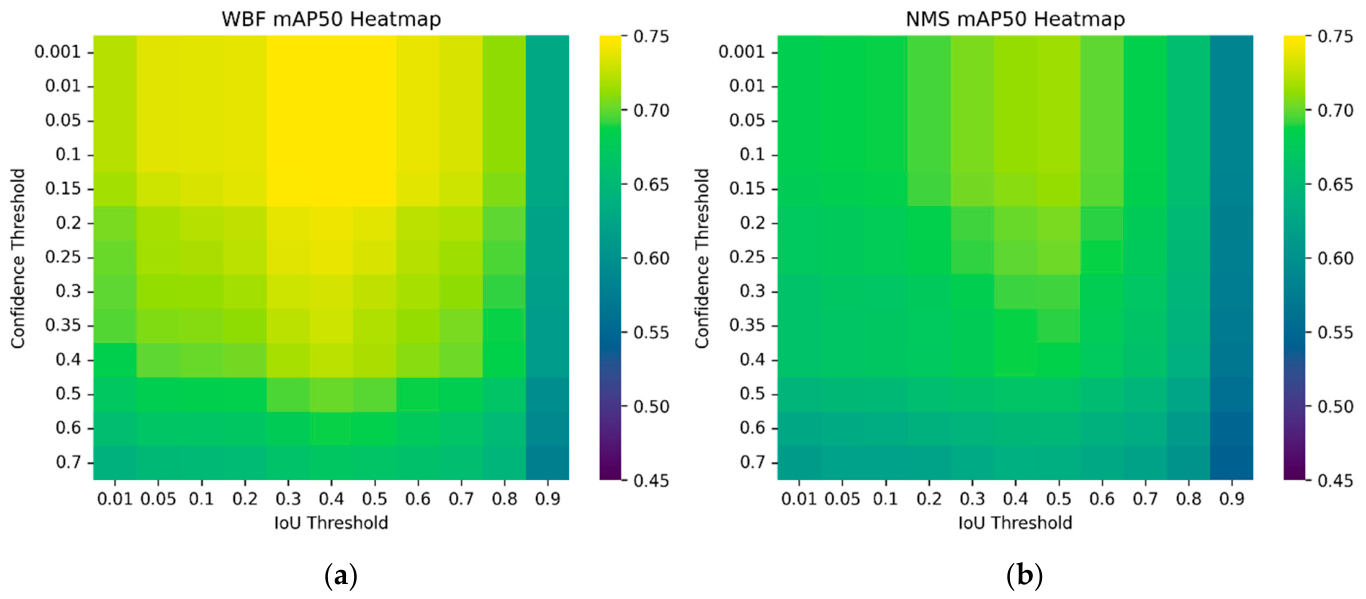
The parameter sensitivity analysis in
Figure 2 shows that the NMS-based ensemble is sensitive to threshold selection, with performance degrading rapidly as confidence or IoU values deviate from a narrow optimal range. In contrast, the WBF-based ensemble demonstrates more stable performance across a wider range of settings.
As summarized in
Table 5, even under their respective optimal thresholds, WBF consistently outperforms NMS. This comparison is conducted under identical confidence and IoU settings (
Table 5), confirming that the performance gain of WBF is not due to parameter tuning.
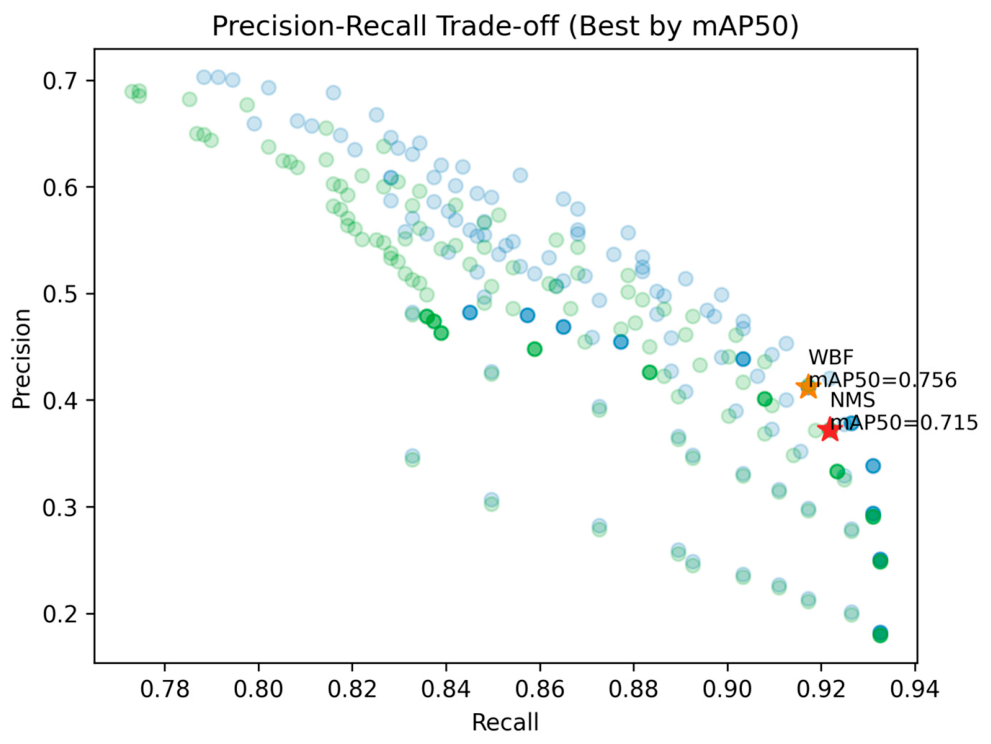
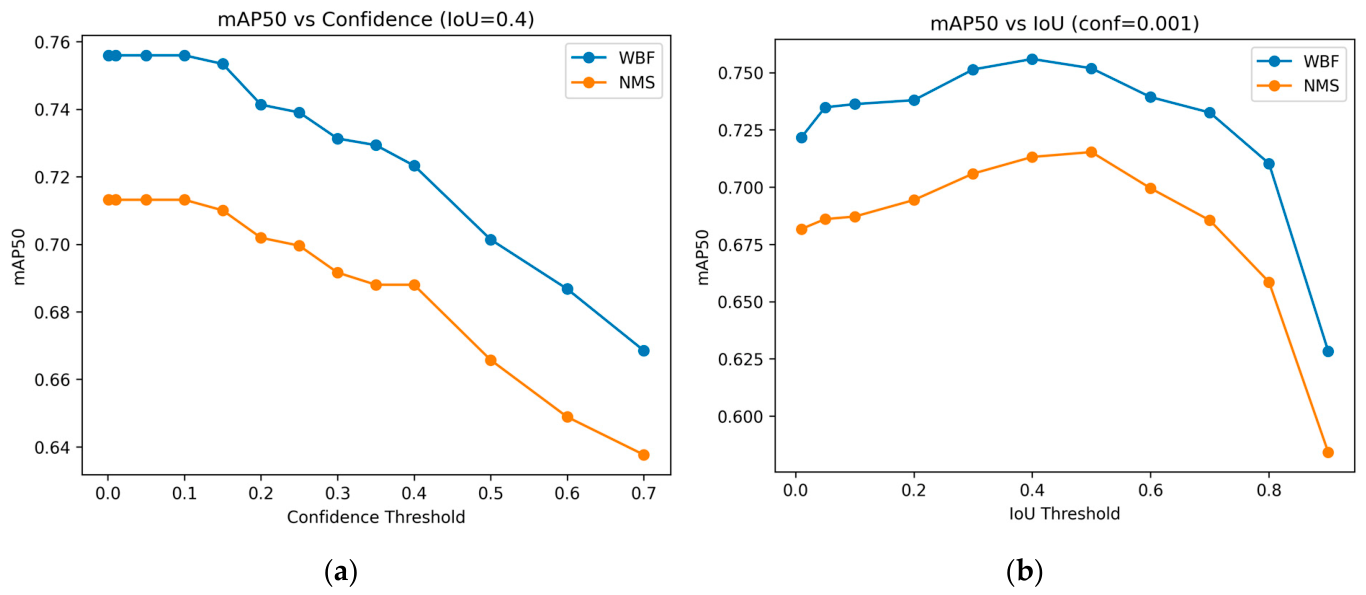
These observations are further supported by
Figure 3 and
Figure 4, which illustrate the behavior of both ensembles across different operating points. Both methods operate in a high-recall regime, while WBF achieves its optimal mAP50 with relatively higher precision, indicating a more balanced precision–recall trade-off. In addition, WBF consistently maintains higher mAP50 across varying confidence and IoU thresholds, while NMS exhibits a narrower optimal region and rapid performance degradation outside it.
4.4. Ensemble Composition Ablation
To analyze the impact of ensemble composition, ablation experiments are conducted using subsets of YOLO generations. As shown in
Table 6, ensembles constructed from similar generations (Early-YOLO and Recent-YOLO) provide only marginal improvement over their corresponding single-model baselines.
In contrast, the multi-generational ensemble achieves the highest mAP50, significantly outperforming both single models and same-generation ensembles. This result indicates that combining models from different YOLO generations provides stronger complementarity.
Overall, these findings highlight that performance gains are primarily driven by cross-generational diversity rather than simply increasing the number of models.
4.5. Quantitative Analysis of Accuracy–Efficiency Trade-Offs
The trade-off between accuracy and efficiency is quantitatively analyzed from two complementary perspectives: (i) intra-family comparison within the YOLOv12 series (
Table 7), and (ii) cross-model and ensemble evaluation (
Table 8).
As shown in
Table 7, the YOLOv12 family exhibits a clear accuracy–efficiency trade-off. Lightweight models such as YOLOv12n provide high throughput but limited accuracy, whereas larger models improve accuracy at the cost of speed. Among single models, YOLOv12x offers the best balance when accuracy is prioritized, achieving higher mAP50 than YOLOv12l with only a moderate reduction in FPS.
This trend is further extended in
Table 8, which compares heterogeneous single models and ensemble configurations. Relative to the best single model (YOLOv12x), the full ensemble improves mAP50 from 0.696 to 0.756 but at substantially higher computational cost, including increased parameters, GFLOPs, latency, and reduced throughput.
Smaller ensembles provide a more practical balance. For example, the two-model ensemble improves mAP50 to 0.707 while maintaining near real-time performance, whereas the four-model ensemble further improves accuracy to 0.746 but reduces FPS to 12.53. In addition, WBF consistently outperforms NMS across all ensemble settings (e.g., 0.756 vs. 0.715 for the full ensemble), indicating that preserving complementary predictions is beneficial in dense disaster scenes.
Overall,
Table 7 and
Table 8 reveal a controllable accuracy–efficiency trade-off. Lightweight models are suitable for latency-sensitive deployment, whereas YOLOv12x is a stronger single-model choice when accuracy is crucial. Ensemble methods provide the highest reliability when computational resources permit. Because the proposed framework operates only at inference time and requires no retraining, model combinations can be flexibly adjusted according to deployment constraints. This two-level analysis implicitly defines a Pareto frontier between accuracy and efficiency across both model scaling and ensemble design.
4.6. Cross-Validation Analysis
The effectiveness and generalization capability of the proposed multi-generational ensemble framework were further evaluated using a 5-fold cross-validation (CV) scheme and compared with the original hold-out evaluation. As summarized in
Table 9, the average 5-fold CV results are highly consistent with the hold-out performance across all metrics evaluated.
Specifically, mAP50, mAP50–95, precision, and recall obtained from 5-fold CV align closely with those reported under the hold-out setting, with relatively small standard deviations across folds. This consistency indicates that the observed performance improvements are not sensitive to a specific data split and are not attributable to overfitting. Overall, these results demonstrate the stability and generalizability of the proposed ensemble approach across different data partitions.
4.7. Interpretation of Quantitative Differences Between NMS and WBF
To complement the quantitative evaluation presented in
Table 4,
Table 5 and
Table 8, an interpretation of the observed quantitative results is provided to examine the behavioral characteristics of Non-Maximum Suppression (NMS) and Weighted Box Fusion (WBF) under challenging emergency-response scenarios. Although both methods operate as post-processing strategies for object detection, they exhibit distinct trade-offs between recall and precision.
The quantitative results suggest that NMS tends to preserve a larger number of candidate detections. This characteristic improves the likelihood of retaining partially occluded or low-visibility targets, thereby contributing to higher recall. However, the increased sensitivity also leads to a higher occurrence of false positives and redundant detections, particularly in crowded environments where multiple objects overlap spatially. In such situations, visually similar regions may be incorrectly interpreted as separate targets, resulting in duplicated bounding boxes or erroneous object assignments.
In contrast, the quantitative performance differences observed in
Table 4,
Table 5 and
Table 8 suggest that WBF provides a stronger capability for consolidating overlapping predictions generated by the ensemble models. By aggregating spatially consistent bounding boxes, WBF produces cleaner detection outputs with fewer duplicate detections and reduced false-positive rates. These characteristics contribute to improved localization stability and higher overall detection accuracy, consistent with the superior mAP and F1-score results reported in
Table 4 and
Table 5. These observations are further supported by the results in
Table 8, where WBF-based ensembles consistently outperform their NMS counterparts across different ensemble configurations.
The comparison further indicates that the advantages of WBF may become more evident in complex scenes containing multiple interacting subjects. In these scenarios, WBF effectively suppresses redundant predictions while preserving primary targets, leading to more coherent detection results. Nevertheless, the fusion mechanism may also suppress detections associated with weak confidence scores. Consequently, highly occluded, distant, or visually degraded targets may occasionally be omitted during fusion despite the overall competitive recall performance of WBF. Another notable observation is that both methods exhibit similar limitations in fine-grained role recognition. Confusions between visually similar categories persist regardless of the post-processing strategy employed. This suggests that classification ambiguities primarily originate from feature representation and model discrimination capability rather than from the post-processing stage itself. Therefore, improvements in feature learning, class-specific representation, or attention mechanisms may be necessary to further enhance category discrimination.
Overall, the foregoing interpretation is consistent with the quantitative results reported in
Table 4 and
Table 5. NMS favors sensitivity by preserving more candidate detections and achieving stronger recall performance, whereas WBF prioritizes detection reliability by reducing redundant predictions and false positives. As a result, WBF achieves superior overall detection performance, while NMS remains advantageous when detecting heavily occluded or low-confidence targets is critical. These findings suggest that future research may benefit from adaptive or hybrid post-processing mechanisms that dynamically balance recall and precision according to scene complexity and target visibility conditions.
5. Discussion
This study demonstrates that leveraging cross-generational architectural diversity with a consensus-based fusion strategy significantly improves rescue-oriented object detection in complex disaster scenes. The proposed multi-generational YOLO ensemble consistently outperforms single-model baselines and conventional NMS-based approaches, achieving a notable increase in mAP50 (0.696 → 0.756) along with improved recall and F1-scores. Sensitivity analysis further shows stable performance across a wide range of confidence and IoU thresholds, indicating strong robustness under variable conditions.
These findings extend prior work on YOLO-based disaster detection and ensemble learning. Unlike existing approaches that rely on single architectures or homogeneous ensembles, this study systematically leverages cross-generational complementarity, combining convolution- and attention-enhanced YOLO variants. The results confirm the advantage of WBF over suppression-based methods in crowded scenarios and demonstrate that its effectiveness is further amplified when paired with heterogeneous model ensembles. In addition, the curated rescue-oriented dataset enables fine-grained, role-aware detection, addressing a key limitation in existing datasets that focus primarily on generic human detection.
From an academic perspective, this work contributes a principled multi-generational ensemble framework that treats architectural diversity as a core design strategy. It further provides empirical evidence that inference-time fusion via WBF improves localization robustness without additional training cost, making it suitable for time-critical applications. The proposed dataset also establishes a benchmark for role-aware disaster detection.
Despite these contributions, several limitations remain. The dataset is limited in scale and diversity, as it is largely derived from disaster news imagery, and the current framework does not exploit temporal information from video data. Additionally, evaluation is not explicitly stratified by visibility conditions (e.g., smoke or severe weather), which may affect performance in extreme environments.
Future work will focus on expanding the dataset to include multi-source and multi-modal data, incorporating temporal fusion for video-based analysis, and exploring adaptive ensemble weighting to better balance accuracy and efficiency. Extending the framework to integrate Transformer-based detectors (such as RT-DETR [
32]) and additional modalities (e.g., thermal imaging) also represents a promising direction, particularly for low-visibility scenarios. In general, the proposed ensemble design for inference-only remains flexible and scalable, allowing practical deployment in diverse disaster response settings.
6. Conclusions
This study presents a multi-generational YOLO ensemble with a WBF framework for rescue-oriented object detection in chaotic and densely populated disaster scenes. By explicitly leveraging cross-generational architectural complementarity and integrating model predictions through confidence-weighted fusion, the proposed approach achieves robust and reliable detection performance beyond that of individual detectors.
Experimental results demonstrated that ensemble-based detection substantially enhances localization accuracy and detection completeness compared to single-model baselines. In particular, the proposed framework demonstrated strong robustness to variations in confidence and IoU thresholds, highlighting its suitability for real-world disaster response scenarios where operating conditions may be difficult to tune in advance.
Although lightweight YOLO variants are attractive for resource-constrained deployment,
Table 7 shows that YOLOv12n/s/m exhibits noticeable performance degradation in complex disaster environments due to limited feature representation. In contrast, YOLOv12x offers superior accuracy and more stable localization under challenging conditions, making it a more reliable choice for safety-critical rescue tasks where missed detections must be minimized. Accordingly, this study prioritizes robustness by incorporating YOLOv12x as a core component of the proposed multi-generational ensemble framework. Importantly, the framework remains model-agnostic and supports resource-aware configurations, allowing lightweight variants to be included when computational constraints are critical, albeit with reduced detection accuracy. This design enables flexible adaptation across diverse deployment scenarios.
Ablation studies further confirm that architectural diversity across multiple generations of YOLO plays a critical role in improving detection performance, whereas ensembles constructed from limited or closely related variants provide only marginal gains. In general, these findings demonstrate that the complementarity of cross-generational models, combined with inference-time consensus, offers a practical and effective solution for accurate and robust object detection in complex disaster environments. More importantly, this study reframes ensemble object detection by treating cross-generational architectural diversity as a core design principle enabled by consensus-based fusion to achieve enhanced robustness in complex scenes.