


Digital Twin Technology in Pipeline Engineering: A Study Review of Applications, Challenges, and Future Directions


Abstract
1. Introduction
Review Methodology
2. Oil and Gas Pipelines: Frameworks and System-Level Twins
2.1. Overview and Scope
2.2. Component and System Integration
2.3. Regulatory and Safety Considerations
3. Hydraulic Pipeline Systems
3.1. Water Distribution and Hydraulic Infrastructure
3.2. CFD-Based Digital Twins for Transient Flow
3.3. Smart Water Networks
4. Leak Detection in Gas and Water Pipelines
4.1. Significance and Detection Paradigms
4.2. Reduced-Order Models and DTROT
4.3. Multiphase Flow and Visual Twins
4.4. Data-Driven and Hybrid Approaches
4.5. Industry Deployment: Visual Twins and MLOps
4.6. Critical Assessment of Reported Performance Metrics
5. Subsea Pipeline Monitoring and Structural Integrity
5.1. The Subsea Challenge
5.2. Sensor Architectures and Inspection Technologies
5.3. Corrosion Monitoring via ILI-MFL
5.4. Underwater Digital Twin Landscape
6. Condition Monitoring and Predictive Maintenance
6.1. The Case for Predictive Pipeline Management
6.2. Ensemble Kalman Filter Data Assimilation
6.3. Corrosion Digital Twins and Unsupervised Learning
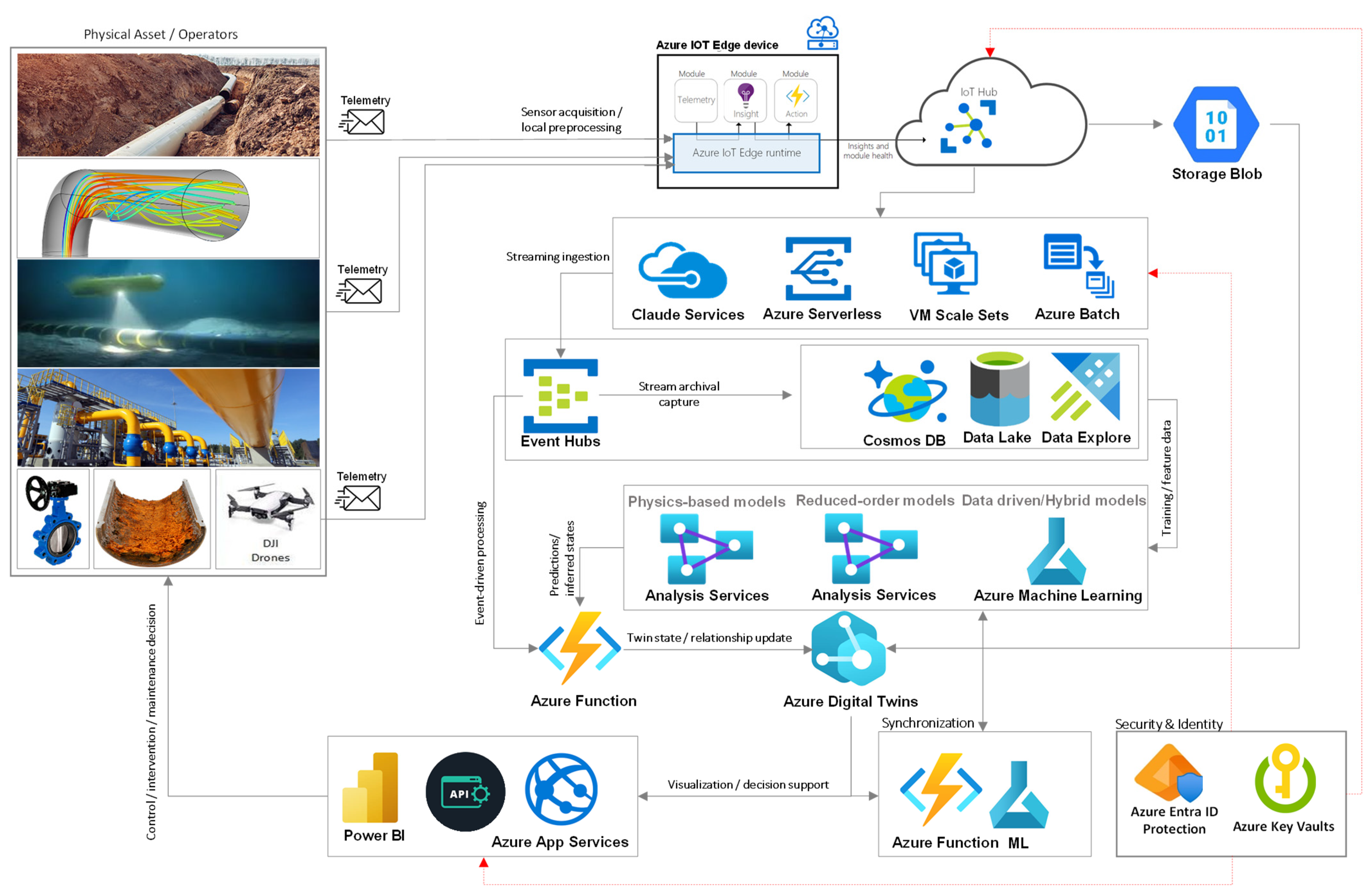
6.4. Integration with Industrial IoT and Cloud Platforms
7. Cross-Cutting Themes, Challenges, and Future Directions
7.1. Common Methodological Themes
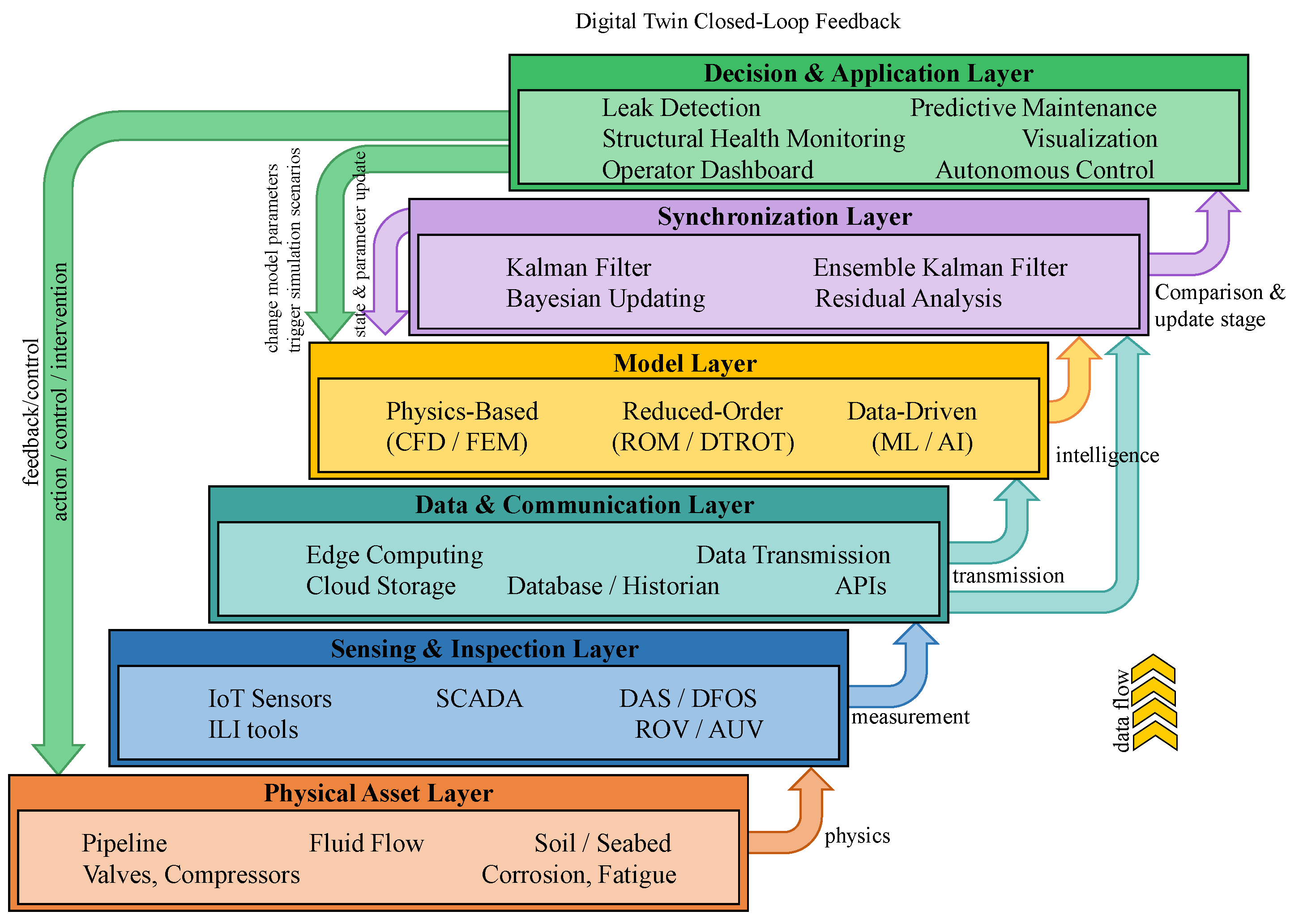
7.2. Proposed Reference Architecture for Pipeline Digital Twins
Relationship to Existing Digital Twin Frameworks
7.3. Mathematical Formulation of Digital Twin Synchronization
7.4. Comparative Analysis of Pipeline Digital Twin Studies
7.4.1. Quantitative Synthesis of Reviewed Studies
7.4.2. Cross-Study Comparison of Performance Metrics
7.4.3. Maturity Classification Using the Digital Model, Digital Shadow, Digital Twin Framework
7.4.4. Summary of Problem Statements and Main Contributions Across Reviewed Studies
7.5. Uncertainty Quantification and Reliability in Pipeline Digital Twins
Uncertainty Propagation and Decision Integration
7.6. Systemic Research Gaps Across Pipeline Digital Twins
- Multi-physics coupling with quantified interaction error: Wang et al. [6] and Duan et al. [46] each couple two physical domains (fatigue/Bayesian and FEA/DL respectively) but do not report the error introduced by one-way vs. two-way coupling. Future work should quantify coupling-induced error bounds when combining ≥3 physical domains (flow, structural, electrochemical).
- Cross-domain transfer of data-driven leak models: Liang et al. [36] and Wang et al. [35] each train single-pipeline models with reported accuracy losses under new operating conditions; transfer-learning or domain-adaptation studies quantifying accuracy degradation when a trained model is deployed on a topologically different pipeline are currently absent from the reviewed literature and should be prioritized.
- Standardized minimum reporting for UQ: because none of the reviewed studies (Section “Uncertainty Propagation and Decision Integration”) closes the loop from predictive interval to decision threshold, future digital twin publications in this domain should adopt a minimum reporting standard (e.g., calibration plots, prediction-interval coverage probability) analogous to practices in the broader UQ literature, to make cross-study comparison possible.
7.6.1. Synthesis of Reported Limitations and Failure Modes
7.6.2. Study-Level Limitations and Future Directions
7.7. Persistent Challenges
- Real-time computational constraints: High-fidelity Multiphysics simulations remain computationally expensive, limiting real-time deployment. Although reduced-order models (ROMs) alleviate this issue, maintaining accuracy under dynamic operating conditions remains challenging.
- Hybrid model integration: While hybrid physics–data approaches dominate the literature, robust coupling strategies between first-principles models and machine learning components remain challenging, particularly in ensuring stability, interpretability, and generalization.
- Model validation and verification (V&V): There is no universally accepted methodology for validating digital twins in pipeline systems. Validation is often case-specific and lacks standardized performance metrics.
- Cybersecurity risks: Integration of digital twins with Industrial IoT (IIoT) and cloud platforms introduces vulnerabilities to cyberattacks, data manipulation, and system disruption, yet this aspect remains insufficiently addressed in the literature.
- Legacy infrastructure integration: A substantial share of operating pipeline assets relies on SCADA architectures built around serial or point-to-point protocols (Modbus RTU, DNP3) with historian systems (e.g., OSIsoft PI) that predate modern publish–subscribe or service-oriented interfaces (OPC UA, MQTT). Integrating such systems into a digital twin’s data and communication layer (Section 7.2) typically requires protocol gateways or middleware translation layers, which introduce additional latency and a single point of failure. Architecturally, legacy control systems are frequently segmented on isolated OT networks for safety reasons, creating a tension between the digital twin’s need for continuous bidirectional data flow and the air-gapped or firewalled design of existing control infrastructure. Operationally, retrofitting instrumentation onto brownfield assets, installing DFOS, additional pressure taps, or corrosion probes on pipelines already in service, is constrained by shutdown windows, hazardous-area certification requirements, and the capital cost of retrofit relative to new-build instrumentation. Data synchronization is further complicated by inconsistent historian sampling rates and time-stamping conventions across legacy and modern subsystems, which can introduce misalignment errors into the synchronization and assimilation layer (Section 7.3) if not explicitly reconciled through timestamp harmonization or interpolation. None of the reviewed studies (Table 3) explicitly reports retrofit cost or legacy-protocol translation overhead, which we identify as a reporting gap for future field-deployment papers.
- Human–machine interaction: Many DT systems lack effective visualization and decision-support interfaces, limiting their usability by operators and engineers.
Cyber-Physical Security in Pipeline Digital Twins
7.8. Future Research Directions
- Multi-Physics and Multi-Scale Digital Twins: Future digital twins should integrate fluid dynamics, structural mechanics, corrosion chemistry, and thermal effects within unified frameworks. Multi-scale modeling approaches that bridge component-level and network-level behavior are particularly important.
- Probabilistic and Bayesian Digital Twins: The incorporation of probabilistic methods, including Bayesian inference and stochastic modeling, is essential for uncertainty-aware predictions. This will enable risk-informed decision-making and enhance regulatory acceptance.
- Standardization and Interoperability: The development of standardized data models, communication protocols (e.g., OPC UA), and digital twin ontologies is critical for enabling interoperability across platforms and stakeholders.
- Edge–Cloud Hybrid Architectures: Future systems should adopt hybrid computing architectures that leverage edge computing for real-time processing and cloud computing for large-scale simulation and analytics.
- Explainable and Trustworthy AI: Explainable AI (XAI) techniques should be integrated to ensure transparency and interpretability of machine learning components, particularly in safety-critical applications.
- Autonomous and Prescriptive Digital Twins: The evolution from predictive to prescriptive and ultimately autonomous digital twins represents a key frontier, where systems can not only predict failures but also recommend or execute optimal interventions.
- Economic and Lifecycle Assessment: Comprehensive cost–benefit analyses and lifecycle performance evaluations are needed to quantify the economic value of digital twin deployment and support investment decisions.
- Regulatory frameworks governing pipeline safety, including API RP 1160, ASME B31.8S, PHMSA regulations, and CSA Z662, require operators to implement integrity management programs (IMPs) based on risk assessment, inspection, and continuous monitoring. Emerging standards such as ASME V&V 40, NIST VVUQ frameworks, and ISO 23247 provide foundational guidance for validation, verification, and uncertainty quantification of digital twins. However, no unified regulatory standard currently defines requirements for digital twin fidelity, real-time synchronization, or acceptable uncertainty thresholds in safety-critical decision-making. Consequently, the integration of digital twins into regulatory-compliant IMPs remains an evolving area of industry and academic collaboration.
- Beyond the CNN, LSTM, and transformer architectures already covered in Section 4.4, Section 5.3 and Section 6.3, two emerging deep learning directions are relevant but absent from the current literature on pipeline digital twins: (i) physics-informed neural networks (PINNs), which embed the governing flow or structural PDEs directly into the loss function and could reduce the training-data dependence identified in Section 4.6; and (ii) graph neural networks (GNNs), which naturally represent pipeline network topology (junctions, branching, looped mains) and could improve network-level leak localization beyond the single-pipeline case studies reviewed in Section 4. Both directions merit dedicated empirical evaluation against the hybrid physics–ML baseline established in Section 7.1.
8. Conclusions
Author Contributions
Funding
Data Availability Statement
Acknowledgments
Conflicts of Interest
References
- Grieves, M.; Vickers, J. Digital twin: Mitigating unpredictable, undesirable emergent behavior in complex systems. In Transdisciplinary Perspectives on Complex Systems: New Findings and Approaches; Springer International Publishing: Cham, Switzerland, 2016; pp. 85–113. [Google Scholar]
- Kritzinger, W.; Karner, M.; Traar, G.; Henjes, J.; Sihn, W. Digital twin in manufacturing: A categorical literature review and classification. IFAC-PapersOnLine 2018, 51, 1016–1022. [Google Scholar] [CrossRef] [Scilit]
- Tao, F.; Zhang, M.; Nee, A.Y.C. Five-dimension digital twin modeling and its key technologies. In Digital Twin Driven Smart Manufacturing; Springer: Singapore, 2019; pp. 63–81. [Google Scholar]
- Fuller, A.; Fan, Z.; Day, C.; Barlow, C. Digital twin: Enabling technologies, challenges and open research. IEEE Access 2020, 8, 108952–108971. [Google Scholar] [CrossRef] [Scilit]
- Conejos Fuertes, P.; Martínez Alzamora, F.; Hervás Carot, M.; Alonso Campos, J.C. Building and exploiting a digital twin for the management of drinking water distribution networks. Urban Water J. 2020, 17, 704–713. [Google Scholar] [CrossRef] [Scilit]
- Wang, T.; Feng, K.; Ling, J.; Liao, M.; Yang, C.; Neubeck, R.; Liu, Z. Pipeline condition monitoring towards digital twin system: A case study. J. Manuf. Syst. 2024, 73, 256–274. [Google Scholar] [CrossRef] [Scilit]
- Hamidishad, N.; Barbosa, R.S.; Allahyarzadeh-Bidgoli, A.; Yanagihara, J.I. Digital twin frameworks for oil and gas processing plants: A comprehensive literature review. Processes 2025, 13, 3488. [Google Scholar] [CrossRef] [Scilit]
- ISO 50001:2018; Energy Management Systems—Requirements with Guidance for Use. International Organization for Standardization (ISO): Geneva, Switzerland, 2018. Available online: https://www.iso.org/standard/69426.html (accessed on 27 July 2026).
- API Recommended Practice 1160; Managing System Integrity for Hazardous Liquid Pipelines. American Petroleum Institute (API): Washington, DC, USA, 2019. Available online: https://www.api.org/products-and-services/standards/important-standards-announcements/recommended-practice-1160 (accessed on 27 July 2026).
- ASME B31.8S-2022; Managing System Integrity of Gas Pipelines. American Society of Mechanical Engineers (ASME): New York, NY, USA, 2022. Available online: https://www.asme.org/codes-standards/find-codes-standards/b31-8s-managing-system-integrity-gas-pipelines (accessed on 27 July 2026).
- 49 CFR Parts 192: Transportation of Natural and Other Gas by Pipeline: Minimum Federal Safety Standards; The Office of the Federal Register (eCFR): Washington, DC, USA, 2024. Available online: https://www.ecfr.gov/current/title-49/subtitle-B/chapter-I/subchapter-D/part-192 (accessed on 27 July 2026).
- 49 CFR Parts 195: Transportation of Hazardous Liquids by Pipeline; The Office of the Federal Register (eCFR): Washington, DC, USA, 2024. Available online: https://www.ecfr.gov/current/title-49/subtitle-B/chapter-I/subchapter-D/part-195 (accessed on 27 July 2026).
- CSA Z662:23; Oil and Gas Pipeline Systems. CSA Group: Toronto, ON, Canada, 2023. Available online: https://www.csagroup.org/store/product/CSA%20Z662%3A23/ (accessed on 27 July 2026).
- DNV-ST-F101; Submarine Pipeline Systems. DNV: Høvik, Norway, 2021. Available online: https://www.dnv.com/energy/standards-guidelines/dnv-st-f101-submarine-pipeline-systems/ (accessed on 27 July 2026).
- ASME V&V 40-2018; Assessing Credibility of Computational Modeling Through Verification and Validation: Application to Medical Devices. American Society of Mechanical Engineers (ASME): New York, NY, USA, 2018. Available online: https://www.asme.org/codes-standards/find-codes-standards/assessing-credibility-of-computational-modeling-through-verification-and-validation-application-to-medical-devices (accessed on 27 July 2026).
- ASME V&V 10-2019; Verification and Validation in Computational Modeling and Simulation. American Society of Mechanical Engineers (ASME): New York, NY, USA, 2019. Available online: https://www.asme.org/codes-standards/find-codes-standards/standard-for-verification-and-validation-in-computational-solid-mechanics (accessed on 27 July 2026).
- McGrattan, K.; Forney, G. NIST Special Publication 1019: Fire Dynamics Simulator (Version 4) User’s Guide; National Institute of Standards and Technology (NIST): Gaithersburg, MD, USA, 2004. Available online: https://nvlpubs.nist.gov/nistpubs/Legacy/SP/nistspecialpublication1019.pdf (accessed on 27 July 2026).
- ISO 23247-1:2021; Automation Systems and Integration—Digital Twin Framework for Manufacturing—Part 1: Overview and General Principles. International Organization for Standardization (ISO): Geneva, Switzerland, 2021. Available online: https://www.iso.org/standard/75066.html (accessed on 27 July 2026).
- ISO 55000:2014; Asset Management—Overview, Principles and Terminology. International Organization for Standardization (ISO): Geneva, Switzerland, 2014. Available online: https://www.iso.org/standard/55088.html (accessed on 27 July 2026).
- ISO/TC 67; Materials, Equipment and Offshore Structures for Petroleum, Petrochemical and Natural Gas Industries. International Organization for Standardization (ISO): Geneva, Switzerland, 1947. Available online: https://www.iso.org/committee/49506.html (accessed on 27 July 2026).
- API Recommended Practice 580; Risk-Based Inspection. American Petroleum Institute (API): Washington, DC, USA, 2016. Available online: https://www.api.org/products-and-services/individual-certification-programs/certifications/api580 (accessed on 27 July 2026).
- NACE SP0102-2010; In-Line Inspection of Pipelines. NACE International: Houston, TX, USA, 2010. Available online: https://store.ampp.org/standards/sp0102 (accessed on 27 July 2026).
- ASME B31.4-2022; Pipeline Transportation Systems for Liquids and Slurries. American Society of Mechanical Engineers (ASME): New York, NY, USA, 2022. Available online: https://www.asme.org/codes-standards/find-codes-standards/b31-4-pipeline-transportation-systems-liquids-slurries (accessed on 27 July 2026).
- ASME B31.8-2022; Gas Transmission and Distribution Piping Systems. American Society of Mechanical Engineers (ASME): New York, NY, USA, 2022. Available online: https://www.asme.org/codes-standards/find-codes-standards/b31-8-gas-transmission-distribution-piping-systems (accessed on 27 July 2026).
- Li, S.; Cheng, W.; Liu, Z.; Zhang, B.; Zheng, M.; Zheng, J.; Li, Y. Key technologies and applications of digital twin hydraulic engineering. Digit. Twin 2025, 2, 2486862. [Google Scholar] [CrossRef] [Scilit]
- Paternina-Verona, D.A.; Coronado-Hernández, O.E.; Fuertes-Miquel, V.S.; Saba, M.; Ramos, H.M. Digital twin based on CFD modelling for analysis of two-phase flows during pipeline filling–emptying procedures. Appl. Sci. 2025, 15, 2643. [Google Scholar] [CrossRef] [Scilit]
- Ramos, H.M.; Kuriqi, A.; Besharat, M.; Creaco, E.; Tasca, E.; Coronado-Hernández, O.E.; Iglesias-Rey, P. Smart water grids and digital twin for the management of system efficiency in water distribution networks. Water 2023, 15, 1129. [Google Scholar] [CrossRef] [Scilit]
- Pandey, P.; Mücke, N.T.; Jain, S.; Ramachandran, P.; Bohté, S.M.; Oosterlee, C.W. Machine learning-based digital twin for water distribution network anomaly detection and localization. Eng. Proc. 2024, 69, 201. [Google Scholar] [CrossRef] [Scilit]
- Micai, V.; Marsili, V.; Mazzoni, F.; Alvisi, S. Toward smarter water loss management: Application of a digital-twin-based method for leakage localization. Eng. Proc. 2026, 135, 2. [Google Scholar] [CrossRef] [Scilit]
- Syed, T.A.; Muhammad, M.A.; AlShahrani, A.A.; Hammad, M.; Naqash, M.T. Smart water management with digital twins and multimodal transformers: A predictive approach to usage and leakage detection. Water 2024, 16, 3410. [Google Scholar] [CrossRef] [Scilit]
- Homaei, M.; Di Bartolo, A.J.; Ávila, M.; Mogollón-Gutiérrez, O.; Caro, A. Digital transformation in the water distribution system based on the digital twins concept. arXiv 2024, arXiv:2412.06694. [Google Scholar]
- Ahanger, T.A.; Abdibayev, Z.; Sagnayeva, S.; Zhumadillayeva, A.; Dyussekeyev, K. Smart wastewater management in hydro-technical systems using digital twin technology. Sci. Rep. 2026, 16, 12497. [Google Scholar] [CrossRef] [Scilit] [PubMed]
- Lei, C.; Li, X.; Li, Y.; Chan, H.; Leong, W.; Zhao, Y. Optimizing leakage management in water distribution networks using pressure-driven demand modeling and digital twin technology: A case study of the University of Macao Hengqin Campus. AQUA Water Infrastruct. Ecosyst. Soc. 2026, 75, 98–128. [Google Scholar] [CrossRef] [Scilit]
- Al-Ammari, W.A.; Sleiti, A.K.; Rahman, M.A.; Rezaei-Gomari, S.; Hassan, I.; Hassan, R. Digital twin for leak detection and fault diagnostics in gas pipelines: A systematic review, model development, and case study. Alex. Eng. J. 2025, 123, 91–111. [Google Scholar] [CrossRef] [Scilit]
- Wang, D.; Shi, S.; Lu, J.; Hu, Z.; Chen, J. Research on gas pipeline leakage model identification driven by digital twin. Syst. Sci. Control Eng. 2023, 11, 2180687. [Google Scholar] [CrossRef] [Scilit]
- Liang, J.; Ma, L.; Liang, S.; Zhang, H.; Zuo, Z.; Dai, J. Data-driven digital twin method for leak detection in natural gas pipelines. Comput. Electr. Eng. 2023, 110, 108833. [Google Scholar] [CrossRef] [Scilit]
- Cai, X.; Wang, J. A digital twin-driven natural gas pipeline leakage detection method. Int. J. Press. Vessel. Pip. 2026, 222, 105793. [Google Scholar] [CrossRef] [Scilit]
- Al-Ammari, W.A.; Sleiti, A.K.; Hamilton, M.; Ferroudji, H.; Gomari, S.R.; Hassan, I.; Rahman, M.A. Development of digital/visual twin for real-time leak detection in gas pipelines under multiphase flow conditions. Greenh. Gases Sci. Technol. 2025, 15, 513–530. [Google Scholar] [CrossRef] [Scilit]
- Umer, S.; Ullah, N.; Kim, J.M. Attention mechanism-based CNN-LSTM hybrid deep learning model for industrial pipeline leak detection. Sci. Rep. 2026, 16, 22763. [Google Scholar] [CrossRef] [Scilit] [PubMed]
- Hamilton, M.; Ferroudji, H.; Colbourne, M.; Sheppard, S.; Barooah, A.; Sleiti, A.K.; Rahman, M.A. Digital twin for pipeline leak monitoring. In Proceedings of the Abu Dhabi International Petroleum Exhibition and Conference (ADIPEC), Abu Dhabi, United Arab Emirates, 3–6 November 2025. Paper D031S102R004. [Google Scholar]
- Chen, B.Q.; Videiro, P.M.; Guedes Soares, C. Opportunities and challenges to develop digital twins for subsea pipelines. J. Mar. Sci. Eng. 2022, 10, 739. [Google Scholar] [CrossRef] [Scilit]
- Wegner, D.C.; Moses, I.; Ezenwa, I.O. Digital twin framework for subsea pipeline monitoring and integrity management. Int. J. Comput. Appl. 2025, 187, 52. [Google Scholar] [CrossRef] [Scilit]
- Syuryana, E.P.; Kariem, M.A.; Puja, I.W.; Maulana, M.I.; Uriyana; Agus, R. Digital twin for subsea pipeline corrosion monitoring location based on ILI-MFL pipeline operator forum and potentiodynamic test. In AIP Conference Proceedings; AIP Publishing: Melville, NY, USA, 2024; Volume 3076, p. 150002. [Google Scholar]
- Olawole, O.O.; Gbadeyan, O.J.; Deigh, C.; Sijuade, M.F. Advanced sensor systems and machine learning for pipeline integrity management: A review of corrosion monitoring and prediction strategies. npj Mater. Degrad. 2026, 10, 48. [Google Scholar] [CrossRef] [Scilit]
- Kaarlela, T.; Padrao, P.; Boswell, K.M.; Xanthidis, M.; Duran, A.; Bobadilla, L. Underwater digital twin applications: A systematic literature review. Digit. Twin 2025, 3, 2605418. [Google Scholar] [CrossRef] [Scilit]
- Duan, J.; Wang, X.; Yan, H.; Wang, S.; Huang, Y.; Tao, C. A digital twin framework for damage detection and localization of self-sensed cured-in-place underground pipelines. Eng. Struct. 2026, 354, 122401. [Google Scholar] [CrossRef] [Scilit]
- Bhowmik, S. Digital twin for offshore pipeline corrosion monitoring: A deep learning approach. In Proceedings of the Offshore Technology Conference (OTC), Houston, TX, USA, 16–19 August 2021. Paper D041S049R003. [Google Scholar]
- Ismail, L.; Abdelmoti, A.; Basu, A.; Berini, A.D.E.; Naouss, M. A systematic review of digital twin-driven predictive maintenance in industrial engineering: Taxonomy, architectural elements, and future research directions. arXiv 2025, arXiv:2509.24443. [Google Scholar]
- Mardanov, E.; Mavlutova, I.; Sloka, B. AI-driven predictive maintenance using digital twin technology for optimization in oil and gas. In Novel & Intelligent Digital Systems Conferences; Springer Nature: Cham, Switzerland, 2025; pp. 211–225. [Google Scholar]


| Method Type | Example Techniques | Accuracy | Real-Time Capability | Data Requirement | Advantages | Limitations |
|---|---|---|---|---|---|---|
| Physics-Based | CFD, FEM, RTTM | High | Low | Medium | Interpretable, reliable | Computationally expensive |
| Data-Driven | ANN, SVM, DL | Medium–High | High | High | Fast, adaptive | Require large datasets |
| Hybrid | Physics + ML | Very High | Medium–High | High | Best performance | Complex integration |
| Reduced-Order Models | ROM, DTROT | Medium–High | Very High | Medium | Efficient | Reduced fidelity |
| Probabilistic DT | Bayesian, EnKF | High | Medium | High | Handles uncertainty | Complex |
| Visual Twins | 3D/VR models | Medium | High | Medium | Operator-friendly | Not analytical alone |
| Category | Standard | Scope | Key Requirements | Relevance to Digital Twins |
|---|---|---|---|---|
| Core Pipeline | API RP 1160 [9] | Liquid pipelines | Risk assessment, integrity verification, documentation | Enables DT integration into IMPs and continuous monitoring |
| Core Pipeline | ASME B31.8S [10] | Gas pipelines | HCAs, threat mitigation, inspection | Provides structured framework for DT-based risk modeling |
| Regulation | PHMSA (49 CFR 192/195) [11,12] | U.S. pipelines | Mandatory IMPs, risk-based decisions | Drives adoption of DT for compliance and monitoring |
| Core Pipeline | CSA Z662 [13] | Canada pipelines | Design, operation, integrity | Supports DT in lifecycle monitoring and risk assessment |
| Offshore | DNV-ST-F101 [14] | Offshore pipelines | Structural reliability, safety factors | Enables DT for structural integrity and verification |
| Validation | ASME V&V 10/40 [15,16] | Simulation models | Model validation, credibility | Ensures DT outputs are reliable for decision-making |
| Validation | NIST VVUQ [17] | Digital systems | Verification, validation, uncertainty | Supports trust and uncertainty-aware DT predictions |
| DT Framework | ISO 23247 [18] | Digital twin systems | Architecture, integration | Provides structural basis for DT implementation |
| Asset Management | ISO 55000 [19] | Asset lifecycle | Risk-based management | Aligns DT with lifecycle (digital thread) concepts |
| Standards Body | ISO/TC 67 [20] | Oil & gas | Global standardization | Supports harmonization of DT deployment |
| Inspection | API 580/581 [21] | Risk-based inspection | Probabilistic risk models | Enables DT-driven inspection prioritization |
| Inspection | ILI (NACE/API/ASME) [22] | Pipeline inspection | Corrosion, defect detection | Provides data inputs for DT calibration |
| Design Codes | ASME B31.4/B31.8 [23,24] | Pipeline systems | Design, operation, maintenance | Provides baseline models for DT physics |
| Study | Pipeline Domain | DT Approach | Data Source | Real-Time | Primary Application | Key Strength | Main Limitation |
|---|---|---|---|---|---|---|---|
| Ahanger et al. [32] | Water network | Hybrid (Hydraulic + ANFIS + Blockchain) | IoT sensing + municipal wastewater dataset | Partial | Monitoring & forecasting (overload, contamination) | High accuracy (R2 = 0.89), secure data traceability | Requires validation across broader systems |
| Al-Ammari et al. [38] | Gas pipeline | Hybrid (ML + visual twin + simulation) | Experimental (flow loop) + synthetic (OLGA) | Yes | Leak detection & localization (single & multiple leaks) | High accuracy (up to ~99%), robust under multiphase flow, integrated visualization platform | Limited real-field deployment; reliance on controlled experiments and synthetic data; computational complexity |
| Al-Ammari et al. [34] | Gas pipeline | Hybrid DT (data-driven + simulation-based) | Simulated (OLGA) + limited field/experimental validation | Partial | Leak detection, localization & diagnostics | High accuracy (<3.21% error), zero false alarms, leak size & location estimation | Limited real-field validation; dependence on simulated data; scalability not demonstrated |
| Bhowmik [47] | Subsea pipeline | Hybrid (Corrosion physics + CNN) | Sensor + inspection + environmental data | Yes | Corrosion prediction & RUL | Accurate hotspot detection, scalable | Requires long-term validation |
| Cai & Wang [37] | Gas pipeline | Reduced-order (DTROT) | Pressure sensors + flow/acoustic data | Yes | Leak detection | >90% accuracy, real-time capability | Reduced fidelity in complex conditions |
| Chen et al. [41] | Subsea pipeline | Hybrid (Multi-physics + ML) | LiDAR + ILI + IoT sensors | Yes | Integrity & fatigue prediction | Automated DT lifecycle integration | Data standardization & security challenges |
| Duan et al. [46] | Underground pipeline | Hybrid (FEA + CNN + DFOS) | DFOS + simulation data | Yes | Structural health monitoring | High-resolution strain monitoring | Needs full-scale validation |
| Hamilton et al. [40] | Subsea pipeline | Visual digital twin + ML + DT MLOps (digital thread integration) | Experimental multi-modal data (pressure, acoustic, video) + processed data streams | Near real-time | Leak detection, localization, plume prediction, and operator training | Integrated visual twin with DT MLOps enabling explainable ML, experimental validation, and enhanced operator decision support | Limited to lab-scale validation; lacks real-world deployment and large-scale field validation |
| Homaei et al. [31] | Water network | Data-driven (LSTM, XGBoost) | IoT + historical + weather data | Yes | Demand forecasting & optimization | Operational efficiency, reduced delays | Requires high-quality data |
| Ismail et al. [48] | Multi-domain | Hybrid (AI-enabled DT framework + architectural taxonomy) | Systematic review (multi-database literature) | Conceptual (real-time requirement emphasized) | Predictive maintenance & anomaly detection | Comprehensive taxonomy | Low industrial adoption (Lack of standardized frameworks; limited real-world validation) |
| Kaarlela et al. [45] | Subsea infrastructure | Hybrid (Simulation + sensor fusion) | Sparse underwater sensing | Yes | SHM & RUL | Comprehensive classification | Data sparsity, communication limits |
| Liang et al. [36] | Gas pipeline | Data-driven (AE-CNN) | Operational data | Yes | Leak detection | High accuracy (~97%) | Limited abnormal data |
| Pandey et al. [28] | Water network | Data-driven (ML ensemble) | IoT sensors | Yes | Leak detection & localization | Improved localization accuracy | Requires scalable ML infrastructure |
| Ramos et al. [27] | Water network | Hybrid (Hydraulic + GIS + SCADA) | GIS + SCADA + sensors | Partial | Water loss reduction | Significant loss reduction | Requires integrated data systems |
| Syed et al. [30] | Water network | Data-driven (Transformers) | Real-time sensor data (pressure, flow, thermal) | Yes | Forecasting & anomaly detection | High accuracy (R2 ≈ 0.999) + multimodal data fusion + real-time DT integration | High system complexity; reliance on multimodal sensors and computational cost |
| Syuryana et al. [43] | Subsea pipeline | Hybrid (ILI-MFL + electrochemistry) | Inspection + lab testing | Partial | Corrosion prediction | Accurate degradation estimation | Not fully real-time |
| Wang et al. [35] | Gas pipeline | Data-driven (SVM) | Pressure + simulation data | Yes | Leak detection | Robust real-time performance | Reduced field accuracy |
| Wang et al. [6] | Pipeline (fatigue) | Hybrid (FEM + Bayesian + ML) | IoT + experimental data | Yes | Damage & reliability prediction | Uncertainty-aware modeling | Needs broader validation |
| Wegner et al. [42] | Subsea pipeline | Hybrid (physics-based + probabilistic + data-driven analytics)) | Multi-source data (ROV imagery, sensors, NDT inspection, environmental & geohazard data) | Yes | Integrity management, predictive maintenance & risk-based decision support | Integrated multi-layer DT architecture + data fusion + predictive & prescriptive analytics | Conceptual framework; lacks real-world validation and quantitative performance evaluation |
| Conejos Fuertes et al. [5] | Water network | Hybrid (Hydraulic + real-time calibration) | Sensor + consumption data | Yes | Optimization & leak detection | Large-scale deployment | Requires continuous calibration |
| Li et al. [25] | Water system | Hybrid (GIS-BIM + simulation) | Multi-source + real-time data | Yes | Hydrodynamic & risk prediction | High simulation fidelity | High computational demand |
| Paternina-Verona et al. [26] | Hydraulic pipeline | Hybrid (CFD + ML) | Experimental + CFD data | Yes | Transient flow analysis and pressure surge prediction | High-fidelity CFD-based DT capturing air–water interactions + ML reducing computational cost with high predictive accuracy | High computational cost of CFD; validated at laboratory scale; limited direct real-time deployment without ML acceleration |
| Grieves & Vickers [1] | General DT concept | Hybrid conceptual | Real-time sensor data | Yes | Lifecycle management | Foundational DT concept | Interoperability challenges |
| Kritzinger et al. [2] | Manufacturing systems (Industry 4.0 context) | Conceptual (categorical literature review + DT integration-level classification) | Literature-based (no experimental or real-time data) | Not implemented (defines levels: DM—no flow, DS—one-way, DT—two-way real-time) | DT classification | Clear DM–DS–DT framework | Lack of real implementations, validation, and quantitative evaluation |
| Tao et al. [3] | General DT concept | Conceptual (five-dimensional DT modeling framework) | Multi-source (physical, virtual, service, and knowledge data) | Yes | Digital twin modeling, system representation, and lifecycle integration | Introduces five-dimensional DT model, enabling data fusion and service-oriented DT architecture | Conceptual framework without real-world implementation or quantitative validation |
| Fuller et al. [4] | Multi-domain (manufacturing, healthcare, smart cities) | Conceptual review (definitions, classification, enabling technologies) | Literature review (multi-domain studies) | Conceptual (supports real-time DT, not implemented) | DT definitions, applications, challenges, and enabling technologies | Comprehensive overview | Terminology inconsistency |
| Hamidishad et al. [7] | Oil & Gas | Multi-fidelity framework (high-fidelity simulation + hybrid ML + reduced-order + co-simulation) | Systematic literature review | Conceptual + architectural (real-time monitoring, edge–cloud DT systems) | Energy optimization, Process optimization, energy efficiency, lifecycle management, and predictive analytics in O&G processing system | Provides a modular, multi-fidelity DT architecture integrating high-fidelity simulation, hybrid ML models, and real-time data frameworks for O&G systems | Needs standardization, lack of long-term validation, and cybersecurity challenges in large-scale DT |
| Study/Task | Metric Family | Reported Value(s) | Validation Setting |
|---|---|---|---|
| Al-Ammari et al. [34] gas leak detection (single-phase) | Classification/localization accuracy | Leak location error < 3.21%; zero false-alarm rate | Real-field gas pipeline |
| Liang et al. [36] gas leak detection (single-phase) | Classification accuracy | 97.23% accuracy; 90.77% fault-detection rate; 0.88% false-alarm rate | In-service 19 km pipeline (field) |
| Cai & Wang [37] gas leak detection (ROM) | Classification accuracy | >90% accuracy at 1–3% leak rates; zero false alarms ≥1.5% | Dedicated test bench |
| Wang et al. [35] gas leak detection (SVM) | Classification accuracy | ~95% (simulation); ~90.5% (laboratory); >91% multi-point average | Simulation and laboratory |
| Al-Ammari et al. [38] gas leak detection (multiphase) | Classification accuracy | 42–57% (individual classifiers); 98.6% accuracy, F1 = 0.985 (stacked ensemble) | Experimental flow loop + OLGA synthetic data |
| Paternina-Verona et al. [26] transient flow-state classification | Classification accuracy | 100% accuracy (decision tree/ensemble classifiers) | Laboratory rig, CFD-validated |
| Syed et al. [30] water usage forecast/leak detection | Regression fit/classification accuracy | R2 = 0.9995, MSE = 2.2 (forecast); 98.4% accuracy, FPR = 0.0019 (leak model) | Real-time multimodal sensor data |
| Ahanger et al. [32] wastewater monitoring | Classification + correlation | 89.3% precision, 88.1% sensitivity, F = 88.7%, R2 = 0.89; ~9.51 s control latency | Real municipal dataset (80,114 samples) |
| Homaei et al. [31] water demand forecasting | Regression fit/operational outcome | MAE = 5.76, MAPE = 18.61% (forecast); 14% faster tasks, 25% fewer delays, 17% lower CO2 | Historical + real-time utility data |
| Ramos et al. [27] water-loss reduction | Network-level operational outcome | 80% reduction in real losses (434,273 m3); ILI improved 21.15 → near-recommended; €165,000 est. savings | Operating network (Gaula, Portugal) |
| Conejos Fuertes et al. [5] water-loss reduction | Network-level operational outcome | Up to 28% water savings | Operating network (Valencia; 1.6 M inhabitants) |
| Syuryana et al. [43] subsea corrosion assessment | Physical degradation measurement | Corrosion rate range 0.0068–0.1730 mmpy | Lab electrochemical testing + ILI-MFL field data |
| Study | Problem Addressed | Main Contribution |
|---|---|---|
| Grieves & Vickers [1] | Unpredictable, undesirable emergent behavior in complex systems across the lifecycle | Proposed the Digital Twin as a virtual equivalent linked to the physical system |
| Kritzinger et al. [2] | Ambiguous, inconsistent definitions of “digital twin” in manufacturing | DM/DS/DT classification framework distinguishing levels of synchronization |
| Tao et al. [3] | Original three-dimensional DT structure insufficient for new applications | Five-dimensional DT model (physical entity, virtual entity, connection, data, services) |
| Fuller et al. [4] | Definitional inconsistency; digital models/shadows misclassified as digital twins | Categorical review identifying enabling technologies and shared challenges across domains |
| Conejos Fuertes et al. [5] | Absence of validated frameworks for municipal-scale WDN digital twins | Multi-year operational DT for Valencia network; quantified 28% water savings |
| Wang et al. [6] | Limitations of physical-space-driven inspection for pipeline condition monitoring | IoT + FEM + Bayesian + cloud DT for fatigue-crack reliability prediction |
| Hamidishad et al. [7] | Fragmented DT architectures across oil and gas processing plants | Systematic review of 85+ sources synthesizing DT architectures for FPSO systems |
| Li et al. [25] | Fragmented virtual–physical integration in complex water infrastructure | Five-dimensional GIS–BIM DT framework validated on the Danjiangkou diversion project |
| Paternina-Verona et al. [26] | Steady-state models cannot capture transient pressure-surge/vacuum risk | CFD + ML digital twin for pipeline filling/emptying transient flow |
| Pandey et al. [28] | Limited localization accuracy of single-stage leak classifiers | Two-stage ML digital twin improving localization via posterior probabilities |
| Micai et al. [29] | Gap between aggregate inflow and billed consumption masking structural leakage | Smart-meter + pressure-sensor DT achieving low-MAE leak localization on a real network |
| Syed et al. [30] | Single-modality sensing cannot jointly capture usage trend and localized leaks | Multimodal transformer DT (Informer + Vision Transformer); R2 = 0.9995, 98.4% detection accuracy |
| Homaei et al. [31] | Operational-efficiency DTs lack integrated cybersecurity for critical water infrastructure | CAUCCES platform combining AI/ML forecasting with ISO 27001-aligned security |
| Ahanger et al. [32] | Wastewater operational inefficiencies (treatment delay, overload, contamination) | DT with ANFIS + blockchain auditability; 89% precision, secure supervisory control |
| Lei et al. [33] | Lack of closed-loop detection-to-repair workflows at campus scale | PDD hydraulic model + digital work order system for a campus water network |
| Al-Ammari et al. [38] | High cost and elevated false-alarm rate of existing O&G leak detection | DT model with zero false alarms, <3.21% leak size/location error on a real-field pipeline |
| Al-Ammari et al. [34] | Existing methods inadequately identify leak size or location | Comprehensive DT model detecting leaks, equipment failure, and damage |
| Cai & Wang [37] | Computational cost of high-fidelity models prevents real-time leak detection | DTROT reduced-order model achieving >90% accuracy with real-time execution |
| Umer et al. [39] | Acoustic emission signals are noisy and feature-extraction-sensitive in multiphase flow | Attention-based CNN-LSTM hybrid; 96.88% classification accuracy |
| Liang et al. [36] | Limited abnormal-condition data and dynamic operating conditions | AE-CNN DT trained on normal data; 97.23% accuracy on a 19 km field pipeline |
| Wang et al. [35] | Need to improve detection accuracy and real-time monitoring beyond conventional CPM | SVM-based DT; ~95% simulation/90.5% laboratory accuracy |
| Hamilton et al. [40] | Gap between algorithmic accuracy and practical operator deployment | Visual DT with MLOps for operator training and situational awareness |
| Chen et al. [41] | Fragmented understanding of subsea DT opportunities and challenges | Foundational scoping review spanning design, construction, service life, and life extension |
| Wegner et al. [42] | Neither fixed sensing nor mobile inspection alone provides full subsea coverage | Integrated framework combining distributed sensors with ROV/AUV inspection |
| Syuryana et al. [43] | Gap between periodic inspection and real-time corrosion degradation | ILI-MFL + electrochemical testing DT for corrosion-rate and remaining-strength estimation |
| Olawole et al. [44] | “Big data” bottleneck from advanced corrosion sensors (MFL/UT/DFOS) | ML fusion framework combining deep learning diagnosis with FEA-neural-network prognosis |
| Kaarlela et al. [45] | Fragmented understanding of underwater digital twin research themes | Systematic review classifying UDT purposes, architectures, and sensing modalities |
| Ismail et al. [48] | Unclear sector-adoption patterns and architectural taxonomy for DT-driven PdM | Systematic review and layered taxonomy of predictive-maintenance DT systems |
| Mardanov et al. [49] | Unclear strategic/financial value of AI-DT predictive maintenance in oil and gas | RBV/Dynamic Capabilities case study; 20% outage reduction, 5–15% cost reduction |
| Bhowmik [47] | Manual inspection demands for offshore corrosion monitoring | CNN + physics-based DT for corrosion hotspot detection and RUL prediction |
| Duan et al. [46] | Lack of real-time SHM for CIPP-rehabilitated underground pipelines | DFOS + FEA + CNN DT for strain-based damage detection and localization |
| Ramos et al. [27] | High water loss in distribution networks lacking DT-based diagnosis | DT + Smart Water Grid model; 80% loss reduction, €165,000 estimated savings |
| Study | Reported Limitation | Suggested Future Direction |
|---|---|---|
| Grieves & Vickers [1] | Software interoperability challenges | Broader systems-engineering integration (addressed by later domain-specific frameworks) |
| Kritzinger et al. [2] | Most existing studies remain at Digital Model/Digital Shadow level | Standardized definitions and improved real-time integration capability |
| Tao et al. [3] | Conceptual only; no real-world implementation or quantitative validation | Empirical validation of the five-dimensional model across domains |
| Fuller et al. [4] | Terminology inconsistency across the field | Standardized modeling approaches and stakeholder expectation management |
| Conejos Fuertes et al. [5] | Continuous calibration burden; social/environmental benefits unquantified | Improved data interoperability; monetization of non-technical benefits |
| Wang et al. [6] | Validated only at the scale of a single fatigue-crack case study | Expand to broader damage types and maintenance-optimization scope |
| Hamidishad et al. [7] | Lack of industry standardization and long-term validation | Standardization efforts; robust cybersecurity integration |
| Li et al. [25] | High computational demand; data consistency challenges | Scalable computational infrastructure for large-scale implementation |
| Paternina-Verona et al. [26] | Laboratory-scale validation only; real-time deployment needs ML acceleration | Field-scale validation |
| Pandey et al. [28] | Requires scalable ML infrastructure for large urban networks | Architecture-scaling studies |
| Micai et al. [29] | Requires substantial hardware investment (smart meters, sensors) | Cost-effectiveness studies at larger network scale |
| Syed et al. [30] | High system complexity; deployment/computational cost unquantified | Cost-efficiency optimization of multimodal sensing |
| Homaei et al. [31] | Requires integration with legacy systems | Legacy-system interoperability solutions |
| Ahanger et al. [32] | Validated on a single dataset/region | Broader validation across hydro-technical systems |
| Lei et al. [33] | Short-format study; lacks multi-year validation record | Extended longitudinal validation |
| Al-Ammari et al. [38] | Reliance on controlled experiments and synthetic data | Broader real-field deployment |
| Al-Ammari et al. [34] | Dependence on simulated data; scalability undemonstrated | Real-field validation across pipeline types |
| Cai & Wang [37] | Reduced fidelity under complex operating conditions | Improve ROM accuracy under dynamic operating conditions |
| Umer et al. [39] | Validated on a limited leak-size set in a controlled testbed | Field-scale generalization testing |
| Liang et al. [36] | Limited abnormal-sample database | Expand abnormal databases; dynamic thresholds; transfer learning |
| Wang et al. [35] | Accuracy drop from simulation (~95%) to laboratory (~90.5%) | Improve robustness under real operating noise |
| Hamilton et al. [40] | Laboratory-scale validation only | Large-scale field validation |
| Chen et al. [41] | Standardization and proprietary data access remain barriers | Unify standards; develop user-friendly tools |
| Wegner et al. [42] | Conceptual framework; lacks real-world validation and quantitative evaluation | Empirical deployment and performance evaluation |
| Syuryana et al. [43] | Not fully real-time (episodic inspection and testing) | Continuous monitoring integration |
| Olawole et al. [44] | Needs field validation on noisy real-world data | Non-contact EMAT sensing; transfer learning to close the sim-to-real gap |
| Kaarlela et al. [45] | Data sparsity and communication limits underwater | Interdisciplinary collaboration; next-generation cyber-physical systems |
| Ismail et al. [48] | Low industrial adoption; lack of standardized frameworks | Standardized architectures; autonomous, self-updating models |
| Mardanov et al. [49] | Qualitative case study; no quantitative model performance reported | Cross-company quantitative validation |
| Bhowmik [47] | Needs improved data quality and long-term field validation | Extended field validation across corrosion morphologies |
| Duan et al. [46] | Validated only via laboratory compression tests | Full-scale validation under real-world conditions |
| Ramos et al. [27] | Requires integrated GIS/sensor data and initial investment | Quantify social and environmental co-benefits |
Disclaimer/Publisher’s Note: The statements, opinions and data contained in all publications are solely those of the individual author(s) and contributor(s) and not of MDPI and/or the editor(s). MDPI and/or the editor(s) disclaim responsibility for any injury to people or property resulting from any ideas, methods, instructions or products referred to in the content. |
© 2026 by the authors. Licensee MDPI, Basel, Switzerland. This article is an open access article distributed under the terms and conditions of the Creative Commons Attribution (CC BY) license.
Share and Cite
Azimi, H.; Shoghi, R.; Shiri, H. Digital Twin Technology in Pipeline Engineering: A Study Review of Applications, Challenges, and Future Directions. Technologies 2026, 14, 479. https://doi.org/10.3390/technologies14080479
Azimi H, Shoghi R, Shiri H. Digital Twin Technology in Pipeline Engineering: A Study Review of Applications, Challenges, and Future Directions. Technologies. 2026; 14(8):479. https://doi.org/10.3390/technologies14080479
Chicago/Turabian StyleAzimi, Hamed, Rahim Shoghi, and Hodjat Shiri. 2026. "Digital Twin Technology in Pipeline Engineering: A Study Review of Applications, Challenges, and Future Directions" Technologies 14, no. 8: 479. https://doi.org/10.3390/technologies14080479
APA StyleAzimi, H., Shoghi, R., & Shiri, H. (2026). Digital Twin Technology in Pipeline Engineering: A Study Review of Applications, Challenges, and Future Directions. Technologies, 14(8), 479. https://doi.org/10.3390/technologies14080479