
A Sleep Staging Method Based on Cardiopulmonary Signals Using a Unified Multimodal Model



Abstract
1. Introduction
- (1)
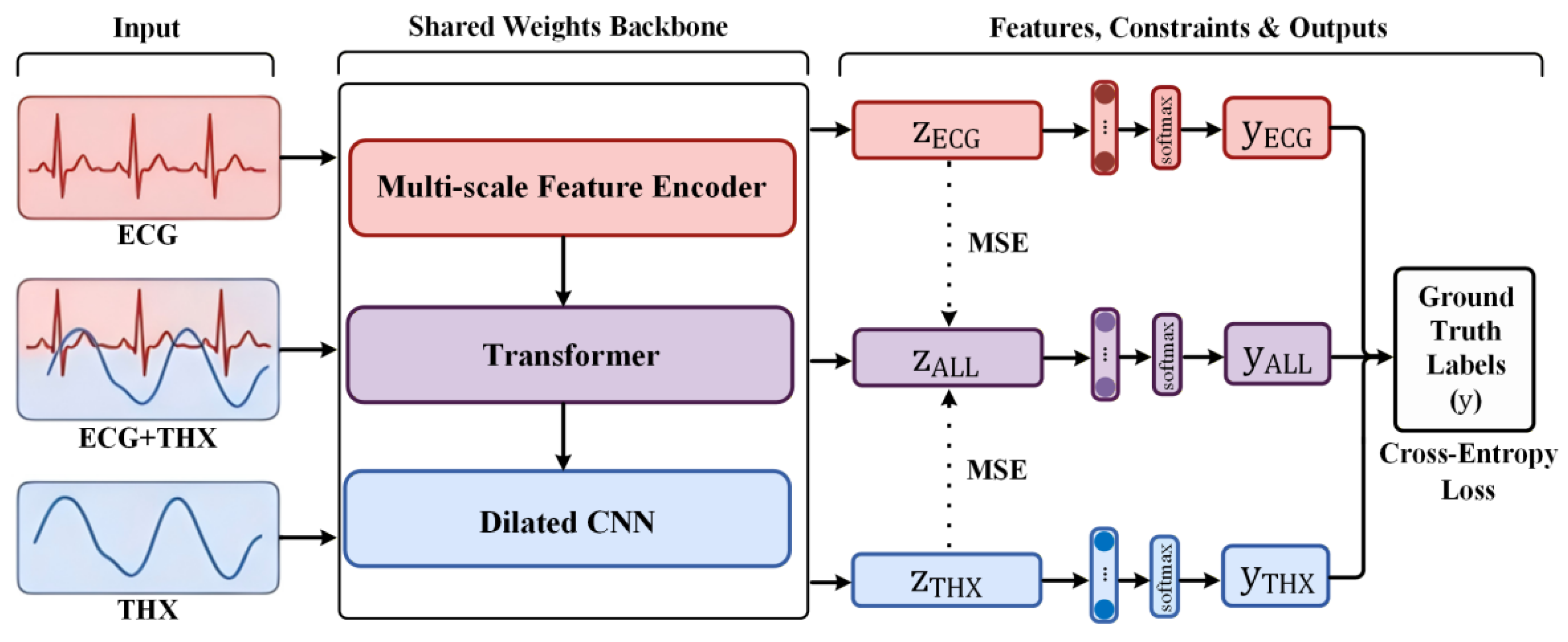
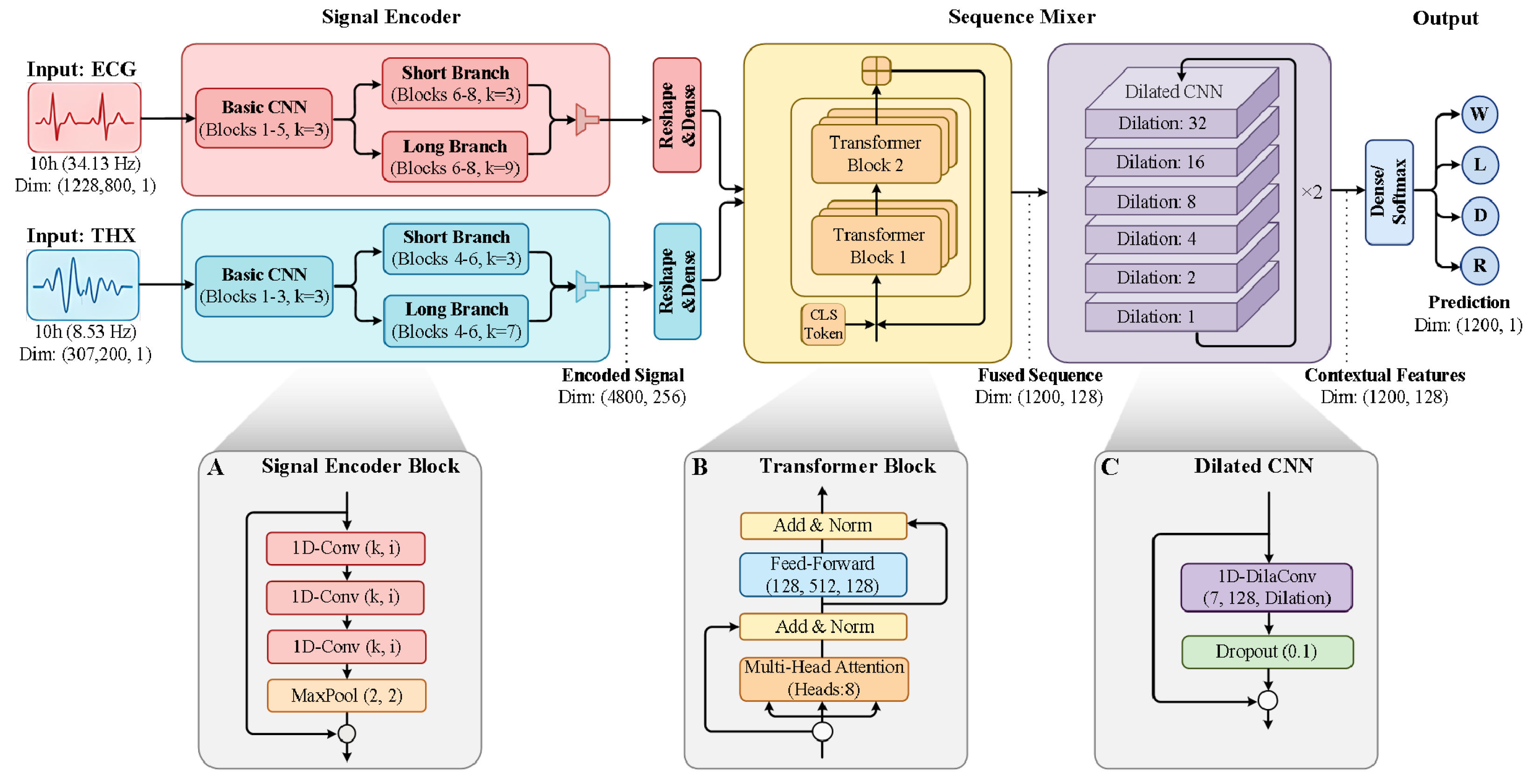
- We formulate heterogeneous missing-modality sleep staging as a unified learning problem and develop a unified framework capable of supporting arbitrary combinations of ECG and thoracic respiration using a single trained model.
- (2)
- We propose a dual-branch heterogeneous encoder together with a weakly constrained modal feature alignment strategy, enabling effective cross-modal knowledge transfer while preserving modality-specific physiological representations.
- (3)
- Extensive experiments on two large-scale public sleep datasets demonstrate that the proposed framework achieves stable performance across different modality configurations while simplifying practical deployment for long-term home sleep monitoring.
2. Materials and Methods
2.1. Datasets and Preprocessing
2.2. Network Architecture Design
2.3. Model Training Framework
2.4. Experimental Setup
3. Results
3.1. Overall Performance
- Comparative method: Three separate independent models (ECG-only, THX-only, and bimodal ALL) were trained without the proposed modal feature alignment module; each model was optimized exclusively for its single input modality.
- Proposed method: A single unified multimodal model integrated the modal feature alignment strategy, which adaptively processes three input types including unimodal ECG, unimodal THX, and bimodal ALL.
3.2. Ablation Experiment
3.3. Parameter Analysis
3.4. Method Comparison
3.5. Generalization Validation
4. Discussion
5. Conclusions
Author Contributions
Funding
Institutional Review Board Statement
Informed Consent Statement
Data Availability Statement
Acknowledgments
Conflicts of Interest
Abbreviations
| PSG | Polysomnography |
| AASM | American Academy of Sleep Medicine |
| ECG | Electrocardiogram |
| THX | Thoracic Respiratory Signal |
| NREM | Non-Rapid Eye Movement |
| REM | Rapid Eye Movement |
| CNN | Convolutional Neural Network |
| SDB | Sleep-Disordered Breathing |
| AHI | Apnea–Hypopnea Index |
| ACC | Accuracy |
| MF1 | Macro-F1 Score |
| SHHS | Sleep Heart Health Study |
| P2018 | 2018 PhysioNet Sleep Challenge |
Appendix A. Additional Results and Discussion
Appendix A.1. Preprocessing Rationale

Appendix A.2. Qualitative Analysis


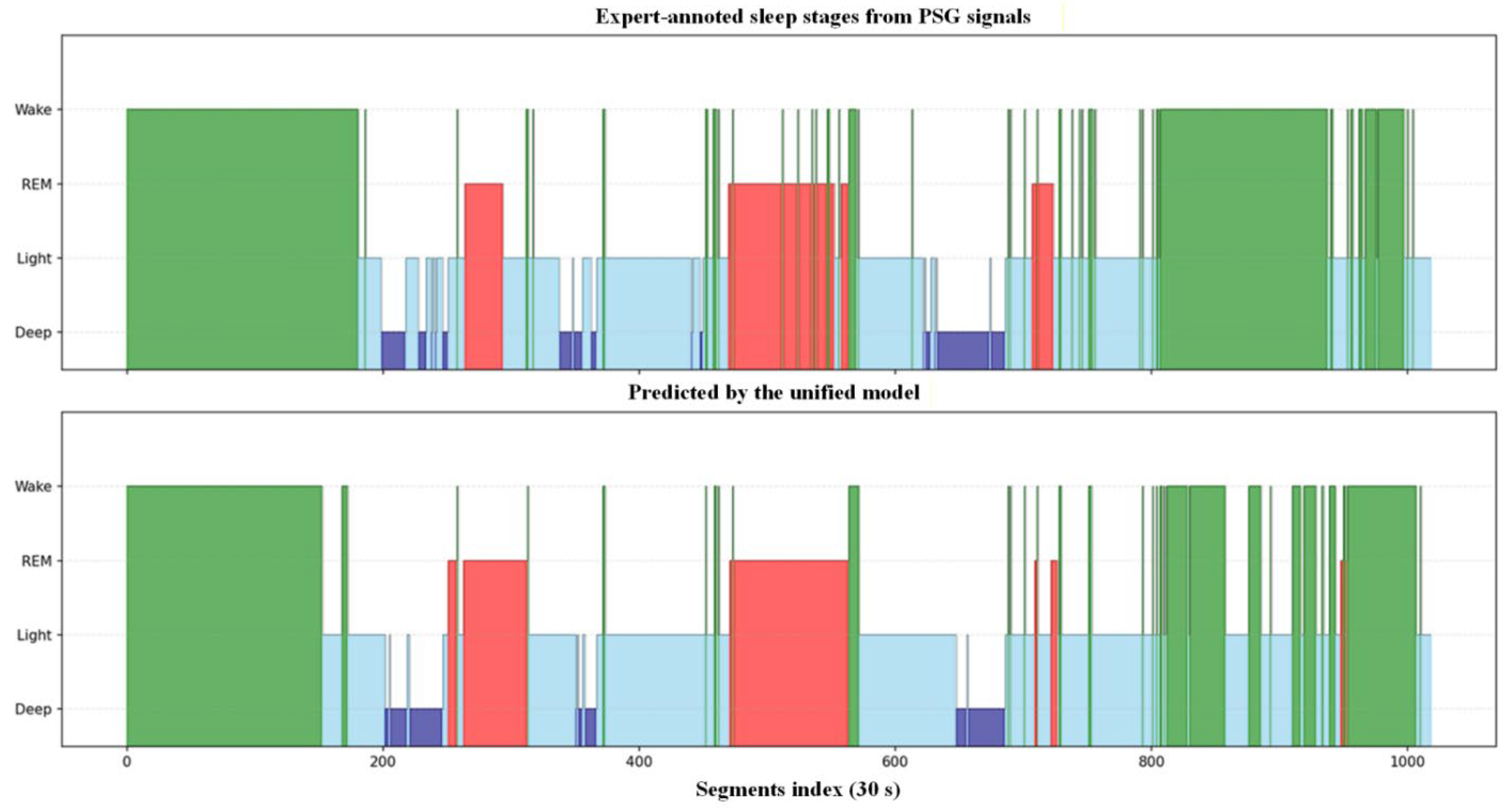
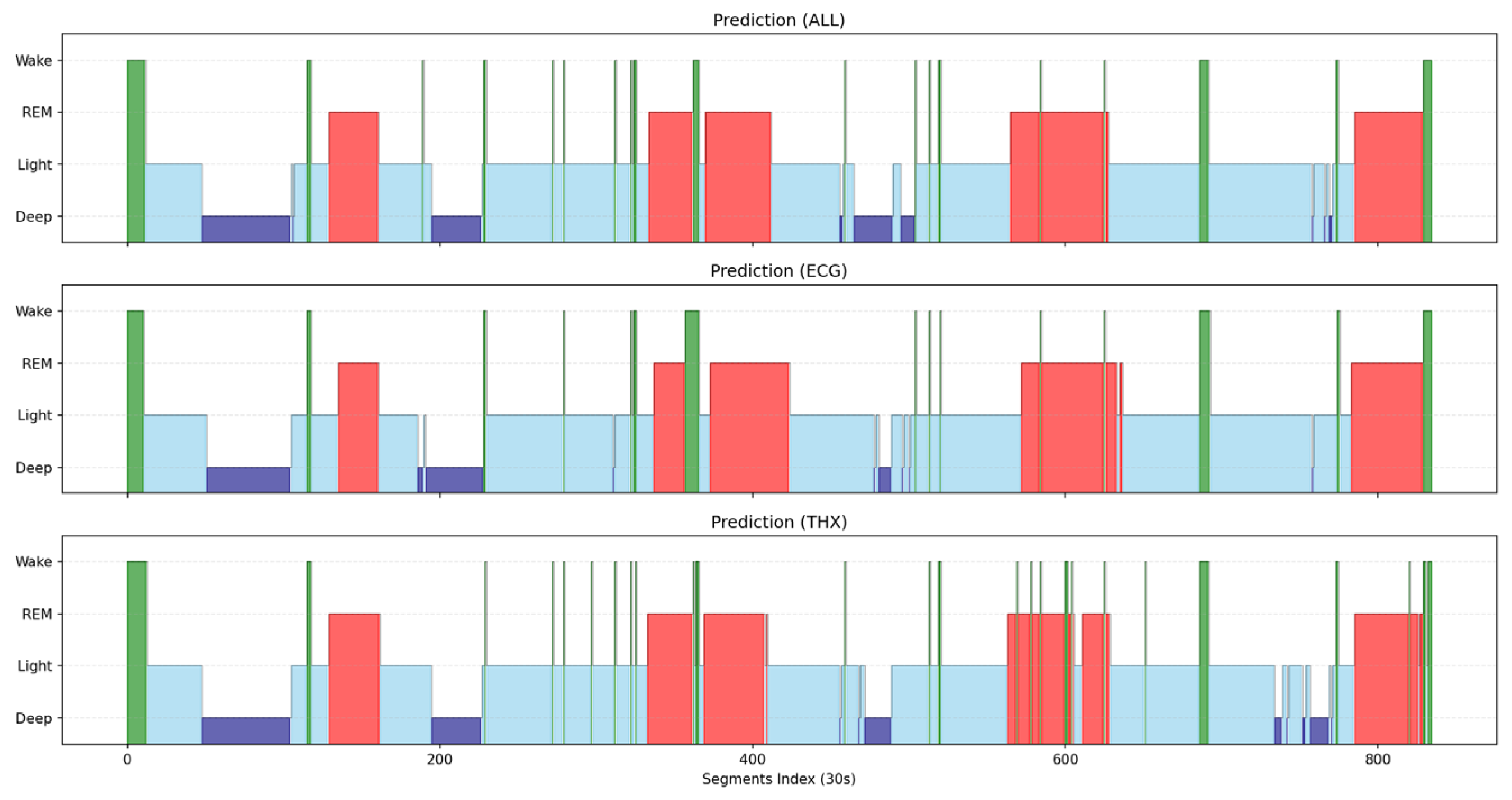
- For the proposed method (Figure A2), the staging patterns generated by ECG-only and THX-only inputs show excellent overall alignment with the full dual-modal baseline. Only sporadic scattered inconsistent epochs exist between single-modal and dual-modal outputs, with no large-scale continuous stage mismatches.
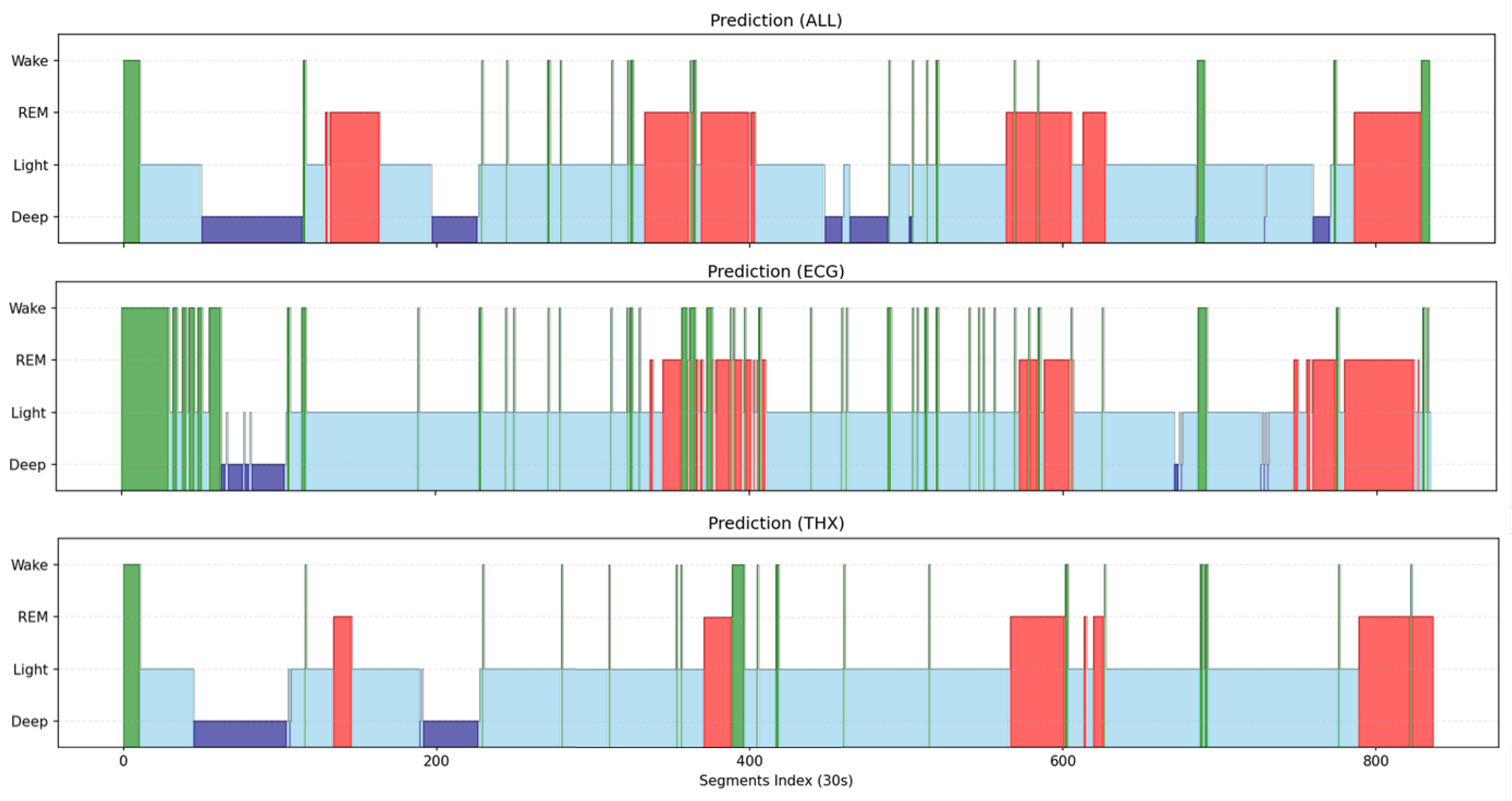
- For the random masking baseline (Figure A3), single-modal predictions retain the general sleep cycle trend matching the dual-modal benchmark, yet more scattered inconsistent epochs appear across the whole recording relative to the proposed method.
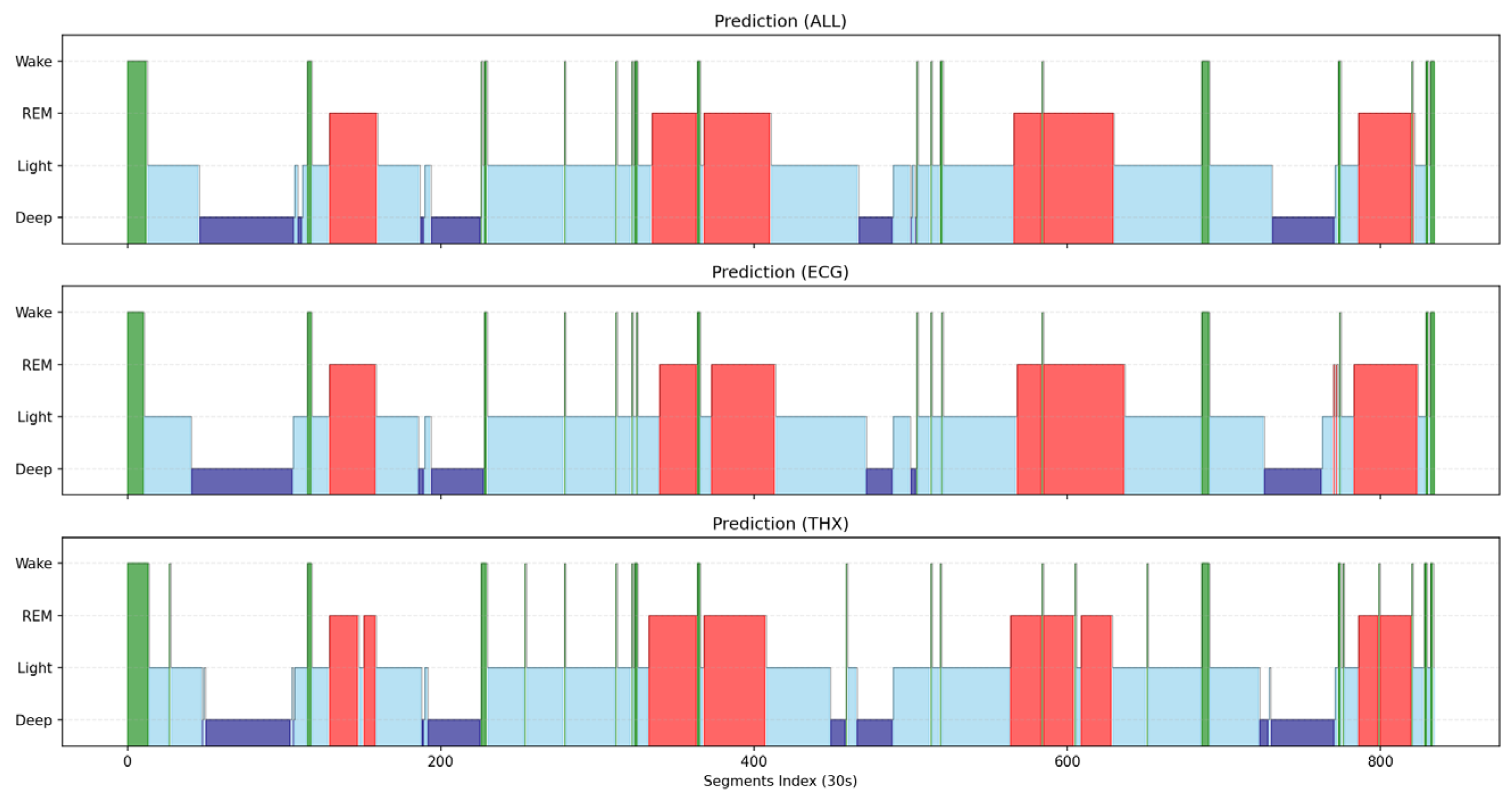
- For the direct training baseline (Figure A4), severe long-range mismatches emerge when only ECG signals are available. A large portion of continuous epochs produce drastically different staging results from the full dual-modal reference, demonstrating weak cross-modal transfer capacity.
References
- Baranwal, N.; Yu, P.K.; Siegel, N.S. Sleep physiology, pathophysiology, and sleep hygiene. Prog. Cardiovasc. Dis. 2023, 77, 59–69. [Google Scholar] [CrossRef] [Scilit] [PubMed]
- American Academy of Sleep Medicine (AASM). The AASM Manual for the Scoring of Sleep and Associated Events: Rules, Terminology and Technical Specifications (Update v2.4); American Academy of Sleep Medicine: Darien, IL, USA, 2017. [Google Scholar]
- Jones, A.M.; Itti, L.; Sheth, B.R. Expert-level sleep staging using an electrocardiography-only feed-forward neural network. Comput. Biol. Med. 2024, 176, 108545. [Google Scholar] [CrossRef] [Scilit] [PubMed]
- Byun, J.H.; Kim, K.T.; Moon, H.J.; Motamedi, G.K.; Cho, Y.W. The first-night effect during polysomnography, and patients’ estimates of sleep quality. Psychiatry Res. 2019, 274, 27–29. [Google Scholar] [CrossRef] [Scilit] [PubMed]
- Yue, H.; Chen, Z.; Guo, W.; Sun, L.; Dai, Y.; Wang, Y.; Ma, W.; Fan, X.; Wen, W.; Lei, W. Research and application of deep learning-based sleep staging: Data, modeling, validation, and clinical practice. Sleep Med. Rev. 2024, 74, 101897. [Google Scholar] [CrossRef] [Scilit] [PubMed]
- Liu, P.; Qian, W.; Zhang, H.; Zhu, Y.; Hong, Q.; Li, Q.; Yao, Y. Automatic sleep stage classification using deep learning: Signals, data representation, and neural networks. Artif. Intell. Rev. 2024, 57, 301. [Google Scholar] [CrossRef] [Scilit]
- Masad, I.S.; Alqudah, A.; Qazan, S. Automatic classification of sleep stages using EEG signals and convolutional neural networks. PLoS ONE 2024, 19, e0297582. [Google Scholar] [CrossRef] [PubMed]
- Liu, G.; Wei, G.; Sun, S.; Mao, D.; Zhang, J.; Zhao, D.; Tian, X.; Wang, X.; Chen, N. MicroSleepNet: Efficient deep learning model for mobile sleep staging using dilated convolution and multi-scale fusion. Front. Neurosci. 2023, 17, 1218072. [Google Scholar] [CrossRef] [Scilit] [PubMed]
- Supratak, A.; Dong, H.; Wu, C.; Guo, Y. DeepSleepNet: A model for automatic sleep stage scoring based on raw single-channel EEG. IEEE Trans. Neural Syst. Rehabil. Eng. 2017, 25, 1998–2008. [Google Scholar] [CrossRef] [Scilit] [PubMed]
- Toma, T.I.; Choi, S. An end-to-end multi-channel convolutional Bi-LSTM network for sleep stage detection. Sensors 2023, 23, 4950. [Google Scholar] [CrossRef] [Scilit] [PubMed]
- Wang, J.Q.; Zhao, S.; Jiang, H.T.; Zhou, Y.; Yu, Z.; Li, T.; Pan, G. CareSleepNet: A hybrid deep learning network for automatic sleep staging. IEEE J. Biomed. Health Inform. 2024, 28, 7392–7405. [Google Scholar] [CrossRef] [Scilit] [PubMed]
- Phan, H.; Lorenzen, K.P.; Heremans, E.; Chén, O.Y.; Tran, M.C.; Koch, P.; Mertins, A.; Baumert, M.; Mikke, K.B. L-SeqSleepNet: Whole-cycle long sequence modelling for automatic sleep staging. IEEE J. Biomed. Health Inform. 2023, 27, 4748–4757. [Google Scholar] [CrossRef] [Scilit] [PubMed]
- Vaswani, A.; Shazeer, N.; Parmar, N.; Uszkoreit, J.; Jones, L.; Gomez, A.N.; Polosukhin, I. Attention is all you need. In Advances in Neural Information Processing Systems; NeurIPS: Long Beach, CA, USA, 2017; pp. 5998–6008. [Google Scholar]
- Guo, Y.; Nowakowski, M.; Dai, W. FlexSleepTransformer: A transformer-based sleep staging model adaptable to varying channel counts. Sci. Rep. 2024, 14, 26312. [Google Scholar] [CrossRef] [Scilit] [PubMed]
- Chen, Y.; Yuan, J.; Tang, J. A high precision vital signs detection method based on millimeter wave radar. Sci. Rep. 2024, 14, 25535. [Google Scholar] [CrossRef] [Scilit] [PubMed]
- Ganglberger, W.; Krishnamurthy, P.V.; Quadri, S.A.; Tesh, R.A.; Bucklin, A.A.; Adra, N.; Westover, M.B. Sleep staging in the ICU with heart rate variability and breathing signals: An exploratory cross-sectional study using deep neural networks. Front. Netw. Physiol. 2023, 3, 1120390. [Google Scholar] [CrossRef] [Scilit] [PubMed]
- Yoon, H.; Choi, S.H. Technologies for sleep monitoring at home: Wearables and nearables. Biomed. Eng. Lett. 2023, 13, 313–327. [Google Scholar] [CrossRef] [Scilit] [PubMed]
- Vitazkova, D.; Foltan, E.; Kosnacova, H.; Micjan, M.; Donoval, M.; Kuzma, A.; Vavrinsky, E. Advances in respiratory monitoring: A comprehensive review of wearable and remote technologies. Biosensors 2024, 14, 90. [Google Scholar] [CrossRef] [Scilit] [PubMed]
- Charlton, P.H.; Allen, J.; Bailón, R.; Baker, S.; Behar, J.A.; Chen, F.; Zhu, T. The 2023 wearable photoplethysmography roadmap. Physiol. Meas. 2023, 44, 021001. [Google Scholar] [CrossRef] [Scilit]
- Fayyaz, H.; D’Souza, N.S.; Beheshti, R. Multimodal sleep apnea detection with missing or noisy modalities. Proc. Mach. Learn. Res. 2024, 252, 1–22. [Google Scholar] [CrossRef] [Scilit]
- Kontras, K.; Chatzichristos, C.; Phan, H.; Suykens, J.; De Vos, M. CoRe-Sleep: A multimodal fusion framework for time series robust to imperfect modalities. arXiv 2023, arXiv:2304.06485. [Google Scholar]
- Shen, Q.; Xin, J.; Dai, B.T.; Zhang, S.; Wang, Z. Robust Sleep Staging over Incomplete Multimodal Physiological Signals via Contrastive Imagination; NeurIPS: Long Beach, CA, USA, 2024. [Google Scholar]
- Kweon, Y.-S.; Shin, G.-H.; Kwak, H.-G.; Jo, H.N. Multi-signal reconstruction using masked autoencoder from EEG during polysomnography. arXiv 2023, arXiv:2311.07868. [Google Scholar]
- Xie, Z.; Liang, H.; Jia, Z. A multimodal knowledge distillation framework for sleep physiological data. In Advanced Data Mining and Applications; Springer: Berlin/Heidelberg, Germany, 2024; pp. 256–265. [Google Scholar]
- Quan, S.F.; Howard, B.V.; Iber, C.; Kiley, J.P.; Nieto, F.J.; O’Connor, G.T.; Rapoport, D.M.; Redline, S.; Robbins, J.; Samet, J.M.; et al. The Sleep Heart Health Study: Design, rationale, and methods. Sleep 1997, 20, 1077–1085. [Google Scholar] [CrossRef] [Scilit] [PubMed]
- Ghassemi, M.M.; Moody, B.E.; Lehman, L.W.H.; Song, C.; Li, Q.; Sun, H.; Clifford, G.D. You Snooze, You Win: The PhysioNet/Computing in Cardiology Challenge 2018; PhysioNet: Cambridge, MA, USA, 2018. [Google Scholar]
- World Medical Association. World Medical Association Declaration of Helsinki: Ethical principles for medical research involving human subjects. JAMA 2013, 310, 2191–2194. [Google Scholar] [CrossRef] [Scilit] [PubMed]
- Fonseca, P.; Ross, M.; Cerny, A.; Anderer, P.; van Meulen, F.; Janssen, H.; Pijpers, A.; Dujardin, S.; van Hirtum, P.; van Gilst, M.; et al. A computationally efficient algorithm for wearable sleep staging in clinical populations. Sci. Rep. 2023, 13, 9182. [Google Scholar] [CrossRef] [Scilit] [PubMed]
- Zhuang, Z.; Xue, B.; An, Q.; Chu, H.; Zhang, Y.; Chen, R.; Xu, J.; Ding, N.; Cui, X.; Wang, E.; et al. Advancing sleep health equity through deep learning on large-scale nocturnal respiratory signals. Nat. Commun. 2025, 16, 9334. [Google Scholar] [CrossRef] [Scilit] [PubMed]
- Davidson, S.M.; Carter, J.; Stanyer, E.C.; Sharman, R.; Roman, C.; Kyle, S.D.; Tarassenko, L. Longitudinal cardiorespiratory wearable sleep staging in the home. Front. Neurosci. 2026, 20, 1693860. [Google Scholar] [CrossRef] [Scilit] [PubMed]
- Hinton, G.; Vinyals, O.; Dean, J. Distilling the knowledge in a neural network. arXiv 2015, arXiv:1503.02531. [Google Scholar]
- Le, V.K.D.; Ho, H.B.; Karolcik, S.; Hernandez, B.; Greeff, H.; Nguyen, V.H.; Vietnam ICU Translational Applications Laboratory (VITAL) Investigators. vital_sqi: A Python package for physiological signal quality control. Front. Physiol. 2022, 13, 1020458. [Google Scholar] [CrossRef] [Scilit] [PubMed]
- Carter, J.F.; Tarassenko, L. wav2sleep: A unified multi-modal approach to sleep stage classification from physiological signals. arXiv 2024, arXiv:2411.04644. [Google Scholar]
- Zhang, Y.; Cao, W.; Feng, L.; Wang, M.; Geng, T.; Zhou, J.; Gao, D. SHNN: A single-channel EEG sleep staging model based on semi-supervised learning. Expert Syst. Appl. 2023, 213, 119288. [Google Scholar] [CrossRef] [Scilit]
- Korkalainen, H.; Aakko, J.; Nikkonen, S.; Kainulainen, S.; Leino, A.; Duce, B.; Leppänen, T. Accurate deep learning-based sleep staging in a clinical population with suspected obstructive sleep apnea. IEEE J. Biomed. Health Inf. 2020, 24, 2073–2081. [Google Scholar]
- Sun, H.; Ganglberger, W.; Panneerselvam, E.; Leone, M.J.; Quadri, S.A.; Goparaju, B.; Westover, M.B. Sleep staging from electrocardiography and respiration with deep learning. Sleep 2020, 43, zsz306. [Google Scholar] [CrossRef] [Scilit] [PubMed]
- Si, K.; Dong, K.; Lu, J.; Zhao, L.; Xiang, W.; Li, J.; Liu, C. A U-Sleep Model for Sleep Staging Using Electrocardiography and Respiration Signals. In Asian-Pacific Conference on Medical and Biological Engineering; Springer Nature: Cham, Switzerland, 2024; pp. 475–482. [Google Scholar]
- Chu, W.; Wang, C.; Yang, L.; Guo, L.; Wu, C.; Wang, B.; Wan, X. Sleep Staging Method Based on Multimodal Physiological Signals Using Snake-ACO. Appl. Sci. 2026, 16, 1316. [Google Scholar] [CrossRef] [Scilit]
- Sharan, R.V.; Takeuchi, H.; Kishi, A.; Yamamoto, Y. Macro-Sleep Staging With ECG-Derived Instantaneous Heart Rate and Respiration Signals and Multi-Input 1-D CNN-BiGRU. IEEE Trans. Instrum. Meas. 2024, 73, 2535212. [Google Scholar] [CrossRef] [Scilit]
- Cater, J.F.; Jorge, J.; Gibson, O.; Tarassenko, L. SleepVST: Sleep Staging from Near-Infrared Video Signals using Pre-Trained Transformers. In Proceedings of the IEEE/CVF Conference on Computer Vision and Pattern Recognition (CVPR), Seattle, WA, USA, 16–22 June 2024; pp. 12479–12489. [Google Scholar]



| Method | Modality | ACC (%) (95% CI) | Kappa (95% CI) | MF1 (95% CI) |
|---|---|---|---|---|
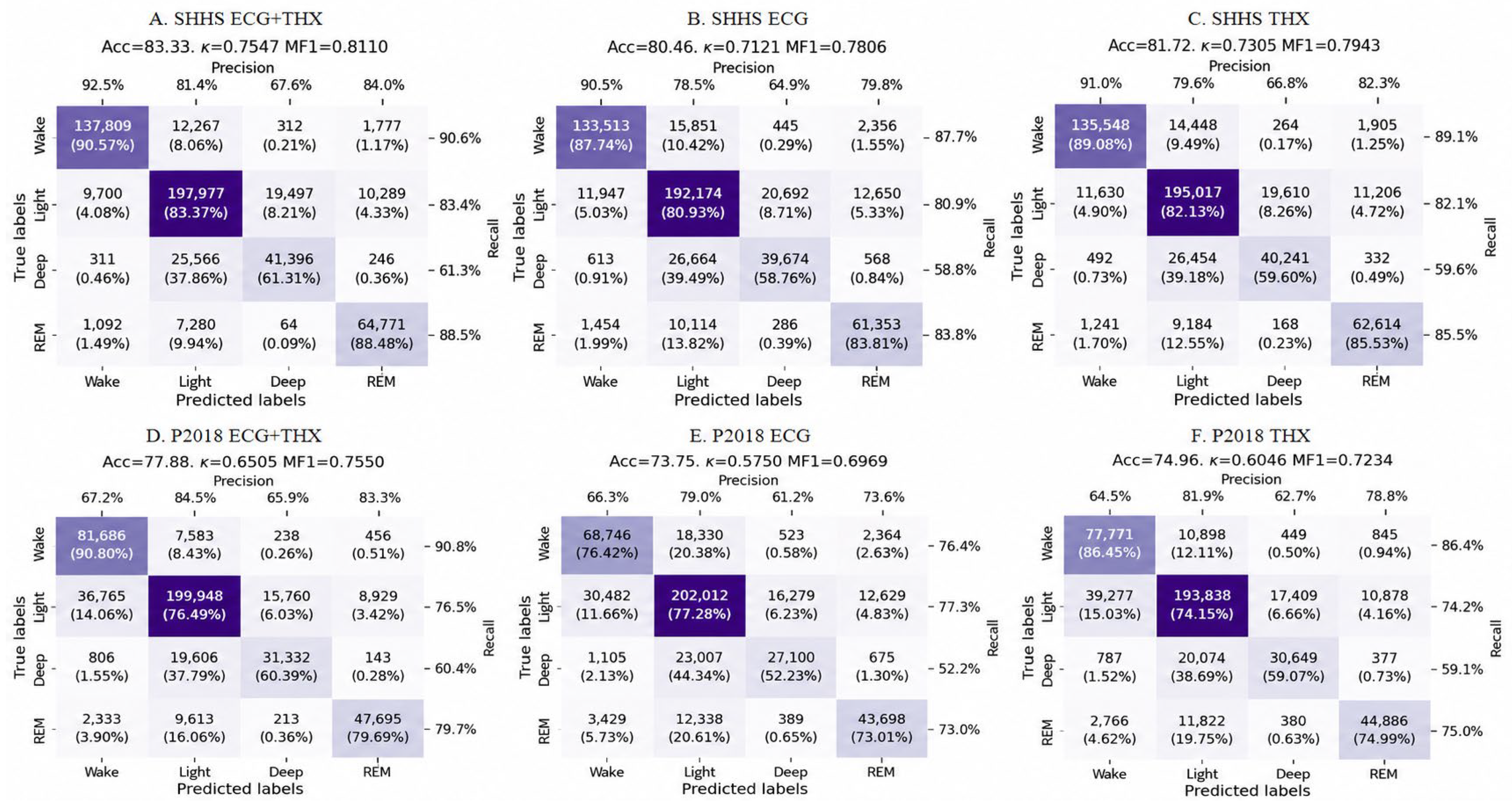
| Comparative method | ALL | 83.11 (82.56, 83.60) | 0.7510 (0.7429, 0.7585) | 0.8075 (0.7998, 0.8148) |
| ECG | 80.43 (79.82, 81.00) | 0.7113 (0.7030, 0.7191) | 0.7794 (0.7712, 0.7871) | |
| THX | 81.55 (80.99, 82.08) | 0.7271 (0.7193, 0.7344) | 0.7905 (0.7826, 0.7981) | |
| Proposed method | ALL | 83.33 (82.83, 83.80) | 0.7547 (0.7472, 0.7618) | 0.8110 (0.8037, 0.8180) |
| ECG | 80.46 (79.90, 80.99) | 0.7121 (0.7043, 0.7196) | 0.7806 (0.7729, 0.7880) | |
| THX | 81.72 (81.18, 82.23) | 0.7305 (0.7230, 0.7376) | 0.7943 (0.7867, 0.8016) |
| Method | Modality | Per-Class F1 Score (%) (95% CI) | |||
|---|---|---|---|---|---|
| Wake | REM | Light | Deep | ||
| Comparative method | ALL | 91.24 (90.65, 91.77) | 85.80 (85.11, 86.45) | 82.45 (81.80, 83.09) | 63.63 (62.48, 64.73) |
| ECG | 88.80 (88.15, 89.41) | 81.62 (80.85, 82.34) | 79.73 (79.00, 80.43) | 61.53 (60.35, 62.65) | |
| THX | 90.09 (89.45, 90.68) | 84.03 (83.30, 84.72) | 80.76 (80.05, 81.44) | 61.36 (60.21, 62.48) | |
| Proposed method | ALL | 91.54 (90.99, 92.05) | 86.20 (85.56, 86.81) | 82.39 (81.78, 82.98) | 64.30 (63.17, 65.37) |
| ECG | 89.08 (88.47, 89.65) | 81.76 (81.05, 82.43) | 79.69 (79.01, 80.34) | 61.70 (60.56, 62.78) | |
| THX | 90.04 (89.44, 90.60) | 83.88 (83.18, 84.55) | 80.83 (80.16, 81.47) | 63.00 (61.89, 64.06) | |
| Modality | Index | Number of Branches and Results | ||||
|---|---|---|---|---|---|---|
| 0 | 1 | 2 | 3 | 4 | ||
| ECG | Kappa for the validation set | 0.7145 | 0.7162 | 0.7153 | 0.7169 | 0.7154 |
| GPU Memory (GB) | 9.315 | 9.323 | 9.329 | 9.331 | 9.810 | |
| THX | Kappa for the validation set | 0.7330 | 0.7371 | 0.7367 | 0.7388 | 0.7355 |
| GPU Memory (GB) | 4.974 | 4.979 | 4.983 | 5.327 | 5.974 | |
| Modality | Independent Training | Kappa for Each λ | |||||
|---|---|---|---|---|---|---|---|
| 0 | 0.1 | 0.5 | 5 | 10 | 100 | ||
| ALL | 0.7575 | 0.7614 | 0.7627 | 0.7637 | 0.7631 | 0.7625 | 0.7620 |
| ECG | 0.7169 | 0.7198 | 0.7212 | 0.7218 | 0.7214 | 0.7212 | 0.7202 |
| THX | 0.7388 | 0.7370 | 0.7391 | 0.7398 | 0.7393 | 0.7386 | 0.7384 |
| Method | Comparative Metrics | Random Seeds and Their Effects | |||||
|---|---|---|---|---|---|---|---|
| 7 | 19 | 23 | 37 | 61 | 42 | ||
| Proposed method | Number of iterations | 17 | 15 | 17 | 17 | 17 | 17 |
| Validation set kappa | 0.7612 | 0.7617 | 0.7617 | 0.7617 | 0.7607 | 0.7637 | |
| Direct training | Number of iterations | 15 | 11 | 17 | 17 | 15 | 17 |
| Validation set kappa | 0.7569 | 0.7565 | 0.7548 | 0.7524 | 0.7546 | 0.7575 | |
| Random masking | Number of iterations | 24 | 32 | 26 | 27 | 28 | 27 |
| Validation set kappa | 0.7597 | 0.7589 | 0.7593 | 0.7592 | 0.7580 | 0.7595 | |
| Studies | Year | Methods | Stages | Kappa/ACC | Missing Modality |
|---|---|---|---|---|---|
| Sun et al. [36] | 2020 | CNN + LSTM | W-R-N W-R-N1-N2-N3 | 0.586 (Kappa) 0.750 (Kappa) | No Support |
| Si et al. [37] | 2024 | U-Net | W-R-N1-N2-N3 | 64.1% ACC) | No Support |
| Chu et al. [38] | 2026 | SVM (Snake-ACO) | W-R-N1N2-N3 | 68.9% (ACC) | No Support |
| Sharan et al. [39] | 2024 | 1D-CNN + BiGRU | W-R-N1N2-N3 | 73.7% (ACC) | No Support |
| Cater et al. [40] | 2024 | Transformer | W-R-N1N2-N3 | 82.8% (ACC) | No Support |
| This paper | - | Unified Multimodal Model | W-R-N1N2-N3 | 0.7547 (Kappa) 83.33% (ACC) | Support |
Disclaimer/Publisher’s Note: The statements, opinions and data contained in all publications are solely those of the individual author(s) and contributor(s) and not of MDPI and/or the editor(s). MDPI and/or the editor(s) disclaim responsibility for any injury to people or property resulting from any ideas, methods, instructions or products referred to in the content. |
© 2026 by the authors. Licensee MDPI, Basel, Switzerland. This article is an open access article distributed under the terms and conditions of the Creative Commons Attribution (CC BY) license.
Share and Cite
Guo, L.; Yin, Y.; Wang, C.; Chen, H.; Cui, Q.; Wan, X. A Sleep Staging Method Based on Cardiopulmonary Signals Using a Unified Multimodal Model. Technologies 2026, 14, 441. https://doi.org/10.3390/technologies14070441
Guo L, Yin Y, Wang C, Chen H, Cui Q, Wan X. A Sleep Staging Method Based on Cardiopulmonary Signals Using a Unified Multimodal Model. Technologies. 2026; 14(7):441. https://doi.org/10.3390/technologies14070441
Chicago/Turabian StyleGuo, Lin, Yuhang Yin, Chen Wang, Hongyu Chen, Qinghua Cui, and Xiangkui Wan. 2026. "A Sleep Staging Method Based on Cardiopulmonary Signals Using a Unified Multimodal Model" Technologies 14, no. 7: 441. https://doi.org/10.3390/technologies14070441
APA StyleGuo, L., Yin, Y., Wang, C., Chen, H., Cui, Q., & Wan, X. (2026). A Sleep Staging Method Based on Cardiopulmonary Signals Using a Unified Multimodal Model. Technologies, 14(7), 441. https://doi.org/10.3390/technologies14070441