Article

Planning and Design of a Photovoltaic Solar-Energy-Generation System in the Southeastern Amazon Region of Ecuador

by
Carlos Brito-Brito
,
Luis Córdova-Cajamarca
and
Daniel Icaza-Alvarez
*
Maestría en Electricidad, Universidad Politécnica Salesiana, Campus el Vecino, Cuenca 010102, Ecuador
*
Author to whom correspondence should be addressed.
Technologies 2026, 14(7), 428; https://doi.org/10.3390/technologies14070428
Submission received: 12 June 2026 / Revised: 3 July 2026 / Accepted: 10 July 2026 / Published: 14 July 2026

Abstract

This research evaluates the feasibility of implementing photovoltaic solar systems in the Ecuadorian Amazon to harness solar energy and increase energy security in the region. It is based on the need to reduce direct dependence on fossil fuels and existing hydroelectric systems. The overall framework is to transform the energy matrix to utilize incident solar energy, integrating it with current hydroelectric and thermal generation. The fundamental goal is to evaluate the energy resource using specialized software such as Homer Pro and develop designs for the proper operation of photovoltaic solar technology, which will contribute its surplus energy to the National Interconnected System (SNI) and, therefore, reduce the country’s high dependence on the hydrological cycle. The results obtained demonstrate that solar power plants can be of great benefit to the country, especially when combined with wind and existing hydroelectric power. This will contribute to the diversification of energy sources and, consequently, to energy security through the increase in renewable energy. In the worst-case scenario, the cost of energy can be 7 cents per kWh, and in the best-case scenario, in a combined dispatch, 3 cents per kWh.

1. Introduction

The incorporation of renewable energy sources and changes in population consumption habits are essential milestones for reducing the environmental impact of human activities [1]. Among these, industrial and transportation activities are the largest contributors to greenhouse gas (GHG) emissions, increasing their effects on climate change [2]. Studies conducted between 2000 and 2026 have identified that the most significant increase in GHG emissions is due to energy supply, transportation, and industry. Energy from fossil fuels accounts for 70% of GHG emissions [3]. While climate change is a natural process, various studies have concluded that human activities have contributed to accelerating it, altering the global atmospheric structure, and causing variations in the environment that are reflected [4]. For example, water scarcity poses risks to the food security of the surrounding population, both animal and human [5].
Ecuador, due to its geographical location, is situated in a region where the effects of climate change are significantly visible in biodiversity, agriculture, and food security, among other key areas [6]. Therefore, it is necessary to address strategies that mitigate the effects of climate change as a cross-cutting issue in all public policies, a fact supported by the Constitution of the Republic of Ecuador [7], which in Article 414 establishes: “The State shall adopt appropriate and cross-cutting measures for the mitigation of climate change, limiting greenhouse gas emissions, deforestation, and air pollution; it shall adopt measures for the conservation of forests and vegetation, and shall protect the population at risk”. This provision serves as the legal foundation upon which national policies and international commitments are built, ensuring that climate action effectively permeates all sectors of public administration [8]. Furthermore, by placing particular emphasis on the protection of at-risk populations, the constitutional precept recognizes that climate change is not only an ecological challenge but also a profound threat to social equity and human security [9]. Consequently, this article not only defines an unavoidable state responsibility but also lays the groundwork for the transition to a resilient and sustainable development model, guaranteeing that future generations inherit a healthy environment, as ensured by the Ecuadorian constitutional framework in the face of the global climate crisis. The implementation of photovoltaic systems in Ecuador aligns directly with the constitutional mandate of Article 414, as it constitutes a cross-cutting and effective measure to mitigate climate change [10]. By promoting the generation of clean energy, this technology significantly reduces greenhouse gas emissions and dependence on fossil fuels, fulfilling the state’s obligation to limit air pollution. In this way, solar energy not only guarantees the right to a healthy environment but also strengthens the resilience of the energy sector, promoting a sustainable and resilient development model in the face of the global climate crisis.
The main problem identified affecting environmental stability is deforestation for the expansion of the agricultural frontier, urbanization, and logging, which causes effects such as reduced biodiversity, disruption of the water cycle, and a contribution to climate change through the release of carbon stored in trees [11]. Therefore, deforestation must be reduced through reforestation programs, greater energy efficiency, and a transition to the use and exploitation of renewable energy sources, among other key actions to be developed [12]. It is essential to intensify efforts to reduce or eliminate emissions of agents that contribute to climate change through adaptation and mitigation processes [13].
Renewable energy consists of sources whose potential is inexhaustible (they are constantly replenished), as they originate from sources that provide energy continuously as a result of solar radiation or the gravitational pull of the moon; these types of energy include hydroelectric, solar, wind, biomass, geothermal, and tidal [14]. One of the current objectives is to eliminate or at least reduce the consumption of fossil fuels by producing energy from renewable sources [15]. In 2022, it was established that 29% of global electricity came from renewable sources, and it is estimated that by 2030, with adequate investments, electricity generated from renewable sources could cover 65% of the world’s electricity supply [16].
Renewable energies play a fundamental role in mitigating climate change, reducing greenhouse gas emissions, and strengthening countries’ energy security. In Ecuador, the electricity grid has historically relied on hydroelectric generation, allowing for high percentages of renewable electricity. However, increasing climate variability, prolonged droughts, and a sustained rise in energy demand highlight the need to diversify generation sources. In this context, incorporating technologies such as photovoltaic solar energy [17], wind energy [18], biomass [19], and energy storage systems will increase the resilience and flexibility of the national electricity system [20]. The Ecuadorian Amazon region, in particular, presents significant potential for harnessing solar energy due to its year-round availability and the existence of large isolated areas that still depend on fossil fuels for their energy supply. The development of solar projects in this region could significantly contribute to the sustainable electrification of rural communities, reduce operating costs, and decrease polluting emissions. Furthermore, the integration of photovoltaic systems with energy storage and smart microgrids would promote local energy independence and improve the quality of electricity supply. Therefore, technological diversification and the strategic use of Amazonian solar resources are key elements for accelerating Ecuador’s energy transition and moving towards a more sustainable, secure, and resilient energy matrix by 2050.
The remainder of the article is structured as follows: Section 2 presents a state-of-the-art analysis. Section 3 outlines the scientific methodology adopted in this study. Section 4 presents a hybrid renewable energy system, which incorporates wind and hydroelectric power, with photovoltaics as the primary focus of the analysis. Section 5 presents the modeling and simulation of the hybrid system. Section 6 analyzes the results. Finally, Section 7 presents the conclusions of this study.

2. Review of the State of the Art

The global energy transition has driven accelerated growth in electricity generation from renewable sources, with solar photovoltaics being one of the fastest-growing technologies due to cost reductions, technological maturity, and its ability to adapt to different generation scales. Several studies highlight that photovoltaic systems are a viable alternative for improving access to electricity in isolated regions where expanding the conventional grid is technically or economically complex. In Latin America, solar energy has acquired a strategic role in promoting sustainable electrification processes and reducing greenhouse gas emissions. In Ecuador, the available solar potential across the country has spurred numerous research projects related to the design, sizing, and optimization of grid-connected and off-grid photovoltaic systems. According to Miravet-Sánchez et al. [21], solar systems represent an efficient solution for rural communities where geographical limitations hinder the expansion of conventional electrical infrastructure. Furthermore, the Solar Atlas of Ecuador [22] has shown that a large part of the territory has adequate levels of irradiation for the implementation of photovoltaic projects at different scales, constituting an opportunity to diversify the national energy matrix and strengthen the country’s energy security.
Several recent studies have been addressed, which are considered benchmarks in Ecuador. Among them is the study by Luis H. Álvarez-Játiva et al. [23], who experimentally evaluated the energy performance of a group of twelve 5 W photovoltaic panels mounted vertically on university buildings in Ibarra, Ecuador, in four azimuthal orientations (−135° SE, −45° NE, 45° NW, 135° SW). An 8-month continuous monitoring campaign was carried out using an Arduino-based data logger, validated with multimeter measurements (error < 5%). The dataset was used to develop forecasting models in MATLAB version 2025b based on sum-of-sine functions, obtaining R2 values between 0.83 and 0.98 and RMSE values between 0.024 and 0.082 W. The 45° (NW) orientation achieved the highest annual energy yield of 48% STC, reaching approximately 440 kWh/kWp on the best-performing facade, while the 135° (SW) orientation also showed favorable performance compared to the northeast and southeast orientations. Esteban Zalamea-León et al. [24] proposed a methodology for sizing photovoltaic capacity at the parish level, which is the basic political-administrative unit in Ecuador. Microgeneration and rooftop self-supply are considered to have minimal environmental impact while offering significant potential to meet the basic energy needs of buildings in the Andean equatorial climate. The results demonstrate that, using accessible tools such as drones, computer-aided design software, and Agisoft Metashape 2.3.1, and through low-labor processes, it is feasible to estimate the PV potential of buildings at the parish scale. The estimated annual generation potential reaches 28,101 MWh, compared to an annual demand of 1827 MWh for both parishes combined. Similarly, Tyrone Fernando Alcívar-Reyna et al. [25] modeled the production of medical oxygen using photovoltaic-powered PEM electrolysis for Guayaquil, Ecuador. The optimal configuration determined consists of 4778 photovoltaic modules and a total electrode area of 68.8 m2, capable of producing 438.5 tons/year of medical-grade oxygen to meet the needs of the Teodoro Maldonado Carbo Hospital.
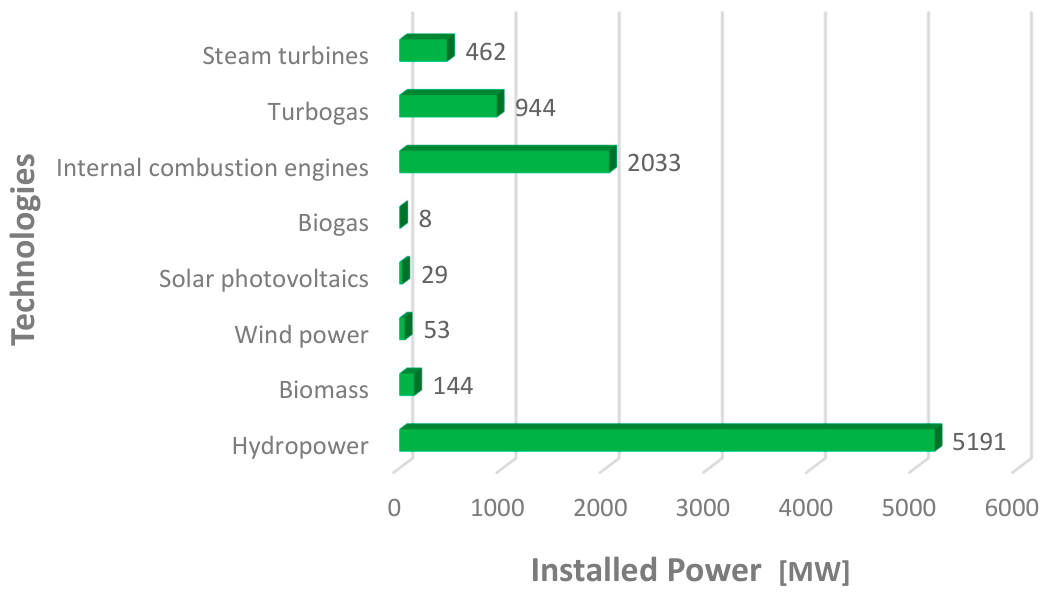
Figure 1 presents the distribution of installed electricity generation capacity in Ecuador according to the main energy technologies, showing a marked predominance of hydroelectricity with approximately 5191 MW installed [26]. This value represents the largest contribution within the analyzed energy mix, reflecting the historical role of water resources in electricity supply. Internal combustion engines stand out in second place with approximately 2033 MW, mainly associated with conventional thermal generation. Gas turbine and steam turbine technologies also have significant shares, with values close to 944 MW and 462 MW, respectively. In contrast, non-conventional renewable energies still show a small share, with biomass reaching approximately 144 MW, wind energy 53 MW, and solar photovoltaics just 29 MW. Biogas also makes a marginal contribution of approximately 8 MW. This reality shows that, although there is a significant presence of traditional renewable resources, there is still a limited penetration of emerging renewable technologies, which represents both a challenge and an opportunity for future energy transition and decarbonization strategies of the electricity system [27].
The Ecuadorian Amazon region faces significant energy challenges due to its dispersed population, limited road infrastructure, and complex geographical conditions. Historically, many Amazonian communities have relied on diesel generators to meet their energy needs, resulting in high operating costs and significant environmental impacts. In response to this problem, several researchers have proposed the integration of stand-alone photovoltaic systems and renewable microgrids as sustainable alternatives to improve electricity coverage. Apolo et al. [28] conducted a techno-economic analysis for the Amazonian community of Yuwints, concluding that centralized photovoltaic systems with local distribution networks can be a more efficient solution than individual systems, guaranteeing full coverage of demand and safe system operation. Similarly, other studies in the Ecuadorian Amazon have demonstrated that photovoltaic microgrids with energy storage significantly reduce fossil fuel consumption and improve the quality of electricity service in isolated communities [12]. These findings demonstrate the potential of solar energy to transform energy access conditions in remote areas of the country.
Over the past decade, the design of photovoltaic systems has evolved considerably thanks to the development of simulation and energy optimization tools such as PVsyst, HOMER Energy, MATLAB/Simulink, and geospatial analysis platforms [29]. These tools allow for the determination of optimal configurations considering technical, economic, and environmental variables. In Ecuador, several studies have used these platforms to design both grid-connected and off-grid photovoltaic systems. Cuenca et al. [30] developed a design methodology based on MATLAB/Simulink and MPPT algorithms to optimize electricity generation in rural photovoltaic systems. Simultaneously, studies conducted in Amazonian communities have incorporated economic optimization models to select the best combination of solar panels, storage, and backup systems. These methodologies allow for reduced investment costs, increased reliability of supply, and maximized energy production. Furthermore, the availability of satellite databases such as PVGIS has facilitated the accurate characterization of solar resources in regions where there are no permanent weather stations, contributing significantly to energy planning in rural Amazonian areas.
The integration of energy storage systems is another key topic addressed in recent scientific literature. Due to the intermittent nature of solar radiation, batteries play a fundamental role in ensuring the continuity of electricity supply in isolated communities [31]. Several studies have evaluated the performance of electrochemical storage technologies in combination with photovoltaic systems and smart microgrids [32]. In the province of Morona Santiago, solutions based on photovoltaic microgrids with batteries have been proposed to increase electricity coverage in dispersed Amazonian communities, yielding favorable results in terms of reliability and sustainability [33]. Likewise, recent research has incorporated advanced energy management strategies based on predictive control to optimize the operation of electro-thermal microgrids in the Ecuadorian Amazon [34]. These approaches minimize operating costs, reduce battery degradation, and decrease polluting emissions associated with the use of fossil fuels, thus strengthening the technical and economic viability of isolated renewable energy systems.
Another widely studied aspect is the evaluation of the energy and environmental performance of photovoltaic systems implemented in tropical regions [35]. The characteristic climatic conditions of the Amazon, such as high temperatures, high relative humidity, and frequent rainfall, directly influence the performance of solar modules [36]. Research conducted in Pastaza has analyzed the operational behavior of grid-connected photovoltaic installations, demonstrating that solar technology maintains adequate levels of efficiency and contributes significantly to the reduction of carbon dioxide emissions [37,38]. Similarly, review studies on photovoltaic systems in Ecuador indicate that, despite the high available solar potential, the widespread adoption of this technology still faces regulatory, financial, and technical barriers that limit its expansion [39]. However, advances in smart monitoring, power electronics, and energy management systems are improving the performance of solar installations and facilitating their integration into both conventional grids and off-grid systems [40].
Despite the progress made, the scientific literature reveals significant research gaps related to the comprehensive planning of photovoltaic systems for the southeastern region of the Ecuadorian Amazon [41]. Most studies have focused on specific cases of rural electrification or on analyses of individual communities, with a limited amount of research aimed at the regional assessment of solar resources, detailed characterization of energy demand, and the optimized design of systems adapted to local socioeconomic and environmental conditions [42]. In this context, the development of a photovoltaic system for the southeastern Amazon region of Ecuador represents a significant contribution to scientific knowledge, as it will allow for the identification of technologically viable, economically competitive, and environmentally sustainable configurations to accelerate the energy transition in territories historically marginalized from conventional electricity development [43].
Modern energy planning recognizes that technological diversification is one of the main mechanisms for ensuring the security and resilience of electrical systems in the face of extreme weather events and variations in the availability of energy resources [44]. In Ecuador, the high dependence on hydroelectric generation has allowed for a relatively clean energy mix in terms of carbon emissions; however, recent droughts have highlighted the vulnerability of the national electrical system to reduced flows in the main reservoirs [45]. In this context, the incorporation of photovoltaic systems in strategic regions such as the Ecuadorian Amazon can complement hydroelectric generation and reduce dependence on fossil fuels used during periods of energy deficit [46]. Several international studies have demonstrated that the combination of solar energy, energy storage, and smart grids improves the operational stability of the system, increases the reliability of supply, and significantly reduces the costs associated with backup generation [47]. Furthermore, the temporal complementarity between renewable resources presents an opportunity to optimize national energy management and advance toward deep decarbonization scenarios by 2050 [48].
From a socioeconomic perspective, the development of photovoltaic projects in the Amazon region can generate additional benefits related to local development, job creation, and the reduction in territorial inequalities [49]. Specialized literature indicates that electrification through renewable energy acts as a catalyst for improving the quality of life in rural communities by facilitating access to health services, education, telecommunications, and productive activities [50]. In the Ecuadorian Amazon, where numerous communities still face limitations in accessing modern energy services, the implementation of photovoltaic systems can contribute to strengthening sustainable economic activities, promoting local entrepreneurship, and reducing the costs associated with the transportation and supply of fossil fuels [10]. Moreover, reliable access to electricity promotes environmental conservation by reducing pressure on natural resources traditionally used to meet basic energy needs, such as firewood and other biomass fuels. Therefore, solar energy represents not only a technological solution for electricity generation but also a strategic tool for driving the region’s sustainable development [51].
Finally, global energy transition trends highlight the increasing integration of digital technologies, artificial intelligence, and advanced energy management systems in the design of renewable infrastructure [52]. These innovations allow for the optimization of photovoltaic system operation through real-time monitoring, energy resource forecasting, and intelligent electricity demand management [53]. Recent research has demonstrated that incorporating geospatial analysis tools, geographic information systems (GIS), and energy simulation platforms facilitates the identification of optimal locations for solar projects, maximizing their productivity and minimizing environmental impacts [54]. In the case of the Ecuadorian Amazon, the application of these methodologies is especially relevant due to the region’s geographic and ecological complexity [8]. Consequently, the planning and design of photovoltaic systems must go beyond simple technical sizing and incorporate comprehensive approaches that consider environmental, economic, social and technological variables, thus contributing to the construction of a more sustainable, resilient energy system aligned with national energy transition and sustainable development objectives [55].
Table 1 below presents a summary of the most relevant literature reviewed in comparison with the current research.

3. Methodology

The scientific methodology adopted in this study considers the possibility of generating diversified energy in the Ecuadorian Amazon, leveraging the energy potential of wind, hydroelectric, and photovoltaic sources. Within this framework, the methodology recognizes the potential of photovoltaic energy in the Morona Santiago Province, specifically as a case study. To effectively conduct this research, the Homer Pro design tool was used, which allows for determining the impact of photovoltaic systems in the study area. The objective is to guarantee an uninterrupted electricity supply in the Morona Santiago Province, essential for the population and their daily activities. Social and economic aspects are also analyzed, with corresponding results for the study area.
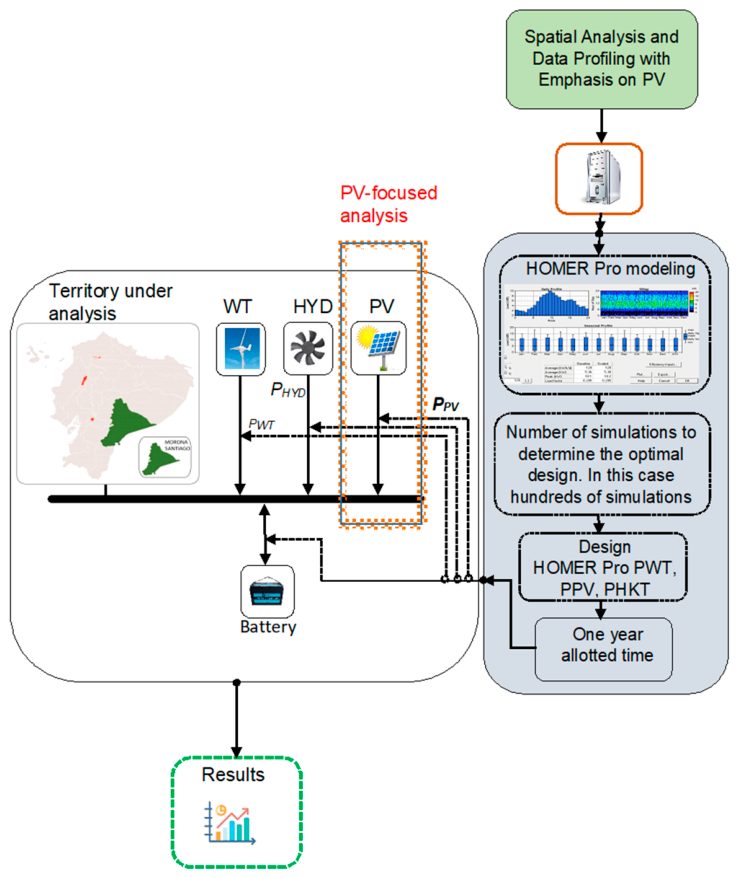
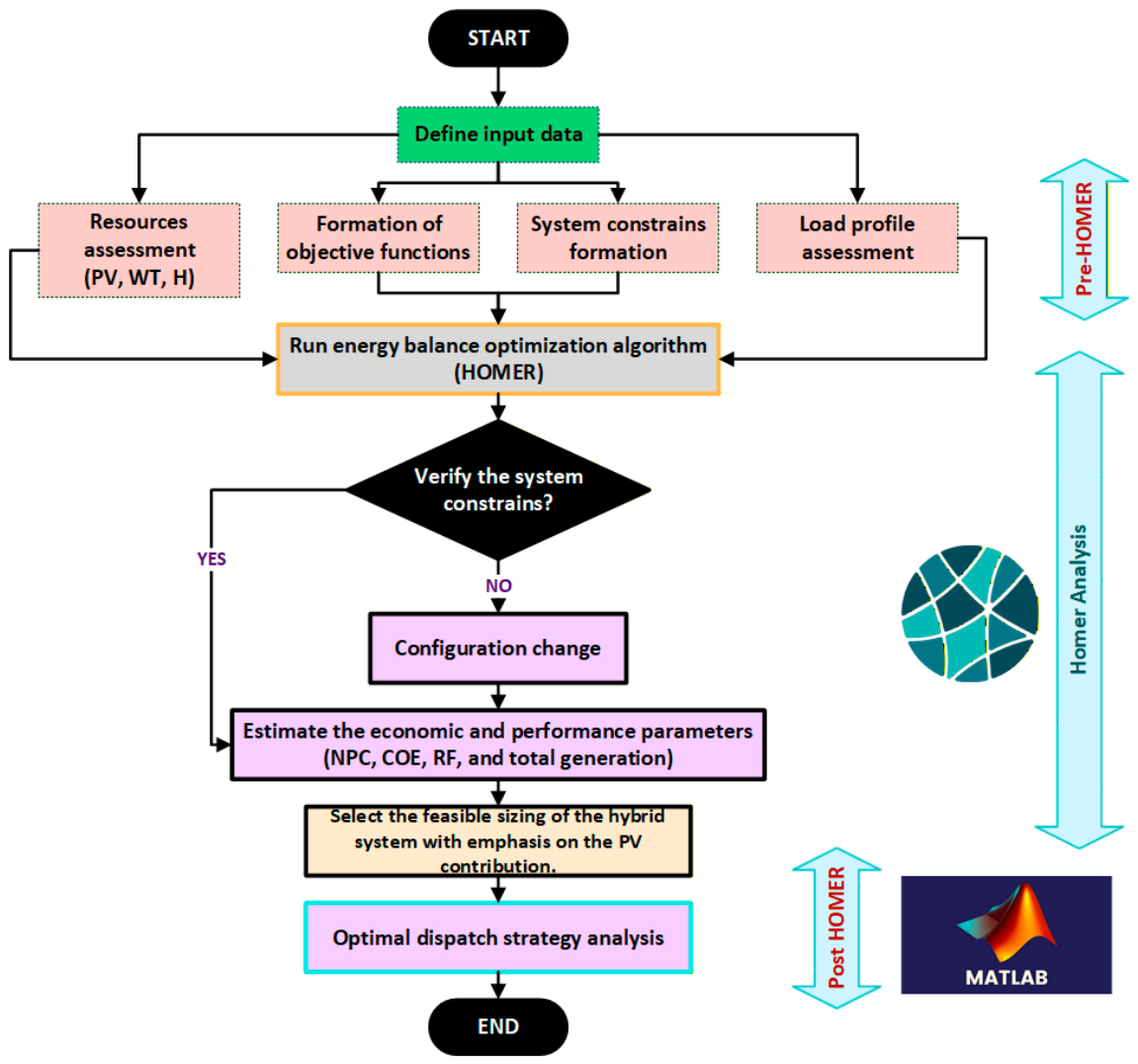
For the design and evaluation of the system, HOMER Pro software version 3.16.2 was used. This software is widely recognized and recommended by researchers and energy planning specialists due to its robustness, accuracy, and versatility in the analysis of hybrid systems [56,57]. It features an up-to-date database of technologies and equipment available on the market, facilitating the simulation of multiple operating scenarios under different technical, economic, and environmental conditions. Subsequently, MATLAB was used for the processing, organization, and visualization of the results, allowing for a more structured and customized graphical representation of the information. Furthermore, this platform offers the possibility of performing calibration, optimization, and complementary analyses according to the researcher’s specific objectives and the constraints identified during the study. The integration of both tools provides a suitable environment for developing more detailed techno-economic evaluations, as well as for determining optimal configurations that maximize system performance while simultaneously considering technical, economic, and sustainability criteria. Finally, the methodological diagram presented in Figure 2 summarizes the main stages and procedures followed in the development of this research.

4. Design of a Photovoltaic Solar System to Operate in Conjunction with Wind and Hydroelectric Sources

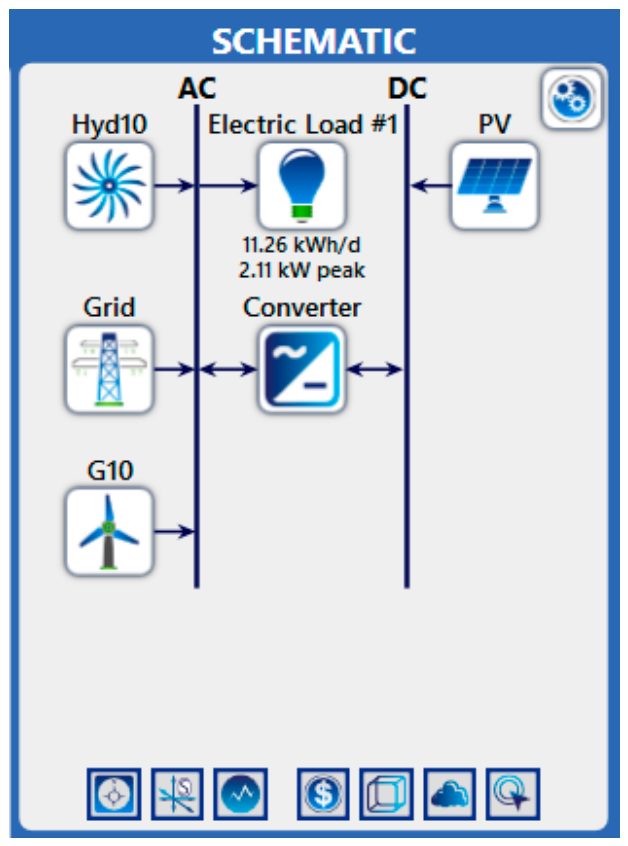
This study focuses on analyzing the impact of integrating photovoltaic solar systems to operate in conjunction with hydroelectric and wind power sources. The purpose is to make the best use of the photovoltaic source according to the specific conditions of the study site, Morona Santiago, in the Ecuadorian Amazon. Figure 3 below presents a hybrid system in which wind and hydroelectric power operate on alternating current (AC), while the photovoltaic system operates on direct current (DC). A power inverter converts the DC energy to AC to supply power to the load under a single operating regime. Wind and hydroelectric systems prefer AC because they use rotating mechanical generators that naturally induce a sinusoidal and variable electrical flow. In contrast, photovoltaic panels generate direct current DC due to the photoelectric effect, where photons release electrons that flow in a single, constant direction through the semiconductor.

4.1. Demand Profile

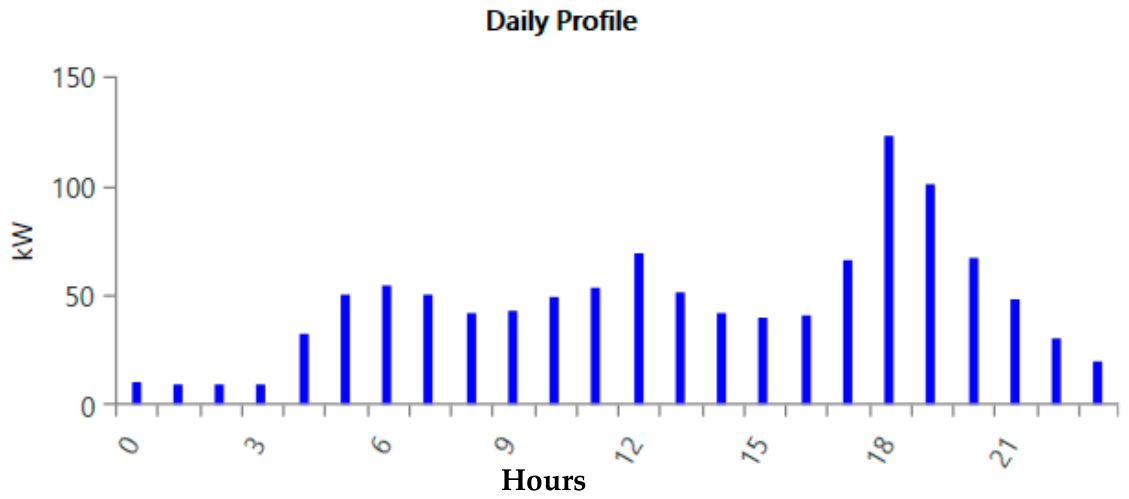
Figure 4 presents the daily electricity demand profile of a network located in the province of Morona Santiago, showing typical behavior for systems with predominantly residential consumption and small-scale productive activities. During the early morning hours (00:00–04:00), demand remains at minimum levels close to 10 kW, due to reduced user activity. From 05:00 onwards, a progressive increase is observed, associated with the start of daily activities, reaching values close to 50 kW. During the daytime, demand fluctuates between 40 and 70 kW, with a slight increase around midday, reflecting the simultaneous use of domestic, commercial, and institutional equipment. Peak consumption is recorded between 18:00 and 20:00, reaching approximately 120 kW, as a result of the activation of lighting systems and appliances in homes. Subsequently, demand gradually decreases until the end of the day with values below 30 kW. This profile shows a marked difference between base load and peak load, a fundamental aspect for the sizing of hybrid energy generation and storage systems that guarantee the reliability of the electricity supply.
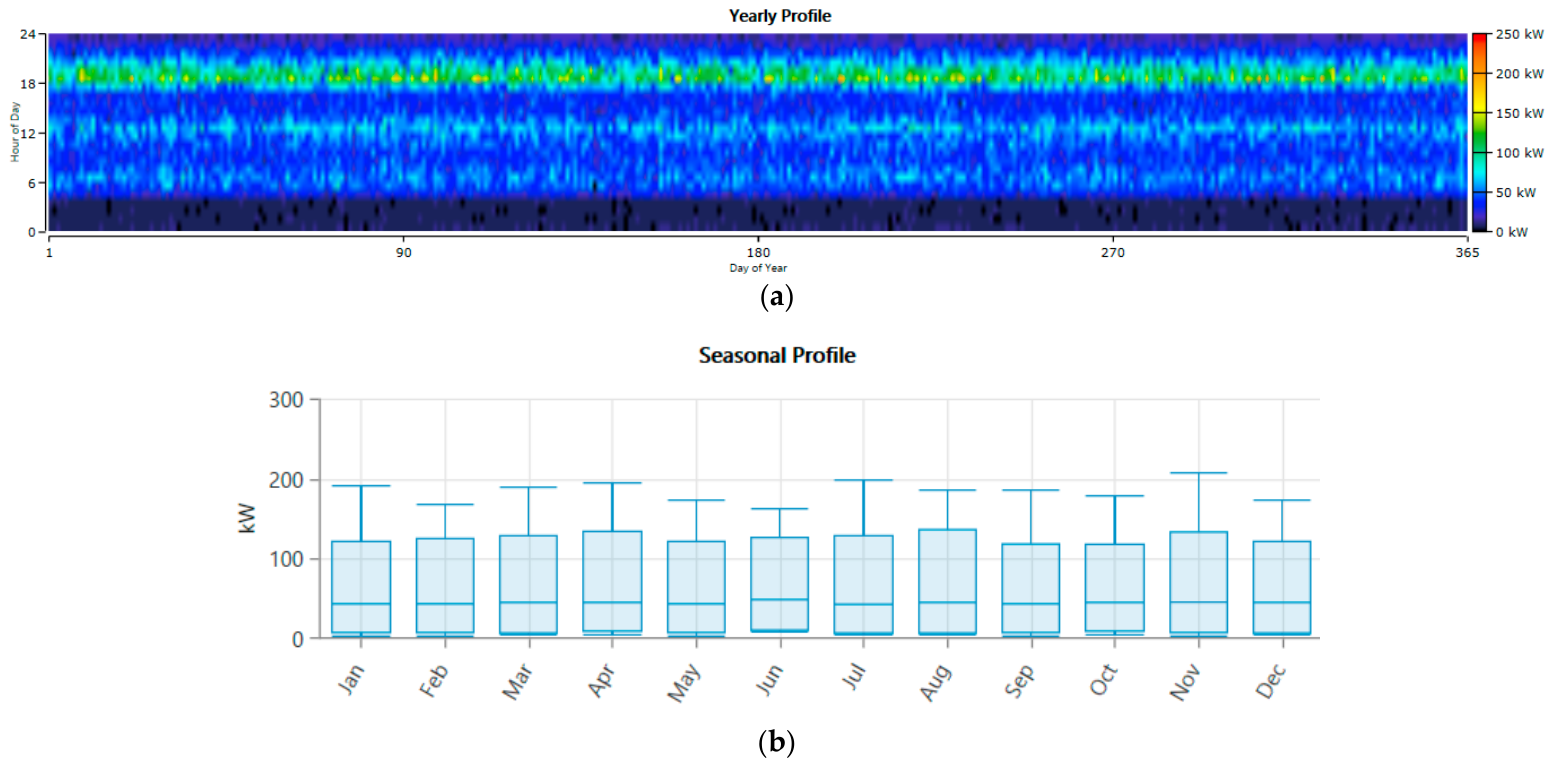
Figure 5a shows the annual electricity demand profile using a heat map, revealing that peak consumption consistently occurs between 6:00 PM and 8:00 PM throughout the year, reaching values close to 250 kW. During the day, demand remains relatively stable at intermediate levels, while the lowest consumption is recorded in the early morning. The homogeneous distribution of load patterns indicates limited seasonal variation and a high degree of consistency in user behavior.
Figure 5b presents the seasonal variability of electricity demand using box plots for each month of the year. It shows that consumption levels remain relatively uniform, with similar medians and maximums ranging between 170 and 210 kW, indicating a low seasonal influence on load. Furthermore, the wide interquartile range reflects moderate variability in demand throughout the year, suggesting that consumption patterns remain stable and predictable regardless of the time of year analyzed.

4.2. Hybrid System Modeling

The proposed hybrid system comprises four generation sources, three of which are renewable and one a conventional backup source. The renewable sources include a photovoltaic (PV) system, a wind turbine (WT), and a hydroelectric turbine (H), integrated in a complementary manner to utilize available energy resources. Additionally, the system is connected to the electrical grid, ensuring continuity of supply, optimizing energy management, and improving the system’s operational reliability under varying demand and renewable resource availability conditions.

4.2.1. Photovoltaic Solar Panels

The residential system analyzed is located in the province of Morona Santiago, in the Ecuadorian Amazon, a region with favorable conditions for harnessing renewable energy resources. Within the proposed hybrid system configuration, photovoltaic generation is one of the main sources of electricity supply, due to the availability of suitable spaces for installing solar panels on residential rooftops and adjacent areas of the property. The incorporation of this technology aims to reduce dependence on conventional energy sources, improve the energy security of the home, and contribute to mitigating greenhouse gas emissions, in accordance with national and international objectives for energy transition and sustainable development.
The selection of photovoltaic solar energy as a fundamental component of the hybrid system is based on the availability of adequate levels of solar irradiance for much of the year in the Amazon region. Although the climatic conditions include periods of cloudiness and precipitation characteristic of the area, the available solar resources allow for significant energy production, especially during the middle of the day. Additionally, photovoltaic technology offers advantages related to its ease of installation, low maintenance requirements, high operational reliability, and future expansion capacity, characteristics that make it a technically viable and economically attractive alternative for off-grid or grid-connected residential applications.
For this study, high-efficiency monocrystalline photovoltaic modules were considered, widely used in modern residential applications due to their good energy performance and long lifespan [58]. These modules can be easily integrated with inverters, charge controllers, and energy storage systems, allowing for flexible operation within the proposed hybrid configuration. Furthermore, the ventilation and orientation conditions available in the home favor the proper functioning of the solar panels, maximizing their energy performance. The power generated by the photovoltaic system depends primarily on the incident solar irradiance, the operating temperature of the modules, and the technical characteristics of the installed equipment. The mathematical expression used to estimate the power output of the photovoltaic system is presented in Equation (1):
P p v = f p v Y p v I T I S   [ W ]
In Equation (2), Y P V represents the nominal installed capacity of the photovoltaic array, expressed in kW, while f P V corresponds to the overall derating factor, which accounts for losses associated with the actual operation of the system. These losses include voltage drops in conductors, losses in connections and terminals, accumulation of dust or dirt on the surface of the modules, electrical mismatches between panels, aging of components, and other factors that affect the performance of the photovoltaic system.
Furthermore, I S represents the reference solar irradiance under Standard Test Conditions (STC), which has a value of 1000 W/m2, considered the optimal radiation condition for evaluating the performance of photovoltaic modules. Finally, I T corresponds to the total solar irradiance incident on the surface of the photovoltaic panel, expressed in kWh/m2 or W/m2 depending on the analysis period, and constitutes the solar energy effectively available for conversion into electrical energy.
T C = G S   N O C T 25 1000 + T a m b   [ ° C ]
In the equation, G S represents the global solar irradiance incident on the surface of the photovoltaic modules, a parameter that determines the amount of solar energy available for conversion into electricity. T a m b corresponds to the ambient temperature of the environment where the photovoltaic system operates, a variable that directly influences the performance and efficiency of the modules (Table 2).
Likewise, the parameter NOCT (Nominal Operating Cell Temperature) represents the nominal operating temperature of the photovoltaic cell under specific reference conditions, generally defined for a solar irradiance of 1000 W/m2, an ambient temperature of 21 °C, and standardized ventilation conditions. This parameter is widely used to estimate the actual operating temperature of the cells and to evaluate the effect of environmental conditions on the energy production of the photovoltaic system.

4.2.2. Hydrokinetic Turbine

Hydropower generation is a highly viable alternative to complement the proposed hybrid system in the province of Morona Santiago, due to the abundance of water resources characteristic of the Ecuadorian Amazon. The presence of rivers, streams, and creeks with relatively constant flows throughout the year allows for harnessing the local hydropower potential through small-scale systems with low environmental impact. This study considers a hydraulic turbine with a nominal power of 75 kW, capable of providing a stable and predictable source of generation that contributes to meeting residential electricity demand and reducing dependence on other energy sources. The main advantage of this technology lies in its ability to operate continuously 24 h a day, provided there are suitable hydraulic conditions, thus complementing the inherent variability of solar and wind power generation. Additionally, mini-hydroelectric plants offer high levels of efficiency, low operating and maintenance costs, and a lifespan exceeding 25 years, making them a technically reliable and economically attractive solution for communities and homes located in rural areas of the Ecuadorian Amazon. The energy generated by the turbine depends primarily on the available flow rate, the net head, and the overall efficiency of the system—parameters that determine the usable energy potential at the study site.
The electrical power generated by the hydrokinetic turbine is determined using Equation (3), which relates the physical characteristics of the water resource to the efficiency of the energy conversion system. In this expression, ( ρ W ) (kg/m3) represents the density of water, a parameter that directly influences the amount of kinetic energy available in the flow. The variable (v) (m/s) corresponds to the water velocity, considered one of the most important factors in energy production, since the available power is proportional to the cube of this velocity. (A) (m2) represents the effective swept area of the hydraulic turbine, that is, the surface through which the water flow interacts with the rotor. The term ( C p ,   h ) corresponds to the power coefficient or combined conversion efficiency of the turbine, which quantifies the fraction of the water’s kinetic energy that can be transformed into useful mechanical energy. Finally, ( ɳ H ) represents the overall efficiency of the generator associated with the hydraulic turbine, considering electromechanical losses present during the electricity generation process. Together, these parameters allow for an accurate estimation of the usable electrical power from the water resources available at the study site:
P H = 1 2 ρ W A v 3 C p ,   h ɳ H K T t   [ W ]
In order to characterize the water resource available for hydrokinetic generation, flow velocity measurements were taken in an open channel approximately 75 cm wide. Measurements were taken in the central section of the canal, where a more reliable representation of the flow’s hydraulic behavior is obtained. The results showed a maximum velocity of 3.8 m/s and an average velocity of 3.3 m/s, values considered suitable for energy generation using small-scale hydrokinetic turbines. Despite the canal’s small size, the hydraulic conditions allow for sufficient energy potential to supplement the generation of the proposed hybrid system, especially for residential applications located in rural areas of the Ecuadorian Amazon.
Considering these conditions, a commercially available hydrokinetic turbine compatible with the technical specifications available in the HOMER Pro equipment library was selected, facilitating its modeling, simulation, and economic analysis within the hybrid system. This technology was chosen not only for its market availability and operational reliability but also for its ease of installation, as it does not require the construction of large civil works or significant modifications to the natural watercourse. Furthermore, the canal’s configuration allows for the future implementation of a cascaded turbine array, increasing generation capacity without significantly impacting the canal’s hydraulic regime. This alternative represents a technically viable, environmentally sustainable, and economically attractive solution for strengthening the energy supply in communities and homes in the Amazon region. The main technical specifications of the selected hydrokinetic turbine are presented in Table 3.
The total energy produced during the year is determined by Equation (4):
E = t = 1 t = 8760 h P t t   [ J ]

4.2.3. Wind Turbine

Wind energy constitutes a complementary renewable source within the proposed hybrid system for the province of Morona Santiago. Although the Amazon region experiences moderate wind speeds compared to other areas of the country, there are specific times of year and locations with favorable conditions for harnessing this resource. Incorporating a wind turbine allows for diversification of the generation mix, reduces dependence on other energy sources, and improves the reliability of the electricity supply. Furthermore, its operation in conjunction with photovoltaic and hydroelectric systems helps to compensate for the inherent variability of each renewable resource, increasing the stability and sustainability of the residential energy system.
The power PWT generated by the wind turbine can be evaluated using Equation (5).
P W T ( t ) = 1 2 C p ( λ ,   β ) ρ a A v w 3   [ W ]
R is the turbine radius. The power production depends mainly on the inlet wind speed (vW). The relation λ defined as λ = m/v, ωm is the velocity angle of the turbine shaft. Cp is Betz coefficient is in function angle β and λ. ρ a is air density.
The power output P W T a b of the wind turbine is a function of wind speed as shown in Equation (6), detailed by reference [59]:
P W T a v t = 0   i f   v w <   v i   1 2 C p λ , β ρ a A v 3 t   i f   V i   v w     v r   P w r   i f   v r < v w <   v c   0   i f   v w >   v c
The minimum speed is vi, and the cutting speed is vc. Turbine operation with a speed higher than the rated wind speed vr.
If the wind speed exceeds 20 m/s, the wind turbine stops for safety.
The parameters of the wind turbine are shown in Table 4.
Energy generation and consumption are calculated as a function of time:
  • P P V   T + P H T + P W T T > P D E M A N D T The total power generation of the hybrid system exceeds the load demand.
  • P P V T + P H T + P W T T < P D E M A N D T In this case, the public electricity grid supplies the demand if the renewable energy system fails to fully meet it.
Where
n i n v : Efficiency of the inverter.
P D E M A N D T : Energy received by the demand in a specific hour.
τ : Hourly self-release rate.
P W T T : Power produced by the wind turbine.
P P V T : Power produced by the PV panel.
P H T : Power produced by H.

4.2.4. Inverter

The maximum DC to AC conversion capacity of the power inverter ( P i n v t ) depends on the inverter efficiency [60]. It is expressed in Equation (7):
P o t = P i ( t ) η i n v
The input power to the P i t inverter will be given by the renewable energy system. In this study, the efficiency of the inverter is 95%.

4.3. Techno-Economic Analysis

With the aim of maximizing the energy use of available resources in the Ecuadorian Amazon, a hydrokinetic turbine and a wind turbine are integrated into a pre-designed photovoltaic system, forming a hybrid system capable of providing a more reliable, efficient, and sustainable electricity supply for a residential home located in the province of Morona Santiago. The complementarity between these technologies allows for compensating for the inherent variability of each renewable source, increasing energy availability and reducing dependence on conventional sources or the electrical grid. In this context, HOMER Pro evaluates multiple operating configurations to identify the equipment combination that offers the best balance between technical performance, system reliability, and economic viability.
From an economic standpoint, one of the main objectives of optimization is to minimize the Net Present Cost (NPC) of the hybrid system. This indicator integrates all costs associated with the project’s life cycle, including the initial investment, equipment replacement costs, operation and maintenance activities, fuel consumption (where applicable), and the residual value of the components at the end of the analysis period. Minimizing the Net Present Cost (NPC) allows for the selection of the technological configuration that guarantees the lowest total cost over the system’s entire lifespan, while simultaneously maintaining the reliability and power quality levels required by the residential load.
As a complement to the economic analysis, the Total Annual Cost (TAC) is determined. This indicator expresses the equivalent annual cost of the system, considering all expenses distributed throughout its operating period. This parameter facilitates the comparison between different design alternatives and constitutes a fundamental basis for calculating other economic performance indicators, such as the Levelized Cost of Energy (LCOE). The TAC is obtained from the relationship between the Net Present Cost and the capital recovery factor, as expressed in Equation (8).
T A C = C a c a p + i = 1 n C 0 & M , i + C f + i = 1 n C R , i
To determine the total costs of the hybrid system, it is evaluated using the NPC parameter. It is calculated by Equation (9).
M N P C = M a n n , T o t C R F i , R p r o j
C R F i , R p r o j corresponds to the capital recovery factor with an interest rate 1%, M a n n , T o t is the total annual cost in $/year, M N P C is the net current cost, and R t h is the lifetime of the project in years, see Equation (10).
C R F I , N = I 1 + I N 1 + I N 1
N = Number of periods (years).
I = Interest rate.
Contemplating a scheme of minimized costs M i n M t P p v t , P p v t , P w t t , P h t each contribution seen from the point of view of its own restrictions is evaluated through Equation (11):
M i n M t P p v t , P p v t , P w t , P h t = M i n M p v t , M p v A t , M w t t , M h t
where M t is the cost of the hybrid system.
M p v t , M p v t , M w t , M h t   Parameters that refer to the individual costs of each technology and its complements for the joint operation of the hybrid system.
The Cost of Energy (COE) is an essential parameter; the mathematical relationship is presented in Equation (12):
C O E = M a n n , T o t M s t o r a g e E t h e r m a l E p r i m A C + E p r i m e D C + E d e f + E g r i d s a l e s

5. Modeling and Simulation

The hybrid system modeling and simulation were developed using HOMER Pro software, one of the most widely used tools for the design, optimization, and techno-economic analysis of hybrid energy systems. The proposed configuration for a planned residential system located in the province of Morona Santiago integrates photovoltaic, hydroelectric, and wind technologies, with the goal of ensuring a reliable and sustainable electricity supply under the energy conditions of the Ecuadorian Amazon. Within this configuration, the photovoltaic system is the main generation component and of particular interest in this study due to the availability of solar resources for much of the year and the ease of installing modules in strategic locations to form solar farms. HOMER Pro allows for modeling the energy production of solar panels, considering variables such as global irradiance, ambient temperature, the reduction factor, and the technical characteristics of the selected equipment. Furthermore, the tool evaluates the hourly behavior of photovoltaic generation and its interaction with the other renewable sources, allowing for the determination of the energy contribution of each technology within the hybrid system. Through iterative simulation and optimization processes, the most suitable configurations are identified from a technical and economic standpoint, considering indicators such as net present cost, levelized cost of energy, and renewable energy fraction. In this way, the analysis performed in HOMER Pro allows for the evaluation of the system’s overall performance and the establishment of an optimal energy solution for the specific conditions of the residential sector in Morona Santiago. For more details, see Figure 6.

5.1. Input Data

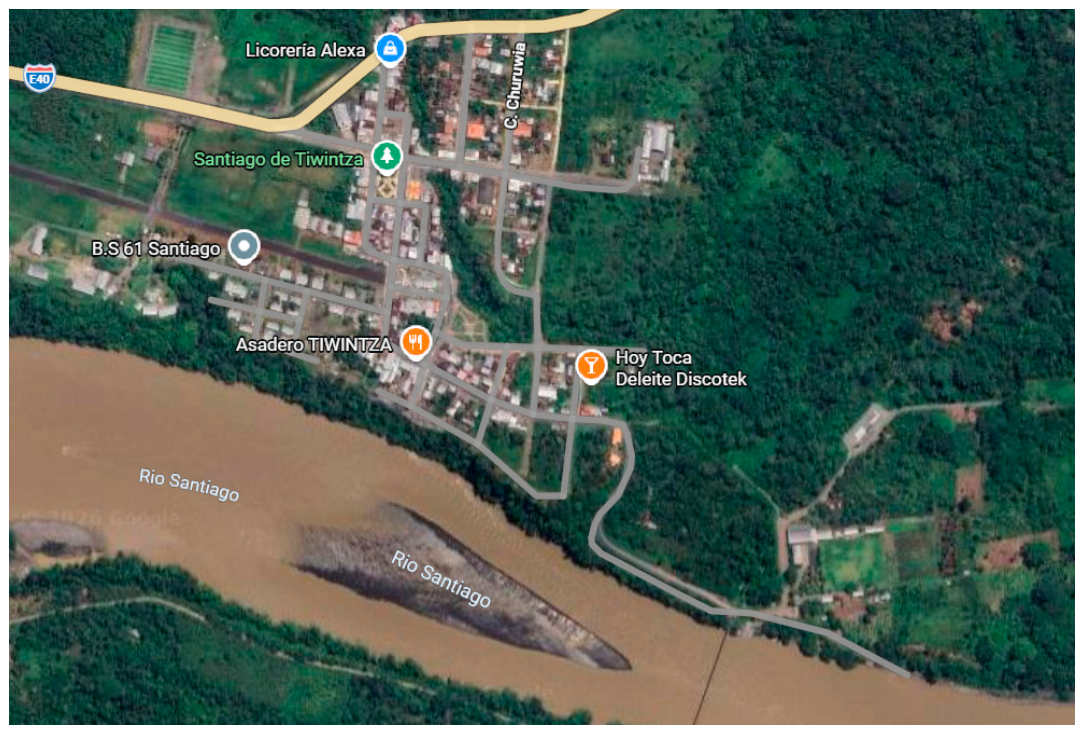
This study focuses on the Ecuadorian Amazon, specifically on Twintza. It is a canton located in the southeast of the province of Morona Santiago, with its capital city being Santiago de Tiwintza. Officially established on 23 October 2002, it borders several other Amazonian cantons and the Republic of Peru [61]. Its territory lies between the valleys of the Santiago and Morona rivers, surrounded by the lush biodiversity characteristic of the Ecuadorian Amazon. The canton’s population exceeds 9200 inhabitants according to the 2022 census, with a significant presence of the Shuar indigenous people, who preserve their traditions, language, and ancestral knowledge [62]. Further details can be seen in Figure 7.
Twintza has a warm, humid tropical climate, with an average temperature of 25.5 °C and abundant rainfall throughout the year. Its economy is based primarily on agriculture, livestock farming, local commerce, and activities related to the sustainable use of natural resources [63]. Among its main attractions are the waterfalls, lagoons, rainforests, and Shuar communities that promote cultural and ecological tourism. Furthermore, the canton is recognized for its historical and geographical importance on Ecuador’s southeastern border, making it a symbol of identity and natural wealth for the Ecuadorian Amazon.
Input data is essential to understanding the site’s energy conditions and potential, allowing for optimal utilization. Through a conversion process, sufficient energy is generated to supply the load—in this case, a residential system in the Ecuadorian Amazon. This input data is available in profiles related to the wind, hydroelectric, and solar energy systems.

5.1.1. River Speed

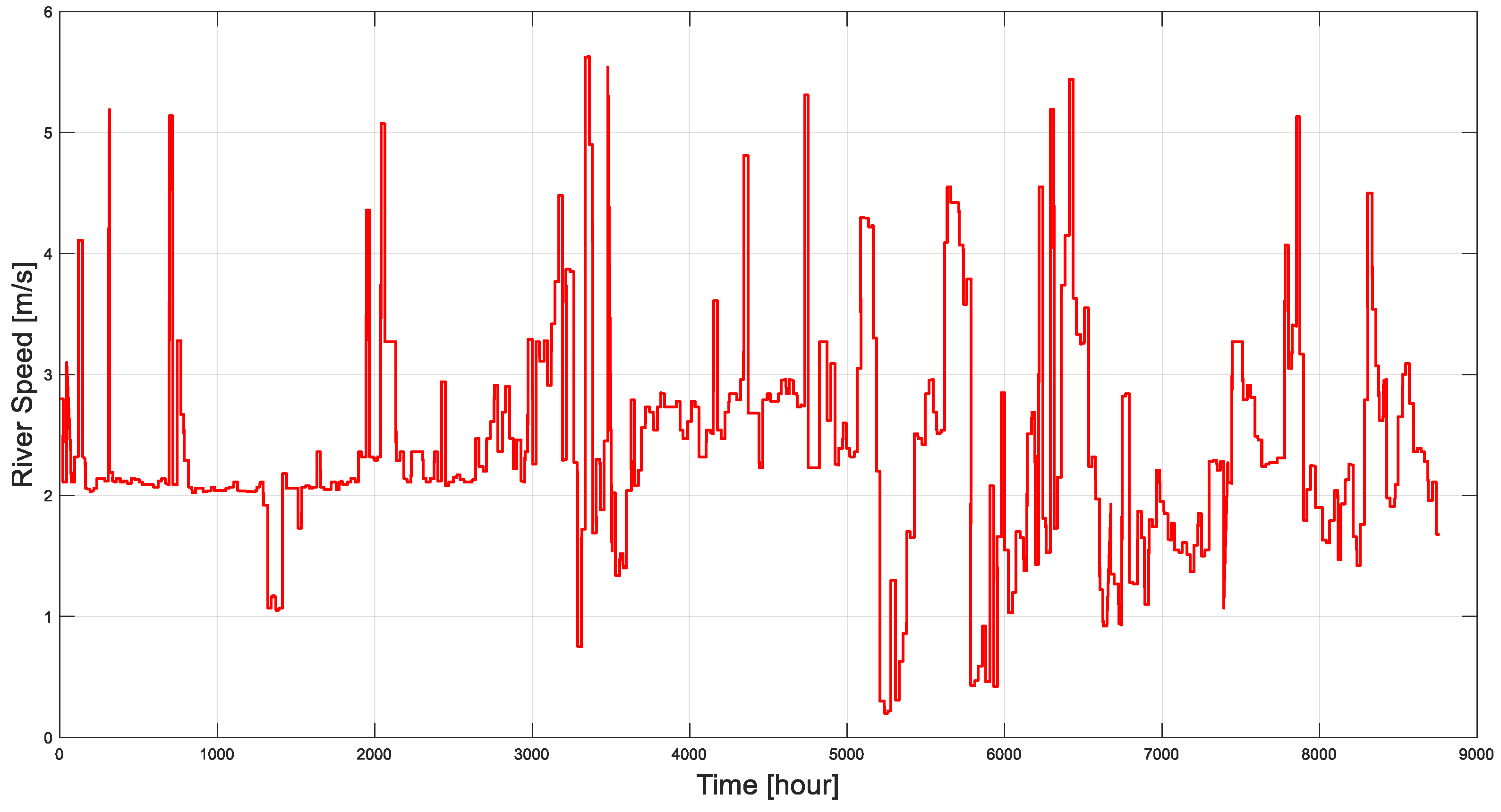
The Santiago River, located in the Tiwintza canton, is one of the most important water resources in the southern Ecuadorian Amazon and offers favorable conditions for small- and medium-scale hydroelectric power generation. Its basin receives annual rainfall exceeding 3000 mm, which helps maintain a relatively constant flow regime for much of the year. In several sections, the river’s width ranges from 80 to 200 m, with varying depths and average velocities estimated between 2.5 and 5.5 m/s, depending on the season and the channel’s morphology (See Figure 8). Furthermore, the average flow rate can exceed several hundred cubic meters per second in the main reaches, providing a significant availability of hydroelectric power. From the Santiago River, there are entrances to its banks where small open channels are formed; these, in turn, can be suitable and useful for installing 4 HKT turbines. These characteristics allow for the development of run-of-river hydroelectric plants, minimizing the need for large reservoirs and reducing environmental impacts. The natural elevation changes present in some tributaries and associated streams increase the potential for micro-hydroelectric plants intended to supply energy to rural communities and nearby towns. From a technical standpoint, the usable power depends on the combination of flow rate and head, parameters that can generate anywhere from a few kilowatts to several megawatts of renewable energy. However, any project requires detailed studies of flow measurement, hydrology, sedimentation, and ecological flow to guarantee the sustainability of the resource and the conservation of the Amazonian ecosystems that characterize the region.

5.1.2. Wind Speed

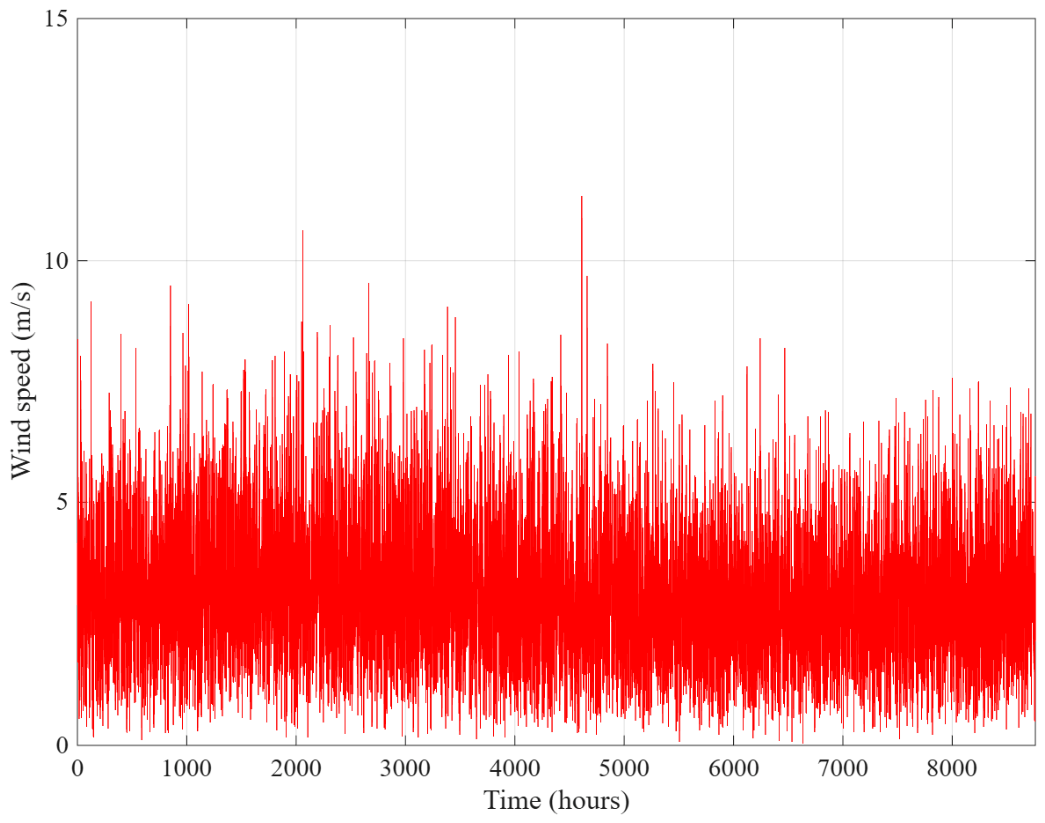
In the Tiwintza canton, wind conditions are characterized by moderate speeds typical of the Amazon region, where dense vegetation and complex topography significantly influence atmospheric circulation. Available meteorological records for similar areas of the Ecuadorian Amazon indicate average annual wind speeds ranging from 1.5 to 4.0 m/s at a height of 10 m, with increases that can reach between 4 and 6 m/s at greater measurement heights. From a technical standpoint, these values are considered low to moderate for large-scale conventional wind projects, but they may be viable for distributed generation systems and small wind turbines designed to operate in low-speed conditions. Air density, terrain roughness, and the presence of natural obstacles are factors that should be evaluated through anemometric surveys lasting at least twelve months. The energy potential depends on the cubic relationship between wind speed and power generated, so small variations in speed produce significant changes in electricity production. For rural applications, wind power systems between 1 and 20 kW could complement other renewable sources such as solar and hydroelectric energy. Consequently, wind energy development in Tiwintza is primarily focused on small-scale hybrid solutions aimed at providing sustainable energy to isolated communities and local production centers. The design of the wind system considered 10 wind turbines that will be strategically located outside the central urban area. Further details are presented in Figure 9.

5.1.3. Solar Radiation

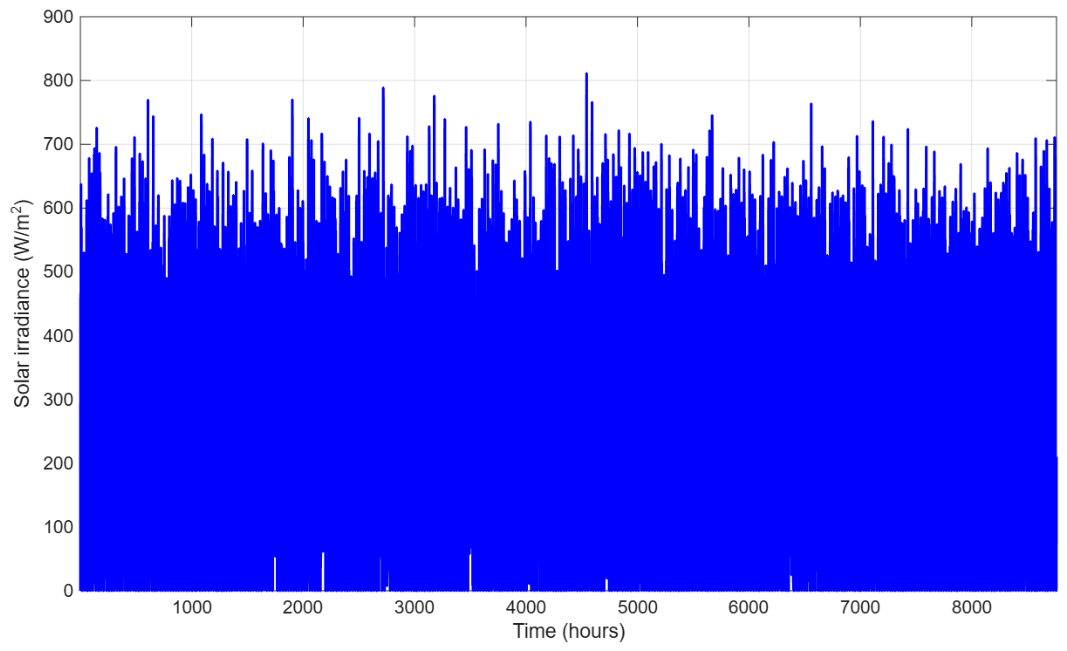
Figure 10 presents the annual hourly profile of solar irradiance for the province of Morona Santiago, showing the variation in available solar energy over the 8760 h of the year. A daily cyclical pattern is observed, with irradiance being zero at night and reaching maximum values between 800 and 1000 W/m2 around midday. The fluctuations throughout the year reflect the effects of cloud cover and atmospheric conditions characteristic of the Amazon region. A slight seasonal variation is also evident, with periods of greater solar availability in certain months of the year. The irradiance peaks indicate clear sky conditions, while the sudden decreases correspond to the passage of clouds or local weather events. Overall, the graph demonstrates a solar resource that can be used for photovoltaic systems, although with variability typical of the humid tropical climate of Morona Santiago.

6. Results and Analysis

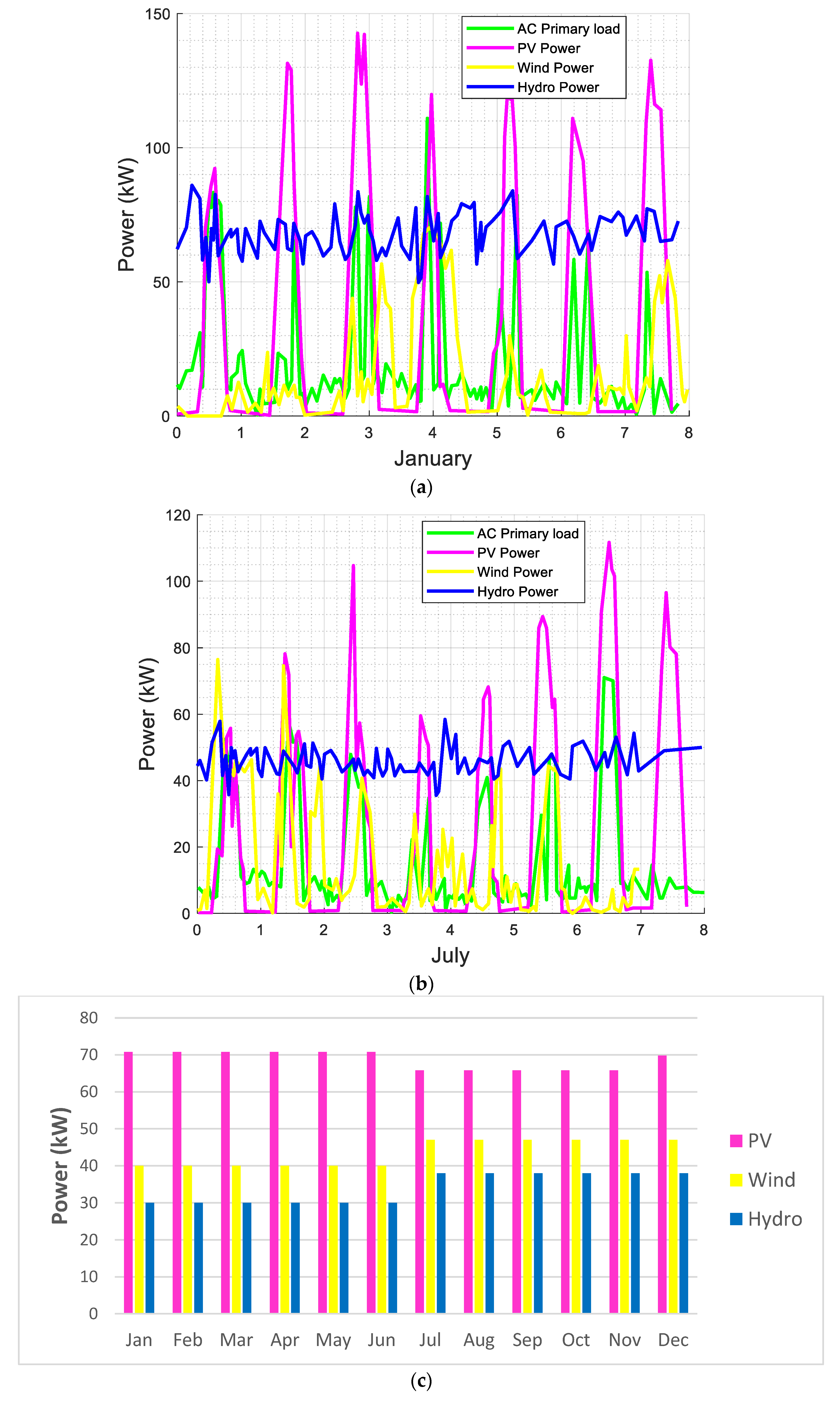
Figure 11a, corresponding to the first week of January, shows the operational behavior of a hybrid generation system composed of photovoltaic solar energy, wind energy, and hydropower to supply the electricity demand in the province of Morona Santiago. It can be observed that hydroelectric power (blue line) maintains a relatively constant production, fluctuating approximately between 60 and 85 kW, constituting the baseload source of the system due to its high stability and availability. On the other hand, photovoltaic generation (magenta line) makes significant contributions according to the structured design, reaching values exceeding 140 kW during peak solar irradiance hours, demonstrating the important contribution of solar resources to the energy supply. Wind energy (yellow line) shows greater variability and a complementary role, with power outputs generally remaining below 60 kW. The electricity demand (green line) experiences occasional increases that are met through the combined action of the different renewable technologies. These results demonstrate a suitable complementarity between the generation sources, where hydroelectricity guarantees system stability, while solar and wind energy contribute to meeting temporary increases in demand and reducing dependence on conventional resources.
Figure 11b, corresponding to the first week of July, reflects a similar pattern, although with some differences associated with seasonal weather conditions. During this period, hydroelectric generation maintains a stable production between 45 and 55 kW, again providing the system’s energy base. Photovoltaic generation continues to be the source with the highest levels of instantaneous power, reaching values exceeding 100 kW at certain times, which confirms the high solar potential in the Morona Santiago Amazon region, even during different times of the year. Wind energy shows a variable contribution, with some significant generation events that complement solar production and help balance demand. Furthermore, it is observed that peak electricity loads are satisfactorily covered by the combination of the three renewable sources, avoiding energy deficits and improving the reliability of the supply. From a technical and economic perspective, these graphs demonstrate that the integration of diversified renewable resources allows us to take advantage of the strengths of each technology, increase the resilience of the system to climate variations, and guarantee a sustainable electricity supply for the communities of Morona Santiago, also contributing to the reduction in emissions and the strengthening of the energy transition in the Ecuadorian Amazon.
Figure 11c presents the average monthly performance of the three renewable energy sources that make up the proposed hybrid generation system for Morona Santiago: solar photovoltaic, wind, and hydroelectric power. Photovoltaic technology is the primary source of generation throughout the year, with an average output of approximately 70 kW between January and June, a slight decrease to around 65 kW between July and November, and a recovery in December. This performance demonstrates the high availability of solar resources in the Ecuadorian Amazon region, allowing for relatively stable production throughout the year. Wind power generation averages around 40 kW during the first half of the year and increases to approximately 47 kW during the second half, suggesting greater availability of wind resources during certain periods. Hydroelectric generation maintains a consistent contribution, averaging around 30 kW in the first six months and around 38 kW for the remainder of the year, providing stability and backup to the energy system.
From an energy planning perspective, the graph demonstrates the importance of complementarity among different renewable technologies to guarantee a reliable and sustainable electricity supply. Although solar energy contributes the largest share of annual generation, wind and hydroelectric power play a fundamental role in compensating for seasonal variations in solar radiation and providing greater operational stability to the system. The slight reduction in photovoltaic production observed between July and November is offset by the simultaneous increase in wind and hydroelectric generation, allowing for an adequate energy balance throughout the year. This behavior confirms that technological diversification is an effective strategy for reducing the system’s vulnerability to changing climatic conditions and improving regional energy security. Consequently, the results show that the combination of solar, wind, and hydroelectric resources efficiently harnesses the renewable potential of Morona Santiago, contributing to the reduction of carbon emissions, decreased dependence on fossil fuels, and the strengthening of the sustainable energy transition in the Ecuadorian Amazon.
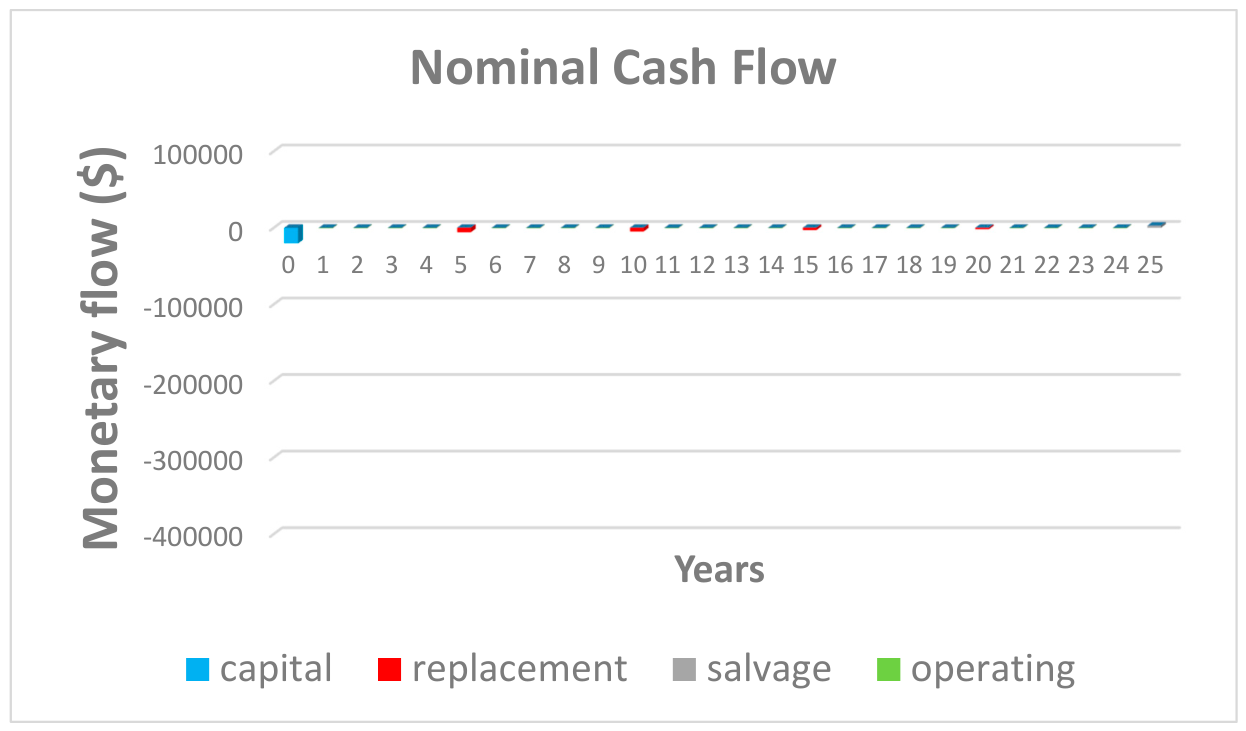
The nominal cash flow graph for the proposed generation system in the province of Morona Santiago shows the evolution of costs and revenues associated with the project over a 25-year planning horizon, see Figure 12. The largest outlay occurs in the initial year, represented by the capital investment, with an approximate value of $400,000, corresponding to the acquisition and installation of the main components of the generation system. Subsequently, throughout the project’s lifespan, annual operating costs remain relatively low and constant, highlighting one of the main advantages of renewable energy systems, characterized by reduced operating and maintenance expenses. Replacement costs are also identified in specific years, primarily associated with replacing equipment with a lifespan shorter than the total project duration, such as charge controllers, inverters, and other critical components. These periodic costs are significantly lower compared to the initial investment and ensure the system’s operational continuity. Similarly, at the end of the analysis period, a positive salvage value is observed, reflecting the residual value of the still-usable assets. In economic terms, the distribution of cash flows demonstrates that the majority of the financial effort is concentrated at the beginning of the project, while subsequent costs are moderate and predictable. This characteristic favors the financial sustainability of the system, reduces dependence on fossil fuels, and allows for long-term economic benefits. For a province like Morona Santiago, where there are significant challenges regarding energy access and high conventional generation costs, this financial behavior confirms the viability of implementing renewable technologies as a strategic alternative to strengthen energy security, reduce future costs, and promote sustainable development in the Ecuadorian Amazon region.
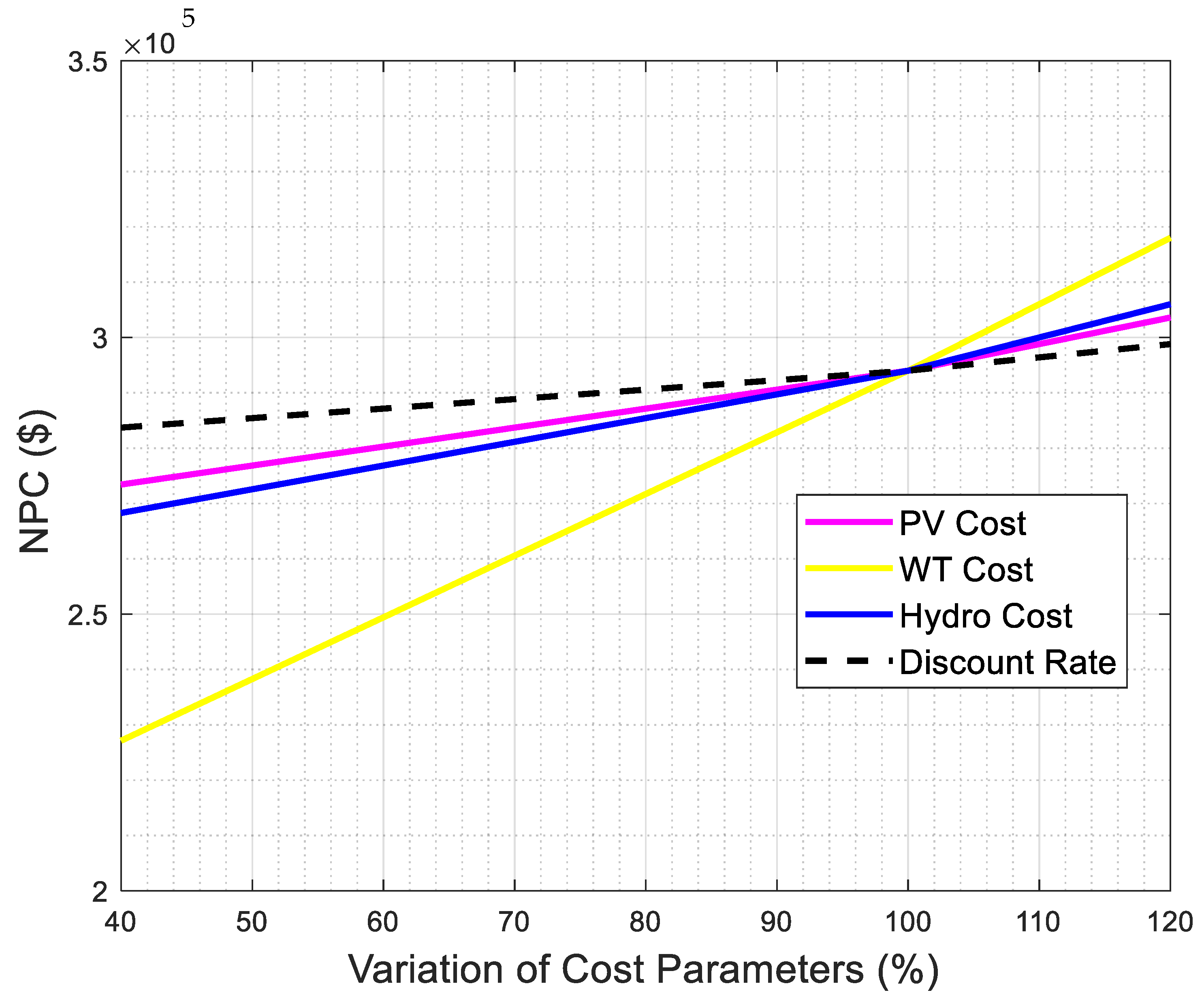
Figure 13 presents a sensitivity analysis of the Net Present Cost (NPC) against variations in the cost parameters of the main components of the hybrid energy generation system. The horizontal axis shows the percentage variation in costs, from 40% to 120% of the base value, while the vertical axis represents the NPC expressed in US dollars. It can be observed that all technologies show an upward trend, indicating that the increase in investment and operating costs directly impacts the total cost of the system. However, the magnitude of this influence varies depending on the technology considered, demonstrating different levels of economic sensitivity.
The curve corresponding to the wind system (WT Cost) shows the steepest slope, rising from approximately US$22,500 to over US$31,500 when costs increase from 40% to 120%. This behavior indicates that the NPC is highly sensitive to variations in the costs associated with wind turbines, making wind technology the component with the greatest economic impact within the hybrid system. Conversely, the costs of photovoltaic (PV Cost) and hydroelectric (Hydro Cost) systems show more moderate and virtually parallel increases, reflecting a lower sensitivity of the NPC to changes in investment costs. As costs rise, both technologies converge toward values close to USD 30,000, maintaining a relatively stable trend.
Furthermore, the dotted line corresponding to the Discount Rate shows a lesser influence on the NPC compared to generation technologies. Although the net present cost increases slightly with an increase in this financial parameter, the slope of the curve is less than that observed for the wind system. This suggests that, under the analyzed conditions, variations in equipment costs have a more significant impact on the project’s economic viability than changes in the discount rate. Consequently, managing and optimizing wind technology costs is fundamental to improving the profitability and financial sustainability of the hybrid energy system.
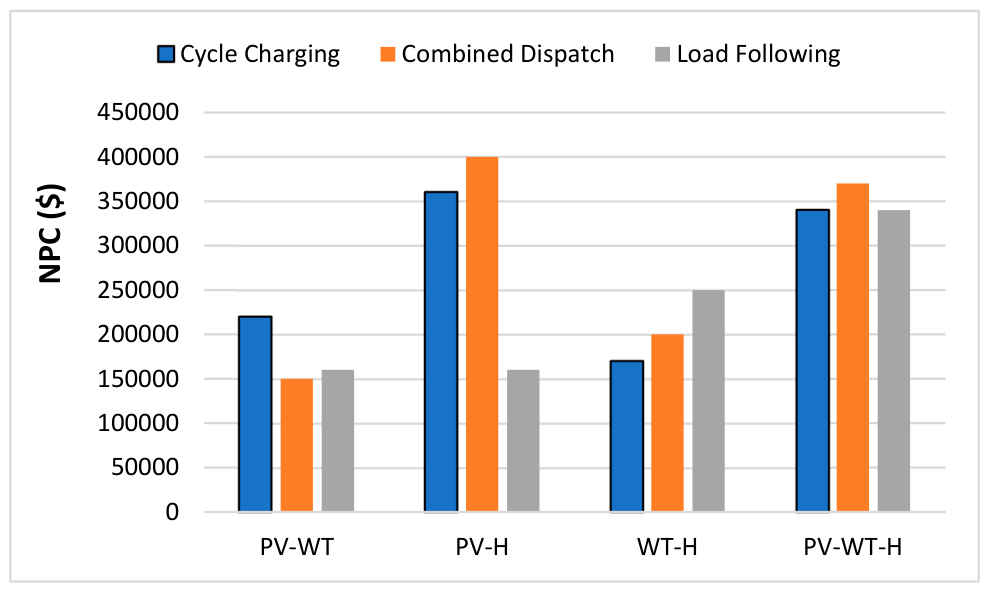
Figure 14 shows the NPC behavior for different technological configurations and dispatch strategies of the hybrid generation system. The PV-WT (solar photovoltaic-wind) configuration exhibits the lowest costs, especially under the Combined Dispatch strategy, with an NPC close to USD 150,000, making it the most economically attractive alternative. On the other hand, the PV-H (solar photovoltaic-hydroelectric) configuration registers the highest costs, reaching approximately USD 400,000 under Combined Dispatch, possibly due to the initial investment and costs associated with the hydroelectric infrastructure. The WT-H (wind-hydroelectric) combination presents intermediate costs, while the integrated PV-WT-H configuration shows the highest values after PV-H, reflecting that the simultaneous incorporation of multiple technologies increases the total system investment. In general, the results suggest that configurations with less technological complexity offer better economic profitability for the conditions in Morona Santiago.
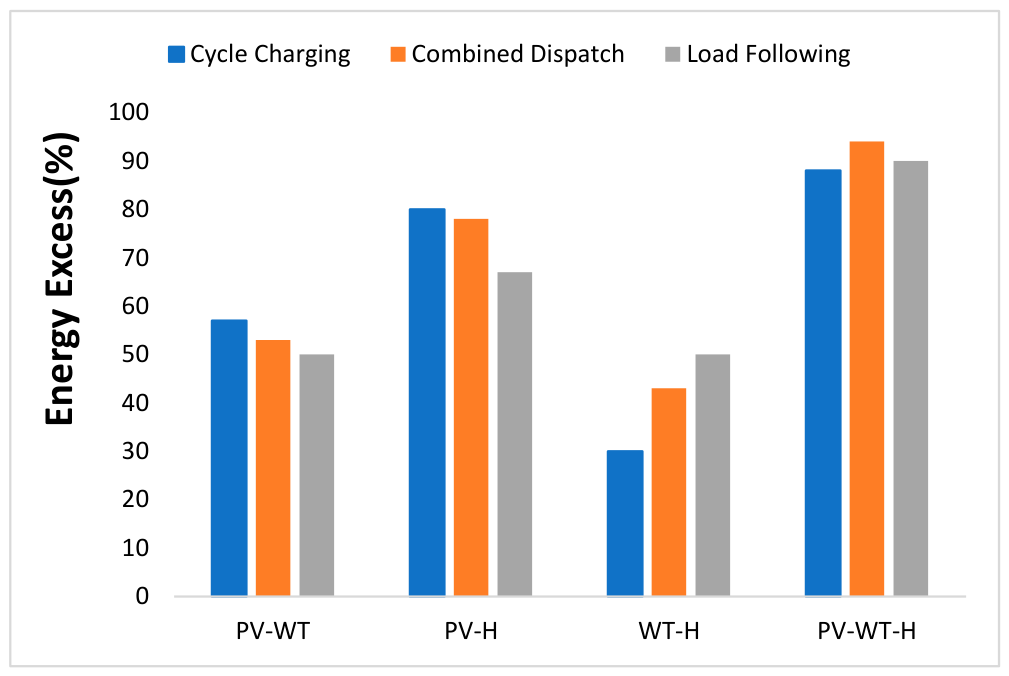
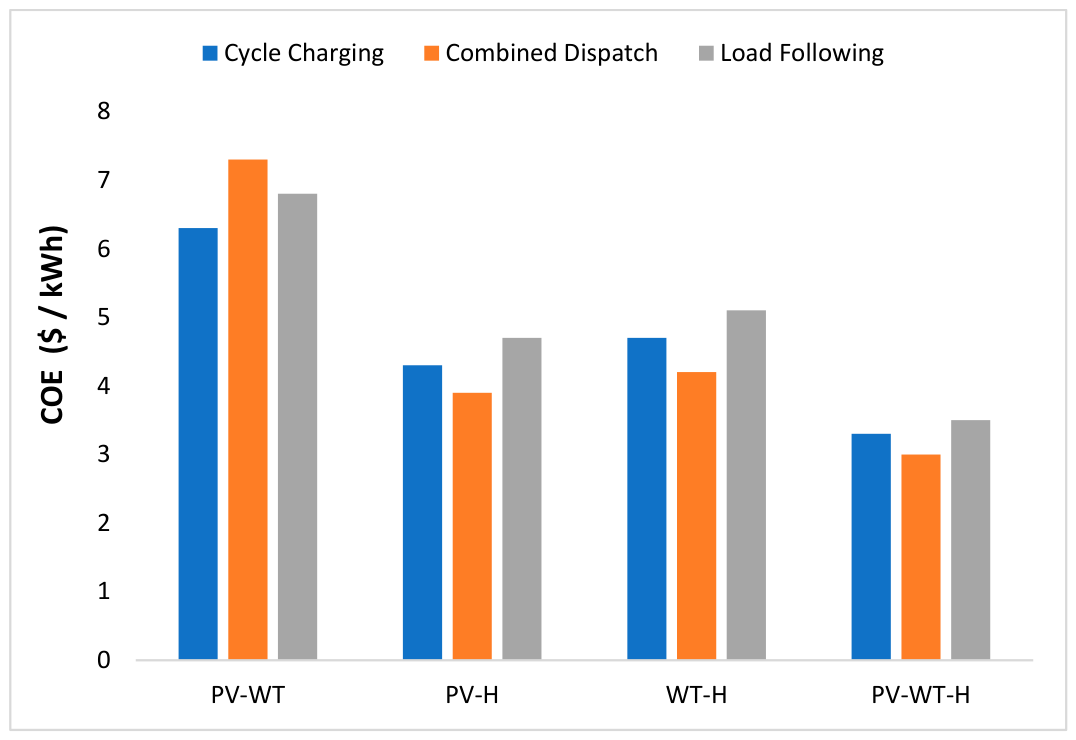
Figure 15 presents the percentage of surplus energy generated by each technological configuration and dispatch strategy. It shows that the PV-WT-H configuration produces the largest energy surpluses, with values close to 90%, indicating a high generation capacity relative to demand, although a significant portion of this energy is not utilized. Similarly, the PV-H configuration registers surpluses between 67% and 80%, while PV-WT presents moderate values between 50% and 57%. In contrast, the WT-H configuration generates the smallest surpluses, especially under the Cycle Charging strategy, where approximately 30% of energy is left over. These results indicate that, although configurations with a greater number of renewable sources increase energy reliability and availability, they can also cause greater losses due to overproduction if storage systems or demand management strategies are not incorporated, see Figure 16. For the conditions in Morona Santiago, the balance between cost and energy utilization seems to favor hybrid configurations with less excess generation and lower NPC (Net Present Value).

6.1. Financing Options

Financing options for renewable energy projects in the Ecuadorian Amazon, particularly in the province of Morona Santiago, are crucial to accelerating the energy transition and promoting effective decarbonization processes. Due to the region’s geographical characteristics, including dispersed communities and limitations on the expansion of conventional electrical grids, photovoltaic systems are the most suitable base technology for ensuring sustainable access to energy. However, integrating solar energy with wind and micro-hydroelectric systems improves supply reliability, reduces intermittency, and optimizes the use of available natural resources year-round.
From a financial perspective, one of the main alternatives is the public financing mechanisms promoted by the Ecuadorian government. Through rural electrification programs and funds earmarked for the sustainable development of the Amazon, resources can be channeled toward the implementation of hybrid renewable energy systems. This type of financing typically offers preferential interest rates and longer repayment periods, favoring projects that generate social, environmental, and economic benefits for Amazonian communities.
Furthermore, multilateral development organizations represent a significant source of funding for renewable energy projects. Institutions such as the Inter-American Development Bank, the World Bank, the Andean Development Corporation, and the Green Climate Fund have financed initiatives aimed at reducing emissions and strengthening climate resilience in Latin America. These organizations tend to prioritize projects with a high positive environmental impact, especially those that replace fossil-fuel-based generation with renewable technologies, as shown in Table 5.
The issuance of green bonds is another emerging alternative for financing sustainable energy projects. These instruments allow for raising capital from investors interested in projects with verifiable environmental benefits. In the case of photovoltaic systems integrated with wind and hydroelectric generation, green bonds can significantly contribute to covering initial investment costs, which often represent the main barrier to implementing this type of infrastructure in remote regions. Financing is recommended as presented in Table 6.

6.2. Discussion

The fight for decarbonization in the Ecuadorian Amazon represents one of the greatest challenges and, at the same time, one of the most important opportunities for building a sustainable and inclusive development model. For decades, oil exploitation has been one of the main economic activities in the Amazon region, generating significant income for the country, but also profound environmental and social impacts. Soil and water pollution, deforestation associated with the expansion of extractive infrastructure, and greenhouse gas emissions have severely affected the integrity of ecosystems considered among the most biodiverse on the planet. At the same time, many Amazonian communities continue to face limitations in access to basic services, economic opportunities, and modern energy systems, demonstrating that the wealth generated by fossil fuels has not always translated into proportional improvements for local populations. In this context, the transition to an energy matrix based on renewable sources is a fundamental strategy for reducing dependence on oil and promoting more equitable development. Technologies such as solar photovoltaic energy, complemented by small-scale wind and hydroelectric systems, offer viable alternatives for supplying clean energy to rural communities and dispersed population centers, taking advantage of the abundant natural resources available in the Amazon region.
The decarbonization of the Ecuadorian Amazon should not be understood solely as a process of technological substitution, but as a comprehensive transformation aimed at correcting historical inequalities and strengthening territorial sustainability. The expansion of renewable energy projects can generate local employment, boost technical capacities, improve the quality of life of communities, and foster greater energy autonomy, reducing dependence on fossil fuels transported from other regions of the country. Likewise, these projects can become instruments for strengthening community participation and respect for the rights of Indigenous peoples, key actors in the conservation of Amazonian ecosystems. The implementation of public policies that promote sustainable investments, climate finance mechanisms, and rural electrification programs will accelerate this just energy transition. Consequently, studies such as the one presented here, in which photovoltaic energy emerges as a strategic tool to lead decarbonization processes in provinces like Morona Santiago, are integrated with other technologies, simultaneously contributing to climate change mitigation, biodiversity protection, and the construction of a more inclusive, resilient, and socially equitable development model for future generations in the Ecuadorian Amazon.

7. Conclusions

This research evaluated the technical and economic feasibility of implementing photovoltaic systems for electricity generation in the southeastern region of the Ecuadorian Amazon, with a particular focus on the province of Morona Santiago. The results show that the available solar resources in the area present favorable conditions for the development of photovoltaic projects, with sufficient irradiance levels to guarantee stable energy production throughout the year, despite the climatic variations typical of the Amazonian environment. The analysis of different technological configurations demonstrated that photovoltaic solar energy is a competitive alternative for supplying energy to rural communities and isolated population centers, reducing dependence on fossil fuels and lowering the costs associated with transporting fuel to hard-to-reach areas. Furthermore, integrating photovoltaic systems with other renewable energy sources can increase the reliability and resilience of the electricity supply in territories with limited conventional energy infrastructure.
The economic sensitivity analysis results show that photovoltaic technology is less vulnerable to cost fluctuations compared to other renewable technologies analyzed, strengthening its position as one of the most attractive options for future energy investments in the region. Similarly, the economic indicators obtained confirm the feasibility of developing photovoltaic projects under different operating and demand growth scenarios. From an environmental perspective, solar photovoltaic energy is consolidating itself as a strategic tool to drive decarbonization processes in Morona Santiago and the Ecuadorian Amazon in general. Its implementation directly contributes to the reduction in greenhouse gas emissions, compliance with national and international commitments on climate change, and the strengthening of the sustainable energy transition objectives established for Ecuador. The planning and design of a photovoltaic system in the southeastern Amazon region of Ecuador proves to be a technically and environmentally viable solution, supported by average solar radiation ranging from 4.0 to 4.64 kWh/m2/day. This project not only allows for the capitalization of the area’s renewable energy potential but also constitutes a strategic measure to mitigate the environmental impact of fossil fuel use, which is often highly prevalent in isolated areas. The implementation of photovoltaic systems directly contributes to fulfilling the constitutional mandate of Article 414, promoting energy decentralization and the protection of Amazonian ecosystems.
Finally, it is concluded that proper planning and design of photovoltaic systems represents a significant opportunity to promote sustainable energy development of the Amazon region, improve the quality of life of local communities, and foster a growth model based on the efficient use of renewable resources. In this context, photovoltaic energy emerges as a fundamental technology to achieve a cleaner, more resilient energy mix aligned with the long-term goals of sustainable development and carbon neutrality.

Limitations of the Study and Future Work

While the results obtained demonstrate the technical, economic, and environmental viability of photovoltaic systems for promoting the energy transition in conjunction with other viable technologies in the province of Morona Santiago and the Ecuadorian Amazon, the study presents some limitations that must be considered when interpreting the results. First, the analysis was based on climate databases and hourly profiles, which were entered into Homer Pro, including solar irradiance, wind speed, and electricity demand. These allow for a reliable preliminary assessment but do not replace long-term, in situ measurement campaigns. Furthermore, the climatic variability inherent to the Amazon region, characterized by high levels of cloud cover, intense rainfall, and local microclimatic changes, could generate differences between simulated values and the actual behavior of energy resources. Similarly, the study focused primarily on technical-economic and energy indicators, without addressing aspects related to social acceptance, territorial governance, cultural impacts, or specific implementation mechanisms at the community level.
Another significant limitation is the uncertainty surrounding the future evolution of technological costs, discount rates, national energy policies, and available financing schemes for renewable energy projects in the Amazon region. Although sensitivity analyses were conducted to assess some of these factors, actual market conditions could alter the economic results obtained. Furthermore, the research considered hybrid configurations based primarily on solar photovoltaic, wind, and small-scale hydroelectric resources, without incorporating advanced energy storage systems, smart demand management, or emerging technologies that could significantly improve system performance in the future.
As future research directions, it is recommended to develop long-term meteorological and energy monitoring campaigns in different locations across the Ecuadorian Amazon to build high-resolution databases that will allow for the optimization of the design of hybrid renewable energy systems. Additionally, it is necessary to further evaluate storage technologies such as batteries and green hydrogen, as well as other alternatives that facilitate greater penetration of renewable energy in isolated areas. Future research should also incorporate more detailed socioeconomic analyses, including studies on energy poverty, community participation, impacts on Indigenous peoples, and governance mechanisms to ensure a just and inclusive energy transition. Finally, it is recommended that the scope of studies be broadened to include integrated regional decarbonization models that allow for quantifying the environmental, economic, and social benefits derived from the progressive replacement of fossil fuels with renewable energy systems throughout the Ecuadorian Amazon.
While the results obtained demonstrate the technical and economic feasibility of implementing a hybrid system with photovoltaic predominance in the southeastern region of the Ecuadorian Amazon, this study presents some limitations that should be considered in future research. These include uncertainties associated with long-term climate variability, the availability of high-resolution hydrometeorological data, and the constraints related to expanding energy infrastructure in hard-to-reach areas. Furthermore, the implementation of renewable energy generation systems must comply with the national regulatory framework and current environmental provisions, ensuring adherence to licensing and impact assessment processes. In the case of micro-hydropower projects, it is essential to consider the potential effects on aquatic ecosystems, the connectivity of waterways, and the conservation of the biodiversity characteristic of the Ecuadorian Amazon. Likewise, the acceptance and participation of Indigenous and rural communities are crucial to ensuring the social sustainability of these projects; therefore, it is recommended to strengthen mechanisms for consultation, participation, and shared benefit. Future work should include incorporating multi-criteria analyses that integrate technical, economic, environmental, and social variables, as well as evaluating climate change scenarios and energy demand growth. Finally, it is recommended to promote public policies that incentivize distributed generation through preferential financing mechanisms, tax incentives, green loans, and public–private partnership programs, facilitating the adoption of renewable technologies and strengthening the sustainable energy transition in the Ecuadorian Amazon.

Author Contributions

Conceptualization, D.I.-A.; methodology, C.B.-B. and L.C.-C.; data curation, D.I.-A., C.B.-B. and L.C.-C.; validation, D.I.-A.; writing—original draft, D.I.-A., C.B.-B. and L.C.-C.; writing—review and editing, D.I.-A., C.B.-B. and L.C.-C. All authors have read and agreed to the published version of the manuscript.

Funding

This research received no external funding.

Data Availability Statement

The original contributions presented in the study are included in the article, further inquiries can be directed to the corresponding author.

Acknowledgments

The authors of this manuscript, who are students at UPS, thank all the teachers who shared their knowledge, in particular the Thesis Director and the Director of the Master’s Program in Electricity, whose guidance and support were instrumental in bringing their studies to completion.

Conflicts of Interest

The authors declare no conflicts of interest.

References

  1. Islam, S.; Alvi, S.; Niblock, S.J.; Sulimany, H.G.H.; Roshid, M.M.; Mirindi, F. The Role of Energy Transition, Digitalization, and Green Goods in Material Footprints and Sustainability. Sustain. Dev. 2026, 1–21. [Google Scholar] [CrossRef] [Scilit]
  2. Ipkovich, Á.; Héberger, K.; Sebestyén, V.; Abonyi, J. Utility Function-Based Generalization of Sum of Ranking Differences–Country-Wise Analysis of Greenhouse Gas Emissions. Ecol. Indic. 2024, 160, 111734. [Google Scholar] [CrossRef] [Scilit]
  3. Nations, U. Causes and Effects of Climate Change. Available online: https://www.un.org/en/climatechange/science/causes-effects-climate-change (accessed on 11 May 2026).
  4. Sidibe, G.; Sumana, S.L.; Shuaibu, A.; Xu, L. Assessing Synergistic Impacts of Climate Change and Anthropogenic Stressors on Freshwater Ecosystems. Biodivers. Conserv. 2026, 35, 65. [Google Scholar] [CrossRef] [Scilit]
  5. Algarni, S.M. The Impact of Climate Change on Economic Losses and the Performance of Global Dairy Production for Food Supply. Res. World Agric. Econ. 2026, 7, 759–779. [Google Scholar] [CrossRef] [Scilit]
  6. Icaza, D.; Borge-Diez, D.; Galindo, S.P.; Flores-Vázquez, C. Analysis of Smart Energy Systems and High Participation of V2G Impact for the Ecuadorian 100% Renewable Energy System by 2050. Energies 2023, 16, 4045. [Google Scholar] [CrossRef] [Scilit]
  7. Montecristi, A.C. De Constitución de la República del Ecuador. 2008. Available online: https://media.unesco.org/sites/default/files/webform/mhm001/ecuador_constitucionpo_08_spaorof.pdf (accessed on 9 July 2026).
  8. Arévalo, P.; Benavides, D.; Ochoa-Correa, D. Renewables for Isolated and Rural Areas, the Case of Ecuador. In Towards Future Smart Power Systems with High Penetration of Renewables; Academic Press: Cambridge, MA, USA, 2025; pp. 213–237. [Google Scholar]
  9. Chen, J.; Lu, L. Renewable Energy Integration and Application in Buildings for Carbon Neutrality. Sustainability 2026, 18, 4310. [Google Scholar] [CrossRef] [Scilit]
  10. Terneus-Páez, C.F.; Viteri-Salazar, O. Energy Security in Ecuador: An Analysis Considering the Interrelationships of the WEF Nexus. Energies 2023, 16, 7166. [Google Scholar] [CrossRef] [Scilit]
  11. Alves, D.B.; Pérez-Cabello, F. Multiple Remote Sensing Data Sources to Assess Spatio-Temporal Patterns of Fire Incidence over Campos Amazônicos Savanna Vegetation Enclave (Brazilian Amazon). Sci. Total Environ. 2017, 601–602, 142–158. [Google Scholar] [CrossRef] [Scilit] [PubMed]
  12. Clairand, J.-M.; Serrano-Guerrero, X.; González-Zumba, A.; Escrivá-Escrivá, G. Techno-Economic Assessment of Renewable Energy-based Microgrids in the Amazon Remote Communities in Ecuador. Energy Technol. 2022, 10, 2100746. [Google Scholar] [CrossRef] [Scilit]
  13. Awad, H.; Bayoumi, E.H.E. Resilient Grid Architectures for High Renewable Penetration: Electrical Engineering Strategies for 2030 and Beyond. Technologies 2026, 14, 112. [Google Scholar] [CrossRef] [Scilit]
  14. Spiru, P. Assessment of Renewable Energy Generated by a Hybrid System Based on Wind, Hydro, Solar, and Biomass Sources for Decarbonizing the Energy Sector and Achieving a Sustainable Energy Transition. Energy Rep. 2023, 9, 167–174. [Google Scholar] [CrossRef] [Scilit]
  15. Gomez-Exposito, A.; Conejo, A.J.; Canizares, C. Electric Energy Systems: Analysis and Operation; CRC Press: Boca Raton, FL, USA, 2018; ISBN 978-1-351-75450-7. [Google Scholar]
  16. United Nations. Renewable Energy—Powering a Safer Future. Available online: https://www.un.org/en/climatechange/raising-ambition/renewable-energy (accessed on 11 May 2026).
  17. Bošnjaković, M. Analysis of Concentrated Solar Power Potential in the Photovoltaic Competitive Landscape. Technologies 2025, 13, 554. [Google Scholar] [CrossRef] [Scilit]
  18. Bucur, I.-O.; Crunțeanu, D.-E.; Dombrovschi, M.-C. Numerical and Experimental Assessment of a Passive Flow-Control Strategy for Vertical-Axis Wind Turbine Blades. Technologies 2026, 14, 400. [Google Scholar] [CrossRef] [Scilit]
  19. Castillo Alvarez, Y.; Jiménez Borges, R.; Alfonso-Francia, G.; Rodríguez Pérez, B.; Patiño Vidal, C.D.; Iturralde Carrera, L.A.; Rodríguez-Reséndiz, J. Transition to a Circular Bioeconomy in the Sugar Agro-Industry: Predictive Modeling to Estimate the Energy Potential of By-Products. Technologies 2025, 13, 238. [Google Scholar] [CrossRef] [Scilit]
  20. Quiroz-Vazquez, F.; Cardenas, V.; Gonzalez-Garcia, M.; Espinosa-Pérez, G.; Barrios, M.A. Experimental Validation and Gain Selection of Classical Controllers for Current Regulation in IPT-Based BESS Chargers. Technologies 2026, 14, 317. [Google Scholar] [CrossRef] [Scilit]
  21. Miravet-Sánchez, B.L.; García-Rivero, A.E.; Yuli-Posadas, R.A.; Inostroza-Ruiz, L.A.; Fernández-Guzmán, V.; Chávez-Juanito, Y.A.; Rutti-Marin, J.M.; Apesteguia-Infantes, J.A. Solar Photovoltaic Technology in Isolated Rural Communities in Latin America and the Caribbean. Energy Rep. 2022, 8, 1238–1248. [Google Scholar] [CrossRef] [Scilit]
  22. Global Solar Atlas. Available online: https://globalsolaratlas.info/map (accessed on 17 October 2020).
  23. Álvarez-Játiva, L.H.; Imbaquingo-Chasiguano, N.R.; Romero-Astudillo, J.P.; Guamán-Tabango, J.; García-Montoya, J. Evaluation of the Performance of a Building-Attached Photovoltaic Panel on Different Orientations in Ibarra—Ecuador. Energies 2026, 19, 1666. [Google Scholar] [CrossRef] [Scilit]
  24. Zalamea-León, E.; Jaramillo-Arevalo, S.; Vera-Tandazo, R.; Chica-Guayacundo, Á.; Tapia-Sacasari, J.; Barragán-Escandón, A.; Ordóñez-Castro, A. Methodology for the Integration of Photovoltaics in Buildings for Inclusion in Territorial and Urban Planning with Low-Technology, Affordable Instruments. Urban Sci. 2026, 10, 154. [Google Scholar] [CrossRef] [Scilit]
  25. Alcívar-Reyna, T.F.; Gutiérrez-Martín, F.; Dos Santos-García, A.J.; Caravaca, Á. Renewable Energy for Healthcare: Modeling Medical Oxygen Production through PV-Powered PEM Electrolysis. A Case Study in Guayaquil, Ecuador. J. Power Sources 2026, 663, 238861. [Google Scholar] [CrossRef] [Scilit]
  26. Operador Nacional de Electricidad CENACE—Organizaciones—Datos Abiertos Ecuador. Available online: https://www.datosabiertos.gob.ec/organization/cenace?tags=generaci%C3%B3n&tags=energ%C3%ADa&tags=producci%C3%B3n&organization=cenace (accessed on 1 July 2026).
  27. Icaza, D.; Borge-Diez, D.; Galindo, S.P. Analysis and Proposal of Energy Planning and Renewable Energy Plans in South America: Case Study of Ecuador. Renew. Energy 2022, 182, 314–342. [Google Scholar] [CrossRef] [Scilit]
  28. Apolo, C.A.A.; Minchala-Avila, L.I.; Marques, P.J.F. Techno-Economic Design of a Stand-Alone Photovoltaic System for a Rural Community in the Ecuadorian Amazon. Int. J. Res. Stud. Electr. Electron. Eng. 2015, 3, 32–41. [Google Scholar] [CrossRef] [Scilit]
  29. Alkadri, M.F.; De Luca, F.; Turrin, M.; Sariyildiz, S. Understanding Computational Methods for Solar Envelopes Based on Design Parameters, Tools, and Case Studies: A Review. Energies 2020, 13, 3302. [Google Scholar] [CrossRef] [Scilit]
  30. Cuenca, A.; Oña, C.; Suquillo, I.; Miniguano, H. Design Methodology of Off-Grid PV Solar Powered Systems for Rural Areas in Ecuador. Rev. Téc. Energ. 2023, 20, 43–51. [Google Scholar] [CrossRef] [Scilit]
  31. Andrade, C.S.; Rosa, L.P.; da Silva, N.F. Generation of Electric Energy in Isolated Rural Communities in the Amazon Region a Proposal for the Autonomy and Sustainability of the Local Populations. Renew. Sustain. Energy Rev. 2011, 15, 493–503. [Google Scholar] [CrossRef] [Scilit]
  32. Bradley, A.V.; Gerard, F.F.; Barbier, N.; Weedon, G.P.; Anderson, L.O.; Huntingford, C.; Aragão, L.E.O.C.; Zelazowski, P.; Arai, E. Relationships between Phenology, Radiation and Precipitation in the Amazon Region: Phenology drivers in the Amazon. Glob. Change Biol. 2011, 17, 2245–2260. [Google Scholar] [CrossRef] [Scilit]
  33. Sánchez, A. Generación Solar Fotovoltaica, en la Provincia de Morona Santiago, como un Mecanismo de Desarrollo Limpio. Rev. Téc. Energ. 2011, 7, 87–90. [Google Scholar] [CrossRef] [Scilit]
  34. Martinez-Bolaños, J.; Silva, V.; Zucchi, M.; Heideier, R.; Relva, S.; Saidel, M.; Fadigas, E. Performance Analysis of Topologies for Autonomous Hybrid Microgrids in Remote Non-Interconnected Communities in the Amazon Region. Sustainability 2021, 13, 44. [Google Scholar] [CrossRef] [Scilit]
  35. Alvear, J.; Estuardo, J. GIS-Based Sustainability Assessment of Decentralized Rural Electrification in the Amazon Region. Bachelor’s Thesis, Universitäts- und Landesbibliothek Bonn, Bonn, Germany, 2017. [Google Scholar]
  36. Ferrer Martí, L.; Hidalgo, G.; Domenech Léga, B.; Pastor Moreno, R. Design of Electrification Projects for Communities in the Amazon Region of Ecuador; Universitat Politècnica de Catalunya: Barcelona, Spain, 2018; pp. 1–6. [Google Scholar]
  37. Pastaza, Provincia Pionera en Implementar Políticas de Conservación Natural Sostenible—Viceministerio del Ambiente. Available online: https://www.ambienteyenergia.gob.ec/ambiente/pastaza-provincia-pionera-en-implementar-politicas-de-conservacion-natural-sostenible/ (accessed on 1 July 2026).
  38. Icaza-Alvarez, D.; Arias Reyes, P.; Jurado, F.; Tostado-Véliz, M. Smart Strategies for the Penetration of 100% Renewable Energy for the Ecuadorian Amazon Region by 2050. J. Clean. Prod. 2023, 382, 135298. [Google Scholar] [CrossRef] [Scilit]
  39. Barragán-Escandón, A.; Jara-Nieves, D.; Romero-Fajardo, I.; Zalamea-Leon, E.F.; Serrano-Guerrero, X. Barriers to Renewable Energy Expansion: Ecuador as a Case Study. Energy Strategy Rev. 2022, 43, 100903. [Google Scholar] [CrossRef] [Scilit]
  40. Blaabjerg, F.; Chen, Z.; Kjaer, S.B. Power Electronics as Efficient Interface in Dispersed Power Generation Systems. IEEE Trans. Power Electron. 2004, 19, 1184–1194. [Google Scholar] [CrossRef] [Scilit]
  41. Feron, S.; Heinrichs, H.; Cordero, R.R. Are the Rural Electrification Efforts in the Ecuadorian Amazon Sustainable? Sustainability 2016, 8, 443. [Google Scholar] [CrossRef] [Scilit]
  42. Torres, N.N.S.; Ledesma, J.J.G.; Cavallari, M.R.; Ando Junior, O.H. Amazon Kit: Proposal for an Innovative Energy Generation and Storage Solution for Sustainable Development of Isolated Communities. Sustainability 2024, 16, 6280. [Google Scholar] [CrossRef] [Scilit]
  43. Rodriguez, M.; Arcos-Aviles, D.; Guinjoan, F. Simple Fuzzy Logic-Based Energy Management for Power Exchange in Isolated Multi-Microgrid Systems: A Case Study in a Remote Community in the Amazon Region of Ecuador. Appl. Energy 2024, 357, 122522. [Google Scholar] [CrossRef] [Scilit]
  44. Herington, M.J.; van de Fliert, E.; Smart, S.; Greig, C.; Lant, P.A. Rural Energy Planning Remains Out-of-Step with Contemporary Paradigms of Energy Access and Development. Renew. Sustain. Energy Rev. 2017, 67, 1412–1419. [Google Scholar] [CrossRef] [Scilit]
  45. Naranjo-Silva, S. A Hydropower Development Perspective in Ecuador: Past, Present, and Future. La Granja 2024, 39, 63–77. [Google Scholar] [CrossRef] [Scilit]
  46. Godoy, J.C.; Cajo, R.; Mesa Estrada, L.; Hamacher, T. Multi-Criteria Analysis for Energy Planning in Ecuador: Enhancing Decision-Making through Comprehensive Evaluation. Renew. Energy 2025, 241, 122278. [Google Scholar] [CrossRef] [Scilit]
  47. Jokar, H.; Niknam, T.; Dehghani, M.; Siano, P.; Ouahada, K.; Aly, M. Integrated Energy Management in Small-Scale Smart Grids Considering the Emergency Load Conditions: A Combined Battery Energy Storage, Solar PV, and Power-to-Hydrogen System. Smart Cities 2024, 7, 3764–3797. [Google Scholar] [CrossRef] [Scilit]
  48. Mearns, E.; Sornette, D. Are 2050 Energy Transition Plans Viable? A Detailed Analysis of Projected Swiss Electricity Supply and Demand in 2050. Energy Policy 2023, 175, 113347. [Google Scholar] [CrossRef] [Scilit]
  49. Loloum, T.; Ortar, N.; Abram, S. Ethnographies of Power: A Political Anthropology of Energy; Berghahn Books: Brooklyn, NY, USA, 2021; pp. 1–212. [Google Scholar]
  50. Informe Mundial Sobre Energía 2026—Análisis—IEA. Available online: https://www.iea.org/reports/global-energy-review-2026 (accessed on 4 June 2026).
  51. Lyall, A.; Valdivia, G. The Entanglements of Oil Extraction and Sustainability in the Ecuadorian Amazon. In Environment and Sustainability in a Globalizing World; Routledge: Oxfordshire, UK, 2019. [Google Scholar]
  52. Ahmad, T.; Madonski, R.; Zhang, D.; Huang, C.; Mujeeb, A. Data-Driven Probabilistic Machine Learning in Sustainable Smart Energy/Smart Energy Systems: Key Developments, Challenges, and Future Research Opportunities in the Context of Smart Grid Paradigm. Renew. Sustain. Energy Rev. 2022, 160, 112128. [Google Scholar] [CrossRef] [Scilit]
  53. Adinkrah, J.; Kemausuor, F.; Tutu Tchao, E.; Nunoo-Mensah, H.; Agbemenu, A.S.; Adu-Poku, A.; Kponyo, J.J. Artificial Intelligence-Based Strategies for Sustainable Energy Planning and Electricity Demand Estimation: A Systematic Review. Renew. Sustain. Energy Rev. 2025, 210, 115161. [Google Scholar] [CrossRef] [Scilit]
  54. Bocco, G.; Mendoza, M.; Velázquez, A. Remote Sensing and GIS-Based Regional Geomorphological Mapping—A Tool for Land Use Planning in Developing Countries. Geomorphology 2001, 39, 211–219. [Google Scholar] [CrossRef] [Scilit]
  55. Martínez, A.P.; Jara-Alvear, J.; Andrade, R.J.; Icaza, D. Sustainable Development Indicators for Electric Power Generation Companies in Ecuador: A Case Study. Util. Policy 2023, 81, 101493. [Google Scholar] [CrossRef] [Scilit]
  56. Kilinc-Ata, N.; Proskuryakova, L.N. Modeling Hybrid Renewable Microgrids in Remote Northern Regions: A Comparative Simulation Study. Energies 2025, 18, 5827. [Google Scholar] [CrossRef] [Scilit]
  57. Rodriguez-Aburto, C.; Montaño-Pisfil, J.; Santos-Mejía, C.; Morcillo-Valdivia, P.; Solís-Farfán, R.; Curay-Tribeño, J.; Morales-Vargas, A.; Vara-Sanchez, J.; Gutierrez-Tirado, R.; Vigo-Roldán, A.; et al. Machine Learning for Photovoltaic Power Forecasting Integrated with Energy Storage Systems: A Scientometric Analysis, Systematic Review, and Meta-Analysis. Energies 2025, 18, 6291. [Google Scholar] [CrossRef] [Scilit]
  58. Jiang, L.; Cui, S.; Sun, P.; Wang, Y.; Yang, C. Comparison of Monocrystalline and Polycrystalline Solar Modules. In Proceedings of the 2020 IEEE 5th Information Technology and Mechatronics Engineering Conference (ITOEC); IEEE: New York, NY, USA, 2020; pp. 341–344. [Google Scholar]
  59. Ourahou, M.; Ayrir, W.; EL Hassouni, B.; Haddi, A. Review on Smart Grid Control and Reliability in Presence of Renewable Energies: Challenges and Prospects. Math. Comput. Simul. 2020, 167, 19–31. [Google Scholar] [CrossRef] [Scilit]
  60. Blanco Charro, C.; Reigosa, D.D.; Briz, F.; Guerrero, J.M. Strategies for the Connection of Distributed Power Generation Units to Distorted Networks. IEEE Trans. Ind. Appl. 2015, 51, 4111–4120. [Google Scholar] [CrossRef] [Scilit]
  61. Mestanza-Ramón, C.; Cuenca-Cumbicus, J.; D’Orio, G.; Flores-Toala, J.; Segovia-Cáceres, S.; Bonilla-Bonilla, A.; Straface, S. Gold Mining in the Amazon Region of Ecuador: History and a Review of Its Socio-Environmental Impacts. Land 2022, 11, 221. [Google Scholar] [CrossRef] [Scilit]
  62. Morona Santiago, Ecuador—Genealogía. Available online: https://www.familysearch.org/es/wiki/Morona_Santiago,_Ecuador_-_Genealog%C3%ADa (accessed on 2 July 2026).
  63. Gobierno Autónomo Descentralizado Municipal Del Cantón Tiwintza|Ecuador—Guía Oficial de Trámites y Servicios. Available online: https://www.gob.ec/gadmc-tiwintza (accessed on 2 July 2026).
Figure 1. Distribution of electricity generation by primary source.
Technologies 14 00428 g001
Figure 2. Methodology applied to the present case study in Morona Santiago of the Ecuadorian Amazon.
Technologies 14 00428 g002
Figure 3. Schematic designed in Homer Pro version 3.16.2.
Technologies 14 00428 g003
Figure 4. Power demand for a residential system in Morona Santiago, Ecuador.
Technologies 14 00428 g004
Figure 5. Load profile. (a) Spectrogram of annual power demand. (b) Electricity demand using box plots for each month of the year.
Technologies 14 00428 g005
Figure 6. Hybrid system flowchart with Homer Pro support.
Technologies 14 00428 g006
Figure 7. Study site in Morona Santiago in the Ecuadorian Amazon.
Technologies 14 00428 g007
Figure 8. Speed of the Santiago River in the Ecuadorian Amazon.
Technologies 14 00428 g008
Figure 9. Wind speed profile in Morona Santiago.
Technologies 14 00428 g009
Figure 10. Annual solar irradiation in Morona Santiago.
Technologies 14 00428 g010
Figure 11. Multi-source power generation for Morona Santiago. (a) Power profile generated in the first days of January. (b) Power profile generated in the first days of July. (c) Evaluation of contributions by the generation source.
Technologies 14 00428 g011
Figure 12. Economic evaluation of the present study.
Technologies 14 00428 g012
Figure 13. NPC of the hybrid system.
Technologies 14 00428 g013
Figure 14. NPC according to the different technological combinations and types of dispatch obtained through Homer Pro.
Technologies 14 00428 g014
Figure 15. Surplus energy produced in different technological combinations.
Technologies 14 00428 g015
Figure 16. COE according to different technological combinations.
Technologies 14 00428 g016
Table 1. Comparative matrix of recent energy studies in Ecuador vs. present research.
Author/Study ReferenceMain Technology and ScopeLocation/RegionSizing and Optimization Tools UsedKey Results and ContributionComparison/Contrast with Your Article
Álvarez-Játiva et al. [23]Vertical PV panels on building facades (Experimental performance)Ibarra, Imbabura (Andean Region)Arduino-based logger, MATLAB (Sum-of-sine functions).NW orientation achieved 440 kWh/kWp. Developed forecasting models with R2 up to 0.98.Focuses on urban building-integrated PV (BIPV) and experimental tracking, whereas your article shifts focus to regional planning and horizontal/ground-mounted grid-connected or off-grid systems.
Zalamea-León et al. [24]Parish-level microgeneration potential on rooftops.Andean Equatorial Parishes (Andean Region)Drones, CAD software 1.0, Agisoft Metashape.Estimated an annual PV potential of 28,101 MWh vs. a basic demand of 1827 MWh.Uses low-labor geospatial/photogrammetric methods for urban/semi-urban rooftops, while your study addresses a large-scale regional planning framework for isolated territories.
Alcívar-Reyna et al. [25]PV-powered PEM electrolysis for medical oxygen production.Guayaquil, Guayas (Coastal Region)PV-electrolysis modeling tools.Sized 4778 PV modules to produce 438.5 tons/year of medical oxygen for a hospital.Applies solar PV to a highly specialized, grid-connected industrial/medical end-use, whereas your project targets broad electrical electrification and energy matrix diversification.
Apolo et al. [28]/Amazonian Context [12,33]Techno-economic analysis of standalone PV and centralized microgrids.Yuwints community, Morona Santiago (Amazon Region)Energy optimization and local distribution networks.Confirmed centralized microgrids with battery storage guarantee full demand coverage and reduce diesel dependence.Highly focused on isolated community electrification (micro-scale case studies), serving as a foundation for your wider regional assessment.
Cuenca et al. [30]Electrical optimization of rural PV generation systems.Rural Ecuador/Amazon BasinMATLAB/Simulink and Maximum Power Point Tracking (MPPT) algorithms.Reduced investment costs and increased supply reliability via power electronics and electrical design.Focuses on the low-level micro-controller/MPPT control algorithms, whereas your work focuses on high-level regional energy planning and resource characterization.
Pastaza Case Studies [37,38]Grid-connected PV performance and environmental assessment under tropical climates.Pastaza Province (Amazon Region)Grid-connected operational data monitoring.Proved that PV installations maintain adequate efficiency under high humidity/rain and lower CO2 emissions.Validates technical feasibility under tropical constraints, but lacks the comprehensive socioeconomic planning framework that your study offers.
Present ResearchComprehensive Regional PV Planning and Sizing FrameworkSoutheastern Amazon Region of Ecuador (Morona Santiago/Zamora Chinchipe)PVsyst, HOMER, MATLAB/Simulink, GIS platforms, and PVGIS databases.Bridges research gaps by providing a holistic regional resource characterization, detailed demand profiling, and social-environmental integration to tackle national grid vulnerabilities (droughts) and energy marginalization.Overcomes the limitation of “isolated community case studies” by offering a scalable, regional energy transition blueprint designed specifically for the socioeconomic reality and tropical climate of the southeastern Amazon.

Table 2. Technical and economic parameters of the photovoltaic module considered in the study.
ParameterValue
PV Module ModelRS10-450M
ManufacturerRESUN SOLAR
Rated Power450 Wp
Technology TypeMonocrystalline
Number of Cells144 Half-Cells
Module Efficiency20.70%
Open Circuit Voltage (Voc)49.5 V
Short Circuit Current (Isc)11.52 A
Voltage at Maximum Power (Vmp)41.5 V
Current at Maximum Power (Imp)10.85 A
Junction Box ProtectionIP68
Dimensions2094 × 1038 × 35 mm
Weight23.5 kg
Capital Cost250 USD/kW
Replacement Cost250 USD/kW
Operation and Maintenance Cost0 USD/year
Derating Factor0.8
Tilt Angle15°
Lifetime25 years
Power Temperature Coefficient−0.35%/°C
Table 3. Technical and economic parameters of the hydraulic turbine considered in the study.
ParameterValue
Turbine TypeRun-of-River Micro-Hydropower
Rated Power75 kW
Turbine TechnologyCrossflow/Kaplan (depending on site conditions)
Rated Head15 m
Design Flow Rate0.70 m3/s
Maximum Flow Rate0.85 m3/s
Minimum Flow Rate0.25 m3/s
Water Density (ρw)1000 kg/m3
Turbine Efficiency85%
Generator Efficiency95%
Overall System Efficiency80.75%
Nominal Frequency60 Hz
Nominal Voltage400 VAC
Power Factor0.9
Capital Cost2500 USD/kW
Replacement Cost2000 USD/kW
Operation and Maintenance Cost50 USD/year
Civil Works CostIncluded in capital cost
Lifetime30 years
Availability Factor95%
Capacity Factor60–80%
Table 4. Technical and economic parameters of the wind turbine considered in the study.
ParameterValue
Wind Turbine ModelGeneric Small Wind Turbine
Rated Power5 kW
Turbine TypeHorizontal Axis Wind Turbine (HAWT)
Rotor Diameter5.5 m
Swept Area23.76 m2
Number of Blades3
Cut-in Wind Speed3 m/s
Rated Wind Speed11 m/s
Cut-out Wind Speed25 m/s
Survival Wind Speed50 m/s
Hub Height18 m
Generator TypePermanent Magnet Synchronous Generator (PMSG)
Generator Efficiency92%
Power Coefficient (Cp)0.4
Nominal Voltage240 VAC
Nominal Frequency60 Hz
Capital Cost2000 USD/kW
Replacement Cost1800 USD/kW
Operation and Maintenance Cost100 USD/year
Lifetime20 years
Availability Factor95%
Capacity Factor15–30%
Derating Factor0.9
Table 5. Main financing mechanisms for renewable energy systems proposed for the Ecuadorian Amazon.
MechanismFunding SourceAdvantagesApplicability
Public FinancingNational government and local governmentsPreferential interest rates and institutional supportHigh
Multilateral Development BanksIDB, CAF, World BankLarge funding amounts and long repayment periodsVery High
International Climate FundsGreen Climate Fund, GEFResources focused on decarbonization and climate actionVery High
Public–Private Partnerships (PPPs)Public and private sectorsRisk-sharing and enhanced project viabilityHigh
International CooperationEuropean cooperation agencies and UN programsFinancial support and technical assistanceHigh
Green BondsSustainable financial marketsAccess to climate-focused investorsMedium–High
Table 6. Recommended financing structure for hybrid projects.
ComponentSuggested Share
International Climate Funds40%
Multilateral Development Loans30%
Government Contribution20%
Private or Community Investment10%
Disclaimer/Publisher’s Note: The statements, opinions and data contained in all publications are solely those of the individual author(s) and contributor(s) and not of MDPI and/or the editor(s). MDPI and/or the editor(s) disclaim responsibility for any injury to people or property resulting from any ideas, methods, instructions or products referred to in the content.